



Abstract
An increasing number of children fail to meet the recommended levels of physical activity. The purpose of this study was to examine the effects of peer presence on variables that have been shown to evoke moderate-to-vigorous physical activity (MVPA) in children. We recorded the levels of MVPA in three preschool children across no adult, attention, and interactive play conditions, with a peer present and absent. All conditions were compared with a naturalistic baseline and presented in a multielement design with a brief reversal to baseline and reintroduction of the most effective condition. All three participants displayed most MVPA during the interactive play condition with a peer present. This study furthers research on the identification of variables that evoke MVPA in young children and emphasizes the interaction of peer presence and contingent social positive reinforcement as relevant variables.
The Centers for Disease Control and Prevention (CDC), World Health Organization (WHO), and the U.S. Department of Health and Human Services (HHS) all recommend that children engage in a minimum of 60 min of physical activity per day. This should include aerobic activities of moderate-to-vigorous intensity and strengthening activities to improve cardiorespiratory and muscular fitness, as well as bone health, and cardiovascular and metabolic health. Meeting these minimum recommendations has been shown to aide in maintaining a healthy body weight, to mitigate many of the health issues associated with obesity, to help to prevent heart disease, to lower the risks of certain cancers, and even to reduce stress and anxiety (CDC, 2015; U.S. HHS, 2008; WHO, 2017).
Despite the obvious benefits of physical activity, a number of authors have noted that an alarming percentage of children do not meet the recommended levels. For example, Troiano et al. (2008) reported that only 42% of children aged 6 to 11 years regularly meet the recommended 60 min of activity per day. This appears to worsen in adolescence, with reports suggesting that only 16.3% of adolescents aged 12 to 17 years regularly meet the CDC guidelines (Song, Carrol, & Fulton, 2013). Furthermore, Thompson, Humbert, and Mirwald (2003) suggest that it may be more effective to focus on positive ways to increase physical activity in young children, as negative experiences of physical activity in childhood often result in low levels of physical activity in adulthood.
A number of previous studies have focused on the moderate-to-vigorous physical activity (MVPA) of preschool children and have also shown levels to be very low (Brown, Googe, McIver, & Rathel, 2009; Brown, Pfeiffer, et al., 2009; Hustyi, Normand, Larson, & Morley, 2012; T. A. Larson, Normand, Morley, & Miller, 2013, 2014; Oliver, Schofield, & Kolt, 2007; Pate, Long, & Health, 1994; Sallis, Patterson, McKenzie, & Nader, 1988).
A number of recent studies have taken a behavioral approach to this issue and have utilized a direct observation approach to minimize the issues and inaccuracies associated with self-report and devices such as heart rate monitors and pedometers (Hustyi, Normand, & Larson, 2011; T. M. Larson, Normand, & Hustyi, 2011; McIver, Brown, Pfeiffer, Dowda, & Pate, 2009). For example, T. M. Larson et al. (2011) and Hustyi et al. (2011) evaluated the Observational System for Recording Activity in Children (OSRAC; see McIver et al., 2009) as a direct observation method of recording physical activity in preschool children, and results confirmed the concurrent validity of the OSRAC. Furthermore, the authors suggested that observational systems such as the OSRAC are better suited to behavioral research that seeks to understand and manipulate the environmental variables of which physical activity is a function.
The OSRAC is composed of five levels of activity, increasing in intensity from 1 to 5, and research has focused on Levels 4 and 5 combined as a measure of MVPA. These activity levels have been scored using a variety of different continuous and discontinuous schedules including momentary time-sampling (Hustyi et al., 2011; McIver et al., 2009) and partial interval recording (Hustyi et al., 2012; T. A. Larson et al., 2013; T. A. Larson, Normand, Morley, & Miller, 2014; T. A. Larson et al., 2011).
Methods of direct observation, such as the OSRAC, allow for the examination of the environmental and contextual variables that correlate with MVPA in children. Brown, Pfeiffer, et al. (2009) examined the social and environmental factors that correlated with MVPA in preschool children and found that balls, toys, and open space correlated with the most MVPA, followed by fixed equipment, wheel toys, and sociodramatic props.
Hustyi et al. (2012) and T. A. Larson, Normand, Morley, and Hustyi (2014) utilized a functional analysis methodology to examine the effects of various physical environments on MVPA. Functional analysis is a methodology that is typically used to demonstrate functional relations between environmental variables and problem behavior, and the results are used to inform a function-based treatment (see Beavers, Iwata, & Lerman, 2013 for a review). Contrary to the findings by Brown, Pfeiffer, et al. (2009), these authors demonstrated that fixed equipment resulted in higher levels of MVPA than outdoor toys or open space, when presented separately in a multielement design. Boga and Normand (2017) replicated these findings, demonstrating that fixed equipment and open space promoted the highest levels of MVPA.
Although the previous studies had introduced a functional analysis of contextual variables to the study of MVPA in children, they did not examine the role of various consequences presented contingent on MVPA, and the functional relations between these and levels of physical activity. Larson et al. (2013) addressed the role of consequent variables on the MVPA of two preschool children, using a similar functional analysis methodology across four conditions: alone (no programmed consequences), attention (adult attention delivered contingent on MVPA), interactive play (adult engagement in the physical activity contingent on MVPA), and escape (removal of tasks contingent on MVPA). These were compared with a naturalistic baseline to assess levels of MVPA in the absence of any experimental manipulations and a control condition to control for the effects of social variables present in other conditions. Results were similar for both participants, with very low levels of MVPA in baseline, the highest levels of MVPA in attention and interactive play conditions, no MVPA in the escape or control conditions, and infrequent MVPA during the alone conditions.
A systematic replication by T. A. Larson, Normand, Morley, and Miller (2014) showed similar results with the highest levels of MVPA during the interactive play condition, lower levels during the return to baseline, and similarly high levels during the return to the interactive play condition.
T. A. Larson et al. (2013) noted the importance of further investigating the role of peer presence as an additional contextual variable, given that other children are often present on playgrounds and in open play areas. While investigating the role of the physical environment, Brown, Pfeiffer, et al. (2009) also examined the role of social variables and found that MVPA occurred most often when children were alone and less with peers, and that it was least likely in the presence of an adult; however, T. A. Larson, Normand, Morley, and Hustyi (2014) found that all eight of their participants engaged in higher levels of MVPA in the presence of one or more peers.
Given the discrepancies in prior research, the likelihood that other children will be present in situations in which MVPA is likely to occur, the difficulty of controlling the presence of and behavior of other children in that setting, and the possibility of an interaction of any effects with contingent consequences intended to increase MVPA, further analysis of the contextual variable of peer presence is warranted.
The purpose of this study was to replicate and extend previous research (T. A. Larson, Normand, Morley, & Hustyi, 2014; T. A. Larson, Normand, Morley, & Miller, 2014) by examining the interaction of contingent social attention and interaction as consequent variables, and peer presence, as a contextual variable on the MVPA of preschool children. Based on previous research, we expect that contingent attention and interactive play will increase MVPA, but the interaction of these effects with peer presence are unknown, as prior research has shown both increased and decreased levels of MVPA in the presence of (uncontrolled) peers.
Method
Participants
Three typically developing children (two girls and one boy) were recruited from a university-based early education center and served as participants in this study. Two typically developing children (one girl and one boy) from the same early education center participated as peers in the study. All participants and peers were aged between 3 and 4 years, and they were recruited via an informational flyer sent to parents, followed by informed consent form for parents and an assent form for children. Although the children may have been minimally familiar with one another, they were not from the same classroom and were not known to be friends. In addition, none of the participants were familiar with the experimenters.
The university’s institutional review board reviewed and approved all procedures before the initiation of recruitment or data collection. Participants were provided with a questionnaire that asked parents about any current or prior health conditions or other nonmedical conditions that may affect their child’s ability to engage in MVPA. Any reported condition excluded the child from participating in the study (either as a main participant or as a peer). Restrictions were not made on the basis of the child’s weight or body mass index (BMI) and these measures were not taken as previous studies had reported similar findings for children who were classified as overweight and obese (T. A. Larson, Normand, Morley, & Hustyi, 2014). It should be noted that none of the parents reported weight as a barrier to physical activity for their child.
Setting
All sessions were conducted in the morning, between 10:00 and 11:00 a.m., on various days of the week. Each experimental session lasted 5 min, with three to six sessions per day, 3 to 5 times per week, for each participant. For Maggie, sessions were conducted in the outdoor play area at the early education center. This was comprised of grass and cement, with an area for running and jumping. Due to the availability of a fixed playground structure, sessions for Dexter and Dana took place at the early education center’s playground. The playground area consisted of several open spaces comprised of sand and grass, an open cement area for running and jumping, and a fixed playground structure for climbing. Objects such as soccer balls, bats, baseballs, jump ropes, sand buckets, and different-sized balls were provided for all participants in all sessions.
Response Measurement and Integrity
We used the OSRAC Levels 4 and 5, combined, to provide a measure of participants’ MVPA. Using a continuous 5-s partial interval recording system, trained observers recorded an occurrence of MVPA any time the participant engaged in movement at a moderate to vigorous pace, climbing or hanging from equipment with legs swinging, or two or more repetitions of skipping or jumping. Observers collected data from video recordings of the participants during each session.
Observers were initially trained by watching a video of children playing outside and recording 5-s partial interval data on the occurrence of MVPA. All observers were required to achieve 95% accuracy before they began recording data with participants in this study. Throughout the study, a second observer recorded data on 45% of sessions. Interobserver agreement was calculated on an interval-by-interval basis by dividing the number of intervals of agreement by the number of intervals of agreements plus disagreements and multiplying this by 100. Agreement averaged 97% across participants, with a range of 85% to 100%.
Experimenters were trained to deliver the antecedents and consequences for each condition using a written description of the procedures, modeling, role-play, and feedback. Each experimenter had to demonstrate each of the session conditions at 100% accuracy before conducting sessions with participants. For 33% of sessions, observers collected data on the implementation of the independent variables by recording the antecedents and consequences delivered for each of the conditions. Observers collected data on the (a) delivery of the contingency statement at the beginning of session, (b) withholding attention and interaction when participants were not engaging in MVPA, (c) providing verbal praise or interactive play within 5 s of the participant engaging in MVPA, (d) providing neutral statements every 30 s contingent on MVPA in the interactive play condition, and (e) providing verbal praise every 10 s contingent on MVPA in the attention condition. Procedural integrity averaged 96% across all experimental conditions.
Design
A combined multielement and reversal design was used. Following an initial baseline, six conditions were semirandomly alternated, with the restriction that the same condition could not occur more than once in succession. Each of the three types of conditions (no adult, attention from an adult contingent on MVPA, and interactive play with an adult contingent on MVPA) occurred 3 times in the presence of a peer and 3 times in the absence of a peer. The number of sessions in each condition was set at three to mirror the number of conditions in T. A. Larson, Normand, Morley, and Miller (2014). This was followed by a brief return to baseline and follow-up for the condition that produced the most MVPA.
Procedure
Each session began with the researcher delivering a brief statement regarding what she would do if the participant engaged in physical activity, and what she would do if the participant did not engage in physical activity. These conditions replicated the alone (referred to here as no adult due to the presence of peers in some variations of this condition type), attention, and interactive play conditions of T. A. Larson, Normand, Morley, and Miller (2014) and were meant to approximate situations analog to the child’s natural environment in that an adult may give attention to the child, interact with the child, or not be present. In addition, a peer was present in some conditions, and this was designed to create an analog of situations in which a child would play with a same-age peer. During experimental conditions that required the presence of a peer, the peer was simply instructed to play with the participant on the playground. Peers were free to interact with the participant or engage in solitary activities and were not provided with any further instructions about how to behave in any of the conditions. The peer did not receive any directly programmed consequences; however, the researcher answered questions and acknowledged the peer–upon-peer initiations. We did not collect data on the behavior of the peers.
Conditions
Baseline
Baseline sessions occurred during the participants’ regularly scheduled outdoor time, with other children present. The researchers did not interact with the participants and differential consequences were not provided for the participant engaging in MVPA. The participant had free access to outdoor toys and fixed equipment and interacted with peers and staff as they typically would in their normal outdoor time. Each session lasted 5 min with a total of three to four sessions per participant. Sessions occurred once per day at the same time each day during the middle of the participant’s recess. The purpose of taking baseline data was to evaluate each participant’s typical level of MVPA during their regularly scheduled outdoor time.
Attention
The attention condition began with the researcher leading the participant to the outdoor area and providing a brief statement such as, “I have to work right now, but if you run and play I will watch you and talk to you.” The researcher then pretended to look busy and provided attention in the form of positive verbal statements and eye contact contingent on the participant engaging in MVPA. The verbal statements delivered were related to the activities that the participant was engaged in such as, “I like how you are jumping,” “you are the fastest runner I know,” “wow, you climb so high,” and so on. This was repeated every 10 s that the participant continued to engage in MVPA. If the participant did not engage in MVPA, or stopped engaging in MVPA, the researcher turned slightly away from the participant, returned to the task they were pretending to do, and ignored all other behaviors. Any attempt to engage the researcher in social interaction when the participant was not engaged in MVPA was followed by a brief reminder that the experimenter was busy and no eye contact was given. The purpose of this condition was to examine the possible reinforcing function of attention from adults on MVPA, and to examine the interaction of the condition with the presence and absence of peers. This condition was included to model situations in which parents, teachers, or significant others provide positive verbal statements while watching a child play, either by themselves or in the presence of a peer.
Interactive play
The interactive play condition began with the researcher leading the participant to the outdoor area. The researcher provided a brief statement such as, “I have to work right now, but if you run and play I will play with you.” In addition, the researcher provided brief neutral statements and eye contact every 30 s, regardless of the occurrence of MVPA. This was done in accordance with the procedures of T. A. Larson, Normand, Morley, and Miller (2014) to eliminate the confounding effects of any contingent attention in this condition. Contingent on MVPA, the researcher joined the participant in the activity (e.g., if the participant was running, the researcher ran too), and this continued as long as the participant continued to engage in MVPA. If the participant did not engage in MVPA, or stopped engaging in MVPA, the researcher returned to the task they were pretending to do, and ignored all other behaviors. Any attempt to engage the researcher in social interaction when the participant was not engaged in MVPA was followed by a brief reminder that the experimenter was busy and no eye contact was given.
The purpose of this condition was to examine the potentially reinforcing effects of adult engagement in physical activity with the participant. The condition was designed to be analogous to situations where adults interact and join physical activity with the child, with and without the presence of a peer.
No adult
In the no adult condition, the researcher directed the participant to the outdoor area and provided a brief statement such as, “I have to go inside and do some work. Play out here for a little bit.” The researcher left the area so that she was not visible to the participant. A second researcher was located in a discrete corner of the open grass area to video record the session. In this condition, no consequences were delivered for MVPA and all other behaviors were ignored. The purpose of this condition was to control for adult programmed social reinforcement. This condition was designed to approximate situations where the child may be outside playing by themselves, or with a peer present, when adults are not available to deliver any form of contingent reinforcement for MVPA. This also served as a control condition for the presence of an adult.
Social Validity
Upon completion of the study, two of the three participants, and their parents, were given a social validity questionnaire to evaluate their opinion on the procedures and outcomes of the study. This was intended to measure reported enjoyment of the procedures on the part of the participants (assuming that children are more likely to be willing participants in activities they enjoy), the importance of children’s physical activity to parents (as parents are most likely to create opportunities for MVPA and be the ones who would provide relevant consequences), and to evaluate parents’ belief that they could implement these procedures themselves. Maggie and her parents did not receive the social validity questionnaire because of a number of absences and her unexpected departure from the early educational center at the end of the study. Dexter and Dana both reported that they enjoyed the study, and that they liked climbing and running with the other adults and children. Parents reported that their child’s physical activity was important to them, and that they believed it was important to interact with children while they are engaged in physical activity; however, parents also reported that they were unsure that they would be able to implement these procedures with their child. This suggests that the procedures used, while important to parents, are unlikely to be utilized by them. This is likely due to the high effort and intense reinforcement schedule used.
Results
For all three participants, the overall levels of MVPA were higher in the contingent attention and contingent interactive play than in baseline or no adult conditions, both with and without the presence of peers. In addition, the trends and variability reflect greater and more consistent increases in MVPA in the interactive play conditions with peers present. When comparing the effects of contingent adult interactive play with contingent adult attention, with peers present to those with peers absent, the results are more variable, but generally suggest that the contingent interactive play condition with a peer present produced the highest level of MVPA for all three participants.
Figure 1 shows each participant’s percentage of MVPA across baseline and experimental conditions, with and without the presence of a peer. All participants showed relatively low levels of MVPA during the naturalistic baseline, with a mean of 18.3%, 10.42%, and 14% for Maggie, Dexter, and Dana, respectively; however, it should be noted that the lowest mean level of MVPA for all participants occurred during the no adult condition, in the absence of peers, with means of 11.3%, 8.8%, and 9.6% for Maggie, Dexter, and Dana, respectively. The return to baseline resulted in levels of MVPA similar to the initial baseline and a reinstatement of the most effective condition (interactive play with a peer for all participants) resulted in higher levels of MVPA, similar to those obtained in the multielement presentation of conditions.
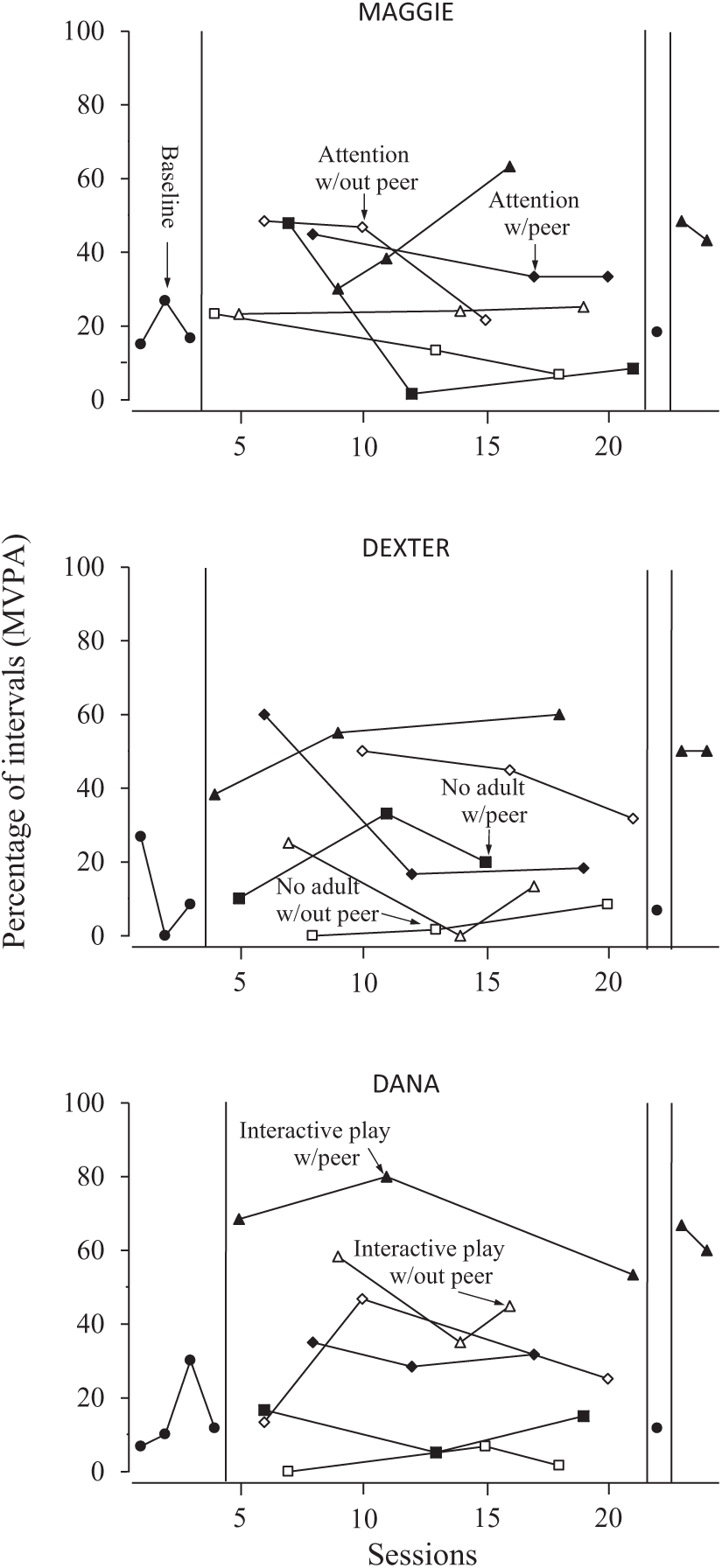
Percentage of intervals with MVPA for all participants, across conditions, with and without the presence of a peer.
For Maggie, baseline levels of MVPA were relatively low (19/2%), the highest level of MVPA in the absence of peers, occurred during the attention condition (mean of 38.9%), particularly in the first two sessions, followed by the interactive play condition (mean of 24.1%) and the no adult condition (mean of 14.4%). In the presence of peers, she continued to demonstrate relatively high and stable levels of MVPA during the contingent attention condition (mean of 37.2%), but demonstrated the most MVPA during the interactive play condition with a peer (mean of 44.7%), showing an increasing trend across sessions. and the least MVPA during the no adult condition (mean of 19.3%). MVPA remained consistently low in the no adult condition, with the exception of the first no adult condition with a peer present; however, this also dropped to low levels for the remaining sessions. During the return to baseline, levels of MVPA for Maggie were similar to the initial baseline, and during the reintroduction of the most effective condition (interactive play with a peer present), levels of MVPA increased again and were similar to those obtained earlier, although with a slight downward trend.
For Dexter, baseline levels of MVPA were low (mean of 10.4%), with the highest level of MVPA in the absence of peers during the attention condition (mean of 42.2%), with a slight decreasing trend and relatively low levels in all other conditions (12.8% for interactive play and 3.3% for no adult conditions). In the presence of peers, MVPA began high, but reduced during the attention condition (mean of 31.7%), whereas MVPA stayed high throughout the interactive play condition (mean of 50.7%) and was lowest in the no adult condition (mean of 21%). It should be noted that for Dexter, the no adult condition in the absence of peers resulted in low levels of MVPA, with slightly higher levels in the presence of peers (even though no programmed consequences were presented). Again, the return to baseline for Dexter resulted in levels of MVPA similar to his original baseline and reinstatement of the most effective condition (interactive play with a peer present) resulted in similarly high levels of MVPA.
Dana also demonstrated low levels of MVPA in baseline (mean of 14%), higher levels of MVPA in the attention condition, followed by the interactive play condition in the absence of peers (means of 28.3% and 46.1%, respectively), with low levels in the no adult condition (2.8%). With a peer present, the interactive play condition resulted in higher levels of MVPA (mean of 65.7%), with lower levels in attention (mean of 31.7%) and lowest levels in the no adult condition (12.2%). Although levels of MVPA in the no adult condition remained relatively low, they were slightly higher in the presence of a peer. As with the other two participants, her return to baseline resulted in levels of MVPA similar to the initial baseline and reintroduction of interactive play with a peer as the most effective condition resulted in a return to higher levels of MVPA that were similar to those observed in the multielement presentation of conditions.
Overall means for each condition, by participant, can be seen in Figure 2.
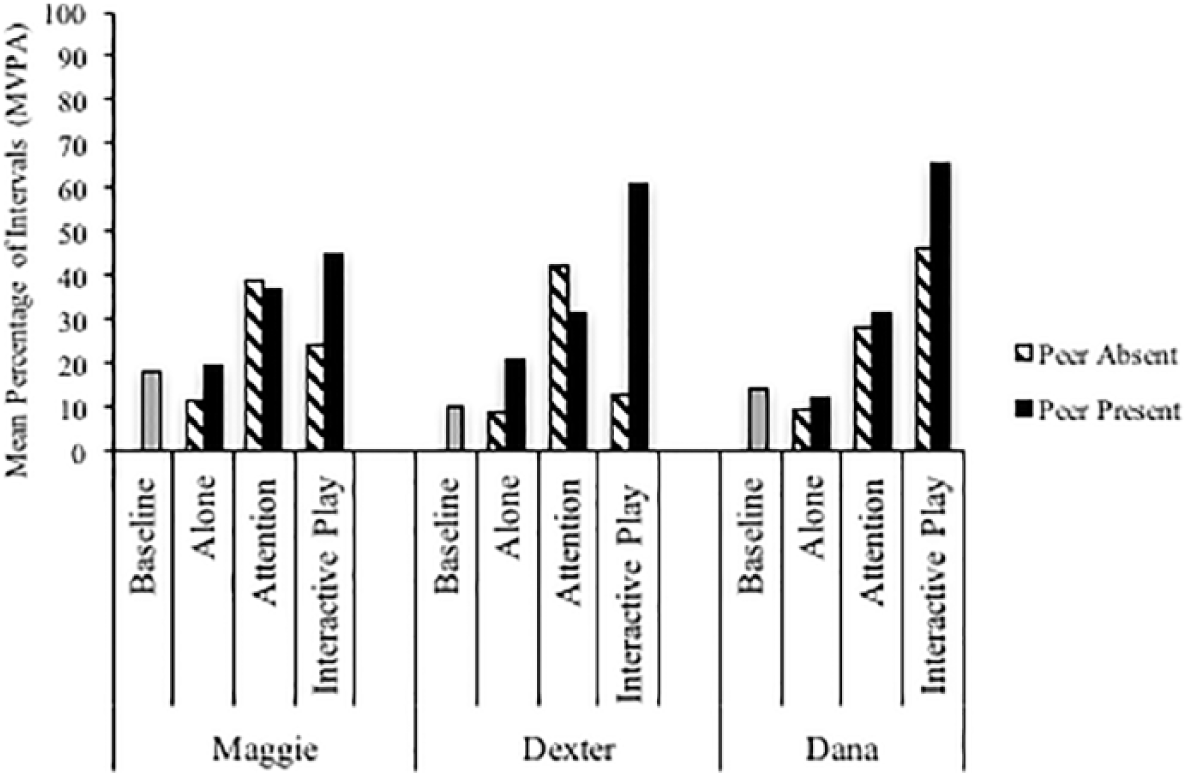
Mean percentage of intervals with MVPA for each participant, in each condition, with and without the presence of a peer.
These results suggest that, for all participants, the mere presence of a peer increased levels of MVPA over previously similar conditions presented in the absence of a peer. The exception to this is the attention condition, where the absence of a peer resulted in slightly lower overall levels of MVPA for two of the three participants (Figure 2). Overall, the interactive play condition appeared to be more effective in increasing MVPA in the presence of a peer, than in the absence of a peer.
Discussion
The results of this study confirm prior research indicating that levels of MVPA in children are typically low in naturally occurring play situations, even in the presence of peers. In addition, higher levels of MVPA are observed when social positive reinforcement is provided contingent on the occurrence of MVPA (T. A. Larson et al., 2013; T. A. Larson, Normand, Morley, & Miller, 2014). All three participants engaged in the highest percentage of interval with MVPA during the interactive play condition when a peer was present. In addition, high levels of MVPA also occurred during the attention condition when a peer was absent for two out of the three participants, and during the interactive play when a peer was absent for the third participant. For all participants, the most effective maintaining variable, regardless of peer presence, was some form of social positive reinforcement. Furthermore, levels of MVPA were generally lower during the no adult condition, suggesting that physical activity was not, in itself, reinforcing to the participants in this study. This remained true even in the presence of a peer, particularly for two of the three participants. This suggests that, although levels of MVPA were highest in a condition with a peer present, the presence of a peer itself was not sufficient. The interaction of peer presence with contingent interaction from the adult was optimal.
Limitations and Future Research
Despite these findings, the study had some noteworthy limitations. The behavior of the peer was not measured in this study, and this makes it difficult to draw any firm conclusions about why the presence of a peer during contingent interactive play resulted in higher levels of MVPA for all participants; however, this furthers previous research findings that also evaluated the presence of a peer without controlling or measuring the behavior of the peer. It should also be noted that the presence of a peer did not consistently have the same effect when combined with contingent adult attention. It is possible that the presence of a peer functioned as a motivating operation, specifically as an establishing operation, in the interactive play condition. A motivating operation is a stimulus or event that temporarily alters, and in the case of establishing operations increases, the value of another stimulus or event as a reinforcer, and evokes behavior which in the past has resulted in that particular reinforcer (Laraway, Snycerski, Michael, & Poling, 2003). In this case, the adult interactive play in the presence of a peer may have been more reinforcing for the participant. Alternatively, it is possible that the interactive play from the adult also functioned to reinforce the peer’s behavior resulting in increased levels of MVPA by the peer and this, in turn, increased the MVPA of the participant (i.e., if interactive play with an adult increased MVPA, then it is likely that interactive play with a peer would function similarly). It may also be the case that the peer provided additional forms of social reinforcement to the peer during MVPA in the interactive play condition. Future research should collect data on the MVPA of the peer and investigate the role, if any, of observational learning when children play with other peers and reinforcement is delivered to others contingent on MVPA. Interactions (both vocal and nonvocal) between participants and peers may also play a role. Given that participants and peers were running around on a playground, it may be difficult to record and measure the vocal interactions between the participants and the peers (cameras did not pick up the vocalizations in this study and so either individual or strategically placed microphones may need to be used to measure this). Future studies may investigate the role that such interactions play in the MVPA of participants.
Overall, this study confirms prior research suggesting that contingent adult attention and interactive play are effective in increasing MVPA (Zerger, Normand, Boga, & Patel, 2016); however, the role of any consequences that peers may have been provided by peers is unclear. Although peers were not instructed to provide any particular consequences, and anecdotally were not observed to do so in a formal manner, it is possible that the peers and participants interacted in ways that provided contingent reinforcement for some aspects of MVPA. Future research should investigate the role of peer provided consequences on MVPA in children. This may be an especially relevant analogy for many children who play in the presence of other children but in the absence of adults.
Some additional limitations to note were structural. One participant, Maggie, was only exposed to the open space and play materials during her sessions, whereas the other two participants were also exposed to the fixed equipment. This was due to the availability of participants and the availability of the fixed equipment area of the playground, but according to the study by Hustyi et al. (2012), this may explain why Maggie’s overall levels of MVPA are slightly lower than those of Dexter and Dana. In addition, other variables such as ambient temperature may have played a role. The study took place during the summer and early fall where the outdoor temperature ranged from 90 to 100 F°. Although the conditions were presented in a semirandom and alternating manner, the study took place at the same time of the morning each day, and we provided the children with water throughout, the heat may have reduced overall levels of MVPA. Future studies should ensure the same materials and physical environment across all participants.
It is also important to note that no attempt was made to control for participant variables such as ethnicity and socioeconomic status. Although previous research has suggested that physical activity can vary across ethnic groups, findings between Anglo American children and Hispanic or Latino American children (largest ethnic groups where study was conducted) have been mixed, largely due to the influence of socioeconomic status and body composition and a lack of objective measures (Eyre & Duncan, 2013). More well-controlled studies of the influence of such variables using the methods described here would be beneficial.
Finally, further studies should examine MVPA in children over longer periods of time. This study only examined MVPA during 5-min conditions, and given the widely accepted recommendations of 60 min of MVPA per day (CDC, 2015; U.S. HHS, 2008; WHO, 2017), future studies should examine the effectiveness of various forms of social positive reinforcement over longer sessions. In light of this, studies should focus on methods of fading the reinforcement schedule. For example, attention was provided each time the participant engaged in MVPA and continued every 10 s until they stopped. Consequences delivered repeatedly, on a dense schedule, over a longer period of time, may lose some of their reinforcing value, and this may need to be addressed to provide a practical intervention or recommendation. Furthermore, responses of parents on the social validity questionnaire indicate that the intervention, although viewed as important, was unlikely to be implemented by them at home. This may be, at least in part, due to the dense schedule of reinforcement. So again, future research should investigate the use of less dense schedules of reinforcement to provide a practical procedure for use by parents, caregivers, and others in the child’s everyday environment. In addition, future research may show differential effects for consequences delivered by familiar adults or peers (experimenters were not known to the participants prior to this study).
In summary, the current study extends the research on the functional variables that support increased levels of MVPA in preschool children and the interaction of contextual and consequential variables that are likely to be involved. Interventions derived from these results may provide methods that can be used to increase physical activity in young children and alleviate many of the health risks associated with a sedentary lifestyle.
Footnotes
Acknowledgements
The authors would like to thank the children, parents, and staff of the Joyce Huggins Early Education Center for their assistance and cooperation with this project.
Authors’ Note
This study is based on a thesis submitted by the first author, under the supervision of the second author, in partial fulfillment of the requirements for the Master of Arts degree in psychology at California State University, Fresno.
Declaration of Conflicting Interests
The author(s) declared no potential conflicts of interest with respect to the research, authorship, and/or publication of this article.
Funding
The author(s) received no financial support for the research, authorship, and/or publication of this article.
