



Abstract
Augmentative and alternative communication (AAC) systems can support communication skills for people with significant developmental disabilities who experience complex communication needs (CCNs). There is a need to tailor best practices in AAC assessment and intervention to create individualized communication systems with this population. In this article, we outline the important components of AAC systems that can be implemented in authentic settings. However, given the limited evidence on AAC interventions specific to people with CCNs, we also identify some priority areas for future inquiry. Among these involve strategies to enhance decision making regarding (a) matching communication mode(s) to learner skills and contextual demands, (b) identifying communicative opportunities and obligations, (c) individualizing aided communication display features, (d) selection of vocabulary specificity, and (e) considering dosage parameters needed to acquire and maintain a communicative repertoire. In addition, we briefly discuss the use of telehealth to enhance intervention capability.
“If all my possessions were taken from me with one exception, I would choose to keep the power of communication, for by it I would soon regain all the rest”
Communication as a Basic Human Right
The National Joint Committee for the Communication Needs of People With Severe Disabilities (NJC) issued a revised communication bill of rights that states that people with disabilities at any level of severity have the right to “affect, through communication, the conditions of their existence” (Brady et al., 2016, p. 23). The NJC endorses a definition of severe disabilities that prioritizes focus on the person’s adaptive functioning, leading to person-centered assessment and intervention with less emphasis on deficits. Thus, in the current article, we use the term complex communication needs (CCNs) to refer to people with severe disabilities who are not verbally communicating and may have limited speech comprehension skills who may benefit from non-verbal means of communication.
Functional communication is produced across almost every context that people experience, including home, community, and educational settings. Without transparent communication skills, people with CCNs are at significant risk of exclusion from the human experience. Many persons with CCNs cannot effectively express themselves because of significant limitations in their production and comprehension skills. For some, these challenges extend into adulthood. Without viable communication intervention strategies, persons experiencing CCNs are at risk of being deprived the basic human right of communication (Ganz, 2015; Murphy, Lyons, Carroll, Caulfield, & de Paor, 2018).
Defining CCNs
As previously mentioned, complex communication needs is a term to refer to the communication needs of people with severe disabilities who are not able to use speech as their primary communicative means and may have significant communication comprehension and production delays in multiple areas of communication (i.e., pragmatics, phonology, semantics, and syntax). Persons with CCNs may have related sensory and/or physical disabilities that make it challenging to access augmentative and alternative communication (AAC) systems. Consequently, to develop more effective communication strategies, persons with CCNs benefit from a transdisciplinary approach in designing and implementing communication assessment and intervention support.
Challenges Associated With CCNs Without Timely and Effective Support
Persons with CCN’s limited societal participation and social isolation often have a negative impact on their life span quality (Clarke et al., 2011; McNaughton & Light, 2015) and result in community and social exclusion (Murphy et al., 2018). For some, this isolation begins with their educational experience as over 50% of students with significant intellectual disabilities receive their education separate from their peers outside of the general classroom (National Center for Education Statistics, 2017). Persons with CCNs with a limited exposure to more typical communication environments afforded by inclusive settings had fewer employment opportunities (National Center for Education Statistics, 2017). In addition, with a higher incidence of health challenges, persons with CCNs often have difficulty communicating with health care providers. This, in turn, can further negatively affect their quality of life (Blackstone & Pressman, 2016; McNaughton & Light, 2015).
AAC
For most of us, speech is a quick and efficient means of both expressing one’s self and understanding the utterances produced by others. Unfortunately, for many with CCNs, intelligible speech will not be possible. Fortunately, for these people, AAC applications will be a viable option or supplement vocal/verbal output. AAC encompasses both aided and unaided applications. Aided AAC involves using equipment that is not part of the learner’s body (e.g., communication books and wallets such as the Picture Exchange Communication System [PECS], Bondy & Frost, 1994; speech-generating devices [SGDs]; schedules/calendars). Unaided AAC applications are those that do not require any external equipment (e.g., signing, natural gestures).
Aided AAC applications may be particularly beneficial for people who have challenges with recall memory (Hyppa-Martin, Reichle, Dimian, & Chen, 2013), abstract language, or fine motor control (Beukelman & Mirenda, 2005), and require a simultaneous display of communication symbols from which to choose. Aided AAC systems containing multiple symbols provide the learner with a multiple-choice format in terms of choosing a symbol from an array that matches their communicative needs. Aided AAC systems that produce speech (SGDs) have the advantage of being able to be used at a distance and thus may lessen the need for communicative repair (as the symbols are electronically translated into speech).
Unaided AAC applications, on the contrary, may work well for people who have good recall memory, are able to more easily learn abstract symbols, have access to communicative partners who readily understand applications such as gestures and signs, and have the motor skills required to produce the response (Johnston, Reichle, Feeley, & Jones, 2012; Rotholz, Berkowitz, & Burberry, 1989). Gestures and sign can provide immediate access to vocabulary items, improved portability, and speed of production (Johnston et al., 2012). A more detailed discussion of advantages and disadvantages of aided and unaided communication systems is discussed in Johnston et al. (2012).
Clarke et al. (2011) reported results of a survey of 360 providers who offer multi-disciplinary assessment services, including investigation of AAC options for children with CCNs. These investigators reported that AAC effectively supported persons with CCN in accessing a range of community environments and activities. To date, little research addressing the effect of communication intervention (including AAC applications) has provided a detailed examination on its long-term impact on social, educational, and employment outcomes among persons with CCNs (O’Neill, Light, & Pope, 2018).
Positive Impacts of Timely and Effective Intervention and Support for Persons With CCNs
With an increasing number of persons with CCNs who require AAC, numerous positive outcomes have resulted among people with a wide range of disabilities (McNaughton & Light, 2015). Persons with CCNs include persons representing many other neurodevelopmental disabilities (Ganz et al., 2015), including persons with chronic, severe aphasia (Beukelman, Hux, Dietz, McKelvey, & Weissling, 2015); a critical illness or injury (Happ et al., 2014); cerebral palsy; and intellectual disabilities (Bonnike, Douglas, & Stoner, 2018). McNaughton and Light (2015) reported that the percentage of intervention research publications between 1985 and 2014 was distributed across multiple disabilities (25%), cerebral palsy (22%), other developmental disabilities (20%), acquired disabilities (17%), autism (9%), and intellectual disability (7%).
O’Neill et al. (2018) completed a meta-analysis focused on aided AAC intervention for persons with CCN. They reported that AAC interventions were highly effective across age groups, disability categories, and level of communication and language skills for both production and comprehension outcomes. Investigators (Beukelman et al., 2015; Blackstone & Pressman, 2016) concluded that to help reduce the negative impact of communication challenges, AAC strategies should provide persons with CCN not only early intervention but the continued provision of exemplary AAC intervention during post-secondary and vocational educational experiences. In addition, greater attention must focus on adults who will develop CCN later in life (i.e., persons acquiring Amyotrophic Lateral Sclerosis (ALS), Parkinson’s, stroke, and a host of other diseases). They concluded that the past 30 years the primary focus on AAC applications with persons with CCN has been primarily on younger age group (below 17 years) between 1998 and 2014 (McNaughton & Light, 2015).
Describing Evidence-Based Interventions Pertinent to Persons With CCN
Communication interventions comprise a continuum of approaches from what have traditionally been referred to as applied behavioral analysis (ABA) or “behavioral” approaches to social-pragmatic, more relationship-based approaches. Prizant and Wetherby (1998) characterized both behavioral and social-pragmatic developmental approaches to intervention. Table 1 compares some defining characteristics of the anchor points of this continuum (Prizant & Wetherby, 1998). Both general approaches have advantages and disadvantages when applied to AAC programming for learners with CCNs that can be briefly summarized.
Differences in Intervention Strategies for AAC Intervention.
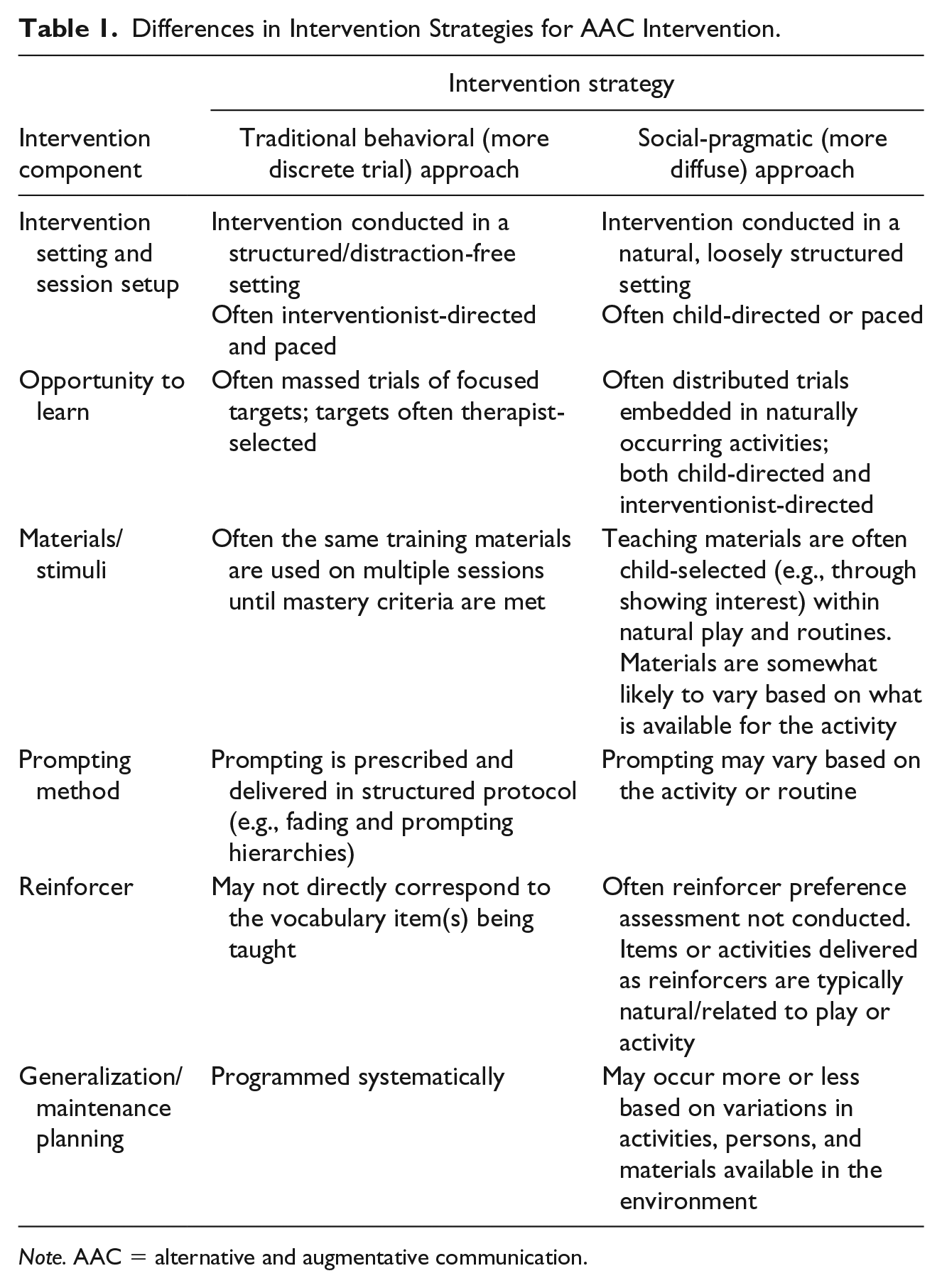
Note. AAC = alternative and augmentative communication.
Behavioral approaches have an impressive base of empirical studies demonstrating substantial gains across a variety of skills (Eikeseth, Smith, Jahr, & Eldevik, 2002; Harris, Handleman, Gordon, Kristoff, & Fuentes, 1991; Howard, Sparkman, Cohen, Green, & Stanislaw, 2005; Smith, Groen, & Wynn, 2000). Typically, behavioral approaches provide a task analysis of skills (i.e., a breakdown of a larger skill into manageable pieces and systematic data collection). Behavioral approaches are often consistent with the principles of ABA. ABA-based interventions may refer to focused ABA, in which specific skill sets are targeted in a narrower period of time versus comprehensive ABA, sometimes referred to as intensive early behavioral intervention, where young children with autism or related disabilities receive a large quantity of hours of ABA therapy targeted to broad and comprehensive developmental skill domains (Hagopian, Hardesty, & Gregory, 2015).
An example of a well-established, focused ABA intervention for communication and challenging behavior is Functional Communication Training (FCT). FCT involves identifying the function of a challenging behavior and teaching a communicative alternative that serves the same function as the challenging behavior (Derby et al., 1997; Tiger, Hanley, & Bruzek, 2008; Wacker et al., 2013). FCT has been very effective for learners with good parent satisfaction ratings in serving persons with CCNs who engage in problem behavior that responds to socially acceptable communicative alternatives.
In contrast, social-pragmatic approaches focus on developmentally appropriate contexts and the formation of positive relationships between the child and adult, with the goals of increasing initiation and spontaneity in communication. Social-pragmatic intervention is often child led, or balances child and adult-directed intervention. Intervention is often embedded into natural routines or play. Social-pragmatic approaches have been associated with generalization of skills across settings, people, and materials because of the focus of teaching opportunities embedded within naturally occurring contexts (Greenspan, Wieder, & Simons, 1998; Prizant & Wetherby, 1998). Additional benefits of social-pragmatic approaches include naturally occurring reinforcement contingencies, an emphasis on social interactions (Snow, Midkiff-Borunda, Small, & Proctor, 1984), and encouraging relationship with communicative partners.
Although 30 years ago proponents of more behavioral-discrete trial and social-pragmatic intervention approaches tended to have a more adversarial relationship, we are coming to understand that often a blending of approaches best serves learners with CCNs. Increasingly, there seems to be general agreement that the more diffusely an intervention can be embedded into the natural environment, the better provided that the learner can make timely gains in his or her communication skills. Unfortunately, it is also clear that some learners struggle during early phases of intervention in acquiring communicative skills in the milieu of socially/pragmatically focused intervention. In our experience, for these learners, who are often people with CCNs, the term “blended approach” increasingly has appeared in the literature. Blended approaches incorporate more discrete trial strategies within natural contexts and have been referred to as Naturalistic Developmental Behavioral Intervention (NDBI; for example, Hong, Ganz, Gilliland, & Ninci, 2014).
NDBI intervention approaches include those that blend ABA methodology with elements of developmental relevance for young learners (Schreibman et al., 2015). Many NDBIs rely on ABA behavioral principles and methods (e.g., systematic prompting and fading, reinforcement; Schreibman et al., 2015); however, interventions are also viewed through a more social-pragmatic lens. Hallmarks of NDBI strategies include implementation within settings in which AAC skills would naturally be used enabling generalization of skills into a range of settings (Light, 1997; Ogletree, Davis, Hambrecht, & Phillips, 2012) with the inclusion of natural communication partners while also including behavioral techniques such as prompting, time delay, positive reinforcement, and shaping (Reichle, Drager, & Davis, 2002). Furthermore, NDBIs are consistent with practices of natural routine-based and family-centered interventions, as discussed by Schreibman and colleagues (2015). Proponents of NDBIs recognize that with some learners, there may be times when higher dose, or more intensive, interventions that minimize distractions (e.g., discrete trials) may be required.
The Early Start Denver Model (Dawson et al., 2010; Vismara, McCormick, Young, Nadhan, & Monlux, 2013) is an example of NDBIs. Others include Pivotal Response Treatment/Training (Koegel, Bimbela, & Schreibman, 1996) and Milieu Language Teaching (Kaiser & Hester, 1994; Kaiser, Yoder, & Keetz, 1992). Milieu Teaching strategies have evolved to include pre-linguistic communication (Pre-Linguistic Milieu Language Teaching). As previously stated, many of the best exemplars of blended approaches are found in the intervention literature for chronologically young learners with CCNs who are likely to use speech as their primary communicative means. It is important to note that many of these blended approaches (e.g., Early Start Denver Model and Pivotal Response Treatment) involve communication intervention that is often targeted to vocal or verbal responses, with perhaps gestural communication modes as well. There are fewer examples in the literature of blended NDBIs with children with CCNs or that utilize graphic mode aided AAC.
Considerations in Beginning Communication Intervention With Persons Experiencing CCNs
In this section of the article, we will address what have been widely accepted as best practices in initiating a communication intervention for persons with CCNs.
In considering the selection of an AAC system, Light and McNaughton (2012) cautioned that with respect to aided communication systems, “too often it is assumed that intervention begins and ends with the provision of a device” (p. 300). These investigators reported that most learners used a combination of aided and unaided AAC to supplement speech or vocalizations. Unfortunately, to date, there are insufficient objective and evidence-based guidelines to determine how to best deploy communication mode(s) for a given person as a function of learner performance, preference, and demands of the environments in which the learner will communicate. Furthermore, if an aided communication system is selected, there is a sparsity of criteria to apply to objectively evaluate the relative emphasis to place on low-, mid-, or high-tech applications. Next, we will address selecting a communicative mode(s) and then address decisions to consider if an aided communication system is chosen for emphasis.
Conducting an Ecological Inventory
An ecological inventory (Reichle, York, & Sigafoos, 1991) is a comprehensive process that carefully considers how a learner functions in different environments when compared with how a typically developing peer functions in that same environment. Ecological inventories systematically identify all the communicative opportunities and obligations that may be important for the learner to be successful in the range of activities and settings that are encountered and can reasonably be expected to encounter in the future.
Next, the interventionist considers how typically developing persons successfully communicate in those situations. This is followed by comparing how the learner communicates in those situations, which, in turn, allows the design of intervention supports to bridge the gap between the learner’s current skills and those required to participate as a peer would participate. Ecological inventories address the greater variability in sequence and speed of development that often results in an increasing achievement gap. In selecting a communication system to support intervention with respect to the identified outcomes of an ecological inventory, one must consider intervention allocation among speech, graphic symbols, and gestural symbols. Next, we will consider a strategy that we have found helpful in making this decision.
Selecting a Communicative Mode(s)
As previously noted, available communicative modes include vocal, gestural (unaided), and graphic (aided). Reichle et al. (1991) proposed a strategy that they described as modality sampling that involved an objective assessment strategy in which comparative data are considered within learner across each communication mode being considered. It involves teaching previously non-produced symbols in each of three communicative modalities. When replicated longitudinally along with an assessment of maintenance and generalization of symbols, evidence may be gathered addressing mode efficacy. In the short run, modality sampling allows the interventionist to determine whether symbols in a particular mode(s) are more easily acquired, maintained, and generalized. In addition, the learner’s preference between communicative modes can be examined through systematic observations of the learner in a variety of settings and with a variety of communicative partners to determine the relative frequency with which he or she uses the various communicative modes. Modality sampling involves surveying the preferences of stakeholders who are the receivers of the learner’s communicative acts. Finally, when paired with an ecological inventory, consideration can be given to the communicative demands and opportunities of a specific context with respect to communicative mode. For example, aided communication is apt to be more effective at a restaurant where few people sign, and speed in communicating a message is important. In a second example, shaking one’s head to indicate “yes” or “no” when one has a listener’s attention can be faster than selecting a graphic symbol. However, if one’s listener is not immediately present, there may be other more effective alternatives. As Johnston et al. (2012) noted, modality sampling can provide objective data to support the selection of communication mode(s) to emphasize at the point of initial AAC implementation. However, acquiring communication skills is influenced by a wide array of variables that overtime may directly influence the efficiency of a given communication mode. Consequently, communication mode emphasis must be regularly revisited, and an interventionist may find that a combination of modes can be used to meet different communication needs for a person with CCNs.
Foundational or pivotal skills (e.g., Koegel & Frea, 1993) such as motor-imitation ability may predict the speed with which learners acquire certain communication modes (i.e., manual sign vs. picture exchange-based communication, imitation in vocal/verbal mode, and matching to sample in graphic mode). However, current evidence does not provide definitive guidance on the issue (Gregory, DeLeon, & Richman, 2009). Consequently, modality sampling using an alternating treatment single-case design (Byiers, Reichle, & Symons, 2012) can be beneficial. In an alternating treatment design, the interventionist on any given day implements each of two different AAC strategies. Usually with people having significant developmental disabilities and CCNs, each intervention is locked to a different set of symbols that have been matched and monitored for preference. Dependent measures include percentage of opportunities in which symbols from each communicative mode are used during acquisition and maintenance. In addition, generalized use across people, activities, and settings also may represent areas examined (see Byiers et al., 2012, for additional information on alternating treatment designs).
Among populations with CCNs, several investigators (i.e., Hyppa-Martin et al., 2013; Johnston et al., 2012) have provided detailed procedures for implementing modality sampling. Hyppa-Martin et al. (2013) implemented modality sampling in all three modes with a toddler who experienced Angelman syndrome, discovering more prolific performance in learning aided communication production. In implementing modality sampling, concurrently teaching graphic and gestural modes of communication can be challenging. For example, the behaviors being taught may not be wholly independent from each other and as a result may be susceptible to multiple treatment interference (see Schlosser, 1999, for a discussion of this issue and methodological suggestions for addressing it). In addition, it may require greater short-term effort from the interventionist. To date, there is an insufficient algorithm to apply in the selection of communication modes to emphasize at the outset of intervention with a person who has not previously relied on AAC. Modality sampling offers an experimentally oriented approach to communicative mode selection in determining the emphasis to place on a graphic, gestural, and verbal mode communication. Furthermore, implementing the described comparisons is not a one-time assessment. As environments and learners’ skills change along with preferences, these comparisons must be repeated.
Once a communicative mode(s) has been chosen, interventionists can carefully consider several variables unique to that mode. Given the space available in this article, we will focus on graphic mode AAC for beginning communicators. Although not all factors to consider are addressed in this article, a number of those with which there is some evidentiary base will be briefly discussed.
Selecting Graphic Symbol Type to Be Used in an Aided AAC Application
The logic of modality sampling can be applied in selecting the type of symbols that would be easiest to discriminate. Options include both three-dimensional (e.g., button to represent shirt, swatch of material to represent a learner’s coat) and two-dimensional (e.g., line drawings, photos, product logos, printed words) symbols. By concurrently comparing the learner’s ability to discriminate between symbols within each of these options, the interventionist can select a symbol type that is easiest for the learner to acquire in the beginning stages of AAC implementation. Johnston et al. (2012) provide a detailed explanation of procedures that can be used to implement this strategy (including those with CCNs who experience severe intellectual disabilities).
Determining Symbol Specificity in Establishing Early Communication Skills
In either aided or unaided AAC applications, little attention is given to the specificity of the symbols to be taught. One can think of specificity as a continuum: On one end, very specific vocabulary (e.g., mosquito) and on the other end, general vocabulary items (e.g., bug). Of course, the more specific the symbol, the clearer the meaning. However, preciseness has the trade-off of being able to use these vocabulary items in more restrictive contexts. With people who experience severe vocabulary comprehension and production limitations, it may be important to consider these trade-offs in selecting symbols to teach. Next, we will focus on symbol specificity advantages and disadvantages.
General symbols apply across a wide variety of contexts (Johnston et al., 2012; Reichle et al., 1991). Examples of general vocabulary items include “more” (Laraway, Snycerski, Michael, & Poling, 2003) and “look.” General vocabulary items have both disadvantages and advantages. With respect to the former, they can make a learner’s communicative act more context-dependent (Johnston et al., 2012). For example, if a learner says “more,” his or her listener must already know the referent which often means being in proximal to the learner. This can limit the efficiency of a communicative production from the standpoint of a communicative partner. As a result, topics that are disproportionately represented with general vocabulary items may enhance the likelihood that the learner will be more apt to communicate with familiar people and potentially less apt to communicate with less familiar partners. Furthermore, after a general vocabulary item is taught, it may be more difficult to subsequently teach a related explicit vocabulary item that refers to the same referent. For example, once “drink” is mastered, the learner may prefer to use it than a new term with greater specificity such as milk. This is because among early communicators, there is a tendency for the learner to think that each referent has only one correct word associated with it (Mervis & Bertrand, 1994). The notion of response classes where different response topographies may be used to refer to the same thing is often still under development for persons with CCNs, particularly those who also have significant ID. On the contrary, there are clear advantages associated with general vocabulary items. General vocabulary items are maximally used in a broader range of situations than more explicit vocabulary items (Johnston et al., 2012; Reichle et al., 1991).
Explicit vocabulary items involve a learner producing communicative acts that are less reliant on context (Mirenda, 2003). This provides potential benefits for communicating about referents that may not be present in the environment. It may also make it easier to talk about future and past events. In many cases, explicit vocabulary items may not support a training intensity that general vocabulary can support with intervention strategies implemented in natural contexts. For example, learners may satiate on “orange” but may continue to be interested in requesting other types of “fruit” throughout the day. To date, the research on symbol specificity is very sparse among persons with CCNs even though the topic has significant implications for considering demands on a conversational partner, aided communication navigational strategies, and the priority for establishing communicative repair strategies for people with significant communication limitations.
Determining Graphic Symbol Size in Aided AAC Applications
Our experience has been that interventionists tend to select symbol size and the spacing between symbols somewhat arbitrarily as they begin designing an aided AAC display. Reichle et al. (1991) suggested objectively examining symbol size and symbol spacing using an objective assessment strategy in which an interventionist compared a range of different symbol sizes during a simple discrimination task in which an array of three symbols were provided. Johnston et al. (2012) provided examples of this procedure. For example, given symbols that were each ½ inch by ½ inch, and spaced an inch apart, the learner was encouraged to select one. The symbol selected became the criterion for a correct selection in future opportunities. Across opportunities, the three symbols’ placement was randomized as the learner was asked to select it again. Each correct choice resulted in the learner being offered an array of reinforcers from which to choose. The learner’s continued selection of the same symbol suggests that he or she can see symbols well enough to locate the target symbol. Once a performance baseline was established, the size of symbols offered were systematically decreased until the learner’s performance began to deteriorate. This outcome can then be replicated. This easy procedure can be easily used to assess appropriate symbol size prior to intervention onset.
Determining the Space Between Graphic Symbols in Aided AAC Applications
Once optimal symbol size had been determined, the interventionist can systematically manipulate the distance between symbols with a set of optimally sized symbols. Some AAC assessment instruments such as the Test of Aided-Communication Symbol Performance (TASP; Bruno, 2010) consider several size variations of symbols.
Characterizing Low-, Mid-, and High-Tech Aided AAC Communication Options
Once the variables that have been described thus far have been addressed, the interventionist can consider a range of low-, mid-, and high-tech AAC systems that are available. Reichle, Ganz, Drager, and Parker-McGowan (2016) described considerations in making these selections that we will review next.
Low-Tech Dynamic Display
These applications offer no electronic components and correspondingly no speech output. As mentioned earlier, examples of low-tech AAC applications include communication books and wallets. They are often implemented with beginning communicators while determining symbol size, number of symbols per display page, and a variety of other features that need to be addressed in a strong application for SGD funding. In addition, they are often used as a backup to an SGD when the learner is operating in settings that require maximum portability and durability (i.e., sand box, playground, etc.).
A mini-wallet is one example of a “low-tech” system used by some beginning communicators to maximize portability and reduce navigational demands of a wallet display. In a mini-wallet application, a series of wallet inserts is used. Often, each insert represents a daily activity and is placed in the wallet by another stakeholder (e.g., Doss et al., 1991; Reichle & Johnston, 1999; Reichle et al., 1991; Sigafoos & Iacono, 1993). The advantage of this strategy is that, initially, a person need not learn to use navigational strategies to locate the correct page from an array of symbol pages. A second advantage is that the size of the wallet needs to house only a small number of symbols at any given time and is relatively light to maximize portability.
In using a mini-wallet, a storage location for a series of one-page wallet inserts is established. A low-tech alternative to a mini-wallet is a communication wallet or notebook with multiple tab-indexed pages—similar to a two-subject notebook (detailed information regarding mini-wallets can be found in Reichle & Drager, 2010; Reichle, Simacek, & Parker-McGowan, 2018). The tabs represent the basis for a navigational strategy in which the learner is taught to select a superordinate tab and subsequently the specific symbol(s) that is the focus of the learner’s communicative utterance. Often multipage communication wallets are introduced to teach a rudimentary navigation strategy that can be used when the learner begins to use an SGD.
Mid-Tech Displays
Some mid-tech SGDs use overlays like the low-tech mini-wallet. Each overlay, however, is associated with a new layer of digitized speech output messages that are associated with each symbol displayed on the new overlay. When the overlay is changed, the person changing it moves a button to the corresponding layer of digitized messages. Some devices use “level switching” that allows the learner to control which page of the SGD is displayed. In this application, the learner selects a symbol on the display of the device to advance to the level matching the symbol overlay. For example, a learner might have one row of symbols that includes “things I like to eat,” “games I want to play,” “places I enjoy,” and so on. By selecting one of these superordinate symbols takes the learner to a new electronic page of messages and cues a partner to change to the overlay corresponding to the superordinate symbols. Alternatively, on some devices, there is a switching mechanism, which permits the learner (or interventionist) to switch from one page to another within an SGD. For many learners with CCNs who also have significant cognitive and/or physical limitations, this type of mid-tech application may make it more challenging for the learner to independently control his or her device. Mid-tech devices do not offer text to speech in which the learner can type a message and the device will convert the message to speech. Similarly, functions such as prediction are also not available. In addition, mid-tech applications have limitations on being able to construct a series of symbols and then display the completed message. Mid-tech devices lack the capability to easily interface with a computer so that they can be used as the computer’s keyboard or smartboard.
Changing overlays on many mid-tech aided AAC applications may limit the learner’s flexibility and speed in using his or her SGD. More sophisticated dynamic displays found on high-tech SGD applications allow the learner to link to a new page of symbols from any symbol location on any symbol page contained in the learner’s SGD without changing overlays. This more dynamic display may increase a learner’s independence and speed in accessing a larger number of symbols. That is, in high-tech applications, each symbol has the capability of linking to another page of symbols or linking to a small pop-up (e.g., by selecting a symbol representing hamburger, a pop-up may display pickles, onion, mustard, ketchup, and lettuce representing condiments often selected by the learner). Alternatively, in page linking, selecting a superordinate symbol on the initial page might correspond to a subordinate symbol on a subsequently displayed page of symbols. Using pop-ups and page linking likely requires that a learner be able to match a superordinate symbol to subordinate symbol. At the heart of the applications just discussed is the learner’s ability to use navigation strategies.
High-Tech Displays
High-tech aided AAC applications afford the learner a number of useful features that typically are not found on mid-tech devices that include, both digitized and synthesized speech (as an SGD), prediction, the capability to link person symbols to other pages of symbols, use of small movie clips as symbols, capability to receive and generate email, keyboard emulator capability, and other environmental control capability (among an array of features). High-tech devices afford the user greater flexibility and speed in accessing messages once they have a larger vocabulary. In addition, some features allow learners to more efficiently formulate messages by quickly accessing frequently used words and topics. Further being able to coordinate text to speech and digitized messages allows greater flexibility in combining communicating with activities such as singing.
Ganz, Mason, et al. (2014) conducted a meta-analysis of communication intervention with persons with autism spectrum disorder (ASD) who also experienced CCNs in studies appearing in refereed sources. These investigators concluded that SGDs were the most effective AAC for persons with ASD. Among persons with ASD and intellectual delay, PECS appeared to be the most effective.
Considering Navigational Features With Aided AAC Communication System Users
Many variables can influence a learner’s efficient navigation of an aided AAC system. Navigating across a range of symbols may be affected by (but not limited to) (a) permanence of the display (e.g., static or dynamic display), (b) symbol layout (e.g., traditional grid displays or visual scene to be discussed), (c) number of representations on a display (addressed earlier), (d) size of the symbols and the display (addressed earlier), and (e) organization of symbols (to be discussed). Each of these components can have a significant impact on the degree to which a person with CCNs meets his or her communicative opportunities and obligations using an aided AAC system.
Static and Dynamic Symbol Displays—Addressing Display Permanence
Displaying the entirety of a learner’s symbol display concurrently on a single page of a communication display is referred to as a static display (a simultaneous symbol display). A static display can facilitate ease of correct symbol selection among some learners with CCNs because it requires that the user only recognizes rather than recalls a symbol that he or she wishes to produce (Reichle, Wilkinson, Johnston, Feeley, & Jones, 2012). For many persons with CCNs, static displays may speed acquisition as navigational demands are minimized. However, as the learner’s symbol vocabulary grows, the only way to preserve a simultaneous (single-page static) display is to decrease the size of and the spacing between symbols. Consequently, either mini-wallets discussed earlier or a dynamic symbol display (the use of multiple manual or electronic pages of symbols) must be considered. In a dynamic display, symbol choices may either appear across several pages or may appear via a scrolling function on a single page.
Both static and dynamic displays have unique potential advantages and disadvantages for an aided AAC system user. Static displays have a propensity to be easier for people with significant developmental disabilities who have CCNs because the choice array of symbols can be compared concurrently with a referent (Reichle et al., 2012; Wilkinson & Reichle, 2009). In dynamic (sequential) displays, the specific symbol to be selected cannot be compared concurrently with the referent because it is not visible at the same time as the referent (Reichle, Wilkinson, Johnston, Feeley, & Jones, 2012; Wilkinson & Reichle, 2009) and therefore requires recall memory. Signing also requires recall memory because it is not possible to display signs simultaneously from which the learner has a visual representation. Much of the research validating the use of aided AAC systems with young children with CCNs has involved the use of static/simultaneous symbol displays (e.g., Durand, 1999; Dyches, Davis, Lucido, & Young, 2002; Schepis, Reid, Behrmann, & Sutton, 1998; Sigafoos, Didden, & O’Reilly, 2003). Johnson, Reichle, Feeley, & Jones, (2012) and Reichle and Drager (2010) provide a more in-depth discussion of the issues addressed here.
Organization of Aided Symbol Displays
Symbols can be organized and displayed on an AAC system in different manners to foster efficient and effective communication that provides the symbols in a traditional grid display format or a visual scene display format. In a traditional grid display, symbols are often displayed in tabular, boxed formats and organized by category (Beukelman & Mirenda, 2005; Blackstone, Light, Beukelman, & Shane, 2004; Wilkinson, Light, & Drager, 2012). In a visual scene display, symbols are embedded into photos or drawings that represent a setting or event (e.g., the zoo or a one’s bedroom), often organized by context, containing relevant people, objects, and other content related to the activity or setting.
Depending on the needs of the learner, symbols can be categorized and arranged in a variety of ways within a grid or visual scene display. For example, a page may be arranged with frequently used symbols in easy to access locations for early communicators or a learner with a bigger repertoire of vocabulary. This arrangement may also be used on a “home page” with symbols linked in folders to additional specifications, such as a symbol for “drink” can open a folder where a learner can select from a variety of drink types that he or she wishes to discuss. Interventionists have a variety of choices available in organizing symbol arrays. For example, they can be arranged by (a) category (taxonomic; for example, toys, family members), (b) vocabulary related to a specific event/activity/setting (schematic; for example, items familiar at the library), or (c) the semantic or grammatical location of different vocabulary (e.g., verbs, nouns).
A clear limitation to understanding the “best fit” of symbol display type for people with CCNs is that to date, many studies comparing the two display types are with typically developing children (e.g., Drager, Light, Speltz, Fallon, & Jeffries, 2003; Drager et al., 2004). However, we can assume that there may be several advantages and disadvantages to different symbol display arrangements for people with CCNs (for an in-depth description, see Beukelman & Mirenda, 2005) and that the interventionist should plan for symbol arrangement based on the personized needs of the person using the AAC system.
For example, with respect to static and visual scene displays, the latter may provide context cues for the people using them, as the symbols are arranged in the spatial location that they naturally occur. When symbols that are relevant to an experience are all grouped together in a visual scene display, a learner may be able to more quickly locate and utilize vocabulary. However, potential drawbacks to the visual scene arrangement intuitively include that users may be limited in novel settings/experiences (such as visiting a new location in the community or if a room is rearranged). Visual scene displays may also pose difficulty in including more abstract core vocabulary types within a scene (e.g., “I am all done with this activity”). While more research is needed to drive intervention planning with learners with CCNs, it is possible that many learners may benefit from a combination of symbol arrangements personized to their unique communication needs. Symbol arrangement likely also needs to continue to be addressed over time, as the number or complexity of symbols grows when new vocabulary is introduced or expanded upon.
Teaching Navigational Skills Used in Dynamic Display Aided AAC
To date, there is a limited literature addressing navigational strategies for persons with CCNs. This is one of the largest obstacles for many people in accessing effective communication strategies. For persons with CCNs, often teaching content symbols and teaching a learner how to navigate must be addressed as separate skills rather than simultaneously attempting to teach both. In this portion of the article, we will address several readily available navigation strategies.
Page Linking
During a simultaneous matching task, the learner can refer to the possible symbol choices at any point during the symbol search without engaging in navigation. In delayed matching, the learner cannot always see the symbol that they wish to select at the initiation of the communicative opportunity and, typically, must navigate to the symbol. Consequently, the learner must not only inhibit responses to potentially appealing non-targets, he or she must also keep in mind the specific target being sought as they apply navigational skills. Page linking may be helpful as a learner’s symbol repertoire begins to grow and not all symbols can be made simultaneously visible on a single page of a display. Locating the correct and desired symbol may require both simultaneous matching skills (finding a symbol representing “drink” from a main page as well as a form of non-identity matching to sample that requires matching the symbol “drink” to a subordinate symbol, for example, Coca-Cola). Currently, there are not experimentally validated intervention strategies to teach “page linking” navigational skills with persons who experience CCNs. Teaching navigational skills such as scrolling and page linking represent two areas that need to be addressed in future research.
Scrolling
During scrolling, a person can use a click-and-drag movement with a finger (or mouse) to gain access to other portions of a page that were not visible at the onset of the click-and-drag movement. This navigational strategy allows the learner to maintain a smaller number of symbols that are simultaneously displayed yet have quick access to related symbols on the same page that are not visible. To utilize scrolling, the learner must be aware that relevant symbols that are out of view are available. During scrolling, as a “page” is moved either right, left, up, or down, new symbols are displayed. For some learners, being able to follow a continuous scroll may be easier than matching a superordinate to subordinate symbol in executing page linking. Unfortunately, to date, with children who experience CCNs, there have been no comparisons of these strategies. To date there is no replicated experimental descriptions of manualized intervention programs to teach scrolling to persons with CCNs.
Eye-Tracking
When a learner is not able to select symbols using an appendage or an appendage directed cursor, eye-gaze technology represents a potential solution that permits symbol selections as a result of fixing one’s gaze on a symbol for a specified amount of time (“dwell time”). Once the “dwell time” criterion is met, the symbol is activated (Fager, Bardach, Russell, & Higginbotham, 2012). Eye-tracking devices interface with SGDs (Higginbotham, Shane, Russell, & Caves, 2007). Although promising, much of the evidence addressing eye-gaze technology has involved children and adults who had intact communication prior to a disability or disease acquired after acquiring and efficiently using speech (e.g., traumatic brain injury, amyotrophic lateral sclerosis) with far fewer studies extended to people with CCNs.
Simacek, Reichle, and McComas (2016) demonstrated preliminary evidence of successful implementation of eye-gaze technology with a child having Rett syndrome who experienced CCNs. Three requests were targeted via eye-gaze technology that allowed symbol selections on an SGD. The child acquired the requests, using a combination of stimulus prompts approximating an errorless learning strategy (i.e., making the targeted symbol much larger than a non-targeted distractor symbol and gradually decreasing the size of the targeted symbol and increasing the size of the non-targeted symbols) and the use of a light to illuminate the correct symbol (referred to as an extra stimulus prompt) that was systematically faded for one of the requests. However, the researchers noted the difficulty with initial prompting efforts and with eventual prompt fading attempts and the resultant variability of responding. This study was a single-case experimental design study that signaled the need for additional research to perfect effective and efficient intervention protocols for teaching eye gaze as a selection response to people with CCN, particularly defining protocols for efficient and effective prompting techniques for eye gaze for people with CCN.
Ensuring That Persons With CCNs Are Initiating Communicative Acts That Communicate What They Are Attempting to Communicate
It has been well documented that persons with CCN have a propensity to use their communication in responding to the communicative overtures of others and more rarely initiate communicative exchanges with others using AAC systems. However, it is important to be able to initiate communication about referents that are not visible to the speaker and listener (Reichle & Brady, 2012). Others have discussed the significance of this skill (see, for example, Deacon 1997, or Savage-Rumbaugh, McDonald, Sevcik, Hopkins, & Rubert, 1986, as well as Romski, Sevcik, & Pate, 1988, within the discipline of AAC).
Once a learner is initiating communicative acts, speaking partners may tend to assume that the learner’s utterance accurately reflects their communicative intent. For example, when thirsty, even though there may be no soft drink in sight, a learner should be able to seek out a listener and touch the relevant symbol representing Pepsi®. Once this request is made, a communicative partner can offer a can of Pepsi® and Sprite®. The learner in reaching for the actual can of Pepsi® demonstrates that the choice matched the communicative utterance that was produced (the item corresponding to the symbol selected). Reichle et al. (1991) referred to this brief procedure as correspondence. Subsequently, Bondy and Frost (1994) made the practice a component of their PECS as a validity check to ensure that when a learner initiates the use of a symbol, it was discriminatively rather than randomly selected.
Most research addressing aided AAC with persons with CCNs has focused on selecting symbols in the presence of referent objects or events (Johnston et al., 2012). Doing so places the learner in the role of a responder so that the correctness of the symbol choice can be verified. The notion of “correspondence” provides the basis for examining symbol correctness while promoting independent and initiated communicative acts.
Considering the Influence of the Interventionist(s) on AAC Intervention Outcomes
Interventionists play an extremely important role in teaching, supporting, and encouraging people with CCN to use AAC to communicate in their daily lives. Among persons with CCNs, intervention often must be delivered with a high level of treatment intensity (Warren, Fey, & Yoder, 2007) during a learner’s participation in a variety of settings and activities. Interventionists who were teachers, researchers, educators, speech–language pathologists (SLPs), parents, and peers have demonstrated large effect sizes in implementing aided AAC with persons experiencing CCNs (O’Neill et al., 2018). Providing intervention in authentic settings (Kent-Walsh, Murza, Malani, & Binger, 2015) by persons with whom learners typically interact represents an increasingly important issue in translational research. The wide range of prospective interventionists capable of delivering intervention with high fidelity directly addresses the challenge that many people with CCNs have difficulty maintaining and generalizing their communication skills across varied settings, contexts, and other people (Calculator, 1988; Ganz & Hong, 2014). Communication partners are well suited to foster communication skills given the many communication opportunities throughout most facets of daily life. Parents and peers are particularly well positioned to mediate intervention because of the hours that they spend with people who experience CCNs. Consequently, familiar people implementing intervention support throughout the day maximizes opportunities for maintenance and generalization of newly taught communication skills.
Across contexts, people are most likely to implement an intervention if they have “buy in,” because they find the intervention to take a reasonably small amount of time to implement, to be relatively low cost, to be likely to result in an improvement in the target person, and to address skills or deficits that the stakeholder finds to be important (Johnston, 2006). Interventions that are relatively intuitive and easy to quickly adapt and program are likely to maximize implementation consistency (Light & McNaughton, 2012). These interventionist characteristics would seem to be more likely when there is good contextual fit between the interventionist and the intervention plan being implemented. Furthermore, as technology develops, “just-in-time” programming (Reichle, Drager, Caron, & Parker-McGowan, 2016) will allow parents to use AAC technology more flexibly, allowing them to add vocabulary in real time, as needed, across contexts. For example, ideally, the implementer should be able to quickly take a photo within a communication app and rapidly and intuitively add the photo to the device, program hotspots, and/or add voice-output to capture novel communication needs when they occur. Parents should also be taught specific strategies to encourage communication in their children, such as prompting and prompt fading for independent responding, addressing numerous communicative functions, and implementing AAC within naturalistic activities (Shire & Jones, 2015).
Although available research supports the use of peer instruction in AAC mediation (Myers, 2007), there are barriers that must be addressed in overcoming the challenges in establishing friendships when there is limited access to communication (Østvik, Ytterhus, & Balandin, 2017). For several suggestions to promote friendship between children with CCNs and their peers, see Østvik et al. (2017). Peer-to-peer relationships should be promoted rather than peers serving as helpers or teachers to students who use AAC (Fisher & Shogren, 2012). Furthermore, communication intervention for typically developing peers may increase opportunities for reciprocal communication, frequency of communicative exchanges, and friendship (Fisher & Shogren, 2012; Raghavendra, Grace, Newman, Wood, & Connell, 2013; Thirumanickam, Raghavendra, & Olsson, 2011). Part of this instruction should involve coaching peers. Aspects to be addressed in peer coaching include providing information about the target child’s disabilities and communication needs, practical instruction in how to use and model the use of the target child’s communication modes, and strategies to promote communication (Carter & Maxwell, 1998; Chung, Carter, & Sisco, 2012; Kohl, Moses, & Stettner-Eaton, 1983). Specific strategies taught to peers may include instruction in paralinguistic skills that include but are not limited to eye contact, limiting conversational control to minimize those interacting with the learner who may have a propensity to dominate the conversation, modeling and prompting use of the AAC system (Carter & Maxwell, 1998; Chung et al., 2012; Hunt, Staub, Alwell, & Goetz, 1994).
Furthermore, during intervention, regardless of the interventionist, it is important to collect data on the treatment fidelity as implemented by the natural communication partners. Doing so allows the practitioner to determine whether more intensive coaching/training is needed and to be assured that any gains in the target person’s communication skills are associated with the intervention, implemented as intended.
Addressing Culturally Responsive Approaches
Interventionists must address aspects of culture and linguistic diversity (CLD) when designing and implementing assessment and intervention procedures with people with CCNs. Effective support addressing CLD people with CCNs requires support and collaboration between parents and extended families in both native and English (Kulkarni & Parmar, 2017; Parette, Huer, & Scherer, 2004).
Among families who are CLD, interventionists must identify and address biases regarding the use of AAC. Families may reject using AAC if they have not been involved in the AAC decision-making procedures for their children. In some cultures, this involvement includes elders and/or other members of the extended family. Language differences can also create challenges in implementing AAC. For example, in an AAC high-tech application, many languages are not available. Consequently, English is the language used by default ignoring the native language (Kulkarni & Parmar, 2017). Communicating with professionals may create challenges for many families as a result of cultural perceptions around questioning medical and educational professionals paired with alternative beliefs (Kulkarni & Parmar, 2017). For example, people in Asian cultures may believe the past sins are related to the cause of their child’s disability and they are ashamed to ask for other supports (Parette & Huer, 2002). Another example includes that in Latino cultures, the word “training” when referring to intervention can have negative connotations that can be interpreted as parents provided sub-optimal support (Rosa-Lugo & Kent-Walsh, 2008).
In providing AAC supports for CLD families, interventionists can be culturally responsive by implementing various techniques to gather information from and respond to parents related to their children’s needs (Soto & Yu, 2014). First, AAC intervention should not include only their native language but should also focus on vocabulary that culturally valued of their native culture (Soto & Yu, 2014). Second, future applied research addressing the implementation of AAC with CLD families must focus on both direct and indirect intervention strategies and generalize skills within and across their language (Soto & Yu, 2014). Third, interventionists should consider parental input regarding specific functional communication skills that their child requires to participate in home and community settings (Soto, 2012).
To increase the participation and involvement of CLD families in using AAC, interventionists should be aware of their culture and beliefs. Interventionists should then create the AAC system that reflects on their family’s culture and beliefs. When providing intervention with the AAC system, this should use vocabulary, symbols, contexts, and strategies that culturally relevant and sensitive to the family and their culture (McCord & Soto, 2004; Soto & Yu, 2014). For example, storybook reading with a communication partner could help parent and child interaction and increase the use of AAC devices when stories chosen are relevant to a family’s culture (Binger, Kent-Walsh, Berens, Del Campo, & Rivera, 2008; Rosa-Lugo & Kent-Walsh, 2008).
Choosing the Appropriate Treatment Intensity/Dosage Parameters
We know that the intensity of which an intervention is delivered can have a significant impact on how well the intervention works. Intervention intensity is a concept proposed by Warren et al. (2007) to be translated from the medical community to behavioral interventions. Traditionally, we may think of the intensity of an intervention as limited to the number of hours the intervention is delivered per week. Or we think of whether opportunities to learn are delivered via a massed trial instruction or a distributed trial instruction. Although important, intervention intensity is not limited to these parameters, as they do not capture the entirety of aspects that comprise intervention intensity. Warren et al. (2007) described how to quantify a cumulative level of intervention intensity that considers the many different “dosage parameters.” These parameters expand to including elements of intervention such as the total duration of an intervention from start to finish and the form of the intervention. In implementing any communication intervention, well-articulated dosage parameters are needed. Without those, any studies seeking to replicate or compare intervention types are not possible. Likewise, interventionists are unable to “prescribe the correct dosage” of intervention for a particular learner to experience the greatest effects. Table 2 provides hypothetical examples of how dosage parameters can be applied to AAC intervention examples.
AAC Intervention “Dosage” for Learners With Complex Communication Needs Based on the Intervention Intensity Parameters Proposed by Warren, Fey, and Yoder (2007).
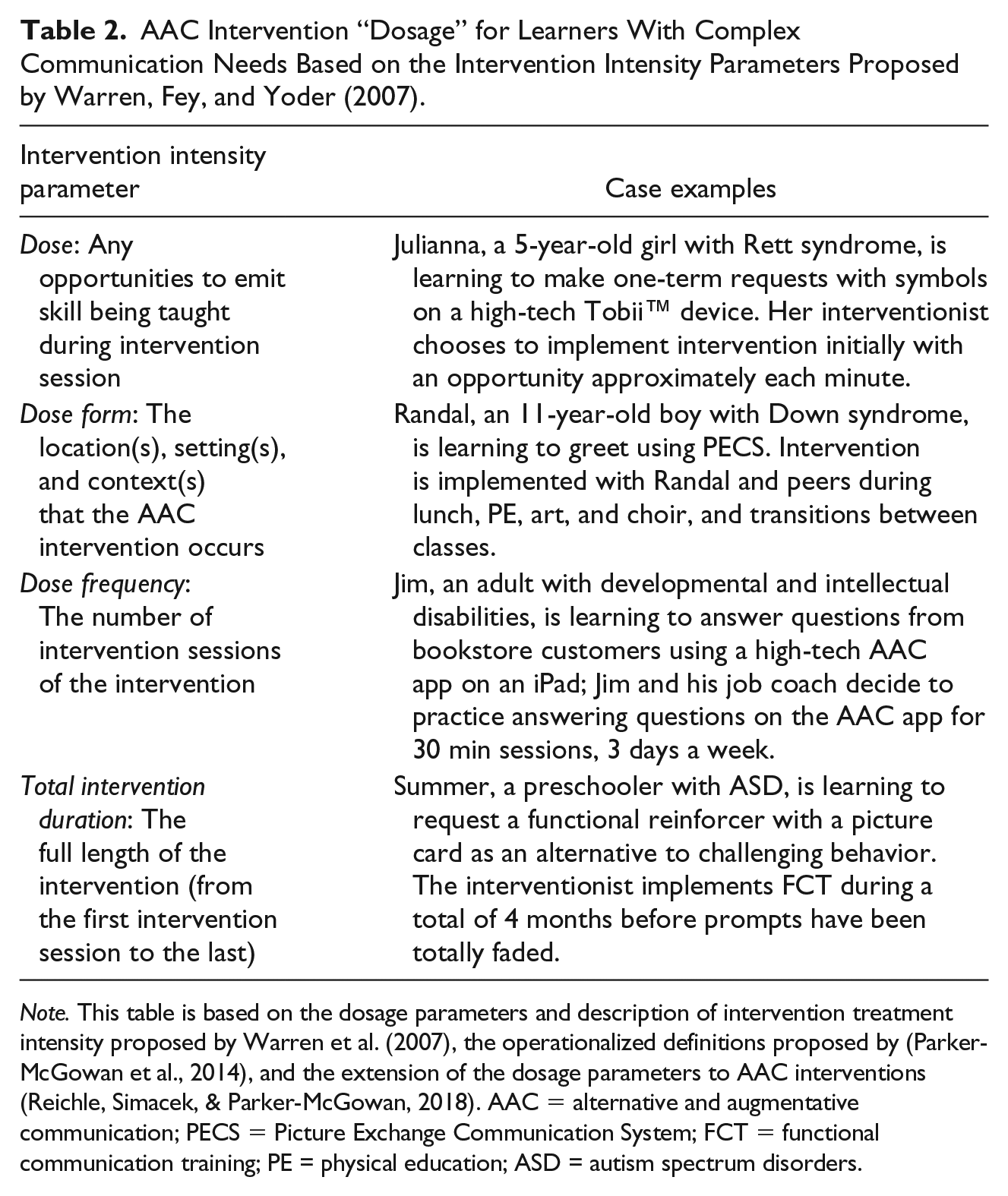
Note. This table is based on the dosage parameters and description of intervention treatment intensity proposed by Warren et al. (2007), the operationalized definitions proposed by (Parker-McGowan et al., 2014), and the extension of the dosage parameters to AAC interventions (Reichle, Simacek, & Parker-McGowan, 2018). AAC = alternative and augmentative communication; PECS = Picture Exchange Communication System; FCT = functional communication training; PE = physical education; ASD = autism spectrum disorders.
With respect to AAC intervention, prescribing the most effective intervention intensity/dosage for a particular learner is not possible given our current understanding of treatment intensity parameters with respect to learner characteristics and specific skill being taught (Parker-McGowan et al., 2014; Simacek, Pennington, Reichle, & Parker-McGowan, 2018). The modest available evidence describing the differential outcomes of varying dosage parameters in communication interventions for any given set of students is just beginning to emerge.
. . . And Who Will Bake the Bread . . . The Shortage of Skilled Professionals
Articles and book chapters have a propensity to discuss topics such as AAC intervention for persons with CCNs in terms of building on an existing literature. As a result, there seems to be an inherent assumption that what we have learned in the research literature has permeated applied implementation of these research findings in schools and community service delivery. Clearly, this is not the case for a variety of reasons.
A clear barrier to the delivery of high-quality AAC intervention for people with CCN is the dire need for personnel with expertise in assessment and intervention for persons with CCN. There is a critical shortage of licensed SLPs and special educators to guide and oversee communication intervention for children who would benefit from AAC (American Speech-Language-Hearing Association (ASHA) Healthcare Survey, 2005); particularily for children with CCN (e.g., severe and multiple disabilities; Ludlow, Conner, & Schechter, 2005; McLeskey, Tyler, & Flippin, 2004) and for children with ASD (Wise, Little, Holliman, Wise, & Wang, 2010). In addition, there are few SLPs specializing in AAC, as pediatric SLPs surveyed by ASHA reported that only 5% of their time was dedicated to AAC programming (ASHA, 2011).
To better meet the needs of CCN, additional personnel preparation and continuing education can be provided in AAC and intervention programming. Telemedicine (i.e., the delivery of AAC assessment and/or intervention using telecommunications) offers one avenue to extend professional training in addition to both direct and indirect service to persons with CCNs and their families. Telemedicine has both ethical and practical guidelines issued through the ASHA to guide telemedicine use for SLPs. It can include synchronous (i.e., live interaction) and asynchronous (e.g., video recordings stored and viewed by a practitioner) delivery (ASHA, 2016). Telemedicine can support the delivery of intervention through connecting experts in AAC and CCNs with practitioners in the community with less knowledge in those areas. Hybrid models can also be employed that combine synchronous, asynchronous, and in-person modalities.
There is a growing evidence base supporting the use of telemedicine to (a) conduct parent training and coaching for the assessment and intervention of low-technology aided AAC, such as picture card exchange (e.g., Simacek, Dimian, & McComas, 2017), and high-technology, speech-generating aided AAC devices (e.g., Dimian, Elmquist, Reichle, & Simacek, 2018); (b) provide FCT through parent coaching intervention for children with autism or related disabilities at outpatient, satellite-site clinics and in children’s homes (Lindgren et al., 2016); and (c) provide parent training in intervention for social-communication skills of young children with autism (Meadan, Meyer, Snodgrass, & Halle, 2013; Vismara et al., 2013). Telemedicine, though not the only solution, does have the potential as one solution to increase the reach of AAC intervention and can be used to deliver both direct and indirect SLP services (Boisvert, Hall, Andrianopoulos, & Chaclas, 2012). While the state of the evidence is promising, additional research is needed to better understand the utility and effectiveness of telemedicine to best support and advance AAC intervention for people with CCN.
Summary
As a society, we are only as good as our effort to include everyone with significant disabilities including those with CCNs. The first author of this article has observed amazing strides that have been made in the past 40 years that should be celebrated. However, there is much yet to be done. As a field, we have not yet fully embraced translational research. Many service providers are still implementing practices that are less than current with the existing literature. There are far too few service providers than are needed to provide quality intervention and mentoring in serving persons with CCN. Our service provision does not promote smooth interfaces from school to community and from school to home in promoting a continuity of intervention. We are just beginning to address the influence of an increasingly diverse society on the provision of communication services to learners from diverse backgrounds. Contextual fit is an area that applies to all stakeholders who will be facilitating a learner’s communication acquisition. As such it is important that they embrace the intervention strategies to be implemented. We fear that often may not be the case. Without good contextual fit, the effectiveness of intervention strategies will be degraded. Despite our growing assessment technology, service providers often fail to make several decisions regarding the design of AAC systems. Too often, when designing and executing intervention protocols, personized educational team members do not adequately consider dosage parameters of intervention that might best serve a person based on their history of acquisition. Currently, we lack an adequate evidence base on how to best teach a number of navigational skills that, for some learners, are critical in learning to use aided communication systems (e.g., scrolling, page linking, and eye tracking). We suspect that too often interventionists are attempting to teach both navigational and content skills simultaneously, which can be daunting for some people with CCNs.
Despite all the challenges that remain, great progress has been made in efforts to create intervention procedures that increasingly consider the range of environments in which persons with CCNs have both communicative opportunities and obligations. Increasingly, we are considering contextual variables in real environments that may influence the implementation of intervention strategies that may have been validated under optimal conditions. We believe that the use of the Internet via telecommunications will be a valuable tool in supplementing onsite intervention in the next several years where a literature is beginning to develop. In addition, for “in-home” service providers, telecommunications will make it possible to provide some level of service for learners on waiting lists. In addition, for families in extremely rural areas, it may provide a substantial portion of primary delivery. All these areas should engender enthusiasm and encouragement to both practitioners and researchers. Clearly, our best years of service provision to persons with CCNs are emerging.
Footnotes
Declaration of Conflicting Interests
The author(s) declared no potential conflicts of interest with respect to the research, authorship, and/or publication of this article.
Funding
The author(s) received no financial support for the research, authorship, and/or publication of this article.
