



Abstract
The purpose of this study was to determine the effects of an early numeracy Tier 2 intervention on the mathematics performance of second-grade students with persistent mathematics difficulties. Whole number content and instructional design features were used to boost performance in second-grade early numeracy concepts and skills. Researchers employed a pretest-posttest control group design with randomized assignment of 83 students to the treatment condition and 38 students to the comparison condition. The research team’s mathematics interventionists delivered instruction four days per week for 20 weeks to small groups of second-grade students who were identified with persistent mathematics difficulties. Proximal and distal measures were used to determine the effects of the intervention. Findings showed that students in the treatment group outperformed students in the comparison group on the proximal measure of mathematics performance. There were no differences between groups on the problem-solving measures.
Introduction
As part of this special issue, we begin with a brief overview of the Supreme Court’s ruling on Endrew F. as a backdrop for providing interventions to struggling students as a means for achieving a strong educational benefit in mathematics. We then apply the idea of fostering a strong educational benefit for struggling students in a Multi-tiered Systems of Support (MTSS) model. The goal is to improve the mathematics performance of second-grade children to prevent inappropriate referrals to special education due to inadequate instruction.
In 2017, the Supreme Court ruled in favor of the parents of a child with autism by compelling school district personnel to provide children who have disabilities with more than a de minimis, or trivial, educational benefit standard (Endrew F. v. Douglas County School District). The Supreme Court ruling “. . . requires schools to offer an Individualized Education Program (IEP) reasonably calculated to enable a child to make appropriate progress in light of the child’s circumstances” (Yell & Bateman, 2017, p. 13) and replaced the de minimis educational benefit standard. Thus, the Endrew F. Supreme Court decision means that school officials must ensure a free appropriate public education (FAPE) for students with disabilities that provides a higher educational benefit standard rooted in monitoring the student’s progress in relation to their IEP goals and circumstances (Yell & Bateman, 2017, p. 13). A “higher educational benefit” can be promoted through Tier 2 interventions to provide services to students with mathematics difficulties and mathematics learning disabilities.
In addition to adhering to the Supreme Court’s decision stipulated in Endrew F. for students with identified disabilities, school district leaders also have responsibilities for students receiving services in Response to Intervention (RtI) or MTSS models. Typically, school district educators provide evidence-based interventions to students who qualify (usually by scoring below a specified cut point, such as the 25th percentile) on a district’s universal mathematics screener and continually monitor students’ progress. Early numeracy interventions are appropriate for students with identified disabilities and also are needed for younger children (e.g., first-graders, second-graders) who may not yet be identified as having a disability, but who demonstrate persistent mathematics difficulties and are served in RtI and/or MTSS Tier 2 or Tier 3 intervention programs. (see the National Center on Intensive Intervention, 2010, https://rti4success.org/resource/essential-components-rti-closer-look-response-intervention for more in-depth information on RtI and MTSS).
In this paper, our focus was on the findings of a Tier 2 intensive whole number, early numeracy Tier 2 intervention, which we provided to second-grade students with continued, persistent mathematics difficulties. According to Jordan, Kaplan, Ramineni, and Locuniak (2009), children who enter kindergarten with low mathematics performance and who do not demonstrate improvement in outcomes that tap whole number competencies (e.g., number knowledge, counting, number combinations), predictably exhibit continued patterns of difficulties in the elementary grades and beyond.
One could argue that second-grade students who have not yet been identified as having mathematics learning disabilities (MLD; see IDEA 2004 for an explanation of types of MLD) yet score persistently below school district mathematics benchmark assessments manifest persistent mathematics difficulties. Left unchecked, these difficulties will be exacerbated further by insufficient foundation knowledge in whole number and early numeracy concepts, which are critical for the number and operations and base-ten developmental progressions in the primary and later grades (Bryant, D. Bryant, Sorelle-Miner, Falcomata, & Nozari, 2018; Dougherty, Flores, Louis, & Sophian, 2010; Frye et al., 2013; Geary, 2011). In fact, according to Morgan, Farkas, and Wu (2009), “young children experiencing learning difficulties in mathematics will likely continue experiencing these mathematics difficulties (MD) later in their school careers” (p. 305). Moreover, the mathematics achievement gap between typically performing students and students who are at-risk for MD continues to widen rather than close, indicating issues with understanding fundamental whole number and early numeracy content (Andersson, 2008; Morgan, Farkas, & Wu, 2009; Vukovic, 2012). Insufficient mathematics performance growth can be linked to problems with conceptual understanding and students’ inability to think and reason about mathematics in flexible ways (National Assessment of Educational Progress [NAEP], 2016; National Mathematics Advisory Panel [NMAP], 2008). These struggling students must receive early interventions, which address their mathematical difficulties and are grounded in whole number concepts and skills. Thus, a robust conceptual framework is required for early intervention to ensure that the curriculum supports those concepts and skills necessary to improve mathematics performance.
Conceptual Framework for Early Numeracy Intervention
Numeracy is the ability to understand and reason with numbers and to apply numeric knowledge to place value concepts and arithmetic operations, for example (Reid & Andrews, 2016). A focus on early numeracy includes topics included in our intervention, such as number, numeration, and number relations (e.g., comparing numerical magnitudes, ordering numbers [counting to 1000]); strategies (e.g., part-part-whole, counting on, doubles + 1, making 10) to solve number combinations (i.e., basic facts), base-ten and place value concepts (e.g., place and value of digits, number composition and decomposition), and multi-digit addition and subtraction (i.e., using place value concepts] and properties of operations [e.g., commutative and associative properties of addition) (Common Core State Standards in Mathematics [CCSSM], Council of Chief State School Officers & National Governors’ Association [CCSSO/NGA], 2010).
To develop the conceptual framework for our early numeracy intervention, we utilized an array of sources to inform decision-making about the instructional content and instructional design features. First, we examined findings from researchers (e.g., Clarke et al., 2014; Dyson, Jordan, & Glutting, 2013; Fuchs et al., 2005) who have developed and tested early interventions. Second, we reviewed recommendations from prominent publications (i.e., NMAP, 2008; National Research Council [NRC], 2001; What Works Clearinghouse (WWC) Practice Guides (e.g., Gersten, Beckmann et al., 2009) and prominent national organizations (e.g., National Council of Teachers of Mathematics [NCTM], 2006) to inform development and validation efforts of our early numeracy Tier 2 intervention for students with MD. Third, we examined results from syntheses (e.g., Anthony, & Walshaw, 2009; Baker, Gersten, & Lee, 2002; Shin & Bryant, 2015) and meta-analyses (e.g., Dennis et al., 2016; Gersten, Chard et al., 2009) on early numeracy interventions and instructional practices related to young students with MD to glean evidence-based practices, which warrant inclusion in the conceptual framework. Finally, we incorporated research findings related to learning trajectories (LT), which Sarama and Clements (2009) defined as empirically-supported “descriptions of children’s thinking as they learn to achieve specific goals in a mathematical domain . . . .” (p. ix).
Consequently, we conceptualized the framework of our early numeracy intervention as consisting of two major elements. First, the conceptual framework was grounded in whole number concepts and skills based on the CCSSM (2010) and second-grade LTs or developmental progressions of concepts and skills (Confrey, 2007; Confrey, Maloney, Nguyen, Mojica, & Myers, 2009). Second, the conceptual framework included key instructional design features, which were gleaned from research findings (e.g., Gersten, Chard et al., 2009; Rittle-Johnson & Jordan, 2016).
Whole number content
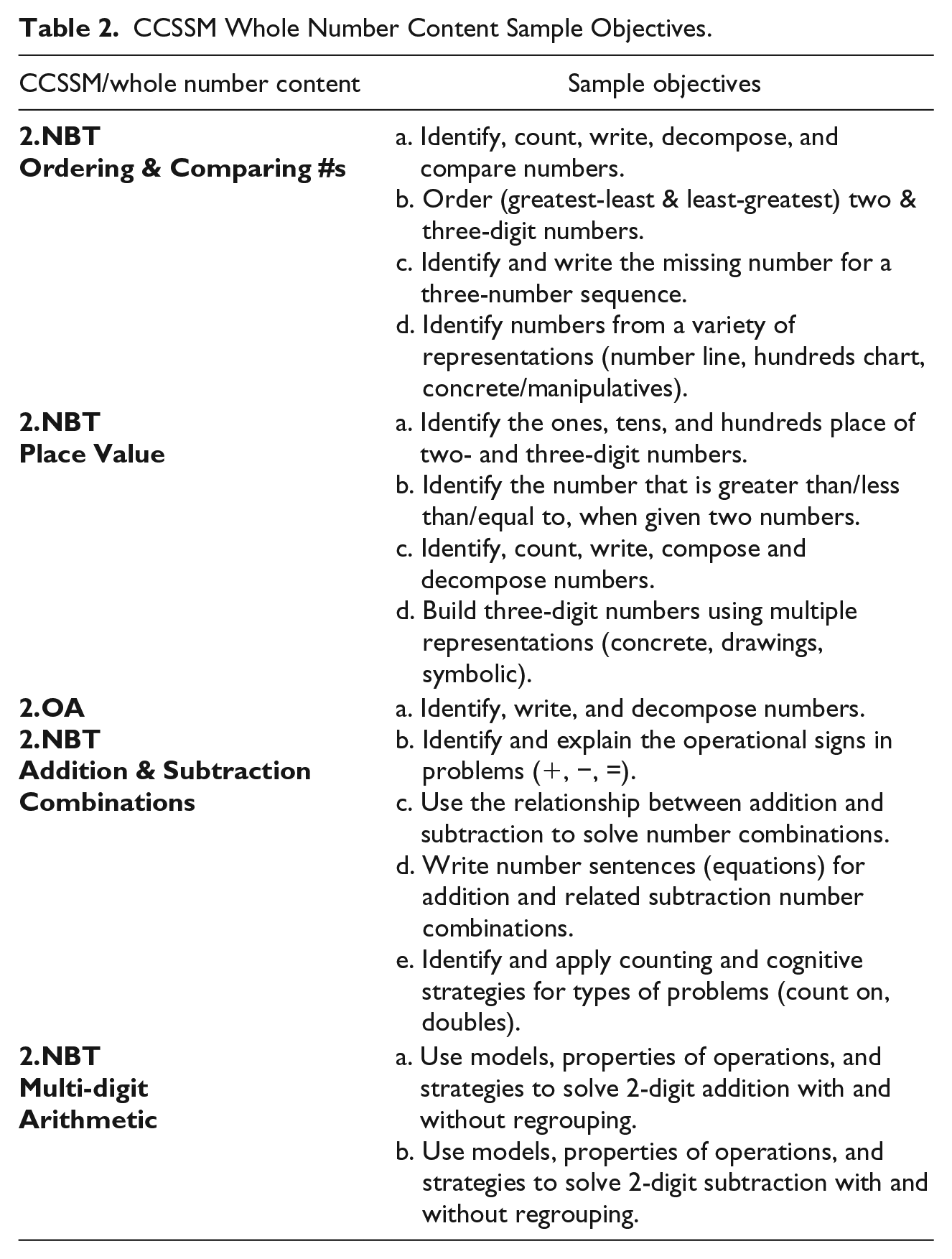
Mathematical Content Standards from the second-grade Operations and Algebraic Thinking Domain (2.OA) and Number and Operations in Base Ten Domain (2.NBT) and Mathematical Practice Standards such as model with mathematics and use appropriate tools strategically (College and Career Readiness Standards, CCSSM, 2010) were tapped for the instructional content in the intervention. We operationalized whole number content as four major topics, related to the CCSSM domains, to include ordering and comparing numbers, base-ten and place value, addition and subtraction number combinations, and multi-digit addition and subtraction problems. For each whole number topic, instructional objectives were developed and sequenced across units and lessons within units to represent LTs or progressions (CCSSM, 2010; Confrey et al., 2009; Sarama & Clements, 2009) (see the procedures section of this paper for details about the lessons).
Instructional design features
We utilized research-based findings (see above sources) to support the identification of effective instructional design features for intervention development. Instructional design features were drawn from empirical research to ensure that the early numeracy Tier 2 intervention included principles and practices that have been shown to improve the mathematics performance of students with MD and MLD.
To that end, we incorporated explicit, systematic instruction; multiple representations; mathematical language; student verbalizations; and teacher questioning into the intervention. Explicit, systematic instruction includes essential features for teaching concepts and skills. Explicit instruction entails, for example, associating new content to previous learning, modeling and thinking aloud procedures, providing multiple opportunities to practice (e.g., guided practice, independent practice), offering immediate corrective feedback, and monitoring student progress. Systematic instruction is characterized by a series of tasks that are identified through task analysis procedures and sequenced from easier to more difficult complexity (Archer & Hughes, 2011; Coyne, Kame’enui, & Carnine, 2011; The IRIS Center, 2010, 2017 rev.). Scaffolds or instructional supports are included for concepts and skills that are initially presented with gradual fading of these supports as students become more proficient with the topics being taught across lessons. Anghileri (2006) presented evidence-based scaffolds for mathematics instruction, which includes, for instance, environmental provisions (e.g., sequencing and pacing, peer collaboration), ideas for reviewing (e.g., prompts) and restructuring (e.g., rephrasing or revoicing student verbalizations) mathematics tasks, and ways to foster conceptual thinking (e.g., representational tools).
The following practices also were incorporated into the early numeracy Tier 2 intervention and are drawn from Anthony and Walshaw’s (2009) synthesis of effective mathematics pedagogy. Multiple representations refer to concrete (e.g., base-ten models, number lines), pictorial (e.g., drawings), and symbolic (e.g., numbers) that teachers and students can use to model concepts and skills; modeling the mathematics is a good way for students to show their understandings of mathematical problems and solutions. Teacher questioning is a powerful mechanism to assess student thinking, reasoning, and learning, and is evident with the use of “why” questions, for example. Through student verbalizations of their understanding about problem situations and reasoning about possible solution strategies, teachers can have a better understanding of any underlying misconceptions, which should be addressed during instruction. Finally, mathematical language is a critical aspect of any intervention. Key vocabulary terms are determined for most intervention lessons and are explicitly taught. Students then are expected to use the terms as they engage with representations to model the mathematics and to communicate during instruction.
Given that a group of low-performing second-grade students with MD continue to exhibit problems learning mathematical concepts and skills and understanding the ramifications long-term of these persistent performance issues, the purpose of this paper was to present the effects of an early numeracy Tier 2 intervention.
Method
Participants, Setting, and Research Design
Second-grade participants were identified in eight elementary schools in a Central Texas suburban school district. The district served approximately 25,000 students. Demographics of the school district included 23% White, 48.6% Hispanic, 16.3% Black, 7.7% Asian, 0.2% Pacific Islander, and 4.2% Two or more races.
The current study was part of a larger, four-year randomized controlled trials (RCT) study in which two cohorts of first-graders (Cohort 1 in Year 1 and Cohort 2 in Year 2) underwent a year-long Tier 2 first-grade mathematics intervention (see Bryant et al., 2011 for further information about the larger study). In Years 2 and 3, members of Cohort 1 and Cohort 2 (now second-graders) were administered a universal screener (Texas Early Mathematics Inventories-Progress Monitoring; TEMI-PM; University of Texas System & Texas Education Agency, 2007b; see Measures section for further details) to determine the participants for the current study. Students who scored between the 11th through 34th percentiles of the TEMI-PM Total Score were eligible for the second-grade treatment or comparison condition in Years 2 (Cohort 1) and 3 (Cohort 2).
For Cohort 1 in second grade, 42 (treatment) and 20 (comparison) students who qualified in first grade remained eligible for the study as a result of their TEMI-PM Total Score. For Cohort 2 in second grade, 41 (treatment) and 18 (comparison) students who qualified in first grade remained eligible for the second-grade early numeracy Tier 2 intervention as a result of their TEMI-PM Total Score (i.e., scoring between the 11th and 34th percentile on the TEMI-PM Total Score).
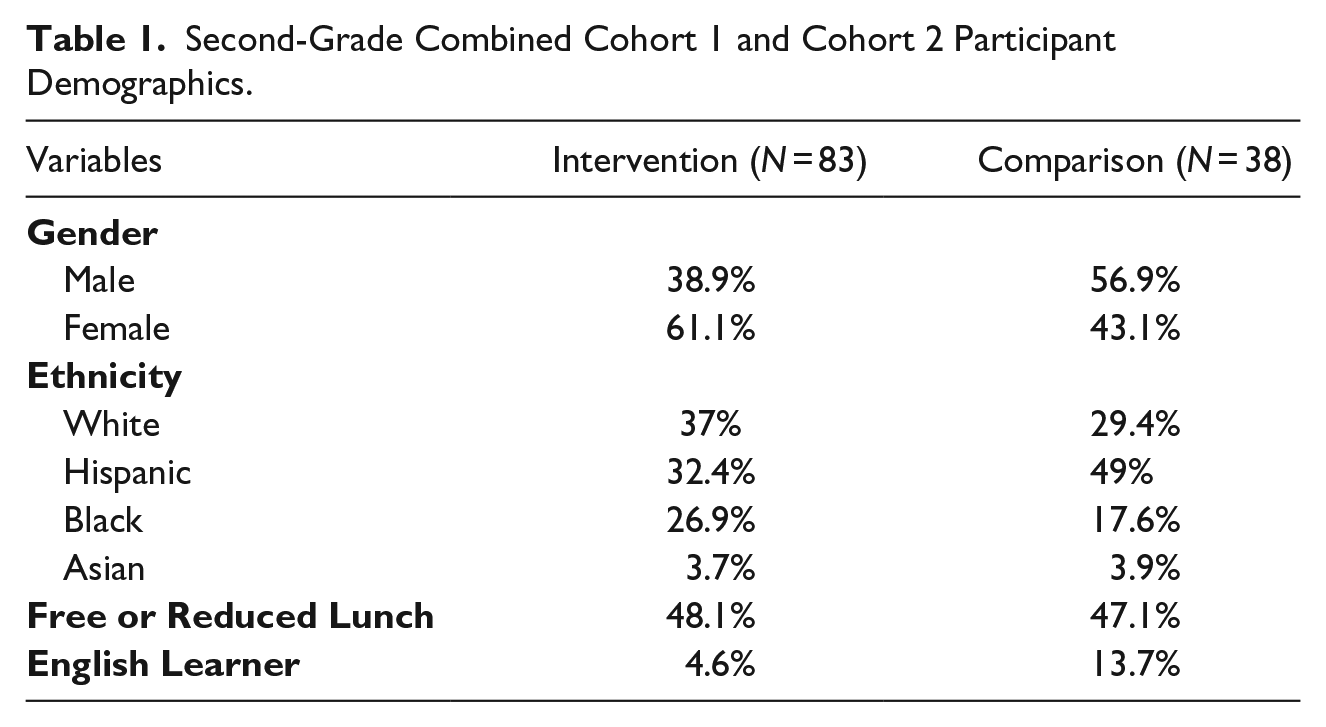
Students for the current RCT study remained in their previous groupings; we did not re-randomize. We combined the remaining Cohort 1 and Cohort 2 second-grade eligible students to increase power resulting in 83 treatment and 38 comparison (“business as usual”) Tier 2 students. Demographics for these students are shown in Table 1.
Second-Grade Combined Cohort 1 and Cohort 2 Participant Demographics.
Measures
Texas Early Mathematics Inventory—Progress Monitoring (Proximal Measure)
The Texas Early Mathematics Inventory—Progress Monitoring (TEMI-PM; Texas Education Agency/University of Texas System, 2007b), a group administered early numeracy test composed of four subtests, served as the universal screener and proximal measure in this study. All numbers appearing on the test range from 0 through 999, and all subtests have 2-min time limits. The TEMI-PM has three alternate, equivalent forms and was normed on a standardization sample of over 1675 second-grade students across the state of Texas. Demographic characteristics of the normative sample match the state’s student population with regard to gender, race, and socio-economic status. The test, which was developed using funding provided by the Texas Education Agency and is available free of charge to all Texas teachers, is composed of four subtests that yield a total score. All four subtests have a 2-min time limit, which begins after the examinee demonstrates to the students how to take the subtest and mark their answers and then provides a 30-s practice trial.
Magnitude Comparison. For this subtest, students look at two numbers set side-by-side inside a box and separated by a dotted line. They look at the numbers and circle the one that is “less,” or both numbers if they are the same. Reliability coefficients for the Grade 2 normative sample range from 0.81 to 0.83, with a median of 0.83.
Number Sequences. Students see a three-number sequence, with one number missing. The missing number may be in the first, second, or third position. Students write the missing number in the blank. Reliabilities range from 0.84 to 0.88, median 0.87.
Place Value. Students look at pictured stacks of hundreds, tens and ones up to 999. They then write number that shows “how many.” Reliabilities range from 0.80 to 0.88, with a median of 0.87.
Addition/Subtraction Combinations. For the fourth subtest, students look at 40 addition and subtraction problems on a page. They compute and write the answer below each problem. Sums and differences range from 0 through 19. Reliabilities range from 0.83 to 0.85, median 0.84.
The Total Score is composed by summing the raw scores of all four subtests. The alternate forms reliability coefficient for the TEMI-PM Total Score range from 0.92 to 0.93, median 0.93. In addition, area under the Receiver Operating Curve values were identified for the TEMI-PM Total Score to be 0.78, demonstrating good predictive power (Minitab, undated) for the criterion measure, the Stanford Achievement Test (10th edition) (SAT-10, Pearson Eduction, 2003). In addition to providing evidence of reliability, the technical manual of the TEMI-PM reposts evidence of the subtests’ and total score’s content, criterion-related (both concurrent and predictive), and construct validity (e.g., sensitivity to annual growth, lack of floor and ceiling effects, relationship to reading and writing test scores, differentiation of groups, interrelationship among subtests), and construct validity.
Texas Early Mathematics Inventory—Outcome (Distal Measure)
The Texas Early Mathematics Inventory—Outcome (TEMI-O; Texas Education Agency/University of Texas System, 2008) was co-normed with the TEMI-PM and served as one distal measure for this study. The TEMI-O has two subtests, which are untimed, and a Total Score. Before administering each subtest, the examinee goes owe practice items with the students to ensure they understand how to take the subtests and mark their answers.
Mathematics Problem Solving. Students respond to 40 items that assess a broad array of mathematics concepts and skills (e.g., number and operations, geometry, statistics and probability, measurement, NCTM, 2008). For each item, the examinee reads a stimulus prompt (e.g., “Look at the numbers in the first box. Misha was counting 40, 50, 60. Now look at the other boxes. Mark the box that shows what Misha would say next. Mark the box with the NS if you don’t see the answer.” Students then mark the box, from four response choices (including NS, which means, Not Shown), that contains their answer. A short break is provided midway through testing. After the examinee demonstrates, three practice items precede testing so that students can familiarize themselves with the test format and how they are to mark their answers. Average coefficients alpha across forms, as reported in in the Technical Manual, were 0.60.
Mathematics Computation. This multiple-choice subtest assesses whole number computation (i.e., addition, subtraction, multiplication, and division). Sums, differences, products, and quotients, range from 0 through 999. The teacher first demonstrates how students are to examine items and mark their answers; five response choices are available, one of which, NS, is circled if the answer is not shown. Technical Manual reports average coefficients alpha across forms as 0.86.
Total Score. The Total Score is derived by summing the two subtest scores. The index has an average coefficient alpha across forms of 0.81. As with the TEMI-PM, the technical manual of the TEMI) reposts evidence of the subtests’ and total score’s content, criterion-related, and construct validity.
Stanford Achievement Test—Tenth Edition (Distal Measure)
The SAT-10 (Pearson Education, 2003) was used as the second distal outcome measures for this study. The Grade 2 mathematics portion of the SAT-10 includes the Mathematics Problem Solving (MPS) and Mathematics Procedures (MP) subtests, with items that assess numeration, numerical sequencing, measurement, statistics, problem solving, and computation. A composite score (Total Mathematics) is also available. Students in the sample were administered the Primary 1 level of the SAT-10 at the beginning of the study (fall) and the Primary 2 version at the end of the study (in the spring). According to the SAT-10 technical manual, subtests yielded internal consistency reliability coefficients that exceeded 0.80, and the total score internal consistency reliability coefficient exceeded 0.90. Conclusive evidence of the validity of the SAT-10 scores is also provided in the manual.
Procedures
Assessment procedures
The TEMI-PM was utilized in the fall to identify students for the Tier 2 intervention who had received Tier 2 intervention in first grade; the measure was used again in the winter and spring to determine student progress. The TEMI-O was given in the fall, winter, and spring. After school, the project directors gave second-grade general education classroom teachers (N = 40) assessment materials and taught them how to administer the TEMI-PM and TEMI-O. For the winter and spring administrations, the project directors provided a refresher after school or during the teachers’ “prep” time depending on their preference. General education second-grade teachers gave all of their students the TEMI-PM and the TEMI-O in the fall (September), winter (January), and spring (May). To qualify for the intervention, the student had to have received Tier 2 intervention in Grade 1, and had to score below the 35th percentile on the TEMI-PM in the fall.
All second-grade general educators administered the assessments to the class over three-days within a one-week testing window to all students that returned a signed consent form aligned with Institutional Review Board procedures. Each testing day took 30 to 45 min. The project staff administrated the SAT-10 to the grade two intact classes in May. The SAT-10 was administered over two-days, each testing day lasting 30 to 45 min.
The project directors trained the research team on the administration of the TEMI-PM, TEMI-O, and SAT-10. For each TEMI-PM and TEMI-O administration, the research team conducted fidelity measures for 30% of the randomly chosen teachers over the course of the three-days. Interrater agreement results for teacher fidelity were 91% in the fall, 97% in the winter, and 97% in the spring. Interrater agreement was calculated as:

Early numeracy Tier 2 intervention
A description of the intervention is followed by training information about the intervention training and instructional delivery. Finally, we explain the behavior management system employed as part of the daily routine.
Description of the intervention
The early numeracy Tier 2 intervention consisted of 10 units with 14 lessons in each unit for developing conceptual understanding and procedural fluency of foundational mathematics concepts and skills (see the Conceptual Framework section for a description of the whole number content and instructional design features inherent to the intervention lessons). Each instructional day consisted of two scripted lessons each 10 min in length on topics identified in Table 2, resulting in instructional time of 30 min. A warm-up (3 min) was conducted prior to each day’s lessons; the warm-up was focused on a review of previously learned concepts and skills. Warm-ups consisted of fact practice, writing and counting numbers, and comparing numbers. Each lesson consisted of (a) Preview/Engage Prior Knowledge, which included gaining student attention, connecting to prerequisite skills, and presenting the focus for the lesson; (b) Interactive Modeling, which was modeling in which the students were actively involved with the teacher through creating models, counting, and discussing the mathematics; (c) Guided Practice where students applied what was just modeled with minimal support from the teacher; and (d) Independent Practice, which was timed (one-min) with the goal of identifying whether students understood the daily lessons. The students self-corrected their work and the interventionist recorded the amount correct in 1-min.
CCSSM Whole Number Content Sample Objectives.
Intervention training
The research team was comprised of two fulltime project directors and six graduate students who were working on doctoral and master’s degrees in the Department of Special Education and either held teaching credentials or were in the process of completing a teaching certification program. All of the team members were female and 100% were White. Prior to starting the intervention groups, the project directors and the principal investigator provided a half-day training in the fall on the intervention lessons and instructional materials. The training included a review of the instructional design features and whole number content. The research team practiced at least four lessons (2 days of instruction), with the other research staff acting as students, and the project directors completing a fidelity form to guide coaching and additional training as needed. All research staff obtained a fidelity score of 90% or better prior to working directly with students.
Instructional delivery
The research team members participated as the mathematics interventionists across the eight elementary schools. The project directors worked with the teachers across the eight schools to schedule the Tier 2 intervention sessions. Intervention sessions occurred four days per week for 30 min across 20 weeks (total of 2,400 min and 80 sessions). Each intervention group consisted of students from the same grade level, but not from the same class as students were pulled across teachers within the same school. Every attempt was made to keep the intervention groups small, 3 to 5 students, and as homogenous in ability as possible based upon the beginning of year TEMI-PM score. Most groups were not changed over the course of the year, but occasionally, due to other pull-out conflicts, scheduling, or students moving, the groups had to be changed. This occurred less than five times over the course of the school year.
Behavior management system
Each intervention group and research staff utilized the same inter-dependent group contingency system for behavior (Litow & Pumroy, 1975). Each student within the Tier 2 group had to display Math Ready behaviors to meet the criterion before receiving the reinforcement (e.g., stickers, pencils, erasers). Math Ready consisted of five behaviors: (1) eyes on teacher, (2) listening, (3) ready to learn, (4) mouth quiet (no off-task talking), and (5) hands on table. The behaviors were taught and practiced with the students prior to starting the intervention lessons. In addition, following longer breaks, such as winter break, the Math Ready expectations were reviewed. Each day the interventionist displayed the Math Ready sign (contained a hand with each expectation and a picture) along with 5 to 10 marbles to intermittently reinforce the group for exhibiting desired Math Ready behaviors. Students were reminded to be Math Ready, as needed, during the course of the 30-min session.
Fidelity of Implementation: Treatment and Comparison (“Business as Usual”) Groups
Fidelity of Treatment
Each interventionist was observed 30% of the time over the course of the 20 weeks to access quality and adherence to the intervention procedures. The researcher-created fidelity form included specific implementation indicators that included: (a) completion of all aspects of the lesson; (b) adherence to the scripted lessons (Warm-up, Preview/Engage Prior Knowledge, Interactive Modeling, Guided Practice, and Independent Practice); (c) implementation of the features of explicit, systemic instruction (e.g., pacing, error correction, choral, and independent response); (d) management of student behavior through the Math Ready procedures; and (e) management of the lesson (e.g., use of time, transition across lesson, and use of materials). The interventionists were rated on a zero to three-point scale, in which Zero = Not at All, 1 = Rarely, 2 = Some of the Time, and 3 = Most of the Time. Results were shared with individual interventionists to guide coaching, future training, and recommendations for improved implementation. Two observers each conducted 14 observations of the interventionists. The average ratings exceeded 2.50 in all areas, with no single rating <2.00; the majority of ratings were 3.00 (range = 2.35–3.0). These results ascertain that a high level of fidelity to the early numeracy Tier 2 intervention was evident across interventionists.
Fidelity of Comparison
The comparison group was defined as “business as usual.” Across the eight participating elementary schools, none offered a specific Tier 2 mathematics intervention for students identified as at-risk. The project directors conducted a total of two observations for each general education teacher. The main components observed and recorded included: (a) the intervention components to determine evidence of similar components to our intervention, (b) instructional delivery, and (c) monitoring and managing behavior. For example, intervention components included modeling, guided practice, independent practice, multiple representations, vocabulary, and strategies items. Instructional delivery consisted of pacing, error correction, and scaffold items. Monitoring and managing behavior had items about the use of reinforcers, redirection, and materials management. The entire mathematics instructional block was observed to be able to record all areas on the form. Using the same rating scale as the intervention observations, Zero = Not at All, 1 = Rarely, 2 = Some of the Time, and 3 = Most of the Time, findings showed the following averages across teachers: 2.17 (range = 1.5 to 2.75) for intervention components, 2.25 (range = 2.00 to 2.50) for instructional delivery, and 2.32 (range = 2.00 to 2.75) for behavior with no rating of 3.00, the maximum rating.
Results
Baseline Equivalency
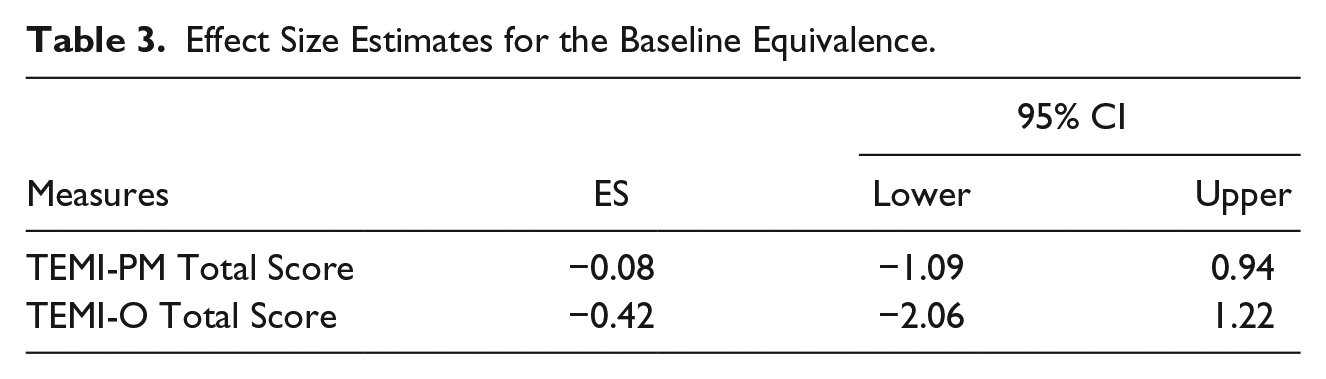
Baseline equivalence was established using preintervention test scores for all outcome measures of interest. Per the WWC’s recommendations (2017), we report standardized differences for groups’ pretest means. The differences on TEMI-PM are within tolerable limits (Effect Sizes [ES] <.08) and satisfy baseline equivalence after statistical adjustment. Differences on TEMI-O are high (ES = –.42) and does not satisfy baseline equivalence. In Table 3, we summarize the two groups’ comparability at baseline.
Effect Size Estimates for the Baseline Equivalence.
Findings for the Early Numeracy Tier 2 Intervention and ES
To determine the effect of mathematics intervention on mathematics posttest scores, an analysis of covariance (ANCOVA) model was run using treatment condition and the mathematics pretest score as covariates. We fit models in Mplus 6.0, under the assumption that data were missing at random. We used a full information maximum likelihood estimator. We calculated ES as Hedges’ g, using the coefficient corresponding to the relevant parameter as the numerator and the posttest pooled standard deviation as the denominator, per recommendations of the WWC (2017). Finally, we used the Benjamani-Hochberg correction (BH; Benjamini & Hochberg, 1995, 2000) to correct for false discovery rates (FDR) associated with multiple comparisons (Benjamini & Bogomolov, 2011).
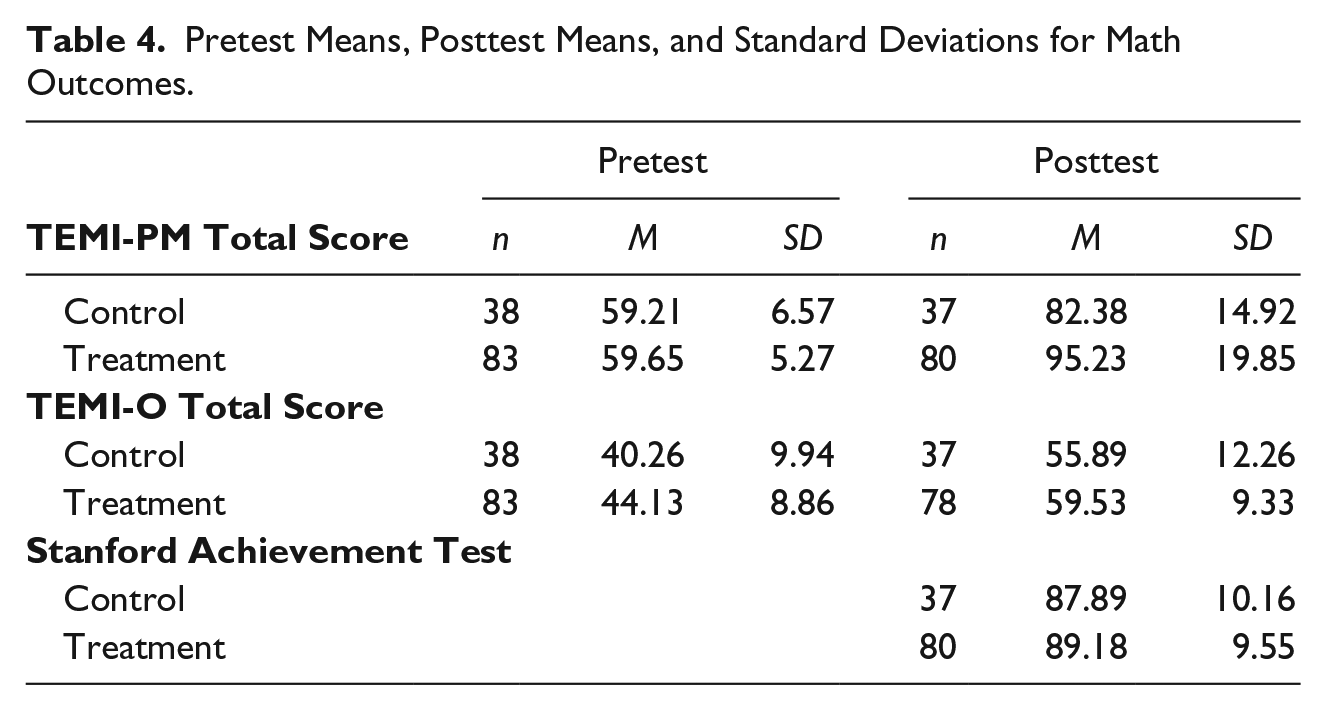
Means and standard deviations for the mathematics measures are summarized in Table 4. There were statistically significant differences between treatment and comparison groups on the TEMI-PM Total Score (β = 12.70, SE = 3.24, p = .00, FDR corrected p-value = .00). The ES was 0.66, which means that treatment-assigned students’ performance at posttest was two-thirds of a standard deviation higher than students in the comparison on average, after adjusting for pretreatment differences. This ES represents a moderate to moderately-large effect. Differences on the TEMI-O Total Score and the SAT-10 were not statistically significant (β = 1.45, SE = 2.12, p = .50, FDR corrected p-value = .51, the ES was 0.14 and β = 1.28, SE = 1.96, p = .51, FDR corrected p-value = .51, ES = 0.13, respectively). Findings are displayed in Table 5.
Pretest Means, Posttest Means, and Standard Deviations for Math Outcomes.
ANCOVA Results.
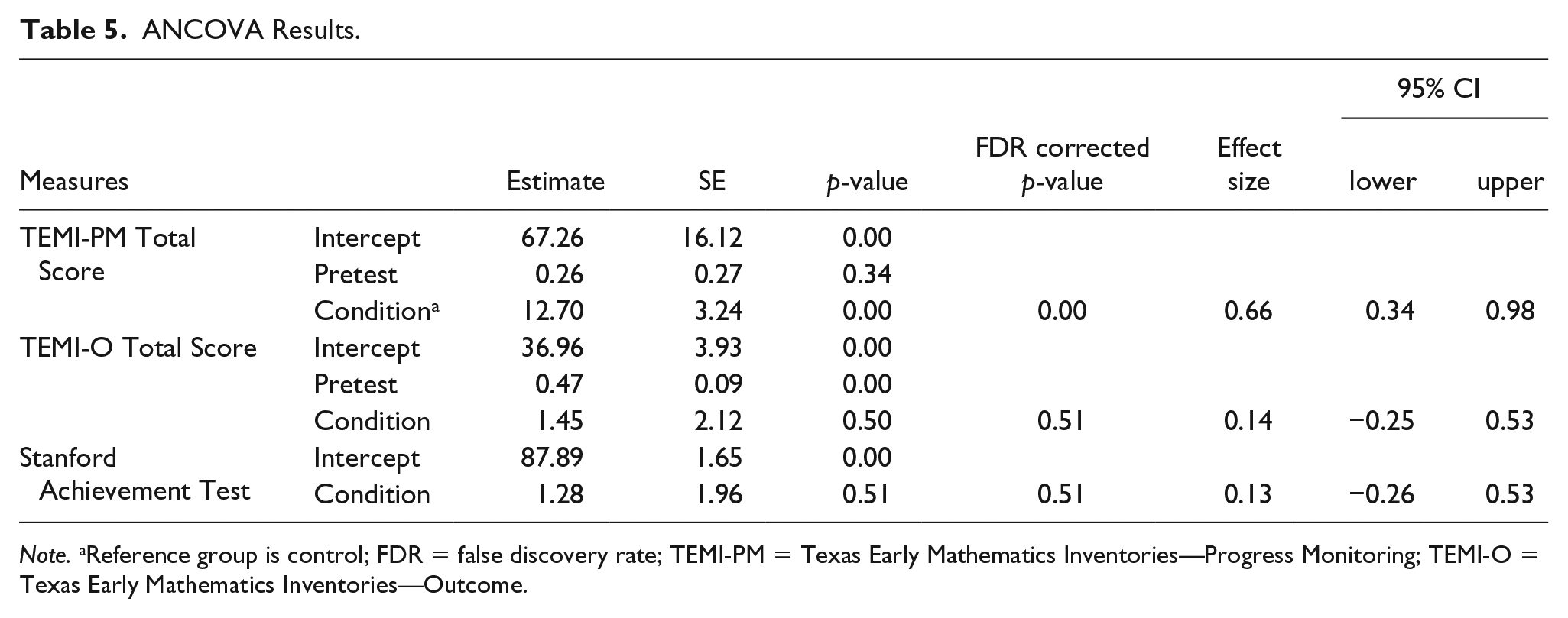
Note. aReference group is control; FDR = false discovery rate; TEMI-PM = Texas Early Mathematics Inventories—Progress Monitoring; TEMI-O = Texas Early Mathematics Inventories—Outcome.
Discussion
The purpose of this study was to determine the effects of an early numeracy Tier 2 intervention on the mathematics performance of second-grade students with persistent MD within the context of a MTSS. We focused on whole number content and explicit, systematic instructional design features to boost performance in second-grade early numeracy concepts and skills. The focus on whole number stemmed from its emphasis in the CCSSM (2010) at the elementary level and the importance of elementary level students possessing a solid foundation in whole number in preparation for work with rational numbers.
Results showed that the treatment group had greater performance gains, which were statistically significant (ES = 0.66), than the performance gains of the comparison group on the TEMI-PM Total Score. These findings are more robust than those from our first-grade intervention investigation (ES = 0.50) (Bryant et al., 2011) suggesting that a small group of students who continue to demonstrate MD after a year of early intervention, continue to require and can respond favorably to a second round (i.e., year) of intervention. The students in this study did not achieve scores on the screener above the cut score (above the 34th percentile) at the beginning of second grade and, thus, remained eligible for another round of intervention. It is plausible that it took yet a second round of an early numeracy Tier 2 intervention with continued small group, intensive work on whole number concepts and skills and evidence-based instructional design features for students to demonstrate stronger mathematics performance.
As noted in the fidelity section of this paper, none of the general education second-grade teachers had a specific Tier 2 mathematics intervention in place, thus, students with continued mathematics problems likely would not have received what they needed to foster stronger understanding and performance on whole number concepts and skills. It is not surprising that a specific Tier 2 intervention was lacking in the general education setting. Fuchs and Fuchs (2016) discussed the need for an RtI approach to differentiated instruction especially for struggling students. Citing the evidence that teachers do not systematically plan for and implement adaptations for Tier 1 (core instruction) and Tier 2 instruction, Fuchs and Fuchs argued for the use of progress monitoring data to inform a systematic differentiated instructional approach to increase student academic growth.
Given the persistent nature of MD for the group of students in this present study, their response to the second round of Tier 2 intervention is encouraging showing an educational benefit from the intervention that could possibly reduce inappropriate referrals to special education for some of these students. Although the outcome of the unanimous Supreme Court ruling from the Endrew F. v. Douglas County School District was applied to students with disabilities, FAPE, and a higher educational benefit standard aligned with IEP goals, we argue that a higher standard including presence and duration of interventions also must generalize to low-performing students who need Tier 2 (or Tier 3) interventions.
Results for the distal measures (TEMI-O and SAT-10) did not show statistically significant differences. These overall findings are similar to those in our early numeracy Tier 2 intervention for first-grade students with MD (Bryant et al., 2011). Our findings are similar to those of Clarke et al. (2014) who found positive effects on the proximal measure for their Tier 2 first-grade Fusion program. Yet, these researchers did not find statistically significant differences on a distal measure (SAT-10) although the effect was positive (Hedges’ g = 0.11). In sum, according to the summary of evidence guidelines from the WWC (2017) for characterizing findings from a study with multiple outcome measures, the overall findings from the present study can be viewed as favorable and important (i.e., statistically significant positive effect with at least one measure with an ES = 0.25).
Limitations and Future Research
Our mathematics interventionists delivered the early numeracy Tier 2 intervention to small groups of second-grade students with MD who were pulled out from their general education classes for 30 min of instruction, four days a week. Although this procedure is desirable to control for teacher effects and to foster stronger fidelity of implementation, school-based mathematics interventionists or general education classroom teachers represent more “authenticity” in terms of teaching struggling students using evidence-based intervention practices.
The question remains, when research teams depart are school-based resources available and prepared to provide the type of Tier 2 interventions that are critical for younger students. Therefore, future studies on early numeracy interventions are needed to investigate scaling up from research team interventionists to school-based personnel who must have quality professional development, coaching on demand, and adequate resources to deliver interventions to their students with persistent MD. Additionally, future research must include replication studies with different researchers to further validate (or refute) intervention programs for younger students.
Studies also are necessary to determine ways to help struggling students become more proficient with generalizing their learning about whole number content to measures that assess a broader range of mathematics domains and topics. This generalization issue becomes even more critical when states’ high stakes assessments are the measure for determining performance that warrants promotion to the next grade. Researchers must investigate ways to better prepare students with MD to transfer (generalize) their mathematical understandings to those tests and activities that have major implications for their advancement in mathematics and in school.
Conclusion
We began this paper with a brief overview of the findings of the 2017 Supreme Court ruling on the Endrew case. As espoused in the Supreme Court’s ruling regarding the child’s educational needs, interventions that show educational benefit for struggling students are necessary. We sought to foster a strong educational benefit for struggling students in an MTSS model with our second-grade early numeracy Tier 2 intervention. Findings from our investigation show that struggling students benefited from the early numeracy Tier 2 intervention with an emphasis on whole number within the context of the MTSS model. Additional research is needed on early numeracy interventions, including replication studies of our intervention, to add to the growing body of evidence (e.g., Clarke et al., 2015; Dyson et al., 2013) on validated practices for elementary level students with MD.
Footnotes
Declaration of Conflicting Interests
The author(s) declared no potential conflicts of interest with respect to the research, authorship, and/or publication of this article.
Funding
The author(s) disclosed receipt of the following financial support for the research, authorship, and/or publication of this article: This research was supported by the Institute of Education Sciences (IES), U.S. Department of Education, through a Goal 2 grant, #R324A120364, to The University of Texas at Austin.
