



Abstract
The present investigation examined the associations among thwarted belongingness (TB), emotion regulation difficulties (ERD), and posttraumatic stress disorder (PTSD) symptom severity among firefighters. First, the associations of TB and ERD with PTSD symptom severity were evaluated. Second, the indirect effect of TB on PTSD symptom severity through ERD was examined. The sample included 246 trauma-exposed firefighters (M age = 40.21, SD = 9.93, 93.1% male) who completed an online questionnaire battery. Results demonstrate significant, positive associations among TB, ERD, and PTSD symptom severity; and an indirect effect of TB on PTSD symptom severity through heightened ERD (β = 0.17; CI [0.08, 0.29]). Alternate indirect effect models were also significant, underscoring the potentially bidirectional associations of these variables. These findings suggest that there is merit in investigating the role of interpersonal factors and ERD among firefighter populations to better understand PTSD symptomatology. Clinical and empirical implications are discussed.
Introduction
Firefighters are at elevated risk for experiencing potentially traumatic events (PTEs) as well as developing posttraumatic stress disorder (PTSD) symptoms, as compared to the general population (Beaton & Murphy, 1993; Berger et al., 2012). It is estimated that approximately 91.5% of firefighters have experienced a PTE (Beaton et al., 1998; Meyer et al., 2012). Rates of PTSD among firefighters are estimated as high as 32.4%, and many more endure subclinical PTSD symptoms (Tomaka et al., 2017). To inform PTSD prevention and treatment for firefighters, it is important to understand the psychological processes that are associated with PTSD symptoms.
Social disconnectedness is one such factor with relevance to understanding PTSD among firefighters. Social disconnectedness broadly refers to limited interpersonal relationships and/or difficulties associating with a broader social group (Van Orden et al., 2012). Thwarted belongingness (TB), a dimension of social disconnectedness, is defined as a perceived unmet need of affiliation with others (Van Orden et al., 2010, 2012). Although TB was originally conceptualized as a facet of the interpersonal psychological theory of suicide (Joiner, 2007), it has been explored as an independent construct in an emergent literature not focused exclusively on suicidal ideation or behavior (Hom et al., 2017; Stanley et al., 2019). Emerging research among firefighters has demonstrated that TB and related constructs (e.g., low perceived social support) are associated with higher PTSD symptom severity (Hom et al., 2018; Stanley et al., 2019). Given the emergent literature documenting TB-PTSD symptom associations, it is clinically relevant to understand emotional mechanisms that may account for the documented associations.
Emotion regulation difficulties (ERD) offer one explanatory avenue for understanding the established association between TB and PTSD symptomatology. The positive association between PTSD symptom severity and ERD has been well-established in the literature, including among firefighter populations (Bartlett et al., 2019a; Boden et al., 2013; Hom et al., 2016). Individuals with diagnostic and subclinical PTSD manifest greater ERD, as demonstrated by self-report and experimental paradigms (Badour & Feldner, 2013), and these relations are considered to be bidirectional. Interpersonal factors such as insecure adult attachment style, low perceived social support, social exclusion, and other related social cognitive factors have been directly implicated in ERD in cross-sectional, longitudinal, and experimental research (Besser & Priel, 2010; Charuvastra & Cloitre, 2008; DeWall et al., 2011). There has been extensive experimental research within the field of social neuroscience showing how an individual’s perspective of interpersonal relationships is directly related to emotion regulation, with perceptions of greater closeness related to increased emotion regulation (Coan, 2011; Coan & Maresh, 2014). Factors that interfere with social relationships result in ERD, and ERD may manifest in greater impairment in interpersonal functioning (e.g., Coan & Maresh, 2014; Hughes et al., 2012). Interestingly, research focused specifically on relations between TB and ERD has been limited, although significant relations between TB and ERD as well as TB and ERD-related constructs, such as distress tolerance and high negative urgency, have been documented (Anestis et al., 2011; Heffer & Willoughby, 2018).
The social ecology of PTSD proposes that risk and resilience trajectories following trauma are significantly shaped by social phenomena (Charuvastra & Cloitre, 2008). The primary hypothesized mediating factors between social mechanisms and PTSD severity are related to an individual’s ability to regulate emotions (Bryant, 2016; Charuvastra & Cloitre, 2008). Indeed, social support following trauma is a well-established protective factor as it can provide emotional validation, reduce stigma, and enhance safety and trust (Bryant, 2016; Charuvastra & Cloitre, 2008). Thus, problems with social affiliation before or after trauma exposure (e.g., social disconnectedness and TB) might lead to increased ERD, and in turn, greater PTSD symptom severity. Clinically, trauma-exposed firefighters who experience greater social disconnectedness or elevated TB thus may manifest difficulty regulating negative emotions due to occupational stress or trauma-related emotional reactivity, which would in turn, elevate their experience of PTSD symptomatology. Notably, bidirectional or transactional associations among these variables are also plausible, as ERD might lead to greater TB and PTSD; and elevated PTSD symptoms might maintain ERD and lead to TB.
Taken together, several gaps were identified in the extant literature. First, no studies to date have evaluated associations among TB, ERD, and PTSD symptom severity, generally, or among firefighter populations, specifically. This line of work has potential to inform policy and interventions among firefighter populations. Second, although TB has been conceptualized as a distinct interpersonal construct in the broader literature (Hom et al., 2017; Stanley et al., 2019), thereby demonstrating its relevance to various psychological disturbances (e.g., depression and PTSD), associations between TB and ERD have been examined only in the context of the interpersonal theory of suicide (see Van Orden et al., 2010). Associations between TB and PTSD have been studied among firefighters, and the importance of camaraderie and social support in firefighter culture has been emphasized as a protective factor with regard to various negative mental health outcomes (Hom et al., 2018; Stanley et al., 2019). Third, although PTSD severity and ERD have been preliminarily studied among firefighters (Bartlett et al., 2019a), the association has not been examined in the context of interpersonal factors, such as social disconnectedness. This limits our ability to understand how elevated TB may be associated with ERD and PTSD symptom severity among trauma-exposed firefighters.
Therefore, the objective of the present study was to investigate the relations of TB with ERD and PTSD symptom severity among firefighters. First, it was hypothesized that TB will be positively associated with ERD and PTSD symptom severity. Second, it was hypothesized that ERD will be positively associated with PTSD symptom severity. Finally, it was hypothesized that TB will be indirectly related to PTSD symptom severity through heightened ERD (See Figure 1). Effects were expected after accounting for theoretically relevant covariates, including years of fire service, relationship status, and trauma load. The covariates were selected based on their associations with PTSD symptom severity in previous research among firefighter samples (Bartlett et al., 2019a, 2019b; Stanley et al., 2018). To examine whether TB is related to specific PTSD symptom clusters through ERD, exploratory analyzes were conducted to evaluate each of the clusters (i.e., Intrusion, Avoidance, Negative Alterations in Cognitions and Mood, and Alterations in Arousal and Reactivity) as outcomes.
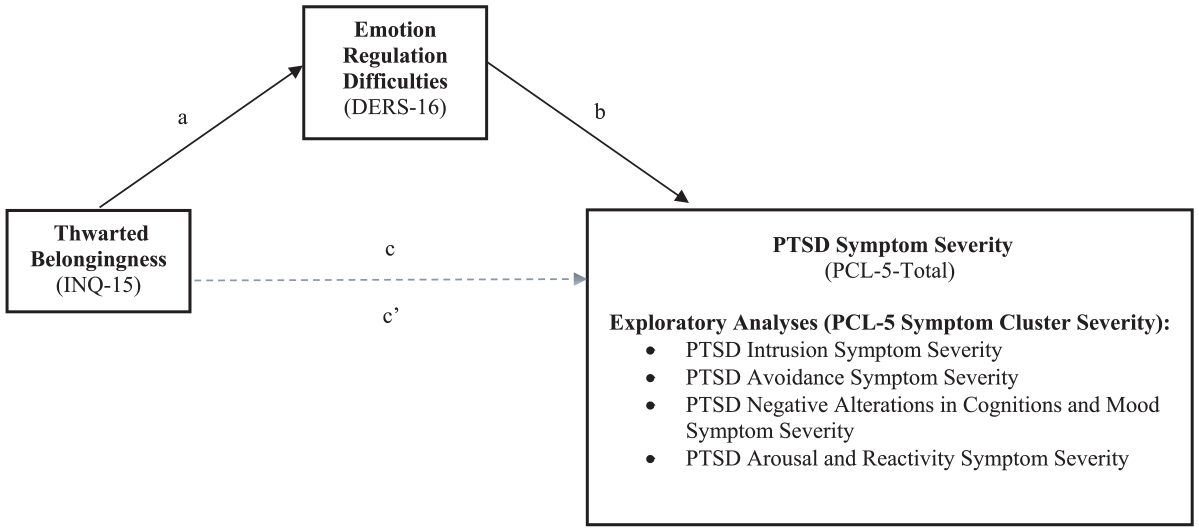
Indirect effect of thwarted belongingness on PTSD symptom severity through emotion regulation difficulties. Path “a” shows the direct effect of TB (INQ-15) on ERD (DERS-16). Path “b” shows the direct effect of ERD (DERS-16) on PTSD symptom severity (PCL-5). Path “c” shows the total effect of TB (INQ-15) on PTSD symptom severity (PCL-5). Path “c’” shows the direct effect of TB (INQ-15) on PTSD symptom severity (PCL-5) controlling for ERD (DERS-16).
Method
Participants
Sample characteristics are summarized in Table 1. This study was a secondary analysis of data from a larger ongoing project examining stress, resilience, and overall well-being among firefighters. The sample included 246 career and volunteer firefighters recruited online from career, combination (i.e., volunteer and career), and volunteer departments in Houston, Texas, and the surrounding area. Thus, participants are full- or part-time career or volunteer firefighters, including firefighters who are Emergency Medical Services (EMS) personnel. To be included in the larger ongoing study, participants had to be 18 years of age or older, be current firefighters in career, combination, or volunteer fire departments, and consent to participating in the completion of all online questionnaires. Exclusionary criteria were comprised of inability or unwillingness to provide informed consent for completing the online questionnaires. For the current analysis, participants must have endorsed at least one PTSD Criterion A traumatic life event (American Psychiatric Association [APA], 2013). Please see Procedures section for more information.
Sample Characteristics (N = 246).

Note. All reported variables were derived from the Demographics Questionnaire except where the LEC-5 (Life Events Checklist for DSM-5) and PCL-5 (PTSD Checklist for DSM-5) are noted.
Measures
Demographic questionnaire
Participants were asked to self-report demographic information including sociodemographic characteristics and firefighter service history. Years in the fire service will be included as a covariate in the present analyzes.
Life Events Checklist for DSM-5 (LEC-5)
The LEC-5 is a self-report questionnaire used to screen for potentially traumatic events experienced at any time (Weathers et al., 2013a). Respondents are presented with a list of 16 potentially traumatic events (e.g., combat, sexual assault, transportation accident) as well as an additional item assessing for “other” potentially traumatic events not listed. Respondents are asked to indicate (via check mark) whether each listed event “happened to me,” “witnessed it,” “learned about it,” “part of my job,” or “not sure.” If participants endorsed that an event “happened to me,” “witnessed it,” or “part of my job,” this was coded as positive exposure to that particular type of traumatic event. Total exposures were summed to produce a “trauma load” variable indicating the total number of traumatic life event types experienced. The total number of trauma exposure types was summed to produce the LEC-5 total score (i.e., trauma load), a covariate in the current analyzes.
PTSD Checklist for DSM-5 (PCL-5)
The PCL-5 is a 20-item self-report measure designed to measure PTSD symptom severity over the past month (Blevins et al., 2015). Respondents were asked to complete the PCL-5 with regard to the “worst” traumatic event endorsed on the LEC-5. Each of the 20 items reflects a symptom of PTSD according to DSM-5 criteria (APA, 2013). Participants are asked to rate each item on a 5-point scale (0 = Not at all to 4 = Extremely) to indicate how much they have been bothered by the symptom in the past month. Total symptom severity scores range from 0 to 80, with higher scores indicating greater symptom severity. The measure can be divided into four subscales corresponding to the DSM-5 PTSD symptom clusters: Intrusion (five items), Avoidance (two items), Negative Alterations in Cognitions and Mood (seven items), and Alterations in Arousal and Reactivity (six items). The PCL-5 has demonstrated strong psychometric properties (Blevins et al., 2015). The internal consistency of the PCL-5 total score in the current sample was excellent (α = .96). The internal consistency of each of the PTSD symptom clusters, including Intrusion (α = .89), Avoidance (α = .89), Negative Alterations in Cognitions and Mood (α = .91), and Alterations in Arousal and Reactivity (α = .89), ranged from good to excellent. The PCL-5 total score was evaluated as the main outcome, and the symptom clusters were each evaluated as outcomes in post hoc exploratory analyzes.
Interpersonal Needs Questionnaire-15 (INQ-15)
The INQ-15 measures recent unmet interpersonal needs (Van Orden et al., 2012). The INQ has two subscales, TB (consisting of nine items) and perceived burdensomeness (PB) (consisting of six items). The TB subscale is defined as the unmet need of social connectedness and the PB subscale is defined as an unmet need of social competence. Levels of TB and PB are measured on a 7-point scale (1 = Not at all true for me to 7 = Very true for me) where higher scores indicate higher levels of TB or PB. Previous research has shown that this version of the INQ has adequate construct validity and reliability (Van Orden et al., 2012). Internal consistency of the INQ-15 TB subscale total score in the current sample was good (α = .89; Cronbach, 1951). The TB subscale, an index of perceived social disconnectedness, was evaluated as the predictor variable in the proposed analyzes.
Difficulties in Emotion Regulation Scale–16 (DERS-16)
The DERS-16 consists of 16 items measuring general ERD (Bjureberg et al., 2016). Respondents indicate how often each item applies to them using a 5-point scale (1 = almost never to 5 = almost always), with scores ranging from 16 to 80 (higher scores indicate greater emotion regulation difficulties). The scale measures various facets of ERD, that when combined, yield a total score. The DERS-16 has demonstrated adequate psychometric properties (e.g., Hallion et al., 2018; Paulus et al., 2018). Internal consistency of the DERS-16 total score in the current sample was excellent (α = .97; Cronbach, 1951). As consistent with past work (Hallion et al., 2018; Paltell et al., 2019), the DERS-16 total score was used as an index of ERD.
Procedure
All firefighters were recruited for participation in the parent study through career, combination, or volunteer fire departments throughout Texas. A department-wide email was sent to current firefighters in participating combination or volunteer fire departments notifying them of the opportunity to complete an online research survey for a chance to win one of several raffle prizes (e.g., assorted gift cards). Current firefighters in the career fire department were notified of the study when accessing their continuing education (CE) online portal. All notifications across departments indicated that the purpose of the survey is to better understand strength and resilience characteristics among firefighters, and how these positive characteristics may influence overall well-being. Once firefighters accessed the portal, they were provided with a description of the survey and the choice to review the informed consent form, which delineates all aspects of the study. Across all departments, firefighters who did not wish to participate and consent to the study were given the option to indicate (by clicking “no”) that they did not wish to participate. Participants who indicated that they were interested in participating (by clicking “yes”) were directed to the beginning of the survey. Once firefighters electronically signed off on the consent form, they were presented with the online survey in Qualtrics for which they could complete at a time and place of their choosing. The total amount of time required for participation in this study was estimated to be 30 to 45 minutes. Firefighters could discontinue participation at any time without penalty. The study protocol was approved by the University of Houston Institutional Review Board and all participating fire departments.
Data Analytic Plan
Statistical analyzes were conducted using IBM SPSS version 26.0. First, data were examined for multivariate outliers, normality, and missingness. Missing variables were handled via list-wise deletion. Second, preliminary analyzes evaluated descriptive statistics and bivariate correlations among all study variables. Third, regression coefficients for each hypothesized path in the models were evaluated. These analyzes used PROCESS Macro for SPSS (Hayes, 2017) to examine the indirect association between TB (INQ-15) and PTSD symptom severity (PCL-5) through heightened ERD (DERS-16). A visual representation of this model is displayed in Figure 1. Path “a” examined the direct effect of TB (INQ-15) on ERD (DERS-16). Path “b” examined the direct effect of ERD (DERS-16) on PTSD symptom severity (PCL-5). Path “c” examined the total effect of TB (INQ-15) on PTSD symptom severity (PCL-5), and path “c prime” examined the direct effect of TB (INQ-15) on PTSD symptom severity (PCL-5) controlling for ERD (DERS-16). The model used 10,000 bootstrap re-samplings to detect the indirect effects of the predictor (TB) on the outcome variable (PTSD symptom severity) via the mediator (heightened ERD) (Hayes, 2017; Preacher & Hayes, 2004). It has been found that bootstrapping can overcome the issue of power due to nonnormality in the sampling distribution (Bollen & Stine, 1990). A bootstrap confidence interval (CI) that does not include zero provides evidence of a significant indirect effect (Preacher & Hayes, 2008). The indirect effect was computed as the product of the beta coefficients of the “a” and “b” paths. A bootstrap confidence interval that does not include zero provides evidence of a significant indirect effect (Preacher & Hayes, 2008). Effect sizes (R2) were calculated for each indirect effect (small, 0.01; medium, 0.09; large, 0.25; Preacher & Kelley, 2011). Years of fire service, relationship status, and trauma load (LEC-5) were included as covariates in the models.
Post hoc exploratory analyzes were conducted, following the same procedures as the main analysis, to examine the indirect association between TB (INQ-15) and each of the four PTSD symptom clusters (PCL-5; Intrusion, Avoidance, Negative Alterations in Cognitions and Mood, Alterations in Arousal and Reactivity) through heightened ERD (DERS-16). In order to account for multiple comparisons, a Bonferroni correction was used for the significance of the post hoc analyzes, with the standard p value of .05 being divided by four (the number of comparisons), which yields a significance p value threshold of .0125.
Finally, to test the specificity of the theoretical models and per recommendations for cross-sectional designs, two alternative models were tested. The predictor and explanatory variables were reversed (alternative model 1), and then the criterion and explanatory variable were reversed (alternative model 2) (Kraemer et al., 2008; Preacher & Hayes, 2008).
Results
Descriptive Statistics and Bivariate Correlations
Descriptive statistics and bivariate correlations among all study variables are shown in Tables 1 and 2, respectively. TB was positively and significantly associated with ERD, PTSD symptom severity, and all individual PTSD symptom clusters. ERD was also positively and significantly associated with PTSD symptom severity and all individual PTSD symptom clusters. Relationship status was negatively and significantly associated with TB, such that being in a current relationship was associated with lower TB. Years of fire service was positively and significantly associated with current relationship endorsement and trauma load, and negatively and significantly associated with TB. Trauma load was positively and significantly associated with ERD, PTSD symptom severity, and all individual PTSD symptom clusters except PTSD Intrusion symptoms.
Bivariate Correlations for Study Variables.

Note. Fire Service Years = years of service in fire department; Relationship Status = relationship Status (0 = single/divorced/widowed; 1 = married/living with partner); Trauma Load = LEC-5 total score; TB = INQ-TB subscale total score; ERD = DERS-16 total score; PTSD Symptom Severity = PCL-5 total score; PTSD-Intrusions = PCL-B subscale total score; PTSD-Avoidance = PCL-C subscale total score; PTSD-Neg Alterations in Cog/Mood = PCL-D subscale total score; Alterations in Arousal/Reactivity = PCL-E subscale total score.
p < .05. **p < .01.
Indirect Effect Analyzes
Indirect effect analyzes are presented in Table 3 (Model 1). Controlling for all covariates, TB was positively and significantly associated with ERD. ERD was positively and significantly associated with PTSD symptom severity. Regarding the association between TB and PTSD symptom severity, the total effects and the direct effects were statistically significant, as well. Through ERD, TB exerted a significant indirect effect on PTSD symptom severity.
Standard Regression Coefficients: Main Analysis, Exploratory, and Reverse Indirect Effect Models.

Note. The standard error and 95% CI for a*b is obtained via bootstrapping with 10,000 resamples. INQ-TB = INQ-TB subscale total score (Thwarted Belongingness); DERS-16 = DERS-16 total score (Emotion regulation difficulties); PCL-5 = PCL-5 total score (PTSD symptom severity); PCL-5 B = PCL-5 B subscale score (Intrusions); PCL-5 C = PCL-5 C subscale score (Avoidance); PCL-5 D = PCL-5 D subscale score (Negative Alterations in Cognitions and Mood); PCL-5 E = PCL-5 E subscale score (Alterations in Arousal and Reactivity); CI (lower) is the lower bound of a 95% CI; CI (upper) is the upper bound of a 95% CI. Per Figure 1, path a indicates effect of X on M; b, effect of M on Y; c, effect of X on Y; c’, direct effect of X on Y, controlling for M. All total, direct, and indirect paths are noted after controlling for the variance accounted for by theoretically relevant covariates, including years of fire service, marital status, and trauma load.
p < .001.
Post Hoc Exploratory Analyzes
Post hoc exploratory analyzes were conducted to examine the indirect effects of TB on each of the PTSD symptom clusters through ERD, as shown in Table 3 (Models 2–5). Controlling for covariates, ERD was positively and significantly associated with all of the PTSD symptom clusters. The total effects and the direct effects were statistically significant regarding the association between TB and all of the PTSD symptom clusters with the exception of the direct effect of the PTSD Intrusion model. The indirect effects models were significant with regard to all of the PTSD symptom clusters.
Alternative Indirect Effect Analyzes
The indirect effect analyzes for the two alternative models are presented in Table 3 (Models 6 and 7). In the first alternative model, controlling for all covariates, ERD (i.e., predictor) was positively and significantly associated with TB. TB was positively associated with PTSD symptom severity. Regarding the association between ERD and PTSD symptom severity, the total effects and the direct effects were statistically significant. Through TB, ERD exerted a significant indirect effect on PTSD symptom severity.
In the second alternative model, controlling for all covariates, TB (i.e., predictor) was positively associated with PTSD symptom severity. PTSD symptom severity was positively associated with ERD. Regarding the association between TB and ERD, the total effects and the direct effects were statistically significant. Through PTSD symptom severity, TB exerted a significant indirect effect on ERD.
Discussion
The present study examined, among trauma-exposed firefighters, associations of TB and ERD with PTSD symptom severity. Hypotheses were supported after controlling for theoretically relevant covariates of years of fire service, relationship status, and trauma load. First, TB was positively, incrementally associated with ERD and PTSD symptom severity. This is consistent with previous literature showing the association between TB and related social-emotional factors with both ERD and PTSD (Besser & Priel, 2010; Heffer & Willoughby, 2018; Stanley et al., 2019). Findings indicate that perceived or actual social disconnectedness among trauma-exposed firefighters is related to greater emotion regulation difficulties and higher levels of PTSD symptoms. Although these findings are cross-sectional and neither directionality nor temporality can be assumed, results are consistent with a growing body of work postulating that perceived or actual social disconnectedness among trauma-exposed individuals is related to both ERD and increased PTSD symptom severity potentially due to lower levels of social bonds that innately protect against these maladaptive emotion modulation processes (Charuvastra & Cloitre, 2008; Shallcross et al., 2014). Replication and extension, using longitudinal and experimental designs, with various measures of social disconnectedness, are necessary before more conclusive determinations can be drawn regarding temporality, causality, or the nature of the associations (e.g., support from peers or co-workers; romantic or familial estrangement) most relevant to ERD or PTSD.
Second, ERD was positively, incrementally associated with PTSD symptom severity, consistent with a well-established body of past research (Bartlett et al., 2019a; Hom et al., 2016). Indeed, studies have shown that individuals with diagnostic and subclinical PTSD exhibit increased ERD, and this has been demonstrated in cross-sectional (Ehring & Quack, 2010) and experimental studies (Badour & Feldner, 2013; Boden et al., 2013; Ehring & Quack, 2010). These results support a burgeoning literature among firefighters (e.g., Bartlett et al., 2019b) demonstrating that ERD are robustly related to PTSD symptoms. Future work should continue to explore this empirical avenue to better understand the temporal relations between ERD and PTSD in firefighters so as to inform evidence-based cognitive-behavioral interventions to prevent and treat PTSD in this chronically trauma-exposed population.
Third, consistent with hypothesis, TB was indirectly related to PTSD symptom severity through heightened ERD. These results are consistent with previous literature examining similar associations between social-emotional constructs and PTSD, and this work fits well within extant theoretical frameworks, such as social baseline theory and the social ecology of PTSD (Charuvastra & Cloitre, 2008; Coan, 2011). In these theoretical models, the ability to regulate emotions is proposed as a mediating factor between social bonding factors and PTSD symptom severity (Bryant, 2016; Charuvastra & Cloitre, 2008). The associations in the present study demonstrate that perceived problems with social affiliation (i.e., TB) are associated with increased ERD and greater PTSD symptom severity. However, since these results are based on cross-sectional data, no assumptions can be made about temporality or causality of associations.
Indeed, results of the two alternative models showed that reversing the predictor and explanatory variables (alternative model 1) and reversing the criterion and explanatory variables (alternative model 2) yielded significant results. This highlights the potential bidirectional and transactional associations of TB, ERD, and PTSD symptomatology, but the cross-sectional design precludes any determinations about temporality or causality. The significant results of the indirect effects for all model configurations additionally highlight general ambiguity of association patterns; and thus, the impact of the results from the primary analysis should be interpreted with caution as only one of several theoretically plausible models. Just as greater TB might lead to ERD and PTSD symptom severity, ERD might lead to elevated TB and PTSD. Furthermore, TB might lead to greater PTSD symptoms and thus higher ERD. Finally, it is also possible that PTSD symptoms in the aftermath of trauma might lead to greater ERD and TB. There is evidence that supports certain features of these varying temporal and causal associations including research on trauma and PTSD disrupting interpersonal networks as well as inducing emotion regulation difficulties (Charuvastra & Cloitre, 2008). While the bidirectionality of ERD and PTSD has been established (Badour & Feldner, 2013; Weiss et al., 2012), there has been no research examining the potential bidirectional association between TB and ERD, specifically. Future research might employ experimental paradigms, such as trauma-related cue reactivity or fear condition paradigms, to explore whether higher TB leads to greater emotion modulation or higher trauma reactivity in a laboratory setting. As firefighters represent a population chronically exposed to trauma, these results suggest that social connectedness and emotion regulation may be clinically important factors to consider in evidence-based intervention and prevention efforts for PTSD.
Notably, post hoc exploratory analyzes revealed that TB is related to each of the PTSD symptom clusters (i.e., Intrusion, Avoidance, Negative Alterations in Cognitions and Mood, Alterations in Arousal and Reactivity) through ERD. Exploratory analyzes thus failed to demonstrate any specificity of TB or ERD relations with regard to specific PTSD symptom clusters. Indeed, all four PTSD symptom clusters have been individually correlated with either TB or ERD in past work (Seligowski et al., 2016), and all are related to both constructs at the bivariate level in the present study. Limited work has considered these constructs in one overarching model, and no published work to date has specifically investigated the associations among TB, ERD, and PTSD symptom clusters. Additional work is necessary to bridge the present model with related biological systems (e.g., oxytocin system; Kim et al., 2011; Olff et al., 2013) to create a more comprehensive biopsychosocial framework for understanding these relations.
Findings should be considered in light of study limitations. First, this investigation used a cross-sectional design to test statistical mediation, which inhibits our ability to determine causality or temporality of associations among study variables. Bi-directional, transactional, and/or interactive associations are possible, as indicated by the significant indirect effects documented in the post hoc alternative models. Temporal and causal connections between psychosocial factors, such as TB, emotion regulatory processes, and PTSD remain unclear. Future research should consider tests of moderation and utilize longitudinal and experimental designs to better understand the causality and directionality of the associations among TB, ERD, and PTSD symptomatology in firefighters. Second, the study relied exclusively on self-report measures for all of the study variables. Issues of method variance and social desirability bias thus cannot be ruled out. Relatedly, we did not collect data on when each reported PTE occurred, and therefore, we cannot conclude definitively whether the variables considered (i.e., TB, ERD) temporally followed or preceded exposure to PTEs. Future research directions might include replication and extension utilizing interview-based measures of PTSD symptoms, including the month/year of exposure to the index trauma, and behavioral or physiological indices of TB and ERD, respectively. Third, the study focused on only one interpersonal construct related to social disconnectedness indexed via the INQ, TB. Future research should investigate associations of additional interpersonal constructs with potential relevance to ERD and PTSD, including PB (Short et al., 2020). Fourth, the INQ does not measure firefighter-specific perceived social disconnectedness or camaraderie, and future research could develop and include instruments that are more specific to measuring social dynamics within firefighter populations.
Fifth, the study did not specifically sample firefighters based upon interpersonal trauma histories or interpersonal index traumas, and only 31 firefighters in this sample endorsed interpersonal traumas as their index traumatic events. Interpersonal PTEs are associated with greater risk of developing PTSD (Charuvastra & Cloitre, 2008) and may affect the associations among trauma, post-trauma social support, and PTSD symptoms (Zalta et al., 2020). Future research should examine differences in PTSD symptoms among firefighters with interpersonal and non-interpersonal traumas and evaluate whether associations between TB, ERD, and/or PTSD vary as a function of the nature of the index traumas reported. Finally, the current study included a sample of career and volunteer firefighters recruited from fire departments in Texas, and the sample was socio-demographically homogeneous, comprised of mostly white (81.3%) and male (93.1%) firefighters. To ensure that findings generalize across all firefighter populations, future research should focus on national samples that include and/or over-sample women as well as racial and ethnic minorities. Such research will illuminate the role that sociocultural influences (e.g., sexual harassment, racial discrimination, racism) might have on TB, ERD, and PTSD symptomatology.
Despite these limitations, this investigation has multiple strengths. As the first study to examine associations among TB, ERD, and PTSD symptom severity, the findings provide an incremental contribution to the emergent literature. The social context of fire culture is a clinically meaningful area for further study, particularly given its relevance to trauma-relevant risk and resilience processes and the camaraderie inherent to and sustaining of the fire service (Chu et al., 2016; Regehr et al., 2003). Ultimately, this line of inquiry has the potential to meaningfully inform evidence-based intervention and prevention efforts for PTSD among firefighters. For example, incorporating social activities or social skills training into the fire academy, through in-service trainings, and ongoing discourse, can infuse the fire service with the importance of social and psychological health and wellness. An emphasis on the importance of camaraderie and social support for occupational outcomes (e.g., working efficiently) as well as mental health and wellness can be underscored along with guidelines for how to handle social disconnectedness or potential social ostracism, as a peer or as a ranked colleague (e.g., lieutenant, captain, chief). Indeed, building upon peer support programs in the fire service may be especially helpful in this regard (Dowdall-Thomae et al., 2009; Varvel et al., 2007). Furthermore, enhancing dialogues regarding mental health and emotion regulation in the fire service from the academy forward could prove fruitful in decreasing mental health stigma and cultivating a more open environment wherein discussions of emotional experiences are encouraged and expected in the context of an acknowledgement of the chronic occupational stressors faced by firefighters. Additionally, basic emotion regulation skills, such as emotional awareness and expression, can be presented, coached, and discussed along with more advanced skills, such as behavioral coping strategies for distress (e.g., Cloitre et al., 2016), either in peer support and/or via ongoing trainings. Specialized evidence-based interventions, developed for the unique needs of the fire culture, can be developed to incorporate elements of social skills as well as emotion regulation in order to offer prevention, early intervention, and ongoing cognitive-behavioral skills “toolkits” for firefighters to enhance social-emotional functioning and maintain emotion regulation in order to lower risk or maintenance of PTSD symptoms.
Footnotes
Declaration of Conflicting Interests
The author(s) declared no potential conflicts of interest with respect to the research, authorship, and/or publication of this article.
Funding
The author(s) received no financial support for the research, authorship, and/or publication of this article.
