



Abstract
Telehealth behavioral interventions are increasingly necessary when in-person services are not accessible (e.g., due to geographic location, time, cost, and health and safety restrictions). There is a growing evidence-base for the effectiveness of telehealth interventions but few demonstrations of telehealth interventions for pediatric feeding disorders. The purpose of this study was to evaluate a telehealth caregiver training package to teach caregivers to implement a feeding intervention, in their home as primary interventionists, to treat their children’s food selectivity. To address some previously documented caregiver concerns regarding some intervention procedures (e.g., nonremoval of the spoon or escape extinction) and ensure caregivers could safely/feasibility implement intervention, the intervention included differential reinforcement of bites consumed within a 3-minute opportunity. All three caregivers demonstrated high levels of correct performance following training and all children demonstrated increases in the number of bites consumed and decreases in disruptive behaviors. Findings suggest training caregivers via telehealth may be a viable option to treat some children’s food selectivity without first requiring in-person services.
Keywords
Pediatric feeding disorders affect children with a range of developmental, medical, and/or oral-motor challenges and often impact multiple areas of a child’s life including growth, family life, and skill development (Taylor & Taylor, 2021). Pediatric feeding disorders are also associated with high levels of caregiver stress and decreased self-esteem and poor confidence as a caregiver (Tereshko et al., 2021). The most commonly reported childhood feeding problem, food selectivity, occurs when children refuse to consume certain types or textures of foods (Williams & Seiverling, 2014).
Treating food selectivity often involves in-person, clinician-provided interventions that caregivers then learn to carry over at home (Peterson et al., 2021); however, telehealth interventions may offer some distinct advantages compared to clinic-based feeding services such as decreasing barriers to access services because of geographic location, time, and cost, as well as health and safety regulations related to the recent COVID-19 pandemic. In addition, as suggested by Mueller et al. (2003), telehealth interventions can involve training parents to implement a feeding protocol at home or in the natural context, which may be superior to interventions in clinic settings because the natural contingencies are in place. Observing the natural contingencies may help improve interventions targeting both child behavior and caregiver intervention integrity (Peterson et al., 2021). For example, Clark et al. (2019) modified the format of feeding intervention sessions from in-clinic to telehealth for one child after the child’s father reported difficulties with generalization to the home setting and difficulties with involvement of untrained family members at home. During telehealth sessions, the clinician communicated with the whole family resulting in the child demonstrating similar improvements in acceptance of non-preferred foods and food flexibility he had demonstrated previously in the clinic. Further, when caregivers implement intervention strategies to improve their child’s eating from the onset of intervention, they may avoid potential regression during the transition from therapists to caregivers and/or from the clinic to the home setting.
While we have some evidence to support telehealth services to treat feeding issues, there are limited data specifically evaluating telehealth caregiver training intervention packages. In-person caregiver training is effective in teaching caregivers to carryover interventions following clinician-implemented services (Bachmeyer et al., 2009; Binnendyk & Lucyshyn, 2009; McCartney et al., 2005; Pangborn et al., 2013) and even implement interventions from the onset, as primary interventionists (Alaimo et al., 2018; Anderson & McMillan, 2001; Mueller et al., 2003; Najdowski et al., 2010; Seiverling et al., 2012). For example, Seiverling et al. (2012) successfully trained caregivers using behavioral skills training (BST; instructions, modeling, rehearsal, and feedback) to implement a single-bite taste session intervention protocol with their child, resulting in increases in their child’s average percentage of bites accepted and decreases in the child’s average percentage of bites accompanied by disruptive behaviors. Alaimo et al. (2018) extended this work by adding a general case training (GCT) component to the caregiver training so that caregivers were taught to correctly respond to a range of commonly documented disruptive mealtime behaviors rather than just those behaviors their child demonstrated during the baseline phase. All three caregivers implemented the taste session protocol intervention with integrity, resulting in improved mealtime behaviors for their children.
Of the small number of studies evaluating feeding interventions provided through telehealth, most included child participants who first received feeding services for some time in-person (Peterson et al., 2015; Rivas et al., 2014; Volkert et al., 2014). For example, Peterson et al. (2021) examined archival data to evaluate the effectiveness of providing outpatient follow-up to children with avoidant/restrictive food intake disorder (ARFID). All child participants in this study initially received services at an in-person, intensive, day-treatment program. For families unable to return to the facility for follow-up because of distance, the program provided follow-up via telehealth and focused on maintenance of discharge goals and caregiver implementation of intervention. Clinicians trained caregivers using in-vivo and post-meal feedback. Outcomes for both children and caregivers were relatively equivalent for in-clinic and telehealth follow-up services, suggesting telehealth can be used not only to maintain gains made in-vivo, but to help children progress toward age-typical feeding.
We identified only one telehealth study evaluating caregiver implementation of a feeding intervention as the primary interventionists, without any direct treatment provided by a clinician. Bloomfield et al. (2019) taught one child’s mother via teleconsultation to implement a stepwise changing contingency criterion for reinforcement and guided compliance intervention after she reported being previously unsuccessful implementing escape extinction. Using guided compliance, if the child refused to consume a bite, the caregiver progressed through a series of prompts from verbal to model to physical/guided compliance (i.e., hand moved to the utensil and guided toward the mouth but not forced into the mouth). Reinforcement in the form of access to the child’s preferred tablet was provided for bite acceptance. The child responded well to the intervention (i.e., bite consumption increased) and was reported to exhibit low levels of refusal. This study not only shows that caregivers can act as the primary interventionists without prior intervention provided by a clinician, but also suggests the importance of carefully choosing intervention strategies so they are feasible for caregivers to implement.
It is important to note that while the guided compliance intervention described in the study above was demonstrated to be effective, some children may exhibit high levels of inappropriate behavior, which may make procedures like physically prompting the child to eat the presented food and escape extinction difficult to implement with integrity (Seiverling et al., 2011). Escape extinction, or nonremoval of the spoon, involves caregivers not terminating bite presentations immediately contingent on their child’s disruptive mealtime responses. Typically, caregivers would continue to present the bite until it is consumed. Caregivers may view this procedure as unacceptable (Gentry & Luselli, 2008; McCartney et al., 2005). Vazquez et al. (2019) not only found that parents rated escape extinction as the least acceptable and least preferred intervention strategy to address their children’s challenging behavior, but also that parents rated another common component of intervention, differential reinforcement of alternative behavior, as the most preferred and most acceptable strategy.
Alternatives to escape extinction interventions have been successful for some populations of children with feeding disorders, indicating these procedures may be more appropriate for specific behaviors or specific severity of behaviors (Tereshko et al., 2021). For example, Trejo and Fryling (2018) implemented two variations of a high-probability response sequence and successfully improved consumption and reduced inappropriate mealtime behaviors without ever adding extinction as a component of intervention. However, the researchers reported inappropriate mealtime behaviors rarely occurred. Other successful alternatives have included shaping (Cosbey & Muldoon, 2016), shaping combined with differential reinforcement (Hodges et al., 2017), simultaneous presentation (Whipple et al., 2019), simultaneous presentation combined with stimulus fading (Cho & Sonoyama, 2020), as well as modeling (Hillman, 2019; O’Connor et al., 2020).
The purpose of this study was to evaluate a telehealth caregiver training package to teach caregivers of three children to implement a food selectivity intervention using an alternative to escape extinction or nonremoval of the spoon procedure. Rather than presenting bites until consumed, caregivers were trained to provide their child with a 3-minute opportunity to earn access to highly preferred items and/or activities contingent on consuming a single bite.
Method
Participants
Three caregiver-child dyads participated after responding to a web-based posting identifying an opportunity for caregiver training via telehealth in interventions to address to their child’s food selectivity. Inclusion criteria to participate in the study included (1) the child participant demonstrated food selectivity (i.e., refusal to eat certain types or textures of foods; (Williams & Seiverling, 2014), (2) the child participant chewed adequately for their age by chewing a range of textures such as fries and/or meat during an initial observation, and (3) the child participant engaged in some disruptive behaviors (e.g., saying, “No!” or pushing the food away, crying, yelling, gagging) when presented with new or non-preferred foods. Exclusion criteria included (1) the child demonstrated oral-motor skill deficits, (2) the child did not have a history of oral feeds, and (3) the child had any underlying medical concerns that prevented them from being medically cleared to participate in the study.
Before participating in the study, caregivers obtained medical clearance from their child’s gastroenterologist or pediatrician. All caregivers who participated in the study were those who most frequently and consistently fed the child (or presented meals to the child) prior to the start of intervention. Each caregiver had consistent and reliable access to a computer with audio and video capability as well as internet access. Prior to participating, caregivers completed an assessment of their knowledge about applied behavior analysis (ABA) to determine their baseline level of pre-existing experience of the field.
Helen, 42-years-old, and her son Nathan, 13-years-old, participated. Helen was a teacher. She had less than one semester of coursework in ABA but no degree or certification/license in ABA. Helen reported she had never implemented any teaching or interventions using ABA. Nathan was a typically developing male diagnosed with gastroesophageal reflux (managed with medication) and seasonal allergies with a history of food selectivity. Nathan was in the 50th percentile for weight and did not rely on supplemental formulas. Helen reported that Nathan appeared anxious when in social situations and presented with non-preferred foods. He demonstrated age-appropriate communication and learning skills. Prior to the study, he consumed approximately 20 foods including French fries only from one restaurant, some candies and chips, cheese, several fruits and vegetables, specific breads, and few meats. He did not like to mix even preferred foods and was rigid with brands and types of foods.
Niky, 36-years-old, and her 5-year-old son, Mason, participated. Niky was in the process of earning her certification as a registered behavior technician with one semester of coursework in ABA so far. She also reported 1 to 6 months of experience teaching or implementing interventions using ABA. Mason was diagnosed with ASD and eczema and was in the 58th percentile for weight. He was non-verbal and was just beginning to use an augmentative communication system. Prior to the study, he consumed vanilla Pediasure©, chicken and fries from a specific restaurant, and rice puffs. He was consuming about five servings of Pediasure© per day.
Pedro, 44-years-old and his 15-year-old son, David, participated. Pedro worked as a police officer. He reported no prior coursework, experience implementing ABA interventions, or any certifications/licenses in ABA. David was diagnosed with ASD and had a history of constipation. We were unable to collect percentile for weight data, but David’s father did not report any weight concerns. David vocally indicated when he was hungry and requested specific foods. He followed simple instructions and imitated a model. Prior to the study he consumed pepperoni, fried chicken strips, French fries, pasta, bread, pizza, grilled cheese, beef ravioli, apples, pineapple, broccoli, and collard greens. David showed preferences for specific brands and types of food as well.
Setting and Materials
The study was approved by the City University of New York Institutional Review Board. All sessions took place in designated eating areas in the participants’ homes with the experimenter participating via Zoom© videoconferencing. The experimenter and caregivers used computers or tablets with audio and video capability as well as internet access. Children sat in the chairs available in the eating areas of their homes. Each caregiver conducted one to four sessions each day based on their availability. Caregivers used dishware and utensils available in their homes.
Caregivers helped identify target foods eaten by the family, but not by the child. Mason’s target foods were apple, carrots, peas, rice, and roti. David’s target foods included kale, sweet potato, grilled chicken, salmon, and baked potato. Given Nathan’s age and skill repertoire, he participated with his parents in identifying target foods. Initially, his mother identified 10 foods eaten by the family and not by Nathan. His mother than presented him with the list of 10 foods and asked him to select 5 foods he would like to work on tasting. Nathan then selected strawberry jam on bread, blueberry muffin, green beans, potatoes, and white rice as his target foods. Nathan’s rapid progress allowed us to examine five additional foods which he selected from another list of foods his mother identified (beginning post-training session 7). His additional target foods were presented every other session and included hamburger, sausage, fried potato, bell peppers, and rice pilaf. Although Nathan chose rice pilaf, he reported that he did not like it and engaged in disruptive behaviors. During post-training session 8, another rice dish was tried but Nathan continued to express his dislike. He opted to replace the rice dishes with grilled chicken during follow-up session 2. Caregivers prepared and presented all target foods throughout all phases of the study using materials available in their homes. The target foods were presented in across caregiver-implemented baseline and post-training sessions for each child participant.
The children and/or caregivers identified highly preferred items and/or activities as rewards for bite consumption. We did not use a formal preference assessment as all three child participants either vocally requested preferred items and/or activities or consistently gravitated toward a limited range of preferred items and/or activities during initial observations. Nathan’s preferred items and/or activities included Dairy Queen Desert or computer time. Mason’s preferred items and/or activities included tablet access and preferred foods (i.e., chicken nuggets and fries). David’s preferred items and/or activities included tablet access and preferred foods (i.e., chips and cookies).
Interventionists
The first author, a Board Certified Behavior Analyst and student in a doctoral program in psychology specializing in behavior analysis, trained the caregivers.
Dependent Measures
The experimenter video recorded all baseline, assessment, post-training sessions, and follow-up sessions. The experimenter and research assistants observed video recordings to score both caregiver and child behavior.
Caregiver behavior
We examined caregiver completion of the steps (See Table 1) indicated by the intervention to target their child’s food selectivity. The 10-bite taste session intervention protocol was derived from Alaimo et al. (2018) and included differential reinforcement of alternative behavior (DRA) for bite consumption. The intervention protocol was modified to use an alternative to traditional escape extinction. Rather than presenting bites until consumed as done with escape extinction or nonremoval of the spoon procedures, caregivers were trained to provide their child with a 3-minute opportunity to earn access to highly preferred items and/or activities contingent on consuming a single bite. If the child consumed a bite within 3 minutes, they were provided a break with access to highly preferred items and/or activities. If the child did not take a bite within 3 minutes, they were provided a break in the absence of highly preferred items and/or activities. If a bite was expelled, caregivers were trained to represent the bite as done with escape extinction, but only until the 3-minute opportunity elapsed. When the timer beeped, the bite was removed immediately if it had not yet been consumed.
Correct Caregiver Behavior of 10-Bite Taste Session Intervention Protocol.

We then calculated the percentage of correctly implemented steps of the intervention protocol out of total applicable steps for that session. Not applicable steps refer to steps of the intervention protocol the caregiver would not be expected to implement because their child did not engage in a particular behavior. For example, the step to re-present expelled bites was not applicable if the child did not expel the bite of food. All caregivers offered their child a break following each bite presentation. The breaks included access to highly preferred items and/or activities if the child consumed the bite. Child participants could request to skip breaks and/or earn delayed access to preferred items and/or activities. For example, Nathan earned 5 to 15 minutes of computer access for each bite consumed; he chose to access the computer after sessions.
Modifications for Helen and Nathan
Nathan’s performance in response to intervention resulted in his consumption of sequential bites of food with little pause between bites, reflecting eating during a typical meal. Given this observation, during the second session in post-training, we modified the intervention steps. The step involving praise for each bite consumed was modified to praise at least one time during a 10-bite taste session. There was also no concern for packing that would necessitate a clean mouth check, so the experimenter omitted that step.
Based on his age and skill level, Nathan was able to request delayed access to reinforcement and reported preferring this. Nathan consistently requested computer time contingent of bite consumption (i.e., 5–15 minutes per bite) which he could access any time after meal sessions. During one session, Nathan requested earning a trip to Dairy Queen where he could order a highly preferred desert. He earned one point for each bite consumed, and if he consumed all 10 bites within a session, he was able to earn the trip.
Modifications for Niky and Mason
Given that packing was not a concern we omitted the step for a mouth clean check for Mason and Niky. Mason consumed his reinforcers after each bite presentation. Mason was offered his tablet and preferred foods Niky presented on a plate (i.e., French fries and chicken nuggets) and was able to consume either one or both on his breaks if he consumed a bite.
Child behavior
Bite consumption was defined as the child swallowing the bite at some point during the 3-minute trial (i.e., no food visible in the mouth during a check). The experimenter reported the total number of bites consumed during each session implementing the 10-bite taste session intervention protocol.
Disruptive behaviors for each bite presentation included: refusal (e.g., child pushes spoon or feeder’s hand away, hits the feeder on the hands, arms, face, or upper body, or turns the head 45° away from spoon in any direction, changes food, elopes/leaves before swallowing the bite or before the timer beeps, negotiates either the target food or preferred item/activity, and/or does not consume bite), negative vocalizations (e.g., crying, yelling, negative statements regarding bites, expressions of disgust like, “ew!” or “gross”), expelling food (i.e., any occurrence of food larger than the size of a pea that previously entered the child’s mouth being beyond the lips), gagging (i.e., any retching, both silent and audible, that occurs during a bite presentation or after food entered the child’s mouth), emesis (i.e., ejection of matter/food previously swallowed through the mouth), and packing (i.e., the child swallows the bite after 45 seconds from the bite entering the mouth or holds the bite in their mouth and does not swallow). Disruptive behaviors were scored independent of bites consumed. For example, a child could consume the bite and still engage in disruptive behaviors. We reported the percentage of bites with disruptive behaviors for each 10-bite taste session protocol.
Experimental Design
We used a non-concurrent multiple baseline design across caregiver-child dyads with the following sequential phases: (a) caregiver-implemented baseline, (b) training, (c) post-training caregiver-implemented intervention sessions, and (d) follow-up intervention sessions. Following recommendations from Watson and Workman (1981), the experimenter randomly assigned participants to one of three pre-determined numbers of sessions of baseline sessions.
Procedure
Pre-baseline assessment
The experimenter conducted a caregiver interview and meal observation prior to the onset of baseline to observe the child’s disruptive behaviors and determine the appropriateness of the intervention protocol using exclusion and inclusion criteria for all child participants.
General procedures
The experimenter instructed caregivers to restrict their child’s access to preferred foods at least 1 hour before baseline and post-training intervention sessions and between consecutive intervention sessions to increase the child’s appetite. All children had access to a preferred drink (Paul et al., 2007; Pizzo et al., 2009) throughout the 10-bite taste session intervention protocol, including immediately following bite consumption. All children could take additional bites and take bites larger than crumb-size (i.e., no larger than grain of rice), if requested, or self-feed bites any point during the study. If a child engaged in elopement behavior at any point during post-training, the experimenter provided suggestions for how to safely direct the child back to the eating area and how to reduce the likelihood of elopement occurring again.
Caregiver-implemented baseline
The experimenter provided caregivers with a written task analysis to implement the 10-bite taste session intervention (see Table 1). Caregivers conducted the 10-bite taste session with their child to the best of their abilities and without any additional support from the experimenter.
Caregiver training
Caregiver training included BST and GCT as well as video models to train caregivers in the protocol-specific procedures. All the training was conducted via telehealth. The experimenter used instructions, modeling, rehearsal, and feedback as indicated in BST; GCT was incorporated into the modeling and rehearsal components. This was done by developing five training scripts (see Table 2) that sampled the range of commonly documented child mealtime behaviors (Williams et al., 2010) the caregiver may encounter during meals with their child as in Alaimo et al. (2018). For example, in script A, the child accepted a bite within 10 seconds and demonstrated a mouth clean, while in script D, the child did not accept the bite within 10 seconds and did not take the bite within 3-minute, gagged, and attempted to get out of the seat. The training scripts provided caregivers with an opportunity to practice how to respond in different situations. A video model was created for each of the training scripts, which all included the experimenter modeling caregiver behavior and a doctoral student in behavior analysis simulating child behavior. The experimenter used the same video models for Mason and David; however, the experimenter modified the language used to provide instructions to Nathan so that they were appropriate for his skill level and based on the disruptive behaviors he engaged in during baseline. For example, in one script, the simulated negative vocalization from the child was, “No, no thank you,” for Mason and David, but “Oh, that’s gross! Why do I have to even do this, it’s unhealthy!” for Nathan.
Scripts That Sample the Variety of Discriminative Stimuli and Responses That May Be Encountered During an Intervention Session.

BST phases
First, the experimenter read aloud and explained each step in the 10-bite taste session intervention protocol and answered any questions the caregiver had regarding the procedures. Next, the experimenter presented the five video models in order from A through E. After viewing the video models, the experimenter instructed the caregiver to practice responding to their child’s behavior just like they had seen in the previous video models. This was done through the screen. The caregiver held up the spoon to the camera on the screen and acted as if they were feeding the experimenter. The experimenter then selected a script and simulated the child’s behavior within that script while the caregiver practiced implementing the 10-bite taste session intervention protocol. After the caregiver rehearsed one script, the experimenter immediately provided feedback based on caregiver performance. Feedback included several comments regarding correct performance (e.g., saying, “Great job checking for a mouth clean before allowing access to preferred toys!”), and several comments regarding incorrect performance (e.g., saying, “Next time, try to ignore any gagging or crying and only provide attention after your child takes the bite.”) if applicable.
After rehearsal and feedback for all five scripts, the caregiver completed an assessment in which the caregiver performed the procedures of the 10-bite taste session intervention protocol for one bite presentation while the experimenter simulated child behavior for each script selected randomly. There was no feedback presented during the assessment. The experimenter set the assessment mastery criterion as at least 90% correct performance. The entire sequence of training was completed in approximately 1 hour 20 minutes for Helen, 1 hour 30 minutes, and 1 hour for Pedro.
Post-training caregiver-implemented intervention sessions
Post-training sessions were conducted in the same manner as baseline. During post-training sessions, the caregiver independently implemented the 10-bite taste session intervention protocol with their child. The experimenter was present via Zoom© to answer any questions but did not otherwise provide any components of GCT and BST package during post-training sessions.
Modifications for Helen and Nathan
During post-training, Helen began incorporating the additional target foods into sessions. Beginning with session 7, Helen alternated days conducting one session with the initial target foods only and days with two sessions, a session with the initial target foods and a session with the additional target foods. Based on self-reports of non-preference and request to swap out target foods, one target food was replaced two times (i.e., rice in session 11 and grilled chicken in follow up session 13), which resulted in some response variability. During days with two sessions, the experimenter provided Nathan a choice of which set of target foods he would like to begin with: the initial target foods or the additional target foods. Nathan consistently self-fed throughout the study and sometimes independently consumed bites larger than rice sized. For example, he would sometimes grab extra bites off the plate and consume them simultaneously or request extra bites of specific target foods at the end of the 10-bite taste session. However, his mother only instructed him to take rice-size bites to earn access to his highly preferred items and activities.
Modifications for Niky and Mason
During the first three post-training sessions Mason did not consume any bites of food and continued to engage in high levels of disruptive behaviors. Mason also demonstrated elopement from his chair during sessions, so the experimenter recommended to Niky that she arrange Mason’s chair in a corner of their dining room to decrease the possibility of eloping. Consistent with Patel et al. (2007), we modified intervention to empty spoon presentations in the absence of target foods. Niky presented Mason with an empty spoon for post-training sessions 9 through 12. As disruptive behavior decreased, Niky placed the target foods on the table to facilitate tolerance of target foods being visible (sessions 13 and 14; Tanner & Andreone, 2015). When Mason met the criterion of 20% or fewer disruptive behaviors per session for three out of four sessions, Niky resumed presenting target foods on the spoon (starting session 15).
Follow-up
Following post-training, the experimenter instructed each caregiver to continue to present target foods using the 10-bite taste session intervention protocol at least one time each day. During follow-up, the experimenter observed one session each week for 2 to 3 weeks.
Social Validity
Caregivers completed social validity questionnaires prior to baseline and after the last follow up session. Caregivers rated (1) their current knowledge of teaching their child to taste new foods, (2) their child’s current tasting of new foods in the last week, (3) how effective they think BST techniques will be/were, (4) which component of BST they think will be/was most helpful, (5) how effective they think teaching through telehealth will be/was, and (6) how effective they think the overall teaching will be/was. The post-measure included an additional rating of their overall participation in the study. Caregivers rated each item on a Likert scale from one (poor) to five (excellent).
Interobserver Agreement (IOA)
A trained student research assistant and doctoral student observed at least 30% of baseline, post-training, and follow-up sessions for IOA. The experimenter defined an agreement for caregiver behavior as both observers indicating that the caregiver’s performance for each step was either correct or incorrect out of applicable steps. IOA was calculated for caregiver performance by dividing the total number of agreements by the total number of agreements and disagreements and multiplying by 100. IOA across all phases was 97% for Helen (range, 88%–100%), 99% for Niky (range, 96%–100%), and 99% for Pedro (range, 94%–100%).
The experimenter also collected IOA data for child behavior. The experimenter defined an agreement for child behavior as both observers indicating the behavior occurred or did not occur during that trial. For example, the experimenter and the observer both indicated bite consumption did not occur at any point during a trial. IOA per session was calculated by dividing the number of agreements by agreements plus disagreements and multiplying by 100%. The IOA for consumption was 100% for Nathan, Mason, and David. The IOA for disruptive behaviors was 100% for Nathan, 98% (range, 90%–100%) for Mason, and 98% (range, 90%–100%) for David.
Intervention Integrity
The experimenter provided the same research assistant and doctoral student calculating IOA with two different intervention integrity checklists: one for baseline, post-training, and follow-up sessions and another for training. The observers observed the entire training session to ensure all intervention components were implemented correctly. The observers also observed at least 30% of baseline, post-training, and follow-up sessions for all three participants to ensure no components of the intervention (i.e., instructions, modeling, rehearsal, and feedback) were implemented. Intervention integrity was calculated by dividing the number of correctly performed steps by the experimenter by the total number of steps and multiplied by 100. The mean intervention integrity for the caregiver training was 100% for all caregivers. The mean intervention integrity for baseline, post-training, and follow-up was also 100% for all caregivers.
Results
Figure 1 shows the percentage of correctly performed steps for each caregiver across baseline, assessment, post-training, and follow-up sessions. All caregivers demonstrated low levels of correct performance in baseline. The mean percentage of correctly performed steps during baseline (with only written instructions presented to caregivers) was 11% (range, 10%–13%) for Helen, 0% for Niky, and 1% (range, 0%–9%) for Pedro. All caregivers demonstrated difficulties presenting 10 bites as well as responding to disruptive behaviors.

Caregiver performance.
All caregivers scored 100% correct performance during the assessment. Compared to baseline, caregiver performance increased during post-training sessions and remained at stable, high levels across all caregivers with very little variability. The mean percentage of correctly completed steps during post-training sessions was 97% (range, 97%–100%) for Helen, 90% (range, 34%–100%) for Niky, and 96% (range, 80%–100%) for Pedro. All caregivers also demonstrated maintenance of correct performance across all three follow-up sessions, even for Helen during sessions with additional target foods with Nathan. The mean percentage of correctly completed steps during follow-up sessions was 97% (range, 97%–100%) for Helen, 78% (range, 75%–80%) for Niky, and 99% (range, 98%–100%) for Pedro.
Figure 2 shows the number of bites consumed across sessions for Nathan, Mason, and David, respectively. During baseline, Nathan consumed an average of 3 bites (range, 2–5 bites) from the 10-bite taste session intervention protocol across sessions; however, due to incorrect caregiver implementation of the procedure (prior to caregiver training) during session one, he chose to consume 9 additional bites of white rice. Because he was only supposed to be presented with 2 bites of that food during the procedure, the additional bites consumed of the white rice are not depicted on Figure 2. He only consumed 1 bite each of potato, jelly on bread, and green beans, and never chose to eat the blueberry muffin. During post-training and follow up, Nathan consumed an average of 10 bites for the initial target foods, and an average of 9 bites (range, 8–10 bites) for the additional target foods. Except for session 7 during post-training when additional target foods were added, Nathan consistently chose to continue consuming bites after the 10-bite session (not included on the graph).

Child behavior: bites consumed.
Mason did not consume any bites across all five baseline sessions. During post-training and follow up, Mason consumed an average of 8 bites (range, 0–10) and 9 bites (range, 9–10) across sessions, respectively. Mason’s mean percentage of bites with disruptive behaviors in baseline was 100%. Mason’s mean percentage of bites with disruptive behaviors in post-training was 58% (range, 0%–100%). The range varied greatly due to the empty spoon modification.
During baseline, David consumed an average of less than 1 bite (range, 0–2 bites) across sessions. During session 6 of baseline, he consumed 2 bites of kale and did not taste any of the other target foods. Due to incorrect caregiver implementation of the procedure in that baseline session, he consumed three more bites of kale (not depicted on Figure 2). During post-training sessions, David consumed an average of 10 bites (range, 9–10 bites) across sessions. David consumed all 10 bites presented to him across all follow-up sessions.
Figure 3 shows the percentage of bites with disruptive behaviors across sessions for Nathan, Mason, and David, respectively. Nathan’s mean percentage of bites with disruptive behaviors in baseline was 87% (range, 60%–100%). Nathan’s mean percentage of bites with disruptive behaviors in post-training was 5% (range, 0%–20%) for the initial target foods and 50% (range, 40%–60%) for the additional target foods. Nathan’s mean percentage of bites with disruptive behaviors in follow-up was 3% (range, 0%–10%) for the initial target foods and 17% (range, 0%–40%) for the additional target foods.
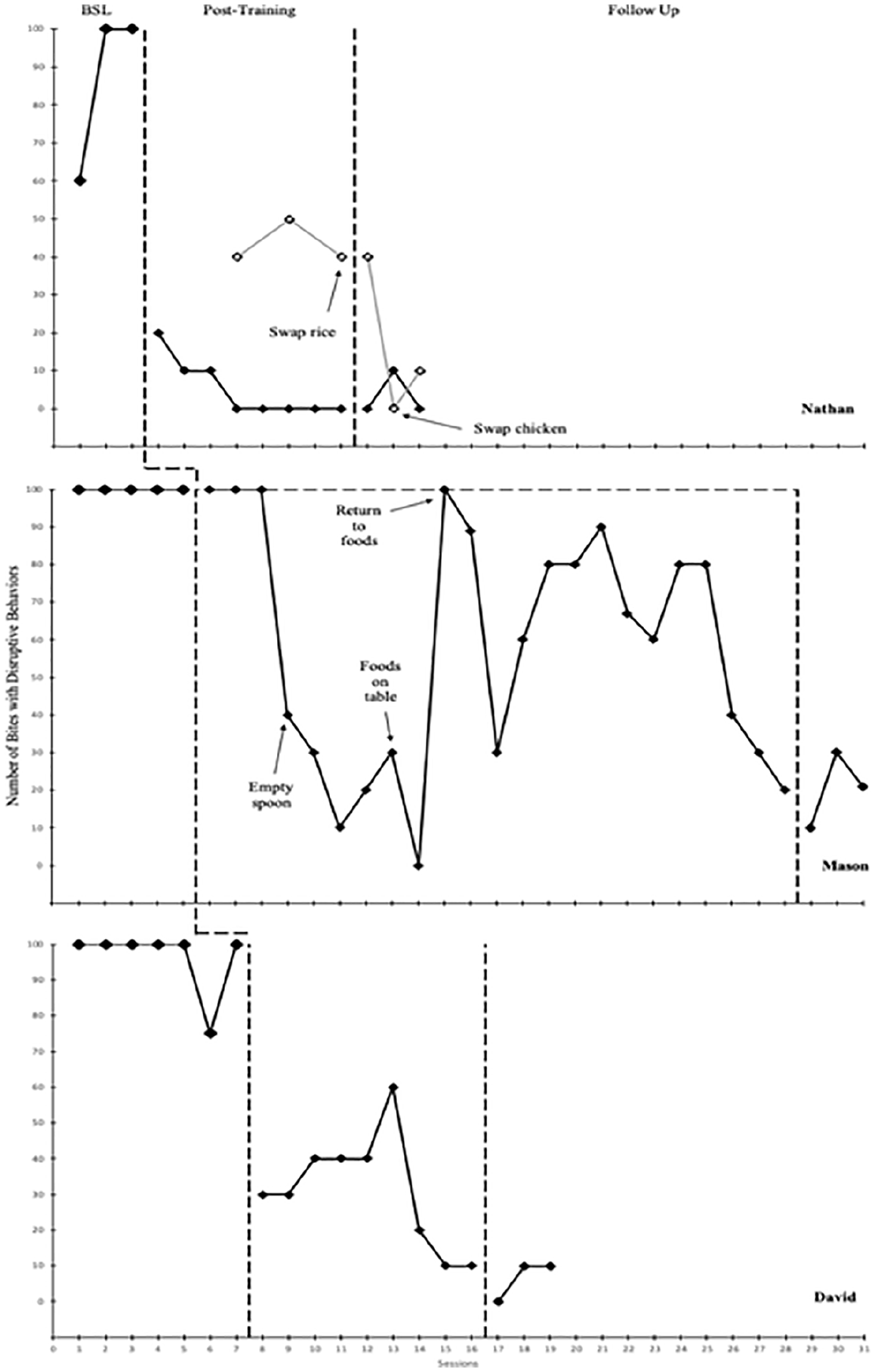
Child behavior: disruptions.
Mason’s percentage of bites with disruptive behaviors decreased initially with the modifications to empty spoon trials, then increased again upon return to target foods, and did not decrease again until the last three sessions in post-training. Mason’s mean percentage of bites with disruptive behaviors in follow-up was 20% (range, 10%–30%).
David’s mean percentage of bites with disruptive behaviors was 96% (range, 75%–100%) in baseline, 31% (range, 10%–60%) in post-training, and 7% (range, 0%–10%) in follow-up.
Social validity
All caregivers rated their knowledge and effectiveness of training and telehealth as excellent post-intervention (Table 3). All caregivers also reported improvements in their child’s skills. Pre-intervention, caregivers thought modeling and feedback were likely to be the most helpful components of training; post intervention, Helen and Niky thought feedback was the most important and Pedro continued to report that modeling was the most helpful. All caregivers also rated their overall experience participating as excellent.
Parent Responses on the Social Validity Questionnaire From 1 (Poor), 2 (Fair), 3 (Good), 4 (Very Good), 5 (Excellent).

Discussion
In this study we demonstrated the effectiveness of telehealth caregiver training in a feeding intervention with an alternative to escape extinction or nonremoval of the spoon for children with food selectivity. All three caregivers demonstrated high and stable levels of correct performance implementing the 10-bite differential reinforcement for bite consumption taste session intervention protocol following caregiver training. Their performance maintained in the follow-up phase. Caregivers also reported telehealth training and the intervention were effective.
Findings suggest telehealth is a viable option to train caregivers not only to carry over interventions, but to serve as primary interventionists implementing a pediatric feeding protocol for food selectivity. Telehealth training resulted in clinically significant outcomes, similar to those reported in previous studies when clinicians implement intervention. All three child participants demonstrated both increases in bites consumed and decreases in disruptive behaviors from baseline to post-training. While Mason remained at crumb-size bites through the follow-up phase of intervention, Nathan and David progressed to age-appropriate bite sizes. These outcomes were produced by teaching caregivers an alternative to escape extinction or nonremoval of the spoon, which is a common component in feeding interventions. This choice was made considering the feasibility of caregivers implementing the intervention in their home. All three caregivers rated the effectiveness of the telehealth teaching and their overall experience as excellent, suggesting these types of interventions are acceptable for families. In this alternative to escape extinction intervention, bites were not removed immediately contingent on disruptive behaviors, nor were they presented continuously as done with nonremoval of the spoon procedures. However, it can be argued that the delay in the removal of the food for a certain period (i.e., 3 minutes) could serve as a modified form of escape extinction as the food may still be presented briefly while the child is engaging in disruptive behaviors. Therefore, future researchers should further examine this type of alternative to nonremoval of the spoon (escape extinction) procedure with reinforcement provided contingent on bite acceptance or consumption within a predetermined period to determine the effectiveness of the procedure with varying amounts of time to accept the bite (e.g., 1 minute vs. 10 minutes). Future researchers should also further examine the behavioral mechanisms responsible for behavior change. For example, the procedure may serve as an extinction procedure for children with short durations of disruptive behavior as they are less likely to encounter the actual removal of the bite, while it may not serve as an extinction procedure for other children who exhibit longer durations of disruptive behavior.
Like previous research (Alaimo et al., 2018; Seiverling et al., 2014), some child participants required modifications to the 10-bite taste session intervention protocol to meet their clinical needs. For example, we modified intervention to empty spoons for Mason when his levels of disruptive behaviors were high, and he consumed no bites of food. Importantly, these modifications did not include the addition of escape extinction as in earlier studies (Ahearn, 2003; Piazza et al., 2002) and may have helped us avoid needing escape extinction or nonremoval of the spoon. Rather than implementing escape extinction or nonremoval of the spoon at some point in the post-training phase, we incorporated additional antecedent strategies to increase overall consumption of new or non-preferred foods, similar to Cho and Sonoyama (2020) in which a simultaneous presentation component was added to a stimulus fade-in of non-preferred foods when outcomes were initially unfavorable. The researchers then reported 100% consumption of three non-preferred foods following the addition of a second antecedent strategy. Findings contribute to the growing literature supporting interventions that do not include escape extinction.
However, feeding disorders encompass a wide range of feeding problems, some presenting with more severe challenging behaviors, oral motor skill deficits, and/or medical complexities. Those feeding problems may be better treated with escape extinction or nonremoval of the spoon and/or the direct assistance of a trained clinician. For example, while Mason did make progress consuming crumb-size bites of target foods with a decrease in disruptive behaviors, he required more sessions that the other participants to produce behavior change. Mason also consumed the least number of foods and was dependent on supplemental formula prior to participating in the study, suggesting the severity of his food selectivity may have required greater intensity of intervention for similar treatment outcomes to the other participants. It is also important to note two of the three caregivers in the study had some previous experience with ABA, which may have impacted their learning. Future researchers should investigate ways to identify appropriate interventions and involve clinicians and caregivers with various skill levels both in-person and via telehealth for various subpopulations of children with feeding disorders.
Findings suggest several potential advantages of telehealth caregiver training. First, telehealth is an important option for those who cannot access interventions in person. Caregivers who participated in the study ranged in their location from local to the researchers, in a different time zone but the same country as the researchers, to in a different country much farther away and with limited access to local behavioral interventions. This underscores the importance of telehealth to increase access to evidence-based interventions for those in locations without such in-person services.
Second, telehealth may enhance maintenance of caregiver implementation of intervention. All three caregivers maintained high levels of correct performance during the follow-up phase, in contrast to Alaimo et al. (2018) where caregivers received similar training but in-person, but gains were not maintained over time for all caregivers. The lack of decreases in correct caregiver implementation of the intervention during the follow-up phase in this study also meant we did not have to provide ongoing feedback as done in previous research (Anderson & McMillan, 2001; McCartney et al., 2005), suggesting telehealth training provided to caregivers as the primary interventionists and in their homes may enhance intervention outcomes. While telehealth caregiver training may result in improved caregiver and child performance compared to in-person caregiver training, further research with direct comparisons of the approaches is necessary.
One participant, Niky, showed a decrease in performance during post-training, but we did not need to introduce booster sessions as she self-corrected her responses to her child expelling food. Niky also showed inconsistency in praising her child throughout post-training and follow-up; however, because her child’s disruptive behaviors had improved, there were fewer total steps of intervention, increasing the weight of the praise step and decreasing Niky’s overall performance. Mason continued to demonstrate improvements in his bite consumption, suggesting verbal praise may not be a necessary component of intervention. Given the package nature of caregiver training and the 10-bite taste session feeding protocol, future research may examine which components are necessary to produce behavior change.
In this study, caregiver training also involved video models rather than in vivo models as done in most in-person caregiver training research (Shea et al., 2020). Future research should compare the use of in vivo models to video models as well as other ways videos could be incorporated into caregiver training. For example, a video recording of the experimenter reading aloud and explaining the written instructions of the intervention protocol may be as effective as the experimenter doing so in vivo, reducing the overall time and cost of needed support from a clinician with telehealth services. The clinician could then focus their time on providing guidelines to help caregivers progress their child to age-appropriate feeding.
Third, findings show that telehealth caregiver training not only improved caregiver performance, but all children consumed new and non-preferred foods with their caregiver. Children’s disruptive behaviors decreased and remained low during intervention. Interestingly, during baseline, Nathan and David did take extra bites of some target foods (i.e., greater than the 2 bites of each target food that were supposed to be presented based on the intervention protocol). This was a result of incorrect caregiver implementation of the feeding intervention prior to training. Helen and Pedro allowed their children to select and consume one target food in some baseline sessions rather than present all five target foods in rotation. Nathan’s caregiver only presented the additional target foods during post-training and baseline data were not collected for those additional target foods. Nathan also consistently continued to consume extra bites after his mother successfully implemented the 10-bite taste session protocol. Therefore, it would be beneficial if future researchers examined various methods to collect additional baseline data on child behavior as well as probes in the absence of the protocol to (1) assess when foods can be transitioned into regular meals and (2) assess developing preferences for individual target foods.
The ages and skills of the three child participants varied greatly, demonstrating the effectiveness of the intervention protocol and caregiver training for children with a variety of needs who present with food selectivity. Nathan’s strong communication skills and perhaps age meant he readily communicated a request to modify the target foods that the other two child participants did not clearly do. When his caregiver changed one of the target foods in session 8 upon his request, his disruptive behaviors decreased, suggesting preference assessments may be useful in identifying target foods. Future researchers should examine additional components of intervention such as giving children choices about target foods to enhance the overall outcomes of the intervention.
Children’s food consumption and disruptive behavior improved; however, we only collected follow-up for 2 to 3 weeks. Future researchers should extend the follow-up period to evaluate long-term maintenance outcomes. Two of the caregivers provided additional anecdotal information regarding their children’s continued success. Helen reported during the follow-up period that Nathan was beginning to consume some of the target foods outside of the taste sessions and that he was expressing preferences for some of those foods as well (green beans during the second follow-up session). During the post-training phase, Nathan reported directly to the experimenter how much he now loved white rice. Two months after completion of the study, Helen reported Nathan was eating fried potato, grilled chicken, and sausage in his typical meals. Nathan demonstrated this pattern of increased bite consumption of target foods only after repeated exposure. For example, he did not consume any additional bites of sausage, hamburger, and fried potato until the last follow-up session. Pedro contacted the experimenter 3 months after completion of the study to inform he was able to introduce yogurt into David’s diet using the 10-bite taste session intervention protocol as well as other foods.
These are several additional limitations of the current study. Due to Nathan’s rapid success with the initial target foods in post-training sessions, we introduced additional target foods. Those additional target foods were not presented initially during baseline, limiting our conclusions about the effectiveness of caregiver training and the 10-bite intervention protocol with these additional foods. We did not consult with a nutritionist in the selection of the target foods for any of the participants. Future researchers should consider incorporating nutrition input to ensure quality of participants’ diets.
We also did not formally evaluate the child participants for pediatric feeding disorder (PDF) or ARDIF prior to the study. Instead, participants responded to a recruitment posting for caregivers interested in expanding their child’s diet variety. Future researchers should consider evaluating children for PDF and ARFID to better identify children who may benefit from these types of interventions and children who may require more intensive, intrusive, and/or clinician-implemented interventions. For example, Mason’s food selectivity was more severe than the other child participants, which may explain why he required more intervention sessions to produce behavior change.
Future researchers should examine caregivers’ ability to transition target foods from the 10-bite taste session intervention protocol to their child’s typical meals, transition from crumb-size bites to age-appropriate bite sizes and then age-appropriate portions of those target foods, as well as caregivers’ ability to introduce additional new foods.
Summary
Caregivers can be trained via telehealth to treat their child’s food selectivity. This can be done using alternatives to escape extinction interventions, which may be more feasible and acceptable to caregivers, especially when serving as primary interventionists in their own home. Telehealth allows clinicians to connect with caregivers while in the home setting so that they can directly observe the contingencies available in both the caregiver and child’s natural environment. This may offer additional benefits to in-person training, where researchers sometimes find child and/or caregivers demonstrate decrements in performance after returning to their home. While the results of this study are promising and offer clinicians an evidence-based training package to work with families, future researchers should continue to expand these results to demonstrate more widespread generalizability for both caregiver and child performance. In addition, future researchers should develop guidelines for determining which children can benefit from telehealth feeding therapy as a primary form of intervention and which children require more intrusive feeding services that can then be transitioned to telehealth for ongoing support as in previous literature (Peterson et al., 2021).
Footnotes
Author Note
Jessica T. Ortsman is now affiliated to Binghamton University, NY, USA.
Declaration of Conflicting Interests
The author(s) declared no potential conflicts of interest with respect to the research, authorship, and/or publication of this article.
Funding
The author(s) received no financial support for the research, authorship, and/or publication of this article.
