




Abstract

The influence of visual impairment (i.e., blindness or low vision) on the development of children’s speech sound production has undergone some speculation for over half a century. Children learn to produce speech sounds by utilizing and integrating several cognitive-linguistic and sensory-perceptual processes, which may include processing visual input. Speech sound production is fundamentally supported by auditory acuity and auditory perceptual skills (Bernthal et al., 2009; McLeod, 2007), but the role of visual acuity and visual perception in the development of speech sound production skills is less well understood.
The effects of visual impairment on children’s speech sound production development
Researchers have explored how the absence of visual input, or partial vision loss that compromises the quality of visual input, can negatively affect children’s speech sound production (Breeuwer & Plomp, 1986; Gougoux et al., 2004; Hugdahl et al., 2004; LeZak & Starbuck, 1964; Lucas, 1984; Menard et al., 2009). Investigators have suggested that a variety of processes or factors may be disrupted. Lewis (1975), for example, found that babies with visual impairments babbled less than did sighted babies, presumably related to their lack of visual regard of the faces of people who were talking to them. Menard et al. (2009) suggested that the lack of access to visual information might induce differences in the use or control or both of the speech organs (lips, tongue, etc.). Elstner (1983) and Mills (1988) reported various studies that documented speech sound production delays and disorders in younger and older children with visual impairments. Brambring (2007) discovered only minor developmental speech sound production delays in children with congenital blindness but found a high degree of variability within and across these children’s verbal skills. House (2000) found that some speech sound production errors persisted into adulthood for some individuals with visual impairments. Mills (1987) and James and Stojanovik (2007) concluded that lack of visual information impedes the global speech acquisition process.
Related to a child’s ability to pronounce speech sounds in words adequately is the ability to discriminate speech sounds in words. Speech sound discrimination consists of identifying the acoustic differences between speech sounds (e.g., distinguishing the /k/ sound from the /g/ sound to tell, for example, “cap” from “gap”; Wepman, 1960). Young children typically develop the ability to learn and remember the speech sounds of their native language. Studies conducted for over a half century (e.g., Sherman & Geith, 1967) have established that children with strong speech sound discrimination abilities generally have strong speech sound production skills (Bernthal et al., 2009). To date, the relationship between speech discrimination and speech sound production development is not well understood in children with visual impairments. Therefore, the present study attempted to answer the following research question: Is there a relationship between speech sound discrimination and a speech sound productions in children with visual impairments?
Exploring these relationships may lead to a better understanding of how these skills develop individually and then reciprocally influence one another in children with visual impairments. Findings may have implications for establishing developmental norms for these skills in the population of children with visual impairments, so that a sense of the developmental expectations for this population may become clear. It is hoped that the assessment information obtained in this study can contribute to subsequent targeted instruction that is evidence-based.
Method
Instrumentation
Speech sound discrimination was assessed using a standardized measure, the Wepman Auditory Discrimination Test Second Edition (ADT; Wepman & Reynolds, 1987). This test assesses the examinee’s ability to discriminate between commonly used phonemes in the English language. The examinee listens to the examiner say a pair of two words that differs by one phoneme, for example, “red” and “dead” and replies by stating whether the two words are the same or different. The ADT has 40 items, was normed on children aged 4 to 8 years, and does not have any visual stimuli. The participants of the present study were tested exactly as sighted peers would be. Raw scores were obtained for use in subsequent statistical analyses of the participants’ performance.
Speech sound production testing was based upon the Goldman-Fristoe Test of Articulation, Second Edition (GFTA-2; Goldman & Fristoe, 2000). The GFTA-2 was selected because it is the most widely used test of speech sound production (Fabiano-Smith, 2019), it has a relatively large and representative sample (over 3,500 participants) and because of its high internal reliability (.96 for females, .94 for males). This test was normed on persons aged 2–21 years. Sighted children take this test by looking at a picture and spontaneously naming what is pictured or answering a simple question about the item shown. Children’s responses are generally one-word or short phrases or sentences, and only production of the target word is scored. For example, if the child, when shown a picture of a house, says the word “house,” production of the /h/ sound can be evaluated. The visual cue allows the child to speak the word without hearing the examiner say the word first. The GFTA-2 administration guidelines have specific prompts to use if an examinee does not produce a target response spontaneously.
For the purposes of this study, the GFTA-2 was modified for use with children with visual impairments by implementing a delayed imitation technique. The protocol employed was for the examiner to state the target word aloud, give a cue similar to what is suggested by the GFTA-2 administration guidelines, then ask for the target word. For example, the GFTA-2 allows a child who does not label the picture of a house to be asked, “Where do people live?” In the present modification, the examiner stated, “A house is where people live. Where do people live?” This modification provided the target word but interjected the delay caused by the remainder of the cue words, which differs from an immediate imitation, such as would occur if the child were told, “Say ‘house’.” This modification removed all visual stimuli.
While using a test that needed to be modified was not preferable, the authors were not aware of any auditory only (as opposed to picture-based) published standardized assessments of speech sound production. In other words, at this time all published standardized assessments of speech sound production must be modified for children with visual impairments.
Participants
The University of South Dakota institutional review board approved this study and the researchers obtained informed consent from all participants. The study took place in the upper plains region of the United States. Twenty-four students who received special education services related to visual impairment in their local community schools or at special purpose schools for visually impaired students were recruited by word of mouth. The researchers utilized direct communication with professional contacts to seek children who met the inclusionary criteria of being school age (5–18 years old). All participants spoke English as their primary language. Students with severe intellectual disabilities, syndromic conditions, or autism were excluded, because they are categorized as special populations in the influential Speech Disorders Classifications System (Shriberg et al., 1997), and have different speech profiles than other forms of speech delay. However, children with coexisting disabilities (also referred to as “multiple disabilities”) that did not involve significant intellectual disabilities were included.
Age, gender, ethnic background, school placement, and degree of vision loss information is presented for each participant in Table 1. Twenty participants were Caucasian, two were Hispanic or Latino, one was African American, and one was Hawaiian or Pacific Islander. Seven were females and 17 were males. Seven attended special purpose schools for the blind and visually impaired and 17 attended their local public schools. Based on case history forms, six students were identified as having low vision, two as partially sighted, 12 as legally blind, and four as totally blind. No information was available to the researchers to determine visual acuity or fields.
Demographics and results of study participants.

Note. SP denotes that the subject attended a special purpose school for students who are visually impaired. No information was available to the researchers to determine visual acuity or visual fields.
Procedures
All students passed a 20d B hearing screening for 500 to 4000 Hz administered by the investigators or had passed a hearing screening administered by a certified speech-language pathologist within the recent months prior to the investigators’ data collection visits to the schools.
Testing was administered in non-randomized order by master’s level graduate students in speech-language pathology who had completed a graduate course in speech sound disorders. The first author, a certified speech-language pathologist, was present and supervised all testing. Testing was video recorded to ensure scoring accuracy. The graduate students scored the tests during live administration and reviewed the videos for point-by-point rescoring.
Results
To answer the research question, that being how children with visual impairments perform on standardized measures of speech sound discrimination and on a modified standardized assessment of speech sound production, raw scores for the ADT and the modified GFTA-2 are presented in Table 1.
ADT raw scores ranged from 20 to 40. Students aged 8 years and older scored 82% or greater, as did a 7 year old. No student scored below 50% accuracy. Trends were not apparent for any other participant variables. Scores on the modified GFTA-2 ranged from 0 to 22.
The speech sound production scores had a significant inverse relationship to speech sound discrimination at r = −0.690. Figure 1 depicts the variability in scores that produced these inverse correlations.
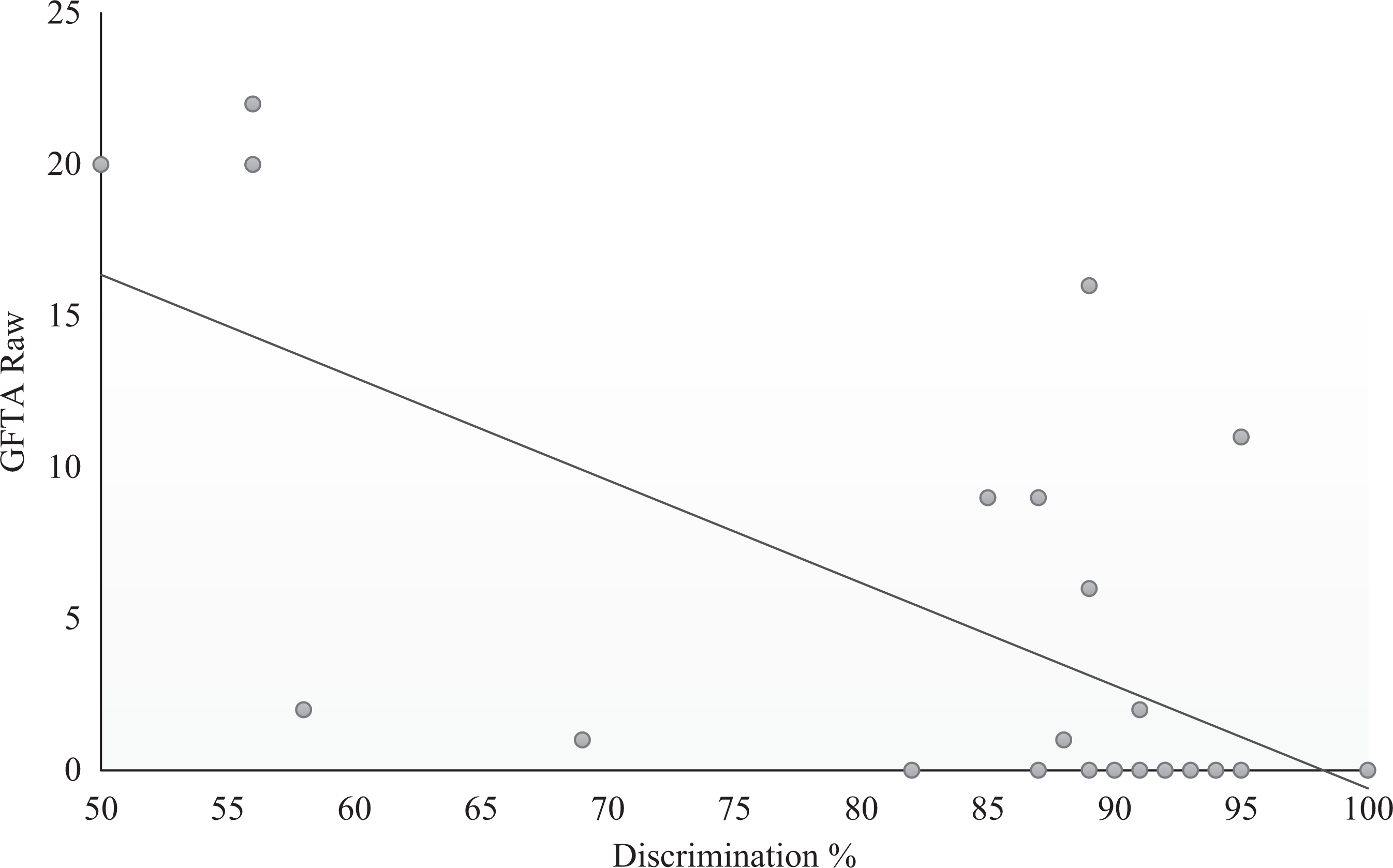
Relationship of modified Goldman-Fristoe Test of Articulation, Second Edition scores and Wepman Auditory Discrimination Test Second Edition scores. Note. Higher scores on GFTA Raw indicates more speech sound errors.
Discussion
It appears that children with visual impairments have widely variable performance on measures of speech sound discrimination and speech sound production. Speech sound discrimination appears to have a strong relationship with the participants’ speech sound production scores. Although these relationships are consistent with studies conducted with sighted children, the results may hold unique implications for children with visual impairments. Children’s acquisition of speech sound discrimination and speech sound production skills is supported by their access to visual models of speech movements, and lack of access may be a contributing factor in speech sound discrimination and speech sound production delays or deficits. It seems prudent that educators, parents, speech-language pathologists, and other service providers consider the speech sound discrimination and speech sound production factors that may support the development of phonological awareness skills of children with visual impairments.
In addition, future research is necessary to further illuminate the role these skills play in the communicative development of children with visual impairments. Longitudinal designs may indicate which factors are most predictive of speech sound development. Intervention studies targeting speech discrimination, phonological awareness, and speech discrimination will also be valuable in establishing evidence-based treatment methods for children with visual impairments who might benefit from intervention.
The current study is limited by a number of factors that have historically been problematic for researchers investigating speech and language development in children with visual impairments. First, it is difficult to recruit a large pool of children with visual impairments in studies that require measurement and observation. We are grateful to the schools that primarily serve children with visual impairments for their assistance in recruiting participants and coordinating schedules so the study variables could be measured. It is time intensive to recruit children with visual impairments who attend local public schools. Usually there are very few children with visual impairments within a school district and, therefore, communication with district personnel and travel time are obstacles to investigators seeking to include a large participant pool of these students. However, we sought to have a balance of children in specialized schools for children with visual impairments and children who attended their local public schools. Even though the current study included a sufficient number of children to find statistically significant results, larger numbers are necessary to make stronger conclusions about speech development in children with visual impairments.
A second limitation is the use of Wepman’s ADT in this preliminary study. Even though this assessment included a standardized, valid set of auditory discrimination items, the age and scope of this assessment’s population sample made using norm-referenced scores unadvisable. Future research should be conducted with updated, more modern tests of auditory discrimination. Because the GFTA administration was modified, the observed scores should be interpreted cautiously. Ideally, standardized tests that do not need to be modified for children with visual impairments will eventually be developed.
A final limitation is the heterogeneous nature of children with visual impairments. Children with visual impairments are not only diverse in their visual functioning but also in their cognitive and communicative development. We attempted to use reasonable inclusion and exclusion criteria so that the sample group was relatively homogeneous. For example, all students were verified as having visual impairments, based on their state guidelines, and we did not include children with significant intellectual disabilities. However, because we recruited children in multiple states, there may be some variation within the state criteria for visual impairment. The children included in the current study also had different levels of visual functioning, as was reported on case history forms. Future research should include well-defined visual acuity ranges as a variable. It was not possible at this time to recruit a large enough group of children that were of more similar age and visual functioning. Therefore, future research is necessary to more accurately understand the relationships between visual and communicative functioning. However, the results of the current study extend the current literature related to understanding speech development in children with visual impairments. For this reason, it is reasonable to believe that continued work in these areas will contribute toward improved communicative outcomes for children with visual impairments.
Footnotes
Declaration of conflicting interests
The author(s) declared no potential conflicts of interest with respect to the research, authorship, and/or publication of this article.
Funding
The author(s) received no financial support for the research, authorship, and/or publication of this article.