



Abstract
Introduction
The United Nations Committee on the Rights of Persons with Disabilities identified the Chinese blind massage policy as “reserved employment” in its Concluding Observations in 2012. In response, this paper reviewed the policy on blind massage in China and discussed its effectiveness and social impact.
Methods:
Adopting a historical perspective, this paper describes the development stages of the blind massage policy in China. It reveals the social construction process of the blind massage policy. Government data were provided to help analyze the positive and negative effects of the policy according to the United Nations’ Convention on the Rights of Persons with Disabilities.
Results:
The blind massage policy is a national strategy involving semi-reserved employment to improve the low employment rate of people with visual impairments in China. It promoted employment of people with visual impairments at the start, but, as the system of the blind massage gradually took shape, it restricted these individuals from choosing a career freely. The blind massage policy has resulted in deep-rooted social prejudices, and it demonstrates disability-based discrimination and charity-oriented practices.
Discussion:
The Chinese blind massage policy is discriminatory and does not reflect the modern concept of disability rights advocated in the United Nations’ Convention on the Rights of Persons with Disabilities.
Implications for Practitioners:
The Chinese government needs to promote institutional reforms to provide better education and employment for people with visual impairments to change the limited content of vocational training and eliminate discriminatory policies.
The United Nations’ (UN) Convention on the Rights of Persons with Disabilities (UNCRPD) reaffirmed in 2008 that all people with disabilities are entitled to human rights and fundamental freedoms regardless of their disability status. It suggests a new paradigm of disability rights in research and practice (Harpur, 2012), by shifting from medical model that views people with disabilities as recipients of charity, medical treatment, and social protection, to a social model that regards these individuals as citizens with rights. Protecting the rights of people with disabilities becomes an international consensus, appealing nations to take actions through policy-making and practices.
The Chinese government not only signed and approved the UNCRPD in 2008, but it also revised domestic legislation based on requirements of the UNCRPD. However, according to the Concluding Observations (CRPD/C/CHN/CO/1) in 2012, the UN Committee on the Rights of Persons With Disabilities believed that the Chinese provisions and policies did not strictly align with UNCRPD. For example, in Article 27 of Concluding Observations, the committee pointed out that the existence of a quota system in China did not effectively address the unemployment issue among people with disabilities or the deep-rooted causes of employment discrimination toward people with disabilities.
The Chinese government attaches great importance on the employment of people with disabilities. A system of protecting and promoting employment for people with disabilities has been primarily established through a series of legislation, regulations, and government documents such as the 1990 Law on the Protection of Persons with Disabilities (LPPD) and its revision, in 2008, the 2007 Regulation on Employment of Persons with disabilities (REPD) and multiple Five-Year Projects. These policies have established a framework outlining two employment types for people with disabilities: concentrated and dispersed. Concentrated employment involves "welfare enterprises," work-rehabilitation centers, massage hospitals and clinics, and other institutions or groups that provide welfare. It is specified that people with disabilities should account for at least 40% of all employees in these welfare enterprises. Dispersed employment is another approach to promote disability employment. It requires that organizations and institutions nationwide employ a certain percentage of people with disabilities (no less than 1.5% of all employees), otherwise they should pay a fine. This is part of the Quota Scheme of the Employment Policy, which constitutes a major employment policy adopted by many countries in the 20th century (Huang, Guo, & Bricout, 2009).
Among diverse policies on disability employment, blind massage is a unique policy adopted by the Chinese government, for it is exclusively designed for persons with visual impairments (ie, those who are blind or have low vision). (Note: In China, the terms blind and low vision are used interchangeably, since the term blind is always used to refer to all people with visual impairments in the country.) There is no other specific official Chinese policy designed for individuals with other types of disabilities. Moreover, only the blind massage policy manifests continuity and completeness in government documents, among other programs (e.g., music and handcrafts) to improve employment of people with visual impairments. In practice, blind massage has almost become the one and only avenue of employment for every person with visual impairment in China (Li & Fu, 2015). This paper, thus, aims to describe the origin and development of the Chinese blind massage policy and to provide analysis based on the equal right of employment advocated by UNCRPD.
The Development of Blind Massage in China
Budding and Autonomous Development Stage: 1949–1985
Before the founding of People’s Republic of China, there were few written accounts of blind massage, except in memoirs of some famous people with visual impairments. It has been documented that blind massage was a type of vocational education offered by the school for blind students in Beijing (the capital of the Peoples' Republic of China) in the 1930s, after teachers from the school for blind students in Fuzhou were sent to Japan to study massage in 1932, and a Japanese visually impaired person trained the first cohort of blind masseurs in 1938 (Tie & Guo, 2011).
After the founding of the People’s Republic of China in 1949, the China Blind Welfare Association (CBWA, renamed the China Disabled Persons’ Federation in 1988) initiated four training programs (relating to teacher qualification, blind massage, music, and handcrafts) in 1955 for veterans who became visually impaired during previous domestic wars. These programs were intended to provide employment opportunities for people with visual impairments (Li, 2013). All programs but one were suspended in 1962, due to lack of support and funding. Among the training programs, only the blind massage program remained, and it came to be an important enterprise and the primary profession for people with visual impairments.
The retention of blind massage training was justified for several reasons (Cao, 2002), which were repeatedly mentioned in media and government documents. First, due to the strong influence of the culture of traditional medicine in China, the Chinese public regarded massage as a type of medical technology. Second, massage was perceived by policymakers and many others as a suitable occupation for blind people, based on the belief that people with visual impairments had greater tactile sensitivity and skills than sighted people. Third, massage was a popular and respected profession at the time.
By 1962, the CBWA had held five training classes on blind massage. About 200 people with visual impairments were trained on medical massage and clinical skills (Tie & Guo, 2011). The trained blind masseurs worked in hospital, clinics, and schools of blind massage all over the country. The trained masseurs also passed on massage skills through apprenticeships.
From 1963 to 1964, the CBWA convened four meetings to facilitate experience and skills exchanges among blind masseurs (Teng, 2013). The CBWA also assisted local governments in holding 18 training classes and opening 70 clinics or hospitals that provided massage by blind people (Teng, 2013).
The development of the blind massage profession was interrupted by the Cultural Revolution from 1966 to 1976, before slowly recovering in the late 1970s and early 1980s. During this period, the massage profession for blind people was not promoted at a national policy level.
Blind Massage as a National Policy: 1985–2010
In 1985, the Chinese Ministry of Civil Affairs held the National Conference on Blind Massage. The conference significantly affected the development of blind massage in China. During the conference, participants reviewed the progress and status of blind massage in China and outlined plans and strategies for the future development of the profession. The conference especially stressed the improvement of the knowledge of theory and technique of blind masseurs, and the reform on the management of blind massage organizations. These recommendations imply that blind massage had become an enterprise at the national policy level.
Subsequently, blind massage was included as a special task in governmental projects. In 1988, it was pointed out in the Five-Year (1988–1992) Project for Persons with Disabilities that employment of blind people was more difficult compared to that of persons with other disabilities. The 1988–1992 Project further stated that the government should consolidate existing hospitals and clinics of blind massage, establish new governmental agencies relating to blind massage, and develop blind massage in multiple ways. The government was required to run schools and training classes for blind massage, and to provide assessment for qualified personnel and practitioners. The 1988–1992 Project regarded blind massage as the primary approach to boost employment for people with visual impairments, although other types of employment such as telephone wiring and hand weaving were also mentioned. This project facilitated rapid development for blind massage.
It is worth noting that there are two kinds of blind massage in China: health-care massage and medical massage. Health-care massage is categorized as a general service and is provided by commercial organizations to enhance one’s bodily relaxation and physical wellness. By contrast, medical massage is provided by medical institutions such as hospitals and clinics for therapeutic purposes. Although health-care massage mainly relies on short-term training programs, medical massage requires systematic training provided by vocational schools or institutions of higher education. Thus, the cost of training health-care masseurs is much lower than the cost of training medical masseurs.
Medical massage was the main focus of the 1985 conference and the 1988–1992 Project, which was also emphasized again in the LPPD in 1990. However, health-care massage gradually became more prominent. In 1996, the Chinese State Council approved the Ninth Five-Year (1996–2000) Project for Persons With Disabilities, which sought to develop the blind massage profession by mainly focusing on health-care massage over medical massage. This national project was also the first one to outline specific targets and supportive measures that were intended to exclusively promote blind massage. It aimed to train 18,000 health-care masseurs who are blind, cultivate 2000 medical masseurs who are blind, and establish a national network of blind masseurs.
Three reasons were provided to explain the shift from medical massage to health-care massage for blind people in the national policy. First, the training cycle would be shorter for health-care massage. Second, there was an increased demand for health-care massage in the 1990s, as a result of rapid economic growth and improvement in people’s quality of living in China. In order to enhance the competitiveness of health-care blind massage in the Chinese market-oriented economy at the time, a special Notice About Accomplishing Vocational Skills Training, Identification and Employment Placement for the Health-Care Blind Massage was released in 1997. The notice established a network of vocational skills training for blind masseurs to intensively carry out training programs, to verify the technical ability of blind masseurs, and to promote employment placement of blind masseurs. This policy helped health-care blind masseurs compete with masseurs without disabilities. Third, there were barriers for blind people to engage in medical massage as certified physicians. In 1997, the Notice About Appraisement and Engagement of Professional and Technical Positions for Medical Blind Masseurs was also announced to standardize professional development of medical massage. It classified medical masseurs as clinical medical professionals and technicians (Ministry of Human Resource, 1997). It, however, disqualified blind masseurs to conduct medical practice as certified physicians. In 1999, the Chinese government enacted the Law of Medical Practitioners in which medical masseurs who are blind were not included in the occupational category of physicians (State Council, 1999). The supporting justifications were that the qualifying examination for practicing physicians involves the ability to read an X-ray, electrocardiograph, and clinical operation, all of which require vision. In other words, it was almost impossible for the blind medical masseurs to pursue a generalized medical career. The impossibility for blind people to obtain professional qualification in medical massage had a great effect on the enterprise of blind massage. It not only forced masseurs who are blind to transition from medical massage to health-care massage, but it also shifted the national policy. Thus, medical massage performed by blind people was gradually marginalized.
Health-care massage continued to develop with its own challenges. Some workplaces that employed blind masseurs, such as private beauty salons and sauna massage centers, involved pornographic or illegal activities or both. These activities impeded the construction of socialist ideological and ethical progress for the profession. As a result, health-care massage was stigmatized and became subject to more government regulations.
In 1999, the State Council issued the Announcement About Suggestions of Further Promoting Employment of Persons With Disabilities, to further attach great significance on the development of blind massage and to actively boost the employment of blind masseurs (State Council, 1999a). The announcement required that relevant organizations should prioritize in the employment of certified blind masseurs. It also required that government at all levels should take further measures to boost employment for blind masseurs.
In 2000, the Chinese Disabled Persons’ Federation (CDPF) reported that the goal of the 1996–2000 Project (to train 18,000 blind people in health-care massage and cultivate 2000 medical masseurs who are blind) had been attained (even over-achieved) in advance, and the trained blind masseurs were all employed, reflecting the general public’s positive recognition and the societal demand for blind massage. Subsequently, in 2001, the State Council approved the Tenth Five-Year (2001–2005) Project for Persons With Disabilities. The new round of the project aimed to further develop blind massage by intensifying training (to cultivate 35,000 blind masseurs, with around 6000 of this number being trained in medical massage), expanding employment channels, providing policy support, and perfecting guidance of blind massage organizations at all levels (State Council, 2001). Meanwhile, the project guidance stated that "employing one blind person equals to the employment two persons with disabilities." This statement was designed to encourage more organizations to employ people with visual impairments. It also implied that the employment of people with visual impairments remained a challenge.
By the end of the 2001–2005 Project, the number of blind masseurs reached 90,000, 60,000 of whom were health-care masseurs and 30,000 were medical masseurs; 95% of them had been employed, and blind massage remained the primary occupation of people with visual impairments (State Council, 2006).
The governmental effort for large-scale training and employment of people with visual impairments continued after the approval of the Eleventh Five-Year (2006–2010) Project for Persons With Disabilities (State Council, 2006). The 2006–2010 Project highlighted the special employment policy that "employing one blind person equals to the employment two persons with disabilities." It also aimed to cultivate 400,000 health-care blind masseurs, and 10,000 medical blind masseurs. It spelled out the necessity to strengthen continuing education of working blind masseurs in order to enhance their competitiveness in the market. Meanwhile, this project called for the teaching materials for blind massage to be written and revised to establish a national practice base for teaching and research of blind massage and to promote international exchange of information and academic communication. The CDPF at all levels were required to strengthen the administration and management of blind massage, and to perfect the market of blind massage in line with the national requirement. The 2006–2010 Project resulted in a large population of trained and employed people with visual impairments, demonstrating the Chinese government’s affirmation that blind massage was an effective strategy to improve employment of blind people.
Another change between health-care and medical massage emerged during the implementation of the 2006–2010 Project. In 2009, the Administrative Measures for the Blind Medical Massage was announced. This document was a response to the petition that the CDPF and other disability organizations initiated to fight the 2007 Regulations on the Employment of Persons With Disabilities. The specific regulations on blind massage did not respond to the professional qualifications of medical professionals (CDPF, 2009; State Council, 2007). It stressed that blind medical massage refers to massage activities conducted by blind people as a medical treatment, and that the blind medical masseurs constitute medical technical personnel. In 2010, the National Examination Committee for the Blind Medical Masseurs was established in Beijing and conducted its first national examination. These efforts were intended to re-emphasize the medical treatment aspects of blind massage.
Swing Policy: 2011 to the Present Day
In 2011, the State Council approved the Twelfth Five-Year (2011–2015) Project for Persons With Disabilities that aimed to fully implement Administrative Measures for the Blind Medical Massage (State Council, 2011). This effort was to regulate and strengthen the blind medical massage, to improve knowledge and skills of blind medical masseurs, and to guarantee legal rights for different stakeholders. The 2011–2015 Project also required the creation of administrative measures to regulate health-care blind massage. However, the project did not specify the exact number of masseurs to be trained. To address this omission, the subsequent 2011–2015 Implementation Plan for the Blind Massage, which was announced by the CDPF according to the 2011–2015 Project, aimed to train 300,000 health-care blind masseurs and 200,000 medical blind masseurs (CDPF, 2015).
In 2016, the Thirteenth Five-Year (2016–2020) Project: Accelerating Process of Better Living for Persons With Disabilities aimed to train no less than 25,000 medical care blind masseurs and no less than 50,000 health-care blind masseurs (State Council, 2016). There was not any subsequent implementation plan to set specific tasks on the training of health-care or medical care blind masseurs. This omission did not mean that blind massage was no longer a focus of the Chinese government. Instead, the 2016–2020 Project required medical institutions at all levels to positively employ the qualified medical blind masseurs. It also suggested the large-scale development and branding of blind massage.
Despite the fact that blind massage remains a national focus to promote the employment of people with visual impairments from 2011 to the present day in China, the lack of specification on targeted training numbers for health-care or medical care blind masseurs in the Twelfth Five-Year Project and the lack of a follow-up implementation plan seems to imply the uncertainty of blind massage in future policy-making.
The Protective Purpose of the Blind Massage Policy in China
A Strategy to Improve Employment for People Who Are Blind
The origin of the blind massage initiative in China was to resolve poor employment of people with visual impairments, as it was stated in a series of social policies that people with visual impairments encounter the most difficulty in finding employment compared to persons with other disabilities. According to the 1987 national survey, the employment rate of people with visual impairments over age 15 years was only 23.61%, ranking the lowest among persons with disabilities. The second national survey, conducted in 2006, indicated a slight increase in people with visual impairments from 14.6% to 14.9%, yet the employment of people with visual impairments remained the most challenging among persons with disabilities (Second National Sampling Survey of People with Disabilities, 2006). (It should be noted that, although this survey was implemented in 2006, it remains the latest and the most comprehensive national survey on persons with disabilities.)
Faced with the low employment rates of people with visual impairments, the Chinese government had to identify effective strategies to promote their employment. As discussed, the Chinese government selected and affirmed blind massage as a feasible strategy to promote the employment of people with visual impairments. As data indicated, the number of blind massage practitioners increased from 200 to 5,000, and blind massage hospitals and clinics reached 5000 in total number, from the first year of blind massage training in 1955–1985 (Commission of Legislative Affairs of the NPC Standing Committee, et al., 1991, p.129).
The Reality of Semi-Reserved Employment
Reserved employment is regarded as one of measures to support the integration of people with disabilities into open employment, according to the World Program of Action Concerning Disabled Persons (General Assembly resolution 37/52, 3rd December, 1982). Different governments (e.g., Italy, Korean, and Taiwan) have specified in policies that massage is work that is reserved exclusively for people with visual impairments, and that people without vision loss are prohibited from engaging in massage (Lin, 2010).
Blind massage in China was regarded as an example of reserved employment, according to the Concluding Observation (CRPD/C/CHN/CO/1, 2012) from the Committee on the Rights of Persons With Disabilities in 2012. It was also stated that blind massage, being reserved employment, discriminates against people with visual impairments and limits their vocational and career choices.
However, none of the Chinese laws, regulations, or governmental documents have stated that the blind massage is a reserved employment. Neither do any Chinese laws or regulations require relevant organizations to exclusively restrict the work of massage to people with visual impairments. The LPPD, in 1990, and its revision in 2008 did not prohibit the general public from practicing massage, which means that massage as a profession is not exclusively reserved for people with visual impairments.
Although a small number of provinces mandate that blind massage institutions only hire blind masseurs, massage in China is, in fact, largely open to people who are not visually impaired. Thus, the blind massage policy in China operates more like a semi-reserved employment in reality.
Restricted Consequences: The Problem of Policy Practices
Inefficient Policies
As discussed, the Chinese government vigorously promotes blind massage, and massage has indeed become a major employment channel for people with visual impairments. However, it is not completely clear to what extent the blind massage policy has improved the employment rate of people with visual impairments after more than three decades of government effort in this area.
The number of blind masseurs has increased overall, despite health-care massage and medical massage having different growth patterns. By 2018, an approximate number of 300,000 people with visual impairments have been trained in massage (Figure 1). Compared to more than 12 million people with visual impairments in China, according to the second national survey conducted in 2006, the trained number of blind masseurs is almost negligible. Moreover, national statistical data indicate that only 40% of trained blind masseurs (around 120,000) are currently employed (Yuan, 2018). Though statements such as "employing one blind person equals to the employment of two persons with disabilities" have been emphasized, there has been no significant increase in the employment rate of people with visual impairments through the blind massage policy. Only a small number of trainees eventually engage in massage. Recent studies (Chen et al., 2018; Chu & Xu, 2012) indicated that the income of blind masseurs (including both health-care and medical masseurs) was around 42,000 RMB (about $6592 USD) per year, which is significantly lower than the average annual income of the Chinese population: 75,229 RMB (about $11,807 USD). Based on previous discussions, it can be inferred that the blind massage policy has largely been inefficient. Training for blind massage (unit: person). Data source: Statistical Communique on the Development of the Work on Persons with Disabilities (1996–2019), http://www.cdpf.org.cn/sjzx/tjgb/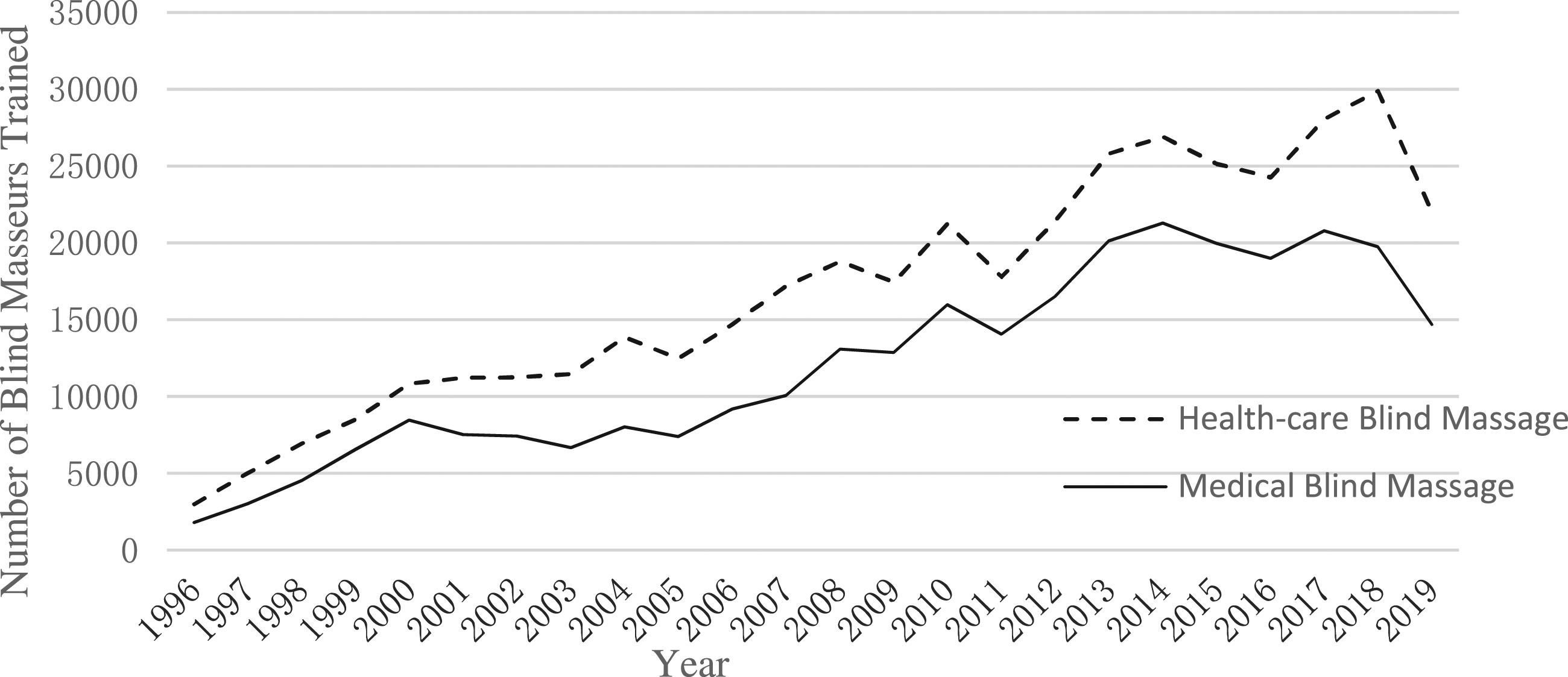
Constructed Social Prejudice
The blind massage policy has been the primary mode of employment offered to people with visual impairments in China. It has been reiterated in government documents and through mass media that massage skills are suitable for people with visual impairments to learn and master because of the strengths blind people have in the tactile sense and attention. As a result, it is widely accepted that people with visual impairments (especially those who are blind) are good at massage, and that massage as a vocation best fits people with vision loss. This belief has resulted in the assumption that every person with visual impairment is suitable for massage and should engage in massage practice. The general public tends to believe that people with visual impairments would not be able to engage in other professions other than massage. Being a masseur, thus, becomes the primary profession for all people with visual impairments. This assumption reflects a deep-rooted social prejudice against people with visual impairments.
Moreover, the idiomatic term blind massage has been constructed as a common phrase in China. The term can be seen on billboards everywhere in the streets and alleyways. In many Chinese literary and artistic works (e.g., the famous novel Tuina, written by Bi Feiyu, in 2008), the phrase blind massage becomes a cultural myth, reinforcing the idea that people with visual impairments are talented in massage and that massage is a natural destiny for this group. In this way, blind massage is not merely a common phrase in the Chinese language, but it also constitutes a cultural phenomenon that particularly links the physical traits of people with visual impairments to the vocation of massage. It constructs social prejudice that limits work options for these individuals.
Disability-Based Discrimination and Charity-Oriented Practices
The blind massage policy and practice continuously emphasizes the match between the bodily characteristics of people with visual impairments and the vocation of massage. It has strengthened the stereotype that blind people are suitable for massage. The reiterated fit of massage and people with visual impairments has resulted in the assumption that blind people are not only suited to massage, but also born to perform massage. This construct implies a disability-based discrimination against people with visual impairments and prevents them from freely choosing an occupation.
Admittedly, blind massage has been an important approach for people with visual impairments to engage in employment and to participate in social activities. However, it has become almost the only opportunity for people with visual impairments to be employed and involved in society. As a semi-reserved employment, the social interaction with the outside world of blind masseurs was restricted, since their only social engagements were often with their blind colleagues and sighted staff members in blind massage facilities (LI & Fu, 2015). This limited scope for social interaction is not conducive to the integration of people with visual impairments in larger society.
From the promotion and the influence of the Chinese government, blind massage has already formed a closed system from education and training, to assessment and evaluation. Almost all provinces in China have set up a special official institution to monitor the profession. Special education schools for blind students have established a set of massage curriculum from secondary vocational education to higher education in which only two major areas of study are available for people with visual impairments: blind massage and music. A majority (about 80%) of people with visual impairments in special higher education enroll in the major of blind massage (Li & Fu, 2015). This lack of educational opportunities demonstrates the limited number of options for blind people at the institutional level (Li & Fu, 2015). Further, blind massage as a main focus of the national policy to improve the employment of people with visual impairments restricts their choices. The Chinese policies that have been created in response to the employment needs of people with visual impairments have not shifted the focus to individual rights (Campbell & Uren 2011; Zhang, 2017). Rather, the uniqueness and exclusiveness of blind massage in Chinese policies tends to be a charity-oriented approach that neglects the reality of employment needs for people with visual impairments.
To summarize, blind massage policy and practice not only exaggerates the link between bodily functions of blind people and massage as a specific vocation, but it also ignores heterogeneity within the population of people with visual impairments. The Chinese government needs to replace this charity-oriented practice with a rights-based practice to serve people with disabilities in the country.
Discussion and Implications for Practitioners
The blind massage policy is a national strategy for semi-reserved employment that is intended to improve the employment rates of people with visual impairments in China. At the preliminary stage of policy practice, blind massage as a profession, indeed, served its purpose. As the system of blind massage gradually expanded, it has restricted people with visual impairments from being able to freely choose a career path. The establishment of the National Examination Committee for the Blind Medical Masseurs in 2010 implies a re-emphasis on blind medical massage and suggests that the Chinese government is intentionally rebuilding the blind medical massage system, which demands further attention.
In addition, the blind massage training is inefficient. At present, the employment rate of blind people is still the lowest among persons with disabilities. Given that the blind massage policy has already been promoted for more than three decades, the employment rate of people with visual impairments has not improved over that of persons with other disabilities for whom the Chinese government did not make any exclusive or specific employment policies.
Most importantly, blind massage has resulted in deep-rooted social prejudice. It restricts people with visual impairments from pursuing diverse work. Furthermore, the Chinese blind massage policy demonstrates disability-based discrimination and charity-oriented practice, which goes against the disability rights advocated by UNCRPD.
Today, not many nations set up reserved work to protect the rights of people with disabilities, and an employment quota system is also gradually declining. The Chinese government is aware of the fact that people with disabilities are entitled to have equal rights in terms of work. However, it is difficult for people with visual impairments to receive appropriate training and work opportunities in the open market in modern China. Without appropriate support, it is also impossible for people with visual impairments to compete with those who do not have disabilities.
Thus, it is necessary to further support the development of blind massage in China, since a relatively comprehensive system of blind massage already exists. The Chinese government should continue to adopt this approach to guarantee the right to work of people with visual impairments. Meanwhile, deconstructing social prejudice and discrimination related to blind massage is also an urgent task. The Chinese government has come to realize the importance of enhancing the occupational status of people with visual impairments through increased training and education in medical massage, since medical massage is considered to confer higher social status on its practitioners compared with health-care massage.
Beyond blind massage, the Chinese government needs to find other effective approaches to facilitate vocational training for people with visual impairments. This task is not easy, considering that different training programs (e.g., music and handcraft) were conducted at the beginning, but only blind massage remains. A positive sign is that the Chinese government is adopting a universal policy of 9 years’ compulsory education for people with disabilities. Through the advocacy efforts of Chinese disability organizations, reasonable accommodations have been available for people with visual impairments since 2014 so they may participate in the national college entrance examination (MOE, 2015; Zhang, 2017). This change demonstrates the Chinese government’s effort to promote institutional reform to provide better education and employment for people with visual impairments. What is more, along with the implementation of UNCRPD in China, the new generation of people with visual impairments and their own organizations for policy advocacy have started to voice their diverse needs inspired by the framework of UNCRPD (Zhang, 2017). They will be the new force that will push the Chinese government to adopt innovative and nonrestrictive ways to address age-old problem of employment for people with visual impairments and promote their participation in society.
Footnotes
Declaration of Conflicting Interests
The author(s) declared no potential conflicts of interest with respect to the research, authorship, and/or publication of this article.
Funding
The author(s) disclosed receipt of the following financial support for the research, authorship, and/or publication of this article: This work was supported by the National Social Science Project (Grant No. 19BFX137), the Chinese Disabled Person Foudantion (Grant No. 21&ZC018) and the Chongqing Educational Department (Grant No. 2020-CX-014).