



Abstract
Audio description (AD), the rendering of images into words, helps people who are visually impaired to access audiovisual products. Being able to access media is a basic human right. The United Nations Convention on the Rights of Persons with Disabilities clearly states that people with disabilities should have “access to television programs, films, theater, and other cultural activities, in accessible formats” (United Nations, 2006). Recent developments in technology, for example, text-to-speech synthesizers, have enabled audio description to include more languages (see Tor-Carroggio, 2020). Training is important to ensure the quality of audio describers. Offering audio description training in universities can provide students an opportunity to get early exposure to this field and increase their understanding of the issues about accessibility. This report presents an audio description training module conducted in a university interpreting program in Hong Kong. Based on the commonalities between audio description and interpreting in quality assessment, a set of criteria was proposed and applied to the assessment of the students’ audio description performance. A visually impaired colleague was invited to participate in the evaluation, and her timely feedback for the student was provided from the user’s perspective. A post-class survey was conducted after the training program. The survey results suggested that students were highly motivated to learn audio description in interpreting classes. In reflecting on the skills cultivated during the training process, students acknowledged the value of audio description training for learning interpreting. The implementation of audio description training in interpreting programs has proved to be feasible and highly regarded by the students. The present study hopes to shed some light on the feasibility of offering audio description training in universities in general and interpreting classes in particular. It is expected this practice can significantly enrich and broaden the scope of education, audio description and development.
Audio description, the rendering of images into words, helps people who are visually impaired to access audiovisual products. Being able to access media is a basic human right. The United Nations Convention on the Rights of Persons with Disabilities clearly states that people with disabilities should have “access to television programs, films, theater, and other cultural activities, in accessible formats” (United Nations, 2006). Recent developments in technology, for example, text-to-speech synthesizers have enabled audio description to include more languages (see Tor-Carroggio, 2020). Training is important to ensure the quality of audio describers. Offering audio description training in universities can provide students an opportunity to get early exposure to this field and increase their understanding of the issues about accessibility.
Audio description training is not only special technical training, but it also contributes to the whole-person education of students. However, training programs in audio description are rare in universities. Only a few academic institutions offer audio description courses, the majority of which are taught at the postgraduate level (Fryer, 2016) as part of audiovisual translation modules or translation in general (audio descriptionLAB PRO, 2017). Given that both audio description and language interpreting (delivered in spoken language) are oral types of translation, the quality heavily depends on the delivery of the presenters (Branje & Fels, 2012), and some scholars have started to notice the overlapping between audio description and interpreting, especially in areas such as training and evaluation. Based on students’ feedback on audio description training in a translation course, Yeung (2007) suggested that some skills acquired in audio description are similar to those in interpreting training. For example, they both have “vocal skills,” “command of the language,” and “grasping an overall picture and finding focus in description” (pp. 234–235) in common.
Inspired by a previous study on the role of delivery in the quality assessment of interpreting, Fernández et al. (2015) used audio description with different delivery styles to test the users’ evaluations of the quality of audio descriptions. They found that most individuals who use audio description prefer it to be delivered in an affective voice. This study shows that cross-fertilization between audio description and interpreting is feasible from the perspective of the role of delivery in quality assessment. The training of delivery and other aspects (language ability, vocal skill, etc.) in audio description can help enhance students’ interpreting skills. Also, the facilities for language interpreting training can serve the purpose of audio description training. It is difficult to find so many overlapping areas in other training programs. However, no practice in integrating audio description training in interpreting programs has been documented. The present study hopes to shed some light on the feasibility of offering audio description training in universities in general and interpreting classes in particular. This practice is expected to significantly enrich and broaden the scope of education, audio description, and development.
Course Design
Based on previous studies that discussed the overlapping between audio description and interpreting, the authors designed and implemented a two-week audio description module in a university language interpreting program in Hong Kong. The audio description module was taught to 54 students in a postgraduate-level English–Chinese interpreting course. This course aims to prepare students for advanced-level English–Chinese interpreter training by introducing basic skills, such as listening and oral skills, vocabulary building, memory training, and note-taking skills, many of which are relevant to audio description training. All students were native Chinese speakers and had either Mandarin or Cantonese as their first language.
The aims of the two-week audio description training module were: (1) to introduce the concepts, history, and various types of audio description; (2) to discuss the legal and cultural environments for audio description; (3) to demonstrate how audio description works and guide students in studying and analyzing audio description products; and (4) to explain and guide the students through the audio description creation process. By the end of the program, students had hands-on experience in writing and performing live audio description for a selected film clip.
Since audio description is a young discipline, there is no relevant textbook available. Fortunately, the audio descriptionLAB PRO project (2019) and the HBB4ALL project (Orero, 2017) have a series of audio description teaching materials that provide useful information about the pedagogical approaches and activities that can be implemented in audio description training. Therefore, some of these materials were adapted and integrated into the course design.
Classroom Activities
As a warm-up exercise, the opening scenes of the film The Hours (Daldry, 2002) were played for the first time to students with their eyes closed. The clip is an ideal learning material because of “its high visual input and emotional load” (Fernández et al., 2015, p. 80). With their eyes closed, students would not be able to understand the story by only listening to the various sound effects of these scenes. This experience enabled them to realize the importance of visual information in understanding the film and, hence, the importance of audio description. Later, the film clip was shown for the second time, the audio description soundtrack was played, and students were asked to define what audio description is in their own words. The teacher guided the discussion.
The instructor then started the lecture by sharing the various definitions of audio description in the literature. Some key concepts about audio description, such as “inter-semiotic translation,” “audiovisual translation,” and “media accessibility” were explained to the students. The instructor then presented and compared audio description legislation and provisions in different countries and regions around the world. This section of teaching was designed to help the students understand: first, that the provision of audio description is insufficient and the development of audio description is uneven across the world; second, in Hong Kong, people have not paid enough attention to this field, and there is much to be done; and third, the students can be potential audio describers, legislators, or social workers who could contribute to this area.
Then came the textual analysis of audio description clips. The instructor used two clips from the Chinese kung fu film Ip Man: The Final Fight (Yau, 2013) to show the students how to analyze audiovisual texts. After the clips were played twice, the students were invited to describe in Chinese what they had seen. The instructor then commented on the students’ descriptions, pointing out the critical visual clues that had been overlooked. The audio description soundtrack made by the filmmaking company was later played as a sample for students to listen to and study. The text of the audio description transcripts was given to the students to analyze, identifying the visual clues.
Next, the instructor illustrated the four-steps of audio description making: (1) analyzing the audiovisual text, (2) writing and timing the audio description script, (3) consulting an expert or teacher for feedback, and (4) rehearsing and making final changes. Students were then assigned a task to create audio description for a film clip selected by the instructor after the class. They were divided into four-person groups and informed about the arrangement of the next class. See Box 1 for the audio description practice assignment guidelines.
• Four students in each group; one team leader for each group • Prepare audio description script for a 6-minute film clip of Lust, Caution (Ang Lee, 2007). • Language: Chinese • The clip can be viewed from: https://youtu.be/uJJ5-MRS1Tg • The audio description scripts should be submitted to the instructor before next class; two hard copies of your audio description scripts should be given to the instructor in the next class. • Every student will practice and deliver live audio description in class (to be recorded at your seat) in next class. • Audio description competition: One student from each group will deliver live audio description in the next class. The group performance will be evaluated by three judges (two people who are sighted and one person who is visually impaired). The three groups with the highest score will receive certificates.Box 1. Audio Description Practice Assignment Guidelines.
A
The video clip for the audio description practice assignment was a six-minute clip of the film Lust, Caution (Lee, 2007). The language of the film was Chinese. The first language of the students was Mandarin Chinese or Cantonese, so they could make audio description in either. The film was selected mainly because the clip contains very little dialog, leaving ample time for students to insert descriptions. Also, as most information is conveyed through visual clues (e.g., the characters’ facial expressions, actions, and settings), plenty of information is provided for students to interpret and describe. The students had a week to complete the assignment.
At the beginning of the second class, all students performed their prepared audio description through the interpreting lab system. The facilities in the lab enabled the instructor to monitor and collect the recordings of students’ audio description performance for assessment. After all the audio description works were collected, one representative from each group performed live audio description on stage. The three judges who evaluated the students’ performances included the two authors of this article, who are interpreter trainers and a visually impaired member of the project. Previous studies have pointed out that cooperation between people who are sighted and people who are visually impaired in audio description teaching is common and should be encouraged (audio descriptionLAB PRO, 2017; Chmiel et al., 2019). The evaluation by people who are visually impaired contributes to the comprehensiveness of assessment and helps students better understand audio description quality from the user’s perspective. Below is part of the feedback by the evaluator who was visually impaired on the students’ live audio description performance (in translation): Speaking as a person who is visually impaired, I value speech speed most. I noticed that the student from the fifth group had an excellent speech speed. If you provide service for people who have to receive most information through sounds, it’s better not to include too much information in your description. It’s better to slow your speech speed. Actually, content is not the focus in my evaluation… Even though you want to provide a lot of information in your audio description, your efforts may be wasted if we can’t hear clearly.
The feedback helped to draw students’ attention to the needs of the major users of audio description, people who are visually impaired.
Assessment
An important rationale for integrating audio description training into interpreting programs is that audio description and interpreting have many commonalities in quality assessment. Fernández et al. (2015) suggested that the role of delivery in quality assessment is essential for both interpreting and audio description. Fryer (2019) systematically examined the potential overlapping between language interpreting and audio description in quality assessment. She adapted the interpreting rating scale proposed by Lee (2008) into a rating scale for audio description, which includes four macro criteria: accuracy, language, delivery, and synchrony. These previous studies provide food for thought in current training practice. For the present practice, a rating scale (see Box 2) was designed and applied in assessing students’ audio description performance. In addition to the criteria proposed by Fryer (2019), “representational narrative,” was used to assess the narrative aspect of students’ audio description output. In total, 20 micro criteria were identified. Each micro criterion was assigned five points to facilitate the instructor’s marking.
1. Is there any mistake in audio description? (5%) 2. Is there any important visual clue not described? (5%) 3. Is there any over-description? (5%) 4. Is the audio description cohesive and coherent? (5%) 5. Is the audio description logical? (5%) 1. Is the language of audio description grammatically correct? (5%) 2. Are there redundancies in the language of audio description? (5%) 3. Is the language clear and easy to understand? (5%) 4. Is the language accurate and does it conform to the style of the film? (5%) 5. Is the language vivid enough? (5%) 1. Does the describer pronounce clearly? (5%) 2. Is the speed of audio description delivery appropriate? (5%) 3. Is the volume of the describer appropriate? (5%) 4. Are the intonation and pronunciation of the describer natural? (5%) 5. Is the overall delivery smooth? Is there any redundant sound or repetition in delivery? (5%) 1. Is the audio description synchronized with the images on the screen? (5%) 2. Is there any overlapping between the audio description and the dialog of the characters? (5%) 3. Is there any overlapping between the audio description and important sound effects in the film? (5%) 1. Does the audio description become a spoiler? (5%) 2. Is the audio description too subjective? (5%)Box 2. A Quality Assessment Protocol for Audio Description Training in Interpreting Classes.
A
L
D
S
R
The procedure of the two-week audio description training is presented in Figure 1. Procedure of audio description training in interpreting classes.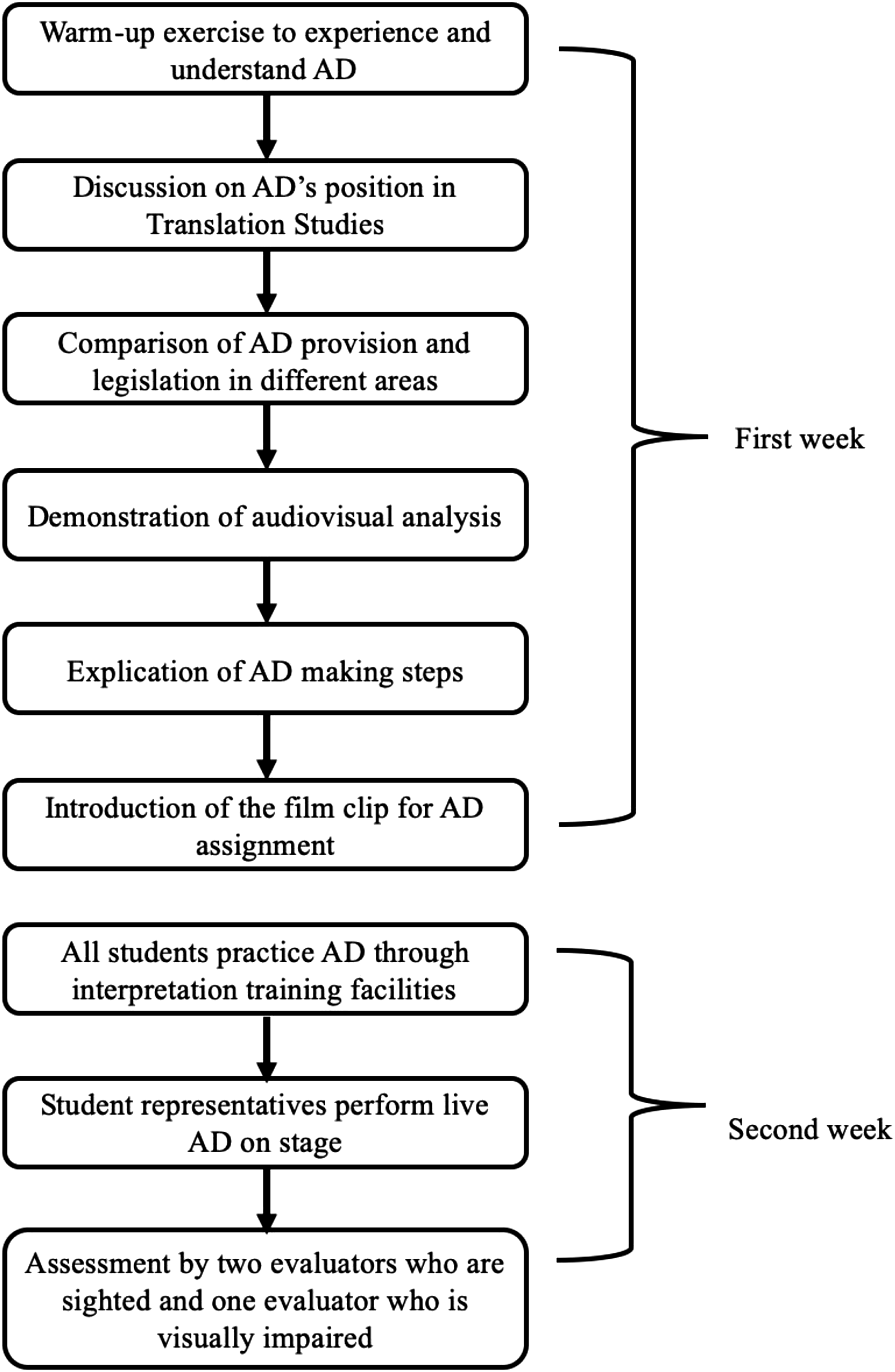
Post-class Survey
A post-class survey was conducted at the end of the module to solicit students’ feedback to the training module. Open-ended questions were designed to investigate students’ perceptions of the training. Thematic analysis was conducted on the data collected from the students’ responses. The following section includes researchers’ questions and major themes that emerged from students’ responses, together with some quotations from the students as supporting evidence. For each question, students were asked to explain their answers.
Do You Want To Learn More About Audio Description?
One student responded that audio description is socially significant: [Being an] audio describer is an honorable and glorious job. Now I can assist more people who are visually impaired with the skills I have learned.
Another student indicated that audio description is interesting: I like watching films very much…. Preparing audio description scripts is interesting. It is worthwhile spending time and effort on it.
A third student said that audio description training cultivates soft skills: Audio describers must have excellent observational skills and good knowledge about everything in the movie. Audio description training cultivates my observational skills, delivery skills, and enables me to be more sensitive to everything around us.
Do You Agree That Audio Description Training Can Help Improve Skills Related To Interpreting?
One student said the training improved observational skills: Audio description training has improved my ability of observation, which is necessary for interpreting. This ability for interpreters is reflected in their being alert to the moods and tones of the speakers.
Another said that it helped improve language proficiency: Audio describers must have high levels of language skills, including knowledge about vocabulary, descriptive skills, and summarizing skills.
A third said the training helped them cultivate the skill of time management: Audio describers need to be able to react quickly, as do interpreters. Besides, both roles need to comprehend the source text and express its meanings within the limited time.
A fourth said it allowed them to exercise their delivery skills: Audio description training helps cultivate my oral communication skills. Interpreters (just like audio describers) also need to use different voices, tones, and intonations in different contexts and scenarios.
Conclusion
This report presents an audio description training module conducted in a language interpreting program in Hong Kong. For the course design, the authors referred to the training materials generated by the audio descriptionLAB PRO project (2019) and the HBB4ALL project (Orero, 2017). Based on the commonalities between audio description and interpreting in quality assessment, a set of criteria was proposed and applied to the assessment of the students’ audio description performance. A visually impaired colleague was invited to participate in the evaluation, and her timely feedback for the students was provided from the user's perspective.
A post-class survey was conducted after the training program. The survey results suggested that students were highly motivated to learn audio description in interpreting classes. In reflecting on the skills that were cultivated during the training process, students acknowledged the value of audio description training for learning interpreting. The implementation of audio description training in interpreting programs has proved to be feasible and highly regarded by the students. This model is the start of a long journey. The authors will continue with this practice and keep adjusting and refining the module based on the needs of the students and society.
Footnotes
Declaration of Conflicting Interests
The author(s) declared no potential conflicts of interest with respect to the research, authorship, and/or publication of this article.
Funding
The author(s) disclosed receipt of the following financial support for the research, authorship, and/or publication of this article: This project is partially supported by The National Social Science Fund of China (18AYY004) and City University of Hong Kong Grant research grant (7004939, 6000744, 6390212).
