



Abstract

Over the last decade, many local education agencies (LEAs) across California imposed significant restrictions on community-based orientation and mobility (O&M) instruction. Administrators from these LEAs prohibited O&M Specialists from transporting students off-campus for instruction, with one large Southern California district going so far as to direct O&M specialists to rewrite existing IEP goals that required transportation. Consequently, students who attended schools governed by these LEAs were denied access to the community-based O&M instruction to which they were entitled under the Individuals with Disabilities Education Act (2004), known as IDEA.
Orientation and mobility specialists in both Northern and Southern California LEAs attempted various advocacy efforts within their districts, including educating administrators on the legal rights of their students to community-based instruction, as well as submitting letters of support from the California Association of Orientation & Mobility Specialists (CAOMS). These unsuccessful advocacy efforts within individual LEAs led to the recognition that a statewide approach would be needed.
In 2017, CAOMS and the California Council of the Blind (CCB) partnered to start a grassroots movement to resolve the problem. They succeeded in passing a law entitled “Expanded core curriculum: visually impaired pupils,” (AB-947, 2019), amending California’s Education Code. This law affirms the rights of students with visual impairments to community-based evaluation and instruction as needed in both familiar and unfamiliar environments, in “varying lighting conditions,” and outside of school hours, with transportation to support these services. It also authorizes LEAs to consider elements of the expanded core curriculum (ECC) when developing Individualized Education Programs (IEPs). This report describes our procedures, which can serve as a model for other states experiencing administrative barriers to providing community-based O&M instruction.
Step 1: Educate Your Administrators
Some California O&M specialists were successful in obtaining permission for off-campus instruction after educating their administrators. We suggest O&M specialists start with providing their supervisors with the relevant sections of IDEA. Section 300.34 (c) (7) places O&M services in the “school, home, and community.” Section 300.34 lists transportation as a related service to be provided as needed to access IEP services such as O&M. The Federal Register’s Policy Guidelines on Educating Students with Visual Impairments (2000) provides additional rationale and interpretation of the IDEA on O&M services. Sharing this information may convince administrators without compromising your relationship with them. If you are the sole O&M specialist in your district, consider inviting the teacher of students with visual impairments to aid in your education efforts. Even if administrators remain unconvinced, this attempt to educate lays the groundwork for moving to the next step.
Step 2: Utilize Existing Complaint Procedures
After an educative approach failed in the large Southern California LEA, an independent O&M specialist filed a formal complaint against the district. Despite an investigation that led to the complaint being upheld and the district ordered to allow for off-campus transportation for O&M instruction, the LEA failed to comply. Although this outcome was not ideal, we believe filing a formal complaint is still a viable option for O&M specialists in other districts as the legal underpinning of the complaint ruling clearly supports the rights of students with visual impairments to O&M instruction in community environments.
There are two common avenues for addressing disagreements or complaints. The first, utilizing the IEP process, is available to parents only. Parents can use the IEP meeting to request community-based O&M instruction, as well as to document that request. If the district’s policies prohibit or limit a community-based evaluation or instruction, parents can request a district-funded independent education evaluation of O&M skills in the community. If this effort is unsuccessful, parents may file a formal complaint requesting mediation or a due process hearing. Although this process may provide a successful resolution for an individual family, the results may not generalize to other students who are being denied community-based O&M instruction.
The second option does not apply specifically to parents. Any individual can pursue the generic complaint process available within the LEA or state Department of Education. The procedures for your geographic area can be found with an Internet search for the name of the LEA or state and the term “special education complaint.” In California, the Department of Education outlines how a formal complaint can be filed (“Uniform Complaint Procedures,” n.d.).
Step 3: Identify the Nature and Scope of the Problem
The first step of the CAOMS action committee was to obtain the data we needed to convince stakeholders, advocates, and legislators of the problem and of the need for intervention. We surveyed O&M service providers working in schools throughout the state. Working through CAOMS, our statewide professional organization, gave us easy access to our target population. Our survey confirmed that the problem was pervasive, longstanding, and significant in its damage to our students. Thirty-nine percent of O&M specialists reported significant limitations in providing community-based O&M services due to administrative policies that restricted options for transporting O&M specialists and their students to community sites. The survey also uncovered common prohibitions against assessment and instruction in the home, at night, and outside of school hours.
Step 4: Gather Resources
We recruited a core group of experts from both inside and outside our organization to form an exploratory committee. The three critically important members were a legislative expert, a parent-advocate, and a legal advisor. Our legislative expert was the chair of the Governmental Affairs Committee of the California Council of the Blind (CCB), a retired lawyer with substantial lobbying experience at the state and federal levels. Our parent representative, a powerful advocate with extensive community-organizing experience, was, and continues to be, the co-coordinator of a statewide parent organization. Our legal advisor was a private practice disability rights lawyer who represents students with visual impairments in disputes with school districts.
We then gathered informational resources, starting with IDEA. The Federal Register, which provides policy guidance on IDEA, supports the need for O&M instruction in a variety of environments. (Educating Blind and Visually Impaired Students,” 2000). The California Department of Education publishes excellent program guidelines for programs serving students with visual impairments. These guidelines include details about environments and skills for community-based O&M instruction.
At this stage, we informed the director of the Special Education Division of the Department of Education of the problem. We requested that her office publicize the guidelines and urge LEAs to implement them. The director did not implement our request.
Step 5: Consider Possible Options
According to our key consultants, we had two possible paths towards solving the problem: legal and legislative. Our advising attorney wanted to pursue a legal case, while our legislative consultant recommended passing a law. We considered both options, both of which would require significant parent involvement. A legal solution would require us to educate parents and to direct parents with concerns to advocates. Passing a law would require parents to contact their legislators and to testify at legislative hearings. Therefore, we initiated a campaign to educate parents. We disseminated notices to parents through existing advocacy agencies, and we designed and presented workshops for parents. Simultaneously, we targeted the professional community by distributing articles through professional publications. Throughout the rest of our process, we continually expanded our communications network, targeting the broader disabilities community in addition to the community of individuals with visual impairments.
Step 6: Identify a Solution
Several months of concerted effort yielded enthusiastic and ever-expanding support from related professional and disability communities. It was much harder to connect with parents—turnout at our parent-oriented events was extremely low. O&M specialists and teachers of students with visual impairments were reluctant to risk conflict with their employers by informing parents of our movement. It became apparent that we had stronger support for legislative action than for a lawsuit, and we decided to focus our efforts on establishing a law to amend the California education code.
The three benefits of succeeding in passing a law are that it: • Is enforceable, • Permits a means of recourse if the school district does not comply, and • Provides instructors with concrete documentation to prove to administrators that their practices are valid.
A law can also showcase the issues. The introductory section of the law could list problematic LEA practices and explain how these constituted barriers to meeting the needs of students. The law could direct LEAs to refrain from engaging in such practices and guide LEAs on the steps required to serve students appropriately.
Step 7: Develop an Action Plan
Our detailed step-by-step action plan included identifying a broad community of stakeholders, developing a communication network, soliciting support from agencies and organizations throughout the state, drafting the legislation, and finding a legislator to author our bill. The stakeholders were professionals in the field of education and rehabilitation of individuals with visual impairments (i.e., those who are blind or have low vision) at agencies serving infants, children, youth, and adults; consumers of those services; family members of those consumers; and advocacy agencies.
In summarizing the problem for our stakeholders, we used accessible language that was free from jargon. We framed the problem in terms of best practices and the adverse consequences of failing to provide O&M instruction in the community. Finally, we emphasized students’ right to equitable preparation for adult life.
We connected with stakeholders through telephone, email, social media, print media, and face-to-face presentations. We relied heavily on guidance from a key organizer of two successful legislative efforts in Texas; SB 39 (2013) a comprehensive ECC law and HB 590 (2013) a law that requires all students with visual impairments to receive an O&M evaluation conducted by an appropriately certified O&M specialist upon referral for services. Using these Texas laws as models, we targeted the following provisions to uphold the rights of students with visual impairments to, according to individual need, receive transportation to community sites to access O&M instruction, as well as to receive evaluation and instruction: In all areas of the ECC, as outlined in the California Program Guidelines; In the home and in the broader community; By qualified O&M specialists (i.e., the instructor must have a current “Clinical or Rehabilitative Services Credential” in O&M from the California Commission on Teacher Credentialing); Outside of school hours, for both teachers of students with visual impairments and O&M services; In both familiar and unfamiliar environments; and For night travel.
Our legislative consultant warned us of the likelihood of having to negotiate with the legislators, dropping or modifying some provisions from the bill. Following his advice, we identified essential provisions and those we could discard as bargaining chips. Our priorities were “qualified” (credentialed) evaluators and instructors, O&M evaluation and instruction in the home and throughout the community, transportation to community-based sessions, and vision-related services outside of school hours. One negotiable was night travel; following the advice of our Texas consultant, we circumvented this controversy by using the euphemism “in varying lighting conditions.” Our legislative consultant drafted the bill with the content we requested, and we revised the draft multiple times using input from expert consultants.
Step 8: Legislative Action
Our legislative advisor, the retired lawyer, also served as our lobbyist. He suggested that we secure one legislator from each party to author the bill, thereby demonstrating bipartisan support. He capitalized on a prior legislative relationship to schedule a meeting with the chief consultant to the Assembly Education Committee. The chief consultant referred us to legislators with potential interest in our bill. Eventually an assembly member with a personal connection to the field agreed to author and carry the bill.
The legislative consultant educated us on California’s legislative process and advised us how to navigate it. In California, there are hearings by a minimum of three designated committees in each of the two legislative houses, with a vote at each stage either to stop the bill or to move it forward to the next committee.
At every stage (see Figure 1), we urged our support network to flood committee members with letters. We maximized student and parent involvement to lend power and credibility to the cause. Live testimony was permitted at only one hearing. The first of the two allowed speakers was our lobbyist and legislative consultant, who gave personal testimony about his own experience and about the experience of his daughter who is visually impaired in the education system. Our other speaker was an O&M specialist and teacher of students with visual impairments who described her work, as well as the educational journey of her son, who is visually impaired. Over 40 supporters, many with long white canes or dog guides, came to voice support. The Stages of Our Efforts and the Legislative Process.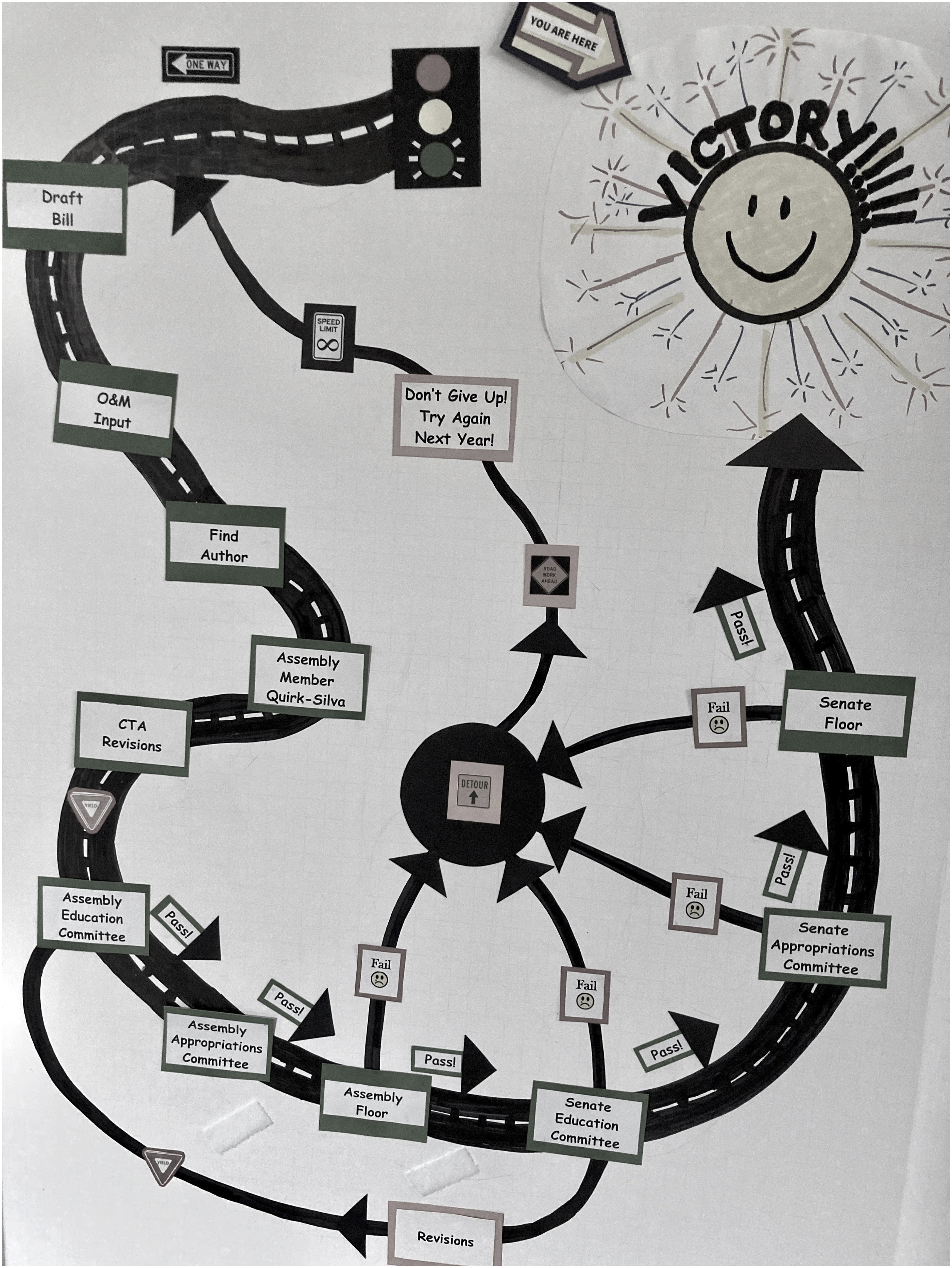
At every step in the legislative process, we distributed progress reports to our stakeholders. We continued to publish articles and present at conferences. A delegation of O&M specialists, teachers of students with visual impairments, and students visited the home office of the assembly member who authored our bill. Another delegation met with their assembly member in our state capitol. With the widespread and active involvement of the people and organizations, our bill passed at every level by unanimous vote. Our bill was signed into law by the governor in 2019 on White Cane Safety Day (October 15th).
Step 8: Inform Stakeholders
We launched a simultaneous top-down and bottom-up campaign to inform our community about the new law. The California Department of Education and its Special Education Division issued a simple memo to LEAs, and we obtained and disseminated that memo. We sent announcements through our email and social media network, published more articles, and gave additional professional presentations. Our webinar on the law is available on-demand through the CAOMS Membership page of our website (https://caoms.org/membership/). The law became effective on January 1, 2020, and, since then, O&M specialists throughout the state went to their administrators with a copy of the law in hand. At least three districts won immediate compliance.
Conclusion
In California, a small group of concerned individuals led a grassroots movement for legislative change. We secured the right of our students to receive O&M services from qualified instructors, throughout their home communities, and in varying lighting conditions, with transportation provided by the school district, as well as the right to receive vision education services outside of school hours. We obtained recognition that the ECC can guide LEAs in serving students with visual impairments. We hope to inspire movements in states across the country to pass similar legislation. Ultimately, we want an amendment to the IDEA that fully recognizes the right of students with visual impairments to receive evaluation and instruction in all nine areas of the ECC.
Footnotes
Declaration of Conflicting Interests
The author(s) declared no potential conflicts of interest with respect to the research, authorship, and/or publication of this article.
Funding
The author(s) received no financial support for the research, authorship, and/or publication of this article.