




Abstract
Keywords
Accessing graphical information is challenging for people with visual impairments (i.e., blindness or low vision). The primary method for making graphical information accessible is to translate visual graphics into tactile graphics. In this translation process, the goal is to retain and convey the most important or salient informational features of the represented object or phenomenon (Braille Authority of North America, 2010; Gardner, 1996). Commonly, resemblance is used as the main semantic bridge between a tactile image and its visual referent, however, sometimes line drawings of objects can become too complex for tactile graphic readers owing to many intersecting lines. Moreover, perspective viewpoint and partial obstruction add to this difficulty (Heller et al., 2002). Such issues can make one consider the need for a tactile graphic to resemble a visual image of an object and the possibility of designing tactile graphics that are tailored for persons with blindness and are not mere embossed versions of images. This process requires an in-depth investigation into the perceptual foundation of touch and an evaluation of new tactile graphic design strategies in pedagogy. In this light, the theory of paired associate learning (PAL) provides an interesting approach—that is, a pictorial and verbal association is very well retained in memory (Arndt, 2012). However, the validity of this concept remains untested for tactile stimuli and this work aims to address the same.
The practice of associating simple graphic designs with words or short phrases dates back thousands of years (Womack, 2005). Abstract shapes can convey meaning and also signify larger concepts (e.g., stroke + branches = tree; and tree + tree + tree = forest) (Womack, 2005). According to Ullmer, symbols or shapes have to fulfill four requirements to be meaningful—they should be easily: (1) discriminated from other designs; (2) remembered; (3) remembered semantically: conveying an assigned meaning (tree), or even multiple meanings (tree, wood); and (4) semantically functional within a multisign system to construct complex meanings (forest; Ullmer, 2002). Conveying knowledge through symbols is common in sighted culture, but rarely explored in research for persons with blindness.
A well-studied field with conceptual roots in Gestalt theory, PAL research posits that any pairing of stimuli, or stimulus-response, can be remembered if at least one factor is a word, and the participant intuitively or deliberately responds to the word by conjuring mental imagery (not necessarily visual imagery) to associate it with the other half of the pair (Arndt, 2012; Greeno, 1970). Some researchers believe this association is inevitable: “…[T]he mind cannot really be a blank tablet…” that simply records the proximity of two stimuli, but will spontaneously conjure a bridging idea or association (Greeno, 1970). This emphasis on association as the core of memory continues a theoretical tradition stretching back to Aristotle. If an association is automatic, then visual or even logographic or informational resemblance, although helpful, may be unnecessary. This speculation requires more research but suggests that abstract tactile shapes can be used to signify or symbolize knowledge if they can satisfy the aforementioned four requirements of meaningful signs.
The value of spoken words to catalyze meaning is suggested by Lacey and Campbell (2006), who investigated whether retention of visual and tactile stimuli relied on verbal (amodal) representations using an interference technique. These researchers inferred that information related to unfamiliar objects was verbally encoded in memory (Lacey & Campbell, 2006). Millar investigated tactile memory in children with blindness with a task in which they were required to remember and recall a sequence of tactile patterns. The list contained patterns that: (1) were tactually similar, (2) had similar sounding names, or (3) dissimilar in both dimensions. The results suggest that after associations between tactile stimuli and specific verbal or phonological codes are established, tactile stimuli are stored verbally (amodally) by the participants (Millar, 1975). Other research suggests that concrete and abstract concepts are encoded, processed, and retrieved differently, with words for tangible referents being more memorable (Noppeney & Price, 2004). Also, tactile exploration along with visual exploration of novel stimuli assists association of shapes and sounds than visual exploration only (Fredembach et al., 2009).
This current work is indebted to research by James and Gill (1972) and Nolan and Morris (1971), who first identified a set of abstract tactual primitives for use in tactile graphics. That research is conceptually linked, if indirectly, to William Moon's development of a simplified raised-line alphabet in 1845, work that is little discussed (or even unknown) today (Schwink, 2009), and the alternative symbol set developed by Thurlow (1988). The symbols used in this work also bear possible overlap with design strategies used in the development of a communication system developed by Charles K. Bliss called “blissymbolics” in 1965 (Bliss, 2004). Implicit in this early work, as well as more recent research (Jehoel et al., 2006), is the assumption that when translating visual sources into tactual format (including charts, diagrams, etc.), using these primitives will reduce tactile clutter, although there has been little or no classroom application and testing of this assumption.
In their work with a set of simple abstract tactile shapes, Gupta et al. found that individuals with blindness often incorrectly identified shapes if, during their tactual exploration, they encountered a simple, salient configuration (e.g., a right angle adjacent to an acute angle) that was also present in another shape. They also observed that students often ended their tactual explorations as soon as a salient configuration was encountered, without continuing to explore the entire shape. They called these primitives basic identity tags (BITs; Gupta et al., 2018). They proposed that abstract BIT-based shapes can fulfill two of the four requirements: to be discriminable and memorable regardless of size and orientation. This observation echoes earlier research by Berla et al. (1976). These works informed the design of stimuli for the experiments in this research.
Research on “tactons” by Brewster and Brown (2004), discusses another approach for conveying information tactually. Tactons are structured, abstract messages encoded in vibrotactile stimulation (using parameters like amplitude, frequency, etc.) for fingertips. Though interesting, this method does not provide an opportunity for active exploration using hand movements which are said to be optimal, even necessary for effective haptic perception (Lederman & Klatzky, 1987).
This work aims at investigating whether simple tactile shapes can facilitate the perception and retention of associated information using different recall experiments. A set of 12 shapes were identified (created using basic elements such as right angle, curve, or line, etc.) and one-word labels were assigned to them according to three categories: consonant, with plausible resemblances to visual versions (e.g., star); dissonant, contradicting an expected resemblance (e.g., pencil); and abstract, with no tangible referents (e.g., cold; see Figure 1). This work primarily addresses two research questions: (1) can various categories of paired associations of tactile shapes and verbal labels be retained and recalled by participants after small and long gaps; and (2) which triggers (verbal or tactile) enable better recall of remembered information.
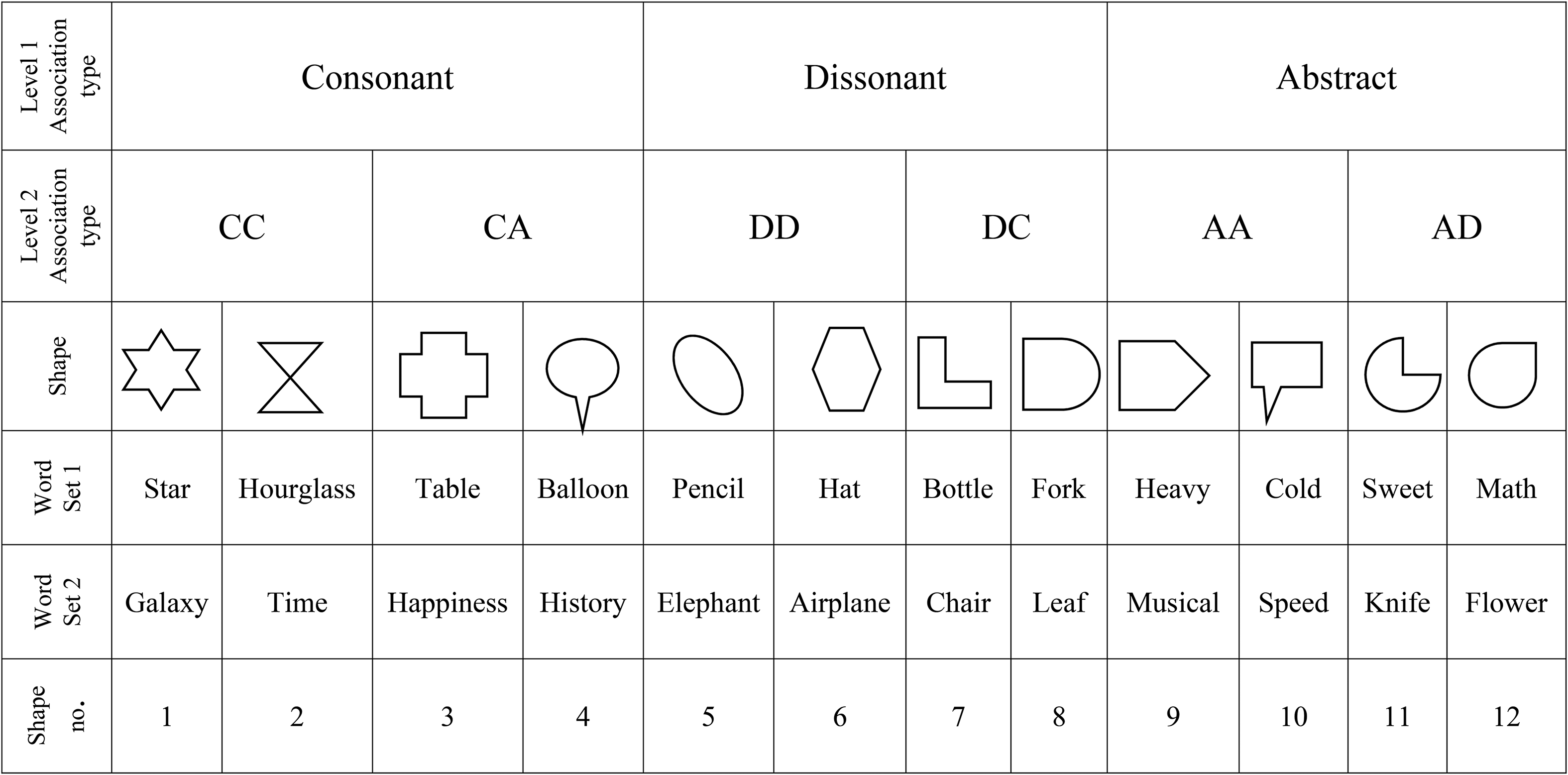
Tactile Shapes, Word Associations, and the Categories of Associations Used in Experiments.
Methods
A training session followed by recall tasks was used to address the research questions. First, the tactile shape–label associations were presented to participants and they were orally guided by the research team to explore and learn them. After this training, they were asked to recall the paired association one by one using verbal, braille, and tactile shape triggers (i.e., one part of the two-part association was provided as a trigger and the participants were expected to provide the other part of the said association). For example, in different tasks, they were (1) told a label and asked to explore and touch the respective correct shape; (2) asked to place stick-on braille labels on the respective correct shapes on a sheet; (3) asked to place the correct embossed tiles on respective braille labels on a table. It is also noteworthy that most related earlier work has been conducted with sighted (sometimes blindfolded) participants and the conclusions cannot be generalized for individuals with blindness owing to physiological differences between vision and touch. Additionally, it has been noted by Norman and Bartholomew (2011) that people who are blind have enhanced tactile acuity. To address this gap, the experiments in this work were conducted with persons with blindness.
Experiments were conducted at the National Association for the Blind (NAB), in New Delhi (India), and at the Indiana School for the Blind and Visually Impaired (ISBVI), in Indianapolis (USA). Thirty individuals who were totally blind aged 12–20 years participated in this research. All participants were competent in braille and spoken English with no learning disabilities. Ethical clearance was obtained for conducting the studies with human subjects. Informed consent was obtained from participants and school authorities.
Stimuli
Twelve embossed-line shapes (see Figure 1) were prepared on a thermoformed Braillon sheet using three-dimensional-printed shapes as negatives (or molds) in a 4 × 3 arrangement which is a low-cost and effective realization technique (Gupta et al., 2017). Shapes were assigned labels as per three categories of semantic associations: consonant, dissonant, and abstract (see set 1 in Figure 1). The second set of labels was created for the same shapes that were consonant (reinforcing the labels of set 1), dissonant (contradictory to the labels of set 1), or abstract (not related to the label of set 1; see set 2 in Figure 1). In a consonant–consonant association, the label star–galaxy was associated with a six-pointed polygon.) Braille stickers with embossed labels were prepared for use in experiments 3 and 4. Twelve small plastic tiles that were 5 cm × 5 cm in size were prepared, each having one tactile shape stuck on it, for use in experiments 3 and 4.
Training
Ten participants (7 males and 3 females) aged 13–20 years (M: 15.6, SD: 2.633) participated at ISBVI. Twenty participants (10 males and 10 females) aged 13–16 years (M: 13.85, SD: 1.089) participated at NAB. The procedure mimicked classroom pedagogy. Researchers presented stimuli to the participants and asked them to explore the shapes one by one while the researcher announced the respectively associated label simultaneously. For example, the researcher said, “Touch this shape, this is called a pencil.” The participants actively responded, and their expressions were noted for consonant associations (e.g., “Yes, this looks like a balloon” or “I can see that”). Dissonant labels often evoked surprise or shock, “That doesn't make sense.” Abstract labels evoked little or no emotional reaction beyond occasional puzzlement. This process was repeated two times and then participants were given an opportunity to explore and encode the newly acquired information.
Experiment 1
Experiment 1 investigated the recall of shape–label associations using verbal triggers a few days after training. This experiment investigated the quality of retention and recall of various types of associations. Ten participants (7 males and 3 females) aged 13–20 years (M: 15.6, SD: 2.633) at ISBVI were first trained with the 12 shape–label associations from set 1 (see Figure 1), then tested 5 or 6 days later (as per their availability). In the test, participants heard the spoken labels one by one, then were asked to search for the respectively associated shape amongst 12 tactile shapes on a sheet. This experiment was conducted in a classroom setting with groups of 4–5 participants at a time.
Results
The results show that the mean percentage accuracy of responses for consonant associations (M = 90.0, SD = 8.16) was higher than that for dissonant associations (M = 65.0, SD = 12.91) and abstract associations (M = 60.0, SD = 16.33). Since this experiment had a repeated measures design, a one-way analysis of variance (ANOVA) was used for a comparison between the three categories of associations. Levene's test indicated homogeneity of variances for three categories of associations: F(2,9) = 0.50, p > .05. A one-way ANOVA indicated a significant difference between the accuracy of responses for categories of associations: F(2,9) = 6.20, p < .05. Multiple comparisons were performed using the Tukey procedure, which indicated that performance with consonant associations was significantly higher than that for dissonant and abstract associations (p < .05).
Experiment 2
Experiment 2 examined the recall of shape-two labels associations using verbal triggers a few days after training. To test the extent of the semantic capacity of tactile shapes, the second set of one-word labels was added to the existing shape-word associations (see set 2 in Figure 1). These new labels or words were categorized as (1) consonant (reinforcing the labels of set 1), (2) dissonant (contradictory to the labels of set 1), and (3) abstract (not related to the label of set 1). Six different combinations were created: consonant–consonant (CC), dissonant–consonant (DC), consonant–abstract (CA), dissonant–dissonant (DD), dissonant–abstract (AD), and abstract–abstract (AA; see Figure 1).
Eight students aged 13–19 years (M = 14.7, SD = 2.12) from ISBVI participated in this experiment. The participants were trained (following earlier procedure) and were told, “Each shape now has two names; try to learn and remember both.” They were tested after 5 or 6 days (as per their availability), using the same procedure as experiment 1. Verbal triggers included labels from both sets 1 and 2.
Results
The percentage accuracies for the six categories of association sets are shown in Table 1. The analysis was aimed at comparing the means of performance accuracies for the six categories (total of 24 data points = 12 shapes × 2-word sets, each data point as mean accuracy of performance by eight subjects). A Levene's test indicated nonhomogeneity of variances—F(5,18) = 2.935, p < .05—thus, ANOVA analysis was rejected. A nonparametric Kruskal–Wallis test was conducted to detect variation between categories at a significance level of 0.05. A significant result (p < .05) was followed by a pairwise comparison using the Dunn–Bonferroni post hoc method. Significance values were adjusted using the Bonferroni correction for multiple tests. A significant difference (p < .05) was observed between CC type associations (accuracy percentage M = 100, SD = 0.0) and AA (accuracy percentage M = 68.75, SD = 7.21), although there was no significant difference between all other pairs. Additionally, an independent samples t-test indicated that there was no significant difference between the accuracy of recall for the first and second sets of labels of 12 shapes each: t(22) = 0.77, p > .05. The overall accuracies percentages for the two sets were 84.37 (SD = 12.06) and 79.17 (SD = 20.18), respectively.
Mean Percentage Accuracy of Responses for Experiment 2 at ISBVI.
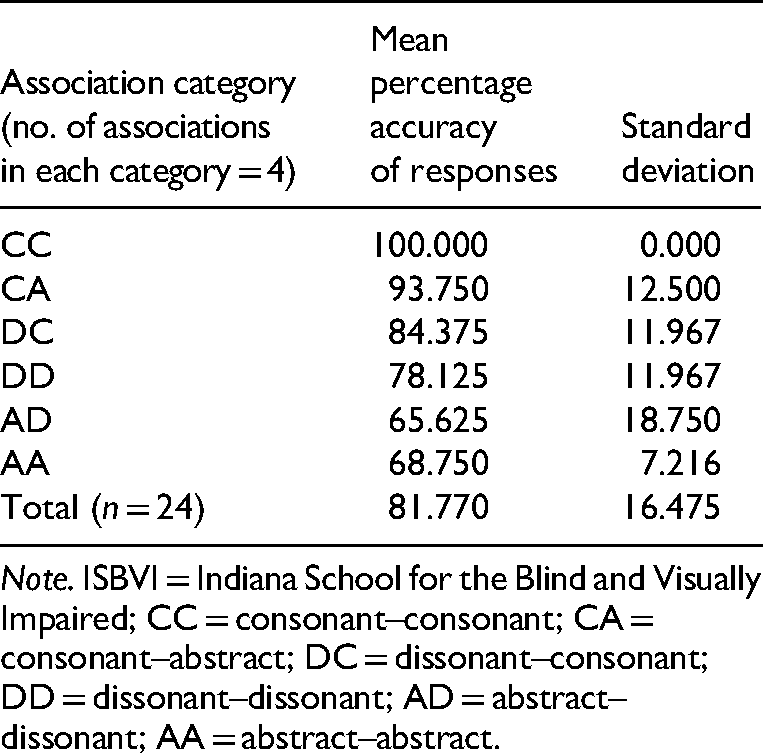
Note. ISBVI = Indiana School for the Blind and Visually Impaired; CC = consonant–consonant; CA = consonant–abstract; DC = dissonant–consonant; DD = dissonant–dissonant; AD = abstract–dissonant; AA = abstract–abstract.
Experiment 3
Experiment 3 looked at the recall of shape-two word associations using tactual triggers a few days after training. The aim of this experiment was to investigate the effect of using tactual triggers on the accuracy of recall. Twenty students (10 males and 10 females) aged 13–16 years (M: 13.85, SD: 1.089) from NAB participated. They were trained on set 2 associations as described in experiment 2. In recall tasks, tactile triggers were used instead of verbally announced labels. For group 1 (label-on-shape [LS] protocol), labels were presented as braille stickers and the participants were asked to read a label, look for the respectively associated shape in the tactile shape sheet (same as used in training) and stick the braille sticker on it (see Figure 2). Each braille sticker had two labels, one from each set, associated with the same shape. For group 2 (shape-on-label [SL] protocol), shapes were presented as small tiles (with sticky back side) and labels were embossed as a list on a sheet (though widely spaced to accommodate shape tiles). Tactile shape tiles were presented in a jumbled set on the tabletop; the participants were asked to pick a tile, recognize the shape, look for the respectively associated label and stick the tile on it.

Pictures of Participants at (a) NAB India and (b) ISBVI Indianapolis During Experiment 4 using LS Protocol.
Results
The results indicate that the mean percentage accuracy of recall for group 1 (LS protocol) (M = 91.67, SD = 9.37) was significantly better than that for group 2 (SL protocol): M = 44.17, SD = 21.51; t(18) = 7.01, p < .001. A comparison between performances for the six types of associations was done using Levene's test (p > .05) followed by one-way ANOVA, which indicated no significant difference between the performances: F(5,18) = 0.472, p > .05.
Experiment 4
Experiment 4 examined the recall of shape-two word associations using tactual triggers four months after training. (This experiment was conducted after four months to probe long-term retention and recall with tactual triggers.) Participants from both locations were given recall tasks to test if tactile shapes facilitated long-term retention of associations. The participants included nine students aged 13–19 years (M = 14.67, SD = 2.00) of ISBVI (four in group 1, LS protocol, and five in group 2, SL protocol) and 17 students aged 13–16 years (M: 13.87, SD: 1.163) of NAB (10 in group 1, LS protocol, and 7 in group 2, SL protocol). All had participated in previous training and experiments 1, 2, and 3. During the four-month gap, participants had no access to the training or testing materials, no contact with the researchers, and no other reinforcing experiences. The tests were conducted according to the procedure of experiment 3 (see Figure 2).
Results
A two-sample Student's t-test was used to check differences in the mean for two protocols (means of participant performance for 12 shapes = 12 data points). At NAB, the mean percentage accuracy of recall for group 1 (LS; M = 71.79, SD = 14.16) was significantly higher than for group 2 (SL; M = 31.25, SD = 37.11), t(22) = 3.52, p < .05. However, there was no significant difference found between performance between the two groups at ISBVI—t(22) = 0.435, p > .05—the mean percentage accuracy of recall was 75 (SD = 25.76) and 70.83 (SD = 20.87) for groups 1 and 2, respectively. The percentage accuracy for group 1 (LS protocol) at ISBVI was on par with that for group 1 at NAB: t(22) = 0.374, p > .05. For group 2 (SL protocol), the participants at ISBVI performed significantly better than the participants at NAB: t(22) = 3.22, p < .05.
Discussion
This work demonstrated the semantic capacity of simple tactile shapes, with little or no resemblance to tangible objects through four experiments that were aimed to investigate if tactile shapes can facilitate semantic encoding, retention, and recall of associated verbal information using various triggers.
Three types of associated were studied (consonant, dissonant, and abstract). Of the three, consonant associations were most easily learned and remembered, dissonant associations were second and abstract associations were the most difficult. The semantic strength of consonant associations may be explained in part by the likelihood that participants had previous experience with these concrete, familiar shapes, or objects. As noted in Noppeney and Price (2004), and stated in Paivio and Okovita (1971), familiar words are easier to learn and retain than abstract words as they arouse mental imagery. While testing consonant associations, spontaneous comments (such as, “Yes, I can see that”) from the students supported this speculation. It was interesting to see that the training session invoked similar responses of agreement and surprise from participants in the USA and India, which suggests that such associations cater to a more innate psychological response that may not be affected by cultural background. This observation resonates with the popular “schema-congruity theory” in human psychology which professes that cognitive processing of new information is influenced by ones existing knowledge.
Individuals organize acquired knowledge or information in “schemas” from where the information can be accessed by a trigger, which can be verbal, visual, auditory, tactual, or olfactory (Alina & Ioan, 2013). “Schemata” are enduring understandings of a specific phenomenon that are established over time and experiences and cannot be easily changed once established. According to the theory of schema-congruity, a schema-congruent stimulus offers a comfortable feeling of familiarity which enables easy retrieval. For example, shapes for which the performance accuracy was higher are combinations of salient features that are salient in the referent object, as well: for example, an hourglass shape has a wide top, wide base, and slim connection in between; a table shape has a main rectangular center with identical salient features at each corner to suggest four legs; and, in the case of “sweet” shape, which the authors assigned as abstract association, participants could think of a pie (see Figure 3). Whereas a schema-incongruent stimulus generates surprise and triggers extensive cognitive processing to enable an individual to make sense of the unusual information, thus, facilitating recall also called the “distinctiveness effect” (Waddill & McDaniel, 1998), which is evident from the recall performance for dissonant associations. For example, upon hearing the label “pencil,” participants might anticipate a thin linear symbol with an acute angle at one end, rather than the oval assigned to that label (see Figure 3). The distinctiveness of this association facilitated a resilient memory. Figure 3 suggests that the primacy effect could also have contributed to better retention of the first few associations. However, in view of the relatively small statistical differences and sample size, these findings should be considered preliminary.
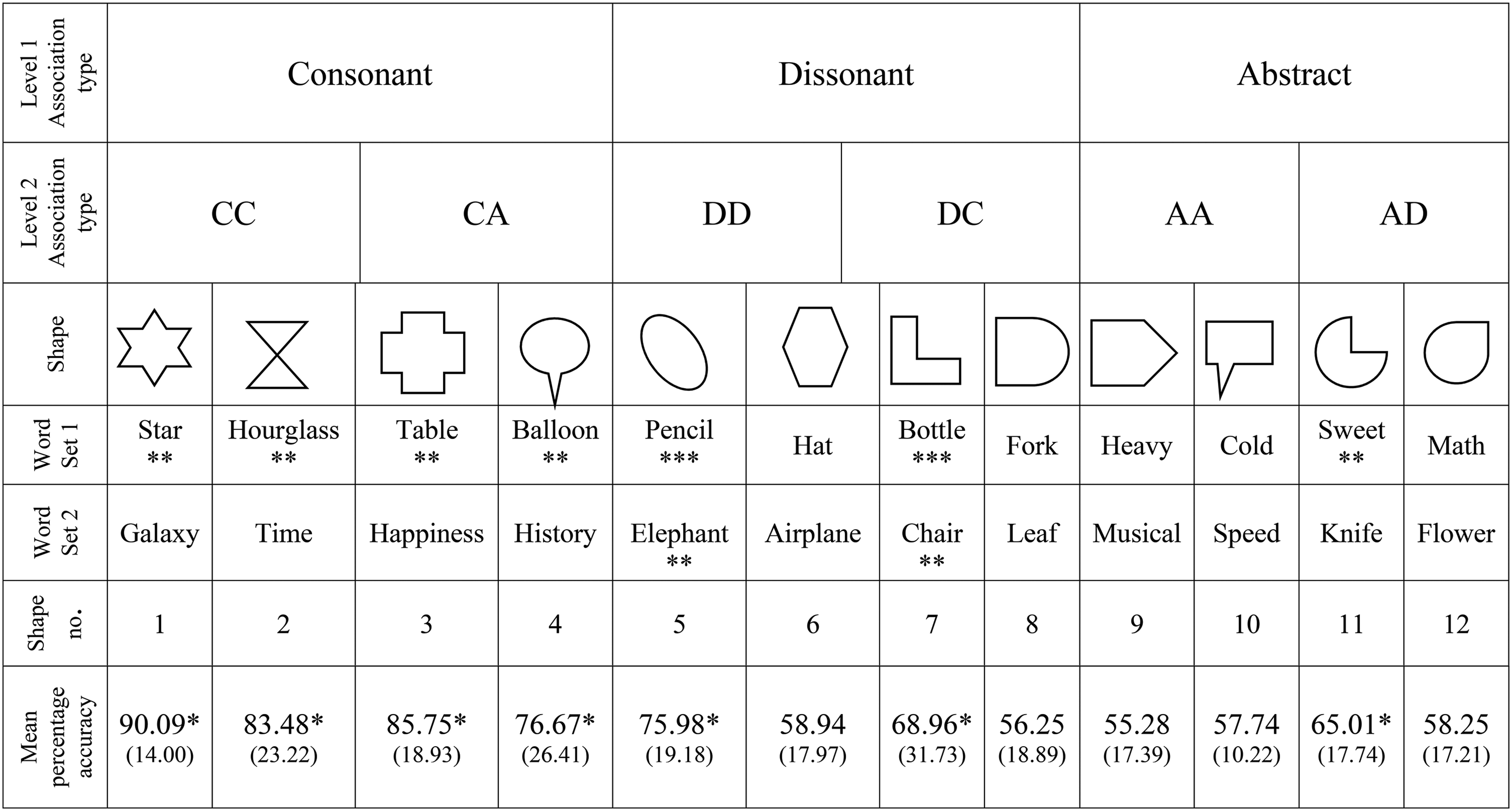
Mean Percentage Accuracy (With SD) for Associations Across All Experiments and its Correlation With Schema Theory.
These findings suggest that simple tactile shapes can facilitate associative learning, even with no resemblance to its referent, or with a little logographic resemblance. Equally intriguing is the capacity for these tactile symbols to support multiple semantic associations. As seen in these experiments, participants could remember at least two label associations for an individual shape in cases in which the second set of labels was (1) reciprocal or reinforcing, as well as (2) contradictory or categorically exclusive.
In experiment 4, the retention quality of the associations was tested over a long-term gap (four months) and, as per expectations, the recall accuracy deteriorated. However, recall accuracy for some shapes was high (above 70%), which suggests that those shapes may possess some particularly memorable characteristics not present in all shapes (see Figure 3 for an overall performance metric for each shape). Gupta et al. (2018) identified a small set of “basic identity tags” (right angle, acute angle, and curve) that participants readily recognized and used them as tags to identify an entire shape. It is likely that other distinct design features or combinations of features could also function as salient characteristics that can facilitate encoding and trigger memory at the time of information retrieval. Based on the results, it is speculated that (a) shapes having a relatively larger number of salient changes and (b) shapes having symmetry (compared to asymmetrical shapes) are more memorable. Further research that investigates correlations between such characteristics and recall performance may confirm this speculation.
It is interesting to note that recall with orated verbal triggers was better than that with tactual triggers, and further recall was better when tactual braille triggers as compared to tactual shape triggers (see the results for experiments 3 and 4). This finding can be attributed to the mode of training used. Since the participants learned the associations with orally spelled-out labels and simultaneous tactile reference to shapes, orally presented labels triggered better recall, while braille labels made recall taxing. The cognitive load was further increased in case of tactual triggers and resulted in poor recall accuracy. However, from this finding, the importance of training (i.e., teaching) methodology is evident and its role in information encoding and thus recall strategy. Also, since similar stimuli in training and testing were used, positional salience may also have facilitated the encoding and retrieval of information.
These findings broadly demonstrate that tactile graphic design does not necessarily require a foundation in visual or pictorial resemblance to a referent or depicted phenomena. Other factors such as schema congruency, primacy effect, shape characteristics, positional salience, and the like also play an important role and further investigation is needed to establish correlations.
Implications for Practitioners
Most tactile educational material use graphics that are embossed versions of their respective print versions. Such design strategies are not tailored to the strengths (and limitations) of tactile perception. The findings of this article indicate that simple tactile shapes can improve tactile graphic design, and perhaps tactual learning strategies, to improve the classroom experience for students who are blind in several ways. First, the findings about the presence of the primacy effect suggest that tactile graphics be designed with small batches of information so that the quality of learning does not phase out in longer narratives. Second, an important finding about good retention quality of associations implies that tactile graphics need not always present “visually correct” representation of an object, since, in many cases, a two-dimensional perspective line drawing of an object can be very complex (e.g., a simple “L” shape can be more effective for depicting a chair). Third, ideas of associative learning with simple shapes can help in making educational material more efficient; for example, the use of a standard set of basic symbols for adding tactile annotation in a book such as an end-of-chapter symbol, genre of the graphic on a page, common symbols for repetitive ideas like chapter name, section name, and the like.
These implications can influence change in educational pedagogies for students with blindness. However, it should be noted that further research is required to evaluate the use of the suggested strategies in pedagogy thus providing an opportunity for future research.
Conclusion
This work presents an investigation of the semantic capacity of tactile stimuli in associative learning: that is, whether they can facilitate encoding, retention, and retrieval of associated verbal information using various triggers and if the visual resemblance is necessary for the same. The results show that tactile shape associations can facilitate robust encoding and quality retention over long periods of time with little or no visual resemblance. Additionally, results show higher retrieval accuracy with verbal (oral) triggers. Future research endeavors into evaluating the role of factors such as schema congruency, shape features, primacy effect, positional salience, and the like can help develop a deeper understanding of tactile learning strategies and validate the application of these findings in pedagogy. Based on the inferences, possible design strategies for tactile materials are suggested.
Footnotes
Declaration of conflicting interests
The author(s) declared no potential conflicts of interest with respect to the research, authorship, and/or publication of this article.
Funding
The author(s) disclosed receipt of the following financial support for the research, authorship, and/or publication of this article: This work was supported by the Indiana University Bloomington (grant number The President’s International Research Award).
