



Abstract
Dog guides are trained to assist people who are blind or have low vision (i.e., those who are visually impaired) with independent travel by performing functions such as avoiding obstacles, stopping at curbs and stairs, safely navigating across streets, traveling primarily in a straight line, and targeting specific locations or objects (Crudden et al., 2017; Franck et al., 2010; Gaunet & Besse, 2019). The dog's movements are communicated to the handler through the harness (Franck et al., 2010). The relationship between a dog guide and its handler has been described as revolving around communication, trust, and interdependence (Craigon et al., 2017).
When a person or another dog interferes with a dog guide's work, the team's safety and independent travel can be compromised. The handler's focus must quickly shift from traveling safely to a destination to assessing the interference and its effect on their dog, with little or no vision to aid in this assessment (Kutsch, 2011). Sometimes the interference is very minor, and the team can recover quickly, but in other cases, the team's progress is interrupted or ended. In worst-case scenarios, handlers must defend their dog guides or themselves from attacks by other dogs.
There is a small body of literature concerning the frequency and effect of dog attacks on dog guide handlers (Brooks et al., 2010; Godley & Gillard, 2011; Kutsch, 2011; Moxon et al., 2016). This literature has raised awareness about the significant implications of attacks by dogs on dog guides and their handlers. There are also sources that highlight the positive effects of public attention directed toward dog guide teams (International Guide Dog Federation, n.d.; Li et al., 2019). However, there is a scarcity of literature on interference from humans and dogs that does not rise to the level of attack and may not be aggressive.
☑ Earn CEs Online
by answering questions on this article.
For more information, visit:
http://my.aerbvi.org/AER-Store/Publications/BKctl/ViewDetails/SKU/AER
The Seeing Eye, a dog guide school founded in 1929 (Fishman, 2003), has long observed that a significant challenge dog guide handlers face after they complete training is interference with their dogs’ work from people and other dogs. A 2011 survey of dog guide handlers in North America conducted by The Seeing Eye found that 44% of respondents in the United States had experienced an attack by a dog, and 58% of those respondents said their dogs had been attacked more than once; 83% of respondents had experienced aggressive interference by a dog; and most interference and attacks happened on a public sidewalk or right of way (Kutsch, 2011, p. 4).
As of 2021, a majority of U.S. states and some Canadian provinces have adopted laws intended to protect dog guides from harm (The Seeing Eye, 2020). Nonetheless, observations and anecdotal evidence indicated that dog guide teams continued to experience interference from both people and dogs in a wide range of public settings, warranting further study of the problem. The goals of this study were to obtain current and comprehensive data about the types and severity of interference experienced by dog guide handlers and to develop strategies for combatting the interference.
Materials and Methods
Survey Design
The authors designed a 54-question survey concerning the interference that handlers who had completed The Seeing Eye's training program had been experiencing from people and from other dogs.
The survey was entitled, “Work Interference Survey,” and the instructions encouraged handlers to participate in the survey regardless of whether they believed they had experienced interference, or the type or severity of that interference while working their dogs. “Skip logic” in the survey allowed respondents to bypass questions that did not apply to them. The survey was designed this way to limit self-selection bias that would result if only handlers who experienced interference responded to the survey, but it was impossible to eliminate this potential bias entirely.
For some questions, respondents were required to choose between five possible responses on a Likert scale, ranging from “frequently” to “never” for questions about how often something had been experienced, or “not at all” to “very severely” for questions about the effect of an experience on the team's work. Other questions asked respondents to check boxes associated with specific statements and allowed respondents to choose more than one if applicable to them. Handlers were also given opportunities to provide additional comments.
The survey questions were divided into sections covering topics including demographics, interference from people, interference from dogs, aggressive physical contact, and laws and public education. The survey asked handlers to report on experiences they had had within the past five years. This time frame helped ensure that respondents reported on experiences that occurred after the 2011 survey, but gave respondents the opportunity to discuss their experiences of interference experienced by themselves and subsequent dog guides, if applicable.
The Interference from People section of the survey was designed to elicit how frequently respondents were experiencing interference from humans, whether intended or unintended, regardless of the presence of nonworking dogs, what types of interference were most common, and where it was taking place. The survey defined interference from people as a situation in which a person is deliberately trying to get the dog's attention. There were also questions about the public making unwanted observations concerning the appearance and handling of their dogs.
The Interference from Dogs section, on the other hand, was designed to obtain information about whether the interference involved nonaggressive or aggressive behavior on the part of other dogs, where the dogs were situated and whether they were attended to or unattended, and in what type of setting the interference occurred. In the sections about interference from people or dogs, the focus was on the behavior of the people and nonworking dogs who were interfering with the team's work, not the behavior of the dog guide.
In the Aggressive Physical Contact section, questions were designed to elicit information about how respondents determined that aggressive physical contact had been made; what information they could determine about the dogs’ injuries, what steps they took in response; the effect the encounter had on their dogs’ work; and whether they sought help from law enforcement or other sources.
Finally, the Laws and Public Education section sought information on how knowledgeable respondents were about the laws that protected them as handlers. It also asked about how engaged they were in grassroots education and lobbying around issues related to interference and dog guide protection.
Once a draft of the survey had been created, it was pilot-tested by four graduates of the Seeing Eye training program before it was launched, with minor clarifying changes made.
Survey Administration
This study was approved by The Seeing Eye. Informed consent for all participants was obtained by participants selecting a survey link or calling to participate in the survey, reading or being read the survey's introductory page, and accessing the survey. The survey was made available to 1761 active Seeing Eye graduates. SurveyMonkey was used to administer the survey. The survey was available online from October 1 through October 31, 2019. Handlers were notified of the opportunity to participate by email and by automated telephone message. Both messages offered handlers the opportunity to complete the survey by telephone instead of online to avoid technology becoming a barrier to participation. Handlers who elected to take the survey by telephone received a call from a trained volunteer who administered it and contemporaneously inputted the responses using SurveyMonkey. The same trained volunteer administered all telephone surveys. Descriptive statistics were then used to summarize responses to the survey questions.
Results
The survey did not require respondents to answer all questions, therefore, the authors have included the number of overall responses to each question when discussing the results.
Demographics
In total, 519 Seeing Eye graduates responded to the survey, including 129 who completed it by telephone, giving a response rate of 29.5%. Of the 519 respondents, 474 lived in the United States, 43 in Canada, one in the United Kingdom, and one in New Zealand.
Interference from People
The most common type of interference from the public reported by respondents was people talking to their dog guides or directing other verbal or nonverbal contact toward their dogs (see Table 1). Of those who reported experiencing interference from other people, 89.4% (437/489) experienced this type of interference at least occasionally. The anecdotal data showed that respondents experienced people making eye contact with their dogs or making other visual gestures to get their dogs’ attention. Respondents also commented that people made noises such as whistling, kissing, calling to their dogs, and even barking sounds. These types of interference sometimes occurred at intersections. The second most common type of interference from people was petting, which 81.3% of respondents (386/487) reported experiencing at least occasionally. Multiple respondents commented that while talking to or petting their dogs, people made statements such as, “I know I’m not supposed to [pet your dog], but I can’t help myself.”
Frequencies of Interference From People by Type of Interference.

In total, 66.1% of respondents (361/478) experienced people asking if their dogs were still training when the dog appeared excited or made a mistake, and 68.5% of respondents (296/432) had been criticized for reprimanding their dogs for work errors. Respondents commented that they often spent time attempting to educate the public about the importance of not interfering with their dogs while they were working and that this undertaking became burdensome at times.
Interference from Dogs
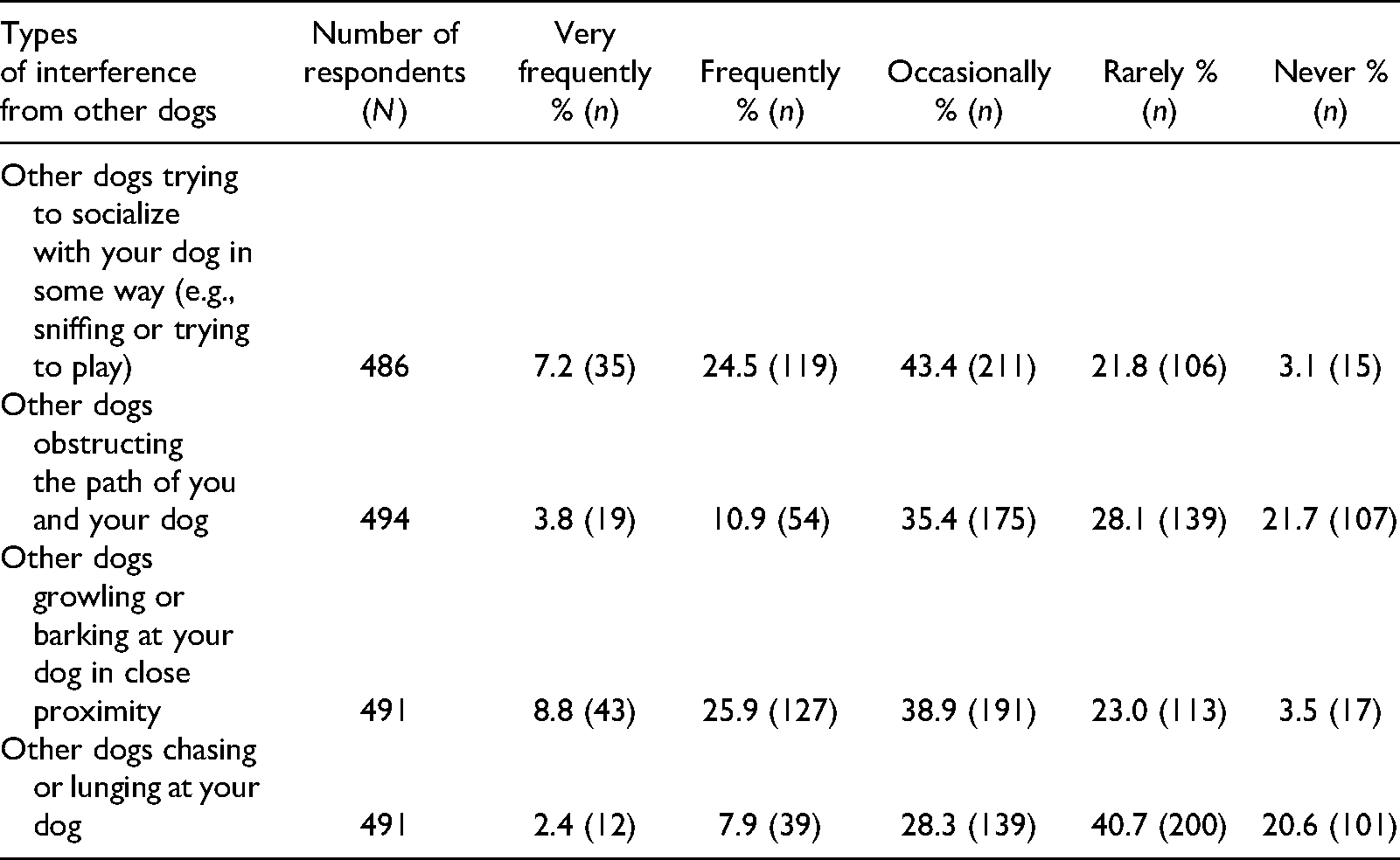
The majority of respondents, 77.7% (403/519), experienced interference from other dogs at least occasionally. The most common types of interference were attempting to play, obstruction, growling, and barking. Chasing and lunging reportedly happened less often (see Table 2). For 78.7% of respondents (387/492), interference from leashed but uncontrolled dogs caused problems. Six respondents commented on issues with poorly controlled dogs on long leashes. Loose dogs interfered with 61.8% (304/492) of respondents’ dogs, while 60.8% (299/492) experienced interference from dogs behind a fence. Eight respondents also commented on their experiences with interference from dogs barking out of stationary or moving cars, though the survey did not specifically ask about this context.
Frequency of Interference by Other Dogs by Type of Interference.
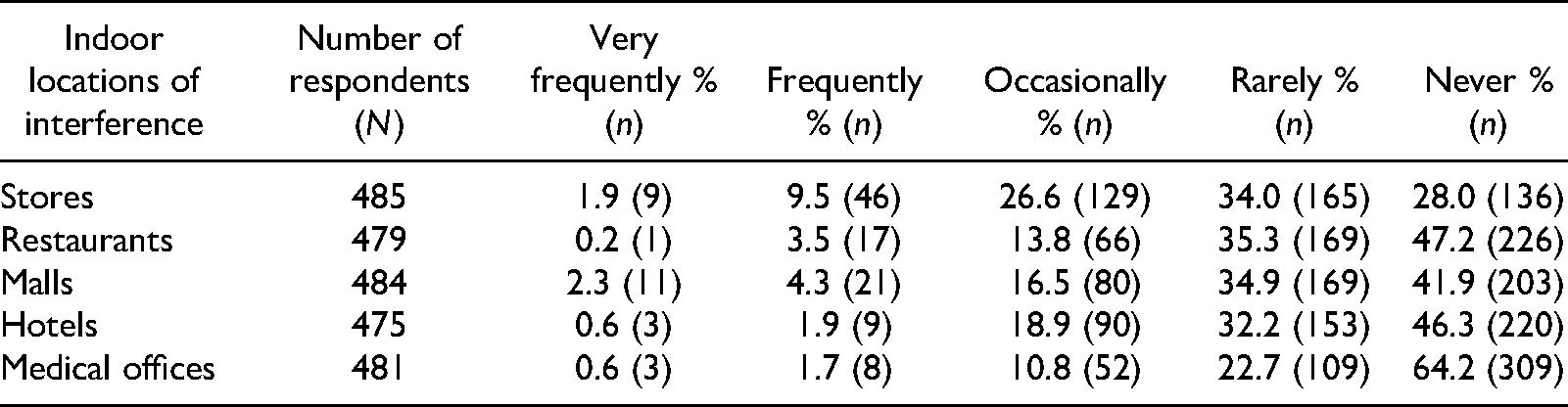
In total, 73.7% of respondents (361/490) reported encountering interference from dogs on public roads and sidewalks at least occasionally. In order of most frequent to least frequent, respondents encountered interference with dogs in stores, malls, hotels, restaurants, and medical offices (see Table 3). The anecdotal data also showed interference in public parks, on mass transit, at pet stores, and at veterinary offices. In their home areas, respondents experienced interference from other dogs most frequently in yards, relieving areas, and parking lots.
Frequency of Interference by Other Dogs According to an Indoor Location.
Only 6.3% of respondents (27/428) reported that their work with their dog guide was extremely affected by interference from other dogs. Encouragingly, 53.2% (228/428) reported interference from other dogs had slight or no effects on their dog's work.
Aggressive Physical Contact
Thirty-six percent (187/519) of respondents reported that their dogs were the victims of aggressive physical contact within the past 5 years. More than half (57.4% or 105/183) of aggressive encounters took place on public sidewalks or roadways. According to 48.9% of respondents (87/178), the aggressor dog was loose; and 38.8% (69/178) reported the aggressor dog was leashed, but uncontrolled. Nearly half of respondents, (49.6%, or 88/177) were at least somewhat disoriented as a result of the aggressive encounter.
According to 64.2% (120/187) of respondents, the other dog jumped on their dog guides, and 50.8% (95/187) found saliva on their dogs without broken skin. However, only 16.6% (31/187) of the dog guides who experienced aggressive physical contact were reportedly bitten. This finding corresponded closely to the 17% (32/187) of respondents who reported taking their dogs to the vet after the aggressive encounter. The majority of those who reported not taking their dogs to the vet (84.3% or 129/153) said they did not think their dog was injured.
Over half (54.9% or 101/184) of respondents reported that the aggressive encounter had no effect on their dog's work. However, 23.4% (43/184) said their dog became easily distracted by other dogs and 11.4% (21/184) said their dog became fearful of other dogs. Only 7.1% (13/184) said their dogs became aggressive toward other dogs. Five respondents (2.7%) said their dogs were permanently unable to work and had to be retired.
Only 28.4% (54/187) of respondents reported the encounter to law enforcement. Over half of those who chose to not report the encounter did so because they believed their dog's injuries were not severe enough to warrant it. Other common reasons were an inability to identify the dog's owner and a belief that law enforcement would not take appropriate action. In the open-ended comment section concerning reasons for not reporting, one respondent stated, Dog on dog attacks or incidents are not taken seriously in the area in which I live. Even when my prior guide was severely attacked, law-enforcement stated that the worst the other owner would endure was a small fine. Not to mention that I could not identify the owner as they fled after the attack. We still have some way to go regarding guide dog protection laws.
Of those who did report the encounter, just over half were satisfied with the response they received. Only 16 of the 54 responded “yes” to the question about whether law enforcement knew about applicable dog guide protection laws where the encounter took place, and the remaining 38 responses were divided evenly between “no” and “not sure.”
Laws and Public Education
The majority of those who responded to the survey (80.5% or 418/519) reported that they had attempted to educate the public about issues related to dog guide teams. Not all respondents provided further information about their public education efforts. Of those who did, 58.6% (228/389) made presentations or conducted outreach events. In the anecdotal data, respondents also said they educated people one on one when interference took place. Forty-three percent (223/519) of respondents reported that they knew there were dog guide protection laws where they live[d] and 49% (259/519) were not sure.
Discussion
The results show that dog guide teams experience a significant amount of interference from people and other dogs. The biggest problems are occurring on sidewalks and roadways and in public places. The results also suggest that the general public does not understand the myriad ways they can interfere with a dog guide team, even if the interference is unintentional. The most common types of interference reported by respondents did not involve physical contact and were sometimes subtle. Respondents were slightly more likely to experience people talking to their dogs or making eye contact than they were to have their dogs petted. Most respondents did not specifically state how they knew people were making eye contact with their dogs, but one respondent said a sighted companion informed them of the behavior. The least common type of interference respondents experienced was people feeding or attempting to feed their dogs, which is arguably one of the most direct ways a person can get a dog's attention. Thus, it appears that the less overt the interference was, the more pervasive it was. This finding is particularly troubling because subtle forms of interference can be harder to detect and address with little or no vision. A handler may sense that interference is occurring but not be quite sure what type of interference it is.
The public's observations about the behavior of handlers and their dog guides suggest that people often do not have an accurate understanding of how the partnership between a dog guide and a handler works. Perhaps this lack of awareness is not surprising, given the results of a survey of American adults that found that more than two-thirds of respondents had no or only minimal exposure to assistance dogs in public settings in the year preceding the survey (Schoenfeld-Tacher et al., 2017). These individuals may not realize that both members of the team play a willing and active role in the partnership and have clear expectations of one another (Pemberton, 2019).
The results concerning interference from other dogs are significant because of what they reveal about how those dogs are being managed by the people who are responsible for them. The interference was intrusive but did not always rise to an aggressive level. The biggest problem for dog guide teams stemmed from leashed but uncontrolled dogs, which indicates that people tend to overestimate their ability to manage their dogs on a leash.
A majority of respondents reported that their dogs did not experience “aggressive physical contact,” as that term was defined for purposes of the survey, but the number of incidents is still too high. Loose dogs were reported to be the biggest cause of aggressive physical contact, followed by leashed but uncontrolled dogs. Conversely, leashed but uncontrolled dogs were a bigger problem than loose dogs in situations where interference did not necessarily result in aggressive physical contact. These findings serve as a reminder of how compliance with leash laws can keep a disastrous physical encounter between dogs from happening, even if a person's control over their leashed dog is less than ideal.
The data indicate that respondents took proactive steps concerning the treatment of their dogs’ injuries since the percentage of people who took their dogs to the vet was consistent with the percentage of the dogs reportedly injured. This number was lower than the proportion of attacks on dog guides in the United Kingdom that required veterinary attention (41%) in a retrospective study of such attacks reported to Guide Dogs UK (Brooks et al., 2010). The greater proportion in the U.K. study could relate to attacks that required veterinary attention being more likely to be reported to the school, especially since Guide Dogs UK pays for veterinary treatment of all their working dog guides. Most respondents who did not take their dogs to the vet reported not doing so because they did not think their dogs were injured.
It is encouraging that over half of those involved in an aggressive encounter said the encounter had no effect on their dogs’ work. This result may speak to the mental stability of the dogs in question. It is concerning that almost a quarter of respondents found that their dogs subsequently became distracted by other dogs as a result of the encounter. The number of dogs that had to be retired as a result of an aggressive encounter was similar in proportion to that reported in the most recent Guide Dogs UK retrospective survey, in which 3% of dog guides (13 of 430) had to be retired after being attacked by another dog (Moxon et al., 2016). Although this number is relatively low, it is too high when one considers the resources that are necessary to create and maintain dog guide partnerships, not to mention the effect on the welfare of the dog and the social and emotional well-being of the dog guide handler.
The findings demonstrate that respondents generally did not think contacting law enforcement was an effective way to address an aggressive encounter. The data on whether law enforcement officers were familiar with dog guide protection laws was inconclusive. The most likely reason is that respondents were not in a position to accurately assess the knowledge of law enforcement in this area. Half of the survey respondents were themselves uncertain of whether there were dog guide protection laws where they live.
Limitations
To protect the privacy of respondents, the authors did not ask for personal information such as age or sex. Without these details, it was not possible to state how representative a sample of those responding to the survey were to the handlers surveyed.
An additional limitation of the study was the use of a Likert scale ranging from “never” to “very frequently” for some questions. Upon further consideration, a scale using numerical values from one to five would have reduced the potential for varied and subjective interpretations of the meanings of answer choices such as “frequently.” The study may also have benefited from follow-up interviews with a subgroup of the respondents to further expound upon survey responses. Finally, this survey did not specifically explore the emotional impact of interference on dog guide handlers as individuals because the goal was to examine the effects on the team's work as a whole. However, respondents did report on the emotional toll interference takes on them, which indicates further study of the issue is warranted.
Implications for Practitioners
A recent study concluded that dog guide handlers experience less stress associated with pedestrian travel than cane users, in part because they may be more experienced and sophisticated travelers (Crudden et al., 2017). However, Crudden et al. also noted that managing the stress of independent travel can place a greater cognitive burden on visually impaired people than on their sighted counterparts. Orientation and mobility specialists counseling consumers about their options for mobility devices may or may not have significant experience providing services to people with dog guides and may not have had opportunities to observe interference and its effect on a team's work. Thus, practitioners can use the information in this study to gain a more concrete and realistic perspective on the various types of aggressive and nonaggressive interference handlers face while working their dogs and how these encounters can contribute to the cognitive burdens they experience related to independent travel. That said, the findings of this study should not be used to discourage orientation and mobility specialists from recommending dog guide mobility when appropriate, but it can help them better support the dog guide handlers with whom they work and understand their perspectives.
Dog guide schools can use the study to empower their consumers by developing and widely disseminating educational tools specifically targeted at different audiences such as handlers, law enforcement, and members of the public at large. These dog guide schools should consider holding periodic webinars for handlers about topics related to work interference and dealing with the public that can be attended live and recorded. Schools might also consider creating a portfolio of outreach materials that handlers can use and customize to self-advocate by reaching out to their local law enforcement personnel and elected officials about dog guide protection laws and the risks work interference poses to dog guide teams. The materials could contain a general template letter about the importance of enforcing dog guide protection laws with a copy of the statute for the applicable state or province and key findings from the study.
Future Research
As stated in the Limitations section, this study did not specifically explore the psychological and emotional effect that interference and aggressive encounters had on respondents. There has been some study specifically focused on the emotional effect of attacks on dog guide handlers (Brooks et al., 2010; Godley & Gillard, 2011), but there is no literature on the emotional effect of other types of interference on handlers and dog guides.
The final question on the survey that was the subject of this study asked respondents to provide their contact information if they wished to do so. The Seeing Eye should consider conducting a follow-up survey made available to those respondents who both volunteered their contact information and discussed the emotional or psychological effects of interference or aggressive encounters in their responses to the open-ended questions. This subgroup of respondents would likely be more inclined to respond to an additional short survey than would the original pool of respondents. The Seeing Eye should consider using the findings to develop the most effective and feasible ways to support handlers who experience lasting emotional or psychological effects as a result of members of the public or other dogs interfering in their work with their dog guides.
Footnotes
Declaration of Conflicting Interests
The author(s) declared no potential conflicts of interest with respect to the research, authorship, and/or publication of this article.
Funding
The author(s) received no financial support for the research, authorship, and/or publication of this article.