




Abstract
Keywords
Traditional instruction for students who are blind or have low vision (i.e., those who are visually impaired) has often included the use of hand-over-hand guidance by instructors to try to stimulate and facilitate students’ tactile engagement with objects in their environment. It most often takes the form of grasping the student by the back of the hand or wrist to compel the student to use their hands as directed by the instructor. Over the past few decades, many professionals have advocated for a change in the standard practices by which instructors and caregivers physically interact with children who are visually impaired and deafblind. In recent years, the use of less directive and restrictive hand-under-hand support in place of the more traditional hand-over-hand guidance has become increasingly prevalent among professionals working with these students. Despite this move toward a more inviting approach to manual instruction, hand-over-hand guidance is still commonly incorporated into the accommodations and instructional strategies for students with vision loss.
In Remarkable Conversations: A Guide to Developing Meaningful Communication with Children and Young Adults who are Deafblind (1999), Barbara Miles and Marianne Riggio describe the use of “gentle touch, the teacher's hands under the child's, never controlling, always coaxing,” as the most effective way to encourage the tactile curiosity and exploration of children who are deafblind (p. 74). In The Importance of Hands for the Person Who is Deafblind (2003), Miles describes and expands on the observations of Selma Fraiberg (1977), who described how the hands of blind infants behave in similar ways and take on many of the functions of other parts of the body, such as the eyes, faces, and mouths of sighted children. Because the hands of children who are blind and deafblind serve functions of other sensory systems, Miles likens manipulating the hands of these children to control what they feel to physically moving the eyes of a child who is sighted to control what they see (p. 1). Other authors such as Downing and Chen (2003) and Downing and Eichinger (2011) have also described the importance of allowing more freedom of hand movement in children who are visually impaired and deafblind to encourage independence and concept development. Most recently, the National Center on Deaf-Blindness (NCDB) published a practice guide for instructors describing the rationale for, and implementation of, hand-under-hand technique when working with students who are deafblind (NCDB, n.d.) which draws on the work of these and other authors.
The term “hand-under-hand” has been used to describe the techniques that promote the tactile autonomy of a student. Within the context of this review of the literature, we use the term hand-under-hand to refer to any physical contact on the part of the instructor or guide that allows the learner or attendant to engage in volitional movement. To make the case for the use of the hand-under-hand technique, practitioners tend to cite the works of Fraiberg, Miles, and subsequent authors, as well as their own anecdotal reports, observations, and descriptions of how students respond to interactive tactile instruction. Although the conclusions of these authors and practitioners are compelling, there is a noticeable lack of literature cited in these resources connecting research on biological and social responses to touch to make their case for the use of either hand-under-hand or hand-over-hand techniques. Subsequently, we attempted to address the following questions regarding touch and learning:
What are the potential links between the neurological processing of touch from different receptors on the skin and its effect on executive function, memory and learning as described by existing literature; and What does the existing literature tell us about how controlling forms of touch may impact perceptions and stereotypes and affect the sense of self-determination and autonomy of individuals who are visually impaired or deafblind, including those who have multiple disabilities?
Methodology
The search for literature describing research related to the subject of the physiological and sociological responses to touch was conducted by the authors from September 2021 to March 2023, using online databases such as Google Scholar, as well as the OneSearch scholastic library search engine. Review of additional literature included a search through hardcopies of publications housed at the library of a state school for blind students. The identification of relevant literature using the search of online databases and hardcopy publications consisted of two separate search domains. The first domain included a list of terms and keywords related to biological and neurological responses to touch. The second domain included a list of terms and keywords that identified literature describing the effect of touch on the social dynamic between individuals. Table 1 provides a list of the terms and keywords that were used to identify relevant literature under each of these two search domains.
Online Search Criteria.
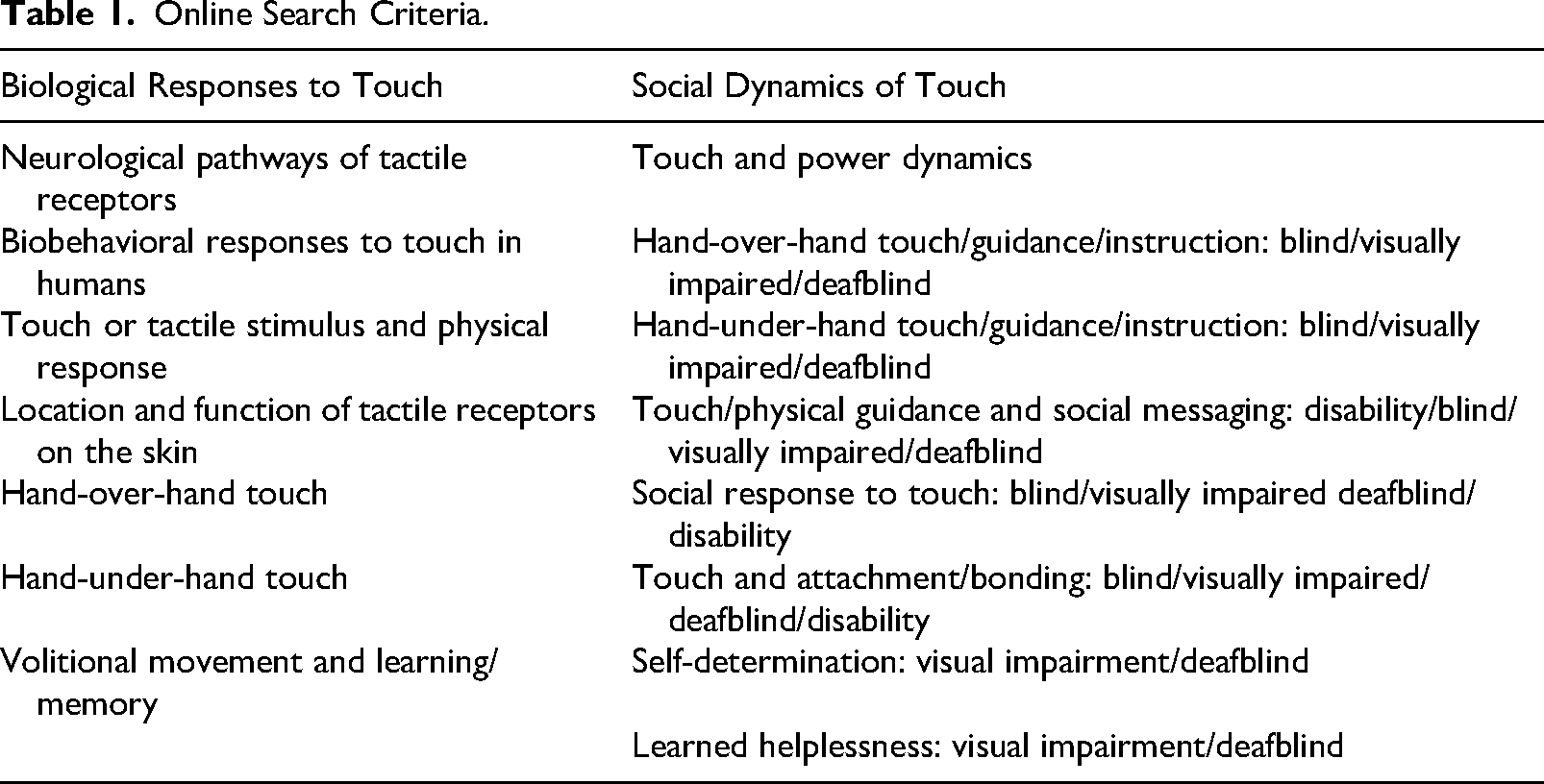
The determination of the literature to include in the review was prioritized based on: (a) the accuracy of the match of vocabulary and concepts contained in the source material to keywords used in the search criteria and (b) the source material as academic or clinical study rather than a guide for practice. Literature that contained the keywords and terms identified in Table 1 were included in the review. Materials containing words or phrases that were synonymous with these keywords and terms were also included. Based on this process, 46 sources employing peer-reviewed data from qualitative or quantitative analysis were initially identified as directly correlating to these areas of study. After the initial identification of relevant research, ancestral searches of both hardcopy and online sources were conducted to include foundational studies and increase depth of knowledge on the areas of inquiry using the same process as the initial search. The search for ancestral material yielded 27 additional works for a total of 73 sources.
Biological Responses to Touch
To answer the research question on the potential links between the neurological processing of touch from different receptors on the skin and its effect on executive function, memory and learning, we attempted to gather information on how humans interpret and respond to information gleaned through the sense of touch. Literature describing brain mapping studies with increasing resolution and accuracy as technology improved, as well as behavioral studies during which participants’ responses to sensory information and specific subjective experience was included. Aspects of touch that were closely examined included discriminative versus affective, as well as active versus passive touch. Discriminative and affective touch, two systems used for gathering exteroceptive information, were selected to examine how the brain typically interprets and uses information gleaned through the skin, whether the content is analytical and categorical, or social and psychosocial. A number of different types of cells have been identified within the skin and joints that integrate information received to form a cohesive tactile understanding of an individual's physical and social environment. Information from these exteroceptive information-gathering cells can also have a strong impact on the interoceptive system, affecting a person's ability to maintain or regain the comfortable, homeostatic state necessary for creating and integrating new neural connections. Thus, we examined studies describing active and passive systems, exploring whether volitional movement is related to performance and retention of information.
A Comparison of the Function and Physiology of Affective and Discriminative Touch
According to McGlone et al. (2014), The primary role [of discriminative touch] is to detect, discriminate, and identify external stimuli with a view to ultimately making rapid decisions to guide subsequent behavior. . . . [It also] subserves the perception of pressure, vibration, slip, and texture, all critical in providing haptic information about handled objects and during exploratory procedures. (p. 737)
Affective touch occurs between individuals to communicate emotions and to create and maintain social bonds. These messages can be quite intense, and a similar touch can trigger extreme emotions such as pleasure or disgust, depending on the context. As Ellingsen et al. (2015) explain, Inter-individual touch can be a desirable reward that can both relieve negative affect and evoke strong feelings of pleasure. However, if other sensory cues indicate it is undesirable to interact with the toucher, the affective experience of the same touch may be flipped to disgust. (p. 1)
Discriminative touch is sensed through glabrous skin, skin without hair. The best sensors of this type of information are located on the fronts of the hands (palms or fingers), the bottoms of the feet, the toes, and the lips. Affective touch is sensed through hairy skin, such as that on the backs of the hands and feet as well as the legs, arms, trunk and face. When these two types of touch are perceived, or sensed, they travel within specific pathways that communicate with disparate parts of the brain. In the past two decades, categorical dichotomies between affective and discriminative touch systems (McGlone et al., 2014; Olausson et al., 2010) have drawn on anatomical and physiological distinctions between tactile information carried via two relatively distinct affero-spinal pathways. To a great extent, these pathways correspond to the classical “lemniscal” and “extralemniscal” pathways. (Morrison, 2016, p. 1315)
What Morrison refers to as the lemniscal pathway through which discriminative touch messages travel to the brain, is also described as “the more sophisticated of our two transmission systems for touch” (McLinden et al., 2020, p. 45) and is responsible for “detection of size, form, texture, and movement across the skin” (Royeen & Lane in McLinden et al., 2020, p. 45). The extralemniscal pathway, through which affective touch messages are conveyed to the brain, is also known as the anterolateral system. This system “serves to mediate pain and to provide gross information about touch and about temperature” and is “mainly ‘survival oriented’ and as such serves a protective function” (McLinden et al., 2020, p. 46).
An important distinction to note is the difference between the locations where discriminative and affective touch messages terminate within the brain. Discriminative touch information is carried to the primary somatosensory cortex, which resides in the cortical regions of the brain; while affective touch information is conveyed to the reticular formation, which resides in the brainstem. These processes are complex, and there are overlaps between the affective and discriminative systems. However, roughly translated, affective touch is more closely associated with survival or lower brain functions, and discriminative touch is connected with intellectual focus or higher brain functions (Morrison, 2016, p. 1314).
A 2006 study by Hertenstein et al. investigated a person's ability to identify a stranger's emotion without seeing them, but rather simply by being touched on the arm. This behavioral study did not differentiate between the discriminative and affective touch systems, but it did help to establish that emotional states could be communicated solely through the sense of touch.
In a 2017 study by von Mohr et al., subjects participated in a game in which they were excluded from taking turns, then they were given either slow or fast strokes on their arms with a soft natural brush. Participants who received the C tactile (CT)–optimal speed for affective touch, or soothing touch, rated themselves consistently higher in feelings of well-being than those receiving fast touch (p. 6). A similar study by Spitoni et al. (2020) found that, “. . . people with a history of traumatic parental bonds and a disorganized attachment pattern perceive a ‘caress-like’ stimulus as being unpleasant, whereas participants with organized attachment consider the same tactile stimulation to be pleasant” (p. 1). This study goes on to suggest that “. . . early experiences with parental deficiencies shape the physiological responses of peripheral CT fibers and central nervous networks” (Spitoni et al., 2020, p. 1).
In 2019, Boehme et al. used fMRI to demonstrate that the insula, which is highly involved in assessment of well-being and is also activated using the affective touch system, was deactivated during self, or nonsocial touch. This finding indicates that affective touch receptors are more likely to be responsive to externally, rather than internally, generated stimuli (p. 2290).
A Comparison of Attention to Tasks Using Active and Passive Touch: Volitional Control and Memory or Learning
A 1981 study by Richardson, Wuillemin, and MacKintosh asked participants to memorize a route through a tactile maze with either volitional or nonvolitional movement. The authors of this study concluded that volitional movement requiring attention to, or decision making about, movement interfered with the ability to remember a tactile route (pp. 361–362).
In a similar study on volitional movement by Snapp-Childs et al. (2013), sighted adults were divided into three groups and provided a video game to play. The control group did not practice playing the video game. The second group practiced the game by placing their hand on the control while the joystick moved on its own, giving them no control. The third group practiced the game by controlling the movements of the joystick themselves. The findings of this study indicated that, passively experiencing a desired movement pattern is not an effective route to learning – the individual needs to perform prospective control of the trajectories during practice. . . . Practice that allowed and supported active prospective control yielded progressive improvements in prospective control and thus, effective sensori-motor learning. (Snapp-Childs et al., 2013, p. 8)
In an extensive 2012 review of the literature regarding tactual perception, Fernandes and Albuquerque devoted a section to passive and active touch. They defined passive touch as “conditions in which participants are not allowed to move, and the stimuli are presented against the skin” (p. 292). The studies of passive touch they examined involved “air jets (e.g., Bliss et al., 1966), vibration (e.g., Gallace et al., 2008), or even by pressing still stimuli against the participant's skin (e.g., Cronin, 1977)” (p. 292). Qualities of active touch described by Fernandes and Albuquerque (2012) included movement from the participants and can be: 1) free, when the participants are allowed to explore the objects with the whole hand (e.g., Klatzky et al. 1985); or 2) restricted, when participants can touch the objects: with only one finger (e.g., Klatzky & Lederman 1995), through gloves (e.g., Klatzky et al. 1993), or with a specific type of movement (e.g., Lederman and Klatzky 2004). (p. 292)
A third category, dynamic touch, was determined to be a subcategory of passive touch. Dynamic touch was described as the stimulation of the active touch receptors without volitional movement (Fernandes & Albuquerque, 2012). Use of dynamic touch in studies disallows variability of the subjects self-selected exploratory procedures such as lateral motion, pressure, static contact, unsupported holding, enclosure, and contour following allowing for greater control of data (Lederman & Klatzky, 1987). Like Morrison (2016) and Cerritelli et al. (2017), Fernandes and Albuquerque (2012) make a distinction between active and passive touch. These authors point to the work of Chapman (1994), who described the phenomenon of movement-related sensory gating or the suppression of certain tactile information in the somatosensory cortex during engagement of active touch. This phenomenon appears to indicate that passive touch may be better for encoding tactile information than active touch. However, as Fernandes and Albuquerque (2012) explain, active touch “involves proprioception, kinaesthesia and cutaneous senses,” while “passive touch relies only on the latter” (p. 292). They go on to suggest that, as Chapman (1994) and others describe, disadvantages in encoding resulting from movement-related sensory gating may be offset by the ability to “control movement velocity and to select which properties to evaluate at each moment,” afforded by active touch (Fernandes & Albuquerque, 2012, p. 292).
In 2021, Pacheco Estefan and colleagues sought to learn more about the mechanisms by which volition improves learning and memory as described by previous behavioral studies. Participants were given a virtual game of memory in which representations of objects were hidden under red boxes and could be viewed one at a time with the objective of remembering which objects were hidden in which locations. One set of participants were able to move at will and visually examine the images under the boxes in a self-determined manner. The other set of participants were yoked to a partner and passively observed the movement and viewing of the objects in the manner decided by that partner. All participants were given a confidence test regarding their memory of the objects they had seen. Some of the participants had been implanted with intracranial electroencephalography (iEEG) due to epilepsy, and they were deemed to have responses on par with the healthy participants. Theta oscillations, which are associated with the hippocampus and building memory, were measured during the task and test. The authors found that 10 of 13 participants during the first trial and 11 out of 13 during the second trial performed better after learning actively. The active learners also presented significantly higher confidence ratings in their answers. Among their conclusions, these authors determined that active learning improves memory formation and increases hippocampal theta oscillations (Pacheco Estefan et al., 2021).
More recently, Kilteni and Ehrsson (2022) described two phenomena regarding tactile perception and movement and predictive attenuation and gating. These authors found that when an individual receives a self-generated tactile stimulus, it is perceived as being less intense than unexpected sensory input delivered by some other source (predictive attenuation), and the accuracy of the perception of tactile input may decrease. This study suggests that when an individual is moving their body, decreased attention is devoted to information received via touch (gating), and the perceived difference between stimuli decreases (Kilteni & Ehrsson, 2022).
Social Responses to Touch
A search for literature addressing the psychological and social effects of controlling forms of touch on individuals who are visually impaired or deafblind using the search criteria described did not yield direct research on this specific topic. However, studies such as those by Schweigert and Rowland (1992) and Rowland and Schweigert (2001) have described how the use of certain kinds of controlling touch can develop into overprotective actions taken by educators that result in a lack of opportunities to learn new skills or the formation of learned helplessness in children who are deafblind.
A 2001 case study by Andersen and colleagues explored the experiences of a blind teacher who provided instruction to a young student who was also blind. In this study, the teacher describes the manner in which she and the student take turns exploring objects tactilely saying, By laying my hands like a lightweight blanket over Nora's hands, I read and interpret her motivation and attention. The action together of our hands is like a dance…. When we examine the unknown together, our hands alternate between being the tour guide and the travelling companion. (Andersen, et. al., 2001, p. 98)
More recently, research by Edwards (2014, 2015) has described how the emergence of the pro-tactile movement among the DeafBlind community has increased the feelings of empowerment for these individuals by emphasizing touch, rather than vision or hearing, as the sense through which linguistic and social messages are communicated with and among DeafBlind people. These studies suggest that how touch is used, and by whom, can serve as a means of communicating social messages that are either empowering or inhibiting to those who rely on touch for information from others. Specifically, they provide evidence that when touch involves mutual exchanges of information and the taking of turns between partners, it can lead to more equitable social experiences and interactions.
There is a great deal of literature in which people with disabilities describe their experiences with nondisabled individuals as being patronizing and express the feeling that they lack control over decisions that are made on their behalf. In addition, we found a small body of literature exploring the relationship between touch and attachment that contained information on how different kinds of touch might affect individuals who are visually impaired specifically.
Many individuals with disabilities describe the ways in which a medical or deficit model of disability intervention and perceptions of nondisabled people can lead to feelings of inadequacy and exclusion (Mertens & Ginsberg, 2009; Munger & Mertens, 2011). Negative stereotypes of individuals, including those with disabilities, have long been associated with poorer physical and mental health outcomes among this population due to the chronic stress that accompanies these perceptions (Inzlicht et al., 2012; Pascoe & Richman, 2009). Research from the field of disability studies also suggests that power dynamics and social status can be communicated through touch (Walters, 2014).
The social barriers presented by “stereotype threat” to individuals with visual impairments are perhaps best illustrated in a 2014 study by Silverman and Cohen. In this study, the authors found that stereotype threat to individuals with vision loss was associated with a reductive effect on traits such as challenge-seeking, well-being, and employment. These authors also found that blind students that were enrolled in a program for training individuals with vision loss in compensatory skills demonstrated improved progress following the completion of a values-affirmation intervention designed to address the student's issues related to self-esteem (Silverman & Cohen, 2014, pp. 1335–1338).
Touch is one of the first senses that determines the organization of attachment patterns in infants and toddlers (Spitoni et al., 2020). A search for studies on the direct role that touch plays in the development of attachment patterns for infants and toddlers who are blind and deafblind yielded no specific research on this topic. However, studies on touch and bonding between children and caregivers have indicated that when eye-gaze and positive facial expressions are removed, comforting and affirming touch between mothers and infants can contribute to biological processes associated with organized attachment patterns (Muir, 2002; Moszkowski & Stack, 2007). In addition, studies by authors such as Peled-Avron et al. (2016) and von Mohr et al. (2017) describing how affective touch can convey emotions such as empathy and foster feelings of inclusion suggest that touch is integral to the attachment process for all children including those who are visually impaired and deafblind.
Heightened and repeated activation of the stress response not only affects the child's physical responses to touch, but also their social development with respect to others (National Scientific Council on the Developing Child, 2005, 2014; van Dijk et al., 1999). Authors such as Hartshorne and Schmittel (2016) and Yee (2020) have posited that because children who are visually impaired and deafblind may not possess the same capacity for observing the visual or auditory qualities or both of interactions that promote the connections between themselves and their caregivers, touch plays a primary role in the attachment and bonding process for these children. These authors provide descriptions from individuals with CHARGE Syndrome and individuals who are visually impaired and their families explaining how the attempt of adults with sight and hearing to control their actions can lead these individuals to view themselves as people who are limited in, or incapable of, self-control and self-reliance. Internalized social messages regarding the lack of autonomy of blind and deafblind individuals can, in turn, lead to the type of interactions between blind and deafblind individuals and their sighted peers that may perpetuate stereotypes and lead to the feelings of patronization and lack of control commonly described by individuals with disabilities (Walters, 2014).
Discussion and Potential Implications
In re-examining our first research question, we found that a variety of neurological responses may be triggered by tactile interactions. Although there is some literature which offers that the use of controlling touch may support learning in certain situations (e.g., rote learning), the majority of the literature, including previous meta-analysis, indicates that volitional movement is more likely to promote learning through touch than nonvolitional movement (Fernandes & Albuquerque, 2012). This research provides evidence that practitioners in the field of visual impairment must be mindful in how the affective touch system is approached. Affective touch can activate survival responses or be used to soothe an individual who has become distressed and help them return to homeostasis. Regardless of the type or intensity of response, the activation of the affective touch system affects a person's ability to focus on discriminative touch, the system through which analytical skills are built.
Self-generated movement may be less available to a person whose body is being moved for them, a common side effect of hand-over-hand instruction. “Studies on how active touch may improve learning have suggested that involving students in consciously choosing to investigate the properties of an object increases attention to learning” (Sathian, 1998, in Nicolas, 2010, p. 5). Baniel (2012) posits that if a child is provided with opportunities to attend to their own movements and sensations, neurological connections related to executive functioning are able to develop (p. 43). The literature uncovered through this study suggests that if learners are allowed to self-select what they touch after tactual observation, it will create opportunities for self-regulation and prospective control. Further, this literature indicates that if practitioners and caregivers force the use of objects and actions with another person's hands, it may reinforce the defensive pathways that may have already been formed and prevent access to the discriminative touch system (McLinden et al., 2020; National Scientific Council on the Developing Child, 2020; Spitoni et al., 2020).
Regarding the second research question, we found a much smaller body of research. However, existing evidence indicates that pathological stress from a variety of factors, including stereotype threat, may affect the sense of autonomy in individuals who repeatedly experience controlling forms of touch.
One of the factors that leads to pathological stress is a lack of control (National Scientific Council on the Developing Child, 2005, 2014). People who provide instruction, support, or accommodations for individuals who learn primarily through the tactile sense may observe that some of these individuals pull their hands away when another person tries to manipulate their hands. They may even preemptively pull their hands away as soon as another person's hands touch theirs. Neurological differences may explain such “tactile defensiveness,” though research suggests this response may also be experience-based (McLinden et al., 2020). Respecting the autonomy of others is an important element in establishing trust in the relationship between individuals. When teachers or other practitioners respect an individual's capacity to explore and make decisions on their own, it helps them develop a sense of self-assurance, relatedness and independence (Knight, 2016). In contrast, when practitioners and caregivers attempt to control or restrict the movement or actions of others, it can lead those individuals to feel a lack of competence and express a variety of maladaptive responses including passivity or aggression (Ryan et al., 2016).
Need for Additional Research
Although we found a growing body of research on the physiological effects of touch in the human brain and body, we found very few studies that specifically examine the psychological and social effects of controlling and noncontrolling touch among visually impaired individuals. Future research in the area of the physiological responses to touch may include studies using FMRI or other brain-imaging techniques to examine the neurological responses to activation of the affective and discriminative touch systems in visually impaired individuals, including those with limited mobility. Given the ethical implications raised throughout this review, such studies would require close scrutiny of the methods employed, including full disclosure and confirmation of understanding of how touch will be employed to obtain data.
Research on the social effects of volitional versus nonvolitional movement in the instruction and guidance for individuals who are visually impaired may include behavioral studies, interviews, or surveys of individuals who are visually impaired or deafblind. Studies that employ ex post facto surveys, interviews, or focus groups to compare responses among individuals whose lived experiences have consisted of receiving instruction primarily through hand-over-hand guidance with those that have mostly received instruction through hand-under-hand techniques may be particularly informative.
Limitations
The primary limitations of this study are the parameters of the search criteria that were used in identifying the literature that was relevant to the topic. The keywords that were employed in the search engines used for this review yielded relatively few results. Further review using the references included in studies identified by the initial search criteria revealed additional source material that was included in this analysis. Other limitations included limited access to source material outside of English-speaking countries. It may very well be the case that there are additional studies in the areas of touch explored by this review and analysis that were inaccessible to us due to lack of such studies being made available through English language search engines and databases. Future analysis in this area may need to delve further into research on touch by seeking out source material that has been published in languages other than English.
Footnotes
Declaration of Conflicting Interests
The author(s) declared no potential conflicts of interest with respect to the research, authorship, and/or publication of this article.
Funding
The author(s) received no financial support for the research, authorship, and/or publication of this article.