



Abstract
Disability unemployment rates can range from 60% to 90% in low- and middle-income countries, where many individuals with disabilities reside (United Nations Flagship Report, 2018). The economic well-being of people with disabilities from low- and middle-income countries shows that they often have low education levels, low labor force participation rates, and live in poverty (Banks et al., 2017; Mitra et al., 2021). Inequality in opportunities is a significant problem; where opportunities exist, many people with disabilities are in low-paid positions requiring low-level skills (Agyei-Okyere et al., 2019; Amin & Abdullah, 2017; Bhanushali, 2016). Data from the Middle East shows that the unemployment rate among people with disabilities is over 80% (Combaz, 2018), policies supporting the employment of women and people with disabilities are not adequately implemented, and negative attitudes toward people with disabilities are widespread (Peter et al., 2018).
The primary issues prohibiting persons with disabilities from participating in the workforce, according to reports, are negative attitudes from employers, families, and society (Morwane et al., 2021). In addition, the lack of support to develop their potential from families of people with disabilities can deny them access to productive activities that can improve their living conditions (Naami et al., 2012). In particular, when it comes to educating family members with disabilities, families may see it as a waste of scarce financial resources (Opoku et al., 2019).
Families’ socioeconomic status (Doren et al., 2012) and expectations about their children's abilities (Doren et al., 2012; Kirby et al., 2019) influence students’ decisions to pursue postsecondary education. Given the amount of time individuals with visual impairments spend with their families, counselors must work to promote self-determination through collaboration with families (Cmar & Markoski, 2019). Youths with disabilities (including those with visual impairments) may benefit from self-determination skills in postsecondary education and the workplace (Burke et al., 2020; National Technical Assistance Center on Transition [NTACT], 2016; Shogren et al., 2015). Self-determination as a product of opportunity and capacity implies that interventions that maximize both are essential for people with visual impairments (Mithaug et al., 2003). However, opportunities for self-determination are reduced in the presence of a disability (e.g., Shogren et al., 2018).
People with visual impairments find it difficult to attain employment at the same rate as their sighted peers. Although decreasing over time, there is still a large gap between the employment rates of people with and without visual impairments (McDonnall & Sui, 2019). Only 46.2% of people with visual impairments were employed in 2019, compared to 78.6% of those without disabilities, according to the most current American Community Survey statistics (U.S. Census Bureau, 2020). Additionally, throughout the 10 years between 2008 and 2017, people with visual impairments had considerably lower employment rates than those without disabilities at all levels of educational achievement (McDonnall & Tatch, 2021).
The high unemployment rate or turnover among people with visual impairments may result from a weak labor market, a lack of motivation to look for work, and the inability to act independently (Bell, 2012). Moreover, gender, which is associated with employment disparities for people with disabilities (Boman et al., 2020; Sevak et al., 2015), is also an essential determinant for individuals with visual impairments; men are more likely to be employed than women (Darensbourg, 2013).
The Situation in Turkey
Turkey has a lower-middle-income economy (The World Bank, 2022). According to reports, 29% of Turkish people have a disability (TURKSTAT, 2020). Registered in the National Disability Data System of the Turkish Ministry of Family, Labor, and Social Services, there are 281,439 people with visual impairments in Turkey. Whereas the general population's participation in the workforce in 2020 stood at 47.5%, the employment rate was only 21% for people with disabilities (TURKSTAT, 2020).
As in many other countries, people with disabilities in Turkey constitute a discriminated group concerning their access to the labor market (Yılmaz, 2020). Individuals with visual impairments are underemployed or directed to low-skill jobs, such as switchboard operators, due to social prejudices (Bengisu et al., 2008; Koca-Atabey, 2016). Students with disabilities are also disadvantaged in completing school compared to their peers without disabilities. The Europe 2020 strategy data show that over 60% of young adults with disabilities do not complete secondary education (Eurostat, 2020). Only 11% of those with disabilities are represented on Turkish university campuses, and a significant proportion (89%) receive distance education (Council of Higher Education, 2023).
Research on the problems experienced in the education and employment of individuals with disabilities shows that some families restrict the independent movement of their family members who are disabled, act in a manner that is overly protective to these family members (Kanyılmaz-Polat et al., 2020; Tumlu & Akdogan, 2022; Unal, 2021), and do not support their access to education (Kanyılmaz-Polat et al., 2020). As a result of these attitudes, individuals with disabilities from overprotective families frequently do not participate in education and the workforce (Unal, 2021).
Turkey represents the Southern European Model, where welfare is based on family support (Bugra & Keyder, 2006). Therefore, social care is not a state duty unless family members cannot provide it (Akkan & Serim, 2019), and it is only available to those with severe disabilities and those in extreme poverty who receive cash benefits (Atasu-Topcuoglu, 2021). As a result of this structure, people with disabilities who wish to live independently from their families or institutions are hindered from doing so unless they meet these severe criteria (Bezmez & Porter, 2022). Living with their families may be an option for some students, but those with disabilities may have to choose a college in the city in which their families live, especially in countries where there are no accessible conditions. For example, a study showed that individuals with visual impairments who continue their university education in Turkey live with their families (Cihan, 2021). There is a lack of research that addresses the perceptions and experiences of individuals with visual impairments regarding the role of their families in their career choices. This study, therefore, aimed to explore the career choices of individuals with visual impairments and their experiences with their families’ expectations in Turkey.
Method
Participants
The goal of criterion sampling is to construct a sample from individuals, events, objects, or circumstances that meet the criteria established regarding the issue in line with the research's purpose (Marshall & Rossman, 2014). Accordingly, having a visual impairment, being an adult, and being able to read and write or use electronic communication devices were determined as the inclusion criteria for this study's participants. According to the Turkish Civil Code (2001), any person who is 18 years of age is an adult (p. 3).
All 18 participants were diagnosed with visual impairments, their ages were between 22 and 36 years, and they were living in different regions of Turkey. Characteristics of the participants are presented in Table 1. The occupations of the participants were as follows: two school counselors, two teachers, three switchboard operators, five civil servants (two of whom were also university students), one musician, one private patient caregiver, and three housewives. One participant, who was still enrolled in college, did not have an occupation.
Characteristics of the Participants.

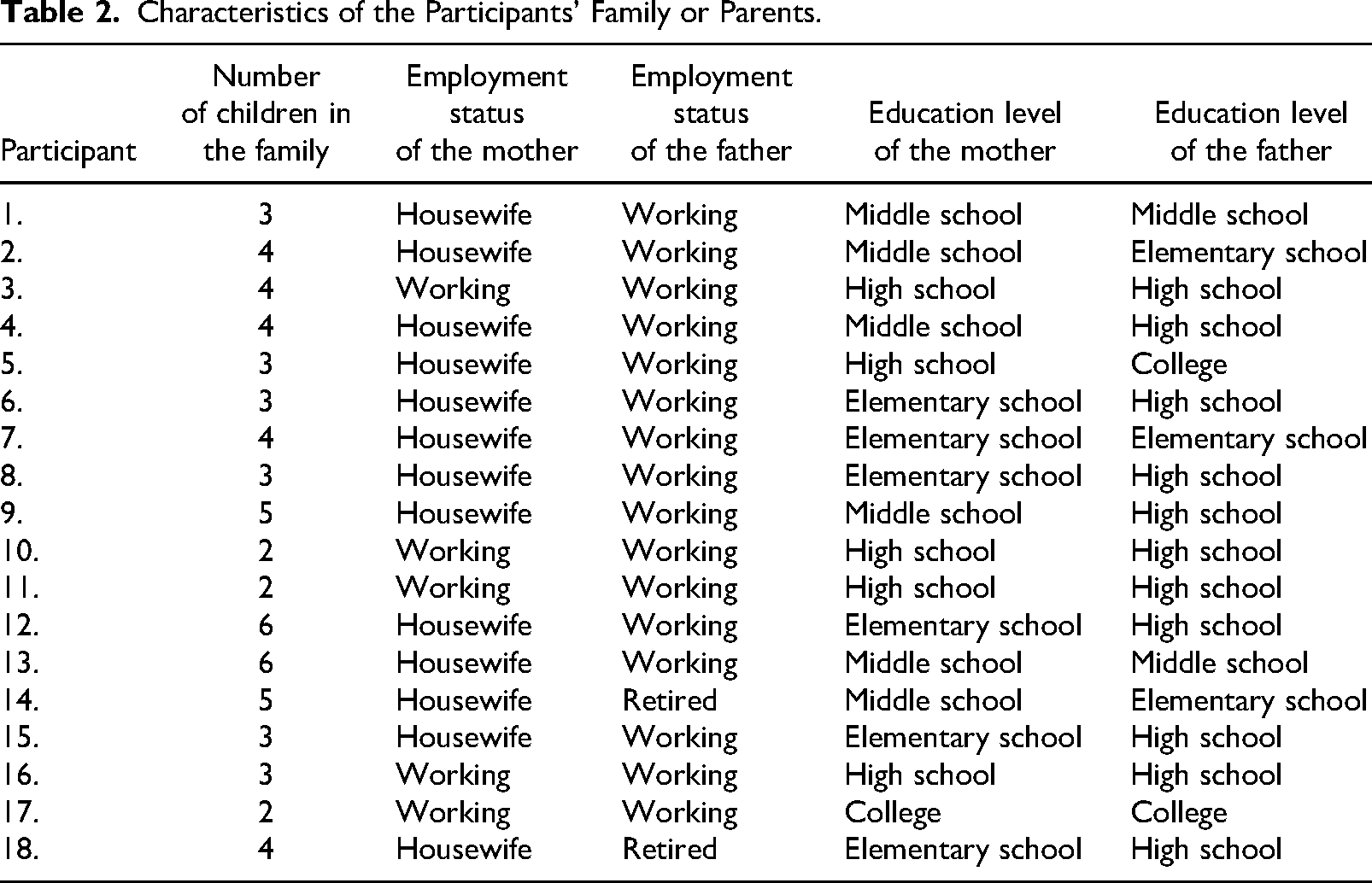
Civil servants, as discussed in this study, are office workers who, after completing high school, pass the central exam organized by the state for all citizens and are appointed to state-affiliated institutions. The participants who were civil servants were placed in their positions of employment according to the quota opened for individuals with disabilities. With reference to the Turkish Law on Civil Servants (1965), civil servants’ status is terminated in the following cases: dismissal from the civil service in accordance with the provisions of this law; subsequent discovery that they do not meet any of the conditions for recruitment to the civil service or loss of any of these conditions during their civil service; withdrawal from the civil service; and retirement due to reasons such as their own will, age limit, and death. Therefore, the job of civil servant has the status of a “guaranteed job” for Turkish people. Table 2 presents the characteristics of the participants’ families or parents.
Characteristics of the Participants’ Family or Parents.
Procedure
Participants
The study was carried out in 2022. As a first step, the study received ethical approval (Hacettepe University, Ankara, Turkey; approval number: E-35853172-600-00001514869). Due to the difficulty of conducting face-to-face interviews during the COVID-19 pandemic, online interviews were used to collect data. The researcher (the author) contacted two nongovernmental organizations (NGOs) to recruit participants for the study. The study's ethical approval and informed consent forms were sent online. The researcher interviewed participants from these NGOs who agreed to participate voluntarily. All participants provided informed consent.
Twenty-six individuals from these civil society organizations volunteered to participate in the research. However, two people were not included because they did not have any visual impairments. An interview invitation email was sent to 24 individuals who volunteered to participate in the research, one of whom did not respond to the invitation email. In the interview with the 18th participant, however, data collection was terminated because saturation was achieved. All 24 individuals were informed about the research's termination.
Interview Questions
The researcher benefited from the literature on careers and visual disabilities to develop the interview questions. Then, two experts’ opinions were obtained for the interview form. Based on the opinions of the experts, some changes were made to the questions. For example, the question, “How does your family guide your career choice?” was changed in line with the feedback that it could be directive. Before data collection commenced, three semistructured and open-ended questions were tested with two individuals with visual impairments who were working for an NGO. These individuals were asked to explain their career choice processes, the role of their families in their career choices, and what they thought as to whether their visual impairment had an effect on their career choices. Examples of the final questions include, “Can you tell me about your career choice?” and “What role did your family play in your career choice?.”
To ensure detailed responses, the researcher shared the questions with participants at the beginning of the interviews. Zoom software was used to interview the 18 individuals who accepted an interview; interviews took from 38 to 49 min each. After the interviews were recorded, the researcher transcribed them verbatim. Until saturation, data collection and analysis were conducted simultaneously. According to Creswell and Poth (2016), saturation is achieved when little or no change is made in the code list due to new information, and no new themes emerge from the collected data.
Trustworthiness
For credibility, the researcher read the transcripts multiple times. To ensure that the information shared by participants reflected their intended meaning, member checking was used (Lincoln & Guba, 1985). The research preparing interview questions, the analysis and reporting of the data were conducted with the support of two career and qualitative research experts.
The saturation of the data was used to determine the optimal sample size. Having completed a few interviews, an independent coder began the preliminary analysis to make the saturation decision easier (Creswell & Poth, 2016). In the research, independent coding was performed, and finally, the researcher and the coder discussed the codes and themes.
To properly understand the phenomenon and demonstrate the transferability of the results, as recommended by Roberts and Priest (2006), the researcher offered detailed information about the participants, the number and duration of sessions, and the entire data collection process. The researcher followed the same questionnaire for each participant to avoid influencing their responses. The researcher and participants did not have existing relationships confirming the researcher's independence and appropriate status (Noble & Smith, 2015). To prevent any other bias, participant demographic information was hidden in transcripts. Additionally, attention was taken to describe as much information as possible regarding the study methodology, data collection tools, and data analysis (Roberts & Priest, 2006). Quotations were used to elucidate, demonstrate the relationship between data and outcomes, and represent the perspectives of the participants in the findings (Creswell & Poth, 2016).
Analysis
Using deductive thematic analysis, the researcher examined participants’ experiences and highlighted similarities and differences. In deductive thematic analysis, the data are based on predetermined themes. As a result, thematic analysis was conducted primarily based on the researcher's theoretical interests and analytical preconceptions about the experiences of individuals with visual impairments and vocational rehabilitation (Braun & Clarke, 2006).
Using Braun and Clarke's (2006) thematic analysis as a guide, the researcher read the dataset first. Next, the researcher reread all datasets to understand better and become familiar with all aspects of the data. As a second phase, the researcher tried to frame the most basic units that reflected the phenomena meaningfully. In this step, the researcher utilized the dataset to create codes with a deductive approach and independently coded them. At the same time, an independent coder read and coded the data. Until no new codes were defined, the researcher and the coder repeated this iterative process. The coding and analysis was carried out by two researchers.
The researcher and the coder matched the initial codes to the units of the dataset after detecting them. The codes were sorted when all data were initially coded, and they combined them to form the main themes. With the help of setting and context knowledge, preliminary themes were refined through the creation of textural and structural descriptions of experiences. Next, they shared statements that fit into the themes. Finally, they discussed emerging themes to build consensus during the analysis. A final list of significant themes and agreement on the coding categories were eventually reached through debate and rereading the transcripts. In this step, researcher and the coder merged some themes into four main ones, as some of the themes collapsed into one another.
Results
Theme 1: Work Not School
According to the participants, their families found pursuing higher education challenging for individuals with visual impairments. The parents of P2, P4, and P12 insisted that they should become civil servants instead of attending university (high school graduates can become civil servants in Turkey by taking a centralized exam). Families could make it a prerequisite for their children to pass the civil service exam. Their parents told P2, P4, and P12 that they could continue higher education only after they passed the exam and were appointed to civil jobs. My parents told me, ‘First, take the exam, pass, and get a job. Then, you can work and get an education simultaneously.’ However, it is so hard. I could not explain it to them. When I am working, I will be at work full-time. I will have limited annual leave. How am I supposed to go to university every week? They do not understand that. So studying at university remained in my heart. (P4)
Just like P4, P12 also stated that he could not achieve his dreams with regard to the university-level education he received. According to P4, his family would have supported him in his university education if they had a good income. P12 stated that his family did not want him to try harder because he was not successful in the university entrance exam. As explained by his family, he tried his luck and failed. However, P12 thought that he could be more successful if he tried again. P12 felt discouraged. He felt pressure to become a civil servant instead of taking the university entrance exam again. He could not resist this pressure. According to him, if he started working, his family would be relieved of an important worry. P12 was satisfied with his job, but angry with his family. In his opinion, families do not give young people with visual impairments enough opportunities. They rush these young people into working life as soon as possible.
P15 and P16, who were students, also worked as civil servants. They thought it was challenging to attain an education and work simultaneously. The families of the two university students who had graduated pressured them to take the exam and become civil servants, as well. Their families found it pointless for them to look for jobs in professions related to the education they had completed. They insisted that they get a job as soon as possible.
P4, P12, and P15 agreed that it is difficult to pass the university entrance exam in Turkey. They were aware of the fact that they were being prevented from “wasting time” by trying to take the exam again due to their family's lack of money. However, they criticized the fact that their families put pressure on them and saw university educations as meaningless. They also criticized their families for seeing the visually impaired quota as a not-to-be-missed opportunity. P15 chose to become a civil servant rather than being perceived as an ignorant person who missed an important opportunity. However, he then tried taking the university exam again and succeeded. He was proud of himself but resented his parents for not trusting in him. In P15's words, his family's attitude made it difficult for him to focus on what he wanted. He stated that individuals with visual impairments cannot focus on their own desires and abilities due to family expectations. This situation contradicts the self-determination of individuals with visual impairments.
P14 explained that his father wanted him to work because his family income was low. According to his father, a university education is a luxury. When P14 was asked what it meant for education to be a luxury, his father replied, “Because education is expensive, and it means postponing working.” His father wanted him to get a job and bring his income home soon. P14 explained that his father was hoping to retire, but, since there was no breadwinner, he continued to work: My father worked very hard for many years and was physically exhausted. He was not too old, and he could still work. However, he did not want me to go to university and wait for four more years (for me to begin earning an income). Of course, even if he wanted to, I was not sure I could pass the exam in the first year and start a university education, so I did not insist. I felt sorry for him, and I started working. (P14)
P12 felt similarly: He believed that he would not pass the exam and would fail to continue to higher education. He stated that he gave up this desire for higher education completely after his family discouraged him. P12 completed high school through distance education. Therefore, he could not meet with a school counselor during the time period in which he was making his career choice. He explained, My family did not support me and broke my existing enthusiasm. I was already saying I could not do it or pass the exam, but I needed someone to tell me I could do it. My teachers at school believed that I would succeed. However, my father kept telling me to start working. ‘You will get a job thanks to the disability quota, and most university graduates are unemployed anyway. What will you do studying at university?’. (P12)
Theme 2: Guaranteed Jobs Are Good Enough
Some participants said that their families directed them to a narrow range of low-skilled or guaranteed jobs. For example, the parents of P1 and P8 led their children with visual impairments to switchboard and call center operator jobs, which they thought were “simple jobs.” P8 believed that being perceived as low-skilled by her family hindered her from pursuing her dream profession: My mother is very anxious … she said … you don’t need to choose challenging professions. … She wanted me to be a switchboard operator because it was easy … answer the phones … that's all she expects from me. … It made me feel inadequate. (P7)
The sentiment that a guaranteed job is good enough was emphasized by another participant (P3): “According to my parents, a guaranteed job should be enough to make you happy. I didn't agree with them, but they insisted.” P3's father argued that teaching is easier and more advantageous. According to P3, his father believed teaching did not require special skills. He believed teacher training is centered around textbook learning and is accessible. The father's discourse is based on the perception that teaching in Turkey is easy. P6's mother described another advantage, “If you become a teacher, you will find a job easily, but if you are interested in art, you will be unemployed. We cannot take care of you if you are unemployed, you should find a guaranteed job.”
Teaching degree programs are four years long, postgraduate education is not compulsory to work as a teacher, and many programs do not require a second language in Turkey. According to the 2015 Ministry of National Education (MoNE) data, 0.1% of teachers in Turkey hold a doctorate degree, 7.7% have a master's degree, 80.5% earned a bachelor's degree, and 5.9% had an associate's degree. Once appointed, there is no obligation to attend in-service training; and there is no accreditation system. For example, P3 stated that his mother supported his father's view, claiming that teaching was comfortable and guaranteed: My mother thought that teachers should only be at school during class hours. She said you would be at home the rest of the time. It would be easy. In addition, there are no accreditation rules. No one can fire you because of your visual impairment. (P3)
Similarly, P10's mother thought psychological counseling would be a good fit for her daughter because, according to her, school counselors have their own offices, which is comfortable. Unlike other countries, psychological counseling programs in Turkey require 4 years of study at the undergraduate level. They also fall under the faculties of education. Most graduates (68.1%) work in the education sector (Presidential Human Resources Office, 2023) as school counselors. Postgraduate education is not compulsory for an individual to obtain a job as a counselor. In Turkey, school counselors, like teachers, take a centralized exam after completing their university education and are assigned to schools in different cities according to their scores. Therefore, the undergraduate education requirements and work conditions for school counselors are very similar to that of teachers. School counselors are the only individuals in addition to administrators with dedicated offices in the school building. They do not regularly attend classes except for planned group guidance activities. For these reasons, school counseling in Turkey may be perceived as a “cushy job” by parents.
For example, P10's father said, School counselors have a room. They are comfortable. You will not have to run around all the time. You will not have to work very long hours. You will not get tired. You can ride a desk. It is suitable for your disability.
Similarly, P11's mother said, You work at school; you will be comfortable until you retire. You do not need to work in the classrooms; you will have your own office. Why do you want to get a business administration education? When you graduate with BA, you will not find a job, and even if you do, you will not compete with those without visual impairment.
The parents of P3 and P10 also wanted them to be school counselors or teachers at a state school. In Turkey, working in state institutions is a “guaranteed job,” meaning one from which a person cannot be laid off. Finally, P5's parents suggested he become a psychologist so that he could find a job quickly. In Turkey, psychologists can work in various institutions such as the Ministry of Family, Ministry of Justice, Ministry of Health, and Ministry of Youth and Sports. In addition, the employment rate for psychologists, in the first 6 months after graduation, is 54% (Presidential Human Resources Office, 2023).
P1, P3, P10, and P14 stated that their parents’ overprotective attitudes toward them also affected their career choices. Because their families told them, “Who will take care of you after us? Get a guaranteed job. Work so that you will not become dependent on others.”
Theme 3: Daughters Should Marry
Three participants’ parents wanted them to marry instead of continuing their education or working. P9 stated that as soon as she turned 18 years of age, she would be married off without being asked, even though she had completed high school through distance education. P9 thinks her father wants to transfer his “responsibility for honor” to her spouse. When P9 wanted to get a job, she could not tell her father directly; she told her mother. (Because her father was an authority figure within the household, she stated that her mother assumed the role of mediator.) Her father told her mother, (The world) is full of dishonest people out there. How will she protect herself from trouble in her condition (referring to her disability)? She should get married as soon as possible before she gets into trouble. Her husband will decide to let her work.
P9 claimed that her father was relieved when she got married because the pressure to protect her honor had ended. P9 stated that her father held ignorant thoughts and said that she was sad that she and her father had never had a good relationship.
P18 and her family lived in a town, but the university she could attend was in a city. P18 said that, as a hardworking student, she begged her father to allow her to continue her college education, but he refused. Her father disapproved of her attending college alone, away from the family, in the city. P18 stated that her father sent her elder sister to college, but not her. When she confronted her family about this issue, her mother said, “The streets are dangerous for you. Who would take you to and from school?” Her father said, I cannot send you to the city as a girl. Your situation (referring to P18's disability) is different from your sister's. … You have had enough education. Now help your mother at home. In the future, your husband will work and take care of you.
P18 characterized her father's viewpoint about women in the workforce: According to my father, a woman's place is at home. She does not need to work. Her husband should take care of her. If a woman has a disability, according to my family, she is even more in need of a man's protection and control. My father is backward. But I couldn’t convince him. I still resent him. (P18)
The parents of P9 and P18 did not favor women working due to gender norms in Turkey. P13 referred to the fact that she, not her brother, completed high school through distance education as gender discrimination. According to her, if she had not been willing and persistent, her family would not have allowed her to finish high school. Her father wanted her to be at home because of her disability. He did not allow her to leave the house except when necessary, such as helping her mother with grocery shopping. P13 thought that her father had the perception that all girls with disabilities would be abused. Her father often said, “It is dangerous for you outside. You cannot see; something will happen to you.” When P13's father saw her with her boyfriend, whom she had met at a nongovernmental organization for people with visual impairments, he became outraged and locked her in the house, saying, “Girls should not have boyfriends; they should have husbands.” He wanted her to marry her boyfriend immediately. P13 completed the last year of her distance high school education as a married woman. She felt wronged by this situation. She said, “Maybe a man with disability has a chance to make his own choices, but if you are both a woman and disabled, it is very challenging” (P13). This statement suggests that the concept of honor can be an obstacle to self-determination for women with disabilities.
Theme 4: Discrepancy in Expectations Based on Household Income
A few codes that were not collected under the other themes indicate that the children of high-income families were more favorable to university education. For example, P17 stated that her family supported her even though they knew that music education in Turkey could result in unemployment. Her family directed her to various courses to discover her interests and talents: “My parents told me that, ‘What matters is your happiness. We will support you in every way. Focus on your dream job’” (P17). P17 felt supported by her family. She was happy to finally see that her disability was not the deciding factor for her future. P17 thought that her family's positive attitude was also influenced by the conversations they had with their school counselors in the past.
Likewise, P5 noted that the support of her family, teachers, and school counselor played an essential and positive role in her choice of profession. P5's family was financially affluent. They supported her high academic achievement with private tutors. In addition, according to P5, her family made great efforts to ensure that her visual impairment did not affect her choice of profession. For example, they arranged for her to meet with a career counselor. Through her interactions with visually impaired peers, P5 realized that it is rare for a young person to receive support from their family. She was proud of her family for supporting her and was happy with her life. I have been interested in reading about human psychology since childhood. I believed that I would be happy in this field, and my family believed I was talented in empathizing and listening and supported me. (P5)
P5 also stated that she was not satisfied with her mother's profession. She observed that her mother was forced by her grandparents to study medicine and that she regretted it throughout her working life. According to P5, this dissatisfaction influenced P5 to choose her dream profession. In this study, I observed that two families with good economic statuses supported the participants to continue their education or to choose professions that were suitable to their interests and abilities.
Discussion
The results of this study showed that Turkish families had an influence on the career choices of participants with visual impairments. According to most of the participants, their parents encouraged them to work and take guaranteed or low-skilled jobs instead of receiving a college education. In addition, a family's low income or traditional gender stereotypes held by members of a family were additional obstacles.
The finding that some individuals with visual impairments are directed to jobs requiring low-level skills is consistent with other research team findings from low- and middle-income countries (Agyei-Okyere et al., 2019; Amin & Abdullah, 2017; Bhanushali, 2016). Another research study showed that 38% of people with visual impairments who were employed in Turkey are switchboard operators (Bengisu et al., 2008). This job is the one that is most commonly held by people with visual impairments. It is not a legal but a practical issue. There are many overqualified switchboard operators across the country, such as teachers and lawyers or social sciences graduates (Koca-Atabey, 2016). The low-middle income status of Turkey can explain this situation.
This study also showed that many participants with visual impairments were directed to education sector jobs, which is the case in other low- and middle-income countries: for example, in Nepal, nearly 50% of individuals with visual impairments are employed in education (Lamichhane, 2017). The orientation of individuals with disabilities toward the education field may also be related to Turkey's policies. In 2010, the MoNE (2010) designed a separate examination for employees with disabilities. Of 5,000 positions, 1,000 of them were for teachers. The results also may be related to the centralized examination system for university admission in Turkey. Students who want to study at a Turkish university must take a centralized exam organized by the Student Selection and Placement Center. Until recently, people with disabilities in Turkey were not accepted into jobs requiring exceptional talents or science, technology, engineering, and mathematics fields. As of 2017, the Turkish Higher Education Institution (THEI) established rules for these exams and expanded the groups of students with disabilities who can take them (THEI, 2017).
In Turkey, the selection of students for teacher training programs is based on general criteria for admission and an exam after graduation. It is relatively easy to find a job in the education sector in Turkey (Hacettepe University, 2017). The Turkish Statistical Institute 2021 higher education employment statistics showed that the two fields with the highest registered employment rates were health (82.7%) and education (77.8%; TURKSTAT, 2022a). The job-placement rate of teachers in the first 6 months after graduation is 58.7% (Presidential Human Resources Office, 2023).
According to most of the participants, parents directed their children to the faculty of education programs (teaching, psychological counseling, and the like) with statements such as “easy to read, has no visual content,” which may indicate the lack of accessible materials for individuals with visual impairments in university education in Turkey. A 2015 study by the Eğitimde Görme Engelliler Derneği (Association for Individuals with Visual Impairment in Education) in Turkey showed that individuals with higher levels of vision loss prefer “verbal departments” in the faculty of education. In studies examining the reasons why candidates prefer the education sector in Turkey (e.g., Hacettepe University, 2017; Sunar et al., 2015), reasons included the guarantee of finding a job, the comfort of working conditions, family and environmental influences, the score obtained in the university exam, and the desire to become a teacher.
As mentioned earlier, once graduates pass the exam and are appointed as teachers or school counselors in Turkey, they continue to work without in-service training or accreditation until retirement. This issue may lead to perceiving these professions as comfortable or guaranteed. According to the 2015 Trends in International Mathematics and Science Study results, Turkey's ranking among 49 countries, for example is 49th in the rate of teachers’ participation in professional development activities related to mathematics education in the last 2 years (MoNE, 2016). Similarly, according to PISA 2015 data, less than one-quarter of teachers in Turkey have participated in a professional development program in the last 3 years (MoNE, 2016).
The rates of psychological counselors who are employed and working in the public sector in the first 6 months after graduation are above 50%, a similar proportion to those who studied to become teachers (Presidential Human Resources Office, 2023). Similar to teachers, when school counselors are assigned to a school, there is no obligation to take in-service training or additional certifications after placement. There are no accreditation systems such as The Council for Accreditation of Counseling and Related Educational Programs for those in the profession. Because they work as civil servants, they can only be dismissed once they retire if they follow the general laws and regulations. In addition, there is no professional law for counselors, and the existing professional association has no legal sanctioning power. In this respect, families believe it is guaranteed that their children will find work as school counselors.
In a large-scale study from Turkey (Sunar et al., 2015), the Turkish Occupational Reputation Scale was created for 126 occupations based on the ILO's International Standard Classification of Occupations 08. According to the results of the scale, the five most prominent features that the participants look for in a good job and the level of importance for the participants are “Good salary (89.2%), Job guarantee (88.8%), No risk of work accidents and death (88.2%), Low stress (86.4%), Suitable working hours (84.8%)” (Sunar et al., 2015, p. 3). Consistent with that study, the findings of the study presented here shows that participants with visual impairments were directed to the education sector by their families, especially in terms of job guarantees, comfort, and convenient working hours. In addition, teaching ranks fourth among the most prestigious professions, with a score of 81%; and psychology ranks 12th (Sunar et al., 2015), which may explain the preference of these two professions as reported by the participants of the study presented here.
The findings from the present study showed that gender stereotypes held by family members were a career barrier for some women participants with visual impairments. Although in many Western societies, gender differences continue to narrow, traditional gender norms still prevail, especially for women, in Turkish society (Evcili & Golbasi, 2017; Yalcin et al., 2012). For example, the woman's choice is not considered in arranged marriages. Instead, the marriage decision is made by men, especially the father in the family. Data from the 2021 Turkey Family Structure Survey (TURKSTAT, 2022b) show that 14.8% of women get married in accordance with the decisions of their families. The group of women with the highest rate of marriage according to their family's wishes was those without a formal education (26.5%). The fact that families prefer their daughters to marry rather than receive an education shows that some participants experience double discrimination at the intersection of disability and gender.
The need to protect honor was a career barrier that forced some female participants to drop out of school at the instruction of their families. Particularly in the Middle East, women's behavior plays a significant role in the honor of the family (Akbas et al., 2020; Chakraborty, 2010; Cowburn et al., 2015; Shankar et al., 2013; Siddiqui, 2013) and a variety of behaviors are seen as risk factors for honor loss (Akbas et al., 2020). Otherwise, society stigmatizes women as “bad girls” (Chakraborty, 2010). Gender norms state that women should only have intimate interactions with their spouses (Cowburn et al., 2015; Shankar et al., 2013). Overprotection of girls by Asian or Filipino families with predominantly patriarchal roots prompts the point of disregarding the ability of women with disabilities to make decisions independently (Ancha, 2022).
For women, leaving school can result in disrupted school-based support and a lack of career choices. When school-based services are no longer accessible, evidence shows that self-determination interventions can encourage employment and community access for young people with disabilities (Shogren et al., 2015). Research suggests that self-determination is a significant predictor of postsecondary education and employment for students with disabilities (NTACT, 2016). There are, however, a lack of self-determination intervention studies that have been conducted students with visual impairments (e.g., Ivy et al., 2016; Levin & Rotheram-Fuller, 2011) and research on visual impairments and self-determination in general (Cmar & Markoski, 2019).
Finally, the economic well-being of the family may have been a determinant in the participants’ career choices. The participants’ career choices and college attendance were supported by economically affluent families, and children whose families were experiencing economic difficulties were directed to guaranteed jobs. As mentioned earlier, the deficiencies in Turkey's social policy arrangements may lead to a perception of people with disabilities being dependent on family members for their economic well-being (Bezmez & Porter, 2022). The fact that social care is only seen as a duty of the state if the family cannot provide support (Akkan & Serim, 2019) shows that there is an urgent need for policies and regulations in this area.
Limitations
This study was conducted with some limitations. Self-reported data is regarded as a valuable source of information in most situations that address essential concerns, even though relying on them can constrain research (Rutherford et al., 2000). This is the first study in Turkey to specifically investigate the perceived role of the family in the career choices of individuals with visual impairments. Therefore, this study should be considered preliminary. Another limitation of this study is that the interviews were only conducted online due to the COVID-19 pandemic. Finally, I did not conduct triangulation of qualitative analysis. In this research, I focused only on the perspectives of individuals with visual impairments. Future research could focus on the perspectives of the parents or other persons, such as school teachers, school counselors, service providers, and special education teachers.
Implications for Career Counseling Field
The family is an integral part of the support network for people with visual impairments; as such, they are an essential component as the visually impaired individuals acquire professions. For this reason, career counselors should work with families to provide effective services to visually impaired people. It is very difficult to advocate for persons with disabilities without parental engagement, since parents make decisions that affect their children's educational experiences (Vaughan & Super, 2019). As a result, school counselors should inform parents about any available resources and programs for students with disabilities and inspire families to become more active in their children's education.
It is also understood that self-determination in career counseling with people with disabilities is essential. Decision-making, problem-solving, and goal setting are valuable skills that serve numerous purposes and improve the lives of people with disabilities (Burke et al., 2020). Mentoring interventions can be used by career counselors to help students with visual impairments with self-determination. Mentoring improves job search self-efficacy and assertiveness in college students with visual impairments who are close to graduating (O'Mally & Antonelli, 2016).
This study's findings showed that the participants’ relatives direct them to a narrow range of low-skilled jobs. Therefore, it seems essential for school and career counselors to reduce myths surrounding visual impairments and improve the disability literacy of families of people who are blind or have low vision. Counselors need awareness and knowledge about disabilities and the necessary abilities to work with people who are disabled so they may provide services to this group effectively (Rivas, 2020).
Future Research
Given the importance of independent living, life course factors affecting visual health should receive more attention, especially in low- and middle-income countries. Research is also required to pinpoint factors that affect young people with visual impairments in finishing their postsecondary education. In addition, interventions that result in successful postsecondary education and job outcomes are needed.
Footnotes
Declaration of Conflicting Interests
The author declared no potential conflicts of interest with respect to the research, authorship, and/or publication of this article.
Ethical Statement
This study was conducted with permission from Hacettepe University Ethics Boards and Commissions. The present study was carried out based on the 1964 Declaration of Helsinki. Informed consent was obtained from all participants.
Funding
The author received no financial support for the research, authorship, and/or publication of this article.
