




Abstract
When Howard House, future founder of the House Ear Institute, completed his 2-year ENT residency at Los Angeles County Hospital, his father lent him $5000 to travel and learn from the leading otolaryngologists in the United States and Europe. His post-residency training took him to Iowa City, St. Louis, Chicago, and Boston. At the Massachusetts Eye and Ear Infirmary, he gained the attention of Harris P Mosher, the demanding and mercurial chief of the department. After a trying, but formative 2-month sojourn at Mosher’s dissection course and laboratory, Mosher provided House with a letter of introduction and sent him to learn what he could about the new otosclerosis procedure devised by Julius Lempert of New York. 1
Julius Lempert’s family escaped from pogroms in their Polish ghetto, sailed to New York, and settled in the 19th-century slum that was the Lower East Side. Julius worked as a shoeshine boy and sold apples on the street as a young child. Finishing public high school, he enrolled at Long Island College Hospital, a poorly regarded medical school at the time, that accepted him without a college degree. He graduated and obtained a New York medical license, but no internship or residency would admit him. After several unauthorized observer-ships at Manhattan ENT training programs, he borrowed money and started an otolaryngology practice in a rowhouse that served as a clinic and 8-bed hospital. His practice grew quickly as he ignored American College of Surgeons standards and split his surgical fees with referring doctors. 2 By 1927, he was swamped with patients and had performed 1500 mastoid surgeries using a new approach he had devised. 3
House arrived at Lempert’s doorstep and presented the letter from Mosher. The much-maligned Lempert was amazed and eager to show off to Mosher’s disciple. He moved House from his seedy Times Square rooming house to the Waldorf Astoria and sent a chauffeur to pick him up each morning. Far more importantly, he allowed House full access to his office and OR. He introduced him to the “fenestra nov-ovalis” operation for otosclerosis. Their 4 days together left House both impressed and eager to learn these new ways of operating.
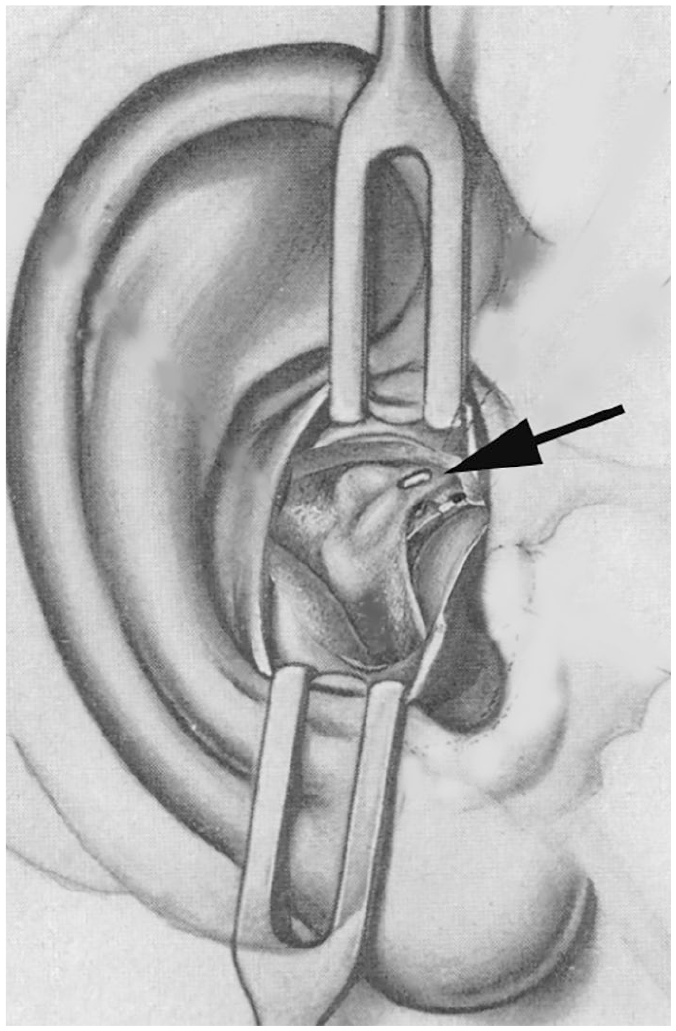
House passed his Otolaryngology Boards and joined the staff of the Moore-White Clinic in Los Angeles. Five years into practice, he took a leave of absence to attend Lempert’s 6-week long fenestration course in New York. Lempert used an endaural approach to the mastoid (Figure 1) rather than the postauricular incision favored by European otologists. For the fenestration procedure he wore magnifying loupes and a bright electric headlight for illumination. (Figure 2) instead of a hammer and gouge, Lempert performed a controlled mastoid dissection with an electrically powered dental drill. After exposing the lateral semicircular canal, he used a 2-mm polishing bur to create a trough on its lateral surface. He then thinned the optic capsule bone to the endosteum and cracked it to create a perilymphatic third window to transmit sound. The patients, who were sedated but conscious, often complained of dizziness at the same time their hearing was restored. A thinned tympanomeatal skin flap was then rotated posteriorly to cover the fenestra. 4
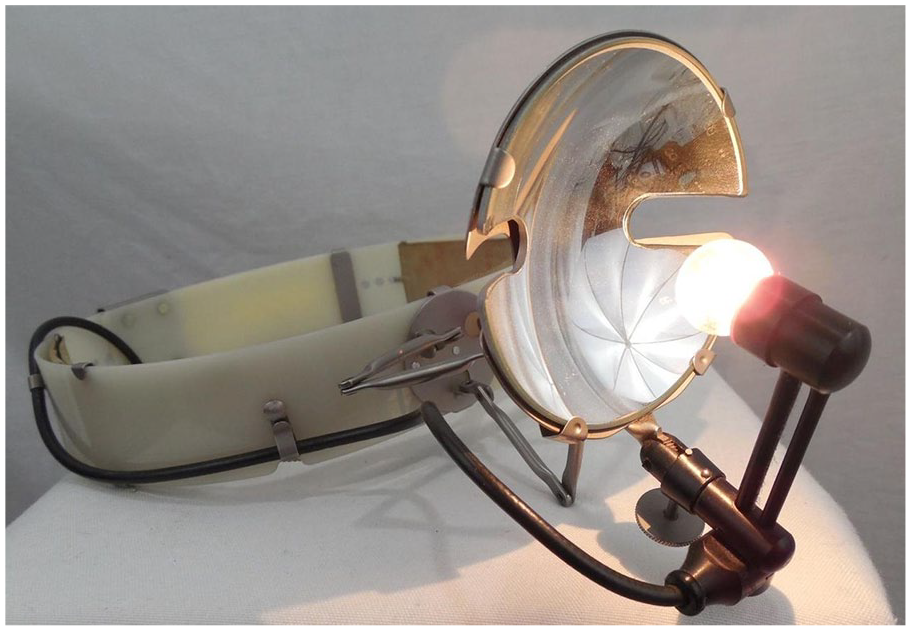
A Lempert electric headlight, used for illumination during mastoid and fenestration procedures.
House so impressed Lempert with his manner and surgical skill during the course that Lempert offered him a job. Instead, he returned to California and began his own practice devoted exclusively to otology. His otosclerosis practice grew rapidly. Within a year he was doing 14 fenestration procedures each week—and 5000 in the next decade.
The 2 otologists maintained their collegial relationship over the years. In 1954, Lempert and his wife planned a vacation in Los Angeles. He telephoned House and arranged to see some of his old fenestration patients who lived in California using House’s office. Lempert greeted his patients and went to examine the first of them. He adjusted the well-used Lempert headlight hanging in the office and went to wash his hands in a basin of water. Suddenly he collapsed to the floor, writhing. When he awoke, he complained of severe shoulder pain. Radiographs showed an avulsion fracture of the scapula. The electric shock from the short-circuited headlight had torn muscle from bone. House had nearly killed his mentor with his own electric headlight.
Lempert took the train home and after a short rest, continued to do the critical fenestration portion of his operation with his arm in a spica cast.
Footnotes
Declaration of Conflicting Interests
The author declared no potential conflicts of interest with respect to the research, authorship, and/or publication of this article.
Funding
The author received no financial support for the research, authorship, and/or publication of this article.

Level of Evidence
5—expert opinion.