



Abstract
Embedded in the collection of tales about the prophet Elisha is a series of three inter-connected scenes reflecting the depredations of siege warfare and the breakdown of normal social control mechanisms (2 Kgs 6:24–7:20). Each scene plays upon the tendency by humans whenever possible to calculate the risks that they face. Presented in these three episodes is a simple proposition: given current conditions, what actions are worth the risk? To make this clear the storyteller shapes the drama in order to highlight the choices that are made by the unnamed king and two widows as they attempt to deal with an emergency situation. The choices made by these characters include whether to take a risk and handle the crisis in their own way or to be risk-averse and rely upon the covenantal injunction to trust Yahweh to provide what is needed.
Modern studies on the sociology of risk tend to separate themselves from the risk-taking behavior typical of business, insurance, and commerce, which is “calculative, opportunistic and acquisitive” in nature (see Young for the business approach and Bernstein for the comparative approach). Instead their focus is on “the reality of dangers facing society, the task of managing threats to people's well-being and security,” as well as the way that people react “when they acquire knowledge about hazards” (Wilkinson: 15). These studies have shown that risk-averse individuals or communities “prefer traditional ways of handling stressful and uncertain situations while risk takers are more likely to look for innovative responses” (Miller & Hoffman: 65; Holloway: 391–95).
In situations that require a “problem decision” that involves either taking or avoiding risk, the equation comes down to the element of loss, its significance to either the individual or the community, and the degree of uncertainty asociated with loss (Yates & Stone: 4). That element is also influenced by how much an individual or group has to lose. The poor, such as the four lepers who spend their days beggaring outside the walls of Samaria (2 Kgs 7:3–4), have little to lose and therefore may be more open to taking risks. While the king of the city may find himself dragged down by the number of alternatives he must weigh before making a decision.
To a certain extent, the argument over the potential for loss, usually an institutional one in the sociological literature, against risk taking is based on the uncertainty of benefit and cost attached to the range of alternatives (Douglas; Bellaby: 477–79). Still, failure to take action (risk-avoidance) has its consequences just as risky behavior may have either beneficial or catastrophic results. Thus our understanding of risk can be described as “a mode of thinking in which the costs and benefits of specific actions and discrete events are weighed in the balance” (Wilkinson: 9). What these modern studies do not take into account, of course, is the theological agenda of the Deuteronomistic Historian that always favors risk avoidance since that is the equivalence of complete trust in Yahweh.
Case Study: The Siege of Samaria (2 Kings 6:24–7:20)
Embedded in the collection of tales about the prophet Elisha is a series of three inter-connected scenes reflecting the depredations of siege warfare (2 Kgs 6:24–7:20). Each scene plays upon the tendency by humans whenever possible to calculate the risks that confront them (Arnoldi: 9). Presented in these three episodes is a simple proposition: given current conditions (siege), what actions are worth the risk? To make this clear the storyteller shapes the drama in order to highlight the choices that are made by the major characters as they attempt to deal with an emergency situation. The choices made by these characters include whether to handle the crisis in their own way or to rely upon the covenantal injunction to trust Yahweh to provide what is needed (see Prov 3:5–6). Ultimately, they will discover that their crisis is the direct result of their lack of faith in Yahweh's covenantal promises. Therefore, they should have been risk averse rather than risk takers. But both the characters and the story's audience must first be confronted with the situation and see that for themselves.
In the midst of a crisis for the city of Samaria an unnamed king of Israel and his subjects are faced with the question of just how much risk is acceptable (Yates & Stone: 3). They will have sufficient time to consider their options since they are besieged and can see their food supply dwindling. Of course, among their choices is risk avoidance, which would be tantamount in this case to placing their complete trust in Yahweh's intent to preserve them. However, if their decision is to take matters into their own hands, then they may decide that their survival or self-interest supersedes the importance of the survival of even their weakest member(s). In that way, risk becomes a social concept directly tied to rational decisions and actions and separate from random occurrences or panicked behavior (Arnoldi: 10). However, an individual household or the nation will also have to deal with unexpected consequences or “second-order dangers” associated with their decision. There is often a ripple effect that may heighten their present danger and ultimately dispel their certainty “in the infallibility of a specific risk-construction” (Zinn: 3). Simply put: no risk/problem decision is simple, and its consequences may have complex repercussions.
Scene One
The narrative in 2 Kings 6 begins with the city of Samaria besieged by the forces of the Aramean king Ben-Hadad. Naturally, many of the people from surrounding villages have come to Samaria to escape the invading army, but that only adds to the overcrowding, and the city's food supply is being quickly exhausted. As prices for basic commodities precipitously rise (see Greenfield: 121–22), the unnamed king of Samaria walks the walls as he considers the desperate situation with which he and his people are confronted (6:24–26). Like any other political leader faced with a difficult situation it is probable that as he tours his battlements he is calculating the advantages and disadvantages of taking risks on behalf of his city and his role as king. The fact that the storyteller has left him without a name makes it clear that this story is a case study separated from exact historical events and designed to demonstrate the axiom associated with actions and the consequences of those actions.
One consequence of a monarch choosing to engage in “risky behavior,” here equated with making decisions without regard to the covenantal allegiance owed to Yahweh, is the ending of his dynasty. Despite the fact that the decisions made by Samaria's embattled leaders may be based on logical reasoning and real world stresses (cf. Isa 7:4), the underlying principle of the storyteller is that risk-based decisions are worthwhile only when that risk is to accept God's injunction to trust. As a result this episode with its display of risky behavior, like others in Samuel—Kings, can be labeled a “disqualification story” (Saul and Jeroboam are other prime examples). These narratives are designed to explain why a particular dynasty becomes extinct, especially when their decisions are based on enhancing personal power or authority at the expense of following God's command or law (Arnoldi: 10–11). The chart below provides an outline in which several kings are disqualified for their risky/foolish choices.
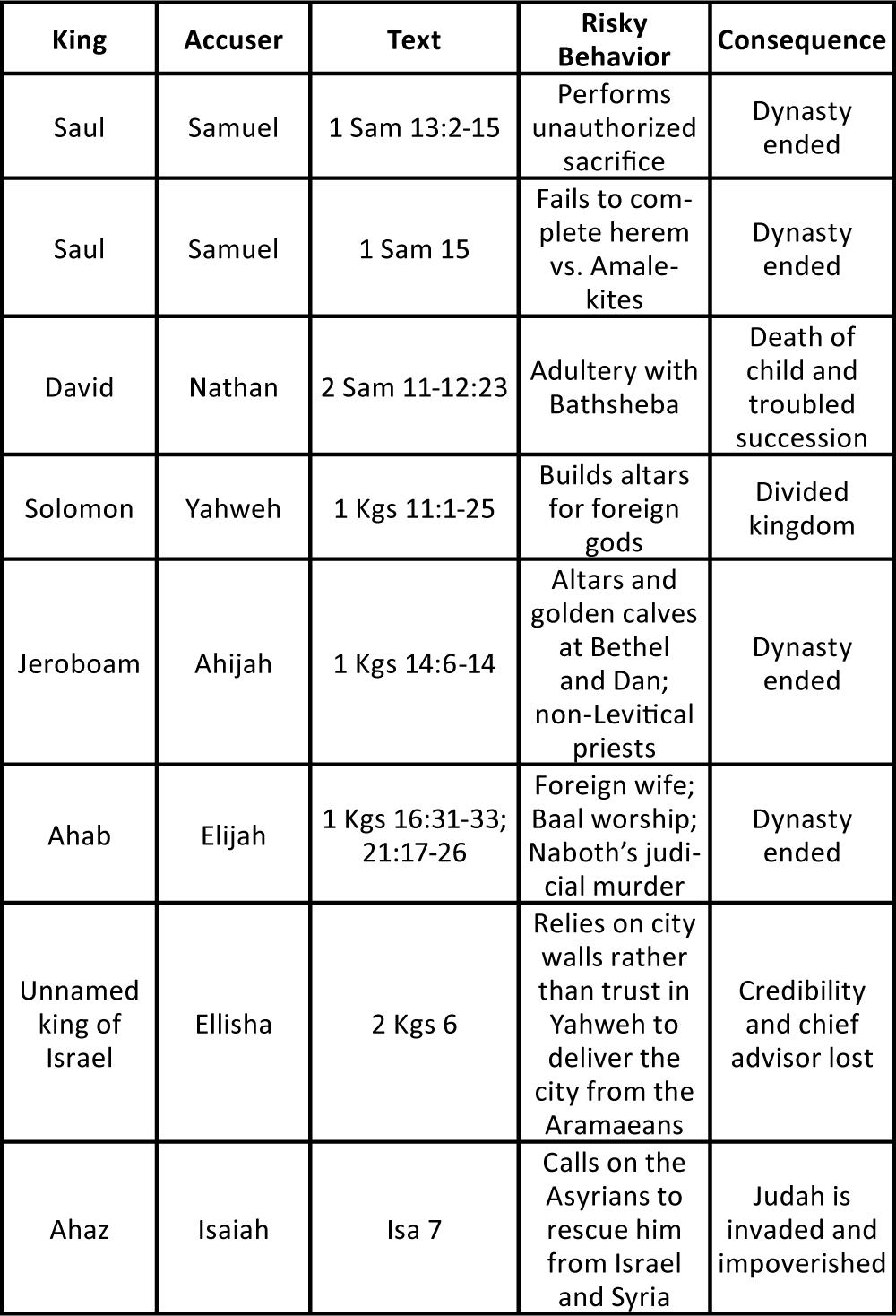
Among the fullest expressions of this motif of monarchic maleficence are the narratives about Solomon's apostasy and “Jeroboam's sin.” As was typical of ancient monarchs, Solomon established domestic and foreign alliances through marriage (Durand; Schulman). Such a policy made sense within the political context of the ancient Near East—the more marriages that were contracted, the more powerful the king. However, for the Deuteronomistic Historian, looking back at these events from the perspective of the sixth century
What then follows is the scene in which the prophet Ahijah stops Jeroboam, a high-ranking member of Solomon's public works bureaucracy, and performs an enacted prophecy declaring that Jeroboam will rule the northern tribes of Israel (1 Kgs 11:26–37). In the midst of what, to Jeroboam at least, must have been an exciting moment, he is cautioned by God that in return for divine favor he must “listen to all that I command you, walk in my ways, and do what is right in my sight by keeping my statutes and my commandments, as David my servant did” (1 Kgs 11:38a). If Jeroboam adheres to these terms, God will provide him with “an enduring house” to rule over Israel (11:38b; cf. 2 Sam 7:11, 27).
Jeroboam's moment to take command of the northern tribes comes after Solomon's death. The king's successor, Rehoboam, refuses to negotiate terms with the northern tribes to “lighten the hard service” imposed on them by Solomon (1 Kgs 12:3–11). His ill-considered, unbending stance drives the northern elders to proclaim Jeroboam as their king and to secede from the united monarchy (1 Kgs 12:12–16).
Trouble, from the perspective of the Deuteronomistic Historian, comes when Jeroboam says to himself, “Now the kingdom may well revert to the house of David” (1 Kgs 12:26). Just as Solomon had chosen to rely on his own thinking and political strategy, Jeroboam chooses to take a series of steps that are designed to create a separate national identity for Israel and break ties with the temple and the sacrificial cult in Jerusalem (1 Kgs 12:28–33). From a political perspective, everything that Jeroboam did was well thought out and for many would be considered quite shrewd as a calculated political risk. But for the editors of these tales Jeroboam's actions were the height of royal ingratitude. Rather than hold to a risk-averse path, the king, through his risky behavior, drives a wedge between the northern and southern tribal groups that permanently separates the northern tribes from the true worship of Yahweh (see the final summation of these events in 2 Kings 17:21–23). The consequences of Jeroboam's risk strategy become the basis for a catch phrase repeated throughout the remainder of the Book of Kings identifying bad kings as those who “walked in the way of Jeroboam” (1 Kgs 16:2, 26, 31; 22:52) or “followed the sins of Jeroboam” (2 Kgs 13:2, 11; 14:24; 15:9, 18, 24, 28).
For his failure to obey the terms laid out by God, Jeroboam, like Saul, will see his dynasty extinguished. Interestingly, the prophetic condemnation of the risk-taking monarch is delivered to Jeroboam's wife. She comes to Ahijah in disguise, at her husband's urging, as a penitent hoping to save the life of her son (1 Kgs 14:1–5). There is an echo to this scene in Solomon's judgment of the Case of the Two Prostitutes in 1 Kings 3:16–28. The life of a child is also at issue in that earlier story, but the contrast is that Solomon is portrayed as a wise king, capable of dispensing justice to his people. Jeroboam, however, has chosen badly and now his house will pay the price. The blind prophet recognizes the queen and can give her only the small comfort that her son, who will die, will be the only member of the House of Jeroboam to be given proper burial (1 Kgs 14:6–13). Her husband and the remainder of his House will be caught up on a rebellion that will leave them all dead (1 Kgs 14:14; see the follow up scene in 1 Kgs 15:25–32 and Sweeney: 184–86).
Scene Two
In the second scene of this piece of shock literature, the storyteller confronts the audience with an incredible revelation. The testimony of a complainant reveals that the siege of the city, the growing shortage of food, and the desire for survival have contributed to a grisly pact. Two starving mothers have negotiated a covenant to kill and eat their children—first one, and then the other. After they have killed and eaten one child, the mother of the surviving child breaks their agreement and hides her child in order to preserve its life (2 Kgs 6:28–30). Now the king is publicly confronted with a plea for justice which requires him to force the surrender of the child to its fate. This familiar type-scene parallels other instances in which an authority figure is petitioned by a woman or women (see the chart below):
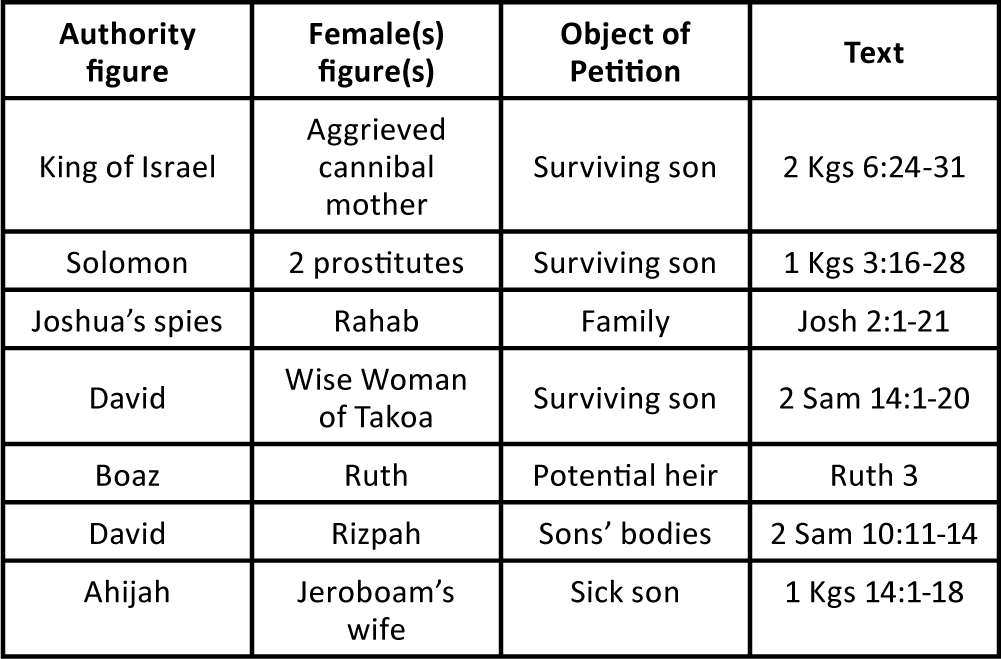
In all of these instances the king or male authority figure is confronted by a woman or women who call for assistance or relief from social injustice. In ordinary circumstances the expectation would be that leader involved would find a solution or make a move to end the woman's distress. His decision in turn would be based on the values of the collectivistic culture of ancient Israel (Crook: 598–99). These ordinarily would include feelings of loyalty, honor, respect, and duty and would focus on protecting the household's honorable status and the well-being of the community rather than on preserving the self or on maintaining personal liberty (Shweder: 1120).
However, the overcrowded and starved city of Samaria no longer functions according to established social principles. With the potential for civil unrest growing, the normal mechanisms of social control like shaming are in danger of being disrupted (see Matthews & Benjamin: 142–54). The question then arises—what happens when the court is out and all of the usual mechanisms associated with social control are no longer functioning? When a society is coming apart at the seams, can the normal patterns of behavior that include protection of the weak be maintained, or are they more likely to be disrupted or destroyed? Is it not more likely that disasters such as the long-term siege of a city would contribute to various forms of social adjustment and the rearrangement of everyday behavior patterns (Thornburg, Knottnerus, & Webb: 3)? War, especially when it is perennial or long-term, has always been one of these major social disruptors since it contributes to a general acceptance of heightened levels of violence against persons and property and civil disorder (Vikman). During the course of the nearly constant hostilities that characterized the history of the ancient Near East, military activities (including raids on local villages as well as the besieging of cities) disrupted normal business activities, all types of travel, and typical processes like marriages and burials. The very concept of community was thrust aside in the midst of mounting crises (see Jer 16:1–9). The degree to which negative disruptions occur and continue to escalate has a significant effect on group stability and social dynamics (Mason & Knottnerus: 10–11).
Under these stressful conditions perhaps it is not too surprising to find a woman confronting her king on her own for justice (see Cogan & Tadmor: 79). She uses a formalized phrase, “Help, my lord King!” to appeal to the king as chief arbiter (compare 2 Sam 14:4–Wise Woman of Tekoa). The king's prerogative would be to respond by asking “what is the matter?” as he does in v. 28. However, before pulling himself together and using that conventional address, this distraught king responds emotionally (envision arms being thrown upward in frustration), saying “No! Let the Lord help you. How can I help you? From the threshing floor or from the wine press?” (6:27). In what he considers a hopeless situation, the king sarcastically points to the city's exhausted resources and inaccessible vineyards and fields (see Lasine: 66, for the comparative story about Solomon–1 Kings 3:16–27).
What he does is shift the responsibility for redress away from himself in the hope that he can avoid making a decision or taking any further risks (Mann: 210). In his despair the shamed and frustrated king is acknowledging that he is helpless, a condition no political leader would desire (Taylor: 92). His reaction further blurs the lines of authority and reduces public confidence in the normal authoritative hierarchy within society and the possibility for a positive outcome (Mason & Knottnerus: 16). The king's inability to provide either hope or justice in the face of the woman's plea is an indication that households must now respond by making their own risk calculation if they hope to survive (Zinn: 173).
Like other stories that portray cases brought before the king (Cogan & Tadmor: 79–80), the episode of the cannibal mothers also serves as a test of the ruler's ability to make a wise decision and dispense justice to the people. In each case in which this type-scene appears there is a possibility for loss of public loyalty if the monarch fails to perform the role of a “Just King” (Long: 92; LaBarbera: 637–38). Of course, failure to perform expected duties already exists since the king has failed to prevent the siege of his capital city and by extension is responsible for the current stressful conditions that are endangering normal behavior and the co-hesiveness of the community. He may not be directly responsible for the crime presented to him by the woman, but as the leader of the people he is obligated to find a just solution or punishment. Otherwise, the cry can be raised, as Absalom does against David, that there is no justice in the land and the people need to direct their support to a new leader who will serve them and their interests (2 Sam 15:1–6). In this instance, however, the king, while pressed to do so by the cannibal mother, does not make a decision, wise or foolish. Instead, he, in this stressful situation, shifts the blame on Elisha and he leaves the resolution of the crisis to Yahweh (see Mann: 209–10, on “defensive avoidance”).
Several interesting parallels to this type-scene involving a woman's cry for justice do exist. For instance, Solomon is confronted by two prostitutes, who are also arguing over the life of a child after another child has died (1 Kgs 3:16–28; Lasine: 69–70). However, that story simply begins with the statement that the two “came to the king and stood before him” (1 Kgs 3:16). Cogan (194) is correct to note that this is a direct link to Absalom's promise to hear the cases of all who came to him if he were king (2 Sam 15:3–4). That once again demonstrates that the true test of justice is the keeping of covenants. It is important to the Deuteronomistic Historian's portrayal of Solomon, from the outset of his reign, that Solomon demonstrate openness and skill as a “Just King.” In this way he obtains honor and avoids the shameful charges that Absalom had made about a neglectful and unjust David (2 Sam 15:3).
There also is a marked contrast between Solomon's expressed wisdom and the inability of the king in 2 Kings 6 to find a solution (Rendsberg: 535). That, of course, may be the editor at work again contrasting non-Davidic kings with Davidic monarchs. In the case of the cannibal mothers it is the singular lack of wisdom on the part of the king in the face of extreme emotion and crisis that provides a stark comparison with “good kings” like Hezekiah and Josiah. Furthermore, when the injured mother in the story of the siege of Samaria seeks out the king for justice she does not find him in his throne room. Instead, the king is walking the city's parapets and may well be distracted by the military catastrophe enveloping his capital. When brought out of his revelry, he discovers that his macro concerns also have micro repercussions for his subjects when without any sense of protocol or decorum a woman asks him directly for the life of another woman's child (Lasine 1989: 66; 1991: 26). In form, the woman's initial address to the king is reminiscent of the plea of the Wise Woman of Tekoa to David in 2 Samuel 14.4–20. There the woman says, “Help, O King!” and David responds, “What is your trouble” (2 Sam 14:5). But, of course, in that case the mother is asking for the life of her surviving son rather than for the death of another woman's child.
The two prostitutes who address Solomon serve as the initial test of the new king's wisdom and judgment. What ties their plea to the story of the cannibal mothers is the loss of a child and the potential threat to the other. There is also a similar callousness expressed by one of the mothers in each scene. In both instances the accusing woman claims to have been injured or deprived of her rights. There is an argument between the prostitutes as Solomon stands there, and that contrasts with the fact that the other cannibal woman never speaks in the interview with the king (Garsiel).
In the story of the cannibal mothers it is clear that social stresses, including massive reduction in the food supply and abdication of leadership on the part of the king, has led to social psychological failures. With the invaders terrorizing and looting the countryside, the city's population has swollen with refugees seeking shelter, and that puts an additional strain on the food and water supply within the city walls. With the king already recriminating over Elisha's orders that have put his city and his people in such jeopardy (see 2 Kgs 6:31), the story teller plugs in the type-scene with the petition by the cannibal mother. Thus in the midst of the crisis and as part of a test of both the king's leadership and the veracity of the prophet Elisha, the king and the audience are introduced to two women who have made a grisly covenant. They have made a risk calculation and determined that if they are to survive they must kill and eat their children. For risk calculations begin when a person or persons first ask “Are the risks serious if I don't change?” and then ask “Are the risks serious if I do change?” However, this process and the resulting conflict begin when there is recognition that serious risks exist whichever decision is made (Janis & Mann: 70).
Without any other assets to draw on and without the likelihood that the siege will be lifted anytime soon, the mothers' murderous contract represents the lengths to which humans may go to survive. Still, they do have a choice just as the widow of Zarepath had a choice when Elijah requested that she make a meal of her last remaining meal and oil for him (1 Kgs 17:8–16). When the widow chooses to accept the prophet's admonition not to fear and to obey his instructions, her household is saved from destruction and prospers while the people of Israel face drought and famine. This result is exactly the point that the Deuteronomistic Historian drives home by indicating how a risk calculation is a double-edged decision. Choose correctly and you will live, and choose foolishly and you will die or be forced into an even more undesirable situation.
Of course, with the Deuteronomistic Historian's usual attention to developing a theological underpinning in the episodes in the annals of the kings, this gruesome tale provides a graphic example of the strict admonition found in Deuteronomy 28:47–57 and Leviticus 26:29. The Israelites are warned that while invaders feast on “the fruit of your animals and the fruit of your ground” (Deut 28:51) the disobedient Israelites will be forced to consume “the fruit of your womb, the flesh of your sons and daughters” (28:53). Similar warnings are also found in the prophetic literature. Ezekiel 5:9–10 predicts that in punishment for their abominations Israelite “parents shall eat their children … and children shall eat their parents.” Outside the biblical text, the 7th century
It is not surprising that the desperate state of the defenders of Samaria and the mounting despair of the starving people within the walls have brought them to the edge, but their desperation also provides an ironic twist on the covenant promise of land and children. The Israelites have placed their trust in walled cities instead of Yahweh, and now it is their enemies who benefit from the produce of the land while at least some of the Israelites are reduced to cannibalism and the negation of the covenant promise of children (Craigie: 347–48). Given this 6th century theological declaration by the Deuteronomistic Historian, the question arises whether the 9th century siege of Samaria and the accompanying report of cannibalism are designed as a prooftext for the editor to make a point or whether the Deuteronomy passage is based on the actual events of Samaria's siege in Jehoram's time (Hobbs: 78–79).
Stuart Lasine (1991: 35–36) identifies the story in 2 Kings 6:24–7:20 as an example of the prophetic “world turned upside down” topos. That would place this tale in the disaster genre of the Egyptian “Dispute between a Man and His Ba” and “The Admonitions of Ipuwer.” Each of these pieces of literature describes a severely reversed world in which calamities have resulted in the rich losing their power and the poor finding themselves in remarkable and unfamiliar situations. Such a reversal of the normal social structures also removes the necessity for the story to be dependent on actual events, since it is designed to shock the audience into realizing just how desperate a situation actually has become.
Adding to the speculation on its historicity is a parallel passage in Josephus (J. W. 6.3.4) that raises the same question about its veracity while describing a very similar event during the siege of Jerusalem by the Romans. In dramatic fashion the audience for Josephus' history is once again presented with a mother who has apparently been driven mad by the theft of what little food she has and by the likelihood of slavery should she survive the siege. She calls on the infant suckling at her breast to “Come on; be thou my food” (J. W. 6.3.4:207). At that point she kills the child, roasts him and consumes half the body while putting the rest aside. Remarkably, the smell of roasting meat attracts a hungry crowd who demands a portion, but when she tells them it is her son and challenges them to eat from the same dish that she has, they are shocked into slinking away in their shame and misery for themselves and for the city (Chapman).
The major point being made here by the Deuteronomistic Historian and in the story in 2 Kings 6 is not that it is a surprise that one human is eating another. Instead, the most important issue is that the mother and the king she addresses have lost hope that Yahweh will deliver Samaria. Under these conditions, it is the end-time for the people trapped in a doomed city. In a world without hope or belief in the saving power of Yahweh, those children who can no longer be fed are to be consumed. This desperate act is an example of lifeboat ethics or twofold effect. Rather than let two die—which they will when the city is defeated—the risk calculation intones that they feed on the weak in order to provide temporary relief from death. However, while the mothers have chosen cannibalism as a calculated response, their compact is also symptomatic of the covenantal treason of the Israelites in general.
Laurel Lanner's reader-response analysis of this story does admit that the “powerless mother” is responsible for her actions, but she also charges the king and Yahweh with placing her in a situation that disrupts ritual practice and shame restraints. As she says (Lanner: 115), “certainly her hand struck the final blow, but the first blow was not hers” (see also Hens-Piazza: 80). In this case, however, there is a further irony to the story. After one child has been eaten, the mother of the surviving child refuses to give him up to be eaten. The lack of reciprocity and clear evidence of covenant breaking, even if it is a monstrous pact, triggers anger against the non-compliant mother and a desire for justice. That in turns leads the “aggrieved party” to ask the king to intervene and to insure that the other child is given up (see Bowles & Gintis: 427).
The non-compliant mother's action may imply a sense of regret or even remorse, or possibly a refusal to submit to any further loss. And, of course, some risky decisions are made based on moral intuitiveness while others are more detached and center on economic efficiency (Sagoff). In this scene one mother has chosen to hide her child in order to keep it safe, but the other woman clearly does not consider this a moral or correct decision. When she and the other woman choose to make a survival pact, it is based on a rational decision that puts aside normally acceptable moral choices. She has carried out her part of the bargain. Faced with her partner's action, her frustration and fury is based on the failure to maintain their bargain. Since covenant-keeping is the basis of their community, that becomes an even greater crime than whether they have shared a meal of human meat. Therefore, she is not willing to remain silent in the face of the other woman's covenant-breaking actions.
Even more inexplicable is the fact that in everything the cannibal mother says or does, there is no sense of moral outrage at the death and consumption of her own child. Fixated on her own survival, her outrage focuses on the fact that the other child is not being made available for their next meal (Taylor: 104–07). The very idea that she is willing to make known their plan publicly without any sign of embarrassment suggests that she has abandoned all sense of communal responsibility, and in that way she demonstrates her subjective preference for survival at any cost. She has made her risk calculation and is slavishly bound to it. Her only desire is to fulfill the stipulations of the contract and her passion reflects the idea that both the king and the audience should support her in this aim.
Scene Three: Final Resolutions and Risk Calculations
What the interaction between the cannibal mother and the king demonstrates is that the woman is trying to force an action by attempting to convince the king to do his job while the king is looking for a way to impose responsibility on someone else. In their brief dialogue there seems to be a clear disconnect between the thinking of the cannibal mother and the king. She is adamant that justice be served and therefore her primary complaint addresses covenant-breaking and it seems less important to her that what has occurred here is cannibalism. The king is outraged, and perhaps this woman's plea is the last straw. He engages in a ritual form of humiliation, expressing his outrage by tearing his garments and displaying to the citizens that he already is wearing sackcloth (King & Stager: 372–73). However, his public expression of penitent behavior, which under other circumstances could be interpreted as calling on God to save the city (cf. Jonah 3:6–9), turns to anger and he shifts the blame for the current state of affairs by condemning God's prophet Elisha for their circumstances (2 Kgs 6:30–31).
Of course, the prophet's death could in no way end the siege, but it might redirect the public's anger away from the king. Displaying his lack of a workable plan, the king simply demonstrates his frustration over his own failures and lack of control (see LaBarbera: 646). He takes the particularly risky step of pronouncing an oath (6:31) to have Elisha executed that day (cf. 1 Sam 14:24–46 and Judg 11:29–40). He then sends a man to carry out these orders. Cogan & Tadmor (80) suggest that the king soon regrets his order to have the prophet killed and rushes to Elisha's house to stop his messenger (cf. the reinterpretation in Ant. Ix.69–70). That coincides with Elisha's instruction while he sits calmly with the elders (6:32) for the door to be shut and the messenger to be barred in order to give the king time to rethink his precipitate decision (see Bergen: 132).
Unable to maintain his anger, the king does have second thoughts and comes to Elisha's house himself (see Cogan & Tadmor: 80 on this reading), but once again he speaks in a despairing voice: “This trouble is from the Lord! Why should I hope in the Lord any longer?” That identification of the true source of the disaster and the king's question, of course, is the narrative cue for Elisha to predict that God would lift the siege and that the people's economic straits will be relieved (2 Kgs 7:1–2). The king and the city will receive relief now that they recognize the divine source of their problem, and Elisha will once again be affirmed as a true prophet of Yahweh (cf. the Shunnamite's gesture in 2 Kings 4:37). Throughout this story the king's loss of authority is highlighted and it seems likely that he will never completely forget his feelings of helplessness, guilt, and shame. As such, he is simply another of a long line of “bad kings” sketched darkly in the Deuteronomistic History.
As for the cannibal mothers, the narrative contains no resolution to their dispute. Their distress, their risk calculation that is designed to at least temporarily forestall loss, and the subsequent plea for justice in the face of covenant-breaking have simply served the Deuteronomistic Historian's purpose of displaying the magnitude of civic disintegration and lack of faith in the besieged city. The disruption of normal behavior, the risk-taking that removes claims to maternal affection and communal responsibility, and the inability to place reliance on Yahweh to relieve their condition further illustrates this point. It is that very desperation and lack of proper calculation of risk that then serves as the final catalyst for the story's resolution.
In the end Elisha once again emerges as the true prophet whose prediction of the city's relief (2 Kgs 7:1–2) is proven true (2 Kgs 7:16–20). Personal covenants and the dubious leadership skills of the king are set aside in the wake of the trampling horde that plunders the empty Aramaean camp (7:16–17). The survival-based decision that had unleashed a calculated but ill-conceived risky action by at least two members of Samaria's populace is now proven to be unnecessary. The consequences of their risk calculation cost the mothers at least one son, just as the lack of trust on the king's part cost him a trusted advisor (7:17). While the flight of the Aramaeans and the return of an adequate food supply ends the crisis, the point is made once again that crisis is the true test of trust in Yahweh.
With the crisis ended, the need to make risk calculations is minimized for now. Normal social control mechanisms and the sense of community spring back into place. However, disaster and trauma are all too common for the ancient Israelites and when the next crisis occurs they will once again be faced with the decision whether to cope by employing their own measures of risky behavior or whether they will trust in Yahweh to preserve and restore his covenant partners. Thus in their depiction of dangerous situations the editors tend to use the threat of imminent danger. That in turn results in a decision to take a risk without a logical examination of the alternatives available. Risky behavior then produces unintended or unexpected consequences and demonstrates the value of risk averse behavior (Wilkinson: 24). Since theirs is a history written in hindsight, the Deuteronomistic Historian's actual audience is in their own time and the future. If they can make it clear to their intended audience that violations of the covenant (= risky behavior) bring danger to the community, they may be able promote a Yahweh-only religion, and reduce the frequency of future crises that will threaten the existence of the community.