



Abstract
This article begins by surveying the modern history of interpretation of Galatians 4:21–31, and in doing so demonstrates that virtually no commentator from the time of Calvin has concluded that Paul accurately conveys the message of the Pentateuch's narratives to which he alludes in his “allegory.” It then provides an alternate approach to the analysis of Paul's interpretation of the Pentateuch in this passage, relying on the hermeneutical tool of intertextuality. It demonstrates, through four sets of intertextual connections within the Pentateuch, that the Hagar and Sinai narratives are intricately related and therefore appropriately read by Paul. It concludes that, instead of viewing Paul's interpretation in Galatians 4:21–31 as arbitrary allegory, modern commentators should give Paul a bit more grace in their analysis of his hermeneutic.
One of the most controversial passages for hermeneutics textbooks and discussions on the New Testament's use of the Old is Galatians 4:21–31. In this text Paul refers to the Hagar and Sinai narratives as “allegory.” The definition of this particular word is debated almost as much as Paul's use of it in this particular passage and especially in relation to its use in the early church and first century Jewish and Hellenistic contexts (see, e.g., Barber: 193–209; Gil-Tamayo: 35–63; Di Mattei: 102–22; McClane: 125–35; Kepple: 239–49). For the purposes of this article, “allegory” will be generically defined as “spiritual interpretation.” But this article is intended to address, not the particular nuances of the definition of “allegory,” but instead the legitimacy of Paul's use of the Pentateuch for his “allegorical” argument in Galatians 4:21–31.
In addressing this issue, the use of Galatians 4:21–31 as an example of “allegory” in contemporary hermeneutics texts (including works on the New Testament's use of the Old) and the stance of contemporary commentaries towards Paul's hermeneutic in the passage will be surveyed. After demonstrating from a representative sample of contemporary hermeneutics texts and commentaries that Paul's hermeneutic in this passage is almost universally declared offensive to the Pentateuch's original meaning at worst and a-textually typological at best, this article will attempt to show that Paul is actually employing a hermeneutic that properly interprets the textual meaning of the Pentateuch and the particular passages involved (Genesis 16–17, 21; Exodus 12–20). The primary method employed in this endeavor will be that of intertextuality (see Hays: 154–92).
While “intertextuality” is a term used by modern biblical scholars, Jewish interpretation in the first century included tools that mirror Hays' and others' definition of the term. For instance, Gezera Shawa and Kayotse Bo Bemaqom Aher both allow for the mutual interpretation of one or more passages given similarities in words or phrases (Snodgrass: 43). So even though this article will rely primarily on the term “intertextuality” to describe Paul's method, it does so, not anachronistically but in recognition that the term correctly describes Jewish hermeneutical method in the first century. It also assumes that Paul, as a first century Jew, liberally employed this method.
Contemporary Texts That Argue for the Unrepeatability of Paul's Interpretation in Galatians 4:21–31
First, there are those scholars who argue that Paul's use of the Pentateuch in Galatians 4:21–31 does not accurately reflect the author of the Pentateuch's intention for the particular passages in question (although see Hays: 84–121 and Jobes: 299–320 for conections between Sarah and Jerusalem in Isaiah 54:1). Among the first of these in modern interpretation is Martin Luther, who, in his commentary on Galatians, says that Paul does not use this allegory to prove a point but merely to add beauty to what he has already said. He says that since Paul
had fortified his cause before with invincible arguments, taken of experience, of the example of Abraham, the testimonies of the Scripture, and similtudes, now in the end of his disputations he addeth an allegory, to give a beauty to all the rest. For it is a seemly thing sometimes to add an allegory when the foundation is well laid and the matter thoroughly proved [Luther: 426].
In other words, Paul's argument here is not intended to prove anything textually about the meaning of the relevant sections of the Pentateuch, but simply to aesthetically strengthen Paul's previously made point.
More contemporary examples can be found in a number of hermeneutical works, biblical theological monographs, essays on the New Testament use of the Old, and commentaries on Galatians. One such example is found in Jonathan Lunde's introductory chapter to Three Views on the New Testament Use of the Old Testament. Although he notes that allegory does not necessarily deny the historical sense of the text, he says of Paul's use of Hagar and Sarah that he “appears not to be concerned with historical reality here—other than the historical existence of these women—but seems to utilize these women in surprising, symbolic ways to make his theological point” (Lunde: 29). So for Lunde, while Paul may not deny the historical sense of the Sarah and Hagar narratives, his use of them in Galatians 4 is actually concerned, not with that historical sense but with how they fit into his argument. Many other scholars seem to agree, including John Goldingay (152, 155), C. H. Dodd (169), Ernest Burton (253), and F. F. Bruce (218).
A similar argument can be found in those scholars who maintain that Paul was simply arguing against his opponents and their incorrect use of the Pentateuch narratives. Walter Hansen, in his commentary on Galatians and following C. K. Barrett, suggests that
Paul deemed his allegorical treatment of the Hagar-Sarah story necessary “because his opponents had used it and he could not escape it. His so called allegorical treatment of Abraham was evoked not by a personal love of fantastic exegesis but by a reasoned case which it was necessary that he should answer (Barrett 1982: 162)” [Hansen: 141; see also Hupenberger: 336, n. 41; and Dunn: 9].
Richard Longenecker agrees, saying that “Paul's allegorical treatment of the Hagar-Sarah story is for polemical purposes and thus apparently countering the Judaizers' own contemporization of that story in ad hominem fashion” (Longenecker, 1990: 200). This leads him to conclude that the allegory should be considered as part of Genesis and Exodus itself but only as Paul's response to the Judaizers' use of those texts in their own theological construction (210).
Among the most extreme views concerning Paul's hermeneutic in this passage are those of Longenecker and James D. G. Dunn. They both argue that Paul's hermeneutic in Galatians 4:21–31 is arbitrary and unrepeatable. Longenecker says that, because Paul's interpretation in this passage is “circumstantial” and “ad hominem,” “Christians today are committed to the apostolic faith and doctrine of the New Testament, but not necessarily to the apostolic exegetical practices as detailed for us in the New Testament” (Longenecker, 1994: 385; see also Longenecker, 1999: 109). Dunn agrees, stating that
It is difficult … to deny a degree of arbitrariness in the exposition, particularly in the allegorical identification of Hagar (Abraham's slave-girl) with Mount Sinai (4.24), the interpretive move which enables Paul to turn the tables on the other missionaries. On the other hand, the whole exposition has a logic consistent with the basic contrasts of the original story…. But it hardly provides justification for more arbitrary allegorizations, especially if offered as substantive argument for a theological assertion (Dunn: 124).
This group of scholars, then, while differing in some of their articulation, argue that Paul's use of the Pentateuch narratives in Galatians 4:21–31 is arbitrary, ad hominem, aesthetic allegory, or an appropriation of the narrative for polemical purposes that does not take into account the historical sense of the text. Paul's hermeneutic for these scholars is at best unrepeatable (e.g. Bruce, Dodd, and Goldingay) and at worst a violation of the original sense of the Pentateuch (e. g. Longenecker).
Contemporary Texts That Argue That Paul Imported Christological Presuppositions onto the Pentateuch in Galatians 4:21–31
A second group of scholars argue that while Paul has not violated or ignored the historical sense of the text, he also has not reflected it wholesale and has imported Christological presuppositions onto it. Perhaps the best example of this approach is found in Francis Watson. According to him, examples of the more “eccentric” uses of the OT by the NT are to be understood in light of the fact that the NT writers were (re-)reading the OT in light of their newfound Christological presuppositions, and namely an
understanding of Jesus as God's definitive self-disclosure, the consequent displacement of Jewish scripture in so far as it appears to speak of a definitive divine self-disclosure other than that which has now taken place in Jesus, and the reinterpretation of that scripture as attesting and enacting the preparing of the way for Jesus…. Recognition of these basic presuppositions of Christian faith and theology makes it possible to accept the theological rationale for New Testament exegesis of the Old without obliging us either to imitate it in detail or to rule this out in principle [Watson: 216].
So for Watson, the recognition that the NT writers were simply reading the OT in a new, Christological context allows the interpreter at one and the same time to affirm Paul's exegesis and reject any impulse to try to imitate it. It is thus removed from the outright rejection seen by Longenecker, but neither is it a wholesale affirmation of Paul's hermeneutic. Others who appear to agree with this point of view are J. B. Lightfoot (278), Moisés Silva (163), and Darrell Bock (121). Robert Thomas articulates this view in light of the concept of sensus plenior, saying,
One … discerns two kinds of uses of the Old Testament by New Testament writers. First, in some cases the New Testament writer abides by and applies the grammatical-historical sense of the passage. Second, sometimes the New Testament writer goes beyond the grammatical-historical meaning to assign a passage an additional meaning in connection with its New Testament context. In the former instance, a New Testament writer uses the Old Testament's literal sense. The latter quotations are a nonliteral use of the Old Testament. We may call this an ‘inspired sensus plenior application’ … of the Old Testament passage to a new situation [Thomas: 242].
For these scholars, then, Paul is in some way placing something new onto the original texts of the Pentateuch. He is not treating the Pentateuch narratives' historical sense as arbitrary or merely referring to them polemically, but he is also not solely concerned with reading them in light of their original or pre-Christian sense. Something new, Christ and his resurrection, has entered into Paul's hermeneutical lens, and he is applying that to these OT texts. This is not necessarily a violation of the OT narratives for these scholars, but it is a re-reading that comes more from Paul's own presuppositions than it does from the original text itself.
Contemporary Hermeneutics Texts and Commentaries That Argue For Paul's Typological Use of the OT in Galatians 4:21–31
Finally, there are those scholars who argue that Paul's use of the term “allegory” does not indicate either of the two types of readings above, but is more accurately defined in contemporary hermeneutical terms as typology. According to E. Earle Ellis,
NT typological exegesis is grounded firmly in the historical significance of the “types.” … For the NT writers a type has not merely the property of “typicalness” or similarity; they view Israel's history as Heilsgeschichte, and the significance of an OT type lies in its particular locus in the Divine plan of redemption…. Divine intent is of the essence both in their occurrence and in their inscripturation [Ellis: 127].
John Calvin gives a typical explanation of this view when he says,
But what reply shall we make to Paul's assertion, that these things are allegorical? Paul certainly does not mean that Moses wrote the history for the purpose of being turned into an allegory, but points out in what way the history may be made to answer the present subject. This is done by observing a figurative representation of the Church there delineated. And a mystical interpretation of this sort (anagoge) was not inconsistent with the true and literal meaning, when a comparison was drawn between the Church and the family of Abraham. As the house of Abraham was then a true Church, so it is beyond all doubt that the principal and most memorable events which happened in it are so many types to us [Calvin: 136].
Timothy George in his commentary on Galatians also contrasts allegory with typology and identifies Paul's hermeneutic in Galatians 4:21–31 with the latter (338–40). Francis Foulkes likewise argues along these lines, stating that “typology is not to be dismissed as allegory…. When St. Paul used the word [allegory] (in the one place in which it is used in the New Testament), he meant something different from what we commonly mean by allegorizing.” According to Foulkes, Paul uses the word to say that
he was speaking, or interpreting, with a meaning other than the literal, but neither to deny the reality of the literal (as was often the case with Greek allegories), nor to reject the principles of the context…. This can rightly be classified as typological interpretation, because the theological principles involved in the old narratives are simply taken up and shown to find a new, and a deeper, meaning in Christ [367–68].
These scholars argue that there is a correspondence between the theological principles and/or events that Paul is discussing in Galatians 4 and the narratives of the Pentateuch. There is for Paul, according to these scholars, the recognition that God is sovereign over history and has ordained events in such a way as to provide a parallel for his own contemporary situation in Israel's history. For those that take this view, there is not so much a textual hermeneutic used by Paul as one that is looking for parallels in the history of Israel with the contemporaneous events of the early church.
Conclusion
While these three approaches are certainly not the same, they each share one common characteristic. None of the scholars cited above nor any contemporary text known to this author believes that what Paul does in Galatians 4:21–31 is rooted primarily in a textual reading of the Pentateuch. By textual reading I mean a reading that pays attention to the “historical” or “original” sense of the passage as seen through an exegetical study of the grammar, syntax, and structure of the text—the intentionality of a given passage. At best, according to the above survey, it is rooted only in typology and the recognition of God's providence over history, and at worst it is arbitrary and ignores the original sense of the passage. In what follows I shall attempt to demonstrate that Paul's reading of Genesis 16–17, 21 and Exodus 12–19 in Galatians 4:21–31 is not arbitrary, nor merely an importing of Christian presuppositions onto the text, nor only a typological connection, but is a reading grounded in the intentionality of the text of the Pentateuch narratives. The primary strategy for this project will be to examine the intertextual links between the various passages of the Pentateuch to which Paul alludes or quotes. This will demonstrate that these narratives are actually connected lexically and thus promote a particular way of being read that then leads to a particular message—namely, the one Paul ascertains in Galatians 4:21–31.
The lexical and conceptual connections that are discerned in this next section will serve to demonstrate the following theological interpretation of the Hagar/Sarah and Sinai narratives: The promises made to Hagar/Ishmael, along with the covenant made to Israel at Sinai, are essentially promises made in the desert/wilderness to Egyptian slaves fleeing from a master who cast them out. These promises are thus in contrast to the life-giving covenant that is received by Abraham (Gen 15:6) and those under the new covenant (Deuteronomy 30, Jeremiah 31, Ezekiel 36) in the land. This theological interpretation will further support the thesis that Paul's interpretation of the Pentateuch was not arbitrary or a-textual but thoroughly textual and faithful to the Pentateuch's original message.
An Intertextual Approach to Paul's Hermeneutic in Galatians 4:21–31
Genesis 16, 17 and 21 and the Abrahamic Covenant
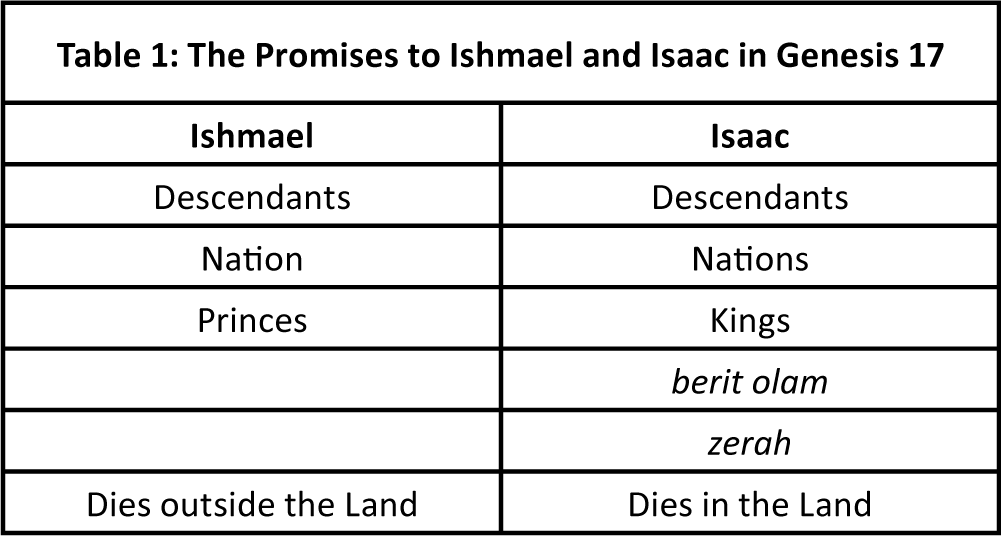
In a study of Paul's exegesis in Galatians 4:21–31, one must begin where he begins: the Hagar and Sarah narratives. There are three primary texts that deal with these two women: Genesis 16, Genesis 17, and Genesis 21. These three chapters occur in the larger unit of Genesis 15–22, which concerns the giving and nature of the Abrahamic covenant. The specific role of the Hagar and Sarah stories in this context appears to be about contrasting Hagar/Ishmael with Sarah/Isaac and the promises made to each of them. (Although not agreeing with Paul's exegesis, Brueggemann (152) does note the Hagar/Sarah and Isaac/Ishmael contrast.) This is especially seen in chapter 17, where nearly identical promises are made to both of them (Abraham and Sarah are promised descendants, nations, kings, offspring/seed; Hagar and Ishmael are promised descendants, nation, princes), with two notable exceptions—the berit olam, the eternal covenant, is promised (Gen 17:7, 13, 19) only to Abraham, as is the zerah, the offspring (Gen 3:15–17:7–10). Neither of these is promised to Hagar or Ishmael. In other words, all of the physical blessings are essentially identical, but Ishmael's are notably not as universal as Isaac's. The difference comes with the promise of the eternal covenant. Further, Ishmael lives and dies outside the land (Genesis 25), as do his descendants. So although Hagar is told to go back to the land, at least her son and all of his descendants (the receivers of the promises) do not end up heeding that call.
The Promises to Ishmael and Isaac in Genesis 17
Genesis 16, 21 and Genesis 3–4, 12
But these chapters are not only contextually connected with one another. They also appear to be textually connected to each other and to the Fall, Cain, and Abrahamic call narratives (Sailhamer: 153–55). Specifically, Genesis 16 and 21 contain linguistic and thematic ties to Genesis 3 and 4. The verb “cast out” (garash—Gen 21:10) is used for God casting out Adam and Eve from the Garden in Genesis 3:24 and Cain out of his home in Genesis 4:14. Furthermore, both Abraham and Adam “listen to the voice of his wife” (Gen 3:17; 16:2; Wenham 1994: 7) and both receive the “gift” (Hagar and fruit, respectively) from their wives (Wenham 1994: 8). Finally, Hagar “curses” Sarah (Gen 16:4; ESV—“looked on Sarah with contempt”), which is the same Hebrew word used for God promising to “curse” those who curse Abraham in Genesis 12:3 (qalal). Additionally, Genesis 12:1–3 should be seen as a reversal of the curses of Genesis 3 (Wenham 1987: 291). Therefore for Hagar to “curse” Sarah is to identify herself not with the promised blessing of Abraham's seed but with the curses of his enemies.
Therefore Genesis 16 and 21 appear to be linguistically and thematically linked with the Fall, Cain, and Abrahamic call narratives. Further, the links between these chapters give the actions in Genesis 16 a heavily negative connotation, one that is related to the Fall, Cain's further devolvement into sin and idolatry, and the curses promised by God in Genesis 12 to those who look upon Abraham “with contempt.” This should not surprise the reader since, as is argued by Gordon Wenham, the events of Genesis prefigure Israel's history (e.g. Abraham's sojourns in and Israel's captivity in Egypt; Wenham 1987: 287, 291). If the author of the Pentateuch uses Genesis to prefigure the Exodus-Deuteronomy narrative, why should it surprise us if he uses Genesis 1–3 to prefigure the Abrahamic narrative? Finally, Egypt is given a negative connotation in Genesis 12–26, as it is the site, or at least connected to the site, of Abraham's “‘wife-as-sister’ or ‘endangered ancestress’ motif” (Greifenhagen: 30). Egypt is, for Abraham, “a detour. The greatest danger the Egyptian detour presents is to the chosen lineage, which is comprised by the attraction of assimilation into the house of Egypt” (Greifenhagen: 31). Therefore for Hagar to be identified as an Egyptian slave woman throughout the narrative indicates the danger presented by her relationship with Abraham, and thus gives a negative connotation to their offspring. As Sarna notes (119), “The stress on [Hagar's] origin may have ironic significance in light of the prediction in the ‘covenant between the pieces that the descendants of Abram were to be enslaved and oppressed in Egypt. The very name Hagar suggests a word play on the Hebrew ger, ‘stranger.’”
The Fall, Cain, Abraham, and Hagar Narratives
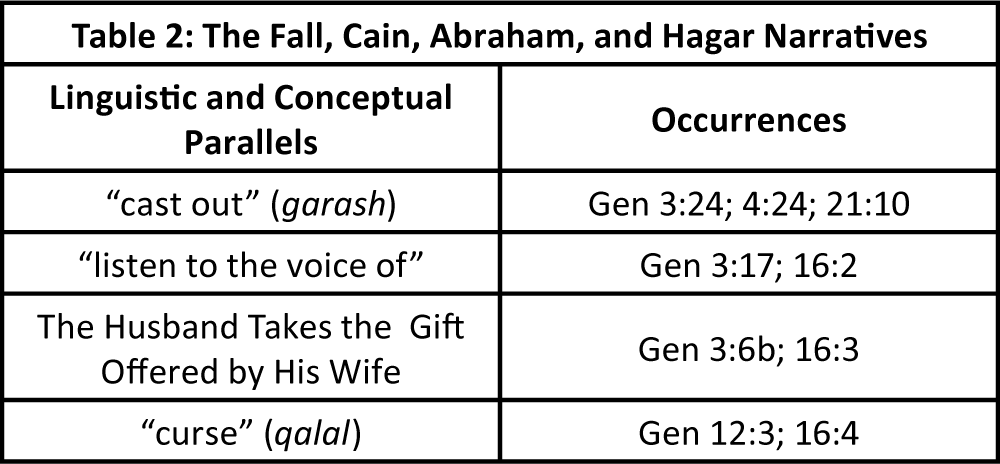
In this connection with the Fall and Cain narratives, Genesis 16 and 17 contrast two different reactions after the renewal of the covenant and God's justification of Abraham through faith. In Genesis 16 Abraham “takes salvation into his own hands” with disastrous results that are pictured as a “new Fall,” but in Genesis 17 he relies on the L
Genesis 16–17, 21 and Exodus
Most importantly, there are also a number of linguistic and thematic connections between Hagar/Ishmael and Israel in the Exodus and at Sinai (For the connections outlined here, see Greifenhagen: 32; and Trible: 9–35). Hagar flees (barach—Gen 16:6, 8; cf. Exod 14:5) towards Shur (Gen 16:7), as does Israel (Exod 15:22); Hagar is “cast out” (garash) by Sarah (Gen 21:10), and Israel is “cast out” by Pharaoh (e.g. Exod 10:11; cf. Gen 3:24; 4:14); and both receive their promises/covenants in the wilderness. Additionally, the identification of Hagar as an Egyptian slave and the fact that both she and Israel receive their promises from God in the wilderness lends itself to the thematic connection between the two narratives. Hagar is also told by the angel of the Lord in Genesis 16:9 to “return to your mistress and submit to her.” The verb for “submit” is the hithpael of anah, the same root that is used for the verb “oppress” in Genesis 15:13 (Wenham 1994: 10). Genesis 15:13 is when God tells Abram that his descendents will live under Egyptian oppression for four hundred years, thus providing yet another link with Israel and Sinai.
The Hagar and Exodus Narratives
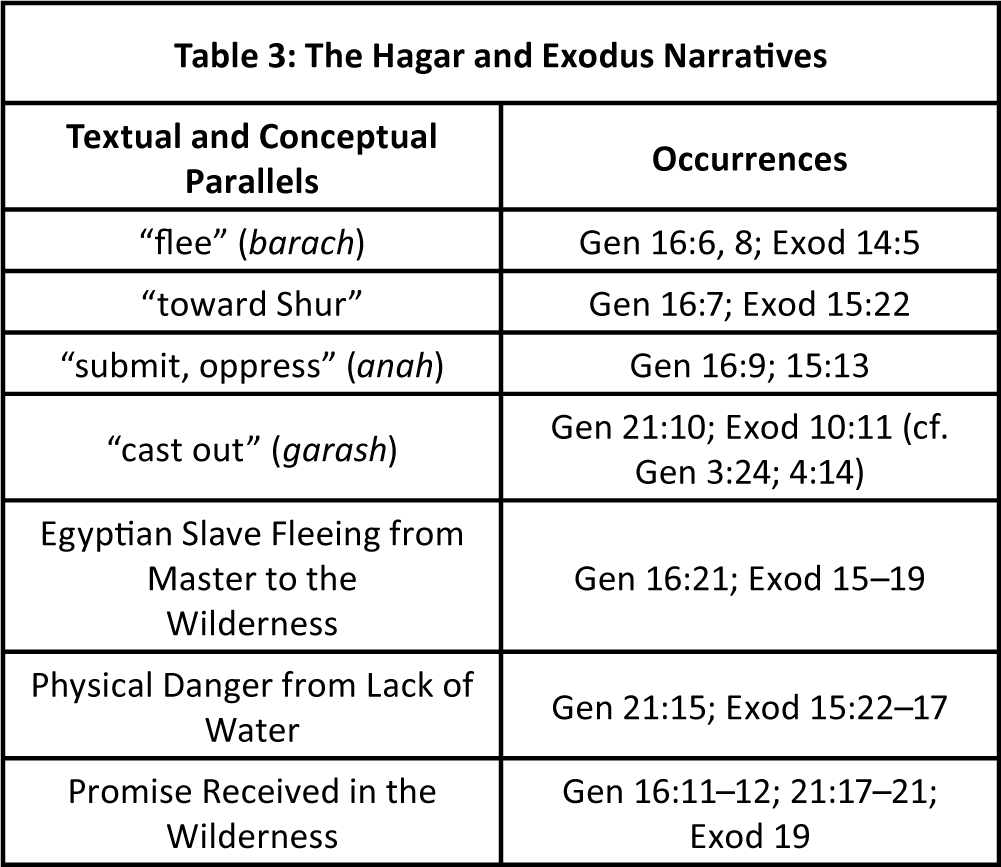
What we see, then, from the verbal and conceptual connections between Genesis 16, 21 and Exodus 12–19 is that the Hagar narrative foreshadows the Exodus narrative (Wenham 1994: 10). Alison Schofield agrees, saying that the Hagar narrative “proves to be only a foreshadowing of the climactic wilderness event: Sinai and God's leading of Israel through the wilderness” (43). Because, from the above analysis and from the evidence within Genesis itself (e.g. the fate of Ishmael in Genesis 25), the Hagar covenant is evidently not eternally salvific but only for physical protection, one must consider the possibility that the links presented are intended to show that the Sinai covenant too is only for physical protection and not eternally salvific. This is the crux of the point Paul is making in Galatians 4:21–31. The evidence from the Pentateuch seems to indicate that the Sinai covenant is, at least in some respects, a covenant of slavery, not of freedom.
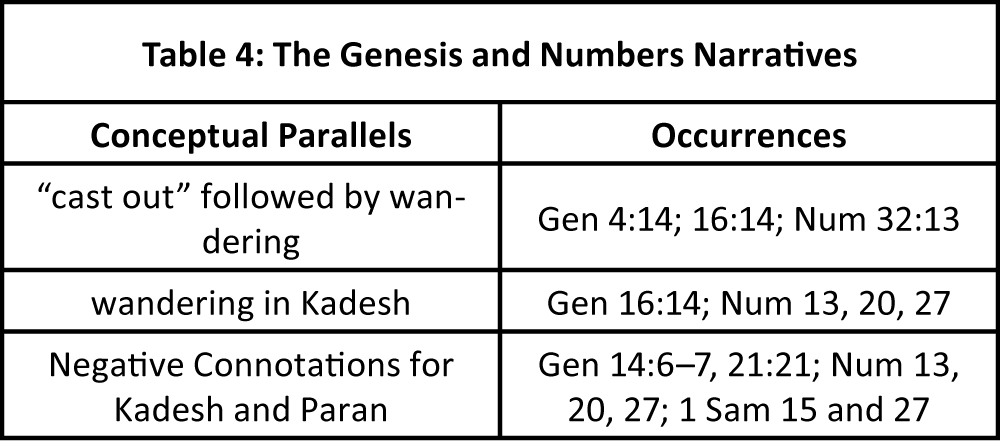
The Genesis and Numbers Narratives
Genesis 16–17, 21 and Numbers
The Sarah and Hagar narratives also appear to be connected to Israel's wandering in Numbers. First, after Cain is “cast out” of God's presence in Genesis 4, he begins to “wander,” the same verb used for Israel's wandering in Numbers 32:13. If the connection between Genesis 3 and 4 and Genesis 16 is taken into consideration, then a possible implication of that connection is that Hagar's flight into the wilderness can be considered as “wandering” as well. Bolstering this implication is the fact that Hagar and Ishmael are both connected to Israel's wandering in Numbers in other places in Genesis. Both are seen “wandering” in Kadesh (Genesis 16:14; Numbers 13, 20, 27). Kadesh and Paran, moreoever, where Ishmael dwells in Genesis 21:21, are both homes of the enemies of God (Horites and Amalekites) in Genesis 14:6–7 and 1 Samuel 15 and 27. Kadesh and Paran are also places in which Israel wanders in Numbers. In other words, the places to which Hagar flees and in which Ishmael settles, and thus the places in which they receive their promises and blessings, are outside the land. Thus it is possible that by connecting Hagar and Ishmael with Cain and his casting out, and by connecting their flight from Sarah and their dwelling places to Israel's wandering and their enemies, the text is also connecting Cain's wandering with both Israel's (again, see Genesis 4:14 and Numbers 32:13) and Hagar's. This connection continues to bolster the negative connotations of everything surrounding the Hagar narrative in Genesis 16. Like the promise made to Cain and to Israel in the wilderness, the promise made to Hagar does not result in her or Ishmael's inclusion in the eternal covenant but only in physical provision.
Conclusion
The promises made to Hagar and Ishmael, along with their geographical location and actions done by them or to them, link them explicitly with Adam and Eve, Cain, those who curse Abraham, and the first generation of Israel that received the Sinai covenant and wandered and died in the wilderness. They are also linked explicitly with other places in the Hebrew Bible that speak of God's enemies or being exiled by God (e.g. 1 Samuel 15 and 27). While God is certainly gracious to them in Genesis 16, 17, and 21, it is not, as Paul says in Galatians 4, a covenant of freedom but a covenant of slavery. The promises made to Hagar/Ishmael, along with the covenant made to Israel at Sinai, are essentially promises made in the desert/wilderness to Egyptian slaves fleeing from a master who cast them out. They are not the life-giving covenant that is received by Abraham (Gen 15:6) and those under the new covenant (Deuteronomy 30, Jeremiah 31, Ezekiel 36).
It appears, then, that Paul in Galatians 4:21–31 was not arbitrarily allegorizing or even reverting to a-textual typology, but was reading the Pentateuch carefully and applying it to his readers' situation in Galatia. When he uses the term “allegory,” it is not to indicate that he is moving from a textual reading to one that ignores the Pentateuch's plain sense, but only to note that he is expounding on the full sense and interconnectedness of these related passages. It may be time, therefore, to put down the hatchet of our own hermeneutical law which we raise against Paul's interpretation in Galatians 4:21–31 and give him grace instead.