



Abstract
István Czachesz adapts Mark Granovetter's Social Network Analysis (SNA) view, “the strength of weak ties,” that new, innovative information spreads through a network, not through one's intimate family and friends (“strong ties”), but through more distant, hardly known acquaintances (“weak ties”); Paul, constantly on the move, did not make many strong ties, but spread his message through weak ties. This article appreciates, but counterbalances, Czachesz's thesis with the SNA theory that strong ties are necessary for reinforcing risky behavioral change (complex contagions) and with conclusions about recruitment to, and spread of, new religions. It draws attention to Paul's longer stays as an artisan and the kinds of spaces in which he might have stayed. It also develops matrices and a simple sociogram of Paul's strong tie relationships and exchanges based on Paul's Philemon letter.
Keywords
Three decades ago Elizabeth Clark introduced Social Network Analysis [SNA] to the Society of Biblical Literature, demonstrating its importance as a tool for interpreting the Origenist controversy among the late fourth-century Christ believers (Clark 1984). Her study dazzled her audience with her matrices and sociograms, but appeared only later, in a 1992 (1991 on the cover) Semeia collection of SNA-based or related articles about method (White), patronage networks at Thessalonica (Hendrix), local networks at Apollo sanctuaries (Robinson), Epictetus' networks (Hock), patronage networks in the Acts of Peter (Stoops), and epidemics and the success of Christian expansion (Stark). In the 1990s other interpreters of Mediterranean antiquity included SNA in their studies: patronage networks at Corinth (Chau), networks of voluntary associations (Ascough 1997), and Aristides' network at the Pergamum Asclepieion (Remus). At the turn of the century I theorized about Jesus' spatial and social network in Galilee (Duling 1999; 2000; 2002a; 2002b). More recently, Bruce Malina and six colleagues have produced seven books on Paul's network of “friends”: Timothy (Malina), Epaphras (Trainor), Lydia (Ascough 2009), Phoebe (Campbell), Apollos (Hartin), Priscilla and Aquila (Keller), and Titus (Stenstrup). Still more recently, István Czachesz analyzed Paul's network in relation to “weak ties” (2011)—more of that later—and Adriana Destro and Mauro Pesce argued that Jesus' social network was developed among the people at temporary villages where he wandered (2012: 26–29, 41–77). At a joint meeting of the Context Group and the NordForsk network at Helsinki-Järvenpää, Finland, in June of 2012, organized by Risto Uro, Petri Luomenen, and Jutta Jokiranta, Czachesz (2012b), Rikard Roitto (2012a), Mikko Heimola, Eric Stewart, and I (2012c) gave SNA presentations. At the “Mind, Society, and Religion in the Biblical World” Section at the 2012 Society of Biblical Literature in Chicago, Illinois, Petri Luomenen (2012), Czachesz (2012a), Roitto (2012b), and I (2012d) offered SNA papers again. In short, interest in SNA by Biblical scholars has been sporadic, but steady, and is apparently growing. This article is a shortened version combining my presentations at Helsinki, Chicago, and a Context meeting near Toronto (2013), the latter critiqued by Mona Lafosse.
Several SNA theorists have tackled the history of SNA (Wellman; Scott; Freeman; Prell: 19–58). John Scott and Linton Freeman distribute its pioneers into three intellectual traditions, the sociometric tradition of Jacob Moreno (1941) and Kurt Lewin, the “Harvard Structuralist” tradition of the 1930s and 1940s (Mayo; Roethlesberger & Dickson [Hawthorne Works, Cicero, Illinois]; Warner & Lunt), and the 1950s “Manchester School,” linked at times with the London School of Economics. With the work of Elizabeth Bott in the background, the Manchester School was spearheaded by John Barnes (1969a; 1969b; 1972) and anthropologist Clyde Mitchell (1969; 1973; 1974). Clark's ground-breaking study noted above drew on this “Manchester School,” which she correlated with the work of network Mediterranean anthropologist Jeremy Boissevain (1974; 1979), patron-client research by S. N. Eisenstadt & Louis Roniger [cf. Elliott 1987]), the network analysis of anthropologist Rudo Niemeijer, and “new religions” research by Rodney Stark and William Sims Bainbridge (1980). In the almost thirty years since her study, there has been an exponential explosion of SNA publications in general (Borgotti & Foster: 992 [chart]; Knoke and Yang: 1).
For those unfamiliar with SNA, a definition and a brief discussion of concepts and terminology will be helpful. Sociologist and SNA theorist Charles Kadushin's view is especially useful for the humanities and social sciences. He states that
[a] network is simply a set of relations between objects which could be people, organizations, nations, items found in a Google search, brain cells or electrical transformers. … [W]e are concerned with social networks, and what passes through these networks—friendship, love, money, power, ideas, and even disease [Kadushin 2012: 3–4].
Kadushin organizes SNA data into what I call “the three c's”: “cases,” “connections,” and “content.” “Cases” refer to any social entity—groups, organizations, places—but especially, as Kadushin's sociological view suggests, to individuals, variously termed in SNA as “actors,” “agents,” “members,” or “players.” “Connections” are simply the “ties” or “links” between these “cases,” which can be geographical/spatial, biological, or social. “Content”—Kadushin's “what passes through these networks”—refers to material or non-material exchanges. In mathematical graph theory, which has a long and venerable history (Ore) and is closely related to SNA (e.g., Barnes 1969a), cases and/or their connections are often correlated on a “case-by-case” matrix or graph. If “content,” or “what is passed on,” is given the main consideration, a “case-by-variable” matrix or graph can be developed. Then these correlations can be displayed on a “sociogram,” the cases represented by “dots,” “points,” “nodes,” or “vertices,” the connections between them by lines called “ties,” “links,” “edges,” or “arcs.” Person-centered SNA theorists are very interested in how such connections influence interactions in the social network itself.
Earlier social network analysts (e.g., Barnes 1969a; 1969b; 1972; Mitchell 1969; 1973; Whitten & Wolfe) developed these concepts, which are often described in the above mentioned SNA handbooks (see also Duling 1999: 156 = 2002b: 301–02). In “simple relationships” nothing is formally exchanged; people are simply next to each other in the same place at the same time (“propinquity”). Such relationships are represented on a sociogram by dots connected with lines (•—•). However, human relationships are usually more complex than this; indeed, propinquity can generate (or can be generated by) “homophily,” literally, “love of the same thing,” described as “birds of a feather flock together,” referring to persons who share common social status, opinions, interests, or goals (although homophily can lead to “sub-networks” or “clusters” in which social boundaries, social hierarchies, and ethnocentrisms and prejudices are formed; cf. McPherson, Smith-Lovin, & Cook). Propinquity based on family, workplace, neighborhoods, or ethnicity, can also lead to strong bonds. Relationships can be intimate, such as kinship ties (involuntary) and friendship or work-related ties (voluntary), or more distant connections, such as mere acquaintances or “friends of friends” one seldom sees.
“Content” or “what is passed on in networks” in Kadushin's definition gives rise to more SNA concepts. In a “directed relationship,” a content exchange “flows” primarily in one direction between a “sender” and a “receiver,” for example, parental gifts to children, diagnosis by a physician to a patient, or a patron to a client (although receivers normally offer something in return—love, gratitude, honor). Such more or less one-way relationships are said to be “asymmetrical,” a form of “unbalanced reciprocity” (in exchange theory) and on a sociogram the direction of the content is indicated by lines with directional arrowheads pointing one way, sometimes called an “arc” (•→•). But if the exchange is more equally balanced, as in barter, or friendship between those of more or less equal status—“balanced reciprocity” in exchange theory—the “arc” is given arrowheads at both ends (•↔•). Of course, if the exchanged relationship is negative—agonistic insults, false rumors, gossip, cheating, and the like—there is “negative reciprocity.” Antagonistic exchanges between individuals and especially sub-networks, or network “clusters,” give rise to “network polarization” (Duclos, Esteban, and Ray; Canover et al; Maoz). Exchanges between two actors are said to be “binary.” As noted, relationships can be intimate, but can also be mediated by an intermediary or “broker,” as in patron-client relations, and this is represented by two or more sequentially directed arcs on a sociogram (•→•→•). Such less intimate “paths” expressing “social distance” or “long ties” (“weak ties”) can be represented by longer arcs (•— — — →•). Relationships in a network may be based only on one type (“single stranded”; “uniplex”) or several (“many stranded”; “multiplex”), such as co-workers who are also friends; in such relationships, ties are stronger, more intimate, and thus have more “adjacency.” If the focus of SNA is on one central “actor,” that “focal person” is usually called an “Ego” (for “I”) and the other actors, whether close friends or distant acquaintances are called “alters”; thus, an analyst can examine relatives, friends, or more distant acquaintances of Ego in an “Ego-centered network” (Duling 1999; 2000; 2001; 2002b).
In network theory it is theoretically possible to consider every actor and to imagine each as an Ego. It is thus theoretically possible to analyze an “unbounded network,” and every possible link between nodes (Egos), thus a “total network,” the whole being an “infinite network.” In practice, however, it is necessary to “limit the analysis” to only a selection of actors, thus a “bounded network,” and the links between them, that is, a “partial network,” in short, a “finite network.” An “Ego-centered” network, such as that between Paul the Apostle and his friends and acquaintances, or among those alters themselves, offers a well known example (Malina; e.g., Trainor: 22–24).
There are more terms and concepts, but these are basic and are enough as an orientation. Later in this study I take up select names in Paul's network (“prosopography”). I also isolate some of Paul's person-related terms, construct case-by-variable graphs, and develop a sociogram to illustrate a small part of Paul's Aegean network.
István Czachesz on Paul's Mission and the “Strength of Weak Ties”
Contemporary network analysts can generate gigantic amounts data from interviews, questionnaires, polls, and the internet; they can graph the data and analyze it with algorithms and software; and they can then display it in sophisticated, computer-generated sociograms. Historians of antiquity must be more modest (Chau: 35–36). They are restricted to a limited number of literary and archaeological sources, that is, “informants” who are often vague or silent about the intricacies of their social networks. Nonetheless, as noted above, there are attempts to study ancient networks and such networks can function mentally as social-scientific models of relationships. Although the data are more limited, it is nonetheless important to “limit the analysis,” that is, focus on some manageable “fnite network.”
To simplify, I take as a point of departure an excellent SNA study by István Czachesz, “Women, Charity and Mobility in Early Christianity. Weak Links and the Historical Transformation of Religions” (2011). Czachesz has a broad concern: namely, to explain why early “Christianity” grew more rapidly than its competitors, a difficult, well known historical problem (e.g., White 1985; Stark 1992; 1997; Riley; Sanders). Two of Czachesz's reasons for the success of Christ movements are charity to others and the inclusion of women, but his main emphasis and the key to his article is “the strength of weak ties,” a SNA concept developed in the much cited Ph.D. dissertation of Mark Granovetter (1973; 1982=1983).
A brief word about Granovetter's ground-breaking research will help to clarify Czachesz's adaptation of it. Granovetter knew from previous SNA studies that each person has an “intimate network” of “strong ties,” that is, family and friends who are socially close, know one another well, relate to one another with a high percentage of possible ties (“high density”), in several types of ways (“multiplexity”), often over long periods of time, and with emotional intensity. Each person also has a less familiar “acquaintance network” of “weak ties,” persons who are socially distant and do not know one another well, who seldom, if ever, cross paths, share a low percentage of possible ties (“low density”), relate to each other usually only in one specific way (“uniplexity”), and thus have no strong emotional connection. Granovetter's most important discovery was that people recently hired to new jobs did not usually find them through their “intimate network” of strong ties, but through their “acquaintance network” of weak ties. He generalized: important new information is usually not available in one's intimate network because family and friends tend to be more insulated from others and thus share the same or similar information. Such information is “homogenous” and “redundant.” New, innovative information is diffused rather though one's acquaintance network of weak ties. Weak ties are the main “bridges” to important new information. In other words, ties that are “weak” in the relational sense—socially distant ties—are “strong” in the structural sense—they are conduits to critical new information. This led Granovetter to a parallel generalization:
[W]hatever is to be diffused [the content, “what passes through the network”] can reach a larger number of people, and traverse a greater social distance, when passed through weak ties rather than strong [ones] [Granovetter 1973: 1366].
Granovetter illustrated the “strength of weak ties” with an “Ego-centered network.” To illustrate further, I offer a simple sociogram of two Egocentered networks “bridged” by weak ties in each (Figure 1).
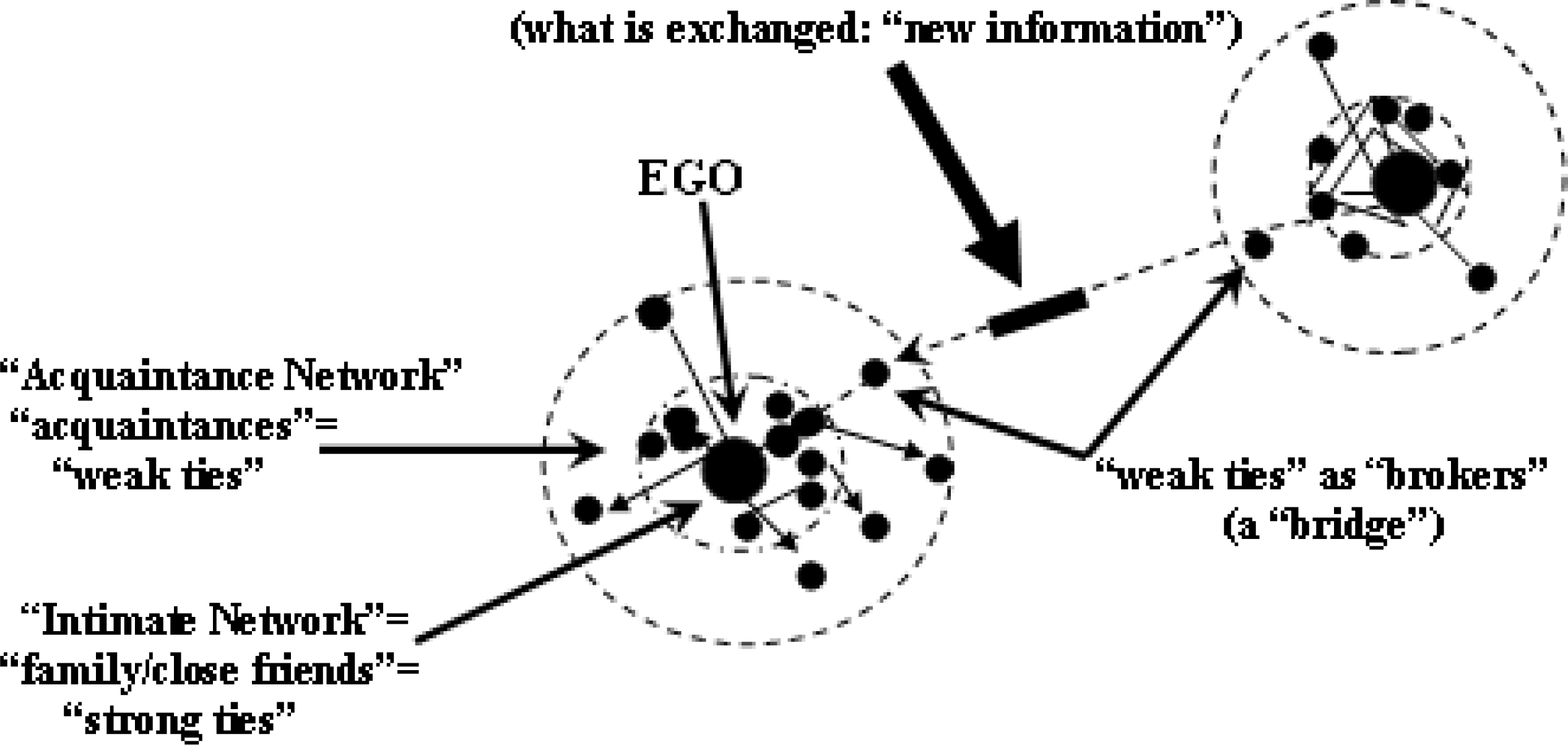
Weak Ties Between Two Ego-Centered Networks
Czachesz applies Granovetter's strength of weak ties model to Paul's relationship with church members in the churches he founded. He first transfers Gerd Theissen's notion of the “itinerant charismatics” in rural Palestine to Paul's journeys. He writes:
Since Paul moved about so much, he was prevented from maintaining many strong social links, but it enabled him to develop a great number of weak ties with individuals in a variety of geographical and social locations. Such a position could be best described as that of a between-group broker … that is, he connects members of various communities who possibly never met each other [Czachesz 2011: 143; cf. 151].
This is a concept reminiscent of David Fiensy's “craftsmen as brokers” (Fiensy). I imagine Czachesz's view of Paul's weak ties in terms of a map (Figure 2, next page), suggesting his geographical network, and a corresponding sociogram (Figure 3, next page), suggesting a social network at a very simple level.
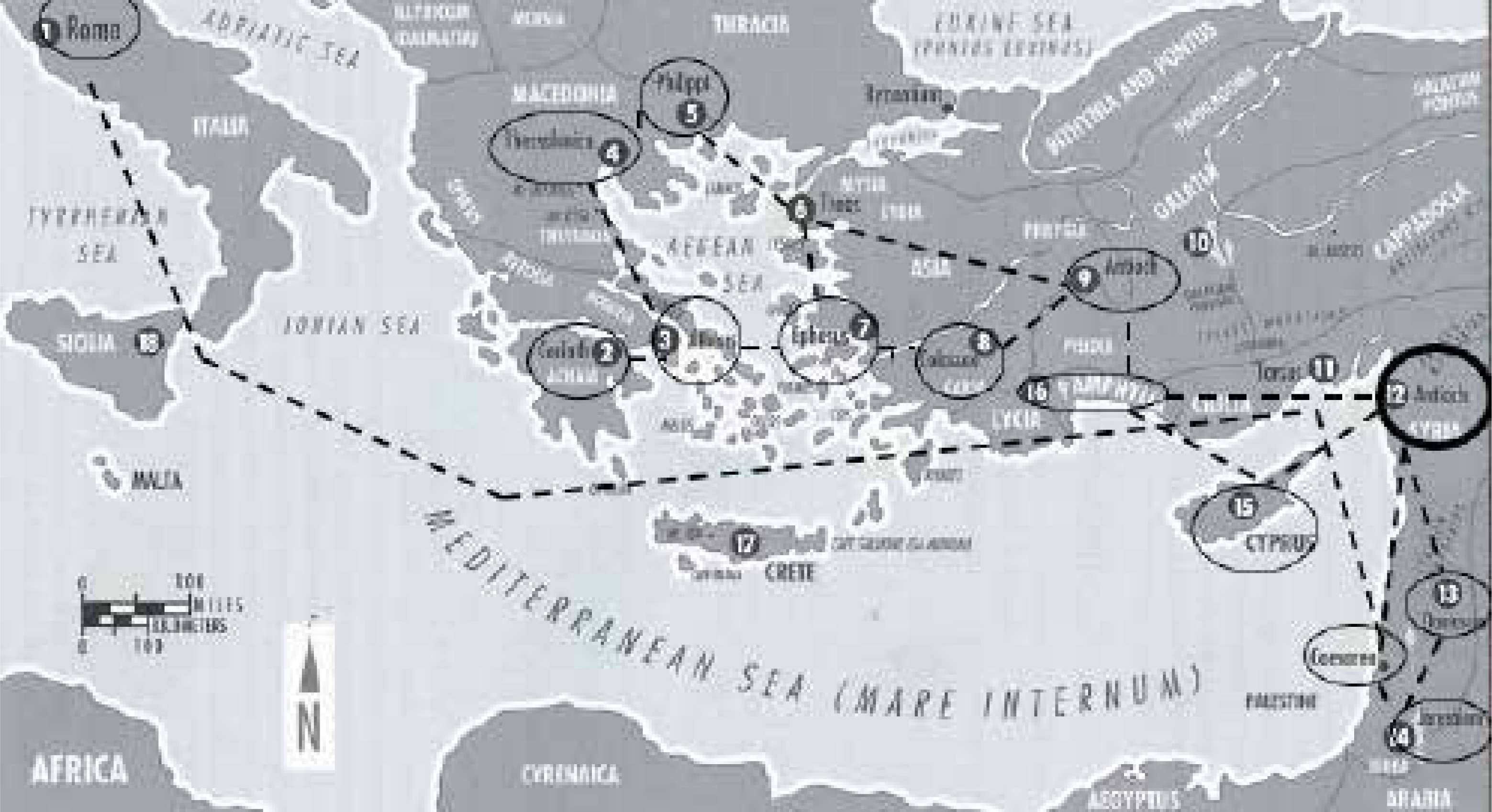
A possible construction of a map based on Chachesz's theory of “Weak Tie” Links between Paul's cities. Map (slightly modified) reproduced from Duling 2003a, p. 164. By permission from Cengage Learning.
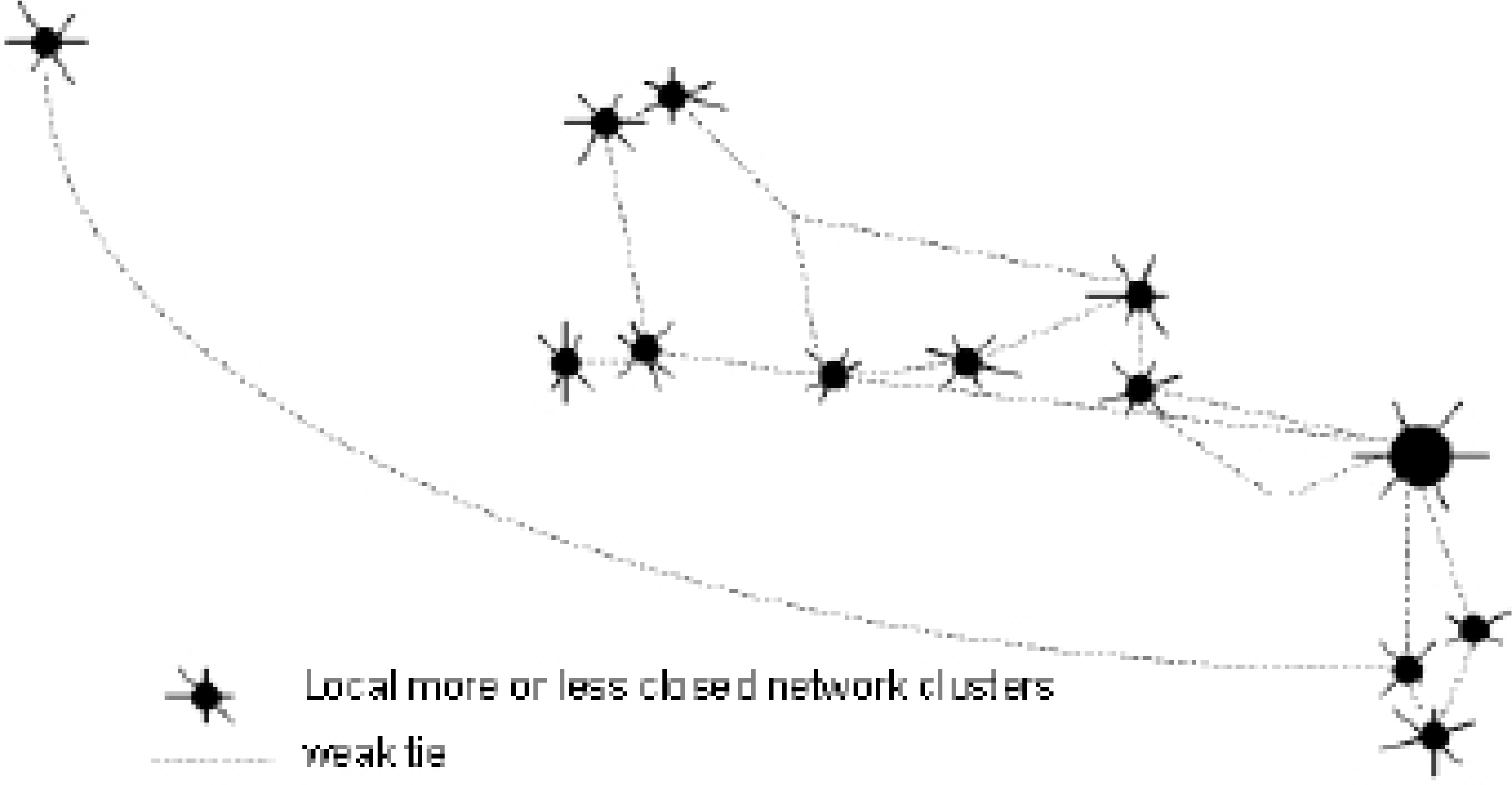
Paul as a Link between His Clustered Communities.
Combined with the appeal of charity and the inclusion of women, Czachesz suggests, weak ties gave the early Christ movements a competitive advantage in the “free market” of Greco-Roman religions (2011: 142–46).
Like Granovetter, Czachesz incorporates related SNA theories into his perspective, such as Stanley Milgram's “small world” theory (Milgram [“popularized” as the view that everyone is connected to everyone else by no more than “six degrees of separation” [Guare 1990; 1993]), Ronald Burt's “structural holes” (Burt [isolated network clusters that are sometimes linked by a single weak tie]), and Everett Rogers' “diffusion of innovations” with the help of “change agents,” a theory about a new product's life cycle (Rogers [innovators→opinion leaders→early adopters →late adopters→laggards]; adapted in Malina's study of Paul's network, 2008: 52–56). In a nutshell, Czachesz proposes that Paul was essentially a “weak link” charismatic wanderer, a “between-group broker,” who introduced new, innovative gospel “information” to his more or less isolated communities.
Complex Contagions, Weak (Long) Ties, and Strong (Short) Ties
István Czachesz's proposal based on Granovetter's “strength of weak ties” is innovative. It is an important critical contribution, a creative proposal capable of generating hypotheses. In my view, however, the strength of weak ties needs to be supplemented and counterbalanced with its opposite, the strength of strong ties—first, between Paul and his communities, and second, within those local networks themselves. With respect to theory, Granovetter himself noted that strong ties “have greater motivation to be of assistance and are typically more easily available” (1982: 113). As “diffusions of innovations” theorist Everett Rogers observed, “Certainly, the influence potential of network ties with an individual's intimate friends is stronger than the opportunity for influence with an individual's ‘weak ties’” (340). To these observations, I first add theories about “complex contagions” (suggested to me by Rikard Roitto) and new religious movmenets (NRMs) before returning to Paul and his geographical and social network.
Damon Centola and Michael Macy have also emphasized the importance of strong ties in their study, “Complex Contagions and the Weakness of Long Ties” (704–05). In epidemiology “complex contagions” require multiple carriers or contacts in contrast to “simple contagions” that spread disease through a single carrier. Centola and Macy use this medical language metaphorically and replace “weak ties” with “long ties” (see the discussion of long arcs and “social distance” above). They recognize that Granovetter's insight, “whatever is to be diffused can reach a larger number of people, and traverse a greater social distance, when passed through weak ties rather than strong ties” (Granovetter 1973: 1366 [italics mine]), is one of the most influential sociological contributions to the advancement of cross-disciplinary knowledge today. However, they argue that with respect to collective behavior, as contrasted with jobs data, Granovetter's claim must be “carefully circumscribed.”
[W]hile weak ties facilitate diffusion of contagions like job information or diseases that spread through simple contact, this is not true for “whatever is to be diffused.” Many collective behaviors also spread through social contact, but when these behaviors are costly, risky, or controversial, the willingness to participate may require independent affirmation or reinforcement from multiple sources. We call these “complex contagions” because successful transmission depends upon interaction with multiple carriers. Using formal models, we demonstrate [in this paper] fundamental differences in the diffusion dynamics of simple and complex contagions that highlight the danger of generalizing the theory of weak ties to “whatever is to be diffused.” Network topologies that facilitate diffusion through simple contact can have a surprisingly detrimental effect on the spread of collective behaviors that require social reinforcement from multiple contacts. This is not to suggest that complex contagions never benefit from weak ties, but to demonstrate the need to identify carefully the conditions under which they can [703].
Centola and Macy recognize that Granovetter's point has often been applied to the spread of collective behaviors, for example, powerful rumors or urban legends, from a single actor to another single actor (“neighbor”), one by one, like a “domino effect.” However, they point out that for major changes in behavior to be activated, multiple sources—two or more—of exposure (not just one exposure, or even multiple exposures by the same carrier) are needed to trigger adoption. In Everett Roger's language, multiple “prior adaptors” are required for people to adopt costly behaviors, to join social movements, and, I add, to affiliate with new, non-normative religious groups or movements (NRMs; see below). In other words, redundancies with strong ties—family and friends forming multiplex relationships in dense clusters—are needed to reinforce behavioral change, and these are fed by multiple or “wide” bridges, not single, narrow, weak tie bridges.
Centola and Macy cite four overlapping social mechanisms that possibly explain why complex contagions require multiple sources of exposure to activate adoption (707–08).
Strategic complementarity. Knowing about innovations is not enough; many are costly, especially for early adopters, but less so for later adopters. The same is true for participants in collective action. Costs and benefits depend on the number of investors; adoption is much more likely when a “critical mass” makes benefits worthwhile.
Credibility. Innovative information from a distant, weak tie becomes more credible when confirmed by others or adopted by strong-tie “neighbors.”
Legitimacy. Participation in a collective action by close friends increases the likelihood that bystanders will also participate; non-adopters will challenge its legitimacy and early adopters will be seen as deviants until they become a critical mass.
Emotional contagion. Most models of collective behavior (e.g., action theory, threshold models, cybernetics), assume that expressive and symbolic impulses in human behavior are communicated and amplified in cumulative interaction, that is, spatially and socially concentrated gatherings (an example of propinquity).
This means that the redundancy of strong ties that is a weakness for simple contagions is a strength for complex contagions.
A low level of trust and familiarity between socially distant persons [at the personal level] means the relationship is weak, and this inhibits the ability of one person to influence the other. What is not at all obvious is that the long [weak] ties can also have structural weakness—they are nontransitive. … [W]hen activation requires confirmation or reinforcement from two or more sources, the transitive structure that was redundant for the spread of information now becomes an essential pathway for diffusion. Thus, while weak ties are beneficial for the spread of new information precisely because they are nonredundant, for complex contagions uniqueness becomes a weakness rather than a strength. … For simple contagions, what matters is the length of the bridge between otherwise distant nodes. For complex contagions, the effect of bridges depends not only on their length (the range that is spanned) but also on their width … [709–10].
In short, while weak ties in networks can facilitate the spread of new information or a social movement, they do not always do so and indeed can sometimes hinder the spread of behaviors that are costly, that is, risky or controversial, when there is little or no trust or reinforcement. “Complex contagions” for collective behavior require social reinforcement by strong ties of trusted and familiar family and friends (731). Other studies indicate that complex contagions spread quickly through short paths in overlapping communities as contrasted with isolated communities (van der Leij and Goyal 2006; Shi, Adamic, & Strauss).
The Strength of Strong Ties in New Religious Movements
The theory and data of complex contagions focuses especially on decisions, affiliations, and group actions that are costly. In addition the strength of strong ties for social reinforcement can be also important for adopting less risky innovations—indeed, even more important than the innovative knowledge itself! This fact arises from sociological data about recruitment to, and growth of, New Religious Movements (NRMs), a phenomenon that peaked in the United States in the 1970s and 1980s. The most discussed study of NRMs, John Lofland's and Rodney Stark's “conversion to a deviant perspective,” was a “value added” conversion model with two parts, that is, “predisposing factors,” interpreted with social-psychological deprivation/stress theory, and “situational factors,” interpreted with sociological deprivation/appeal theory (cf. Duling 1999; 2000; 2002a; 2002b). With respect to part one, “predisposing factors,” a potential recruit must
experience enduring, acutely-felt tensions,
within a religious problem-solving perspective,
which leads him (or her) to define himself (or herself) as a religious seeker.
With respect to part two, “situational factors,” the potential recruit must
encounter the NRM at a turning point in his (or her) life,
wherein affective bonds must be formed (or pre-exist) with one or more converts,
where extra-cult attachments are absent or neutralized,
and where, if he or she is to become a … [total convert] …, he or she is exposed to intensive interaction (Lofland & Stark: 874, cf. 862; Stark & Bainbridge 2000).
The Lofland-Stark “conversion to a deviant perspective” value added model was much debated (Lofland & Stark; Stark & Bainbridge 1987; Lofland 1977; Bainbridge 1978; Snow & Phillips; Snow, Zurcher, and Ekland-Olson). Greil and Rudy summarized studies of ten NRMs in relation to the model and concluded that a scholarly consensus exists on two of the seven steps: the importance of affective bonds (step 5) and exposure to intensive interaction (step 7) (Greil & Rudy: 313). In short, recruitment success in NRMs requires the development of close friendships between prospective recruits and movement group members.
These studies revealed another fact. Development of close friendships with NRM members is more important than learning about NRM ideology—the “new information.” Rodney Stark and William Sims Bainbridge stated this point clearly:
Rather than being drawn to the group because of the appeal of its ideology, people … [are] … drawn to the ideology because of their ties to the group—‘final conversion … [is] … coming to accept the opinions of one's friends’” [1980: 1378–79, citing Lofland & Stark: 871; Snow & Phillips: 431; Ebaugh & Vaughn: 155; cf. White 1992a: 20–21; Duling 2001].
This consensus is further indicated by the thirteen-step strategy of the most successful of all NRM movements, the Church of Jesus Christ of Latter Day Saints. That strategy emphasizes that ideology should be introduced to the potential recruit last, but network bonding should be established very early (Snow, Zurcher, and Ekland-Olson). William Gamson made the same point about social mobilization in general: “The argument that recruitment to a movement follows lines of preexisting social relationships and that recruitment networks are a critical part of the mobilization process has become part of our shared knowledge” (61). One might object that these are simply modern movements, but Bernard Frischer argued the same point in relation to recruitment to ancient philosophical movements (Frischer), and I did the same in relation to gospel recruitment stories despite the impression that “call stories” are based on direct, person-to-person “picking up,” which has a prototype in the Elijah/Elisha recruitment model (Duling 2001). In each study, the model was adjusted for antiquity.
Finally, strong ties in preexisting networks are also emphasized in relation to the growth of NRMs, which bears directly on Czachesz's interest in the rapid success of the early Christ movements. Like Czachesz, Rodney Stark has argued (1992) that Christian love, charity, and concern for the poor and sick beyond what was typical for “pagans” were critical for the spread of Christ movements, but also in analogy with modern cults that early Christianity spread through preexisting networks among the upper social strata (Stark 1979; 1980; 1986; 1987; 1990; 1996; Stark & Roberts: 348). However, in my view his results for this last point have to be adjusted since the sect/cult distinction is too facile for the early Christ movements (see Elliott 1995), and in any case intimate family networks were important at all levels of society in antiquity, not just upper social strata (Hanson & Oakman). The point about family as a social domain for all strata networks is important since at least most of Paul's recruits came from the lower social strata (1 Cor 1:26; Rom 16; see below).
Paul's Recruitment Strategy in His Aegean Network: The Necessity of Strong Ties
Czachesz's view of Paul as an itinerant weak-tie “between-group broker” makes a great deal of sense in relation to some aspects of Paul's life and thought that have survived. For example, if one were to rely only on the Acts of the Apostles, one would certainly conclude that Paul was often on the move. With respect to the letters, his many controversies and his use of brokers Timothy and Titus to help resolve some conflicts (1 Thess 3:1–10; 1 Cor 4:17; 16:10–11) also suggest he did not always develop the strongest, most intimate, and most trusting relationships. Among his followers in local settings, “network polarization” among homophilous socioeconomic, ethnic, and gender factions often existed (e.g., 1 Cor 1–4; 6:1–11; 8; 10; 11:17–34; 15:12–34; Gal 2:11–21), which suggests that his authority, and thus his personal ties, were not uniformly strong.
On the other hand, both theoretical considerations such as those noted above and textual considerations yet to be discussed suggest that Paul formed some strong ties in his network and that such ties were also important in local networks. The theory of complex contagions points to the importance of reinforcement of more intimate others for new, risky affiliations. Both recruitment to, and growth of, NRMs also depend upon strong network ties. These ties existed both between Paul and his recruits, and, despite instances of factionalism, among those recruits themselves in his churches. In short, strong ties must also be considered carefully.
As an initial point, it should be remembered that whether one agrees with Theissen's characterization of Paul or not, Theissen himself did not portray Paul as a Jesus-like wandering, homeless, charismatic beggar who was constantly on the move, as Czachesz implies, but as an urban community organizer who at times settled down in a port city and supported himself with hand labor in his trade (Acts 18:1–3; Hock 1978; 1980). To be sure, Paul had received some support from Macedonia (2 Cor 11:9; Phil 4:10–20), but he also explicitly rejected it for Thessalonica and Corinth (1 Th 2:9; 1 Cor 4:12; 9:15–18; 2 Cor 2:17; 11:7–15; 12:13–18; cf. Acts 18:3). This apparent inconsistency did not bode well in his defense of his self-support (see the debate between Hock 1978 and 1980 and Marshall 1987). More importantly, Theissen held that although Paul challenged Mediterranean family values at times, he also held that Paul also accommodated his challenge to the traditional household code, a position that Theissen called, famously, “love-patriarchalism.” In Theissen's words, “A familial love-patriarchalism, which places high value on obedience of women, children, and slaves, and has little room for nonfamilial ethical radicalism of the synoptic tradition, is characteristic of these communities with their marked social stratification” (Theissen 1978: 37 and 62–63, n. 33). Again, “… [Paul's] love-patriarchalism allows social inequalities to continue but transfuses them with a spirit of … respect, and … concern for the conscience of the other person” (Theissen 1978: 139). Even if one is skeptical about Theissen's judgment (e.g., Bartchy 1999: 75–76), Theissen himself did not use Jesus' itinerancy as a model for Paul's strategy.
In Paul's undisputed letters, as well as in comments in Acts, it is clear that Paul shifted his headquarters from Antioch to Ephesus, the key port city that became the center of Paul's Aegean network of port cities (Murphy-O'Connor 1992: 50–51), and, more importantly, that Paul did not always quickly move on, but made long stays not only at Ephesus, but also Corinth. I shall not attempt to develop a full Pauline chronology to demonstrate this point (cf. Duling 2003: 159–67; Mitchell 2005), but simply emphasize certain passages.
Paul wrote to the Corinthians from Ephesus that he desired to remain there “until Pentecost” (1 Cor 16:8). This statement implies a period of residence. Moreover, he composed at least four letters to Corinth from Ephesus (Duling 2003: 142–47; and they clearly imply a period of back-and-forth communications via envoys and delegations, which required a good deal of time. The Acts data say that Paul remained in Ephesus “many days longer” (Acts 18:18), that, indeed, he was there for “two years” (Acts 19:10), and that he was in “Asia for a while” (Acts 19:22). These references to longer periods of residence are important for understanding Paul's strategy. If he wrote the prison letters from Ephesus, which is not certain but likely (1 Cor 15:32; 16:9b; 2 Cor 1:8–11), there is a possibility that one might include an even longer period than these references suggest.
Surviving information about Corinth also suggests that Paul had longer residential stays there. Paul planted the new community (1 Cor 3:6; cf. Acts 18), returned for a “painful visit” (2 Cor 2:1), says that he is coming for a “third time” (2 Cor 12:14; 13:1), and promises to “spend some time” with the Corinthians (1 Cor 16:6–7). If the Acts references are credible, his first stay lasted a year and a half (Acts 18:11; 18:18: “many days”) and there is also mention of “three months” in “Greece” (Acts 20:2). The usual opinion is that Paul probably wrote Romans from Corinth on his last visit (Gaius: Rom 16:23; 1 Cor 1:14), a letter that required some time.
Paul appears to have anticipated some sort of stay in Rome, as well (Rom 15:24).
The point is this: longer stays in select cities of his Aegean network, particularly Ephesus and Corinth, are certain. Such stays do not conform to the one-day limitation of itinerant charismatics suggested by the Didachē, which Czachesz cites as an illustration that informs Paul's mission (2011: 144). From a SNA perspective these stays suggest a spatial and social network of some duration of social interaction, one index of intimacy, thus the likelihood of “strong ties.”
Thus far, I have suggested that Paul had a recruitment network in port cities around the Aegean, and that he had periods of residence in at least two cities, Ephesus and Corinth. Stronger network ties can be supported further by examining where Paul likely stayed in these cities.
Paul says in the Letter to Philemon, probably from Ephesus, that believers met in an oikos, usually translated “house,” of Philemon, probably in Colossae (names in Philemon 2:23–24 compared with those in Colossians 4:10–14), and he asked Philemon to prepare for him there an xenia, a “guest room” (Phlm 22; cf. Acts 28:23). Paul's greetings suggest that Philemon might have had a wife Apphia and son Archipus (Phlm 2), and certainly he had a slave Onesimus. Most scholars agree with these possible identifications and they suggest at least the plausibility of some strong relationship with an extended family (Trainor), which, as I shall indicate later, is supported by Paul's intimate language in his letter to Philemon.
The author of Acts claims that Paul stayed with Aquila, a Judean believer from Pontus, and his wife Priscilla (Prisca) at Corinth as their guest (Acts 18:1–3; Keller: 1–13). The Acts account also says that Aquila had come from Italy (presumably expelled from Rome under Claudius), that they had the same trade as Paul, “tentmakers,” that they worked together with him. Acts adds that Paul also went to the oikos of a certain Titius Justus (Acts 18:7).
Paul writes from Ephesus that Christ believers there met in the oikos of Prisca (Priscilla) and Aquila (1 Cor 16:19). Acts 18:19 says that they had accompanied Paul from Corinth to Ephesus and that Paul “left them there,” perhaps as an advance team while he visited Caesarea, Jerusalem, Antioch, Galatia, and Phrygia (Acts 18:22–23; Keller: 29), and during this time they were active in Ephesus, among other things correcting Apollos, the learned Alexandrian Judean (Acts 18:24–28). When Paul returned to Ephesus (Acts 19:1) he is said to have preached and worked miracles for some two years (Acts 19:10). In a letter to the Corinthians Aquila and Priscilla joined Paul in sending warm greetings (1 Cor 16:19). The deutero-Pauline author also preserves a social memory that they had a relationship (2 Tim 4:19). In short, Paul's relationship with this artisan couple suggests strong ties (Keller: 55–56).
Paul later reports that at Corinth he was a guest of Gaius where the “whole church” met (Rom 16:23; cf. 1 Cor 1:14).
In short, it is clear that in the midst of his travels Paul stayed in oikoi of friends and co-workers as a guest for varying lengths of time—in two cases, one to three years. This suggests strong ties.
Can one be more specific about these oikoi and their potential for strong ties with Paul or the people who gathered there? Hans-Josef Klauck and others have emphasized that oikos had a broad semantic range (Klauck: 15–20) and scholars drawing on archaeology have suggested several space possibilities for them. These possibilities might shed light on where members of Paul's communities might have lived and where he interacted with them, and they with each other.
Paul says that he was a guest of Gaius in Corinth where “the whole church” met (Rom 16:23; cf. 1 Cor 1:14 for Gaius). With this “whole church” reference in mind Jerome Murphy-O'Connor proposed that a “sumptuous” villa in the Anaploga district of Corinth dated by archaeologists to Paul's time was large enough to assemble about forty (to fifty) people (Murphy-O'Connor 1983; 2004; 2009; for the archaeology, see Jongkind: 143–44 and Romano: 58). The place and time match Paul's life, and the theory has won many adherents (see, e.g., the list in Murphy-O'Connor 2009: 190), especially among some “new consensus” Paul scholars who think that the Paul's churches were made up of a cross section of socioeconomic strata, including wealthy patrons. But is the estimate of people large enough for “the whole church,” did early believers collectively meet in “sumptuous” villas of wealthy elite patrons, and is a villa model the most appropriate?
Another residential option has been proposed. About a century ago Marxist interpreters and Aldolf Deissmann argued that the early churches took root among the lower “classes” (Duling 2012a: 14–19). A generation ago Robert Jewett, with Rome in mind, argued that most urban “Christians,” like most ancient urban dwellers altogether, were poverty-stricken and lived in the small, upper-storey rooms of crowded multistorey, apartment buildings on city blocks, or insulae (Jewett 1993; cf. Keller: 34–36), many with ground-level shops on the outside (tabernae). The “whole church,” Jewett suggested, could have gathered in a shop room on the ground level, or in one of the more spacious, lower-level apartments. He also considered such communities to be more “egalitarian,” thus willing to share their food and drink at an “Agape meal” (Acts 2:42, 46; 20:7, 11; cf. Lampe 1991: a “potluck”; Smith 2003: 178). In short, he argued that the “house church” model should be replaced by a “tenement church” model. Bradly Billings has recently developed the “tenement church” model for Ephesus and tried to correlate the various social strata living there with “familial, ethnic, commercial” networks led by what he calls “religions anchors” of the paterfamilias-type, such as Paul. As far as I am aware, Billings' article is the first attempt to relate much debated archaeological spaces directly to SNA, although his SNA is not highly developed.
A third option is neither a “villa house church” nor a “tenement church” model, but a “craftworker house church” model. Studies by Andrew Wallace-Hadrill and David Balch emphasize that ancient insulae in Rome, Ostia, and Herculaneum often had not only an apartment building, but also houses of various sizes, the larger ones containing “housefuls” of people of differing wealth and social rank—elites, craft workers, slaves, and ex-slaves—and that personal relations across the social boundaries of such social strata might well have taken place (Wallace-Hadrill 1994; 2003; Balch: 6–13). Peter Oakes's study of the Insula of the Menander at Pompeii describes a spacious mansion (entrance 4), a medium-sized house of a cabinet maker/craftworker (entrance 7), a tiny shop and one-room house of a stoneworker (entrance 6), and a small bar where one could purchase food and wine (entrance 2–3) (Oakes 2009a; 2009b; 2010: 180; see Figure 4: Penelope Allison's Insula of Menander plan). He then describes four lower strata related to these spaces: a bath-stoker slave in the mansion (entrance 4); a successful cabinet maker/craftworker (entrance 7); a very poor freed slave stoneworker (and her husband) (entrance 6); and a female slave-prostitute barmaid who ran the bar (entrance 2–3). An ancient artisan's shop and living quarters in, behind, or immediately above it could be quite small, as in the tiny stoneworker shop and one-room house of entrance 6 (see further, Hock: 32). However, the cabinet maker/craftworker's house was somewhat larger, and Oakes imagines that Christ believers could have met there—thus a “craftworker house church.” He adjusts this Pompeii model for Rome and then asks how the several ranks of the lower strata would have “heard,” that is, interpreted, Romans 12.
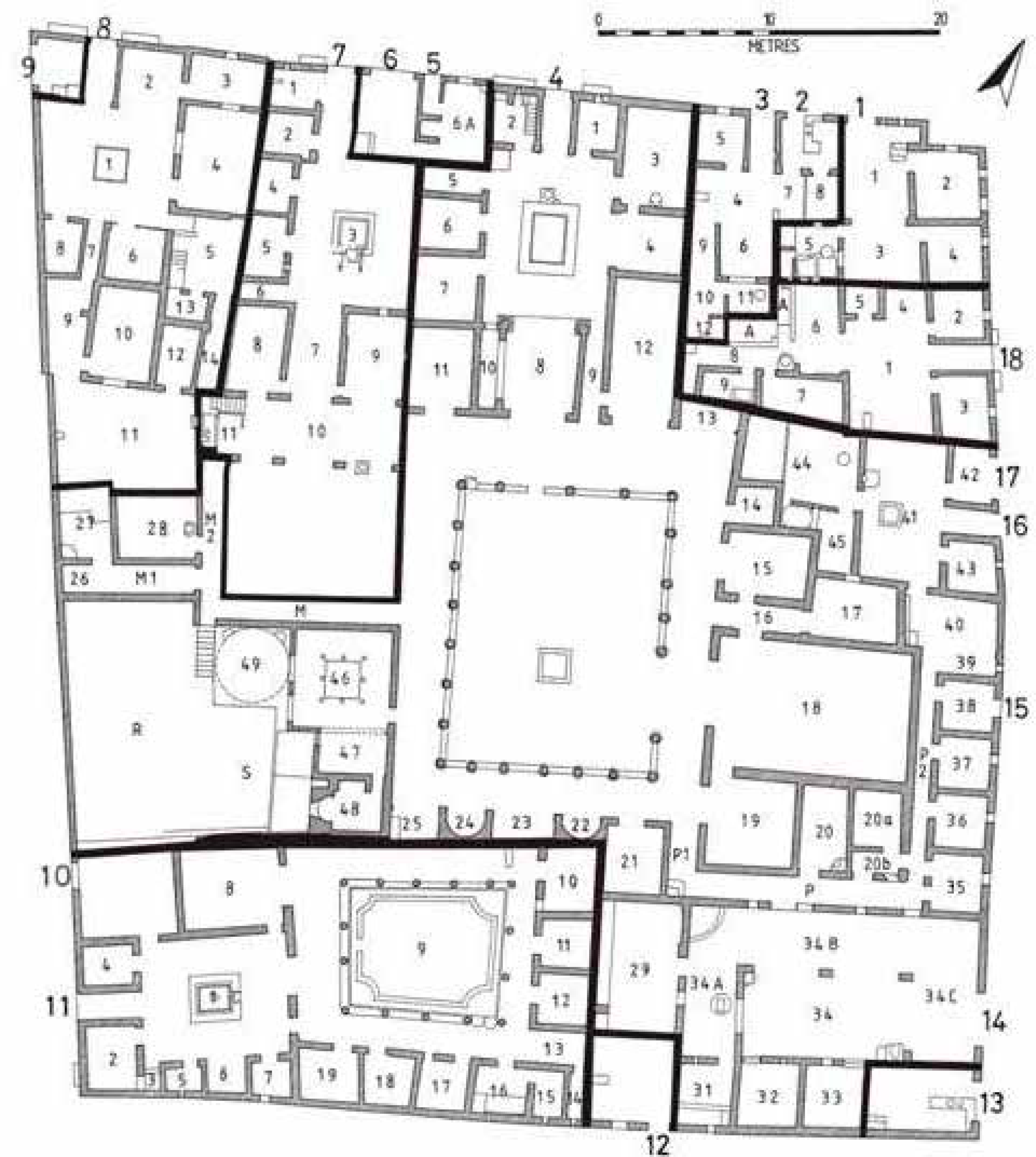
Plan of the Insula of the Menander at Pompeii taken from The Finds in Context: An On-Line Companion by P. Allison, The Insula of the Menander in Pompeii, volume iii. University of Leicester http://www.le.ac.uk/ar/menander/insulaplan.html. Original source from R. Ling, Menander volume i fig. 24, drawn by S. Gibson, J. S. Gregory, R. J. Ling, and D. Murdoch, cited by P. Oakes, Reading Romans in Pompeii, 12.
Craftworkers' houses are known from Corinth (Murphy-O'Connor 1992: 48; Keller:17–18). Thus, to Oakes' proposal we may add David Horrell's “disciplined imagination” about two-, possibly three-, storey Buildings 1 and 3 of East Theater Street in Corinth. These were buildings that contained shops and domestic quarters of “small traders and business folk,” those whose social status, he thinks, was not much different from that of the artisans. Horrell also suggests that assemblies could have taken place in one of the larger rooms, similar to the insula theory (361–68).
What might be the connection of these three residential models to the places where Paul stayed? If there is some connection, how do they affect an understanding of his social network? The villa “house church” model often adopted for Corinth is neat and has been used to support a stratification of elites versus non-elites (1 Cor 1:26). In this scenario, one imagines close ties within, but certainly not always between, polarized clusters, as the familiar baptismal, food, and Lord's Supper factions at Corinth, as well as possible food differences at Rome, indicate. The “tenement church” model shifts the focus to the poor and destitute, and recent studies, such as those by Justin Meggitt and Steven Friesen, have reenergized an older view that Paul's followers were mainly from the lower strata, indeed were probably very poor (Meggitt; cf. Friesen; Still 2006: 795). As perceived by Jewett, it is easy to imagine a great deal of social networking and bonding between family members and friends of similar, if not virtually the same, socioeconomic status. Recent studies of the oikos/domus, insulae, and the two or three storey buildings of East Theater Street in Corinth, suggest a somewhat “thicker description,” that is, multi-stratified environments and social rankings among non-elites themselves, as Oakes suggests. This implies, I think, homophilous clusters of strong ties at different levels. Yet, “housefuls” in the large houses as well as propinquity among various strata may lead to some possibilities of stronger relationships. Wallace-Hadrill (2003: 18) goes so far as to say of the insulae, “We should not overlook the possibility of a strong sense of community among such neighbors.” To what extent were there strong ties not only among those of the same socio-economic stratum, but occasional strong ties across strata?
With respect to SNA, our major interest, it is worth citing Mark Granovetter's Excursus. He states that persons with “strong ties” are found, not only in groups formed by geography, family, race, and ethnicity, but in the lower socio-economic strata, that is, those with less education, which he (rightly or wrongly) judges to have less “intellectual and cognitive flexibility,” “high context” modes of communication, and greater reliance on reciprocity, that is, support networks. As a result of their collective orientation and tendencies to social conformity, they form in his view close-knit communities of the Gemeinschaft (“community”) type (Granovetter 1982: 105). Recall that Ferdinand Tönnies characterized Gemeinschaft communities by close, personal, emotionally bonding relationships typified by family, kinship, ethnicity, and less education; by place relationships such as neighborhoods, villages, and towns; and by moral relationships based on kinship, friendship, and religion. Gesellschaft communities are the opposite; they are less personal and emotional, more utilitarian (Duling 1995: 180–82). Questions arise. Do not the tenement and craftworker house church models that focus on the lower strata allow for more personal, emotional relationships—strong ties—than the elite/non-elite model? I suggest that without denying the importance of weak ties, the strength of strong ties is powerful in Paul's Aegean recruitment network. SNA analyses help to nail down this view, particularly among those within the same or similar socio-economic strata.
A Heuristic SNA Refinement of Paul's Aegean Recruitment Network
Paul's headquarters for his Aegean network was at Ephesus where, it appears, he resided for long period of time, perhaps two to three years (ca. 52–55
Paul is well known for his use of fictive kinship language and his implied challenge to “the power of a father” (patria postestas) in the family (e.g., Bartchy). We must be cautions, however. Important links based on names (“prosopographic links”) are sometimes incomplete or missing (White 1992: 13) and Paul Trebilco shows that Paul's “insider language” sometimes has several meanings (Trebilco: 9–10). I would add that Paul's deliberative rhetoric can cloud meanings. An important example is adelphoi, “brothers,” which in different contexts can mean all Christ believers, specific individuals, or inclusive “brothers and sisters.” Nonetheless, a SNA case-by-variable matrix from the Letter to Philemon indicates the probability that fictive terms indicate social realities. See Figure 5, opposite.

A Case-by-Variable Matrix: Nouns of Relationship with Paul in Philemon
To these variables, real and fictive terms from the “Phoebe letter” in Romans 16 can be added. Real kinship terms are “relative” (syngenēs; Rom 16:7, 11), “mother” (16:13), and “brothers” (16:14). Fictive kinship terms are “family” (16:11) and siblings (16:14). Other terms of intimacy are also “fellow workers” (Rom 16:7, 8) and “fellow prisoners” (16:7), and “beloved” (16:9, 12), to which one should certainly add “risked their life for me” (16:4).
A “Case-by-Variable” Matrix of nouns of relationship in Philemon also shows the dominance of fictive kinship relations (see Figure 6, on the following page).
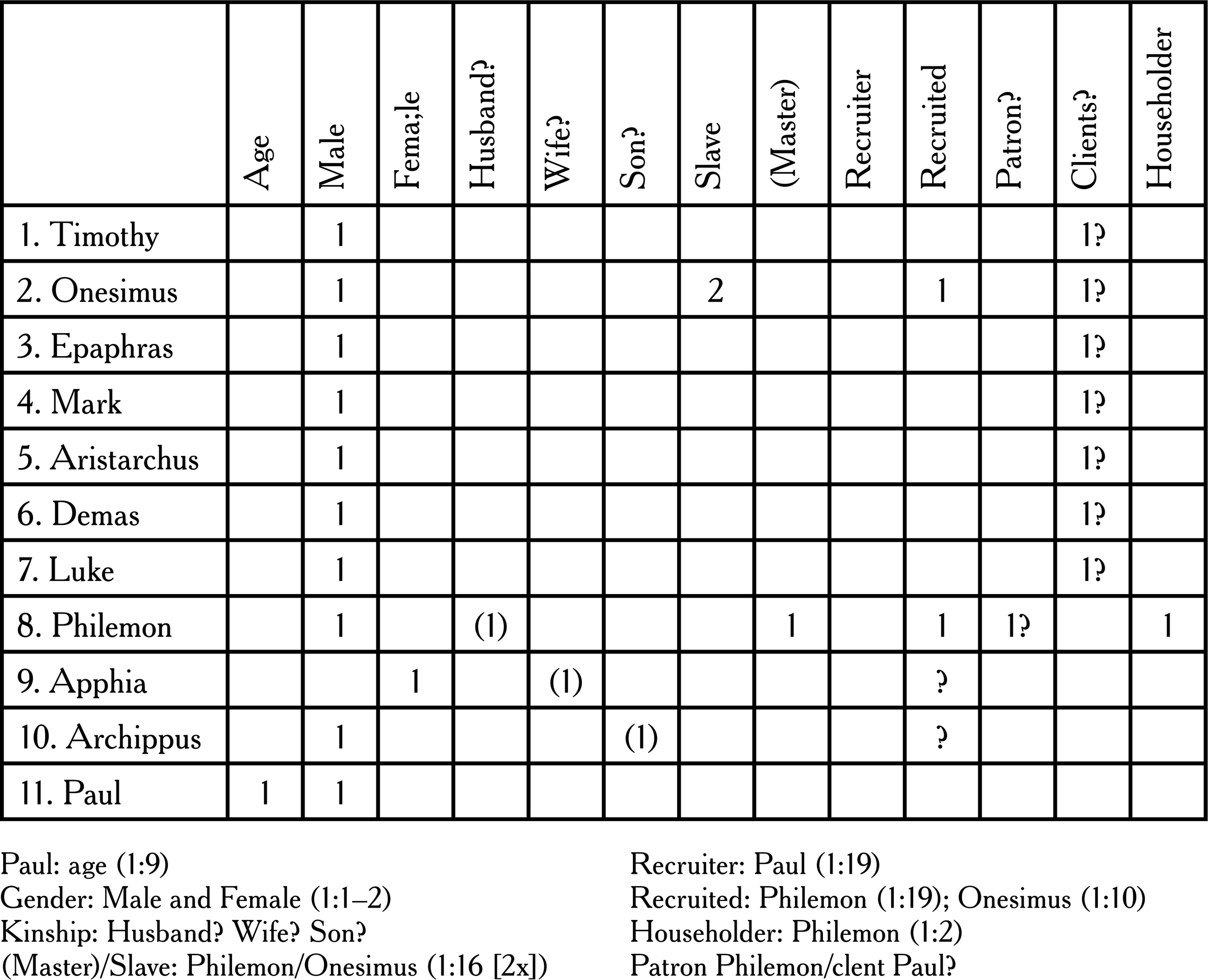
A Case-by-Variable Matrix: “Attributes” in Philemon
Attributes in this matrix offer some limited information. With respect to ascribed data (involuntary), ten of the eleven persons are males (gender) and Paul may have been “an old man” (age, cf. v 9). With respect to acquired data (“voluntary”), Philemon is a householder, for the church met in his (Greek sou) house with a guest room and he is probably a patron of the local church. He is a master of the slave Onesimus. Thus, Philemon is probably a person of some social rank. The roles of Apphia and Archippus are uncertain, but the usual suggestion is that they are Philemon's spouse and son. The most prominent person in this set is Timothy, a fictive “brother” who is elsewhere called “my beloved and faithful child in the Lord,” “our brother” (1Thess 3:2; 2 Cor 1:1; Col 1:1), a servant of Christ Jesus” (Phil 1:1), and “our/my co-worker” (1Thess 3:2; Rom 16:21). He is also a “co-author” of four of the seven undisputed letters—four out of five of explicitly co-authored letters (2 Cor; Phil; 1Thess; Phlm; 1 Cor is the exception; Gal and Romans are not explicitly co-authored)—and mentioned more than any other associate (12 times in the undisputed letters). He is a co-recruiter of the Philippians, Thessalonians, Corinthians with Paul and Silvanus (1 Cor 1:19). He is Paul's broker or agent (1 Thess 3:1–10; 1 Cor 4:17; 16:10–11; see Malina).
It is possible to gain further insight from what SNA calls “content,” that is, social exchange, or “what is passed on in networks.” It consists of any type of social capital, such as material or social support, values, affections, and so on. Figure 7, on the next page, is a sample chart of content in Philemon with directional arrows representing the flow from giver to receiver.

Content of Exchanges in Philemon: Giver → Receiver
Based on the analysis above, I suggest that the Philemon relations in Paul's Aegean recruitment network look like what is diagrammed in Figure 8, on page 149, However, Figure 8 is an overly simplified sociogram. If fully diagrammed the Ego-centered network of Paul would show much more complexity (density and multiplexity) between Paul and his close associates and friends, and, of course, we do not know precisely which of them also had connections with Philemon and the members of his household. Similarly, there would have been more complex relationships within the Philemon group. Finally, further work would attempt to develop the Aegean network represented in all the undisputed letters of Paul.
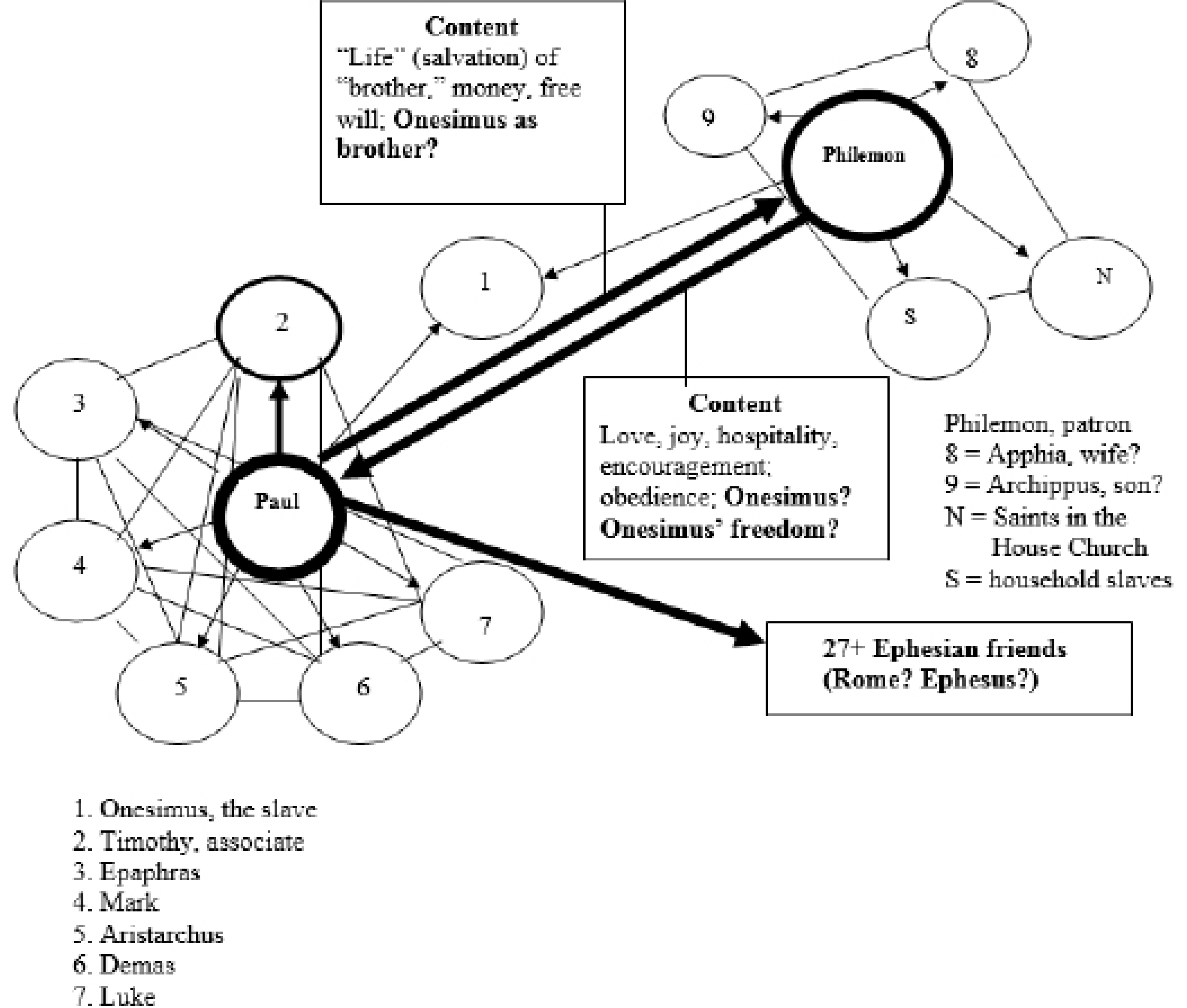
Paul's Aegean Network: A Partial Network
Conclusion
In this paper I have tried to build on, yet counterbalance, István Czachesz's innovative study suggesting that Paul is a weak-tie broker between his various communities. I have emphasized Paul's strong ties with members in his churches in certain port cities of his Aegean spatial network, and speculated about the potential for strong ties within those churches themselves. I have made the following points.
Paul may have had the role of a between-group weak tie broker at times, as István Czachesz suggested. However,
Gerd Theissen argued that Paul was not a Palestinian-style charismatic itinerant begger, but a community organizer who sometimes settled down for periods, usually supported himself with his trade, and seems to have accommodated himself to values associated with love-patriarchalism.
While weak ties in networks can facilitate the spread of new information or a social movement, they do not always do so; indeed, they can sometimes hinder the spread of behaviors that are costly, that is, risky or controversial, when there is little or no trust or reinforcement. “Complex contagions” for such behavior, especially in collectivities, however, require social reinforcement by strong ties of trusted and familiar family and friends.
New Religious Movement research demonstrates that strong ties of family and close friends are critical for recruitment to, and growth of, less risky movements.
Paul's letters plus Acts show that Paul had long stays in the cities of his Aegean network, particularly Ephesus and Corinth.
Paul stayed in oikoi, perhaps in guest rooms, in these cities. He seems to have had strong ties with some hosts, particularly Aquila and Prisca, but also Gaius, whose family he baptized.
Despite social stratification and clustering in the local communities, there are possibilities for strong ties in the complex urban spaces, such as domus, but especially apartment buildings and houses on insulae where believers lived and gathered.
Various factors surrounding Paul's headquarters at Ephesus are especially revealing. Matrices and a simple sociogram based on Philemon in this network (Figure 8, next page) are especially illustrative, for they illustrate language of intimate strong tie relations. If we add Romans 16, also associated with Ephesus, the probability of many strong ties and greater density emerges.