



Abstract
In the entire undisputed Pauline corpus, the term body is used with respect to resurrection in only two verses: 1 Corinthians 15:44 and Philippians 3:20–21. In neither case does it mean resuscitated flesh, as some theologians would have it. In Corinthians, Paul uses the rhetorical device of oxymoron in modifying the term body by “spiritual.” The oxymoron expresses the ineffability of Paul's experience of the Risen Christ, which for him is something beyond precise description.
In addressing the Corinthian questions about the nature of the resurrected body, “How are the dead raised? With what sort of body do they come?” (1 Cor 15:35), Paul initially answered “Fool!” (1 Cor 15:36) and finally said that if a physical body is sown, a spiritual body is raised. Other than Philippians 3:20–21 the only other Pauline use of the term body to speak of the resurrection is 1 Corinthians 15:44. In that verse we find the enigmatic term, “spiritual body” (sōma pneumatikon). The term is not seen in Greek literature prior to Paul. For that matter, “spiritual body” does not seem to have been used in any language by any author prior to Paul. He coined the term, which is part of the reason its definition has been so elusive. What did Paul mean by spiritual body? Scholars, theologians, and others have differed through the centuries, and no singular consensus has emerged. The very fact of the plethora of definitions offered, yet none gaining wide acceptability, attests that the term as Paul used it cannot be defined with precision. Scholars will continue to attempt to define the term as long they fail to recognize that Paul deliberately used the contradictory terms because he strove to express resurrection, a Semitic idea, in terms of sōma, a Greek term for which there is no Semitic equivalent.
In Semitic anthropology, the human being is understood as an indivisible whole, though with many aspects including thoughts, feelings, desires, moral weakness, receptivity to the action of God, etc. The Greek translators responsible for the Septuagint would have been familiar with the concept of an indivisible whole human being, but they also used certain Greek terms for which there is scarcely a Hebrew equivalent, e.g., sōma. Paul's writings reflect such Old Testament anthropological ideas as reflected through the Septuagint.
There are 74 instances of sōma in the undisputed Pauline corpus. Paul uses the term in a variety of ways to mean six different things:
body in the Greek sense, i.e., to express the physical, tangible, material part of the human being (e.g., Rom 7:4; 12:4; 1 Cor 5:3; 7:34a; 12:14–26; 2 Cor 12:2; and Gal 6:17);
corporate personality (e.g., Rom 12:5; 1 Cor 10:16–17; 12:27);
a physical union brought about by intercourse (e.g., 1 Cor 6:16);
synonymously with flesh, i.e., to express a human being's natural frailty (e.g., Rom 6:12; 8:13);
to refer to the self (e.g., 1 Cor 9:27; 13:3; Rom 6:12; 12:1; Phil 1:20); and even
to speak of the heavenly sphere and the objects within it (e.g., 1 Cor 15:40).
Paul uses pneuma anthropologically to express the self (e.g., 2 Cor 2:13), and that aspect of a human being that is able to be influenced by the power of God (e.g., Rom 1:9). He also uses pneuma theologically to express the creative, life-giving, energizing power of God at work in the individual and community. For Paul, that power came through the risen Christ. Both anthropologically and certainly theologically considered, pneuma is immaterial for Paul, i.e., it is not a physical or material thing.
This clarification about language becomes significant when discussing Paul's neologism, spiritual body. Paul, in fact, nowhere speaks of the risen Christ as tangible. So, the question naturally arises, what does he mean by the term spiritual body in 1 Corinthians 15:44? We will begin with a broad look at chapter 15, before narrowing our focus to 15:36–50, and then focusing further on 15:42–44. It is there (1 Cor 15:44) that we find the enigmatic term, spiritual body.
1 Corinthians 15
Paul opens this chapter by reminding the Corinthians of the gospel he preached, which they believed (15:1, 11), namely, that Christ died, was buried, rose, and was seen. Thus, the resurrection of the dead becomes the theme of this chapter (it is repeated thirteen times vv 12[bis], 13, 15[bis], 16, 20, 21, 29, 32, 35, 42, 52). Paul focuses on the resurrection itself in vv 12–58. In a classic article on the topic, Jeremias (155) points out that 15:12 asserts the “that” of the resurrection, for it addresses some who claim that there is no resurrection of the dead, whereas 15:35 begins to discuss the “how” of the resurrection. Many have noted that Paul's arguments addressing the “that” of the resurrection merely beg the question, or in Luther's words, probatur negatum per negatum (7.288). Paul's arguments are indeed ad hominem and would scarcely convince anyone who did not already believe in the resurrection of Jesus. The only proof of the resurrection that Paul can offer is that Jesus was seen by Paul himself (15:8). Beyond his eyewitness account, as well as the reports about eyewitness accounts of others, vv 12–34 indicate that Paul can offer no other convincing argument. Paul then proceeds to demonstrate the manner (15:35–58) of the resurrection by analogy rather than ad hominem arguments.
In the Greek world, resurrection was generally denied: “but when the dust has drawn up the blood of a man, once he is dead, there is no resurrection” (Aeschylus, Eumenides. 647–48; cf. Homer, Iliad. 24.551; Herodotus, Histories, 3.62.4; Aeschylus, Agamemnon, 1360; Sophocles, Electra, 137). At times, however, the return of a soul was thought of as an isolated miracle. For example, Plato recounts the story of Alcestis, who gave up her life for her husband: “so that among all the many who do many noble deeds they are few in number indeed to whom the gods have given the privilege of raising the soul up again from Hades, but they raised up hers in admiration of her deed” (Plato, Symposium. 179c).
Paul's Corinthian interrogators do seem to have understood “resurrection of the dead” implicitly as resurrection of the fleshy body. To those who denied a resurrection of the dead, Paul responds by claiming that there was a resurrection of the dead, for Christ himself had been raised. Earlier in the chapter Paul asserted that Christ raised from the dead was the firstfruits of those who had fallen asleep (1 Cor 15:20). Since Christ is the pattern of the resurrection of the dead, so to speak, Paul refers to the resurrection of Christ and draws implications from that. Paul also answers by resorting to analogy.
While 1 Corinthians 15:12–34 addresses the “that” of the resurrection of the dead, 1 Corinthians 15:35–58 addresses “how are the dead raised?” The initial answer is a dismissive aphrōn, “fool!” For Paul, the questions the Corinthians raise about resurrection reveal that they do not understand the resurrection. In fact, the situation is worse than misunderstanding. They are fools. “In diatribal fashion the proposition of the opposition is immediately dismissed as foolish before proof is mustered to refute it” (Watson: 245).
Paul then answers chiastically the two questions posed in v 35. That is, vv 36–50 answer the second question “With what kind of body do they come?” and vv 51–58 answer the question “How are the dead raised?” Thus, his respective answers can be summed up as “Fool! A spiritual body!” and “In an instant.”
1 Corinthians 15:36–50
Paul states, “What you sow is not brought to life unless it dies.” An important consideration in this sentence is the ancient understanding of biological processes. Moderns understand that in fact a seed does not die but undergoes organic change. This was not Paul's understanding. For him the truth lies in the conditional statement, “What you sow does not come to life unless it dies.” This agricultural maxim seems to reflect conventional wisdom of the day (cf. John 12:24, and Riesenfeld: 1970). In effect then, his immediate answer to the question “With what sort of body do they come?” is, “Fool, the body dies!” Understood in his answer, implicitly in v 36 but brought out more fully later, is that the seed having died is transformed and brings forth new life. Thus, this earthly body, which may be figuratively likened to a “bare grain,” is sown.
He then develops his analogy and shifts it subtly (vv 37–41) before he says, “So it is with the resurrection of the dead.” These analogies are intended to prepare the reader for the idea that just as in nature there is transformation and diversity, including differences in flesh, body, and brightness that God has designed, how can human beings limit (or even comprehend) what God has willed for raising the dead? With the stage set, Paul draws his conclusion.
Paul returns to the image of sowing and juxtaposes four characteristics of the natural body with four characteristics of the resurrected body, using the rhetorical device of antithesis (vv 42–44), of which Aristotle says, “Antithesis is more instructive and conciseness gives knowledge more rapidly” (Aristotle, Rhetoric. 1412b). The juxtaposition of the characteristics of the natural versus the resurrected body summarizes the answer to the second question posed in v 35. In vv 45–49, Paul reinforces his teaching with citations from Scripture. He introduces the idea of the last Adam, who became a life-giving spirit, with whom he compares the first Adam, who became a living being. Paul describes characteristics of each Adam, and applies those characteristics to living human beings.
His answer concludes in v 50: living human beings (flesh and blood) will not inherit the kingdom of God, just as corruption does not inherit incorruptibility. He said that essentially in v 37, “You do not sow the body that is to be.” There must be a transformation, as there is with the seed that becomes a body. Though Paul says that all will not die, he maintains that all will be changed “in a moment.” He struggles to give apt apocalyptic images, “in the blink of an eye, at the last trumpet.” Such images reveal that Paul held no great secret about the resurrection other than that human beings would be resurrected, in an instant. As the dead would be raised, so too would living human beings in Christ be transformed (15:51). Paul invokes his encounter with the Risen Lord. Words fail to provide a real description of that event. Paul cannot say precisely what the transformation will bring. His answer may not delight those who seek a description of the properties of the resurrected body, but he simply is not able to say much more than he does. To make that point he juxtaposes terms. The dead shall be raised with a transformed, spiritual body. The oxymoronic language veils a truth Paul himself could not descriptively express.
1 Corinthians 15:42–44
As we narrow the scope to vv 42–44, Paul's thought and his use of antithesis come into sharper focus. He begins by saying, “so it is with the resurrection of the dead.” With this application of the analogy (there is transformation and diversity in nature), Paul has answered the question, “With what sort of body do they come?” “Resurrection means transformation” (Barrett: 372). As a bare grain dies and thereby lives with a resplendent body, so is the resurrection of the dead. Those who have died have sown a body. But God will raise them up, not with the old body, the bare kernel, for there will be a transformation, into what we cannot precisely say. As there are varieties throughout nature, who can describe what variety the resurrection will take. Paul then gives four couplets by which to understand the resurrection.
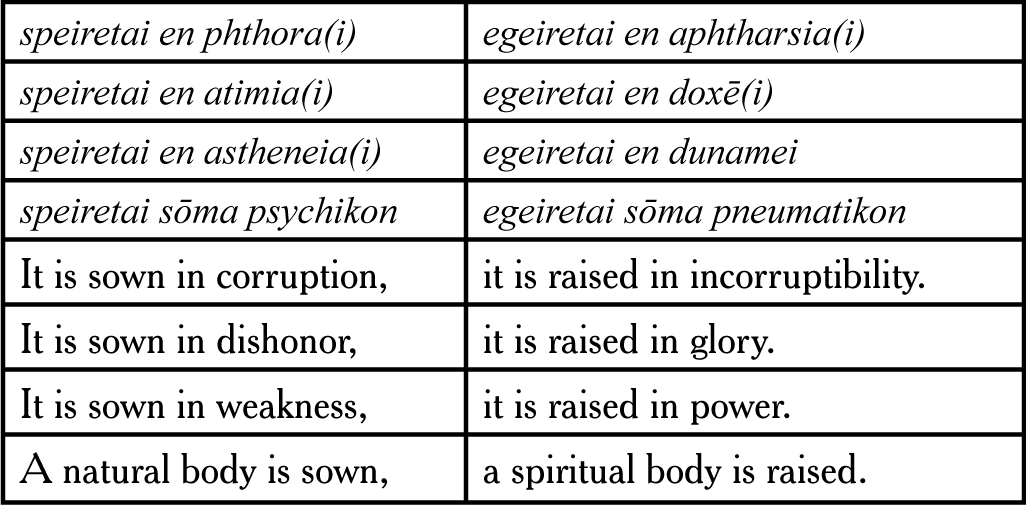
The key to these couplets lies in the last one. Though Barrett recognizes that the subject of the passive verbs is ambiguous, he understands the verbs as impersonal passives, translating them as “the sowing takes place in … the raising up is in …” (372). While this is plausible, a different translation seems more likely, for it gives an insight into the couplets themselves. By juxtaposing the spiritual body with the natural body, Paul is able to predicate antonymous characteristics of one to the other. The body is the subject of each verb.
As Collins (567) rightly notes, Paul is using the rhetorical tool of antithesis. Aristotle defines the antithetic as
that in which for each of a pair of clauses either one opposite is juxtaposed to another, or the same word is linked to both opposites…. This form of style is pleasant, because opposites are very clear and all the more so when juxtaposed, and because it resembles the syllogism; for the refutational syllogism is conclusion from contraries. Antithesis (antithesis), then, is of this nature. Equality of clauses is parisosis; the similarity of the final syllables of each clause paromoiosis. This must take place at the beginning or end of the clauses. At the beginning, the similarity is shown by the entire word; at the end, in the last syllables, or the inflexions of one and the same word, or the repetition of the same word [Aristotle, Rhetoric, 3.9.7,9].
Aristotle then gives examples. Paul seems to reflect some of this rhetorical theory when he repeats the syllables, eiretai en in the first three couplets. In the last couplet the syllables, eiretai en become eiretai sōma. Such an effect catches the readers' attention and prepares them for what follows.
Thus, the natural body is sown in corruption; the spiritual body is raised in incorruptibility. By synonymous parallelism Paul makes explicit the transformation that must take place. Paul is speaking of the state of being corruptible or perishable, which all creation shares. Romans 8:21 gives another example that bears on the meaning of the word: “that even creation itself will be freed from its slavery to corruptibility and share in the glorious freedom of the children of God.” Here again, the term “corruptibility” expresses the decay or corruption that all creation shares (Fitzmyer 1993: 509). The distinction in Romans lends insight into Paul's distinction in 1 Corinthians 15:42a. In some respects, to be freed from the condition of corruptibility (Rom 8:21) is incorruptibility (1 Cor 15:42). Likewise, incorruptibility (1 Cor 15:42) is in some respects a share in the glorious freedom of the children of God (Rom 8:21).
The juxtaposition of dishonor with glory gives another insight into Paul's thinking. If he were basing this teaching on the natural body, to which he had ascribed dishonor, one would expect honor to be ascribed to the raised body. As it stands, the object of true importance for Paul is the spiritual body, raised not merely in honor, but in glory. The term glory has no direct negative; but Paul will contrast it with dishonor again in a later letter (2 Cor 6:8a).
The alpha-privative term atimia expresses dishonor, shame, or disgrace. That seems to be the way Paul normally uses it. It expresses a concept similar to that of tapeinōsis “lowliness.” In fact, Paul uses the term glory again in speaking of the resurrection. In Philippians 3:21 Paul says that is the Savior, the Lord Jesus Christ, “who will transform the body of our lowliness (to sōma tēs tapeinōseōs hēmōn) so that it will share the likeness of the body of his glory, according to the power that enables him to bring everything under his control.” In the Philippians verse the juxtaposition is not only between our body and the Lord's body, but our body of lowliness and the Lord's body of glory.
In the Old Testament, kabôd means “glory” and is regularly translated in Septuagint as doxa. It denotes riches or abundance (Gen 31:1), honor both of human beings (Gen 45:13) and of things (Exod 28:2). The meaning is extended to the manifestation of Yahweh's presence (Exod 16:7). Yahweh's glory was abiding in the temple (Ps 26:8) and made holy the sacred tent (Exod 29:43). The entire earth is filled with the glory of Yahweh (Isa 6:3).
For Paul, the glory of God is communicated to human beings as they approach God (Rom 3:23; 5:2; 8:18, 21; 9:23; 1 Thess 2:12; 1 Cor 2:7; 4:6; Phil 3:21—Fitzmyer 1993: 347). The glory of God awaits the Christian, who already has some share in it (2 Cor 3:18). It expresses Paul's eschatological belief that Christians will share in the magnificent presence of God. Thus, when Paul says that the spiritual body will be raised in glory, he means that it will share in the magnificent presence of God (cf. 1 Thess 4:17).
In the third couplet Paul contrasts weakness and power, which are two prominent terms in Paul's letters. In 2 Corinthians 12:9a Paul quotes the risen Lord saying to him, “My grace is enough for you, for power achieves perfection in weakness.” Paul himself immediately adds (2 Cor 12:9b–10), “so I shall boast all the more in my weaknesses, so that the power of Christ may dwell in me; therefore I am content with weakness, insults, hardships, persecutions, and constraints for the sake of Christ; for when I am weak, then I am strong.”
In the Old Testament, “power of God” means the ability of God to act and shape human history. Power is a concept important for Paul throughout his letters. He uses the phrase power of God (Rom 1:16,20; 1 Cor 1:18,24; 2 Cor 6:7); power of Jesus (1 Cor 5:4); power of Christ (2 Cor 12:9); for Jesus Christ himself is the power of God (1 Cor 1:24); he has been “established as the Son of God with power” (Rom 1:4); through him God unleashes his power (1 Cor 2:5; 6:14; 2 Cor 13:4; Phil 3:10). Paul also mentions the power of the Spirit (Rom 15:13,19). Though Paul does not use power only to speak of the divine, this is its primary meaning for him. Thus, when he claims that the spiritual body is raised “in power,” he is at least implying that it is a work of God, and also that it will no longer be weak like the present body.
At the conclusion of his rhetorical antinomies, Paul drops the impersonal form of the expression (Conzelmann: 283) and supplies the nouns he had in mind the whole time: “a natural body is sown, a spiritual body is raised.” With the nouns clear, Paul's meaning should be clear: In perishability, dishonor, and weakness is sown a natural body; in imperishability, glory, and power a spiritual body is raised. For Paul the natural body denotes humanity as it exists in the everyday world, and it is compared to the bare kernel that is sown. What is raised is a spiritual body. Such a term has no precedent in classical Greek literature.
Paul meant to use the oxymoron (pace Thiselton 2009: 143). As Fitzmyer rightly notes (2008: 594) oxymoron is “the only explanation of the term that is really admissible.” Lausberg recognizes oxymoron as a rhetorical device and defines it as “the closely tightened syntactic linking of contradictory terms into a unity which, as a result, acquires a strong contradictive tension” (Lausberg: 358, §807). That is certainly the case with the terms sōma and pneuma. At the height of the antithetical notions of sown and raised, Paul wraps another antithesis into his answer, “spiritual body.” The language of “body” is meant to convey the concept of individuality, yet it also conveys the idea of physicality/matter. It has been shown that body meant something physical, tangible for Paul, even though at times it was used to express corporate or personal identity. As Greeks, the Corinthians would have had a material notion of sōma and an immaterial understanding of pneuma. Indeed, because they had such a physical understanding of sōma, the concept of resurrection was so difficult (1 Cor 15:35). The question was not simply “How will the dead come?” but more precisely “With what sort of body will they come?” Paul is answering the question likely conveyed to him by Stephanas, Fortunatus, and Achaicus (1 Cor 16:7). The Corinthians were clearly troubled by the concept of a somatic resurrection.
The language of “spirit” is meant to convey the concept of God's creative, life-giving presence; yet it also conveys the idea of immateriality/breath/wind. Paul believed “spiritual” to be that which pertains either to the Spirit of God or to humanity. In this case “spiritual” is derived from Spirit pertaining to God, and not in the anthropological sense. Therefore, it is by definition immaterial. One might argue that Paul applied “spiritual” to material things elsewhere: spiritual drink, rock, food. The spiritual rock was Christ (1 Cor 10:4). The spiritual body is not equivalent to Christ, though Paul may have admitted that the risen Christ had a spiritual body. Spiritual drink and spiritual food denote that the elements conveyed the Spirit of God. A spiritual person (1 Cor 2:14) was one led by the Spirit of God. However, when spiritual is applied to body it seems to be nonsensical, and the paradox comes closest to conveying the mystery of the resurrection and the resurrected body. What can be said about one term, the other term contradicts. The material sense of the body is contradicted by the immaterial sense of the spirit. The human or animal individuality expressed by body is opposed by the divine otherness expressed by Spirit.
Yet the Corinthians conceivably would have understood what Paul meant by a “natural body” (sōma psychikon). They were unprepared for the concept of “spiritual body.” It is interesting to note what Paul does not say in speaking of resurrection. He does not quote Job, “In my flesh I shall see God” (Job 19:26). He retains the interrogators' word sōma. It is as though he were compelled to fit resurrection into somatic categories. When drawn into this quandary, he offers an oxymoron, “spiritual body.” He will offer something similar in his letter to the Philippians when he resorts to a “body of glory” (Phil 3:21). For Paul, the resurrection of Christ is beyond somatic categories. Paul's language is that the risen Christ appeared. “God was pleased to reveal his son in me” (Gal 1:16), Christ has been exalted (Philippians 1). When compelled to define this status in somatic categories, he speaks of a “spiritual body.”
A body that pertains to the spirit was a contradiction. According to Wedderburn (239), the Corinthians understood the body as something inferior and transitory. For them body had only one sense. They were wholly unprepared for what Paul taught them regarding body in this chapter. Resurrection meant only one thing for them, “a restoration of this body which they already knew.” Clearly, not every Corinthian believed even this. Paul says, however, that the body will be raised in the image of the resurrected Christ, inasmuch as he is the firstfruits of the resurrection (1 Cor 15:20, 23). Resurrection is not mere resuscitation, but transformation.
Dunn comes closer to the mark when he says:
The embodiment of the resurrection body will be quite different, an embodiment appropriate to the world of Spirit, beyond death. Quite what Paul envisaged we can hardly begin to say. Quite possibly he was using these distinctions heuristically, to indicate the fact (the “that”) of the distinction rather than its “what” [61].
I would add that what Paul envisaged, he could hardly begin to say. He struggled to put apt words and phrases to his experience of the risen Christ and, by extension, to the resurrection of all believers. Thus, he uses the oxymoron “spiritual body.” It is as though the Corinthians asked Paul what kind of squares there would be in the kingdom of God and he answered, “Fool! Circular squares.”
Paul does not mean a resurrected body of flesh, (pace Grosheide: 384–85; Schep: 184; Gundry: 165–66) or a body endowed with four dotes, as the Roman Catechism from the Council of Trent puts it (Catechism: §§101–03) using later systematic theological terms. He does not mean a spiritual substance whose form is the sōma, because he does not speak in Aristotelian categories (pace Holsten; Lüdemann). Paul does not mean a renewed personality (pace Bultmann; Dahl). Paul does not mean that the spiritual body is animated (pace Barrett: 372–73; Wright: 354), adapted (pace Murphy-O'Connor: 813), or commanded (pace Clavier: 361) by the Spirit of God, controlled (pace Schweizer: 6.421; Conzelmann: 283) or determined (pace Ridderbos: 544) by the pneuma, or a form of embodiment perfectly adapted to a heavenly environment (pace Harris: 153), or the realm of the Spirit (pace Thiselton 2000: 1279). He does not use spiritual body to refer to a human being energized by the Spirit of God, (pace Collins: 567) or to all Christian believers (pace Robinson). The ambiguity Paul offers in his response is deliberate. A spiritual body defies definition because the terms are incompatible. What Paul meant to convey by using the term is that resurrection itself as a category applied to the glorified Christ is incomprehensible in human language. Indeed, resurrection is itself only one category, or phrase, by which the exaltation and ascension of the glorified Christ may be understood.
With the statement, “if there is a natural body, there is also a spiritual body,” Paul has answered the second question in v 35, “With what sort of body shall they come?” He proceeds to buttress his answer with arguments from Scripture. He does not delve into eloquent definitions on the nature of this resurrected body; he merely states that as a seed, once it dies, produces a living plant, so this body shall be as a seed for the spiritual body. As God gives to each seed a body as he wills, God will also give to human beings a transformed, resurrected body. By Paul's analogy of the seed, one may suppose with E. P. Sanders (29), that there is some connection between the earthly and resurrected person. Paul now confirms his argument by quoting Genesis 2:7b.
Paul uses this passage to show that it is by the power of the last Adam that the transformation will take place. He continues the contrasts of vv 42–44 by contrasting the first man Adam and the last Adam. The application seems to be the same as that of vv 21–22 in this same chapter. Death came through one human being (Adam), so the resurrection comes through one human being (the last Adam). Proof of this is Christ's own resurrection, the firstfruits of the general resurrection. In v 45 he maintains that as Adam became a living being, with a natural body subject to corruption, dishonor, and weakness, so Christ, the last Adam, became a life-giving Spirit with a spiritual body possessing incorruptibility, power, and glory. This verse is another example of Paul's use of psychē to express the totality of the person. Although Dunn (76) cites this verse as an example of psychē to express the totality of the person, he later translates, “the first man Adam became a living soul” (Dunn: 241, 260). The first Adam became not merely a living soul, but a living being.
Paul spells out clearly humanity's relationship to the cosmological Adams. Paul has only to say once again in other terms what he has been saying throughout the argument: “Just as we have borne the image of the earthly man, we shall also bear the image of the heavenly man.” Paul thus continues the distinction he has been making since v 42. However, the language of, “image of the heavenly man” too seems paradoxical. For what is the “image of the heavenly man?” The heavenly man is the risen Christ, the last Adam. Sections in Paul's other letters gives clues, e.g., 2 Corinthians 3:18; Philippians 3:21; Romans 8:29. Thus, “the image of the heavenly man” is again language by which Paul struggles to convey the truth that the future “body” is beyond our capacity to grasp. The image of the earthly man can be said to be equivalent to the “natural body,” with which we are familiar, while the image of the heavenly man is equivalent to the “spiritual body.”
Paul then states clearly that flesh and blood, the natural body, does not and cannot inherit the kingdom of God. “I am saying this, brothers: flesh and blood cannot inherit the kingdom of God, nor does corruption inherit incorruptibility” (1 Cor 15:50). This is a via negativa restatement of his answer in vv 42–44. The natural body cannot inherit a spiritual body unless it dies, and even then, only by the power of Christ or God. In other words, living human beings, as they are now, cannot inherit the kingdom of God. Paul does not often refer to the kingdom of God, a phrase common to all of the Synoptics. In this instance, it seems that Paul is using inherited traditional teaching, or a formula used by Christians before him, for kingdom of God is anarthous, as are the instances in Galatians 5:21 and 1 Corinthians 6:9, 10, which are clearly pre-Pauline. For Paul, just as human beings as they are now cannot inherit the kingdom of God, mortality cannot of its own accord inherit immortality. Paul has used a literary inclusion to incorporate the idea expressed in v 42b. How does the mortal body attain immortality? How do human beings inherit the kingdom of God? By the resurrected, life-giving Spirit, the heavenly man, the last Adam.
Conclusion
As is the case with many of his letters, the question frames the answer. Paul was not writing a comprehensive treatise of the nature of the resurrection and the resurrected body. Rather, he was responding to specific issues in Corinth at the time. Paul answered the questions from his own background that included the Scriptures reflected through the Septuagint as well as his experience of the risen Christ. Or as Wright (348) notes, “his [Paul's] picture of the Christian resurrection body is modelled closely on what he thinks was and is true of Jesus.” Resurrection was a term he had in his vocabulary to interpret his encounter with the risen Christ. Asked to express the resurrection of the dead in terms of sōma, Paul puts forth an oxymoron, sōma pneumatikon, for the experience of the risen Christ was beyond somatic categories. Body used in the sense of “spiritual body” is meant to convey the idea of personal continuity, rather than flesh. Indeed, flesh and blood will not inherit the kingdom of God. This “spiritual body” is completely unlike the natural body in as much as the seed is unlike the plant, or the acorn the oak. The natural body is formed in the image of the man of dust; the spiritual body will be formed in the image of the one from heaven, the risen Christ. Thus by the oxymoron, spiritual body, Paul comes closest to speaking of the mystery of the resurrection, grounded in his experience of the Risen Christ.
Our thesis is that Paul usually expressed his new faith in Jewish terms, and, when these proved inadequate, he turned to Greek terms. The language used is that which happens to convey most clearly the new idea [Stacey: 199–200].
Paul affirms that the resurrection means a transformation of the body, and denies that it is a walking corpse and/or a disembodied spirit (Sanders: 30).
Though vv 51–58 are not the primary focus of this section, certain concepts conveyed in these verses support the view that Paul speaks openly to discuss an idea about which he has inadequate tools for expression. For example, in v 51 he states that though not all will die, all of us (living and dead) will be changed. This echoes the point he made with the analogy of the bare grain, which dies and thus grows into a mature plant. Now the mystery of which Paul speaks is that not all will die. Death is not a precondition for the “resurrection event,” though the concept of resurrection presupposes death. This is more evidence that resurrection is an apt category to convey the truth of which Paul speaks, but the term resurrection does not encompass the entirety of the “resurrection event.” For even those still living will participate in a transformation. This transformation will take place “in an instant, in the blink of an eye.” Then in language similar to that in 1 Thessalonians 4:16, Paul uses the imagery of the trumpet blast, calling to mind the Old Testament “trumpet of God” often associated with theophanies (Exod 19:13, 16, 19; 20:18) and the end time (Zeph 1:14–16; Isa 27:13). In v 53 Paul speaks of the change that is a precondition for the “resurrection event,” i.e., “for this perishable body must put on imperishability, and this mortal body must put on immortality.” When this happens, then the Scripture will be fulfilled, for we will no longer be subject to death. The Scripture Paul cites in vv 54b–55 is a combination of Isaiah 25:8 and Hosea 13:14. Paul then concludes with a thanksgiving (v 57) followed by a brief exhortation (v 58).
Thus, in writing 1 Corinthians, Paul responds to the Corinthian question, “With what sort of body the dead shall come,” by giving them examples of transformation from nature. Just as a seed dies and a living plant emerges, so do human beings die, but a spiritual body will be raised. Just as God gives to each seed its own body, God will also give to human beings transformed bodies related to their earthly bodies. Rhetorical analysis also shows that Paul meant to use the oxymoron. At the height of the antithetical notions of sown and raised, Paul wraps another antithesis into his answer, “spiritual body.” The language of “body” is meant to convey the concept of individuality, yet it also conveys the idea of physicality or matter. “Spirit” conveys the concept of divine otherness as well as immateriality. The oxymoron comes closest to expressing the mystery Paul wants to communicate. Paul's teaching sets boundaries, horizons for the possibility of understanding the resurrection. Paul is the first author to use the term sōma pneumatikon in an extant writing, and he used it to answer this question from the Corinthians. He is clear that “flesh and blood (this body as it is now) will not inherit the kingdom of God” (1 Cor 15:50).
Shortly after the time of Paul, theologians attempted to define the spiritual body as a resurrected body of flesh. Modern scholars continue to seek to define the term spiritual body or to discuss characteristics of the resurrected body. Yet, it is important to recognize that Paul deliberately used contradictory terms, the rhetorical tool of oxymoron, because he strove to express resurrection, a Semitic idea, in terms of sōma, a Greek term for which there is scarcely a Semitic equivalent (pace Roetzel: 137).
Paul is limited by human language in discussing the resurrection. Rather than give descriptions of resurrection or the resurrected body, he often uses metaphors, abstract concepts, and even oxymoron. Indeed, “spiritual body” is merely one way Paul spoke of resurrection, and resurrection is only one category by which Paul speaks of the exalted Christ. Every “definition” of a spiritual body may do more to limit what Paul had in mind than to encapsulate it. Ultimately, the resurrection, exaltation, and glorification of Christ have to do with mystery.
The term spiritual body should not be used to develop theories on the nature or qualities of embodied existence in the afterlife. The underlying reality is that Paul did not have the language, or even adequate metaphors available to him to convey his experience of the risen Christ in a descriptive way. Thus, he used oxymoron. “Eye has not seen, and ear has not heard, nor has it even entered the heart of a man, what God has prepared for those who love him” (1 Cor 2:9).