




Abstract
Leviticus 18:5b (the one doing them shall live in them) offers a prism through which to view the idiom of Scripture—the distinctive dynamics and theology of the Bible. The verse pinpoints the interplay between God's doing-and-living and ours. At issue is whether the commandments reflect a “command-and-do” structure of life with God, which maximizes a quid pro quo dynamic between God and us; or do the commandments delineate a “covenant place where” we abide with God and God with us, as a gift of shared doing pure and simple? The article traces Leviticus 18:5b through both Old and New Testaments, to show how pervasive it is. The main post-World War II English translations misstate the verse at every turn, in contrast to the 16th-century Church Reformation, which understood the verse and the issue under the topic of Law and Gospel.
Keywords
More than 40 years ago the distinguished Old Testament professor and churchman, Eugene March, was overheard to say: “Churches that do not require their ministers to read the Bible in its original languages lose contact with the idiom of Scripture within a generation.” Idiom here refers to the language, thoughts, sensibilities, ethos, and dynamics peculiar to the people of the Bible, things which comprise the air they breathe or the water they swim in, especially as to their awareness of God. In fact, many American ministers do not consult the Greek or Hebrew, having fallen back into reading the Bible only in translation. Any problems in the translations will call into question whether the modern American Church still grasps the idiom of Scripture and with it the Gospel. The question is amplified if, as by all accounts, we are living through a time of major change, moving from one epoch, Modernism-Pietism (1650–1950), to another, as yet unnamed (1950–).
I am not the only one raising questions about Bible translations. According to Jewish linguist and Biblical scholar Robert Alter, “There is … something seriously wrong with all the familiar English translations, traditional and recent, of the Hebrew Bible.” (Alter 2004: 16). The problem is partly in presenting translations that do not reflect the natural idiom of the original language. “Biblical Hebrew,” he says,
has a distinctive music, a lovely precision of lexical choice, a meaningful concreteness, and a suppleness of expressive syntax that by and large have been given short shrift by translators with their eyes on other goals [Alter: xlv].
The bigger problem, however, “the unacknowledged heresy,” he calls it,
is the use of translation as a vehicle for explaining the Bible instead of representing it in another language, and in the most egregious instances this amounts to explaining away the Bible [Alter: xix].
A host of freshly minted English translations of the Bible have poured forth since 1950 (Table 1). Most of them seek a “dynamic equivalence” of the Greek and Hebrew text, a correspondence in thought but not necessarily word-for-word. The outcomes fall somewhere between a deliberate paraphrase and a more literal or “close equivalence” translation. As impressive as they are, reflecting the advances of modern biblical scholarship, these modern translations do not always capture the thought-world of the Bible.
The Main English Bible Translations since World War II
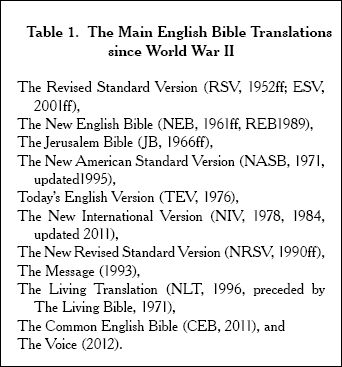
The Main English Bible Translations since World War II
The matter of biblical idiom cuts two ways. Besides the idiom of Scripture, we face the idiom of our own fast-paced, rapidly changing, advanced technological world. We expect things to be relevant to our lives, and we have little patience with artifacts and languages from the past. The danger is that we will dismiss the Bible as out of touch with us in whole or in part, or alter the idiom of the Bible to match our own. If the Bible speaks to us only when it mirrors what we already think, what can it say to us that we cannot say to ourselves?
Over the last 200 years, biblical scholars have developed careful techniques and enormous resources to uncover the historical-cultural context for each text. As interpreters of the Bible, we sincerely want and strive mightily to breathe the air and swim in the water of the Bible. We exercise this methodology, however, from within our own idiom, and so cannot expect to hit the mark automatically. Even a well-resourced, impartial technique will not by itself produce the biblical idiom. So, what is the biblical idiom, distinct from our own?
My aim in this essay is to show how Leviticus 18:5 may open the idiom of Scripture in fresh ways for us. Why Leviticus 18:5? The verse first came to my attention from seeing it quoted repeatedly by Paul. Then it showed up—usually unflagged—in other New Testament authors and passages, both positively and negatively. Finally, I realized how much this verse resonated with Martin Luther and John Calvin in the 16th-century Church Reformation, when they were dealing with the watershed issues of Law and Gospel, faith and works. Over the course of time, I have studied the verse on its own and followed it into the dynamics of the biblical covenant, both Old and New Testaments, with the results you see in this article. Perhaps this verse holds a key to the elusive idiom of Scripture, or at least to something of value we have overlooked.
Specifically, Leviticus 18:5 pinpoints the interaction between God and humanity within the Biblical covenant. This article looks first at the covenant framework into which the verse fits and how Hebrew grammar shapes the theological issue at stake. The second section deals with the verse directly, while sections three and four cover how the verse shows up in the OT and NT.
The Covenant Framework and the Issue of Leviticus 18:5
The Covenant Framework of the Bible
Central to the idiom of the whole Bible, the overarching covenant framework emerges when God says, speaking to Moses while freeing the Hebrews from slavery in Egypt: I will take you for my people, and I will be your God (Exod 6:7, RSV). This covenant language runs through the biblical history of Israel, including Abraham, Isaac, and Jacob (Exod 6:2–3), the exodus from Egypt (6:1ff, 6ff), and the promises of a people and a land (6:4, 8). The same language shows up in the covenant with David and his successors (2 Sam 7:14); and in the prophets, like Isaiah (41:8–10), Jeremiah (7:23, 11:5, 30:22, 31:33), Ezekiel (36:28, 37:23–28), and Zechariah (13:9). All this culminates in the NT language about Jesus Christ as God with us (Emmanuel, Matt 1:23), and the new covenant in his blood (Luke 22:20).
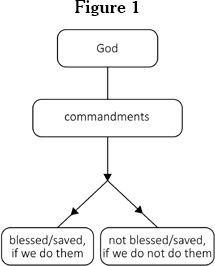
The covenant takes a particular turn when God's directives and commandments enter the picture, which they do at every step of the way. Does the biblical covenant function like the suzerainty treaties of the Ancient Near East, where the sovereign declares his mighty deeds to the people, binding them to himself with promises of blessings if they obey and threats of curses if they do not? (Mendenhall; Weinfeld). Such blessings and curses, of course, are conditional on the people doing their part.
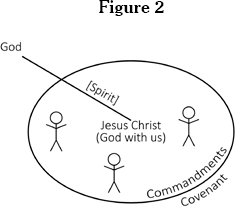
Or, does the biblical covenant function to set out the space where the mighty and holy God, the creator of the ends of the earth, actively dwells with particular people, and these people actively dwell with their God? In this case, the commandments serve as the meeting ground, delineating the arena of interaction between God and humans. God creates that space when giving the commandments. But God also keeps the commandments, and humans commune with God in that space. Keeping the commandments from the human side— and communing with God—comes as part of God's gift of the covenant in the first place (von Rad: 193–94).
We can diagram these two approaches to covenant as follows. Figure 1 sets forth a “command-and-do” structure, Figure 2 the form of a “covenant space where.”
Copyright © 2017 by In Christ Supporting Ministries. All Rights Reserved. Used by Permission.
Copyright © 2017 by In Christ Supporting Ministries. All Rights Reserved. Used by Permission.
The combined tangle of biblical idiom, translation, and theology arises already at this point. The English and other modern, notably Western, languages use a specific verb form—the subjunctive mood—to express directly the conditional “what might happen if… .” The Hebrew language, however, contains no such verb form. Whether or not other Ancient Near Eastern languages have some form of subjunctive mood, Hebrew definitely does not (Rosén: 222; Meyer: 316). Figure 1 clearly depends on a subjunctive verb: if we are going to be saved/blessed, we must keep the commandments. Expecting the commandments to describe a place where we abide together with God and God with us, Figure 2 handles verbs differently, idiomatically, without requiring the subjunctive mood at all. To see how Hebrew gets to would-be outcomes, but not through the means used by modern languages, we need to take a short trip through Hebrew grammar (see Aside 1) and then look at an example of how the OT sets forth the covenant with God.
Exodus 19:5–6
The passage where Moses introduces the Sinai covenant serves well as an initial case study. In Exodus 19:4 God tells Moses to go to the people, remind them what God did to bring them out of Egypt (on the wings of eagles), and say to them (see Aside 2):
5a And now, when hearing you shall hear in my voice,
5b and you kept my covenant
5c and you were for me a treasure among all the peoples,
5d because for me [is] all the earth.
6a And you shall be for me a kingdom of priests and a holy nation.
6b These [are] the words which you shall speak to the sons of Israel.
This passage contains no direct commands or “must” statements. Pointing to the reality of the future, a statement of “what shall be” is actually stronger than any imperative. The passage idiomatically combines the future and the past into a single, powerful statement about the present. Intensified, our hearing God's voice thrusts us into the future with God (5a). That future encompasses what follows in the past tense as if these things had already been accomplished, namely, our having kept the covenant (5b) and our having been a treasure among all the peoples (5c). So, we are now a kingdom of priests and a holy nation (6a), because we are participating in the future reality already accomplished in God's on-going, active presence. In the hearing, God connects us to God's future and presence now.
Yet the modern English translations reverse that thrust. They take the “when” [Hebrew word, im] to be a conditional “if”; they harden the intensified hearing into a demand to “obey”; they reverse the order of the future and past tenses of 5a and 5b; and they conflate the meaning into what we must do to gain God's favor (5c) by our actions. Somehow what began as a focus on hearing God's voice has turned into what we must do in order to secure our status before God. The NIV makes verse 5 a complete “if … then” sentence. The NIV and RSV/NRSV readings are typical:
RSV/NRSV: Now therefore, if you obey my voice and keep my covenant, you shall be my treasured possession out of all the peoples.
NIV: Now if you obey me fully and keep my covenant, then out of all nations you will be my treasured possession.
Exodus 19:5–6 sets forth the broader covenant framework of the Bible. Our discussion of the passage shows how Hebrew grammar presents the covenant without recourse to either the conditional or the “must” language required in Figure 1. Leviticus 18:5 takes us a step further, into the heart of the covenant as a place where we live interactively with God, as in Figure 2.
The Prism of Leviticus 18:5
Leviticus 18:5 adds a particular dimension to the covenant framework outlined above. This verse pinpoints the dynamic interaction between God and humanity, and offers a striking prism through which to gauge what is happening in that covenant space. The verse pervades the OT wherever covenant language appears, to an extent at which this article can only hint (see the section, below, on Leviticus in the Old Testament). Equally important, the verse shows up throughout the New Testament, quoted directly by multiple authors in multiple books, at critical junctures of the NT presentation of the Gospel message (see the section below, on Leviticus 18:5 in the New Testament). The verse is, further, crucial to Luther's treatment of Law and Gospel. John Calvin mentions Leviticus 18:5 often when dealing with the Third Use of the Law in the Institutes and in his commentaries on Romans and Galatians. We are here touching the idiom of Scripture, the air it breathes, and therein the heart of the Gospel message.
Within the covenant framework, God and God's people come together in the commandments which God gives and the people keep, notably the Ten Commandments (Exod 20:1– 17, Deut 5:6–21). Chapter 18 of Leviticus begins exactly this way. I am the Lord your God, says God to Moses (18:1, 4, 5). You shall not act like the people around you (18:2–3). Instead (see Aside 3):
4a My judgments you shall do
4b and my statutes you shall keep for walking in them;
5a and you keep/kept my statutes and my judgments;
5b who shall do them the man also lives/lived in them;
5c I [am] the Lord.
Three things put Leiticus 18:4–5 firmly in the pattern of Figure 2, the “covenant space where.” First, the commandments taken together circumscribe a space (in them) where God and God's people interact. The commandments constitute as much a space as the promised land, Jerusalem, the temple, the nation, the family, the human heart, or even creation. At the simplest level, the commandments function like the rules of a game to establish the field of play and the interactions among players. To play the game, whether as a team together or as competitors, the players keep the rules, interacting and fellowshipping with the other players who are also keeping the rules. They do not play the game to keep the rules, but when they stop keeping the rules or play by other rules, they are no longer playing that game. While the rules of a game are typically stated in “must” language (imperative form: “do this,” “do not do that”), the force of the rules is essentially descriptive, marking off the space of play (Calvin: 360; Lehman: 85; Miller: 420).
Second, God's commandments say as much about what God is actually doing as about what humans are supposed to do, not one without the other (Calvin: 360, 367; Lehman: 81–101; Miller: 421f, 426f; Barth: 509–20). God also keeps the commandments. So, God is a player in the game, too, with the unique role of creating and sustaining the covenant space where the game is played. That is why walking in the commandments is to walk with God. Living in the commandments is to live in fellowship with the living God. The third clause, 18:5c, fills the whole verse and punctuates it emphatically: I [am] the Lord!
Third, the doing and the living of Leviticus 18:5b overlap each other in a way that makes one indispensable to the other. We are dealing here with an idiomatic way of speaking and thinking. Doing or keeping the commandments entails living in them. Living in the commandments entails doing or keeping them. To value human life, to tell the truth, to honor family members, to be faithful to our spouses, to rejoice in the good fortune of others, to look out for one another's well-being, and/ or to worship God—like the skillset of any game—is both to keep the commandments and to concentrate on the simple, existential reality of breathing the air God provides, walking on the road from here to there daily, working and sharing with others within the space allowed, and/or drinking in the moment and the surroundings. The goodness of the doing is not different from the goodness of the living. The two overlap and enhance each other immeasurably.
Such doing-and-living gives a clear preference to what is done in fact, not for what we might have done conditionally or what we must do on command. The reality of things as they are or will be thus stands as the basis for things as they “must be” or “might be.” In truth God's commandments already encompass whatever could be called imperative or conditional (see Aside 4). The richness and meaning of our actions come directly from participating in the covenant where God is also in fact doing-and-living. Keeping the commandments connects our doing and our living, but also our doing with the living God.
These connections hold whether the doing and living are simply set beside each other in a repetition (as in doing-and-living) or living is an outcome of the doing (as in doing-for-the-sake-of-living). Note, too: from the biblical perspective … feelings, thoughts, and relationships are also actions of God or humanity, so that these inner or motivational accents do not supersede the doing and the living.
By contrast, the idiom of modern Western culture is to turn doing and living into a sequence and separate them from each other. We typically turn the living into a goal or an outcome and the doing into the instrumental means for getting there. The goals thus become self-determined (“we can do anything we set our minds to do”) and abstract (“the possibilities are endless”). Just as often, the goals become self-absorbed, and so does the doing, without God in the picture. The oft-quoted directives, ask, and you shall receive; seek, and you shall find; knock, and it will be opened to you (Matt 7:7), thus become circular. As a matter of fact, we tend to receive what we ask for, find what we seek, and open doors where we knock … and not much more. The key lies in identifying what to ask for, what to seek, and where to knock. A starting point in God makes all the difference, as in the fear of the Lord is the beginning of wisdom (Proverbs 1:7), or seek first [God's] kingdom and [God's] righteousness, and all these things shall be yours as well (Matt 6 : 3 4).
The three points outlined here belong to the idiom of the Bible. The consistency among them is remarkable. But the larger, covenant framework of the commandments remains descriptive—called Torah or instruction. The commandments mark off God's distinctive reality, presence, and activity at every moment, and pinpoint the distinctive interactions between God and humanity. That larger, covenant framework leaves plenty of room for lower level, tactical imperatives (“go left!” “go right!”) without replacing the whole field of play. The inner connection between doing and living extends seamlessly into lower level imperatives and echoes almost programmatically throughout the Bible.
All this is achieved without any subjunctive verb forms. Neither Hebrew grammar nor the Bible has any need to turn imperatives or promises into conditional statements. Conditional statements may work at a tactical level, but “if … then” language merely confuses and disrupts at the level of the covenant framework (see Aside 5). Conditional thinking also tends to separate doing from living and make these free-floating—doing without a clear sense of direction or consequence, living as an open-ended goal or outcome to pursue, and the two as a sequence whose connection is left for humans to make, without God in the picture.
Across the board, the Hebrew places the human domain within the commandments instead of placing the commandments into a human domain for which we alone are responsible. Indeed, the commandments take on a life of their own when they
are simply imposed on the human domain from outside, or
become detached from the God who also keeps the commandments, and/or
separate the doing from the living, or the deed from what makes it most vividly alive.
When they take on a life of their own, the commandments can even push aside the God who gives them. Then, instead of bringing life to us, the commandments become, as Paul puts it, the letter that kills (2 Cor 3:6). This breakdown in dynamics reflects the “command-and-do” pattern of Figure 1.
Modern English translations, for their part, make Leviticus 18:5 entirely conditional upon human behavior, and they portray the commandments as a means for us humans to make ourselves righteous before God. Compare the translation I have offered with the following examples:
Above in text:
4b my statutes you shall keep for walking in them;
5a–b and you keep/kept my statutes and my judgments; who shall do them the man also lives/lived in them.
NRSV: 5a–b You shall keep my statutes and my ordinances; by doing so one shall live.
NIV: 5a–b Keep my decrees and laws, for whoever obeys them will live by them.
NASB: 5a–b So you shall keep My statutes and My judgments, by which a man may live if he does them.
KJV: Ye shall therefore keep my statutes, and my judgements: which if a man do, he shall live in them.
The KJV retains the accent on place, in them, but maintains the conditional if a man do. The other translations all turn the commandments into a means of our living by them, instead of a place where we live in them. The combination of “if” and “by them” intensifies the modern bias towards conditional behavior, an accent on the instrumental means, and—taken together—a righteousness for which we humans are wholly responsible.
So, the issue comes down to this:
Is Leviticus 18:5, especially the second clause, setting up a bargain hinging on what humans do (“if you do this, you will get that”), with specific outcomes for what we do or not do—the “command-and-do” pattern of Figure 1?
Or,
Is this passage simply describing things as they are (“this is the way things work”), so that the doing itself, established by the command and facilitated by the commander, comes as the gift of life in fellowship with God—“the covenant space where” pattern of Figure 2?
At stake is whether the Gospel ultimately depends on some form of human recognizing, accepting, choosing, believing, responding, doing something good; or whether the Gospel really does live out of God's goodness and grace, including the believing and doing as gifts.
Modern people know how to deal with offers, bargains, and threats. We do it every day. We know what we must do to get what we want and sidestep what we don't want, to attain success and avoid failure. At the human, horizontal level, in a sequence of our interactions, we are constantly calculating cause and effect, effort and result, action and response, cost and benefit. Believing that God resides in the inner self, we moderns assume that our life is finally up to us, even with God in it. In the cultural air we breathe, Leviticus 18:5 makes no sense to modern readers except as a command-and-do: God commands … we choose and do or do not do … with good or bad consequences.
What if, instead, the text concentrates on “us in God” more than on “God in us?” What if the biblical authors see God's actions as the place for our actions instead of our actions as the place for God's? What if God truly leads us into a freedom no longer bound by the circular limits of our own self-determined vision, habits, and constant calculations? Finding ourselves alive to the active presence of the living God casts everything into an entirely new light—including the present moment concretely, the people around us, and the issues of our lives. Indeed, is not Leviticus 18:5 saying the same thing as John 3:21: The one doing the truth comes to the light, that his deeds might manifest that they are being wrought in God?
Leviticus 18:5 in the Old Testament
Leviticus 18:5 is not a one-time verse, even in the OT. The verse shows up word-for-word in Ezekiel 20:11, 21, and with slight variations in Nehemiah 9:29. In Ezekiel 20:11:
And I gave to you my statues, and my judgments I made them known—
Who shall do them the man also lives/lived in them.
[repeated in 20:21, in relation to not keeping the commandments]
In these passages Ezekiel makes Leviticus 18:5b the basis for his own statements. He routinely begins his prophecies with the phrase, as I [God] live (5:11, 14:16, 18:3, 20:31). For us to live in them is to share the space with God, who also keeps the commandments and lives in them. In Chapter 18 Ezekiel underscores the living that takes place in keeping the commandments and the dying that takes place apart from them.
Maintaining the interaction between God's doing/living in the commandments and ours is indispensable to the Bible, going forward. The echoes to Leviticus 18:5 pop up everywhere, it seems, usually as a variation on the theme of doing and living, for example:
Prov 4:4—Keep my commandments, and live.
Amos 5:4, 6—Seek me and live.
Gen 42:18—Do this and live.
Deut 4:1—Hear the commandments I am teaching you for doing, so that you shall live.
Hab 2:4—The righteous [self] in his faithfulness shall live.
Joel 2:32—All who call upon the name of the Lord shall be delivered.
Unlike modern people, the Hebrew does not turn these actual or implied imperatives into conditional sequences of offer and acceptance, action and response, cost and benefit, hence of command-and-do. Instead, the Hebrew places the imperatives within the overarching framework of God's simultaneous activity—which makes the human activity both intensely alive and important.
The dynamics of Leviticus 18:5b show up, significantly, in the prophet Isaiah 55:3–4, tied to the covenant with David (see Aside 6):
55:3a Stretch out your ear and walk toward me;
b hear and your self shall live
c and I shall make for you [an] everlasting covenant, my loving-kindness for David being constant.
55:4 Behold a witness for the people I have set him [as] a ruler and commander for the people.
The same accents arise in Proverbs 8. Dame Wisdom, who is with God at creation (8:20f), is positioned as the place where God and creation/humanity meet, like the Mosaic commandments or the covenant with David. In that space God's doing is simultaneous with ours, without any separation of the doing and the living (see Aside 7).
8:17 The one loving me I shall love and the one seeking me shall find me.
8:32 And now, sons, listen to me, and, blessed, they shall keep my ways.
Our activity of loving Wisdom, who is always with God, stands within the reality of God's loving us, and God's blessing accompanies those who walk in God's ways. These are statements of fact, not conditional statements. This is the way things work; this is the defined space where God and humanity meet in reality.
The Book of Deuteronomy may represent a special case. Deuteronomy was obviously at the heart of the 621 BCE reform of Israel under King Josiah, but may date from the pivotal reform under King Hezekiah ca. 721 BCE (Weinfeld). The Book, however, is an extended sermon by Moses exhorting the Hebrew people as they were about to enter the promised land—centuries before either Hezekiah or Josiah. The Book served to call the Israelites back to God and motivate them toward keeping the commandments. From Deuteronomy also comes the yardstick for measuring Israel's faithfulness and that of her kings down to the exile to Babylon in 587 BCE. The OT books of Joshua, Judges, 1–2 Samuel, and 1–2 Kings track this history. Does the motivational role of Deuteronomy change its dynamics in relation to Leviticus 18:5b?
Key passages in Deuteronomy reflect the verb pattern of Leviticus 18:5b (Deuteronomy 4:1–2, 28:1–2), while other passages take the compatible form of doing so that you shall live (Deuteronomy 4:1b–c; also 30:19c–d). The central role of the Ten Commandments (5:6–21) is already clear in Deuteronomy 4:1–2 (see Aside 8):
4:1a And now, Israel, listen to the statutes and the judgments
b which I [am] teaching you for doing
c so that you shall live
d and you came and possessed the land which Lord God [was] giving your fathers for you.
4:2a Not you shall add upon the word which I [am]commanding you,
b and not you shall hold back from it
c for keeping [the] commandments [of] the Lord your God which I [am] commanding you.
The Hebrew of Deuteronomy 4:1–2 has a vigorous and urgent tone but does not convey the legalism associated with contract language or the overbearing demand commonly associated with “must” language. The passage concerns the reality of our future interactions with God. By contrast, the modern English translations render this passage with demands for obedience that turn the living into a reward for the doing.
The later passage, Deuteronomy 30:14, 19–20, continues both the urgent tone and the connections of 4:1–2. The later passage also spells out the doing (30:14) and living 3 0 : 1 9 d) in terms of loving God, hearing his voice, and abiding with him (30:19d–20c—see Aside 9):
30:14 … when/because near to you the very word [is] in your mouth and in your heart for doing
30:19a I warned with you this day the heavens and the earth, the living and the death,
b I set before your face the blessing and the curse,
c and you chose with the living
d so that you shall live, you and your seed,
30:20a for loving the Lord your God
b for hearing in his voice and
c for abiding with him,
d when your lives and your length of days [are] for dwelling upon the earth
e which God swore to your fathers to Abraham to Isaac and to Jacob for giving to them.
The Hebrew locates the choosing of 19b in the past tense, without “must” language. The passage is a simple narrative of choices already made (you chose with the living). Choosing here is not an open-ended offer, waiting for us to act and make it happen. The choosing is a doing like everything else and cannot be separated from the living.
That is why even Deuteronomy does not set up a command-and-do pattern. In this Book as well, the commandments set up a domain where God and humans are acting simultaneously to do them, and where the doing and the living cannot be separated—just like Leviticus 18:5b. The imperatives have a natural home, without any need to lapse into conditional language. Surely, James has this in mind when he says in James 1:25:
the one having looked into the perfect law of freedom and having persevered, not becoming a forgetful hearer but a doer of work, this one shall be blessed in his doing.
Or Jesus, when he says in John 13:17, in the context of washing his disciples' feet:
When you know these things, blessed are you when you do them.
Needless to say, the modern English translations turn the Deuteronomy passages into a command-and-do pattern. The NRSV is especially egregious, setting the whole of 30:15– 20 into a blatant if-then, quid pro quo, demand-requirement transaction:
16 If you obey the commandments of the Lord your God that I am commanding you today, by loving the Lord your God, walking in his ways, and observing his commandments, decrees, and ordinances, then you shall live and become numerous, and the Lord your God will bless you in the land that you are entering to possess.
17 But if your heart turns away and you do not hear, but are led astray to bow down to other gods and serve them,
18 I declare to you today that you shall perish; you shall not live long in the land that you are crossing the Jordan to enter and possess.
19 I call heaven and earth to witness against you today that I have set before you life and death, blessings and curses. Choose life so that you and your descendants may live,
20 loving the Lord your God, obeying him, and holding fast to him; for that means life to you and length of days, so that you may live in the land that the Lord swore to give to your ances tors, to Abraham, to Isaac, and to Jacob.
The prophets who lived after the collapse of Josiah's reform and experienced the destruction of Jerusalem in 587 BCE, notably Jeremiah and Ezekiel, realize that motivating sinful humans to keep God's commandments takes more than issuing threatening commands or offering incentives. Jeremiah talks plainly about putting my law within them and writing it upon their hearts (Jer 31:30). And Ezekiel speaks of giving God's people a new heart and a new spirit …within you (Ezek 36:26).
In sum, Leviticus 18:5b shapes the language whenever the OT turns to the dynamic interaction between God and the Israelites within the space of the covenant. Sometimes the shaping is direct, as when the verse is quoted as the basis for further comments (Ezekiel, Nehemiah). Sometimes the shaping is indirect, as when doing-and-living are incorporated into the message of the prophets, the Wisdom literature, or even the covenant renewal of Deuteronomy. The impact, however, is pervasive.
Leviticus 18:5 in the New Testament
In the Septuagint of 287ff BCE Leviticus 18:5b was translated from Hebrew into Greek as follows: the one doing them shall live in them (see Aside 10). Most NT authors, especially Paul, pick up the verse in this form. The survey here covers the following:
direct quotes of the verse (Luke 10:28; Rom 10:5; Gal 3 :12; Eph 2:10);
passages about Jesus Christ becoming the new covenant where we abide with God and God with us (John 10:1– 17); and
other passages that bring out doing and living in Christ (Luke 10:28, the love command).
The same questions about translation from Hebrew to English recur in those from Greek to English.
Paul: Ephesians 2:10, Romans 10:5, Galatians 3:12
Paul makes the most direct use of Leviticus 18:5. Deeply immersed in OT Law from his Pharisaic background, he cites Leviticus 18:5b both positively (Eph 2:10) and negatively (Rom 10:5, Gal 3:12).
Positively, in Ephesians 2:10 Paul provides a paraphrase if not a commentary on the verse from Leviticus (see Aside 11):
For of him [God] we are [the] workmanship, having been created in Christ Jesus for good works, which God prepared beforehand that in them we might walk.
Remember that Leviticus 18:4–5 speaks of walking and living in God's commandments—the covenant—as in a garden. Now, in Ephesians 2:10, the primary “space where” we live in covenant fellowship with God is in Christ Jesus instead of the commandments. The phrase in Christ is central to Paul's understanding of the Christian message. He uses in Christ or some variation of it 164 times in his writings, (Deissmann: 140). He speaks often of being in the Spirit as well. The good works mentioned here correspond to real instances, moments, and events of doing the commandments, as Leviticus 18:5b suggests. In the Ephesians passage the good works that involve keeping the commandments and fellowship-ping with God are gifts, pure and simple: God prepared them beforehand. United with Christ—created in Christ Jesus—we walk with God in the good works which God provides.
Negatively, Paul quotes Leviticus 18:5b twice (Rom 10:5, Gal 3:12). The negative sense emerges when the three vital connections we cited for Leviticus 18:5b above, come unraveled. The commandments become a demand requirement instead of a gift. They become separated from God's own active life. The doing of the commandments gets separated from the living in them.
Mistakenly taking the commandments as a divinely imposed standard or law of goodness, we try to make ourselves actually good as a direct result of doing what the law commands. We thus focus our attention on the law, not the Lawgiver, hence upon ourselves and not God as the one “in whom we live and move and have our being” (Acts 17:28). The futility of the undertaking is enormous. For if we can make ourselves good, we don't need God—which is Paul's main point. If we fail or violate the law even once, we can never be good according to the commandments, no matter how hard we try. Yet striving to keep the law from within our sinful selves, we become self-absorbed in our own doing, our own good works, and our own righteousness. The harder we try, the more our efforts misfre (Rom 7). For Paul, then, keeping the law for the sake of the law leads to death and not life. He calls it the power of sin (1 Cor 15:56) and a letter that kills (2 Cor 3:6). That is the negative sense of Leviticus 18:5b in Galatians 3:12 and Romans 10:5.
Paul's answer to the dilemma of Leviticus 18:5 in its negative sense has to be as simple and direct as the problem. To be clear: the problem with the law is neither failure to keep it nor an endless legalism, but turning the God-given law into a substitute for God, an idol. That is the worst sin of all, and it sets up a vicious circle from which we cannot extricate ourselves: the harder we try to correct our mistakes, the more sinful we become. The only solution is for Jesus Christ, as Son of God and Lord—God as a human being—to fulfill the law (Rom 8:1–4) and replace it with himself. Paul makes this case in Galatians 3:13–14 (immediately following Lev 18:5b in verse 12):
Christ redeemed us from the curse of the law becoming a curse for us—for it is written, “Cursed is everyone hanged on a tree”—so that to the Gentiles the blessing of Abraham might come in Christ Jesus, that we might receive the promise of the Spirit through the faith [of Jesus Christ].
In his letter to the Romans, 6:10–11 (see also Rom 3:19– 26, 5:15–21), he says:
For in that he died he died to sin once for all, but in that he lives he lives to God.
So also you, reckon yourselves to be dead to sin but living to God in [en] Christ Jesus.
And in Romans 10:4, just prior to his quote of Leviticus 18:5 in verse 5—Paul says:
Christ is the end of the law into [eis] righteousness for all the believing-ones… .
The full passage here is Romans 10:1–17, but the modern English translations turn our believing into the cause instead of the result of our salvation. Christ, however, cannot replace the covenant law for us if we add conditions or demand requirements on top of what he has already done. That would turn the good news in Jesus Christ into another instance of command-and-do.
At the end, the negative use of Levicitus 18:5b dovetails utterly with the positive use of it for Paul. Both aspects center in Jesus Christ and how God's covenant with humanity now takes place by participation in the new covenant Christ establishes.
John 15:1–17
John draws directly upon the OT accent on God's commandments as a place where we abide with God and God abides with us. In the pivotal passage, John 15:1–17, notice verses 9–10, especially the use and range of verb tenses (see Aside 12):
9a Just as the father has loved me, so have I loved you;
b abide in my love.
10a When you keep my commandments,
b you will abide in my love,
c just as I have kept the commandments of my father
d and I am abiding in his love.
These verses build on the root metaphor introduced in John 15:1: Jesus is the vine and we are the branches engrafted into him. He is the source for the life-giving, fruit-bearing sap that only the vine can provide. Abide is the most frequent word in the full passage as well as in these verses. The “space where” we abide—in Jesus' love, in my father's love— is marked off by the commandments, where the son and the father also abide together.
The Johannine passage not only follows Leviticus 18:5 very closely but also raises the same issues of grace and conditionality. Does the Greek word ean signal a condition: “If you do this (keep my commandments), you will get that (abide in my love)”? Or, is the force of ean a description of fact in time: “When you find yourself actually keeping my commandments—probably to your surprise and amazement—you will find yourself abiding in my love and God's as well”? Significantly, every modern English translation listed in Table 1 begins verse 10 with “if.” Is the Gospel finally an offer or a bargain, requiring us to seize it, use it properly, and face the consequences if we do not? Or does Jesus Christ, in the power of the Spirit, establish our abiding in him and him in us as a gift pure and simple? Jesus answers this question himself when he says, apart from me, you can do nothing (John 15:5). Abiding thus in Christ, we live in the full freedom and joy of abiding in God (see John 8:31f and 15:11).
Luke 10:25–37
This passage could well come first in this section. After all, in 10:28 Jesus is clearly referencing Leviticus 18:5b in a form compatible with much of the OT, including its translation from Hebrew to Greek. The exchange between Jesus and the hard-driving lawyer (Luke 10:25–28) goes like this:
Lawyer: Having done what shall I inherit eternal life?
Jesus: What is written in the law?
Lawyer: You shall love God with your whole self, and your neighbor as yourself.
Jesus: You have answered rightly; do this and you shall live [Lev 18:5b].
Like the lawyer's initial question (19:25), modern Western Christians assume a “command-and-do” answer, that eternal life is something self-standing, and we must do something to attain it. The living is thus separated from the doing. God and the commandments are not in the picture until Jesus asks what the law says. Jesus here refers both the doing of the lawyer's question and eternal life to their proper location within God's covenant law (10:26f). Leviticus 18:5b is the norm he cites to confirm his move (10:28).
Jesus does the same thing with the lawyer's further question, “Who is my neighbor?” (10:29). Telling the parable of the Good Samaritan (10:29–37), Jesus forces the lawyer to identify with a man whose very survival depends on a hated Samaritan (10:30–34). The neighbor in this case—the one to be loved as himself—is the Samaritan, not the lawyer or even the man in the ditch. When Jesus ends the exchange with the command, Go, and do likewise (10:37), he roots eternal life—the lawyer's original question—in the place where mercy reigns (10:33–36). Mercy is the “covenant space where” Jesus himself is going and doing, and the place where the lawyer will fellowship with Jesus.
Jesus and the Love Command
Someone has pointed out that What must I do? is Luke's favorite question. Besides the lawyer cited above (Luke 10:25), we find it on the lips of the rich young ruler (Luke 18:18), Paul at his conversion (Acts 9:5–6), and the Philippian jailer (Acts 16:30). The question of what to do pervades all of Jesus' teaching as well, not least in the Sermon on the Mount (Matt 5–7) or in Luke's case the Sermon on the Plain (Luke 6:17–49). At the heart of what we are to do is the new commandment uttered by Jesus, Love one another as I have loved you, from John 15:12 (which connects directly with our discussion of John 15:9–10 above).
Loving one another as I have loved you enfolds both the OT command to love your neighbor as yourself (Lev 19:18) and the Golden Rule, as you wish that men would do to you, do so to them (Luke 6:31, Matt 7:12). In his discourse Jesus takes these companion statements to a whole new level (Johnson: 53–62). As I have loved you, of course, pertains to Jesus Christ, God as a human being. For us to love one another is to participate in God's own love, and to love God. Loving this way is always concrete and involves doing particular things, like visiting the sick, lonely, and imprisoned, or giving food or water or clothing to those who are without. Jesus is quite clear: inasmuch as we do these things to the least of these, we do them to Christ (Matt 25:40, 45). Loving this way entails loving our enemies, doing good, lending, and being merciful expecting nothing in return (Luke 6:35). The reward that comes with this doing is not a quid pro quo, but living with God as God's children (Luke 6:35), living not as slaves but as friends willing to make the ultimate sacrifice for one another (John 15:13–15). Transparent here are the inseparable connections between doing and living, between God's doing-and-living and ours, in the covenant place where by God's grace we meet and fellowship together. These are the very interactions which Leviticus 18:5b pinpoints.
The obvious caveat here is, “When do we ever actually behave this way?” And the simple answer is, “never.” So, what good is it to talk like this or to set such ideals before us in a work-a-day, busy, modern world? For sure, we will never attain these lofty goals from a command-and-do perspective, no matter how hard we try. In reality, Jesus Christ is the only person who has ever attained such love. Which means that the only way we have access to such loving is by participation in Christ's loving. The command to love one another as I have loved you redefines our present moment in terms of Christ's own loving— concretely the person and situation immediately before us. To participate in Christ's loving is God's gift of the doing itself in the covenant space where God also lives and loves.
Conclusion
The ideas expressed here are not new. With help from Leviticus 18:5, the Reformation era rediscovered in Christ the “covenant space where” God abides with us and we with God, in simultaneous not sequential interactions. That sense clearly resonates with the multiple passages and authors we have considered, both OT and NT, supported by Hebrew and Greek grammar.
The weight of evidence is compelling, that “command-and-do” renderings of both OT and NT distort the Bible's meaning, and with it the Gospel. “Command-and-do” language fits well with the modern, Western mantra: “if it's to be, it's up to me.” At the points we have considered, the modern English translations have imposed upon Scripture our own, modern assumptions. Linguists and biblical scholars, it seems, are no more immune to these tendencies than theologians.
This outcome—both translation and theology—does not distinguish between right, left, or center perspectives. The modern English translations make the same mistakes across the board. On the crucial theological issues raised here, partisan liberals and conservatives are saying the same things! The Biblical idiom counters all these partisan perspectives equally.
At stake is not only what the Bible says but also how the Bible functions among us. Ironically, the Bible loses its character when we turn it into a manual of rules for everything, with a “command-and-do” leverage to motivate humans into keeping the rules. As “command-and-do,” the Bible becomes just another human self-help book. On the other hand, when the Bible spells out the “covenant place where” God lives with us and we live with God, it serves authentically as the Word of God, a lamp to our feet and a light to our path (Psalm 119:105). Then life with God, one another, and the world becomes an end in itself, to be lived to the fullest with joy, moment-by-moment.
The lead question, of course, is whether the modern Christian Church has lost contact with the idiom of Scripture and with it the Biblical meaning. The question is vital for the Christian Church today, in the middle of an epochal paradigm shift. The basic theological issues we have uncovered here surely transcend the current divides in the Christian Church. So do the issues of Biblical translation. The challenging times we live in likewise send us back to the Bible in its original languages to re-discover the idiom of Scripture— and the Gospel—for the new paradigm coming.
Asides
The verb is the obvious key to Hebrew. Where most modern and many ancient languages have multiple verb tenses for past, present, and future, Hebrew has only two:
perfect tense/completed action/positional past or present and
imperfect tense/continuous action/positional present or future.
Where most modern languages have multiple verb forms for moods—indicative, imperative-jussive-exhortative, conditional-subjunctive—Hebrew has only two, the indicative and the imperative (including the jussive and the exhortative). Participles and infinitives play an important role in Hebrew as well, but to complement not replace other verb forms.
For over a hundred years, Hebrew language scholars have wrestled with Hebrew verb tenses, with help from the family of languages that belong to the ancient near East (Mettinger; Waldman; Gentry). These studies have been fruitful, but not determinative. Using modern language theory, some scholars claim that the Hebrew tenses—perfect and imperfect—highlight different aspects of action, not time (Barnes). Others dispute this, bringing into play a variety of other factors (Meyer; Rosén; Hughes; Bandstra; Waldman), including the development of the language over time (Andersen; Naudé).
The verb tenses (perfect, imperfect) have their own simple meaning. When strung together with “ands”—the waw consecutive—the two tenses provide an array of combinations, with keen insights and nuances. The typical story narrative, for example, begins with a verb in the perfect tense (completed action/positional past), then with waw strings verbs together either in the perfect tense (past or pluperfect action) or the imperfect tense (continuous action/present-future). The result is a lively historical narrative with a keen sense of sharing the moment. (Revell; Peckham; Nicacci)
By convention, however, modern English translators allow the lead verb tense in a string (with waw consecutive) simply to override the trailing verb tenses (e.g., Weingreen: 90ff). They lose thereby a remarkable range of nuances and insights in the text. While dated, Gesenius supports the conclusions made in this article (336–38) and covers many verb combinations involving the waw consecutive (326–39).
Scholars agree that Hebrew contains no subjunctive mood. Instead, Hebrew grammar creatively projects a completed action (perfect) into the arena of a present or future activity (imperfect) as if it had already come to pass. The typical sentence begins with a verb in the imperfect tense to establish the positional future (or present), then creatively adds a string of verbs in the perfect tense (completed action/past or present) joined together with “ands” (the waw consecutive), so that we are already participating in what will be. (Peckham: 142, 155) This move takes on particular power in biblical prophecy, but works well in situations where God is making promises (deRegt). Other verb combinations complement but do not override the underlying syntax described in this paragraph.
Biblical Hebrew language patterns often establish different expectations from those of open-ended, modern, Western languages. At the point of verb tenses the idioms of the Hebrew language ask for particular attention. (Peckham: 144)
The Hebrew word im (5a) is naturally translated “when” in the standard Hebrew lexicons (Brown: 50). Also in 5a, the Hebrew preposition for in (beh) precedes my voice: voice is the object of a preposition, not of a verb.
The passage moves from the positional future tense (shall hear, imperfect/continuous action) in 5a, to the past tense (kept, were, perfect/completed action) in 5b–d, then back to the positional future tense (shall be, shall speak, imperfect/ continuous action) in 6a–b. Identifying the imperfect verbs as positional present instead of future would make no difference. The point is the same: a continuous action is projected as if it were already completed—imperfect + perfect.
Repeating the “hearing” in 5a (hearing, infinitive absolute, plus you shall hear, imperfect tense) intensifies the moment of being within the sound of God's voice.
Leviticus 18:4–5
This passage contains no “must” language or imperative verb forms. The use of the imperfect tense/continuous action/ positional future points to a reality in fact that has more force than an imperative (see Aside 4).
The verbs of 18:4, shall do and shall keep, in the imperfect tense (continuous action/positional future), set up the verb of 18:5, kept, in the perfect tense (completed action/past). The phrase, for walking [infinitive construct] in them (18 : 4 b) concentrates on the action itself and where the walking takes place. In them (bhem, 18:4, repeated in 18:5) marks off the statutes and judgments as the space where we walk (18:4) or live (18:5) with God. The perfect tense in 18:5a confirms that this is in fact an accomplished reality. The grammatical pattern, imperfect /continuous action/positional future + perfect/ completed action/past tense, is identical with that of Exodus 19:5–6 (also Deuteronomy 28:1–2).
The pattern repeats itself within the clause 18:5b. This pivotal phrase, who shall do [imperfect tense/continuous action/positional future] them the man also [waw] lives/lived [perfect/completed action/past tense] in them, projects forward what happens when a person in fact continuously does what the commandments entail. In doing them, the person acts in concert with the living God, with whom to live is human life at its fullest.
The two verses end with a signature shout, I [am] the Lord!
The Imperfect Tense and the Imperative Mood in Hebrew
Biblical commandments are typically stated as a future reality with God, hence in the imperfect verb tense (“you shall do this”) —not as imperatives. Indeed, the jussive (“you will clean up your room”) and exhortative (“let us clean up our room”) verb forms, which complement the simple imperative (“clean up your room”), are simply variations of the imperfect tense (Gesenius: 124-–32).
Genesis 3:1–7
Isn't the prospect of conditional thinking what happens in the conversation between Eve and the serpent in Genesis 3:1– 7 (note the imperfect-perfect verb pattern of 3:4–5)? If indeed Adam and Eve were like God, knowing good and evil, then they could make their own rules and not have to keep God's. Then indeed they would be acting like God, not merely acting in God's image.
Isaiah 55:3–4
Leviticus 18:5b echoes directly in verse 3b, hear and your self [nephesh] shall live.
The verbs in 55:3 lead off in the imperative (stretch out, walk, hear, 55:3a–b), followed by the imperfect (continuous action/positional future: shall live, 55:3b and shall make, 55:3 c). With a waw connection, however, 3c begins a new and familiar sequence of imperfect (55:3c) and perfect (55:4) which roots the whole passage in the everlasting covenant with David, whom God has set as a ruler and commander for the people. The clause in 55:3c both explains and elaborates the covenant: my lovingkindness [hesed] for David being constant [participle].
The imperatives in 55:3–4 find their place within, not apart from, the structure of the covenant with David as a realm where God and humanity meet. Our doing takes place simultaneously with God's doing (constant lovingkindness); hence our living takes place in the context of God's living (active nearness—verse 6).
[55:6] Seek [imperative] God in his being found [niphal, infinitive construct], address [imperative] him in his being [infinitive construct] near.
Proverbs 8:17, 32
Both 8:17 and 8:32 work within the interactions set forth in Leviticus 18:5b, although the verb combinations differ. 8:17 has a participle (loving, seeking) followed by imperfect/ present-future (shall love, shall find). 8:32 moves from an imperative (listen) followed by an imperfect/present-future/ continuous action (shall keep).
Deuteronomy 4:1–2
4:1a leads off with an imperative (listen, 1a) followed by a participle (teaching, 1b) and an infinitive construct (doing, 1b). The participle and infinitive construct intensify the focus on doing. Following an “and” (waw), the imperfect tense of 4:1c, (shall live, continuous action/positional future), moves in the very next clause, 1d, to a perfect tense (came and possessed, completed action/past). The participle (giving) extends the meaning of these two verbs into the future reality of Israel settling into the promised land. 4:1 echoes Lev 18:5 both in joining the living and doing (4:1a–1b) and in the imperfect + perfect tenses of 4:1c–d).
4:2 gives instructions on how to proceed with the listening of 1a. Both not you shall add, 2a, and not you shall hold back, 2b, are in the imperfect tense (continuous action/positional future). These actions are deepened with participles for God's commanding (2a, 2c) and an infinitive construct for our keeping the commandments (2c). The participles and the infinitive construct highlight the overlap between God's actions and ours.
Deuteronomy 30:14, 19–20
The Hebrew word ki (30:14, 30:20d) can be translated either “when” or “because.” The sense of “when” brings out the nuance of a fact-based reality more plainly, which emerges in both 30:14 and 30:19d–e.
The verb forms in these verses do not contain any imperative. In 30:14 the very word is in your mouth and in your heart culminates in an infinitive construct (doing).
30:19 starts with a three-fold perfect tense/completed action/positional present (I warned, I set, you chose 19 a – c). The passage moves into the future with 19d (shall live, imperfect/continuous action/positional future). The next clauses (20a–c) spell out the quality of the future action with a string of infinitive constructs: loving the Lord your God (20 a), hearing in his voice (20b), abiding with him (20c). These actions in turn are associated with our dwelling [also an infinitive construct] upon the earth (20d), which overlaps directly with God's giving [also an infinitive construct] promises to Abraham, Isaac, and Jaco b (20e), as God swore to them, perfect tense/presumed past/completed action).
To talk about the choosing in 19b, the Hebrew uses a perfect tense (completed action/past or present), not an imperative.
Alter (1029f) translates Deuteronomy 30:19–20 similarly, though not identically.
The Greek Translation of Leviticus18:5
The translation from Hebrew to Greek reverses the location of future and present tenses, but (a) the one doing them remains a fact statement, (b) in them is the place where the doing occurs, and (c) the verb, shall live, still projects the whole into the future. The Greek translation retains the tight interaction between doing and living that runs throughout the OT.
Ephesians 2:10
For of him [God] we are [present tense] [the] workmanship, having been created [aorist passive participle/positional past] in [en] Christ Jesus for good works, which God prepared beforehand [aorist/positional past] that in [en] them we might walk [aorist subjunctive].
The place references of this passage are important: in [en] Christ Jesus, referring to Christ as a place designation, and in [en] them referring to good works. The two locations overlap, both of them bringing us into fellowship with God.
The verb forms have a greater range in Greek than in Hebrew, but the sense of them is quite similar. The subjunctive mood at the end of 2:10 projects a past action—the good works which God has prepared beforehand—into the future as a place where we, too, abide in them.
John 15:9–10
The ean of 15:10a is best rendered “when.” For its part, Greek has words for “if” (ean, ei) and verb forms that express conditionality (the subjunctive mood in a variety of tenses). But these Greek words also can be translated “when” as readily as “if,” and, as used in the NT, the subjunctive mood can point toward a future reality in which we participate now. The NT continues to breathe the air of its Hebrew forebears.
The verb play here mixes indicative, imperative, and subjunctive moods, as well as past, present, and future tenses. 9a begins with two past indicatives (has loved, have loved), which grounds the rest of these two verses in the love of both the father and the son. The imperative follows in 9b: abide in [en] my love, which is now a place where we are to abide.
The only subjunctive verb shows up in 15:10a (keep), fol -lowed immediately by a future indicative (will abide) and the place where that will happen, in [en] my love. Clearly, to keep my commandments is to abide in my love (15:10a), which models directly the two-part doing and living of Leviticus 18:5b. With “when” and the subjunctive, the thrust of 10a is more factual than conditional. This conclusion is reinforced by (15:10c-d) where Jesus says he has kept the father's commandments (past perfect indicative, have kept.) and now abides (present indicative, am abiding) in his love—a phrase repeated three times in the space of two verses (!)
Footnotes
Acknowledgements
NB: Special thanks to David Mayo, Librarian at Union Presbyterian Seminary, Charlotte, NC, and to Fred Guyette, Reference Librarian at McCain Library, Erskine College and Seminary, Due West, SC, for their help in researching this article.