



Abstract
In The Seven Basic Plots: Why We Tell Stories (2004), Christopher Booker names seven basic plots: overcoming the monster (battle), rags to riches, the journey quest, voyage and return, comedy, tragedy, and rebirth; to these he adds three subplots: call and commission, trials, and temptations. Booker argues that these plots shape the stories we tell and provide a key to their meaning for us. This article shows that biblical stories from both the Old and New Testaments use and combine these basic plots and subplots to create biblical narratives. Besides providing a way of identifying the connection between stories, these categories also offer a context for understanding what is distinctive about each story and about the biblical narrative tradition. As such, these basic plots and subplots offer another strategy for the analysis of genre (form criticism).
Keywords
In the early twentieth century, Hermann Gunkel led a new approach to biblical texts by identifying their different types or “forms” and linking them to their counterparts in the ancient Near East. Form criticism set out to identify the various categories of literature, such as stories, hymns, “laments,” prayers, laws, proverbs, oracles, etc. Stressing their function within society, Gunkel emphasized the importance of their “social context” (Sitz im Leben) for their understanding. This comparative approach remains a fixture of biblical scholarship, and Gunkel's basic assessment of “forms” in the Book of Psalms continues to serve as a foundation.
His approach to narrative reflected Romanticism's desire to recapture the original experience of literature, and so Gunkel sought to recover the oral stories or sagas that, as he thought, gave way to later, historical accounts. He saw the story's Sitz im Leben as the key marker of orality and its pre–literary roots. As a result, his approach to narrative focused on the history of a text's development—a major concern of these early critics. While social context continues to be an important focus for modern scholarship, Gunkel's project did not succeed, as Thomas Dozeman's recent assessment shows (Dozeman 2017: §3.1 and §3.4). Robert Alter in his famous book, The Art of Biblical Narrative, criticizes form criticism as it is often practiced as “set on finding recurrent regularities of pattern rather than the manifold variation upon a pattern that any system of literary convention elicits” (Alter: 55–56). Still, Alter recognizes the importance of form or genre with its conventions.
David Duff begins his introduction to Modern Genre Theory with this proviso: “In modern literary theory, few concepts have proved more problematic and unstable than that of genre” (Duff: 1–24, 1). His collection of essays charts this shifting discussion, which begins with the romantic aversion to genre in reaction to the rules of classicism and then moves through the tension between an emphasis on form or on content. The Russian formalists, particularly Vladimir Propp, and later the structuralists celebrate form. On the other hand, Mikhail Bakhtin and others argue that language is basically “dialogic” and so focus on content (Eagleton: 101; Bakhtin, 1981: 411–14). The two currents of thought are not as antithetical as they sometimes appear. Tzvetan Todorov, the French structuralist, builds on Bakhtin by making the important distinction between historical genres and theoretical genres; while it is possible to talk about Shakespearian comedy, one can also talk about it in relation to Greek comedy and Molière and romantic comedy in movies (Duff: 198–99; Bakhtin 1986: 60–63).
Duff provides a valuable starting point with his definition of genre: “a recurring type or category of text, as defined by structural, thematic and/or functional criteria” (Duff: xiii). These three criteria offer separate categories for analysis. Gunkel, in his analysis of the psalms, sometimes focuses on structural criteria or, as he calls it, form. A hymn typically begins with the imperative calling others to sing praise, and it follows with statements about God. The “lament,” on the other hand, uses the imperative to call on God to act as savior, and it adds statements particularly about the psalmist's dire situation and other reasons why God should act. Gunkel uses theme/content for the basis of other forms, such as the royal psalms and the psalms of Jerusalem. However, the royal psalms are mainly hymns of praise that make statements about the Lord as king. A given text then may belong to several genres, depending on the criteria of similarity: structure, theme, and function. Therefore, it is important to be clear about the criteria.
The importance of literary genre is at least twofold. First, genre represents the common understanding that allows an audience to receive a new text by recognizing its similarity to a larger tradition. As Todorov says, “they function as ‘horizons of expectations’ for readers and as ‘models of writing’ for authors” (199). Having heard various stories of battle, we know something about what to expect and so are able to follow and fill in the gaps.
Second, this common framework with its typical expectations allows the audience to identify a text's differences and therefore its transformation of the tradition. This insight belongs particularly to the Russian formalist Viktor Shklovsky who makes “defamiliarization” the hallmark of art (13). While some texts fulfill the typical expectations of the audience, others rework or thwart those expectations as they move in new and unforeseen ways. To appreciate the innovation, the audience must know the generic expectation. The differences, then, are ultimately much more important than the generic likenesses, for they represent the newness and creativity of the art work.
In terms of Duff's three basic criteria, this article deals with narrative as the basic “structure.” Narrative can be defined in various ways, but for this essay, it consists of a storyteller and a story in which a sequence of events moves from tension to a resolution (Abbott: 13–15; Ska: 25–30). The beginning of even a very short narrative must capture us with a tension, a problem. For example, some enemy shows up; something is lost; there is nothing to eat; someone dies. The audience has a demanding desire for resolution and closure, but a good storyteller typically delays the resolution by introducing other tensions that the characters must resolve as they figure out how to move toward a final resolution for the overriding tension. Scholarship on narrative during the last fifty years has found that a resolution is seldom final; it may raise questions, begin new tensions, or fail to resolve the tension (Fewell 2016a: 18–20; Moore: 37)
This article builds on the work of Christopher Booker in The Seven Basic Plots: Why We Tell Stories (2004), which outlines seven basic plots together with three subplots. Each plot deals with a basic human problem that establishes a tension that seeks some resolution.
Overcoming the monster or the battle narrative: An enemy's threat of destruction brings forth a hero who triumphs.
Rags to riches: A hero begins in poverty but comes to possess great wealth and power.
Journey quest: A hero goes in search of someone or something and does not relent until it is found.
Journey of voyage and return: The hero leaves home and moves out into a different and unknown world where he or she typically matures and is transformed before returning home.
Comedy: The characters begin in confusion and separation but come to a clearer identity that brings union, which often means marriage.
Tragedy: A main character seems to prosper, but because of sin or flaw or fate, the resolution brings destruction.
Rebirth: Someone in a death–like situation is reborn.
Booker also names three recurring subplots:
Call and commission: Someone commissions another to carry out a task, or someone asks for and receives a commission or permission.
Test: A person must overcome an external obstacle before proceeding to deal with the larger tension.
Temptation: A person beset by temptations of appetite (food, sex, pleasure, wealth) or animus (anger, pride, ambition) must show or gain self–mastery in order to move the story forward.
While one plot often defines the overarching tension and resolution of a narrative, most stories add several of these basic plots as subplots to create a more complex narrative in much the same way that character types combine to create complex characters (Abbott: 136–38). The Iliad, the quintessential battle story, ends with King Priam making a journey in a quest for his son's corpse. He calls on Achilles to hand over the dead Hector, and finally, by doing so, the Greek hero resolves the fundamental tension of his anger (temptation) that appears in the opening line of the epic. Meanwhile, the great journey narrative of The Odyssey ends with Odysseus and his son in a battle with the suitors of the faithful Penelope. One plot may dominate, but narratives typically combine these basic plots to create their own story, and different interpreters may emphasize one over another.
Booker, who is dealing with large stories, divides each of his plots into exactly five “stages.” However, his divisions represent only the typical complications and retardations found in narrative: new tensions, false resolutions, new trials and temptations, escalations of the main tension before a final resolution. This article will focus on the basic movement from tension to resolution while allowing for whatever complications arise.
Booker's seven-hundred-page book offers no justification for his basic plots. He claims the heritage of the German ethnological studies of the nineteenth century in general terms (8–12). He also makes mention of both Northrup Frye and Joseph Campbell. In his Anatomy of Criticism, Frye offers a complex theory of literature in which everything has its proper logical place, and Booker's basic plots fit somewhere into Frye's mythoi of comedy, romance, and tragedy (Frye 1971: 163–23). Frye has been criticized for “dropping each work into its appointed mythological slot with computerized efficiency” while blending “this with the most Romantic of yearnings” (Eagleton: 81). Booker is more interested in the psychological dimension and points to Carl Jung's “archetypal structures” that provide “the basic meaning and purpose of the patterns underlying storytelling.” Joseph Campbell, also building on Jung, saw all narrative as a variation of his own particular understanding of the “monomyth,” made famous in his Hero with a Thousand Faces (13). Robert Segal, among others, has criticized Campbell for, among other things, his insistence that every story is just another example of his own monomyth. While Booker can be insightful, this essay does not depend upon his Jungian analysis.
Booker's basic plots provide a practical framework that allows readers to recognize the similarities of stories as well as their differences at the literal level. These categories touch the fundamental areas of human tension and resolution, which are reflected, for instance, in Abraham Maslow's hierarchy of needs (Maslow: 370–96). It would be possible and, at times, helpful to create sub–categories. Robert Alter, for instance, devotes a chapter to biblical type scenes, particularly to betrothal scenes (55–78), and Michael Martin has developed it as the “betrothal journey narrative.” Recently, Levi DeLapp Nevada has published Theophanic “Type Scenes” in the Pentateuch, a category based on type of character rather than plot. Other elaborations are possible. Still, taken literally and metaphorically, Booker's basic plots provide a serviceable framework for tracing the general movement of narrative.
Booker is mainly interested in the trans–cultural and trans–historical connections of plots; yet he recognizes that basic plots can be analyzed from either a historical or theoretical perspective, also referred to as synchronic and diachronic perspectives. The Odyssey and Huckleberry Finn, whatever their historical differences, are both stories of journey and can be considered together. Likewise, it is possible to study the journey within a historical period and culture, as Janis Stout has done for American literature. This essay will argue that biblical narratives reflect these recurring basic plots found in world literature. At the same time, they also constitute their own particular tradition.
The essay begins with the call narrative which has been a standard genre of biblical scholarship in order to show that this subplot has a much wider reach than has been recognized. There follows a longer consideration of journey which is central to both Testaments, if in different ways. The essay will then seek to show that the other basic plots are pervasive in the Scriptures. Some attempt is made to identify traditional themes associated with these basic plots, but the tradition is forever presenting its audiences with complications as it re–imagines and transforms itself.
Call and Commission
More than fifty years ago, Norman Habel, recognizing the importance of the call narrative in the prophetic literature, identified a pattern of six elements, and then, applying the pattern strictly, he found only six instances of the form: the call of Moses (Exodus 3:1–10), Gideon (Judges 6), Isaiah (Isa 6), Jeremiah (Jer 1:4–10), Ezekiel (Ezek 1–3), and Second Isaiah (Isa 40:1–11) (Habel: 297–323). While his narrow focus created clear criteria, it also isolated these passages from similar stories. Gregorio del Olmo Lete expanded the list, and Martin Buss, looking even more broadly, noted that “a call by a deity or spirit commonly summons the recipient to a lifetime of service” both in the Bible and beyond (Buss: 14). All of these authors were mainly interested in calls and commissions by God to a human being, but this is a sub–category of an even larger group.
Booker sees the call and commission as a common feature of human interaction. Military officers, civic leaders, and parents call and commission those in their charge who then typically carry it out. While Booker ties the call narrative particularly to the story of battle, he notes that it plays a crucial role in the story by giving the hero some task that will lead to the resolution of the tension (Booker: 17, 48, 65, 70–71).
This pattern can be extended even further depending on the power and authority of the one calling and the one called. While the general can command the soldier to do something, a person in need must beseech or beg the “hero” to take up the commission. Similarly, a person in need may beg a person in authority for permission to do something that they need or want. The schema in Table 1 outlines the main related possibilities.
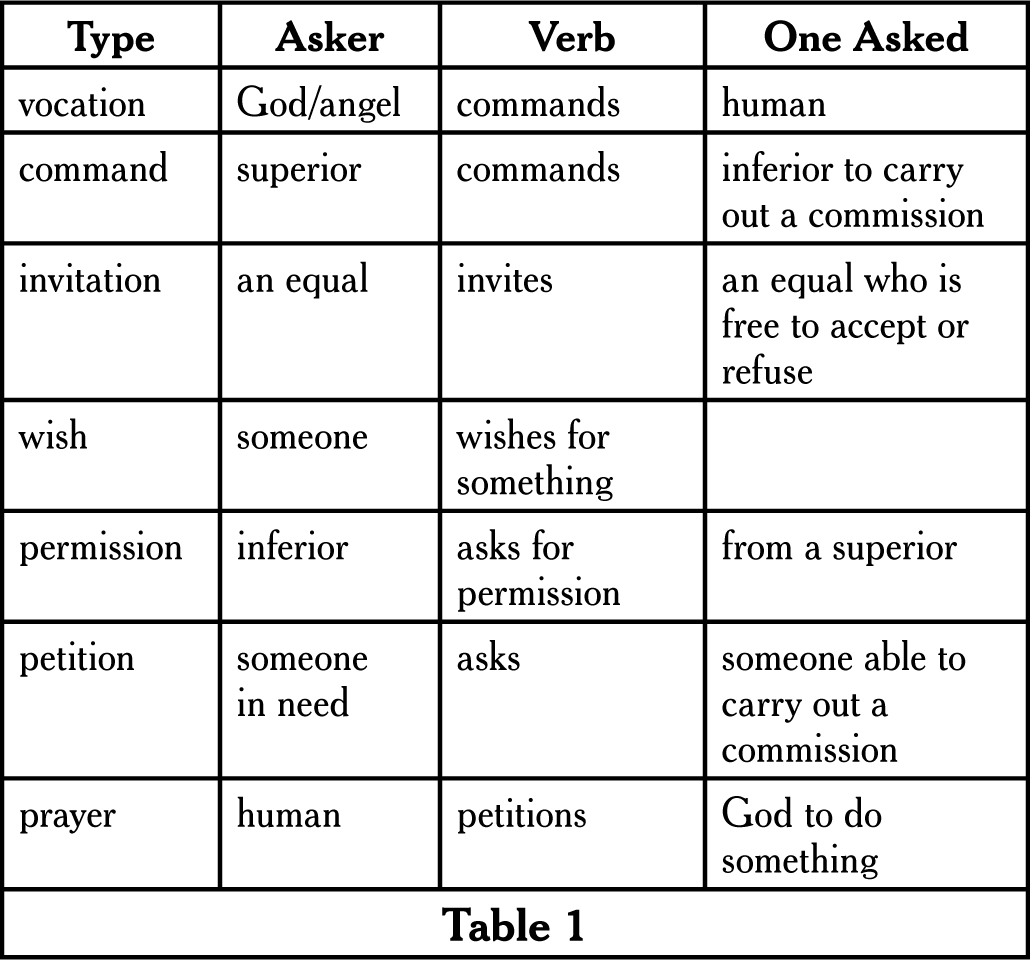
The call narrative in one of its variations typically serves as the subplot moving the story forward toward its resolution; as a result, it is one of the most pervasive subplots in narrative.
In Genesis 12:1–4, God calls Abraham and promises him land and progeny. Abraham does not object but instead goes, “as the L
As Habel recognizes, the pattern is often complicated by the person called either objecting or asking some question. This element can both heighten the tensions and reveal character. When Isaac commissions Esau to bring him savory food, Esau does so without objection, but when Rebecca calls and commissions Jacob to bring “two choice kids,” Jacob objects that his brother is hairy and that, being found out, he will receive a curse. His mother answers by claiming the curse for herself and sends him off (Genesis 27). Jonah famously flees in the opposite direction.
Those without authority must invite or beg someone to carry out the commission. The besieged people of Jabesh Gilead send out a general call asking someone to take the commission, and Saul answers by calling Israel to arms (1 Sam 11). The elders of Gilead do the same with Jephthah, who raises an objection which they must answer (Judg 11:4–11).
Importantly, all prayers of petition, including the psalm that Gunkel calls “lament,” belong to this genre. Hannah, for examples, prays for a child. The priest Eli objects that she is drunk in the sanctuary. When she answers the objection with her distress, Eli asks God to grant her prayer (1 Samuel 1). Related are the biblical stories announcing the birth of a hero studied by Timothy Finlay. These stories do not call a person to accept a commission but rather announce what will happen to the person.
Though the audience expects the person to accept the commission, it does not always happen. In the Book of Ruth, Naomi bids her daughters-in-law to return to their parents. Orpah obeys, but Ruth objects and instead continues with her mother-in-law. David also objects to Ittai joining his fleeing army since the king cannot demand loyalty of this newly arrived soldier, but Ittai objects, and David accepts (2 Sam 15:17–22).
A basic pattern can be outlined as follows:
The leader calls and commissions the hero. possible complication: The hero raises an objection or question. The leader answers this. The hero accepts.
The major variation has the hero himself call for the commission to which the leader may object or ask a question. When David volunteers to fight Goliath, Saul objects that he is only a youth, but David answers with stories of lions and bears. Therefore, Saul grants the commission and then arms him—a typical motif of the battle commissions (1 Sam 17:31–40; Booker: 22).
Exodus 1–12 presents an elaborate series of call narratives. In Exodus 1:15–22, the nefarious Pharaoh commissions the Hebrew midwives to kill the Hebrew boys, but they, of course, disobey. Ironically, Pharaoh's daughter commissions Moses' mother to nurse him (Exod 2:5–9). The commission of Moses at the burning bush extends through Exodus 3–4 with four objections by Moses, which the Lord answers. After receiving permission from his father–in–law (Exod 4:18–20), Moses returns with Aaron, who is commissioned in Exod 4:27. When they bring God's demand “Let my people go,” Pharaoh refuses to grant permission. Spurned by the Israelites, Moses receives a second commissioning (Exod 6:1–13; 7:1–6). Again he seeks permission from Pharaoh, who objects and relents only when Moses raises the tension with a new plague. Pharaoh, of course, breaks his word as soon as the plague ends, until the tenth plague (Exodus 7–12), but even then Pharaoh goes back on his word and pursues Israel making their Exodus. His continuing refusal reveals his hard–heartedness which sinks into the Red Sea. The question of call and acceptance lies at the heart of vocation, and Exodus continues to explore the question of Israel's vocation as they escape into the desert.
The scenes of call and commission continue to appear with the sending of anyone to do anything. Elijah's journey to Mount Horeb becomes a re–commission of the prophet (1 Kings 19). The stories of the Shunammite woman and of Naaman the Syrian (2 Kings 4–5) also depend on the call narrative and its acceptance, to name but a few.
Call and commission is central to the ministry of Jesus and his calling of disciples. Matthew, when called, does not object, but the Pharisees do (Matt 9:9–13). We find the pattern also in the Angel Gabriel's birth announcements first of Zechariah and then of Mary (Luke 1); each questions the angel, but with different results, indicating a different mindset. One of the most interesting variations on the pattern comes at the wedding feast of Cana. The mother of Jesus points out that they have no wine, with the implication that he should do something. As often happens in the tradition, he objects: “Woman, how does your concern affect me? My hour has not yet come” (John 2:4). Rather than answering the objection, she does what only a mother can do and forces his hand by commissioning the servants: “Do whatever he tells you” (2:5). Then he commissions them to fill the jars, and so his ministry begins. The call narrative also plays a critical role in many of the healing narratives, and the Gospels end with various commissions to evangelize. Finally, the call of Saint Paul with that of Ananias is one of the best known in the Bible (Acts 9:3–19), but there are many more.
Again Robert Alter criticizes form criticism as “set on finding recurrent regularities of pattern rather than the manifold variation upon a pattern that any system of literary convention elicits” (Alter: 55–56). Habel identified one version of the pattern, but his narrow focus did not allow him to connect it to the many other passages where it appears. It or some variation is a standard feature of narrative.
Journey: The Quest, and the Voyage and Return
We turn next to journey because so much of the Bible narrates a journey, and ultimately a journey to God. Excluding battle stories, the Old Testament has some eighty narratives in which journey plays a significant role. The New Testament, if one counts Jesus' journey from Galilee to Jerusalem as one unit, contains another twenty, with the Acts of the Apostles being a series of journeys (Hagan: 2017).
Booker names two types of journey: the journey quest, and the voyage and return. The hero's quest for a specific goal, perhaps as the result of a call and commission, explores the theme of desire and fulfillment. Booker's examples include Homer's Odyssey, Virgil's Aeneid, Dante's Divine Comedy, quests for the Golden Fleece and the Holy Grail, Tolkien's The Lord of the Rings, Steven Spielberg's The Raiders of the Lost Ark, among others (Booker: 69–72). The object of desire as well as the hero's way of reaching it provides the basis for a larger interpretation at the psychological and spiritual levels.
The story of voyage and return takes the hero away from the known and predictable into a new world of difference and challenge. The allure of possibility rather than a specific goal causes the hero to set out. This journey invites the audience to observe how and why these heroes change, if in fact they do. Booker's examples include Robinson Crusoe, Gulliver's Travels, Alice in Wonderland, The Wizard of Oz, and the parable of the Prodigal Son. Typically, these stories of voyage and return tell of maturation and transformation (Booker: 87–89).
Journey is also a major feature of American literature, and Janis Stout has surveyed its patterns and significance. The earliest stories tell of escape from the old world to the new, but they quickly become voyages of adventure or quests for home–founding. Except for African Americans and Latinos who move northward, the American journey is relentlessly westward. Examples include Cooper's The Pioneers, Wilder's Little House on the Prairie, Steinbeck's Grapes of Wrath. Melville's Moby Dick tells of Ahab's quest, and Huckleberry Finn recounts the voyage and return of Huck and Jim. Jack Kerouac's On the Road offers a new type of journey in the twentieth century: a wandering without purpose or end. As Stout's book shows, the journey is pervasive in American literature, but there is no monomyth; rather, the journey provides a framework for telling many different stories.
For journey narratives, space and geography represent more than physical location, as Jurij Lotman and others have emphasized (Lotman: 217–39; Ryan). This insight is not new to biblical studies. The Egypt of Exodus has the plain sense of a land of slavery and oppression, which also must also be understood at the psychological and spiritual levels. Still, as Thomas Dozeman has noted, modern biblical studies have taken “a one–sided approach to biblical geography in contemporary study, which lacks a critical exploration of the ideological role of setting in creating a cultural and religious landscape in the writing of biblical history” (Dozeman, 2007: 103). The journey represents more than physical movement. Much of the Old Testament focuses on home-founding while the New Testament becomes a journey to the ends of the earth on a quest to preach the gospel.
Subplots for Journey: Trials and Temptations
During the journey, heroes with their companions “go through a succession of terrible, often near fatal ordeals followed by periods of respite when they recoup their strength, receiving succor and guidance from friendly helpers to send them on their way” (Booker: 73). Booker divides these into trials that come from the outside and temptations that come from within.
He gives four typical trials:
a difficult terrain, such as Frodo encounters in The Lord of the Rings,
a battle with a monster, such as Odysseus' battle with the Cyclops,
navigation between deadly opposites, as between Scylla and Charybdis in order to find the middle way, and
the journey to the underworld. (Booker: 73, 76).
Temptations come from within and can be divided into two types: appetite (food, sex, pleasure, wealth) and animus (anger, pride, ambition). The hero must show self–control in order to move the story forward. “The danger to the hero is simply that he will be seduced and lulled into forgetting the great task that he has undertaken, and will abandon his quest under some beguiling spell” (Booker: 74). The hero who endures these tests and temptations proves his or her worth as a human being—a major theme of the journey.
Journey in the Ancient World
The Bible develops within a world of journey narratives, most importantly for western literature, Homer's Odyssey and Virgil's Aeneid. In Egypt, the most important journey is that of the dead, which has no coherent written narrative. It also figures importantly in the Egyptian stories of “Sinuhe,” “The Story of the Ship–Wrecked Sailor,” “Tale of Two Brothers,” and “The Tale of the Doomed Prince” (Simpson: 45–53, 54–66, 75–79, 80–90). Mesopotamia provides important examples of the journey to the underworld, which sometimes serves as a test as they explore themes of death and fertility (rebirth) as in “Inanna's Descent to the Underworld” (Foster 2005: 498–505). Most importantly, journey shapes important parts of the Gilgamesh Epic, particularly the journey to Utnapishtim in his search of eternal life (Foster 2001: Gilg. IX–XI).
For Israel, however, the journey is first a journey toward— toward the land and then toward Jerusalem; later, it becomes a return to the land and Jerusalem because the biblical journey is always a journey toward God.
Journeys in the Book of Genesis
After the expulsion of Adam and Eve from the garden, Cain becomes “a fugitive and a wanderer on the earth” (Gen 4:12). Noah survives his voyage in the ark, as did his Sumerian and Akkadian predecessors (Foster 2005: 227–80). Instead of eternal life, which his Mesopotamian counterparts received, Noah receives God's covenant, promising never again “to destroy all mortal beings” (Gen 9:15).
The journeys of Abraham follow, and two themes dominate, as Dozeman notes: “the divine promises of many descendants and of a homeland” (Gen 12:1–4: Dozeman 2017: §1.2). The theme of the land, as Dozeman points out, resolves with the buying a tomb for Sarah (Gen 23; Dozeman 2017: §5.3). The story's main tension, progeny, rises with the renewal of the promise in Genesis 15 and 17. The visit of three men in Genesis 18 foretells the birth of Isaac in Genesis 21, which resolves the tension. However, God raises the tension again and “puts Abraham to the test” by demanding the sacrifice of Isaac. This too requires a journey to a mountain, where God will provide (Gen 22:2, 14). This final test again reveals Abraham's trust in God who provides. Though Abraham does not change, the journey with its tests reveals this hero's profound spiritual maturity.
Like Abraham's servant in Genesis 24, Jacob makes a journey to Haran to find a wife (Genesis 27–32). The opening theophany at Bethel brings Jacob's conditional response, revealing his immaturity. In Haran, he finds his wives, a story of comedy, and becomes wealthy, in spite of his father-in-law. When he decides to return, he must deal first with Laban in another comic scene ending in reconciliation and covenant. Jacob expects his journey to end in a battle with Esau, but the night before, he engages in a single–handed combat with a “man” who gives him the new name of “Israel,” for, as he says, “you have contended with divine and human beings and have prevailed” (Gen 32:29). This battle marks the end of Jacob's spiritual transformation developed in the course of his voyage and return.
The story of Joseph continues to explore the relationship between brothers and family (Genesis 37; 39–50). Booker categorizes it as “rags to riches” (Booker: 58). However, from my perspective, the story builds on journeys. Jacob sends Joseph on a journey to his brothers. They sell him to traders who take him to Egypt, while they return to their father with a lie. In Egypt, Joseph is tested by Potiphar's wife, and the husband throws him in jail—a kind of journey to the underworld. Called by Pharaoh, Joseph passes the test as an interpreter of dreams and becomes second in the kingdom. When the famine comes, his brothers, sent by Jacob, make the journey to Egypt. Recognizing them but hiding his identity, Joseph creates a comedy by keeping Simeon and sending the others back with a demand for Benjamin. The brothers make a second journey with Benjamin, but Joseph, again hiding his identity, sends them away only to have his servants chase them down and find his cup in Benjamin's sack. At their return, the comedy ends with Joseph revealing his true identity and reconciling with his brothers. Jacob is sent for and makes the journey to Egypt with the rest of the family, but at his death Joseph makes the return journey to bury his father in the homeland. The brothers' journeys and Joseph's revelation of his identity should bring maturation and reconciliation, but Genesis 50:15–21 raises questions.
The Exodus, the Desert, and the Promised Land
The flight from famine has taken Israel out of the land of promise. The Books of Exodus, Leviticus, Numbers, and Deuteronomy tell of the return, and it is a story of many journeys.
Exodus 2 begins with the hero, Moses, put into a little boat and ending up in Pharaoh's palace. When grown, he must make an escape from Egypt. In the desert, his journey brings him to the burning bush of Horeb, where God calls and commissions him to return to Egypt (Exodus 3–4). In Exodus 5–11, Moses and Aaron make the journey to Pharaoh and call for permission to make the journey to the mountain of God. Though the tenth plague forces Pharaoh to allow the journey, he changes his mind and with his army pursues Israel in order to do battle. Egypt, of course, is swallowed by the sea as Israel looks on from the other side (Exodus 13–15).
Crossing the Red Sea does not resolve all the problems; rather, the journey through the desert is filled with trials and temptations, as is typical of the tradition. The hero's character should grow and mature as he or she deals with these obstacles. Here all three main characters—Israel, Moses, and God—are tried and tempted.
Food and water become the first of the trials with God resolving the conflict by sending quail and manna, and then water from the rock (Exodus 16–17). When Moses journeys up the mountain, Israel gives into the temptation of idolatry and has Aaron make a golden calf. This draws the anger of God, who is ready to destroy Israel. Only Moses, caught between the two, is able to bring about a change that reconciles Israel and keeps God from destroying the promise (32:13–14). Though God tempts Moses with a promise to make him the new Abraham (Exod 32:10), Moses does not give in and continues to intercede for Israel and to assuage God's anger. Even so, these tensions continue and are never fully resolved contrary to what the tradition suggests.
With trial and temptation also comes the experience of revelation in the theophany at Sinai. Moses has his own personal theophany that transforms him and makes his face shine (Exodus 32–34). Though Moses becomes a prototype for Israel's transformation, the people are never completely transformed; they continue to complain and so draw God's anger. After the completion of the Tent of Meeting and more law, the testing begins again with food (Numbers 11) and water (Numbers 20) and various rebellions in between. Moses himself fails the test at Meribah by striking the rock twice, and God denies him entrance into the Promised Land (Num 20:12). The remainder of the desert journey turns the focus outward toward Israel's enemies.
Kenton L. Sparks in his essay, “Genre Criticism” for Methods for Exodus, notes:
Scholars have frequently compared parts of [Exodus] to “historiography” (Exod 1–18), “law codes,” “treaty texts” (Exod 19–24), “prescriptive rituals” (Exod 25–40), “legends” (stories that explain the origins of religious institutions), “religious propaganda” (Exod 32–34), and “biography” (parts of the book are about the life of Moses) [65].
These have been typical and important categories of biblical scholarship, and they can be very illuminating. Sparks goes on to say:
Because each biblical text shares features from many generic categories, the best generic judgments about the biblical text will be made by those with the most exposure to, and best grasp of, the many genres found in the Bible, the ancient Near East, and human cultures farther afield [65].
Sparks characterizes Exodus 1–18 as a “compromise document” or possibly “an anthology” because it combines various traditions (72). His analysis of other sections finds mainly the genres that he lists above, and concludes that Exodus “includes a staggering variety of generic diversity that, in turn, reflects the multiplicity of authors and editors who contributed to the book” (93). Although Sparks talks about genres of “human cultures farther afield,” he does not utilize them; he only reflects on the general state of biblical scholarship. Booker's basic plots offer Sparks a way to connect these stories to the larger literature of the world.
Dozeman, in his masterful analysis, The Pentateuch, discusses the “wilderness journey” with its “trials and tests of the Israelite people” and then the reversal when the people “test God” (§6.3, 227, 230). He then traces the journey into Numbers 10:11–21:35 where the journey of the first generation ends in rebellion and death (§ 8.3, pp. 437–38). As is typical of biblical scholarship, Dozeman treats journey and trial as elements in and of themselves and does not set them into a larger, generic context. This essay points to that larger context in which rebellion and death are not the traditional end of a journey. That context does not suggest a different analysis but offers a larger framework.
After Moses' death, Joshua commissions spies to make the journey to Canaan, where the wily Rahab, professing the Lord as God, saves them from the king so that they can return. Israel then crosses into the Promised Land with the Jordan rolling back its waters as the Red Sea had done at the beginning of the desert journey (Joshua 3–4). The journey out, which began with Joseph, comes to an end as Israel returns home. The promise of land to Abraham in Genesis 12, so important to both the Deuteronomistic and Priestly theologies, is fulfilled.
Journey after the Exodus
Journey continues to shape many narratives in the remainder of the Old Testament. The Book of Ruth tells of the journey out to Moab followed by the return to Bethlehem. David is forced to flee the raving Saul who continues to pursue him, and his journey is marked by tests and temptations, particularly the temptations to kill Saul and Nabal (1 Samuel 24–26). After David takes Jerusalem, he brings the ark up in procession (2 Samuel 6). With this, Jerusalem becomes the geographical center and also Israel's psychological and spiritual center, crowned with Solomon's temple. Escape and flight fill the so–called “Succession Narrative” (2 Samuel 9–20; 1 Kings 1–2).
Journey also plays an important role in the prophetic cycle. In 1 Kings 17–19, Elijah flees Ahab, but reappears after three years. Though he defeats the four hundred fifty prophets of Baal in “battle,” he must flee, but strengthened by an angel, he journeys to Horeb where he receives the theophany of the still, small voice. Other journeys follow until both he and Elisha cross the Jordan, where he is caught up in a whirlwind, leaving Elisha to make the return journey with his master's mantel (2 Kings 2). Jonah combines the journey with the call narrative and lots of objections, with the motif of a good foreigner making an appearance, both on the ship and in Nineveh.
The journeys into exile, first to Assyria and then to Babylon, come to dominate the biblical imagination as Martien A. Halvorson–Taylor has argued in Enduring Exile: The Metaphorization of Exile in the Hebrew Bible (199–204). Ezra and Nehemiah recount something of the return and the rebuilding of the Temple and the walls of Jerusalem. From another perspective, the creation of the Torah establishes a way for Israel to create its own sacred space among the nations. Wisdom literature supports this by offering two ways, and Psalm 119:1 calls happy those “who walk in the law of the L
Journey in the New Testament
For some time, scholars have recognized the importance of journey In the New Testament, particularly in Luke–Acts (Talbert: 116–19; Matera: 62). Moreover, Jesus calls himself the Way (John 14:6). The journey to Emmaus is a classic example of journey out and back, marked by transformation when the disciples recognize the identity of their companion (Luke 24:13–35). As many scholars have noted, Acts 1:8 captures the basic call and commission of the book, which leads to many journeys: “You will be my witnesses in Jerusalem, throughout Judea and Samaria, and to the ends of the earth.” Paul's letters and even the later epistles presume the context of his journey. Finally, the Book of Revelation ends with the vision of the New Jerusalem and its twelve gates through which “people will bring into it the glory and the honor of the nations” (21:26). The journey serves as one of the great metaphors for life, and the Bible celebrates journey as a metaphor for life's spiritual journey to God.
Overcoming the Monster: The Battle Narrative
Booker's plot for “overcoming the monster” tells of a threat by an enemy and its resolution with the hero's victory. By monster, Booker means “some superhuman embodiment of evil power,” which includes Little Red Riding Hood's wolf, David's Goliath, Beowulf's Grendel, and St. George's dragon (Booker: 23–26). While the enemy may be a monster, the antagonist may also be an ordinary human being like all the bad guys in westerns and police stories. This “enemy” represents the forces that threaten the hero's society, and the hero's victory signifies the conquest of those values and structures. The victory also proves the worth of the hero, and it presents her or him as an ideal person.
In the ancient Near East, battle narrative divides into two main patterns: the heroic and the royal (Hagan 2013: 19–52; Jason: 471–516). In the heroic pattern, the enemy's appearance brings a threat which causes “our” side to react with fear and helplessness. The middle of the story heightens the tension, while preparing for its resolution by finding and commissioning the hero. Sometimes, false heroes are commissioned but fail to conquer the enemy and so heighten the tension. Once commissioned and armed, the hero typically gathers and commissions an army before setting out on the journey to the battle. The final scene brings the hero and the enemy together in single-handed combat. Typically, a verbal exchange makes clear the themes of the battle. The hero brings down the enemy with a projectile and ends by cutting off his head. “Our” side, seeing the victory, pursues the enemy, now fleeing in fear. After their total destruction, “our” side takes the plunder and then acknowledges the hero. This pattern fits Marduk's battle in the Enuma elish, Ninurta's in the Anzu Myth, Gilgamesh's against Humbaba, Baal's against Yamm, Sinuhe's against the Strong Man of Retenu, and Achilles' against Hector in The Iliad. Mark S. Smith has recently discussed many individual motifs in Poetic Heroes, his survey of battle poetry.
The royal pattern begins with the hero already designated as the king. An attack by the enemy causes the king to call for a commission from the deity who joins him in battle (Hagan 2013: 53–76). As shown in the study of K. Lawson Younger, Jr., these narratives typically underline the king as the agent of the deity, and the celebration of the victory includes sacrifice to acknowledge the deity (Lawson: 72–79).
David's battle against Goliath reflects the full heroic pattern. The story opens with a description of the enemy-hero and his challenge, which causes the typical reaction of fear: Israel becomes “dismayed and greatly afraid” (1 Sam 17:1–9). The narrator then introduces the hero, the boy David, whose father gives him the commission to take supplies to his brothers on the battlefield. On his arrival, David hears Goliath's challenge and sees Israel's reaction of fear. Hearing of Saul's reward to the man who faces Goliath, David asks about it again and is rebuked by his eldest brother, a false hero. When he hears of the boy's interest, Saul sends for David, who immediately calls for the commission, but Saul objects that he is but a boy. David answers that he has killed both lions and bears and so will bring down this enemy who has “defied the armies of the living God” (17:35). Saul then gives his blessing: “Go, and may the L
As the hero and enemy meet, the verbal exchange clarifies the meaning of the literal battle. Here, David, the only one to use Y
The battle at the Red Sea also reflects this pattern and theme, but here there is no human hero. The approach of the Egyptian army causes Israel to rebuke Moses for bringing them out of Egypt. Moses counters their reaction of fear by telling them not to fear, for “the L
The Book of Judges, with its unlikely heroes, also underlines this theme of the Lord as hero: the left–handed Ehud is alone; Jael is a woman; Gideon is the biggest coward in his tribe; Jephthah has been driven out as the bastard outcast; Samson, though the traditional strong man, wins his greatest battle after being captured and blinded. The boy David also fits into this line of unlikely heroes, as do the boy Daniel fighting Bel and the widow Judith (Daniel 14; Judith 8–10). In her story, Judith does not ask for the commission but shows her moral superiority by announcing to the elders that she is going to do something heroic but does not tell them what. Then she arms herself by taking off her widow's garments and making herself beautiful. With her maid, Judith sets off for the single–handed combat with Holophernes and, of course, returns with his head. The motif of the unlikely hero undermines the traditional ideal of the strong hero and emphasizes instead the Lord as the true if unseen hero in these biblical stories.
In the royal pattern, the hero is already designated but is away when the enemy threatens “our” side, who reacts with fear. The Book of Joshua also fits the royal pattern which begins with the commission of Joshua (1:1–9), who then carries out the command of God unswervingly. The pattern shapes Saul's victory over Nahash in 1 Samuel 11 as well as three battle narratives in 2 Chronicles 13:1–22, 14:9–15, and 20:1–30. In general, the Chronicler heightens the piety of Judah's good king through his prayer and speeches while minimizing the human involvement in order to celebrate God as the undisputable hero.
The Book of Kings introduces a new character, the prophet, who is pitted against the King of Israel—invariably a bad king as in 1 Kings 20; 22; 2 Kings 3; 6:8–23, and 6:24–7:20. The primary tension shifts from a fight between Israel and its foreign enemy to a conflict between the king and the prophet. Comedy overtakes the battle narrative as focus shifts from the attack by outsiders to the question of whether the king of Israel can recognize the prophet as an agent of the L
As the Books of Kings unfolds, reality overtakes the traditional pattern in which “our” side always wins. The Assyrians and then the Babylonians defeat “our” side, with exile following. The traditional battle narrative gains ascendency again with the rise of the apocalyptic tradition. It foresees a cosmic battle in which the archetypal enemy is defeated and all who have stood firm during the terror find a place in the kingdom of the Messiah.
The Apocalyptic tradition shapes the New Testament context as the ultimate conflict with evil. However, in the Gospels, the battle becomes a verbal rather than a physical fight, with the religious leadership in the various “controversy stories” explored by Herbert Ulonska and others. The religious establishment attacks Jesus with their arguments, which he defeats with wit and a new vision. When attacked physically, Jesus does not respond in kind, as Peter would have him (John 18:11), and contrary to that tradition, the hero dies.
Rags to Riches
The title of this basic plot describes its tension and resolution. The hero begins with nothing and ends up becoming rich and powerful. Booker sees this as the story of “an ordinary, insignificant person, dismissed by everyone as of little account, who suddenly steps to the center of the stage, revealed to be someone quite exceptional” (Booker: 51). His examples include King Arthur, who pulls the sword from the stone, Eliza Doolittle in My Fair Lady, Clark Kent as Super-man, Cinderella, and more. In American literature, this plot describes the nineteenth century novels of Horatio Alger in which impoverished boys overcome various obstacles to strike it rich. Alger's stories celebrate hard work, determination, and moral uprightness; as such they embody American Pelagianism—salvation by self alone.
Booker finds the Joseph story as a prime biblical example of this plot; however, he misses the spiritual dimension (Booker: 58–59). The Bible ties prosperity to blessing, and as we hear in Proverbs 10:22, “The blessing of the L
This basic plot also shapes the story of Jacob's growing wealth despite Laban's trickery. Likewise, the Book of Tobit chronicles the father's move from poverty to wealth and includes the journey with a marriage for his son Tobias and rebirth in his healing from blindness. Tobit's good fortune is tied to his upright behavior, particularly his burial of the dead. The link between virtue and blessing is again an important feature of the wisdom tradition.
The Sermon on the Mount begins: “Blessed are the poor in spirit, for theirs is the kingdom of heaven” (Matt 5:3), and in Mark 9:35 Jesus says: “If anyone wishes to be first, he shall be the last of all and the servant of all.” A new paradigm is at work, and yet it stands in continuity with what is found in the stories of Jacob, Joseph, and Tobit. The biblical “rags to riches story” does not celebrate self–reliance but reliance on God to resolve the basic tension of poverty versus wealth and power.
Comedy
Comedy can have several meanings. It sometimes refers to humor. As a genre, it often serves as an umbrella for stories that reach a happy ending as opposed to tragedy which ends badly. In that sense, all of the basic plots discussed here, with the exception of tragedy, would fit under that umbrella. Booker defines comedy more narrowly by building on Frye's understanding of it as “a movement from illusion to reality” (Frye 1971: 169–70). For Booker, comedy tells the triumph of identity and insight over separation and confusion.
Booker begins his survey with the two stages of Greek comedy. “Old comedy,” particularly that of Aristophanes, sets out a conflict between two characters: one with “some dark, rigid, life–denying obsession” and the other who “represents life, liberation and truth.” The latter triumphs in the end. “New comedy” tells the story of a boy and girl who fall in love but are prevented from marrying by the dark forces of the old order, typically represented by the girl's father or a false suitor. Overcoming the old, the boy and girl marry and establish the new order of love (Booker: 108–13; also Frye 1971: 163). This basic plot remains pervasive and is playing on a movie screen nearby.
Frye describes the movement of comedy as U–shaped: The fortunes of the protagonists becomes more and more desperate during the first part of the story, but finally turn with truth and love winning the day. Frye sees the whole of the Bible reflecting this U–shaped plot, which begins with the expulsion from the Garden in Genesis 3 and comes to a conclusion only with the entrance into the New Jerusalem in Revelation 21–22 (Frye 1971: 141; 1982: 169). Cheryl J. Exum edited a famous collection of essays that followed Frye's lead, and others, including William Whedbee, have continued in that line (Exum 1985).
Booker differentiates comedy from the other basic plots with his emphasis on recognition and identity at both a literal and a psychological level. The tension rises because the characters are “in some way unaware of each other's true identity or indeed their own.” Dark characters, imprisoned in “some hard, divisive, unloving state” must be liberated, while others discover their true identity and often “their true ‘other half.’” Resolution comes with the recognition that brings about insight and union with all division, separation or loss repaired (Booker: 111–16). While union in romantic comedy means marriage, the ultimate union in the Bible is with God.
The stories of the marriages of Jacob to Leah and Rachel (Gen 29), Ruth and Boaz (Ruth 2–4), Abigail and David (1 Sam 25), and Tobias and Sarah (Tob 7–8) easily fit into this understanding of comedy. Genesis 2 also fits: God without any foresight creates hā–?ādām, who is soon lonely. Though God creates animals for hā–?ādām, who names them, the loneliness does not depart. God then takes bone from the side of hā–?ādām, who recognizes the other as “bone of my bones and flesh of my flesh” and so a “suitable partner.” The two, now “male and female,” are joined to become “one flesh,” and for the moment all is well.
Deception, particularly false or mistaken identity, is a major motif in the Old Testament, especially as a strategy for the weak heroes. Its presence indicates that comedy is shaping the narrative. Jacob wakes up to find Leah instead of Rachel in his bed (Gen 29:25). Joseph conceals his identity from his brothers (Gen 42:8; 43:30–31). Tamar relies upon a deception and false identity to become pregnant and resolve the tension (Genesis 38). Rahab lies to the king's servants in Joshua 2, and the Gibeonites lie to Joshua in Joshua 9. In various ways, Ehud, Jael, Gideon, and Samson rely on deception in the Book of Judges. Solomon resolves the identity of the true mother by deception in 1 Kings 3. People are often scandalized by so much deception in the Bible, but it underlines the need to look beyond appearances to discern the larger reality at hand.
Within the Deuteronomistic corpus, identity is a central question: Who is the true God? Who are the true worship-pers of this God? The stories of prophets in the Books of Kings explore this in various ways and so become comedies. A prophet disguises himself in 1 King 20 to unmask Ahab, and in 1 Kings 22:29–34 the king of Israel disguises himself only to be hit by a stray arrow. The Deuteronomistic corpus, however, ends not as a comedy but as a tragedy with its stories of conquest and exile. The curses of the covenant bring the kingdoms of Israel and Judah to a tragic end.
The stories of the Priestly theology found in Genesis through Numbers, Chronicles, Ezra, and Nehemiah are more hopeful with their insistence upon Torah identity. Both Noah and Abraham prove themselves unfailingly righteous and so offer little in the way of comedy. Moses, except for his one lapse at Meribah, is similar (Numbers 20). Pharaoh is a comic figure because he does not recognize that the Lord is God, and the Israel of the Exodus plays a comic role in its readiness to return to Egypt. Even the Lord, ready to destroy the fickle Israel, must be reminded by Moses of his divine promise to the ancestors. Still, Priestly insistence on Torah identity precludes the need for comedy, and the people of the promise are able to live out their identity wherever they may find themselves, and so establish through the Torah a connection to Judah and Jerusalem. Although the Priestly Corpus ends happily in the Books of Ezra and Nehemiah with the return to rebuild the Temple and Jerusalem's walls, Torah identity, and not return, is the central element of its happy ending.
The Gospels are comedies in the sense that their tensions turn on the ability of individuals to recognize correctly the identity of Jesus of Nazareth. Those who make the correct identification become his true disciples and are united to him in baptism. From this perspective, Jesus' question provides a key verse: “Who do people say that I am?” (Mark 8:27; Matt 16:13; Luke 9:20). The Gospel of Mark focuses particularly on this question as the disciples struggle to grasp the demands of discipleship. In all the Gospels, those who do not or cannot correctly identify Jesus become outsiders even though they may have been insiders before his coming.
The question of identity carries into the Acts of the Apostles, which reports that “it was in Antioch that the disciples were first called Christians” (Acts 11:26). The question also shapes Paul's experience of conversion: “Saul, Saul, why are you persecuting me?” Paul answers, “Who are you, sir (kúrie)?” (Acts 9:5).
Tragedy
Booker defines tragedy as stories ending in death—not peaceful death at the end of a full life, but “death that is violent and premature, a death that is ‘unnatural,’ … which shows that something has gone hideously or, as we say, tragically wrong” (Booker: 153–54).
I would add that some death is comic. When death puts an end to evil, we do not weep; instead, we rejoice. Therefore, Goliath's death is comic, as are Sisera's at the hand of Jael, Egypt's destruction at the Red Sea, and Haman's in the Book of Esther. Tragic death, on the other hand, results from a person's sin, or from some human flaw, or from blind fate—and sometimes a mix of all three (Humphreys: 3). To achieve this sadness, tragedy requires some psychological realism while comedy is able to deal in stereotypes.
Tragedy appears early in the Bible. The comedy of Genesis 2, which ends with the man and woman having nothing to hide, gives way to the tragedy of Genesis 3 where the eating of the fruit brings shame and the punishment of expulsion. Genesis 4 follows with the murder of Abel and the wandering exile of Cain. Is Cain a tragic figure, or has he merely gotten his just desserts?
Dozeman underlines the failed Exodus journey of the first generation in the wilderness; though he does not call it a tragedy, still he names a fatal flaw in this generation. In Numbers, their “murmuring in the wilderness journey from Sinai signals the rejection of Yahweh, which culminates in the death of the first generation” and so their loss of the Promised Land (Dozeman: §8.3, 437–38). These are the people that Moses has sought to save, but in the end, he can save only their progeny, the next generation who will come into the land.
Tragedy looms over the death of Achan, who acknowledges his sin and still suffers death for it (Joshua 7). There is some discussion on whether or not the death of Samson is tragic (Exum 1992: 42–44; Humphreys: 68–72). Surely his death is sad, in part because Samson's physical blindness expresses his moral blindness; yet his death, even by his own hand, reveals a hero, for “those killed at his death were more than those he had killed during his life” (Judg 16:30).
The first great tragic figure of the Bible is Saul. Though he is incompetent in 1 Samuel 13–14 and disobedient in 1 Samuel 15, Saul's sin lies primarily in his refusal to acknowledge David as God's chosen hero, unlike his son Jonathan who acknowledges and enters a covenant with David (1 Sam 18:1–4). The story presents a complex character by juxtaposing pictures of Saul's raving, his pursuit of David, and his repentance both in 1 Samuel 24:16–22 and 26:21–25. “I have done wrong. Come back, David, my son! I will not harm you again,” he says in 1 Samuel 26:21. Though sincere, Saul cannot be trusted. The tragedy deepens as he meets the dead Samuel through the medium at Endor who then tenderly feeds the distraught king. Her care reveals the humanity of both. On Mount Gilboa, Saul dies by his own hand with his armor–bearer refusing to take the life of the king—a link to David, who was once the king's armor–bearer. The good Jonathan, like the good Hector, also dies a tragic death because he remained faithful to his father and king rather than abandoning that loyalty to follow his friend, the chosen one. David's celebration of their death and of the love forged in war, in contrast to the love of peace, adds to the sense of tragedy (2 Samuel 1). Saul dies for his refusal to acknowledge David, complicated by his personal instability, and he brings down with him the good Jonathan. All tragedy is not the same, though it is all sad.
There are others: Jephthah's daughter by the hand of her father; Joab, David's faithful heroic friend, who is betrayed by and then betrays his king. The destruction of Samaria by the Assyrians and that of Jerusalem by the Babylonians are handled as tragedies, and the Bible becomes a response to those tragedies.
The life of Jesus appears to end tragically as Cleopas on the road to Emmaus laments (Luke 24:21), but death is not the end of that story, but resurrection.
Rebirth
Booker describes the plot for rebirth as a movement from death to life, and this includes the movement from winter to spring, sickness to health, imprisonment to liberation, shadow to reality, sleep to consciousness, despair to hope, lack of love to love, death to rebirth (Booker: 204). As examples, Booker points to Sleeping Beauty, A Christmas Carol, Crime and Punishment, Fidelio. In some ways, everything that is discussed above, except for tragedy, could metaphorically fit here, more or less, as a movement from death to life.
The stories of Christ's resurrection, of course, belong to the plot of rebirth. Some find this an embarrassment because it seems to secularize the event and make it just another example as in James Frazer's skewed study, The Golden Bough. However, the link underlines the centrality of the question to human beings. By recognizing this connection, the reader is able to link the resurrection to many other stories.
Every story of sin and conversion is a story of rebirth— to name but some: Peter with his acknowledgement after the great catch of fish, Matthew the tax collector, Zacchaeus in the tree, Peter again after the resurrection. Still, each of these is different. Healings as well as the casting out of demons also reflects both a physical and spiritual rebirth. Mark's Gospel opens with a series of healings: the man with an unclean spirit, Peter's mother-in-law, “all who were sick or possessed,” a leper, etc. The text makes the connection clear by using the vocabulary of the resurrection (egeírō—raise: Mark 1:31; 2:9, 11–12; 3:3; 5:14, and 16:6). Likewise, the feeding of the four or five thousand finds a place here as do parables like the mustard seed, the leaven, the prodigal son, and the Good Samaritan. All of these stories share the basic plot of rebirth with the stories of the resurrection. As a result, they both support and draw from the resurrection of Christ.
Dennis Horton goes beyond this generic connection and argues that “the death–resurrection motif” specifically shapes the Acts of the Apostles, particularly “imprisonment-release episodes, healings, and shipwrecks-rescue scenes,” so that they reflect the crucified and risen Messiah (Horton: 104–05). In chapter two, he traces this “motif” in the stories of the major characters: Peter, Stephen, and Paul, with minor characters following in chapter three. Horton concludes that the motif “creates a theological balance between suffering and renewed life” and so “should inform our understanding of Lukan soteriology and discipleship” (111–12).
The Old Testament too has its rebirth narratives: Isaac replaced by a ram (Genesis 22), Joseph's emergence from prison (Genesis 41), Israel's escape from Egypt, David's repentance (2 Samuel 12), Absalom's return in 2 Samuel 14, the rain at the end of 1 Kings 18, Elijah's vision on Mount Horeb (1 Kings 19) and his being caught up in the chariot of fire (2 Kings 2). In 2 Kings 4, Elisha raises the dead son of the Shunammite woman, and in the next chapter, he heals Naaman the leper. Tobit's journey from blindness to sight tells of rebirth on various levels. The various prayer psalms that end with a thanksgiving hymn also reflect this pattern. Finally, Old Testament's main story of rebirth, the Exodus, becomes a paradigm for Judah's return from Babylon.
From this perspective, the story of the resurrection connects so many pieces within the Bible.
Summary
As shown in this paper, Christopher Booker's basic plots shape biblical stories just as they shape the narratives of world literature. These plots appear everywhere, and people use them (mostly unconsciously) to understand movies, television shows, novels, and more.
This essay, therefore, breaks from the rather narrow and outmoded confines of biblical form criticism and offers readers and preachers, students and scholars a larger generic context for understanding biblical narrative. These practical categories deserve the concentrated attention of scholars, but high school students could easily use them to analyze biblical stories and relate them to their own world of stories. The similarities of plot should help set into relief the differences and thereby highlight the singularity of the text at hand. This article neither names all the examples nor explores all of the complications and their thematic possibilities. This would be impossible, for as Victor Shklovsky argues, the artist is forever finding ways to defamiliarize the tradition and show us the world anew.
The modern study of narrative, as Danna Nolan Fewell observes, charts the “shifts from the initial New Critical emphasis on the Bible's ‘art’ and ‘poetics’ … to poststructural and post classical acknowledgment of textual instability and undecidability, opening biblical poetics to the realms of the personal and the sociopolitical” (Fewell 2016a: 4). Some may be inclined to see this approach as a return to the certainties of the New Critics, but I have tried to emphasize that the recognition of the generic plot helps the reader to see the singularity and complexity of each story. These basic plots are not pigeonholes implying only one possible meaning; rather they should help the reader see the possibilities offered by these texts.
Footnotes
Appendix: Summary of the Basic Plots

| Basic Plots | Tension | Resolution | Typical Theme |
|---|---|---|---|
|
|
present physical threat or past harm | victory | triumph of good over evil triumph of ‘our’ values |
|
|
poverty | wealth and status | independence and power; Bible: blessing |
|
|
something lost, needed, or desired | attainment | desire and fulfillment |
|
|
going out to the unknown, the new, the dangerous | returning changed to the known and the safe | maturation, transformation |
|
|
separation deception & masks illusion old order |
union true identity reality new order |
insight and love |
|
|
sin/flaw/fate | death | justice or fate |
|
|
death winter sickness unconsciousness sin |
rebirth spring health consciousness conversion |
life |
|
|
|||
|
|
call of a hero for a commission | hero's acceptance | duty, service |
|
|
external obstacle | success | worthiness |
|
|
internal appetites or animus | self-mastery | self-possession; moderation |
Though one plot may dominate, stories typically combine and repeat several basic plots and subplots. Storytellers are continually defamiliarizing the received tradition.