



Abstract
Luke is the singular evangelist to use the term “plan” (boulē) (of God). He is also the only NT author to use the related terms horizō/hōrismenos, and these he uses in a sense similar to “boulē.” This article investigates Luke’s construction and use of the term “plan (of God)” to convey a fundamental proclamation of faith, namely, that the Jesus event fulfilled a predetermined divine plan. Primarily three examples from Luke (Peter’s Speech at Pentecost, Jesus’ words at the Last Supper, and the claim that the Messiah must suffer) demonstrate this claim. Luke’s use of this term reflects Greco-Roman concepts more than those in the LXX and would therefore have been readily understood by his predominantly Gentile audience. Luke may be properly understood as the master architect of God’s plan. This image and language that he forged was ultimately so effective it influenced centuries of Christian thought and catechetical formulae.
To those accustomed to hearing “God’s plan” invoked with regularity by modern Christians, it might be surprising to learn that the term “plan [of God]” (boulē [tou theou]) appears infrequently in the New Testament. In fact, aside from Luke (e.g., 7:30, 23:51; Acts 2:23; 4:28; 5:38; 13:36; 20:27) it scarcely appears at all. Many NT authors speak of the events around Jesus’ passion, death, and resurrection as having happened in fulfillment of scripture or according to the will of God. Many biblical scholars find evidence of the divine will or salvation history in other NT authors such as Paul, even though Paul never uses the term “God’s plan.” Even the title of N. T. Wright’s Justification: God’s Plan & Paul’s Vision (IVP Academic, 2016) uses the term that Paul never does (“plan”). The accompanying chart illustrates how various NT authors use concepts similar to “God’s plan,” even if they do not use the precise term. Though some modern scholars show that “the rather common Greek notions of foreknowledge and predestiny were used by [NT] writers comfortable with the Greek philosophical milieu to reconcile the events that had taken place recently in Jesus of Nazareth with the historic events and promises of Israel’s past” (Oxford Companion to the Bible, s.v. predestination), the chart makes clear that it is Luke who is the primary NT author to use the more restrictive term “plan of God.” Luke himself seems to have a unique way of interpreting salvation/redemptive history as Conzelmann noted more than a half-century ago when he wrote of it as best understood as three phases: the time of Israel, the time of Jesus and the time of the Church. S. Schulz, echoing Conzelmann’s work, goes so far as to say, “the Hellenist Luke is the creator of salvation history” (104). But as we focus more squarely on the term, “plan of God” we hear J. T. Squires successfully demonstrate that “The plan of God is a distinctively Lukan theme which undergirds the whole of Luke-Acts, becoming especially prominent in the speeches of Acts” (186). Squires posits that Luke uses the “plan of God” motif to “explain Christianity in such a way that it might be more fully understood by Hellenized Christians” (191). Luke understands the plan of God as essentially this, “the Messiah must suffer and rise from the dead on the third day; in his name repentance for the forgiveness of sins must be preached to all the nations” (Luke 24:46–47). We shall see that this term is especially appropriate for Luke as it expresses concisely a classical concept that utilizes LXX language.
Divine Providence in Antiquity
The term boulē is used extensively in Classical Greek literature, especially with respect to the gods or divinity. What follows are some examples of the variety of terms used by many different authors in speaking of the wide-ranging topic of divine foreknowledge or plan. One of the earliest examples is from Homer, and he uses the term we seek to focus upon. In the opening lines of the Iliad we read that the “plan (boulē) of Zeus was fulfilled” (Dios d’ eteleieto boulē; Il i.5). But it is Plato (Timaeus and Laws, X) who gives the first systematic treatment of divine providence (pronoia, “forethought” or in Latin, providentia). And it is that term, pronoia, rather than boulē, which is used more often in the ancient Greek world to speak of divine foreknowledge. (Both pronoia and pronoeō are used infrequently in the NT and with the sense of “provision.” The term pronoia appears in Acts 24:2 and Romans 13:14, whereas pronoeō appears in Romans 12:17, 2 Corinthians 8:21, and 1 Timothy 5:8. Plato says in the Timaeus, “We must declare that this Cosmos has verily come into existence as a Living Creature endowed with soul and reason owing to the providence of God” (Timaeus 30B; cf. Timaeus 44C). In Laws X, 896E and following, there is the idea of the World Soul guiding the universe benevolently. Later in the same book Plato maintains that the divinity cares for things both great and small (Laws X; 901B–903B). Xenophon too speaks of providence when he says that the design of the human body with its specialty parts indicates foreknowl-edge (Memorabilia 1.4.6) as does the design of the world itself (Memorabilia 4.3.6). Seneca pens a work on the topic, On Providence, in which he addresses the riddle of theodicy as the first line in the treatise makes clear, “You have asked me, Lucilius, why, if a Providence rules the world, it still happens that many evils befall good men” (On Providence, 1.1). Plutarch addresses divine providence too in wondering about Zeus’ role in overseeing and directing other worlds (Moralia 426a), while also attributing to providence human sight and hearing (Moralia 436d).
On a note related to providence, Cicero wrote a treatise on what he termed “divination,” the foresight and knowledge of future events, which others might see as happening by chance. In this case he refers to the Greek term mantikē, which typically refers to something of a prophetic oracle, in the opening words of the entire work:
There is an ancient belief, handed down to us even from mythical times and firmly established by the general agreement of the Roman people and of all nations, that divination of some kind exists among men; this the Greeks call mantikē—that is, the foresight and knowledge of future events…. Now I am aware of no people, however refined and learned or however savage and ignorant, which does not think that signs are given of future events, and that certain persons can recognize those signs and foretell events before they occur [On Divination 1.1.1–2].
Even though divination, or mantikē, is a term not found in the NT, the concept that some have foresight or foreknowl-edge of events, which can be known by signs, is certainly present throughout both the OT and the NT.
The ability or perhaps even gift of pronoia/providentia was considered a virtue of political leaders. For example, the Emperor Tiberius instituted the cult of “Providentia Augusti,” a frequent theme on coinage. And Tiberius erected an altar of Augustan “Providentia” in the Campus Martius near the Ara Pacis. The date of the adoption of Tiberius as future emperor, June 26, was the anniversary. Thus, the providentia of Augustus was the foresight of choosing or planning wisely for transition, which avoided a civil war. It was also Tiberius’ way of entrenching his own power, having been chosen by Augustus in an act of providence (Oxford Classical Dictionary s.v. providentia, 1265).
Aside from Classical sources, there is the famous story of Josephus. After leading the resistance of Jotopata against the Romans, the elusive fellow claims that lots cast in his favor allowed him to survive the mass suicide, whether by “chance” or “pronoia of God” (War 3.8.387–91). Philo entertains the question of fate (pronoia) in “On Providence,” the first book of which speaks of a personal god, whereas the second book entertains arguments against providence.
Thus, as this cursory and admittedly incomplete glance indicates, the milieu of the classical world was imbued with a sense of divine providence, fate, and foreknowledge. From the time of Homer, we hear of the “plan of Zeus” being fulfilled. Hundreds of years later Plato speaks of the cosmos which came into existence by the providence of God, where nothing is too small to escape divine care. Not only the universe but also the human body were seen by Xenophon as so perfectly ordered as to display evidence of divine fore-thought. Many other authors addressed the topic of providence in works devoted to the topic or as a part of larger works. The sense that there was a divine plan, some divine foreknowledge of events, which might also be known by those so attuned, saturated the thought world of classical antiquity. This sense was also reflected by the authors of many books in the Hebrew Bible and Septuagint, for whom the use of the Greek term “boulē” was preferred to “pronoia.” The latter term appears only in the Greek Testament that has no Hebrew vorlage (e.g., Wis 14:3; 17:2; Dan (LXX) 6:18 (19); 2 Macc 4:6; 3 Macc 4:21; 5:30; 4 Macc 9:24; 13:19; 17:22) (Hatch & Redpath).
Boulē in LXX
Perhaps not unlike other ancient peoples, the biblical authors saw events in light of God’s plan, God’s will, or God’s providence. Like the Hebrew OT, the Septuagint used a wide variety of terms to express the divine will. As noted in the Anchor Bible Dictionary (6.915–18), there are many words used in the Hebrew and Aramaic Bible to speak of God’s will. These words tend to overlap in meaning in Hebrew and with their English translations. A neat, tidy, one-to-one equivalence between a Hebrew/Aramaic original and English is not to be had in each and every instance. Even in English the terms “God’s intent,” “God’s desire,” and many others reflect that “no single Hebrew word or phrase for the divine will predominates” in the OT (Anchor Bible Dictionary 6.915). Instead, there are many overlapping terms in the OT that speak of this concept.
Even though a wide variety of Hebrew terms was used to speak of the divine will, the two primary Greek terms used in the LXX were boulē (plan, purpose) and thelēma (will, wish, desire). In the Old Testament, the term “God’s plan” is closely akin to “God’s will.” The original difference in meaning between boulē and thelēma is “disputed in philological investigation” and the two terms are nearly equal numerically in the Septuagint. At times, the terms are used interchangeably (TDNT, boulē 1.634). The Greek term bboulē was used in the LXX to translate a variety of Hebrew terms, with the most common one-to-one translation being ’ēṣâ (plan, purpose) (Hatch & Redpath, s.v. boulē. Cf. TDNT, boulē 1.633). The Greek term thelēma (will, wish, desire) was used in the LXX to translate a number of terms as well, with the most frequent being rāṣôn (favor, will). A third Greek term used with regularity is logismon (reasoning, thought, to have in mind), which most often translates maḥăšābâ as we shall see below in an example from Jeremiah 29:11.
It is not unreasonable to assume that for the authors, the entire Bible, more, even, than the Old Testament alone, is a revelation of “God’s will.” Indeed, the first verses of Genesis can be understood to speak of God’s desire for light “and there was light.” Much of the OT portrays God speaking or acting, and thus disclosing his will. Broadly considered, the will of God in much of the OT is essentially that God’s people follow Torah; and in doing so, they will prosper and find salvation. Some of the most frequent uses of the Hebrew term for divine will (‘ẹ̄sâ—plan, purpose) translated by the Greek term boulē—“plan”—occur in the books of Jeremiah and Isaiah, (e.g., Isa 5.19; 8.10; 11:2; 14:26; 19:3, 11, 17; 25:1; 29:15; 30:1; 44:26; 46:10; 47:13; Jer 18:18; 18:23; 19:7; 27 (50):45; 29 (49):7, 20; 30 (49):30; 39 (32):19), and in particular Jeremiah 29:1 and Isaiah 46:10. These last two passages deserve special attention if only because they are the focus of so much popular theology today regarding God’s plan.
Jeremiah 29:11
Chapter 29 of Jeremiah preserves a letter to the Babylonian exiles from Jeremiah himself. It has words of encouragement from Y
Isaiah 46.9–10
Deutero-Isaiah (chapters 40–55) consoles the people in their Babylonian exile. It is no longer Isaiah who writes, but an anonymous poet who says:
I am God, there is no other; I am God, there is none like me. At the beginning I foretell the outcome; In advance, things not yet done. I say that my plan (‘ăṣātî) (hē boulē) shall stand, I accomplish my every purpose (ḥep̣sî) (bebouleumai).
This claim that God foretells the outcome of events, that God’s plan stands, is akin to the classical view in antiquity about divine pronoia. In this case, divine foreknowledge is not attributed to an amorphous deity but to God, for there is no other, none like God. The Greek term for plan here is that which is the focus of our study, boulē.
The OT background to the term “God’s will” or “God’s plan” thus set the stage for some New Testament authors who interpreted the life and events of Jesus as fulfilling God’s will. To speak of the “divine will” or “divine plan,” they would have recourse to one of these two terms boulē or thelēma. As reflected in the chart, the clear favorite for most of the authors was thelēma (will, wish, desire). Even so, we turn our attention now to the more precise, less frequently used term in the NT, boulē (plan, purpose).
Boulē of God in Luke-Acts
As Luke uses the term “God’s plan” or a variant thereof more than any other NT author, he seems to have found a worthy concept to convey his understanding of what God had done in Christ. That is, the events that unfolded only a generation before Luke would be expressed by him as having happened according to “God’s plan.” This articulation gives meaning to the tragic events of Jesus’s passion and death. Luke presents the events in a way that can be more readily understood. What Paul called “folly to the Gentiles” (1 Cor 1:23), the crucified Christ, is presented by Luke as part of a larger, divine “plan.”
Luke uses the term in the Gospel (7:30) where the Pharisees and Sadducees are said to be thwarting God’s plan by not submitting to John the Baptist’s baptism. And he uses the term in Acts to refer to Jesus’s suffering and death (Acts 2:23; 4:28). Even King David was part of God’s plan (Acts 13:36). Paul tells the Ephesian elders about God’s plan in Acts 20.27. But there are three examples of Luke’s story-telling that are particularly representative of his “plan of God” theology. They are Peter’s speech at Pentecost, Jesus’s words at the Last Supper, and the description of the suffering messiah. We will discuss each briefly below and include some other details which support Luke’s unique theological terminology.
Peter’s Speech at Pentecost
In taking a closer look at Luke’s use of the term boulē, we begin with Peter’s speech at Pentecost (Acts 2:14–36) as it is especially laden with Lucan theology. As Luke tells the story, fifty days after Passover, on the Jewish feast of Pentecost, Peter was emboldened by the Holy Spirit to proclaim the good news to Jewish pilgrims who had come to Jerusalem for the feast.
In terms of the historicity of Peter’s speech at Pentecost, we agree with Fitzmyer who states simply, “The sermon is scarcely a verbatim report, since the composition of the speech is Lucan; Lucan style and formulation run throughout it” (Fitzmyer 1998: 249). Thus, in the speech we hear Peter (or rather Luke) quoting the prophets(!) Joel and David, and claiming that they foretold the events fulfilled in Peter’s day. Even here, we see a Lucan theme of prophet as predictor of the future, which itself reflects classical attitudes of the kind that Cicero addressed in his On Divination. (Luke attributes even non-prophetic passages in the OT as predictive [Luke 18:31; 22:37; 24:44; Acts 13:29; 10:43]). Joel and David were privy to future events, even hundreds of years into the future, unfolding at that very time and place: Peter’s speech at Pentecost.
The term in question (boulē) occurs in the section (2:22–24) on the recitation of the life, death, and resurrection of Jesus, and it is surrounded by other rather unique and theologically significant terms:
You who are Israelites, hear these words. Jesus the Nazorean was a man commended to you by God with mighty deeds, wonders, and signs, which God worked through him in your midst, as you yourselves know. This man, delivered up by the set plan (tē(i) hōrismenē(i) boulē(i)) and foreknowledge (prognōsei) of God, you killed, using lawless men to crucify him. But God raised him up, releasing him from the throes of death, because it was impossible for him to be held by it [NABRE].
The key terms for our study are in verse 23, which references “this man, delivered up by the set plan and foreknowledge of God.” In Greek, the terms are boulē (“plan”), prognōsis (“foreknowledge”), and hōrismenos (“set,” or “established,” here used as an adjective modifying plan). We saw above the extensive use of boulē in the LXX and we recall that it appears only about a dozen times in the GNT, a vast majority from Luke. It is used with the genitive, “of God” explicitly or implicitly ten times in the GNT, eight of which are by Luke (cf. chart). Similarly, prognōsis has the sense of “foreknowl-edge” and is used with regularity in the LXX even if not as extensively as boulē. Even so, prognōsis is used only twice in the GNT and each time is modified by the genitive, “of God.” (Acts 2:23; 1 Pet 1:2). The term is also used in its verbal form proginōskō, “to know beforehand (of God),” in the GNT in Rom 8.29; 11:2; and 1 Pet 1:20. The term hōrismenos is from the verb horizō, which means “to determine, appoint, establish, or set.” The term and its variants are used only eight times in the NT, and Luke is the only author to use the term hōrismenos as a theological passive meaning “established/set [by God]” (Luke 22:22; Acts 2:23; 10.42; 17.31).
So the constellation of terms in Acts 2:23 (boulē [“plan”], prognōsis [“foreknowledge”], and hōrismenos [“set,” or “established”]) is primarily and even distinctly Lucan. Nowhere else in the NT do we have the phrase, “delivered up by the set plan and foreknowledge of God.” For Luke, “[t]his counsel is predetermined and inflexible” (TDNT “boulē,” 1.635). Here we see in microcosm what Fitzmyer noted about the speech as a whole, “the composition of the speech is Lucan; Lucan style and formulation run throughout it” (1998: 249). Though lawless men crucified Jesus, God reversed this action by raising Jesus, releasing him from death. Thus, Luke is able to show that the entire Jesus event, tragedy and ultimate victory, unfolded according to God’s plan. Luke states that David “foresaw the resurrection of the Messiah” and quotes Psalm 16:10 as proof: “he was neither abandoned to the nether world nor has his flesh seen decay” (Acts 2:31). God did for Jesus what he did not do for David. For on the one hand, “David died and was buried, and his tomb is here in our midst to this very day” (Acts 2:29). On the other hand, “this Jesus God has raised up” (Acts 2:32a). He has been exalted to God’s right hand, received the spirit and poured it forth on that Pentecost day (Acts 2:33). As Luke understands it, as expressed by Peter’s preaching on the feast of Pentecost, the events that had transpired on Passover and then on that very Pentecost day were according to God’s plan as foretold by the prophets Joel and David. Thus, not only the handing over and death, but also the raising up and the giving of the spirit were part of God’s plan, according to Luke.
Words at the Last Supper
In his Gospel, Luke also promotes the idea that the “delivering up” or “handing over” of Jesus to death was done according to God’s design and foreknowledge. In fact, Luke 22:22 comes close to the view expressed in Acts 2:23. The Gospel passage occurs at the Last Supper (22:14–20). Immediately following the cup of blessing, Jesus predicts his betrayal: “for the Son of Man indeed goes as it has been determined (kata to hōrismenon); but woe to that man by whom he is betrayed” (Luke 22:22; NABRE). We may see Lucan theology more clearly when we compare this scene with the Marcan and Matthean counterparts. Both Mark and Matthew agree with each other word for word in Greek, but together they differ from Luke in a significant way: “The Son of Man indeed goes, as it is written of him (kathōs gegraptai peri autou), but woe to that man by whom the Son of Man is betrayed” (Matt 26:24a; Mark 14:21a; NABRE).
Mark as well as Matthew, who follows his text, has the phrase, “as it is written of him,” that may allude to Psalm 41:10: “Even my trusted friend, who ate my bread, has raised his heel against me” (NABRE). John 13:18 explicitly cites this Psalm: “I am not speaking of all of you. I know those whom I have chosen. But so that the scripture might be fulfilled, ‘The one who ate my food has raised his heel against me’” (NABRE). Thus, John sees Psalm 41:10 being fulfilled in the act of Judas’s betrayal. Matthew and Mark see the events happening “as it is written” without explicitly citing a particular scriptural passage. It is precisely because Mark did not cite a specific passage that Fitzmyer surmises Luke uses a different notion, “as it has been determined” (Fitzmyer 1982: 2.1410). Of the four evangelists, only Luke does not make the scriptural citation or even allusion. Instead, he simply says, “as it has been determined.” As we noted in the discussion of Peter’s speech at Pentecost, Luke is the only NT author to use this term hōrismenos, and he uses it as a theological passive. That Luke changed the Marcan text he had before him to remove the allusion to scripture and instead to use “hōrismenos” (as it has been determined), is a clear indication that we are dealing with Lucan theology. The Greek term is the same that modifies “plan” in Acts 2:23: “set” (hōrismenos). The handing over of Jesus is part of God’s plan; it has been determined.
A Suffering Messiah
We might also shed light on Luke’s understanding of God’s plan by examining another exclusively Lucan idea, that of the suffering Messiah. Luke relates a story unique to his Gospel that is aptly referred to as “the Road to Emmaus” (Luke 24:13–35). In the story, on Easter Sunday the risen Jesus converses incognito with two disciples who were bewildered at the events that had recently transpired. Jesus says to them: “Oh, how foolish you are! How slow of heart to believe all that the prophets spoke! Was it not necessary that the Messiah should suffer these things and enter into his glory? (Luke 24:25–26 NABRE). A little later on the risen Jesus reiterates the point: “Thus it is written that the Messiah would suffer and rise from the dead on the third day and that repentance, for the forgiveness of sins, would be preached in his name to all the nations, beginning from Jerusalem” (Luke 24:46–47 NABRE).
No other evangelist or NT author states that the Messiah must suffer. Indeed, as Fitzmyer rightly states, “[t]he idea of a suffering Messiah is found nowhere in the OT or in any Jewish literature prior to or contemporaneous with the NT. This is true despite what Luke says in 24:27, 46 about ‘Moses,’ ‘all the prophets,’ and ‘all the scriptures’” (Fitzmyer 1982: 1.200). These two verses (Luke 24:27 and 46) are punctuated with and surrounded by evidence of Lucan theology. Not only is the phrase “Messiah would suffer” Lucan, but also “the forgiveness of sins,” “beginning from Jerusalem,” and “was it not necessary [edei].” Thus, for Luke, the necessity of the suffering Messiah was written in the Scriptures, or in other words, done with the foreknowledge of God.
Luke interpreted the OT in light of the events that had transpired a generation before him. In doing so, he gave certain OT texts, and even a way of reading the OT, a meaning that was new and original. He used the terminology of “God’s plan” as echoing language from the LXX but essentially drawing on concepts of divine providence with which his Gentile audience would have been familiar. This was an apt term to express his understanding, even if the OT had not clearly predicted a Jesus who was confined to playing an already fixed role of Messiah.
The Expansive Plan of God according to Luke
By broadening our survey of Luke’s use of the term “God’s plan,” we can see that he has a vast understanding that encompasses even more than the betrayal, suffering, death, and resurrection of Jesus, and the Pentecost event. As noted above, Luke also used the term “God’s plan” once in his Gospel (7:30), when he said that the Pharisees and Scribes thwarted God’s plan by refusing to be baptized by John. Thus, in Luke’s telling, God’s plan incorporates even John’s ministry. In Acts 4, Peter and John are released from the custody of the authorities and return to the nascent Christian community. Upon hearing about Peter and John’s encounter and what the chief priests and elders had said, the Christian community responds with a prayer, raising their voices to God. The praying Christians see that Psalm 2:1 is being fulfilled in their midst. They claim: “Indeed they gathered in this city against your holy servant Jesus whom you anointed, Herod and Pontius Pilate, together with the Gentiles and the peoples of Israel, to do what your hand and [your] will (boulē) had long ago planned (pro[h]ōrisen) to take place” (Acts 4:27-28 NABRE).
Acts 4:27-28 reflects much of the Lucan theology in Acts 2:29-33, including even the term plan (boulē) and a variation of establish (horizō) but here preceded by pro-, giving it the sense of “predestined,” or “predetermined,” or simply, as translated by the NABRE, “planned.” The mention of “this city” (Jerusalem) is also a key to Lucan theology. Earlier in the Gospel the Lucan Jesus says, “It is impossible that a prophet will perish outside of Jerusalem” (Luke 13:33). For Luke, even the place (Jerusalem) of Jesus’ death was part of God’s plan. Thus, Acts 4:27–28 confirms what we learned from Acts 2:29–33 while also adding the detail of the suffering and death of God’s servant Jesus having been done “in this city” according to what God had planned long ago.
In the next chapter of Acts, we see the Greek term boulē appear again with respect to God. The Pharisee Gamaliel stands up in the Sanhedrin to ask whether Peter and John are acting according to God’s plan or merely a human plan. Gamaliel’s advice is to let the matter be:
So now I tell you, have nothing to do with these men, and let them go. For if this endeavor [boulē] or this activity is of human origin, it will destroy itself. But if it comes from God, you will not be able to destroy them; you may even find yourselves fighting against God [Acts 5.38-39 NABRE].
Of course, from Luke’s point of view this activity is of God. It is God’s plan. The Sanhedrin will not be able to destroy it, and they will find themselves fighting God.
Several chapters later, we come across the term again. Paul is in Antioch in Pisidia, participating in synagogue services. He is invited to give a “word of exhortation” after the law and the prophets were read. Paul’s “exhortation” is Acts 13:16–41, in which he recites salvation history as fulfilled in Jesus. As part of this long and fascinating exhortation, Paul echoes what Peter proclaimed on Pentecost, namely that David experienced corruption whereas Jesus has not. It is in this brief passage that we find the term “plan of God”: “Now David, after he had served the will [plan] of God (tē(i) tou theou boulē(i)) in his lifetime, fell asleep, was gathered to his ancestors, and did see corruption. But the one whom God raised up did not see corruption” (Acts 13:36-37 NABRE).
For Luke, God’s plan extended back at least a millennium, to the time of David. Later in Acts, Paul is in the midst of a farewell speech in Miletus to the Ephesian elders (20:18b–35). He knows he will not see any of them again. He has been with them for three years and now commends them to God. He says that “savage wolves” will not spare them (Acts 20:29) but even so, he solemnly declares that he is not responsible for them any longer as he has declared to them the “whole plan of God” (pasan tēn boulēn tou theou) (Acts 20.27). This shorthand way of expressing the gospel is of course, Luke’s rather than Paul’s. We are reminded of Plato’s discussion in Laws Book X that the divine cares for all things great and little. There is nothing outside the scope of divine pronoia, or providence.
In addition to boulē, Luke uses other terms to speak of God’s intentions such as “will”—”not my will but yours be done” (Luke 22:42; cf. Acts 21:14; 22:14). He says God the Father fixes times (Acts 1:7), and that Jesus is “preordained to be judge of the living and the dead” (Acts 10:42; cf. 17:26, 31). Paul’s conversion is also part of the plan (Acts 22:14; 26:16) (Fitzmyer 1982: 1.179). For Luke, the plan of God is ultimately human salvation, which is appropriate, as Luke is the only Synoptic author to call Jesus Savior (2:11).
Squires concludes his study by summarizing in three theses the function of “plan of God” in Luke-Acts. His conclusion is worth repeating here:
(1) The theme confirms the faith of the readers of Luke-Acts. It provides a means of relating diverse elements into an overall story; it offers a cohesive interpretation of Christian origins, especially in its explanation of the passion of Jesus and the mission of the early church. (2) The theme thus encourages the readers to exercise their tasks as witnesses to the Christian faith, and especially equips them to present the Gospel to the hellenistic world in a way that will make it understandable, that is, already ‘translated.’ (3) The theme enables the readers to defend their beliefs in the face of strong objections which might arise within their own context. The story makes it clear that Jesus and the early church faced objections and offered plausible explanations in their own times; the readers of Luke-Acts are thus enabled to do the same should the need arise in their own times. [Squires: 192].
Thus, the “plan of God” term seems to have been used by Luke to appeal to his Hellenized audience. Luke expressed the Christian message with fidelity to the Scriptures and to what God had done in Jesus, and translated that message into terms his Hellenized audience would recognize and accept. By using the term “plan of God,” Luke effectively recovered and utilized an OT term that would also have meaning for his Hellenized audience. Rather than a mere stenographer, Luke is a theologian in his own right. He found a convenient term to express the meaning of the events that unfolded a generation before him. For Luke, God’s plan encompasses David, the ministry of John the Baptist, and Jesus himself as well as his betrayal, death, and resurrection in Jerusalem, the outpouring of the Spirit at Pentecost, and the preaching and ministry of the early Christians including Paul. These events fulfill a determined plan according to the foreknowledge of God. No other NT author makes such a sustained case.
The simplicity of the term became programmatic for later church fathers, catechisms, and preaching. Once Luke established the overarching concept of “God’s plan,” to give meaning to the life, death, and resurrection of Jesus, church fathers took it up and expanded its use widely, especially in a catechetical way. This reaches a pinnacle in the second edition of the Catechism of the Catholic Church, in which §751–80, ¶1, entitled “The Church in God’s Plan” is explicit that: “The church is part of the plan of the Holy Trinity (758), a plan born in the Father’s heart (759), a “plan of salvation” (763, cf. 841, 851). The Church is said to be the “visible plan of God’s love for humanity” (776) and both the “means and goal of God’s plan” (778). But that story, the development of the term “God’s plan” by church fathers, theologians, catechisms and church documents, is matter for a later study.
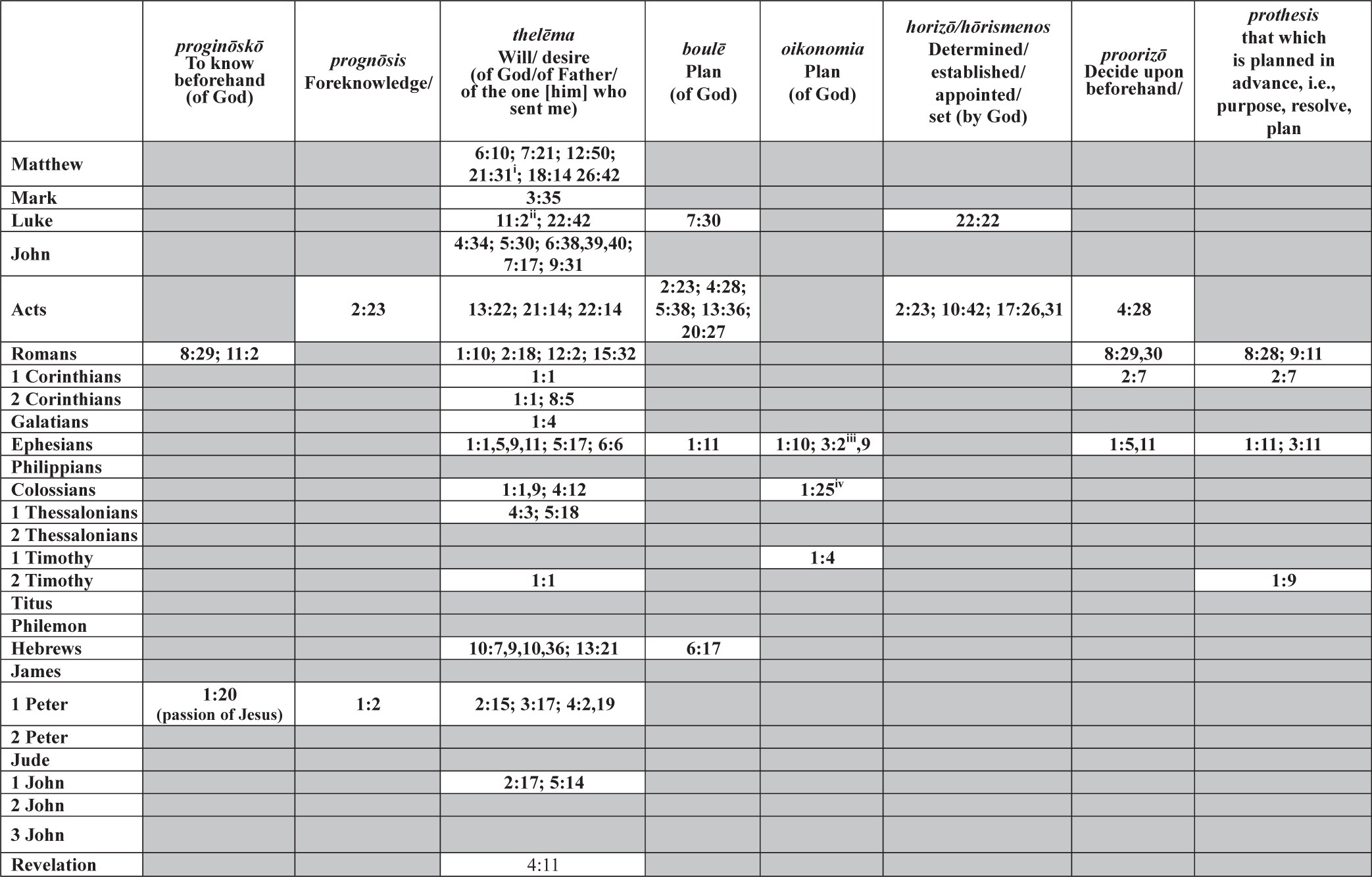
iUsed in a parable, where the “will of his father” refers to the father figure who represents God.
iiLuke 11:2-4 is the “Our Father”. Luke's version is shorter than Matthew's and does not include “thy will be done, as in heaven so on earth.” Yet, some manuscripts do have the phrase here, reflecting Matthean influence.
iiioikonomia here has the sense of “stewardship,” but it can also be translated as “plan.”
ivoikonomia here has the sense of “stewardship,” but it can also be translated as “plan.”
*logismon (the product of a cognitive process, “calculation,” “reasoning,” “thought”) occurs only in Rom 2:15; 2 Cor 10:4; significantly logismon occurs in LXX Jer 36:11 (MT Jer 29:11).
The chart does not include the eschatological “dei” used in the passion narratives and other points in the gospels. Mark (8.31) and Matt (16.21) use dei only once, Luke uses it expansively: Luke 2.49; 4.34; 9.22; 13.33; 17.25; 19.5; 21.9; 22.37; 24.7, 26, 44; Acts 1.16, 21; 3.21; 4.12; 5.29; 9.6, 16; 14.22; 15.5; 16.30; 17.3; 19.21; 20.35; 23.11; 24.19; 25.10; 27.24; also anankaion “necessary” in Acts 13.46. (J.A. Fitzmyer. The Gospel According to Luke I-IX. Anchor Bible 28 [Doubleday, 1982], 180).