




Abstract
Exploitation is a fact of life for social organisms, and natural selection gives rise to revenge mechanisms that are designed to deter such exploitations. However, humans may also possess cognitive forgiveness mechanisms designed to promote the restoration of valuable social relationships following exploitation. In the current article, the authors test the hypothesis that decisions about forgiveness result from a computational system that combines information about relationship value and exploitation risk to produce decisions about whom to forgive following interpersonal offenses. The authors examined the independent and interactive effects of relationship value and exploitation risk across two studies. In Study 1, controlling for other constructs related to forgiveness, the authors assessed relationship value and exploitation risk. In Study 2, participants experienced experimental manipulations of relationship value and exploitation risk. Across studies, using hypothetical and actual offenses and varied forgiveness measures, the combination of low exploitation risk and high relationship value predicted the greatest forgiveness.
In the vocabulary of evolutionary biology, social relationships are relationships in which one individual’s behavior has fitness consequences not only for the self but also for the other individual (West, Griffin, & Gardner, 2007). In some types of social relationships, one individual obtains fitness benefits at the expense of the other’s fitness. Predator–prey relationships, parasite–host relationships, and even the relationships of mother and fetus, for example, are considered social in this sense because the predator, the parasite, and the gestating fetus possess adaptations to extract benefits from—and at some fitness cost to—the prey, host, or mother. In response to the recurrent selection pressures created by the costs intrinsic to such social relationships, domain-specific physiological and behavioral adaptations designed to deter or minimize such burdens have developed. For example, some prey animals possess specialized adaptations for recognizing and evading predators (Herberholz, Sen, & Edwards, 2004; New, Cosmides, & Tooby, 2007), hosts can evolve defenses to promote parasite resistance (Miller, White, & Boots, 2005; Tung et al., 2009), and maternal genes that code for growth hormones can be silenced to slow the rate at which gestating fetuses extract maternal resources (Haig, 2004).
Likewise, ancestral humans (as well as many other social animals) recurrently faced adaptive problems in which conspecifics sought to extract benefits from them—at some fitness cost (Buss & Duntley, 2008). For ancestral humans, such adaptive problems included (to name but a few) homicide, assault, theft, mate poaching, sexual infidelity, reputational damage, deception, broken promises, failures to share or cooperate, and the infliction of such costs on one’s offspring, mates, allies, or friends (Boehm, 2008; Petersen, Sell, Tooby, & Cosmides, 2010). In the same way that prey animals, hosts, and mothers possess adaptations to minimize or deter exploitation, natural selection would have favored individuals who possessed cognitive mechanisms that minimized or deterred the fitness costs associated with behaviors such as lying, cheating, and stealing (Petersen et al., 2010).
One potential way to deter exploiters (or would-be exploiters) from imposing fitness costs on oneself is to impose retaliatory costs that cause exploiters to revise downward the net returns they expect to receive by engaging in similar exploitive behaviors in the future. Such retaliatory costs can (a) deter them from future exploitive efforts (Bshary & Grutter, 2005) or (b) induce them to emit benefits for the sake of the retaliator (McCullough, Kurzban, & Tabak, 2010; Petersen et al., 2010; Sell, Tooby, & Cosmides, 2009). Evolved mechanisms that implement these retaliatory impositions of fitness costs can be conceptualized as punishment mechanisms (Clutton-Brock & Parker, 1995) or as revenge mechanisms (Aureli, Cozzolino, Cordischi, & Scucchi, 1992; McCullough, Kurzban, et al., 2010), and they are common in many social systems (e.g., Bshary & Grutter, 2005; Clutton-Brock & Parker, 1995; Hoover & Robinson, 2007; for a review, see McCullough, 2008). When the possibility of revenge deters exploiters from imposing harm on their victims in the future, both parties can return to potentially mutually beneficial interaction. In the same sense that thorns “teach” animals to treat the rose with greater care, revenge too can “teach” individuals to treat the avenger with greater care and benevolence (McCullough, Kurzban, et al., 2010).
The Risk of Using Revenge: The Evolution of Forgiveness Systems
However, the operation of revenge mechanisms creates second-order adaptive problems—most notably, the potential loss of access to downstream fitness benefits from the individual on whom retaliatory costs have been imposed. What creates this adaptive problem is the fact that human social relationships—including those in the small-scale, close-knit societies in which our psychology evolved—are rarely pure types: Many social relationships are not purely exploitive or purely cooperative. For example, one young man might attempt to demonstrate his physical prowess and establish dominance in his living group at the expense of another young man in his living group, whereas they also assist each other when they make tools or build shelters. More generally, individuals who have common fitness interests represent large potential downstream benefits, making retaliatory damage to those individuals or one’s relationships with those individuals potentially quite costly. In other words, revenge can deter future exploitation, which can contribute to higher fitness, but it may also reduce one’s access to potential fitness benefits (Petersen et al., 2010).
As a result, selection pressures for maintaining valued relationships even after exploitation has occurred might have selected for cognitive mechanisms designed (a) to inhibit vengeful behavior and simultaneously (b) to produce behaviors that signal one’s motivation to return to cooperative relations toward individuals who possess relationship value despite their cost-imposing behavior on the victim. We envision these putative adaptations as forgiveness systems (McCullough, Fincham, & Tsang, 2003; McCullough & Root, 2005; McCullough, Worthington, & Rachal, 1997). We propose that forgiveness systems (a) inhibit vengeful motivations and (b) coax relationship partners who have harmed the forgiver into increasing their valuation for the forgiver—typically by reminding aggressors of the benefits that the forgiver has historically made available to the aggressor or by actually increasing one’s provision of benefits to the aggressor (Petersen et al., 2010). That is, forgiveness is prosocial and involves a transformation of motivation away from vengefulness and toward beneficence. Forgiveness, then, can cause exploiters to raise their regard for their victims without the costs of retaliation (McCullough, Kurzban, & Tabak, 2011; Petersen et al., 2010).
Forgiveness Systems, if They Exist, Must Be Computational Systems
If humans actually possess one or more cognitive systems that are dedicated to implementing forgiveness—that is, if such adaptations reliably develop within human brains during ontogeny—then they should be well designed (Williams, 1966). One important element of good design for an information-processing system such as the forgiveness system we propose here would be for the system to selectively process information that enabled it to make good decisions in the domain of the adaptive problem for which it was naturally selected (Duchaine, Cosmides, & Tooby, 2001). A “good” or “adaptive” decision for a well-designed forgiveness system would be a decision that, under ancestral conditions, would have led to an optimal (i.e., fitness maximizing, given the design or population-genetic constraints under which such a system would have to evolve) trade-off between the fitness-enhancing value of deterrence and socially mediated access to fitness-enhancing resources. After these comparisons are implemented, the forgiveness system should then return a value indexing whether the focal individual should be forgiven for his or her exploitive behavior. From that decision point, we posit, the resultant output value is passed on to other cognitive systems that generate interpersonal approach, interpersonal avoidance, aggression, and so on—that is, the cognitive machinery that inhibits revenge and generates behaviors that are designed to coax the exploiter to increase his or her regard for the forgiver (McCullough et al., 2011; Petersen et al., 2010).
One can demonstrate a deep understanding of the circuit logic of an information-processing system when one can specify how the system integrates information to arrive at an optimum decision (Lieberman, Tooby, & Cosmides, 2007). With this principle in mind, we think any evolved forgiveness system should be designed to process (and therefore should be particularly effective at processing) social information that is relevant to estimating (a) the probability that one will encounter fitness gains from reestablishing an association with the harm-doer (which we call relationship value) and (b) the probability that the harm-doer will impose costs on the self in the future (which we call exploitation risk; McCullough, Kurzban, et al., 2010; Petersen et al., 2010).
Relationship value as a predictor of forgiveness in interpersonal relationships has recently been explored. For example, McCullough and colleagues (McCullough, Luna, Berry, Tabak, & Bono, 2010) found that a self-report measure of relationship value predicted longitudinal change in people’s forgiveness scores over a 21-day period following recent interpersonal transgressions. However, research to date has not examined the interactive effects of relationship value and exploitation risk on forgiveness, which is a crucial gap: It seems unlikely that natural selection could produce a forgiveness system that returned forgiveness decisions strictly as a linear function of relationship value because such a design could result in forgiveness of individuals who had a high likelihood of exploiting the forgiver in the future. Likewise, it seems unlikely that natural selection could produce a forgiveness system that returned forgiveness decisions strictly as a linear function of exploitation risk because such a system could motivate individuals to resume relationships with some individuals whose value is estimated to be zero—that is, in relationships that would not produce fitness gains that offset the fitness costs associated with exploitation, however remote the likelihood of future exploitation risk might be. A well-designed computational system for forgiveness that evolved via natural selection would have to operate more judiciously than that. Specifically, because decisions to forgive would have been ancestrally adaptive only when relationship value was high and exploitation risk was low, we hypothesize that information about relationship value and exploitation risk is combined in a multiplicative fashion.
Overview and Predictions
We examined this interactive hypothesis in two studies. In the first study, we introduced the newly developed RVEX (Relationship Value and Exploitation Risk) Scale and, after controlling for various predictors of forgiveness, examined the direct and interactive effects of relationship value and exploitation risk in predicting forgiveness of hypothetical and autobiographical betrayal incidents in romantic relationships. In Study 2, we experimentally manipulated relationship value and exploitation risk to causally test our predictions using a broader sample of participants and relationship types. We predicted that appraisals of relationship value and exploitation risk would each uniquely predict the extent to which people forgave (or projected that they would forgive) individuals who had harmed them. We also hypothesized that perceived relationship value and perceived exploitation risk would interact to influence forgiveness such that people would forgive individuals who had harmed them more readily when the offender was perceived to embody both high relationship value and low exploitation risk.
Study 1
Method
Participants
Participants were undergraduate students (N = 361; 260 women) in introductory psychology classes at a large southeastern public university. Most participants were young adults (M = 19.41 years old, SD = 3.00). The composition of the sample was 54% White, 22% Black, 3% Hispanic, 10% Asian, and 11% Other.
Procedure and materials
We recruited participants from undergraduate introductory psychology courses who voluntarily participated for partial course credit. We recruited participants who reported being currently in a romantic relationship (at least 1 month in duration). Participants reported varying types of relationships that had lasted an average of 20 months (Mdn = 15 months, range = 1 month to 10 years); 39% categorized their relationships as friendship or casual, 47% as dating steadily, and 5% as engaged or married (9% chose other). We asked them to answer the following questions with regard to their relationship partner.
RVEX Scale
Participants completed 10 self-report items designed to measure the extent to which they perceived their transgressors as potentially valuable relationship partners and as exploitation threats, which together constitute the RVEX Scale (see Table 1). Participants indicated their agreement or disagreement with each of these items using a 5-point scale ranging from 1 (completely disagree) to 5 (completely agree). To examine items designed to assess the value and risk constructs, we randomly split the data set and conducted an exploratory factor analysis (EFA) with the first half of the data and a confirmatory factor analysis (CFA) with the second half of the data.
Exploratory Factor Analysis Loadings From Maximum Likelihood Factoring With Promax Rotation: Study 1

Factor loadings less than .30 are not shown. The third eigenvalue was .74.
We ran an EFA with maximum likelihood factoring and promax rotation (n = 178) with the first half of the data. We chose EFA because the RVEX Scale is a newly developed scale that has not been tested, and thus we wanted to place few restrictions on the patterns of relations between the common factors and the measured variables. EFA was also preferable because the primary goal was to identify a set of latent constructs underlying the measured variables. We chose maximum likelihood based on recommendations for when data are normally distributed (data met this assumption) and a promax rotation because we had no reason to expect that the factors would be completely orthogonal (Fabrigar, Wegener, MacCallum, & Strahan, 1999). The break in our scree plot, extracted eigenvalues, and percentage of variance explained by the factors revealed two clear factors that appeared to measure relationship value and exploitation risk (see Table 1).
For the CFA, the covariance matrix was analyzed with maximum likelihood estimation using Mplus 5.2. We used items from the RVEX Scale as indicators of the exploitation risk and relationship value factors, modeled as correlated factors. For each model, we examined several fit indices to evaluate the overall fit of the model including the chi-square value, the comparative fit index (CFI), the root mean square error of approximation (RMSEA), and the square root mean residual (SRMR). As a rule of thumb, a CFI around .95, an RMSEA less than or equal to .08, and an SRMR less than .08 suggest adequate fit (Hu & Bentler, 1999). The two-factor model adequately fit, χ2(34) = 63.99, p < .001, CFI = .97, RMSEA = .07, SRMR = .05. These CFA findings from the split data analyses (n = 184) provide additional evidence for the factor structure of the newly developed RVEX scale.
To examine our primary hypotheses—that is, to evaluate the direct and joint contributions of relationship value and exploitation risk in predicting forgiveness—we used the full data set (N = 361). Using the full sample, the five items assessing relationship value exhibited good reliability (α = .92), as did the five items assessing exploitation risk (α = .77). We coded the two scales so that higher numbers represented higher relationship value and exploitation risk. The two factors were negatively correlated, r(361) = −.27, p < .05.
Forgiveness
We used the ENVL scale (exit/neglect/voice/loyalty; Rusbult, 1993), which is a scenario-based assessment of conciliatory and vengeful or avoidant responses. For this measure, participants read descriptions of 12 hypothetical acts of betrayal (e.g., “your partner borrows something of yours, ruins it, and seems to shrug it off”) committed by their relationship partner (or most recent partner) and responded to four items regarding each betrayal. All items of the ENVL involve the same partner. In keeping with previous research regarding responses to conflict, we included a measure of exit, neglect, voice, and loyalty for each of the acts (e.g., neglect response: “I would be silently angry about the thoughtlessness”; loyalty response: “I would quietly forgive my partner and chalk it up as an accident”). Participants indicated their agreement or disagreement using a 9-point scale ranging from 0 (not at all likely to react this way) to 8 (extremely likely to react this way). We created an overall score, recoding exit and neglect such that higher numbers indicate more forgiving responses (α = .89).
Although hypothetical offenses allow for experimental control, such hypothetical situations are unlikely to arouse the intensity of affective and cognitive responses experienced in the wake of naturally occurring offenses. In addition, findings from a recent meta-analysis indicate that scenario methodologies can yield effects that differ from those that are obtained using recall methodologies (Fehr, Gelfand, & Nag, 2010). Therefore, we also incorporated a recall methodology to improve the generalizability of our conclusions.
Specifically, we used a slightly adapted version of the Transgression-Related Inter-personal Motivations (TRIM; McCullough et al., 1998) recall measure of forgiveness following specific offenses. Participants recalled and reflected on the most hurtful act that their partner (or most recent partner) had committed in the past 3 months and briefly wrote a description of the event. Participants rated from 1 (strongly disagree) to 5 (strongly agree) how much they agreed that they acted in vengeful, avoidant, or benevolent manner toward their partner in the wake of the offense. Recent research using item response theory analyses (Bond & Fox, 2001) indicated that items on these three subscales of the TRIM actually reflect a single unidimensional construct (McCullough, Luna, et al., 2010)—which suggests that the TRIM adequately operationalizes a concept of forgiveness that encompasses both (a) the inhibition of revenge and (b) the motivation of behaviors designed to up-regulate the transgressor’s regard for the forgivers’ welfare. We combined items and recoded such that higher numbers represent more forgiveness (α = .94).
Control variables
We included as covariates measures of personality traits, aspects of the relationship, and demographic variables. We assessed prominent dispositional components of forgiveness including trait forgiveness and empathy. We used the Trait Forgivingness Scale (Berry, Worthington, O’Connor, Parrott, & Wade, 2005), a 10-item measure of dispositional forgivingness, with each item rated from 1 = strongly disagree to 5 = strongly agree. Items include, for example, “I can usually forgive and forget an insult” and “I am a forgiving person” (α = .77). To assess empathy, we used the empathic concern subscale of the Interpersonal Reactivity Index (Davis, 1983) a seven-item measure, with each item rated from 1 = does not describe me well to 5 = describes me very well. Items include, for example, “I would describe myself as a pretty soft-hearted person” and “I often have tender concerned feelings for people less fortunate than me” (α = .84). We assessed relationship commitment with a six-item version of the Investment Model Scale (Rusbult, Martz, & Agnew, 1998; e.g., “I would feel very upset if our relationship were to end in the near future”; 0 = do not agree at all, 8 = agree completely). Higher numbers indicate more commitment (α = .96). We also asked participants how long they had been in the relationship with their partner. Furthermore, when using the TRIM as our measure of forgiveness, we incorporated components related to the recalled offense including time since offense (in days) and three items assessing severity of the offense (e.g., “The betrayal was the most hurtful that I have ever experienced”; 0 = do not agree at all, 7 = agree completely). Higher numbers indicate more perceived offense severity (α = .89).
Results
To test our predictions, we used the standard regression approach (Cohen, Cohen, West, & Aiken, 2003). We first examined the ENVL outcome. In the first step, we entered all of our control variables (i.e., age, sex, trait forgiveness, trait empathy, commitment, and time in relationship). In the second step we entered the main effects of relationship value and exploitation risk, and in the third step we entered the two-way interaction term of relationship value and exploitation risk (see Table 2 for correlations among variables in the model). Contradicting our prediction, relationship value did not significantly predict ENVL scores, B = .07, t(326) = 1.10, p = .27. However, in line with predictions, exploitation risk predicted ENVL scores in the expected direction, B = −.11, t(326) = 1.98, p = .05. As predicted, (see Figure 1) the relationship value × exploitation risk interaction effect was significant for the ENVL measure of forgiveness, B = −.13, t(326) = −2.57, p = .01. Tests of simple slopes conditioned 1 standard deviation above and below the mean of relationship value (Aiken & West, 1991) revealed a significant negative association of future exploitation risk with forgiveness among individuals with high relationship value, B = −.22, SE = .07, p = .001, compared to individuals with low relationship value in which the association between future exploitation risk and forgiveness scores on the ENVL was not significant, B = .03, SE = .07, p = .70. Another way to conduct the simple slopes analyses is to test the relationship value relation to forgiveness across levels of exploitation risk. For these analyses, simple slopes conditioned 1 standard deviation above and below the mean of exploitation risk (Aiken & West, 1991) revealed a significant positive association of relationship value with forgiveness among individuals who reported low exploitation risk, B = .18, SE = .07, p = .01, compared to the nonsignificant relation among individuals who reported high exploitation risk, B = −.06, SE = .08, p = .45.
Means, Standard Deviations, and Intercorrelations of Variables Included in Both Regression Models in Study 1
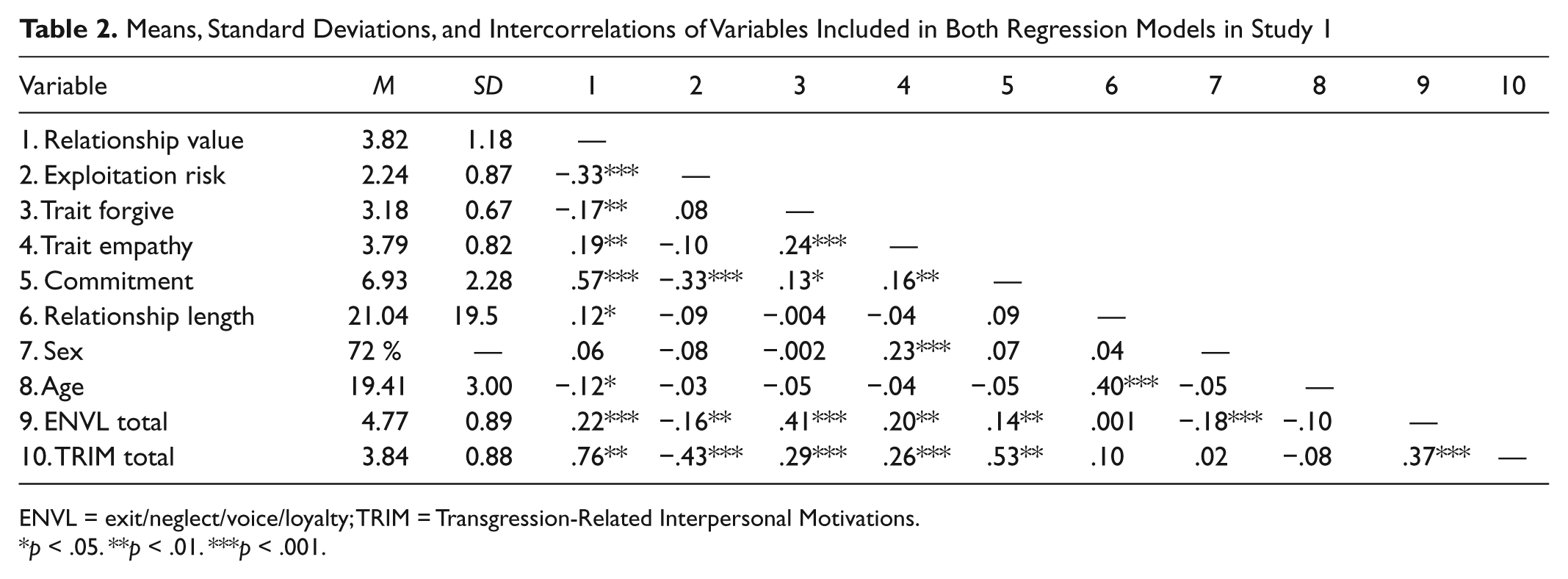
ENVL = exit/neglect/voice/loyalty; TRIM = Transgression-Related Interpersonal Motivations.
p < .05. **p < .01. ***p < .001.
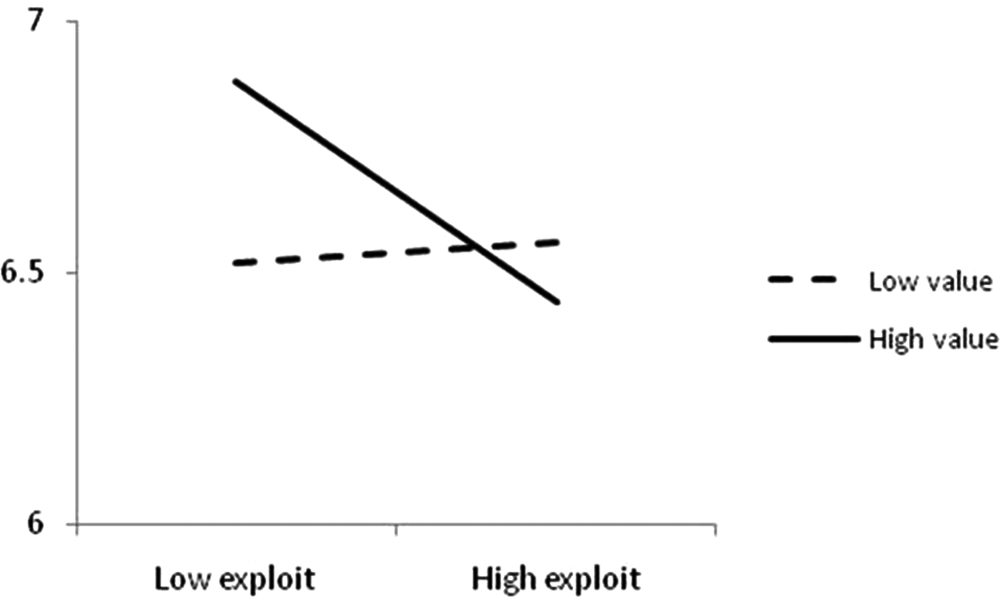
Study 1 interaction of relationship value and exploitation risk in predicting ENVL responses to hypothetical offenses
To examine the TRIM outcome, we followed the same steps as above and included time since offense and offense severity as additional control variables. In support of our prediction regarding the association of relationship value with forgiveness, relationship value positively predicted TRIM scores, B = .53, t(302) = 13.02, p < .001, indicating that forgiveness was directly proportional to the perceived relationship value of the transgressor. In addition, exploitation risk was negatively associated with TRIM scores, B = −.14, t(302) = −4.07, p < .001. However, an interaction qualified these direct effects as illustrated in Figure 2, B = −.07, t(302) = −1.97, p = .05. Tests of simple slopes conditioned 1 standard deviation above and below the mean of relationship value (Aiken & West, 1991) revealed a significantly stronger negative association of exploitation risk with forgiveness among participants whose transgressors had high relationship value, B = −.21, SE = .05, p < .001, compared to participants whose transgressors had low relationship value, B = −.09, SE = .05, p = .05. Another way to conduct the simple slopes analyses is to test the relationship value relation to forgiveness across levels of exploitation risk. For these analyses, tests of simple slopes conditioned 1 standard deviation above and below the mean of exploitation risk revealed a similar pattern: A significant positive association of relationship value with forgiveness among individuals who reported low exploitation risk, B = .59, SE = .05, p < .001, but a weaker association for individuals who reported high exploitation risk, B = .46, SE = .05, p < .001. Although the association of relationship value and scores on the TRIM were statistically significant at both low and high levels of exploitation risk, a Fisher’s z transformation indicated that the two betas differed significantly, z = 3.38, p < .001. That is, relationship value more strongly influences forgiveness for individuals reporting low exploitation risk relative to individuals reporting high exploitation risk.
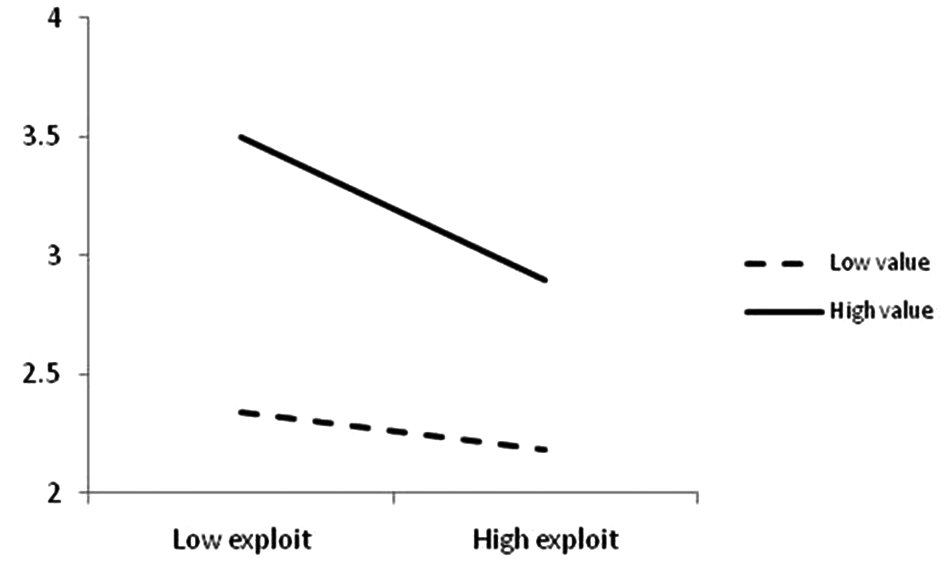
Study 1 interaction of relationship value and exploitation risk in predicting TRIM forgiveness scores after a recalled offense in a romantic relationship
Discussion
The primary goal of Study 1 was to establish the RVEX scale and examine the relations of relationship value and exploitation risk with forgiveness. In line with recent research testing the relationship value hypothesis, reported relationship value directly predicted greater forgiveness on the TRIM measure. In addition, as predicted, across both forgiveness assessments (TRIM and ENVL), greater perceived risk of exploitation predicted reduced forgiving responses and motivations. Unexpectedly, in the overall regression model predicting ENVL, relationship value did not directly predict forgiveness at a significant level, although zero-order correlations revealed a significant positive relation between relationship value and forgiveness assessed by the ENVL (see Table 2).
In line with our prediction about moderation, relationship value and exploitation risk interacted to predict forgiveness. This observation is consistent with how an adaptively designed forgiveness system should operate: High levels of relationship value should be a particularly potent influence on forgiveness at low levels of exploitation risk. In a parallel fashion, low levels of exploitation risk should be particularly influential in forgiveness decisions at high levels of relationship value. Results from Study 1 primarily supported these hypotheses. Study 2 was an attempt to replicate and extend these findings using experimental methods.
Study 2
Method
Participants
We recruited participants (N = 417; 218 women) via Amazon Mechanical Turk, a service that matches researchers needing samples with individuals open to participating. Recent research suggests that such recruitment yields similar participants and findings as using college students and urban samples (e.g., Fagerlin et al., 2007; Oppenheimer, Meyvis, & Davidenko, 2009). Participants were of varying ages (M = 30.28 years old, SD = 10.29, range = 18−70). The composition of the sample was 56% White, 5% Black, 4% Hispanic, 13% Asian, and 22% Other (e.g., South Asian, West Indian).
Procedure and materials
Participants completed all procedures online. We randomly assigned participants to one of four conditions in a 2 (relationship value: low vs. high) × 2 (exploitation risk: low vs. high) design. To manipulate relationship value, we asked participants in the high relationship value condition to “Think of a person who you know that is of high value to you (a person with whom your relationship is rewarding for you and therefore worth an investment of your time and energy).” In the low relationship value condition, participants read a similar passage: “Think of a person who you know that is of low value to you (a person with whom your relationship is not very rewarding and therefore not really worth an investment of your time and energy).” We then informed participants that we wanted to learn more about their relationship with the person they had listed as possessing high (vs. low) relationship value. Specifically, we randomly assigned participants to respond to several open-ended questions intended to prime exploitive or nonexploitive features of a relationship (e.g., high exploitation risk condition: “Describe two ways in which this person puts his/her own needs before your own”; low exploitation risk condition: “Describe two ways in which this person puts your needs above his/her own”). We asked them to include examples if possible. Examples in the high exploitation condition included caring more about extended family relationships than my happiness, putting his or her career above my needs and the needs of the relationship, spending money on his or her own needs rather than considering things that could be enjoyed together. Examples in the low exploitation condition included working a job he or she does not like to support the family and my schooling, giving me a big bite of chocolate from a small piece, and helping out financially after I was laid off at work. After completing this priming induction, participants completed the following measures.
Forgiveness
Following the exploitation risk prime, we asked participants to write the initials of the person whom they had just described. Participants then imagined that this focal individual had committed a specific transgression against them. The offense read, “You confided in this person and trusted them with a secret which they disclosed. You had clearly asked him or her to keep this information to himself or herself. The disclosure of the secret is humiliating and upsetting to you.” Participants then completed the 18 items from the TRIM Inventory that we used in Study 1. We again coded such that higher numbers represented more forgiving motivations (α = .93).
RVEX Scale
Participants completed the RVEX scale created in Study 1. The relationship value subscale (α = .88) and exploitation risk subscale revealed good reliability (α = .81). In this study the correlation between constructs was r(410) = −.44, p < .001.
Results
To check the effectiveness of the relationship value and exploitation risk manipulations, we ran a 2 (low vs. high relationship value) × 2 (low vs. high exploitation risk) analysis of variance using the relationship value and exploitation risk subscales of the RVEX as the outcomes. It was not surprising, considering the nature of the relationship value manipulation, that results revealed a strong effect of relationship value condition on relationship value, F(406) = 64.85, p < . 001, with individuals in the high relationship value condition (M = 5.67, SD = 1.22) reporting significantly more relationship value for the offender than did individuals in the low relationship value condition (M = 4.46, SD = 1.76). The exploitation risk prime did not affect scores on the exploitation risk measure, F(405) = 0.003, p > .05. For discriminant validity purposes, we note that the relationship value manipulation did not influence exploitation risk (p = .13) and the exploitation risk prime likewise did not influence relationship value (p = .36).
We used a 2 (low vs. high relationship value) × 2 (low vs. high exploitation risk) analysis of variance to examine primary hypotheses. Results revealed a significant main effect of relationship value, F(1, 406) = 104.19, p < .001, η2 = .20, with participants in the high relationship value condition (M = 3.28, SD = 0.84) reporting more forgiveness than did participants in the low relationship value condition (M = 2.49, SD = 0.73). Results for the exploitation risk prime, although in the expected direction (M = 2.95, SD = 0.89 for low exploitation risk and M = 2.83, SD = 0.87 for high exploitation risk), did not reach statistical significance, F(1, 406) = 2.28, p = .13. However, in line with the Study 1 findings, there was a significant interaction of relationship value experimental condition and exploitation risk experimental condition, F(1, 406) = 5.94, p < .05, η2 = .05. Simple effect analyses indicated that forgiveness was highest in the high relationship value−low exploitation risk cell (M = 3.43, SD = 0.73), with this condition differing significantly from the other three cells (see Figure 3).

Study 2 interaction of relationship value condition and exploitation risk condition in predicting TRIM forgiveness scores after a hypothetical offense
As noted above, the exploitation risk manipulation failed to significantly change either participants’ ratings of their relationship partners’ exploitation risk or their TRIM ratings of forgiveness, which calls into question exactly what the significant interaction of the relationship value manipulation and the exploitation risk manipulation might mean. Thus, to further examine whether information about relationship value and exploitation risk are combined in a multiplicative fashion to influence forgiveness, we ran analyses another way. Specifically, we used the relationship value manipulation (dummy coded such that low relationship value condition was coded as 0 and high relationship value condition was coded as 1) and standardized scores from the exploitation risk subscale of the RVEX (rather than participants’ assignments to the two levels of the exploitation risk priming manipulation), plus their interaction, as predictors of forgiveness. In the first step, we entered participants’ relationship value condition scores and their self-reported exploitation risk score from the subscale of the RVEX. In the second step, we entered the product of the dummy coded relationship value condition and standardized exploitation risk scores to represent their two-way interaction. In Step 1 of the regression model, replicating the direct effect of relationship value reported in the ANOVA analyses above, relationship value was positively associated with TRIM scores, B = .44, t(406) = 9.95, p < .001. In addition, self-reported exploitation risk was negatively associated with TRIM scores, B = −.13, t(406) = −2.97, p < .01. Also, results revealed a significant interaction between the relationship value manipulation and scores on the exploitation risk subscale, B = −.23, t(405) = −3.66, p < .001. Simple slope analyses revealed a similar pattern as the interaction reported above using both experimental conditions (see Figure 4). That is, in the high relationship value condition, exploitation risk significantly and negatively predicted forgiveness, B = −.25, p < .001, whereas in the low relationship value condition, exploitation risk failed to significantly predict forgiveness, B = .03, p = .57. Alternatively, another way to examine the interaction is to examine the effects of the relationship value condition on forgiveness at high and low levels of exploitation risk. For these analyses, as expected, the relationship value condition effect on forgiveness was stronger at low levels of exploitation risk, B = 1.05, p < .001, relative to high levels of exploitation risk, B = .49, p < .001.
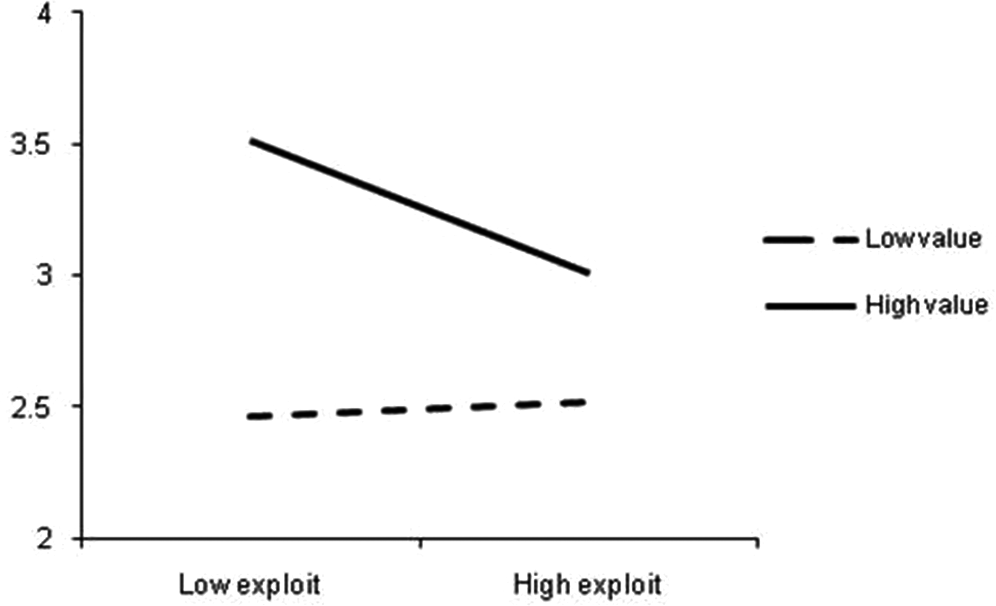
Study 2 interaction of relationship value condition and exploitation risk subscale of the RVEX in predicting TRIM forgiveness scores after a hypothetical offense
Discussion
Study 2 replicated findings from Study 1. As predicted, the relationship value manipulation was significantly and positively related to forgiveness. That is, individuals in the high relationship value condition reported more forgiveness than did those in the low relationship value condition. Furthermore, self-reported exploitation risk was significantly negatively related to forgiveness. Finally, across analyses, relationship value and exploitation risk interacted to predict forgiveness in expected ways. That is, perceived relationship value and exploitation risk appeared to be combined in a nonadditive way such that the effects of relationship value on forgiveness were apparently highest at low levels of exploitation risk and the effects of low exploitation risk on forgiveness were highest at high levels of relationship value.
Study 2 also had some methodological limitations worth noting. First, the exploitation risk prime did not significantly influence the RVEX exploitation risk subscale or the TRIM forgiveness scale. Without conclusive evidence that we experimentally primed exploitation risk, it is difficult to draw firm causal conclusions about causal effects related to exploitation risk. For example, it is possible that the apparent interaction of the relationship value and exploitation risk manipulations was partially the result of the fact that priming high exploitation risk activated negative constructs generally or priming low exploitation risk activated positive constructs generally: Such activations can have a general valence-congruent effect (e.g., Bargh & Pietromonaco, 1982). Second, the relationship value condition manipulation itself could have narrowed the range of exploitation that participants expected from their transgressors in the future. This is not an unreasonable scenario to envision: In real life, people probably take actions to increase their interdependence with individuals from whom they expect low exploitation. However, the impact of these possibilities on our conclusions for Study 2 is mitigated to some extent by the fact that the self-reported exploitation risk measure was indeed uniquely associated negatively with the forgiveness measure—even when controlling for the relationship value manipulation—and the fact that individual differences in perceived exploitation risk interacted with the relationship value manipulation in the predicted fashion, thereby paralleling the interaction between the two experimental manipulations themselves. Nevertheless, firmer causal conclusions about how relationship value and exploitation risk are combined must await future research in which perceived exploitation risk can be successfully manipulated with experimental methods.
General Discussion
For humans, as has been the case for many social organisms, exploitation by social interaction partners has been a perennial selection pressure (Buss & Duntley, 2008; Cant, 2011; Clutton-Brock & Parker, 1995; Petersen et al., 2010), and antiexploitation mechanisms—including mechanisms that motivate punishment or revenge—have likely evolved in response (Buss & Duntley, 2008; Clutton-Brock & Parker, 1995; Daly & Wilson, 1988; McCullough, Kurzban, et al., 2010). However, the potential for damage to valuable social relationships that revenge often entails likely created subsidiary selection pressures for mechanisms that would inhibit revenge and promote efforts to restore mutually beneficial interactions. We conceptualized these processes as forgiveness systems. If computational systems for forgiveness truly exist as natural kinds that are instantiated in neural tissue within the human mind, then they should process information that under ancestral social conditions would have led to optimal (i.e., fitness-maximizing) trade-offs (given constraints) between the fitness-enhancing value of deterrence and the fitness-enhancing value of restored access to socially mediated resources.
In the two studies presented herein, we tested the hypothesis that the postulated forgiveness system relies on information that is relevant to estimating (a) the probability that one will encounter fitness gains from maintaining or restoring an association with the harm-doer and (b) the probability that harm-doer will impose additional costs on oneself in the future. Across both studies, we found evidence that forgiveness is most likely when relationship value is high and future exploitation risk is low. We found support for these interactive effects across a variety of methodological and relationship contexts—for example, (a) when we experimentally manipulated the relationship value of the offender as well as when we analyzed naturally occurring between-persons variation in relationship value and exploitation risk, (b) when participants recalled real-life offenses that had previously occurred within relationships as well as when they responded to scenarios, and (c) when participants responded to offenses involving romantic relationships as well as when they responded to offenses involving more casual acquaintances. In addition, in Study 1, the interaction of relationship value and exploitation risk emerged even after controlling for relevant components of the offense (e.g., severity), relationship (e.g., commitment), and personality of the victim (e.g., trait forgiveness, trait empathy). These findings comport well with other work that has examined how relationship value predicts forgiveness (e.g., McCullough, Luna, et al., 2010; Tabak, McCullough, Root, Bono, & Berry, in press) and extends this work in important ways by directly testing the interaction of relationship value and exploitation risk and introducing some new measures of these constructs (i.e., RVEX Scale).
Compatibility With and Extension of Other Theories of Forgiveness
Although we derived our predictions by starting with the premise that natural selection operates to create mechanisms (including psychological mechanisms) that perform well in the domains for which they were designed (Williams, 1966), alternative theories such as interdependence theory (Kelley, 1979), the investment model (Rusbult, 1980), and attachment theory (Bowlby, 1969/1982) have inspired studies into similar psychological phenomena as those that we examined herein. Using interdependence theory and the investment model as a starting point, for instance, researchers have found that victims who are committed to their partners act in forgiving and accommodating ways—presumably because forgiveness helps them reach their goal of maintaining relationships that they value (Finkel, Rusbult, Kumashiro, & Hannon, 2002). Also, attachment theory (Ainsworth, Blehar, Waters, & Wall, 1978; Bowlby, 1969/1982), which highlights the importance of satisfying the need for felt security (Sroufe & Waters, 1977), gave rise to a prediction that anxious attachment (which reduces trust in one’s partner) would be negatively related to forgiveness, which has been confirmed (e.g., Burnette, Taylor, Worthington, & Forsyth, 2007; Finkel, Burnette, & Scissors, 2007). Both interdependence and attachment theory, then, lead to the predictions that relationship value and exploitation risk are important contributors to forgiveness decisions.
However, these theories do not seek to explain how forgiveness systems are designed to operate in light of ancestral problems for which they were designed (if they do indeed exist as natural kinds). A key contribution of the current article, we think, is the design analysis that elaborates on how a naturally designed forgiveness system should and should not operate. For example, our adaptationist analysis leads one to expect that a forgiveness system, by necessity, should not strongly motivate behaviors that would have harmed one’s survival under ancestral conditions—for example, by promoting the restoration of valuable relationships with people who remain willing to exploit the forgiver, or restoring seemingly safe relationships with people who have nothing of value to offer as relationship partners. Thus, one innovation of our approach lies in the specific predictions that can be made by considering the interactive effect of both relationship value and exploitation risk.
In addition, the adaptationist perspective we brought to considering the computations that well-designed forgiveness mechanisms should perform well enables us to make novel predictions about the cognitive mechanisms that underlie the forgiveness process. For example, in addition to those hypotheses we tested here, our approach to thinking about well-designed forgiveness mechanisms also leads to the following predictions about the cognition and behavior of individuals who are actively motivated to make decisions about whether to forgive or avenge a harm: (a) those individuals should be willing to pay a relatively large cost to obtain information that is relevant to assessing relationship value and exploitation risk (in comparison to the prices they would pay for other types of social information about the harm-doer), (b) such information should gain privileged access to attention and working memory and should be relatively resistant to interference from competing information, (c) such information should be automatically scanned to determine whether it is the result of deception on the part of the exploitive individual, (d) memories about the exploitive individual that are retrieved from episodic memory should tend to be (on average) valid for evaluating those individuals’ relationship value and exploitation risk, and (e) memories about exploitive individuals’ past behavior toward the self should be given more weight in decision making than will cues about their behavior toward other individuals.
To our knowledge, it is only an adaptationist approach to thinking about forgiveness that leads to the predictions offered above—and that would be at risk of falsification if such predictions were not confirmed. This is because the very existence of the cognitive mechanisms we posit here hangs on whether they can efficiently locate, attend to, process, store, recall, transform, and motivate decisions on the basis of information that would have (in ancestral environments and perhaps also modern environments) provided valid information for estimating continued relationship value and exploitation risk in the future. Such issues seem to us to be excellent targets for future research. Finally, by offering the new RVEX scales for measuring people’s perceptions of the relationship value and exploitation risk associated with transgressors, the current article can extend existing research by facilitating future work examining the computations, which, we think, a designed forgiveness system is likely to be devoted to executing.
Limitations and Future Directions
Our studies had some limitations. For example, we examined only an interactive model for how information about relationship value and exploitation risk might be combined, even though there are many ways in which even two pieces of information might be integrated by an information-processing system (Currie & Little, 2009). Simply knowing that the two pieces of information are combined interactively in fact sheds limited light on the nature of that information integration process. For example, two pieces of information might conceivably be combined sequentially as a function of the order in which they are obtained from the environment (first first), as a function of the cognitive requirements necessary to extract them from the environment (cheapest first), or as a function of their quality (best first). In other words, the fact that the information appears to be combined nonadditively does not say as much as one would ideally want to know about the actual process by which the information is combined, but it is an important starting point for future inquiry. Other research designs could enable a finer-grained approach to understanding the heuristics by which the proposed forgiveness systems operate and could elaborate on causality. In anticipation of other models that researchers might consider in the future, we think it is worth pointing out that the computational system in question is unlikely to be one in which perceptions about one of the two forms of information mediates perceptions regarding the other (or, in computational terms, one in which the output of one computational process is used as an input for the other computational process). We base this hypothesis, too, on adaptationist considerations: It would be a poorly designed cognitive system indeed that used information about exploitation risk to inform computations about relationship value, or vice versa (as a mediational model would imply).
On a related note, our research here only examined participants’ perceptions of relationship value and exploitation risk as predictors of forgiveness, but presumably, those perceptions result at least in part from the assembly of cues that perpetrators emit via actual behavior that would have been ancestrally valid for assessing relationship value (e.g., kinship, friendship, history of productive relations despite previous harms) and exploitation risk (e.g., histories of taking advantage of other parties in similar situations). Future research that attempts to identify these cues, to document their effects on perceptions of relationship value and exploitation risk, and then to show how the resulting perceptions are combined to influence forgiveness decisions would help to provide a more complete characterization of the forgiveness mechanism we have posited here.
Our reliance on self-report measures lends itself to common critiques including the possibility that our findings were influenced, for example, by socially desirable responding, retrospective reconstruction, and common method bias. On the other hand, across the two studies, we used hypothetical scenarios and recalled offenses and we assessed both motivations (i.e., TRIM) and behavioral tendencies (i.e., ENVL). Moreover, our findings from Study 1 were robust enough to emerge even after controlling for other self-report measures that share related response biases such as trait forgiveness and empathy. Nevertheless, in future work researchers might extend the present findings by using alternative behavioral indices of forgiveness such as physiological or behavioral assessments (e.g., coding videotapes of betrayal relevant conversations and facial expressions, actual retaliatory or conciliatory behavior in the laboratory, etc.). In addition, although the self-report data here suggest that the outputs of the systems that compute exploitation risk and relationship value are accessible to conscious reflection, this need not be the case. Research methods that assess computations of exploitation risk and relationship value via the activation of particular neural pathways, or via implicit measures, would be valuable as well.
Conclusion
Several theories that have been applied to understanding the evolution of human sociality (e.g., Hamilton, 1964; Tooby & Cosmides, 1996; Trivers, 1971) imply that cognitive mechanisms designed to implement forgiveness under certain circumstances will be naturally selected (McCullough, 2008). If such mechanisms can exist at all, it is only because they returned fitness-enhancing decisions in the ancestral environments in which they evolved (Williams, 1966). For this reason, we should expect that such mechanisms should preferentially process information that would have been ancestrally relevant to making such adaptive decisions. Here, we have attempted to shed initial light on how such a system might operate. It is our hope that these initial observations and the adaptationist approach to thinking about forgiveness that we presented might complement other work on forgiveness that is being conducted from other theoretical perspectives. As forgiveness continues to be an important societal issue—with intrastate conflicts outpacing the number of interstate conflicts (e.g., Staub, 2006), the concept of restorative justice increasingly finding traction among criminologists (e.g., Ame & Alidu, 2010; Kuo, Longmire, & Cuvelier, 2010), and truth and reconciliation commissions continuing to be implemented in the aftermath of many mass atrocities (e.g., Brounéus, 2010; Byrne, 2004)—revenge and forgiveness continue to be relevant and important topics for social psychology. We are hopeful this initial research into the information-processing architecture of a putative forgiveness system can make a tangible contribution both to understanding forgiveness as a basic phenomenon and as an interpersonal process that is broadly relevant to human welfare.
Footnotes
The author(s) declared no potential conflicts of interest with respect to the research, authorship, and/or publication of this article.
The author(s) received no financial support for the research, authorship, and/or publication of this article.