




Abstract
The present study explores the role of personality in moderating the effect of public social context on self-control. The authors predicted that in public settings neuroticism would be associated with ego-depletion effects and individual differences in impression management (IM) would be associated with restoration effects. Three experiments supported the hypothesis. In Study 1 neuroticism was associated with impaired self-control and IM was associated with enhanced self-control following an initial phase of working on a simple task in public (vs. in private). Study 2 replicated and extended these results to other domains of self-control. Study 3 explored whether public social context can cancel out early depletion effects. In this study, depleted participants engaged in a task that required self-control either alone or in public. As expected, the public settings were associated with restored self-control resources mostly among high IM individuals. Implications for self-control, neuroticism, and IM are discussed.
Keywords
Many people describe being the focus of public attention as one of their greatest anxieties. This anxiety rests on a widespread sentiment that one’s reputation is crucial for success, a sentiment that has roots in human evolutionary endowment: Being judged negatively by one’s group was associated with diminished likelihood of reproduction and survival (Buss, 1995). It thus makes sense that in approaching public social contexts people sense both dread and challenge (Uziel, 2007). However, people generally wish to appear cool and collected and therefore seek to counter any destabilizing feelings (Erber, Wegner, & Therriault, 1996). Such effort demands exertion of self-control, and the present article argues that not all individuals are equally motivated and able to adaptively expend self-control in public contexts.
Polar abilities to successfully self-regulate in public social contexts characterize two central traits: neuroticism, which has been associated with decreased cognitive control and impaired performance in public contexts (e.g., Lambert et al., 2003), and impression management (IM), which has been associated with high self-control and improved performance in public social contexts (Uziel, 2010a). The three experiments in this report explore how working in a public social context affects self-control availability among individuals varying in neuroticism and IM. Studies 1 and 2 focused on the effect of early exposure to a public social context on subsequent level of self-control (thus focusing on potential ego-depleting effects of public social context). Study 3 adopted the reversed approach by exploring the effect of public social context on depleted participants (thus focusing on the role of public social context in cancelling out depletion effects).
Public Social Contexts
Managing one’s behavior in social presence poses a self-regulatory challenge that contrasts automatic feelings, thoughts, and behavioral tendencies with externally oriented controlled responses (Erber et al., 1996; Vohs, Baumeister, & Ciarocco, 2005). Concordantly, self-regulatory accounts are no stranger to the major theoretical explanations of individuals’ responses to public situations. For example, self-control theory (Carver & Scheier, 1981) suggests that social presence elucidates a discrepancy between one’s present state and one’s ideal self, which the actor attempts to narrow. Such “matching to standard” process involves goal setting and continuous monitoring of progress, two fundamental components of self-regulation.
Self-regulatory conflict is a recurrent theme in other accounts of “social facilitation.” According to drive theory, social presence triggers the emission of a dominant response (i.e., an automatic response) often at the expense of a more appropriate controlled response (Zajonc, 1965). In evaluation apprehension theory, one struggles to curb aversive emotional state (Weiss & Miller, 1971). Distraction-conflict theory describes a mental conflict arising when one seeks to focus on the task at hand amid the distraction caused by the presence of others (Baron, 1986).
Hence, self-regulatory processes constitute a substantial part of the theoretical argumentation in accounts of behavior in public contexts. And yet little attention was paid in these theories to an important component of self-regulation—actual capacity—that is, to the availability of self-control resources required to initiate and maintain controlled behavior. This aspect of self-regulation has been attracting the attention of researchers in recent years, and its implications for interpersonal behavior have just begun to be explored (e.g., Vohs et al., 2005).
Self-Control Capacity
Self-control refers to the capacity for altering one’s responses to bring them in line with desired standards (Baumeister, Vohs, & Tice, 2007). Self-control capacity has been associated with an ability to successfully obtain specific short-term goals as well as broad long-term goals (e.g., Mischel, Shoda, & Peake, 1988). According to the strength model (Baumeister, Bratslavsky, Muraven, & Tice, 1998), self-control is akin to a muscle that modulates self-regulation. Consequently, self-control would tend to be impaired after an initial exertion because some of the self’s willpower or strength has been expended, leaving the person with a depleted resource (a state known as ego depletion).
Depletion of self-control has negative implications for social behavior. For example, depletion reduces helping behavior (DeWall, Baumeister, Gailliot, & Maner, 2008) and increases the expression of prejudice (Muraven, 2008). People seem to be aware of the negative implications of failing to exert self-control on their interpersonal adjustment, and when approaching social interactions they actively regulate their responses (Erber et al., 1996). Vohs and colleagues (2005) have documented that success at such efforts rests on the availability of self-control resources. They found that early depletion of self-regulatory resources had detrimental effects on participants’ success at IM. The association between these constructs existed in the reversed causal direction as well. That is, efforts of self-presentation had consumed participants’ self-regulatory resources.
The present research seeks to extend this work by focusing on responses to mere public social context and by studying the role of individual differences in moderating these responses. The next section discusses the role of personality.
Personality: Neuroticism and Impression Management
Not all individuals approach social situations with the same level of skill and proficiency. Some individuals are resourceful, self-assured, and interpersonally competent, whereas others are anxious and apprehensive. One way to conceptualize behavior in public social contexts from a dispositional perspective is by referring to the interpersonal circumplex (e.g., Trapnell & Wiggins, 1990; Wiggins, 1979). The circumplex is defined by two orthogonal dimensions that govern social behavior: dominance (vs. submission) and affiliation (vs. disaffiliation). The space formed by combining these dimensions could be divided to quadrants into which different individual traits fit.
A central assertion of the present research is that in their conduct in public social contexts, the traits neuroticism and IM share the quadrant defined by low dominance and high affiliation. This profile explains their strong reactivity in the transition from private to public social context because low dominance necessitates one to make behavioral adjustments in public contexts and high affiliation motivates one to do so. In addition, however, neuroticism and IM represent polar self-regulatory abilities. This difference accounts for a discrepancy in the adaptation that characterizes their response to public social contexts. The following elaborates on this issue.
Neuroticism
Although neuroticism in not inherently an interpersonal trait, it has a clear behavioral signature in interpersonal contexts. Neuroticism is associated with low social status and with submissiveness (e.g., Cote & Moskowitz, 1998; McCrae & Costa, 1989). Furthermore, it forms the basis for enhanced negative self-conscious emotions (such as shame and embarrassment; e.g., Costa & McCrae, 1992) and high levels of attachment-related anxiety (cf. Mikulincer & Shaver, 2007), which reflect (an often frustrated) high affiliation need. To complete the picture, neuroticism also has a negative association with self-control (e.g., r ~ −.40; Tangney, Baumeister, & Boone, 2004). As a result, high scorers are in a vulnerable position, lacking an essential component for successful coping with anxiety (for a review, see Kashdan, Weeks, & Savostyanova, 2011).
In accordance with the above theoretical profile, empirical evidence shows that during evaluative social situations, individuals high in neuroticism report high levels of anxiety (Geen, 1985a), experience elevated physiological responses (Beidel, Turner, & Dancu, 1985), demonstrate anxiety-related behaviors (Geen, 1985b), and experience performance impairments (Uziel, 2007). Impairments in performance among high as compared to low neuroticism individuals in public settings were related to a failure to regulate mounting self-presentational concerns (Lambert et al., 2003).
It should be noted that when working alone or when feeling supported (i.e., in low threat situations), individuals high in neuroticism often demonstrate superior performance to that of low neuroticism individuals, especially on simple challenges (e.g., Geen, 1985a, 1985b; Horwitz & McCaffrey, 2008; Hutchinson & Ruiz, 2011). Although low neuroticism individuals faced with nonchallenging tasks experience disengagement, early success in secure environment works to motivate high scorers to continue exert effort.
Impression management
The interpersonal profile associated with IM is similar to that of neuroticism (as manifested in public social contexts). IM is associated with low dominance and high affiliation (e.g., Cervenka, Gustavsson, Halldin, & Farde, 2010; Paulhus & John, 1998). That is, high scorers generally do not dominate social interactions but rather adjust their behavior to the prevailing norms (Uziel, 2010b). To successfully accomplish this behavior, one needs to exert self-control (Seeley & Gardner, 2003); however, in contrast to the pattern found for neuroticism, there is a strong positive correlation between IM and self-control (r > .50; Tangney et al., 2004).
Empirical evidence is consistent with the above assertions. In addition to direct evidence connecting IM with low dominance and high affiliation, a large number of studies document a positive correlation of IM with agreeableness (a proxy of affiliation) and a small negative correlation with extraversion (a proxy of dominance; Uziel, 2010b).
A high affiliation–low dominance combination should lead to enhanced responsiveness and greater motivation in public social contexts. Experimental evidence demonstrates exactly so. For example, IM scores were higher when participants completed the questionnaire in a public versus in a private context (Paulhus, 1984), and among high IM individuals the transition from a private to a public context was associated with marked behavioral changes and performance facilitation (Uziel, 2010a).
Direct and indirect evidence connects IM with superior self-control (see Uziel, 2010b, for an elaborate review). As described above, explicit measures of IM and self-control are strongly correlated (Tangney et al., 2004). In addition, experimental evidence shows that IM is associated with successful self-regulation under stressing social and nonsocial contexts (e.g., Blackhart, Eckel, & Tice, 2007; Brody, Veit, & Rau, 1997). More broadly, IM is associated with a wide array of real-life expressions of successful self-regulation, such as low levels of alcoholism, criminal behavior, and risk taking (e.g., Bradburn et al., 1979).
In sum, as compared to low IM individuals, high IM individuals have both stronger motivation (in public social contexts) and higher level of self-control (overall). Sure enough, individuals who testify about themselves (in IM scales) that they behave impolitely and that they are disorganized (i.e., low IM individuals) are not motivated to present a desirable side of themselves to other, nor do they possess high levels of self-discipline.
Still, the advantage of high IM individuals over low IM individuals shows only in public social contexts, when high scorers’ self-control capacity and high motivation combine. As Uziel (2010a) showed, when alone, low IM individuals often outperform the demotivated high IM individuals.
Neuroticism–IM relations
Like other broad personality dimensions, neuroticism and IM share some similar and some contrasting aspects. Such complex relations are often manifested in statistical independence in neutral contexts along with contrasting behavioral responses in psychologically relevant contexts. 1 We suggest that in the context of public behavior, neuroticism and IM share the same basic set of structural characteristics along the interpersonal circumplex, namely, low dominance and high affiliation. However, these traits differ in one critical factor—ability to self-regulate. As a result, in the transition from private to public social context, (a) both neuroticism and IM will be associated with responsiveness (vs. indifference), but (b) neuroticism will be associated with self-regulatory failure, whereas IM will be associated with self-regulatory success.
The Present Research
Three studies were designed to explore the differential effect of public social conditions on the level of self-control among individuals varying in neuroticism and IM. Studies 1 and 2 focused on the effect of early exposure to a public social condition on subsequent level of self-control. In both studies participants underwent an early stage of performing a simple task either alone or in a public social context. Participants then continued to perform a second task (in private) that served to measure their self-control resources.
We had the following predictions. Given the simple nature of the task in the first stage and the absence of social evaluative threat, we expected neuroticism to be positively associated with performance in the private (i.e., in the control) condition. Importantly, neuroticism was predicted to have negative effect on performance in the experimental group, after working on the early task in public. The self-presentational effort associated with performing the early task in public should deplete their already low level of self-control.
We had the opposite prediction for IM. Working alone on the first and then on the second task was expected to demotivate high scorers who should fail to exert maximal performance. IM was therefore expected to have a negative effect on self-control in the private condition. However, once the public context was saliently active (i.e., after working on the early task in public), IM should be positively associated with a motivation to exert self-control. Coupled with the high level of self-control typical of high IM individuals, they were expected to outperform low IM scorers, in spite of the fact that the measurement of self-control was performed in private.
Study 3 addressed potential restoring effects of public social context on self-control. In this study, participants first engaged in a set of demanding tasks (performed alone) that depleted their self-control resources. Next, they were asked to perform another task that measured their self-control either alone or in public. We expected to find superior self-control among high IM individuals in the public context. The greater motivation that this setting infuses among high IM individuals and their relatively large reservoir of self-control capacity should allow them to outperform other participants in this setting. Neurotic individuals should experience high motivation in the public social context as well. However, given their low baseline level of self-control, the added motivation was less likely to suffice to cancel out the early depletion effect.
It is worth noting that we used a camcorder to manipulate public social settings. Video recording is commonly applied to manipulate public or social evaluative settings (e.g., Dickerson & Kemeny, 2004), and it offers the advantage of consistency and unity across participants and studies, which actual human presence lacks. To stress the public nature of the situation, participants were told that their recorded behavior would serve to train observers for a different procedure taking place in the lab.
Study 1
Overview
Participants in this study performed a simple (i.e., nondepleting) task either alone or in a public social context. After completing the task, all participants worked alone on a second unrelated task that measured their level of self-control. Our main hypothesis was that after working on the simple task in a public context neuroticism would be negatively associated with self-control, whereas IM would be associated with greater self-control.
Method
Participants
Participants were 44 students at Florida State University (22 in the public social context condition). The average age was 19.5, and 64% (28) were females.
Materials: Personality
We used the short version of the Eysenck Personality Questionnaire–Revised (EPQ-RS; Eysenck, Eysenck, & Barrett, 1985) to measure neuroticism (e.g., “Do you worry too long after an embarrassing experience?”) and IM (with the Lie scale; e.g., “Do you always practice what you preach?”). To maximize reliability, a 4-point Likert-type response format was utilized (1 = definite no, 2 = no, 3 = yes, 4 = definite yes). Reliabilities were satisfactory (α = .76 for neuroticism and α = .78 for IM). There was a nonsignificant correlation between neuroticism and IM (r = −.25, ns).
Materials: Es crossing task and social context manipulation
We applied the simple version of this task that is frequently used in studies on self-control (e.g., Baumeister et al., 1998). In this simple version participants were trained to form a habit and were then asked to simply act on the habit. With some detail, all participants were instructed to cross out every occurrence of the letter e on a page containing a high number of es. Then on the second page of the text they were asked to follow the same rule as before by crossing out all occurrences of the letter e. In several early studies this version of the task has proven simple and nondepleting (e.g., DeWall et al., 2008). One half of the participants performed the task alone, and the other half worked facing a camcorder that recorded their behavior.
Materials: Unsolvable puzzle task
To measure participants’ level of self-control resources, all participants engaged in a task that measured their persistence in working on a frustrating puzzle. The task required participants to fully trace a geometric figure without retracing any line and without lifting the pencil from the paper. The participants were told that they could take as much time and as many trials as they wanted and that the only criterion for judging their performance was their ability to solve the puzzle. Unbeknownst to the participants, the figure had been prepared so as to be impossible to solve. Time spent working on the task was our measure of self-control (cf. Baumeister et al., 1998)
Materials: Affect
Emotional reactions to the manipulation were measured with the Brief Mood Introspection Scale (BMIS; Mayer & Gaschke, 1988). In this survey participants rate their current feeling on 16 adjectives that load on two factors—valence (e.g., happy; α = .77) and arousal (e.g., drowsy; α = .56).
Procedure
Participants arrived individually to an experiment on personality and cognition. After signing a consent form, each participant was left alone in the room to complete the personality scales. Next, all participants were introduced with the es crossing task. Participants in the experimental group performed this task facing an operating camcorder. They were told that we videotaped their behavior to train observers for a different procedure taking place at the lab (thus making sure that they were aware of the public nature of their behavior). Participants in the control group completed the task alone. All participants then continued alone to complete the BMIS followed by the unsolvable puzzle. The experimenter secretly timed the duration that each participant spent working on this task. On completion, all participants were debriefed, compensated, and thanked.
Results
Manipulation check
All participants engaged in the same version of the es crossing task. We therefore expected and found no difference between the experimental groups in how difficult and in how effortful the task was for them (ts < 1). Corroborating the simple nature of task, it was judged significantly less difficult (M = 2.11), t(43) = −5.29, p < .001, and somewhat less effortful (M = 2.67), t(43) = −1.77, p < .10, than the scale’s neutral midpoint of 3 (the possible range was 1 to 5). No difference was found between the experimental groups in pleasantness or arousal (ts < 1.2, ns).
Main analyses
Our main hypothesis was that after being exposed to a public social condition, neuroticism would be associated with a decrease in self-control (i.e., less persistence in the puzzle task). 2 To test the hypothesis we regressed work time on the puzzle on neuroticism (standardized), the social context manipulation, and their interaction. In support of the hypothesis, the analysis yielded only a significant interaction, β = .42, t(39) = 1.99, p = .05. Simple slope analyses (one-tailed throughout) indicated that neuroticism was associated with less persistence in working on the puzzle task after initially working on the es crossing task in public (βsimple slope = −.27, p < .08) but with more persistence after initially working on the task in private (βsimple slope = .36, p < .07). Figure 1a plots the interaction.

Time spent working (privately) on an unsolvable puzzle in Study 1 as a function of early experience in a private or public social context and neuroticism (Panel A) or IM (Panel B) N = neuroticism; IM = impression management.
Auxiliary analyses exploring change in mood (pleasantness and arousal) following the social context manipulation yielded one significant effect, an interaction between neuroticism and social condition in predicting pleasantness, β = .42, t(39) = 2.01, p = .05. Simple slope analyses revealed that neuroticism was associated with experiencing less pleasantness after working on the es crossing task in public (βsimple slope = −.37, p < .05) but with somewhat more pleasantness after working on the task in private (βsimple slope = .28, p < .13).
For IM we predicted the opposite set of responses in public settings to the one found for neuroticism. We regressed work time on the puzzle on IM (standardized), the social context manipulation, and their interaction. In support of the hypothesis, the analysis yielded only a significant interaction, β = −.44, t(39) = −2.01, p < .05. Simple slope analyses indicated that IM was associated with more persistence in working on the puzzle task after initially working on the es crossing task in public (βsimple slope = .31, p < .08) but with less persistence after initially working on the task in private (βsimple slope = −.33, p < .08). Figure 1b plots the interaction.
Auxiliary analyses predicting change in mood (pleasantness and arousal) following the social context manipulation yielded one significant effect, an interaction between IM and social condition in predicting arousal, β = −.42, t(39) = −2.02, p = .05. Simple slope analyses revealed that IM was associated with experiencing more arousal after working on the task in public (βsimple slope = .29, p < .09) but with experiencing less arousal after working on the es crossing task in private (βsimple slope = −.34, p < .07). 3
Discussion
Study 1 demonstrated that working on a nondemanding task in a public setting can have ensuing depleting effects on the level of self-control among individuals high as compared with low in neuroticism. Even though the initial task was simple and required of participants only to act on a well-learned habit, mere public performance was suffice to associate high neuroticism with reduced levels of regulatory capacity.
The detrimental effect is notable considering the positive association of neuroticism with performance in the alone condition, when evaluative threat was minimal. Consistent with past studies, neuroticism was positively associated with performance in a nonthreatening condition (e.g., Geen, 1985a, 1985b). Because the initial (es crossing) task was very simple, the self-regulatory challenge facing participants in this condition was not hard. These parameters favored those who are prone to feel anxious as compared to emotionally stable individuals, who most likely found this context demotivating.
A similar account explains the advantage of individuals low in IM over those high in IM in the alone condition. Private, nonthreatening but also nonchallenging settings favor those who are low in self-control ability and affiliation motive (i.e., low IM individuals). High IM scorers find these settings disengaging. However, when the setting is public and self-control is required to manage multiple goals (performing well on the task and impressing others), individuals high in IM are more motivated and also better self-regulators than low scorers (Uziel, 2010a). Accordingly, in this relatively demanding situation, the general positive association between IM and self-control showed most clearly.
Taken together, the results show that both neuroticism and IM reflect high responsiveness in social contexts. However, these traits predicted opposite capacity to self-regulate after exposure to a public context. We sought to extend these results in Study 2.
Study 2
Overview
Study 2 introduced several changes to the procedures applied in Study 1, the first being the tasks. Specifically, the es crossing task in the early phase of Study 1 might have triggered among some participants an attentional conflict between finding all the es and attending to the camera, thus consuming valuable resources. The task applied in Study 2 overcame this potential problem by asking participants to simply write down their thoughts with no particular goal to achieve, thus posing little conflict. Furthermore, because the task was not judged in terms of success or failure, it did not raise performance-related concerns. Study 2 also introduced a new measure of self-control, which relied on actual success in working on a solvable task. Last, Study 2 included a measure of trait self-control, which allowed us to examine more closely our theoretical rationale. With detail, to the extent that neuroticism is associated with depletion following public performance, the effect should show mostly among low self-control individuals. In contrast, to the extent that public performance motivates high IM individuals to express high self-control, the effect should show mostly among high self-control individuals. 4
Method
Participants
Participants were 44 students at Florida State University (22 in the public condition). The average age was 19.6, and 52% (23) were females.
Materials: Personality
Akin to Study 1, neuroticism (α = .82) and IM (α = .67) were measured with the EPQ-RS. In addition, participants completed the brief (13-item) version of the Trait Self-Control scale (Tangney et al., 2004). The scale’s reliability was good (α = .83). Intercorrelations between the trait measures were r = −.16, ns, for neuroticism−IM; r = −.23, ns, for neuroticism–self-control; and r = .53, p < .01, for IM–self-control.
Materials: Thoughts task and social context manipulation
Manipulation of social context took place while participants engaged in the simple nondepleting version of the thoughts task (cf. Muraven, Tice, & Baumeister, 1998). Participants were asked to list their thoughts on a sheet of paper for 6 minutes. In the simple version that we applied, no constraining instructions were provided. In the public condition participants were videotaped for the whole duration of the task. Participants in the control condition worked in private.
Materials: Anagrams task
This task served to measure participants’ level of self-control. Participants were provided with a sheet of paper containing 25 five-letter anagrams. They were informed that several of the anagrams might be unsolvable and that their goal is to solve as many of the solvable anagrams. They were told that they could work for as long as needed and that their success would be determined only by their success at solving all the solvable anagrams. Unbeknownst to participants, all the anagrams were solvable. The uncertainty about the solvability of the anagrams makes this task a well-fitting measure of self-control. On facing difficulties in solving a particular anagram, participants could either capitalize on the tempting and face-saving option of rendering it unsolvable or put in more effort and persist further in trying to solve it until they eventually succeeded.
Materials: Affect
Akin to Study 1, participants’ emotional reaction to the manipulation was measured with the BMIS. Reliability was good for the valence index (α = .85) but low for the arousal index (α = .43).
Procedure
Participants arrived individually to an experiment on personality and information processing. After signing a consent form, each participant was left alone in the room to complete the personality scales. Next, all participants were introduced to the thoughts task. Participants in the experimental group performed this task facing an operating camcorder. As in Study 1, they were told that we videotape their behavior to train observers for another procedure taking place at the lab. Participants in the control group completed the task alone. All participants continued alone to complete the BMIS followed by the anagrams task. On completion, the participants were debriefed, compensated, and thanked.
Results
Manipulation check
We expected and found no difference between the experimental groups in how difficult or how effortful the thoughts task was for them (ts < 1.4, ns). Also as expected, the task was judged significantly less difficult (M = 1.84), t(43) = −7.98, p < .01, and less effortful (M = 2.54), t(43) = −2.49, p < .05, than the scale’s neutral midpoint of 3 (the possible range was 1 to 5). No difference was found between the experimental groups in pleasantness or arousal (ts < 1.6, ns).
Main analyses
In the first analysis we explored the effect of early exposure to a public social context on the level of self-control among individuals low and high in neuroticism. To that aim we regressed the number of anagrams solved on neuroticism (standardized), the social context condition, and their interaction. The analysis revealed a marginally significant effect for the social context condition, β = .30, t(39) = 1.96, p < .06, indicating that participants who were initially in a public social context solved somewhat more anagrams (M = 14.40, SD = 5.46) than participants who were initially in a private social context (M = 11.59, SD = 5.78). Importantly, replicating the effect found in Study 1, the analysis yielded a significant interaction between the social context manipulation and neuroticism, β = −.45, t(39) = −2.20, p < .05. Simple slope analyses revealed that neuroticism was somewhat negatively related to the number of anagrams solved after working initially in public (βsimple slope = −.12, t < 1, ns) but was positively associated with the number of anagrams solved after working initially in private (βsimple slope = .55, p < .01). Focused analyses revealed that the interaction between neuroticism and social context condition was significant only among low self-control participants, β = −.63, t(19) = −2.11, p = .05. Put simply, the depleting effect associated with neuroticism after public performance showed most clearly among those individuals (i.e., low self-control) who are most vulnerable to depletion effects. Figure 2a depicts the interaction.

Number of anagrams solved (privately) in Study 2 as a function of early experience in a private or public social context and neuroticism among low self-control individuals (Panel A) and IM among high self-control individuals (Panel B) N = neuroticism; IM = impression management.
Auxiliary analyses found no significant interaction between the social context condition and neuroticism in predicting participants’ mood. The only significant effect was a negative association between neuroticism and pleasantness across conditions (r = −.32, p < .05).
Next, we sought to explore the contribution of IM to self-control behavior following engaging in public performance. To that aim we have regressed the number of anagrams solved on IM (standardized), the social context condition, and their interaction. The analysis yielded a significant effect for the social context condition, β = .36, t(39) = 2.29, p < .05 (see Means above), which was qualified by a significant interaction, β = .42, t(39) = 2.27, p < .05. Again, replicating the results of Study 1, IM was positively associated with the number of anagrams solved after working on a task in public (βsimple slope = .26, p < .08), but was associated with solving fewer anagrams after initially working on a task in private (βsimple slope = −.51, p < .04). Focused analyses revealed that the interaction between IM and social context condition was significant only among high self-control participants, β = .42, t(19) = 2.23, p < .05. That is, the motivating effect associated with IM after public performance showed most clearly among those individuals (i.e., high self-control) who were most likely to benefit from it. Figure 2b depicts the interaction.
Analyses pertaining to mood yielded only a positive association between IM and arousal across conditions (r = .42, p < .01).
Discussion
Study 2 extended the finding by which after working on a task in public high neuroticism is associated with depleted self-control resources. The depletion effect following the early effort was not the result of the complexity of the early task but the public nature of the situation that accompanied it. The higher one scored in neuroticism the more likely one was to find the public social settings threatening and, as a result, to exert more self-control in regulating responses in this situation. As a result, little self-control strength was left to perform well on the subsequent task, even though the task was performed in private. In contrast, low neuroticism individuals, who have high self-regulatory ability, experienced no shortage of resources after the public setting. They, like high IM individuals, had probably faced the opposite difficulty of overcoming disengagement while working on simple and not very challenging tasks with no clear incentive to excel.
Study 2 also replicated the finding that IM is associated with more self-control after an initial exposure to a public social context. The effect showed even though the measurement of self-control was in private and took place only after the exposure to the (motivating) public social context. This fact implies that the gains from being in a public social context among some individuals are as persistent as the impairments experienced by other individuals in this very context.
Taken together, Studies 1 and 2 demonstrated that early exposure to a public social context has notable effects on self-control resources, which vary according to an individual’s standing on two central traits. Our focus in these studies was mainly on demonstrating that public contexts can deplete self-control resources in a way that is similar to the effect of early exertion of self-control (on most people; e.g., Baumeister et al., 1998). Our goal in Study 3 was to further extend our understanding of the effects of public conditions on self-control. This time we aimed at exploring whether public social context could help cancel out depletion effects.
Study 3
Overview
The two previous studies have rested on the idea that both neuroticism and IM are associated with responsiveness to public social contexts, such that high scorers in both traits aim to excel (i.e., demonstrate high level of self-control) in the public context. We further suggested that whereas high IM individuals have a strong self-control basis to rely on, high neuroticism individuals lack this essential resource. As a result, high IM individuals do not suffer from depletion effects after working in public social context (as demonstrated in Studies 1 and 2 they actually benefit from it). However, the extra effort by high neuroticism individuals in public contexts leaves them deeply depleted.
The present study adopted a different perspective on this effect. To the extent that both traits (neuroticism and IM) are associated with responsiveness to public social contexts, entering such a context after being already depleted by an early performance should actually benefit them and assist them in restoring some of the depleted resources. The prediction for IM was simple enough: Given their strong self-control basis, early depletion tasks will nonetheless leave them with enough resources to enjoy a performance boost in the motivating public social context condition. The process is less straightforward among neurotic individuals. The presence of a strong motivator (i.e., public social context) could assist neurotics to temporarily and partially curb their deep level of depletion after performing early demanding tasks. However, given their low baseline level of self-control, there is little reason to believe that the added motivation will suffice to completely cancel out the effect.
Participants in study 3 were assigned to three groups: in the experimental condition (henceforth depletion–public) participants performed two demanding tasks, one following the other, that required them to exert self-control. They were then asked to work on a third task that measured their self-control while facing a camcorder. Performance in the depletion–public condition was compared with two control conditions. In one control condition (depletion–private) participants underwent the same procedure, except that the final task was performed in private. Participants in the second control condition (no depletion–private) performed simple (i.e., nondepleting) versions of the first two tasks and proceeded to work on the final task in private. This second control condition allowed us to compare the effect of public social context on self-control expenditure to performance under conditions of no depletion.
Method
Participants
Participants were 65 students at Florida State University (22 in the depletion–public condition, 20 in the depletion–private condition, and 23 in the no depletion–private condition). The average age was 18.6, and 74% (48) were females.
Materials: Personality
Neuroticism (α = .86) and IM (α = .73) were measured with the EPQ-RS and were not correlated (r = −.06, ns).
Materials: Line tracing task
In this task participants were required to trace a curved line that was drawn on a sheet of paper without retracing or lifting the pencil. Going out of the line required restarting the task with a new sheet of paper. The task had a complex (depleting) version and a simple (nondepleting) version. In the complex version participants were presented with a thin line and had to work with their nondominant hand. The simple version introduced a thick line, and participants were instructed to work with their dominant hand. To successfully complete the complex version of the task, participants had to maintain high concentration, control their movements, and, mainly, withstand the frustration of repeated failures. Participants spent 6 minutes working on the task.
Materials: A & n task
In this task participants had to write about “my life in 20 years” for 6 minutes. In the complex version of the task they were asked not to use the letters a and n, thus having to exercise control by inhibiting the use of frequently used letters. In the simple version participants were asked to avoid using the letters x and z, which are less frequently used. This task has been applied in several studies in the past and was found to affect self-control resources in the expected direction (e.g., Schmeichel, 2007).
Materials: Letter scramble task and social context manipulation
To measure participants’ level of self-control resources, we asked them to engage in a letter scramble task. Participants were required to generate as many words as possible using only letters contained within a given word (accelerating). Because there are numerous combinations leading to new words, performance on this task rests on persistence and ability to constantly shift frame of minds, processes that rely on self-control. Performance on this task was evaluated by measuring the number of words suggested. Participants in the experimental group performed this task facing a camcorder, whereas those in the control groups worked alone.
Materials: Affect
Participants’ emotional reaction to the manipulation was measured with the BMIS. Reliability was good for the pleasantness index (α = .88) and fair for the arousal index (α = .61).
Procedure
Participants arrived individually to an experiment on personality and information processing. After signing a consent form, each participant was left alone in the room to complete the personality scales. Next, all participants worked on the line tracing task. Participants in the depletion–public and the depletion–private conditions performed the complex version of the task. Participants in the no depletion–private condition worked on the simple version. On completion, all participants continued to perform the a & n task. Again, participants in the depletion–public and depletion–private conditions worked on the complex version and those in no depletion–private condition worked on the simple version. After completing the task, all participants completed the BMIS (in private) followed by the letter scramble task. Participants in the depletion–public condition performed this task facing an operating camcorder. Participants in the two private (depletion and no depletion) conditions worked alone. On completion, all participants were debriefed, compensated, and thanked.
Results
Manipulation check
To check whether participants working on the complex versions of the tasks (i.e., participants in the depletion–public and depletion–private conditions) indeed experienced them as more demanding and therefore expended more self-control than those working on the simple version (no depletion–private), we asked them how difficult and how effortful the tasks were for them. Our checks confirmed our expectations, as detailed below.
We first focused on the line tracing task. ANOVA revealed a significant difference between the groups in their judgment of how effortful the task was, F(2, 62) = 8.47, p < .01. Post hoc analyses (ps < .01) confirmed that the effect reflects a difference among the no depletion–private condition (M = 2.65) and the depletion–public condition (M = 4.05) and the depletion–private condition (M = 3.95). No difference was found between the latter groups. An identical pattern of results emerged for judgments of task difficulty.
We applied the same set of tests to the a & n task. ANOVA indicated a significant difference between the groups in how effortful the task was, F(2, 62) = 20.89, p < .01. Post hoc analyses (ps < .01) confirmed that the only significant source of effect was a difference between the no depletion–private condition (M = 2.48) and the depletion–public condition (M = 4.54) and depletion–private condition (M = 4.10). Again, an identical pattern of results emerged for judgments of task difficulty.
To verify that participants working on the depleting versions of the tasks indeed experienced ego depletion, we compared performance on the letter scramble task between the two private conditions (no depletion–private, depletion–private). As expected, participants in the depletion group wrote fewer words (M = 32.20, SD = 14.02) than participants in the no depletion group (M = 41.96, SD = 18.03), t(41) = 1.96, p < .06. Taken together, as expected, participants working on the complex versions of the tasks experienced them as demanding and demonstrated task performance deficits, indicating the existence of ego depletion.
The next set of analyses focused on affect. Two ANOVAs revealed no difference between any of the groups in pleasantness (F < 1) or arousal (F = 1.03, ns), meaning that the different effort expended across the groups in completing the tasks had no direct impact on participants’ emotional experience.
Main analyses
Our main hypothesis was that IM would be associated with restoration of depleted self-control capacity when the measurement of self-control was in a public setting. Such effect would manifest through better performance in the letter scramble task among individuals high as compared with low in IM only in the depletion–public condition.
To explore the hypothesis, we conducted moderated hierarchical multiple regression predicting the number of words with IM (standardized), social context (broken into two effect-coded variables: depletion–public = 2, depletion–private and no depletion–private = −1 and depletion–public = 0, depletion–private = −1, and no depletion–private = 1; Step 1) and the interaction terms of IM with the two coded variables (Step 2).
Step 1 of the regression revealed two main effects. The first was for the first effect-coded variable, β = .25, t(59) = 2.13, p < .05, indicating that more words were written in the depletion–public condition than in the two control conditions, and the second effect was a marginally significant effect for IM, β = .22, t(59) = 1.83, p < .08, indicating that overall IM was associated with writing more words. Importantly, these effects were qualified by a significant interaction. Adding the two interaction terms in Step 2 brought about a substantial change in R2 (R2 change = .09, p < .05). Probing the interaction (see Figure 3a) with simple slopes revealed that as expected IM was positively and significantly associated with the number of words only in the depletion–public condition (βsimple slope = .57, p < .01) and not in the depletion–private (βsimple slope = .13, t < 1) or in the no depletion–private (βsimple slope = –.09, t < 1) control conditions.
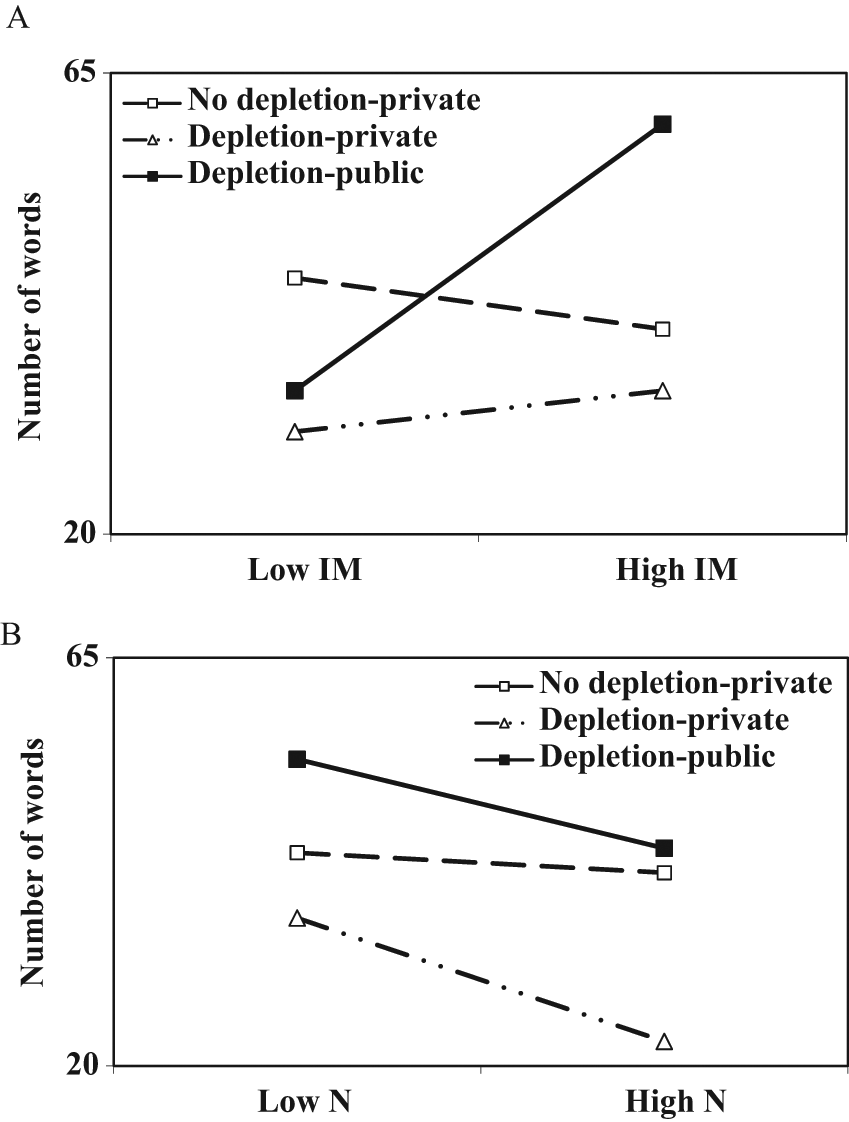
Number of words written in the letter scramble task in Study 3 as a function of social context, self-control manipulation, and IM (Panel A) or neuroticism (Panel B) N = neuroticism; IM = impression management.
Analyses pertaining to mood (i.e., pleasantness and arousal) yielded no significant effects (all ps > .10).
Turning to neuroticism, we performed the same set of analyses described above after replacing IM with neuroticism. Step 1 of the analysis revealed two main effects. The first was for the first effect-coded variable, β = .29, t(59) = 2.37, p < .05, indicating that more words were written in the depletion–public condition than in the two control conditions, and the second effect was a marginally significant effect associated with the second effect-coded variable, β = −.24, t(59) = −1.96, p < .06, indicating that more words were written in the no depletion–private condition as compared to the depletion–private condition. In the case of neuroticism, these effects were not qualified by a significant interaction in Step 2 (R2 change = .01, F < 1; see Figure 3b). Simple slope analyses revealed a marginally significant negative effect of neuroticism on the performance in the depletion–private condition (βsimple slope = −.31, p < .10). As expected, this effect was moderated—not significantly—in the depletion–public condition, where neuroticism was associated with depletion to a lesser extent, implying that some restoration did occur (βsimple slope = −.15, t < 1). Neuroticism was not associated with any depletion in the no depletion–private condition (βsimple slope = −.03, t < 1).
Analyses of mood revealed a main effect for neuroticism in predicting pleasantness, β = −.31, t(59) = −2.36, p < .05. No other effects were significant for pleasantness. Neuroticism had a main effect in predicting arousal as well, β = .31, t(59) = 2.44, p < .05. No other effects were significant for arousal.
Discussion
Study 3 sought to explore whether public social context can assist restoring depleted self-control resources. The results showed that public context indeed helped to restore depleted resources the higher one scored on the IM scale. The social context apparently served as a strong motivator to expend self-control among high IM scorers who worked efficiently in this condition compared to their yield under the nondepleting (but also not engaging) no depletion–private condition.
A small (not statistically significant) moderation of the depletion effect was also found for neuroticism. Working in a public social context after exerting self-control in two earlier tasks induced some new spirit in high neuroticism individuals, but given their low baseline level of self-control, high scorers failed to leverage this opportunity to their benefit in the same way that high IM individuals did.
The results of the present study allow us to evaluate an alternative explanation for the high level of self-control among high IM individuals that was found in Studies 1 and 2. According to the alternative explanation, in Studies 1 and 2 high IM individuals exerted less effort than their counterparts in the first (public) task because they were more accustomed to self-presentation. As a result, they had higher self-regulatory capacity left to expend on the second (critical) task. Study 3 rules out this explanation. High IM individuals exerted much self-control in the public context. It is therefore unlikely that they “saved energy” on the equivalent public setting in Studies 1 and 2 and more likely that they possess a high capacity for self-control.
General Discussion
The present research sought to explore the effect of mere public social context on the capacity to exert self-control. Individual differences in neuroticism and IM were predicted to moderate the response to social presence. Both traits reflect the same standing on the interpersonal circumplex vis-à-vis public social contexts—high affiliation and low dominance. As a result, they are associated with strong responsiveness to changes in social contexts. However, neuroticism is associated with proneness to experience stress and with low self-control, whereas IM is associated with high self-control. Consequently, early public performance was predicted to be associated with subsequent depletion effects for neuroticism but not for IM (Studies 1 and 2). However, once self-control resources were already depleted, public context was expected to temporarily restore self-control resources, especially among high IM individuals (Study 3).
The results of the three studies supported the predictions. In Study 1, high neuroticism participants persisted less than low scorers while working on a puzzle after working on a very simple task in public. In Study 2, high neuroticism participants solved fewer anagrams than low neuroticism individuals after spending time listing their thoughts in public. Both studies also showed that at times high neuroticism individuals are better self-regulators than low neuroticism individuals. In the alone (i.e., low threat) control condition, high neuroticism individuals outperformed low neuroticism individuals. Although not the focus of the present research, this pattern exemplified an interesting phenomenon relating to self-regulation: Early success in performing very simple tasks motivates low self-control individuals (e.g., high neuroticism individuals) and helps them perform better on later tasks. The opposite occurred among low neuroticism individuals, who found the overall nonchallenging settings disengaging.
Although neuroticism was associated with depletion effects following public performance, IM was associated with the opposite effects in Studies 1 and 2. Not only did the early public performance not deplete the resources of high as compared with low IM individuals, but it was actually associated with stronger exertion of self-control on subsequent tasks. That is, the early public context served as a strong prime among high IM individuals to engage in their best performance even beyond the immediate setting. In contrast, working alone on very simple tasks, as in the control condition, lacked the motivating quality that drives high IM scorers to excel.
Study 3 demonstrated again the facilitative impact of public social context on high IM individuals. After an early depletion phase, only high IM individuals, who enjoy strong baseline level of self-control, managed to translate the motivating context into better performance. High (vs. low) neuroticism individuals, who lack strong self-control basis, did not manage to restore their resources in a similar way.
The above results have several theoretical implications. First, they reveal a process of “selective depletion.” Stimuli (e.g., social context) do not posses a predetermined fixed effect on self-control. Cognitive construal, motivation, and existing resources moderate the impact of stimuli on self-control, such that a given stimuli may deplete self-control resources, cancel out depletion effects, or even facilitate exertion of exceptionally high levels of self-control (e.g., Job, Dweck, & Walton, 2010). Second, the results support findings on the role of motivation in moderating depletion effects (Muraven & Slessareva, 2003). However they also put constraints on the facilitating role of motivation. When high motivation to engage in self-control meets low self-control capacity (as among high neuroticism individuals), results may not always be favorable (cf. Uziel & Baumeister, 2010). Third, the present findings indicate that personality is an important factor in moderating depletion effects. Forth, past research has documented the negative impact of public contexts on individuals high in neuroticism (e.g., Lambert et al., 2003). The present results add an explanatory mechanism for these effects, which rests on self-control resources. Finally, the present research further strengthens the theoretical association between IM and self-control (Uziel, 2010a, 2010b). The results of the three studies demonstrate that high IM individuals have high self-control capacity, which shows mostly in interpersonal contexts, when it is most rewarding.
The present set of studies is not without its share of limitations. The short time span of the experiments did not allow us to conclude about the durability of the effects. Such investigation could be informative in settings where depletion effects are cancelled out, such as in Study 3, to tease apart temporary effects of motivational factors from actual high levels of self-control. The focus on mere social presence in the present studies presented an advantage in its minimalism and standardization. However, a more complete account of the effects of social settings on self-control should involve interpersonal interactions. In addition, the expressions of self-control studied in the present set of experiments could be elaborated to other domains of self-control.
In conclusion, the present research demonstrated that mere social presence has differential effects on the self-regulatory capacity of individuals varying along the traits of neuroticism and IM. Personality, it appears, plays an important role in moderating the impact of the social environment on one’s self-related resources.
Footnotes
Most of this work was done while the first author was a postdoctoral fellow at the Baumeister/Tice Lab at Florida State University. Portions of this research were presented at the meeting of the Society for Personality and Social Psychology (February 2009, Tampa, Florida).
The author(s) declared no potential conflicts of interest with respect to the research, authorship, and/or publication of this article.
The author(s) disclosed receipt of the following financial support for the research, authorship, and/or publication of this article: This study was partially supported by a grant from the Israel Science Foundation (Grant No. 70/11) to Liad Uziel. Roy F. Baumeister’s effort was supported by Grant 1RL1AA017541 from the U.S. National Institutes of Health.