



Abstract
The purpose of the present research was to examine the automatic role of psychological need satisfaction in episodic memories and in their associated networked memories on people’s sense of well-being. In each of four studies, participants were asked to describe a main episodic memory and networked memories, that is, other memories related to their main episodic memory. Results of Studies 1 and 2 revealed that levels of need satisfaction in a main episodic memory and in its networked memories both uniquely contributed to the prediction of well-being (based on either participants’ or peers’ ratings). Study 3 examined the automatic effect of priming an episodic memory network on people’s well-being in the here and now. Study 4 revealed that need satisfaction in episodic memory networks predicted changes in well-being over time. In addition, this relationship held after controlling for broad dispositional traits, mental health, and general need satisfaction ratings.
Episodic memories are mostly about significant and affectively charged past events. The recall or the activation of such episodic memories usually leads to the reexperience of this affective charge in the here and now of the situation that has triggered it (LeDoux, 1992; Schwartz, Weinberger, & Singer, 1981). Our theory in the present article is that, over time, recurrent activation of episodic memories should affect a person’s sense of well-being in an enduring fashion, in accordance with the goal-affective component characterizing these memories. In addition, this process should generally occur outside of people’s awareness. Below, we explain our theory in detail.
Memories are easily activated by external cues. This occurs when certain features of the environment match a memory that has been encoded with such features (Andersen & Baum, 1994; Ferguson & Bargh, 2004). Once triggered, most episodic memories do not necessarily coalesce into an experience of reminiscence (Conway & Pleydell-Pearce, 2000). However, their activation appears to influence the person in the situation that triggered the episodic memory. This principle has been investigated with semantic memory (e.g., Neely, 1977) and with social concepts (Ferguson & Bargh, 2004), but little research has examined this process with actual episodic memories.
Episodic Memories and Goal-Affective Component
Episodic memories remain attached to an affective component that has been experienced during the initial event, primarily determined by the person’s goals at the encoding (Conway, 2008; Conway & Pleydell-Pearce, 2000). For example, in a sports competition, if a person’s primary goal is to beat the other team, this person may feel deeply frustrated by a loss and encode this episodic event as a highly negative one. Conversely, another person taking part in the same competition may be motivated to have fun while playing. This goal could be achieved despite the loss and the competition event encoded as a positive experience. Thus, people’s working goals at encoding heavily determine the type of goal-affective component that will remain attached to the episodic memory (Conway & Pleydell-Pearce, 2000).
Although people’s goals may vary across situations, self-determination theory (Deci & Ryan, 2000) proposes that humans have an overarching goal of growth, which is expressed through the daily pursuit of fulfillment of three psychological needs: autonomy, competence, and relatedness. Autonomy refers to the need to feel volitional and authentic in one’s actions. Competence is defined as the need to feel effective and efficacious. Relatedness refers to the need to feel connected and to care for others and be cared for by others in turn. Researchers have highlighted the fundamental nature and importance of these three needs in specific events and across diverse domains and cultures (e.g., Deci et al., 2001; Sheldon, Elliot, Kim, & Kasser, 2001) and have shown that their satisfaction in everyday life is positively associated with measures of well-being such as psychological growth, purpose and meaning in life, general life satisfaction, and psychological adjustment (e.g., Reis, Sheldon, Gable, Roscoe, & Ryan, 2000; Sheldon, Ryan, & Reis, 1996). Because of the fundamental nature and prominence of these needs across situations, their need satisfaction representations should remain attached to a majority of significant episodic memories. Indeed, recent research (Philippe, Koestner, Beaulieu-Pelletier, & Lecours, 2011) has shown that need satisfaction in episodic memories (either positive or negative) is a basic component of such memories and is distinct from several other memory components examined in past memory research (e.g., valence, implicit motives, intrinsic and integrative memories, age of the memory, etc.).
When an episodic memory is activated, therefore, its goal-affective component should also be triggered and affect a person accordingly in the here and now. Thus, the need satisfaction representations attached to an episodic memory should be an active ingredient influencing a person’s well-being in the here and now of a situation triggering the memory. In line with self-determination theory, need satisfaction should signal possibilities for psychological growth and the opportunity to build and expand the self (Deci & Ryan, 2000; Hodgins & Knee, 2002), whereas need thwarting should signal a potential threat to the self and to the innate psychological growth goal and should lead to self-closure and strategies to protect the self (Deci & Ryan, 2000; Hodgins & Knee, 2002). Thus, a situation triggering a need-satisfying episodic memory should positively affect a person’s well-being in the here and now and promote self-growth. Conversely, a situation triggering a need-thwarting episodic memory should negatively affect a person’s well-being in the here and now and lead to self-closure strategies. Furthermore, if repeated over time, this process should affect a person’s well-being in a stable and enduring fashion. In other words, episodic memories, through their repetitive activations across certain situations, should lead to consolidations and changes in one’s well-being.
A Memory Does Not Exist Alone
Another important aspect of memory is its binding property. Memories are organized in association with other memories on the basis of shared characteristics or themes (Anderson, 1984; Brown & Schopflocher, 1998; Christianson & Engelberg, 1999). Research has shown that networks of memories are often formed based on the contiguity of memory elements, such as similar events and themes (Brown & Schopflocher, 1998; Kemp, Burt, & Malinen, 2009). More specifically, networks can be formed of situations or events sharing a common feature, such as a same place, person (Andersen & Baum, 1994), object, motive (Woike, Lavezzary, & Barsky, 2001), or emotion (Bower, 1981). Consequently, when an episodic memory is triggered, other memories to which it is linked become active, as activation spreads across the links (Anderson, 1984; Bower, 1981; Christianson & Engelberg, 1999).
According to emotional memory network theory (Philippe, Lecours, & Beaulieu-Pelletier, 2009), such a spreading activation should trigger the goal-affective memory components (i.e., need satisfaction representations) of each memory that is part of the activated network. The average of these need satisfaction representations is assumed to combine at a higher-order cognitive level and influence the person’s well-being in the here and now (Philippe et al., 2009; Smith & Kirby, 2000). The properties of the network—the need satisfaction representations and the number of networked memories—are essential to this process. If an episodic memory is characterized by need thwarting, other memories of higher need satisfaction levels composing the memory network may temper the impact of such a detrimental memory. Similarly, the number of networked memories affects the quality of the overall memory network because of the averaging process of the need satisfaction representations characterizing each memory of the network (Philippe et al., 2009). Thus, if the frequent activation of an episodic memory also leads to the frequent activation of its networked memories—because activation spreads across the links—need satisfaction in an episodic memory and in its networked memories should each contribute to a person’s well-being. In addition, an episodic memory network (i.e., an episodic memory and its networked memories) should have an independent effect on well-being from other episodic memory networks, since each episodic memory network should not be activated by the same types of cue. Each should produce, over time, additive effects on well-being through their independent and repetitive activations.
The Present Research
The first purpose of the present research was to initially investigate the relationship existing between need satisfaction in episodic memories and well-being and the incremental predictive value of networked memories and of other episodic memories on well-being, rated either by the participants or by one of their peers (Studies 1 and 2). Philippe and colleagues (2011) showed that need satisfaction in a frequently activated memory was associated with various well-being measures. However, only one main memory was studied. In Studies 1 and 2, we sought to examine the additional effect of networked memories on well-being and the degree of independence existing between two different sets of episodic memory network. This is the first research to examine the specific effect of memory networks.
In addition, we examined the situational mechanism through which need satisfaction in memories influences people’s well-being within an experimental design (Study 3) and the long-term impact of this mechanism on well-being within a prospective design (Study 4). Furthermore, we investigated the proposition that this mechanism occurs mostly outside of people’s awareness (Studies 1 and 3). Finally, we examined the discriminant and incremental predictive utility of episodic memories for well-being over more traditional person-level questionnaires, such as personality measures (Studies 2 and 4).
Some research has looked at the association between autobiographical memories and well-being. This research has investigated how mature and happy people frame their autobiographical memories (Bauer, McAdams, & Sakaeda, 2005) and how interpreting important events, such as life transitions (Bauer & McAdams, 2004) or finding out that one’s child has Down syndrome, could affect people’s well-being (King, Scollon, Ramsey, & Williams, 2000). These studies focused on the intentions and meanings people use to make sense of these events in their lives (Bauer et al., 2005), as shown in the themes, sequences, and structures used when they narrate life events (King et al., 2000; Woike et al., 2001). However, in the present research, we focus on how a past episode has been experienced in terms of its level of need satisfaction and not on the content and structure of the narrated episode (see Philippe et al., 2011). For this reason, we use the term episodic memory in the present research to distinguish it from the past research that has focused on autobiographical memory narratives.
Study 1
Study 1 examined the relationship between need satisfaction in a frequently activated episodic memory and in its networked memories and well-being. We hypothesized that need satisfaction in a frequently activated episodic memory would be associated with well-being. In addition, it was expected that need satisfaction in the networked memories associated with this episodic memory would also contribute to the prediction of well-being. Furthermore, it was predicted that need satisfaction in a second separate episodic memory network (another frequently activated episodic memory and its related networked memories) would be only moderately correlated to need satisfaction in the first episodic memory network since each episodic memory network should be activated by distinct cues and should thus be relatively independent of each other. However, each episodic memory network should additively contribute to the prediction of well-being. Finally, we investigated the level of awareness people have that their episodic memories may influence their well-being. In line with the postulate that the influential role of episodic memories occurs mostly outside of people’s awareness, we hypothesized that people’s awareness that their memories may influence their well-being would not moderate the relationship between need satisfaction in episodic memories and well-being.
Method
Participants were 104 undergraduate and graduate students (76 females, 28 males) from a Canadian university with a mean age of 27.67 years (SD = 8.39). A total of 87.5% were Caucasian, 3.8% Asian, 2.9% Black, 1.9% Hispanic, and 1.9% Arabic, and 1.9% were from other ethnic backgrounds. 1
Measures
Well-being
Two types of well-being were assessed: Hedonic (general happiness with one’s life) and eudaimonic well-being, measured with the Satisfaction With Life Scale (Diener, Emmons, Larsen, & Griffin, 1985) and a short version of the Psychological Well-Being scale (PWB; Ryff & Keyes, 1995), respectively. This latter scale assesses six dimensions of well-being, each with three items. However, in the present study, only three of these dimensions (self-acceptance, purpose in life, and personal growth) were used because the PWB’s other dimensions (i.e., autonomy, mastery, and relatedness) are very closely related to the three psychological needs. Participants were asked to rate all items on a 7-point Likert-type scale (1 = do not agree at all, 7 = totally agree). An index of well-being was created by averaging the scores of these two scales (α = .84). 2
First episodic memory network: Main episodic memory
Instructions were derived from past research on self-defining memories, that is, a type of memory that is frequently activated and recalled and that pertains to a specific episodic event (Singer & Salovey, 1993; Sutin & Robins, 2005). The questionnaire first asked the participants to describe
a personal memory of an event that is at least one year old which was significant (important) for you. This memory should reflect your identity or who you are and should reveal something about how you perceive yourself generally. Choose a memory that often comes to your mind. This memory can be either positive, negative, or both.
Thus, participants were free to recall any type of memory and were not guided in selecting a memory of a particular valence.
Networked memories
To assess the networked memories associated with the main episodic memory, the questionnaire further asked participants to recall and describe other personal memories that they might find to be directly or indirectly related to the memory they had just described. A maximum of three text boxes were provided to the participants to describe three networked memories. However, they were informed that they did not have to report as many memories but rather write down memories that came spontaneously to mind. Thus, participants were free to recall any number of networked memories, between one and three.
Second episodic memory network
Participants were then asked to describe a second main episodic memory and to describe networked memories related to this second main memory. Instructions were the same as those presented above. Participants were instructed only to describe memories different than those already described.
Ratings of need satisfaction and awareness of influence
After describing all of their memories (main and networked memories), participants were asked to rate the degree of need satisfaction they experienced at the moment the event of their memory occurred. Participants made their ratings on a 7-point Likert-type scale ranging from −3 (strongly disagree) to +3 (strongly agree), with 0 representing do not agree nor disagree or not applicable—this latter option indicating that both need satisfaction and need thwarting were part of the event or that need satisfaction was not present in the event. They were provided with two items assessing each of the three psychological needs postulated by self-determination theory (i.e., autonomy, competence, and relatedness). Sample items include “I felt free to do things and to think how I wanted” (autonomy), “I felt skillful or capable” (competence), and “I felt connected to one or more people” (relatedness). These items were derived from past research (e.g., Reis et al., 2000; Ryan, Rigby, & Przybylski, 2006; Sheldon et al., 2001) and adapted to assess experience during a past event. Confirmatory factor analyses (Philippe et al., 2011) have revealed excellent fit indices for a three factor model and for a super factor (second order factor), indicating the possibility to average all three needs in an index as is commonly done by self-determination theory researchers (e.g., Deci et al., 2001; Gagné, 2003). Self-ratings of need satisfaction in memories have also been found to correlate highly (r = .70) with coding of need satisfaction by blind judges (Philippe et al., 2011).
Participants were also asked to rate the awareness item “This memory has influenced or still influences my current well-being” on a −3 (strongly disagree) to +3 (strongly agree) Likert-type scale for each of their described memories. An index of awareness was created for each of the two episodic memory networks by averaging the participants’ ratings of awareness of influence for the main memory and for each networked memories.
Procedure
Participants were contacted through their university e-mail and informed that we were conducting an online study about memory. As an incentive, participants were entered into a drawing for three prizes of $125, and this incentive was the same for all studies reported in the present article. It is important that all participants completed the well-being measures before describing their memories to ensure that the description of the memories did not alter the well-being ratings.
Results and Discussion
Table 1 presents the correlational results. A factor analysis with maximum likelihood was used to examine the distribution of each of the three needs in the two main episodic memories and in the two sets of networked memories. Results using the scree test and a parallel analysis revealed two clear factors at 4.10 and 2.49 Eigenvalues. As shown in Table 2, the first dimension was saturated by the three needs characterizing the second main memory and by the three needs characterizing the networked memories of this second main memory. The second dimension was saturated by the three needs characterizing the first main memory and by the three needs related to the networked memories of this first main memory. These results suggest three important conclusions: (a) All three needs characterizing a memory or its related set of networked memories covary together and can be combined; (b) networked memories share a special association with the main episodic memory to which they are related, while being relatively independent from a different main memory and from a different set of networked memories; and (c) two episodic memory networks (i.e., a main episodic memory and its related networked memories) are relatively distinct from each other. In other words, there seems to be little overlap between two episodic memory networks (r = .26 in the present study). This indicates that each episodic memory network may have a distinct signature and consequently a distinct role on people’s well-being.
Correlations Among Need Satisfaction in Each of the Memory Components and Well-Being: Study 1
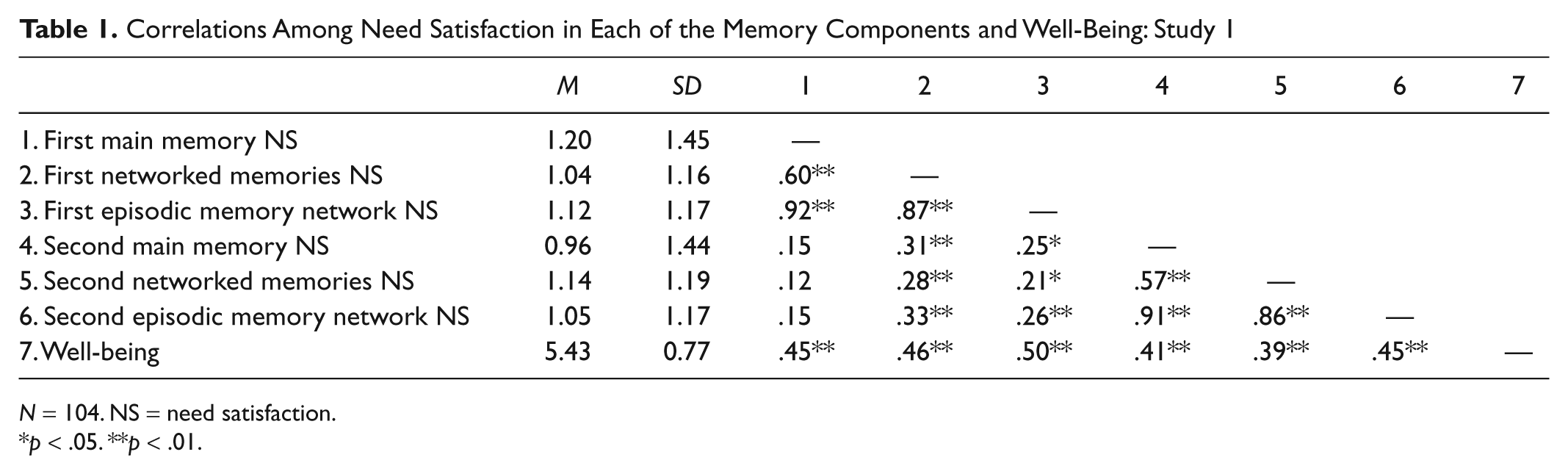
N = 104. NS = need satisfaction.
p < .05. **p < .01.
Factorial Analysis Results (Pattern Coefficients) of the Three Needs Characterizing Two Sets of Episodic Memory Network: Study 1
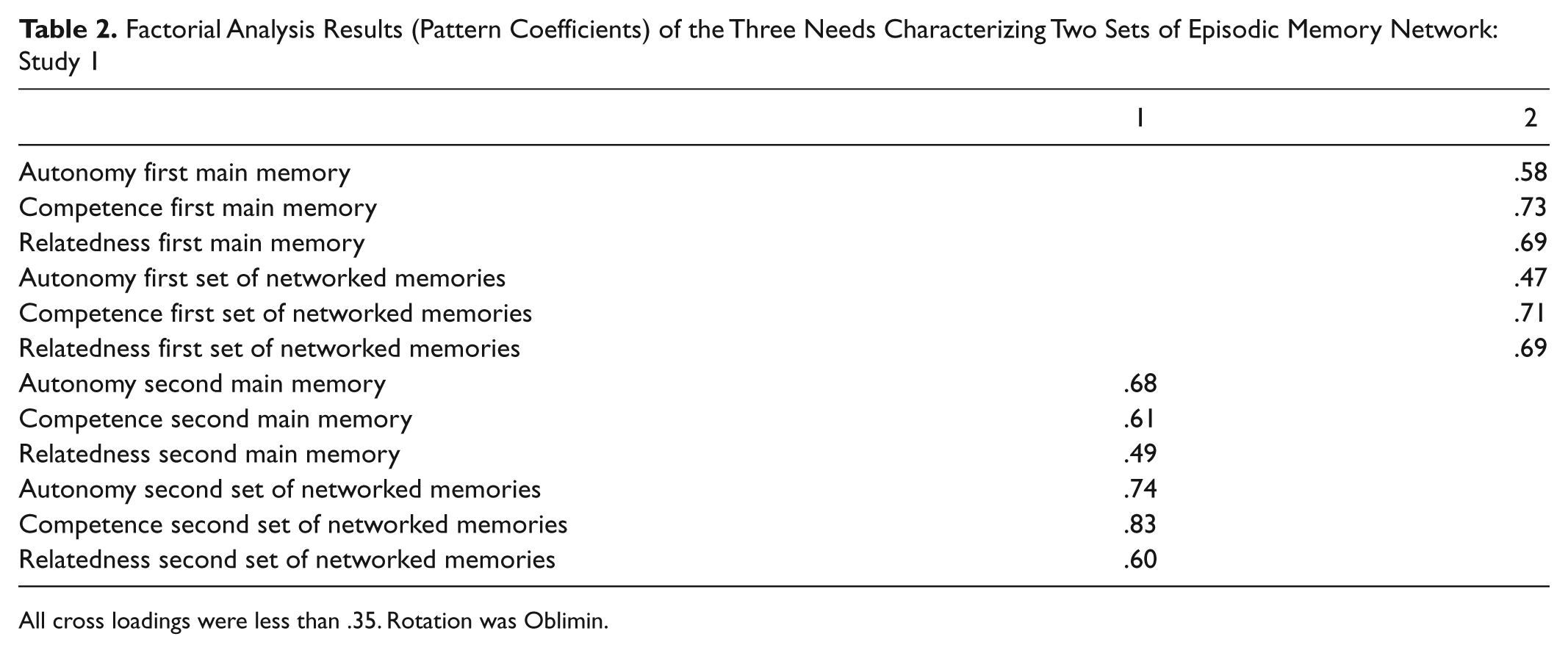
All cross loadings were less than .35. Rotation was Oblimin.
Regression analyses were conducted to examine the specific contribution of each memory component to well-being. Table 3 shows these results. Regression Models 1 (first episodic memory network) and 2 (second episodic memory network) showed that need satisfaction both in the main episodic memory and in its related networked memories additively contributed to well-being, with networked memories explaining 5.8% and 3.7% of the variance of well-being over and above the first and second main memories, respectively. 3 Model 3 examined the relative contribution of each episodic memory network, that is, the combination of a main memory and its networked memories. Results revealed that each episodic memory network independently and additively contributed to the prediction of well-being, with the second episodic memory network explaining 11.2% of the variance over and above the first episodic memory network. Model 4 examined the relative contribution of need satisfaction in each memory component separately (i.e., each main memory and each set of networked memories all covarying). Results revealed that need satisfaction in all components was associated with well-being. Need satisfaction in the networked memories related to the first main memory was marginally significant because of the small sample size but still achieved a substantial beta coefficient of .17.
Hierarchical Regression Analysis Models of Well-Being on the Main Memories and Networked Memories of Two Sets of Episodic Memory Network: Study 1
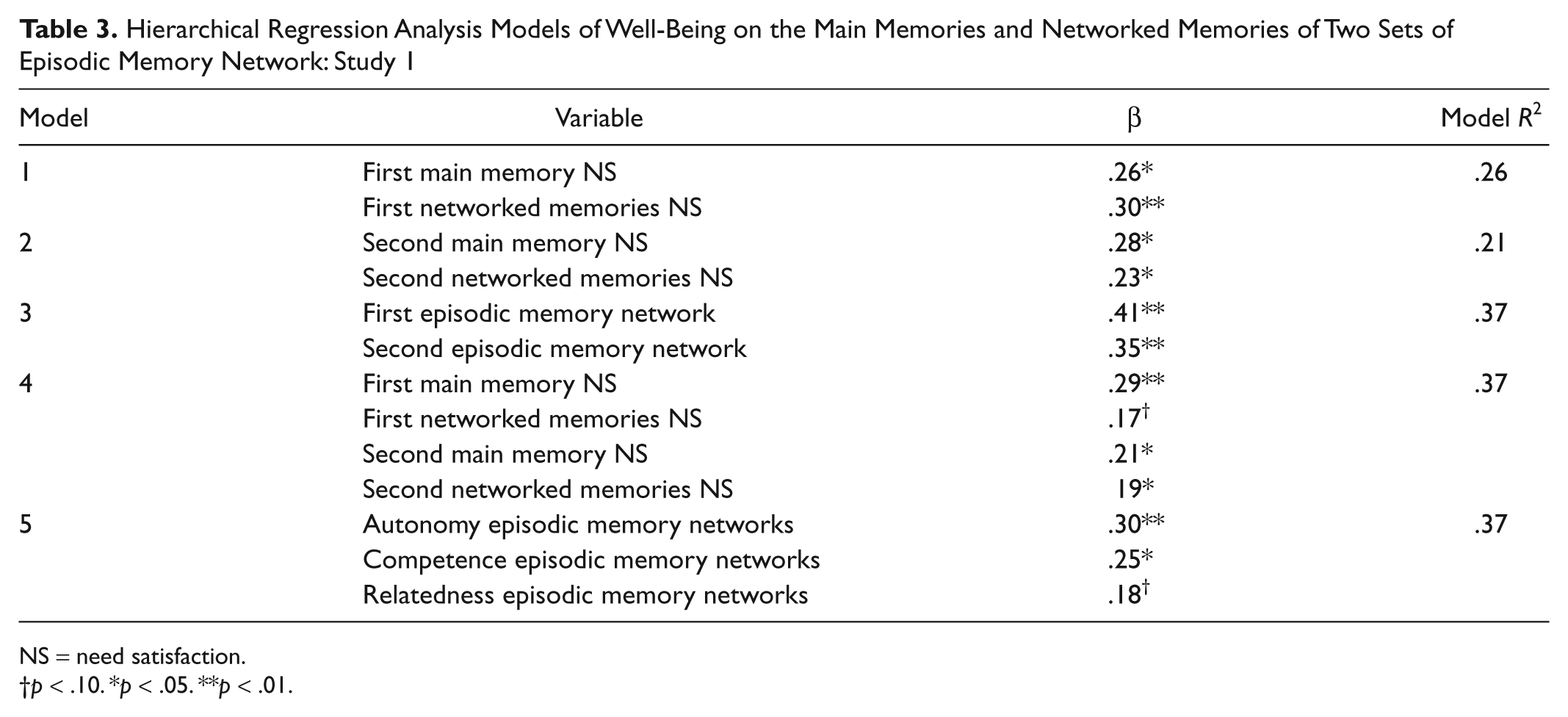
NS = need satisfaction.
p < .10. *p < .05. **p < .01.
In Model 5, we examined if each of the three needs postulated by self-determination theory was uniquely associated with well-being. This was a very stringent test since past research has used special designs (e.g., experience samplings) or methods (e.g., meta-analysis) to examine the unique contribution of each need to well-being (e.g., Reis et al., 2000). To gain more power, we averaged the score of the two episodic memory networks for each need separately. Despite the stringency of this test, results of Model 5 showed that each of the three needs in the episodic memory networks was uniquely associated with well-being, at least marginally, but with substantial beta coefficients. In all the above regression analyses, controlling for age and gender did not alter the results, and there were no correlations among age and gender and all study variables.
Finally, we examined whether people were aware or not that their episodic memories may influence their well-being. The indices of awareness of influence for the first and the second episodic memory network were correlated at .33, p < .01 with each other, at r = .10, ns and r = .20, p < .05 with well-being, and at r = .45 and r = .49, ps < .01 with need satisfaction in the first and the second episodic memory networks, respectively. These results indicate that the more a memory is need satisfying, the more people think that this memory influences their well-being. Finally, a regression analysis showed that once need satisfaction was controlled for, awareness of influence was unrelated to well-being. In addition, the interaction terms between awareness of influence and need satisfaction for each episodic memory network were nonsignificant. These results highlight the fact that people may not be aware of the actual effect that their episodic memories may have on their well-being. Indeed, people appear to falsely believe that need-satisfying memories exert the most influence on their well-being, but not need-thwarting memories. However, the belief or awareness that a memory may have an influence on well-being did not explain the relationship between need satisfaction and well-being, even for people who reported a need-satisfying memory (nonsignificance of the interaction terms).
Overall, these findings provide evidence that need satisfaction in episodic memories is associated with well-being. The present study also highlights the important role of networked memories in contributing additively to well-being. In addition, results suggest that networked memories share a special association with their main episodic memory that is not shared with other main episodic memories or networked memories. Furthermore, each episodic memory network was found to contribute uniquely to people’s well-being. Other noteworthy findings are that each of the three needs postulated by self-determination theory was shown to contribute uniquely to well-being. Finally, it would appear that people are not aware of the actual effect of their memories on their well-being.
Study 2
The association found in Study 1 between need satisfaction in memories and well-being is limited by its use of common measurement methods. In Study 2, we examined this association with well-being as rated by the participants, but also by one of their peers. Furthermore, we investigated the discriminant and incremental validity of need satisfaction in episodic memory networks. Research has shown that episodic memories provide an additional predictive value of well-being, above and beyond traditional questionnaire measures of personality or of general person-level variables (Bauer et al., 2005; Lodi-Smith, Geise, Roberts, & Robins, 2009; Philippe et al., 2010). It was thus hypothesized that need satisfaction in an episodic memory network would be associated with well-being, as rated by the participants or by one of their peers, even after controlling for personality traits and need satisfaction generally experienced in people’s life. Study 2 also controlled for mental health to ensure that the relationship between need satisfaction in memories and well-being was not explained by people’s psychological symptoms.
Method
A total of 80 undergraduate or graduate students (67 females, 13 males) from a Canadian university and one of their peers (44 females, 36 males) took part in this study. Participants’ mean age was 25.05 years (SD = 5.56), and that of their peers was 30.70 years (SD = 11.52).
Measures
Personality traits
The Big Five Inventory (John & Srivastava, 1999) was used to assess the five common traits of personality, namely, neuroticism, extraversion, openness, conscientiousness, and agreeableness. This well-validated measure requires participants to rate on a 5-point scale the extent to which each of 44 items describes their personality. The prompt reads, “I see myself as someone who . . . ,” and sample items include “can be tense” or “is outgoing, sociable.” See Table 4 for the alpha coefficients of all scales.
Means, Standard Deviations, and Correlations Among Episodic Memory Network Need Satisfaction, Traits, General Need Satisfaction in Life, Psychological Symptoms, and Participants’ and Peers’ Well-Being Ratings: Study 2
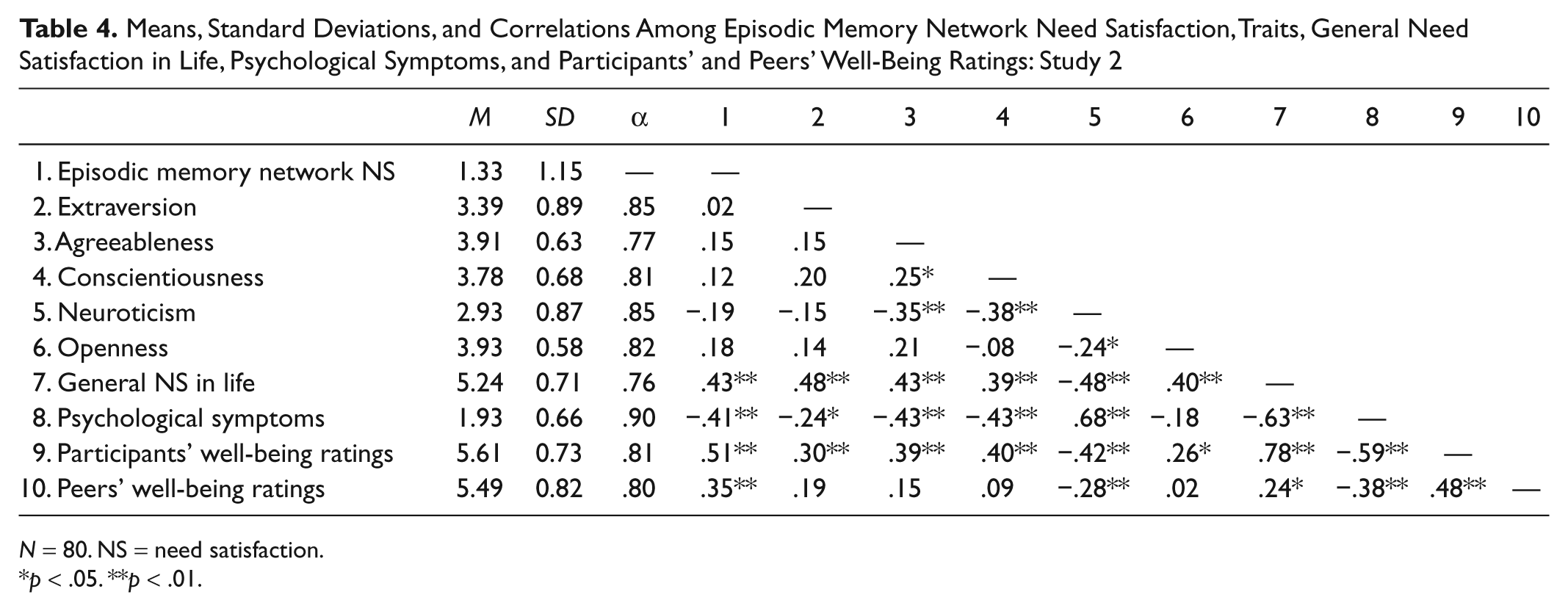
N = 80. NS = need satisfaction.
p < .05. **p < .01.
General need satisfaction in life
The Basic Psychological Needs Scale (Gagné, 2003) was used to assess participants’ general need satisfaction in life. A total of 21 items assess autonomy, competence, and relatedness. Respondents indicated on a scale from 1 (not true at all) to 7 (definitely true) the extent to which each item applied to them.
Psychological symptoms
The short scale of the Symptom Checklist (Rosen et al., 2000) was used to assess mental health. This scale is composed of 10 items responded to on a 5-point Likert-type scale (1 = not at all, 5 = extremely) and assesses various psychological symptoms. This short scale correlates at .95 with the full 90-item original scale.
Well-being
The same well-being scales used in Study 1 were used in Study 2. Both the participants and their peers completed these scales. Peers were asked to respond to each item in reference to their friend or relative, and the items were slightly adapted to this purpose (e.g., “My close other is satisfied with his/her life”).
Episodic memories
Instructions for the main episodic memory and networked memories were the same as those presented in Study 1. Only one episodic memory network (a main memory and its networked memories) was assessed in Study 2 and in all subsequent studies. The ratings of need satisfaction for the main episodic memory and for each networked memory were averaged to form a single episodic memory network need satisfaction score.
Procedure
Procedures were identical to those presented in Study 1. Personality traits, general need satisfaction in life, psychological symptoms, and well-being measures were completed before the memory descriptions and ratings. The peers were asked to respond to each well-being item to the best of their knowledge.
Results and Discussion
As shown in Table 4, peers’ well-being ratings were positively correlated with participants’ reported well-being. As expected, participants’ episodic memory network need satisfaction was positively associated with both self- and peer-rated well-being.
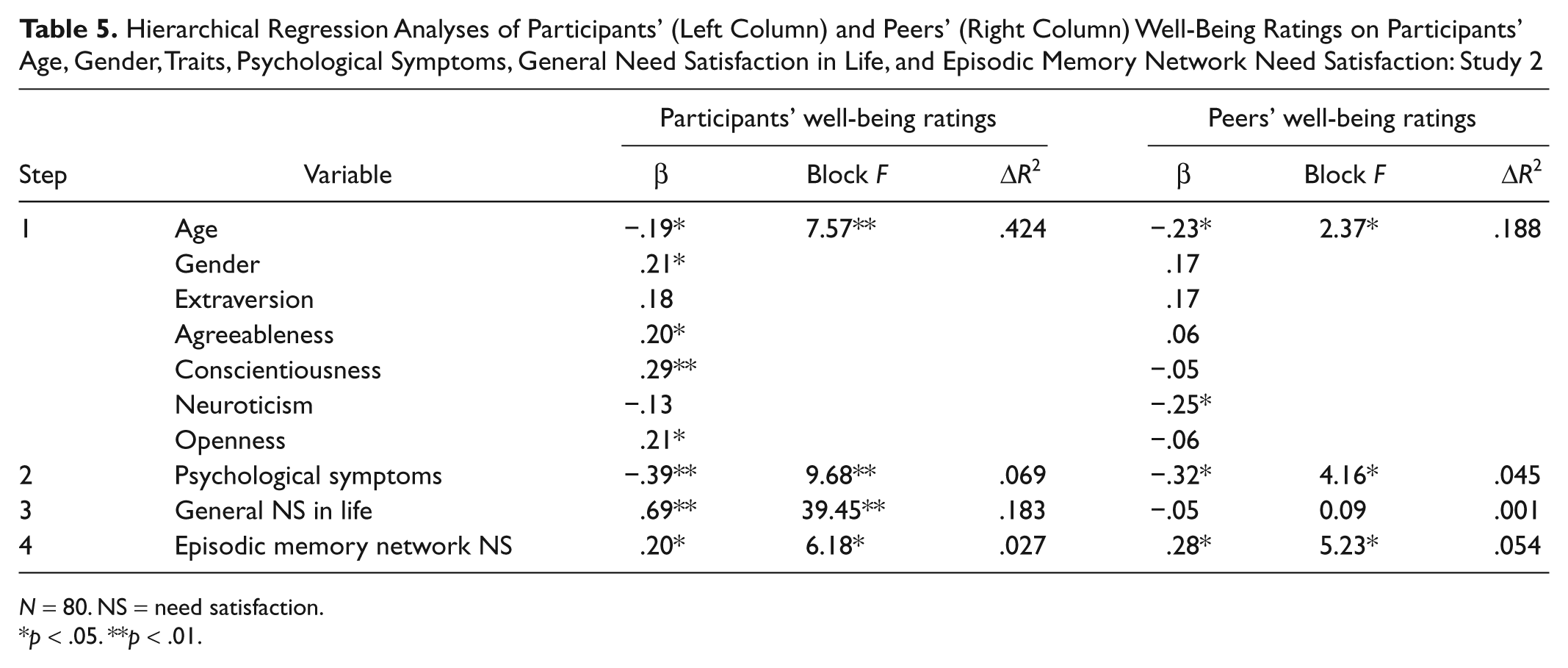
Hierarchical regression analyses were conducted to investigate the association between need satisfaction in the episodic memory network and well-being as rated by the participants and their peers, but once age, gender, traits, general need satisfaction, and psychological symptoms were controlled for. Results (see Table 5) revealed that need satisfaction in the episodic memory network was significantly associated with well-being, rated by either the participants or their peers, even after holding constant the effect of all the control variables.
Hierarchical Regression Analyses of Participants’ (Left Column) and Peers’ (Right Column) Well-Being Ratings on Participants’ Age, Gender, Traits, Psychological Symptoms, General Need Satisfaction in Life, and Episodic Memory Network Need Satisfaction: Study 2
N = 80. NS = need satisfaction.
p < .05. **p < .01.
Overall, these findings suggest that the potential bias of a common measurement method between need satisfaction in memories rated by the participants and well-being is untenable. Indeed, the association between need satisfaction in an episodic memory network and well-being, rated either by the participants themselves or by one of their close others, was equivalent. The present findings also suggest that episodic memories are not a proxy for traits or general need satisfaction, since specific episodic memories significantly contributed to people’s well-being after controlling for these variables. Finally, although people with high psychological symptoms appeared to report lower need-satisfying memories and lower well-being (see Table 4), this relationship did not affect the association between need satisfaction in memories and well-being.
Study 3
Studies 1 and 2 provided cross-sectional evidence that need satisfaction in some frequently activated episodic memories and in their networked memories is associated with well-being. In Study 3, we sought to investigate the core underlying mechanism of this relationship, that is, that episodic memories may be activated outside of people’s awareness and that such activation should influence people’s well-being in the here and now of the situation that triggered these memories.
In Study 3, participants first described an episodic memory network and rated their level of need satisfaction for each reported memory. Two weeks later, these same participants were contacted to take part in an apparently unrelated study. Participants who had reported need satisfaction in their episodic memory network 2 weeks before were primed either with keywords related to their own main episodic memory description or with keywords related to another participant’s main episodic memory who had also reported need satisfaction in his or her episodic memory network. More specifically, we yoked each participant who had reported need satisfaction in his or her episodic memory network with another participant who had also reported need satisfaction in his or her episodic memory network, so that the former was primed with keywords related to his or her own main episodic memory and the latter was primed with exactly the same keywords, which were unrelated to his or her own main episodic memory. The same yoking procedure was used for participants who had reported need thwarting in their episodic memory network. See Table 6 for an overview of this design.
Summary Illustration of the Yoking Design Used in Study 3
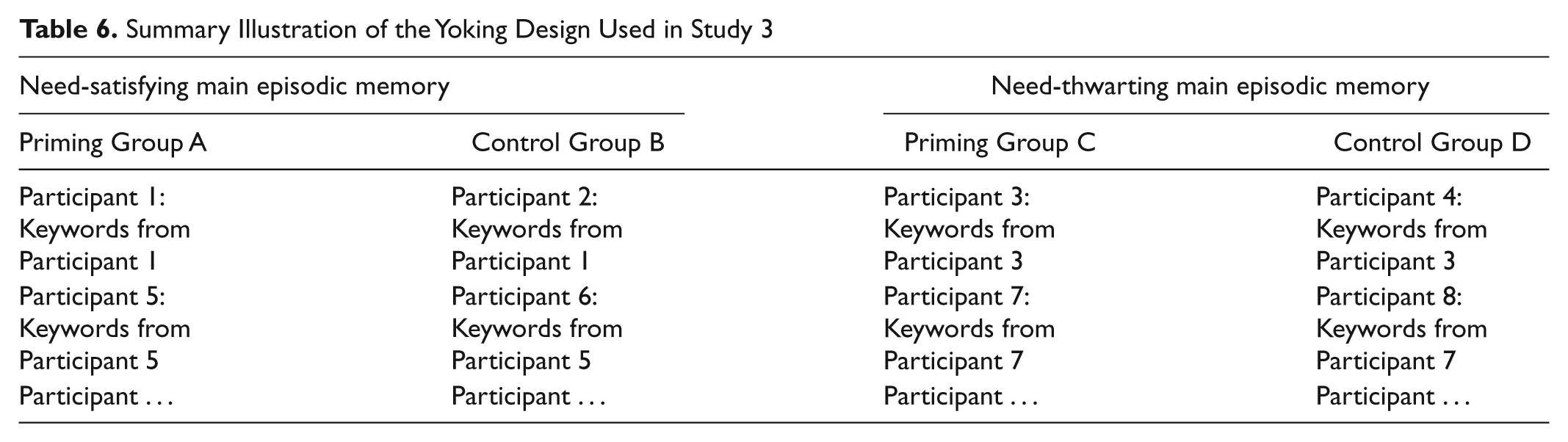
After having been primed with these keywords, participants were asked to rate their situational well-being. It was posited that priming participants with keywords related to their main memory would trigger this memory and its networked memories and thus the whole episodic memory network. Depending on whether this overall episodic memory network is need satisfying or need thwarting, its activation should influence people’s situational sense of well-being accordingly. Conversely, priming participants with keywords related to another participant’s main memory should not trigger any personal memory in particular and should not affect these participants’ situational sense of well-being in any specific direction. Therefore, it was first expected that participants with a need-satisfying episodic memory network primed with their own keywords would report higher well-being levels compared to the control group of participants who were primed with the same keywords but unrelated to their own main memory. Second, it was expected that participants with a need-thwarting episodic memory network primed with their own keywords would report lower well-being levels compared to the yoked control group of participants who were primed with the same keywords but which were unrelated to their own main memory. In addition, we also controlled for participants’ general well-being.
Method
A total of 174 undergraduate students took part in this study, but 23 participants were omitted from the final data analyses. Participants who were suspicious about the priming procedure or the possible linkage between the two phases of the study were deleted (n = 7). Some other participants reported technical problems and were deleted as well (n = 12) or reported having been disturbed while completing the study (e.g., telephone; n = 3). Finally, one participant took too much time completing the priming task and was omitted from the final analyses. The final sample was composed of 151 participants (110 females, 41 males) aged 25.89 years on average (SD = 6.67).
Measures
Phase 1: Episodic memories
The same instructions used in Study 2 were used in Study 3. Two groups of participants were then created: those who had reported need satisfaction across their episodic memory network (above the value of zero) and those who had reported need thwarting (zero and below). Because most participants usually report a relatively need-satisfying episodic memory network rather than a need-thwarting episodic memory network, the groups were highly unequal. Because this inequality represents a natural disparity between the two groups, the groups were not evened out. Thus, overall, 34 participants reported a need-thwarting episodic memory network, whereas 117 participants reported a need-satisfying episodic memory network.
In addition to the usual memory description, participants were also asked to write down 6 keywords that reflected their main memory. The first author also derived 10 other different keywords from the participant’s main memory description by selecting salient words of the memory, for a total of 16 keywords per participant. Proper names and specific location names (e.g., Mount Gabriel) were not selected and were excluded if they were part of the participants’ keywords and replaced with another keyword. Finally, it should be noted that participants’ keywords were not self-related; keywords were chosen to remind participants of an event and not of self-aspects. A sample of keywords from a participant is the following: beach, friend, encounter, party, sun, warmth, cousin, sojourn, budget, travel, trust, subsidize, mother, sand, country, hot.
Phase 1: General well-being
The two scales used in Studies 1 and 2 were again used in Study 3 (α = .82).
Phase 2: Scrambled sentence task
The priming took place with the use of the Scrambled Sentence Task (Srull & Wyer, 1979). This task consists of 20 sentences, each composed of six words, five of which can be rearranged to make a grammatically correct sentence. Each word of a sentence was written with a capital letter in a block rectangle, and participants were asked to move the words (blocks) around with their mouse to form a correct sentence. A total of 16 sentences included a keyword. The keyword of the participants’ main memory was always the sixth extra keyword in each scrambled sentence, so the grammatically correct sentences were the same across all groups. The remaining four sentences included a neutral word (e.g., table, apartment), which was the same for all groups. Participants of each need group (satisfied and thwarted) were randomly assigned to the priming or the control conditions and yoked across conditions. In the priming condition, the keywords used were from the participant’s own main episodic memory. In the control condition, these keywords were from the yoked participant’s main episodic memory of the same need group. One participant in the experimental group did not have a yoked participant because of the uneven separation of the groups.
Phase 2: Situational well-being
Immediately after completing the scrambled sentence task, participants were asked to complete two situational measures of well-being. A short subscale of the Positive and Negative Affect Schedule (Thompson, 2007) assessing positive emotions with five items was used as a measure of situational hedonic well-being, whereas the scale of vitality (Ryan & Frederick, 1997) was used to assess situational eudaimonic well-being with six items. These two scales were standardized and combined to form an index of well-being (α = .80).
Procedure
Participants were contacted by e-mail and asked to participate in a two-phase online study. They were told that the first phase of the study was about memory. During this phase we asked participants to complete the general well-being scales and to describe a main memory, as well as networked memories, and to rate the need satisfaction level and the valence (−3 = very negative, +3 = very positive) of each of their reported memories. Participants were told that in the second phase of the study we would be collecting data relative to their well-being. During this second phase, participants were told that we were interested in how they felt about themselves at the current moment. To collect unbiased measures, participants were asked to engage in a neutral task (the scrambled sentence task) “to remove your daily thoughts from your mind which will allow you to respond to the questionnaire with more accuracy with respect to your real feelings.” Once this task was completed, participants were asked to complete the situational measures of well-being. They were then probed for suspicion with two questions in a sort of funnel debriefing (see Bargh & Chartrand, 2000). The first question asked participants whether they had been bothered by some words or by some things during the scrambled sentence task. The second question asked participants if they noticed anything in particular with respect to the words used in this specific task. Participants were also asked whether they experienced any difficulties in completing the task and if their computer worked properly. These were all open-ended questions. Seven participants either noticed some words in the scrambled sentences task that they had used in their memory description or suspected a link between the two phases of the study. These participants were excluded from the analyses.
The fact that both phases were conducted online deserves special attention. A common criticism of online experimental studies is that they may not allow as much control as laboratory studies. A number of actions were undertaken to ensure that the present study was comparable to one conducted within laboratory settings. First, participants were asked to complete the study alone, to close any running applications on their computer, and to report any disturbance or interruption at the end of the study that occurred during the study. It was also possible to double-check participants’ responses to the interruption question by examining the time taken to complete the scrambled sentence task and the subsequent scales. The web program also saved participants’ responses to the scrambled sentence task to verify whether the task had been completed carefully. Although more “noise” or nonsystematic error may be expected in online studies compared to laboratory studies, this noise reduces only statistical power. It should be noted, however, that many biases found in laboratory settings, such as experimenter effect or demand characteristics, are not found with online studies or are considerably reduced. Overall, research has shown that online experimental studies and laboratory studies usually result in highly similar findings (e.g., Birnbaum, 2004).
Results and Discussion
A 2 (episodic memory network need: satisfied vs. thwarted) × 2 (conditions: priming vs. control) ANCOVA was conducted with situational well-being as the dependant variable. 4 The time taken to complete the scrambled sentence task was used as a covariate. Also, it should be noted that there were no prior differences between the priming and control conditions in the satisfied need group or in the thwarted need group on need satisfaction in the episodic memory network or on general well-being. Results of the ANCOVA revealed a significant need effect, F(1, 146) = 17.51, p < .001, MSE = .60, η = .107, characterized by a significant need × conditions interaction, F(1, 146) = 12.86, p < .001, η = .081. Planned comparisons showed that in the episodic memory network need satisfaction group, participants reported higher situational well-being in the priming condition (M = 0.34, SE = 0.10) than in the control condition (M = −0.11, SE = 0.10), t(115) = 3.15, d = 0.59. However, in the episodic memory network need-thwarting group, participants reported lower situational well-being in the priming condition (M = −0.83, SE = 0.19) than in the control condition (M = −0.20, SE = 0.19), t(32) = 2.38, p < .05, d = 0.84 (see Figure 1). Finally, results remained virtually the same after controlling for participants’ age or general well-being as covariates, even if there was, unsurprisingly, a large main effect for general well-being, F(1, 140) = 27.21, p < .01, η = .163. There was no significant main effect of gender and no significant interactions involving gender, all Fs(1, 140) < 1.50, ns.
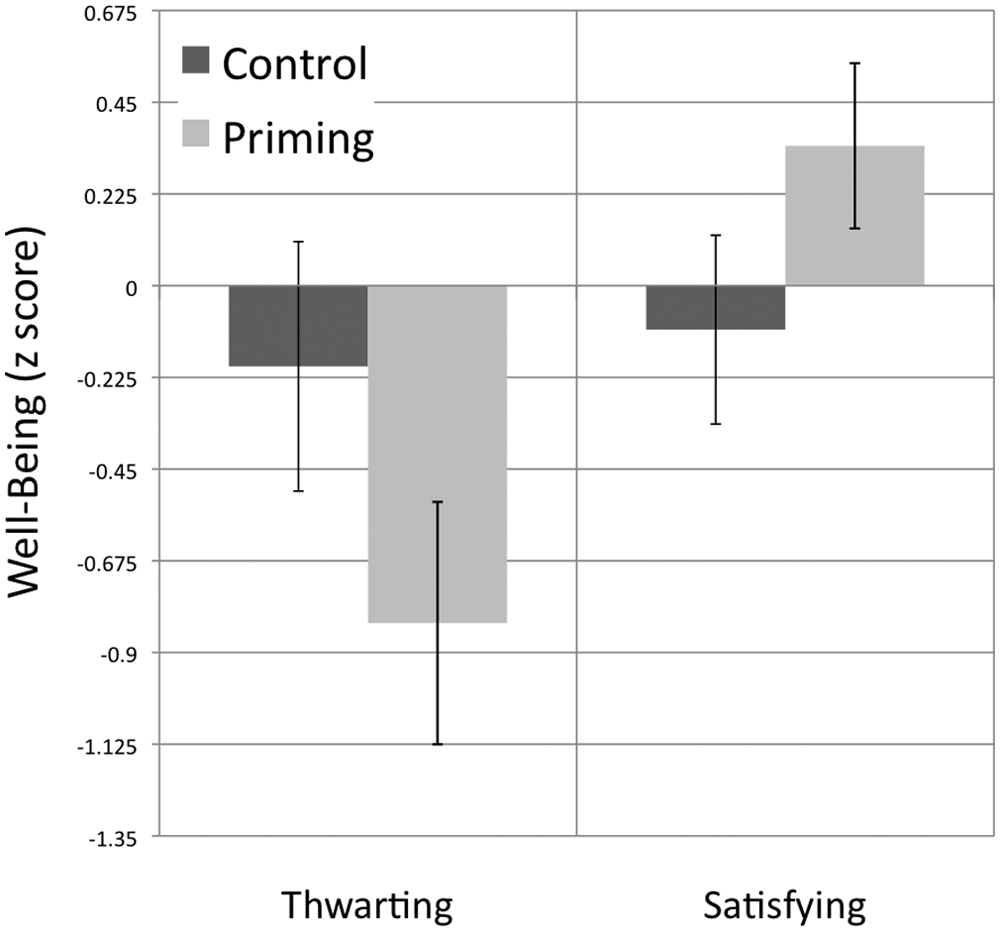
Interaction between episodic memory network need (satisfying or thwarting) and conditions (priming or control) on situational well-being: Study 3
To ensure that the present effect was the result of the need satisfaction characterizing the episodic memory network primed, we further analyzed the data. First, the effect observed could have been the result of the personal valence of the words the participants used. If this were the case, the need satisfaction characterizing the main episodic memory would not predict situational well-being better than the valence of this episodic memory. Both would act as an equivalent proxy variable for the personal valence of the words used. Second, if the need satisfaction (or the valence) of the main episodic memory from which the keywords are derived already represented the valence of the words used by the participants in the primed groups, the need satisfaction of the networked memories would not predict any additional variance over the main episodic memory. However, if the effect is the result of the main episodic memory and the networked memories being activated, both should additively predict situational well-being.
To examine these two possibilities, we conducted a hierarchical regression analysis with situational well-being as the dependent variable and controlled for general well-being and the time taken to complete the scrambled sentences task. At Step 1, the valence of the main episodic memory (standardized), group membership (0 = priming, 1 = control), and the interaction between these two variables were entered. Results showed that this interaction term was not significant (β = −.09, p = .37). At Step 2, the interaction term between need satisfaction characterizing the main episodic memory (standardized) and group membership was significant, β = −.22, p < .10. At Step 3, the interaction term between need satisfaction in the networked memories (standardized) and group membership was also significant (β = −.31, p < .05), thus predicting situational well-being over and above need satisfaction in the main episodic memory. These results further show that the effect of the main and networked memories is additive and that stronger results are obtained when these variables are combined (interaction for the combined episodic memory network was β = −.41, p < .05). Overall, these results represent further evidence that the manipulation did affect episodic memories and that the need satisfaction characterizing them is important.
These results support the hypothesis that environmental cues can activate episodic memories without people’s awareness and influence their situational well-being, as a function of the level of need satisfaction characterizing their episodic memory network.
Study 4
In the introduction, we postulated that the frequent activation of an episodic memory should frequently lead to the kind of situational experience of well-being highlighted in Study 3 and should, over time, affect the person’s well-being in an enduring fashion. Our purpose in Study 4 was to test this hypothesis within a prospective design of approximately 1 year. It was expected that need satisfaction in an episodic memory network would predict changes in well-being over time, such that need satisfaction would be associated with increases in well-being over the year, whereas need thwarting would be associated with decreases in well-being. Thus, a positive correlation between need satisfaction and changes in well-being during the year was expected. In addition, in line with Study 2, we hypothesized that this change in well-being would be independent of the effect of traits and general need satisfaction in life.
Method
Participants were 110 undergraduate or graduate students (63 females, 47 males) from a Canadian university. Their mean age was 30.82 years (SD = 10.53).
Measures
Personality traits
The Ten-Item Personality Inventory (Gosling, Rentfrow, & Swann, 2003) was used to assess the five factors of personality. This brief scale uses two pairs of adjectives to assess each of the five personality factors. It has yielded correlations between .65 and .87 with the complete Big-Five Inventory. Participants were asked to rate, on a 7-point Likert-type scale (1 = disagree strongly, 7 = agree strongly), their degree of agreement with each pair of adjectives (e.g., “I see myself as . . . extraverted, enthusiastic”). Adequate evidence of validity and reliability has been found for this instrument (Ehrhart et al., 2009; Gosling et al., 2003). In this study, the interitem correlation for each trait ranged from .11 to .47.
General need satisfaction
A short version of the Basic Need Satisfaction in General (Gagné, 2003) was used to assess participants’ general need satisfaction. Nine items assessed autonomy, competence, and relatedness with three items each. Based on Study 2 data, correlations between each of these short subscales and their parent subscale ranged from .82 to .90. In the present study, the Cronbach’s alpha for the complete short scale was .60.
Well-being
The two scales used in Studies 1 to 3 were again used in Study 4. Cronbach’s alpha coefficients were .80 and .81 at Times 1 and 2, respectively.
Episodic memories
Instructions were the same as those presented in Study 2.
Procedure
Procedures in Study 4 were identical to those presented in Study 1. At Time 1, participants completed the trait, general need satisfaction, and well-being measures and then described their memories. At Time 2, 8 months later, they were administered the well-being measures again.
Results and Discussion
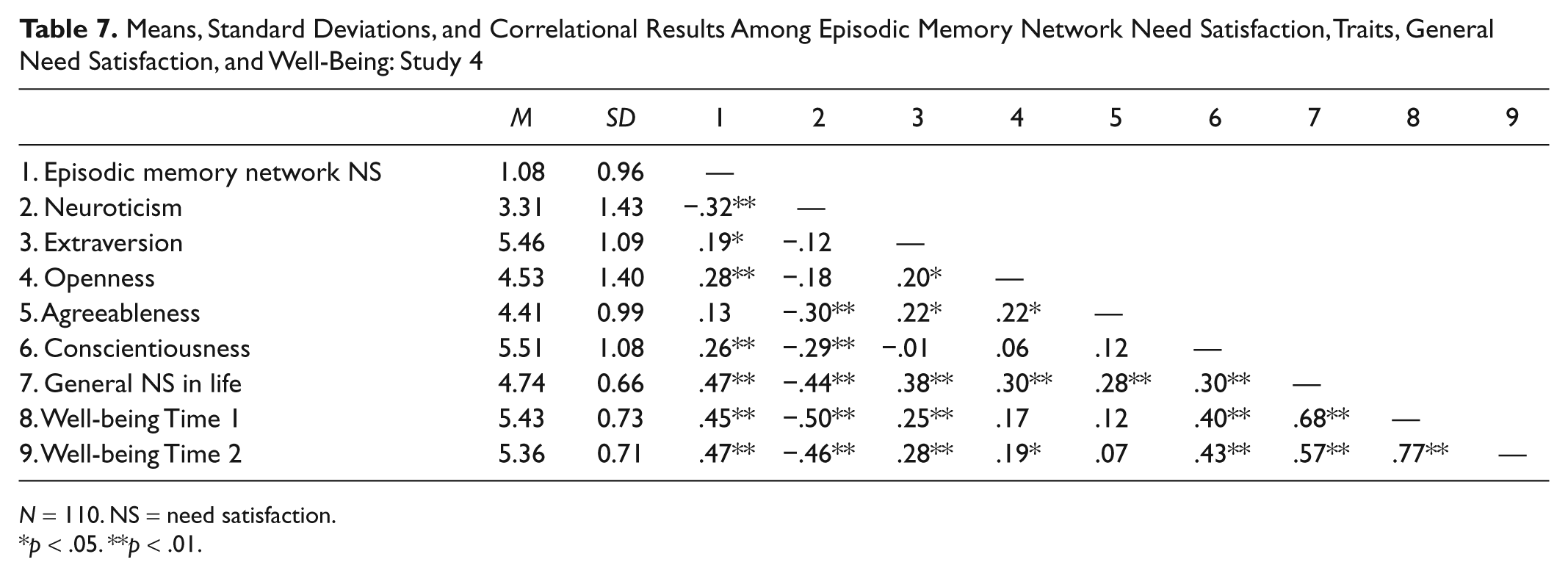
Table 7 presents the correlations among all study variables. Replicating results of Studies 1 and 2, episodic memory network need satisfaction was positively associated with well-being, both at Time 1 and at Time 2. To test whether it would predict changes in well-being, a hierarchical multiple regression analysis was conducted. Well-being at Time 2 served as the dependent variable and was regressed on well-being at Time 1 along with gender, age, traits, and general need satisfaction at Step 1. At Step 2, episodic memory network need satisfaction was entered in the regression. Results revealed that, at Step 1, after controlling for well-being at Time 1 (β = .60, p < .001), gender, age, general need satisfaction, and all traits were not significant predictors of well-being at Time 2 (β = |.10|, ns), except for conscientiousness (β = .14, p = .05) and a marginal effect of neuroticism (β = −.13, p = .08). Finally, at Step 2, episodic memory network need satisfaction was found to be positively associated with well-being at Time 2 (β = .16, p < .05,
Means, Standard Deviations, and Correlational Results Among Episodic Memory Network Need Satisfaction, Traits, General Need Satisfaction, and Well-Being: Study 4
N = 110. NS = need satisfaction.
p < .05. **p < .01.
General Discussion
Our central predictions were supported; levels of need satisfaction contained in episodic memory networks were found to relate to well-being, to predict situational well-being when activated outside of people’s awareness, and to predict changes in well-being over time. An important implication of the present research is that need satisfaction appears to be a critical psychological component of memory. Results of Study 1 showed that each need was uniquely associated with well-being. In addition, results of Study 2 showed that the relationship between need satisfaction and well-being was not the result of a common measurement method. The present research adds to past research that has examined the relationship between narrative components of episodic memories (e.g., closure, redemption and contamination sequences, implicit motives) and well-being (Bauer et al., 2005; Bauer & McAdams, 2004; King et al., 2000) by suggesting that need satisfaction, which taps into the experiential components of an episodic memory or, stated differently, into the goal-affective component that remains associated with the memory (Conway, 2008), is also related to well-being. The way people recall having experienced a past event in terms of need satisfaction appears critical with respect to their current and future well-being. These findings extend those of Philippe and colleagues (2011), who showed that need satisfaction was a basic component of episodic memories and a distinct one as compared to many other common types of component.
Networked memories were shown to play an important role in people’s well-being. First, in Study 1, networked memories were more strongly associated with their own main episodic memory than with a different unrelated episodic memory—one from which the networked memories were not derived. More strikingly, need satisfaction in these networked memories was associated with well-being after controlling for need satisfaction in the main episodic memory to which they were associated. These findings suggest that networked memories share special associations with the main episodic memory from which they are derived, while preserving an independent effect on well-being. Findings also imply that when a memory is activated by an external cue, not only its need satisfaction representations but also the quality of the networked memories related to the activated memory affect the person’s well-being. Finally, two episodic memory networks were shown to be only modestly associated with each other and to predict well-being additively. This finding suggests that episodic memory networks may not be triggered by the same environmental cues and thus exert independent effects on people’s well-being. Future research is needed to examine this issue more closely.
Another implication of the present research is that episodic memories per se can be primed. Although past research has shown that the priming of social concepts, such as hostility or cooperation, with words or environmental stimuli led to the manifestation of related behaviors outside of people’s awareness (see Ferguson & Bargh, 2004, for a review), the present research shows that this same mechanism also applies to episodic memories. More specifically, it was shown that episodic memories characterized by need satisfaction or need thwarting could be activated outside of people’s awareness and influence people’s situational well-being accordingly. This is the first study, to our knowledge, to show that an episodic memory related to a past personal event can be primed and that this priming can subsequently affect people’s well-being.
Finally, our broadest hypothesis stipulated that episodic memories that are frequently primed and triggered should frequently exert their effect on people’s sense of well-being, as a function of the level of need satisfaction characterizing them. Study 3 showed that episodic memories influenced people’s situational sense of well-being when such memories were triggered by environmental features similar to those encoded with these memories. However, in Study 4, it was expected that over time, frequent activation of these memories would alter people’s sense of well-being in an enduring fashion, as a function of the need satisfaction level characterizing these memories. The results of Study 4 supported this hypothesis, as need satisfaction in frequently activated memories predicted changes in well-being over time. Taken together, Studies 3 and 4 shed light on the mechanism by which need satisfaction in episodic memories may alter people’s well-being over time.
A noteworthy finding is that need satisfaction in episodic memories was found to relate to well-being, even after controlling for personality traits. Episodic memory measures usually have an additional predictive utility for understanding meaningful life outcomes above and beyond traditional questionnaire measures of personality (e.g., Bauer et al., 2005; Lodi-Smith et al., 2009; Woike et al., 2001). It appears that need satisfaction in memories also possesses this property. We further found that need satisfaction in episodic memories was associated with well-being above and beyond general need satisfaction ratings. Thus, it seems that the effect of need satisfaction related to past events and encoded as episodic memories is not the same as the level of need satisfaction that one believes to generally experience in life. Episodic memories information and semantic self-knowledge information (such as self-report of traits and self-evaluation of need satisfaction in one’s life) appear to tap into different constituents of the self. Indeed, neuropsychological and cognitive research has shown that although episodic memories and semantic self-knowledge influence each other, they are stored in different brain regions, function independently of each other, and are involved in different psychological processes (e.g., Klein & Gangi, 2010; Klein & Loftus, 1993).
The present research has a number of limitations that need to be mentioned. First, the present findings need to be generalized with caution, as only samples composed of university students from an Occidental university were used. Previous research has revealed cultural differences in memories, and cross-cultural studies are needed to provide a more universal context to the present findings. Second, in all four studies, participants were asked to describe a self-defining memory as their main episodic memory. Future research is needed to replicate the present research with different types of memories. Finally, we provided evidence for how memories may affect people in the here and now and over time. However, showing how the daily or weekly activation of specific episodic memories affects people’s well-being over time using daily or weekly experience samplings of well-being would provide more supportive evidence.
In sum, the present research suggests an active and directive role of psychological need satisfaction in episodic memory networks. The present findings show that episodic memories and their networked memories affect well-being. Further research integrating self-determination theory with memory processes and on the effect of networked memories appears worthy and promising.
Footnotes
Frederick L. Philippe is now in the Department of Psychology at the University of Quebec at Montreal.
The author(s) declared no potential conflicts of interest with respect to the research, authorship, and/or publication of this article.
The author(s) disclosed receipt of the following financial support for the research, authorship, and/or publication of this article: This research was funded by doctoral scholarships and a grant from the Social Sciences and Humanities Research Council (SSHRC) of Canada awarded to Frederick L. Philippe, Natasha Lekes, and Richard Koestner, respectively. Serge Lecours and Genevieve Beaulieu-Pelletier were funded by a grant and a doctoral scholarship, respectively, from the Fonds Québécois de Recherche Société et Culture (FQRSC).