




Abstract
A key insight from investigations of individual relative deprivation (IRD) is that people can experience objective disadvantages differently. In this study, university faculty (N = 953) who reported greater IRD in response to a mandatory furlough (i.e., involuntary pay reductions) were more likely to (a) voice options designed to improve the university (voice), (b) consider leaving their job (exit), and (c) neglect their work responsibilities (neglect), but were (d) less likely to express loyalty to the university (loyalty). Consistent with the emotions literature, (a) anger mediated the relationship between IRD and voice, (b) fear between IRD and exit, (c) sadness between IRD and neglect, and (d) gratitude between IRD and loyalty. IRD was inversely associated with self-reported physical and mental health via these different emotional pathways. These results show how discrete emotions can explain responses to IRD and, in turn, contribute to organizational viability and the health of its members.
The relief is palpable, you can just feel it on campus because we are not all divided now.
The current fear and stress are likely to erupt into chaos, anger and possible protest.
In 2009, during the height of the Great Recession (Rampell, 2009), the two public university systems in California imposed an unprecedented furlough on its faculty. Although the controversial decision allowed the university systems to cope with draconian budget cuts, it reduced faculty’s pay by up to 10% and elicited a range of responses (as indicated by the quotes above). Though the financial impact of the furlough appears obvious, research on relative disadvantage and advantage shows that people can interpret the same objective outcome in many ways (for a review, see Leach, Snider, & Iyer, 2002; also see Smith, Pettigrew, Pippin, & Bialosiewicz, 2011) and, as a consequence, engage in a range of distinct responses. For example, people can protest the actions that created the disadvantage, or they can leave the group. Other less obvious options include maintaining group membership but disengaging from role responsibilities or, alternatively, remaining loyal to the group (Farrell, 1983; Hirschman, 1970).
Although it is apparent that people respond to relative disadvantage in different ways, it is unclear why such distinct responses occur. One potential explanation is that people experience different discrete emotions. Although some might be angered by the furlough, others may feel fear during uncertain times. Alternatively, some may view the furlough as a necessary evil and, as a result, experience sadness or, ironically, gratitude because a resolution has come to a seemingly intractable financial crisis. This study examines how integrating a discrete emotions framework into the experience of a highly salient, wide-reaching, and novel experience of disadvantage (i.e., the furlough) can clarify why people respond differently—in terms of both actions that affect the group and changes to their internal state (i.e., physical and mental health).
Behavioral Responses to Disadvantage
How people respond to objective individual disadvantage should be shaped by whether they view their economic circumstances as undeserved and worse in comparison to others (i.e., individual-based relative deprivation or IRD). Typologies of possible responses include behaviors ranging from (a) acceptance to individual acts of deviance, (b) achievement to collective protest and violence, and/or (c) increased stress, depression, and anxiety (Crosby, 1976; Mark & Folger, 1984; Wright, Taylor, & Moghaddam, 1990). In one of the few experimental studies to examine such behavioral options, Wright and colleagues (1990) showed that people’s reactions to a disadvantageous outcome can motivate responses ranging from acceptance to collective protest.
Although provocative, the behavioral typology and associated evidence developed by Wright et al. (1990) is intended to address societal level political change/stability. Because of this focus, previous RD behavioral typologies do not include exiting the group as a potential response to IRD, nor do they distinguish among the ways in which acceptance of the status quo is expressed or experienced. Though employees may appear to accept their pay reduction, some might continue to work hard whereas others spend time on personal projects. To capture these nuances, we draw on a typology of behavioral options used to assess employees’ behavior in the workplace.
Building on Hirschman’s (1970) seminal work, Farrell (1983) argued that employees who experience declines in the workplace can (a) attempt to improve their workplace (voice), (b) leave their job (exit), (c) allow their workplace to further deteriorate (neglect), or (d) wait and hope that conditions improve (loyalty). Farrell noted that these responses vary along two dimensions. One dimension differentiates between active (i.e., voice and exit) and passive (i.e., neglect and loyalty) responses, whereas a second dimension differentiates between constructive (i.e., loyalty and voice) and destructive (i.e., exit and neglect) responses.
Consistent with this typology, Farrell (1983) showed that a diverse set of reactions to declining workplaces could be classified into four distinct clusters. Subsequent studies find that declines in the workplace are associated with each of these four responses (Rusbult, Farrell, Rogers, & Mainous, 1988; Rusbult & Lowery, 1985; Turnley & Feldman, 1999). Moreover, research demonstrates that IRD predicts psychological disengagement (Tougas, Lagacé, Laplante, & Bellehumeur, 2008), voluntary turnover (Aquino, Griffeth, Allen, & Hom, 1997), the pursuit of professional development opportunities (Zoogah, 2010), and militancy (Donnenwerth & Cox, 1978). To our knowledge, however, this is the first study to simultaneously consider the full range of possible behavioral responses to IRD.
Discrete Emotions
Although employees can react to IRD in numerous ways, studies investigating these responses are often inconsistent (Smith et al., 2011). Some find that IRD is associated with decreased self-esteem (Walker, 1999), increased deviance (Cohen-Charash & Mueller, 2007), higher rates of turnover (Aquino et al., 1997), and greater interest in protest (Donnenwerth & Cox, 1978). Others, however, fail to find such a relationship (e.g., Boen & Vanbeselaere, 2002; Chen & Paterson, 2006; Crocker, Luhtanen, Blaine, & Broadnax, 1994). Similarly, investigations of employees’ interest in voice, exit, neglect, or loyalty yield mixed evidence for the cognitive antecedents derived from social exchange theory (e.g., employee investment, prior satisfaction, and perceived alternatives; see Rusbult et al., 1988).
One explanation for this inconsistency is that studies often overlook the discrete emotional responses elicited by IRD. That is, employees could agree about their personal disadvantage yet experience different emotions. Some might feel angry, others might feel sad, and still others might feel anxious or scared. Though anger, sadness, and fear are negatively valenced emotions, they have different adaptive functions (Devos, Silver, Mackie, & Smith, 2003; Frijda, Kuipers, & ter Schure, 1989; Izard & Ackerman, 2000; Lazarus, 1991; Mackie, Devos, & Smith, 2000; Roseman, Wiest, & Swartz, 1994). As such, they should produce distinct responses to IRD.
Many employees will likely feel anger in response to a deteriorating workplace. Indeed, anger may be the most common reaction to IRD (see Smith et al., 2011). Importantly, anger motivates actions aimed at actively confronting the threat (Frijda, 1986; Izard & Ackerman, 2000; Lazarus, 1991). Specifically, studies show that anger is associated with approach-oriented behaviors (Adams & Kleck, 2003; Crisp, Heuston, Farr, & Turner, 2007; Frijda et al., 1989), political participation (Leach, Iyer, & Pedersen, 2007; van Zomeren, Spears, Fischer, & Leach, 2004), and confrontational action tendencies (Mackie et al., 2000).
Though often leading to confrontation, it is a mistake to view anger as a destructive emotion. Fischer and Roseman (2007) argue that the function of anger is to improve unfavorable situations. Specifically, they show that anger is motivated by a desire to change others’ actions and is reserved for relationships that people wish to (a) preserve and (b) improve (also see Pagano & Huo, 2007; Tausch et al., 2011). Because voice is conceptualized as a constructive attempt to improve one’s environment, anger—a discrete emotion that serves an analogous function—should be associated with voice.
An unstable workplace could also elicit fear. Fear, however, functions differently than anger—it motivates active attempts to escape or avoid a threatening situation (Devos et al., 2003; Frijda, 1986; Izard & Ackerman, 2000; Lazarus, 1991). For example, Roseman and colleagues (1994) showed that fear facilitates action tendencies associated with actively fleeing the fear-inducing situation. Additional research supports the association between fear and avoidance (Adams & Kleck, 2003). Because exit is an active attempt to escape from a deteriorating organization, fear should be associated with exit.
Faculty could also experience sadness over the loss of a previously fulfilling workplace. This would motivate actions that are distinct from those supported by anger and fear. Specifically, sadness is associated with passive avoidance/withdrawal (Crisp et al., 2007; Roseman et al., 1994) and other behaviors that could be destructive to an organization. For example, depression is correlated with declines in productivity and increased absenteeism (Lerner et al., 2004). In fact, depression-related losses in productive work time cost U.S. businesses approximately $44 billion annually (Stewart, Ricci, Chee, Hahn, & Morganstein, 2003). These findings suggest that sadness will be associated with neglecting work-related responsibilities.
Finally, some faculty might perceive a relative advantage in comparison to others in a similar situation and, as a result, feel grateful that the situation is not as bad as it could be (see Guimond & Dambrun, 2002; Leach et al., 2002). This would elicit behaviors that are distinct from those brought about by negatively valenced emotions. Gratitude facilitates prosocial behaviors (Bartlett & DeSteno, 2006; Tsang, 2006) and is integral to the formation—and subsequent maintenance—of relationships (Algoe, Haidt, & Gable, 2008). When applied to the workplace, gratitude could facilitate devotion to one’s job and, thus, predict organizational loyalty.
Physical and Mental Health in Response to Disadvantage
Up to this point, we have addressed the actions that people could pursue in response to IRD. It is also likely that IRD will be internalized and manifested in employees’ physical and mental health (Crosby, 1976; Mark & Folger, 1984). Experimental (Walker, 1999) and correlational (Tougas et al., 2008) studies show that increased IRD predicts lower self-esteem. Likewise, subjective social status—which is often assessed in a manner that is conceptually analogous to IRD (see Smith et al., 2011)—is positively associated with both (a) physical (Adler, 2009) and (b) mental health (Huo, Binning, & Molina, 2010). Even more striking is evidence that lower subjective social status predicts heightened physiological arousal (Adler, Epel, Castellazzo, & Ickovics, 2000) and susceptibility to the common cold (Cohen et al., 2008). In short, unfavorable structural conditions can affect physical and mental health. Still, it is unclear why experiences of IRD are linked to health outcomes. One possibility, which we examine here, is that negative emotional states elicited in response to declining conditions (partially) explain the relationship between IRD and health (see Adler, 2009).
Overview of the Current Study
This study examines the diverse ways in which people can respond to IRD—from actions that range from active and constructive (e.g., voice) to those that are passive and destructive (e.g., neglect). Importantly, we address the question of how the same experience of disadvantage can be manifested in such a range of responses. To help us answer this question, we draw on the literature on discrete emotions and the functions they serve. We also examine the extent to which emotional responses to IRD are associated with self-reported physical and mental health.
Our study was conducted in the context of a highly salient, real-life event. Specifically, we examine responses to a furlough (i.e., an involuntary pay reduction) imposed on faculty members at California public universities in 2009. This situation is uniquely suited to test our hypotheses. First, all faculty, regardless of rank, were subject to the furlough. Because the policy affected everyone, the furlough provides an opportune test of the various ways employees can experience declines in compensation. Second, the furlough elicited intense debates among faculty. This provides a context in which we can examine emotional responses that vary by both range and intensity.
A summary of our hypotheses is presented in Figure 1. We argue that anger and fear will be instrumental in translating IRD into active responses to organizational decline (i.e., voice and exit). Anger and fear, however, have different functions (Frijda et al., 1989)—anger motivates approach-oriented behaviors (Crisp et al., 2007; Devos et al., 2003; Mackie et al., 2000) aimed at improving an interdependent relationship (Fischer & Roseman, 2007), whereas fear is associated with active attempts to escape (Lazarus, 1991; Roseman et al., 1994). Thus, we expect that anger will mediate the relationship between IRD and voice, whereas fear will mediate the relationship between IRD and exit.
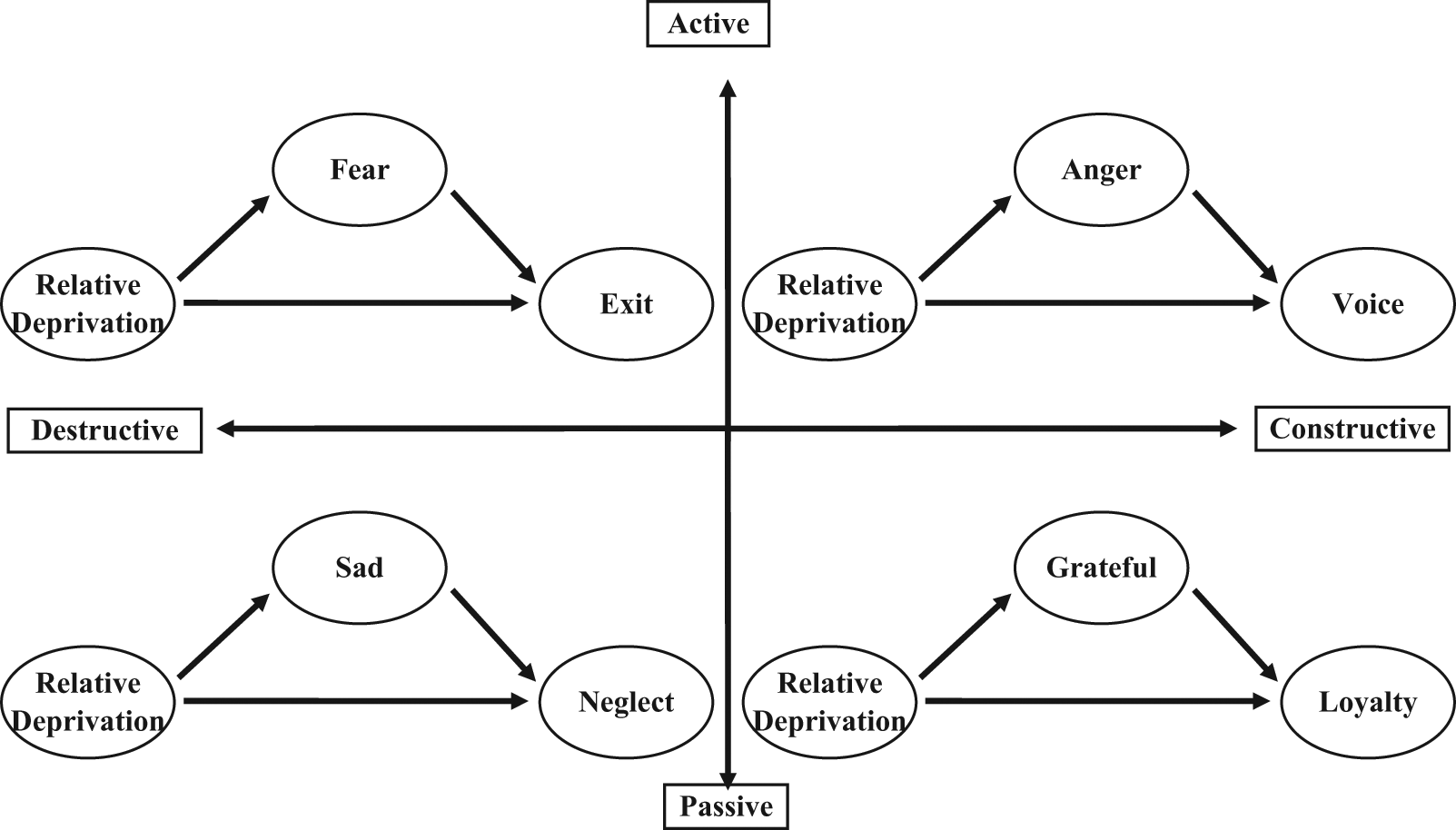
Predicted relationships between relative deprivation and the given response to the furlough
We also predict that sadness and gratefulness will be central processes through which IRD is translated into passive action tendencies (i.e., neglect and loyalty). Depression is correlated with a number of destructive workplace behaviors including declines in productivity and increased rates of absenteeism (Lerner et al., 2004), as well as greater levels of organizational disengagement (Smith, Cronin, & Kessler, 2008). Gratefulness, in contrast, is associated with actions that promote relationships (Algoe et al., 2008). As such, sadness should mediate the relationship between IRD and neglect, whereas gratefulness should mediate the relationship between IRD and loyalty.
Though we have clear hypotheses about which discrete emotions will mediate each distinct response to IRD, the role of discrete emotions in the relationship between IRD and health is exploratory. It is possible that general negative affect (as opposed to any one specific discrete emotion) transmits IRD into declines in employees’ physical and mental health. Alternatively, emotions characterized by high levels of arousal (e.g., anger and fear) may fulfill this role. In either case, examining the ways in which emotional responses to the furlough become internally manifested will improve our understanding of the mechanism(s) through which IRD is associated with health outcomes.
Method
Participants
Respondents were 953 faculty members (50.8% women; M age = 52.43 years, SD = 11.04) from four public universities in California. On average, respondents had worked at their current university for 14.10 years (SD = 10.78). More than half of the sample were tenured faculty (62.6%), and most identified as White (79.5%). The remaining respondents identified as Asian (7.2%), Latino (4.5%), Black (3.4%), or Other (5.4%). These demographics are comparable to those of similar studies conducted with university faculty in California (e.g., Smith et al., 2008).
Procedures
A survey was developed to assess faculty members’ responses to the financial crisis affecting California’s higher education in 2009–2010. In mid-February 2010, 4,107 faculty members were emailed an invitation to participate in this web-based study in exchange for a chance to win one of five $200 gift cards. Two weeks later, a reminder email was sent to those who had not responded. A final reminder was emailed in mid-March, 2010. In total, 1,110 faculty members (27% response rate) responded to our invitation. Of these, 953 respondents (86%) completed this study.
Measures
The survey contained measures of (a) IRD, (b) discrete emotions, (c) responses to the furlough, respondents’ (d) physical and (e) mental health, and (f) background and control variables. All items were keyed so that higher scores indicate greater levels of the given variable. Table 1 displays the means, standard deviations, and zero-order correlations for all our measures.
Means, Standard Deviations, and Zero-Order Correlations Among Measures of (a) Relative Deprivation, (b) Discrete Emotions, (c) Responses to the Furlough, Respondents’ (d) Physical and (e) Mental Health, and (f) Control Variables
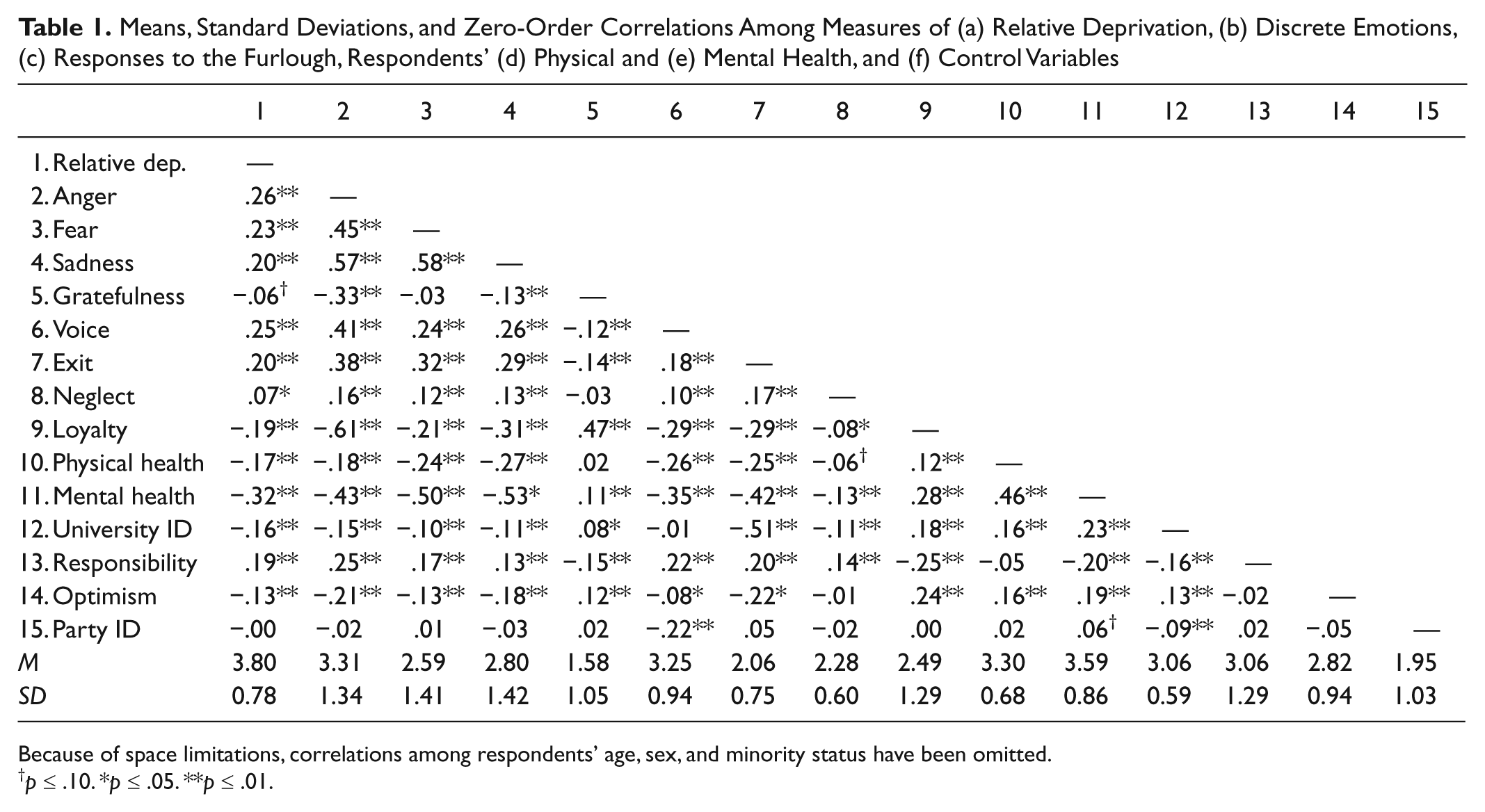
Because of space limitations, correlations among respondents’ age, sex, and minority status have been omitted.
p ≤ .10. *p ≤ .05. **p ≤ .01.
Predictor Variables
Relative deprivation
Two items used by Smith and colleagues (2008) to assess IRD were adapted for this study. The first item had respondents indicate how their pay compared to the pay of “other faculty employed at [their] university” (1 = significantly worse to 5 = significantly better; reverse scored). The second item had respondents indicate whether their pay was more (or less) than they deserved (1 = much more to 5 = much less). These two items were combined into an index of IRD, r(895) = .35, p < .01.
Emotional responses to the furlough
Five items assessed respondents’ discrete emotions. These items had respondents indicate how (a) angry, (b) resentful, (c) fearful, (d) sad, and (e) grateful they were about the furlough (1 = not at all to 5 = a great deal). Because anger and resentment were highly correlated, r(903) = .76, p < .01, they were combined into an index of anger. The remaining items were used as single-item indicators of the respective emotions.
Outcome Variables
Voice
Nine items assessed respondents’ pursuit of voice in response to the furlough. Six of these items were adapted from research on faculty members’ responses to perceived grievances (i.e., Smith et al., 2008). These items had respondents indicate how willing they were to (a) engage the media, (b) sign a petition, (c) attend a rally, (d) attend meetings, (e) support a faculty strike, and (f) lobby students (1 = not at all to 5 = completely). The three remaining items had respondents indicate how frequently they (a) followed the budget discussions, (b) discussed the situation with colleagues, and (c) participated in furlough-related activities (1 = not at all to 5 = a whole lot) prior to the furlough. These nine items were combined into an index of voice (α = .88).
Exit
Three items assessed respondents’ pursuit of exit in response to the furlough. These items had respondents indicate the extent to which they agreed that they (a) were committed to their university (reverse scored), (b) considered quitting, and (c) were looking for another job (1 = strongly disagree to 4 = strongly agree). These three items were combined into an index of exit (α = .73).
Neglect
Four items assessed respondents’ pursuit of neglect in response to the furlough. Two of these items had respondents indicate their willingness to use (a) university resources for personal projects and (b) sick days when they were not sick (1 = not at all to 5 = completely). Two additional items had respondents indicate how much time, relative to the prior year, they planned to spend (a) doing university services and (b) working on campus (1 = a lot less to 5 = a lot more; reverse scored). All four items were combined into an index of neglect (α = .57). 1
Loyalty
Three items assessed respondents’ support for the furlough. These items had respondents indicate the extent to which they (a) agreed with the furlough decision, (b) supported the decision, and (c) felt the decision was fair (1 = not at all to 5 = absolutely). These items were combined into an index of loyalty (α = .95).
Physical health
Two items assessed respondents’ physical health. The first item had respondents indicate their general health (1 = poor to 5 = excellent). The second item had respondents indicate their current health relative to their health before the furlough (1 = much worse to 5 = much better). These two items were combined into an index of physical health, r(930) = .38, p < .01.
Mental health
Five items developed by Ware and Sherbourne (1992) assessed respondents’ current mental health. Each item had respondents indicate how often they felt (a) nervous (reverse scored), (b) “down in the dumps” (reverse scored), (c) calm, (d) happy, and (e) down-hearted (reverse scored; 1 = never to 5 = always). These items were combined into an index of mental health (α = .88).
Control Variables
We included the following control variables: (a) optimism about the university’s financial situation, (b) beliefs about the administration’s responsibility for the furlough, and (c) strength of university identification. The first two measures were included because both (a) the stability of the sociostructural environment (Boen & Vanbeselaere, 2002) and (b) the target of people’s blame (Pagano & Huo, 2007) can affect people’s responses to perceived injustices. Identification was included because those who are highly identified with their university should be more reluctant to leave their jobs than should their less-identified counterparts.
One item assessed respondents’ optimism about whether the financial situation at their university would improve (1 = not at all to 5 = absolutely). Another item assessed the extent to which respondents believed the university administration was responsible for the furlough (1 = not at all to 5 = absolutely). Four items assessed respondents’ strength of identification with their university. These items had respondents indicate how much they agreed that (a) they were proud to be a part of their university, (b) their university stood for something personally important, (c) they had a lot in common with others at their university, and (d) they felt a bond with others at their university (1 = strongly disagree to 4 = strongly agree). These items were combined into an index of university identification (α = .83). Finally, sex, age, ethnic majority–minority background, political party, and university system (California State University [CSU] vs. University of California [UC]) were included as controls in subsequent analyses.
Results
Analyses are presented in three sections. In the first section, we test our assumption that respondents could pursue four distinct responses to the furlough. The second section builds on these results by showing that IRD and the discrete emotions elicited differentially predict these responses; we also explore the predictors of health outcomes. In the final section, we test our hypotheses regarding the meditational role of discrete emotions in each of these relationships.
Responses to the Furlough
We argued that faculty members could pursue four distinct responses to the furlough (i.e., voice, exit, neglect, and loyalty). To test this, we conducted a set of confirmatory factor analyses using EQS version 6.1 (Bentler, 2005). 2 Our hypothesized four-factor model specified that the items for (a) voice, (b) exit, (c) neglect, and (d) loyalty could load only onto their respective latent factor. Because each factor represents a response to the same event (i.e., the furlough), they were allowed to correlate. Finally, inspection of Mardia’s normalized coefficient indicated that these data were not multivariate normal (i.e., Mardia’s normalized coefficient = 37.31). To correct for this, we report robust estimates and the Satorra–Bentler Scaled χ2 test statistic (Satorra & Bentler, 1994).
Because χ2 tests are sensitive to sample size, Hu and Bentler (1999) recommend using both the standardized root mean square residual (SRMR) and the comparative fit index (CFI) to evaluate model fit. Good fitting models are indicated by SRMR less than or equal to .09 and a CFI greater than or equal to .96. Based on these criteria, our initial four-factor model did not fit the data well, Satorra–Bentler Scaled χ2(146) = 1,355.95, p < .01; SRMR = .10, CFI = .83. The Lagrange multiplier test for freeing parameters, however, indicated that we could improve our model by allowing the error variances for (a) three of the voice items and (b) two of the neglect items to covary. After inspecting these items, we determined that the correlated error variances were the result of content overlap rather than measurement problems. 3 As such, we respecified our model in accordance with these suggestions. Following these modifications, our hypothesized four-factor model provided an excellent fit to the data, Satorra–Bentler Scaled χ2(142) = 522.86, p < .01; SRMR = .07, CFI = .95.
After properly specifying our hypothesized four-factor model, we compared it to a two-factor model consisting of (a) a factor composed of the voice and exit items (i.e., active responses) and (b) a factor composed of the neglect and loyalty items (i.e., passive responses). As was done in our hypothesized model, we allowed the error variances for four of the items to covary. This alternative model, however, was a poor fit to the data, Satorra–Bentler Scaled χ2(147) = 1,420.43, p < .01; SRMR = .10, CFI = .85. Moreover, a Satorra–Bentler χ2 difference test (Satorra & Bentler, 2001) confirmed that our hypothesized four-factor model fit the data better than did this alternative two-factor model,
Discrete Emotions
Our next task was to demonstrate the unique contributions discrete emotions make in predicting how faculty responded to the furlough. Before evaluating our hypotheses, we first consider whether the four emotions we assessed accurately represent the range of feelings elicited by the furlough. We do so by examining respondents’ responses to an open-ended question asking them to describe “any other emotions” they were feeling “when thinking about the furlough.”
A subset of the sample (24%) responded to this open-ended item. These responses were, however, variations of the four basic emotions listed above. For example, 119 responses were anger-related emotions such as betrayed, disgusted, and frustrated; 54 responses were sadness-related emotions such as helpless, alienated, resigned, and disappointed; 26 responses were fear-related emotions such as anxiety, panic, worry, and concern; and 9 responses were positive emotions such as relief and gratitude. Thus, the four emotions constituting the focus of our study closely reflect the range of sentiments felt by our respondents.
Next, we examined the hypothesis that each discrete emotion would predict a different response to the furlough. We also examined the associations between discrete emotions and respondents’ (a) physical and (b) mental health. This was done by conducting six separate multiple regressions. 4 In the first block of each regression model, we included IRD and our control variables. The second block of each model included the four discrete emotions. The full model was then regressed onto each of our six dependent variables.
As predicted, IRD was significantly associated with each of the four responses to the furlough (see Table 2). Specifically, the higher respondents’ IRD, the more likely they were to pursue (a) voice (B = .21, SE = .05, p < .01), (b) exit (B = .10, SE = .03, p < .01), and (c) neglect (B = .06, SE = .03, p < .10); IRD was inversely associated with loyalty (B = –.21, SE = .07, p < .01). Also as expected, increases in IRD were associated with decreases in both (a) physical health (B = –.11, SE = .04, p < .01) and (b) mental health (B = –.24, SE = .04, p < .01). Notably, these relationships emerged after accounting for our control variables.
Multiple Regression Analyses Predicting the Given Response to the Furlough From Relative Deprivation (RD) and Discrete Emotions
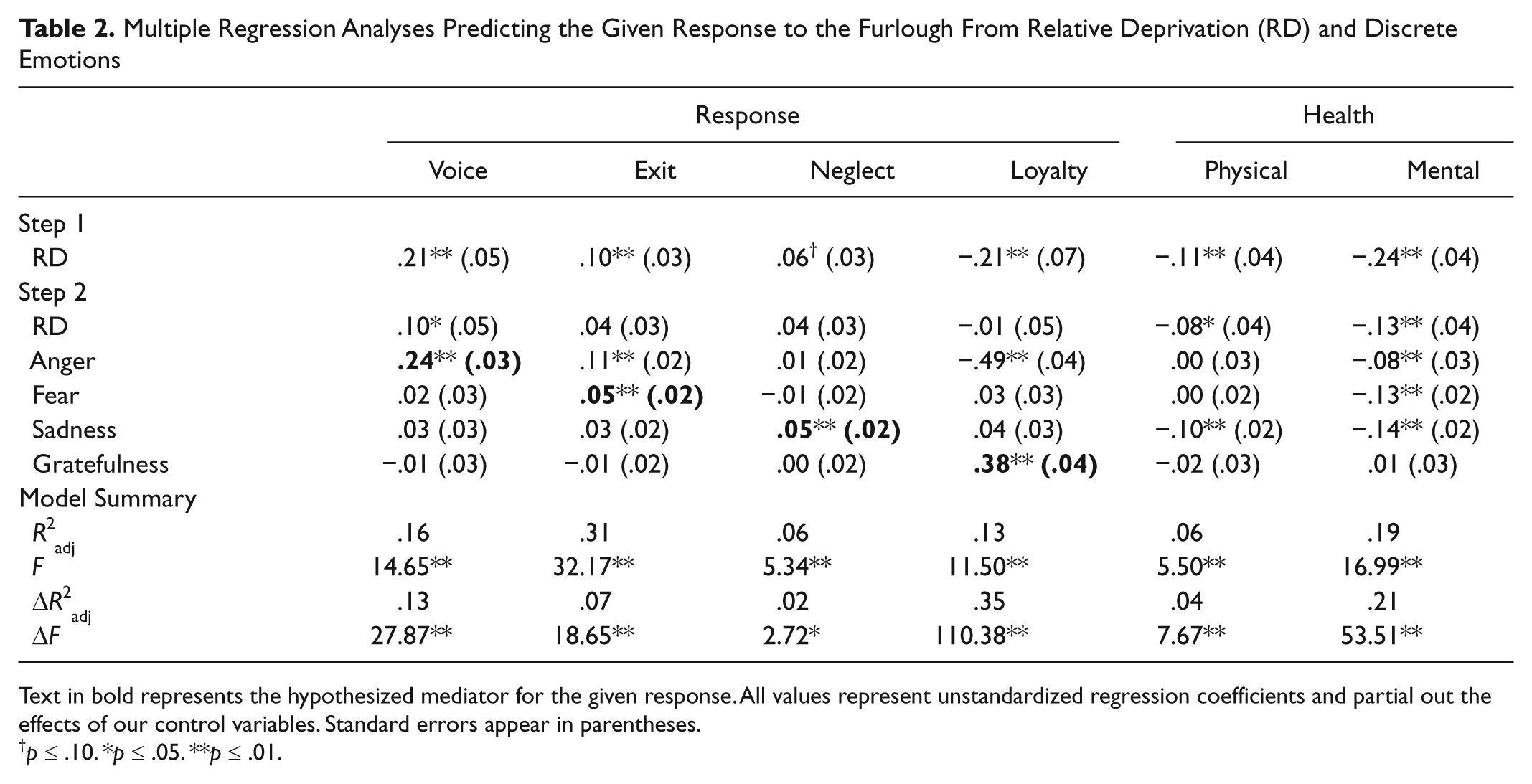
Text in bold represents the hypothesized mediator for the given response. All values represent unstandardized regression coefficients and partial out the effects of our control variables. Standard errors appear in parentheses.
p ≤ .10. *p ≤ .05. **p ≤ .01.
Turning to the second step of the regression models (see Table 2), we see that, as expected, each discrete emotion was associated with its hypothesized response to the furlough. Specifically, anger predicted voice (B = .24, SE = .03, p < .01), fear predicted exit (B = .05, SE = .02, p < .01), sadness predicted neglect (B = .05, SE = .02, p < .01), and gratefulness predicted loyalty (B = .38, SE = .04, p < .01). Notably, anger and sadness were the only discrete emotions correlated with voice and neglect, respectively. In contrast, exit and loyalty were correlated with their predicted emotions of fear and gratitude, respectively, as well as anger (B = .11, SE = .02, p < .01 for exit and B = –.49, SE = .04, p < .01 for loyalty). Thus, although there were instances where multiple discrete emotions predicted the same response, we found consistent support for each of our four hypothesized relationships.
Table 2 also shows the relationship between discrete emotions and respondents’ self-reported physical and mental health. These results indicate that sadness was the only discrete emotion to predict declines in respondents’ physical health (B = –.10, SE = .02, p < .01). Multiple discrete emotions, however, predicted respondents’ mental health. Specifically, anger (B = –.08, SE = .03, p < .01), fear (B = –.13, SE = .02, p < .01), and sadness (B = –.14, SE = .02, p < .01) were all inversely associated with respondents’ mental health. Gratefulness did not reliably predict either physical or mental health.
We should point out that, in each of the cases noted above, the inclusion of discrete emotions explained a significant amount of additional variance in the given outcome (see Table 2). Moreover, including discrete emotions in the regressions reduced—often to the point of nonsignificance—the relationship between IRD and the given outcome measure. Though this is suggestive of mediation (e.g., Baron & Kenny, 1986), the simultaneous inclusion of multiple predictors prevents us from interpreting which discrete emotion(s) mediated each of these relationships. This inference would require a test of multiple mediation (Preacher & Hayes, 2008). We now turn to these analyses.
Multiple Mediation
Though the results presented in Table 2 demonstrate the explanatory power of discrete emotions, the specific role that they play—as well as which discrete emotions matter most—has yet to be addressed. Based on the emotions literature (Devos et al., 2003; Frijda et al., 1989; Mackie et al., 2000), we predicted that discrete emotions would mediate the relationship between IRD and people’s responses to the furlough. The specific discrete emotions through which these indirect effects would occur, however, were expected to vary by the given response (see Figure 1).
To test these hypotheses, we used Preacher and Hayes’s (2008) SPSS macros for models of multiple mediation. This procedure has several benefits over standard meditation analyses. Specifically, multiple mediation analyses allow scholars to assess the unique contribution of a given hypothesized mediator by partialling out the effects of other potential mediators. It also allows us to test two relevant aspects of our hypotheses. First, it assesses the total indirect effect of our four discrete emotions. This indicates whether the inclusion of all four discrete emotions reliably mediates the relationship between IRD and the given response to the furlough. Second, multiple mediation analyses provide tests of the specific indirect effects (i.e., the unique meditational role of each potential mediator). Comparisons across specific indirect effects indicate the relative role each discrete emotion plays in the relationship between IRD and the given outcome.
Based on Preacher and Hayes’s (2008) recommendations, we used a 5,000-bootstrap sampling procedure (with replacement) with bias-corrected and accelerated (BCa) 95% confidence intervals (CIs). Instead of imposing a theoretically normal distribution on these data, this approach utilizes an empirically derived sampling distribution of the indirect effects. BCa 95% CIs around this sampling distribution are then used to test the reliability of a given indirect effect. Notably, this procedure outperforms the standard Baron and Kenny (1986) approach to mediation (MacKinnon, Lockwood, & Williams, 2004).
To interpret these results, significant indirect effects are identified by BCa 95% CIs that do not include 0. The relative size of specific indirect effects can also be compared by calculating pairwise contrasts of the specific indirect effects. Pairwise contrasts with BCa 95% CI that include 0 indicate that the given two specific indirect effects are comparable in size. In contrast, pairwise contrasts with BCa 95% CIs that do not include 0 indicate that the magnitudes of the given two specific indirect effects are reliably different from each other.
Voice
Because anger is associated with actively approaching the source of threat (Mackie et al., 2000) in an attempt to improve the situation (Fischer & Roseman, 2007), we expected that the relationship between IRD and voice would occur primarily through anger. As noted earlier, IRD was positively associated with voice (B = .21, SE = .05, p < .01). Table 3 shows that this relationship partially occurred because IRD had a total indirect effect on voice through the four discrete emotions (B = .11, BCa 95% CI = .063, .154). As expected, only the specific indirect effect of IRD on voice through anger was reliable (B = .09, BCa 95% CI = .051, .135). The specific indirect effects through the remaining discrete emotions all had BCa 95% CIs that contained 0.
Total and Specific Indirect Effects of Relative Deprivation on the Given Response to the Furlough Through Discrete Emotions

Values in parentheses represent the lower and upper bounds of the bias-corrected and accelerated 95% confidence intervals for the given variable.
Hypothesized effects are accented in bold. All analyses were conducted with 5,000 bootstrap samples (with replacement) and partial out the effects of our control variables.
Given indirect effect or pairwise contrast is significant at p < .05.
To evaluate the relative magnitude of the specific indirect effect of IRD on voice through anger, we conducted follow-up pairwise contrasts on each of the specific indirect effects. These analyses demonstrated that IRD’s specific indirect effect on voice through anger was larger than the specific indirect effect of IRD on voice through (a) fear (B = .08, BCa 95% CI = .041, .134), (b) sadness (B = .08, BCa 95% CI = .041, .132), and (c) gratefulness (B = .09, BCa 95% CI = .048, .138). Pairwise contrasts for the specific indirect effects of IRD on voice through the remaining discrete emotions were not reliably different from each other (i.e., all BCa 95% CIs contained 0).
Exit
Because fear motivates active attempts to escape or avoid a threatening situation (Lazarus, 1991; Roseman et al., 1994), we predicted that the relationship between IRD and exit would be mediated by fear. As already noted, IRD was positively associated with exit (B = .10, SE = .03, p < .01). Table 3 shows that this relationship occurred primarily because IRD had a total indirect effect on exit through the four discrete emotions (B = .07, BCa 95% CI = .038, .097). Consistent with our hypotheses, the specific indirect effects were reliable for only a subset of these discrete emotions. Specifically, IRD had a small, but consistent, specific indirect effect on exit through fear (B = .02, BCa 95% CI = .003, .037). There was also an unexpected specific indirect effect of IRD on exit through anger (B = .04, BCa 95% CI = .019, .066).
Follow-up pairwise contrasts were conducted to assess the relative magnitude of these specific indirect effects. These analyses showed that IRD’s specific indirect effect on exit was larger through fear than through gratefulness (B = .02, BCa 95% CI = .002, .036). Likewise, the specific indirect effect of IRD on exit was larger through anger than through both (a) sadness (B = .03, BCa 95% CI = .003, .062) and (b) gratefulness (B = .04, BCa 95% CI = .016, .067). The specific indirect effects of IRD on exit through anger relative to fear were comparable in size (B = .02, BCa 95% CI = –.003, .054).
Neglect
Because sadness is associated with passive avoidance/withdrawal (Crisp et al., 2007; Roseman et al., 1994) and declines in worker productivity (Lerner et al., 2004), we predicted that sadness would mediate the relationship between IRD and neglect. As previously shown, IRD was (marginally) associated with neglect (B = .06, SE = .03, p < .10). Table 3 demonstrates that this relationship was the result of the total indirect effect of IRD on neglect through the four discrete emotions (B = .02, BCa 95% CI = .002, .038). Consistent with our hypotheses, only the specific indirect effect of IRD on neglect through sadness was reliable (B = .02, BCa 95% CI = .004, .036); IRD’s specific indirect effects on neglect through the remaining discrete emotions all had BCa 95% CIs that contained 0.
To assess the relative magnitude of the specific indirect effect of IRD on neglect through sadness, we conducted a series of pairwise contrasts for each of the specific indirect effects. These analyses demonstrated that IRD’s specific indirect effect on neglect was larger through sadness than through gratefulness (B = .02, BCa 95% CI = .002, .038). The remaining specific indirect effects of IRD on neglect were comparable in size.
Loyalty
Given that gratitude facilitates acts of reciprocity (Bartlett & DeSteno, 2006; Tsang, 2006), we predicted that gratefulness would mediate the relationship between IRD and loyalty. As previously mentioned, IRD was inversely associated with loyalty (B = –.21, SE = .07, p < .01). Table 3 shows that this was entirely the result of the total indirect effect of IRD on loyalty through the four discrete emotions (B = –.20, BCa 95% CI = –.295, –.110). As predicted, IRD had a specific indirect effect on loyalty through gratefulness (B = –.04, BCa 95% CI = –.086, –.001). IRD also had an unexpected specific indirect effect on loyalty through anger (B = –.18, BCa 95% CI = –.264, –.109). The specific indirect effects of IRD on loyalty through the remaining discrete emotions were not reliable.
To evaluate the relative magnitude of the specific indirect effect of IRD on loyalty through gratefulness, we conducted follow-up pairwise contrasts on each of the specific indirect effects. These analyses demonstrated that the specific indirect effect of IRD on loyalty was larger through gratefulness than through both (a) fear (B = .05, BCa 95% CI = .006, .101) and (b) sadness (B = .05, BCa 95% CI = .009, .105). The specific indirect effect of IRD on loyalty, however, was larger through anger than through (a) fear (B = –.19, BCa 95% CI = –.279, –.114), (b) sadness (B = –.19, BCa 95% CI = –.289, –.115), and (c) gratefulness (B = –.14, BCa 95% CI = –.222, –.068). Nevertheless, the fact that the specific indirect effect of IRD on loyalty through gratefulness was reliable after controlling for anger supports our hypothesis that gratefulness is an independent pathway through which IRD affects loyalty.
Physical health
We also assessed the relationship between IRD and reports of physical health. Though these analyses are exploratory, we had reason to believe that IRD would be associated with declines in physical health (see Adler, 2009). The specific discrete emotions responsible for this effect, however, are unknown. As such, we took the opportunity to examine whether the relationship between IRD and reports of physical health can be explained by anger, fear, sadness, or gratitude.
As previously noted, IRD was inversely associated with respondents’ self-reported physical health (B = –.11, SE = .04, p < .01). Table 4 demonstrates that this relationship was partially the result of IRD’s total indirect effect on respondents’ physical health through the four discrete emotions (B = –.03, BCa 95% CI = –.053 to -.004). The only reliable specific indirect effect of IRD on respondents’ physical health, however, was through sadness (B = –.03, BCa 95% CI = –.057, –.013). The specific indirect effects of IRD on respondents’ physical health through the remaining discrete variables were not reliable.
Total and Specific Indirect Effects of Relative Deprivation on the Given Health-Related Outcome Through Discrete Emotions Health
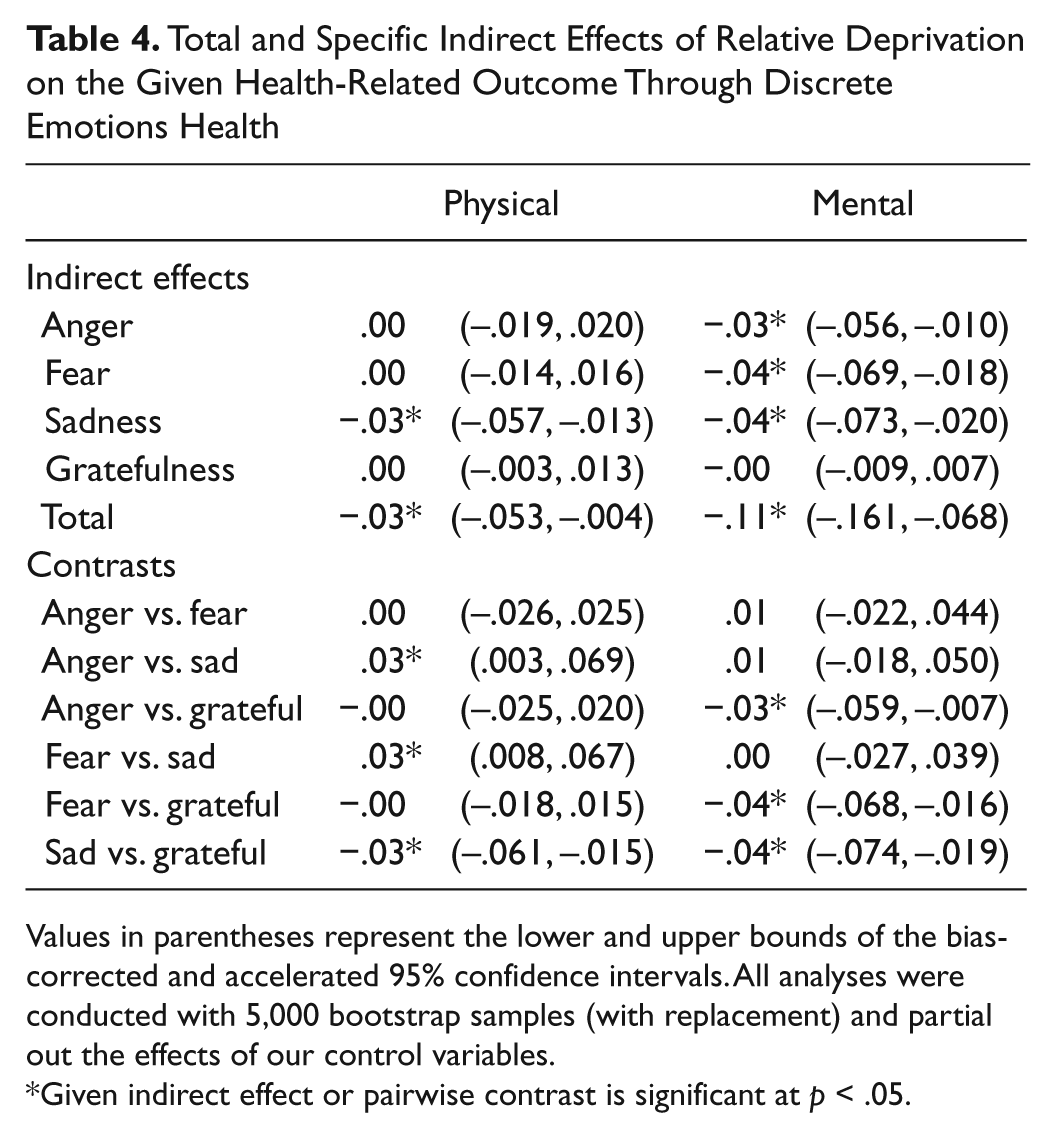
Values in parentheses represent the lower and upper bounds of the bias-corrected and accelerated 95% confidence intervals. All analyses were conducted with 5,000 bootstrap samples (with replacement) and partial out the effects of our control variables.
Given indirect effect or pairwise contrast is significant at p < .05.
Follow-up pairwise contrasts were then conducted to examine the relative magnitude of the specific indirect effect through sadness. These analyses demonstrated that IRD’s specific indirect effect on respondents’ physical health was larger through sadness than through (a) anger (B = .03, BCa 95% CI = .003, .069), (b) fear (B = .03 BCa 95% CI = –.008, .067), and (c) gratefulness (B = –.03, BCa 95% CI = –.061, –.015). The pairwise contrasts between the remaining specific indirect effects of IRD on respondents’ physical health were not reliably different from each another.
Mental health
Because exposure to procedural injustices has adverse consequences for people’s psychological well-being (Huo et al., 2010; Spell & Arnold, 2007), we predicted that IRD would be associated with respondents’ mental health. As was the case for physical health, we did not have explicit hypotheses about which discrete emotions would mediate this process.
As previously noted, IRD was inversely related to respondents’ self-reported mental health (B = –.24, SE = .04, p < .01). Table 4 shows that this relationship partially occurred because IRD had a total indirect effect on respondents’ mental health through the four discrete emotions (B = –.11, BCa 95% CI = –.161, –.068). Further inspection shows that the specific indirect effects of IRD on respondents’ mental health was reliable for three of the four discrete emotions; IRD had a specific indirect effect on respondents’ mental health through (a) anger (B = –.03, BCa 95% CI = –.056, –.010), (b) fear (B = –.04, BCa 95% CI = –.069, –.018), and (c) sadness (B = –.04, BCa 95% CI = –.073, –.020).
To examine the relative magnitude of these specific indirect effects, we conducted a series of pairwise contrasts. These analyses demonstrated that IRD’s specific indirect effect on respondents’ mental health was smaller through gratefulness than through (a) anger (B = –.03, BCa 95% CI = –.059, –.007), (b) fear (B = –.04, BCa 95% CI = –.068, –.016), and (c) sadness (B = –.04, BCa 95% CI = –.074, –.019). The specific indirect effects of IRD on respondents’ mental health through the remaining discrete emotions were all comparable in size.
Discussion
This study assessed responses to IRD in the context of a highly controversial and involving event (viz., the 2009 furlough of faculty at public universities in California). Although their objective disadvantage was universal and equally shared, we showed that faculty responded in four distinct ways. Specifically, they (a) attempted to improve their workplace (i.e., voice), (b) made plans to leave their job (i.e., exit), (c), decreased their workplace contributions (i.e., neglect), or (d) waited for the situation to improve (i.e., loyalty; Hirschman, 1970; Rusbult et al., 1988; Turnley & Feldman, 1999).
As expected, increases in IRD were associated with increases in (a) voice, (b) exit, and (c) neglect, but (d) decreases in loyalty. The specific discrete emotions mediating each of these relationships, however, depended on their social function. Consistent with the view of anger as a constructive approach-oriented emotion (Fischer & Roseman, 2007), the relationship between IRD and voice was uniquely mediated by anger. Likewise, fear—an emotion that motivates escape (Devos et al., 2003; Roseman et al., 1994)—mediated the relationship between IRD and exit. IRD also indirectly affected neglect through sadness. This is consistent with research showing that sadness is associated with avoidance and declines in workplace productivity (Adams & Kleck, 2003; Stewart et al., 2003). Finally, gratitude, an emotion that facilitates interpersonal bonds (Algoe et al., 2008), mediated the relationship between IRD and loyalty.
We also examined the relationship between IRD and respondents’ physical and mental health. As predicted by the literature on workplace stress (Cooper, Kirkcaldy, & Brown, 1994), IRD was inversely associated with faculty members’ (a) physical and (b) mental health. Moreover, anger, fear, and sadness all independently mediated the relationship between IRD and respondents’ mental health. In contrast, the only specific indirect effect of IRD on respondents’ physical health was through sadness. Thus, this study demonstrates that IRD is associated with multiple outcomes and that discrete emotions play an integral, yet nuanced, role in each of these relationships.
Interestingly, anger mediated the relationship between IRD and a number of our outcome variables. Though these findings were unexpected, they suggest that anger is a particularly potent motivator of most responses to IRD. This is consistent with the argument that anger/resentment is a necessary component of IRD (Crosby, 1976). Nevertheless, the fact that each of our hypothesized relationships emerged after controlling for anger demonstrates the robustness of our results.
To the best of our knowledge, this is the first study to evaluate the mechanisms through which IRD is translated into distinct responses. Some of these responses contribute to the decline of an organization (i.e., exit and neglect), whereas others facilitate recovery (i.e., voice and loyalty). Our data also show that emotional responses to IRD can affect employees’ physical and mental health. Though these latter findings were exploratory, our results demonstrate the utility of simultaneously assessing multiple responses to IRD.
Theoretical Contributions
Scholars have outlined many ways in which people can respond to IRD. Nevertheless, empirical tests of the relationship between multiple behavioral options and IRD are rare, and data supporting the psychological antecedents of these behavioral typologies are inconsistent. We clarified this literature by showing that the discrete emotions elicited by IRD direct behavior toward (a) voice, (b) exit, (c) neglect, or (d) loyalty. Though one might assume that a universal pay cut would be greeted with anger (or perhaps global negative affect) and subsequent protest, our data show that the range of actual responses is broader, more complex, and uniquely associated with people’s discrete emotional reactions to IRD.
We also assessed the relationship between IRD and reports of (a) physical and (b) mental health. This allowed us to uncover some of the potentially harmful, yet oftentimes undetected, consequences of IRD. Indeed, IRD affects more than just action tendencies—increases in IRD can be detrimental to people’s physical and mental well-being. Moreover, our data show that discrete emotions uniquely mediated these effects. This further highlights the need to distinguish between discrete emotional predictors of physical and mental health.
Our study is also one of the few studies to examine the relationship between IRD and positive emotions (for exceptions, see Guimond & Dambrun, 2002; Leach et al., 2002). It should be clear from our data, however, that faculty did not report high absolute levels of gratefulness. Rather, some of our respondents expressed relatively more gratefulness, which, in turn, predicted loyalty. Similarly, we demonstrated that the effects of IRD on our outcome variables often occurred through multiple independent emotional pathways. For example, both (a) less anger and (b) more gratefulness independently predicted increases in loyalty. This demonstrates the value of assessing both positive and negative emotions in studies on relative deprivation/gratification (see Leach et al., 2002).
An additional strength of this study is that, rather than analyzing responses to hypothetical scenarios, we assessed people’s discrete emotional reactions to a real-world event. The heightened relevance of the furlough is clearly seen in the feedback provided by many of our respondents. One respondent indicated feeling “disdain for the intellectual and institutional idiocy” that brought about the furlough, whereas another wrote that she felt “betrayed.” Others indicated that the furlough made them feel “disappointed,” “saddened,” or “defeated.” Some even reported feeling “outraged.” Such visceral reactions would have likely been obscured had we studied responses to a mundane (or hypothetical) issue. This is particularly important, given that our findings show that diverse emotional reactions lead to distinct behavioral responses.
It is also important to acknowledge that we obtained our results after controlling for respondents’ age, gender, university identification, optimism, and perceptions of responsibility. Moreover, these findings emerged within four different university campuses and across multiple levels of job security (from adjunct to fully tenured faculty). This demonstrates the robustness of our data and suggests that the furlough may have long-term consequences for California’s two public university systems.
Limitations and Future Directions
Although we provide insights into the experience of IRD, we should note this study’s limitations. First, our data were collected at a single point in time. As such, it is difficult to ascertain the causal relationship among variables. We should note, however, that our predictions were derived from sound theory regarding the affective bases of action tendencies (e.g., Devos et al., 2003; Frijda, 1986; Izard & Ackerman, 2000; Lazarus, 1991). Experimental studies also provide support for the causal relationships posited in this study (e.g., van Zomeren et al., 2004). Still, conclusions about the causal direction of the relationships presented here should be made with caution.
Because we relied on self-reports, our results may misrepresent how faculty members actually responded to the furlough. We find this to be unlikely. As shown by the two quotes that opened this article, faculty wrote opinion pieces for local newspapers (e.g., Bliss, 2009). They also staged “bread lines” (Tapper, 2009), organized class walkouts (Gordon, 2009), and shared strategies for teaching “less well” (Desrochers, 2009). If anything, the sensitive nature of our outcome variables led respondents to underreport their actual behaviors. As such, the results presented in this study likely underestimate the relationships between IRD and faculty’s actual responses to the furlough.
We should also acknowledge the unique nature of faculty work. Because they have relatively high degrees of job security (at least for tenured faculty) and control over their work, faculty may be more likely than employees outside of academia to (a) voice their concerns, (b) neglect their work, and/or (c) look for other jobs. This should be kept in mind when applying our findings to other settings.
Our data demonstrate that furloughs can have hidden, yet nonetheless damaging, consequences for organizations and their employees. For example, given the financial costs associated with depression in the workplace (Stewart et al., 2003), organizations that reduce their overhead by cutting employees’ benefits may ironically decrease their profits (also see Greenberg, 1990). Though furloughs are sometimes unavoidable, there may be circumstances under which they are positively received by employees. Future work should focus on identifying these factors.
Finally, one could argue that our measures of discrete emotions and mental health overlapped with each other. Though we cannot resolve this issue with our data, our respondents were specifically asked to report their emotional responses to the furlough. Also, Adler and colleagues (2000) corroborate our results using physiological measures of mental health. Therefore, we find it unlikely that the relationships between our measures of discrete emotions and mental health are merely artifacts of content overlap.
Conclusion
Given the volatile nature of the current economy, it is necessary to examine how workers cope with deteriorating workplaces. Our study addressed this need by examining university faculty members’ responses to a statewide furlough. As expected, IRD predicted faculty’s willingness to pursue (a) voice, (b) exit, (c) neglect, and (d) loyalty. The discrete emotions through which these relationships occurred, however, varied in accordance with their given function. We also showed that IRD was consistently associated with declines in faculty’s self-reported physical and mental health. The discrete emotions mediating these processes, however, were relatively nuanced.
Unfortunately, the increasing uncertainty in the economy is likely to push organizations to continue searching for ways to balance their budgets. More often than not, this will translate into cuts to employees’ benefits and/or salaries. As we have shown here, these reductions can have far-reaching consequences for both employees (i.e., their physical and mental health) and their organizations (i.e., the actions employees pursue in response to IRD). As shrinking budgets continue to loom on the horizon of an unstable economy, understanding the processes that underlie employees’ responses to IRD will become increasingly important. This study brings us closer to that goal.
Footnotes
The author(s) declared no potential conflicts of interest with respect to the research, authorship, and/or publication of this article.
The author(s) disclosed receipt of the following financial support for the research, authorship, and/or publication of this article: This research was supported by grants from the Society for the Psychological Study of Social Issues (Grants-in-Aid), the California State University’s Chancellor’s Doctoral Incentive Program, a seed grant from the UCLA Academic Senate’s Council on Research, and RUI Grant 064500 from the National Science Foundation.