



Abstract
Empathetic arousal has been found to be a strong predictor of helping behavior. However, research has neglected the motivational mechanisms whereby empathetic concern elicits help giving. Three studies examined the extent to which autonomous and controlled motives for helping mediated the relationship between empathy and helping. Study 1 found that state empathy predicted willingness to offer time and money to help a person in need, with this relationship mediated by autonomous motivation for helping. Study 2 demonstrated that dispositional, empathetic concern predicted prosocial intentions and behavior via the mediation of autonomous motivation. Study 3 revealed that participants who focused on the emotions of another person in distress reported greater willingness to help than did participants who remained emotionally detached, with this effect mediated by autonomous motivation to help. Controlled motivation had no positive effects on helping in any of the studies. The results suggest that empathy encourages prosocial behavior by increasing autonomous motivation to help.
Empathy is defined as the experience of sympathetic emotions and concern for another person in distress and has been identified as a strong predictor of helping behavior (see Dovidio, Piliavin, Schroeder, & Penner, 2006, for a review). Empathy is suggested to elicit motivation to reduce the suffering of others, and consequently is considered to drive helping behavior in a wide range of situations. Researchers (e.g., Batson, 1991; Batson et al., 1988) have shown considerable dedication to enhancing our understanding of the difference between the altruistic motivation elicited by empathetic concern (motivation to reduce the suffering of another person) and the egoistic motivation elicited by personal distress (motivation to reduce the negative emotional arousal experienced in response to witnessing someone suffering). In addition, more recent research has addressed the potential motivational antecedents of empathetic concern (e.g., Batson, Eklund, Chermok, Hoyt, & Ortiz, 2007; Batson et al., 2003; Batson, Lishner, Cook, & Sawyer, 2005). However, we have as yet little insight into the motivational processes whereby empathetic concern promotes helping (Van Lange, 2008). In this article, we examine the extent to which autonomous and controlled motivations mediate the relationship between empathy and helping. We suggest that autonomous motivation to help is a distinct type of motivation that is activated by empathetic concern and that in turn drives helping behavior.
Self-determination theory (SDT; Deci & Ryan, 1985; Ryan & Deci, 2000) suggests that motivation lies on a continuum from being autonomous (e.g., motivated by interest, enjoyment, and personal values) to being controlled (e.g., motivated by tangible rewards, punishments, guilt, or pressure from others). SDT proposes that through socialization and exposure to cultural values, externally controlled motivation can be gradually internalized, be integrated into a person’s central belief system, and become more autonomous. For example, initial external motivation for helping others in childhood (e.g., being kind to others to avoid punishment or gain rewards from parents, or to adhere to social or cultural norms) may become internalized in the developmental process (Downie, Koestner, ElGeledi, & Cree, 2004; Hoffman, 1977), such that tendencies to help others become strongly autonomously motivated in adulthood. It is suggested that the internalization process occurs gradually over time, and in particular when environments are autonomy supportive (Rigby, Deci, Patrick, & Ryan, 1992; Ryan & Deci, 2000). With regard to the role of autonomous motivation in the relationship between empathy and helping, research has shown that autonomous motivation orientation is associated with greater empathy and moral reasoning in children (Ryan & Connell, 1989), and that autonomy supportive parenting styles are associated with higher emotional empathy in children and adolescents (Roth, 2008).
In addition to stable individual differences in internalized values and autonomous motivation to help others suggested as arising during early development, autonomous and controlled motives can also be temporarily or contextually induced. For example, research has shown that priming autonomous motivation, compared with priming neutral or controlled motivation, increases interest and task performance (Levesque & Pelletier, 2003) and reduces defensive responses to threatening situations (Hodgins, Yacko, & Gottlieb, 2006; Pavey & Sparks, 2011). Experimental manipulations that support the needs for autonomy, competence, and relatedness can also enhance autonomous motivation (Sheldon & Filak, 2008). Importantly, experimentally induced feelings of relatedness (suggested by SDT to promote greater autonomous motivation) have been found to increase prosocial tendencies by enhancing feelings of connectedness to others (Pavey, Greitemeyer, & Sparks, 2011). Therefore, in addition to individual differences in motives for helping internalized during development, autonomous and controlled motives for helping others may also be promoted in certain contexts. In particular, autonomous motives for helping may be encouraged in situations where empathy is experienced.
However, it is also possible that empathetic arousal may arouse greater controlled motivation. For example, feeling empathetic concern for another person could potentially trigger external pressure to help others (e.g., adherence to social or cultural norms), which in turn causes helping behavior driven by controlled motives, rather than being due to an increased motivation to act in accordance with personal moral values. Therefore, empathy does not necessarily lead to motivation that is autonomous rather than controlled, despite being experienced internally and being a result of concern for the other person rather than the self. A third alternative is that the empathy-helping relationship is separate from autonomous or controlled motivation entirely and is not mediated by autonomous or controlled motives. The current research explores these possibilities.
Researchers have found prosocial values to be a consistent predictor of helping behaviors (Penner & Finkelstein, 1998; Rioux & Penner, 2001), and more internalized prosocial “role identities” predict more persistent and long-term engagement with prosocial activities (Finkelstein & Penner, 2004; Penner, 2002). Autonomous motivation has also been associated with greater engagement with prosocial activities (Gagné, 2003), and autonomously motivated prosocial behavior has been found to predict prosocial worker engagement and productivity (Grant, 2008). Motivation to help due to pleasure (i.e., because it makes the actor happy) has been shown to be more predictive of helping compared with motivation due to pressure (e.g., because the person seeks to gain external praise or to avoid external sanctions), which bears significant resonance with the internal (autonomous) versus external (controlled) distinction proposed by SDT (Gebauer, Riketta, Broemer, & Maio, 2008). Furthermore, researchers have suggested that extrinsic rewards for prosocial actions do little to instigate long-term behavior change (Kunda & Schwartz, 1983) and that external pressure could deactivate moral concern and subsequent prosocial behavior (Batson et al., 2003).
It is therefore vital to determine whether empathy elicits a type of motivation that is based on autonomous, internal motives and values, or whether it elicits motivation based on external pressures. This is important to establish, as the type of motivation elicited has implications for the persistence and frequency of the helping behavior. In addition to autonomous motivation increasing helping behavior and thus benefiting the recipient of the helping, autonomously motivated helping behavior can also benefit the well-being of the actor. For example, in one experimental study, helping behavior was found to be beneficial to well-being if motivated for autonomous reasons rather than for controlled reasons (Weinstein & Ryan, 2010). If empathy evokes autonomous motivation to help others, this would support the use, for example, of empathy-arousing media that promotes charity giving, as it would suggest that the subsequent act of helping is beneficial to both the actor and recipient. However, if empathy arousal predicts controlled motivation for helping, this would suggest that the subsequent act of helping would be less beneficial for the actor (as it may not increase well-being) and the recipient (as it may be less likely to lead to sustained motivation to help).
No research to date has examined whether the relationship between stable individual differences in empathy and helping behavior is mediated by autonomous or controlled motivation, or the extent to which state empathy or experimentally induced empathy could increase autonomous motivation and subsequent helping. The current research addresses these possibilities and provides a synthesis of the research suggesting a relationship between autonomous motivation and empathy, research suggesting a relationship between autonomous motivation and helping, and research that defines empathy as a key motivator of helping. We propose that empathy increases helping partly due to its association with greater autonomous motivation (i.e., that empathy increases subsequent motivation to act in accordance with internalized values for helping). Three studies are reported that examined whether state, trait, and experimentally induced empathy would increase the tendency to help others via the mediation of autonomous motivation for helping. Showing that empathy promotes helping via autonomous motivation would be a novel finding that would augment significantly the literature on empathy and altruism, and would enhance our understanding of the ways in which empathy increases the tendency to help others.
Study 1
In Study 1, we hypothesized that (a) state empathy would be positively associated with autonomous motivation to help and willingness to offer help, (b) autonomous motivation would be positively associated with willingness to offer help, and (c) autonomous motivation would mediate the relationship between empathy and willingness to help. Controlled motivation was also included in our analysis for comparison.
Method
Participants and Design
A cross-sectional design was used, with participants completing the measures via an online questionnaire. Participants (N = 70; 29 females, 41 males) were recruited from a national participant pool of members of the general population who received points for participating, which they could exchange for consumer vouchers. Ages ranged from 20 to 61 (M = 27.39, SD = 6.59).
Materials and Procedure
Empathy
Participants were emailed a link to an online questionnaire and were asked to read a short passage of information about a person who had been in a car accident and who consequently could not go to work (adapted from Batson et al., 1997). Empathy was measured by participants rating how sympathetic, warm, compassionate, softhearted, and tender they felt toward the person on a 7-point scale (1 = not at all like this; 7 = a lot like this), α = .94.
Autonomous and controlled motivations
Participants were told “People have different reasons for why they might help others in difficult situations. We would like you to rate the extent to which each of the following reasons is true for you.” And they were asked to rate a series of autonomous or controlled reasons on a 7-point scale (1 = not at all true; 7 = very true). Statements followed the stem: “The reason I would help the person in the situation described is . . . ” Autonomous motivation was measured with four items (“ . . . because it is an important choice I really want to make”; “ . . . because I personally believe it is the best thing for me to do”; “ . . . because I have carefully thought about it and believe it is very important for many aspects of my life”; “ . . . because it is consistent with my life goals”), α = .85; controlled motivation was measured with three items (“ . . . because I feel pressure from others to help”; “ . . . because others would be upset with me if I did not”; “ . . . because I want others to approve of me”), α = .87. These measures were adapted from the self-regulation questionnaire first introduced by Ryan and Connell (1989).
Willingness to help
Participants were then asked to respond to two questions using a 5-point scale (1 = not at all; 5 = very much): “To what extent would you be willing to offer financial help to the person in this situation?” and “To what extent would you be willing to offer your time to help the person in this situation?”
Results
Means, standard deviations, and bivariate correlations for each of the variables are provided in Table 1. All measured variables were significantly positively correlated. Mediation analysis (Baron & Kenny, 1986) was also conducted. Empathy predicted autonomous motivation, β = .49, p < .001, and willingness to offer financial help, β = .40, p < .01. When entered together, autonomous motivation, β = .43, p < .05 (but not controlled motivation, β = .13, p > .10), also predicted willingness to offer financial help. When empathy, autonomous motivation, and controlled motivation were all entered in a model predicting willingness to offer financial help, the effect of empathy reduced to nonsignificance, β = .21, p > .05, the effect of controlled motivation was nonsignificant, β = .12, p > .10, and the effect of autonomous motivation remained, β = .33, p < .05. A bootstrapping procedure (Preacher & Hayes, 2008) simultaneously tested autonomous and controlled motivations as mediators with n = 1,000 resamples. The results showed a significant indirect effect of empathy on willingness to offer financial help via autonomous motivation, 95% bootstrap confidence interval (CI) = [0.02, 0.46], but no significant indirect effect of empathy on willingness to offer financial help via controlled motivation, 95% bootstrap CI = [−0.01, 0.18].
Study 1: Descriptive Statistics and Bivariate Correlation Matrix

p < .05. **p < .01.
In a similar analysis, empathy predicted willingness to offer time to help, β = .57, p < .001. Autonomous motivation, β = .66, p < .001 (but not controlled motivation, β = .05, p > .10), also predicted willingness to offer time to help. When empathy, autonomous motivation, and controlled motivation were entered in a model predicting willingness to offer time, the effect of empathy reduced (although remained significant), β = .30, p < .01, the effect of controlled motivation was nonsignificant, β = .04, p > .10, and the effect of autonomous motivation remained, β = .51, p < .001. A bootstrapping procedure with n = 1,000 resamples showed a significant indirect effect of empathy on willingness to offer time to help via autonomous motivation, 95% bootstrap CI [0.12, 0.54], but no significant indirect effect of empathy on willingness to offer time to help via controlled motivation, 95% bootstrap CI [−0.04, 0.13].
Discussion
The findings from Study 1 support our hypotheses that state empathy would be positively associated with autonomous motivation to help and willingness to offer help, and that autonomous motivation would be positively associated with willingness to help. We also found a positive zero-order correlation between controlled motivation and helping. However, this relationship reduced to nonsignificance when autonomous motivation was entered in the model, suggesting that controlled motivation did not explain unique variance in willingness to help beyond that explained by autonomous motivation. Furthermore, we found that autonomous motivation mediated the relationship between empathy and willingness to offer time and money to help the person in need. The results suggest that the emotional experience of empathy translates to motivation to help that is autonomous rather than controlled, which in turn influences willingness to help.
Study 2
To complement the assessment of state empathy in Study 1, we investigated in Study 2 whether dispositional tendencies to experience empathy might also promote general prosocial intentions and behavior via greater general autonomous motivation to help others. Furthermore, to reduce experimental demands, the measure of prosocial behavior was assessed 2 weeks after assessing our measures of trait empathy and autonomous and controlled motivations. We hypothesized that (a) trait empathy would be positively associated with autonomous motivation to help, prosocial intentions, and prosocial behavior; (b) autonomous motivation would be positively associated with prosocial intentions and prosocial behavior; and (c) autonomous motivation would mediate the relationship between trait empathy and prosocial intentions and behavior. Controlled motivation was again included for comparison.
Method
Participants and Design
Participants (N = 166; 136 females, 30 males) were recruited from a university participant pool and were entered in a prize draw with a chance of winning several cash prizes. Ages ranged from 18 to 58 (M = 21.67, SD = 5.46). Participants completed self-report measures of empathy, autonomous motivation, controlled motivation, and prosocial intentions. Two weeks later, participants completed a second questionnaire to measure their prosocial behavior over the previous 2-week period.
Materials and Procedure
Participants were emailed a link to an online questionnaire. At the end of the questionnaire, participants were asked to record their age, gender, and email address (to contact them if they were a winner in the prize draw).
Trait empathy
Empathy was measured using the Empathetic Concern, Personal Distress, and Perspective Taking subscales of the Interpersonal Reactivity Index (Davis, 1983) that measures stable individual differences in subtypes of empathy. Participants were asked to rate statements (e.g., I often have tender, concerned feelings for people less fortunate than me) on a 5-point scale (1 = does not describe me well; 5 = describes me very well). Empathetic Concern, 5 items: α = .70; Personal Distress, 7 items: α = .79; Perspective Taking, 7 items: α = .76.
Autonomous and controlled motivations
Autonomous and controlled motivations were measured in a similar way to Study 1 (adapted from Ryan & Connell, 1989). Participants were given the question “Why do you do things that help other people?” and were asked to rate the same reasons listed in Study 1 on a 7-point scale (1 = not at all; 7 = very much so). Autonomous motivation, α = .89; controlled motivation, α = .81.
Prosocial intentions
Participants were then asked to rate on a 5-point scale the extent to which they intended to conduct six prosocial behaviors: offer money to charity, donate clothes or goods to a charity, do volunteer work for a charity, go out of my way to help a friend in need, give up my time to do something for the community, and go out of my way to help a stranger in need, during the next 2 weeks (1 = definitely will not; 5 = definitely will). This measure was adapted from Rushton, Chrisjohn, and Fekken (1981), α = .70.
Prosocial behavior
Two weeks later, participants were asked to rate the extent to which they had carried out each of the aforementioned six prosocial behaviors during the previous 2 weeks (on a 5-point scale: 1 = never; 5 = very often), α = .83.
Results
Means, standard deviations, and bivariate correlations for each of the variables are provided in Table 2. When perspective taking, empathetic concern, and personal distress were entered into a model predicting prosocial intentions, only the effect of empathetic concern was significant, β = .34, p < .001. Empathetic concern also predicted autonomous motivation, β = .47, p < .001 (but not controlled motivation, β = −.10, p > .10). Autonomous motivation, β = .55, p < .001, and controlled motivation, β = −.19, p < .01, predicted prosocial intentions. When all variables were entered in the regression, the effect of empathetic concern reduced to nonsignificance, β = .10, p > .05, and the effect of autonomous motivation, β = .47, p < .001, and controlled motivation, β = −.16, p < .05, remained. A bootstrapping procedure with n = 1,000 resamples showed a significant indirect effect of empathetic concern on prosocial intentions via autonomous motivation, 95% bootstrap CI [0.11, 0.28], but no significant indirect effect of empathetic concern on prosocial intentions via controlled motivation, 95% bootstrap CI [−0.01, 0.05].
Study 2: Descriptive Statistics and Bivariate Correlation Matrix
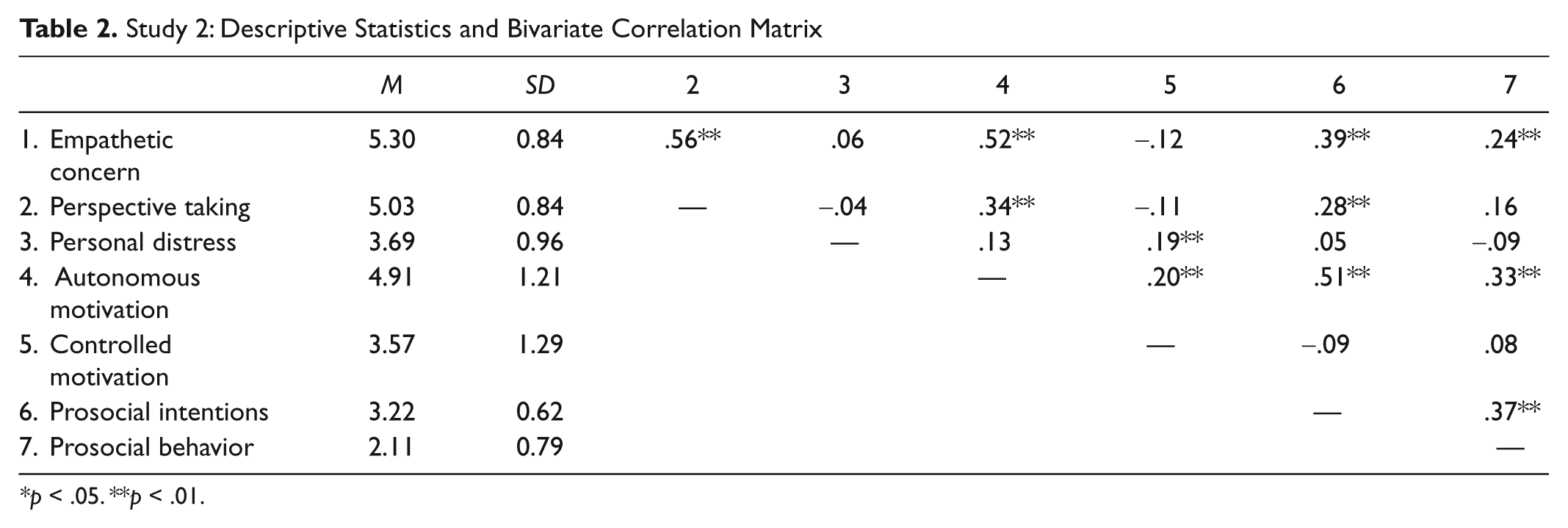
p < .05. **p < .01.
A similar analysis was conducted for self-reported prosocial behavior. When perspective taking, empathetic concern, and personal distress were entered into a model predicting prosocial behavior, only the effect of empathetic concern was significant, β = .25, p < .05. Autonomous motivation, β = .32, p < .001 (but not controlled motivation, β = .02, p > .10), predicted prosocial behavior. When autonomous and controlled motivations were also entered, the effect of empathetic concern reduced to nonsignificance, β = .15, p > .05, the effect of controlled motivation was nonsignificant, β = .07, p > .10, and the effect of autonomous motivation remained, β = .25, p < .05. A bootstrapping procedure with n = 1,000 resamples showed a significant indirect effect of empathetic concern on prosocial behavior via autonomous motivation, 95% bootstrap CI [0.03, 0.25], but no significant indirect effect of empathetic concern on prosocial behavior via controlled motivation, 95% bootstrap CI [−0.05, 0.02].
Discussion
In Study 2, we found that empathetic concern evoked greater helping behavior due to its association with greater autonomous motivation to help others: Autonomous motivation fully mediated the relationship between empathy and prosocial intentions and behavior. Once autonomous motivation was accounted for, controlled motivation was negatively associated with helping intentions (but unrelated to helping behavior).
Despite the clear pattern of effects emerging from Studies 1 and 2, both studies were cross-sectional, and therefore, cannot confirm the direction of the hypothesized effect or discount the possibility that unmeasured variables associated with empathy could explain the relationships found. In addition, individual differences in socially desirable responding could have accounted for the shared variance between empathy, autonomous motivation, and helping.
Study 3
In Study 3, we aimed to clarify the causal processes indicated in Studies 1 and 2 by using an experimental design in which empathy was manipulated to assess effects on autonomous motivation, controlled motivation, and willingness to offer time and financial help to a person in need. The random assignment of participants to each condition was important to help minimize the possibility that our effects were accounted for by variables associated with empathy or individual differences in social desirability motives. In line with our previous theorizing and research findings, we predicted that (a) participants in a high empathy arousal condition would report greater autonomous motivation and willingness to help than would participants in a low empathy arousal condition, (b) autonomous motivation would be positively associated with willingness to help, and (c) the effect of experimental condition (empathy arousal) on willingness to help would be mediated by autonomous motivation. Controlled motivation was included for comparison.
Method
Participants and Design
An independent measures design was used, with participants (N = 59) randomly assigned to either the high empathetic arousal condition (n = 28) or the low empathetic arousal condition (n = 31). Participants (19 females, 40 males) were recruited from an online participant recruitment service as in Study 1. Ages ranged from 30 to 50 (M = 40.32, SD = 5.34).
Materials and Procedure
Participants were emailed a link to an online questionnaire, which randomly allocated them to either the low empathetic arousal or high empathetic arousal condition. At the end of the questionnaire, participants were asked to record their age, gender, and email address.
Empathetic arousal
Participants were given a short passage to read about a woman who was suffering from depression. Before reading the passage, participants in the high empathetic arousal condition were instructed to focus on the person’s emotions (adapted from Batson et al., 1988):
We are interested in people’s responses to emotional experiences, and to what extent people remember other people’s feelings. The following is a story about a woman experiencing a breakdown. Research has shown that the best way to remember emotional experiences is to vividly imagine how the other person is feeling about what has happened and focus on the emotions they are experiencing. Therefore while you read the story, we would like you to try to imagine how the other person is feeling. Try not to concern yourself with attending to all the facts presented. Just imagine how this person feels and the different emotions they would be experiencing in this situation. Please spend two minutes reading and re-reading the text. You will then be asked to recall the emotional elements of the account, and how you think the person was feeling.
Participants in the low empathetic arousal condition were asked to focus on the objective details of the account:
We are interested in people’s memory of events, and how accurately people remember the details of other people’s stories. The following is a story of a woman experiencing a breakdown. Research has shown that the best way to remember events is to remain as objective as possible. It helps if you distance yourself emotionally from the person telling the story, and try not to get caught up in imagining the other person’s feelings. Therefore while you read the story, we would like you to try to be as objective as possible. Try not to let yourself get caught up in imagining what the person has been through and how they feel as a result. Please spend 2 minutes reading and re-reading the text and examining the objective details of the story. You will then be asked to accurately recall some details of the story.
After reading the text, participants in the high empathetic arousal condition were asked “Please now write down the emotions you think the person telling this story was experiencing during the breakdown,” whereas participants in the low empathetic arousal condition were asked “Please now recall as much information about the person telling the story as you can (e.g., their age, name, gender, and any other details you can remember).” To determine whether the manipulation was successful, participants’ levels of empathy were assessed by asking them to rate how sympathetic, warm, compassionate, soft-hearted, and tender they felt toward the person (as in Study 1), α = .92.
Autonomous and controlled motivations
Autonomous and controlled motivations were measured in the same way as in Study 1 (autonomous motivation: α = .77; controlled motivation: α = .84).
Willingness to help
Willingness to offer financial help and offer time to help was measured in the same way as in Study 1.
Results
Means, standard deviations, and bivariate correlations of each of the variables in each condition are provided in Table 3. Those in the high empathetic arousal condition reported greater empathy, t(57) = −4.60, p < .001, willingness to offer financial help, t(57) = −2.21, p < .05, willingness to offer time to help, t(57) = −2.62, p < .05, and autonomous motivation to help, t(57) = −2.15, p < .05, than those in the low empathetic arousal condition. There was no difference between conditions in controlled motivation to help, t(57) = 0.21, p > .10.
Study 3: Descriptive Statistics for Each Variable in Each Condition, and Bivariate Correlation Matrix
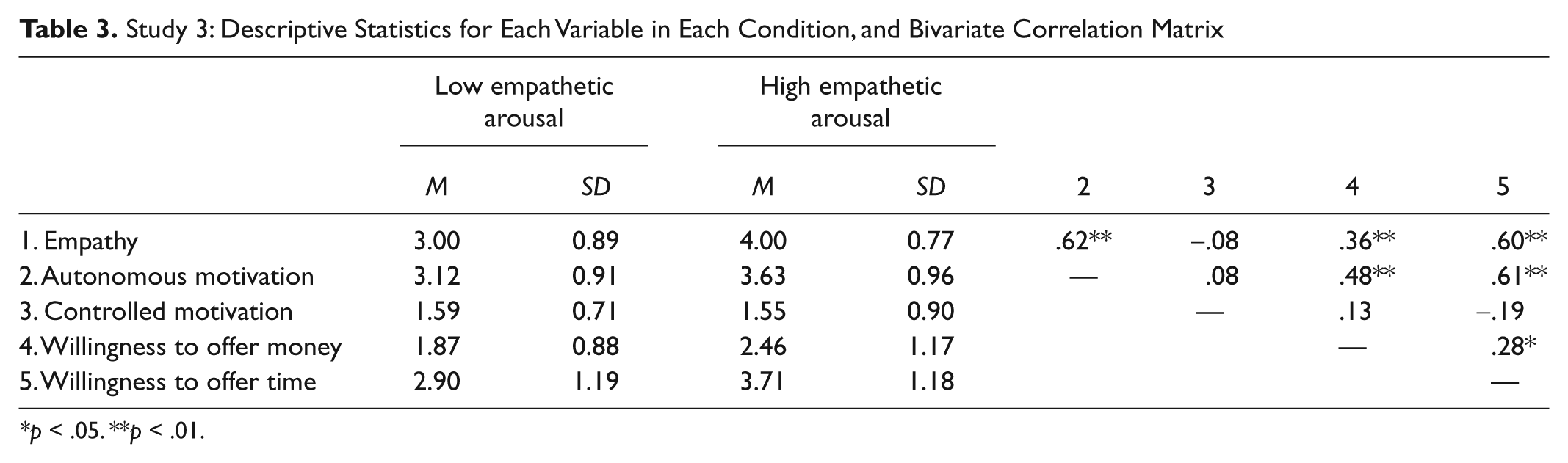
p < .05. **p < .01.
In a mediation analysis, empathetic arousal condition predicted autonomous motivation, β = .24, p < .05, and willingness to offer financial help, β = .28, p < .05. Autonomous motivation, β = .45, p < .001 (but not controlled motivation, β = .10, p > .10), also predicted willingness to offer financial help. When empathetic arousal condition, autonomous motivation, and controlled motivation were entered in a model predicting willingness to offer financial help, the effect of condition reduced to nonsignificance, β = .17, p > .05, the effect of controlled motivation was nonsignificant, β = .10, p > .10, and the effect of autonomous motivation remained, β = .40, p < .01. A bootstrapping procedure with n = 1,000 resamples showed a significant indirect effect of empathy on willingness to financial help via autonomous motivation, 95% bootstrap CI [0.03, 0.25], but no significant indirect effect of empathy on willingness to offer time to help via controlled motivation, 95% bootstrap CI [−0.05, 0.02].
In a similar analysis, empathetic arousal condition also predicted willingness to offer time to help, β = .55, p < .001. Autonomous motivation, β = .63, p < .001 (and also controlled motivation, β = −.24, p < .05), predicted willingness to offer time. When all three variables were entered in a model predicting willingness to offer time to help, the effect of condition reduced to nonsignificance, β = .16, p > .10, and the effect of autonomous motivation, β = .59, p < .05, and controlled motivation, β = −.23, p < .05, remained. A bootstrapping procedure with n = 1,000 resamples showed a significant indirect effect of empathy on willingness to time to help via autonomous motivation, 95% bootstrap CI [0.05, 0.87], but no significant indirect effect of empathy on willingness to offer time to help via controlled motivation, 95% bootstrap CI [−0.19, 0.15].
Discussion
The results of Study 3 support our hypothesis that empathy increases the tendency to help as a result of eliciting greater autonomous motivation. The results suggest that promoting empathetic feelings by encouraging people to focus on the emotional experience of others may be one way to promote autonomously motivated helping behavior. As in Study 2, controlled motivation was not associated with empathy. Once autonomous motivation was accounted for, controlled motivation was negatively associated with willingness to offer time (and unrelated to willingness to offer financial help). Although the findings of Study 3 provide further support for the mediation hypothesis, the limitations of the study should be acknowledged. For example, the results are based on only one particular scenario of help giving; there may be particular context effects of the emotional aspects of this scenario which promoted autonomous over controlled motives for helping. The manipulation also lacks the validity of an actual (observed) scenario of help-giving, and the study used self-reports of autonomous motivation and willingness to help. Future research could usefully extend the research reported here by adopting different experimental manipulations and by incorporating objective measures of prosocial behavior.
General Discussion
The results of these three studies suggest that one reason why empathy is a strong predictor of prosocial behavior is due to its association with greater autonomous motivation to help. Our findings suggest that empathy can be a motivator of helping behavior which is driven by internalized interests and values, but does not motivate helping behavior via a concern to gain positive regard from others or via feelings of pressure or external control. The findings support previous research that has demonstrated relationships between autonomous motivation and empathy (Roth, 2008; Ryan & Connell, 1989), autonomous motivation and helping (Gagné, 2003; Gebauer et al., 2008; Grant, 2008; Weinstein & Ryan, 2010), and empathy and helping (Batson, 1991; Batson et al., 1988; Greitemeyer, 2009). However, the current research furthers our understanding and goes beyond prior empirical evidence by demonstrating that the relationship between empathy and helping is mediated by autonomous motivation, and not by controlled motivation. We also found that an empathy-evoking experience can elicit greater autonomous motivation to help, and therefore, may be one method for encouraging sustained helping behavior based on internalized prosocial values. It is possible that the experience of autonomously motivated helping may also help internalize prosocial values and therefore, reinforce future prosocial action and altruistic motives (Penner, 2002).
It is also important to note that while socially desirable responding poses a concern for much research on prosocial behaviors, we would suggest that this is unlikely to account for our findings, particularly in Study 3. Although we cannot entirely discount the possibility that the empathy manipulation in Study 3 increased social desirability pressures, we would suggest that this interpretation is unlikely given the extent to which the two manipulations were matched for content and task engagement. For example, the neutral condition gave participants the same passage of information about a person in need but asked them to focus on the objective details of the other person, rather than the person’s emotional experience. In addition, the empathy manipulation we used is very similar to methods previously used by Batson et al. (2003) who found that it was a focus on the another person’s emotions that was crucial for increasing empathy and prosocial responding, aside from social desirability concerns. Despite this, further research could usefully assess prosocial tendencies and motivation using methods which are less subject to social desirability influences.
As autonomously motivated helping may increase both the actor’s and recipient’s well-being (e.g., Thoits & Hewitt, 2001; Weinstein & Ryan, 2010), experiencing empathy and engaging in subsequent autonomously motivated helping behaviors may thereby elicit self-benefit in addition to benefiting others. This may seem to contradict the argument that empathy encourages an altruistic rather than egoistic motivation. However, research has shown that people may not be aware that helping others increases their own well-being (Dunn, Aknin, & Norton, 2008). We would argue that although self-benefit may remain a consequence of the autonomously motivated helping act, this does not militate against the likelihood that motivation to help arises primarily from the value placed on the welfare of others and the desire to act accordingly.
An interesting dilemma may occur in a situation where motivation to act in accordance with general moral principles conflicts with motivation to help the target of empathetic concern. For example, Batson, Klein, Highberger, and Shaw (1995) showed that participants tended to allocate resources to individuals in accordance with a general principle of justice. However, when empathy was aroused toward a particular individual, participants tended to give greater allocation of resources to this individual than to others, thus violating their principle of justice. In accordance with this research, we would expect that empathy would increase autonomous motivation to help the target of empathetic concern, rather than autonomous motivation to adhere to general moral principles. This increase in autonomous motivation may subsequently help to justify a decision to act contrary to other potentially strong moral values. It is likely that the motivation to act in accordance with particular moral values and not others is therefore dependent on the context presented and the target of empathetic arousal. Further empirical research could investigate this possibility.
Overall, the current series of studies suggest that an important mediator of the relationship between empathy and helping is autonomous motivation to help, rather than controlled motivation to help. This is important as it has been shown that autonomously motivated prosocial behavior is more likely to lead to greater engagement with helping behavior (Gagné, 2003; Grant, 2008) and greater well-being (Weinstein & Ryan, 2010). Our research suggests that empathy-evoking experiences might promote the internalization of moral values and therefore, result in more persistent helping, rather than activating a controlled motivation that is unlikely to lead to long-term behavior change (Kunda & Schwartz, 1983) and may reduce moral concern and future prosocial behavior (Batson et al., 2003). Further research that examines the influence of empathy on motives for helping would therefore aid our understanding of the extent to which autonomously motivated helping behavior could be promoted to establish individual and societal benefits.
Footnotes
The author(s) declared no potential conflicts of interest with respect to the research, authorship, and/or publication of this article.
The author(s) received no financial support for the research, authorship, and/or publication of this article.