




Abstract
Three studies tested and confirmed the hypothesis that secure attachment relationships lead to feelings of security and energy, as well as willingness to explore. In Study 1, priming a secure attachment relationship increased felt security and energy. In Studies 2 and 3, felt energy mediated the effect of (primed) secure attachment relationships on willingness to explore. In Study 3, the effect of (primed) secure attachment relationships on felt energy and willingness to explore was independent of general positive affect. Secure attachments energize partners, thus enabling exploration.
I’m so glad I finally found you Yes, that one in a million girl And I wish my lovin’ arms around ya Honey, I can stand up and face the world Let me tell ya your love keeps liftin’ me Keeps on liftin’ me higher and higher Jackie Wilson’s, Your Love Keeps Lifting Me Higher and Higher
The preceding quote is an extract from a once popular song. It reflects two qualities of secure relationships: feelings of security and energy. Bowlby (1973) proposed that security results from attachment behavior, such as proximity seeking to a caregiver, which is necessary for survival. The literature has been consistent with Bowlby’s idea that felt security is a consequence of secure relationships (Murray, Holmes, & Griffin, 2000). However, past research has not examined directly the effect of secure relationships on feelings of energy. Attachment security may increase partners’ subjective sense of energy, thus facilitating willingness to explore. The present article is concerned with the energizing impact of secure relationships and with how feelings of energy in turn facilitate exploration.
Attachment, Affect Regulation, and Exploration
Bowlby (1973) highlighted several biologically rooted behaviors that are crucial to the survival of an individual or his/her offspring. These behaviors are attachment, exploration, parenting, and reproduction. Most of Bowlby’s work focuses on attachment and exploration, which aim to protect and provide environmental knowledge, respectively. Attachment behavior involves seeking proximity to a caregiver (e.g., clinging, following), especially when one feels threatened. In contrast, exploratory behavior involves approaching or showing interest in novel and complex stimuli (e.g., activities, objects, people). Thus, these behavioral systems complement each other.
Normatively, in times of danger, stress, or illness, the attachment system is activated leading to proximity seeking. Once attachment needs are met, other behavioral systems, such as exploration, may be activated. Bowlby (1973) argued that both the attachment and exploratory behavioral systems (i.e., display of an appropriate mix of attachment and exploratory behaviors) are crucial to survival. What determines which behavioral system (attachment or exploration) will be activated is in part due to early experiences with caregivers (Ainsworth, Blehar, Waters, & Wall, 1978).
Positive experiences (e.g., receiving sensitive and responsive care) cultivate a self-view as worthy and a view of others as reliable—what is known as attachment security (or low attachment anxiety and avoidance; Brennan, Clark, & Shaver, 1998). Secure children display an appropriate balance of attachment and exploratory behaviors depending on circumstances. Specifically, secure individuals display attachment behaviors when they feel threatened, in order to elicit appropriate responses from caregivers for distress relief. However, when unthreatened, secure individuals are able to use the provision of the caregiver as a base from which to engage in exploratory behavior; this can be considered part of the broaden-and-build cycle (Frederickson, 2001). In addition, security allows the acknowledgment and expression of a variety of emotions (J. A. Feeney, 1999; Magai, Hunziker, Mesias, & Culver, 2000; Mikulincer & Orbach, 1995; for a review, see Fuendeling, 1998).
In contrast, negative experiences with caregivers (e.g., insensitive and unresponsive care) cultivate a self-view as unworthy and a view of others as unreliable. This leads to an inappropriate use of attachment or exploratory behaviors at the expense of others. Inconsistent care is linked to attachment anxiety and a negative self-view (Ainsworth et al., 1978; Bartholomew & Horowitz, 1991). Attachment anxious children display an overuse of attachment behaviors, which interfere with the implementation of exploratory behaviors, in the “Strange Situation” (Ainsworth et al., 1978). Furthermore, individuals high in attachment anxiety overly focus on negative emotions and relationship anxieties (i.e., use hyperactivating strategies) and are vigilant for threat (Birnbaum, Orr, Mikulincer, & Florian, 1997; Mikulincer & Florian, 1995; Mikulincer & Orbach, 1995). Neglect and rejection are linked to attachment avoidance and a negative view of others (Ainsworth et al., 1978; Bartholomew & Horowitz, 1991). During strange situation reunions, attachment avoidant children engage in an overabundance of exploratory behaviors at the expense of attachment behaviors. However, this exploration has been described as superficial on the basis of children showing sustained elevated heart rate, which indicates that they are still upset from the separation (Sroufe & Waters, 1977). Furthermore, those high in attachment avoidance suppress their relationship anxieties and emotions at a conscious level (i.e., use deactivating strategies; Fuendeling, 1998; Mikulincer & Orbach, 1995), albeit sometimes they fail to do so at the unconscious level (Mikulincer, Florian, & Tolmacz, 1990), the physiological level (Mikulincer, 1998), or under cognitive load (Mikulincer, Dolev, & Shaver, 2004).
Researchers have tested Bowlby’s (1973) ideas regarding the display of attachment and exploratory behaviors using measures of adult romantic attachment, and they found that individuals with a secure attachment orientation show an increased propensity to exploration in the form of thrill-seeking activities (Carnelley & Ruscher, 2000), effective and competent environmental transactions (i.e., approach-oriented achievement; Elliot & Reis, 2003), curiosity (Aspelmeier & Kerns, 2003; Mikulincer, 1997), cognitive openness (Mikulincer, 1997; Mikulincer & Arad, 1999), as well as social, environmental, and intellectual exploration (Green & Campbell, 2000). These findings suggest that attachment security is predictive of exploratory behavior that extends beyond infancy and childhood into adulthood.
Attachment and Energy
As previously described, attachment dimensions are related to the expression or suppression of emotions. Crucially, however, no research has examined directly the link between attachment models and energy. This link is important, because a sense of energy may constitute the resource needed for environmental exploration. That is, energy may serve what Frederickson (2001) called a “broaden-and-build” function. It may broaden one’s knowledge about one’s environment through information acquired by exploration. This additional knowledge may help to build one’s resources to cope with potential future threats.
Sense of energy has been conceptualized as subjective vitality by Ryan and Frederick (1997). They define subjective vitality as feelings of aliveness and vivacity. These feelings represent a discrete mood state that is separate from general positive affect. Energy is indicative of the high positive affect spectrum of the Consensual Model of Affect (Watson & Tellegen, 1985), which reflects highly aroused mood states. In contrast, general positive affect represents the pleasantness dimension of Watson and Tellegen’s (1985) model of affect. Furthermore, although subjective vitality has been associated with a component of felt security, namely, self-esteem (Ryan & Frederick, 1997), it does not encompass the other constituents of felt security, namely, feelings of care, love, and safety (Bowlby, 1969; Holmes & Rempel, 1989; Mikulincer & Shaver, 2007a, 2007b; Murray et al., 2000). Therefore, energy should be related to felt security but be distinct from it.
Secure individuals are likely to have relatively high energy. To begin with, acts of self-control (e.g., coping with stress, emotion regulation) reduce energy (Gailliot et al., 2007; Muraven & Baumeister, 2000). As such, persons with low attachment avoidance will be more energetic, because they are less likely to impose strict regulatory control on their emotions (J. A. Feeney, 1999). Moreover, persons with low attachment anxiety will be more energetic, because they are less likely to use emotion-focused coping associated with a hyperactivated attachment system (Mikulincer & Shaver, 2003), which inhibits the activation of other behavioral systems. Finally, past research has shown that high subjective vitality (feelings of energy) is associated with decreased trait anxiety and depression (Ryan & Frederick, 1997), high attachment anxiety is associated with increased anxiety and depression (Carnelley, Pietromonaco, & Jaffe, 1994; Hankin, Kassel, & Abela, 2005), and high attachment anxiety and avoidance are associated with increased physiological arousal when engaging in a stressful task in the presence of one’s romantic partner (Carpenter & Kirkpatrick, 1996) and after a brief separation from one’s romantic partner (B. C. Feeney & Kirkpatrick, 1996).
Consumed by (or suppressing) anxiety and insecurity, individuals with high attachment anxiety and/or avoidance may lack the energy for environmental exploration. This lack of energy may be the reason why past research has found that people with insecure attachments express decreased willingness to explore the environment (B. C. Feeney, 2004), although this research has not tested the direct effect of attachment security on energy. Thus, we propose that the previously reported positive association between secure attachments (i.e., low attachment anxiety/avoidance) and willingness to explore (Carnelley & Ruscher, 2000; Green & Campbell, 2000; Mikulincer & Arad, 1999) is due to individuals with secure attachments having higher energy, which enables them to explore their environment. We tested these hypotheses in three studies. In all studies, we created an experimental microcosm, in which we asked participants to reflect on relationships and then assessed transitory increases in energy. Studies 1 to 3 gauged the effect of a primed secure relationship on energy, whereas Studies 2 and 3 gauged the full mediational model (i.e., energy mediates the effect of relationship security on exploration), in attempting to demonstrate the “broaden-and-build” (Frederickson, 2001) function of energy.
Study 1
Method
Participants and Design
One hundred and two female participants aged 18 to 55 (93.1% aged 18-35) took part online in exchange for credit (n = 12) or were recruited from various websites (n = 90), including http://www.socialpsychology.org, psychological research on the Internet, and online forums with a psychology or research theme (e.g., Linkedin, Livejournal). These websites directed participants to the study’s webpage. The majority of participants resided in the United States (n = 76; 74.5%).
Participants were included in the study, if they wrote for 5 to 10 min about the instructed relationship. They were randomly assigned either to the secure relationship prime condition, the anxious relationship prime condition, or the avoidant relationship prime condition.
Procedure
Participants were informed that this 20-min study involved a visualization task. They were also instructed to complete the study alone and in a quiet place. After giving their consent, they indicated their gender, age, country of origin, and country of residence.
Participants then engaged in the relationship visualization (priming manipulation) task. They visualized a person with whom they had either a secure, anxious, or avoidant relationship. Next, they specified the nature of their relationship with that person (e.g., parent, friend, romantic partner) and the duration of time that they had known her or him. Subsequently, they were instructed that they would have 8 min to write about this person. Although they were presented with an online clock that counted down the time remaining, participants were permitted to continue writing after the 8-min countdown. After the visualization task, participants completed, in the following order, measures of felt security and energy. Written debriefing concluded the testing session.
Priming Manipulation
Participants in the secure relationship prime condition received the following instructions (Bartz & Lydon, 2004; secure attachment prime):
Please think about a relationship you have had in which you have found that it was relatively easy to get close to the other person and you felt comfortable depending on the other person. In this relationship, you didn’t often worry about being abandoned by the other person and you didn’t worry about the other person getting too close to you. It is crucial that the nominated relationship is (or was) important and meaningful to you.
Then, participants were presented with the following guided questions:
Now, take a moment and try to get a visual image in your mind of this person. What does this person look like? What is it like being with this person? You may want to remember a time when you were actually with this person. What would he or she say to you? What would you say in return? What does this person mean to you? How do you feel when you are with this person? How would you feel if this person was here with you now?
Participants in the anxious relationship prime condition received the following instructions (Bartz & Lydon, 2004; anxious–ambivalent attachment prime):
Please think about a relationship you have had in which you have felt like the other person was reluctant to get as close as you would have liked. In this relationship, you worried that the other person didn’t really like you, or love you, and you worried that they wouldn’t want to stay with you. In this relationship, you wanted to get very close to the other person but you worried that this would scare the other person away. It is crucial that the nominated relationship is (or was) important and meaningful to you.
Participants were presented with the same guided questions as those in the secure relationship prime condition.
Finally, participants in the avoidant relationship prime condition received the following instructions (Bartz & Lydon, 2004; avoidant attachment prime):
Please think about a relationship you have had in which you have found that you were somewhat uncomfortable being too close to the other person. In this relationship you found it was difficult to trust the other person completely and it was difficult to allow yourself to depend on the other person. In this relationship, you felt yourself getting nervous when the other person tried to get too close to you and you felt that the other person wanted to be more intimate than you felt comfortable being. It is crucial that the nominated relationship is (or was) important and meaningful to you.
Participants were presented the same guided questions as in the previous two priming conditions.
Measures
Participants responded to the following measures (1 = not at all, 6 = very much).
Felt security
The Felt Security Scale served as a manipulation check. Past theory and research has conceptualized this construct as comprising feelings of care, esteem, love, and safety (Bowlby, 1969; Holmes & Rempel, 1989; Mikulincer & Shaver, 2007a, 2007b; Murray et al., 2000). However, no existing scale captures the full dimensionality of felt security. Gillath, Hart, Noftle, and Stockdale (2009) have developed a state measure of attachment security, but this measure captures the emotions, behaviors, and cognitions associated with attachment security rather than feelings of security per se. Thus, we created items to assess security. Participants indicated how comforted, supported, looked after, cared for, secure, safe, protected, unthreatened, better about myself, valued, more positive about myself, I really like myself, loved, cherished, treasured, and adored they were currently feeling. We computed total scores for the felt security items. The items formed a reliable scale (α = .97; M = 4.25, SD = 1.39).
Energy
The energy scale comprised 10 items. We derived these items from the Subjective Vitality Scale (Ryan & Frederick, 1997) and a word thesaurus. Participants indicated how alive, energetic, vital, lively, vibrant, energized, active, dynamic, excited, and much of a buzz they were currently feeling. We computed total scores for the energy items. Again, the items formed a reliable scale (α = .97; M = 3.70, SD = 1.34). 1
Results
Age and sample type effects
Age was positively associated with feelings of energy, r(100) = .23, p = .02. However, given that most (79.4%) of the sample was between the ages of 18 and 29, we excluded age from the main analyses. 2
As our sample consisted both of students taking part in exchange for credit and volunteers, we explored potential differences in the two subsamples. None of the main effects or interactions involving sample type were significant, Fs(1, 96) < 2.78, ps > .10, ηs2partial < .03. Therefore, we excluded sample type from the remaining analyses.
Target relationships
Across all conditions, participants indicated the nature of the relationship (i.e., target relationship) that they visualized. To find out whether participants visualized different relationship targets across the relationship prime conditions, we computed a chi-square analysis on the target relationship data. Across all three relationship prime conditions, participants visualized a romantic partner, family member, or friend. These target relationships were evenly spread across the relationship prime conditions, χ2(4, N = 102) = 2.22, p = .70, V = .11.
Dependent measures
We computed separate one-way ANOVAs for the felt security and energy scales. We present the scale descriptives in Table 1. The priming manipulation had a significant effect on all of the dependent measures, Fs(2, 99) > 4.33, ps < .05, ηs2partial > .07. As expected, a series of least significant difference tests revealed that participants in the secure relationship prime condition indicated higher levels of felt security than participants in the anxious or avoidant relationship prime conditions, suggesting that our priming manipulation was successful, ps < .05. Furthermore, these analyses revealed that participants in the secure relationship prime condition indicated higher levels of energy than participants in the anxious or avoidant relationship prime conditions, ps < .05. Finally, participants in the anxious relationship prime condition did not differ significantly on feelings of security or energy from participants in the avoidant relationship prime condition, ps > .39.
Study 1: Effects of the Prime Manipulation on the Dependent Variables
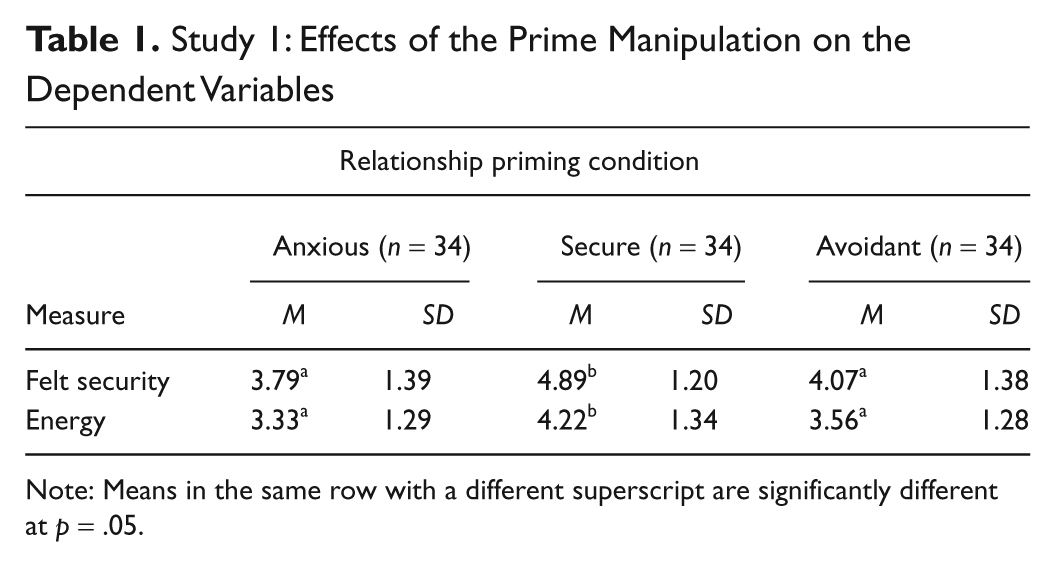
Note: Means in the same row with a different superscript are significantly different at p = .05.
Correlation
The correlation between felt security and energy was significant, r(100) = .67, p < .001. High felt security was associated with high energy.
Discussion
Past research has shown that primed attachment relationships influence interpersonal expectations, recall for attachment words, and mood (Rowe & Carnelley, 2003). Our findings extend this past research by demonstrating that primed attachment relationships exert different effects on felt security and energy. In particular, secure, relative to insecure (i.e., anxious and avoidant), attachment relationships increase felt security and energy, whereas anxious and avoidant attachment relationships do not differ in feelings of security or energy.
In all, Study 1 showed that felt security and energy were boosted by a secure (vs. insecure) attachment relationship prime. We followed up with two studies. These studies tested whether a secure attachment relationship prime boosts felt security, energy, and exploration above and beyond neutral control primes (i.e., distant neutral relationship; Study 2) and positive control primes (i.e., positive affect prime; Study 3). More important, these studies tested whether the effect of attachment security on willingness to explore is mediated by energy. Does energy serve a “broaden-and-build” (Frederickson, 2001) function by sparking the acquisition of new information about one’s environment through exploration?
Study 2
Method
Participants and Procedure
One hundred and nine participants (61 women, 48 men) aged 18 to 64 (89.8% aged 18-40) were either recruited from the same online websites as Study 1 (n = 88) or took part online in exchange for a credit (n = 9) or money (GB£5 ≈ US$8; n = 12). The majority of participants resided in the United States (n = 60; 55.0%) or in the United Kingdom (n = 37; 33.9%). Participants were included in the study, if they wrote for 5 to 10 min about the instructed relationship. They were randomly assigned either to the secure relationship prime condition (n = 61) or the control (i.e., distant neutral relationship) prime condition (n = 48).
Participants filled out demographic items before completing the visualization task and dependent measures, the latter of which were presented in the following order: security, energy, and exploration. Written debriefing concluded the testing session.
Priming Manipulation
Participants in the secure relationship prime condition received the same instructions and guided questions as those in the secure relationship prime condition in Study 1. 3 Participants in the distant neutral relationship prime condition received the following instructions (after Kumashiro & Sedikides, 2005):
Please think of a current relationship that you have. Think of a distant relationship. Think of a person with whom you have had a truly neutral relationship. Think of a person that you don’t know very well, and whom you neither like nor dislike.
Participants were given the same guided questions as those in the secure relationship prime condition.
Measures
Participants responded to the following measures (1 = not at all, 6 = very much).
Felt security
Due to time constraints, participants completed a shortened version (10 items) of the felt security scale described in Study 1. Participants indicated how comforted, secure, supported, safe, loved, protected, better about themselves, encouraged, sheltered, and unthreatened thinking about the person in the visualization task made them feel. Reliability was high (α = .96; M = 4.17, SD = 1.53).
Energy
This scale was identical to that used in Study 1. Reliability was high (α = .98; M = 3.99, SD = 1.59).
Exploration
We used a modified version of Green and Campbell’s (2000) Exploration Index. This scale consisted of four items designed to reflect environmental exploration (e.g., Thinking about the person I described in the visualization task makes me want to . . . explore someplace that I have never been before; spend time traveling abroad). We computed total scores for the exploration items. Reliability was high (α = .81; M = 3.00, SD = 1.50).
Results
Age, gender, and sample effects
Age was negatively associated with feelings of energy and exploration, rs(106) > |-.19|, ps < .05. However, given that most (73.1%) of the sample was between the ages of 18 and 29, we excluded age from the main analyses.
We also examined whether gender and sample type had effects on the dependent variables. We tested whether participants who received compensation (n = 21) differed from those who volunteered (n = 88). Therefore, we combined the participants who received any type of compensation into one group. Women (M = 4.55, SD = 1.43) indicated higher levels of felt security than men (M = 3.68, SD = 1.53), F(1, 102) = 5.98, p = .02, η2 partial = .06. None of the remaining effects of gender and sample type were significant, Fs(1, 102) < 1.20, ps > .30, ηs2 partial < .02. Therefore, we excluded gender and sample type from the main analyses. 4
Target relationships
Across all conditions, participants indicated the nature of the relationship (i.e., target relationship) that they visualized. To examine whether participants visualized different relationship targets across the relationship prime conditions, we computed a chi-square analysis on the target relationship data. Across all relationship prime conditions, participants visualized a romantic partner, family member, friend, coworker, acquaintance, roommate, classmate, neighbor, or teacher. These target relationships were not evenly spread across the relationship prime manipulation, χ2(8, N = 107) = 89.20, p < .001, V = .91. An examination of these results indicated that a small minority of participants in the distant neutral relationship prime condition visualized either a romantic partner (2%), family member (0%), or friend (6.25%) compared with participants in the secure relationship prime condition (54.23%, 1.69%, and 42.37%, respectively). Instead, participants in the distant neutral relationship prime condition were more likely to visualize a coworker (18.75%), acquaintance (29.17%), or classmate (33.33%) than participants in the secure relationship prime condition (0% for coworker, acquaintance, and classmate, respectively). In all, participants thought about a relationship that was appropriate for the relationship prime condition in which they were assigned. 5
Dependent measures
We computed independent t tests on all of the dependent measures. We present the scale descriptives in Table 2. The priming manipulation had a significant effect on all of the dependent measures, ts(107) > 4.73, ps < .001, ds > .93. Consistent with Study 1, participants in the secure relationship prime condition (vs. distant neutral relationship prime) indicated higher levels of felt security, suggesting that the priming manipulation was successful. Furthermore, participants in the secure relationship prime condition reported higher felt energy and higher willingness to explore than participants in the distant neutral relationship prime condition.
Study 2: Effects of the Prime Manipulation on the Dependent Variables

Note: Means in the same row with a different superscript are significantly different at p = .05.
Correlations
As shown in Table 3, all of the dependent measures were significantly correlated, rs(107) > .56, ps < .001. Participants who felt secure indicated high levels of energy and willingness to explore. Finally, participants who reported high levels of energy were particularly willing to explore.
Study 2: Correlations Between the Dependent Measures (n = 108-109)
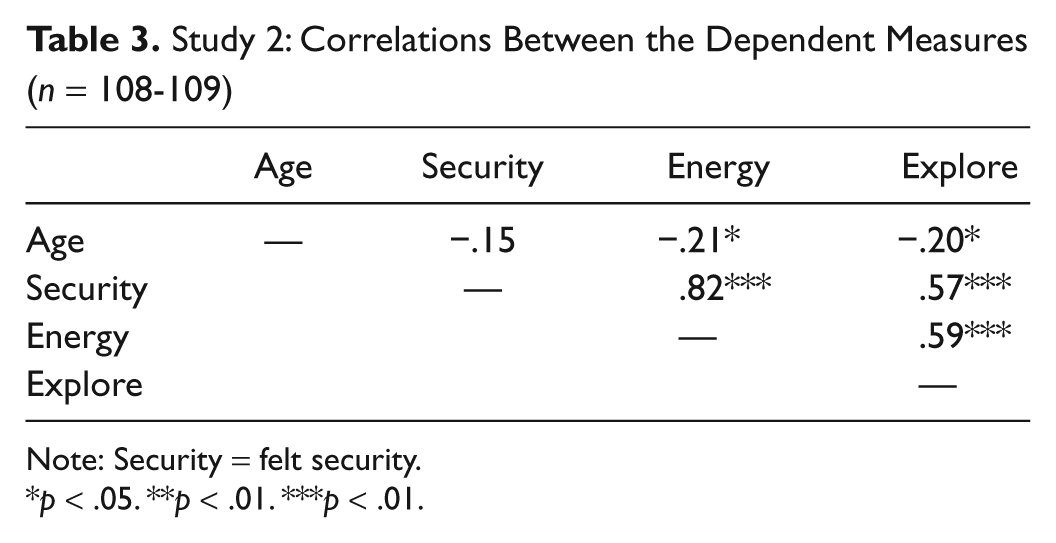
Note: Security = felt security.
p < .05. **p < .01. ***p < .01.
Mediation
We used the bootstrapping procedure (Preacher & Hayes, 2004) to examine whether the effect of the priming manipulation on exploration was mediated by its effect on energy. We estimated the indirect effects of the priming manipulation on exploration via energy by drawing 1,000 bootstrap samples from the data (Figure 1). The priming manipulation (contrast coded: 1 = secure relationship prime, 0 = distant neutral relationship prime) had a significant influence on exploration, β = .42, t(107) = 4.73, p = .001, and energy, β = .46, t(107) = 5.36, p = .001, and energy significantly predicted exploration when controlling for the effect of the priming manipulation, β = .51, t(106) = 5.88, p < .001. Although the direct path from the priming manipulation to exploration was still significant when controlling for the effect of energy, β = .18, t(106) = 2.11, p = .04, the confidence interval (CI) for the indirect effect did not include zero (95% CI = [0.39, 1.08]), indicating that the effect of the priming manipulation on exploration was (partially) mediated by energy.

Study 2: Beta coefficients showing that feelings of energy mediated the relation between the priming manipulation and exploration.
Discussion
Consistent with Study 1, the secure relationship prime condition led to an elevated sense of security and energy. In addition, secure relationships increased exploration. In addition, the effect of the secure relationship prime on exploration was partially mediated by felt energy, as both the direct and indirect paths were significant. Secure relationships strengthen felt security and energy. Energy then enables individuals to engage in environmental exploration, supporting the notion that energy serves a “broaden-and-build” (Frederickson, 2001) function.
Yet it is possible that the manipulation influenced general positive affect in addition to energy. We wanted to be confident that there is something unique about visualizing a secure relationship: It energizes rather than simply enhance the mood. To that purpose, we designed Study 3. Here, we used a different control prime than Study 2, given that our intent was to demonstrate that there is something special about a secure relationship that boosts energy and augments willingness to explore over and above positive affect in general. In particular, participants in the control condition visualized a scene from a comedy movie or television sitcom. We also measured general positive affect. If participants who are primed with a secure relationship (vs. positive affect) report higher security, energy, and willingness to explore, and if there is no effect of the priming manipulation on general positive affect, then we will be able to rule out the possibility that the effect of the relationship prime is due to general positive affect.
Study 3
Method
Participants and Procedure
Eighty-nine participants (53 women, 36 men) aged 18 to 54 (89.9% aged 18-29) were recruited from the same online websites as Studies 1 and 2 (n = 66), took part online in exchange for credit (n = 18), or took part for money (GB£5 ≈ US$8; n = 5). The majority of participants resided in the United States (n = 53, 59.6%) or in the United Kingdom (n = 29; 32.6%). Participants were included in the study, if they wrote for 5 to 10 minutes about the instructed relationship.
The materials and presentation order were identical to Study 2, with two notable exceptions. First, only half of the participants (n = 45) visualized a person with whom they had a relationship. These participants received the same secure relationship prime as in Study 1. The remaining participants (n = 44) visualized a humorous movie or television program that they had recently seen, a control-prime manipulation that we adapted from Mikulincer and Arad (1999). They were then given the following guided questions:
Now, take a moment and try to get a visual image of the movie or television program and the central character. What is the movie or television program about? What does the central character look like? Why did the movie or television program make you laugh? Please describe the funny incident or scene.
Second, all participants completed a mood scale after the relationship prime manipulation.
Measures
Participants responded to the following measures (1 = not at all, 6 very much).
Affect
Participants completed a three-item affect scale assessing general positive affect. We derived these items from the pleasantness dimension of Watson and Tellegen’s (1985) Consensual Model of Affect. Participants indicated how content, happy, and pleased they were currently feeling. We computed total scores for the general positive affect items. Reliability was high for general positive affect (α = .85; M = 4.20, SD = 1.09).
Felt security
This scale was identical to that of Study 2. Reliability was high (α = .95; M = 3.78, SD = 1.40).
Energy
This scale was identical to that of Studies 1 and 2. Reliability was high (α = .96; M = 3.79, SD = 1.27).
Exploration
This scale was identical to that of Study 2. Reliability was high (α = .84; M = 3.04, SD = 1.43).
Results
Age, gender, and sample effects
Age was not significantly associated with any of the dependent measures, rs(87) < −.21, ps > .06. Therefore, we omitted age from further consideration.
We also examined whether gender and sample type had effects on the dependent variables. We aimed to test whether participants who received compensation for their participation (n = 23) differed from those who volunteered (n = 66). Therefore, we combined the participants who received any type of compensation into one group. Women reported higher security (M = 3.98, SD = 1.40) and energy (M = 4.03, SD = 1.23) than men (M = 3.42, SD = 1.25; M = 3.42, SD = 1.26, respectively), Fs(1, 83) > 3.99, ps < .05, ηs2partial > .04. In addition, the Priming Manipulation × Sample Type interaction on felt security was significant, F(1, 83) = 6.54, p = .01, η2partial = .07. This effect emerged because volunteer participants in the secure prime condition reported higher felt security (M = 4.82, SD = 1.07) compared and with volunteer participants in the control-prime condition (M = 2.95, SD = 1.10 compensated participants in the control-prime condition (M = 3.03, SD = 1.38 compensated participants in the secure prime condition (M = 3.81, SD = 1.03), ts(43) > 2.74, ps < .05, ds > 0.96, using the Bonferroni correction for all three comparisons (α/3). Similarly, the Priming Manipulation × Sample Type interaction on energy was significant, F(1, 83) = 7.87, p = .01, η2partial = .09. This effect emerged because volunteer participants in the secure prime condition reported higher energy (M = 4.36, SD = 1.21) compared with volunteer participants in the control-prime condition (M = 3.47, SD = 1.26), t(64) = 2.53, p = .01, d = 0.61, and with compensated participants in the control-prime condition (M = 3.48, SD = 1.28), t(43) > 2.81, ps < .05, ds > 1.03, but did not differ from compensated participants in the secure prime condition (M = 3.24, SD = 0.90), t(44) = 2.14, p > .05, d = 0.71 using the Bonferroni correction for all three comparisons (α/3). None of the remaining effects involving gender and sample type were significant, Fs(1, 83) < 3.61, ps > .06, ηs2partial < .05. Given that these were the only gender differences to emerge and that the sample included relatively few men and compensated participants relative to women and volunteer participants, we excluded gender and sample type from the main analyses. 6
Dependent measures
We computed independent t tests on all of the dependent measures. We display the scale descriptives in Table 4. The priming manipulation had a significant effect on all of the dependent measures, ts(87) > 2.35, ps < .05, ds > .50. Consistent with Studies 1 and 2, participants in the secure relationship prime condition (vs. the control-prime) reported higher security, suggesting that the priming manipulation was successful. Furthermore, participants in the secure relationship prime condition reported higher energy and willingness to explore than participants in the control-prime condition. Finally, there was no effect of the priming manipulation condition on general positive affect, t(87) = 0.51, p = 0.61, d = .11.
Study 3: Effects of the Prime Manipulation on the Dependent Variables

Note: Means in the same row with a different superscript are significantly different at p = .05.
Correlations
As shown in Table 5, with the exception of positive affect, all of the dependent variables were significantly correlated, rs(87) > .46, ps < .001. Participants who reported high security also reported higher energy and willingness to explore. In addition, participants who reported high energy also reported that they were particularly willing to explore. Finally, several significant correlations emerged between general positive affect on one hand and the remaining dependent measures on the other. Participants who reported positive affect also reported higher security and energy, rs(87) > .39, ps < .001.
Study 3: Correlations Between the Dependent Measures (n = 89)

Note: PosAffect = positive affect; security = felt security.
p < .10. *p < .05. **p < .01. ***p < .001.
Confirmatory factor analyses
We tested the extent to which general positive affect and energy are separate constructs using confirmatory factor analysis. We computed two structural models to examine the extent to which general positive affect and energy are unique constructs. Model A included a single factor accounting for all of the covariance between the affect and energy items. This model did not fit the data well, χ2(65, N = 86) = 277.06, p < .001, and the indices indicated poor fit, Comparative Fit Index (CFI) = .80, Standardized Mean Residual (SRMR) = .10, Root Mean Square of Approximation (RMSEA) = .20. Model B tested whether the positive affect and energy items load onto separate factors. This model yielded satisfactory fit, χ2 (64, N = 86) = 181.08, p < .001, and the indices indicated acceptable fit, CFI = .89, SRMR = .06, RMSEA = .15. This model fit the data significantly better than Model A, χ2Δ(1) = 95.98, p < .001. Furthermore, the path coefficients to the latent general positive affect (βs > .63, ps < .001) and energy (βs > .67, ps < .001) were significant. Consistent with Ryan and Frederick (1997), the correlation between the latent general positive affect and energy factors was moderate, r(84) = .57, p < .001. These findings are supportive of the two-factor solution rather than the one-factor solution, suggesting that general positive affect and energy are separate constructs.
Structural equation analyses
We tested a series of structural equation models to examine whether the effect of the priming manipulation on exploration was simultaneously due to the effects of the priming manipulation and positive affect on feelings of energy and to the effect of energy on exploration. First, we examined the full model in which the priming manipulation (dummy coded: 1 = secure relationship prime, 0 = positive affect prime) predicted feelings of energy and exploration, positive affect predicted feelings of energy, and feelings of energy predicted exploration (Statistical Model 1; Figure 2). This model yielded excellent fit, χ2(2, N = 89) = 3.22, p = .20, CFI = .98, SRMR = .06, RMSEA = .08. As shown in Figure 2, all of the paths were significant (βs > .21, ps < .05) except for the direct path from the priming manipulation to exploration (β = .15, p = .12).
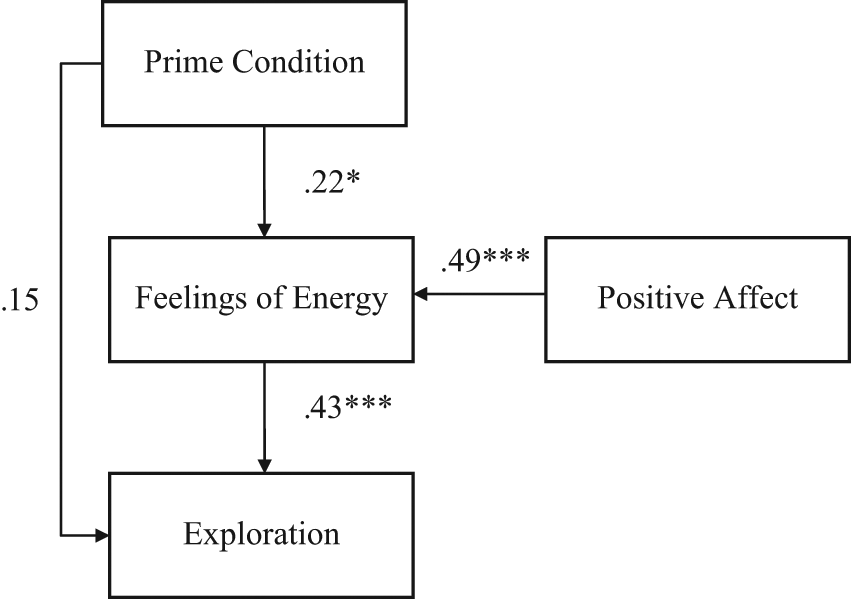
Study 3: Pictorial representation of the full structural model (Statistical Model 1) with the prime manipulation as a predictor of feelings of energy and exploration, positive affect as a predictor of feelings of energy, and feelings of energy as a predictor of exploration.
Next, we computed a series of nested model comparisons. Given that Statistical Model 1 indicated that the path from the priming manipulation to exploration was not significant, we fixed the path from the priming manipulation to exploration to 0 in Statistical Model 2 (Figure 3). Statistical Models 1 and 2 were not significantly different from one another, χ2Δ(1) = 2.38, p = .12. However, further fixing the paths from the priming manipulation to feelings of energy, feelings of energy to exploration, and positive affect to feelings of energy to 0 resulted in significantly poorer fit compared with Statistical Model 1, χ2Δ(4) = 55.16, p < .001, and Statistical Model 2, χ2Δ(3) = 52.78, p < .001. Taken together, these results suggest that Statistical Model 2 is preferable (Figure 3). The secure relationship prime predicted high feelings of energy, positive affect predicted high feelings of energy, and high feelings of energy predicted high willingness to explore. Furthermore, the bootstrapping procedure (Cheung & Lau, 2008), using 1,000 bootstrap samples from the data, indicated that the indirect path from the priming manipulation to exploration (through feelings of energy) was significant (β = .10, p = .02, 95% CI = [0.02, 0.22]). Finally, the indirect path from positive affect to exploration (through feelings of energy) was significant (β = .23, p = .001, 95% CI = [0.13, 0.34]).
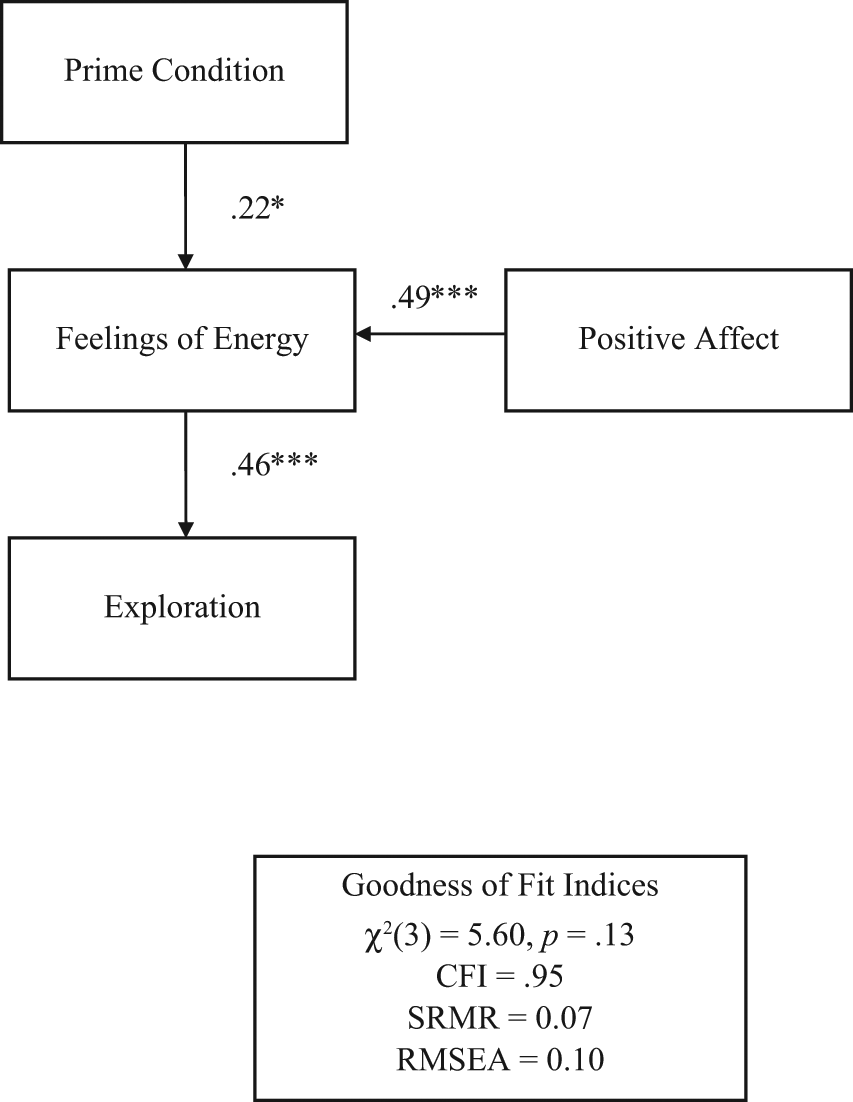
Study 3: Structural model with the prime manipulation as a predictor of feelings of energy, positive affect as a predictor of feelings of energy, and feelings of energy as a predictor of exploration.
Discussion
The results of Study 3 replicated those of Studies 1 and 2. A secure relationship increases felt security and energy and also increased willingness to explore. Furthermore, the effect of a secure relationship on exploration was mediated by felt energy, further bolstering the “broaden-and-build” (Frederickson, 2001) function of energy. Crucially, Study 3 extends Study 2, given that we used a different control prime (i.e., positive affect prime). The findings suggest that a secure relationship, not simply a positive affect prime, increases exploration through its effect on energy.
Moreover, Study 3 offered support for the discriminant validity of our energy scale in two important ways. First, there were no effects of the priming manipulation on general positive affect, but the secure relationship prime increased felt energy relative to a positive affect prime. This suggests that secure relationships boost a discrete positive emotion, energy, rather than positive affect in general. Second, although both energy and positive affect had significant direct and indirect effects, respectively, on exploration, the confirmatory factor analyses gave credence to the two-factor solution with separate factors representing general positive affect and energy. Taken together, these findings indicate that feelings of energy associated with secure relationships, not general positive affect, enable individuals to explore their environment.
General Discussion
In three studies, we provide the first direct evidence that secure relationships increase felt energy. Consistent with past research, Studies 2 and 3 obtained support for the notion that secure relationships predict willingness to explore (Aspelmeier & Kerns, 2003; Carnelley & Ruscher, 2000; Elliot & Reis, 2003; B. C. Feeney, 2004; Green & Campbell, 2000; Mikulincer, 1997; Mikulincer & Arad, 1999). However, Studies 2 and 3 extend past research by showing that the link between secure relationships and exploration is indirect. In particular, secure relationships increased exploration through their effect on felt energy. In Study 2, a secure relationship prime increased exploration relative to a distant neutral relationship prime. In Study 3, energy, not general positive affect, increased willingness to explore. Our findings illustrate the “broaden-and-build” (Frederickson, 2001) function of energy.
Several features of our research are noteworthy. First, we obtained similar results using different control primes. A secure relationship prime increased felt security and energy compared with an insecure relationship prime, regardless of whether the latter focused on anxious or avoidant attachment. Furthermore, a secure relationship prime increased willingness to explore compared with two separate control (distant neutral relationship and positive affect) primes. Second, the priming manipulation had no effect on general positive affect, suggesting that the energizing quality of secure relationships is distinct from general positive affect. The energizing effect of secure relationships is the result of feeling safe, allowing one to express an interest in exploring the environment. Finally, we obtained these results from varied samples collected on the Internet, allowing us to be more confident about the generalizability of the findings beyond university student populations (Gosling, Vazire, Srivastava, & John, 2004).
Despite the strengths of our findings, several issues warrant further consideration. The fact that we collected our data on the Internet may still invite criticism. Participants may not be representative of the wider population, may be maladjusted (i.e., suffer from social isolation), or may provide careless data that are unreplicable in the laboratory. However, this is no serious cause for concern. Gosling et al. (2004; see also Fraley, 2007) provide evidence that Internet samples are more representative of the population than samples published in top psychology journals, are not unusually maladjusted, and are highly motivated to give accurate responses and to feel free to self-disclose information. Furthermore, studies conducted on the Internet produce similar findings to those obtained from traditional methods. Indeed, the effect of the relationship prime on felt security, for which one component is self-esteem, replicates past laboratory research on the influence of relationship priming on felt security (Rushforth, 2009) and self-esteem (Carnelley & Rowe, 2007). This replication reinforces the notion that our findings are reliable and valid.
Similarly, some of our participants may have encountered difficulties with our priming manipulation because they may never have experienced some of the relevant relationships in actual life. This may be more likely for participants who suffer from social anxiety, as there is a link between social anxiety and anxious and/or avoidant attachment styles (Darcy, Davila, & Beck, 2005; Eng, Heimberg, Hart, Schneier, & Liebowitz, 2001; Mickelson, Kessler, & Shaver, 1997). However, past research has demonstrated that priming a secure relationship increased felt security in a sample of participants scoring high on Mattick and Clarke’s (1998) Social Interaction Anxiety Scale (Rushforth, 2009). Nevertheless, future research should examine how priming manipulations like ours may influence felt security, energy, and willingness to explore in larger and more diverse samples, such as Mickelson and colleagues’ (1997) national sample. These researchers obtained a link between self-report measures of psychopathology and an insecure attachment style (Mickelson et al., 1997). Replicating our findings in more diverse samples would further demonstrate the external validity of our relationship prime manipulation.
The correlations between felt security, energy, and exploration were high (rs > .46, ps < .001), raising the possibility that these three constructs may be redundant. However, we believe that these are three separate constructs. Exploration refers to behaviors, whereas felt security and energy refer to specific emotions. Proponents of the tripartite model of attitudes argue that although emotions and behaviors are components of attitudes, they are distinct components (Katz & Stotland, 1959; Zanna & Rempel, 1988); an implication is that felt security and energy should be distinct from exploration.
To explore this notion, we tested the extent to which felt security, energy, and exploration were separate from each other using confirmatory factor analysis on a different sample of 661 participants (468 women, 184 men, 9 undeclared). These participants completed the same felt security scales as in Study 1 and the same energy and exploration scales as in Studies 1 to 3. We computed two structural models to examine the extent to which felt security, energy, and exploration are unique constructs. Model A included a single factor accounting for all of the covariance between the felt security, energy, and exploration items. This model did not fit the data well, χ2(405, N = 661) = 5,993.30, p < .001, and the indices indicated poor fit, CFI = .72, SRMR = .09, RMSEA = .15. Model B tested whether the felt security, energy, and exploration items load onto separate factors. This model yielded satisfactory fit, χ2(402, N = 661) = 2,622.25, p < .001, and the fit indices indicated acceptable fit, CFI = .89, SRMR = .04, RMSEA = .09. This model fit the data significantly better than Model A, χ2Δ(3) = 3,371.05, p < .001. Furthermore, the path coefficients to the latent felt security (βs > .67, ps < .001), energy (βs > .65, ps < .001), and exploration (βs > .50, ps < .001) factors were significant. Although the correlation between the latent felt security and energy factors was high, r(659) = .77, p < .001, the correlations between the latent energy and exploration factors, r(659) = .35, p < .001, and between the latent felt security and exploration factors, r(659) = .24, p = .01, were more modest. These findings are consistent with the notion of a three-factor (rather than one factor) solution, suggesting that felt security, energy, and exploration are separate constructs.
Across all our studies, participants completed the security, energy, and exploration measures directly after the priming manipulation. In addition, the majority of participants completed all of the materials within 30 min. It would be interesting for future research to examine the long-term effects of repeated secure relationship priming on security, energy, and exploration. Relevant past research (Carnelley & Rowe, 2007) has shown that repeated attachment security priming (3 times over 3 days) can last for at least 2 days following exposure to the secure relationship prime. In particular, this repeated attachment security priming increased general positive self-views and relational expectations, but decreased attachment anxiety, regardless of participants’ general attachment styles. There is reason, then, to believe that repeating our priming manipulation over time could have a stronger effect on security, energy, and exploration.
Another cautionary remark pertains to our measure of exploration: It reflected attitudes toward exploration rather than exploratory behavior per se. A task for future research would be to examine whether secure relationships indirectly predict actual exploratory behavior through felt energy. Past research has found that secure relationships predict the amount of information participants request about a novel stimuli (Mikulincer, 1997), the amount of time participants spend engaging with novel stimuli (Aspelmeier & Kerns, 2003), and the degree of feedback participants request (Selcuk & Hazan, 2010). However, none of these studies have examined whether persons with secure relationships actually engage in exploratory behavior because they experience high energy.
Finally, it would be useful for future research to examine whether secure relationships provide people with the resources to cope with adversity. People with secure relationships respond more effectively to stressors (B. C. Feeney & Kirkpatrick, 1996; Simpson, Rholes, & Nelligan, 1992; Wildschut, Sedikides, Routledge, Arndt, & Cordaro, 2010) and like out-groups better, even after their cultural worldview is threatened (Mikulincer & Shaver, 2001). The current findings suggest that priming secure relationships may increase feelings of energy when faced with a hardship. These increased feelings of energy could provide people with the appropriate resources to deal with hardship. Does increased energy associated with secure relationships provide these individuals with the resources to cope effectively with hardships (e.g., a setback or negative feedback)?
Conclusion
These research findings are consistent with Bowlby’s (1973) hypothesis that people are willing to explore their environment when they know that their attachment figures are available or supportive and that they are worthy of their partners’ care. The findings provide the first direct support for the notion that secure relationships are associated with an increase in energy, which provides individuals with the resources for exploration. Secure relationships enable exploration through their energizing potential.
Footnotes
Acknowledgements
We thank Erica Hepper, Fay Julal, Abigail Millings, Angela Rowe, and Angeliki Theodoridou for their helpful input.
Portions of this research were presented at the Biennial Meeting of the International Association for Relationships Research, Rethymnon, Crete, Greece, July 2006, and the General Meeting of European Association of Social Psychology, Stockholm, Sweden, July 2011.
The author(s) declared no potential conflicts of interest with respect to the research, authorship, and/or publication of this article.
The author(s) received no financial support for the research, authorship, and/or publication of this article.