



Abstract
The authors investigated when observers assign contemporary group members moral obligations based on their group’s victimization history. In Experiment 1, Americans perceived Israelis as obligated to help Sudanese genocide victims and as guiltworthy for not helping if reminded of the Holocaust and its descendants were linked to this history. In Experiment 2, participants perceived Israelis as more obligated to help and guiltworthy for not helping when the Holocaust was presented as a unique victimization event compared with when genocide was presented as pervasive. Experiments 3 and 4 replicated the effects of Experiment 1 with Cambodians as the victimized group. Experiment 5 demonstrated that participants perceived Cambodians as having more obligations under high just world threat compared with low just world threat. Perceiving victimized groups as incurring obligations is one just world restoration method of providing meaning to collective injustice.
Keywords
Although people may gain rights based on group membership, particularly those with a history of suffering (Barkan, 2004), the possibility that members of historically victimized groups could also incur obligations based on their victimized group membership has not been considered. Yet, we know that when observers contemplate the victimization of others, their belief in a just world can be threatened (Lerner, 1980). For observers to maintain their just world beliefs in the face of injustice, they use various strategies aimed at making meaning of the victimization. One way to make meaning of victimization is to believe that victims become better people as a result of their suffering and should assist other victims (Lazar, Chaitin, Gross, & Bar-On, 2004; Poulin, Cohen Silver, Gil-Rivas, Holman, & McIntosh, 2009; Warner & Branscombe, 2011).
Our research is the first to empirically examine when contemporary members of a historically victimized group will be perceived by observers as obligated to help other victimized groups, to whom they are unrelated beyond the fact both were victimized, and the consequences of those obligations. It is important to research this at the group level because the phenomena are not likely to be exactly the same as that found at the individual level (Warner & Branscombe, 2011). Contemporary group members have not been directly victimized, but we believe they will still be expected to have learned from the historical suffering of their ancestors. Precisely because contemporary group members were not directly victimized, people must perceive them as connected to their history in order to view them as obligated because of their group’s history. These studies will also go beyond past research by demonstrating the consequences of such obligations—that contemporary members of historically victimized groups will be judged as guiltworthy for not helping to the extent they are perceived as morally obligated to help. This should be especially the case when the particular victimization history considered is perceived as a unique victimization event and present-day victimized group members are viewed as connected to their group’s history.
The Meaning of Historical Victimization for Observers
Collective injustice and victimization can lead to the search for meaning (Updegraff, Silver, & Holman, 2008). Past research has examined the responses of present-day victimized group members to reminders of their own collective injustice (Wohl & Branscombe, 2008), but research has not addressed how members of uninvolved groups make meaning of intergroup victimization. However, there is a wealth of research on how uninvolved observers make meaning of interpersonal victimization from a just world perspective (Hafer & Bégue, 2005).
Because learning about victimization threatens people’s sense that the world is fair, perceivers are motivated to restore justice by making meaning of the victimization—giving the victimization a purpose and attempting to make sense of it (Lerner, 1980). What strategy people use to provide meaning to victimization can vary. The most commonly studied strategy to deal with observed injustice is victim blaming, but that is by no means the only strategy that perceivers can use to restore justice (Anderson, Kay, & Fitzsimons, 2010; Hafer & Bégue, 2005; Hafer & Gosse, 2010; Kay, Jost, & Young, 2005). Indeed, Lerner (1980) argued that observers may also restore their belief in a just world by coming to believe that the victim benefited from their suffering. We examine how a moral imperative to be prosocial can emerge as a consequence of observers believing that victims should grow and become better people—specifically, that victims ought to help other victims because of their own negative experience and that they will be perceived as guilty if they fail to help due to this perceived imperative.
Observers making meaning of victimization so that the victim ultimately becomes a better and more helpful person has been examined for victims of interpersonal violence and tragedy. For example, perceivers viewed a victim of a tragedy as more likely to have a meaningful and enjoyable life than a nonvictim when under high justice threat compared with low justice threat (Anderson et al., 2010). In addition, observers believed that a victim of childhood sexual abuse should grow up to become a more ethical and kinder person than a nonvictim (Warner, Branscombe, Garczynski, & Solomon, 2011). These findings are consistent with just world theory’s assertion that perceiving an individual victim as becoming a better person and believing that the victim should become more prosocial is one strategy for making meaning of injustice. We believe that this strategy applies to how perceivers interpret victims of collective injustice and not just individual targets of victimization. Collective victimization also threatens the idea that the world is fair, which will result in a motivation to restore justice and meaning.
Observers believing that disadvantaged groups are honest, caring, and moral allows people to maintain their belief that the world is fair (Kay & Jost, 2003). Positive stereotypes of victimized groups, or victim enhancement, increase the perceived fairness of society, supporting the idea that these positive beliefs about victimized groups can help restore justice (Kay et al., 2005; Kay & Jost, 2003). Kay and Jost (2003; Study 1) had participants read about four targets with varying degrees of wealth and happiness and found that those participants who read about the “poor but happy” scenario rated the system as more just than those who read about the “poor and unhappy” target. Similarly, women who are victims of discrimination are seen as warmer, more helpful, and more moral than men (Glick & Fiske, 1996). Particularly under justice threat, people use these victimized group enhancing traits as a means of restoring justice (Kay et al., 2005), with such positive qualities compensating the victimized group for its suffering or negative traits (Kay & Jost, 2003). When American participants were asked what positive consequences they perceived after the September 11 terrorist attacks, the most commonly reported one was that Americans became more prosocial (Poulin et al., 2009). This finding provides evidence that people can perceive a social group as benefiting from collective victimization and doing so may result in expectations that they will become more helpful to others.
The Pervasiveness of Victimization
An important factor that may affect the perceived obligations of a victimized group is the extent to which the victimization suffered is seen as pervasive. The responsibility to help any one person can be diffused when other people are available to help (Darley & Latané, 1968). The same is likely to be true for groups. If many groups have been so victimized, then any one victim group should be seen as less responsible for helping others compared with when only the focal group’s victimization history is salient. If they are less responsible for helping, then they should also be assigned less guilt for not helping.
Existing research indicates that perceiving genocide as pervasive does affect how the perpetrator group is viewed, at least by victimized group members. Categorizing Germans at the human level rather than at the group level led Jewish Americans to assign less guilt to Germans to the extent that they viewed genocide as pervasive (Wohl & Branscombe, 2005). In contrast, when the Holocaust is seen as unique, then Germans are judged by Jewish Americans as more guiltworthy. In the case of a perpetrator group, if many groups have committed similar harm, then one specific group is less likely to be singled out for censure. This same process could operate among observers for a victimized group’s perceived obligations. If many groups have been victims of genocide, then one specific victimized group should be less likely to be singled out as incurring obligations to help and as guilty for not helping compared with if that group alone was victimized.
The Connectedness of Contemporary Group Members to Their Victimization History
Contemporary group members of historically victimized groups differ from other targets of injustice in that they may not have been directly victimized. Yet, representations of group history can have powerful effects on contemporary group members (Liu & Hilton, 2005). Whether a group’s history of victimization affects the perceived moral obligations of contemporary group members will depend not only on the salience of that history but also on how much people perceive contemporary group members as linked to that history. People differ in how much they view the past as relevant, and so differ in how much they rely on information about the past for making judgments about others (Ji, Guo, Zhang, & Messervey, 2009; Sani et al., 2007). If people see a group’s history of victimization as not relevant for contemporary group members, then they will not perceive them as having obligations based on that history. But when they perceive a connection between a group’s history and current group members, observers are likely to view current group members as incurring obligations based on their history.
Overview of the Current Research
In five experiments, we investigate the perceived obligations of contemporary members of historically victimized groups to help the victims of a recent genocide—in the Darfur region of the Sudan—and the collective guilt assigned to contemporary members if they fail to fulfill those obligations. We considered two historical collective injustices: the prototypical instance of the Holocaust perpetrated against the Jews and a more recent instance, the Cambodian genocide. Because more severe victimization is especially likely to prompt meaning-making processes (Lerner & Miller, 1978), we examined groups that have experienced extreme victimization in the form of genocide as a conservative test of the idea that collective injustice can lead observers to perceive such victimized groups as obligated to help other victims.
We manipulated how much current group members were perceived as connected to their group’s history of victimization. If current group members are viewed as connected to their group’s past, then they should be more likely to be evaluated based on it. We predicted that participants would view contemporary group members as more obligated to help the victims of the genocide in Darfur and as more guiltworthy if they did not help when participants had been reminded of the group’s history of victimization, and contemporary group members were perceived as connected to their group’s history. We also predicted that participants would assign collective guilt to contemporary members of a historically victimized group when they perceived contemporary group members as connected to their past, to the extent that they viewed that group as morally obligated to help other victims.
We also expected that participants would view contemporary group members as more obligated to help the Darfur genocide victims and assign more collective guilt if they did not help when their history of victimization was presented as unique compared with when genocide was presented as pervasive, and such obligations should mediate the effect of pervasiveness on collective guilt assignment. Finally, we manipulated just world threat. In previous research, it was assumed threats to justice affected perceived moral obligations, but this has not been directly tested. We predicted that participants would perceive contemporary members of victimized groups as more obligated and more guiltworthy under high just world threat compared with low just world threat.
Experiment 1
Method
Participants
Non-Jewish American students (30 men, 31 women; M = 19.18 years) completed the study in small groups.
Procedure
Participants read a paragraph and viewed photographs about either the Holocaust or the Cambodian genocide, and were asked to reflect on the implications of the genocide for its victims. Participants then answered the following moderator question: “To what extent do you think the descendants of the survivors of this genocide are likely to be affected?” (1 = not at all, 7 = very much). This was included to assess the perceived connectedness between historical victimization and contemporary group members; the item referenced whichever genocide participants had just read about.
Next, all participants read a paragraph concerning the genocide in the Darfur region of the Sudan and were asked to reflect on the implications of that genocide for its victims. The paragraph included information about how refugees of the conflict are in need of aid.
Israelis’ obligation to the Darfur refugees (α = .71)
Three items measured Israelis’ obligation to the Darfur refugees. These items were “Israel should assist the Sudanese refugees of the Darfur region who are suffering,” “Israelis have a moral obligation to help their neighbors who are experiencing genocide” (both 1 = strongly disagree, 7 = strongly agree), and “What percentage of the Darfur victims should the Israelis take in for you to feel they have done their part to help?” (0%-100% in 10% increments).
Collective guilt assignment (α = 91)
Participants were asked to imagine that the Israelis had refused to help the Darfur refugees before completing the following four items measuring collective guilt assignment to Israelis: “Because of Israel’s refusal to admit these refugees, many more will die”; “Israelis should feel guilty about their refusal to help the Darfur refugees”; “All Israelis should feel guilty about the harm done to the Darfur refugees”; and “It will be Israel’s fault that the Darfur refugees have nowhere to go and continue to suffer” (1 = strongly disagree, 7 = strongly agree).
Results and Discussion
A principal components analysis using varimax rotation revealed the expected two-factor structure, corresponding to the obligations and guilt assignment scales, with all loadings above 0.5. Factor 1 consisted of the three items tapping moral obligations, and Factor 2 consisted of the four items assessing collective guilt assignment. These two factors accounted for 69.1% of the variance in the items.
In order to examine the interaction between the genocide reminder manipulation and the moderator variable—the perceived connection of survivors’ descendants to the past (connectedness)—the Holocaust condition was coded as −1 and the Cambodian genocide condition was coded as 1 and connectedness was centered. Both dependent measures were regressed on genocide reminder, connectedness, and the two-way interaction.
The three items assessing Israeli obligations were first standardized before being combined because they were on different response scales. The predicted interaction between genocide reminder and connectedness on Israelis’ obligations to help the Darfur refugees was significant, β = −.38, t(56) = −2.98, p < .01 (see Figure 1). Simple slope analyses showed that in the Holocaust condition, as connectedness increased so did the perceived obligations of Israelis, β = .39, t(56) = 2.15, p < .05. In the Cambodian genocide condition, as connectedness increased, the perceived obligations of Israelis decreased, β = −.30, t(56) = −2.16, p < .05.

Connectedness of descendants to the past moderates the effect of genocide reminder on Israelis’ obligations to help the victims of the Darfur genocide, Experiment 1
There was also a significant interaction between genocide reminder and connectedness on collective guilt assignment to Israelis, β = −.30, t(57) = −2.29, p < .05 (see Figure 2). Simple slope analyses revealed that in the Holocaust condition, as connectedness increased so did collective guilt assignment to Israelis, β = .74, t(57) = 2.42, p < .05, whereas in the opposite direction, the slope was not significant in the Cambodian genocide condition, β = −.15, t(57) = −0.61, p = .54.

Connectedness of descendants to the past moderates the effect of genocide reminder on collective guilt assignment to Israelis if they choose not to help the victims of the Darfur genocide, Experiment 1
Mediated moderation
Participants perceived Israelis as having more obligations and assigned Israelis more collective guilt when reminded of the Holocaust if they perceived the descendants of the survivors as connected to their past. We predicted that participants would assign more collective guilt to Israelis to the extent that they perceived them as morally obligated, thus we predicted a mediated moderation model (Version 2 as described in Preacher, Rucker, & Hayes, 2007).
In order to test this, we must demonstrate support for three preconditions (Muller, Judd, & Yzerbyt, 2005): (a) a significant interaction between the predictor (genocide reminder) and moderator (connectedness) on the dependent variable (collective guilt assignment), (b) a significant interaction between the predictor (genocide reminder) and moderator (connectedness) on the mediator (Israeli obligations), and (c) a significant effect of the mediator (Israeli obligations) on the dependent variable (collective guilt assignment) while the original significant interaction between the predictor (genocide reminder) and moderator (connectedness) on the dependent variable (collective guilt assignment) becomes nonsignificant.
The first two requirements were demonstrated in the regression analyses described above. For the third, we found that the effect of Israeli obligations on collective guilt assignment was significant, β = .59, t(57) = 5.21, p < .001, whereas the interaction between genocide reminder and connectedness became nonsignificant, β = −.09, t(57) = −0.77, p =.44. Therefore, Israeli obligations is a significant mediator; its 95% bias-corrected bootstrap confidence intervals (CIs) did not contain zero [−0.74, −0.07] (Preacher et al., 2007).
When participants were reminded of the Holocaust, they viewed Israelis as having more obligations to help another victimized group and as more guiltworthy if they did not help when they also perceived survivors’ descendants as connected to the Holocaust compared with when descendants were not perceived as connected. When observers perceive a connection between historical victimization and contemporary group members, then the actions of contemporary group members will be judged based on that group history. If a group has a history of victimization and that history is salient, then the group will incur obligations to assist other victimized groups and will be evaluated as guiltworthy if they fail to help. Participants assigned collective guilt to Israelis to the extent that they viewed them as obligated to help. If a group is perceived as obligated to help, then they will be assigned guilt if they are seen as failing in those obligations.
Participants showed the opposite when reminded of a different group’s history—the Cambodian genocide. In that case, they perceived Israelis as having fewer obligations to help another victimized group when they perceived the descendants of the Cambodian genocide as being connected to their group’s historical victimization. Although the Holocaust is, for most people, the prototypical genocide, when reminded of another group’s genocide, third-party perceivers saw Israelis as less obligated to help other victims of genocide. If victimization of other groups is salient, then there is less of a basis to view Israelis as especially obligated to help. Therefore, it may be that participants viewed Israelis as less obligated to help when the Cambodian genocide was salient because they viewed the Holocaust as a less unique victimization event and genocide as more pervasive. Research on interpersonal helping demonstrates that when more people are available to help, the responsibility of any one person to help is diffused (Darley & Latané, 1968). Experiment 2 examined how the perceived pervasiveness of genocide affects judgments of Israelis’ obligations to the Sudanese and judgments of Israelis’ guilt if they do not help.
Experiment 2
Experiment 2 manipulated the perceived uniqueness of the Holocaust. We predicted that participants would view Israelis as more obligated to help the Darfur refugees and Israelis as more guiltworthy for not helping when the uniqueness of the Holocaust was emphasized compared with when genocide was presented as pervasive. We also predicted that Israeli obligations would mediate the effect of pervasiveness on collective guilt assignment such that the more participants view Israelis as obligated to help the Sudanese, the more they should view Israelis as guiltworthy if they do not do so.
Method
Participants
Non-Jewish American undergraduates (15 men, 24 women; M = 18.75 years) completed the study online.
Procedure
Participants were randomly assigned to one of two pervasiveness conditions. In the pervasive condition, participants read that several genocides have happened throughout history and then went on to read a short paragraph describing both the Holocaust and the Cambodian genocide. In the nonpervasive condition, participants read a short paragraph about the Holocaust that emphasized how it was a unique event in history. Next, all participants read the same description about the genocide in Darfur used in Experiment 1.
Dependent measures
The dependent measures were the same as in Experiment 1: Israelis’ obligations (α = .69) and collective guilt assignment to Israelis (α = .82).
Results and Discussion
We conducted a one-way (Pervasiveness: pervasive or nonpervasive) ANOVA on the two dependent variables.
Participants perceived Israelis as having more obligations to help the Darfur refugees in the nonpervasive condition (M = 0.36, SD = 0.83) than the pervasive condition (M = −0.37, SD = 0.51), F(1, 36) = 9.80, p < .05,
Participants assigned more guilt to Israelis if they did not help the Darfur refugees in the nonpervasive condition (M = 4.32, SD = 1.20) than the pervasive condition (M = 3.49, SD = .89), F(1, 35) = 6.13, p < .025,
Mediation analysis
We predicted that Israeli obligations would mediate the effect of pervasiveness on collective guilt assignment to Israel. We conducted a test of the indirect effect using bootstrapping (Preacher & Hayes, 2008). There was a significant effect of pervasiveness on collective guilt assignment, β = .37, t(36) = 2.48, p < .025, and Israeli obligations, β = .48, t(36) = 3.30, p < .01, as described in the ANOVAs. When pervasiveness and Israeli obligations were entered into the equation simultaneously, Israeli obligations significantly predicted collective guilt assignment, β = .57, t(36) = 3.84, p < .001, while the effect of pervasiveness on collective guilt assignment became nonsignificant, β = .12, t(36) = .80, p = .43. The indirect effect was significant as the 95% bias-corrected bootstrap CIs did not include zero [0.23, 1.25]. Israeli obligations mediated the effect of pervasiveness on collective guilt assignment.
Participants viewed Israelis as having more obligations to help the Darfur refugees and as more guiltworthy if they did not help when the Holocaust was presented as a unique historical event compared with when such historical victimization was presented as pervasive. Participants assigned Israelis more collective guilt to the extent that they perceived Israelis as obligated to provide assistance. This provides evidence that one reason participants viewed Israelis as less obligated to help the Darfur refugees when reminded of the Cambodian genocide in Experiment 1 is that they learned about another group that had experienced a similar kind of victimization in the past. If many groups share a history of such victimization, then the perception that any one group has a duty to help others will be decreased.
Experiment 3
Experiment 1 showed that when participants were reminded of the Holocaust and thought that the survivors’ descendants would be affected by what happened, they viewed contemporary Israelis as more obligated to help the Darfur refugees and as more guilty if they did not help. The perceived effect of the genocide on survivors’ descendants was used to measure participants’ perception of how much contemporary group members are linked to their group’s victimization history. In Experiment 3, we manipulated whether contemporary group members were portrayed as connected to their group’s victimization history or not in order to more clearly test the idea that groups with a victimization history will incur obligations to help other victims only to the extent that contemporary group members are connected to their history. In Experiment 3, we also wanted to show that a group without a history of genocide would not incur obligations when a history of genocide is salient and so added the comparison groups of Egyptians, Kenyans, and Americans. We also included a control condition with no reminder of any victimization history. We predicted that participants would view Cambodians as having more obligations than Egyptians, Kenyans, or Americans when they were portrayed as being connected to their victimization history but not when portrayed as not connected or when participants were not reminded of their history of victimization.
Method
Participants
Non-Asian American undergraduates (37 men, 36 women; M =18.81 years) completed the study online.
Procedure
Participants were randomly assigned to one of three conditions. In the high-connectedness condition, participants read about the Cambodian genocide and that contemporary group members were affected by their past, felt connected to their group’s past, and the group’s past was an important part of their identity. In the low-connectedness condition, participants read about the Cambodian genocide and that contemporary group members were not affected by their past, they had moved on from their group’s past, and their group’s past was not important to their identity. In the control condition, participants did not read anything about the Cambodian genocide. Next, all participants read the same description of the Darfur genocide used in Experiment 1.
Dependent measures
The dependent measures were the same as in Experiment 1 but adjusted for Cambodians, Egyptians, Kenyans, and Americans: Cambodians’ obligation to help the Darfur refugees (α = .85), collective guilt assignment to Cambodians if they did not help the Darfur refugees (α = .89), Egyptians’ obligations (α = .81), collective guilt assignment to Egyptians (α = .87), Kenyans’ obligations (α = .88), collective guilt assignment to Kenyans (α = .90), Americans’ obligations (α = .85), and collective guilt assignment to Americans (α = .90).
Result and Discussion
Obligations
A 3 (Genocide reminder: High connectedness, low connectedness, or no reminder) × 4 (Country: Cambodia, Egypt, Kenya, or America) mixed-model ANOVA on obligations indicated that the interaction between genocide reminder and country on obligations was significant, F(6, 132) = 2.74, p < .025,
Moral Obligations and Guilt as a Function of Genocide Reminder, Experiment 3
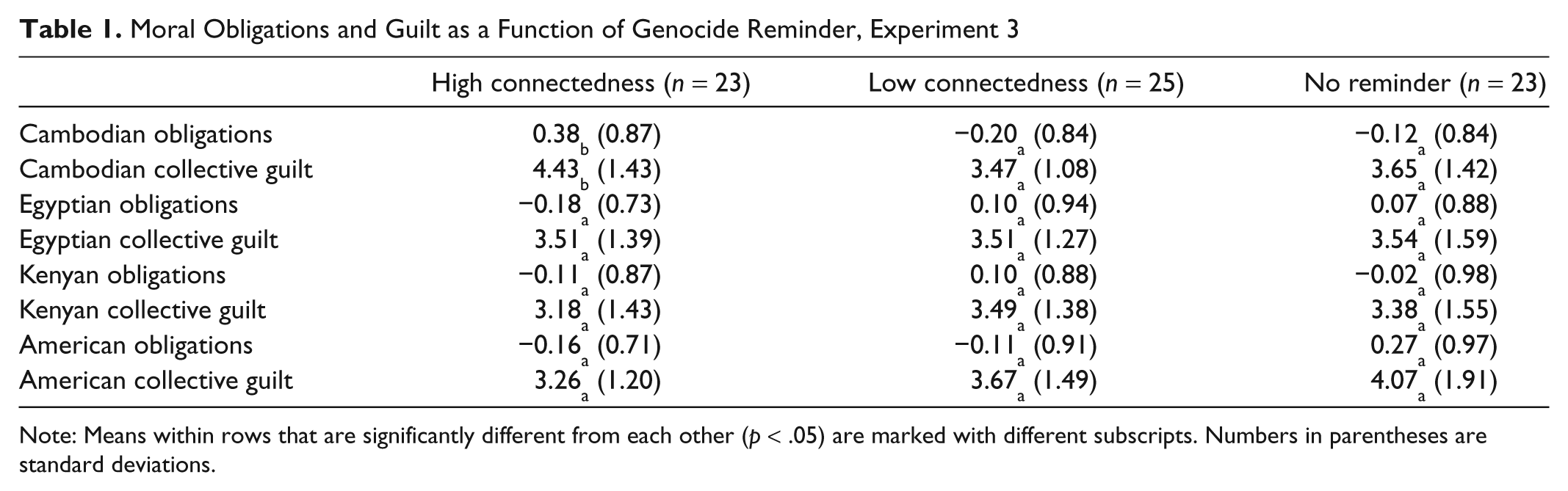
Note: Means within rows that are significantly different from each other (p < .05) are marked with different subscripts. Numbers in parentheses are standard deviations.
Participants viewed Cambodians as more obligated than Egyptians in the high-connectedness condition, F(1, 68) = 7.96, p < .01,
Participants viewed Cambodians as more obligated than Kenyans in the high-connectedness condition, F(1, 68) = 6.21, p < .025,
Participants viewed Cambodians as more obligated than Americans in the high-connectedness condition, F(1, 68) = 6.27, p < .025,
Collective guilt assignment
A 3 (Genocide reminder: High connectedness, low connectedness, or no reminder) × 4 (Country: Cambodia, Egypt, Kenya, or America) mixed-model ANOVA on collective guilt assignment indicated that the interaction between genocide reminder and country on collective guilt assignment was significant, F(6, 134) = 2.26, p < .05,
Participants assigned Cambodians more guilt than Egyptians in the high-connectedness condition, F(1, 68) = 8.13, p < .01,
Participants assigned Cambodians more guilt than Kenyans in the high-connectedness condition, F(1, 68) = 13.39, p < .001,
Participants assigned Cambodians more guilt than Americans in the high-connectedness condition, F(1, 68) = 10.56, p < .01,
Mediation analyses
We predicted that Cambodian obligations would mediate the effect of genocide reminder on collective guilt assignment to Cambodia. The low-connectedness and no-reminder conditions were combined for the mediation analysis. There was a significant effect of genocide reminder on collective guilt assignment to Cambodia, β = .30, t(70) = 2.66, p < .025, and Cambodian obligations, β = .29, t(70) = 2.62, p < .025, such that participants perceived Cambodians as more obligated and as more guiltworthy when there was a high connection to the past compared with a low connection to the past or no reminder. When genocide reminder and Cambodian obligations were entered into the equation simultaneously, Cambodian obligations significantly predicted collective guilt assignment, β = .65, t(70) = 7.07, p < .001, whereas the effect of genocide reminder on collective guilt assignment became nonsignificant, β = .11, t(70) = 1.21, p = .23. The indirect effect was significant as the 95% bias-corrected bootstrap CIs did not include zero [0.07, 0.52].
We demonstrated that incurring obligations is not an effect exclusive to Israelis. Participants also perceived Cambodians as more obligated to help the Sudanese and assigned them more collective guilt for not helping when they were portrayed as connected to their history of victimization compared with when they were not portrayed as connected and compared with a no reminder control condition. The pattern of the results obtained when the connectedness to history is manipulated is consistent with the results of Experiment 1 where the perceived connectedness of the descendants was measured.
We also demonstrated that the effects of incurring obligations, and guilt assignment as a result of failing in them, were limited to the group with a victimization history and not to other groups. Thus, contemporary group members alone incur obligations to help other victimized groups when they are perceived as connected to their group’s history of victimization.
Experiment 4
In Experiment 4, we wanted to replicate the effect of connectedness to history for Israelis that we found for Cambodians. We also wanted to show that contemporary group members would incur obligations when they were shown to be connected to their own group’s history of genocide and not just reminded of genocide in general. To do this, we manipulated the salience of the Holocaust and Cambodian genocide as well as the connectedness of contemporary Israelis and contemporary Cambodians to their history. The design of the study was 2 (Genocide reminder: Holocaust or Cambodian genocide) × 2 (Connectedness: High or low connectedness). We predicted that participants reminded of a group’s history of victimization—compared with those reminded of another genocide—would view that group as having greater obligations to help the Darfur refugees and would be assigned more collective guilt for not helping when they thought that contemporary group members were connected to their history compared with when they did not. We predicted that the proposed interaction between genocide reminder and connectedness on collective guilt assignment would be mediated by perceived obligations.
Method
Participants
Non-Jewish and non-Asian American undergraduates (19 men, 79 women; 2 unknown, M = 18.63 years) completed the study online.
Procedure
Participants were randomly assigned to read a short paragraph about the Holocaust or the Cambodian genocide. Then, participants were randomly assigned to read about how connected contemporary group members belonging to the same group they had read about were to their group’s historical victimization as described in Experiment 3. Next, all participants read the same description of the Darfur genocide used in Experiment 1.
Dependent measures
The dependent measures were the same as Experiments 1 and 3: Israelis’ obligation to help the Darfur refugees (α = .68), collective guilt assignment to Israelis if they did not help (α = .91), Cambodians’ obligations (α = .77), and collective guilt assignment to Cambodians (α = .92).
Results and Discussion
Obligations
A 2 (Genocide reminder: Holocaust or Cambodian genocide) × 2 (Connectedness: High or low connectedness) ANOVA on Israeli obligations indicated that the interaction between genocide reminder and connectedness on Israelis’ obligations was significant, F(1, 96) = 5.02, p < .05,
Moral Obligations and Guilt as a Function of Genocide Reminder and Descendents’ Connectedness to Group History, Experiment 4
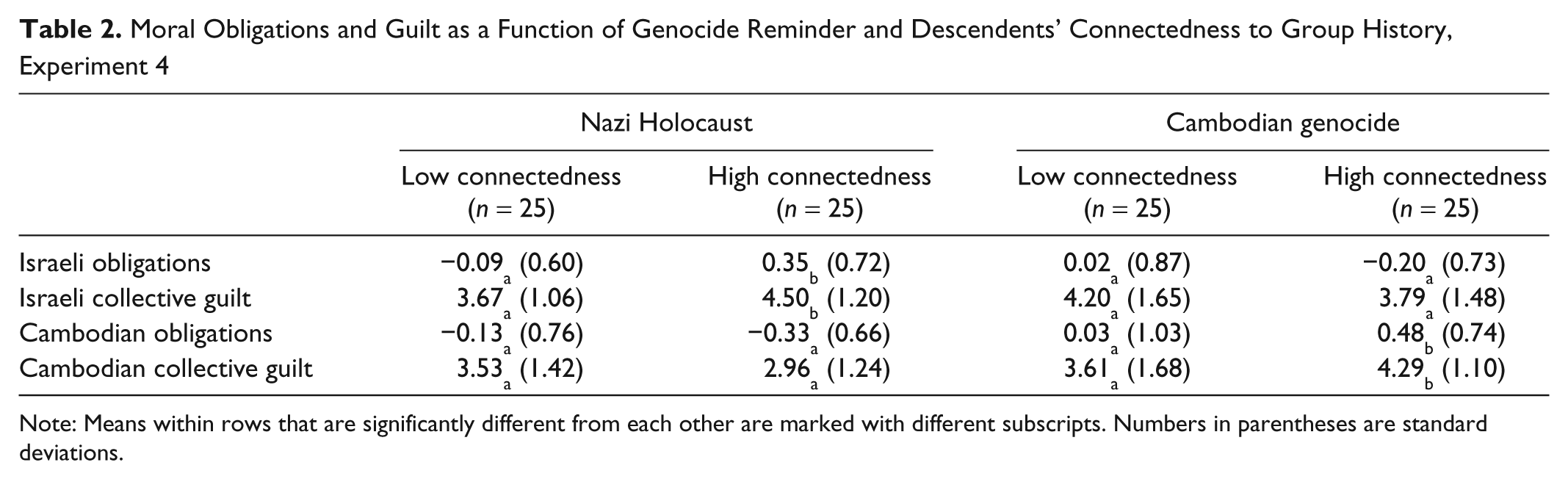
Note: Means within rows that are significantly different from each other are marked with different subscripts. Numbers in parentheses are standard deviations.
Participants viewed Israelis as having more obligations in the Holocaust and high-connectedness condition compared with the low-connectedness condition, F(1, 96) = 4.44, p < .05,
A 2 (Genocide reminder: Holocaust or Cambodian genocide) × 2 (Connectedness: High or low connectedness) ANOVA was conducted on Cambodian obligations. There was a significant main effect of genocide reminder, F(1, 96) = 9.00, p < .01,
Collective guilt assignment
A 2 (Genocide reminder: Holocaust or Cambodian genocide) × 2 (Connectedness: High or low connectedness) ANOVA conducted on collective guilt assignment to Israelis revealed a significant interaction between genocide reminder and connectedness on collective guilt assignment to Israelis, F(1, 96) = 5.12, p < .05,
A 2 (Genocide reminder: Holocaust or Cambodian genocide) × 2 (Connectedness: High or low connectedness) ANOVA conducted on collective guilt assignment to Cambodia revealed a significant main effect of genocide reminder, F(1, 96) = 6.55, p < .025,
Mediated moderation
We conducted two mediated moderation analyses as described in Experiment 1 (Version 2 from Preacher et al., 2007).
Israel
There was a significant interaction between genocide reminder and connectedness on collective guilt assignment, β = −.22, t(96) = −2.26, p < .05, as well as a significant interaction between genocide reminder and connectedness on Israeli obligations, β = −.22, t(96) = −2.24, p < .05, as described in the ANOVA analyses.
There was a significant effect of Israeli obligations on collective guilt assignment to Israel, β = .52, t(95) = 5.83, p < .001, and the interaction between genocide reminder and connectedness on collective guilt assignment became nonsignificant, β = −.11, t(95) = −1.26, p = .21. Israeli obligations is a significant mediator; its 95% bias-corrected bootstrap CIs did not contain zero [−1.04, −0.14].
Cambodia
There was a significant interaction between genocide reminder and connectedness on collective guilt assignment, β = .22, t(96) = −2.27, p < .05, as well as a significant interaction between genocide reminder and connectedness on Cambodian obligations, β = .19, t(96) = 2.02, p < .05, as described in the ANOVA analyses.
There was a significant effect of Cambodian obligations on collective guilt assignment to Cambodia, β = .73, t(95) = 10.25, p < .001, and the interaction between genocide reminder and connectedness on collective guilt assignment became nonsignificant, β = .08, t(95) = 1.14, p = .26. Cambodian obligations is a significant mediator; its 95% bias-corrected bootstrap CIs did not contain zero [0.48, 1.56].
Participants viewed Cambodians as more obligated and more guiltworthy when their victimization history was salient compared with when it was not, but the main effect was not significant for evaluations of Israelis. This may be because the Cambodian genocide is more novel and less significant for participants than the Holocaust (Liu et al., 2005), making the simple reminder of it more powerful. For both groups, there was a significant interaction between genocide reminder and connectedness on obligations and collective guilt assignment. Obligations mediated the interaction between genocide reminder and connectedness on collective guilt assignment for both Israel and Cambodia.
Experiment 5
We argue that one way to restore meaning after being reminded of significant injustice, such as genocide, is to view the victimized group as obligated to help other groups. In Experiment 5, we added a manipulation of just world threat to test whether reminders of injustice lead to increased perceived moral obligations to assist other victims and greater guilt for failing in those obligations. We reminded participants of the Cambodian genocide and predicted that Cambodians would be perceived as more obligated and assigned more guilt than Israelis under high threat compared with low threat.
Method
Participants
Non-Jewish and non-Asian American undergraduates (30 men, 24 women; M = 19.39 years) completed the study online.
Procedure
All participants were randomly assigned to read a short paragraph about the Cambodian genocide and how contemporary group members were highly connected to their group’s historical victimization as described in Experiment 3. Then, participants in the high-threat condition read that the perpetrators of the genocide were never punished. Participants in the low-threat condition read that the perpetrator leaders were tried and punished for their crimes (see van Prooijen & van den Bos, 2009, for a similar just world threat manipulation).
Dependent measures
The dependent measures were the same as in Experiment 4: Cambodians’ obligation to help the Darfur refugees (α = .91), collective guilt assignment to Cambodians if they did not help (α = .86), Israelis’ obligations (α = .89), and collective guilt assignment to Israelis (α = .90).
We also added a measure of perceived empathy of Cambodians (r = .82) and Israelis (r = .89) (e.g., “Cambodia should empathize with the Sudanese victims who are suffering” and “Cambodians should feel sympathy for the Sudanese victims who are suffering”). We predicted that participants would think Cambodians should be more empathetic than Israelis under high just world threat.
Results and Discussion
Three participants failed to remember whether the perpetrators were brought to justice or not and so were excluded from the analyses.
Obligations
A 2 (Justice threat: high or low) × 2 (Country: Cambodia or Israel) mixed-model ANOVA on obligations indicated that the interaction between threat and country, F(1, 49) = 5.78, p < .025,
Moral Obligations, Empathy, and Guilt as a Function of Just World Threat, Experiment 5
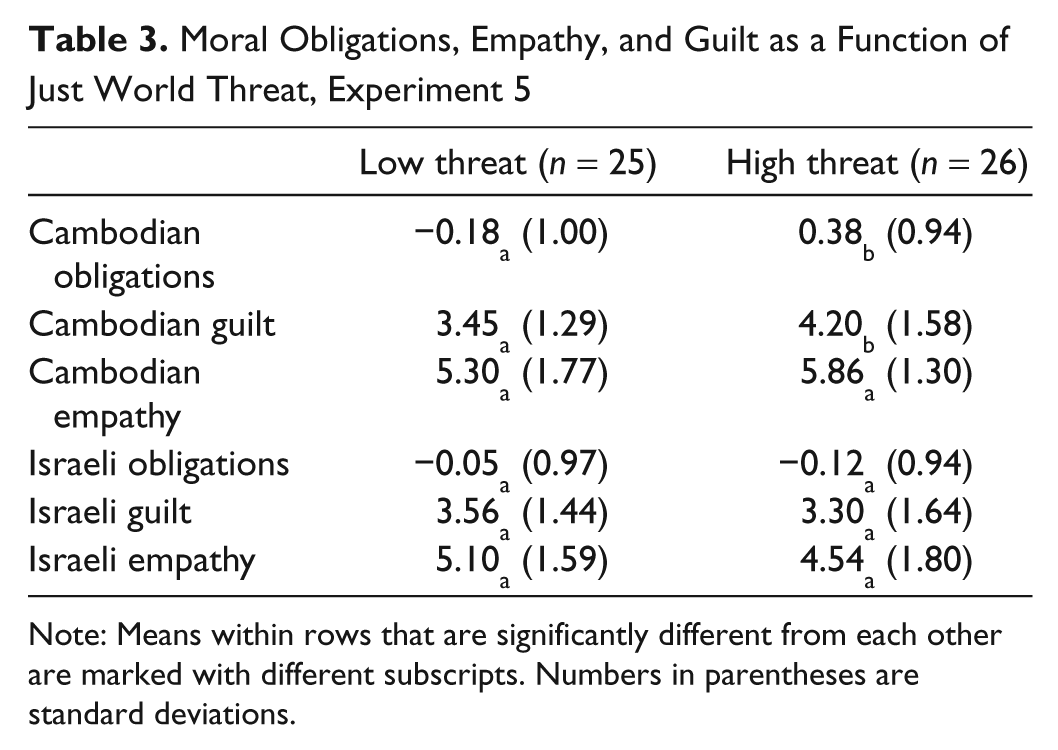
Note: Means within rows that are significantly different from each other are marked with different subscripts. Numbers in parentheses are standard deviations.
Participants viewed Cambodians as more obligated than Israelis in the high-threat condition, F(1, 49) = 7.33, p < .01,
Empathy
A 2 (Justice threat: high or low) × 2 (Country: Cambodia or Israel) mixed-model ANOVA on empathy indicated that the interaction between threat and country, F(1, 48) = 5.75, p < .025,
Participants perceived Cambodians as more empathetic than Israelis in the high-threat condition, F(1, 48) = 15.97, p < .01,
Collective guilt assignment
A 2 (Justice threat: high or low) × 2 (Country: Cambodia or Israel) mixed-model ANOVA on collective guilt assignment indicated that the interaction between threat and country on collective guilt assignment was significant, F(1, 45) = 6.61, p < .025,
Participants assigned Cambodians more guilt than Israelis in the high-threat condition, F(1, 45) = 11.38, p < .01,
Mediation analyses
We predicted that Cambodian obligations would mediate the effect of threat on collective guilt assignment to Cambodia. There was a significant effect of threat on collective guilt assignment to Cambodia, β = .29, t(50) = 2.11, p < .05, and Cambodian obligations, β = .28, t(50) = 2.06, p < .05, such that participants perceived Cambodians as having greater obligations and assigned them more guilt under high threat compared with low threat. When threat and Cambodian obligations were entered into the equation simultaneously, Cambodian obligations significantly predicted collective guilt assignment, β = .69, t(50) = 6.59, p < .001, whereas the effect of threat on collective guilt assignment became nonsignificant, β = .09, t(50) = 0.91, p = .37. The indirect effect was significant as the 95% bias-corrected bootstrap CIs did not include zero [0.03, 0.63].
When reminded of the Cambodian genocide, participants viewed contemporary Cambodians as more obligated, thought they should be more empathetic, and assigned them more guilt for failing to help compared with Israelis under high justice threat. Participants assigned Cambodians more guilt for failing to help under high threat compared with low threat to the extent that they viewed them as obligated to help. High justice threat did not increase the obligations of countries besides Cambodia to help the Sudanese; context is an important determinant of how meaning will be made of injustice (Hafer & Gosse, 2010).
General Discussion
Our goal in this research was to examine when observers perceive victimized groups as incurring obligations to help other victimized groups and the consequences of that perception. There has been little research on how observers view victims as becoming better and more prosocial when interpersonal injustice is salient, and even less research on this possibility for collective injustice (Hafer & Bégue, 2005). These experiments therefore make an important contribution to understanding both when and why people come to believe that victimized groups ought to treat other victimized groups more prosocially.
Reminders of victimization can threaten people’s belief that the world is just (Lerner, 1980). In order to restore justice, people can use multiple strategies, but research has mainly emphasized victim blaming (see Hafer & Bégue, 2005). However, believing that victims become kinder, more moral, and better as a result of their suffering is a strategy that can also be used to provide meaning to victimization (Anderson et al., 2010). Attempting to find meaning in victimization for a victim of interpersonal violence leads to the perception that the victim has obligations to help others (Warner & Branscombe, 2011). The current research provides the first evidence that people believe that members of victimized groups have obligations to help other victimized groups, even if they were not directly victimized. By perceiving that victims should help others, it provides meaning to and redeems negative events (McAdams, 2006; Warner & Branscombe, 2011). However, simply making a group’s victimization history salient does not result in increased perceived obligations for that victimized group. It is when people view current group members as connected to their past that current group members incur greater obligations to help other victimized groups. Precisely when the past is perceived as relevant and important, it is especially likely to be used to judge group members in the present (Ji et al., 2009; Sani et al., 2007).
The perceived uniqueness of a group’s victimization history affects how people judge the obligations of contemporary group members. When genocide is perceived as pervasive, less collective guilt is assigned by victimized group members to the perpetrator group (Wohl & Branscombe, 2005). We have shown that the perceived pervasiveness of genocide can also affect judgments of the victimized group and its actions—or lack thereof—in the present. Israelis are seen as having greater obligations to help others when their history of genocide is seen as unique compared with when it is seen as one of many instances of group-based victimization. We see this effect as consistent with other demonstrations of diffusion of responsibility undermining people’s willingness to help; when more people are present in a helping situation, it lowers the felt responsibility of any one witness to help (Darley & Latané, 1968). In a similar way, if people are reminded of many groups with a victimization history, then the responsibility of any one group to help other victimized groups is lessened.
Group members with a victimized past were readily assigned guilt if they did not help other victims when people perceived them as connected to their history. This is consistent with the idea that groups with a victimization history may be held to a more stringent moral standard than groups without a victimization history (Miron, Branscombe, & Biernat, 2010). Accordingly, we found that Cambodians were judged as more guiltworthy compared with other groups (Egyptians, Kenyans, and Americans) if they were portrayed as connected to their victimized past.
Observers Versus Victims and Perpetrators
The participants in these studies were uninvolved observers rather than members of the victimized or perpetrator group. Future research might examine how other observers might perceive the obligations of historically victimized groups, particularly those who are older and may have memories of the historical victimization events.
Victims
Previous research has demonstrated that when members of the victimized group are reminded of their own historical victimization, they feel less collective guilt for their harmful actions toward another group (Wohl & Branscombe, 2008). Individuals also feel more entitled to behave selfishly when they are reminded of injustice or victimization they have personally experienced (Zitek, Jordan, Monin, & Leach, 2010). But there is some evidence that victimization can lead to increased prosocial behavior among victims in certain cases (Updegraff, Taylor, Kemeny, & Wyatt, 2002). Whether members of a historically victimized group actually behave prosocially or not may depend on the group membership of the target who is in need (i.e., a group currently involved in a conflict with the ingroup or not) and whether they think the lesson of victimization is to be more empathetic toward other victimized groups or not (Lazar et al., 2004). In these experiments, we chose a target of helping (the Sudanese) that Israelis and Cambodians have no real connection to and still found that people perceived them as obligated to help this group.
Perpetrators
Germans exhibit increased anti-Semitism when they perceive Jews as continuing to suffer due to the Holocaust compared with when they do not perceive them as continuing to suffer (Imhoff & Banse, 2009). In the case of Germans though, victim derogation might arise not only because of just world threat but also because being reminded of how one’s group committed such harm threatens social identity and can arouse defensive processes related to maintaining a positive group identity (Branscombe, Ellemers, Spears, & Doosje, 1999). Perceiving Jews as obligated to help is also not the same as anti-Semitism and may be considered an alternative to victim derogation (Kay et al., 2005). Such obligations may be, in effect, a secondary form of victimization—but one that is considerably more subtle and influential primarily when the victimized group fails to live up to those obligations. Perceiving the victim as obligated to help does not lead to negative evaluations of victims all the time, again suggesting that it is different than victim derogation. If an individual victim fulfills their obligation to be more prosocial, then he or she is evaluated very positively (Warner & Branscombe, 2011). We would expect that victimized groups who help other victims would also be praised. Furthermore, we contend that obligations to help will not always be applied to victimized group members. It is when the group’s history of victimization is salient and people see a link between present-day group members and their past suffering that victimized group members will be perceived as obligated to help other victims.
Limitations and Future Directions
Our studies examined perceived obligations of groups with a history of genocide to help other genocide victims and observers’ willingness to assign guilt to descendents of victimized groups when they apparently do not help. Although we showed generalization across different groups with a history of genocide (Cambodians and Israelis), we expect that the same effects would be observed for groups with other types of victimization histories. For example, in the United States, many gay rights activists expressed disappointment when the majority of Black voters favored Proposition 8, California’s ban on gay marriage (Vick & Surdin, 2008). Gay rights activists believed that African Americans ought to empathize with the struggle for gay rights because of African Americans’ own victimization history. More research will be needed to determine whether the same process we identified does generalize to other intergroup contexts. One factor that is likely to affect whether groups incur obligations is the perceived severity of the victimization. Genocide is perhaps the most severe form of intergroup victimization, and the Holocaust in particular is judged as one of the most important events in world history (Liu et al., 2005). Severe victimization represents a substantial threat to just world beliefs, increasing the need to find meaning in the victimization (Lerner & Miller, 1978). Observers do see victims of severe interpersonal violence (e.g., sexual and physical abuse victims) as obligated to help others (Warner & Branscombe, 2011), but whether that applies to less severe forms of victimization awaits future research.
Another important question for future research is whether groups with a victimization history are perceived as obligated to help only groups that are suffering from the same kind of victimization or if the obligation incurred is more general. The discussion of Israelis’ obligations to the Sudanese has focused on the groups’ similarities—both having been victims of genocide (Peraino, 2006). However, if the lesson of a victimization history is for victimized group members to be more humanitarian and empathize with victims more broadly (see Lazar et al., 2004), then victimized group members may potentially incur obligations to help victims of every kind.
The perception that victimized groups are morally obligated to help other victimized groups is reflected in popular discourse and can have important implications for intergroup dynamics (Peraino, 2006; Vick & Surdin, 2008). In speaking about the genocide in the Darfur region of the Sudan, Nobel Peace Prize winner and Holocaust survivor Elie Wiesel (2004) said,
As a Jew who does not compare any event to the Holocaust, I feel concerned and challenged by the Sudanese tragedy. How can we reproach the indifference of non-Jews to Jewish suffering if we remain indifferent to another people’s plight? Should the Sudanese victims feel abandoned and neglected, it would be our fault—and perhaps our guilt.
Although Wiesel is reluctant to draw a comparison between the Holocaust and the present-day events in Darfur, he does argue that Jews ought to help the Darfur refugees because of their own history of victimization. Such beliefs in both members of victimized groups and observers can affect the expectations that people have of themselves and other groups when it comes to giving aid to those currently suffering. Those groups with a victimization history will sometimes be expected by their own members and observers alike to assist currently victimized groups even when they have no real relationship with them.
Conclusions
Historical events continue to affect group members in the present (Liu & Hilton, 2005; Wohl & Branscombe, 2008), and a history of victimization will prompt meaning-making processes in observers (Lerner, 1980). A victimization history can have multiple lessons or psychological meanings for those directly involved, as well as for uninvolved observers. One such lesson is that the victimized groups should learn to be more prosocial and help other victimized groups. On this basis, victimized groups can incur obligations to help others based on their history of victimization, especially if contemporary group members are perceived as linked to their past. When the victimized group fails to fulfill its perceived obligations, that group may be more readily condemned, which could be considered a secondary form of victimization.
Footnotes
Declaration of Conflicting Interests
The author(s) declared no potential conflicts of interest with respect to the research, authorship, and/or publication of this article.
Funding
The author(s) disclosed receipt of the following financial support for the research, authorship, and/or publication of this article: This research was facilitated by an award to the second author from the Canadian Institute for Advanced Research: Social Interactions, Identity, and Well-Being Program.