




Abstract
Culture has been shown to influence response styles. The authors conducted two studies to test the notion that African Americans would be more likely to respond to racism directly, whereas Asian Americans would be more likely to respond indirectly and therefore more subtly. Study 1 showed that Black women subjected to a racist comment from a confederate during an online interaction were more likely than Asian women to verbally reproach the perpetrator. These group differences were not present when the outcome measure was indirect responding—administration of good/bad jellybeans. Study 2 used an online format to demonstrate that Asian women were more likely than Black women to say they would not respond directly to a racist comment. This group difference in unwillingness to confront was significantly mediated by a goal of maintaining peace with their interaction partner. Implications of these findings for the study of discrimination, coping, and well-being are discussed.
Targets of racism and racial discrimination experience their stigmatization as a source of everyday stress, the experience of which is associated with a myriad of negative outcomes, including poor physical and mental health (Clark, Anderson, Clark, & Williams, 1999; Harrell, 2000; Klonoff & Landrine, 1995; Lee, 2003; Soto, Dawson-Andoh, & BeLue, 2011; Sue et al., 2007; Williams, Neighbors, & Jackson, 2008). The relationship between racism and health is believed by many researchers to be a primary contributor to the growing health disparities in the United States between European Americans and ethnic minority groups, especially Black Americans (Clark et al., 1999; Hunter & Schmidt, 2010; Sellers & Shelton, 2003). In recent years, it has become increasingly apparent that an important moderator of this relationship is how individuals respond to or cope with experiences of racism (Brondolo, ver Halen, Pencille, Beatty, & Contrada, 2009; Mays, Cochran, & Barnes, 2007; West, Donovan, & Roemer, 2010). Although the empirical research in this area is still emerging, one of the glaring omissions in the literature is direct comparisons between members of different cultural or ethnic groups in their responses to racism. The goal of the current article is to compare Black and Asian women in their responses to everyday racism and their goals in interacting with perpetrators of racism. Understanding these goals can ultimately help guide possible interventions for the successful navigation of this pervasive social stressor among individuals of varied cultures.
In this article, we bring together disparate literatures on cultural differences in conflict styles, emotional expressivity, communication, and racial socialization that lead to differential predictions about the behavior of Black and Asian women in response to everyday racism or microaggressions, including routine encounters with another’s prejudice as well as discriminatory behavior that pervade daily social interactions (Essed, 1991; Feagin & Sikes, 1994; Sue, 2010; Sue, Bucceri, Lin, Nadal, & Torino, 2009; Swim, Hyers, Cohen, Fitzgerald, & Bylsma, 2003). Specifically, we predict that Black women may respond to a racist perpetrator more directly and vocally than Asian women, who might respond via indirect and subtle actions. To test this notion initially, we used an experimental paradigm across two studies that improved on prior studies by allowing for (a) direct comparison of two minority cultural groups in their response to discrimination (Asian and Black participants), (b) an exclusive focus on the women in these cultural groups based on their being uniquely, socially positioned to exemplify norms in the two cultural groups examined, (c) in-vivo exposure to racial discrimination and measurement of real-time responses instead of retrospective reports of discrimination and coping, (d) inclusion of measures of direct and indirect responding and (e) the provision of an indirect response option that allowed for both the delivery of something aversive or the withholding of something rewarding, and (f) the documentation of mediating mechanisms to shed further light on cultural differences in response to racism. The unique combination of all these elements within a program of studies provides for much greater depth in understanding the different factors affecting these women’s response to racism.
Direct Responding to Racism
A number of researchers have posited mechanisms for understanding the response behavior of targets of prejudice (Czopp & Monteith, 2003; Kaiser & Miller, 2001; Smith, Allen, & Danley, 2007; Stangor et al., 2003; Swim & Hyers, 1999). In this regard, the response most frequently examined is the extent to which targets confront or express their displeasure, disapproval, or anger toward the perpetrator. Often, the targets of racial discrimination retrospectively report wishing they had said something or at least said more than they did (Feagin & Sikes, 1994; Swim, Eyssell, Murdoch, & Ferguson, 2010). Czopp and Monteith (2003) review compelling evidence for why such sentiments might exist, citing a number of individual and societal benefits resulting from confronting instances of racism. Yet, the reasons why they do not fully express themselves are also evident. There may be disadvantages to overtly expressing one’s displeasure to a perpetrator such as fear of further stigmatization or labeling, danger of confirming stereotypes, and disruption of interpersonal relationships. Past research has approached the study of these issues by either collapsing across ethnic minority groups to compare them with White majority groups (e.g., Lott, Asquith, & Doyon, 2001) or by examining one specific ethnic group in isolation (Alvarez & Juang, 2010). However, the relative advantages and disadvantages for directly confronting a racist perpetrator may vary meaningfully across different ethnic groups making it necessary to examine multiple groups at the same time.
Two groups that appear to represent opposite ends of the continuum in terms of their likelihood to engage in direct confrontation of racism are Asian and Black women. On one end of the spectrum, Asian culture places less emphasis on the use of assertiveness in interpersonal situations (Gudykunst, Matsumoto, Ting-Toomey, & Nishida, 1996) potentially because they place greater import on the social goal of promoting interpersonal harmony (Markus & Kitayama, 1991). Consistent with this goal, Asians advocate being polite instead of being forceful, and those Asians who preferred a reticent communication style attributed their preference to cultural norms such as prioritizing group needs over their own, avoiding confrontation, and showing respect to others (Yew, 2002). Furthermore, Asians report handling conflict either by avoiding the topic, person, or situation tied to the conflict or by accommodating another person’s interests over one’s own (Ting-Toomey, 2005; Ting-Toomey et al., 2000). Such work has also been extended to the context of discrimination, which shows that although Asian Americans perceive discrimination directed at their in-group, they also report that they have been socialized to accept their “invisibility” quietly (Sun & Starosta, 2006).
This preference for avoidance or accommodation strategies in Asian culture is consistent with literature on self-silencing among women. Self-silencing is defined as the tendency to suppress thoughts, feelings, or actions that do not conform to expectations in a relationship (Jack & Dill, 1992). Previous research has found that Asians are more likely than Whites or Blacks to endorse self-silencing beliefs (Gratch, Bassett, & Attra, 1995). Self-silencing has also been associated with less confronting of sexism (Swim et al., 2010) suggesting that we might expect less confronting of racism among Asians than Blacks. Interestingly, these culturally driven response styles may be magnified among Asian women relative to Asian men; Asian women may feel additional pressure to conform to stereotypes of being quiet, nonthreatening and compliant (Niemann, Jennings, Rozelle, Baxter, & Sullivan, 1994; Root, 1995). Thus, a heightened sensitivity for the concerns and feelings of others in interpersonal situations might lead Asian women to avoid direct confrontation in instances of racism.
At the other end of the spectrum, aspects of Black culture suggest that Black women may be particularly motivated to engage in direct confrontation of racism. First, research on emotional expressiveness has shown that Black individuals endorsed expressing anger more frequently than Asian and White individuals (Matsumoto, 1993). Locke (1992) explains that emotional assertiveness in Black culture results from experiences that have taught Blacks that they must know how to assert themselves due to a threatening environment. On a related note, because the threat of social injustice and racial strife in American Black–White relations have long been a part of the Black experience, confronting racism may be an explicit part of Black cultural heritage and socialization. Indeed, Black families engage in discussions of prejudice—including lessons on how to prepare for such bias—at a greater rate than families from White or other ethnic minority backgrounds (Hughes et al., 2006). This early preparation may prepare Black individuals to directly confront such inequity when they encounter it.
In addition to the individual motivation to respond directly to racism, a cultural norm of promoting the welfare of Black Americans as a group may compel Black individuals to additionally see confronting racism as a social responsibility (Beauboeuf-Lafontant, 2003). This sense of social responsibility may be magnified among Black women who are perceived as models of strength and resilience (Settles, Pratt-Hyatt, & Buchanan, 2008). The image of the “strong Black woman,” for example, describes Black women as particularly self-reliant, invulnerable, and independent (Robinson, 1983; Romero, 2000). Thus, the intersection between race and gender is particularly interesting for Black women because it counters a potential expectation that women, consistent with traditional gender role norms, will be more likely to self-silence than men. In sum, the above-mentioned literature suggests that Black women may be more likely to directly respond to a racist comment than Asian women.
Indirect Responding to Racism
Conveying a message of disapproval or displeasure in the face of racism may also take a less direct tack. As noted previously, many Asian cultures discourage engaging in conflict and show a preference for methods of intervening in conflict, which avoid interpersonal clashes or possible disruptions to group harmony (Ting-Toomey et al., 2000; Yum, 1999). One method to accomplish both sets of goals is to engage in high-context communication. High-context communication refers to relaying a message to others using such strategies as indirect verbal communication (e.g., “Are you cold?” vs. “Please shut the window”), inferring meaning from context (e.g., understanding that being sat at the “kids table” during Thanksgiving may be a form of reprimand), and using silence as a meaningful form of communication. High-context communication prioritizes politeness and requires that a sender’s meaning be inferred from context rather than from the literal message conveyed, thus relying heavily on the powers of inference of the receiver. Not surprisingly, high-context and indirect communication is highly prevalent in many Asian countries and is more commonly seen among individuals of Asian descent when compared with Whites (Gudykunst et al., 1996; Hall, 1999; Holtgraves, 1997; Katriel, 1986, Park & Kim, 2008). For example, in response to a racist comment, someone using high-context communication might state a reason to end the conversation early or refuse to make eye-contact afterward. Given these findings, we anticipated that Asians would be less hesitant to respond indirectly to a racist incident and that this increased tendency would attenuate the differences seen in direct confronting between Asian and Black women, who may simply see indirect responding as another avenue for communicating their disapproval.
Perceptions of Racism and Responding
Some theories about what motivates individuals to confront an offensive or racist incident suggest an alternative approach to understanding possible cultural differences (Ashburn-Nardo, Morris, & Goodwin, 2008; Dion, 2002). These theories discuss confronting behavior as driven by the extent to which the racist event is perceived to be offensive or racist. This raises a competing hypothesis that Black and Asian women may respond differently to the same racist incident because their perception of how racist an event is may differ. However, this hypothesis only makes sense if there are not culturally imposed restrictions on how one should respond in these situations. The literatures reviewed above suggest that for members of Asian culture, directly challenging or confronting a racist perpetrator is inconsistent with culturally normative practices or traditions about how to interact with others (Gudykunst et al., 1996; Markus & Kitayama, 1991; Ting-Toomey et al., 2000; Yum, 1999). Therefore, the more racist a perpetrator is judged to be by Asian women may have no bearing on whether they directly respond to that perpetrator. Among Black women, however, the acceptability of direct confrontation suggests that their perceptions of how racist a perpetrator is might predict the extent of confrontation. Because indirect responding would be an acceptable form of responding among both groups, we anticipated that the extent to which a perpetrator was perceived to be racist would predict both Asian and Black women’s indirect responding.
Two studies are presented that examined group differences in responding to a racist perpetrator, as well as possible mediators of the expected group differences. The first study examined direct and indirect responses within a lab context where participants interacted with a racist perpetrator. The second study examined self-report ratings in response to an imagined racist scenario to test whether various interaction goals (e.g., educate perpetrator or avoid conflict) may mediate cultural differences in participants’ responses.
Study 1
Study 1 compared Asian and Black women’s responses to racist comments made by a White male confederate during an instant messaging interaction regarding interracial dating. Only women were included because the empirical literature reviewed suggested that the women in these cultures may best exemplify the cultural response styles that led us to expect differences among these two cultural groups (Niemann et al., 1994; Robinson, 1983; Romero, 2000; Root, 1995). We examined the response to the racist comments in two manners: (a) the extent to which the written/typed responses of the participants addressed the racist comment directly in any way, and (b) the extent to which participants distributed good and bad-tasting jellybeans to the perpetrator in a seemingly unrelated taste testing study. In this second part of the study, indirect responding was operationalized as either giving fewer good jellybeans or giving more bad jellybeans. In addition, we also sought to examine the extent to which direct and indirect responding were related to perceptions of the perpetrator as racist.
The extant literature led us to four hypotheses.
Hypothesis 1: First, we expected Black women to respond more directly to the racist comment than Asian women.
Hypothesis 2: Second, we expected these differences to be attenuated or eliminated when we assess indirect responding given that both groups would likely see indirect responding as viable response options.
Hypothesis 3: Third, we predicted that perceptions of how racist the perpetrator was judged to be would predict the responses of Black women and not Asian women on a measure of direct responding.
Hypothesis 4: However, this relation would be found for both groups when considering the indirect responding measure.
Method
Participants
Participants were 34 Asian and 36 Black female undergraduate students enrolled at a large public university. Participants received course credit for an introductory psychology course in exchange for completing the study. Mean age was 18.9 years (range 18-25 years) with most students in their first year (55.7%) or second year (27.1%) of college. Among Asian participants, nearly half reported being born outside of the United States (47.1%); most were of East Asian descent; one was of South Asian descent. Among Black participants, a much lower percentage reported being born outside of the United States (13.9%). 1 Two participants expressed suspicion about whether they interacted with a confederate, and therefore their data were excluded from the final analyses. An additional participant was excluded because her data indicated that her response was an outlier. Participants were recruited for what was described as two separate studies: The first was a computer-mediated communication task, and the second was a taste test for the hotel and restaurant management department.
Procedures
For the direct responding task, participants were told they would participate in an online conversation with another student on the broad topic of “friendships, dating, and social life” using a computer program that allows users in different locations to type messages to each other in real time over the Internet. Immediately before the interaction, participants filled out a “profile sheet” asking for their first name, age, gender, race, major, political affiliation, and religiosity. 2 The participant then exchanged profile information with their interaction partner (confederate), ostensibly to give them an initial impression of each other. In reality, experimenters presented the participant with a prefilled profile sheet depicting their conversation partner as “Donald, 19 years of age, male, White, undecided major, moderately conservative, and moderately religious.” This specific profile was chosen for our confederate perpetrator because studies have documented that White males are the prototypical perpetrator of prejudice (Inman & Baron, 1996) and that conservatism and religiosity are associated with a greater likelihood to endorse prejudiced attitudes (Haslam & Levy, 2006; Sears & Henry, 2003). Thus, participants had some suggestion that the behavior of the confederate could have been based on stable prejudiced beliefs rather than on fleeting contextual reasons.
Confederates were trained to conduct a scripted conversation with participants that contained questions and answers reflective of a typical college student. The conversation lasted approximately 10 min with the confederate making an offensive remark approximately halfway through the conversation. A total of 42 participants were randomly assigned to receive a racist comment (“Don’t get me wrong, but dating Blacks/Asians is painful. Dating Blacks/Asians is for tools who let Blacks/Asians control them.”). The remaining 27 participants received a rude comment (“Don’t get me wrong, but dating women is painful. Dating women is for tools who let emotions control them.”). The rude comment was included to help differentiate responses for dealing with racial discrimination (racist condition) from responses for dealing with generally offensive comments (rude condition). Racist and rude comments were developed via an independent pilot study that asked participants to rate how racist, sexist and offensive the comments were using a 0 to 3 scale (0 = not at all, 1 = a little bit, 2 = somewhat, and 3 = very much). Nonparametric tests comparing these mean ratings confirmed that the racist comment was perceived as more racist than the rude comment (M = 3.0 vs. M = 0.0 at p < .001) and more offensive than the rude comment (M = 3.0 vs. M = 1.2 at p < .001). Although the rude comment was rated as more sexist than the racist comment (M = 1.0 vs. M = 0.1 at p < .05), the fact that it was rated as equally offensive as it was sexist suggested that the rude comment was not perceived as a clearly sexist manipulation in the way that the racist comment was clearly seen as a racist comment.
After making the offensive comment, the confederate waited approximately 30 s for the participant to respond before typing another message. Regardless of the participant’s reaction, the confederate moved the conversation along according to the script and did not remark further about the offensive comment. Immediately after the interaction, participants completed a measure of their perceptions of the comment and the confederate.
Indirect responding
On the conclusion of the online interaction task, a different research assistant told participants that they were randomly chosen to be the “experimenter” in Task 2, leaving the confederate from Task 1 to be the “taste tester.” As the experimenter, participants got to select which of variously flavored jellybeans they wanted to have the confederate taste. To this end, a large box with clearly labeled individual compartments for different flavored jellybeans was provided to participants with options, including good flavors (e.g., cherry, grape, lime) and bad flavors (e.g., earwax, dirt, vomit). All jellybeans were purchased from the same company, Jellybelly™, which manufactures a wide variety of novelty candies, including Bertie Botts Every Flavour Beans™, and hence the jellybeans were labeled according to their actual flavors. Participants were given 5 min in private to put their selections in an opaque container with full knowledge that they would have no further interaction with the confederate. This ended the study and participants were promptly debriefed afterward.
Measures
Perceptions of racism
Participants rated how racist they perceived the confederate’s comment to be and how racist they perceived the confederate to be using two 5-point Likert-type scales (1 = not at all, 2 = a little, 3 = somewhat, 4 = probably, and 5 = definitely). Ratings of the comment and person were highly correlated (r = .91, p < .001), and subsequent findings were identical for each set of ratings so we averaged these into one rating that represented the extent to which they experienced the perpetrator and his behavior as racist. Questions about how sexist, ageist, or heterosexist the participants perceived the comment and confederate to be were also included to hide the purpose of the study. 3 Participants were assured that their responses would not be shared with the interaction partner.
Direct responding
Conversation transcripts were coded by undergraduate research assistants for how directly confrontational each participant’s response was to the offensive comment. First, research assistants read the transcripts to compare the range of actual behaviors. The direct confronting coding scheme included a range of behaviors, consistent with the actual responses observed. An independent pilot study asking participants to rank order the five categories confirmed the ordering of these five responses from least to most directly confrontational:
1 = did not confront or notice comment, did not find comment offensive, or laughed
2 = gives advice to the partner about dating
3 = asks a question to the partner about the comment
4 = asserts a contrasting opinion or attempts to educate the partner
5 = accuses partner of being offensive or expresses partner is wrong in some way
Research assistants were trained by reviewing example transcripts that had been coded along the various points on the confronting continuum. In total, eight research assistants coded portions of the transcripts with half of their transcripts overlapping with the transcripts coded by someone else to compute interrater reliability (intraclass correlation coefficient = .88). The few transcripts that had conflicting coding scores across coders were flagged and discussed among the research assistants and the first author until consensus was reached. Last, in the case of transcripts where participants engaged in multiple responses over the course of the interaction (e.g., give advice, then assert a contrasting opinion), research assistants were instructed to code that participant’s response according to the most direct behavior engaged in.
Indirect responding
After participants made their selection of jellybeans for the confederate to “taste test,” a research assistant removed the opaque container from the room. The contents of the container were then analyzed to provide the following counts: (a) the total number of jellybeans given, (b) the total number of good flavored jellybeans given, and (c) the total number of bad flavored jellybeans given. The latter two amounts served as our measure of indirect responding and allowed differentiation between expressing disapproval toward the confederate by either the withholding of a positive outcome (i.e., fewer good jellybeans) or the administration of negative outcomes (i.e., greater bad jellybeans).
Results
Manipulation check
To ensure that participants experienced the comments made by the perpetrator as intended, we analyzed participant perceptions of racism using a 2 (Race: Black or Asian) × 2 (Comment type: Racist or Rude) ANOVA. Results yielded a main effect of comment type, F(1, 64) = 58.68, p < .001,
Direct responding
We compared Black and Asian women on our measure of direct responding using a 2 (Race) × 2 (Comment type) ANOVA. A significant Race ×Comment type interaction emerged, F(1, 65) = 5.48, p < .05,
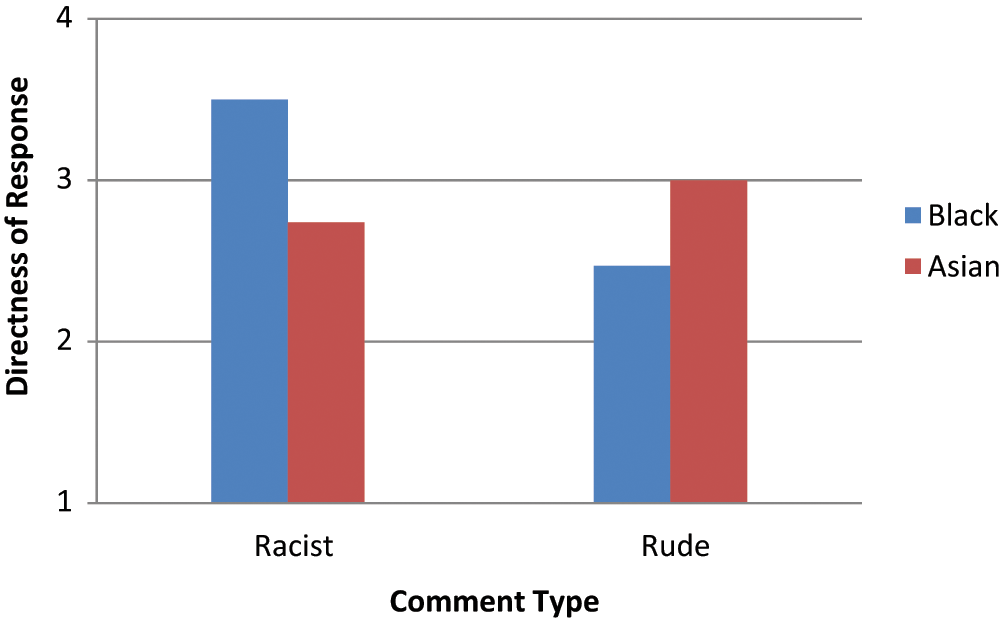
Mean level of Black and Asian women’s direct responding behavior of racist and rude comments (Study 1)
Indirect responding
Next, we compared Asian and Black women on indirect responding. We used two separate ANOVAs to examine the number of good jellybeans and bad jellybeans given to the confederate by participants. Participants gave fewer good jellybeans to the confederate in the racist condition (M = 7.20, SD = 6.76) than the rude condition (M = 11.19, SD = 10.52), F(1, 66) = 4.01, p < .05,
Perceptions of racism and responding
We tested whether racist perceptions were differentially related to direct and indirect responses by first regressing direct responding on target race, perceptions of racism, and the two-way interaction term. Main effects of race (β = .48, t = 2.14, p < .05) and perceptions of racism (β = .42, t = 2.74, p < .01) were significant, but subsumed by the significant two-way interaction (β = −.70, t = −2.92, p < .01). Follow-up correlations split by race indicated that the more racist the condition was judged to be by Black women, the more directly they confronted r(33) = .46, p < .01 For Asians, there was no significant association between perceptions of racism and direct confronting, r(34) = −0.25, ns. In support of Hypothesis 3, these results, along with the lack of group differences in racist attributions, suggest that Black women were more likely than Asian women to act on their internal reactions to the perpetrator.
We tested this same relationship for the indirect responding by regressing the number of good jellybeans on race, perceptions of racism, and the two-way interaction. A marginally significant main effect of perceptions of racism emerged such that participants were less likely to give good jellybeans the more they perceived the confederate as racist (β = −.31, t = −1.94, p = .06). Next, we regressed the number of bad jellybeans on race, perceptions of racism, and the two-way interaction. A marginal main effect of perceptions of racism emerged such that participants were more likely to give bad jellybeans the more racist they perceived the confederate (β = .30, t = 1.92, p = .06). Importantly, however, there were no effects of race or the two-way interaction in either analysis, consistent with Hypothesis 4 in which we expected Black and Asian women to respond more indirectly as they perceived the perpetrator and his behavior to be racist.
Discussion
In support of Hypothesis 1, Black women were more likely than Asian women to directly confront the racist comments made by a perpetrator. Also as expected, results from the “taste test” portion of the study showed no significant differences between Asians and Blacks in indirect responding (the amount of good and bad jellybeans given to the racist confederate), consistent with Hypothesis 2 that predicted similar levels of indirect responding. Although we cannot prove a null hypothesis, these results are such that Hypothesis 2 cannot be rejected. Thus, the group difference in direct responding was absent when indirect responding was considered as the outcome variable, suggesting that Asian women may have been more apt to express their discontent in a more indirect and subtle manner. For Black women, the indirect responding may have been viewed simply as an additional form of confronting.
In support of Hypothesis 3, Black women exhibited more direct confronting the more they perceived the condition to be more racist, whereas this relationship was not present for Asian women. That race moderated the link between perceptions of the condition and direct confronting behavior provides indirect evidence of the contrasting norms governing the behavior of these two groups of minority women. Black women may feel free to allow their perceptions of the perpetrator to guide the directness of their response. Asian women, on the other hand, may have been suppressing their offended reactions (anger, frustration, etc.), which is again consistent with cultural norms of emotional restraint (Matsumoto, 1993). Further supporting this notion is the finding that perceiving the perpetrator and his actions as racist marginally predicted the responding in both groups when the response was more indirect (partially supporting Hypothesis 4) and thereby a culturally acceptable strategy for both groups.
Interestingly, although we expected the indirect responding to occur in the form of giving greater bad-tasting jellybeans to the interaction partner, there was little occurrence of this behavior in general. Instead, the indirect responding seemed to be largely captured by the amount of good jellybeans that were given. This pattern of behavior may reflect a higher threshold about what types of behavior are considered offensive among women (Schumann & Ross, 2010). For the women in study, the act of not giving good jellybeans may have been a sufficiently strong indication of their reaction without needing to give bad jellybeans. Anecdotal evidence for this notion came during the debriefing when some participants mentioned their reluctance to give such awful tasting jellybeans without including at least some good jellybeans. These findings also reinforce the use of the jellybean allocation paradigm which specifically aimed to improve on the hot sauce allocation paradigm (Lieberman, Solomon, Greenberg, & McGregor, 1999) given criticisms that the latter did not allow participants to give good food to their interaction partner, just different amounts of bad food (Ritter & Eslea, 2005).
In sum, the behavior of our Black and Asian participants was in line with the prescriptions of their respective cultures based on research on conflict styles, emotional expressivity, communication and socialization (Carney, 2003; Ting-Toomey et al., 2000). Thus, the pattern of responses observed in our measures of direct and indirect responding situation appeared to reflect behavior that has been long valued as a part of the cultural traditions of Asian and Black women.
Study 2
The results of Study 1 demonstrate that the behavior of Black and Asian women in response to discrimination is consistent with some of the cultural norms of these groups. In particular, we expected that for Asians, the collectivistic focus on interpersonal harmony and subservience of individual goals to the goals of the collective would make direct confrontation undesirable (Markus & Kitayama, 1991). For Black women, we expected that a greater socialization among African Americans’ culture to confront racism, both by immediate family and by the African American community (Carney, 2003; The African American Registry, 2005), would make direct confrontation a favorable option. As of yet, an unanswered question is whether these cultural values and beliefs are, in fact, the driving force behind the group differences seen in Study 1. In reality, the findings from Study 1 may have been mediated by both of these forces acting in concert to push the groups apart, one of these factors, or other factors unrelated to these posited values and beliefs. Thus, Study 2 tested whether culturally consistent values and beliefs mediated group differences in verbal responses.
To test for mediation in Study 2, we used an online study procedure whereby participants were asked to imagine the scenario used in Study 1 (racist comment made to them by a White male) so that we could “slow down” the interaction to look at possible mediating variables that would be activated after the comment, but before the response. This was accomplished by asking participants to report on their expected goals for the interaction before indicating how directly they would respond. We hypothesized that Black women would be more likely than Asian women to endorse interaction goals consistent with the importance of fighting injustice (Hypothesis 5), and that Asian women would be more likely to endorse goals consistent with maintaining interpersonal harmony (Hypothesis 6). We hypothesized that these interaction goals would mediate the expected relation between participant race and verbal responding to the racist comment (Hypothesis 7).
Method
Participants
Participants were self-identified Asian (n = 23) and Black (n = 16) female undergraduate students enrolled at a satellite campus of a large public university. Students who self-identified as biracial and Black participants who self-identified their race/ethnicity as West Indian rather than Black/African American were excluded from the study because they may receive different and possibly conflicting cultural messages. Mean age was 20.2 years (range 18-32 years) with most students in their first year (59.5%) or second year (24.3%) of college. Among Asian participants, 65.2% reported being born outside of the United States, with most being of East or Southeast Asian descent. Among Black participants, a much lower percentage reported being born outside of the United States (6.3%). Participants received course credit for an introductory psychology course in exchange for completing the study.
Procedures
Eligible participants were invited to participate in a study of communication and personality and were provided a link to a survey hosted on Psychdata©. Participants first answered a series of questions (collected from various preexisting measures) that asked about the extent to which they endorsed attitudes and beliefs consistent with the cultural norms believed to play a role in differential responding to discrimination. 4 These included questions about conflict management styles (Rahim, 1983); social activism in response to racial injustice (O’Neil, Egan, Owen, & Murry, 1993); interpersonal communication (e.g., preferences for contentious, indirect, or nonverbal expressiveness; Gudykunst, 2001); and socialization around issues of racism and multiculturalism (Hughes et al., 2006). Because our primary interest was in the direct mediation of confronting via interaction goals, these measures are not discussed further. Immediately after these questions all participants received the following prompt:
Imagine that you are in a psychology study where you are asked to chat for about 10 minutes using Instant Messenger with a stranger about the topic “friendships, dating, and social life in college.” You do not get to meet the interaction partner at all during the experiment, but you do exchange profile information. He reveals that his name is Donald, is White, 18 years old, and has not decided his major. At some point during the conversation, he makes the following comment: “Don’t get me wrong, but dating Black women [the word Black was replaced throughout with Asian for Asian participants] is painful. Dating Black women is for tools who let Blacks control them.” Please keep this scenario in mind when answering the next set of questions.
Afterward, participants indicated how racist they believed the comment to be on a 1 to 4 scale (1 = not at all to 4 = definitely). Then participants were given the following instructions:
In this situation, some people think about responding to the comment while other people think about not responding to the comment. Below are reasons people have provided for their selection of how they would respond. When thinking about this situation, please indicate the extent to which you would have the following goals using the scale:
Participants then rated eight statements on a scale from 1 to 4 (1 = not at all to 4 = definitely) that indicated the extent to which they hoped their response to the perpetrator/interaction partner would (a) discourage future comments by their partner, (b) educate their partner, (c) demonstrate that they did not accept the comment, (d) express their thoughts and feelings in response to the comment, (e) show their partner they do not tolerate such a comment, (f) show their partner that they would not let them get away with such a comment, (g) keep the peace, and (h) avoid causing bad feelings or conflict. These goals were partially derived from Hyers (2007) daily diary research examining self-reported goals when deciding whether to confront everyday discrimination. Last, after rating the interaction goals, participants rated how likely they would be to engage in each of the five direct responding options outlined in Study 1 (no response/ignore/laugh; give advice; ask a question; assert a different opinion; and accuse partner of being offensive or wrong) by rating them on a scale from 1 (not likely) to 5 (most likely). Participants were given this ability to separately rate the five responding options given that it was noted by transcript coders in Study 1 that participants often engaged in multiple responses over the course of their interaction. We then combined the ratings for the first two options (not respond and give advice) into a less direct responding option and combined the ratings for the other options (ask a question, assert a different opinion, and accuse partner of being offensive or wrong) into a more direct responding option.
Results
Manipulation check
A one-way ANOVA of the racist ratings confirmed that Black women and Asian women perceived the comment as equally racist (M = 3.31 and 3.04, respectively), F(1, 37) = .69, ns. These ratings were on par with the perceptions of racism made in Study 1, suggesting that the use of an online-imagined procedure did not substantially alter the offensiveness of the racist comment.
Responding
To test for race differences in responding, we conducted a repeated-measures ANOVA with Race (Black/Asian) as a between-subjects factor and Response Type (less direct/more direct) as a within-subject factor. Participants were more likely to report responding more directly (M = 3.75, SD = .72) than they were to respond less directly (M = 2.32, SD = 1.11), F(1, 37) = 41.51, p < .001,
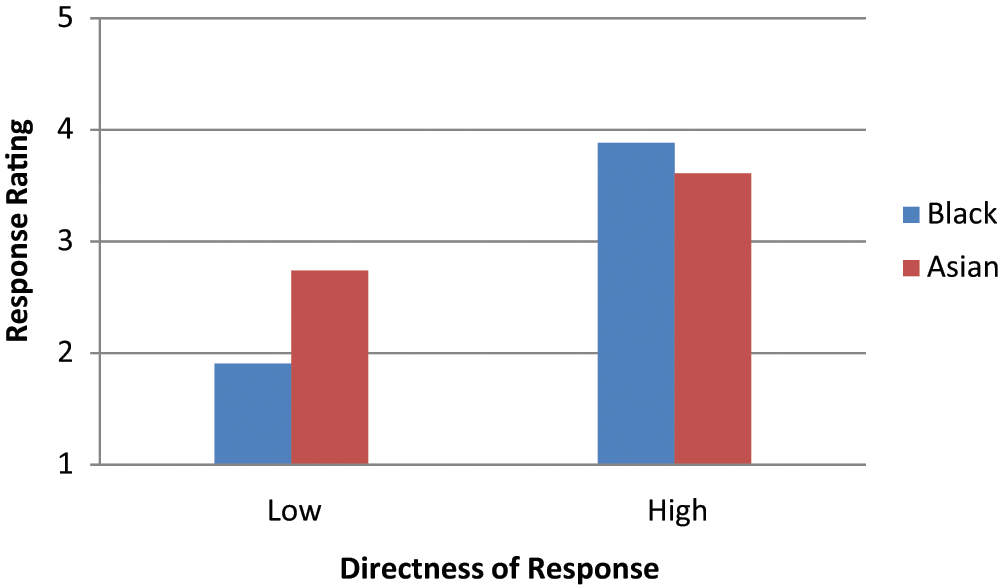
Mean level of Black and Asian women’s ratings of responding either with a less or more direct response to an imagined racist comment (Study 2)
Interaction goals
To test Hypotheses 5 and 6, one-way ANOVAs were used to test for group differences in endorsing different goals one might have during an interaction with someone making such a racist comment. Analyses comparing Blacks and Asians on the eight goals only revealed one significant group difference. Asian women (M = 3.43, SD = .90) reported they were more likely to be motivated by the desire to keep the peace than Black women (M = 2.50, SD = 1.10), F(1, 33) = 6.93, p < .05,
Mediational analyses
The final analyses tested whether the interaction goal of keeping the peace mediated the relationship between participant race and their likelihood of engaging in a less direct response to the racist comment. The mediation model is presented in Figure 3. Both race, β = .37, t = 2.43, p < .05, and the goal to keep the peace, β = .37, t = 2.33, p < .05, were significantly predictive of the likelihood of less direct responding (paths b and c in Figure 3). As demonstrated earlier, race was also predictive of the goal of maintaining harmony (path a), β = .43, t = 2.93, p < .01. When the path from race to less direct responding controlled for the interaction goal, the resulting path (c’) was no longer significant, β = .21, t = 1.31, p = .20. Sobel’s test (z = 1.82) showed that the one-tailed drop in significance was significant at p < .05 suggesting that the desire to keep the peace mediated the relationship between race and the likelihood of engaging in a less direct form of responding. To further explore this mediation effect, we used Preacher and Hayes’ (2004, 2008) bootstrap method to determine a 95% bias-corrected confidence interval (based on 10,000 bootstrap samples) for the indirect effect, which confirmed the significant mediation effect because the confidence internal [.0067, .8106] did not contain zero.
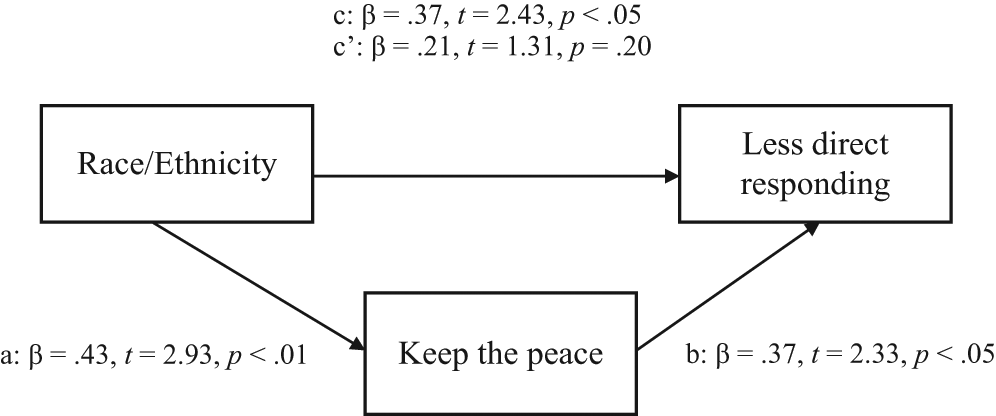
Mediation model showing that the goal to keep the peace mediates the cultural difference in less direct responding to an imagined instance of discrimination (Study 2)
Discussion
Results of Study 2 revealed a difference in confronting tendencies between Black and Asian women such that Asian women were more likely than Black women to anticipate not responding at all or responding in a less direct way (laugh or give advice). Unlike the results of Study 1, however, Black and Asian women rated themselves as equally likely to engage in the more direct avenues of confronting (asking questions, disagreeing with comment, or stating that the comment was offensive). This difference across the two studies may be due to the tendency among individuals to overestimate the likelihood that they would respond assertively or directly confront a hypothetical (vs. an actual) instance of discrimination (Swim & Hyers, 1999). Interestingly, this tendency to overestimate one’s likelihood of responding assertively or directly seemed stronger for Asian women than for Black women and in part, may be due to a ceiling effect for the Black women. Because Black women endorsed and enacted norms for direct responding in Study 1, there may be little room for imagining much more of a direct response in the scenario. However, without any direct evidence it is unclear whether the lack of group difference is necessarily due to Asian women overestimating and/or Black women underestimating their response.
Importantly, Study 2 allowed us to examine whether culturally consistent interaction goals could account for race differences in responding to everyday racism. Consistent with Asian cultural norms of promoting interpersonal harmony, Asian women were more likely than Black women to desire to “keep the peace” in their response to the offending partner, and this interaction goal mediated the relation between race and the tendency to not respond at all or to respond less directly.
General Discussion
Direct Responses to Racism
We aimed to examine cultural influences on the responses to racism given a convergence of numerous literatures within psychology suggesting that Black women would be more likely to confront racism directly than would Asian women. Across two separate, empirical studies we found complementary evidence supporting this notion. In Study 2, Asian women were more likely than Black women to say that they would engage in less direct responding to a hypothetical racist scenario (similar to the actual scenario in Study 1). In other words, Black women were less likely than Asian women to imagine a scenario where less direct responding was an acceptable course of action after hearing a racist comment (Study 2) and Black and Asian women’s actual behavior when placed in such a situation (Study 1) corroborated the imagined scenario findings. Importantly, we expected and found that Asian women tended to respond in more indirect ways (Study 1), that their decreased likelihood to respond directly was unrelated to how racist they perceived the situation. Furthermore, Asian women’s motivation for not responding directly is to maintain interpersonal harmony in these situations (Study 2).
For Black women, responding to racism with a more direct response, such as verbally expressing their disapproval or anger, may be the healthier strategy given the value placed within Black culture on confronting injustice and the socialization of these goals within many Black families (Hughes et al., 2006). For instance, if individuals feel they should respond to prejudicial comments but they do not respond, they tend to ruminate about their lack of response and evaluate themselves negatively (Shelton, Richeson, Salvatore, & Hill, 2006). Furthermore, a recent study analyzing coping styles and the experience of racism among Black women found that using more avoidant coping strategies exacerbated the relationship between depression and discrimination, whereas more active approaches buffered this relationship (West et al., 2010). Importantly, we were not able to show mediation with any of the interaction goals that focused on racial socialization or the importance of fighting racial injustice. Nevertheless, the fact that in Study 1 Black women responded more directly to the racist condition than the rude condition (whereas Asian women did not) provides indirect evidence that Black women may be socialized to think that it is uniquely important to respond to race-related injustices.
A directly confrontational approach may also be tied to a greater societal benefit to Black or African American culture. For instance, historical Black American figures such as Harriet Tubman, W. E. B. DuBois, Sojourner Truth, and Robert Abbott are celebrated as role models who very publicly confronted racism and sexism for the good of the Black cause, often at great cost to themselves (Carney, 2003; The African American Registry, 2005). Thus, the pattern of responses observed in direct responding to an actual discriminatory situation reflected behavior that has been long valued as a part of Black cultural tradition.
Indirect Responses to Racism
The fact that ethnic group differences in direct confronting behavior were eliminated when indirect responding was considered suggests that Asian women may have been more apt to express their discontent in a more indirect and subtle manner. The correlations in Study 1 between racist attributions and selection of jellybeans suggest that Asian women’s selection of jellybeans was a response to their perceiving the confederate as being racist. In contrast, their lack of a more direct or verbal response was unrelated to perceptions of racism suggesting that other forces, such as the goal of interpersonal harmony, were driving a suppression of verbal responses. These findings are consistent with existing literature showing that members of Asian cultures prefer to engage in indirect or high-context communication over direct low-context communication because the former is more culturally acceptable. Importantly, this culturally sanctioned censoring need not be maladaptive, as others have shown that emotional suppression is unrelated to psychological functioning in some Asian cultural groups (Soto, Perez, Kim, Lee, & Minnick, 2011), that passive coping styles in response to discrimination may actually be protective (Noh, Beiser, Kaspar, Hou, & Rummens, 1999), and that negative consequences of not responding such as rumination and negative evaluations of the self are not found among those who do not believe they should confront discrimination (Shelton et al., 2006).
Limitations and Future Directions
Though this work offers what we believe is a novel and valuable contribution to our understanding of how individuals respond to racism, there are, nonetheless, several noteworthy limitations. First, although participants in Study 1 did judge the racist comment as racist, they did not report the racist comment as highly racist (i.e., mean ratings were below the scale midpoint). Pilot data, however, indicated that the racist comment was perceived as very racist. The difference in pilot ratings and ratings in the study may represent a hesitancy to rate a particular person as racist (Swim, Scott, Sechrist, Campbell, & Stangor, 2003). Also related to our Study 1 manipulation is the fact that the racist comment in Study 1 was rated as more racist and more offensive than the rude comment, confounding whether participant responses were unique to racist situations or were more specific instances of a general response to rude situations. This may be a difficult confound to address satisfactorily given that most racist statements would likely be seen as highly offensive. Nevertheless, future work should consider this challenge moving forward.
Second, the reliance in Study 2 on a hypothetical scenario to measure direct confronting behavior may have lessened the ecological validity of those findings as participants likely overestimated their actual response to such a scenario. We balanced this methodological limitation against the ability to test whether culturally consistent interaction goals could explain group differences in response to everyday racism. It would have been awkward or impossible to assess these interaction goals prior to their responses without interfering with the real-life interaction paradigm from Study 1. These design differences notwithstanding, participants in both studies rated the comment and/or the perpetrator as equally racist suggesting that both studies were effective in their experimental manipulation. The different methods in Studies 1 and 2 were designed with the particular goals of those experiments in mind.
Finally, the fact that our participants were college age women limits the generalizability of our results. We specifically focused on women because research suggests that women in these groups may be particularly expected to enact the cultural norms we specified for Blacks and Asians (Robinson, 1983; Romero, 2000; Root, 1995). Yet, Black and Asian men may also be subject to different pros and cons around confronting behavior and, it will be important to explore these gendered norms in future studies (Smith et al., 2007).
Conclusion
In the present research, we endeavored to understand better how culture affects Black and Asian female targets’ responses to racism. Our findings are consistent with Black women’s cultural heritage, which celebrates the past accomplishments of other Black confronters of discrimination, as well as Asian women’s heritage, which advises finding expedient resolutions in the name of peaceful relations. Our findings also highlight the complex interpersonal and intrapersonal factors at play in everyday racism and how these factors may vary meaningfully across targets of different cultures. These findings offer an initial exploration of these important differences among minority groups’ methods of coping with racism.
Footnotes
Acknowledgements
The authors would like to thank the members of the Culture, Health and Emotion lab and the Swim Lab for their assistance with data collection.
First authorship is shared by Elizabeth A. Lee and José A. Soto.
Declaration of Conflicting Interests
The author(s) declared no potential conflicts of interest with respect to the research, authorship, and/or publication of this article.
Funding
The author(s) disclosed receipt of the following financial support for the research, authorship, and/or publication of this article: This work was partially funded by a grant to Elizabeth A. Lee from the Africana Research Center, The Pennsylvania State University.