



Abstract
Recent theorizing on the relation between victim sensitivity and unethical behavior predicts that victim sensitivity is related to an asymmetrical focus on cues associated with untrustworthiness compared to cues associated with trustworthiness. This hypothesis and its consequences for the accuracy of social predictions are investigated in this article. In Study 1, participants rated the trustworthiness of 35 computer-animated faces that differed in their emotional expression. People high in victim sensitivity rated neutral and hostile faces more untrustworthy than people low in victim sensitivity, whereas no such effect was found for friendly faces. In Study 2, participants predicted the cooperativeness of 56 targets on the basis of minimal information. The accuracy of predictions was negatively related to victim sensitivity, and people high in victim sensitivity systematically underestimated targets’ cooperativeness. Thus, the asymmetrical focus on untrustworthiness cues among victim-sensitive individuals seems to impair rather than improve their social judgments.
Cooperation always comes with a price. It requires a certain level of interpersonal trust (De Cremer, Snyder, & Dewitte, 2001; Parks & Hulbert, 1995; Putnam, 1993). Trust is most relevant in socially uncertain situations (Yamagishi & Yamagishi, 1994) because, by definition, uncertain situations are marked by the danger that one’s trust might be exploited. Thus, fear of exploitation and trust are two sides of the same coin, and being able to predict others’ trustworthiness as accurately as possible is required whenever there is a danger of being exploited or victimized (Hardin, 2002).
The ability to predict other people’s trustworthiness and their willingness to cooperate relies on the processing of cues that are associated with trustworthiness and cooperativeness on one hand, and with untrustworthiness and uncooperativeness on the other. A particularly rich pool of (un)trustworthiness cues seems to be the human face: Research on face perception and spontaneous trait inferences suggests that people make trustworthiness judgments after as little as 100 ms exposure to a face (Todorov, Pakrashi, & Oosterhof, 2009; Willis & Todorov, 2006). Although facial cues (such as smiles) can be used to tell whether or not a person is trustworthy (e.g., Ekman, 2001), and despite the fact that facial appearance and facial expressions are used spontaneously for evaluating a person’s trustworthiness, people generally perform poorly at predicting trustworthiness-related behaviors and personality traits (Olivola & Todorov, 2010; Porter, England, Juodis, ten Brinke, & Wilson, 2008; Zebrowitz, Voinescu, & Collins, 1996). However, individual differences in people’s cheater detection capacities are large: Frank and Ekman (1997) demonstrated that the ability to detect deceit is systematically related to the ability to detect emotional expressions in targets’ faces (see Ekman & O’Sullivan, 1991). Thus, some people are obviously better at processing trustworthiness cues and detecting cheaters than others. Not much is known about these individual differences and the cognitive processes underlying their effects on social judgments.
One of the individual differences variables that seems to be systematically related to trustworthiness judgments is victim sensitivity (Gollwitzer & Rothmund, 2011; Gollwitzer, Schmitt, Schalke, Maes, & Baer, 2005). Victim sensitivity describes the tendency to experience strong emotional reactions and to ruminate on injustices to one’s own disadvantage. Individual differences in victim sensitivity are cross-situationally consistent and stable over time (Schmitt, Baumert, Gollwitzer, & Maes, 2010; Schmitt, Gollwitzer, Maes, & Arbach, 2005). Victim sensitivity has been treated as one of four perspectives from which a person can be sensitive toward injustice (Schmitt, Neumann, & Montada, 1995). Besides the victim’s perspective, justice sensitivity also encompasses an observer’s perspective (i.e., witnessing injustice from a third party’s perspective), a beneficiary’s perspective (i.e., profiting from injustice without being responsible for it), and a perpetrator’s perspective (i.e., actively committing an unjust act; cf. Schmitt et al., 2010). Notably, the four justice sensitivity perspectives, including victim sensitivity, do not simply reflect combinations of other personality factors such as the “Big Five,” neither on the domain level nor on the level of lower order facets. In other words, justice sensitivity is more than merely a combination of other personality traits (Schmitt et al., 2010).
Although the four perspectives share a substantial amount of variance that depends on the specific sensitivity components that are compared, they clearly load on separate factors. Moreover, the four perspectives are differently related to other personality traits and attitudes. Unlike the other three perspectives, victim sensitivity is related to self-related concerns such as suspiciousness and jealousy proneness. In other words, victim-sensitive people are concerned about justice, but they are more concerned about justice for themselves than about justice for others (Gollwitzer et al., 2005; Schmitt et al., 2005). Furthermore, victim sensitivity is positively related to uncooperative behavior in socially uncertain situations (Fetchenhauer & Huang, 2004; Gollwitzer, Rothmund, Pfeiffer, & Ensenbach, 2009; Rothmund, Gollwitzer, & Klimmt, 2011). Recent theorizing provides an explanation for this finding: In their Sensitivity to Mean Intentions (SeMI) model, Gollwitzer and Rothmund (2009) argued that victim sensitivity predisposes people to react to contextual cues that are specifically associated with meanness, recklessness, and untrustworthiness. According to the SeMI model, victim sensitivity is connected to the activation of a defensive motivational system: When cues of untrustworthiness are present, victim sensitivity facilitates their detection and prepares the individual for a swift response once they are detected.
Uncooperative or antisocial behavioral tendencies displayed by victim-sensitive persons can thus be conceived of as a means to defend oneself against (assumed) victimization: Victim-sensitive persons legitimize their uncooperative behavior by arguing that they would otherwise be exploited. In line with this theorizing, Gollwitzer and Rothmund (2011) recently found that victim-sensitive individuals experience anger, moral outrage, and annoyance when they were confronted with an ostensibly egoistic partner but not when they were confronted with merely bad luck. Accordingly, they swiftly withdraw their willingness to cooperate as soon as there is reason to believe that others might exploit them (Gollwitzer et al., 2009). In other words, whenever “meanness cues” are present in a given situation, victim-sensitive individuals become suspicious and afraid of being exploited. To avoid or prevent being exploited, they react with defensive strategies such as a reduced willingness to cooperate in a social dilemma.
In the present article, we investigate two potential characteristics of how victim-sensitive individuals possibly perceive and interpret trustworthiness and untrustworthiness cues in facial expressions and appearances: asymmetry and (in)accuracy.
The Asymmetry Hypothesis
One particular prediction that can be derived from the SeMI model is that victim-sensitive individuals are specifically sensitive toward cues of untrustworthiness but not to cues of trustworthiness. This “asymmetry hypothesis” is consistent with other conceptualizations of defensive motivational systems (see Lang, Bradley, & Cuthbert, 1990). For example, rejection-sensitive individuals give more weight to cues that indicate rejection but not to cues that indicate acceptance (Downey & Feldman, 1996). People who harbor “dangerous world beliefs” selectively attend to cues regarding potential danger and put more weight on danger signals than on security signals (Schaller, Park, & Mueller, 2003). Likewise, we hypothesize that victim-sensitive individuals give more weight to untrustworthiness signals than on trustworthiness signals (Gollwitzer & Rothmund, 2009). In a similar vein, some studies seem to suggest that people who score low in general trust are selectively sensitive toward untrustworthiness cues (Parks, Henager, & Scamahorn, 1996; but see Kosugi & Yamagishi, 1998; Yamagishi, 2001). In a recent study, Bell and Buchner (2010) found that justice-sensitive individuals have enhanced source memory for the faces of cheaters than for faces of irrelevant characters. Beyond these singular findings, however, no study has ever explicitly tested the asymmetry hypothesis for victim sensitivity so far. The present article fills this gap and tests this hypothesis in Study 1.
The (In)Accuracy Hypothesis
A second question is whether victim sensitivity promotes or rather defects the accuracy of predictions regarding the cooperativeness of other persons. Notably, the answer to this question does not follow directly from the asymmetry hypothesis. On one hand, it is reasonable to assume that being more sensitive toward cues of untrustworthiness makes victim-sensitive individuals more aware of potential self-presentational strategies that cheaters might display. Evolutionary biologists and psychologists have argued that humans must be equipped with a cognitive module that detects “cheaters” and reliably predicts other people’s willingness to cooperate (Cosmides & Tooby, 1992, 2005). Thus, given an increased ability to detect cheaters, victim sensitivity might lead to more accurate predictions regarding the cooperativeness of others.
On the other hand, being more sensitive toward cues of untrustworthiness might lead to less accurate predictions regarding the cooperativeness of others. If it is true that victim-sensitive individuals give more weight to untrustworthiness cues than to trustworthiness cues (asymmetry hypothesis), and given that both untrustworthiness and trustworthiness cues are independent from each other and equally valid for predicting cooperative intentions, then the asymmetrical focus on untrustworthiness that is typical for victim-sensitive individuals impairs their capability to accurately predict other persons’ cooperativeness. In other words, giving more weight to untrustworthiness cues should make victim-sensitive individuals more likely to underestimate other people’s cooperativeness. A similar relation between asymmetry and inaccuracy has been demonstrated in the aggressiveness domain: Research on the “hostile attribution bias” (i.e., aggressive children’s tendency to attribute hostile intentions to others; cf. Dodge, 1993; Orobio de Castro, Veerman, Koops, Bosch, & Monshouwer, 2002) has shown that these hostility predictions are largely inaccurate (Kenny et al., 2007). Moreover, the hostile attribution bias can at least partly be explained by a tendency to focus more strongly on hostility-related cues and situations than on cooperation-related cues and situations (Gouze, 1987). Here, asymmetry and inaccuracy in social predictions among aggressive children are systematically linked to each other. We believe that the same is true for victim-sensitive individuals: The asymmetrical focus on untrustworthiness cues might result in more inaccurate social predictions. We will test the inaccuracy hypothesis in Study 2, and we will also investigate why victim sensitivity is positively or negatively related to the accuracy of social predictions.
Study 1
Study 1 investigates how victim sensitivity is related to the perception of facial stimuli that differ with regard to their expressed level of hostility/untrustworthiness versus friendliness/trustworthiness. We hypothesize that victim-sensitive persons are asymmetrically sensitive toward cues of hostility and untrustworthiness; therefore, we expect a negative correlation between victim sensitivity and trustworthiness ratings for hostile faces, whereas victim sensitivity should not affect trustworthiness ratings for friendly faces.
Method
Sample
In all, 139 undergraduate students of psychology voluntarily took part in an experiment that supposedly investigated the relation between concentration and cooperation. The same students had taken part in a mass-testing session 12 weeks prior to the lab experiment. In the testing session, participants completed the 10-item Victim Sensitivity scale by Schmitt et al. (2005). Example items are “It bothers me when others receive something that ought to be mine” or “I can’t easily bear it when others profit unilaterally from me” (α = .82). Data from the mass-testing session and from the lab experiment could be matched on the basis of a personalized code. A total of 123 cases (88.5%) could be unequivocally matched. Women were overrepresented (78%); ages ranged between 18 and 46 years (M = 21.5, SD = 3.9).
Trustworthiness ratings
On arrival, participants were individually seated in front of a computer screen. The whole experiment was administered via personal computers. Five participants were tested simultaneously per session. Participants were asked to rate the trustworthiness of computer-animated faces on a scale from 0 (not at all trustworthy) to 6 (very trustworthy). They saw 35 animated faces of male persons (“targets”) whose facial expressions differed in their degree of hostility versus friendliness (cf. Oosterhof & Todorov, 2008; Todorov, Said, Engell, & Oosterhof, 2008). Hostile/untrustworthy faces (n = 10) were marked by narrowed eyes and eyebrows, tightly closed jaws, and a slightly elevated upper lip. Friendly/trustworthy faces (n = 10) were marked by wide-opened eyes, elevated eyebrows, and a smile. Neutral faces (n = 15) did not show any emotional expression and were neither friendly nor hostile. The faces were designed with the FaceGen Modeller (Singular Inversions, 2009). Examples for each of the three categories are depicted in Figure 1.

Example stimuli for hostile/untrustworthy, neutral, and friendly/trustworthy faces (Study 1).
Results and Discussion
Participants’ ratings of trustworthiness were aggregated across the 10 hostile/untrustworthy faces (α = .90), the 10 friendly/trustworthy faces (α = .87), and the 15 neutral faces (α = .84), respectively. There were no significant differences between male and female participants with regard to trustworthiness ratings in any of the three face categories (p ≥ .09 for three separate t tests). Victim sensitivity was treated as a continuous between-subjects variable. A mixed-model ANOVA with face category as a within-subjects factor and victim sensitivity as a between-subjects covariate revealed a significant main effect of face category, F(2, 242) = 5.06, p < .01, and, more importantly, a significant Victim Sensitivity × Face Category interaction effect, F(2, 242) = 4.14, p = .02. To explore the structure of this interaction effect in more detail, face categories were recoded into two dummy variables with neutral faces as the anchoring category (Dummy_1: hostile/untrustworthy = 1, friendly/trustworthy = 0, neutral = 0; Dummy_2: hostile/untrustworthy = 0, friendly/trustworthy = 1, neutral = 0). Of main interest were the interaction terms between victim sensitivity and the dummy variables. Individual scores on victim sensitivity were centered before interaction terms were computed (see Aiken & West, 1991). The data were analyzed with a mixed model that imposed no restrictions on the covariance matrix between the three facial expression categories. Full maximum likelihood estimations were used. The results are displayed in Table 1.
Parameter Estimates of the Mixed Model Regressing Trustworthiness Ratings on Emotional Expressions (Dummy Coded), Victim Sensitivity, and Respective Interaction Terms (Study 1; n = 123)

Note: Dummy_1 contrasts the hostile face condition with the neutral face condition; Dummy_2 contrasts the friendly face condition with the neutral face condition. Model parameters were estimated using full maximum likelihood estimation. No restrictions were imposed on the structure of the covariance matrix.
As expected, the two dummy variables had a highly significant main effect: Hostile/untrustworthy faces were rated as less trustworthy than neutral faces, whereas friendly/trustworthy faces were rated as more trustworthy than neutral faces. Interestingly, victim sensitivity was significantly negatively related to trustworthiness ratings for neutral faces (p = .01), and this negative correlation did not differ between neutral and hostile faces (p = .67). As expected, however, the negative correlation disappeared for friendly faces, as is reflected by the Victim Sensitivity × Dummy_2 interaction effect (p < .01). To put it differently, whereas friendly/trustworthy faces were rated as equally trustworthy both by persons high and low in victim sensitivity, 1 participants high in victim sensitivity rated neutral and hostile faces as significantly less trustworthy than participants low in victim sensitivity (see also Figure 2). Taken together, this pattern confirms the asymmetry hypothesis: Victim-sensitive individuals react more sensitively toward cues of untrustworthiness but not toward cues of trustworthiness.

Predicted trustworthiness ratings of participants high (+1 SD) and low (–1 SD) in victim sensitivity (Study 1).
For reasons of conceptual clarity, we should add that using the labels untrustworthy and hostile (and, vice versa, trustworthy and friendly) as synonyms here does not imply that we argue that, on a theoretical level, untrustworthiness is the same concept as hostility or that trustworthiness is the same concept as friendliness. On an operational level, however, facial expressions that are related to hostility cannot be disentangled from cues that are related to untrustworthiness and vice versa, at least not when facial expressions are constructed in line with Oosterhof and Todorov’s (2008) data-driven model (see Todorov, 2011).
Study 2
Study 2 was constructed to investigate whether the asymmetrical sensitivity toward cues of untrustworthiness implies that victim-sensitive individuals make more accurate or rather less accurate social predictions regarding other people’s cooperativeness. In this study, participants were confronted with short video clips from real (“target”) persons who later took part in a dictator game. Participants’ task was to predict targets’ level of cooperativeness in the dictator game. We investigated whether and how victim sensitivity is related to levels of accuracy in predicting targets’ cooperative behavior. To reduce error variance and to improve the internal validity of our design, we controlled for trait constructs that are potentially related to cooperativeness judgments and that might serve as alternative explanations. These constructs are general trust, trait empathy, and observer sensitivity. General trust has been shown to influence judgments of cooperativeness (De Cremer, 1999) and to be related to interpersonal sensitivity (Parks et al., 1996) and to the accuracy of predicting a partner’s cooperation versus defection in a prisoner’s dilemma game (Kikuchi, Watanabe, & Yamagishi, 1997). Trait empathy has also been shown to influence accuracy rates in social exchange situations (Tanida & Yamagishi, 2004). Observer sensitivity (i.e., the observer perspective in justice sensitivity; cf. Schmitt et al., 2005) has been included because it shares variance with victim sensitivity and may also be related to interpersonal judgments (Gollwitzer et al., 2009; Schmitt et al., 2005).
Method
Part 1: Personality assessment
In all, 184 undergraduate students of psychology took part in a mass-testing session during classes at the beginning of their first semester, in which all trait variables that are relevant for the present study were assessed. Victim and observer sensitivity were assessed with Schmitt et al.’s (2005) 10-item scales (Victim Sensitivity: α = .86; Observer Sensitivity: α = .84). An example item for the observer sensitivity scale is “I am upset when someone is undeservingly worse off than others.” General trust was assessed with the 6-item scale by Yamagishi and Yamagishi (1994); this measure has been attested sufficient reliability and predictive validity (Yamagishi, 1998). An example item is “Most people are trustworthy” (α = .78). Empathy was assessed with a modified version of Davis’s (1983) Empathy scale (German version by Maes, Schmitt, & Schmal, 1995; 18 items). An example item is “Other people’s misfortunes do not usually disturb me a great deal” (reverse-coded) (α = .87). Response scales for all items ranged from 0 (not at all true) to 5 (absolutely true).
Part 2: Behavioral judgments
The same students who had completed Part 1 were approached several months later 2 during classes. They were asked to take part in a study on “first impressions.” Participants did not know that this study was related to the mass-testing session (Part 1). A total of 181 students agreed to take part. They were told that their task was to guess how a person, whom they would see in a short video clip, had probably behaved in a dictator game. First, the logic of the dictator game was described. Participants learned that dictator games are two-person situations in which one person (A) is provided with a resource (e.g., a certain amount of money) and has to distribute this resource between him- or herself and the other person (B). Person B has to accept this offer and cannot negotiate, alter, or decline the offer. In this particular dictator game, Person A had to divide 60 Euros between him- or herself and Person B, and Person A could either give 0, 10, 20, or 30 Euros to Person B.
Next, participants watched a 28-min video in which 56 target persons (i.e., students of business administration from the University of Groningen) were shown. The target persons were asked to talk into the camera and briefly introduce themselves. The material was taken from Fetchenhauer, Groothuis, and Pradel (2010; see also Fetchenhauer & Dunning, 2010). Participants could only see the targets talk; the volume was set to zero. No other information about the targets was given. Each target video clip had a length of exactly 20 s and was followed by an intertarget interval of 10 s.
These target persons were actual participants who had agreed to take part in a study on financial investments. One part of this original study was a dictator game that worked exactly as described above (i.e., A is given 60 Euros and can transfer 0, 10, 20, or 30 Euros to B). Target persons were always assigned to the dictator role. On average, they transferred 20.17 Euros (SD = 11.67) to Person B. Twenty-seven targets (48.2%) gave 30 Euros, 14 (25%) targets gave 20 Euros, 4 (7.1%) gave 10 Euros, and 11 (19.6%) gave nothing but kept everything for themselves (for details, see Fetchenhauer et al., 2010).
Participants were asked to guess the amount of money each target transferred to B immediately after watching the respective 20-s clip. They had to indicate whether targets would give 0, 10, 20, or 30 Euros to their respective partners.
Sample
Data from the personality assessment session (Part 1) and from the behavioral judgment session (Part 2) were matched by a personalized code that allowed no inference about a participant’s identity. A total of 151 cases could be unequivocally matched. Ages ranged from 18 to 46 years (M = 22.3, SD = 5.0). Women were overrepresented (85%). Among all participants who completed the second part of the study, 20 × 10 Euros were raffled. Participants were debriefed immediately after the data were collected.
Results and Discussion
Participants guessed that, on average, targets would transfer 16.29 Euros (SD = 2.57) to Person B in the dictator game. Thus, just like in previous studies, participants generally underestimated targets’ level of cooperation (Fetchenhauer & Dunning, 2010). To assess the accuracy with which participants predicted targets’ behavior, we computed the average relative frequency of correct predictions across all targets and participants. More precisely, we divided the absolute number of correct predictions for each participant (ranging between 0 = no target predicted correctly to 56 = each target predicted correctly) by the number of targets (i.e., 56). Across all 151 participants, the mean accuracy score was 25.82% (SD = 6.4%). Accuracy scores did not differ between men (M = 25.2%, SD = 7.3%) and women (M = 25.9%, SD = 6.3%), t(149) = 0.47, p = .64, d = .11. Next, accuracy scores were regressed on general trust, empathy, and observer sensitivity in a first step, and victim sensitivity in a second step. The three control variables in the first step did not explain a significant part of the variance in accuracy, R2 = .03, F(3, 146) = 1.50, p = .22, but including victim sensitivity in the second step increased the amount of explained variance significantly, ΔR2 = .03, F(1, 145) = 4.67, p = .03. As expected, victim sensitivity was negatively related to the number of correct guesses, β = −.20, t(145) = −2.20, p = .03: Estimated accuracy scores were 27.1% for people low in victim sensitivity (−1 SD) and 24.5% for people high in victim sensitivity (+1 SD).
Trials in which a target’s behavior was not accurately predicted were further subdivided into overestimations or underestimations. Overestimations comprise trials in which a participant predicted a target to give more than he or she actually did (which can happen in cases in which targets gave 0, 10, or 20 Euros), underestimations comprise trials in which a participant predicted a target to give less than he or she actually did (which can happen in cases in which targets gave 10, 20, or 30 Euros). Because predicted cooperativeness was lower than actual cooperativeness, the number of trials in which participants underestimated a target’s transferred amount was generally higher (M = 26.83, SD = 4.82) than the number of trials in which participants overestimated a target’s transferred amount (M = 14.64, SD = 3.45), t(150) = 19.88, p < .001, and the correlation between the two was—unsurprisingly—highly negative (r = −.65, p < .01). The number of under- and overestimations was then regressed on victim sensitivity. As in previous analyses, we controlled for general trust, empathy, and observer sensitivity. Again, these control variables did not explain a significant part of the variance in underestimations, R2 = .02, F(3, 146) = 0.97, p = .41, or overestimations, R2 = .005, F(3, 146) = 0.24, p = .87. As expected, including victim sensitivity in the second step increased the amount of explained variance in underestimations, ΔR2 = .04, F(1, 145) = 5.30, p = .02, but not in overestimations, R2 = .005, F(1, 145) = 0.68, p = .41. More precisely, victim sensitivity was positively related to the number of underestimations, β = .21, t(145) = 2.30, p = .02, which suggests that victim sensitivity is negatively related to the accuracy of predictions due to a systematic underestimation of targets’ cooperativeness.
Additional analyses revealed that the number of underestimations differed depending on how much money targets actually transferred: Victim sensitivity was positively related to underestimating the cooperativeness of targets who transferred 20 Euros, β = .21, t(145) = 2.34, p = .02, and of those who transferred 30 Euros, β = .16, t(145) = 1.67, p = .10, although the latter effect was not statistically significant (see also Figure 3). In other words, victim-sensitive individuals were more likely to assume that a target gave 0 or 10 Euros when in fact he or she gave 20 Euros to his or her partner.
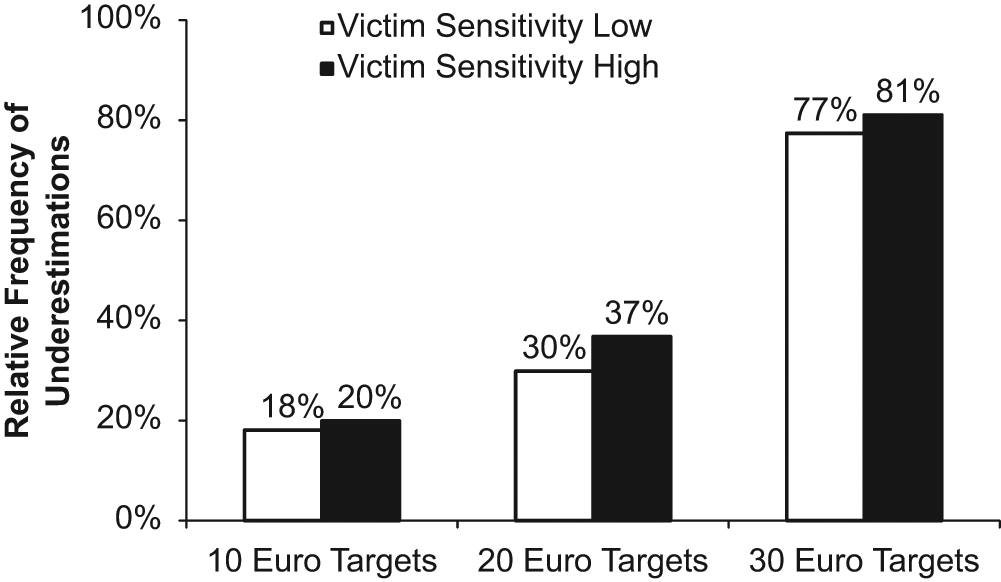
Predicted relative frequency of underestimations of participants high (+1 SD) and low (–1 SD) in victim sensitivity, separated by target category (Study 2).
We argue that this pattern of results resonates with the finding that victim sensitivity is related to being asymmetrically sensitive toward cues of untrustworthiness (Study 1): Given that victim-sensitive individuals give more weight to those cues than victim-insensitive individuals, they predict lower levels of cooperativeness in other people in general. These effects cannot be explained by related constructs such as empathy or general trust.
One might argue that the effect sizes we found in this study were considerably small. However, it should be noted that (a) participants were asked to make social judgments on a very limited basis (each video clip had a length of only 20 s), and that (b) justice sensitivity as well as other trait scales were assessed between 2 and 6 months prior to the behavioral judgments session. We believe that effect sizes would have been larger had we (a) allowed participants to interact with targets and (b) used a shorter time interval between the mass-testing and the lab session. This, however, is speculative and requires further research.
General Discussion
The present research aims to shed light on the psychological meaning and the social-cognitive implications of being justice sensitive from a victim’s perspective. First, we found evidence for the notion that being sensitive to victimization implies an asymmetrical sensitivity to cues of untrustworthiness: Study 1 shows that people high in victim sensitivity perceive hostile and neutral faces as more untrustworthy than people low in victim sensitivity, whereas no effects of victim sensitivity were found for friendly faces. Second, being sensitive to victimization leads to less accurate predictions regarding other people’s cooperativeness: In Study 2, we found that victim sensitivity had a unique effect (over and above observer sensitivity, general trust, and empathy) on the accuracy of predicting other people’s behavior in a dictator game.
On a theoretical level, these findings support central predictions derived from the SeMI model (Gollwitzer & Rothmund, 2009), which explains why a justice-related motivation can sometimes lead to suspiciousness and uncooperative behavior. Whereas the hypothesis that victim sensitivity is related to being sensitive toward cues of untrustworthiness has been already empirically confirmed in previous studies (Gollwitzer et al., 2009; Gollwitzer & Rothmund, 2011; Rothmund et al., 2011), the present studies are the first to corroborate the notion that the sensitivity toward cues of untrustworthiness is asymmetrical, and that this asymmetry can impair social judgments in certain situations. Our findings do not only show that victim-sensitive individuals make less accurate predictions regarding others’ benevolence; we also offer a potential explanation for this effect: Focusing more strongly on cues of untrustworthiness makes it more difficult for people high in victim sensitivity to differentiate cooperators from noncooperators. Victim sensitivity is negatively related to the accuracy of social judgments because the more victim sensitive a person is, the more likely he or she is to give more weight to untrustworthiness cues and to underestimate other people’s cooperativeness.
Future research should address more directly whether the victim sensitivity/inaccuracy relation is “driven” by high victim sensitivity or by low victim sensitivity. We interpreted the negative correlation between victim sensitivity and accuracy scores as evidence for our hypothesis that high victim sensitivity leads to more faulty social judgments. However, being insensitive toward victimization might protect against such an inaccuracy bias. According to the results reported in Study 2, victim-sensitive individuals (i.e., 1 SD above the sample mean) have an estimated accuracy score of 24.5%, which is little below chance level, whereas victim-insensitive individuals (i.e., 1 SD below the sample mean) have an estimated accuracy score of 27.1%, which is more strongly above chance level. An interesting question for future research could be how much victim sensitivity is necessary to make social judgments critically inaccurate or how much victim insensitivity (i.e., how little victim sensitivity) is enough to yield sufficiently accurate social perceptions.
On a broader level, this question indicates that the motivation to avoid being exploited by others is a double-edged sword. On one side, the capability to detect cheaters is an evolutionary adaptive strategy (Cosmides & Tooby, 1992, 2005). On the other side, when fear of being exploited (or “sugrophobia”; cf. Vohs, Baumeister, & Chin, 2007) becomes too strong, social perceptions become increasingly inaccurate because people are overly suspicious. This suspiciousness can impair the quality of social interactions and one’s psychological well-being when it translates into paranoid thinking (Freeman & Garety, 2004).
On an even broader level, our research contributes to the literature on the accuracy of first impressions or “thin slices” of expressions and behaviors (Ambady, Hallahan, & Conner, 1999; Olivola & Todorov, 2010; Zebrowitz et al., 1996; Zebrowitz & Montepare, 2008). This research has shown that people are, in general, not very good at detecting liars and cheaters on the basis of limited information (Porter et al., 2008; Todorov, Said, & Verosky, 2011), but that there are individual differences in the ability to detect lies and liars (Frank & Ekman, 1997). In the present research, we aimed to show that this interindividual variance can partly be explained by justice sensitivity from the victim’s perspective and the social-cognitive features that are accompanied with that trait. Following the report of the findings presented here, an important issue for future research would be to sort out what exactly are these cues of untrustworthiness in social encounters, and to what extent victim-sensitive individuals process these cues differently than people low in victim sensitivity. Recent research suggests that the range of emotional expressions displayed by target persons during social interactions is predictive of targets’ cooperative tendencies (Schug, Matsumoto, Horita, Yamagishi, & Bonnet, 2010). Possibly, victim-sensitive individuals do not perceive the whole range of emotional expressions as they focus too much on negative emotions such as hostility.
Related to the previous point, future research should address whether victim sensitivity implies being sensitive to cues of untrustworthiness in particular or being sensitive to cues of negative affective valence in general. Whereas the SeMI model would predict a specific sensitivity to cues associated with meanness, recklessness, and hostility, it is not implausible to assume that victim-sensitive individuals are generally sensitive to all kinds of negatively valent information. Although previous research suggests that people high in victim sensitivity only experience anger and moral outrage if unfavorable outcomes can be attributed to another person’s malice (and not simply to bad luck; cf. Gollwitzer & Rothmund, 2011), we cannot fully rule out that the findings in our present research can be explained by a negative affectivity account.
Of course, our studies are not free from weaknesses, and therefore some limitations of our findings and interpretations should be outlined. For example, the fact that our samples consist of undergraduate psychology students potentially threatens the generalizability of our findings. However, we are not aware of any psychologically plausible theory that would lead us to expect a different pattern of results in a more heterogeneous sample. Furthermore, representative data show that victim sensitivity (as well as the other three justice sensitivity perspectives) does not systematically depend on demographic variables: Factors such as gender, age, education duration, employment status, or marital status do not explain more than 2% of the variance in victim sensitivity (Schmitt et al., 2010). One might wonder whether a more gender-balanced sample would produce different results than those presented here, and this is a question we cannot address on the basis of the data at hand. However, previous research has shown that although women appear to be more able to decode facial expression cues (Hall, 1984; Hall & Briton, 1993) and to be more sensitive to nonverbal signs (such as the length of a smile) when making trustworthiness ratings (Krumhuber, Manstead, & Kappas, 2007), the evidence for systematic gender differences in the accuracy of trait inferences and social perceptions is weak (Ekman, O’Sullivan, & Frank, 1999; Hall & Carter, 1999; Lippa & Dietz, 2000; Kenny & Acitelli, 2001). In our research, we also did not find gender differences in trustworthiness ratings (Study 1) or accuracy scores (Study 2).
Second, one could argue that victim-sensitive individuals, who have been shown to be less cooperative in socially uncertain situations (Fetchenhauer & Huang, 2004; Gollwitzer et al., 2005; Gollwitzer et al., 2009), are more likely to project their own uncooperativeness onto similar targets and perceive them as uncooperative as well. This “projection” account, which would be an alternative explanation for our results, should be tested in future studies. Third, our findings do certainly not suggest that victim-sensitive individuals are always more likely to make less accurate social predictions. Of course, predictability varies as function of the context and the target sample (see also, Todorov et al., 2011, for a similar argument regarding the representativeness of target stimuli). The sample of targets we used here is certainly not representative in terms of its demographic background (i.e., Dutch business administrations students) or its level of cooperativeness (which was higher than usual; see Engel, 2011, for a meta-analysis on dictator games). In other words, had we used a sample of less cooperative targets, victim-sensitive individuals might have made more accurate predictions than victim-insensitive individuals. However, we believe that the target sample chosen here is particularly interesting because these targets were similar in age and education to our participants, and similar targets should be more predictable than dissimilar targets (Cline, 1964; Letzring, 2010). Despite this similarity, accuracy levels were relatively low in our study. More importantly, it is not unreasonable to assume that the effect of victim sensitivity on inaccuracy is even larger when targets and perceivers are less similar.
Taken together, our studies are the first to show that victim-sensitive people give more weight to cues of untrustworthiness than to cues of trustworthiness, and that this asymmetry is the reason why victim sensitivity may lead to faulty social judgments.
Footnotes
Declaration of Conflicting Interests
The author(s) declared no potential conflicts of interest with respect to the research, authorship, and/or publication of this article.
Funding
The author(s) disclosed receipt of the following financial support for the research, authorship, and/or publication of this article: This research was supported by a German Research Foundation (Deutsche Forschungsgemeinschaft; No. GO 1674/1-1) grant to the first author.