



Abstract
In this article, a Theory of Emotional Capital is investigated, which stipulates that relationships are able to withstand threats when partners have built “emotional capital” within the relationship (by contributing to positive, shared experiences). Support for this idea was obtained in two studies using two samples (newlywed couples and more established married couples) and two methodologies (daily diary and observational methods). Both studies showed that individuals with high emotional capital were less reactive to relationship threats than those with low emotional capital. The importance of emotional capital for healthy and stable relationships is discussed.
All close relationships encounter adversity or threat of some kind. These threats may arise from many sources and may take many forms. For example, they may range from unintentional acts of negativity (e.g., failing to provide a desired form of support to one’s partner, forgetting to follow through on a promise that was meaningful to one’s partner), to intentional acts of negativity that arise during conflict (e.g., insulting/criticizing one’s partner or saying something to make him or her feel bad), to even more malicious acts of negativity (e.g., a betrayal of trust, abandoning one’s partner during a crucial time of need). The perspective advanced in this manuscript centers around the idea that the outcome of such relationship threats depends to a large extent on the emotional capital that one has built within the relationship. We outline this theoretical perspective, describe how it differs from other relevant theoretical perspectives, and present two studies (a daily-diary study and an observational study) that test its core prediction.
Theory of Emotional Capital
The Theory of Emotional Capital provides an answer to the question of why some relationships (friendships, romantic relationships) survive adversity/threat whereas others do not. The idea is that every relationship has an “emotional bank account” made up of the positive, shared experiences that relationship partners have had (see also Gottman, 1999; Gottman, Driver, & Tabares, 2002). These include the types of experiences that make relationship partners feel special to and valued by one another (e.g., intimate conversations, responding to a partner’s needs, thoughtful deeds, etc.). Gottman and colleagues have discussed this concept when describing the importance of positive interactions and the importance of turning toward versus turning away from one’s partner in the course of daily interactions (e.g., Driver & Gottman, 2004; Gottman, 1999). They state that when partners turn toward each other rather than away in everyday, mundane interactions, “this is ‘emotional money in the bank’” (Gottman et al, 2002, p. 384).
Consistent with this theorizing, we define emotional capital as positive emotional investment into one’s relationship. It is an accumulated stock of “relationship wealth” made up of a set of positive, shared emotional experiences that constitute a resource inherent to a particular relationship. This resource is presumed to promote positive relationship development and relationship success. Positive emotional experiences/investments may take many forms within a relationship and may include compliments, expressions of love, smiles, intimate conversations, engaging in fun activities together, planning things to do together, laughing together, and so on. Experiences that are shared but not positive (e.g., conflicts, an experienced stressor) would not constitute emotional capital; however, positive, shared experiences can emerge from negative life events. For instance, having an intimate or humorous conversation about a stressor, or expressing love and affection as a means of providing comfort during a stressful time would constitute emotional capital. Also with regard to establishing the limits of emotional capital, positive experiences that do not involve the partner would not constitute emotional capital because emotional capital is a relational construct. The positive emotional experiences must be conveyed to the partner (e.g., through compliments, encouragement) or experienced with the partner (e.g., engaging in fun activities, laughing together). In addition, emotional capital is related to but distinct from perceptions of the partner’s regard for and responsiveness to the self. Emotional capital may contribute to these cognitions, but emotional capital is thought to predict relationship outcomes beyond the effects of cognitions, and these cognitions about the partner’s sentiments may arise from processes beyond sharing positive emotional experiences (e.g., projection of self-views or own sentiments; Lemay, Clark, & Feeney, 2007; Murray, Holmes, & Griffin, 2000). Finally, emotional capital is not just another word for being “emotionally invested” in a relationship. Emotional investment can include negative emotional investments (e.g., overdependency) that may manifest as jealousy and anger, and emotional investment may arise out of various structural features of relationships that are unrelated to positive emotional experiences, such as mutual influence, investments of tangible resources, and lack of alternative partners (Berscheid, Snyder, & Omoto, 1989; Rusbult & Buunk, 1993). Emotional capital is the degree of positive emotional investment in one’s relationship, so positivity of the relationship experience is an important criterion.
A major postulate of this theoretical perspective is that those who have made many deposits into their relationship’s emotional bank account will be less affected by potentially destructive relationship events/behaviors because they have this emotional buffer and are unlikely to find their account “overdrawn.” The withdrawals to their account are unlikely to break them (i.e., unlikely to cause them to respond in interpersonally destructive ways). Thus, they will be more likely to exhibit prorelationship behaviors even in, and perhaps especially in, response to negative partner behaviors. In contrast, those who have very little emotional capital (i.e., those who have made very few, if any, deposits into their relationship’s emotional bank account) will be more affected by conflict or potentially destructive relationship events/behaviors because they have no emotional buffer and are likely to find their account “overdrawn.” Any withdrawals from their account are very likely to break them. Thus, they will be less likely to engage in prorelationship behaviors in times of adversity or in response to negative partner behaviors (Rusbult, Verette, Whitney, Slovik, & Lipkus, 1991; Wieselquist, Rusbult, Foster, & Agnew, 1999) and less motivated to work through adversity and engage in problem solving.
Hence, this theory predicts that conflict, disagreement, or negative partner behaviors (any type of relationship threat) should be more damaging to the relationships of those who have not invested positive, shared emotional experiences. However, relationship threats are unlikely to negatively affect relationships in which partners have sufficiently made these positive emotional deposits. Positive emotional investment should confer a motivation to defend the relationship from threats.
This perspective complements other theoretical perspectives that identify factors that promote relationship stability. First, Rusbult’s commitment model identifies factors (satisfaction, investment, lack of alternatives) that lead individuals to remain committed to a relationship, regardless of the quality of the relationship, and considers the relationship consequences of feeling committed to a partner (e.g., relationship maintenance behaviors such as accommodation and increased dependence; Bui, Peplau, & Hill, 1996; Rusbult & Buunk, 1993; Rusbult, Olsen, Davis, & Hannon, 2001; Wieselquist et al., 1999). The emotional capital perspective views emotional capital as being a core predictor of factors that lead individuals to remain positively committed to their relationships, and it predicts that emotional capital will protect against relationship threat above and beyond effects of relationship commitment. Second, theory and research on support and caregiving within relationships identifies sensitive and responsive support provision (and perceived partner responsiveness) as an important contributor to individual and relationship well-being (Bowlby, 1969/1982; Feeney & Collins, 2012; Gable, Gonzaga, & Strachman, 2006; Lemay et al., 2007; Overall, Fletcher, & Simpson, 2010; Reis, Clark, & Holmes, 2004). The emotional capital perspective views responsive support provision as one means of building emotional capital within a relationship, and it views a lack of responsive support provision as a relationship threat. Third, theory and research on interpersonal trust views trust as integral to healthy relationships and defines trust as the expectation that a relationship partner will treat one fairly and honorably, has the interest of the relationship at heart, and is willing and able to live up to promises and obligations (Holmes, 1991; Holmes & Rempel, 1989). Trust reflects a willingness to risk investment in someone and has been linked with relationship quality and stability (e.g., Canary & Stafford, 1992; Jones, Couch, & Scott, 1997). The emotional capital perspective complements this work by identifying one important way that individuals are likely to build trust in a relationship, and it suggests that the types of positive relational investments indicative of emotional capital may underlie partners’ willingness to take risks in their relationships (e.g., by revealing vulnerabilities).
The emotional capital perspective is also consistent with theory and research in the health psychology literature that posits a reserve capacity model. According to this perspective, individuals may build a bank of reserves (e.g., optimism, self-esteem) that are health protective against stressors such as low socioeconomic status (Gallo, Bogart, Vranceanu, & Matthews, 2005; Matthews, Raikkonen, Gallo, & Kuller, 2008). The emotional capital perspective focuses on a dyadic reserve that is built within a particular relationship, and it emphasizes an emotional reserve made up of positive shared relationship experiences (e.g., intimate conversations, responding to a partner’s needs, thoughtful deeds, etc.) that make relationship partners feel special to and valued by one another.
We test the prediction that relationship threats should be more damaging to the relationships of those who have low emotional capital, and less likely to negatively affect relationships in which partners have high emotional capital, in newlywed couples using daily-diary methods (Study 1) and in longer-married couples using observational methods (Study 2). Given that perceiving partners as unresponsive to one’s needs is a potent relationship threat (Reis et al., 2004), we focus on perceived lack of partner responsiveness as a relationship threat in the current research. We operationalize emotional capital as the chronic level of positive emotional events that have occurred in the relationship and as the degree to which recent positive emotional deposits have been made into the relationship bank account. Because emotional capital includes positive emotional experiences/investments into a relationship that can take many forms, we include different types of positive experiences/investments in our measures of chronic emotional capital and recent emotional capital as a means of providing convergent validity. All items in both measures fit the conceptualization of emotional capital delineated above. We consider reactions to relationship threat in terms of reduced positivity toward the partner, increased negativity/hostility toward the partner, hurtful behavior toward the partner, and feelings of relationship dissatisfaction. We also show that the effects of emotional capital cannot be explained by other relationship variables such as initial relationship satisfaction, trust, and commitment.
Study 1
Predictions
Study 1 was a daily-diary study that was used to test the prediction that chronic emotional capital (i.e., positive emotional events that occurred in the distant past) would reduce negative reactivity to daily relationship threat. That is, daily relationship threat should be less predictive of negative responses the following day (i.e., reduced positivity toward partner, hurtful behavior toward partner, relationship dissatisfaction) when chronic emotional capital is high relative to when it is low (Hypothesis 1). We used daily perceptions that partners are unresponsive as an index of relationship threat. In addition, daily relationship threat should mobilize the utilization of chronic emotional capital for relationship defense, such that this capital exerts its strongest effect following days on which partners are seen as unresponsive (Hypothesis 2). Both of these effects also should occur with regard to recent emotional capital (i.e., positive emotional events that have occurred yesterday). We measured trust, relationship commitment, and relationship satisfaction to examine whether the buffering effects of chronic emotional capital can be explained by these other variables, which have been shown to moderate responses to relationship threats in prior research.
Method
Participants
Participants were 203 newlywed couples who were recruited through flyers, local newspapers, bridal shows, and email advertisements, and were compensated for their participation. Eligibility criteria included being married for less than a year in both partners’ first marriage, fluency in English, and no older than 40 years of age. Participants were primarily Caucasian (approximately 82%). On average, couples had been romantically involved for 3.8 years and had known each other for 5.2 years. Mean ages for husbands and wives were 27.7 and 26.6 years, respectively. Average level of education was an associate’s or bachelor’s degree, and mean earned annual income was between US$40,000 and US$60,000.
Procedure
Couples completed the measure of chronic emotional capital (among other measures) in a laboratory session. Then, approximately 2 weeks later, couple members completed a daily diary for 7 days (at the end of each day before bed) using Palm Pilot computers, on which they completed the daily measures described below. In this study, we test the idea that emotional capital buffers the effects of partners’ unresponsiveness on outcomes, including positivity of feelings for one’s partner, satisfaction with one’s relationship, and negative behaviors toward one’s partner. A total of 2,776 daily records were collected. Most participants (n = 344; 84.11%) completed all seven daily reports. Some of these participants (n = 18) chose to complete an additional report on the 8th day. Missing daily observations were excluded from analyses.
Questionnaire Measures
Chronic emotional capital
Chronic emotional capital was indexed by participants’ indication of the extent to which their spouses engaged in 11 affectively positive behaviors in the last month (i.e., “Complimented me,” “Told me he/she loves me,” “Smiled at me,” “Greeted me when I came home,” “Told me he/she was thinking about me,” “Looked at me in a loving way,” “Enjoyed seeing me get enthusiastic about something,” “Said thank you when I did something for him/her,” “Made me laugh,” “Said something that made me feel good about myself,” “Held my hand”). Items were completed on 8-point response scales (0 = not at all; 3-4 = sometimes; 7 = a great deal). Responses to these items were averaged to form an index of chronic emotional capital (Cronbach’s α = .89).
Variables relevant to alternative explanations
Participants also completed measures of relatively chronic trust, commitment, and relationship satisfaction. Trust was measured using an 8-item measure adapted from the Trust Scale (Rempel, Holmes, & Zanna, 1985; for example, “I feel that I can trust my spouse completely”; “I am confident that my spouse will always love me”). Items were completed on 7-point response scales (1 = strongly disagree; 7 = strongly agree; Cronbach’s α = .86). Relationship commitment was measured using a six-item measure adapted from the Investment Model Scale (Rusbult, Martz, & Agnew, 1998; see also Van Lange et al., 1997; for example, “Do you feel committed to maintaining your relationship with your spouse”; “For how much longer do you want your relationship to last”). Items were completed using 9-point response scales (Cronbach’s α = .68). Relationship satisfaction was measured using the four items employed by Van Lange et al. (1997) and two additional items from Collins and Read (1990). These items (e.g., “All things considered, how satisfied do you feel with your relationship”; “How does your relationship compare with other people’s”) assessed the degree to which respondents felt happy and satisfied with their current relationship. Again, items were completed using 9-point response scales (Cronbach’s α = .89).
Daily-Report Measures
Recent emotional capital
Participants indicated whether they engaged in each of six affectively positive activities with their spouses on each day (i.e., “We had an intimate conversation,” “We did something fun together,” “We worked together on something,” “We talked about something fun,” “We spent time together,” and “We planned something together.”). Items were constructed to reflect a variety of positive experiences/investments into the relationship that may occur on a daily basis, and it complements the chronic measure by tapping into additional forms of emotional investments for purposes of providing convergent validity. This scale was restricted to six items given that these assessments were taken on a daily basis for a period of 7 days. Responses were coded as “0” if the event did not occur and “1” if the event did occur, and then were averaged to create an index of daily positive events. This variable was rescaled (multiplied by 100) to be similar in scale to the other daily-report measures (Cronbach’s α = .72).
Presence/absence of relationship threat (daily perceived partner responsiveness)
To assess the presence/absence of relationship threat, participants completed three items measuring their perceptions of their spouse’s responsiveness each day. These included, “To what extent do you feel that your spouse looks out for you (and is concerned about your well-being) today?”, “To what extent do you feel today that your spouse is there for you when you need him/her?”, and “To what extent do you feel today that your spouse is supportive of your personal goals (e.g., your career goals, your hobbies, etc.)?” Each item was completed using a 100-point sliding scale (1 = not at all; 100 = very much). Participants moved an icon along a horizontal axis to represent their response to each item. Responses were averaged across the three items to create an index of daily perceived partner responsiveness (Cronbach’s α = .85). High scores on this index indicate a lack of relationship threat, and low scores on this index represent the presence of a relationship threat.
Responses to relationship threat
On each day, participants completed three measures to index their responses to the presence/absence of relationship threat. First, participants completed three items using the same 100-point sliding scale to indicate their daily positivity of feelings toward their partners. Items measured feelings of warmth (“How do you feel toward your spouse today?”: 1 = very cold; 100 = very warm), closeness (“How close or connected do you feel to your spouse today?”: 1 = not at all; 100 = very close), and love (“How much do you love your spouse today?”: 1 = not at all; 100 = very much). Responses were averaged to create an index of daily-felt positivity toward the partner (Cronbach’s α = .84).
Second, participants completed an additional item using the same 100-point sliding scale to indicate their daily relationship satisfaction (i.e., “How satisfied do you feel with your relationship today?”: 1 = not at all; 100 = very much).
Third, to assess daily negative behavior toward the partner, participants indicated whether they engaged in seven potentially relationship damaging or hurtful behaviors toward their spouse (e.g., “Made spouse feel like a burden,” “Avoided my spouse,” “Treated my spouse unfairly,” “Criticized my spouse,” “Hurt my spouse”). Daily negative behavior is measured for purposes of considering a variety of potential responses to relationship threat and thus is not a simple opposite of recent emotional capital, which is conceptualized as positive daily emotional investments into a relationship that can take many forms. Responses were coded as “0” if participants did not engage in the behavior and “1” if they did engage in the behavior. The average of the seven items was then rescaled (multiplied by 100) to range from 0 to 100 (Cronbach’s α = .70).
Results and Discussion
Analysis Strategy
Hypotheses were tested using multilevel regression models (using the SAS MIXED procedure). The models estimated person-level intercepts, which reflect person-level averages across days, as well as the correlation of these intercepts across the two dyad members. In addition, the models estimated correlations of the day-specific residuals across the two dyad members (see Kenny, Kashy, & Cook, 2006). Hence, the models estimated several sources of covariance among the daily observations, including covariance due to making repeated observations on the same person and two forms of dyadic interdependence—interdependence at the daily level and in terms of averages across the days. In addition, heterogeneous variances were modeled for males and females. 1 Our hypotheses regarding buffering effects were tested through the use of two-way interaction (product) terms (i.e., an interaction between daily perceived partner responsiveness and emotional capital). All variables were grand-mean-centered prior to analysis and all subordinate effects nested within interaction terms were included as controls. Hypotheses were tested using a time-lagged regression model, such that variables that are measured “today” (day t) are modeled to predict outcomes measured “tomorrow” (day t + 1). These models include as additional control variables “today’s” assessment of the criterion variable as well as moderator effects involving this variable (i.e., Today’s satisfaction × Emotional capital when predicting tomorrow’s satisfaction). Hence, effects of other predictor variables in the models are effects predicting a residual that reflects temporal change in the criterion variable. In addition, because lagged variables were included as predictors, these models account for autocorrelation of the daily observations. Fixed effects were collapsed across gender given that the theoretically relevant buffering effects did not significantly interact with gender, ps > .16.
Descriptive Statistics and Zero-Order Correlations
Descriptive statistics and zero-order correlations for all person-level variables are presented in Table 1. As would be expected, chronic emotional capital was positively associated with relationship satisfaction, commitment, and trust. However, the correlations were not so strong as to suggest that emotional capital is the same construct as these other variables. In fact, correlations of emotional capital with these other variables were generally the same as or weaker than correlations of these other variables with each other.
Descriptive Statistics and Zero-Order Correlations for Person-Level Variables (Study 1)
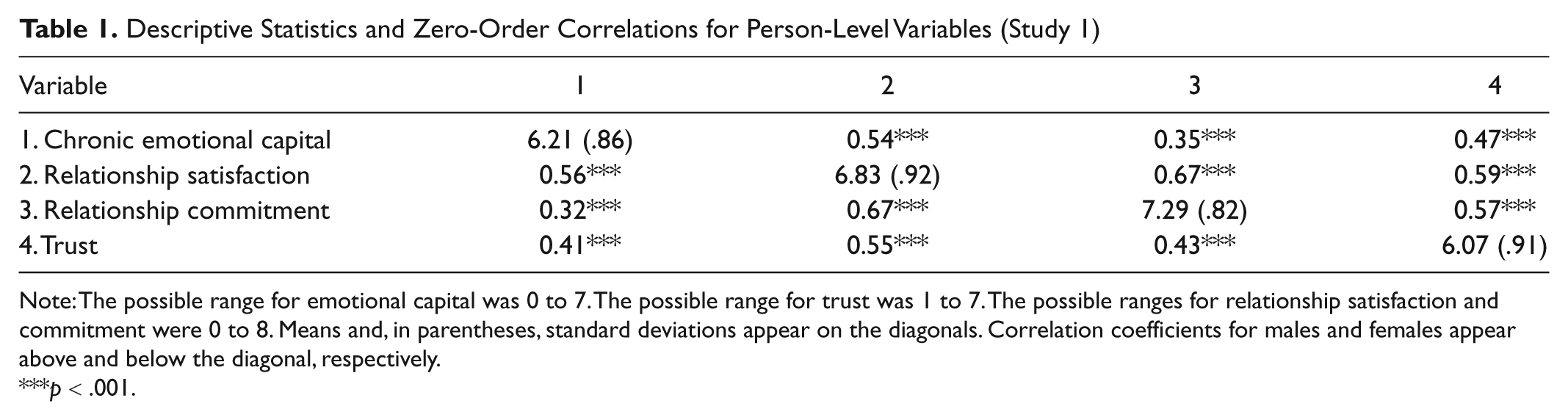
Note: The possible range for emotional capital was 0 to 7. The possible range for trust was 1 to 7. The possible ranges for relationship satisfaction and commitment were 0 to 8. Means and, in parentheses, standard deviations appear on the diagonals. Correlation coefficients for males and females appear above and below the diagonal, respectively.
p < .001.
The analyses reported below also involve daily variables, including daily emotional capital, daily perceived partner responsiveness, daily-felt positivity, daily relationship satisfaction, and daily negative behaviors. To examine the discriminant validity of chronic emotional capital and daily emotional capital with regard to these daily variables, we aggregated all of these daily variables across days and then examined their correlations with chronic and daily emotional capital. (The latter also was aggregated across days.) Chronic emotional capital was significantly associated with daily perceived partner responsiveness (female r = .50, p < .001; male r = .39, p < .001), daily-felt positivity (female r = .46, p < .001; male r = .41, p < .001), daily relationship satisfaction (female r = .42, p < .001; male r = .37, p < .001), and, for women, daily negative behaviors (female r = −.19, p < .01; male r = −.11, ns). Daily emotional capital was significantly associated with daily perceived partner responsiveness for women (female r = .26, p < .001; male r = .11, ns), daily-felt positivity (female r = .28, p < .001; male r = .23, p < .001), daily relationship satisfaction (female r = .30, p < .001; male r = .23, p < .01), and, for men, daily negative behaviors (female r = .04, ns; male r = .20, p < .01). Again, these associations suggest discriminant validity for our measures of chronic and daily emotional capital; chronic and daily emotional capital appears distinct from these daily variables.
Buffering Effects of Chronic Emotional Capital
We predicted that those with high emotional capital should be more likely to feel positively toward their partner and less likely to remain dissatisfied or enact relationship damaging behaviors following the partner’s daily unresponsive behavior, relative to those with low emotional capital. Our buffering model also predicts that emotional capital will be most influential under threat (i.e., days following low perceived partner responsiveness). To test these ideas, we regressed tomorrow’s (day t + 1) daily-felt positivity toward partner, relationship satisfaction, and negative behaviors toward partner on today’s (day t) daily perceived partner responsiveness, chronic emotional capital, and their interaction (controlling for the lagged assessment of the criterion and its interaction with chronic emotional capital).
The predictors and results for all three models are displayed in Table 2. The predicted today’s perceived responsiveness × chronic emotional capital interaction was significant in the models predicting tomorrow’s felt positivity toward the partner and tomorrow’s satisfaction, and it was marginal in the model predicting tomorrow’s negative behavior toward the partner, p < .06. Predicted values are plotted in Figures 1 through 3.
Effects of Today’s PPR and CEC on Tomorrow’s Felt Positivity, Satisfaction, and Negative Behavior (Study 1)
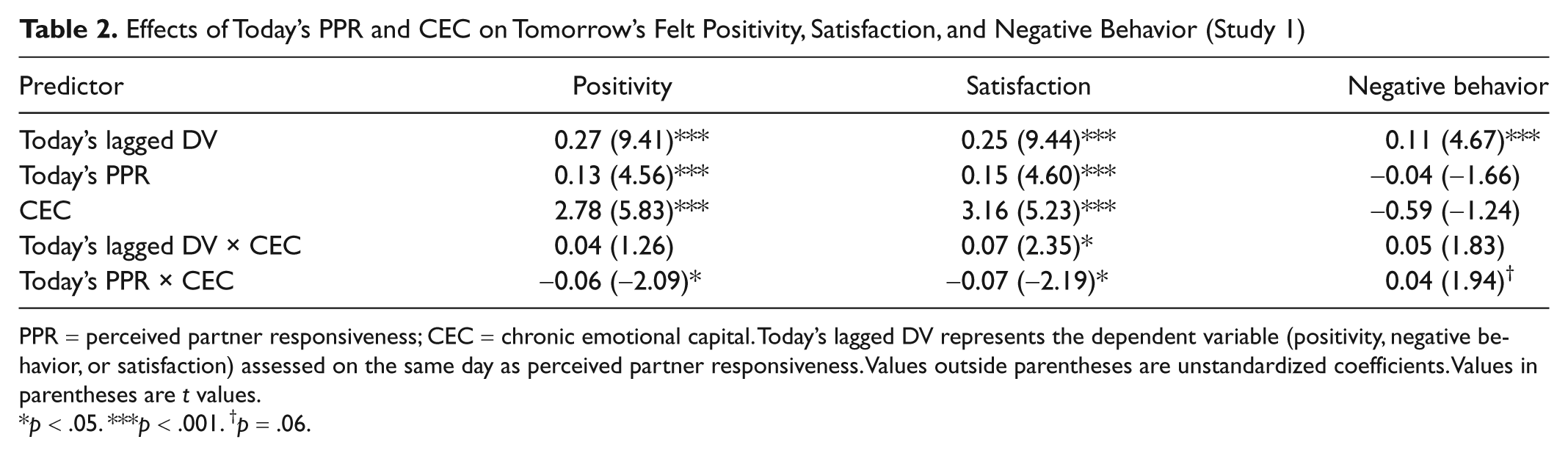
PPR = perceived partner responsiveness; CEC = chronic emotional capital. Today’s lagged DV represents the dependent variable (positivity, negative behavior, or satisfaction) assessed on the same day as perceived partner responsiveness. Values outside parentheses are unstandardized coefficients. Values in parentheses are t values.
p < .05. ***p < .001. † p = .06.
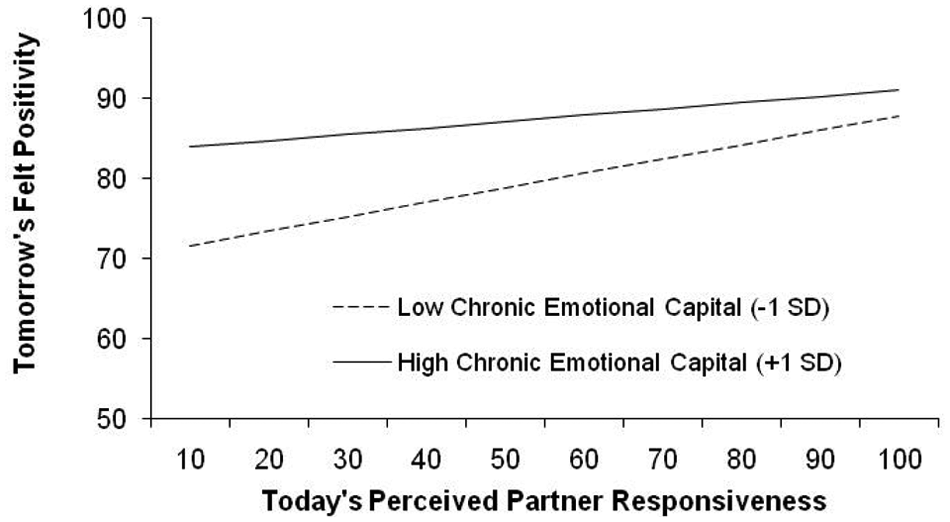
Tomorrow’s felt positivity toward partner as a function of today’s perceived partner responsiveness and chronic emotional capital (Study 1)
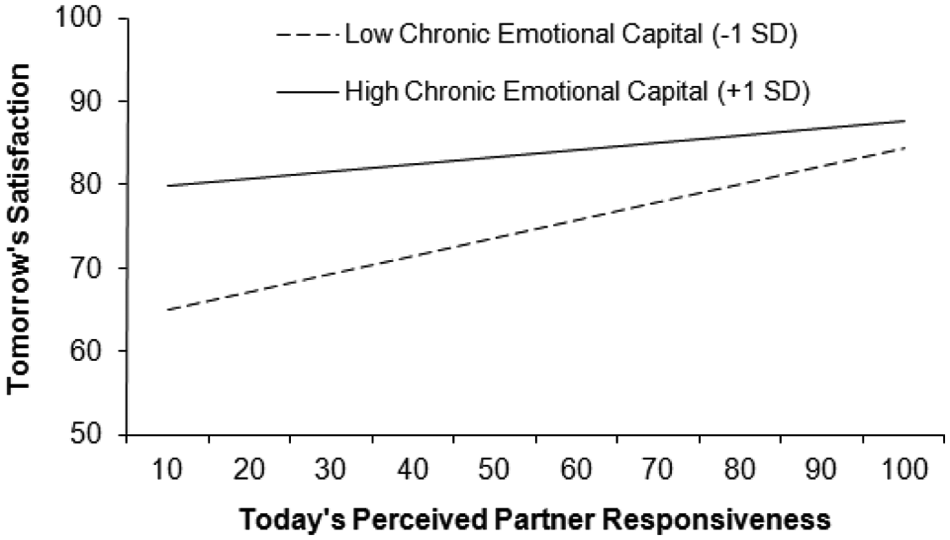
Tomorrow’s relationship satisfaction as a function of today’s perceived partner responsiveness and chronic emotional capital (Study 1)
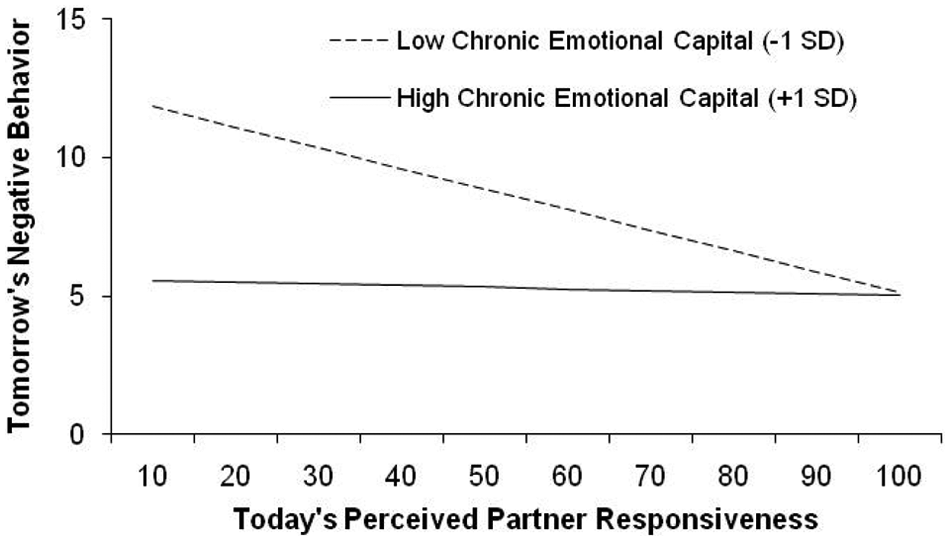
Tomorrow’s negative behavior as a function of today’s perceived partner responsiveness and chronic emotional capital (Study 1)
Conditional effects were examined to probe these interactions. Consistent with our predictions regarding reactivity (Hypothesis 1; see upper portion of Table 3), the effects of today’s perceived partner responsiveness on tomorrow’s felt positivity and satisfaction were stronger for participants who were low in chronic emotional capital (1 SD below the mean) relative to participants who were high in chronic emotional capital (the maximum score of 7, which is just below 1 SD above the mean). Consistent with our predictions regarding the role of threat in mobilizing emotional capital (Hypothesis 2; see lower portion of Table 3), examination of conditional effects also revealed stronger effects of chronic emotional capital on tomorrow’s felt positivity and satisfaction when today’s perceived partner responsiveness was low (−1 SD), relative to when today’s perceived responsiveness was high (+1 SD). For the model predicting negative behavior, today’s perceived partner responsiveness predicted tomorrow’s negative behavior only when chronic emotional capital was low, and chronic emotional capital predicted tomorrow’s negative behavior only when today’s perceived partner responsiveness was low. In short, relative to participants with low chronic emotional capital, those with high capital appeared less likely to respond to their partner’s lack of responsiveness by feeling less positive toward their partner, becoming dissatisfied with their relationship, and engaging in hurtful behaviors.
Conditional Effects of Today’s Perceived Partner Responsiveness and Chronic Emotional Capital on Tomorrow’s Felt Positivity, Satisfaction, and Negative Behavior (Study 1)
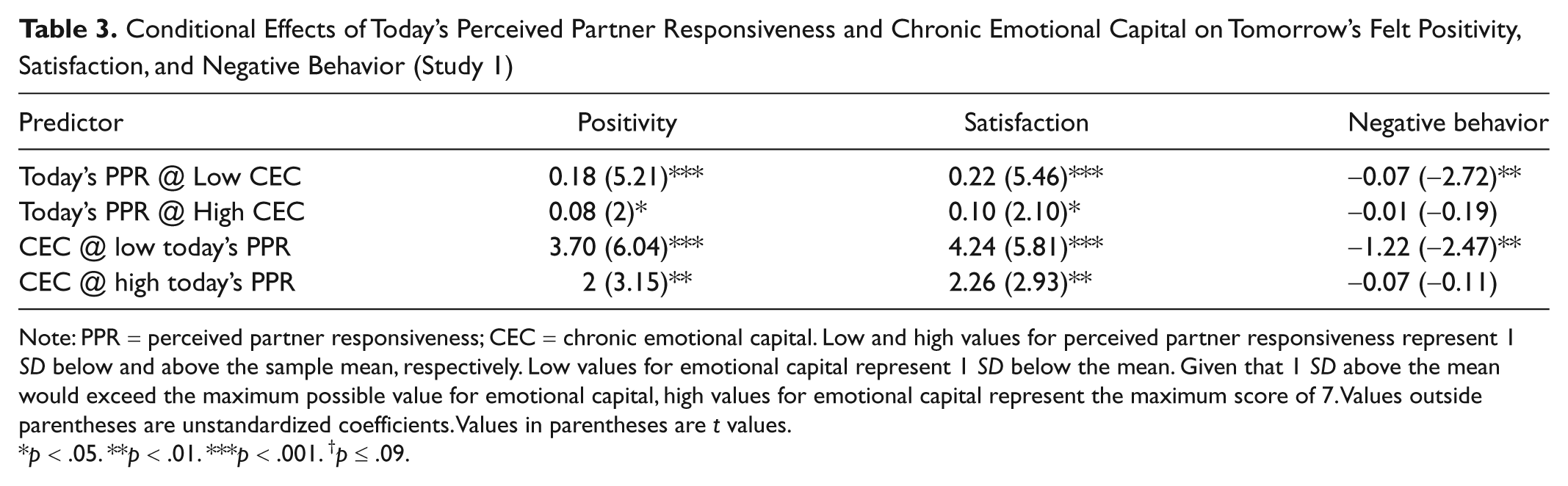
Note: PPR = perceived partner responsiveness; CEC = chronic emotional capital. Low and high values for perceived partner responsiveness represent 1 SD below and above the sample mean, respectively. Low values for emotional capital represent 1 SD below the mean. Given that 1 SD above the mean would exceed the maximum possible value for emotional capital, high values for emotional capital represent the maximum score of 7. Values outside parentheses are unstandardized coefficients. Values in parentheses are t values.
p < .05. **p < .01. ***p < .001. † p ≤ .09.
Buffering Effects of Recent Emotional Capital
We predicted that recent emotional capital (positive events occurring yesterday) also would buffer effects of today’s perceived lack of partner responsiveness on tomorrow’s outcomes. To test these ideas, we regressed tomorrow’s (day t + 1) daily-felt positivity, relationship satisfaction, and negative behavior on today’s (day t) daily perceived partner responsiveness, recent emotional capital (day t − 1), and their interaction (while controlling for the lagged assessment of the criterion on day t and its interaction with recent emotional capital).
The predictors and results of these analyses are displayed in Table 4. The predicted today’s perceived responsiveness × recent emotional capital interaction was marginal in the model of tomorrow’s positivity and was significant in the model of tomorrow’s satisfaction. The predicted interaction was not significant in the model of tomorrow’s negative behavior. The interaction predicting tomorrow’s satisfaction is plotted in Figure 4. (The interaction pattern predicting tomorrow’s positivity was similar and so it is not plotted.)
Effects of Today’s Perceived Partner Responsiveness and Recent Emotional Capital on Tomorrow’s Felt Positivity, Satisfaction, and Negative Behavior (Study 1)
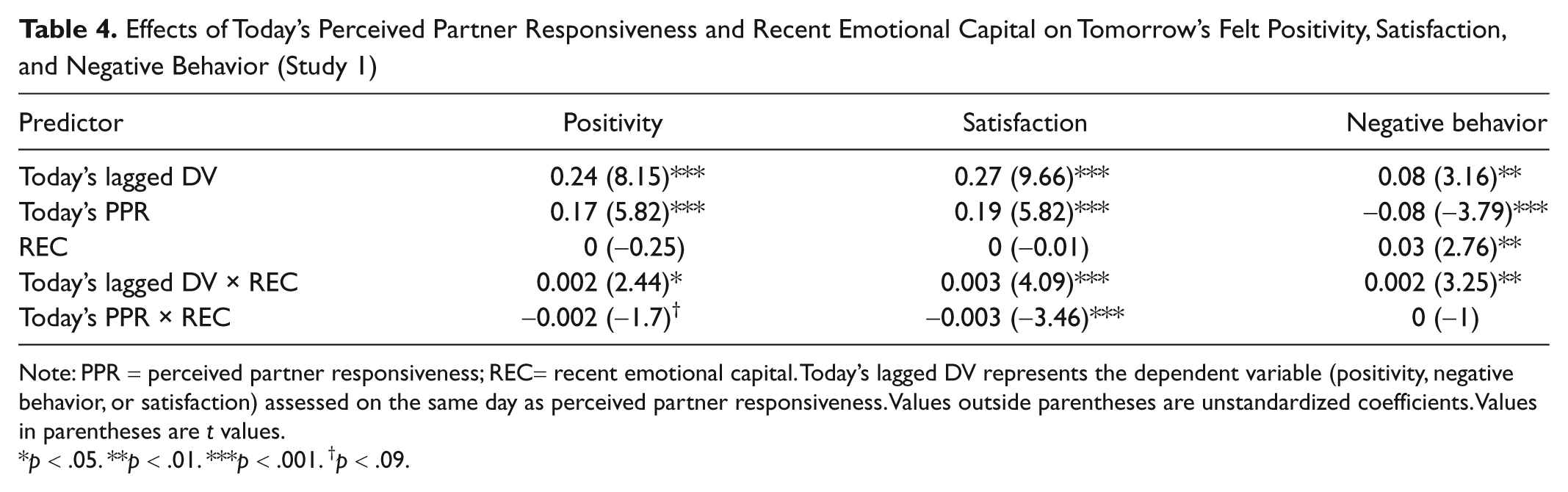
Note: PPR = perceived partner responsiveness; REC= recent emotional capital. Today’s lagged DV represents the dependent variable (positivity, negative behavior, or satisfaction) assessed on the same day as perceived partner responsiveness. Values outside parentheses are unstandardized coefficients. Values in parentheses are t values.
p < .05. **p < .01. ***p < .001. †p < .09.
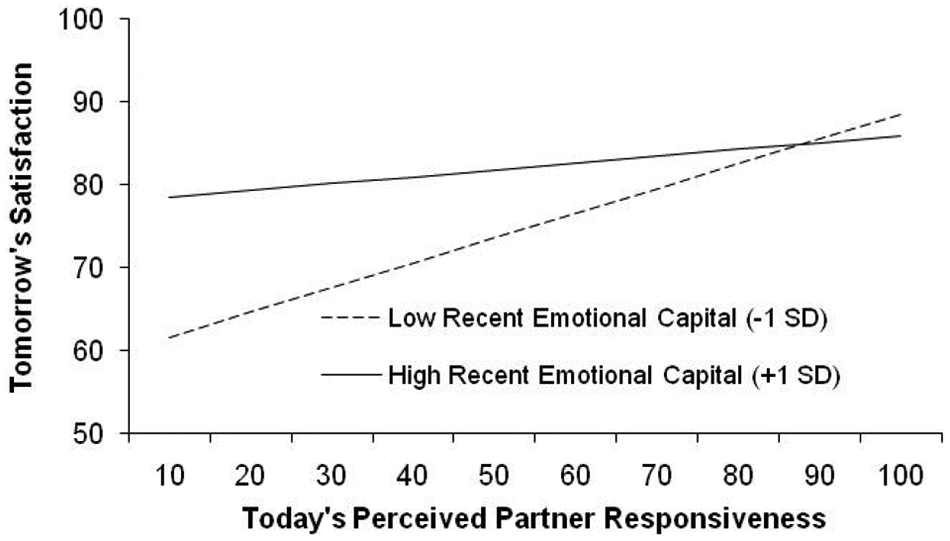
Tomorrow’s relationship satisfaction as a function of today’s perceived partner responsiveness and recent emotional capital (Study 1)
Conditional effects were examined to probe these two interactions. Consistent with our predictions regarding reactivity (Hypothesis 1; see upper portion of Table 5), the effects of today’s perceived partner responsiveness on tomorrow’s felt positivity and satisfaction were stronger for participants who were low in recent emotional capital (1 SD below the mean) relative to participants who were high in recent emotional capital (1 SD above the mean). Consistent with our predictions regarding the role of threat in mobilizing emotional capital (Hypothesis 2; see lower portion of Table 5), examination of conditional effects also revealed positive effects of recent emotional capital on tomorrow’s felt positivity and satisfaction when today’s perceived partner responsiveness was low (−1 SD), but not when today’s perceived responsiveness was high (+1 SD). (However, the conditional effect was significant only for the model of satisfaction.) Hence, relative to those with low recent emotional capital, those with high recent capital appeared less likely to respond to their partner’s lack of responsiveness by becoming less positive toward their partner or becoming dissatisfied. 2
Conditional Effects of Today’s Perceived Partner Responsiveness and Recent Emotional Capital on Tomorrow’s Felt Positivity and Satisfaction (Study 1)
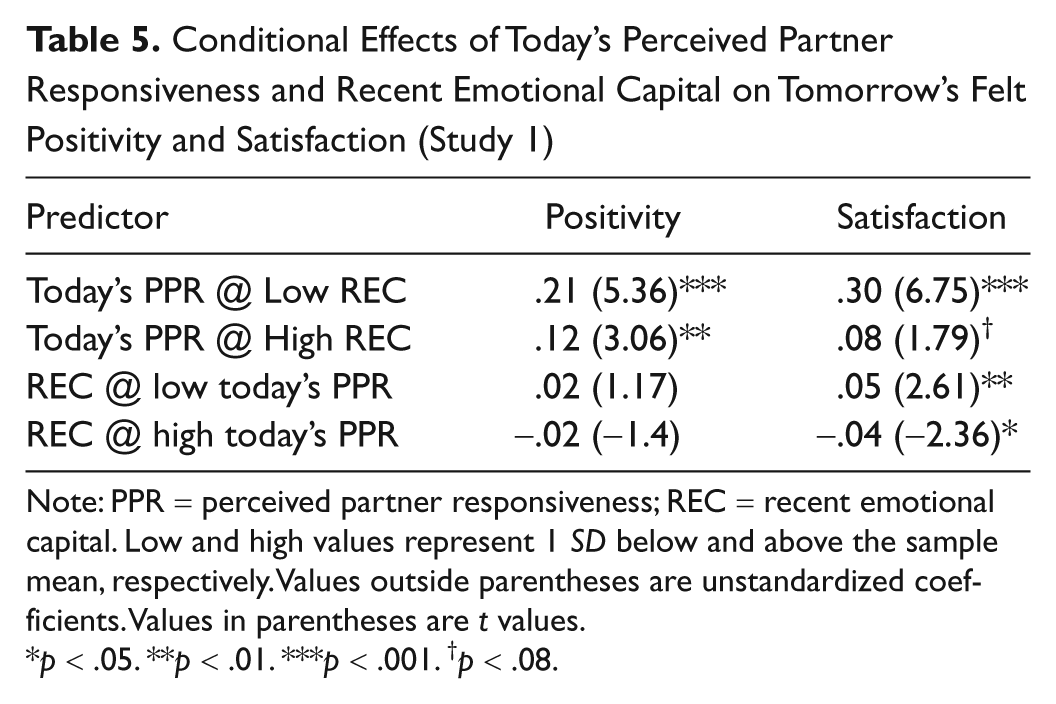
Note: PPR = perceived partner responsiveness; REC = recent emotional capital. Low and high values represent 1 SD below and above the sample mean, respectively. Values outside parentheses are unstandardized coefficients. Values in parentheses are t values.
p < .05. **p < .01. ***p < .001. † p < .08.
Alternative Explanations
We measured several additional variables in the baseline questionnaires that may serve as viable alternative explanations of the chronic emotional capital effects, including chronic relationship satisfaction, commitment, and trust. First, we examined whether these other variables had similar moderating effects as the emotional capital effects presented above. Chronic satisfaction and trust did not moderate the effects of daily perceived partner responsiveness on any of the outcomes, ps > .20. In addition, commitment did not moderate the effects of perceived partner responsiveness on daily negative behaviors or satisfaction, ps > .29. However, commitment did moderate the effects of perceived partner responsiveness on tomorrow’s felt positivity, p < .01. That most of these variables did not exhibit the same moderating effects as emotional capital suggests that these variables cannot explain the emotional capital effects.
To provide a more conservative test of whether these variables explain the emotional capital effects, we tested models that included the interactions of all of these variables (chronic emotional capital, satisfaction, commitment, and trust) with daily perceived partner responsiveness, as well as with the lagged assessment of the criterion variable. Even in these highly conservative models, chronic emotional capital continued to moderate effects of daily perceived partner responsiveness on daily changes in felt positivity, b = −.07, p < .05, relationship satisfaction, b = −.09, p < .05, and negative behavior, b = .08, p < .05.
Summary
This study supported our emotional capital model. Chronic emotional capital (accrued within the last 6 months) appeared to act as a buffer to the relationship stress of seeing partners as unresponsive to the self. On days following this stressor, participants with high chronic emotional capital (relative to those with low chronic emotional capital) were less likely to decline in their relationship satisfaction or their positive feelings toward their partner, and they were less likely to enact negative behaviors toward their partner. Consistent with a threat-buffering view, this emotional capital seemed relevant primarily on days when relationship threat was high (when participants perceived their partner as unresponsive to them). Recent emotional capital (experienced yesterday) had a similar buffering effect on positivity and satisfaction. These findings were not explained by conceptually similar variables, including relationship satisfaction, commitment, and trust, and correlations suggested that emotional capital is a conceptually distinct construct.
A drawback of this study is that we relied on self-report measures to assess the relevant relationship stressor (perceived lack of responsiveness from the partner) and responses to that stressor. Without an objective index of the partner’s behavior, it is possible that participants who are high and low in emotional capital responded differently to relationship stressors because they are experiencing different stressors. In addition, we wished to make claims regarding the implications of emotional capital for behavioral responses, and self-report responses may not reflect actual behavior. Hence, Study 2 presents a test of our model using behavioral observation measures of the relationship stressor and responses to that stressor.
Study 2
In Study 2, we tested our emotional capital perspective with regard to observed behavioral reactions to a partner’s observed lack of responsiveness. One member of a married couple, termed the “explorer,” was randomly assigned to engage in a challenging single-person activity with his or her spouse present. The interaction was unobtrusively videotaped. Spouses’ responsiveness (e.g., task assistance, affect, encouragement) and explorers’ affective and behavioral reactions to that responsiveness (or lack thereof) were subsequently coded. We predicted the same buffering effect revealed in Study 1: Explorers’ chronic emotional capital should buffer the effects of the partner’s unresponsiveness on their negative behaviors toward the partner. Furthermore, if threat mobilizes emotional capital utilization, then chronic emotional capital should exert its strongest effect when spouses are unresponsive. Again, we measured relationship satisfaction, commitment, and trust to address alternative explanations involving these variables.
Method
Participants
Participants were 167 heterosexual, cohabiting married couples who were recruited through newspaper advertisements and posted flyers and were compensated for their participation. Couples had been married for an average of 10.2 years (median = 6.0 years). Each member of the couple was randomly assigned to the role of either “explorer” (80 females; M age = 39.1) or “spouse” (87 females; M age = 39.3). Most participants were Caucasian (approximately 77%) or African American (approximately 16%), and most completed high school (approximately 40%) or obtained a college degree (approximately 55%).
Procedure
During an initial laboratory session, couple members completed questionnaires in private rooms, which included the measures described below. During a second session, approximately 1 week later, the couple member assigned to the role of an “explorer” participated in a novel and challenging exploration activity in the presence of his or her spouse. The purpose of this activity was to permit the observation of one couple member’s engagement in an autonomous activity as a function of the other couple member’s responsive or unresponsive behavior: This was accomplished by giving the explorer a novel exploration activity (an unfamiliar puzzle activity) to try out in the presence of his or her spouse. To mimic the characteristics of many real-life explorations, this activity was selected to be novel and challenging, and performance pressure was minimized by telling the explorer to have fun with it and that it doesn’t matter whether he or she actually solves the puzzles or not.
During this time, the spouse was given a brief questionnaire to complete. The purpose of this questionnaire was to make it clear to both couple members that the exploration activity was not a joint one (that the explorer was the one given the exploration opportunity). However, the spouse remained in the same room, and the spouse’s questionnaire was brief to allow the spouse the time and flexibility to exhibit responsive behaviors (e.g., providing assistance in response to requests, encouraging/praising progress) or unresponsive behaviors (e.g., hostility, criticism, controlling, and intrusive behaviors). After the experimenter left the room, the explorer and spouse were unobtrusively videotaped for 10 min. The spouse’s responsiveness (to indicate the presence/absence of relationship threat) and the explorer’s negative affect/hostility (to indicate the explorer’s response to relationship threat) were later coded by independent observers from the videotaped recordings. A total of six coders were trained to reliability. They were extensively trained on the definitions of behaviors to be coded and methods for making ratings. Among the six coders, pairs of coders were randomly selected to code a subset of the explorers, and different pairs of coders were randomly selected to code a subset of the spouses. Coders recorded the extent to which each behavior occurred using rating scales ranging from 1 (not at all) to 5 (a great deal). All coders were blind to study hypotheses and participant characteristics. To assess interobserver reliability, intraclass correlation coefficients (ICCs) were computed (McGraw & Wong, 1996) for all coded behaviors. Averages of the two observers’ ratings were used in data analysis.
Questionnaire Measures
Explorer’s chronic emotional capital
Explorer’s chronic emotional capital was measured using the same index of 11 affectively positive behaviors described in Study 1. Items were completed on 8-point response scales (0 = not at all; 3-4 = sometimes; 7 = a great deal). Responses to these items were averaged to form an index of explorer’s chronic emotional capital (α = .94).
Variables relevant to alternative explanations
Explorers also completed the same measures of relatively chronic trust, commitment, and relationship satisfaction described in Study 1 using the same response scales (Cronbach’s α = .88, .82, and .95, respectively).
Observational Measures
Presence/absence of relationship threat (Spouse’s responsiveness)
Coders rated the spouse’s behavior while the explorer engaged in the activity. Interrater reliability was acceptable for all ratings and appears in parentheses. They coded emotional support (e.g., praising the explorer for solving a puzzle; ICC = .95), instrumental support (i.e., providing assistance with solving a puzzle in response to the explorer’s request for help; ICC = .93), positive affect toward explorer (i.e., interacting in a warm, friendly, positive manner with the explorer; ICC = .93), negative affect/hostility toward explorer (e.g., criticizing explorer; ICC = .92), controlling behavior (e.g., being bossy or dominating; ICC = .91), intrusive behavior (i.e., providing task assistance that is unsolicited by the explorer; ICC = .94), expression of confidence (i.e., conveying confidence in the explorer’s ability to solve the puzzles; ICC = .87), and overall support (i.e., communicating availability and encouragement, providing responsive support; ICC = .89). Coders made their judgments on 5-point response scales (1 = not at all; 5 = consistent or highest quality). For each behavior, the two coders’ ratings were averaged. In turn, ratings of negative affect/hostility, controlling behavior, and intrusive behavior were reverse-scored and then averaged with the other ratings to create an index of spouse’s responsiveness toward the explorer (α = .76). Higher scores on this index represent the presence of partner responsiveness and lack of relationship threat; lower scores represent low levels of partner responsiveness and the presence of relationship threat.
Response to relationship threat (Explorer’s negative affect/hostility)
Using the same 5-point response scales, coders rated the explorer’s negative affect/hostility toward the spouse (e.g., criticizing spouse). Their ratings were averaged to create an index of explorer’s negativity (ICC = .92).
Results and Discussion
Descriptive Statistics and Zero-Order Correlations
Descriptive statistics and zero-order correlations for all variables appear in Table 6. Explorer’s emotional capital exhibited higher correlations with satisfaction, commitment, and trust relative to the correlations in Study 1. However, these correlations were no larger than the correlations among satisfaction, commitment, and trust. In terms of discriminant validity, this suggests that emotional capital is not any less (or more) distinct than these other variables. Note that these strong correlations render the tests of alternative explanations we report below particularly important and conservative. Emotional capital and these other variables were inversely associated with explorer’s negative affect/hostility, although they were not correlated with spouse’s responsiveness. In addition, spouse’s responsiveness and explorer’s negative affect/hostility were inversely associated. We expect that this association is uniquely moderated by chronic emotional capital.
Descriptive Statistics and Zero-Order Correlations (Study 2)
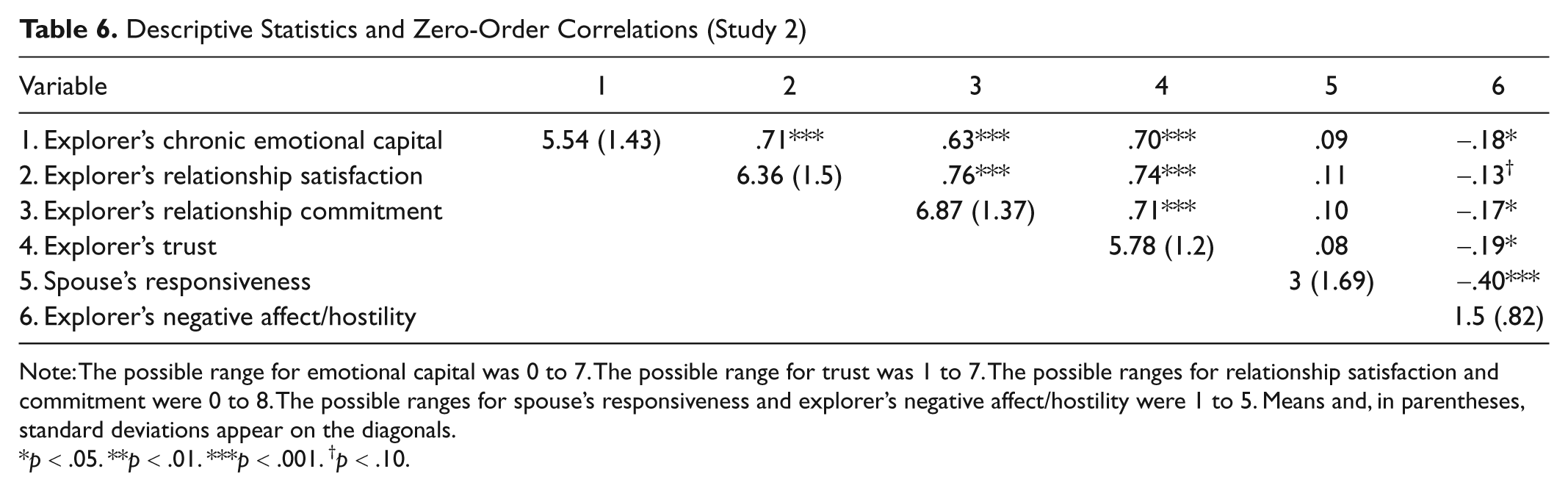
Note: The possible range for emotional capital was 0 to 7. The possible range for trust was 1 to 7. The possible ranges for relationship satisfaction and commitment were 0 to 8. The possible ranges for spouse’s responsiveness and explorer’s negative affect/hostility were 1 to 5. Means and, in parentheses, standard deviations appear on the diagonals.
p < .05. **p < .01. ***p < .001. † p < .10.
Buffering Effects of Chronic Emotional Capital
We expected that explorers with low chronic emotional capital would exhibit negative reciprocity—responding to their spouse’s lack of responsiveness with hostility—but that explorers with high chronic emotional capital would not exhibit this negative reciprocity. Moreover, if emotional capital is mobilized primarily in response to threat, then explorers’ emotional capital should predict their responding primarily when spouses were unresponsive.
To test these ideas, we regressed explorers’ negative behavior on explorers’ emotional capital, spouses’ responsive behavior, and a product term representing their interaction. The predicted interaction was significant, β = 1.56, t = 2.76, p < .01. Predicted values are plotted in Figure 5. Analyses of conditional effects revealed that spouses’ responsiveness predicted explorers’ negativity when explorers’ emotional capital was low (−1 SD), β = −.68, t = −5.16, p < .001, but not when it was high (+1 SD), p = .14. In addition, explorers’ emotional capital predicted their reduced negative behavior when spouses’ responsiveness was low (−1 SD), β = −.36, t = −3.30, p < .01, but not when it was high (+1 SD), p = .26. These results replicate findings of Study 1 while using observed relationship threat and reactivity to that threat. They suggest that chronic emotional capital moderates observed negative reciprocity and is utilized during relationship threat.

Explorers’ negative behavior as a function of spouses’ responsiveness and chronic emotional capital (Study 2)
Alternative Explanations
As in Study 1, we measured several variables that may serve as alternative explanations of emotional capital effects, including relationship satisfaction, commitment, and trust, and we tested whether emotional capital exhibited its moderating effects because of shared variance with these variables. Despite the positive correlations among these variables, the predicted emotional capital × spouses’ responsiveness interaction remained significant after controlling for each of these variables and its interaction with spouses’ responsiveness, ps < .05. In addition, none of these other interactions were significant, ps > .27. Hence, the positive affective experiences captured by our emotional capital measure seemed to uniquely moderate observed negative reciprocity, independently of these other variables.
General Discussion
Strong support for the proposed Theory of Emotional Capital was obtained in two studies using two samples (newlywed couples and more established married couples) and two methodologies (daily-diary and observational methods). These studies provide converging evidence for the idea that those who have made deposits into their relationship’s emotional bank account are less affected by relationship threats (e.g., conflict or potentially destructive relationship events/behaviors) because they have an emotional buffer and are unlikely to find their account overdrawn, whereas those who have very little emotional capital are more affected by potentially destructive relationship events/behaviors because they lack this emotional buffer.
We predicted that participants with high emotional capital would be less reactive to relationship threats than participants with low emotional capital. Using a daily-diary methodology, Study 1 showed that (a) relative to participants with low chronic emotional capital, those with high capital were less likely to respond to their partner’s lack of responsiveness by feeling less positively toward their partner, becoming dissatisfied with their relationship, and engaging in hurtful behaviors, and (b) relative to those with low recent emotional capital, those with high recent capital were less likely to respond to their partner’s lack of responsiveness by feeling less positively toward their partner or becoming dissatisfied with their relationship. Study 2 replicated the results of Study 1 using observational methods, showing that participants high in emotional capital were less likely than those low in emotional capital to engage in negative reciprocity in response to unresponsive partner behaviors.
These results contribute to prior research and theory that attempt to specify the conditions under which individuals are likely to engage in prorelationship behaviors (particularly in response to negative relationship behavior; Rusbult et al., 1991; Wieselquist et al., 1999), and that attempt to determine the predictors of relationship stability versus dissolution (e.g., Bradbury, 1998; Feeney & Monin, 2008; Gager & Sanchez, 2003; Gottman, 1998; Gottman, Coan, Carrere, & Swanson, 1998; Gottman & Krokoff, 1989; Gottman & Levenson, 1992, 2000, 2002; Huston, Caughlin, Houts, Smith, & George, 2001; Karney & Bradbury, 1995; Terling-Watt, 2001). They also support a major theoretical postulate that has been outlined in the work of Gottman and colleagues with regard to building a sound marital house by keeping one’s emotional bank account full (Gottman et al., 2002). This theoretical perspective is also consistent with theory and research showing that a reserve versus deficiency of personal psychosocial resources is predictive of health disparities (Gallo et al., 2005; Gallo & Matthews, 2003).
Notably, the current research suggests that emotional capital may moderate responses to relationship threats above and beyond other well-documented moderators of responses to threat, such as relationship satisfaction, commitment, and trust. In addition, although several items in the chronic emotional capital measure seem related to perceived partner responsiveness (i.e., the partner enacting behaviors that communicate positive regard, care, or commitment), we found similar moderating effects even using a measure of recent emotional capital that seemed distinct from perceived responsiveness (e.g., “We did something fun together,” “We worked together on something,” “We talked about something fun,” “We spent time together,” “We planned something together”). Hence, other positive experiences beyond the receipt of responsive behaviors seem to be relevant to how people respond to relationship threats.
Nonetheless, the results of this research raise many important questions for future investigation. First, it will be important for future work to examine in greater detail the ways in which emotional capital is related to problem solving and longer-term personal and relationship consequences. We propose bidirectional effects in which emotional capital breeds positive relationship tendencies/outcomes, and these positive relationship outcomes give rise to greater emotional capital. Future longitudinal and experimental work will be required to address the issue of causality. Second, it will be important to establish the effects of relationship capital with regard to other more serious types of relationship threats (e.g., betrayals). The emotional capital perspective posits that emotional capital will protect relationships from even severe threats; however, the buffering process is likely to occur over a longer period of time. This idea must be tested in future research. Third, the theoretical perspective advanced suggests that relationship partners who lack emotional capital are likely to make less generous attributions (than those who have emotional capital) for adverse relationship events and negative partner behaviors. This prediction also must be tested in future work. Fourth, theoretically, this process should apply to many types of relationships (e.g., romantic relationships, friendships, sibling relationships). Because only romantic relationships were considered in the current investigation, it will be important to establish these effects in other relationship types. Fifth, it will be important to consider effects of emotional capital (and lack thereof) in new versus established relationships. There is evidence suggesting that new, developing relationships are more fragile and less able to withstand relationship threats than are more established relationships (Lydon, Jamieson, & Holmes, 1997). The Theory of Emotional Capital would predict that one reason for this may be a lack of an emotional capital store in newly developing relationships. Relationship partners who have not built an adequate store of emotional capital before experiencing relationship threats should be less likely to withstand the threats to the relationship. Finally, it will be important for future research to consider discrepancies in the extent to which relationship partners have built emotional capital and related outcomes for each couple member. The theoretical perspective advanced here is that emotional capital has its most protective effects when it is built together between relationship partners. If one partner attempts to build emotional capital yet the sentiment is not embraced or reciprocated by the other, then there should be less protection against relationship threat.
It will also be important for future research to consider ways in which one’s emotional capital can be depleted. Theoretically, emotional capital should buffer individuals from negative effects of relationship threats, perhaps such that some threats are not even perceived as threats at all (if emotional capital leads individuals to make benign attributions for negative partner behaviors or to experience more positive biases). Thus, there is unlikely to be a tit-for-tat depletion such that one loses a measure of emotional capital for every measure of relationship threat that occurs. Instead, once emotional capital is “banked” to a sufficient degree, it is likely to be maintained and serve a buffering effect to the extent that the partners continue to make deposits and do not consistently experience relationship threats. If relationship partners consistently become unresponsive to needs and/or do not contribute to positive emotional experiences, then the account should begin to decline and become depleted over time. Of course, this is speculation and additional research is needed to test these ideas, but our current findings regarding buffering effects of recent emotional capital (i.e., accrued the prior day) support this dynamic view of emotional capital effects.
It is also interesting to note that this work is consistent with Gottman’s research showing that stable, happy couples have many more positive than negative interactions (Gottman, 1995, 1999). The idea that positive interactions must outweigh negative ones raises the issue of how much emotional capital is enough, and it may help to explain one way in which emotional capital can be depleted. Perhaps as long as relationship partners maintain a certain degree of positive emotional investments for every relationship threat, then the account does not deteriorate, an optimal balance is maintained, and the emotional capital provides an important buffering effect in protecting against relationship threats. However, relationship partners who do not maintain a certain level of emotional capital per relationship threat may, over time, experience greater depletion of the emotional capital that they had initially built. These ideas await future investigation.
The work presented here provides a strong foundation for exploring all such avenues of future research. Because relationships have been shown to exert such a powerful impact on psychological and physical health (for reviews, see Cohen, 2004; Cohen & Wills, 1985; Seeman, 2000; Uchino, Cacioppo, & Kiecolt-Glaser, 1996), it is important to determine the factors that contribute to their quality and stability. The Theory of Emotional Capital, and the studies presented here to test the theory, contribute to a growing literature on relational dynamics that promote versus hinder healthy personal and relationship functioning. This research also provides one practical answer to the question of why some relationships are better able to survive adversity/threat than others.
Footnotes
Acknowledgements
Special thanks to David Kenny for advice on data analysis.
Declaration of Conflicting Interests
The author(s) declared no potential conflicts of interest with respect to the research, authorship, and/or publication of this article.
Funding
The author(s) disclosed receipt of the following financial support for the research, authorship, and/or publication of this article: This research was supported by grants from the National Institute of Mental Health (MH066119) and the National Science Foundation (BCS0424579) to the first author.