



Abstract
Why do people neglect or underweight their past failures when thinking about their prospects of future success? One reason may be that people think of the past and future as guided by different causal forces. In seven studies, the authors demonstrate that people hold asymmetric beliefs about the impact of an individual’s will on past versus future events. People consider the will to be a more potent determinant of future events than events that happened in the past. This asymmetry holds between- and within-subjects, and generalizes beyond undergraduate populations. The authors contend that this asymmetry contributes to the tendency for people to remain confident about their future performance in domains in which they have largely failed in the past. This research thus contributes to a growing body of literature exploring how thoughts about events in the past differ from thoughts about the same events set in the future.
One of the most robust biases in the psychology of prediction is that people tend to hold overly optimistic beliefs about what lies ahead (Buehler, Griffin, & Ross, 1994; Weinstein, 1980). A number of explanations have been offered to account for unrealistic optimism about the future, and such a robust phenomenon is likely to be multiply determined. People hold overconfident views of the future because they are motivated to do so (Dunning, 2007); because they fall prey to a narrow focus on the attainment of a desired future event, ignoring other, less-desirable possibilities (Buehler et al., 1994); and because the future is hypothetical and abstract, it allows a great deal of flexibility in the exact nature of the favorable event that is seen as “likely” (Armor & Sackett, 2006). We offer an additional mechanism that feeds overconfidence about the future: People believe that the will is a stronger causal force in shaping future outcomes than it was in shaping past outcomes.
Maintaining Optimism About the Future by Underweighting the Past
One of the greatest sources of overconfidence about the future is people’s tendency to downplay relevant past behavior when forming predictions about what is to come. Gamblers remain optimistic about future success in the face of dismal records of past performance (Gilovich, 1983); the addicted and the overweight remain hopeful that their newest efforts to kick the habit or lose weight will be successful despite repeated previous failures to do so (Polivy & Herman, 2002); and many people solemnly make New Year’s resolutions aware that they have failed to live up to equally solemn vows in years past (Norcross, Ratzin, & Payne, 1989). Consider also the well-known planning fallacy, or the tendency for people to underestimate the amount of time it will take to finish a paper, file their taxes, or complete a construction project, offering predictions that are too optimistic compared with their actual completion times (Buehler et al., 1994). One reason for this misplaced optimism is that people often fail to consult their past experience in these very domains, choosing to ignore past episodes in which deadlines were only met through feverish, last-minute efforts or were not met at all. Even when people do bring past evidence to bear on their predictions (such as their personal base rate for the domain in question), they usually give too little weight to that information relative to its actual predictive power (Helzer & Dunning, in press).
Why do people downplay the past when developing expectations about the future? Although this tendency is itself likely to be determined by a host of motivational and cognitive influences, we explore a heretofore neglected determinant in the studies reported here: that people hold asymmetric beliefs about the impact of various causal forces for events that happened in the past and those that will happen in the future. Specifically, we tested the idea that people see the will as a more potent causal force for events set in the future than for the same events set in the past. To be concrete, consider once again the planning fallacy described earlier. The student who underestimates the time it will take to finish a term paper does so by ignoring past episodes of procrastination. We were interested in whether this neglect of past behavior might be due, in part, to the student’s belief that success in completing this paper will be more influenced by the exercise of will than were attempts to complete papers in the past. If so, persistent overconfidence may be partly a result of different lay theories about the causes underlying success and failure in the past versus the future.
Optimism for Everyone!
Those familiar with the overconfidence literature may be surprised by the generality of our thesis—that it entails optimism about future outcomes in general, for others as well as oneself. After all, there are a number of empirical demonstrations that people are much more (unrealistically) optimistic about their own future prospects than they are about the prospects of others (Buehler et al., 1994; Epley & Dunning, 2000; Koehler & Poon, 2006). In fact, unrealistic optimism was defined by Weinstein (1980) as predicted life outcomes for the self that are more favorable than predicted life outcomes for one’s peers.
This does not mean, however, that people are not optimistic about others’ outcomes—they are merely less so. Although the planning fallacy is greatly reduced when a person predicts a yoked peer’s completion time, predictions about others still tend to be overly optimistic relative to actual completion times (Buehler et al., 1994). Similarly, Helzer and Dunning (in press) asked students in a psychology class to predict their future exam performance. The investigators then gave each student’s background information (e.g., the student’s studying intentions, goals for the upcoming exam, performance on a previous exam) to a yoked peer and asked the peer to predict that student’s performance. Although peer predictions were more accurate than self-predictions, peer predictions were still optimistic relative to the test takers’ actual performance. Thus, although people are particularly optimistic about their own futures, they are broadly optimistic about the future in general.
The Perceived Role of the Will in Producing Outcomes
When people talk about the will, and when scholars write about it, they typically have in mind a faculty that allows a person to stick with his or her goals and to persist in the face of temptation (Locke & Kristoff, 1996). The related construct, willpower, is thought of as an energy reserve that allows the self to continue with willed action and to combat fatigue and the forces of temptation (Baumeister, Bratslavsky, Muraven, & Tice, 1998; Baumeister & Vohs, 2003). Mischel (1996) offered an account that aims for further conceptual clarity by distinguishing the will from related concepts such as intentionality. For Mischel, a person’s will (and willpower) is the critical ingredient that transforms intentions into actions, enabling behavioral commitment to one’s goals. In other words, willpower is the force that directs and sustains effort toward the realization of an intended outcome.
Because the will serves the role of translating intentions into outcomes, any increases in the perceived causal potency of the will should foster a greater sense of control, and thus, optimism about the future (see Harris, 1996). This does not mean that controllability, optimism, and willpower are interchangeable constructs. Previous investigators have distinguished controllability and optimism both theoretically and empirically (Klein & Helwig-Larsen, 2002; McKenna, 1993). Moreover, exerting more will may lead to greater controllability in some circumstances but certainly not all. Individuals who have suffered spinal cord injuries typically try to will their affected limbs to action, but if the injury is severe enough, their enhanced efforts do not produce the desired result. The exercise of will does not guarantee control. The reverse is also true: Events that are controlled do not necessarily require will. Drivers control whether their car stays on the road, but the actions that allow them to do so are so overlearned that they are hardly aware that they are doing them and no exercise of willpower is necessary to ensure that the goal is achieved.
Indeed, it is precisely because the relationship between the will and control is imperfect that temporal asymmetries in the perceived impact of the will can result in unrealistic optimism about the future. If the will is seen as a more potent causal force in the future relative to the past, the future will appear more amenable to personal control. Unrealistic optimism will creep in wherever increases in perceived control are not matched by increases in actual control.
Temporal Perspective as an Attributional Moderator
The hypothesis that people stress the will as a cause of future outcomes more than past outcomes is one variant of a broader literature on contextual moderators of attribution. The weight people assign to internal and external causes is (of course) guided by the particularities of the precise event to be explained, but attribution theorists have identified a number of general attributional tendencies. The well-known self-serving bias consists of people attributing their successes to internal factors and their failures to external factors (Zuckerman, 1979). The actor–observer bias (Jones & Nisbett, 1972) represents another attributional asymmetry, whereby people are more inclined to make situational attributions (and less inclined to make dispositional attributions) for their own behavior than for the behavior of others (see Malle, 2006, and Pronin & Kugler, 2010, for updated—and divergent—perspectives on the actor–observer bias). These different strands of research indicate that people are prone to asymmetries in their assessments of various causal factors—that is, events are attributed to internal factors in one frame of reference but to external factors in another. We sought to expand this work by testing whether a particular kind of internal cause, a person’s will, is judged to be more influential in the future than in the past.
Our contention that temporal perspective is the source of another attributional asymmetry gains credence from research demonstrating that people think differently, in numerous ways, about the past versus the future. Caruso, Gilbert, and Wilson (2008) found that people place more value on events when they are set in the future than when they are set in the past. In one study, people thought they deserved greater compensation for a job when the work was set a month in the future as opposed to a month in the past.
Rothbart and Snyder (1970) found that people bet more on the outcome of a die roll if the die had yet to be rolled than if it had already been rolled (but the outcome was unknown). The authors attributed this finding to differences in feelings of control: Participants could feel more control over an event that had yet to occur than one that had already happened. Taking a different perspective, Brun and Teigen (1990) advanced a matching hypothesis to explain the result: When the level of aleatory uncertainty matches the level of epistemic uncertainty, people feel greater confidence. Thus, because past outcomes are potentially knowable and future outcomes are not, people tend to feel more confident when betting on an event set in the future (an unknown state of the world that matches participants’ own uncertainty) than when betting on an event set in the past (a known state of the world that does not match participants’ uncertainty).
Overview of the Present Studies
The aim of this research was to explore a mechanism underlying people’s pervasive tendency to remain confident in the prospects of future success despite a record of past failure—namely, whether people see the will as a greater causal force in producing future outcomes than past outcomes. To test this idea, we asked participants to consider events that were set in the (equidistant) past or future and to make attributions for or predictions about a protagonist’s outcomes. Across several different paradigms, we examined people’s attributions to the will, to “fixed” factors (i.e., factors that the individual cannot readily change, such as biology, genetic inheritance, situational influences), and to chance. We predicted that participants would see the will as a more powerful causal force in shaping future outcomes than past outcomes.
We also addressed several corollary issues. First, we examined whether the proposed asymmetry in causal assessments applies to the actions of all agents, or only to the self. Second, we explored whether this phenomenon exists over and above a general self-servingness in attribution. We thus examined, in Studies 1A and 1B, whether people exhibit the proposed asymmetry when the event to be explained is a personal failure.
Most important, we sought to elucidate the role of this asymmetry in people’s overconfident estimates about the likelihood of future success. In Study 1B, we tested whether participants would report a greater sense of personal control over future outcomes than for equivalent outcomes set in the past. In Study 4, we tested whether an asymmetric emphasis on the will would lead people to judge a protagonist to be more likely to overcome ego depletion and exert sufficient self-control when the test of will was set in the future, rather than the past. Finally, in Study 5, we explored whether participants would be more likely to bet on a student with strong willpower (but poor past performance) than on a student with high scholastic aptitude (but ambiguous willpower) when wagering on an event set in the future, rather than the past.
In planning this research, we were careful to try to tap this asymmetry using two distinct types of measures to ensure that the documented asymmetry was robust and not limited to a particular method of elicitation. Study 1A assessed participants’ attributions using hydraulic measures: Participants indicated the relative strength of different causal factors by specifying the percentage they thought each factor (will, fixed factors, chance) contributed to the outcome in question. Thus, in adherence to the logic of Kelley’s (1972) discounting principle, attributions to any one factor were constrained by the weight assigned to the others. It is also the case, however, that attributions can be additive in nature, such that the weight assigned to one cause does not diminish the weight assigned to other causes (Ahn & Bailenson, 1996; Hansen & Hall, 1985; Leddo, Abelson, & Gross, 1984). Thus, in Studies 2, 3A, and 3B, we examined past–future asymmetries in attributions to the will by allowing participants to make independent assessments of the impact of the will, chance, and fixed factors. To preview our results, participants showed a robust temporal asymmetry in their attributions to will regardless of the measure we employed.
Studies 1A and 1B
In the first two studies, we asked participants to reflect on three different actual or possible events from their own lives as they occurred in the past or as they will occur in the future. In Study 1A, participants rated a number of causal factors according to how much impact they did/would have in producing the result. In Study 1B, we assessed whether, as a by-product of seeing more will at play in producing future outcomes, participants would believe they have greater personal control over events set in the future than (roughly) the same events set in the past.
Method
Participants
Forty-seven participants completed Study 1A and 23 completed Study 1B at the end of unrelated lab sessions.
Materials and procedures
In Studies 1A and 1B, participants were asked to consider three outcomes: getting admitted into a school of their choice, losing a competition, and performing successfully in school (Study 1A) or in a job interview (Study 1B). Half of the participants were asked to look back on these events as they happened in the past; the other half were asked to look forward to the events happening in the future. For example, participants were instructed to
think back to a time when you participated in a competition and lost [imagine yourself in a future competition of some sort. Imagine that you lose] or to think back on a time when you performed well on an exam in a tough class [imagine performing well on a future exam in a tough class].
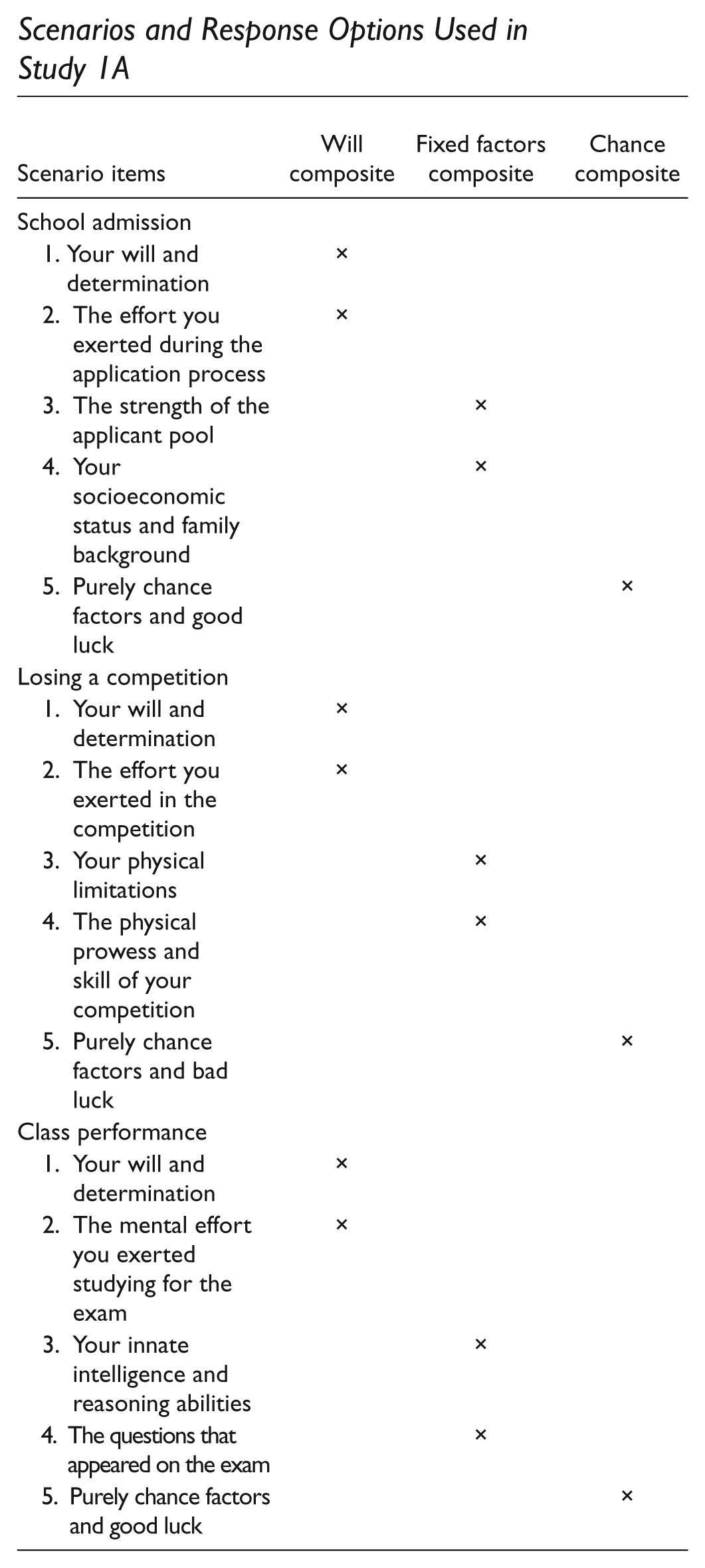
In Study 1A, participants were asked to consider a number of factors that might have been [would be] influential in producing the outcome. Participants rated the extent to which will, effort, innate ability, chance, and situational factors contributed to the outcome by indicating what percentage of the outcome (from 0 to 100) was due to each factor. These were defined more precisely according to each scenario (see the appendix for individual items). Participants were told that their answers should sum to 100% (which we confirmed).
In Study 1B, participants were invited to think about the three events as they occurred/would occur in the past/future and to reflect on why they occurred/will occur. After thinking about the factors that did [would] contribute to each of the three outcomes, participants rated the amount of personal control they had [would have] over each on a 1 = none at all to 7 = complete control scale
Results and Discussion
To assess Study 1A participants’ beliefs about the impact of different causal forces in the past versus the future, we created three composites, representing attributions to will (will and effort questions), “fixed” factors (stable features of the person or the situation), and chance. 1 We collapsed these measures across scenarios and then compared the will composite with attributions to “fixed” factors and chance.
As predicted, a 2 × 3 mixed ANOVA (with time as a between-subjects variable and causal factor as a repeated-measures variable) yielded a significant Time × Factor interaction, F(2, 44) = 4.68, p = .01. As shown in Table 1, participants judged the will to be more causally efficacious in the future than in the past, F(1, 45) = 6.97, p = .01. In contrast, they gave equal weight to the fixed factors of personality and situational influences in the future and the past, F(1, 45) < 1. Although participants gave more weight to chance in the past than in the future, F(1, 45) = 6.13, p = .02, this result should be interpreted with caution. Because judgments were nonindependent, the unequal weight assigned to chance may simply be an artifact of the temporal asymmetry in the perceived importance of the will. The nonindependent nature of our measures prevents us from unambiguously establishing that it is shifting beliefs about the will that are responsible for the observed attributional asymmetry, as opposed to asymmetric beliefs about other causal factors. We return to this issue later (after we have examined the results of studies that used nonhydraulic attribution measures).
Participants’ Ratings of the Relative Causal Impact of the Will, Chance, and the Fixed Factors of Innate Ability and Situational Constraints (Study 1A)
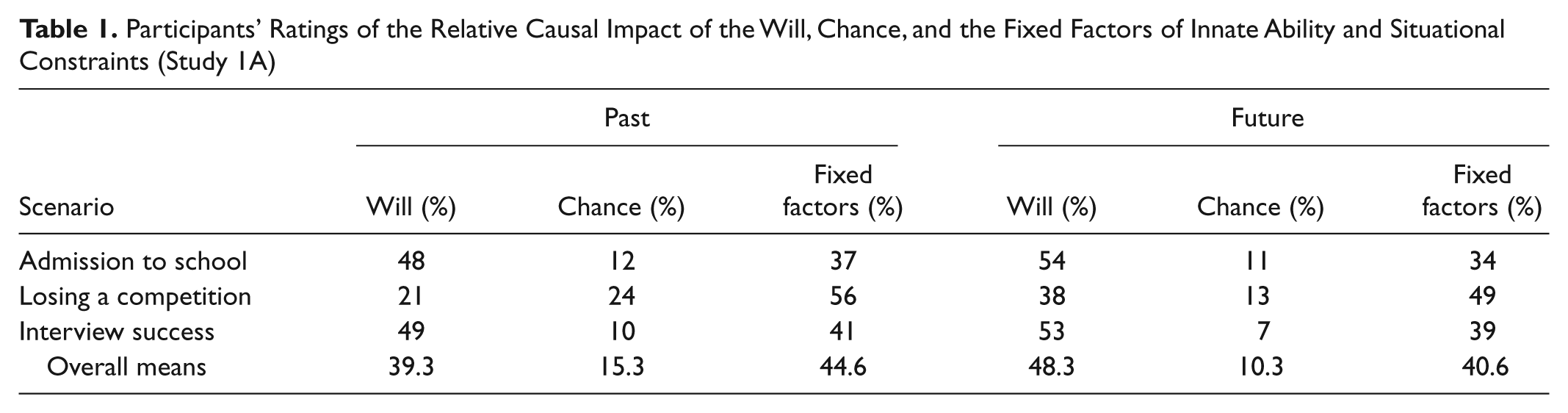
In a final analysis, we explored whether the will asymmetry was moderated by the scenario participants read. We entered the will composites from each of the three scenarios into a repeated-measures ANOVA with time as a between-subjects factor and scenario as a within-subjects factor. Although participants tended to de-emphasize the role of will in producing negative events (losing a competition), F(2, 44) = 22.00, p < .0001, this main effect of scenario did not moderate the temporal asymmetry reported above, F(2, 44) < 1.85, p > .17, which was significant in the full model, F(2, 44) = 6.97, p < .01.
If people see the will as more causally efficacious in producing future outcomes than past outcomes, they should consider an event to be more controllable in the future than in the past. As shown in Figure 1, this is exactly what happened. Participants judged future outcomes to be more controllable than the same outcomes set in the past. The predicted main effect of time was significant, F(2, 21) = 13.12, p < .001, as was the main effect of scenario, F(2, 21) = 8.36, p < .002. Importantly, the main effect of time did not differ by scenario, F(2, 21) < 1.
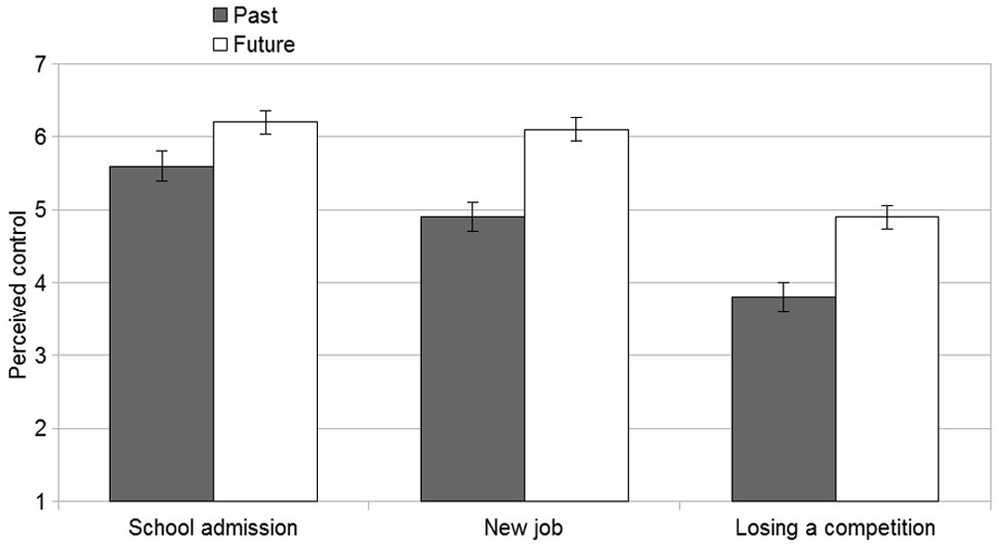
Participants’ ratings of the amount of personal control they had or would have over events set in the past or future (Study 1B)
The results of Studies 1A and 1B support the idea that people see the will as a more potent causal force in the future than in the past. Future outcomes were attributed to participants’ own will to a greater extent than were the same outcomes set in the past. Future outcomes were also seen as more controllable than the same outcomes in the past. Note that participants did not accentuate attributions to the will only when considering future successes: They exhibited the same past–future symmetry when evaluating the causes of a lost competition.
These studies suffer from two limitations that are addressed in the subsequent studies. First, participants evidenced the predicted asymmetric attributions to the will (Study 1A) and beliefs about personal control (Study 1B) with regard to their own outcomes, not another person’s. In the remaining studies, we examine whether the same pattern applies to people’s judgments about the outcomes of others. Second, past and future outcomes in these studies were confounded with actual outcomes (events participants had already lived through) and hypothetical outcomes (events they had yet to live through). Although this mimics a great deal of real-life judgment (people are always speculating about an uncertain future on the basis of their certain past), it leaves open the possibility of all sorts of alternative interpretations of the observed effects. In the remaining five studies, we therefore held constant the real/hypothetical nature of the past and future outcomes participants were asked to consider. In these studies, we also allowed participants to make attributions using independent measures to allay any concerns that the past/future asymmetry to the will is an artifact of the hydraulic measures used in Study 1A.
Study 2
Participants were asked to imagine that another person had accomplished (past) or will accomplish (future) a feat of physical strength. Participants were then asked to attribute this outcome to three factors: the person’s will, physical prowess, and chance. We assessed whether participants would see another person’s will as more influential in producing a future outcome than a past outcome.
Method
Participants
Forty-one participants filled out our survey online for US$0.03.
Materials and procedure
Participants were asked to consider an individual, Peter, who is enrolled in the Army and is asked by his sergeant to do 60 push-ups. Participants were told that 60 was 15 more than Peter’s personal best. Nonetheless, participants learned that 1 year ago (1 year from now), Peter successfully accomplished (will successfully accomplish) the challenge of exceeding his personal best by 15 push-ups. Participants were then asked to attribute Peter’s success to three factors: the strength of his will, pure physical strength, and chance. They made their ratings on three separate scales from 1 = not at all to 5 = entirely.
Results and Discussion
Again, participants offered asymmetrical attributions to the will for past and future events. Participants attributed Peter’s success more to will when it was set in the future than when it was set in the past, F(1, 39) = 5.68, p < .05. Ratings of the extent to which the outcome was due to physical strength or to chance did not differ by time frame, Fs(1, 39) < 1.26, ps > .25. This pattern yielded a significant Time × Factor interaction, F(2, 38) = 3.35, p < .05 (see Figure 2).
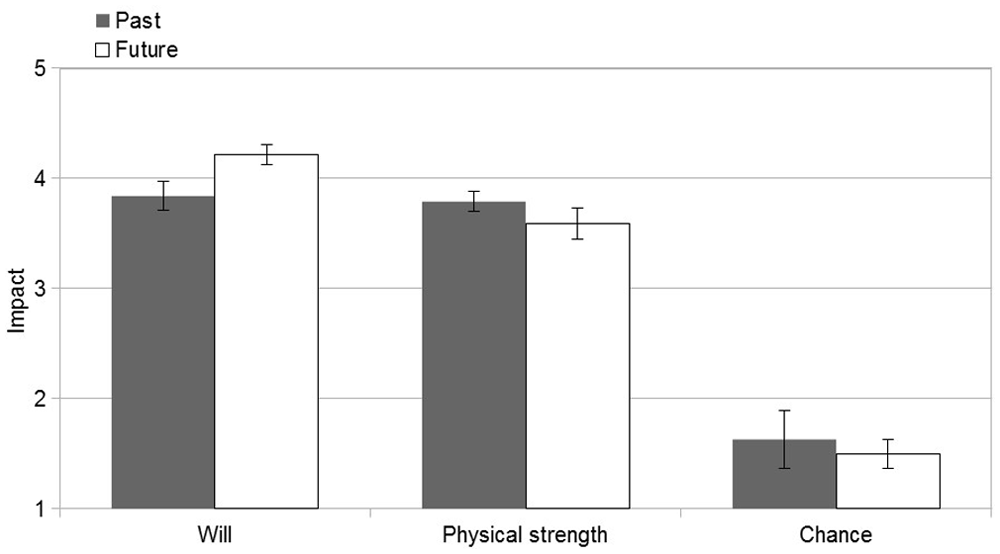
Participants’ ratings of the causal significance of the will, physiology, and chance in determining the outcome of a test of physical endurance set in the past or the future (Study 2)
The results of Studies 1A demonstrate that people think the will has more impact in shaping their future outcomes than their past outcomes. People in turn see the future as more controllable than the past (Study 1B). The results of Study 2 indicate that this past–future asymmetry also applies to beliefs about the outcomes of others. Regardless of the actor involved or the measures used (hydraulic or independent), people see the will as a more potent causal force in the future than in the past.
Studies 3A and 3B
These studies explored the robustness of the will asymmetry by asking participants to attribute success in the past and future within-subjects. The within-subjects nature of the design provides a strict test of the idea that people hold distinct causal theories about the forces that govern the past and the future (because any such theories must be strong enough to overcome consistency concerns). Participants considered the job prospects of a Cornell graduate at a time set equidistantly in the past or future. In Study 3A, participants were presented with three factors—will, innate intelligence, and luck—and were asked how much they thought each of these factors would influence the prospects of two graduates, one graduating 5 years previously and one graduating 5 years hence. In Study 3B, participants in 2010 were asked to indicate which of two students (one from 2005 and one from 2015) would need more will to succeed after graduation.
Method
Participants
In Study 3A, 32 Cornell alumni were approached during the 2010 reunion weekend and asked to fill out several brief questionnaires, including the one reported here. In Study 3B, 183 participants, ranging in age from 18 to 62 years (Median = 30 years), were recruited from Mechanical Turk to complete the questionnaire in exchange for US$0.05.
Materials and procedures
Participants were asked to consider two hypothetical students, one a graduate of the class of 2005 and the other a graduate of the class of 2015. They were told that a number of factors might contribute to these students’ postgraduation success at finding employment. Participants in Study 3A were asked to consider the role of the will, innate intelligence, and luck in shaping the students’ success. They rated the three factors on independent scales from −3 (much less important in the future relative to the past) to +3 (much more important in the future relative to the past), with 0 as a midpoint (equally important in the future relative to the past). Thus, Study 3A was entirely within-subjects.
In Study 3B, participants were faced with a simple choice: Which of two students—past or future—would need a stronger will to be successful? They indicated their response by clicking on a button next to either option. They were then asked to think about the general question, “Does it seem that willpower is a stronger force in the future or the past?” and to pick one of the following response options: much stronger in the past, somewhat stronger in the past, somewhat stronger in the future, and much stronger in the future. We collected the ages of participants to examine whether the magnitude of the predicted effect might vary with age.
We expected participants in Study 3A to assign greater causal weight to the will in the future than the past. In Study 3B, we predicted that participants would indicate that the individual graduating in the future would need more will to succeed and that they would tend to endorse the general claim that the will is a more potent force in shaping future events than past events. We made no prediction about whether advancing age would attenuate or exacerbate the strength of this asymmetry.
Results and Discussion
In Study 3A, we compared participants’ mean responses to the questions about the influence of the will, intelligence, and luck to the null value of 0. (A response of 0 indicates that the participant thought the factor in question would be equally potent in the future and the past, and a response above 0 indicates a belief that the factor would have more influence in shaping the future than it did in shaping the past.)
Interestingly, when directly comparing the past and future impact of the three factors, participants thought that the will (M = 1.51), innate intelligence (M = 0.90), and luck (M = 0.61) would all have more impact in the future than the past. That is, the mean rating for all three factors was significantly higher than 0, all ts(31) > 2.21, ps < .05. However, an inspection of the means revealed that the increased emphasis given to the will in the future versus the past was greater than the increased emphasis given to the other two factors. To test the significance of this asymmetry, we conducted a planned contrast ANOVA with contrast rates of +1 for ratings of will and −0.50 for both intelligence and luck. This contrast was significant, F(1, 31) = 5.70, p < .05. Thus, the past/future asymmetry in attributions to the will was significant over and above a general tendency to give more weight to causal factors in the future, relative to the past. 2
If this asymmetry is robust, then when given the choice of which student (past or future) would need more will to be successful, people should disproportionately choose the future student. Indeed, among participants in Study 3B, a significant majority of respondents (60%) chose the future student over the past student, z = 2.79, p < .01. We then examined participants’ responses to the general question about whether the will is a stronger causal force in shaping future outcomes than past outcomes. Because participants offered their responses on an ordinal scale with no true midpoint, we simply tabulated the percentage of respondents who offered each of the four responses. A full 77% of the participants said that the will would either be somewhat more or much more important in shaping the future than the past, a proportion that differs significantly from the null value of 50%, z = 8.70, p < .0001. Table 2 presents the percentage of participants offering each of the four responses.
Participants’ Views of the Relative Strength of the Will in the Past Versus the Future (Study 3B)

Finally, to test whether the temporal asymmetry in the importance attached to the will varies by age, we created a composite score by averaging each participant’s standardized answers to the two questions in Study 3B and regressed that composite on participants’ age. There was a small but significant effect, such that older participants tended to exhibit a greater past/future asymmetry in the importance attached to the will, r = .15, p < .05.
The results of Studies 3A and 3B thus advance our thesis in two ways. First, the adult samples used here and in Study 2 speak against the possibility that past–future differences in attributions to the will are a product of youthful undergraduate hubris. In fact, the correlational result from this study indicates that the effect is strongest among those who have had the most time to learn the limitations of sheer willpower in bringing about future outcomes.
Second, by using a within-subjects design, participants were made aware of their divergent beliefs about the causes of past and future events. They showed the asymmetry nonetheless and, in Study 3B, showed it very directly by indicating explicit agreement with the claim that the will is a stronger force in shaping future outcomes than past outcomes.
Study 4
Does the asymmetry we have documented lead to overconfidence about future outcomes? The results of Study 1B hint that the answer is “yes,” but to test this question more directly, we asked people to consider an instance of self-regulation in an ego-depleted state. If people see the will as more powerful in the future than the past, they should expect a person to have greater success at exerting self-control following an ego-depletion task (Baumeister et al., 1998) set in the future rather than the past.
Method
Participants
Fifty-nine students completed this questionnaire at the end of an unrelated lab session.
Materials and procedure
Participants first read a description of the central tenets of the contemporary ego-depletion literature: that the will is like a muscle, that acts of self-regulation are depleting, and that deploying self-control resources on one task is likely to decrease a person’s ability to successfully self-regulate when performing a subsequent task (see Baumeister et al., 1998). They then read, from either a past or future perspective, about a fictitious participant in an ego-depletion experiment, Mike, who was asked to count the number of Es in the Emancipation Proclamation. Then, as a reward for participation, Mike was given a choice of either carrot sticks or a candy bar. Participants were told that Mike was on a diet and that although he knew the carrot sticks were the healthy option, the candy bar was tempting. They were reminded that he had been depleted by the letter-counting task and told that, unbeknownst to Mike, the experimenters were interested in the extent to which the first act of self-regulation would influence his snack choice.
Participants were then asked to estimate the effect of the first task on Mike’s self-control resources. First, participants were asked two items tapping their beliefs about the amount of depletion Mike would feel following the first self-control task: “How much was/will Mike’s will [be] depleted by the first self-control task?” and “To what extent did/will he possess self-control resources for the second task?” (reverse scored). Participants answered the first question on a 1 = not at all to 7 = a great deal scale and answered the second as a percentage of the resources that would remain. Because responses to these two questions were highly correlated, r = .78, we standardized and averaged responses as a measure of perceived depletion. On the critical dependent measure, participants were asked about the likelihood of Mike’s success on the second self-control task: “How likely do you think it is that Mike was/will be able to choose the carrots over the candy bar?” (1 = not at all likely to 7 = very likely).
We expected participants to estimate that Mike’s willpower would enable him to succeed on the second task more when it was set in the future than the past. We had no prediction about whether there would be any temporal differences in participants’ assessments of whether Mike would be more depleted following the initial task.
Results and Discussion
Participants’ beliefs about the depleting effect of the first self-control task were similar across conditions, t < 1. That is, they thought Mike would be just as depleted after counting Es in the future as he would after counting Es in the past. Nevertheless, those in the future condition thought that he would successfully exert greater willful control over his future behavior (M = 6.21, SD = 1.39) than those in the past condition (M = 4.90, SD = 2.06), t(57) = 2.91, p < .01. Furthermore, although perceived depletion was related to participant’s ratings of self-control success, b = −.30, p < .05, beliefs about depletion did not moderate the overall effect, p > .83, and the past/future asymmetry was still significant after controlling for participants’ depletion ratings, p < .01. Together, these results indicate that because the will is seen as a stronger causal force in shaping future outcomes than past outcomes, people tend to be more optimistic about the potency and effectiveness of someone’s future self-regulatory efforts.
These results also provide more nuanced insight into the nature of participants’ temporally asymmetric beliefs about the will. Temporal asymmetries in attributions to the will can result from either of two processes. First, they can result from people simply seeing more will in the future—that is, that actors will have more willpower resources available in the future than in the past. Alternatively, people may believe that a given amount of willpower is more causally efficacious in the future than in the past (i.e., each “unit” of will available should have a greater impact in the future than the past). The results of this study support the latter interpretation. Participants did not believe that Mike would have more willpower resources available to him in the future than in the past. But they did believe that the willpower resources available to him in the future would have greater impact—this belief supported participants’ increased confidence in his ability to self-regulate his future actions.
Study 5
Does this temporal asymmetry lead people to discount relevant past behavior when making future predictions? So far, we have provided evidence that the past–future asymmetry in the perceived power of the will leads people to believe that they (Study 1B) and others (Study 4) will have more control over outcomes in the future than they had in the past. In this study, we examined whether these asymmetric beliefs about the will lead people to downplay relevant past behavior and to make predictions about the future that weight an actor’s will more heavily than other predictors of performance.
Participants were told about two students who were preparing for an upcoming chemistry exam. One student was described as having earned a B− on a past exam, but was known to possess a strong will; the other student had earned a better grade on the first exam (a B+) and had an aptitude for science. Participants were invited to bet on one of the students to outperform the other. Participants read the scenario either from a past or future perspective. We were interested in whether setting the event in the future would cause participants to downplay past performance and aptitude and be more inclined to bet on the student with the strong will.
Method
Participants
One hundred thirty participants completed the questionnaire online for US$0.05. Of these, 12 failed the manipulation check (i.e., they were unable to report whether the event had been set in the past or the future), so their data were excluded.
Materials and procedures
Participants read about two students, Allie and Carolyn, who were studying for an upcoming exam in the same chemistry class. To motivate themselves, Carolyn and Allie had placed a bet on who would perform better on the exam. Participants were told that Carolyn had received a B− on the previous exam and Allie had received a B+. They were also told that “Carolyn is known among her friends to have a very strong will; when she sets her mind to something she has been able to surpass the goals she sets for herself” and that Allie “is known among her friends to have an aptitude for chemistry, and enjoys her science courses.” Participants were then presented with the dependent measure:
The exam will occur 1 week from now [occurred 1 week ago]. Imagine you have US$5 to bet on the girls’ competition. You can bet on one girl to win [that one girl won] or you can divide your money, betting some amount of money that one girl will win [won] and some other amount of money that the other girl will win [won].
Participants then indicated how they would bet by selecting from the following options: I bet more money on the student with the strong will; I bet more money on the student with an aptitude for chemistry; or I bet equally on the two. This final option allowed participants to express indifference about the students’ prospects. As can be seen in Figure 3, almost no one chose this response.
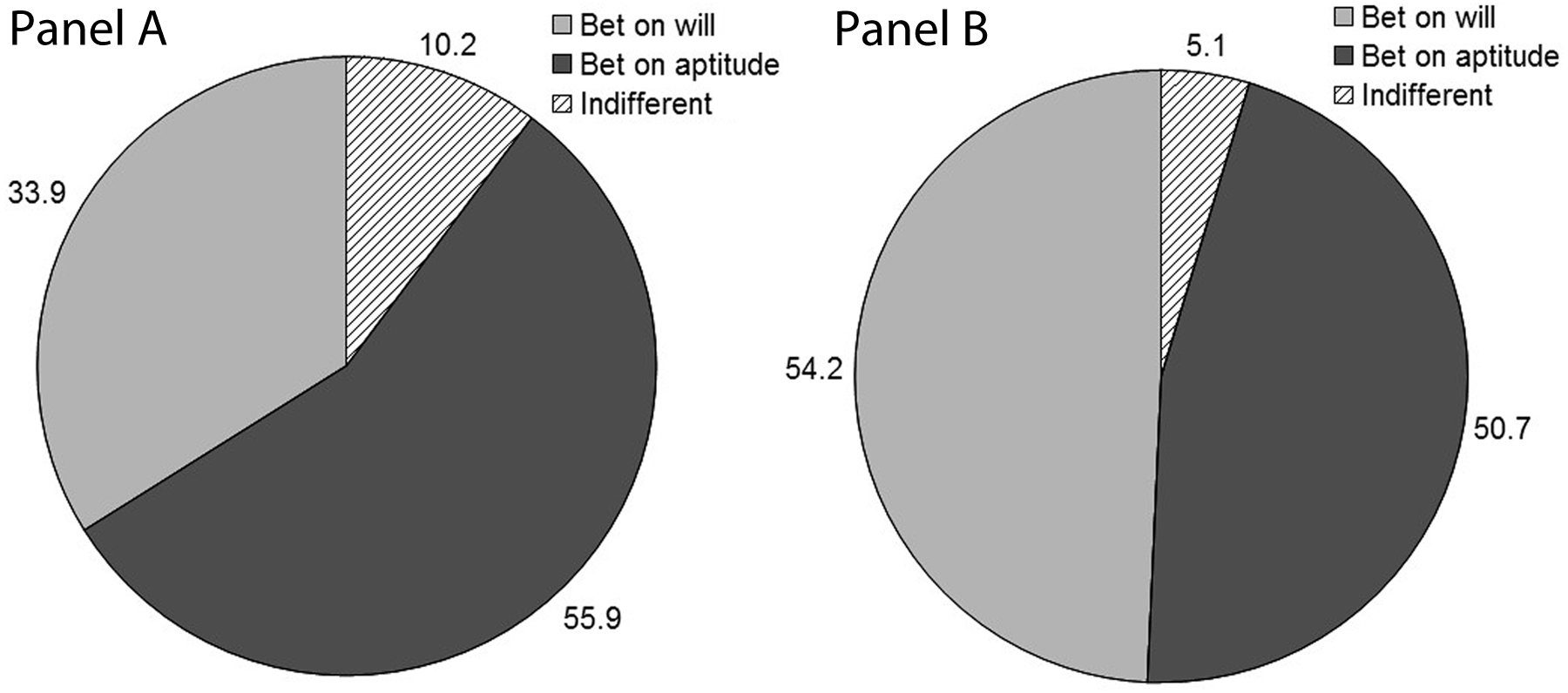
Participants’ bets on the past (Panel A) or future (Panel B) academic performance of either a student with a strong will or demonstrated aptitude (Study 5)
Results and Discussion
As predicted, participants who read about the exam occurring next week were more likely to bet on the student with the strong will (54.2%) than were participants who read about the exam having taken place last week (33.9%), z = 2.04, p < .05. In other words, when the event was set in the future, a majority of participants chose to ignore more concrete (and perhaps normatively important) predictors of performance, such as the students’ aptitude and past performance, and preferred instead to bet on the causal efficacy of the students’ will.
General Discussion
There are a number of entirely defensible reasons to believe that one might succeed in the future despite a record of persistent failure in the past. Sometimes an individual might really have been insufficiently motivated in the past, and now, with newfound resolve, the odds of success would indeed increase (Weiner, Heckhausen, Meyer, & Cook, 1972). Sometimes a person might recognize that his or her previous approach to the problem was misguided and all that is needed is a change of strategy (Anderson & Jennings, 1980). If the new strategy turns out to be truly more apt and not merely a pipe dream, success is indeed more likely. And sometimes the world might have changed—an opponent has gotten weaker, a new market has opened up, demographics have shifted, and so on—making one’s future efforts more likely to succeed than one’s past efforts.
But what we have documented here is an entirely indefensible reason for people to believe that they will succeed in the future even though they have consistently failed in the past. When they look at the road ahead, people see the will as a more potent causal force than it has proven to be in the past. As a consequence, people can downplay the diagnosticity of past failures, even repeated ones, because they view the causal structure of the future as different from that of the past.
We have presented evidence from seven studies that support this idea. Our participants saw the will as a stronger force in determining future behavior than past behavior (Studies 1A, 2, 3A, and B), and this basic temporal asymmetry was connected to participants’ expectations about their own personal control (Study 1B), their faith in another person’s ability to overcome temptation (Study 4), and their inclination to bet on someone with a strong will over someone with greater aptitude and a better record of past performance in a given domain (Study 5).
This past–future asymmetry in participants’ attributions to the will is robust: Participants thought their own and other people’s future successes would be more influenced by exertion of will than their past outcomes had been, and they extended this asymmetry to beliefs about personal failure. This asymmetry was reflected in the beliefs of students and nonstudents alike, and it was not attenuated (indeed, it was exacerbated) as participants aged. Participants exhibited this asymmetry both when considering actual events in their own lives (Studies 1A and 1B) and when considering hypothetical events (Studies 2-5). The effect was observed in both between- and within-subjects designs and was obtained whether participants were forced to make attributional trade-offs between causal factors (i.e., when the weight assigned to different causal factors had to sum to 100%) or were free to make independent assessments of the different causal factors.
We conducted this research to explore what we thought was a neglected mechanism underlying the tendency for people to remain optimistic about future success in the face of past failure. Thus, the results from our seven studies help to explain a phenomenon that has captured psychologists’ attention for some time. But of course the past–future asymmetry we have documented is itself in need of explanation. Why might people hold temporally asymmetric beliefs about the power of the will—asymmetric beliefs that apply to one’s own and others’ exercise of willpower? We propose that the past–future asymmetry stems from at least two sources—people’s broad and pervasive associations to the past and future, and people’s lifetime of experience with the differential malleability of past and future events. With respect to the former, people typically associate the future with openness, brightness, and freedom of movement, but associate the past with fixedness, darkness, and restriction. We have found, for example, that people represent the future using brighter colors than they use to represent the past (Helzer, Hanko, & Gilovich, 2012). We have also found that people are more likely to symbolically represent the future using lighter substances (such as elemental gasses) and the past using heavier substances (e.g., metals). These broad associations to the future and past are likely to influence people’s attributions for events set in these different time periods. To the extent that the future is seen as a less weighty realm of openness, free movement, and possibility, and the past as a heavy period of closed, restricted movement, the future is likely to be seen as affording the will the opportunity to exert itself and guide behavior toward a person’s desired goals in a way that the past cannot match.
This idea—that people’s intuitive feelings about the past versus the future guide their reasoning about causality—is consistent with other work, both older and more recent. Fischoff’s (1975) exploration of the hindsight bias emerged from the observation that people imbue the past with a sense of “creeping determinism,” an implicit belief that past events unfold by necessity and thus could not have been otherwise. A complementary set of findings has recently been reported by Pronin and Kugler (2010), who found that people believe that future events are less predictable than past events were. Perhaps, then, people’s mechanical and deterministic sense of the past leads them to appeal to physical and mechanical causes, and their indeterministic sense of the future points to more ethereal, psychological, and probabilistic causes (for a related idea, see Wasserman, Lempert, & Hastie, 1991). We recently obtained evidence consistent with this idea. We manipulated participants’ sense of the will by having them read one of two essays. In one, we left people’s lay beliefs intact, saying that although physical causation governs brain functioning, deterministic laws seem insufficient for understanding “higher order” functions like a person’s capacity for willing their behavior. In another, we manipulated people’s sense of the will by telling them that mental states are nothing more than physical brain states, specifying that the capacity for willed action is entirely deterministic. Later, in an “unrelated” task, we gave them the questionnaire from Study 2. When the will was described in a manner consistent with participants’ preexisting intuition, we replicated the past–future will asymmetry; when the will was described as a deterministic mental faculty, no such asymmetry was present (Helzer et al., 2012).
Another likely contributor to the past–future asymmetry in attributions to the will derives from two complementary experiences we all have in life. On one hand, everyone has experienced times when what they will (i.e., what they desire or want from the future) actually comes to be. On the other hand, everyone has had the unfortunate experience of realizing that no amount of exertion of will can change the past. As causal agents, we are practiced at orienting to the future in a willful, goal-directed fashion. The same cannot be said of the past. In fact, people may see past events and their causes as snares to be overcome by future acts of will. Thus, although we took pains to equate for certainty of outcomes between past and future in all of our studies (save for the first two, which examined people’s thoughts about real-world successes and failures), people’s experiences as causal agents may have trumped our careful scenario writing. If so, when people report that the will is a more important force in shaping their own or another person’s future, they may be overgeneralizing from their experience as causal agents.
It is up to future research to untangle the relative contributions of these and other possible mechanisms underlying this attributional asymmetry, although, like optimism itself, it is a phenomenon that is almost certainly multiply determined. However that research plays out, it is clear that the past–future difference in attributions to the will that we have documented contributes to a general overconfidence about the future. Psychologists who study overconfidence often bemoan the tendency for people to disregard the past when thinking about the future: Why don’t people make greater use the one piece of information that is so manifestly relevant to predicting future behavior? The answer provided in this article is that people hold different theories about the causes of outcomes in the past and in the future. To the extent that the will seems overmatched in the past, but potent in the future, people will give too little weight to past behavior, and too much weight to the strength of a person’s will, when they estimate what the future may hold.
These results contribute to an emerging literature demonstrating that people think about the past differently than they think about the future. Our work fits with research by Caruso and colleagues (2008) in showing that the same event is evaluated differently depending on its place in time. Indeed, additional research could explore whether the tendency to place greater value on future events than objectively equivalent events set in the past (Caruso et al., 2008) is related to the tendency to attribute future events to an actor’s will or other agentic states (see Burns, Bartels, & Caruso, 2012). Our work also fits with the finding that people bet more on a chance event that has yet to occur than on an event that has already occurred, but whose outcome has not been revealed (Rothbart & Snyder, 1970). Notably, the two explanations offered for this phenomenon are consistent with our proposed mechanisms underlying the temporal asymmetry in attributions to the will. According to Brun and Teigen’s (1990) account, people bet more on the future because uncertainty about the future matches people’s own subjective uncertainty about the roll of the dice. Similarly, we have suggested that people’s subjective sense of the will (as a free, unrestricted causal force) fits better with their subjective sense of the future as open, unrestricted, and free than with their sense of the closed, restricted past. Furthermore, the original mechanism proposed by Rothbart and Snyder (1970)—that people have greater feelings of control over the future than the past, leading them to bet more on events set in the future—gels with our second proposed mechanism for the will asymmetry. Because people are accustomed to willing events in the future, but not the past, future events are seen as more amenable to personal control than past events.
Conclusion
One reason people may form misguided expectations about the future—expectations that seem only loosely connected to the realities of the past—is that the past and future are experienced as psychologically distinct realms, governed by different causal forces. When they look back, people are hard-pressed to see the role played by the will in shaping the outcomes they received. In contrast, when looking forward to an open, unrestricted future, people see the will as a powerful force guiding their behavior. Of course, a person’s future attempts to exert willpower are likely to run up against the same roadblocks as those experienced in the past. Those unexpected snags and distractions that interrupted the person’s best-laid plans last week may very well show up in one form or another next week. Blind to this reality, people exaggerate the importance of the will as a decisive cause of tomorrow’s outcomes, and, as a result, are overconfident about the future. Then, when the will falls short yet again, they can look back on a past that reinforces their beliefs about the weakness of the will as a determinant of past outcomes—but hold out hope for a future in which the exercise of willpower is likely to bring about their hopes and dreams.
Footnotes
Appendix
Scenarios and Response Options Used in Study 1A
| Scenario items | Will composite | Fixed factors composite | Chance composite |
|---|---|---|---|
| School admission | |||
| 1. Your will and determination | × | ||
| 2. The effort you exerted during the application process | × | ||
| 3. The strength of the applicant pool | × | ||
| 4. Your socioeconomic status and family background | × | ||
| 5. Purely chance factors and good luck | × | ||
| Losing a competition | |||
| 1. Your will and determination | × | ||
| 2. The effort you exerted in the competition | × | ||
| 3. Your physical limitations | × | ||
| 4. The physical prowess and skill of your competition | × | ||
| 5. Purely chance factors and bad luck | × | ||
| Class performance | |||
| 1. Your will and determination | × | ||
| 2. The mental effort you exerted studying for the exam | × | ||
| 3. Your innate intelligence and reasoning abilities | × | ||
| 4. The questions that appeared on the exam | × | ||
| 5. Purely chance factors and good luck | × | ||
Declaration of Conflicting Interests
The author(s) declared no potential conflicts of interest with respect to the research, authorship, and/or publication of this article.
Funding
The author(s) disclosed receipt of the following financial support for the research, authorship, and/or publication of this article: This research was supported by National Science Foundation Grant SES-0922323.