




Abstract
In two experiments, the authors investigated how differences in social value orientation predict evaluations of procedures that were accorded to self and others. Proselfs versus prosocials were either granted or denied an opportunity to voice an opinion in a decision-making process and witnessed how someone else was either granted or denied such an opportunity. Consistent with the hypothesis, procedural evaluations of both proselfs and prosocials were influenced by own procedure when other was granted voice, but only proselfs were influenced by own procedure when other was denied voice. These findings were particularly attributable to prosocials’ tendency to evaluate a situation where no-voice procedures are applied consistently between persons more positively than proselfs. It is concluded that proselfs are focused on procedural justice and injustice for self more than prosocials, whereas prosocials value equality in procedures more than proselfs—even when equality implies injustice for all.
One of the most pervasive moral values in contemporary society is that people ought to be treated fairly—with dignity and with respect—by others. The importance that people attribute to fair treatment is illuminated by a growing body of research on procedural justice, which focuses specifically on the way people are treated by decision-making authorities (Thibaut & Walker, 1975). Research within this domain indicates that the perceived fairness of decision-making procedures can have far-reaching consequences for people’s well-being, as variations in procedural justice have been found to be associated with people’s positive and negative emotions, their perceptions of mutual respect between themselves and authorities, their cooperativeness, and their general life satisfaction. These effects were revealed in many types of social situations, like for instance organizations, educational settings, the political arena, and laboratory experiments (for overviews, see Brockner & Wiesenfeld, 1996; De Cremer & Tyler, 2005; Folger & Cropanzano, 1998; Lind & Tyler, 1988; Tyler & Blader, 2003; Van den Bos & Lind, 2002). These accumulating research findings underscore how strongly people are concerned about the extent to which authorities make use of fair procedures during social decision making.
To determine how fair decision-making procedures are, Leventhal (1980) noted that people evaluate procedures by means of various criteria. Examples of these procedural criteria are that procedures should be applied in the same manner to all parties (the “consistency-between-persons” rule) and that procedures should be representative of the basic concerns and values of the parties affected by the decision (the “representativeness” rule). Empirical procedural justice research has tended to place exceptionally strong emphasis on the concept of “voice,” which is most closely associated with the procedural criterion of representativeness. The typical finding regarding this construct is that people tend to believe that they were treated fairer following decision-making procedures that allow them an opportunity to voice their opinion when compared with procedures that deny them such an opportunity (Folger, 1977; Folger, Rosenfield, Grove, & Corkran, 1979). Opportunities for voice are considered to be valuable for various reasons: Not only do voice opportunities raise recipients’ outcome expectancies (see Houlden, LaTour, Walker, & Thibaut, 1978; Lind, Kanfer, & Earley, 1990), but more importantly, voice procedures communicate positive relational information, such as that the recipient is respected and appreciated as a worthwhile member of one’s community (e.g., Tyler & Blader, 2003). The effects of voice as opposed to no-voice procedures have been frequently investigated, and it is well established that these effects are robust and generalize across methods and samples (Folger et al., 1979; Tyler, 1987; Van den Bos & Lind, 2001; Van den Bos, Wilke, & Lind, 1998; Van Prooijen, 2009; Van Prooijen, Karremans, & Van Beest, 2006; Van Prooijen, Van den Bos, & Wilke, 2005).
Although research on voice effects and related procedural justice phenomena has yielded a wealth of findings, a noteworthy limitation is that most studies focused on recipients’ reactions to their own procedures, while ignoring how information about procedures that were accorded to others may contribute to fairness-based evaluations (see Van Prooijen et al., 2008; Van Prooijen & Zwenk, 2009). This provides only a limited perspective on the psychology of procedural justice, as it stands to reason that different procedural justice criteria may be more pronounced when people have such social comparison information. Although people particularly use egocentric procedural justice criteria when they lack social comparison information (“Did I receive voice?”; Van Prooijen et al., 2008), it is likely that information about the procedures that were accorded to both self and others increases the impact of the relatively more egalitarian consistency-between-persons rule (“Am I treated the same as others?”), as such social comparison information allows for an assessment of how fairly decision-making procedures were distributed (Platow & O’Brien, 2009). To investigate to what extent people reason in egocentric versus egalitarian ways when evaluating procedural justice, experimental research necessarily needs to manipulate variations in decision-making procedures that are accorded to both self and other. The number of experimental studies that pursued such an approach is limited, however (for exceptions, see Lind, Kray, & Thompson, 1998; Van den Bos & Lind, 2001; Van Prooijen, Van den Bos, Lind, & Wilke, 2006).
The present research is designed to make two novel contributions. First, we examine people’s underlying motivations to be concerned about procedural justice in a setting with two recipients (self and other): To what extent are people predominantly egocentric in their reasoning about procedural justice (valuing voice opportunities for self only) and to what extent are they driven by egalitarian motives (valuing equal treatment for self and other)? To investigate this question, we focus specifically on social value orientation (SVO), an individual difference variable that predicts people’s egocentric versus egalitarian motives during social decision making (Messick & McClintock, 1968; Van Lange, Otten, De Bruin, & Joireman, 1997). Second, by focusing on SVO, the present research seeks to investigate how individual differences may determine the way in which people form judgments of procedural justice. In particular, we aim to show that prosocials and proselfs (a) both are concerned about procedural justice, but (b) they base their evaluations on different procedural criteria (Leventhal, 1980). Notably, we will argue that prosocials’ orientation toward equality leads them to be more willing to accept injustice if someone else was treated equally unfair. In the following, we introduce our line of reasoning in more detail.
SVO and Procedural Justice
SVO typically distinguishes between prosocials and proselfs to characterize preferences during social decision making. Prosocials are defined in terms of enhancing collective outcomes and equality in outcomes between themselves and other; proselfs are defined in terms of enhancing own outcomes, either in an absolute sense (individualists) or in a relative or comparative sense (competitors; for example, De Cremer & Van Lange, 2001; Parks, 1994; Smeesters, Warlop, Van Avermaet, Corneille, & Yzerbyt, 2003). Research indeed reveals that relative to proself orientations, a prosocial orientation is associated with greater tendencies to enhance both collective outcomes and equality in outcomes (Van Lange, 1999) and that equality may be an even stronger motive than enhancing collective outcomes (Eek & Gärling, 2006).
Although most research focused on differences between prosocials and proselfs in situations that involve questions about distributive justice—that is, situations in which behavior directly shapes the material outcomes for themselves and others (Van Lange et al., 1997)—recent research reveals that SVO also has implications for reasoning about procedural justice, independent from concerns about material outcomes. In four studies, Van Prooijen and colleagues (2008) found consistent evidence that particularly proselfs—and not prosocials—are responsive to variations in the extent to which decision-making authorities allow or deny them the opportunity to voice their opinions. Consistent with the theoretical and empirical distinction between distributive and procedural justice (Brockner & Wiesenfeld, 1996; Colquitt, 2001; Thibaut & Walker, 1975), these effects still materialized after controlling for distributive justice perceptions. These findings suggest that procedural justice effects—at least in situations where recipients are informed about their own procedures only—can be accounted for by various egocentric motives or needs, not only in terms of gaining favorable outcomes but also in terms of gaining respect from others and establishing a positive sense of self-worth.
One may wonder, however, whether such egocentrism in procedural evaluations would generalize to situations where recipients also have information about the extent to which someone else is granted or denied voice. Indeed, a study by Van den Bos and Lind (2001; Exp. 2) indicates that participants incorporated both their own and other’s procedure in their final procedural evaluations: Voice versus no-voice procedures for self only influenced procedural evaluations when participants received information that the other participant received a voice procedure. When the other participant was denied voice, participants responded equally negative to either a voice or no-voice procedure for self. These results suggest that people’s evaluations of decision-making procedures depend on how both self and others are treated, such that people only respond positively to voice procedures for self if they know that an unknown other was granted voice as well. This finding supports the idea that evaluations of procedural justice can be motivated by egalitarian concerns in a setting with two recipients.
In the present research, we sought to delineate how prosocials and proselfs differ in their justice-based responses to a situation where self and other were either granted or denied voice. The general premise on which we base our line of reasoning is that proselfs and prosocials differ in the relative weight that they ascribe to egocentric versus egalitarian procedural justice criteria when evaluating procedures in a multirecipient setting. This point extends previous studies (Van den Bos & Lind, 2001; Van Prooijen et al., 2008) by illuminating that both proselfs and prosocials are concerned about procedural justice, but they do so by adhering to different justice criteria when forming procedural evaluations. Given their propensity to reason egocentrically, proselfs are relatively more likely than prosocials to be concerned about the extent to which they themselves are able to maintain a positive relation with decision makers, regardless of how this decision maker treats others. As a consequence, particularly proselfs are likely to base procedural evaluations on egocentric procedural justice criteria (“Do I receive voice?”), while being relatively insensitive to the treatment accorded to other. Prosocials, in contrast, are due to their social motives more likely to focus on the extent to which self and other received equal procedures. As such, prosocials are more likely than proselfs to base procedural evaluations on egalitarian procedural justice criteria, notably the extent to which procedures are applied consistently between self and other (see Leventhal, 1980).
Such differential emphasis on egocentric versus egalitarian procedural justice criteria can be expected to shape procedural evaluations particularly when other is denied voice, and less so when other is granted voice. When other is granted voice, receiving voice as well is likely to be evaluated very positively by both prosocials and proselfs because both egocentric and egalitarian procedural justice criteria are met (i.e., self receives voice and procedures are consistent between persons). When other is granted voice but self is denied voice, procedural evaluations are likely to be very negative among both prosocials and proselfs given that none of the relevant procedural justice criteria are met (i.e., self is denied voice and procedures are inconsistent between persons). Thus, when other receives voice, we expect people to be influenced substantially by their own procedure irrespective of their SVO.
When other is denied voice, however, the evaluation context is more complex as recipients are faced with the dilemma of deciding to what extent procedural evaluations should be based on egocentric versus egalitarian procedural justice criteria. When self is granted voice while other is denied voice, egocentric procedural justice criteria are met (i.e., self is granted voice), whereas egalitarian procedural justice criteria are not met (i.e., procedures are inconsistent between persons). Likewise, when self is denied voice and other is denied voice as well, egocentric procedural justice criteria are not met (i.e., self is denied voice), whereas egalitarian procedural justice criteria are met in the sense that procedures are equal—and hence, consistent between persons—even though in this case it implies that both parties are accorded equally poor treatment (see Leventhal, 1980). In both cases, proselfs and prosocials may experience an internal conflict between adhering to egocentric versus egalitarian procedural justice criteria, but proselfs are more likely to place stronger emphasis on egocentric criteria than prosocials, whereas prosocials are more likely to place stronger emphasis on egalitarian criteria than proselfs.
On the basis of these considerations, we propose that proselfs will be more susceptible to their own procedure than prosocials when other is denied voice. Given their aversion toward inequality, prosocials may evaluate procedures more negatively than proselfs when they receive voice but perceive how other was denied voice. Paradoxically, and perhaps more importantly, prosocials are also likely to evaluate a situation where both self and other are denied voice more positively than proselfs. Although such a situation may not necessarily elicit exceptionally positive responses among prosocials—after all, it is not likely that prosocials are insensitive to the decision maker’s choice to use procedures that most people consider to be offensive—the fact that no-voice procedures are applied consistently between persons may satisfy prosocials’ concern for equality to some extent. Hence, the general hypothesis that we test is that procedural evaluations of both proselfs and prosocials are influenced by own procedure (voice vs. no voice) in a condition where other is granted voice, but procedural evaluations are influenced more strongly among proselfs than among prosocials by own procedure (voice vs. no voice) in a condition where other is denied voice. We tested this hypothesis in two experiments.
Experiment 1
The first experiment was a study in which we first measured SVO and then asked participants to respond to a scenario in which they imagined how both self and other were granted or denied voice. Following the study by Van den Bos and Lind (2001), the main dependent variable was participants’ procedure judgments, that is, evaluations pertaining to the perceived fairness of, and experienced satisfaction with, the procedures accorded to self and other.
Method
Participants and design
Undergraduate students at the University of Skövde, Sweden (N = 150, 60 men, 90 women; Mage = 25.56; SD = 6.23) were classified as prosocial or proself and were randomly assigned to conditions varying own procedure (voice vs. no voice) and other’s procedure (voice vs. no voice). Participation took approximately 30 min, and participants received a movie ticket in return for their participation.
Procedure
Stimulus materials were handed out during regular classes, and participants were informed that the questionnaire contained several unrelated studies. In “Study 1,” SVO was assessed by means of the Triple Dominance Measure of Social Value Orientation (TDMSV; for details, see Van Lange et al., 1997). Consistent with previous studies (e.g., De Cremer & Van Lange, 2001; Van Prooijen et al., 2008), individualists and competitors were collapsed to create a composite group of proselfs. 1 In the present study, 69 participants were classified as prosocial and 69 as proself. Twelve participants were not classifiable due to inconsistent pattern of responses and therefore excluded from further analyses, resulting in a sample of 138 participants.
After filling out the TDMSV, participants turned the page to find “Study 2.” Here participants were asked to read a scenario and imagine that it happened to them personally. In the scenario, participants read that they were working for a company that had recently signed a contract with a new important client. The company was now about to decide who would be in charge of the new client. It was explained that getting this client would be a great career opportunity and that the participant really wanted to get the job. It was further stated that management had announced that the position would go either to the participant or to another employee (Robin), who was comparable to the participant in terms of competence and experience.
This information was followed by the manipulations of own and other’s procedure. In the own voice condition, participants were informed that they received an opportunity to personally present their case for the management before the decision was made. In the own no-voice condition, participants read that, due to time constraints and because the participant was currently out of town on a business trip, no opportunity was given to present their case before the decision was made. Other’s procedure was then manipulated in a similar fashion. Participants in the other voice condition read that Robin received an opportunity to present his case for the management before the decision was made, whereas participants in the other no-voice condition read that Robin received no such opportunity due to time constraints and because Robin was out of town on a business trip.
We then assessed participants’ procedure judgments by asking the following questions referring to procedural justice and procedural satisfaction (1 = absolutely not, 7 = absolutely): “Do you think the way in which the management decided who should get the job was fair?” “Do you think the way in which the management decided who should get the job was correct?” “Are you satisfied with the way you were treated by the management during the decision-making process?” “Are you happy with the way management made the decision about who should get the job?” and “Are you content with the way the management made the decision about who should get the job?” It turned out that these items had very strong intercorrelations (rs > .59, ps < .001). In addition, a confirmatory factor analysis indicated that a model in which these items loaded on the same factor had a good fit to the data (NFI = 0.92; CFI = 0.93). Given these findings, and in keeping with previous research (Van den Bos & Lind, 2001; Van Prooijen, Van den Bos, & Wilke, 2005), we decided to average these items into a composite scale of participants’ procedure judgments (α = .92). After completing another unrelated study, participants were debriefed, thanked, and paid for their participation.
Results
Cell means and standard deviations are displayed in Table 1. Participants’ procedure judgments were subjected to a 2 (SVO) × 2 (own procedure) × 2 (other’s procedure) ANOVA. This analysis revealed a main effect of own procedure, F(1, 130) = 215.86, p
Procedure Judgments as a Function of Social Value Orientation, Own Procedure, and Other’s Procedure (Experiment 1)

Note: Entries within parentheses are standard deviations; entries without parentheses are cell means. Higher means indicate more favorable procedure judgments. Means with no subscript in common differ significantly (p < .05).
The procedure main was qualified by an own procedure by other’s procedure interaction, F(1, 130) = 107.03, p < .001,
To further test our hypothesis, we examined the SVO by own procedure interaction in the other voice and other no-voice conditions separately. When other received voice, the SVO by own procedure interaction was nonsignificant, F < 1. Thus, irrespective of SVO, responses were more positive following an own voice procedure than following an own no-voice procedure when other received voice. When other did not receive voice, however, a SVO by own procedure interaction emerged, F(1, 130) = 5.88, p < .02,
Discussion
The results corroborated the hypothesis: When other received a no-voice procedure, proselfs were still responsive to own procedure, whereas prosocials were not. Further analyses revealed that this finding was attributable to more positive procedure judgments of prosocials in the condition where both self and other were denied voice in comparison to proselfs. This latter finding suggests that prosocials value equality in procedures, even when it implies equality in poor treatment. No evidence was found for the idea that prosocials would respond more negatively than proselfs to the own voice/other no-voice condition, a limitation that we address in Experiment 2 below. Taken together, Experiment 1 provides preliminary evidence for the general idea that proselfs and prosocials use different justice criteria to evaluate decision-making procedures.
Experiment 2
The second experiment sought to extend Experiment 1 by addressing three of its limitations. The first limitation is that Experiment 1 was a scenario study. In Experiment 2, proselfs and prosocials directly experienced a voice or a no-voice procedure and directly witnessed how another participant also was granted or denied voice (see Van den Bos & Lind, 2001). The second limitation is that in Experiment 1, no evidence was found for the assertion that prosocials would display more negative procedure judgments than proselfs in the own voice/other no-voice condition. We speculate that this expected difference between proselfs and prosocials did not materialize due to the way the dependent variables were phrased. Participants were asked about the perceived fairness of, and experienced satisfaction with, the procedures used by the management in general. As such, participants were implicitly stimulated to engage in social comparison by taking other’s procedures into account in their evaluations. It is possible that such collective framing mitigated proselfs’ egocentric tendencies to some extent. Indeed, previous studies suggest that various social cues can increase the extent to which proselfs behave attentively to others’ needs, even though strategic motives may often drive these ostensibly prosocial acts (Van Kleef & Van Lange, 2008; Van Lange, Klapwijk, & Van Munster, 2011). In Experiment 2, we took a different approach by asking participants to evaluate their own procedures. Thus, whereas Experiment 1 examined to what extent participants chose to ignore other’s procedure when evaluating procedures in general, Experiment 2 examined to what extent participants chose to incorporate other’s procedure in their evaluations of their own procedure. Participants therefore evaluated the experimenter’s choice to either allow or deny themselves voice, which served the purpose of making participants’ egocentric tendencies more pronounced to increase the power to detect potential differences between prosocials and proselfs in the own voice/other no-voice condition.
A third limitation pertains to an alternative, more instrumental, explanation of the current findings. Our line of reasoning presented in the introduction suggests that the observed differences between proselfs and prosocials are independent from concerns about material outcomes (see Van Prooijen et al., 2008). Given that in Experiment 1 no measures were included of how participants perceived the expected outcomes of the decision-making process (e.g., distributive justice, outcome favorability), one cannot exclude the possibility that the differences between prosocials and proselfs in procedural evaluations occur because of instrumental expectations that voice procedures increase the likelihood of fair or favorable outcomes. To empirically establish that the observed differences between proselfs and prosocials in procedural evaluations do not necessarily emerge because of material outcome expectations, in Experiment 2 we included measures of expected distributive justice and expected outcome favorability.
Method
Participants and design
A total of 104 participants were recruited at the VU University Amsterdam campus (34 men, 70 women; Mage = 20.69; SD = 2.71). We again classified participants as prosocial or proself and assigned them randomly to conditions varying own procedure (voice vs. no voice) and other’s procedure (voice vs. no voice). The experiment lasted approximately 20 min, and participants were paid €2.50 for participation.
Procedure
Upon entry in the laboratory, participants were led to separate cubicles. These cubicles contained computer equipment, which we used to present the stimulus materials and to register the data. The experiment was introduced as two separate and unrelated studies. In “Study 1,” we again measured SVO by means of the TDMSV. It turned out that 38 participants could be classified as prosocial and 59 participants could be classified as proself. The remaining 7 participants were not classifiable, and hence, these participants were excluded from further analyses.
Participants then continued with “Study 2.” The study was presented as a study on how people differ in the way that they approach various types of tasks. Participants were informed that they would be conducting the tasks simultaneously with another participant, who was conducting the same study in another cubicle; this person would be referred to as “Other” for the remainder of the experiment. In addition, participants were told that they could receive computer messages from the experimenter, who was allegedly seated behind a computer in a different cubicle (in reality, all stimulus information was preprogrammed). As an additional bonus, a lottery with a prize of €50 would take place among all participants in the experiments, and hence, the experimenter had 200 lottery tickets at his disposal; some of these lottery tickets would be distributed to the participant and Other after conducting the tasks.
Participants then conducted the tasks, which entailed the counting of squares with a distinct pattern within larger figures. Participants conducted these tasks for 3 min (for a more detailed description of these tasks, see Van den Bos et al., 1998; Van den Bos & Van Prooijen, 2001; Van Prooijen et al., 2005). After the tasks, participants received a message stating that Other completed a roughly equal number of tasks. Participants were then asked how hard Other had worked on the tasks compared with how hard they themselves had worked on the tasks (1 = much less hard, 7 = much harder), and they were asked to what extent Other was comparable to themselves (1 = not at all comparable, 7 = very comparable).
Participants were then reminded of the lottery that would take place among all participants and were informed that the experimenter would soon be dividing the lottery tickets. We then induced the manipulations of own and other’s procedure. Participants in the own voice condition received a computer message from the experimenter stating that they were allowed an opportunity to voice an opinion regarding the percentage of lottery tickets they should receive relative to Other. These participants were then asked to type in a percentage. Participants in the own no-voice condition received a computer message from the experimenter stating that they were denied an opportunity to voice an opinion regarding the percentage of lottery tickets they should receive relative to Other. These participants were not asked to type in a percentage. After this, we manipulated other’s procedure: Participants in the other voice condition were informed that Other was allowed an opportunity to voice an opinion regarding the percentage of lottery tickets they should receive relative to the participant; participants in the other no-voice condition were informed that Other was denied such an opportunity.
Participants were then told that they would be informed about their number of lottery tickets at the end of the study and that they first would respond to a number of questions. These questions pertained to the dependent variables and manipulation checks. To measure participants’ procedure judgments, the following questions were posed (wording depended on own procedure condition): “How fair do you consider the procedure that allowed/denied you the opportunity to voice your opinion?” (1 = very unfair, 7 = very fair), “How just do you consider the procedure that allowed/denied you the opportunity to voice your opinion?” (1 = very unjust, 7 = very just), “How correct do you consider the procedure that allowed/denied you the opportunity to voice your opinion? (1 = very incorrect, 7 = very correct), “How satisfied are you with the procedure that allowed/denied you the opportunity to voice your opinion? (1 = very dissatisfied, 7 = very satisfied), and “How happy are you with the procedure that allowed/denied you the opportunity to voice your opinion?” (1 = not very happy, 7 = very happy). It turned out that all these items again were strongly intercorrelated (rs > .67, ps < .001), and a confirmatory factor analysis indicated that a model in which these items loaded on the same factor had a good fit to the data (NFI = 0.91; CFI = 0.92). We therefore again collapsed these items into a composite scale of participants’ procedure judgments (α = .94).
We then assessed our outcome-related measures. To measure expected distributive justice, participants were asked the following three questions: “How fair do you expect the lottery tickets to be divided?” (1 = very unfair, 7 = very fair), “How just do you expect the lottery tickets to be divided?” (1 = very unjust, 7 = very just), and “How correct do you expect the lottery tickets to be divided?” (1 = very incorrect, 7 = very correct). These three items were averaged into a reliable distributive justice scale (α = .97). To measure outcome favorability, participants responded to the following question: “To what extent do you expect to receive more lottery tickets than Other?” (1 = absolutely not, 7 = absolutely).
To check the manipulation of own procedure, the following two questions were posed (1 = not at all, 7 = very much): “To what extent did the experimenter allow you an opportunity to voice your opinion about the percentage of lottery tickets you should receive relative to Other?” and “To what extent did the experimenter pay attention to your opinion about the percentage of lottery tickets you should receive relative to Other?” These two questions were averaged into a reliable own procedure check (α = .94). To check the manipulation of other’s procedure, two comparable questions were posed (1 = not at all, 7 = very much): “To what extent did the experimenter allow Other an opportunity to voice an opinion about the percentage of lottery tickets Other should receive relative to you?” and “To what extent did the experimenter pay attention to Other’s opinion about the percentage of lottery tickets Other should receive relative to you?” These two questions were averaged into a reliable other’s procedure check (α = .95). After this, participants were informed that the experiment had ended. They were fully debriefed, thanked, and paid for their participation.
Results
Manipulation checks
The manipulations were checked by means of 2 (SVO) × 2 (own procedure) × 2 (other’s procedure) ANOVAs. The analysis on the own procedure check revealed a significant main effect of own procedure only, F(1, 89) = 219.63, p < .001,
Perceptions of Other
We then analyzed participants’ responses on the questions how hard Other worked on the tasks relative to themselves (effort) and how comparable Other was to themselves (similarity). A 2 × 2 × 2 MANOVA revealed no significant effects at both the multivariate and univariate levels. The overall means for both questions were around the scale midpoint (for effort: M = 4.14, SD = 0.50; for similarity: M = 4.56, SD = 1.35). These results reveal that participants did not believe there were substantial differences between self and Other in terms of effort and generally believed themselves not to be extremely different from, or similar to, Other.
Procedure judgments
The means and standard deviations are displayed in Table 2. A 2 × 2 × 2 ANOVA on the procedure judgments scale revealed significant main effects of own procedure, F(1, 89) = 85.76, p < .001,
Procedure Judgments as a Function of Social Value Orientation, Own Procedure, and Other’s Procedure (Experiment 2)
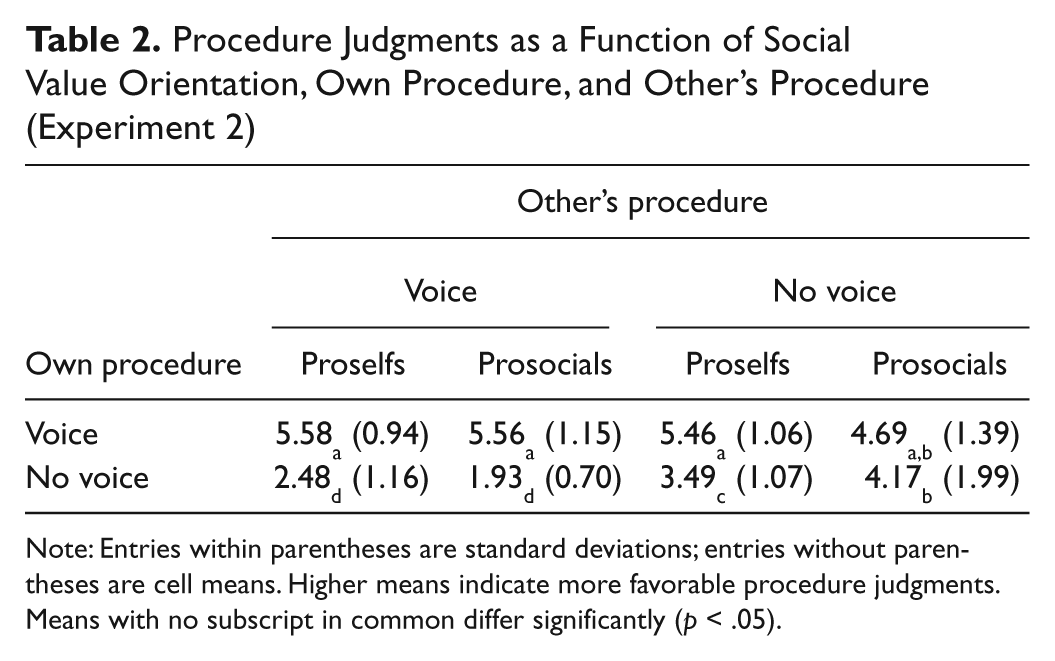
Note: Entries within parentheses are standard deviations; entries without parentheses are cell means. Higher means indicate more favorable procedure judgments. Means with no subscript in common differ significantly (p < .05).
To further test our hypothesis, we tested the SVO by own procedure interaction within the conditions of the other’s procedure. If Other was granted voice, the SVO by own procedure interaction was nonsignificant, F(1, 89) = 1.00, p = .32, which reveals that own procedure had an equally strong effect irrespective of SVO in this condition. If Other was denied voice, however, the SVO by own procedure interaction was significant, F(1, 89) = 7.86, p < .01,
Outcome-related measures
To establish that the present findings emerge independently from material outcome expectations, we tested whether the crucial three-way interaction on procedure judgments would still materialize after controlling for expected distributive justice and outcome favorability. The analysis revealed that expected distributive justice was a significant covariate, F(1, 87) = 12.94, p < .01, and that outcome favorability was not a significant covariate, F(1, 87) = 2.74, p = .10. Importantly, when controlling for these outcome-related judgments, the predicted three-way interaction on procedure judgments was still significant, F(1, 87) = 4.87, p < .04. In keeping with previous research (Van Prooijen et al., 2008), these results reveal that outcome-related expectations do not provide a sufficient explanation of the association between SVO and procedural justice.
Discussion
The results further supported the main hypothesis: As in Experiment 1, own procedure had a stronger impact on proselfs than on prosocials when Other was denied voice. This finding was again partly attributable to a more positive evaluation among prosocials of the consistent denial of voice for both self and other. Furthermore, results also revealed evidence that prosocials evaluated their procedure more negatively than proselfs in the own voice/other no-voice condition, a finding that is attributable to prosocials’ aversion for inequality. These effects cannot be accounted for by instrumental motives alone, as indicated by the finding that the expected three-way interaction remained significant after controlling for expected distributive justice and outcome favorability. Taken together, findings from both experiments underscore the different criteria that proselfs and prosocials use to evaluate procedures in a multirecipient setting.
General Discussion
Two experiments indicated consistent differences between prosocials and proselfs in their evaluations of procedures that were accorded to self and other. A scenario study (Experiment 1), as well as an experiment in which participants directly experienced variations in decision-making procedures accorded to self and other (Experiment 2), revealed that people are strongly influenced by their own procedure (voice vs. no voice) when they are informed that the other party received a voice procedure. When confronted with information that other was denied voice, however, proselfs and prosocials respond differently to their own procedure. Whereas procedural evaluations of proselfs were still influenced substantially by their own procedures, procedural evaluations of prosocials were not. Moreover, this decreased susceptibility for own procedures when other was denied voice was particularly attributable to prosocials’ tendency to evaluate procedures that were equal—in that they denied both self and other voice—more positively than proselfs, a finding that emerged in both experiments. Taken together, the results reported herein provide evidence that proselfs are more strongly inclined than prosocials to base procedural evaluations on whether the self was accorded voice, whereas prosocials are more strongly inclined than proselfs to base procedural evaluations on the extent to which procedures were consistent between persons (Leventhal, 1980).
The more specific contributions of the present research are twofold. First, whereas the majority of previous studies reveal that people’s justice-based evaluations are influenced by voice procedures when they have no information about others’ procedures (Folger et al., 1979; Lind et al., 1990; Tyler, 1987; Van den Bos et al., 1998; Van Prooijen, 2009; Van Prooijen et al., 2008; Van Prooijen & Zwenk, 2009), the present findings underscore that consistency in procedures is a potent factor when people do have information about the procedures accorded to others. These are insights that may have implications for a variety of real-life situations, as people often make judgments of procedural justice in situations that involve multiple actors (e.g., organizations; see Brockner, DeWitt, Grover, & Reed, 1990). The present findings suggest that the psychological weight that people assign to various procedural criteria (i.e., voice for self vs. consistency in procedures) may vary depending on SVO, the number of actors in a given situation, and the availability of social comparison information regarding the procedures that were used by decision makers (Van den Bos et al., 1998).
Second, the present findings may also inform the literature on SVO by further illuminating that proselfs and prosocials differ on more dimensions than preferences for material outcome distributions. Although SVO is commonly measured by means of decomposed games that focus on outcome preferences, it is likely that egocentric versus prosocial tendencies displayed during these decomposed games have implications beyond material outcomes only (Van Prooijen et al., 2008). The evidence presented here suggests that an outcome-oriented interpretation would be too narrow in scope to account for the present findings. It has been well-established by previous research that instrumental motives usually are at best only part of the reason why people desire fair decision-making procedures and that noninstrumental motives (e.g., a desire to be respected and appreciated) are often at least as important (e.g., Lind et al., 1990; Tyler, 1994; Tyler & Blader, 2003). Indeed, in Experiment 2, the predicted differences between prosocials and proselfs in their procedural evaluations still materialized even after controlling for various outcome-related concerns (i.e., expected distributive justice and outcome favorability). As such, besides outcome preferences, prosocials and proselfs may also differ in how they evaluate justice-related issues independent from material resources (e.g., the extent to which one feels treated with respect). At the same time, it must be recognized that these nonmaterial benefits of procedural justice can be regarded as a relational resource that, like material outcomes, can be distributed in fair and unfair ways (Cropanzano & Ambrose, 2001; Platow & O’Brien, 2009). As such, proselfs and prosocials may to some extent follow distributive justice rules to assess relational outcomes. Future research on SVO may fruitfully examine how prosocials and proselfs differ in their evaluation of nonmaterial issues, such as the extent to which they feel appreciated by others.
When assessing the theoretical scope of the present findings, it is important to take the within-group context in which we tested our hypotheses into account. Participants belonged to the same company (Experiment 1) or university (Experiment 2) as the other participant and, according to the data of Experiment 2, perceived moderate similarity between self and the other participant. It is questionable whether the present findings would generalize to a setting where the other participant is markedly dissimilar to the self, such as when the other is an outgroup member. Indeed, research indicates that observers rate unequal procedures (i.e., voice for one participant and no voice for another participant) as relatively unfair in a within-group context but not necessarily in a between-group context where an ingroup member receives a voice procedure and an outgroup member receives a no-voice procedure (Platow, Reid, & Andrew, 1998; see also Van Prooijen et al., 2006). These findings are consistent with theoretical frameworks stipulating that people extend principles of fairness only to people who are inside their moral community (e.g., Opotow, 1990; Reed & Aquino, 2003). It is thus likely that the justice criterion that procedures need to be consistent between persons is not universally applicable, but rather, is considered valuable particularly when regulating within-group relations.
The current research was explicitly focused on differences between proselfs and prosocials in situations that may elicit procedural comparisons in how self and other were treated. A possible extension for future studies is to examine how differences in SVO predict justice-based evaluations among third-party observers. In everyday life, observers often form justice judgments about the actions of others, the victimization of others, or societal developments that mostly affect others. Moreover, such other-oriented justice evaluations can fuel important responses, such as positive and negative affect, and also behaviors such as collective action. It has been noted that third party’s justice-based responses depend on their social orientation, as indicated by factors such as similarity and identification (Skarlicki & Kulik, 2005). This would suggest that, due to a stronger concern with others’ outcomes (Declerck & Bogaert, 2008), prosocial third parties are expected to be relatively more concerned about the way others are treated than proself third parties. At the same time, this line of reasoning hinges on the assumption that no egocentric motives are at play, which may be the case only when people are truly independent as observers. Frequently, however, the procedures others receive hold indirect implications for the self (e.g., during resource scarcity or in competitive settings; moreover, other’s treatment may create expectations of one’s own future treatment), stimulating egocentric motives in the reasoning of observers. Clearly, these issues are intriguing and worthy of future research because they may inspire new conceptualizations of egocentric motives, integrate various literatures (e.g., justice, social comparison), and therefore help to understand how people process and respond to procedural justice about other people.
A limitation of the present studies is that own and others’ procedures were manipulated by means of voice procedures only. Differentiating between voice and no-voice procedures is the most common approach to examine hypotheses regarding procedural justice phenomena in laboratory experiments (Folger, 1977; Lind et al., 1990; Van den Bos et al., 1998; Van Prooijen, 2009). Nevertheless, there are additional criteria that, after being violated, tend to produce feelings of procedural injustice. For instance, Leventhal (1980) also noted that procedures should be accurate in that decision makers ought to take all relevant information into account before making a decision. Such procedural accuracy has been successfully operationalized in research as a manipulation of procedural justice alternative to voice and no-voice procedures (for an overview, see Van den Bos & Lind, 2002). More important for the present purposes, procedural accuracy is likely to shape procedural evaluations in a situation where self and other are treated accurately or inaccurately. Indeed, Van den Bos and Lind (2001; Exp. 1) replicated their findings regarding voice for self and others in an experiment that varied accuracy for self and others. Combining this finding with the contributions of the present research, it seems likely that procedural evaluations of proselfs and prosocials would differ predictably when self and other are accorded accurate when compared with inaccurate procedures. Testing this idea in empirical research would meaningfully extend the present findings by clarifying whether differences in procedural evaluations between prosocials and proselfs obtained here generalize to other procedural justice rules than voice.
The findings presented here are experimental in nature and were thus explicitly focused on testing a theoretical model about the effects of SVO and decision-making procedures within the standardized features of our experimental paradigms. Although our scenario-based Study 1 was designed to compromise between experimental rigor and mundane realism, it would be worthwhile to further study the generalizability of our findings by considering their implications for applied research. In many situations (e.g., organizations), procedures hold implications for multiple recipients, but yet, procedural justice scales that are used in applied studies only marginally distinguish between how the self is treated versus how others are treated. For instance, although typical procedural justice scales usually incorporate a question on whether procedures were applied consistently (Colquitt, 2001; see Leventhal, 1980), these scales usually do not assess whether potential inconsistencies are favorable or unfavorable to the participant. As such, it may be worthwhile to develop separate scales that assess procedural justice for self versus procedural justice for others (see Lipkus, Dalbert, & Siegler, 1996). The studies presented here may form a starting point to investigate responses to own and others’ procedures in a variety of social settings.
The present findings may illuminate the complexity that decision makers sometimes face when they are trying to establish procedural justice among multiple recipients. It is particularly difficult to navigate what procedural justice criteria should be met, as the relative weight that people attribute to these criteria differ depending on both personality and situational factors. These considerations only add to other potential sources of conflict, such as individual differences in value systems, scarcity of resources, and differences in opinion of how personal and common interests are optimally served. Authorities may be able to direct employees’ attention toward more prosocial aspects of procedures (e.g., consistency of treatment) and away from more egocentric aspects (e.g., favorability of own treatment). Indeed, previous research suggests that the extent to which people evaluate procedures in a self-serving versus more prosocial way can be modulated by subtly altering the salience of relevant evaluative dimensions or processing goals (Ståhl, Vermunt, & Ellemers, 2008). Nevertheless, the present findings suggest that establishing procedural justice in real-life situations is often a challenging task.
Concluding Remarks
The present research was inspired by the observation that settings that raise questions about procedural justice usually involve multiple recipients. The findings presented here suggest that such a setting is psychologically different from one in which people evaluate their own procedures in isolation, because evaluations of own procedures depend on the quality of procedures accorded to others. These findings illuminate the relevance of relative deprivation and social comparison processes in evaluations of decision-making procedures, and point at the necessity to examine both own and others’ procedures when investigating how people evaluate procedural justice. Furthermore, by connecting evaluations of own and others’ procedures to differences in SVO, the experiments reported here may inform about the extent to which people take own versus others’ interest into account during the justice judgment process. We found support for a model in which procedural justice concerns originate from both egocentric and egalitarian motivations. As such, the present research may provide a step toward an integrative model that incorporates both types of motivation to explain procedural justice judgments. It is concluded that proselfs are more than prosocials focused on procedural justice and injustice for self, whereas prosocials value equality more than proselfs—even when equality implies injustice for all.
Footnotes
Declaration of Conflicting Interests
The author(s) declared no potential conflicts of interest with respect to the research, authorship, and/or publication of this article.
Funding
The author(s) received no external financial support for the research, authorship, and/or publication of this article.