



Abstract
Authoritarianism may be endorsed in part as a means of managing and buffering psychological threats (e.g., Duckitt & Fisher, 2003; Henry, 2011). Building on this research, the authors postulated that authoritarianism should be especially prevalent among women in societies with high levels of gender inequality because they especially face more psychological threats associated with stigma compared with men. After establishing that authoritarianism is, in part, a response to rejection, a psychological threat associated with stigma (Study 1), the authors used multilevel modeling to analyze data from 54 societies to find that women endorsed authoritarian values more than men, especially in individualistic societies with high levels of gender inequality (Study 2). Results show that the threats of stigma for women are not uniform across different cultures and that the degree of stigma is related to the degree of endorsement of psychologically protective attitudes such as authoritarianism.
No theoretical attention has been paid to the relationship between gender and authoritarianism, probably because heretofore empirical attention has revealed that gender differences in authoritarianism are relatively rare or inconsistent. Research using either Adorno, Frenkel-Brunswik, Levinson, and Sanfords’ (1950) F-scale or Altemeyer’s (1988) Right-Wing Authoritarianism (RWA) scale has found no gender differences (e.g., Adorno et al., 1950; Altemeyer, 1988, 1996; Feather, 1993; Nagoshi, Terrell, & Nagoshi, 2007; Peterson & Lane, 2001) or mixed results with some finding that men are more authoritarian than women (e.g., Lippa, 1995) and others that women are more authoritarian than men (e.g., Whitley, 1999). These measures use items that conceptually overlap with religion and political ideology (e.g., Feldman & Stenner, 1997; Mavor, Louis, & Laythe, 2011; Oesterreich, 2005; Stenner, 2005); however, even when using measures of authoritarianism without overt political or religious content, studies show mixed results, such that women are equally authoritarian as men (e.g., Chuang & Su, 2009; Henry, 2011; Stenner, 2005), that men are more authoritarian than women (e.g., Napier & Jost, 2008; Stenner, 2005), or that women are more authoritarian than men (e.g., Flouri, 2009).
Previous studies, however, typically have been conducted within a relatively homogeneous set of social and cultural settings, such as the United States and Canada. The goal of this article is to provide a large-scale test for gender differences in authoritarianism that spans multiple countries, with predictions concerning the expression of authoritarianism by men and women derived from the stigma literature. Contrary to much of the literature cited above, we predict that women will endorse authoritarianism more than men but only under certain social conditions.
Authoritarianism Provides Psychological Protection
Authoritarianism is a person’s beliefs about the appropriate relationship between a group and its members. It ranges on a continuum from authoritarianism to autonomy, where authoritarianism represents the set of beliefs geared toward the subordination of personal needs and values to promote group cohesion, and where autonomy represents the set of beliefs geared toward the sacrifice of group cohesion for the autonomy of the individual (Feldman, 2003; Stellmacher & Petzel, 2005; Stenner, 2005). Because authoritarians are especially concerned with the integrity of the group, they are particularly prejudiced toward people who challenge group norms (Duckitt, 2006; Napier & Jost, 2008; Stenner, 2005). Importantly, although authoritarianism is often correlated with conservative or right-wing political ideologies (Altemeyer, 1996; Jost, Glaser, Kruglanski, & Sulloway, 2003), authoritarianism is distinct from these constructs and authoritarians will even support system change when they can be convinced it is for the good of the group (Stenner, 2005; see also McFarland, Ageyev, & Abalakina-Paap, 1992).
People can adopt authoritarian beliefs to adapt to and cope with social threats because the group cohesion it promotes and the stable set of values it provides can help people manage the uncertainty and chaos of a threatening social environment (Hastings & Shaffer, 2008). Some of the earliest social-psychological work on authoritarianism theorized that the authoritarian personality helps people manage internalized threats (Adorno et al., 1950), serves as a “fixed anchorage point” to help stabilize a compromised ego (Allport, 1954/1979, p. 403), and allows people to escape insecurity (Fromm, 1941). More recent and refined analyses of authoritarianism have conceptualized it as a belief system that is useful for protecting against threats to the social and normative order (Doty, Peterson, & Winter, 1991; Duckitt & Fisher, 2003; Feldman & Stenner, 1997; Hetherington & Suhay, 2011; Jugert & Duckitt, 2009; Nagoshi et al., 2007; Sales, 1973; Stenner, 2005; for a brief review, see Hastings & Shaffer, 2008) or as a strategy to cope with the stresses of reality when other stress management strategies fail (Oesterreich, 2005). For example, people adopt more authoritarian beliefs during economically threatening times (Sales, 1973) and during culturally threatening times such as the September 11, 2001, attack on the World Trade Center (Nagoshi et al., 2007). Laboratory experiments have demonstrated that having participants imagine a threatening social environment increases support for authoritarianism but not other potentially related constructs such as social dominance orientation or cultural conservatism (Duckitt & Fisher, 2003; Jugert & Duckitt, 2009). Recently, authoritarianism has been shown to be an effective buffer against psychological threats, for example, to members of stigmatized ethnic minorities (Henry, 2011) and to those suffering negative life events more generally (Van Hiel & De Clercq, 2009). Overall, much of the recent work on authoritarianism concurs with Allport’s, Adorno’s, and Fromm’s original theses of authoritarianism as a belief system that assuages psychological threats. Although the psychological protective function of authoritarianism has been defined broadly, the important point for our purposes is that authoritarianism can help people manage a variety of psychological stressors and insecurities. We are interested in the ability of authoritarianism to help buffer a threat, social rejection, associated with stigma.
Stigmatized Individuals Face Psychological Threats
It is uncontroversial to assume that people who are stigmatized, oppressed, or marginalized face threats to their social value and acceptance compared with their nonstigmatized, dominant, and socially included counterparts, an assumption shared by researchers of stigma for more than four decades (e.g., Goffman, 1963; Major & O’Brien, 2005). Around the world, many different groups can suffer from stigma, including (but not limited to) women, most ethnic minorities, and those of lower socioeconomic status (e.g., Sidanius & Pratto, 1999). Although there are many differences in the life experiences of members of these groups, what they all share is a lower social value from society (Pratto, Sidanius, & Levin, 2006) or a social stigma that is “inextricably linked to the value” placed on their social identities (Dovidio, Major, & Crocker, 2000, p. 3). That is, members of stigmatized groups face threats to their sense of belongingness and acceptance. Because many social identities that are subject to stigma are resistant or even impossible to change, members of stigmatized groups face persistent psychological threats that lead them to become more psychologically defensive (Henry, 2009; Schumann & Ross, 2010) and to adopt a variety of palliative beliefs (Jost & Hunyady, 2002), including authoritarianism (Henry, 2011; Napier & Jost, 2008).
Psychological Threats Vary by Context
Combining the psychologically protective function of authoritarianism with the stigmatization of women throughout the world, one could predict that women would be more authoritarian than men because women face greater psychological threats (cf. Henry, 2011). However, the amount of stigma any woman faces in the world differs from one cultural context to the next: The psychological threats a woman faces in Norway or Sweden is very different from those in Pakistan or Bangladesh. Consistent with this idea, several studies using diverse samples have found that countries with high levels of gender inequality devalue women compared with men, such that both men and women in these societies believe that women do not belong in positions of political and economic power, and should work in low-status domestic roles (e.g., Brandt, 2011; Glick et al., 2000; Napier, Thorisdottir, & Jost, 2010). These data show that although women are stigmatized and have lower social status compared with men everywhere in the world (Lips, 2003), the extent of this stigmatization differs depending on the society.
We propose that the extent of the psychological threats women face across societies is an important contextual variable that plays a role in gender differences in the endorsement of authoritarianism. Specifically, we predict that women will be more authoritarian than men in countries with high levels of gender inequality because women in these countries face greater psychological threats due to increased stigmatization, and because authoritarian attitudes can in many cultures serve a psychologically protective function in the face of psychological threats. Women who live in relatively gender egalitarian contexts will have less of a need to manage psychological threats. These two types of societies (gender egalitarian vs. gender unequal) provide two distinct contexts that provide women with differing levels of psychological threat. Previous results bearing on gender differences in authoritarianism are primarily from countries with relatively low levels of gender inequality (such as the United States and Canada), countries we would predict to exhibit small gender differences in authoritarianism. Thus, our perspective situates these past studies within a particular social context.
The Effects of Gender and Gender Inequality Changes Depending on Cultural Context
The effect of gender inequality on the magnitude of gender differences in authoritarianism may change depending on the cultural context, in particular whether a society is predominantly individualistic versus collectivistic. In more collectivistic cultures, authoritarianism represents a culturally normative set of beliefs that both men and women are motivated to endorse as good members of the society (Chao, 1994, 2001; Hofstede, 2001; Kemmelmeier et al., 2003; Xu et al., 2005). Although authoritarianism is likely to help people compensate for the threatened social worth and sense of belonging of women in gender unequal collectivistic societies, men are also likely to be motivated to endorse authoritarian values and beliefs, which could blur any predicted gender differences. In individualistic societies, however, authoritarian values promoting obedience and conformity to the group are not the societal norm. In these countries, the endorsement of authoritarianism is likely due to its ability to provide psychological defense against psychological and societal threats (e.g., Henry, 2011; Oesterreich, 2005; Sales, 1973). Thus, we expected to find the strongest gender differences in individualistic countries with high levels of gender inequality.
Measuring Authoritarianism
The psychological study of authoritarianism has been plagued with measurement problems, including the original F-scale (Adorno et al., 1950). In an effort to remedy these initial issues, Altemeyer (1988, 1996) developed the RWA scale that has obtained prominence in social-psychological research. Although the RWA scale has excellent internal reliability and predictive power, recently the scale has been criticized for a number of issues that limit the use of the RWA scale in both cross-cultural studies and the context of gender.
Political psychologists and psychologists interested in the study of religion have argued that the RWA scale unnecessarily overlaps with political conservatism and religiosity by assessing social and political attitudes directly related to political and religious beliefs (for reviews and empirical support of this argument, see Feldman, 2003; Hetherington & Weiler, 2009; Mavor et al., 2011; Mavor, Macleod, Boal, & Louis, 2009; Stenner, 2005; Van Hiel, Cornelis, Roets, & De Clercq, 2007). These conceptual overlaps are problematic for those interested in the unique effects of authoritarianism independent of political or religious ideology. Moreover, because women and men often differ in their political and religious beliefs (Box-Steffensmeier, De Boef, & Lin, 2004; Norrander, 1999; Stark, 2002), using the RWA scale to assess gender differences may actually reflect gender differences in political ideology or religiosity rather than gender differences in authoritarianism. 1 This issue may be particularly acute in cross-cultural studies because political and religious norms differ across countries (McFarland et al., 1992).
In response to these critiques, other measures of authoritarianism have been proposed (e.g., Feldman, 2003; Feldman & Stenner, 1997; Oesterreich, 2005). The most popular of these recent alternatives is a measure of child-rearing values where participants select traits that are important for children to learn (Feldman & Stenner, 1997; Henry, 2011; Hetherington & Suhay, 2011; Hetherington & Weiler, 2009; Stenner, 2005). Some of these traits represent authoritarianism (e.g., obedience) and others represent its converse, autonomy (e.g., independence; see Stenner, 2005). Participants who select more authoritarian and less autonomous child-rearing values are considered to be more authoritarian.
A measure of child-rearing values can indicate fundamental values with profound importance because the process of socializing children “is a matter of profound consequences, involving basic human values and objectives” (Martin, 1964, pp. 86-87), which may explain why child-rearing values have often been considered at least a part of even early measures of authoritarianism. The original F-scale (Adorno et al., 1950), the RWA scale (Altemeyer, 1996), and a recent measure developed by Feldman (2003) all use at least one item that assesses child-rearing values. The measures of authoritarian child-rearing values found in the American National Election Studies (2006) correlates moderately (r = .54) with a measure of RWA in a student sample (Hetherington & Suhay, 2011), indicating that these measures are capturing some similar content. 2
In addition, studies using datasets representative of the United States have found that authoritarian child-rearing values are distinct from political conservatism and are associated with increased limits on free speech, intolerance toward deviant outgroups, racism, and support for the death penalty and other punitive policies (Stenner, 2005). Large cross-national studies using the measure of authoritarian child-rearing values from the World Values Survey Association (2008; the same dataset we use in Study 2) have found that authoritarian child-rearing values are distinct from economic conservatism, resistance to social change, and religiosity (Napier & Jost, 2008; Stenner, 2005). People who endorse these values are more prejudiced toward ethnic minorities and outgroups, are more prejudiced toward people who violate social norms, score higher on measures of moral absolutism, are less trusting, and are more likely to prioritize “maintaining order in the nation” compared with “protecting freedom of speech” and “giving people more say in important government decisions” (Napier & Jost, 2008; Stenner, 2005), indicating that these measures have predictive validity. Thus, because of the problematic conceptualization of RWA, especially as it pertains to gender, we use measures of child-rearing values to assess authoritarianism in the current studies.
The Current Studies
The goal of the current studies is to demonstrate that societal-level characteristics of gender inequality and individualism/collectivism are important in determining differences that may exist in the endorsement of authoritarianism by men and women around the world. In the first study, we test one of our assumptions: That authoritarianism can be a function of a psychological threat associated with stigma. Specifically, we demonstrate that authoritarianism can help people cope with the psychological threat of social rejection (a key psychological feature of stigma; for a review, see Smart Richman & Leary, 2009). In the second study, we demonstrate that gender differences in authoritarianism differ predictably depending on the specific cultural context. This study provides the first large-scale test of gender differences in authoritarianism and evidence for the power of context in the expression of authoritarianism among men and women.
Study 1: Authoritarianism as a Response to Social Rejection
We first sought to demonstrate that authoritarianism, as represented with a measure of authoritarian child-rearing values, can help people cope with a psychological threat associated with stigma. Although prior research has shown a relationship between authoritarianism and psychological threats generally, we sought to establish that authoritarianism was related to the kinds of psychological threats specifically associated with stigmatization, that of social rejection and threats to a person’s sense of belongingness (Smart Richman & Leary, 2009; Williams, 2009). Although we grant that the specifics of the experience of stigma may differ across stigmatized groups, we suggest that the common thread is one of low relational value and social rejection. We argue that authoritarianism can help assuage psychological threats, including those threats to belongingness and feelings of low relational value (for a similar suggestion, albeit not empirically tested, see Hastings & Shaffer, 2008). Thus, we predict that participants who recall an experience of rejection will endorse authoritarianism more than participants in a control condition. Because university campuses, including the university where this study was conducted, are considered a relatively gender egalitarian context, we did not expect there to be any effects of gender on authoritarianism. By demonstrating that authoritarianism helps people cope with social rejection, we will illustrate that authoritarianism (a) is associated with a psychological threat associated with stigma and (b) is not due to belonging to a stigmatized group per se, but rather the psychological threats associated with stigma.
Method
Participants
Participants (71 men, 175 women; Mage = 20.3, SDage = 3.1) were recruited from the psychology subject pool of DePaul University, a large midwestern American institution, and completed the study for partial course credit for an introduction to psychology course.
Procedure
Participants completed, online, a variety of demographic measures followed by random assignment to one of two conditions. In the rejection condition, participants were asked to spend several minutes recalling and writing about a time they felt intensely rejected. In the control condition, participants were asked to spend several minutes writing about their most recent commute to school or work (see Pickett, Gardner, & Knowles, 2004, for a similar procedure). Following the manipulation of social rejection, participants completed (in this order) a manipulation check, a measure of general mood, and a measure of authoritarianism.
Measures
Dependent variable: Authoritarian child-rearing values
As described above, in an effort to measure authoritarianism free from the potential confounds of religious or political attitudes, we followed the lead of political scientists and psychologists who have proposed that authoritarianism is more precisely measured by the selection of authoritarian values (e.g., obedience, good manners) as important values to teach children (Feldman & Stenner, 1997; Henry, 2011; Hetherington & Weiler, 2009; Stenner, 2005). We used the measure of authoritarian child-rearing values used by Henry (2011, Study 2; for a similar measure, see Feldman & Stenner, 1997). Participants were asked to choose between four pairs of “desirable qualities” using a 7-point scale to indicate which one is more important for a child to have. The pairs were “independence or respect for elders,” “curiosity or good manners,” “obedience or self-reliance,” and “assertive or well-behaved.” The scale ranged from 1 for the nonauthoritarian values (independence, curiosity, self-reliance, and assertive, respectively) to 7 for the authoritarian values (respect for elders, good manners, obedience, and well-behaved, respectively). Items were averaged to form a measure of authoritarianism (α = .74).
Manipulation checks
The rejection manipulation check was one item that read, “To what extent did this experience make you feel rejected by others?” measured on a 5-point scale with the labels “not at all,” “slightly,” “moderately,” “much,” and “very much.” We also included the 20-item Positive and Negative Affect Schedule (Watson, Clark, & Tellegen, 1988) split into its Positive (α = .92) and Negative (α = .89) subscales to rule out the effects of any potential changes in mood.
Results and Discussion
The manipulation check showed that participants in the social exclusion condition experienced more rejection (M = 4.12, SD = 1.05) than participants in the control condition (M = 1.43, SD = 0.86), t(244) = 21.79, p < .001, Cohen’s d = 2.80. Participants in the rejection condition reported both more positive (M = 3.04, SD = 0.92) and negative (M = 2.02, SD = 0.83) moods compared with participants in the control condition (positive M = 2.78, SD = 0.97; negative M = 1.80, SD = 0.68); positive t(244) = 2.12, p = .04, Cohen’s d = 0.28; negative t(244) = 2.31, p = .02, Cohen’s d = 0.29. However, the measures of mood did not significantly predict authoritarianism (positive r = .08, p = .22; negative r = .07, p = .25), consistent with previous research (e.g., Nagoshi et al., 2007; Peterson & Plamondon, 2009), and so this relationship is not considered further.
As expected, participants in the rejection condition (M = 4.19, SD = 1.01) were more authoritarian than participants in the control condition (M = 3.94, SD = 0.78), t(244) = 2.18, p = .03, Cohen’s d = 0.28. We also explored the role of gender. Consistent with our perspective a 2 (experimental condition: social rejection vs. control) × 2 (gender: men vs. women) ANOVA showed no main effect, F(1, 242) = 2.16, p = .14, nor interaction with gender, F(1, 242) = 0.06, p = .81. These results suggest that both men and women who experience social rejection are more likely to endorse authoritarian values compared with those who do not. Thus, group differences in authoritarianism may not be due to stigmatized group membership per se, but rather the psychological threat of rejection associated with that stigmatized group membership.
These results are consistent with previous research and theory suggesting that authoritarianism, including measures of authoritarian child-rearing values, can help protect people from the psychological consequences of social threats (Feldman & Stenner, 1997; Nagoshi et al., 2007; Sales, 1973), and help people maintain security and stability (Allport, 1954/1979; Fromm, 1941; Oesterreich, 2005). Specifically, this study provides the first evidence that needs of belongingness can lead to authoritarianism and further evidence that authoritarianism can help people manage psychological threats associated with stigma (see also Henry, 2011). Consistent with our perspective, the relatively gender egalitarian context of a liberal university did not produce significant differences in the authoritarianism of men and women.
Study 2: Contextual Differences in Gender Differences Across Societies
The first study demonstrated that endorsement of authoritarianism could arise from social rejection, an experience that also characterizes stigmatization (Leary, 2010; Smart Richman & Leary, 2009). We next tested our cross-cultural predictions regarding gender differences in authoritarianism. We predicted a significant three-way interaction between participant gender, societal gender inequality, and societal individualism/collectivism. Specifically, we predicted that women will be more authoritarian than men in regions with higher levels of gender inequality. In more gender egalitarian regions, the difference between men and women in the expression of authoritarianism will be reduced. This two-way interaction between gender and gender inequality will be qualified by a society’s level of individualism/collectivism, such that the interaction is predicted to be significant only in individualistic regions. We tested this three-way interaction (Gender × Gender inequality × Individualistic/Collectivistic culture type) in 54 societies using individual-level data from the European and World Values Survey, societal-level data on gender equality from the United Nations, and societal-level data on individualism/collectivism from Hofstede (2001, 2009).
Method
Participants and Procedure
Data from 161,165 participants (52% women, 48% men; Mage = 42.2, SDage = 16.6) from the second (1994-1999), third (1999-2004), and fourth (2005-2007) waves of the World Values and European Values Surveys (World Values Survey Association, 2008) were used in the current study. These data consist of representative samples from 54 countries (see appendix for the list of countries and their sample sizes). The World Values and European Values Surveys are conducted across several regions every few years using face-to-face interviews, and involve a representative sample of adults in those regions.
Measures
Primary outcome variables: Authoritarian values
Authoritarianism was measured, again, using endorsement of child-rearing values. The preamble to this section read, “Here is a list of qualities that children can be encouraged to learn at home. Which, if any, do you consider to be especially important?” Participants received a list of 10 or 11 values from which they could choose up to 5 they found to be especially important. 3 Following Stenner’s (2005) research on worldwide authoritarianism with this same dataset, and consistent with the measures used in Study 1, we included the selection of obedience and good manners as indicators of high authoritarianism and the selection of independence and imagination as indicators of low authoritarianism. 4 Values mentioned as important were coded as 1, and nonmentioned values were coded as 0. We created an authoritarianism scale from the four items recoded so that higher numbers indicated more authoritarianism (α = .37). 5 Although the low reliability is consistent with past research successfully using this combined measure in the World Values Survey (Stenner, 2005), we also chose to analyze each item separately.
Primary predictor variables: gender, gender equality, and individualism
Three predictor variables were used at two levels of analysis. At the individual level of analysis, participant gender was our primary predictor of authoritarian values (0 = women, 1 = men). At the societal level of analysis, gender equality was measured with the United Nations Gender Empowerment Measure (GEM; United Nations Development Programme, 2009), which computes the level of gender equality in areas of managerial and professional jobs, parliamentary seats, and proportion of earned income. 6 This measure can range from 0 to 1 with higher scores indicating higher levels of equality and 1 indicating (theoretically) perfect equality. The GEM has been used as a valid measure of societal gender equality in social-psychological research (e.g., Brandt, 2011; Glick et al., 2000).
The second societal-level measure was a society’s placement along the individualism–collectivism dimension of culture, taken from Hofstede’s (2009) website (see also Hofstede, 2001) to ensure the most complete and current values. Hofstede’s individualism measure represents the extent to which individuals in a country are integrated into groups or not. The measure can range from 0 to 100 with higher scores representing higher levels of individualism. 7 See the appendix for the GEM and individualism scores for each country in the sample. Individualism and GEM were moderately correlated (r = .65, p < .001). 8
Control variable: Children
Because our measure of authoritarianism refers to values that are important to teach children at home, and everywhere in the world women are more likely to take responsibility for the care of children in the home, we wanted to ensure that any greater endorsement of authoritarian child-rearing values by women did not represent the personal interest or practical necessity women may have in controlling their own children and having their children obey parental authority. Although these more practical concerns may play a role in determining authoritarian attitudes, our perspective is specifically interested in authoritarianism as a reaction to psychological threats, not parental necessity. To rule out this alternative, we statistically controlled for whether the participant had children (0 = no children, 1 = one or more children). If differential child-rearing responsibilities across genders and across cultures account for our effects, then one would expect interactions between gender, having children, gender inequality, and individualism.
Results
Data Analysis Strategy
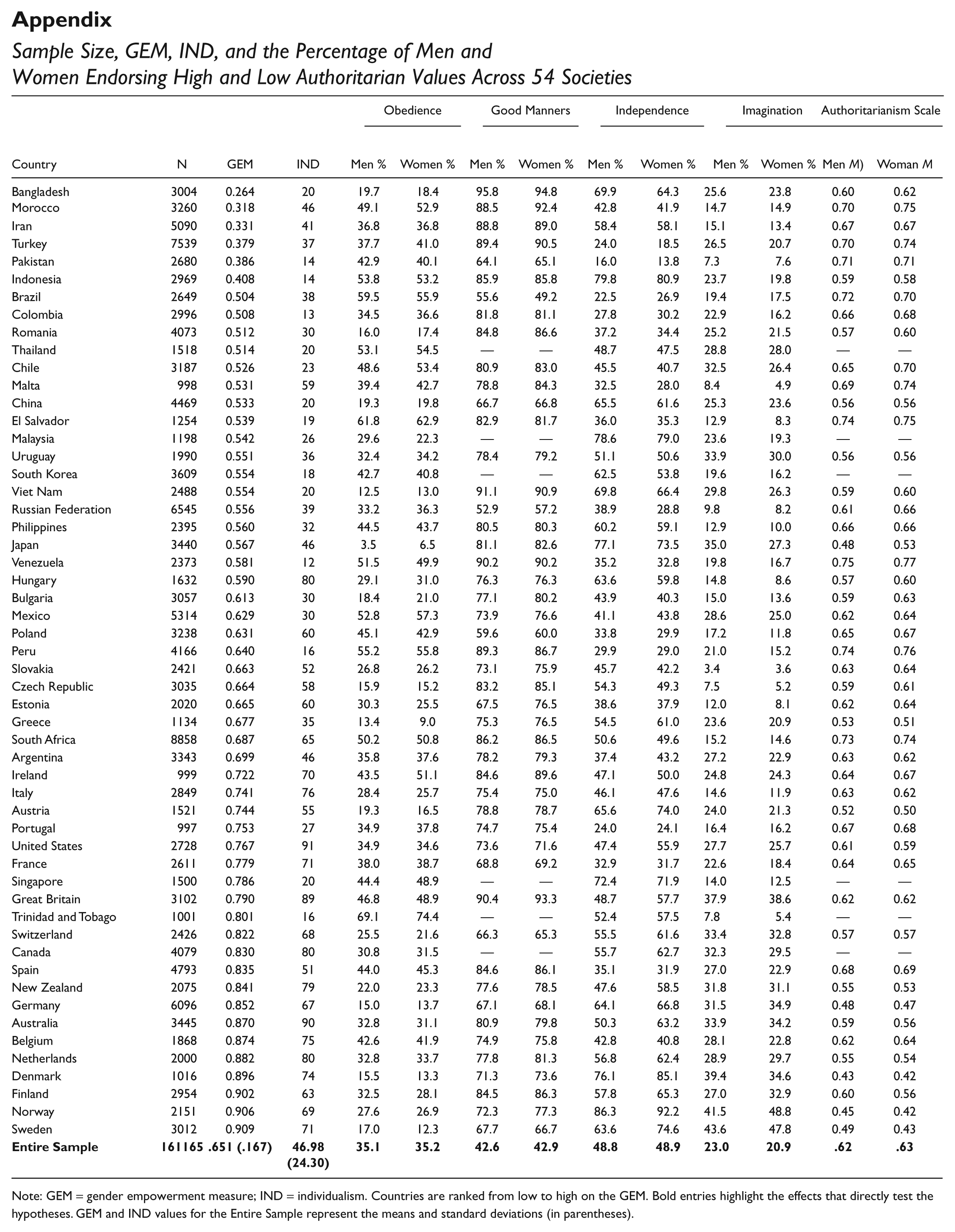
The appendix depicts the percentage of men and women choosing each value and the mean of the two authoritarianism scales in each country. The data for this study operate at two levels of analysis, the individual level and the societal level. Thus, multilevel models were estimated with HLM 7 (Raudenbush, Bryk, & Congdon, 2010). The authoritarianism scale was treated as a continuous outcome variable, and the individual items were treated as binary variables with a Bernoulli distribution (0 or 1). In all of the models, participant gender and having children were centered using a within-context centering strategy to help determine the slope of these individual-level variables and how the slopes change depending on the societal-level variables (see Enders & Tofighi, 2007). The slopes of gender, having children, and their interaction were allowed to vary across countries. GEM, individualism, and their interactions with each other and gender, having children, and the Gender × Children interaction were included in each of the models. The final models for the individual items are in Table 1, and the final model for the authoritarianism scale is in Table 2. We do not include the four-way interaction in the final models because it never approached significance (all ps > .35) 9 .
Multilevel Models Predicting the High-Authoritarian Values of Obedience and Good Manners and the Low Authoritarian Values of Independence and Imagination
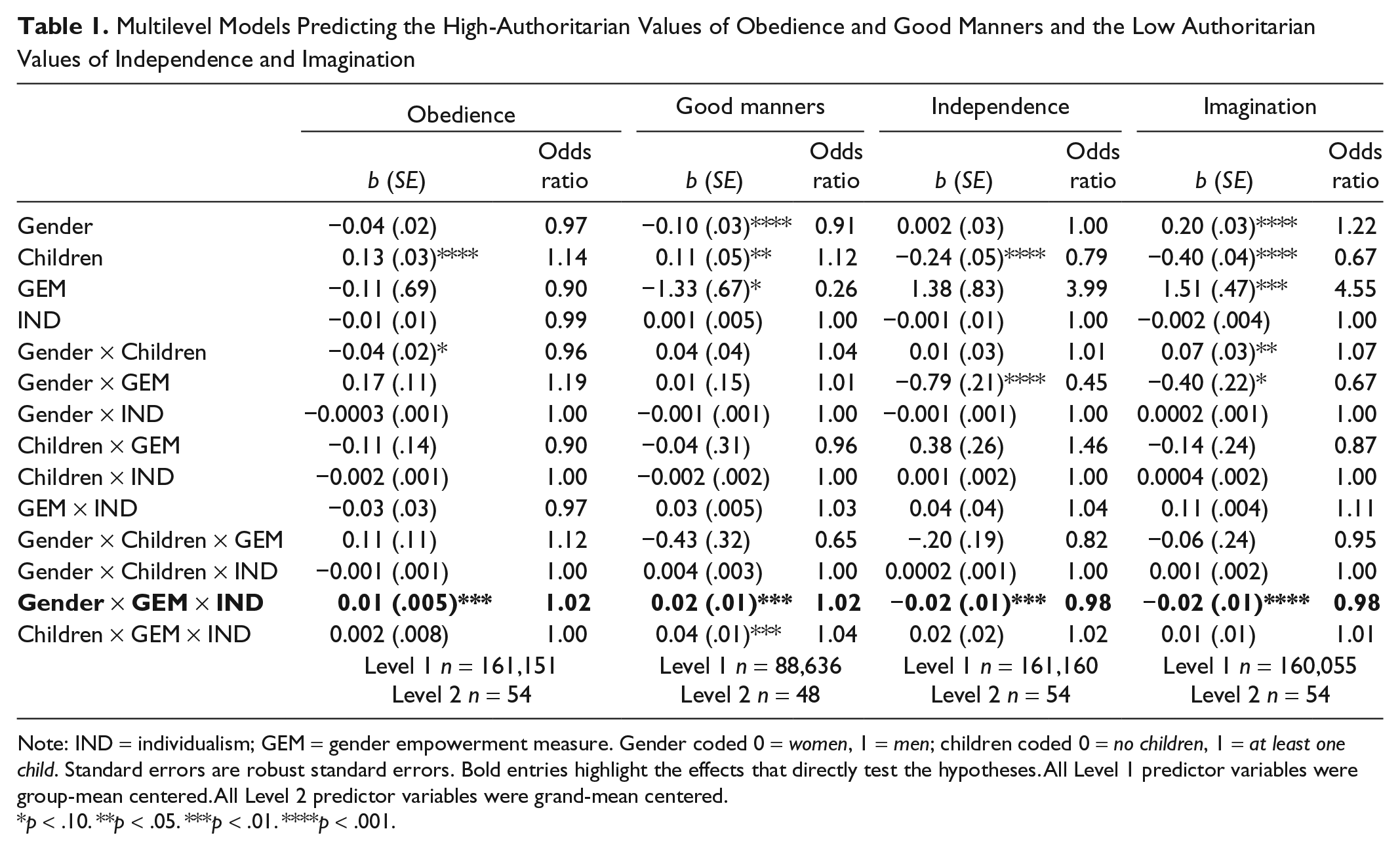
Note: IND = individualism; GEM = gender empowerment measure. Gender coded 0 = women, 1 = men; children coded 0 = no children, 1 = at least one child. Standard errors are robust standard errors. Bold entries highlight the effects that directly test the hypotheses. All Level 1 predictor variables were group-mean centered. All Level 2 predictor variables were grand-mean centered.
p < .10. **p < .05. ***p < .01. ****p < .001.
Multilevel Model Predicting the Authoritarianism Scale
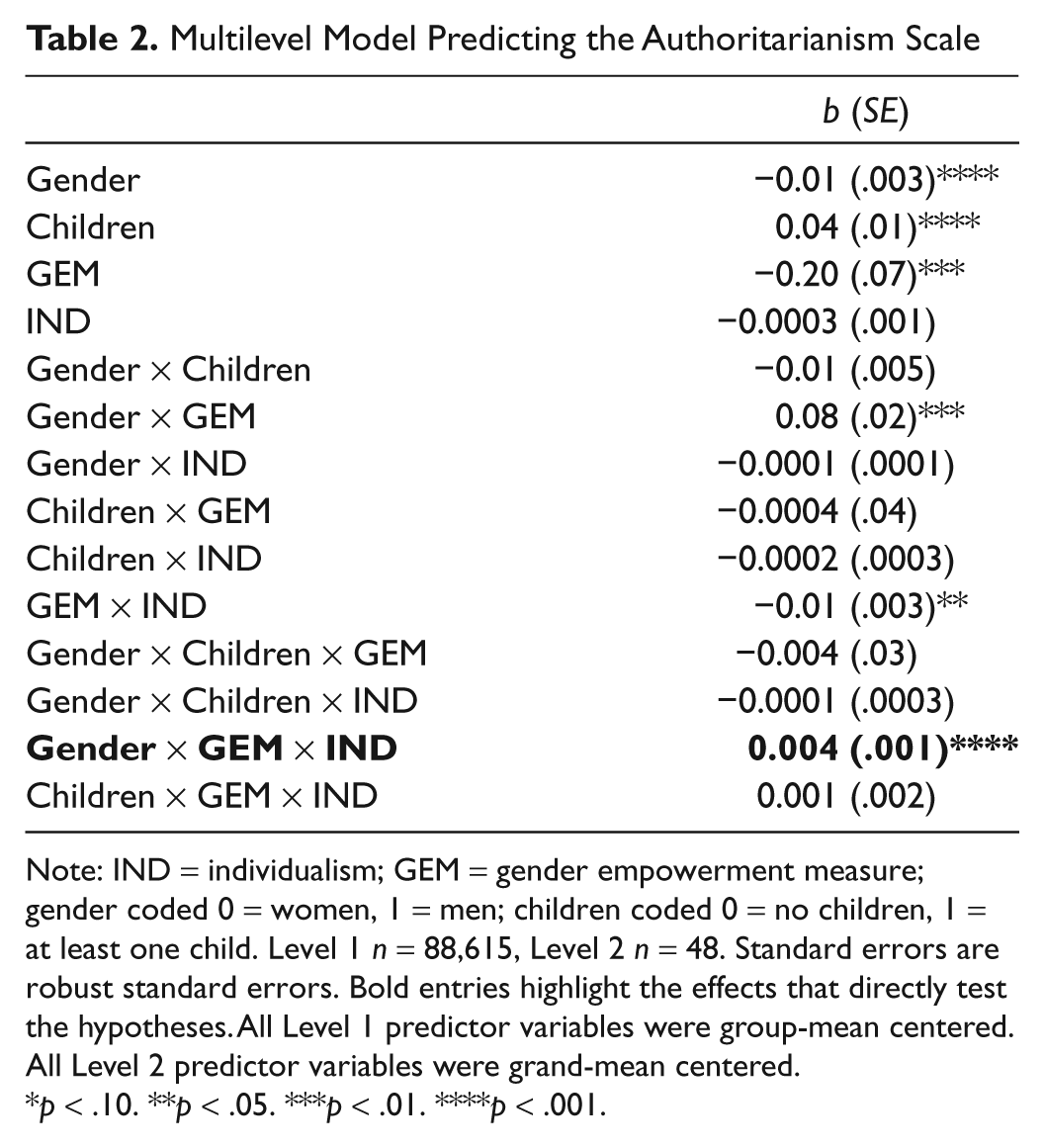
Note: IND = individualism; GEM = gender empowerment measure; gender coded 0 = women, 1 = men; children coded 0 = no children, 1 = at least one child. Level 1 n = 88,615, Level 2 n = 48. Standard errors are robust standard errors. Bold entries highlight the effects that directly test the hypotheses. All Level 1 predictor variables were group-mean centered. All Level 2 predictor variables were grand-mean centered.
p < .10. **p < .05. ***p < .01. ****p < .001.
We predicted that women will be more authoritarian compared with men in countries with higher levels in gender inequality but especially in individualistic countries. Thus, in each analysis, we expected a significant three-way interaction between gender, GEM, and individualism, whereby the interaction between GEM and gender is significant in individualistic countries and less significant or nonsignificant in collectivistic countries. For the purposes of describing the interactions (e.g., Preacher, Curran, & Bauer, 2006), collectivistic societies are estimated as those −1 SD of the individualism mean, and individualistic societies are estimated as those +1 SD of the individualism mean. Countries with low gender equality are estimated as those −1 SD of the GEM mean, and countries with high gender equality are estimated as those +1 SD of the GEM mean.
Testing the Three-Way Interactions
The results of the three-way interactions are summarized in Figures 1 and 2 and will be discussed for each individual measure and the complete scale (see Tables 1 and 2 for the modeling statistics associated with the figures). We found broad support for our hypothesis. Women were more likely to choose high authoritarian values and less likely to choose low authoritarian values than men in individualistic countries with low levels of gender equality across the measures of authoritarianism.
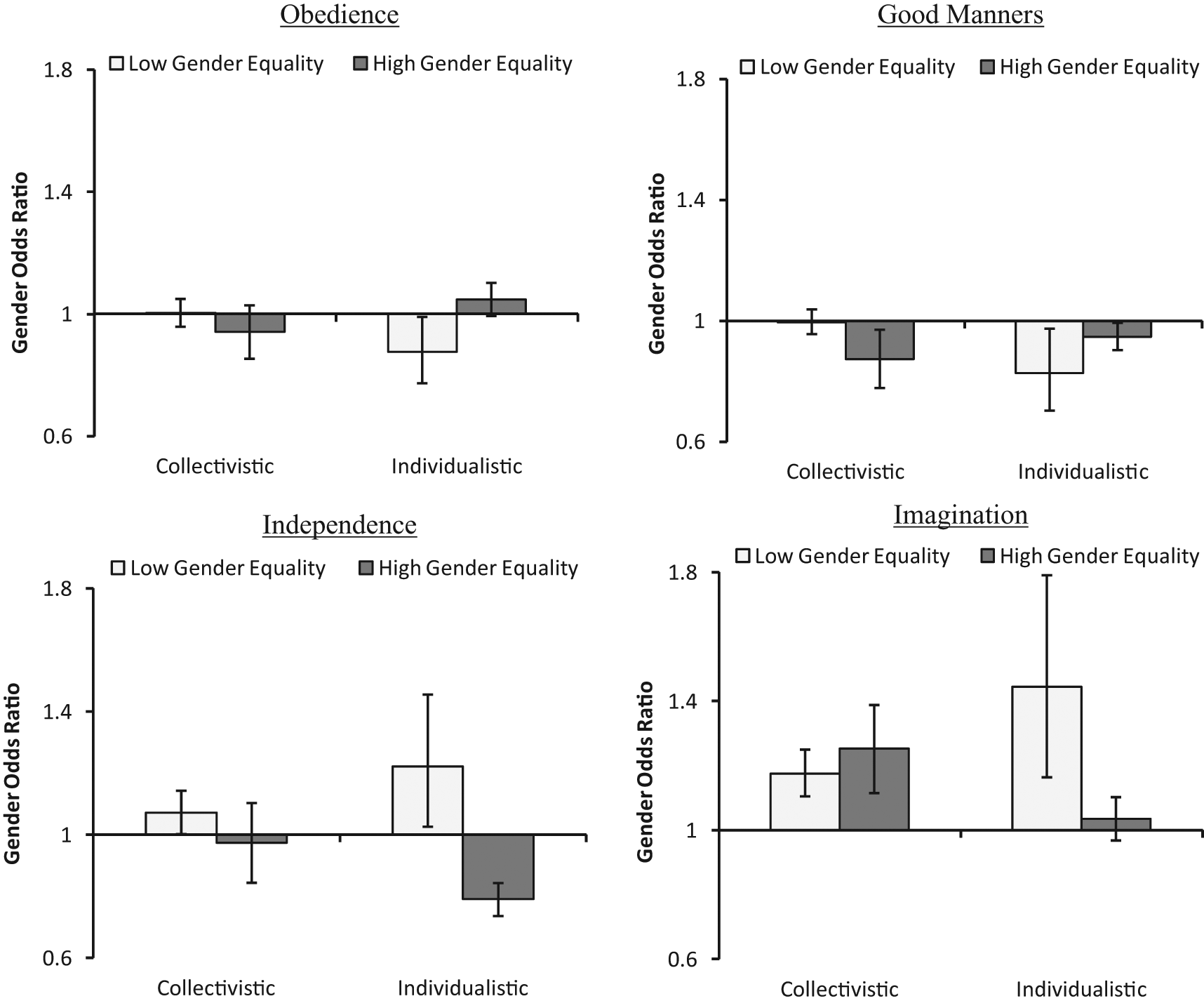
Differences between men and women in obedience, good manners, independence, and imagination as a function of societal gender equality and individualism/collectivism
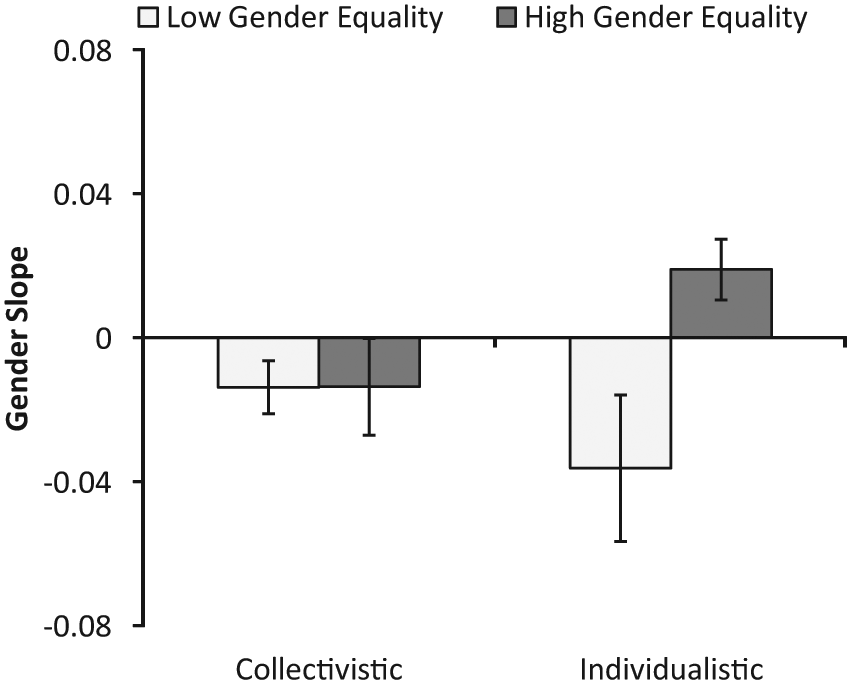
Differences between men and women on the authoritarianism scale as a function of societal gender equality and individualism/collectivism
Obedience
Consistent with our hypotheses, women in more gender unequal individualistic countries were more likely to select obedience, a central value to the authoritarianism concept, than were men, as shown by the predicted three-way interaction (b = 0.01, SE = .005, odds ratio = 1.02, p = .01). The cross-level interaction between participant gender and gender equality was not significant in collectivistic countries (b = −0.19, SE = .15, odds ratio = 0.83, p = .21); however, the two-way interaction obtained significance in individualistic countries (b = 0.54, SE = .19, odds ratio = 1.71, p = .01). In individualistic countries with low levels of gender equality, women were more likely to choose the value of obedience compared with men (b = −0.13, SE = .06, odds ratio = 0.88, p = .04), but in more gender egalitarian countries, the gender difference was marginally reversed (b = 0.05, SE = .03, odds ratio = 1.05, p = .08).
Good manners
We expected that women in more gender unequal, individualistic countries would be more likely to select good manners than men, as shown by the predicted three-way interaction (b = 0.02, SE = .01, odds ratio = 1.02, p = .004). The cross-level interaction between participant gender and gender equality was significant in collectivist countries (b = −0.39, SE = .16, odds ratio = 0.68, p = .02) and marginally significant in individualistic countries (b = 0.41, SE = .23, odds ratio = 1.50, p = .09). Although this is the exception where the expected cross-level interaction for individualistic countries did not obtain statistical significance, the pattern is still consistent with the hypothesis such that for individualistic countries, the gender difference was larger in those countries with low levels of gender equality (b = −0.19, SE = .08, odds ratio = 0.83, p = .02) than those with high levels of gender equality (b = −0.05, SE = .02, odds ratio = 0.95, p = .03).
Independence
We expected that women would be less likely to choose the value of independence, which is an indicator of low authoritarianism, compared with men in more gender unequal, individualistic cultures. In support of our prediction, there was a significant three-way interaction (b = −0.02, SE = .01, odds ratio = 0.98, p = .004). In collectivistic countries, the two-way interaction between participant gender and gender equality was not significant (b = −0.28, SE = .24, odds ratio = 0.75, p = .24); however, in individualistic countries, the two-way interaction attained significance (b = −1.30, SE = .29, odds ratio = 0.27, p < .001). Consistent with predictions, in countries with low levels of gender equality, women were significantly less likely to choose the nonauthoritarian parenting value of independence compared with men (b = 0.20, SE = .09, odds ratio = 1.22, p = .03). In countries with high levels of gender equality, this effect was reversed, so that women were more likely to select the nonauthoritarian value (b = −0.24, SE = .04, odds ratio = 0.27, p < .001).
Imagination
We predicted that women would be less likely to choose the value of imagination in more gender unequal, individualistic cultures because it represents low levels of authoritarianism. This prediction was supported by a significant three-way interaction (b = −0.02, SE = .01, odds ratio = 0.98, p = .001). In collectivistic countries, the two-way interaction between participant gender and gender equality was not significant (b = 0.19, SE = .19, odds ratio = 1.21, p = .34); however, in individualistic countries, the two-way interaction was significant (b = −0.99, SE = .34, odds ratio = 0.37, p = .01), showing that in countries with low levels of gender equality, women were less likely to choose the nonauthoritarian parenting value of imagination compared with men (b = 0.37, SE = .11, odds ratio = 1.44, p = .001). In countries with high levels of gender equality, this effect was nonsignificant (b = 0.04, SE = .03, odds ratio = 1.04, p = .29).
Authoritarianism scale
Finally, the clearest results emerged when we considered the authoritarianism items combined into a scale. We expected that women in more gender unequal, individualistic countries would be more likely to endorse more authoritarianism overall, as shown by the predicted three-way interaction for the authoritarianism scale (b = 0.004, SE = .001, p < .001). The interaction showed that in collectivistic countries, the two-way interaction between participant gender and gender equality was not significant (b = −0.01, SE = .03, p = .76); however, in individualistic countries, the two-way interaction was significant (b = 0.16, SE = .03, p < .001), showing that in countries with low levels of gender equality, women were more authoritarian compared with men (b = −0.04, SE = .01, p < .001). In countries with high levels of gender equality, men were more authoritarian than women (b = 0.01, SE = .004, p = .01).
Discussion
The present study found that women were more likely to endorse highly authoritarian values (i.e., obedience) and less likely to endorse low authoritarian values (i.e., independence and imagination) compared with men in individualistic countries with low levels of gender equality and thus more stigmatization of women (e.g., Brandt, 2011; Glick et al., 2000; Napier et al., 2010). The results of the good manners item were the one exception: The direction of the results in the individualistic countries was consistent with our predictions, but the difference between gender unequal and gender egalitarian countries did not attain traditional levels of significance.
Although the focus of these patterns of results has been on women, notably men were more authoritarian than women on the measures of obedience, independence, and the authoritarianism scale in more gender egalitarian, individualistic cultures. Without over interpreting these patterns, it is possible that these results reflect the different experiences of men in these societies. For example, gender equality may be threatening to some men (cf. Day, Kay, Holmes, & Napier, 2011) and so men may endorse authoritarian values because they perceive the world as more threatening and competitive (cf. Duckitt & Sibley, 2009, 2010), perhaps in part because of the rise of female achievement and equality. This speculation surrounding these patterns in these contexts, however, requires additional research and goes beyond the purview of the present studies.
General Discussion
We predicted that authoritarianism is in part a response to psychological threats, such as social rejection, and that women would be more authoritarian than men in societies where they experienced more psychological threats in the form of gender inequality. In support of our hypothesis, in Study 1 we found that the endorsement of authoritarian values was exacerbated by social rejection. Building on this initial finding, in Study 2 we found that in an analysis of 54 diverse societies women were more authoritarian than men in individualistic countries with high levels of gender inequality. That is, women were more likely to endorse authoritarian values when they lived in a society that values women less and thus provides a more psychologically threatening context for women. These results were robust to controls of whether the participant had children, as well as that measure’s interaction with gender, gender inequality, and individualism, suggesting that the pattern of results is not due to having children or the differential effects of having children between genders and cultures.
The results of our study help advance the study of authoritarianism and stigma. Most directly, our study provides a theoretical framework to understand both past and current results concerning gender and authoritarianism. Second, the current study expands work that suggests authoritarianism can serve a psychologically defensive function by demonstrating that people may adopt authoritarian values in the face of social rejection (Study 1) and that societal-level measures of psychological threat (i.e., gender inequality) predictably influence the adoption of authoritarian values by members of the threatened group (i.e., women; Study 2). Third, and more speculatively, our work suggests that political psychologists should not assume that authoritarianism manifests itself the same way in every culture (cf. Stenner, 2005). Similarly, research on the strategies that members of stigmatized groups use to manage psychological threats due to their stigma (e.g., Henry, 2009; Major & O’Brien, 2005) may be enriched by considering how strategies can differ across cultural contexts, or if they are more discernable as strategies in some cultural contexts compared with others. However, these latter conclusions remain speculative until more work is done on authoritarianism and stigma in both collectivistic and individualistic cultures. Current research on both authoritarianism and social stigma are firmly situated within Western cultures (and often more narrowly within college students), and expanding beyond these friendly confines may reveal a more complete picture of intergroup relations (cf. Henrich, Heine, & Norenzayan, 2010; Henry, 2008a, 2008b).
Qualifications, Limitations, and Future Directions
There are some important qualifications concerning these conclusions. First, there are other determinants of authoritarianism (e.g., Adorno et al., 1950; Napier & Jost, 2008; Stenner, 2005) that may explain why men were sometimes more authoritarian than women in gender egalitarian contexts and why there are no gender differences in collectivistic contexts—Stigma is clearly not the only influence. Our results only suggest that women may adopt authoritarianism when there is severe gender inequality. Second, one should not interpret the findings showing women’s decreased endorsement of authoritarianism in countries with less gender inequality as implying that these women do not face prejudice, discrimination, and stigmatization in those societies. For example, in the current dataset, men and women in the United States endorse approximately the same levels of authoritarianism according to the authoritarianism scale (p = .20), and for the specific values of obedience, good manners, and imagination (ps > .23). For the value of independence, women were more likely to endorse this low authoritarian value compared with men (p < .001). However, we know that women in the United States continue to suffer sexism. The GEM for the United States (.77) still reflects gender inequality, which exists everywhere to some degree. These findings suggest that there may be a critical level of gender inequality that is necessary to be sufficiently psychologically threatening to women for the greater adoption of authoritarian values compared with men in that society. Alternatively, it may mean that in those more egalitarian societies, other forces may drive authoritarianism endorsement. These issues remain open questions for further research.
We postulated that a society’s individualism/collectivism would interact with gender and gender inequality because both men and women are likely to endorse the culturally normative authoritarian values in collectivistic cultures, which obscures the gender differences we predict. However, there are other plausible explanations for this interaction effect. For example, research finds that there are typically smaller gender differences in values and personality traits in collectivistic compared with individualistic societies (for a review, see Guimond, 2008) because men and women in individualistic cultures are more likely to base self-construals on intergroup social comparisons, compared with intragroup or interpersonal social comparisons (Guimond et al., 2007). Future research here, too, will help us understand what explanations are driving the results we observed in our analysis.
Research by Glick and colleagues (Glick et al., 2000; Glick & Fiske, 2001) may provide an alternative explanation for our findings. They find that in countries with the highest levels of hostile sexism, women score higher on measures of benevolent sexism compared with men and further speculate that women may adopt benevolent sexist beliefs to gain men’s admiration and protection out of concerns for their economic prospects and physical safety. Because benevolent sexism is often correlated with authoritarianism (Sibley, Wilson, & Duckitt, 2007), it could be that women are endorsing authoritarianism in gender unequal societies for these same concerns. However, the pattern of results observed by Glick and colleagues can also be explained by our theoretical perspective. Women may adopt a benevolent sexist ideology in these stigmatizing contexts because this ideology values women by putting them on a pedestal as “pure creatures who ought to be protected, supported, and adored and whose love is necessary to make a man complete” (Glick & Fiske, 2001, p. 109) and thus may help women feel more valued and accepted by the sexist and stigmatizing society. Thus, rather than the result of rational self-defense, the endorsement of benevolent sexist beliefs by women in a hostile or unequal environment would help ensure their putative value and acceptance in a society that would otherwise question that value.
In the current set of studies, we relied on measures of authoritarian child-rearing values because other established measures of authoritarianism include content that overlaps with political and religious ideology, and men and women commonly differ on these two constructs. It may be that our results hold just for this measure of authoritarianism. Future studies could include multiple measures of authoritarianism so that the association between threats to belongingness, stigma, gender, and authoritarianism can be more firmly established (or qualified, as the case may be). However, we implore researchers to carefully consider their measures of authoritarianism. If the measures contain religious or political content, as many authoritarianism measures do (e.g., Van Hiel et al., 2007), it will be difficult to isolate the unique effects on authoritarianism rather than these other related constructs.
One could also argue that a measure of authoritarian child-rearing values is especially likely to lead to authoritarianism in women because women often bear the brunt of child-rearing responsibility. Perhaps the act of taking care of children, or even the mere expectation that one should take care of children someday, is enough to elicit the endorsement of authoritarian child-rearing values. However, if this were the case, and if authoritarian values were an effective form of child-rearing, we would expect to see women endorsing these values even in societies that are more gender egalitarian. Research using these types of scales shows this is not the case (Stenner, 2005), or have found that men are more authoritarian than women in these more gender egalitarian societies (Napier & Jost, 2008). Nonetheless, more research is needed to replicate our results and, specifically, identify the experience of stigma as a primary causal variable.
Conclusion
Authoritarianism is an important construct that is influential in political and social life. Our study provides a theoretical framework to understand research on the differences between men and women, and more broadly between the stigmatized and nonstigmatized (cf. Henry, 2011) in their endorsement of authoritarian values. By examining authoritarianism in a large variety of countries and cultures across the world, we were able to make predictions about cultural contexts that influence the adoption of authoritarian values by women. This study extends research on both authoritarianism and stigma to suggest that the experience of stigma for women is not uniform across different cultures and that the degree of stigma is related to the degree of endorsement of psychologically protective attitudes (such as authoritarianism) for the stigmatized.
Footnotes
Appendix
Sample Size, GEM, IND, and the Percentage of Men and Women Endorsing High and Low Authoritarian Values Across 54 Societies
| Obedience |
Good Manners |
Independence |
Imagination |
Authoritarianism Scale |
|||||||||
|---|---|---|---|---|---|---|---|---|---|---|---|---|---|
| Country | N | GEM | IND | Men % | Women % | Men % | Women % | Men % | Women % | Men % | Women % | Men M) | Woman M |
| Bangladesh | 3004 | 0.264 | 20 | 19.7 | 18.4 | 95.8 | 94.8 | 69.9 | 64.3 | 25.6 | 23.8 | 0.60 | 0.62 |
| Morocco | 3260 | 0.318 | 46 | 49.1 | 52.9 | 88.5 | 92.4 | 42.8 | 41.9 | 14.7 | 14.9 | 0.70 | 0.75 |
| Iran | 5090 | 0.331 | 41 | 36.8 | 36.8 | 88.8 | 89.0 | 58.4 | 58.1 | 15.1 | 13.4 | 0.67 | 0.67 |
| Turkey | 7539 | 0.379 | 37 | 37.7 | 41.0 | 89.4 | 90.5 | 24.0 | 18.5 | 26.5 | 20.7 | 0.70 | 0.74 |
| Pakistan | 2680 | 0.386 | 14 | 42.9 | 40.1 | 64.1 | 65.1 | 16.0 | 13.8 | 7.3 | 7.6 | 0.71 | 0.71 |
| Indonesia | 2969 | 0.408 | 14 | 53.8 | 53.2 | 85.9 | 85.8 | 79.8 | 80.9 | 23.7 | 19.8 | 0.59 | 0.58 |
| Brazil | 2649 | 0.504 | 38 | 59.5 | 55.9 | 55.6 | 49.2 | 22.5 | 26.9 | 19.4 | 17.5 | 0.72 | 0.70 |
| Colombia | 2996 | 0.508 | 13 | 34.5 | 36.6 | 81.8 | 81.1 | 27.8 | 30.2 | 22.9 | 16.2 | 0.66 | 0.68 |
| Romania | 4073 | 0.512 | 30 | 16.0 | 17.4 | 84.8 | 86.6 | 37.2 | 34.4 | 25.2 | 21.5 | 0.57 | 0.60 |
| Thailand | 1518 | 0.514 | 20 | 53.1 | 54.5 | — | — | 48.7 | 47.5 | 28.8 | 28.0 | — | — |
| Chile | 3187 | 0.526 | 23 | 48.6 | 53.4 | 80.9 | 83.0 | 45.5 | 40.7 | 32.5 | 26.4 | 0.65 | 0.70 |
| Malta | 998 | 0.531 | 59 | 39.4 | 42.7 | 78.8 | 84.3 | 32.5 | 28.0 | 8.4 | 4.9 | 0.69 | 0.74 |
| China | 4469 | 0.533 | 20 | 19.3 | 19.8 | 66.7 | 66.8 | 65.5 | 61.6 | 25.3 | 23.6 | 0.56 | 0.56 |
| El Salvador | 1254 | 0.539 | 19 | 61.8 | 62.9 | 82.9 | 81.7 | 36.0 | 35.3 | 12.9 | 8.3 | 0.74 | 0.75 |
| Malaysia | 1198 | 0.542 | 26 | 29.6 | 22.3 | — | — | 78.6 | 79.0 | 23.6 | 19.3 | — | — |
| Uruguay | 1990 | 0.551 | 36 | 32.4 | 34.2 | 78.4 | 79.2 | 51.1 | 50.6 | 33.9 | 30.0 | 0.56 | 0.56 |
| South Korea | 3609 | 0.554 | 18 | 42.7 | 40.8 | — | — | 62.5 | 53.8 | 19.6 | 16.2 | — | — |
| Viet Nam | 2488 | 0.554 | 20 | 12.5 | 13.0 | 91.1 | 90.9 | 69.8 | 66.4 | 29.8 | 26.3 | 0.59 | 0.60 |
| Russian Federation | 6545 | 0.556 | 39 | 33.2 | 36.3 | 52.9 | 57.2 | 38.9 | 28.8 | 9.8 | 8.2 | 0.61 | 0.66 |
| Philippines | 2395 | 0.560 | 32 | 44.5 | 43.7 | 80.5 | 80.3 | 60.2 | 59.1 | 12.9 | 10.0 | 0.66 | 0.66 |
| Japan | 3440 | 0.567 | 46 | 3.5 | 6.5 | 81.1 | 82.6 | 77.1 | 73.5 | 35.0 | 27.3 | 0.48 | 0.53 |
| Venezuela | 2373 | 0.581 | 12 | 51.5 | 49.9 | 90.2 | 90.2 | 35.2 | 32.8 | 19.8 | 16.7 | 0.75 | 0.77 |
| Hungary | 1632 | 0.590 | 80 | 29.1 | 31.0 | 76.3 | 76.3 | 63.6 | 59.8 | 14.8 | 8.6 | 0.57 | 0.60 |
| Bulgaria | 3057 | 0.613 | 30 | 18.4 | 21.0 | 77.1 | 80.2 | 43.9 | 40.3 | 15.0 | 13.6 | 0.59 | 0.63 |
| Mexico | 5314 | 0.629 | 30 | 52.8 | 57.3 | 73.9 | 76.6 | 41.1 | 43.8 | 28.6 | 25.0 | 0.62 | 0.64 |
| Poland | 3238 | 0.631 | 60 | 45.1 | 42.9 | 59.6 | 60.0 | 33.8 | 29.9 | 17.2 | 11.8 | 0.65 | 0.67 |
| Peru | 4166 | 0.640 | 16 | 55.2 | 55.8 | 89.3 | 86.7 | 29.9 | 29.0 | 21.0 | 15.2 | 0.74 | 0.76 |
| Slovakia | 2421 | 0.663 | 52 | 26.8 | 26.2 | 73.1 | 75.9 | 45.7 | 42.2 | 3.4 | 3.6 | 0.63 | 0.64 |
| Czech Republic | 3035 | 0.664 | 58 | 15.9 | 15.2 | 83.2 | 85.1 | 54.3 | 49.3 | 7.5 | 5.2 | 0.59 | 0.61 |
| Estonia | 2020 | 0.665 | 60 | 30.3 | 25.5 | 67.5 | 76.5 | 38.6 | 37.9 | 12.0 | 8.1 | 0.62 | 0.64 |
| Greece | 1134 | 0.677 | 35 | 13.4 | 9.0 | 75.3 | 76.5 | 54.5 | 61.0 | 23.6 | 20.9 | 0.53 | 0.51 |
| South Africa | 8858 | 0.687 | 65 | 50.2 | 50.8 | 86.2 | 86.5 | 50.6 | 49.6 | 15.2 | 14.6 | 0.73 | 0.74 |
| Argentina | 3343 | 0.699 | 46 | 35.8 | 37.6 | 78.2 | 79.3 | 37.4 | 43.2 | 27.2 | 22.9 | 0.63 | 0.62 |
| Ireland | 999 | 0.722 | 70 | 43.5 | 51.1 | 84.6 | 89.6 | 47.1 | 50.0 | 24.8 | 24.3 | 0.64 | 0.67 |
| Italy | 2849 | 0.741 | 76 | 28.4 | 25.7 | 75.4 | 75.0 | 46.1 | 47.6 | 14.6 | 11.9 | 0.63 | 0.62 |
| Austria | 1521 | 0.744 | 55 | 19.3 | 16.5 | 78.8 | 78.7 | 65.6 | 74.0 | 24.0 | 21.3 | 0.52 | 0.50 |
| Portugal | 997 | 0.753 | 27 | 34.9 | 37.8 | 74.7 | 75.4 | 24.0 | 24.1 | 16.4 | 16.2 | 0.67 | 0.68 |
| United States | 2728 | 0.767 | 91 | 34.9 | 34.6 | 73.6 | 71.6 | 47.4 | 55.9 | 27.7 | 25.7 | 0.61 | 0.59 |
| France | 2611 | 0.779 | 71 | 38.0 | 38.7 | 68.8 | 69.2 | 32.9 | 31.7 | 22.6 | 18.4 | 0.64 | 0.65 |
| Singapore | 1500 | 0.786 | 20 | 44.4 | 48.9 | — | — | 72.4 | 71.9 | 14.0 | 12.5 | — | — |
| Great Britain | 3102 | 0.790 | 89 | 46.8 | 48.9 | 90.4 | 93.3 | 48.7 | 57.7 | 37.9 | 38.6 | 0.62 | 0.62 |
| Trinidad and Tobago | 1001 | 0.801 | 16 | 69.1 | 74.4 | — | — | 52.4 | 57.5 | 7.8 | 5.4 | — | — |
| Switzerland | 2426 | 0.822 | 68 | 25.5 | 21.6 | 66.3 | 65.3 | 55.5 | 61.6 | 33.4 | 32.8 | 0.57 | 0.57 |
| Canada | 4079 | 0.830 | 80 | 30.8 | 31.5 | — | — | 55.7 | 62.7 | 32.3 | 29.5 | — | — |
| Spain | 4793 | 0.835 | 51 | 44.0 | 45.3 | 84.6 | 86.1 | 35.1 | 31.9 | 27.0 | 22.9 | 0.68 | 0.69 |
| New Zealand | 2075 | 0.841 | 79 | 22.0 | 23.3 | 77.6 | 78.5 | 47.6 | 58.5 | 31.8 | 31.1 | 0.55 | 0.53 |
| Germany | 6096 | 0.852 | 67 | 15.0 | 13.7 | 67.1 | 68.1 | 64.1 | 66.8 | 31.5 | 34.9 | 0.48 | 0.47 |
| Australia | 3445 | 0.870 | 90 | 32.8 | 31.1 | 80.9 | 79.8 | 50.3 | 63.2 | 33.9 | 34.2 | 0.59 | 0.56 |
| Belgium | 1868 | 0.874 | 75 | 42.6 | 41.9 | 74.9 | 75.8 | 42.8 | 40.8 | 28.1 | 22.8 | 0.62 | 0.64 |
| Netherlands | 2000 | 0.882 | 80 | 32.8 | 33.7 | 77.8 | 81.3 | 56.8 | 62.4 | 28.9 | 29.7 | 0.55 | 0.54 |
| Denmark | 1016 | 0.896 | 74 | 15.5 | 13.3 | 71.3 | 73.6 | 76.1 | 85.1 | 39.4 | 34.6 | 0.43 | 0.42 |
| Finland | 2954 | 0.902 | 63 | 32.5 | 28.1 | 84.5 | 86.3 | 57.8 | 65.3 | 27.0 | 32.9 | 0.60 | 0.56 |
| Norway | 2151 | 0.906 | 69 | 27.6 | 26.9 | 72.3 | 77.3 | 86.3 | 92.2 | 41.5 | 48.8 | 0.45 | 0.42 |
| Sweden | 3012 | 0.909 | 71 | 17.0 | 12.3 | 67.7 | 66.7 | 63.6 | 74.6 | 43.6 | 47.8 | 0.49 | 0.43 |
|
|
|
|
|
|
|
|
|
|
|
|
|
|
|
Note: GEM = gender empowerment measure; IND = individualism. Countries are ranked from low to high on the GEM. Bold entries highlight the effects that directly test the hypotheses. GEM and IND values for the Entire Sample represent the means and standard deviations (in parentheses).
Acknowledgements
We would like to thank members of the Laboratory of Social Science Research at DePaul University for helpful comments on a previous draft of the manuscript.
Authors’ Note
Previous versions of this work have been presented at the University of Chicago Political Psychology Workshop and the meetings of the European Association of Social Psychology and the Society for Personality and Social Psychology.
Declaration of Conflicting Interests
The author(s) declared no potential conflicts of interest with respect to the research, authorship, and/or publication of this article.
Funding
The author(s) received no financial support for the research, authorship, and/or publication of this article.