



Abstract
Four experiments examined the hypothesis that individuals who hold discrepant implicit and explicit self-esteem possess relatively strong self-image concerns. As a result, they may act irrationally when expressing sexual health attitudes. In support of the hypothesis, Experiments 1a and 1b demonstrate that large self-esteem discrepancy participants possess strong implicit self-image ambivalence relative to small self-esteem discrepancy participants. In Experiments 2 and 3, participants who varied in self-esteem discrepancies received either negative or positive (or no) feedback on an intelligence test, and then they were given an opportunity to express implicit and explicit attitudes toward condoms. Large self-esteem discrepancy participants who received a self-threat responded irrationally and expressed relatively strong negative implicit (but not explicit) attitudes toward condoms. However, this detrimental effect was completely reversed following a self-affirmation to large discrepancy participants. The implicit and explicit attitudes toward condoms of small discrepancy participants were unaffected by a self-threat or a self-affirmation.
Keywords
Over 50 years of research has demonstrated that people can hold explicit attitudes that are discrepant (Festinger, 1957; Heitland & Bohner, 2010; Higgins, 1987; Priester & Petty, 1996). Such discrepant explicit attitudes can cause a feeling of explicit discomfort, which presumably motivates individuals to address their internal inconsistency (Cooper & Fazio, 1984; Maio, Esses, & Bell, 2000; Maio, Greenland, Bernard, & Esses, 2001; Petty & Briñol, 2009). However, theorists have suggested that the source of this motivation is not the internal inconsistency per se, but rather the threat it poses to people’s positive self-image (Nail, Misak, & Davis, 2004; Steele & Liu, 1981, 1983). In support of this hypothesis, Steele and Liu (1983) found that the motivation to reduce inconsistent explicit attitudes was eliminated when participants received a self-affirmation. This seminal study suggests that because inconsistent explicit attitudes are really about an “inherent self-threat,” such self-image concerns were eliminated after reminding individuals about central aspects of their positive self-image (Steele & Liu, 1983, p. 6).
Just as people possess inconsistent explicit attitudes, recent research has demonstrated that people can exhibit a discrepancy between their implicit and explicit attitudes, and that it can have important behavioral consequences (Bosson, Brown, Zeigler-Hill, & Swann, 2003; Briñol, Petty, & Wheeler, 2006; Haddock & Gebauer, 2011; Jordan, Spencer, Zanna, Hoshino-Browne, & Correll, 2003; Jordan, Whitfield, Zeigler-Field, 2007; Olson & Fazio, 2007; Perugini, 2005; Petty & Briñol, 2009). Some of these studies that examine attitude inconsistencies have focused on discrepancy between implicit and explicit self-esteem, and they suggest that people with large self-esteem discrepancy adopt strategies to reduce their internal inconsistencies. In support of this prediction, Briñol et al. (2006, Study 4) found that large self-esteem discrepancy individuals deliberate over high-quality information more carefully than small self-esteem discrepancy individuals when the information was presented as self-relevant. Additional plausible strategies include defensive behaviors such as the expression of narcissism (Gregg & Sedikides, 2010; but see Bosson et al., 2008) and unrealistic optimism (Bosson et al., 2003), as well as behaviors that may be disadvantageous such as low intuition (Jordan et al., 2007) and self-defeating humor (Stieger, Formann, & Burger, 2011).
The structure and processes underlying discrepancies between implicit and explicit self-esteem are theoretically outlined in Petty and Briñol’s Meta-Cognitive Model (MCM; Petty & Briñol, 2009). As it relates to self-esteem, the MCM essentially argues that individuals’ implicit self-esteem and explicit self-esteem coexist in memory. For some individuals, their implicit (explicit) self-esteem opposes their explicit (implicit) self-esteem, which results in a conflict (i.e., discrepancy) between implicit and explicit self-esteem. Moreover, just like individuals with discrepant explicit attitudes (e.g., cognitive dissonance) possess ambivalence, the MCM suggests that implicit–explicit self-esteem discrepant individuals are ambivalent as well. However, because such individuals are not aware of their internal inconsistency, their state of ambivalence may be an implicit one. Finally, this implicit ambivalence motivates individuals to address their self-esteem discrepancy; that is, as per Petty and Briñol, discrepant individuals’ behavioral approaches “presumably reflect [an] attempt at discrepancy reduction” (Briñol et al., 2006, p. 156).
We take the above notion one step further, arguing that large implicit–explicit self-esteem discrepancy individuals do not wish to address their internal implicit inconsistency per se, but that they are concerned with the harmful effect that implicit–explicit discrepancy has on their positive self-image. Just as people with inconsistent explicit attitudes experience explicit ambivalence and psychological harm to their positive self-view (e.g., Steele & Liu, 1983), people who simultaneously hold inconsistent implicit and explicit self-esteem and experience implicit ambivalence similarly possess heightened self-image concerns. We directly test this hypothesis by first demonstrating that large self-esteem discrepancy individuals have relatively strong implicit self-image ambivalence (Experiments 1a and 1b). Then, we place such individuals in two well-established situations that are fundamental to self-image processes—a self-threat versus a self-affirmation (Experiments 2 and 3). As described next, because a self-threat stings one’s positive self-image, it should exacerbate irrational reactions among large self-esteem discrepant individuals. However, because large self-esteem discrepancy individuals possess strong self-image concerns, a self-affirmation should alleviate such concerns and attenuate irrational reactions.
Reactions of Individuals With Implicit–Explicit Self-Esteem Discrepancy to Self-Threat Versus Self-Affirmation
A self-threat is an experience that calls into question a person’s positive self-image (for a review, see vanDellen, Campbell, Hoyle, & Bradfield, 2011). Individuals who are placed in self-threatening situations tend to behave irrationally and maladaptively (Baumeister, 1997; Baumeister, Heatherton, & Tice, 1993). Namely, they are more likely to eat unhealthy foods (Heatherton, Herman, & Polivy, 1991), abuse alcohol (Hull, 1981), and set more risky or unattainable self-goals (Baumeister et al., 1993) relative to individuals who are not in a self-threatening situation. Given the effects of self-threats, we predicted that such a threat would exacerbate the negative reactions typically displayed by large self-esteem discrepancy individuals. As suggested earlier, such individuals possess an internal implicit ambivalence that readies them to respond in dysfunctional and defensive ways. When such individuals are confronted with a situational self-threat, such behaviors should be exacerbated. This should be the case for large self-esteem discrepancy individuals because presumably they have greater self-image concerns than small self-esteem discrepancy individuals.
In contrast to a self-threat, self-affirmation theory argues that if individuals are reminded of aspects of their positive self-image, then it can function to buffer them from psychological and situational threats (Sherman & Hartson, 2011; Sherman & Cohen, 2002). Following a self-affirmation, people tend to experience pleasant feelings, such as enhanced self-worth (Steele, 1988), and to behave rationally (Epton & Harris, 2008; Harris, Mayle, Mabbott, & Napper, 2007; Jessop, Simmonds, & Sparks, 2009; Sherman, Nelson, & Steele, 2000; also see McQueen & Klein, 2006). For example, after being exposed to a video about AIDS (a threat), participants who were self-affirmed purchased more condoms and took more informational brochures than those individuals who were not self-affirmed (Sherman et al., 2000, Study 2). Furthermore, self-affirmed individuals tend to respond rationally in the health domains of smoking (Harris et al., 2007), sun tanning (Jessop et al., 2009), caffeine intake (Sherman et al., 2000, Study 1), and eating of fruits and vegetables (Epton & Harris, 2008) when compared with individuals who are not self-affirmed. In summary, when individuals are given an opportunity to cast themselves in a positive light, any self-image concerns rooted in self-threats are reduced or eliminated, which enables them to engage in rational behaviors. Thus, we expected that when large self-esteem discrepancy individuals are given an opportunity to self-affirm, the irrational behaviors they are expected to display should be attenuated.
The present research tests the predicted effect of a self-threat versus a self-affirmation on large self-esteem discrepancy individuals’ attitudes toward condoms for two related reasons. First, research demonstrates that sexual attitudes and behavior are strongly tied to one’s self-image (Dunkel & Papini, 2005; Sherman et al., 2000); as per Sherman and colleagues (2000), “because people . . . have sex with self-image concerns at stake, it is important to consider the role of [this behavior] in the individual’s self-image” (Sherman et al., 2000, p. 1057). Indeed, research shows that participants who have strong self-image motivational needs express greater intentions to engage in unprotected sex, are less likely to actually use condoms, and have a greater likelihood of having a sexually transmitted disease (STD), when compared with those whose self-image motivational needs are not as strong (MacDonald & Martineau, 2002; Shrier, Harris, Sternberg, & Beardslee, 2001). Hence, past research suggests that attitudes toward condoms share a critical connection to one’s self-image. Because strong self-esteem discrepancies are a source of self-image concerns, the state of such concerns can be inferred from the expression of attitudes toward condoms. This should be particularly evident when discrepant individuals are placed in self-image-relevant situations such as a self-threat and self-affirmation. This logic is squarely in line with research on discrepancy between explicit attitudes from which we draw the present research. In that work, researchers infer the state of their participants’ self-image from their behavioral attitudes (e.g., smoking, eating health, delivering a speech about tuition costs, etc.), especially after situations of self-threat and self-affirmation (Steele, 1988; also see Tesser, 2000, for a review on how self-image mechanisms are substitutable).
Second, and related, we targeted attitudes toward condoms because the negative expression of such attitudes would be considered irrational as they are associated with engaging in risky sexual behaviors that can lead to acquiring sexually transmitted infections or unwanted pregnancies (R. A. Brooks, Lee, Stover, & Barkley, 2009; Czopp, Monteith, Zimmerman, & Lynam, 2004; Marsh, Johnson, & Scott-Sheldon, 2001). Our logic is in line with rational choice theory, which argues that rational individuals tend to balance the behavioral costs against the behavioral benefits before deciding on a course of action (Caporael, Dawes, Orbell, & van de Kragt, 1989; Jackson, 2008; Lynn & Oldenquist, 1986). If the costs of engaging in a behavior are minimal relative to the personal benefits and advantages, then this process is considered rational; otherwise, it is irrational (i.e., maximum costs, minimum benefits). Because expressing negative attitudes toward condoms predicts sexual behavior that can jeopardize one’s health (high cost), such behavior may not be worth the value of sexual pleasure (low benefit). In light of this, when discrepant individuals with strong self-image concerns are confronted with a situational self-threat, their sexual attitude responses would be considered irrational. In summary, given the relevance of condom attitudes to one’s self-image and that a threat to one’s self-image can trigger irrational behavior, we reasoned that providing large self-esteem discrepant individuals with an opportunity to express their attitudes toward condoms after a self-threat versus a self-affirmation would provide an interesting test of our hypothesis.
We suggest that our hypothesized effects should emerge regardless of the direction of individuals’ self-esteem discrepancy (i.e., individuals with high-implicit, low-explicit self-esteem and those with low-implicit, high-explicit self-esteem). Other researchers demonstrate that there are qualitative differences in the direction of self-esteem discrepancies. For example, Jordan and colleagues (Jordan et al., 2003; Jordan et al., 2007) posit that individuals with high-explicit, low-implicit discrepant self-esteem tend to act defensively, for example, through the expression of narcissism because their high-explicit self-esteem “masks” their low-implicit self-esteem (Jordan et al., 2003, p. 969). However, individuals with low-explicit, high-implicit self-esteem do not act defensively because their high-implicit self-esteem is based on their past and more stable experiences, whereas their low-explicit self-esteem may be based on recent damaging self-relevant experiences. These and other researchers (e.g., Haddock & Gebauer, 2011; Jordan et al., 2007) have unquestionably demonstrated specific conditions under which the interaction between implicit and explicit self-esteem matters. However, their models do not make any specific predictions about the present research goal to examine the role of self-image concerns in self-esteem discrepancies.
We posit that the direction of self-esteem discrepancy is less relevant in the present research for two related reasons. First, the MCM and its empirical evidence (Briñol et al., 2006; Petty & Briñol, 2009) suggest that the magnitude (as opposed to the direction) of the discrepancy matters most because people simply wish to address their internal inconsistency. As stated earlier, we extend the MCM to suggest that self-esteem discrepancy is essentially a source of self-image concerns. That is, discrepant individuals possess implicit ambivalence, which is a function of holding two opposing evaluations regardless of their direction. This implicit ambivalence is an inherent threat to their self-image. Second, and related, our research on discrepancy between implicit and explicit attitudes parallels past research on discrepancy between explicit attitudes. As reviewed at the outset, inconsistent explicit attitudes and their corresponding explicit ambivalence are really about an inherent self-threat. Most relevant to the current research is that this phenomenon is evident regardless of the direction of explicit attitudes discrepancy. Therefore, as it relates to the implications for self-image, just as the direction of explicit attitude discrepancies is inconsequential, so is the direction of explicit–implicit discrepancies. Nevertheless, whether the magnitude or direction of self-esteem discrepancies matters in the current research is an empirical question that we will be able to address.
Overview of the Present Research and Predictions
Across four experiments, we examine the self-image concerns of individuals with large discrepancy between their implicit and explicit self-esteem. Our first goal is to test whether large self-esteem discrepancy individuals possess greater implicit self-image ambivalence than those with small discrepancy (Prediction 1). Our second goal is to examine that if implicit ambivalence is a source of self-image concerns, then situations that afford either a self-threat versus a self-affirmation should yield predictable yet distinct effects. We manipulate such situations by providing negative (in the case of a self-threat) or positive (in the case of a self-affirmation) false feedback on an intelligence test, then gave participants an opportunity to express implicit and explicit attitudes toward condoms (dependent variables). We predicted that participants with relatively large self-esteem discrepancy who receive self-threatening feedback will express greater negative implicit attitudes toward condoms when compared with those participants who receive self-affirming feedback or no feedback (Prediction 2a). Those who receive self-affirming feedback will express less negative implicit attitudes toward condoms than those participants who receive threatening feedback or no feedback (Prediction 2b). By comparison, because participants with small self-esteem discrepancy possess less self-image concerns, their implicit attitudes toward condoms will not vary as a function of feedback (Prediction 3). Finally, self-esteem discrepancy and feedback were not expected to have a combined effect on explicit attitudes toward condoms (Prediction 4). This last prediction is in line with the MCM (Petty & Briñol, 2009; Petty et al., 2007), which argues that because discrepant individuals are not aware of their psychological inconsistency and ambivalence, discrepant self-esteem is more likely to be related to implicit than explicit processes and outcomes.
Experiment 1a
The goal of Experiment 1a was to determine whether implicit–explicit self-esteem discrepancy individuals are more likely to possess implicit self-image ambivalence than small self-esteem discrepancy individuals. In addition, we sought to examine whether self-esteem discrepancy covaried with explicit ambivalence.
Method
Participants and Procedure
Eighty-three participants (73 females) completed the study in exchange for extra credit. Participants’ age ranged from 18 to 60 years (M = 23.8). Of these participants, 44% were Hispanic, 25% were Caucasian, 11% were Asian, 7% were African American, 6% were Multiracial, 5% were Other, and 1% was Native American. Two participants were dropped from the analyses because they made more than 20% errors on a reaction time task. The final N = 81. Participants first completed the measures of implicit and explicit self-esteem (counterbalanced), followed by the measures of implicit and explicit ambivalence.
Measured Variables
Implicit self-esteem
Consistent with past studies on implicit–explicit self-esteem discrepancy (e.g., Briñol et al., 2006; Jordan et al., 2003), we used an Implicit Association Test (IAT; Greenwald, McGhee, & Schwartz, 1998) to measure implicit self-esteem (SE-IAT). The SE-IAT measures the relative strength with which two target groups (the self vs. others) are associated with two opposing evaluations (good words vs. bad words) using response latency to operationalize attitude strength. The SE-IAT is a reliable and valid measure of relative automatic self-esteem. For a complete description of the SE-IAT, see Greenwald and Farnham (2000). High scores on the SE-IAT mean higher implicit self-esteem. Following Nosek, Greenwald, and Banaji (2007), the reliability for all IATs in this research was calculated by submitting difference scores between compatible and incompatible block latencies to a Cronbach’s alpha analysis (α = .71).
Explicit self-esteem
We used six items of the Rosenberg Self-Esteem Scale (RSES; Rosenberg, 1965). Each statement started with “At this moment . . . ” (e.g., “At this moment I take a positive view of myself”). Participants rated each statement on a 5-point scale ranging from 1 (disagree very much) to 5 (agree very much). High scores on the modified RSES mean higher explicit self-esteem (α = .83).
Implicit ambivalence
An implicit ambivalence IAT (A-IAT) was adapted from Petty, Tormala, Brinol, and Jarvis (2006, Study 2) who measured ambivalence toward an attitude target (also see Briñol, Petty, & Wheeler, 2003). In the current research, the attitude target is the self. In the A-IAT procedure, participants saw four types of stimuli presented one at a time on a computer: doubt (doubtful, hesitant, skeptical, conflicted, ambiguous) versus confident (confident, certain, sure, firm, secure) words that were adopted from Petty et al. (2006), and self (I, me, my, mine, myself) versus other (they, them, their, theirs, others) words. The procedure of the A-IAT was similar to that of Petty et al. (Study 2). Petty et al.’s Study 2 used the A-IAT to demonstrate that individuals who are requested to change their attitudes display greater implicit ambivalence about the attitude target when compared with individuals who are not asked to change their attitudes. Higher numbers on the A-IAT mean stronger implicit ambivalence (α = .72).
Explicit ambivalence
Participants rated the stimuli we used in the A-IAT on a 6-point scale ranging from 1 (not very characteristic of me) to 6 (very characteristic of me). We reverse scored the stimuli associated with confidence so that higher numbers on this measure mean stronger explicit ambivalence (α = .87).
Results and Discussion
Table 1 lists the means and standard deviations of all measured variables. We followed Briñol et al. (2006) and others (Petty et al., 2007; Kehr, 2004) to calculate self-esteem discrepancy scores for all experiments in this research. Specifically, an index of self-esteem discrepancy was formed as the absolute value of the difference between the standardized implicit and explicit self-esteem scores. Higher scores mean greater differences between explicit and implicit self-esteem measures (i.e., higher explicit–implicit self-esteem discrepancy).
Summary of Means and Standard Deviations for Experiments 1a to 3
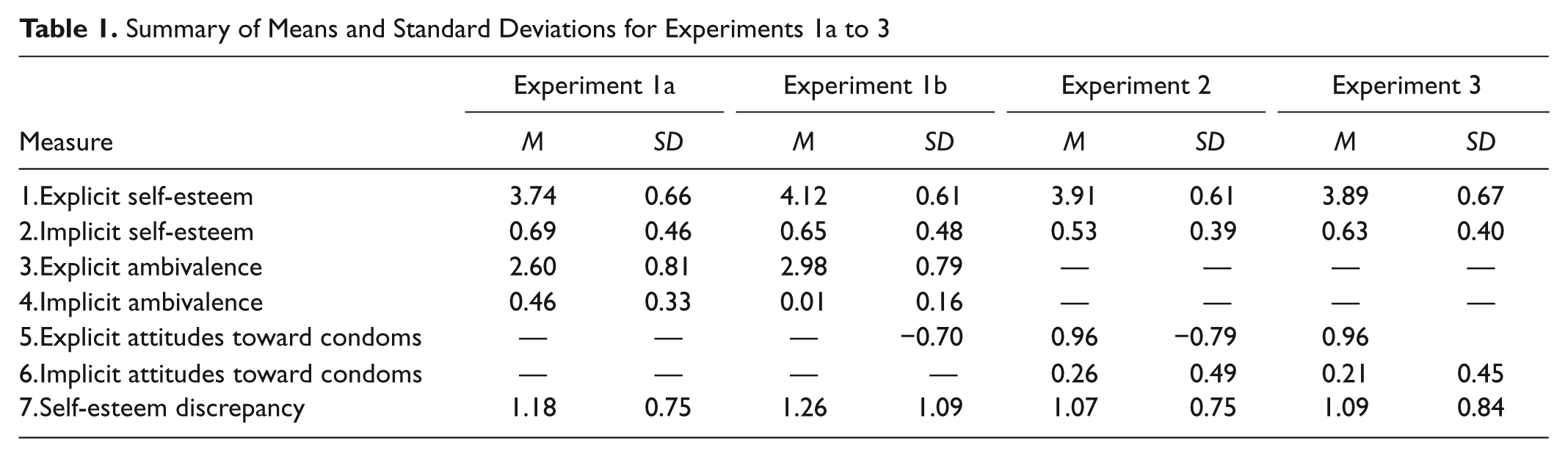
To test Prediction 1 that large self-esteem discrepancy would be associated with more implicit, but not explicit, self-image ambivalence, we computed zero-order correlations between self-esteem discrepancy and both implicit and explicit ambivalence. As predicted, large self-esteem discrepancy individuals exhibited stronger implicit ambivalence than those with small self-esteem discrepancy, r = .33, p < .01 (also see Briñol et al., 2003). However, self-esteem discrepancy was not associated with explicit ambivalence, r = .01, p = .92. 1
As noted in the “introduction,” we did not expect for the direction of self-esteem discrepancy to moderate our predicted effects. To test this, we ran a hierarchical regression analysis in which implicit ambivalence was regressed on implicit and explicit self-esteem (standardized scores) in the first model, and on the interaction term between these factors in the second model. As expected, the two-way Implicit Self-Esteem × Explicit Self-Esteem interaction did not significantly predict implicit ambivalence, ΔF(1, 77) = 0.16, p = .69; R2 = .43; β = −.01, nor explicit ambivalence, ΔF(1, 77) = 0.85, p = .36; R2 = .36; β = .07. However, high-explicit self-esteem predicted strong explicit ambivalence, β = −.48, p < .01, and high-implicit self-esteem predicted strong implicit ambivalence, β = .22, p < .01. The latter results suggest that the relation between self-esteem discrepancies and implicit ambivalence reported above may be partially (or completely) explained by shared method variance. In other words, because IATs contribute to the self-esteem discrepancy scores as well as to the implicit ambivalence scores, an IAT general response bias coupled with the same procedure may be inflating the significant correlation between these constructs. Experiment 1b was designed to address this limitation by using a different implicit ambivalence measure.
Experiment 1b
Experiment 1b administered a sequential subliminal priming task (a lexical decision task) to assess implicit ambivalence. Because a sequential priming task method is essentially distinct from the IAT method, any relation between self-esteem discrepancies measured with an IAT (and a self-report measure) and implicit ambivalence measured with a sequential subliminal priming task should eliminate shared method variance. Thus, a significant correlation between these measures can be attributed to the psychological relation between self-esteem discrepancies and implicit ambivalence. Further-more, such results would ensure the generalizability of Experi-ment 1a’s finding to a second implicit ambivalence measure.
Method
Participants
Forty-six student participants (32 females) completed the study in exchange for extra credit. Participants’ age ranged from 18 to 37 years (M = 20). Of these participants, 37% were Asian, 20% were Caucasian, 15% were Hispanic, 15% were Other, and 13% were African American. One participant was dropped because of a self-esteem discrepancy score of 3 SDs above the mean. The final N = 45. Participants first completed the measures of implicit and explicit self-esteem, followed by the measures of implicit and explicit ambivalence. Furthermore, the measures were counterbalanced such that the reaction time measures preceded the self-report or vice versa.
Measured Variables
Implicit, explicit self-esteem and explicit ambivalence
We administered the SE-IAT (α = .85) and the explicit ambivalence measure (α = .84) from Experiment 1a, and the original RSES (α = .88).
Implicit ambivalence
Participants completed a sequential subliminal priming task that was presented as a lexical decision task (A-LDT; modified . . . from Lun, Sinclair, & Cogburn, 2009; Wittenbrink, Judd, & Park, 1997) to measure the extent to which they implicitly associated the self with doubt- and confidence-related words. Across 54 trials, self-relevant or neutral words were subliminally primed before the presentation of a doubt-related word, confidence-related word, a neutral word, or a nonword. The doubt- and confidence-related words were the same from the A-IAT in Experiment 1a. The neutral words (dependent, passive, preppy, ok, old-fashioned, busy, and unpredictable) were selected from a pretest with a separate sample (n = 34) that rated 119 words rated on a 1 (very negative) to 7 (very positive) scale. The final A-LDT neutral words were not significantly different from the midpoint (4; all ps > .2). The nonwords were gintie, posirion, netessary, glasz, wose, tosorrow, avay, kand, chayr, and draxer.
During the task, participants were first instructed to direct their attention to a fixation point (X) that was presented in the middle of the screen. Next, a string of X’s (XXX XXXXXX) was presented in the center of the screen for 1,000 ms (forward mask). This was immediately replaced with either a self (self, I, me) or neutral word (a, at, the) for 15 ms. The subliminal prime was replaced with the “XXXXXXXXX” for another 1,000 ms (backward mask). Following the forward mask-prime-backward mask sequence, a doubt-related word, confidence-related word, neutral word, or nonword appeared. Then, participants made their lexical judgment—They pressed the right control key for a word judgment or the left control key for a nonword judgment. The computer program waited for a correct response before continuing to the next trial. To allow participants to become acquainted with the task before completing the critical trials, four practice trials were completed including two word trials (apple, pencil) and two nonword trials (youey, njoue). Response latencies that indicated the extent to which doubt and confidence judgments were facilitated by self versus neutral primes served as the dependent measure in the analyses reported below.
Results and Discussion
Table 1 lists the means and standard deviations of all measured variables.
Following standard scoring procedures for sequential priming tasks (Wentura & Degner, 2010), latencies that were more than 3 SDs above the individuals’ average reaction time or lower than 150 ms were excluded from the analyses. We also log transformed the response latencies to normalize their distribution. For each type of word response latency (doubt-related, confidence-related, and neutral), we calculated difference scores by subtracting the self-prime latencies from the neutral-prime latencies. Therefore, the response latencies used in the analyses represent the average amount of time participants took to respond to doubt-related, confidence-related, or neutral words following a self-prime compared to a neutral prime. As a case in point, higher doubt reaction times mean that participants’ judgments to doubt-related words were faster after a self-prime compared with a neutral prime.
We conducted two hierarchical regression analyses in which doubt and confidence reaction times served as the outcome variables. For each regression, the neutral reaction times were entered in the first step as a control variable (i.e., baseline latencies), followed by self-esteem discrepancy scores in the second step. When doubt reaction times were the outcome variable, the regression analysis revealed that large self-esteem discrepancy participants responded faster to doubt-related words following a self-prime compared to a neutral prime than small discrepant participants, β = .30, p = .04, even after controlling for baseline reaction times, β = .04, p = .78. In addition, there was no relationship between self-esteem discrepancy and explicit ambivalence, r = −.18, p = .23. Altogether, and in a replication of Experiment 1a but with a different implicit ambivalence measure, these data suggest that strong self-esteem discrepancy individuals possess implicit, but not explicit, ambivalence.
When confidence reaction times were the outcome variable, the self-esteem discrepancy variable was not significant, β = −.02, p = .89, even after controlling for baseline latencies, β = −.03, p = .85. These data suggest that implicit ambivalence represents the presence of strong implicit self-doubt and not the absence of weak implicit self-confidence. These results parallel past work on explicit attitude discrepancy, which shows that explicit ambivalence is associated with negative affect (e.g., feeling uneasy) as opposed to positive affect (e.g., feeling good; Elliot & Devine, 1994). The past and present work support the notion that internal inconsistency is characterized as a state of affect that is labeled negatively and that such an unpleasant experience drives individuals to address their discrepancy; a state of positive affect does not have this same effect (see Cooper & Fazio, 1984).
Next, we examined whether self-esteem discrepancy direction moderated our predicted effects. Once again, the two-way Implicit Self-Esteem × Explicit Self-Esteem interaction did not significantly predict implicit ambivalence, ΔF(1, 41) = 0.54, p = .47; R2 = .01; β = .16. Finally, these analyses revealed that implicit self-esteem as measured with the IAT was not significantly related to implicit ambivalence as measured with the sequential priming task, β = −.16, p = .29. This suggests that the IAT and the sequential priming task do not share method variance and, thus, that the above results reflect the psychological relation between self-esteem discrepancies and implicit ambivalence.
Experiment 2
Experiments 1a and 1b reliably demonstrate that large self-esteem discrepancy individuals possess relatively strong implicit self-image ambivalence. The main goal of Experiment 2 was to examine whether such individuals have relatively strong self-image concerns by providing them with a self-threat versus a self-affirmation and then examine their effects on the expression of implicit and explicit attitudes toward condoms. Self-threat and self-affirmation were manipulated by providing negative versus positive (respectively) feedback on a bogus intelligence test.
Method
Participants
Eighty-six student participants (71 females) completed the study in exchange for extra credit. Participants’ age ranged from 18 to 52 years (M = 24). Of these participants, 45% were Hispanic, 30% were Caucasian, 12% were African American, 5% were Asian, 5% were Multiracial, 2% were Other, and 1% was American Indian. In all, 7 participants were dropped from the analyses because 5 suspected the hypotheses, 1 made more than 20% errors on the IATs, and 1 had an IAT score that was 3 SDs above mean. The final N = 79.
Measured Variables
Implicit and explicit self-esteem
We administered the SE-IAT (α = .63) and the RSES (α = .88) from Experiment 1b.
Implicit attitudes toward condoms
An IAT was used to measure implicit attitudes toward condoms (C-IAT; modified from Czopp et al., 2004; Marsh et al., 2001). In the C-IAT procedure, participants saw four types of stimuli presented one at a time on a computer: images of condoms versus trees and pleasant versus unpleasant words (condom images were borrowed from Marsh et al., 2001; tree images were self-developed). Past research using the C-IAT has shown that positive implicit attitudes toward condoms are associated with greater reported condom use with casual partners (Marsh et al., 2001) and lower probability of using a condom with an imagined stable partner as opposed to a casual partner (Czopp et al., 2004). In addition, negative implicit attitudes toward condoms are associated with less self-reported condom use with previous sexual partners (Czopp et al., 2004). Higher numbers on the C-IAT mean stronger negative implicit attitudes toward condoms (α = .86).
Explicit attitudes toward condoms
We assessed explicit attitudes toward condoms with a four-item semantic differential measure (see Marsh et al., 2001). Participants responded to the statement “using condoms is” on four pairs of adjectives: awful/nice, ugly/beautiful, good/bad, and pleasant/unpleasant on a scale from −2 to +2. This measure is predictive of prevention-related thoughts as it relates to using condoms (Marsh et al., 2001). Higher numbers on this measure mean stronger negative condom attitudes (α = .82).
Manipulated Variable
Self-threat versus self-affirmation
Following researchers who used false feedback on an intelligence test to manipulate self-threat (for a review, see vanDellen et al., 2011) and self-affirmation (for a review, see McQueen & Klein, 2006), we developed a test that was difficult but ambiguous enough for participants to believe either positive or negative feedback. First, a separate sample (n = 147) completed 34 items selected from various standardized exams. 2 We used the Test Analysis Program (G. P. Brooks & Johanson, 2003) to select 15 items based on their level of difficulty. Of these, 5 items were relatively easy, 5 were somewhat difficult, and the final 5 were very difficult. Second, a separate sample (n = 22) completed the final 15 items after they were informed that they would complete a “new form of a computerized intelligence test” of verbal and reasoning abilities that was being administered nationally to numerous college students. After completing the exam, participants were randomly assigned to receive either a relatively high score (93rd percentile, positive feedback) or a relatively low score (47th percentile, negative feedback; both scores were selected based on Fein & Spencer, 1997). Immediately after the test and feedback were administered on a computer monitor, participants completed measures that assessed their feelings and beliefs about the feedback they received. In summary, participants in the high-score feedback condition felt relatively positive about their score (M = 5.09), whereas those in low-score feedback condition felt relatively negative about their score (M = 3.55), and these means were significantly different, F(1,20) = 6.31, p = .02 (measured on a scale from [1] negative to [7] positive). However, participants in the high-score and low-score conditions similarly agreed with the feedback (Ms = 2.45 and 2.92, respectively; measured on a scale from [1] very much agree to [5] disagree very much) and similarly believed the accuracy of their scores (Ms = 3.00 and 3.10, respectively; measured on a scale of [1] extremely inaccurate to [5] extremely accurate), Fs > 1.44, ps > .23. These results indicate that our test was ambiguous enough for participants to believe either positive or negative feedback.
Procedure
An experimenter informed participants that they would participate in a series of unrelated tasks. First, participants completed the “intelligence test” described above and then randomly received either negative (self-threat condition) or positive feedback (self-affirmation condition). Second, participants were told that they would participate in an investigation of beliefs in which they completed the measures of implicit and explicit self-esteem (counterbalanced) and measures of implicit and explicit attitudes toward condoms (counterbalanced). Finally, participants completed a demographics questionnaire, and then were fully debriefed.
Results and Discussion
Table 1 lists the means and standard deviations of all measured variables.
We predicted that large self-esteem discrepancy participants who receive self-threatening feedback would express stronger negative implicit attitudes toward condoms when compared with those participants who receive self-affirming feedback (Prediction 2a), but that small self-esteem discrepancy participants would not vary in their implicit attitudes toward condoms as a function of feedback (Prediction 3). To test these predictions, we regressed implicit attitudes toward condom (C-IAT) scores on the mean-centered self-esteem discrepancy measure, feedback condition (coded self-affirmation condition = −1, self-threat condition = 1), and their interaction. No main effects were found for Experiments 2 and 3, Fs < .95, ps > .39, so they will not be discussed further. The regression revealed a significant Self-esteem discrepancy × Feedback condition interaction, ΔF(1, 75) = 4.52, p = .03; ΔR2 = .06; β = .37, p = .03 (see Figure 1). To examine the nature of these relationships, we conducted simple slope analyses and estimated the values of the implicit attitudes toward condoms at 1 SD above and below the mean on the self-esteem discrepancy measure (Aiken & West, 1991). Consistent with Prediction 2a, large self-esteem discrepancy participants who received a self-threat expressed strong negative implicit attitudes toward condoms (estimated M = .41) when compared with discrepant participants who received a self-affirmation (estimated M = .01), β = .40, p = .01. In contrast, and consistent with Prediction 3, among small self-esteem discrepancy participants, implicit attitudes toward condoms did not vary as a function of feedback, β = −.08, p = .61.
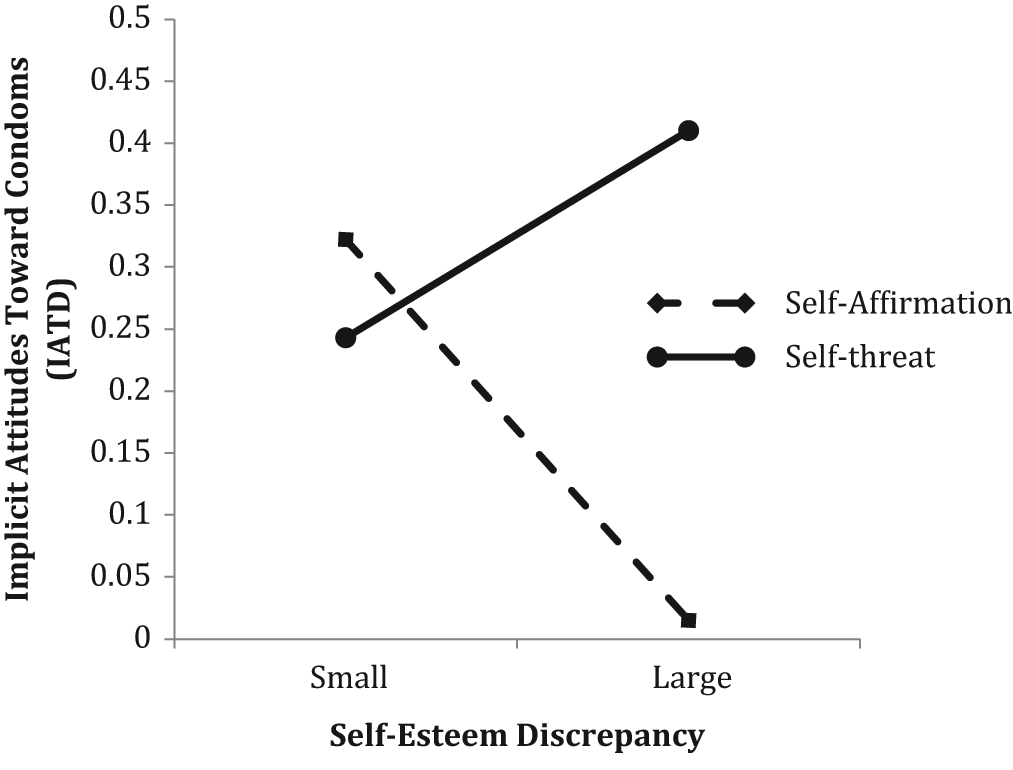
Experiment 2: Effect of feedback and self-esteem discrepancy on implicit attitudes toward condoms
Next, we regressed explicit attitudes toward condom scores on the terms in the above regression model. No main effects were found for Experiments 2 and 3, Fs < .87, ps > .45, so they will not be discussed further. Most importantly, consistent with Prediction 4, there was no combined effect of self-esteem discrepancy and feedback on explicit attitudes toward condoms, ΔF(1, 74) = 0.44, p = .50. 3
To examine whether self-esteem discrepancy direction moderated our predicted effects, implicit attitudes toward condoms were regressed on implicit and explicit self-esteem, feedback condition, and their interaction. As expected, the three-way Explicit Self-Esteem × Implicit Self-Esteem × Condition interaction did not significantly predict implicit attitudes toward condoms, ΔF(1, 72) = 0.89, p = .35; R2 = .05; β = −.13, nor explicit attitudes toward condoms, ΔF(1, 71) = 0.12, p = .73; R2 = .15; β = .08. Furthermore, implicit self-esteem and explicit self-esteem did not separately predict implicit or explicit attitudes toward condoms, βs < .22, ps > .09.
Experiment 3
Experiment 2 found that large self-esteem discrepancy individuals who received threatening feedback expressed strong negative implicit attitudes toward condoms when compared with discrepant individuals who received affirming feedback. In fact, a self-affirmation attenuated the expression of negative implicit attitudes toward condoms. Experiment 2 begs one important question: Are self-threat and self-affirmation shifting implicit attitudes toward condoms in opposite directions? In the absence of a baseline, it is impossible to address this issue. Therefore, Experiment 3 included a third condition in which participants did not complete the feedback procedure (control condition). This modified procedure allowed us to test whether Experiment 2’s results represent a contrast effect; that is, among large self-esteem discrepant individuals, a self-threat exacerbates negative implicit attitudes toward condoms when compared with baseline, and a self-affirmation attenuates negative implicit attitudes toward condoms when compared with baseline. In addition, Experiment 3 allowed us to ensure the reliability of Experiment 2’s findings.
A second change in Experiment 3 is that it measured self-esteem discrepancy before feedback as opposed to after feedback, which was the case in Experiment 2. Past researchers have treated individual differences in implicit–explicit self-esteem discrepancy as relatively stable (e.g., Briñol et al., 2006; Jordan et al., 2003; Petty & Briñol, 2009). Indeed, when the self-esteem discrepancy measure is completed before (Briñol et al., 2006, Study 1) versus after (Briñol et al., 2006, Studies 2-4) the manipulation of the main independent variable, the predicted results remain unchanged. In line with this stability argument, Experiment 2’s feedback conditions did not significantly affect self-esteem discrepancy scores, t(77) = −1.07, p = .29. However, we changed the procedure in Experiment 3 to coincide with the logic of our temporal argument. We expected Experiment 3’s results to support our predictions even when the measures of self-esteem are administered before the manipulation of self-threat versus self-affirmation. 4
Method
Participants
Eighty-seven student participants (68 females) completed the study in exchange for course credit. Participants’ age ranged from 18 to 33 years (M = 20). Of these participants, 26% were African American, 21% were Asian or Pacific Islander, 18% were Hispanic, 16% were Caucasian, 11% did not self-identify, and 7% were Multiracial. Four participants were dropped from the analyses because they had data points that were 3 SDs above mean. The final N = 83.
Procedure and Measures
The procedure and measures were identical to Experiment 2 with two important exceptions. First, we added a third condition in which participants did not complete the intelligence test and feedback procedure (control condition). Second, participants completed the measures of implicit (αSE-IAT = .73) and explicit (αRSES = .88) self-esteem (counterbalanced) before they were randomly assigned to a feedback condition (condom attitudes: αImplicit = .62, αExplicit = .83).
Results and Discussion
Table 1 lists the means and standard deviations of all measured variables. Following Aiken and West (1991), we created planned contrasts to test the combined effect of self-esteem discrepancy and feedback on implicit and explicit attitudes toward condoms. To examine whether the self-affirmation condition and the self-threat conditions varied from baseline (no-feedback condition), we created two dummy variables: (a) self-threat condition coded 1 and the other two feedback conditions (no-feedback and self-affirmation conditions) coded 0, and (b) the self-affirmation condition coded 1 and the other two conditions (no-feedback and self-threat conditions) coded 0. Because they are entered simultaneously in the regression analysis, the first contrast examines whether the self-threat condition differs from the no-feedback condition, and the second contrast tests whether the self-affirmation condition differs from the no-feedback condition. Next, we regressed the scores from the measures of implicit and explicit attitudes toward condoms on the self-threat versus no-feedback contrast, the self-affirmation versus no-feedback contrast, self-esteem discrepancy (centered), and the two interactions (computed by multiplying the discrepancy centered scores by each contrast).
First, the regression using implicit attitudes toward condoms as the outcome variable revealed marginally significant Self-Esteem Discrepancy × Self-Threat Feedback, β = .22, p = .08, and Self-Esteem Discrepancy × Self-Affirmation Feedback, β = −.25, p = .06, interactions (see Figure 2). To examine these interactions, we ran simple slopes analyses and estimated the values of the implicit attitudes toward condoms at 1 SD above and below the mean on self-esteem discrepancy for the three feedback conditions. Consistent with Predictions 2a and 2b, large self-esteem discrepancy participants who received threatening feedback expressed greater negative implicit attitudes toward condoms (estimated M = .44) when compared with those participants who received no feedback (estimated M = .26), β = .36, p = .05. Furthermore, those who received affirming feedback expressed less negative implicit attitudes toward condoms (estimated M = .07) when compared with those participants who received no feedback (estimated M = .26), β = −.28, p = .07 (Prediction 2b). In contrast, and consistent with Prediction 3, among small self-esteem discrepancy participants, implicit attitudes toward condoms did not vary as a function of affirming or threatening feedback, βs < .09, ps > .39. Finally, consistent with Prediction 4, there was no combined effect of self-esteem discrepancy and feedback on explicit attitudes toward condoms, ΔF(2, 77) = 1.61, p = .20.
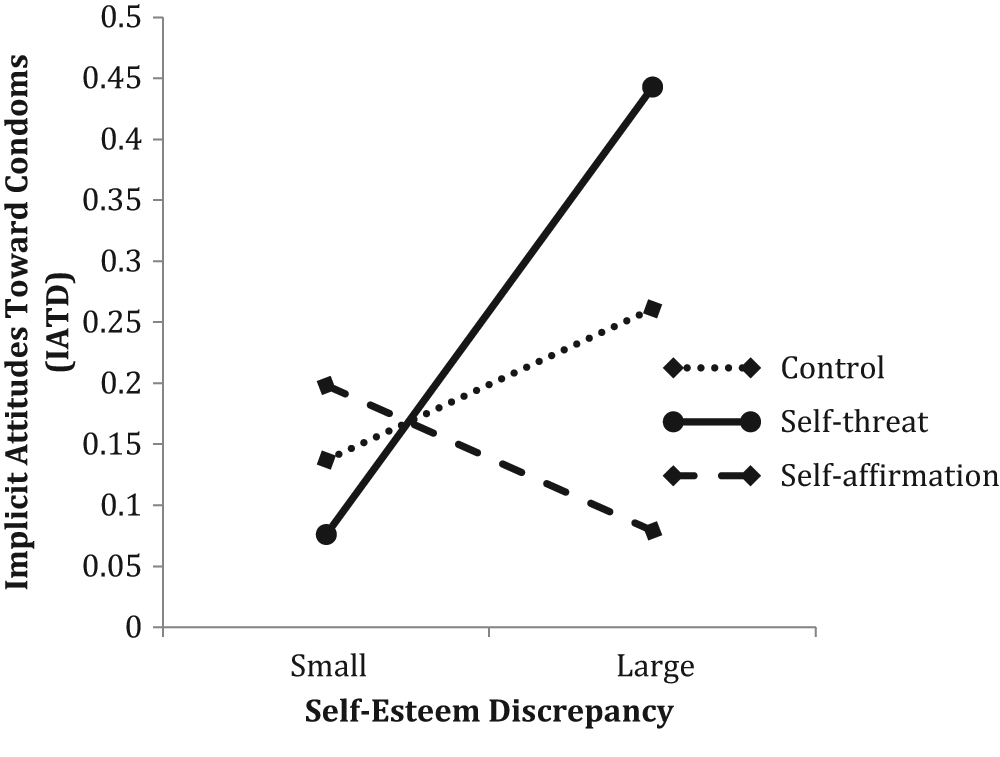
Experiment 3: Effect of feedback and self-esteem discrepancy on implicit attitudes toward condoms
Again, to examine whether self-esteem discrepancy direction moderated our predicted effects, implicit attitudes toward condoms were regressed on implicit and explicit self-esteem, feedback condition, and their interaction. The three-way Explicit Self-Esteem × Implicit Self-Esteem × Condition interaction did not significantly predict implicit attitudes toward condoms, ΔF(1, 79) = 2.52, p = .12; R2 = .14; β = −.16, nor explicit attitudes toward condoms, ΔF(1, 79) = 0.01, p = .92; R2 = .13; β = .02. Moreover, implicit self-esteem and explicit self-esteem did not separately predict implicit or explicit attitudes toward condoms, βs < −.09, ps > .07. Altogether, the four experiments consistently demonstrate that as it relates to self-image ambivalence and attitudes toward condoms outcomes, the direction of an individual’s self-esteem discrepancy does not matter.
General Discussion
The main goal of this research was to demonstrate that individuals who hold discrepant implicit and explicit self-esteem possess relatively strong self-image concerns. In line with this goal, Experiments 1a and 1b found that large self-esteem discrepancy individuals exhibited greater implicit (but not explicit) self-image ambivalence than small self-esteem discrepancy individuals. These results suggest that implicit–explicit self-esteem discrepancy is associated with an implicit feeling of ambivalence, which is a source of self-image concerns. Experiments 2 and 3 provided a relatively strong test of our hypothesis by presenting participants with a self-threat, because it heightens self-image concerns, versus a self-affirmation, because it alleviates self-image concerns. Then, we gave participants an opportunity to express their implicit and explicit attitudes toward condoms. As predicted, results showed that large self-esteem discrepancy individuals who received threatening feedback about their intelligence responded irrationally by expressing relatively strong negative implicit attitudes toward condoms when compared with self-affirmation (Experiment 2) and baseline (Experiment 3) conditions. On the flip side, large self-esteem discrepancy individuals who received affirming feedback about their intelligence responded rationally by expressing less negative implicit attitudes toward condoms when compared with self-threat (Experiment 2) and baseline (Experiment 3) conditions. However, among small discrepancy individuals who do not possess the same self-image concerns of large discrepancy individuals, neither a self-threat nor a self-affirmation affected their implicit attitudes toward condoms. Finally, self-esteem discrepancy and feedback did not have a combined effect on explicit attitudes toward condoms. This result is in line with the MCM (Petty & Briñol, 2009), which argues that because individuals are not aware that they hold discrepant implicit and explicit self-esteem, such discrepancy is more likely to be associated with implicit than explicit processes and outcomes.
Past researchers have suggested that large self-esteem discrepancy individuals adopt strategies that “presumably reflect[s] an attempt at discrepancy reduction” (Briñol et al., 2006, p. 156). Such strategies may include enhanced information processing (Briñol et al., 2006), the expression of narcissism (Gregg & Sedikides, 2010; but see Bosson et al., 2008), and unrealistic optimism (Bosson et al., 2003). We suggest that these strategies may reflect a behavioral response to a threat to self-image concerns inherent in implicit–explicit self-esteem discrepancy. Thus, to the extent that this is the case, situations that call into a question a person’s self-image should increase self-image concerns and yield irrational self-image-related outcomes particularly among large self-esteem discrepant individuals. However, such behavior should be attenuated after self-image concerns are satisfied in some alternative way. In line with this rationale, across Experiments 2 and 3, large self-esteem discrepancy individuals whose self-image was threatened via negative intelligence feedback expressed relatively strong negative implicit anti-condom attitudes, but such attitudes were completely attenuated after large self-esteem discrepancy individuals received a self-affirmation via positive intelligence feedback. We view our data as extending past research by demonstrating that what is troubling about implicit–explicit self-esteem discrepancy is not its instigation of implicit psychological inconsistency—thus the use of strategies that attempt discrepancy reduction—but its detrimental effect on one’s self-image. In this way, our data also complement a long line of research on explicit psychological inconsistency (Festinger, 1957; Higgins, 1987; Priester & Petty, 1996; Steele & Liu, 1983). That is, just as people with inconsistent explicit attitudes experience explicit ambivalence and psychological harm to their positive self-view, we demonstrate that people with inconsistent implicit and explicit self-esteem also experience implicit ambivalence and possess heightened self-image concerns.
Attitudes Toward Condoms and Self-Image Concerns
In Experiments 2 and 3, the independent variable used the intelligence domain to manipulate a self-threat versus a self-affirmation, and the dependent variable was the assessment of attitudes in the sexual health domain. Although these two domains are seemingly unrelated, our data demonstrate their interconnectedness via the self—Specifically, self-image motivational processes activated in one self-related domain (intelligence) can be manifested in another seemingly distinct self-related domain (attitudes toward condoms). This idea is in line with self-image maintenance theories (Lewin, 1935; Steele & Liu, 1983; Tesser & Cornell, 1991; for a review, see Tesser, 2000), which posit that self-image mechanisms are interchangeable; that is, an activity in one domain can function in place of an activity in a different domain when addressing the same self-image concerns. As discussed in the introduction, we reasoned that implicit attitudes toward condoms are functional such that they reflect the state of self-image concerns of large self-esteem discrepancy individuals. Expressing implicit anti-condom attitudes following a self-threat is an indication of strong self-image concerns, whereas the attenuation of implicit anti-condom attitudes following a self-affirmation is an indication of alleviated self-image concerns. Attitudes toward condoms are particularly compelling in testing our hypothesis because they are strongly tied to one’s self-image, especially when self-image concerns are at stake (Dunkel & Papini, 2005; D. A. Sherman et al., 2000).
Self-Esteem Discrepancy and Irrational (and Maladaptive) Behavior
Rational choice theory argues that individuals tend to balance behavioral costs against behavioral benefits before deciding on a course of action (Caporael et al., 1989; Jackson, 2008; Lynn & Oldenquist, 1986). If the costs of engaging in a behavior are minimal relative to the personal benefits and advantages, then this process is considered rational; otherwise, it is irrational (i.e., maximum costs, minimum benefits). As it relates to the present research, we demonstrate that when large self-esteem discrepant individuals who possess strong implicit self-image ambivalence (Experiments 1a and 1b) receive a threat to their self-image, they express relatively strong unfavorable implicit attitudes toward condoms (Experiments 2 and 3). Because expressing negative condom attitudes predicts sexual behavior that can jeopardize one’s health, such behavior may not be worth the benefit of sexual pleasure. In this sense, we have characterized discrepant individuals’ responses as irrational behavior. We acknowledge that perhaps rejecting condoms can be rational for psychological functioning such that it might restore overall self-image, but the cumulative empirical data on attitudes toward condoms suggest otherwise. Unfavorable attitudes toward condoms predict less condom use with casual partners and with previous sexual partners, and less prevention-related thoughts as it relates to using condoms (Marsh et al., 2001). How do such behaviors benefit the global integrity and value of an individual? We view our data as complimenting research showing that individuals with poor self-images are less likely to use condoms and have a greater likelihood of having an STD (Shrier et al., 2001), and more generally speaking, they tend to express an array of irrational beliefs (Sava, Maricutoiu, Rusu, Macsinga, & Virga, 2011; Watson & Culhane, 2005).
What we conceptualize as irrational behaviors may also be considered maladaptive behaviors. By maladaptive behavior, we mean dysfunctional and nonproductive behaviors that are typically exacerbated after a self-threat (e.g., abuse alcohol, set unattainable goals; Baumeister et al., 1993; Hull, 1981). These data suggest that a threat compromises individuals’ psychological resources (Sherman & Hartson, 2011), and, thus, they engage in maladaptive behaviors. As it relates to the present research, because self-esteem discrepancies sting individuals’ self-image, particularly after a self-threat, they are especially likely to express behavioral attitudes that are maladaptive in the domain of sexual health (i.e., at risk of sexually transmitted infections and unwanted pregnancies). Whether one categorizes the presently observed behaviors as irrational or maladaptive, the current data demonstrate that a self-affirmation can psychologically immunize a threatened self-image (Sherman & Hartson, 2011). As a result, individuals respond rationally and adaptively.
Potential Moderators
A reliable finding across all four experiments was that the predicted effects on large self-esteem discrepant individuals’ ambivalence and condom attitudes were evident on “implicit” measures but not on “explicit” measures. These results are consistent with the MCM (Petty & Briñol, 2009), which argues that because individuals are not aware that they hold discrepant implicit and explicit self-esteem, such discrepancy is more likely to be associated with implicit than explicit outcomes. Therefore, when conceptualizing the processes that may moderate the present results, those that rely on consciousness and control may prove futile. For example, people who self-monitor are able to control or adjust their attitudes and behavior to present themselves positively across a variety of situations (Frandt & Ferris, 1990; Turnley & Bolino, 2001). One plausible prediction is that self-esteem discrepant individuals who self-monitor will be less likely than those who are low self-monitors to express implicit negative condom attitudes as a way to present their self-image in a positive light. However, our data do not support this prediction because the ability to self-monitor in this case relies on the awareness of one’s internal inconsistency.
In line with the MCM, we suggest that metacognitive moderators might be more promising. For example, although individuals may not be aware of self-esteem discrepancy, some may acknowledge this possibility. This may be the case because such individuals realize that people do not always “speak their minds” or that some people do not always “know their minds” (i.e., introspect). Individuals who acknowledge the possibility of psychological discrepancy may be aware of its possible impact on their self-image and thus less likely to succumb to the harmful effects of a self-threat. This argument is somewhat consistent with research on another plausible metacognitive moderator, attitude confidence (Petty, Briñol, & Tormala, 2002). Attitude confidence is defined as feeling “conviction or validity” in one’s attitudes. High attitude confidence is more likely to predict behavioral change (e.g., persuasion) than low attitude confidence. As it relates to the present research, the extent to which discrepant individuals are confident about their self-esteem as assessed by indirect and direct measures, such confidence may be predictive of their responses to situations that implicate their self-image. Future research should explore these and related metacognitive moderators in greater depth.
Implications
Our research has important implications for the area of sexual behavior because implicit and explicit attitudes toward condoms are a determinant of family planning and the prevention of sexually transmitted infections (Brooks et al., 2009; Czopp et al., 2004; Marsh et al., 2001). In an interesting experiment, Czopp and colleagues (2004) demonstrated that when participants imagined an evening of sex with either a casual or steady partner, their explicit pro-condom attitudes predicted stronger intentions to use condoms with a casual partner (because presumably individuals are consciously biased toward using condoms with someone who poses a sexual health risk), whereas implicit pro-condom attitudes predicted stronger intentions to use condoms with a steady partner (presumably because individuals are less consciously biased toward using condoms with someone who does not pose a sexual health risk). The present research extends these and related past findings (e.g., Brooks et al., 2009; Marsh et al., 2001) on predicting sexual behaviors by demonstrating the integral role of self-image concerns. Although the majority of past research has relied on behavior models that begin with attitudes toward condoms as the antecedent (for a review, see Albarracin, Johnson, Fishbein, & Muellerleile, 2001), the present research suggests that psychological sources of self-image concerns are important alternative behavioral antecedents (also see Sherman et al., 2000). On one hand, when self-image concerns are at stake (and they often are in sexual situations; Sherman et al., 2000), implicit–explicit self-esteem discrepant individuals may be at great risk of engaging in sexual behavior that can have unintentional consequences for health and family planning. However, our data also suggest good news—A self-affirmation can effectively immunize individuals with implicit self-image concerns from engaging in risky sexual behavior.
Footnotes
Acknowledgements
We thank Kristy Dean, Janet Kottke, and three peer reviewers for their thoughtful comments on an earlier version of this article, as well as Brian Nosek for his statistical advice. We are also grateful to Shari Fife who conducted Experiment 1a as part of her undergraduate honors thesis, and to Christina Baggett, Diane Berlinksi, Stephanie Bolanos, Jessica Calle, Faiza Furqan, Meara Hockensmith, Sherry Mendez, Sean Mohit, Manthan Pandya, Cathleen Rodriguez, Kadiatu Tarawalie, Nicole Tennis, and Marie Vogel for their help with data collection.
Authors’ Note
Both authors contributed equally to this manuscript. Experiment 2 was part of the first author’s master’s thesis under the supervision of the second author.
Declaration of Conflicting Interests
The author(s) declared no potential conflicts of interest with respect to the research, authorship, and/or publication of this article.
Funding
The author(s) disclosed receipt of the following financial support for the research, authorship, and/or publication of this article: This research was partially supported by a Rutgers Lehrman Fellowship and a California State University, San Bernardino, student research grant to Valerie Laws, as well as a National Center on Minority Health and Health Disparities grant (1P20MD002722) to Luis M. Rivera.