



Abstract
The description and explanation of intergroup differences tend to be framed in terms of how nonnormative (untypical and/or stigmatized) groups differ from normative groups rather than vice versa. Three experiments examined how this affects group members’ collective self-esteem. Single participants felt worse about being single when they read (Study 1) or wrote (Study 2) about how singles differ from coupled people than when they read or wrote about how coupled people differ from singles—although they mentioned more positive aspects of being single under the former comparative framing. In Study 3, left-handed participants indicated lower private collective self-esteem after writing about how left-handers differ from right-handers than after writing about how right-handers differ from left-handers. Thus, regardless of the specific characteristics that the comparison focused on, being marked as different and having to explain one’s group identity negatively affected members of nonnormative, but not members of normative groups.
“How come a wonderful person like you is still single?” “Why haven’t you found anybody yet?” “Don’t you feel lonely sometimes?” Questions like these sound quite familiar whereas we will rarely hear people ask others to explain why they are in a relationship or how being in a relationship makes them feel. More generally, certain group identities seem to stand out and prompt explanations more than others that are implicitly taken as the norm (Hegarty & Pratto, 2001; Miller, Taylor, & Buck, 1991; Pratto, Hegarty, & Korchmaros, 2007) and “go without saying” (Pratto, Korchmaros, & Hegarty, 2007). Specifically, groups that fit with implicit expectations—for instance, majorities, high-status groups, and groups that conform to cultural norms in other ways—tend to be taken as the default standard (normative groups) that other groups (nonnormative groups) are compared to (cf. Bruckmüller, Hegarty, & Abele, 2012; Hegarty & Pratto, 2001; Pratto, Hegarty, et al., 2007). This stigmatizes nonnormative groups as “the effect to be explained” (Miller et al., 1991, p. 5).
The present research is the first to address how this asymmetric explanatory focus affects how people feel about the social groups that they belong to. Three studies test whether the comparative framing of intergroup differences, that is, who is compared to whom, affects how positively or negatively members of normative and nonnormative groups feel about their social identity. A construct that captures how positively people feel about their group memberships is collective self-esteem (CSE). Private CSE in particular refers to people’s personal evaluation of their social identity as something positive (Luhtanen & Crocker, 1992). The present studies examine how being the effect to be explained influences the private CSE of singles and coupled people (Studies 1 and 2) as well as of left-handers and right-handers (Study 3). How do singles feel about being single if they permanently find themselves compared to coupled people and thereby implicitly marked as an exception from the norm? Does it affect left-handers’ CSE if they are similarly “singled out” as different from the majority of right-handers? And does this comparative framing also affect how coupled people and right-handers feel about their group membership?
Uneven Comparisons and Explanations in Intergroup Contexts
When people talk about or try to explain differences between social groups, they tend to frame comparisons in terms of how one group differs from the other (Miller et al., 1991). Who will be compared to whom can be predicted based on norm theory (Kahneman & Miller, 1986). It states that mental category norms are formed ad hoc by retrieving category exemplars from memory. The exemplars that come to mind most easily define what appears normal for a category or group of people. Because prototypical category members are called to mind easily, they are usually included in the mental category norm. Attributes that fall outside this category norm seem surprising and attract attention. Consequently, people tend to focus on atypical members’ attributes when they describe and explain differences within a category (see Pratto, Hegarty, et al., 2007). For example, Miller and others (1991) found that most people imagine the typical voter as male. Accordingly, their participants’ spontaneous explanations of an observed gender difference in voting behavior focused more on why women (as the effect to be explained) voted differently than men (as the implicit norm) than on why men voted differently than women.
More generally, we tend to compare less typical groups to more typical groups, and—because high-status groups represent “cultural default values” (Smith & Zárate, 1992, p. 15)—lower-status groups to higher-status groups (see Hegarty & Bruckmüller, in press; Pratto, Hegarty, et al., 2007). For instance, we tend to focus on how women differ from men (Miller et al., 1991), how Blacks differ from Whites (Pratto, Hegarty, et al., 2007), and how lesbians and gay men differ from straight people (Hegarty & Pratto, 2001) rather than vice versa. These effects have also been observed in scientific publications: Articles in APA journals more often discuss how women differ from men than how men differ from women (Hegarty & Buechel, 2006).
Consequences of Asymmetric Comparisons and Explanations
These habits of framing intergroup comparisons are often seen as problematic because they mark nonnormative groups as deviant and imply that they, rather than normative groups, will have to change for differences to be reduced (Miller et al., 1991). More recently, social psychologists have started to empirically examine the psychological consequences of these habits of framing intergroup comparisons.
Hegarty and Pratto (2001) have illustrated how asymmetric explanations of intergroup differences cause stereotypes about nonnormative groups to be aired more often than stereotypes about normative groups. Moreover, the framing of intergroup comparisons affects perceptions of group status and power (Bruckmüller & Abele, 2010), thereby reinforcing existing status differences and associated group stereotypes. For instance, framing gender differences in the stereotypically male domain of leadership in terms of how women differ from men (as most people would do spontaneously) makes status differences between gender groups appear greater and more legitimate and leads to higher endorsement of status-related gender stereotypes than an unconventional framing in terms of how men differ from women (Bruckmüller et al., 2012). Relatedly, explaining nonnormative groups more than normative groups might implicitly reinforce the atypicality of the former and the prototypicality of the latter—and perceived prototypicality can again be used to legitimize intergroup status differences (Weber, Mummendey, & Waldzus, 2002).
In concert with earlier findings on the influence of group status on the framing of differences, this suggests a dynamic process by which status differences and habits of framing mutually reinforce each other. Status differences influence who becomes the effect to be explained and this asymmetric framing in turn communicates relative group status and the legitimacy of these status inequalities (see Hegarty & Bruckmüller, in press). The present research examines whether the framing of comparisons between social groups also influences how individuals feel about their group membership. To the extent that being implicitly marked as deviant from a normative standard (Miller et al., 1991), being stereotyped (Hegarty & Pratto, 2001), and being portrayed as powerless and low in status (Bruckmüller & Abele, 2010) are negative experiences, the research summarized above suggests that people should feel less positively about their category membership when the focus is on how their ingroup differs from an outgroup than when the focus is on how an outgroup differs from the ingroup.
Potentially Positive Implications of Being the Effect to be Explained
Although the present research is concerned with group-based self-experience, research on framing effects in self–other comparisons on the individual level might be informative for the research questions at hand. Self-positivity biases such as unrealistic optimism or the better-than-average effect are greater when the self is compared to others than when others are compared to the self (e.g., Eiser, Pahl, & Prins, 2001; Hoorens, 1995). Moreover, people mention more positive self-aspects when they compare the self to others than when they compare others to the self (Pahl & Eiser, 2006; Pahl, Eiser, & White, 2009).
Pahl and Eiser (2006) explained this “comparative self-positivity” by a combination of Tversky’s (1977) feature matching model and a generally positive self-view. A comparative focus on the self (i.e., comparing the self to others) renders the self’s unique attributes particularly salient, and because most people see themselves positively, comparing the self to others brings more positive self-characteristics to mind than comparing others to the self. Other authors have argued that this comparative self-positivity may essentially be a reaction to threat, either because being the standard of comparison implies a superiority that is threatened when the self is compared to others (Hoorens, 1995) or because a framing that implies that the self might be similar to others threatens personal distinctiveness (Codol, 1987).
Regardless of which interpretation one regards as more plausible, these studies demonstrate that being the effect to be explained can also have positive implications such as rendering positive self-aspects particularly salient or increasing self-positivity biases. Should we expect similar processes on the group level? Individuals strive to maintain not only a positive personal self-view but also a positive view of the social groups that they belong to; how one’s social groups compare with relevant outgroups is of central importance for social identity and CSE (Tajfel & Turner, 1986; Turner, Hogg, Oakes, Reicher, & Wetherell, 1987; see also Luhtanen & Crocker, 1992) and group members often selectively focus on comparison domains that lead to favorable comparison outcomes for the ingroup, especially under conditions of threat (e.g., Crocker & Major, 1989; Van Knippenberg & Ellemers, 1990). Therefore, one might expect that comparing the ingroup to an outgroup causes group members to selectively call positive ingroup attributes to mind just like comparing the self with others causes individuals to call more positive self-aspects to mind.
Should we expect such a potential comparative ingroup-positivity to extend to feelings about one’s ingroup more generally, that is, to CSE? Considering the implications of being the effect to be explained for stereotypes and power dynamics (Bruckmüller et al., 2012; Hegarty & Pratto, 2001), this does not seem particularly likely. But either way, it seems important to extend previous theorizing and research on the key relevance of comparison domains and comparison outcomes for social identity (e.g., Tajfel & Turner, 1986; Van Knippenberg & Ellemers, 1990) to the role of comparative framing, specifically, to the implications of being the effect to be explained versus the implicit norm in comparative intergroup contexts.
Present Research and Hypotheses
A comparative focus on one’s ingroup (i.e., comparing one’s own group to an outgroup) directs special attention to the ingroup’s unique attributes (Hegarty & Chryssochoou, 2005). In isolated incidents, this might allow group members to feel special and unique, especially when the attributes that the comparative framing brings to mind are mostly positive (Pahl & Eiser, 2006). However, any characteristics of a social group that a comparative focus on this group might bring to mind are akin to stereotypes, and people usually experience being stereotyped as disempowering, even when these stereotypes are positive (Cook, Arrow, & Malle, 2011; Fiske, 1993)—presumably more so for members of nonnormative groups who are confronted with disempowering ingroup stereotypes more often than members of normative groups (Hegarty & Pratto, 2001). Therefore, the experience of being singled out as different and having to explain oneself vis-à-vis the implicit standard of a normative group should become especially stigmatizing and frustrating when it is a repeated occurrence—or even the default reaction to one’s nonnormative group membership (see Miller et al., 1991, for a related discussion). Accordingly, the primary hypothesis for the present set of studies is that being the effect to be explained has negative implications for the CSE of members of nonnormative groups, but not necessarily for members of normative groups.
In addition, Studies 2 and 3 examined the kinds of ingroup and outgroup attributes that participants called to mind in the different framing conditions. I included these measures to investigate whether there might be some sort of comparative ingroup-positivity akin to the comparative self-positivity demonstrated in previous research (e.g., Pahl & Eiser, 2006). It also allowed me to explore whether such a comparative ingroup-positivity might ameliorate the hypothesized effect on the CSE of members of nonnormative groups, or whether being the effect to be explained would have negative implications regardless of the specific characteristics that the comparison focuses on.
Although group-based stigma, prejudice, and discrimination have been central topics of social psychology for a long time (e.g., Allport, 1954), there is growing realization that most research attention has been (and still is) focused on a few select social dimensions such as race/ethnicity, gender, or more recently, sexuality (Crandall & Warner, 2006). The present research moved beyond these “standard” dimensions. The first two studies examined how the framing of comparisons between singles and coupled people affects how people feel about being single or in a relationship, respectively. Relationship status as a social category has received limited research attention despite its important social implications (DePaulo & Morris, 2006). Adults who are single often face negative stereotypes and discrimination (e.g., Byrne & Carr, 2005) and the privileges that coupled (especially married) people receive are often not recognized or accepted as legitimate (DePaulo & Morris, 2006). Most important for the present research, being in a relationship is perceived as highly normative, often leading to the stigmatization of single people (DePaulo, 2007).
Study 3 tested the main hypothesis with a sample of left-handed and right-handed participants. Handedness refers to the distribution of fine motor skills between the left and right hands. Numerical estimates vary, but the vast majority of the world’s population is right-handed (70%-90%, see Hardyck & Petrinovich, 1977; McManus, 2002; Raymond & Pontier, 2004). Although positive stereotypes about left-handers, such as their supposedly higher creativity and openness are relatively common (Grimshaw & Wilson, 2012), left-handers also look back to a history of stigmatization and discrimination including their portrayal as unnatural or “twisted” and forced retraining attempts in many countries (e.g., Harris, 2003; McManus, 2002; Sato, Demura, Sugano, Mikami, & Ohuchi, 2008; Sattler, 1996). Moreover, left-handers are frequently faced with the challenge of handling tools and appliances designed for right-handers, constantly reminding them of their nonnormative status (Santrock, 2008).
In Study 1, participants read an otherwise identical text that either compared singles (as the effect to be explained) to coupled people (as the implicit norm) or compared coupled people to singles. In Studies 2 and 3, participants created their own examples of how singles (left-handers) differ from coupled people (right-handers) or of how coupled people (right-handers) differ from singles (left-handers). In all three studies, the central dependent variable was participants’ personal evaluation of their group membership as positive, that is, private CSE (Luhtanen & Crocker, 1992).
Study 1
Method
Participants and design
Thirty-four female and 26 male German university students of different majors (M age = 22.77 years, SD = 3.19) participated in the study. Thirty-five participants indicated that they were in a relationship and on average had been in this relationship for 33.90 months (SD = 25.48). Twenty-five participants identified as single; four of them had always been single, the remaining had been single for a mean length of 21.36 months (SD = 19.29).
The study had a 2 (comparative framing: singles compared to couples, couples compared to singles) × 2 (participant relationship status: single, coupled) design. Participants were randomly assigned to the framing conditions.
Materials and procedure
An experimenter approached participants on campus and invited them to participate in a study “on the perception of single and relationship life.” Upon arrival in the lab, participants completed questionnaires in individual cubicles. They first read a one-page text that either compared singles to coupled people (e.g., “Singles enjoy higher personal freedom and can devote more attention to their occupation and career than people in a relationship . . . Many people perceive singles as less settled and less balanced than coupled people.”) or compared coupled people to singles (“People in a relationship enjoy lower personal freedom and can devote less attention to their occupation and career than singles . . . Many people perceive coupled people as more settled and more balanced than singles.”). The text contained a number of positive and negative aspects of each of the two relationship statuses. Importantly, the factual information was the same in both conditions, only the comparative framing varied.
On the next page, participants indicated whether they were single or in a relationship and for how long they had held this relationship status. They then completed 9 items adapted from Luhtanen and Crocker’s (1992) Collective Self-Esteem Scale (CSES). Six items measured private CSE (Cronbach’s α = .85), including three items based on the original scale (e.g., “In general, I am happy that I am single/in a relationship”) and three items created for the purpose of the study (e.g., “Being single/in a relationship makes me feel good about myself”; see the appendix). For exploratory reasons, participants also answered three items based on the importance of identity subscale of the CSES that measures how central a category membership is for a person’s self-view (e.g., “In general, being single/in a relationship is an important part of my self-image.” Cronbach’s α = .76). Participants always indicated their agreement with the respective statement on a 1 (not at all) to 7 (completely) scale.
Finally, participants indicated their age and gender before they were thanked and debriefed. Interested participants later received a summary of the main findings.
Results
Preliminary analyses
Two participants (one in each framing condition) with a private CSE score more than 2 SDs above or below the mean in the respective condition were excluded from the analyses reported below. Participant gender had no significant main or interaction effects on any of the dependent variables, all Fs < 1.38, ps > .24, and was not considered in the analyses that follow.
Although participants in a relationship reported lower private CSE, the longer they had been in a relationship, r = –.37, p < .04, there was no interaction between length of relationship and comparative framing on CSE, β = .26, t < 1. Length of relationship status was therefore not included in the analyses reported below. Participants overall saw their relationship status as moderately relevant to their self-view (M = 3.59, SD = 1.38), and this was unaffected by comparative framing and relationship status, Fs < 1.
Collective self-esteem
For the main analysis, the framing conditions were recoded into whether participants’ own group or on the respective other group had been the effect to be explained. A 2 (framing: ingroup compared to outgroup, outgroup compared to ingroup) × 2 (relationship status: single, coupled) ANOVA revealed that coupled participants felt better about their relationship status than did participants who were single (Ms = 5.53 and 3.84, respectively, SDs = 0.72 and 1.09), F(1, 54) = 48.81, p < .001, d = 1.83, and participants overall reported slightly higher private CSE when the outgroup was compared to their ingroup rather than vice versa (Ms = 5.02 and 4.69, respectively, SDs = 0.98 and 1.37), F(1, 54) = 2.65, p < .11, d = 0.28. Most importantly, the predicted relationship status by comparative framing interaction was significant, F(1, 54) = 4.64, p < .04 (see Figure 1). In accord to predictions, single participants felt better about being single when coupled people were compared to singles than when singles were compared to couples (Ms = 4.35 and 3.48, respectively, SDs = 0.87 and 1.11), t(22) = 2.08, p = .05, d = 0.87. Coupled participants’ private CSE was unaffected by comparative framing, t < 1.
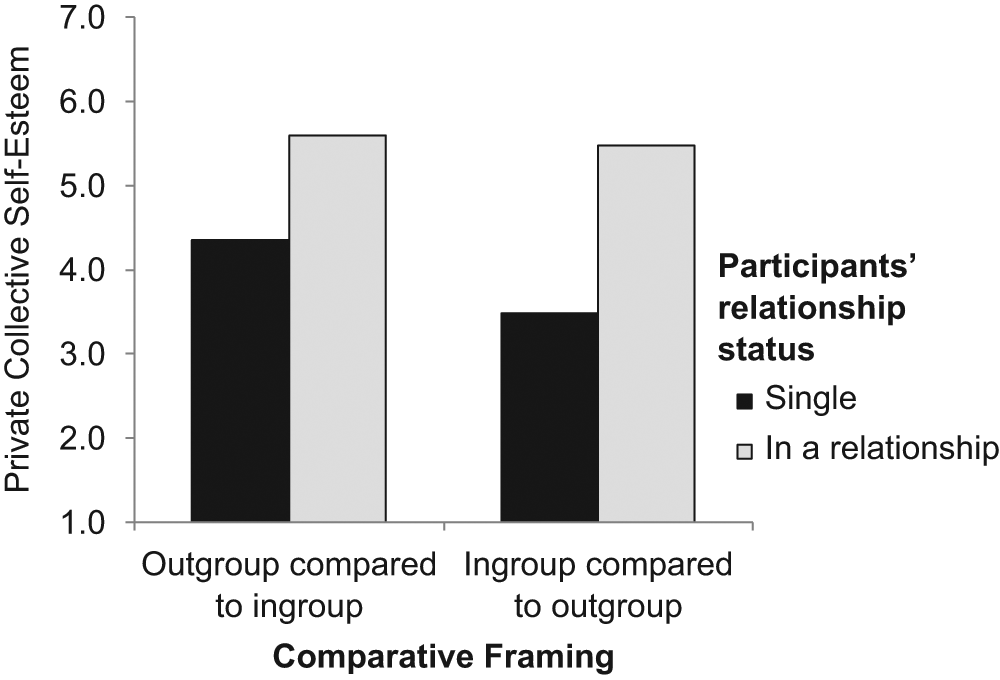
Private collective self-esteem in Study 1 by participants’ relationship status and comparative framing
Discussion
Study 1 confirmed the primary hypothesis. Members of a nonnormative social group (singles), felt more negatively about their membership in this social category when their group was compared to a group that is generally seen as normative in society (coupled people). There were no effects on the CSE of participants who were in a relationship. These results fit well with previous research on implicit normativity in communication about intergroup differences (Bruckmüller & Abele, 2010; Bruckmüller et al., 2012; Hegarty & Pratto, 2001; Miller et al., 1991). They might seem to conflict with research on self–other comparisons on the individual level that has documented higher self-positivity when the self is compared to others (e.g., Hoorens, 1995; Pahl & Eiser, 2006). However, the prefabricated text may have constrained the extent to which being the effect to be explained allowed participants to selectively call positive ingroup attributes to mind. To address this issue, participants in Study 2 produced their own comparisons between singles and coupled people.
Another reasonable objection against Study 1 is that it relied on a sample of fairly young university students for whom their present relationship status may be a less important social identity than for other people. I therefore recruited a community sample for Study 2.
Study 2
In Study 2, participants wrote down the things that came to their mind when either thinking about how singles differ from coupled people or about how coupled people differ from singles. This allowed an examination of the extent to which participants focused their comparisons on single people or on couples and of the extent to which participants specifically focused on positive (or negative) ingroup and outgroup characteristics. The main dependent variable was again private CSE.
Method
Participants and design
Sixty-seven female and 52 male participants (age range = 16-65 years, M = 26.71, SD = 10.88) were recruited in public places in two different German cities and completed a questionnaire on “the perception of singles and people in a relationship.” Seventy participants described themselves as in a relationship, with relationship length varying between 2 days and 38 years (M = 62.86 months). Forty-nine participants indicated that they were single; they had been single between 1 month and 27 years (M = 35.38 months).
The study had a 2 (framing: singles compared to couples, couples compared to singles) × 2 (relationship status: single, coupled) design. Participants were randomly assigned to one of the two framing conditions.
Materials and procedure
Participants first answered an item that either read “In general, how much do you think singles differ from people in a relationship?” or “In general, how much do you think people in a relationship differ from singles?” on a scale ranging from 1 (not at all) to 7 (very much). Next, participants were asked to explain their rating in an open response (“What did you base your response on? Please write down as many examples as you can think of and try to respond in complete sentences”). Several empty lines were provided for participants’ responses.
On the next page, participants indicated their relationship status as either single or in a relationship followed by 7 items from a German translation of the CSES (Luhtanen & Crocker, 1992) by Wagner and Zick (1993). This included the four items measuring private CSE (Cronbach’s α = .75) and three items measuring importance to identity (α = .56). 1
Finally, participants indicated their age, gender, and occupation before they were thanked and debriefed. Interested participants later received a summary of the main results.
Results
Preliminary analyses
Three participants had private CSE-scores more than 2 SDs above or below the mean in the respective condition and were excluded from further analyses. Participant gender had no significant main or interaction effects, Fs < 2.21, p > .13. Although single participants reported somewhat lower private CSE, the longer they had been single, r = –.30, p < .07, duration of singlehood did not interact with comparative framing, β = –.01, t < 1. Accordingly, length of relationship status was not included in the analyses reported below.
There were no systematic influences of comparative framing or relationship status on the perceived magnitude of differences between the groups, all Fs < 1. As in Study 1, participants’ identification with their relationship status was relatively low (M = 3.45, SD = 1.32) and unaffected by relationship status or comparative framing, Fs(1, 111) < 1.68, ps > .19.
Open responses
Fourteen participants did not complete the open-ended item. The responses of the remaining participants were transcribed verbatim and coded by two independent judges blind to experimental condition and participants’ relationship status. They coded for the number of examples focusing on singles (e.g., “As a single, you are responsible for yourself and your own life to a greater extent”) and the number of examples focusing on coupled people (e.g., “Couples mostly go out with other couples”). Ninety-five participants provided at least one codable response.
In addition, judges also coded the number of positive examples (e.g., “Singles are more sociable”; “People in a relationship are more stable”), and negative examples (e.g., “I think in my age group, singles are less mature”; “In a relationship . . . feelings such as jealousy come to the fore”) focusing on singles or coupled people, respectively. Interrater agreement was 91%; disagreements were resolved by a third judge.
Overall, participants gave between 0 and 8 examples focusing on singles (M = 1.67) and between 0 and 7 examples focusing on people in a relationship (M = 1.63). To control for variability in the length of participants’ responses, I examined the number of examples that focused on each group relative to the total number of examples, and the number of positive and negative examples relative to the total number of examples focusing on the respective group. 2
Focus of examples
A 2 (framing: singles compared to couples, couples compared to singles) × 2 (relationship status: single, coupled) × 2 (focus of examples: singles, coupled people) ANOVA to repeated measures on the last factor examined the extent to which participants had focused their responses on the two groups. The interaction between the framing manipulation and the focus of examples was marginally significant F(1, 86) = 3.16, p < .08, and qualified by a significant three-way interaction with relationship status, F(1, 86) = 8.24, p < .01.
For single participants, the interaction of framing and focus of examples was significant, F(1, 36) = 8.37, p < .02; when they had been asked how singles differ from couples, they generated more examples focusing on singles than on coupled people (Ms = 0.77 and 0.28, respectively, SDs = 0.44 and 0.42), t(36) = 2.75, p < .01, d = 1.14, when they had been asked how coupled people differ from singles, they generated more examples focusing on coupled people than on singles (Ms = 0.74 and 0.28, respectively, SDs = 0.68 and 0.34), t(32) = 2.71, p < .02, d = 0.90.
Coupled participants wrote somewhat more about couples than about singles (Ms = 0.70 and 0.47, respectively, SDs = 0.74 and 0.52), F(1, 50) = 3.72, p = .06, d = 0.21, but this was not moderated by the framing manipulation, F < 1.
Valence of examples
A 2 (framing: singles compared to couples, couples compared to singles) × 2 (relationship status: single, coupled) ×y 2 (focus of examples: singles, coupled people) × 2 (valence of examples: positive, negative) ANOVA with repeated measures on the last two factors examined influences on the relative number of positive and negative examples focusing on each group. Table 1 displays the respective means.
Relative Number of Positive and Negative Examples Focusing on Singles and on Coupled People (Standard Deviations in Parentheses) Mentioned in Participants’ Open Responses in Study 2
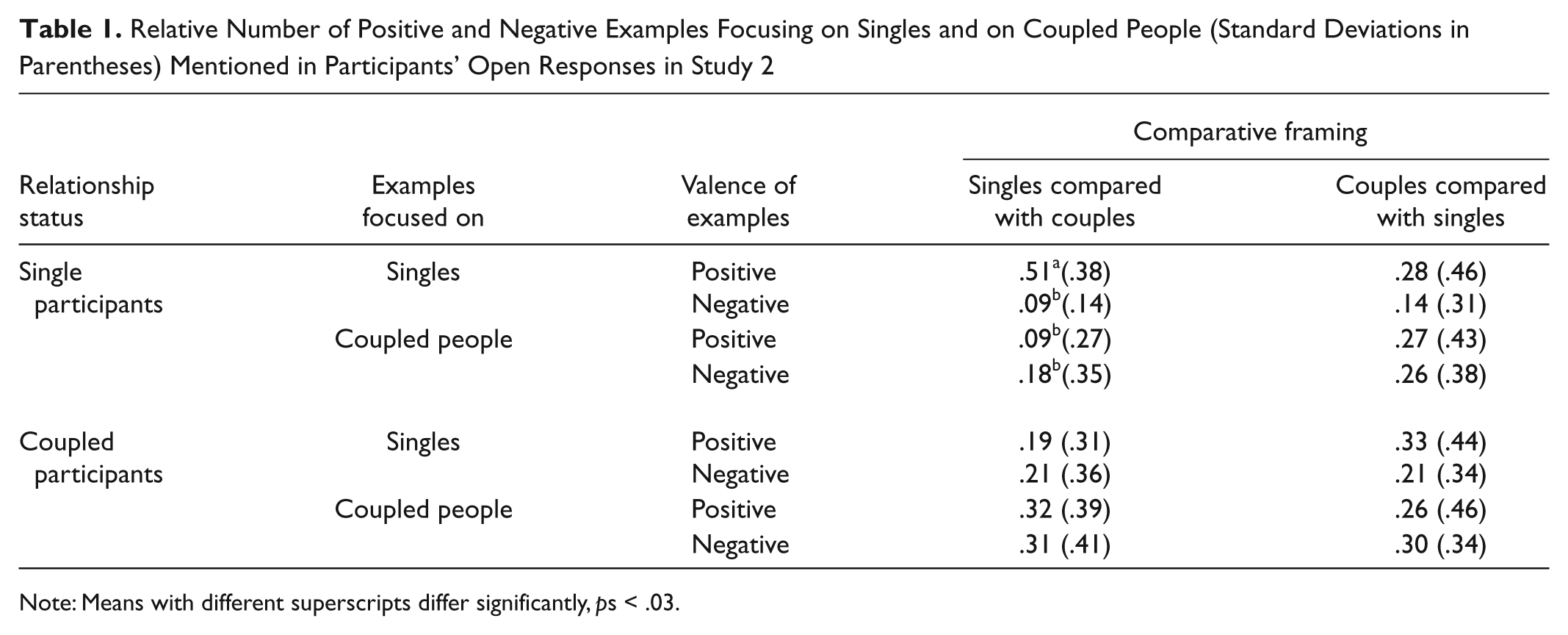
Note: Means with different superscripts differ significantly, ps < .03.
Besides an interaction of framing, relationship status, and focus of examples paralleling the three-way interaction for all open responses, F(1, 88) = 4.94, p < .03, a significant focus of examples by valence interaction emerged, F(1, 88) = 5.43, p < .03. While participants mentioned a comparable number of positive and negative characteristics of couples and being coupled (Ms = 0.25 and 0.27, respectively, SDs = 0.40 and 0.37), t < 1, they wrote more positive than negative statements about singles and being single (Ms = 0.31 and 0.17, respectively, SDs = 0.41 and 0.32), t(91) = 2.30, p < .03, d = 0.24. This was entirely driven by single participants in the singles compared to couples condition (see Table 1), where 51% of participants’ examples focusing on singles were positive and only 9% were negative, t(15) = 4.33, p < .001, d = 1.20; there was no significant difference in any other condition, ts < 1.10, ps > .28, ds < 0.24.
In summary, the framing manipulation affected the comparative focus in single participants’ but not in coupled participants’ responses. Moreover, single participants mentioned many more positive than negative ingroup characteristics when the question was how their ingroup differs from the outgroup of coupled people. The most important question for present purposes is whether this comparative ingroup-positivity extended to participants’ general evaluation of their social identity in terms of CSE.
Collective self-esteem
Comparative framing was again recoded into whether participants’ own group or on the respective other group had been the effect to be explained. A 2 (framing: ingroup compared to outgroup, outgroup compared to ingroup) × 2 (relationship status: single, coupled) ANOVA then tested effects on participants’ private CSE.
Participants in a relationship indicated higher private CSE (M = 6.28, SD = 0.58) than participants who were single (M = 4.88, SD = 0.87), F(1, 111) = 115.09, p < .001, d = 1.89. In addition, participants felt better about their relationship status when the outgroup rather than the ingroup was the effect to be explained (Ms = 5.81 and 5.59, respectively, SDs = 1.07 and 0.90), F(1, 111) = 5.00, p < .03, d = 0.22. Most importantly, this was qualified by a significant interaction of comparative framing and relationship status, F(1, 111) = 4.73, p < .04 (see Figure 2). Framing had no effect on coupled participants’ private CSE, t < 1, but single participants felt better about being single when they had thought about how coupled people differ from singles (M = 5.16, SD = 0.83) than when they had thought about how singles differ from coupled people (M = 4.58, SD = 0.83), t(45) = 2.39, p < .03, d = 0.70. 3
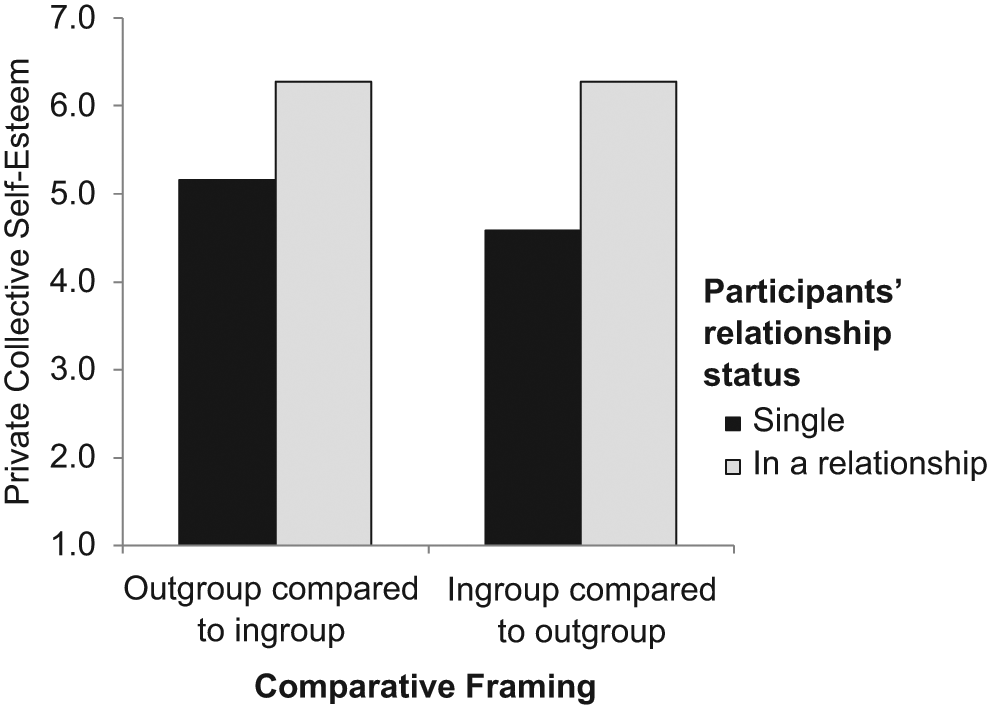
Private collective self-esteem in Study 2 by participants’ relationship status and comparative framing
Being the effect to be explained apparently caused singles to feel worse about their group membership even though the specific ingroup attributes that they wrote about were mostly positive. Accordingly, private CSE did not correlate with the absolute or the relative number of positive ingroup attributes mentioned by singles, |rs| < .19, ps > .28, or coupled participants, |rs| < .08, ps > .59. Single participants’ private CSE was, however, correlated with the absolute number of examples focusing on singles, r = –.39, p < .02. In other words, how positively single participants felt about their relationship status was independent of the extent to which their open responses focused on positive or negative ingroup characteristics, but was instead associated with the extent to which their responses generally focused on singles as the effect to be explained.
Mediational analyses
To test whether this focus on ingroup attributes in singles’ open responses mediated the effect of the framing manipulation on their private CSE, I conducted a series of regression analyses for the subsample of single participants. Framing (coded as 0 = couples compared to singles, 1 = singles compared to couples) significantly predicted the number of examples focused on singles, β = .37, p < .03, as well as private CSE, β = –.35, p < .02. When I simultaneously included the framing manipulation and the number of examples focused on singles in the model, number of examples predicted private CSE, β = –.32, p = .05, but framing no longer did, β = .18, p = .26. Using the Preacher and Hayes (2008) bootstrapping method with 3,000 bootstrap resamples, the indirect effect of framing condition on private CSE through number of singles-focused examples was significantly greater than zero (with a point estimate of .11, 95% confidence interval = [.0065, .3071]), indicating significant mediation. This means that single participants felt worse about being single in the singles compared to couples’ condition because this framing caused them to focus their responses more on singles as the effect to be explained.
Discussion
Study 2 replicated and extended the findings of Study 1. Singles indicated lower private CSE when their ingroup was the effect to be explained than when it was the implicit norm. At the same time, they mentioned more positive than negative ingroup attributes in this condition—as a combination of research on self–other comparisons on the individual level (Pahl & Eiser, 2006) and social identity theory (Tajfel & Turner, 1986) would predict.
These effects on single participants’ open responses and on their CSE might appear contradictory at first. However, both effects can be understood as reactions to the stigmatizing and threatening experience of being “singled out” as the effect to be explained. One response to this social identity threat is to selectively focus on comparison domains that lead to favorable comparison outcomes for the ingroup (cf. Tajfel & Turner, 1986; Van Knippenberg & Ellemers, 1990). At the same time, having to engage in this kind of self-defense in the first place causes group members to feel worse about their membership in this nonnormative social category. Accordingly, it was the total number of examples focusing on the ingroup, not the evaluative content of these examples, that mediated the effect of the framing manipulation on singles’ CSE. This strongly suggests that for members of nonnormative groups, the experience of having to explain how or why they are different from a normative group causes group members to feel less positively about their social identity, regardless of the specific content of the comparisons.
As in Study 1, comparative framing did not affect coupled participants’ CSE. One reason for this may be that, other than singles, coupled people are rarely faced with negative responses to their group membership (DePaulo, 2007) and do not have a history of having to explain themselves. Therefore, a comparative framing that renders their ingroup the effect to be explained is unlikely to remind them of frustrating or stigmatizing previous experiences. Relatedly, the framing manipulation did not cause coupled participants to consider differences with a primary focus on one of the two groups. These participants may simply not be used to thinking about themselves as members of the category “coupled people.” As a consequence, both framing conditions might have rendered this group identity that usually goes without saying very salient regardless of the comparative framing, thus overriding any effects of the framing manipulation.
An important question is whether the findings of Studies 1 and 2 extend to other normative and nonnormative groups. One important way in which relationship status differs from other social categories is that group boundaries are quite permeable. Singles might become coupled people in the future and coupled people might become singles. The permeability of group boundaries affects people’s social identity in important ways; for example, identification with the ingroup (e.g., Ellemers, 1993) tends to be lower when group boundaries are perceived to be permeable. Study 3 examined the effects of comparative framing on CSE with less permeable social groups, namely, left-handers and right-handers. Again, the main prediction was that left-handed participants (the nonnormative group) would experience lower private CSE when their ingroup was “singled out” as the effect to be explained.
Study 3
Method
Participants and design
Participants were recruited via participant mailing lists and social network websites for a short online survey on “the perception of differences based on handedness.” In addition, a link to the survey was posted in online forums on handedness and emailed to the members of two associations for left-handers (one German, one Austrian). As a reward, participants took part in a lottery to win gift certificates.
Overall, 216 participants (189 female, 20 male, 7 who did not indicate gender, M age = 24.78 years, SD = 9.23) proceeded far enough in the online survey to provide data on collective self-esteem. 4 Forty-eight participants self-identified as left-handed, 168 as right-handed. On average, participants took about 6 min to complete the survey (M = 5.85, SD = 5.87).
The study had a 2 (framing: left-handers compared to right-handers, right-handers compared to left-handers) × 2 (participant handedness: left, right) design. Participants were randomly assigned to framing conditions.
Materials and procedure
Participants first indicated their handedness as either left-handed or right-handed. On the next page, they were either asked “In general, how much do you think left-handers differ from right-handers?” or “In general, how much do you think right-handers differ from left-handers?” on a 1 (not at all) to 7 (very much) scale. Participants were then asked to explain their rating in an open response.
On the next page, participants answered 6 items assessing CSE that were based on Luhtanen and Crocker (1992) and on Leach and others (2008). Three items measured private CSE (“In general, I am glad to be left-handed/right-handed”; “Being left-handed/right-handed makes me feel good about myself”; “I feel good about being left-handed/right-handed”; Cronbach’s α = .83); three items measured importance to identity (“In general, being left-handed/right-handed is an important part of my self-image”; “My handedness is important for the way I see myself”; “I often think about the fact that I am left-handed/right-handed”; Cronbach’s α = .82). Items always referred to participants’ own handedness as indicated at the beginning of the survey.
Finally, participants indicated their age, gender, and whether they had ever been retrained from one handedness to another. Interested participants later received a summary of the main results.
Results
Preliminary analyses
One participant with a private CSE score almost 3 standard deviations below the mean in the respective condition, was excluded from all further analyses. Preliminary analyses revealed no effects of participant gender, Fs < 1. Nine left-handers and 5 right-handers indicated a handedness retraining history. As inclusion versus exclusion of these participants did not change the pattern of results or their statistical significance, retrained participants were kept in the sample using their self-identified handedness as independent variable in the analyses that follow.
Perceived magnitude of intergroup differences
A 2 (framing: left-handers compared to right-handers, right-handers compared to left-handers) × 2 (handedness: left, right) ANOVA revealed that left-handed participants perceived greater differences between the two groups (M = 3.45, SD = 1.65) than did right-handed participants (M = 2.38, SD = 1.46), F(1, 212) = 18.33, p < .001, d = 0.69. Comparative framing had no significant main or interaction effects, Fs < 1.95, ps > .16.
Importance to identity
Although participants overall reported low importance of their handedness for their self-view (M = 1.66, SD = 1.11), left-handed participants saw their handedness as more important (M = 2.78, SD = 1.47) than right-handed participants (M = 1.36, SD = 1.36), F(1, 211) = 81.05, p < .001, d = 1.00. Comparative framing had no significant main or interaction effects, Fs < 1.43, ps > .23.
Open responses
One-hundred and thirty-three participants provided an open response. As in Study 2, two independent coders counted the number of examples focusing on left-handers (e.g., “left-handers are more creative”), the number of examples focusing on right-handers (e.g., “right-handers face less difficulties in daily life”), and the number of positive and negative characteristics focusing on each group (e.g., “left-handers can do more things with their right hand than right-handers can do with their left,” “left-handers often have uglier handwriting,” “many tasks are easier for right-handers,” “right-handers sometimes feel awkward or insecure in the presence of a left-hander”). Interrater agreement was 90%; disagreements were resolved by discussion.
Overall, 123 participants provided at least one codable example. They mentioned between 0 and 9 examples focusing on left-handers (M = 1.87) and between 0 and 4 examples focusing on right-handers (M = 0.22). A much higher proportion of participants’ statements focused on left-handers (M = 0.75, SD = 0.39) than on right-handers (M = 0.09, SD = 0.24), F(1, 118) = 163.20, p < .001, d = 1.30, suggesting strong implicit associations of right-handedness with the norm for all people (cf. Miller et al., 1991). This tendency was unaffected by the framing manipulation and participants’ own handedness, all Fs < 1. Of the few examples focusing on right-handers, 43% were positive (SD = 49%) and only 3% were negative (SD = 11%), F(1, 16) = 11.68, p < .01, d = 0.86. Examples focusing on left-handers included a similar proportion of negative (M = 0.38, SD = 0.42) and positive characteristics (M = 0.29, SD = 0.46), F(1, 97) = 2.38, p = .13, d = 0.12. The framing manipulation and participants’ handedness had no significant effects, Fs < 1.76, ps > .20. The most commonly mentioned negative example focusing on left-handers were challenges that left-handers face because they, as one participant put it, “live in a world of right-handers.”
Collective self-esteem
A 2 (framing: ingroup compared to outgroup, outgroup compared to ingroup) × 2 (handedness: left, right) ANOVA indicated that overall, left-handed participants reported higher private CSE (M = 4.93, SD = 1.24) than right-handed participants (M = 2.68, SD = 1.36), F(1, 212) = 108.17, p < .001, d = 1.73. Most important, the framing by handedness interaction was significant, F(1, 212) = 4.24, p < .05 (see Figure 3). Left-handed participants reported higher private CSE when they were asked how right-handers differ from left-handers (M = 5.33, SD = 1.05) rather than how left-handers differ from right-handers (M = 4.57, SD = 1.30), t(45) = 2.18, p < .04, d = 0.65. Framing did not affect right-handed participants’ private CSE, t < 1.

Private collective self-esteem in Study 3 by participants’ handedness and comparative framing
As in Study 2, participants’ private CSE was unrelated to the absolute and the relative number of positive and negative ingroup attributes mentioned by left-handers, |rs| < .19, ps > .29, or right-handers, |rs| < .44, ps > .14. Left-handed participants’ private CSE was also unrelated to the total number of examples focusing on their ingroup, r = .07, ns. For right-handed participants, however, the number of examples focusing on the outgroup of left-handers was associated with higher CSE, r = .21, p = .05.
Discussion
Across conditions, participants overwhelmingly focused their discussion of intergroup differences on left-handers, regardless of how the question was framed. Apparently, the tendency to perceive left-handers as an exception that needs to be explained is so strong that this simple framing manipulation was not enough to shift this explanatory focus. However, the framing manipulation did matter for how left-handed participants felt about their group membership. Paralleling the findings for single participants in Studies 1 and 2, left-handed participants indicated lower private CSE when they thought and wrote about how their ingroup differs from an outgroup rather than about how this outgroup differs from the ingroup.
This effect on CSE was not only independent of the extent to which the ingroup characteristics that left-handed participants mentioned were positive or negative (as in Study 2); it was also independent of the extent to which their open responses generally focused on the ingroup. The observation that all participants almost exclusively focused their responses on left-handers may help us understand this difference to Study 2. Left-handers who are permanently navigating through a world of right-handers should be more often confronted with the experience of being atypical and different from the norm than singles are. As a consequence, they may be generally more aware of being the effect to be explained. Being asked how left-handers differ from right-handers was therefore enough to make them feel singled out and marked as different; actually focusing their responses more on left-handers than participants in the other framing condition was not necessary for this framing to reduce their CSE.
Another important difference to Study 2 is that writing about intergroup differences with a focus on a nonnormative group (i.e., left-handers) was associated with higher CSE among members of a normative group (i.e., right-handers). Although this finding can only be regarded as preliminary, it suggests that members of normative groups might subtly benefit from being the implicit norm—or from singling out others as the effect to be explained. Overall, right-handed participants reported quite low private CSE scores. Interpreting this as an indication that right-handers feel negatively about their handedness seems, however, unwarranted. Instead, their very low importance of identity scores (close to the endpoint of the scale) suggests that right-handedness is a very implicit group membership that is not routinely perceived as a meaningful social category or source of identity.
Most importantly, Study 3 replicated the main finding of Studies 1 and 2, namely, that being the effect to be explained (vs. the implicit norm) had negative implications for how members of a nonnormative group experienced their social identity, whereas these effects did not emerge for members of a normative group.
General Discussion
Three studies examined how being the effect to be explained in a comparative intergroup context affects how people feel about their membership in normative and nonnormative social groups. Using two different manipulations of being the effect to be explained and two different kinds of social groups, the studies yielded very parallel findings supporting the central hypothesis. Single participants who read (Study 1) or thought and wrote (Study 2) about how singles differ from coupled people felt worse about being single than those who were faced with comparisons of coupled people to singles. Left-handed participants felt less positively about being left-handed when they were asked how left-handers differ from right-handers than how right-handers differ from left-handers (Study 3).
These effects on CSE were independent of the extent to which participants wrote positive or negative things about their ingroup. The present studies are therefore the first to show that for how people experience their social identity, it not only matters how the ingroup compares with other groups in various comparison domains (Turner et al., 1987); it also matters who is compared to whom. For members of nonnormative groups, being singled out and having to explain oneself vis-à-via the implicit standard of a more normative group can negatively affect their group-based sense of self-worth, regardless of the specific evaluative content of intergroup comparisons—likely because being the effect to be explained is experienced as stigmatizing, othering, and disempowering (cf. Bruckmüller et al., 2012; Miller et al., 1991; Pratto, Hegarty, et al., 2007). Members of normative groups, on the other hand, might subtly profit from singling out others as the effect to be explained, as suggested by the positive correlation observed here between right-handed participants’ CSE and their tendency to focus on left-handers.
The CSE of coupled and right-handed participants was unaffected by the framing manipulation. One reason for this may be that the manipulation did not cause them to specifically focus on one group or the other. It may be part of the privilege of normative groups that their group membership goes without saying (Pratto, Korchmaros, et al., 2007) and therefore affords group members to think of themselves as unique individuals rather than as exchangeable group members (Lorenzi-Cioldi, 2006). Both personal and social identity can be sources of a positive self-view (Brewer, 1991; Turner et al., 1987) and members of normative groups might have higher freedom to only draw upon their group membership as a basis for social identity if this allows them to feel more positively about themselves.
In Study 2, the comparative framing also affected what kinds of intergroup differences single participants wrote about. They mentioned more positive aspects of singles and being single, when their ingroup was compared to the outgroup of coupled people (rather than vice versa), paralleling findings for self–other comparisons on the individual level (Pahl & Eiser, 2006). One likely explanation is that because this framing made single participants’ stigmatized group membership particularly salient, they shifted their attention to comparison domains favorable for their ingroup to buffer this threat to their social identity (cf. Crocker & Major, 1989). No such effects emerged for left-handed participants in Study 3. One reason for this may be that whereas singles are negatively stereotyped and discriminated against (DePaulo & Morris, 2006), contemporary stereotypes about left-handers are mostly positive (Grimshaw & Wilson, 2012). Accordingly, there may have been a lower need for left-handed participants to specifically write about attributes that make their ingroup look favorable.
More generally, the divergent findings for participants’ open responses and for CSE suggest that these two measures tap into different aspects of social identity that are affected differently by being the effect to be explained (vs. the implicit norm). For example, whereas participants’ open responses mostly referred to the entire group, CSE is more about the self as a group member. In addition, participants’ open responses focused on specific ingroup (and outgroup) characteristics, whereas private CSE is a relatively broad concept assessing how people evaluate their social identities in general. As a starting point for future research, this suggests that people manage their social identity on different levels and that strategies for maintaining a positive group-based self-view—and their effectiveness—might vary between these levels.
The present findings also have implications for research and theorizing on self–other comparisons on the individual level. To my knowledge, research on comparative self-positivity has always assessed the effects of comparative framing on self-judgments with regard to the specific comparison domains considered (e.g., Eiser et al., 2001; Hoorens, 1995; Pahl & Eiser, 2006). The present research suggests that it may also have an impact on general self-evaluations (i.e., self-esteem). This might also inform debates about the question whether comparative self-positivity is in its essence a reaction to threat (e.g., Codol, 1987; Hoorens, 1995), the result of a generally positive self-view (e.g., Pahl & Eiser, 2006), or some combination of both.
The parallel findings across groups based on relationship status and handedness are quite remarkable. These social categorizations differ with regard to such important characteristics as the permeability of group boundaries, social desirability concerns, and the content and valence of the most common stereotypes. A critical characteristic that they have in common is that certain groups are more normative than others, either because of widely shared cultural scripts for what it means to be a happy, successful person (DePaulo, 2007), or based on their sheer numerical majority. This supports the notion that a group’s (non)normative status is a key factor for whether and how being the effect to be explained affects people’s group-based sense of self-worth. Nevertheless, extending the present research to other social groups is an important task for future research. For example, participants saw the groups studied here as only moderately relevant to their self-view. This may be important because for members of stigmatized groups, identification with the ingroup can be a buffer against negative implications of prejudice and discrimination (Branscombe, Schmitt, & Harvey, 1999). Future research will investigate how being the effect to be explained affects members of groups that tend to be more central for how people see themselves and the extent to which identification with the ingroup might play an important role.
Most importantly, the present findings suggest yet another process by which systematic habits of stigmatizing nonnormative groups as the effect to be explained that have been demonstrated by much previous research (e.g., Hegarty & Buechel, 2006; Hegarty & Pratto, 2001; Miller et al., 1991) might contribute to the cultural reproduction of group-based status inequalities (cf. Bruckmüller & Abele, 2010; Bruckmüller et al., 2012). To the extent that rendering nonnormative, lower-status groups the effect to be explained and normative, higher-status groups the implicit norm causes members of nonnormative groups to experience their group as less valuable; they might be more likely to accept the privileges of normative groups as legitimate and less likely to challenge the status quo.
In conclusion, the present findings provide compelling evidence that the way in which we talk about social groups and the differences between them matters and that the communicative habit of marking stigmatized lower-status groups as the effect to be explained is particularly problematic. Considering the extent to which we as social scientists concern ourselves with intergroup differences, it seems important to be aware of these effects. Hopefully, this research will contribute to a heightened awareness of how we talk about group-based phenomena, who we might be singling out by explaining certain groups more than others, and how this might inadvertently contribute to the maintenance and reification of social inequalities.
Footnotes
Appendix
Collective Self-Esteem items used in Study 1. Items with an asterisk were created for the purpose of the study, all other items are based on Luhtanen and Crocker (1992).
Acknowledgements
I am thankful to Andrea Abele, Bella DePaulo, Peter Hegarty, Frieder Lang, and Sabine Pahl for their valuable comments on this research and/or a previous version of this manuscript.
Declaration of Conflicting Interests
The author(s) declared no potential conflicts of interest with respect to the research, authorship, and/or publication of this article.
Funding
The author(s) received no financial support for the research, authorship, and/or publication of this article.