



Abstract
The present research uses insights from evolutionary psychology and social cognition to explore the relationship between jealousy—both experimentally activated and chronically accessible—on men’s and women’s desire to start a family and invest in children. In our first two studies, we found that chronically jealous men and women responded to primed infidelity threat by exhibiting a diminished interest in infants (Study 1) and reporting less happiness upon receiving pregnancy news (Study 2) relative to controls. Study 3 extended these results by examining the effects of jealousy on desired parental investment. Consistent with the proposed theoretical framework, chronically jealous men, but not women, respond to infidelity threat by decreasing their desired level of parental investment relative to controls. Together, these results provide novel empirical support for the hypothesis that jealousy functions to attenuate the reproductive costs associated with partner infidelity.
For many couples, receiving the news that they are expecting their first child can be a thrilling experience. In the United States, for example, this period is often marked by a flurry of activity aimed at preparing their lives for the arrival of their newest family member. Whether researching names, decorating the nursery, or registering for baby gifts, pregnancy can be a period of great emotional closeness and intimacy for expectant parents (Lips & Morrison, 1986). However, imagine for a moment how this experience might change if one member of the couple suspected that their partner was romantically involved with someone else. In such a case, the excitement of starting a family would likely be eclipsed by feelings of anxiety and uncertainty typical of romantic jealousy. For women, this anxiety would likely be rooted in the possibility of losing investment of precious resources—including money, time, and emotional support—from her partner. Will her partner abandon her for his lover, leaving her to care for their child alone? For men, this anxiety would likely be rooted in the fear of compromised paternity. If his partner is involved with someone else, can he ever be sure that he is the biological father of this unborn child?
It is difficult to imagine a context in which the possibility of infidelity is more potentially costly than in the context of reproduction and child care. Indeed, evolutionary theorists have hypothesized that jealousy—the unpleasant psychological arousal that generally occurs in response to an infidelity threat—owes its existence to having helped circumvent these costs over evolutionary time (see for example, Buss, Larsen, Westen, & Semmelroth, 1992; Daly, Wilson, & Weghorst, 1982; Symons, 1979). Despite the ultimate linkage between jealousy and infidelity being borne in the context of reproductive outcomes, little research has yet been conducted examining whether jealousy has implications for men’s and women’s desire to start a family or invest in children (see Shackelford, Weekes-Shackelford, & Schmitt, 2005, for an exception). Here, we begin to redress this gap in the literature using theoretical insights from evolutionary psychology and social cognition. Using this integrative approach, we predict that jealousy—both experimentally primed and chronically accessible—should have important implications for men’s and women’s desire to have children and subsequently invest in their care and welfare. By integrating theory and research from evolutionary psychology with that from social cognition, the present research provides novel support for the hypothesis that jealousy—although psychologically painful—may serve important adaptive functions.
Infidelity As an Adaptive Problem
Despite the general expectation of monogamy within a marriage (Wiederman & Allgeier, 1996), research indicates that as many as 34% of married men and 19% of married women report having engaged in extramarital sex at some point in their marriage (Allen et al., 2005; Wiederman, 1997). Although some women may choose to have children in an attempt to secure the love and affection of their romantic partner and prevent partner infidelity, research suggests that this may be an ineffective strategy. For example, Whisman, Gordon, and Chatav (2007) found that pregnancy is associated with increased—rather than decreased—risk of husband infidelity, with approximately 4.0% of married men from their sample admitting to having had extramarital affairs during their wives’ pregnancy. Regardless of when it occurs, the discovery that a romantic partner has been unfaithful is predictive of a number of undesirable outcomes for the dyad itself and for the partners of the unfaithful. Infidelity remains the most commonly cited reason for divorce (Amato & Previti, 2003) and is predictive of low relationship quality and emotional closeness for those couples who stay together (Previti & Amato, 2004). In addition, spouses of unfaithful partners commonly report anxiety, depression, suicidal ideation, and symptoms similar to posttraumatic stress disorder (Cano & O’Leary, 2000; Gordon, Baucom, & Snyder, 2004).
From an evolutionary perspective, a partner’s infidelity is as adaptively costly as it is psychologically painful. For men, infidelity on the part of their romantic partner opens up the possibility that they are not the biological father of children borne from their mate (i.e., cuckoldry). Such an outcome is tremendously costly to a man’s reproductive success, as it could lead him to unknowingly invest his time, energy, and material resources in children who are not biologically his own (Trivers, 1972). This problem is particularly substantial in humans, as men invest a great deal of love, care, and support in their children at the cost of pursuing additional reproductive opportunities (Alexander & Noonan, 1979). Although women do not face the problem of compromised maternity from infidelity, they too can experience diminished reproductive success as a result of their partner’s infidelity. For a woman, an unfaithful partner increases the likelihood of losing critical resource investment for her and her unborn child, an outcome that could mean the difference between life and death for herself and her offspring (Buss, 1988; Schützwohl, 2008; Thornhill & Alcock, 1983).
Jealousy As an Adaptive Solution to the Costs of Infidelity
Given the substantial fitness-relevant costs associated with a romantic partner’s infidelity, evolutionary psychologists have hypothesized that the emotion of jealousy may be an adaptation shaped by natural selection to help avoid or mitigate these costs (e.g., Buss, 1988; Buss et al., 1992; Daly & Wilson, 1988; DeKay & Buss, 1992). On this view, the unpleasant emotional arousal evoked by romantic relationship threats functions to alert individuals to the possibility of their partner’s infidelity and prompt remediating action (see for example, Buss, 2000). For men, who have reliably confronted the problem of paternity uncertainty over evolutionary time, the primary function of jealousy is thus hypothesized to be circumventing investment in biologically unrelated offspring. For women, on the other hand, the primary function of jealousy is hypothesized to be circumventing the loss of resource investment in her and her children (see for example, Buss et al., 1992; Buss et al., 1999; Buunk, Angleitner, Oubaid, & Buss, 1996; Daly et al., 1982; Edlund, Heider, Scherer, Fare, & Sagarin, 2006; Jones, Figueredo, Dickey, & Jacobs, 2007; Pietrzak, Laird, Stevens, & Thompson, 2002; Schützwohl, 2004, 2005, 2008; Schützwohl & Koch, 2004; Shackelford et al., 2004; Strout, Laird, Shafer, & Thompson, 2005; Symons, 1979).
Empirical support for the hypothesis that jealousy functions to mitigate the reproductive costs associated with infidelity is provided primarily by research exploring sex differences in responses to sexual versus emotional infidelity. In particular, researchers have found that men tend to be more upset by cues to sexual infidelity—an effect predicted due to its greater link with paternity uncertainty. In contrast, women tend to be more upset by potential emotional infidelity—an effect predicted due to its greater link with loss of partner investment (see for example, Buss et al., 1992; Buss et al., 1999; Buss & Shackelford, 1997; Daly et al., 1982; Symons, 1979). Because the ultimate associations between jealousy and infidelity are borne in the domain of reproduction, an evolutionary approach also predicts that the experience of jealousy should have important implications for men’s and women’s desire to start a family and invest in children. First, because this emotion signals a threat to the integrity of one’s romantic relationship, experiencing jealousy should decrease both men’s and women’s reproductive readiness and desire to have a baby. Second, because jealousy is associated with the threat of compromised paternity, but not maternity, jealousy should exert sex-differentiated effects on men’s and women’s desired level of investment in a soon-to-arrive child.
The effect of experimentally induced jealousy on men’s and women’s desire to have and invest in children is reasoned to be influenced not only by the costliness of jealousy to one’s reproductive success, as predicted from an evolutionary psychological perspective. From a social cognitive perspective, we also expect that the effects of jealousy on parenting should be moderated by individual differences in the accessibility of schemas associated with partner infidelity. Some individuals, particularly those who are chronically jealous, tend to be consistently preoccupied by the threat of infidelity and regularly fear that their partner might be involved with someone else (Easton, Schipper, & Shackelford, 2007; Maner, Miller, Rouby, & Gailliot, 2009). Accordingly, although the ultimate cost of infidelity is the same for all men and women (compromised reproductive success), for chronically jealous individuals, the perceived threat of infidelity is particularly salient and distressing (see also Miller & Maner, 2009).
Previous research has noted the interactive effects of chronic jealousy and manipulated infidelity threat. For example, across four studies, Maner et al. (2009) found that priming infidelity concerns using a jealousy prompt increased cognitive processing of attractive same-sex mating competitors only among those men and women high in chronic jealousy. Extending this logic to the present investigation, we predicted that the effects of jealousy on men’s and women’s desire to have and invest in children would occur specifically among those individuals for whom the threat of infidelity is most salient—chronically jealous men and women. For men and women who do not tend to worry about infidelity (i.e., individuals low in chronic jealousy), however, we predicted that activated feelings of jealousy would have a negligible effect on their desire to have and invest in children.
The Present Research
In the following, we present the results from three experiments in which we explicitly tested the relationship between jealousy—both experimentally primed and chronically activated—and men’s and women’s desire to have and invest in children. In our first experiment, we tested the effects of experimentally activated jealousy on men’s and women’s interest in infants, a measure of reproductive readiness (Goldberg, Blumberg, & Kriger, 1982; Maestripieri, Roney, DeBias, Durante, & Spaepen, 2004). We predicted that chronically jealous men and women would exhibit diminished interest in infants in response to the prime compared with controls. In our second experiment, we sought to conceptually replicate the results of Study 1 using a more direct measure of participants’ desire to have children: self-reported happiness upon learning that they and their romantic partner are expecting their first child. In our last experiment, we tested the effects of experimentally activated jealousy on desired parental investment, an effect that we predicted would be sex differentiated. Specifically, because jealousy indicates a potential threat to paternity (but not maternity), we predicted that activating this emotional state would lead chronically jealous men (but not women) to report a diminished desire to invest parental resources in rearing a child with their partner.
Study 1: Does Jealousy Influence Men’s and Women’s Interest in Infants?
In Study 1, we tested the hypothesis that jealousy would lead men and women to experience a diminished desire to reproduce. We measured reproductive desire using the interest in infants inventory, an index of individual reproductive readiness (Goldberg et al., 1982; Maestripieri et al., 2004). Jealousy is believed to function by alerting its bearer to the possibility of infidelity in a romantic relationship. We therefore predicted that experiencing jealousy would dampen interest in reproduction for both sexes because a mate’s potential infidelity compromises both paternity certainty (for men) and expected paternal investment (for women). Specifically, we tested the prediction that priming infidelity concerns would decrease interest in infants among men and women high in chronic jealousy.
Method
Participants
A total of 121 heterosexual university students (64 female; M age = 19.51 years, SD = 1.37) served as participants in this study (58 in the jealousy condition) in exchange for course credit. In all, 74 of the participants reported being single at the time of the study (33 female), and 47 reported being involved in a romantic relationship (31 female).
Design and Procedure
Participants came into a research laboratory in small groups and were seated at individually partitioned computer terminals. Participants were randomly assigned to write about a time they had experienced romantic jealousy in a relationship or about a time they had experienced a serious academic failure. Participants then completed the interest in infants inventory and the Positive and Negative Affect Schedule (PANAS; Watson, Clark, & Tellegen, 1988). The session ended with participants filling out a brief questionnaire that included demographic information as well as a measure of chronic jealousy. A suspicion probe conducted at the end of the study revealed that no participants guessed the true nature of the hypothesis under investigation.
Priming procedure
We used a written guided imagery procedure similar to that used by Maner, Gailliot, Rouby, and Miller (2007) and Maner et al. (2009) in which an emotional state is activated through a writing exercise. Participants in the experimental condition were asked to write about three occasions when they felt romantically jealous and were concerned about possible infidelity by their partner within the context of their romantic relationship. Participants in the control condition were asked to write about three times that they experienced a serious academic failure. This control was chosen because previous research indicates that it elicits comparable levels of negative affect and arousal as writing about jealousy (Maner et al., 2009). Participants in both conditions were then prompted to write in detail about the most distressing of these occasions for 5 min.
To ensure that the jealousy prime elicited significantly more jealousy than the control prime, an independent group of undergraduate students (60 men and 60 women) underwent the priming procedure (58 in the jealousy condition). After being randomly assigned to complete the jealousy or control prime, participants rated how jealous, upset, distressed, ashamed, nervous, irritable, hostile, afraid, sad, and frustrated they felt on Likert-type scales ranging from 1 (not at all) to 7 (extremely). Results confirmed that compared with participants in the control condition (M = 3.17, SD = 1.74), participants in the jealousy condition experienced significantly higher levels of jealousy (M = 5.75, SD = 1.57), F(1, 111) = 68.08, p < .001, d = 1.56. In addition, participants in the jealousy condition also reported greater hostility, F(1, 111) = 4.32, p = .04, d = .39, relative to participants in the control condition, although this increase was relatively small compared with the increase in jealousy. Control participants, on the other hand, reported being more distressed, F(1, 111) = 5.55, p = .02, d = .44, ashamed, F(1, 111) = 10.37, p = .002, d = .61, nervous, F(1, 111) = 7.53, p = .007, d = .51, and afraid, F(1, 111) = 9.51, p = .003, d = .58, than participants in the jealousy condition. There were no significant differences in the degree of upset, irritability, sadness, or frustration evoked by the primes (ps > .47).
Interest in infants
To assess interest in infants, participants were presented with an abbreviated version of a visual preference measure used in previous research (e.g., Maestripieri et al., 2004; Maestripieri & Pelka, 2002). 1 In this measure, participants are presented with pairs of images—color photographs of adult faces matched with infant faces—and then asked to indicate which they prefer (see Maestripieri & Pelka, 2002, for a description of the stimuli). The five experimental photos consisted of adult human faces paired with an infant counterpart; the five control pairs consisted of adult animal faces paired with their infant counterpart. These control images were included to test whether the predicted effects of jealousy on interest in infants is specific to human infants, or whether they reflect a more general preference for neotenous faces. Reliability for the number of infant human and animal faces chosen was similar to that found in previous research (αs ≥ .74).
PANAS
After completing the measure of reproductive interest, participants were asked to fill out the PANAS (Watson et al., 1988), a 20-item self-report measure of positive and negative affect. This scale was chosen because of its demonstrated reliability and validity (see for example, Crawford & Henry, 2004). Participants’ responses to these items allowed us to test whether general changes in affect—as opposed to jealousy, specifically, activated in response to our prime—impacted men’s and women’s reproductive interests.
Chronic jealousy
Individual differences in chronic jealousy were measured using the 8-item Emotional Jealousy subscale from Pfeiffer and Wong’s (1989) Multidimensional Jealousy Scale. Participants were asked to think about a present, past, or potential romantic relationship partner and to indicate the extent to which they would feel upset (scale endpoints: 1 = very pleased, 7 = very upset) by a number of ambiguous events involving this person (e.g., “Your partner works very closely with a member of the opposite sex at school or their office”). A composite chronic jealousy score was created by averaging participants’ responses to each of these items (α = .84). Higher scores indicate higher levels of chronic jealousy and greater concern with the threat of infidelity on the part of one’s romantic partner.
Results
Chronic Jealousy, Relationship Status, and Positive and Negative Affect
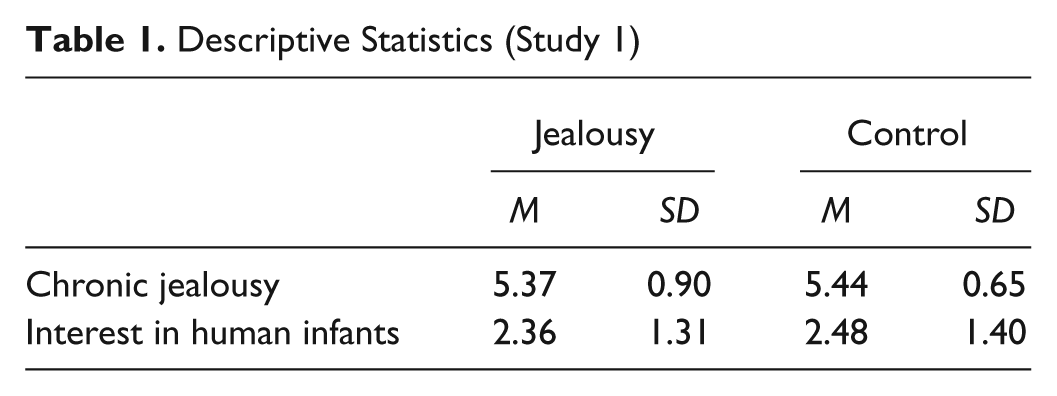
First, to ensure that the priming procedure did not influence participants’ chronic jealousy scores, we conducted a t test with chronic jealousy as the dependent variable and condition (jealousy vs. academic failure) as the grouping variable (see Table 1 for descriptive statistics). The results revealed no effect of priming condition on participants’ reported chronic jealousy (p = .62). Next, we tested whether participants’ relationship status influenced our results by conducting a 2 (Condition) × 2 (Relationship Status) MANOVA, with interest in human infants and interest in animal infants as our dependent measures. The results of this analysis revealed neither a main effect of relationship status on participants’ interest in human or animal infants (ps = .54 and .11, respectively) nor an interaction between relationship status and priming condition on either of these measures (ps = .12 and .69, respectively).
Descriptive Statistics (Study 1)
Next, to determine whether priming condition and chronic jealousy interact to influence affect and arousal, we examined the effects of these variables on participants’ positive and negative affect scores. The results of this analysis revealed no main effect of condition (ps = .42 and .10) or chronic jealousy (ps = .50 and .18), nor any interactions between the two (ps = .41 and .77) on either positive or negative affect, respectively. These results indicate that the experimental and control primes elicited comparable levels of positive and negative affect; therefore, these variables were not included as covariates in the following models.
Interest in Infants
We used multiple regression to test our predictions. In two analyses, interest in infants (human and animal) scores were regressed on priming condition, chronic jealousy, participant sex, and all centered interactions. Although we did not observe a three-way interaction between participant sex, priming condition, and chronic jealousy on participants’ interest in human infants (β = .16, p = .31), we did observe the predicted two-way interaction between priming condition and chronic jealousy when participant sex was dropped from the model, β = .26 (SE = .33), t(3, 117) = 2.27, p = .03, and semipartial r2 = .04 (see Table 1 for descriptive statistics). Probing this interaction revealed no main effect of condition (t = –.57, p = .57) or chronic jealousy (ts ≤ 1.72, ps = .09) on interest in human infants. However, as predicted, among men and women high in chronic jealousy (1 SD above the mean), the jealousy prime led to diminished interest in human infants relative to participants in the control condition, β = .25 (SE = .35), t(3, 117) = 1.96, p = .05, and semipartial r2 = .03(see Figure 1). We did not observe a priming effect for those low in chronic jealousy (β = –.15, p = .23). Furthermore, analyses conducted on participants’ interest in animal infants revealed neither a three-way interaction between participant sex, priming condition, and chronic jealousy on this measure (β = .11, p = .48), nor a two-way interaction between priming condition and chronic jealousy (β = .06, p = .74). The effect of jealousy on interest in infants was therefore specific to human infants and did not lead to a diminished interest in neotenous faces more generally.
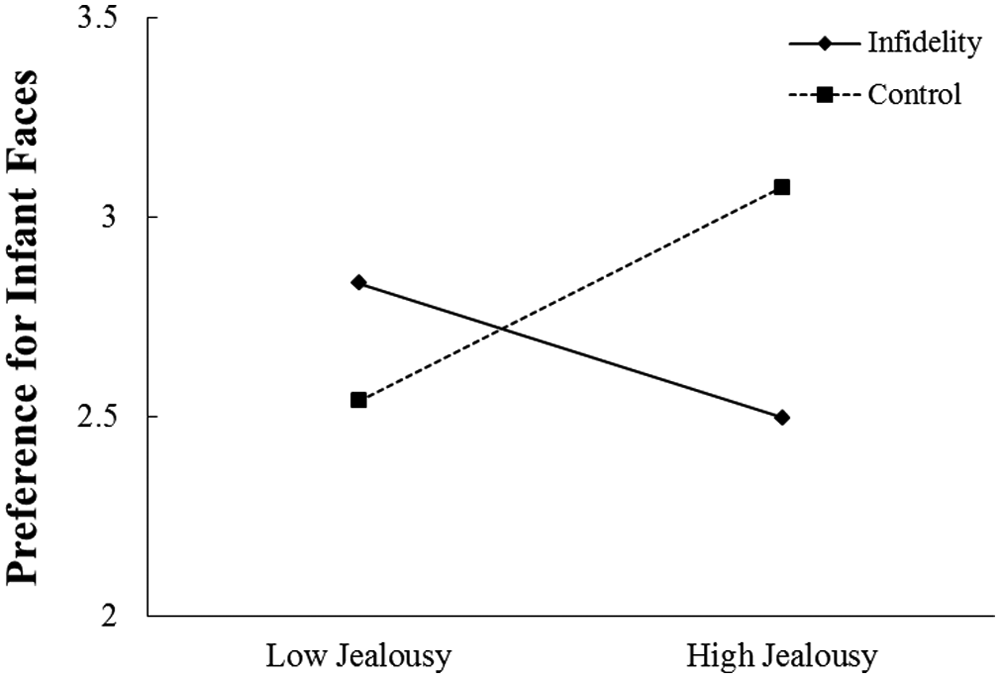
Priming infidelity threat led participants high in chronic jealousy to report less interest in human infants relative to participants in the control condition (Study 1)
Discussion
The results of Study 1 demonstrated that infidelity concerns led chronically jealous men and women to report a diminished interest in infants. That this effect was observed exclusively among those individuals who tend to worry about relationship threats is consistent with past research and lends support for the hypothesis that the effects of jealousy on reproductive readiness are specific to those individuals for whom such a threat is most salient and distressing (Maner et al., 2007; Maner et al., 2009). Furthermore, our results revealed that this shift was specific to human infants, as there were no differences in men’s and women’s preference for infant (vs. adult) nonhuman animals. This result minimizes the possibility that infidelity threat influences people’s preference for mature versus neotenous features, more generally.
One unanticipated result that emerged in Study 1 was that, in the control condition, chronic jealousy was positively related to interest in human infants. Although this association was not significant, that it approached significance suggests that chronic jealousy may vary, in part, as a function of reproductive readiness. That is, the desire to begin having children and start a family may itself increase chronic jealousy due to the high level of commitment required by one’s partner—and the high cost associated with partner infidelity—in the context of reproduction.
The results of Study 1 provide experimental support for the hypothesis that jealousy may have implications for men’s and women’s reproductive readiness, specifically among individuals who are most worried about relationship threats (i.e., highly jealous individuals). However, because of the forced-choice nature of the interest in infants measure, it is possible that the observed pattern of results reflects chronically jealous men and women being more interested in adults following infidelity threat rather than being less interested in infants. Indeed, prior research has demonstrated that priming infidelity concerns leads chronically jealous individuals to increase attention to attractive mates and rivals (Maner et al., 2007; Maner et al., 2009). Accordingly, Study 2 was designed to conceptually replicate the pattern of results obtained in Study 1 using a more direct measure of participants’ desire to start a family: self-reported happiness upon learning that they are about to become a parent. We predicted that experimentally activating jealousy would lead chronically jealous men and women to report less happiness upon learning that they and their romantic partner are expecting their first child compared with controls.
Study 2: Does Jealousy Influence Men’s and Women’s Responses to Pregnancy?
Method
Participants
A total of 108 heterosexual university students (51 female; M age = 19.47 years, SD = 1.23) served as participants in this study (56 in the jealousy condition) in exchange for course credit. In all, 62 of the participants reported being single at the time of the study (29 female) and 46 reported being involved in a romantic relationship (22 female).
Design and procedure
The design and procedure were the same as Study 1 except that instead of using a visual preference measure to assess participants’ interest in infants, we asked men and women to report how they would feel about expecting their first child. Specifically, participants read the following: “Please take a moment to imagine that you are married and that you and your spouse recently found out that you are expecting your first child. Please indicate how happy you would be upon receiving this news.” Participants indicated their response on a 9-point rating scale (anchors: 1 = very unhappy, 9 = very happy).
Results
First, to ensure that the priming procedure did not influence participants’ chronic jealousy scores, we conducted a t test with chronic jealousy as the dependent variable and condition (jealousy vs. academic failure) as the grouping variable (see Table 2 for descriptive statistics). The results revealed no effect of priming condition on participants’ reported chronic jealousy (p = .24). Next, to test whether participants’ relationship status influenced how they responded to the priming procedure or our dependent measure, we conducted a 2 (Condition) × 2 (Relationship Status) ANOVA with self-reported happiness about pregnancy as the dependent measure. The results of this analysis revealed neither a main effect of relationship status (p = .64) nor an interaction between relationship status and priming condition on participants’ happiness about pregnancy (p = .54).
Descriptive Statistics (Study 2)
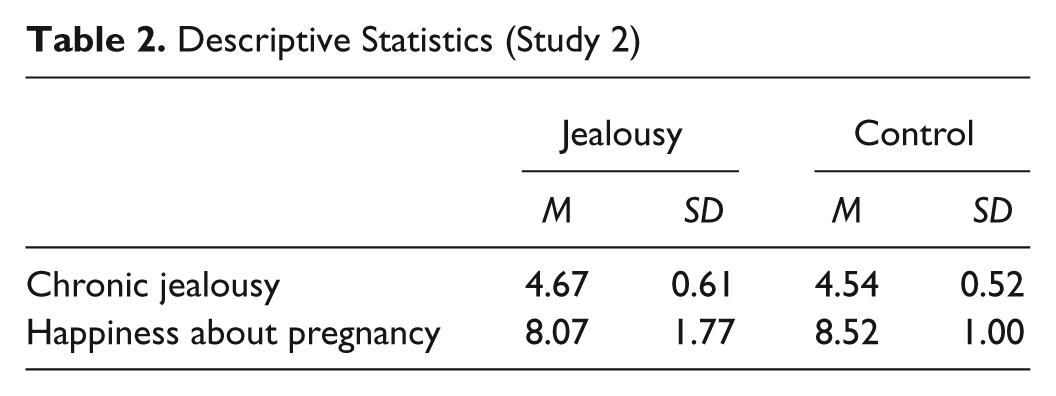
We used multiple regression to test our predictions, regressing self-reported happiness about pregnancy on priming condition, chronic jealousy, participant sex, and all centered interactions. Although we did not observe a three-way interaction between participant sex, priming condition, and chronic jealousy on participants’ reported happiness in response to pregnancy news (β = –.18, p = .25), we did observe the predicted two-way interaction between priming condition and chronic jealousy when participant sex was dropped from the model, β = .41 (SE = .48), t(3, 104) = 3.46, p = .001, and semipartial r2 = .10 (see Table 2 for descriptive statistics). Probing this interaction revealed that for participants in the control condition, chronic jealousy was positively related to happiness in response to pregnancy news, β = .31 (SE = .37), t(3, 104) = 2.10, p = .04, and semipartial r2 = .04. For participants in the jealousy condition, however, chronic jealousy was negatively related to happiness about pregnancy, β = −.35 (SE = .30), t(3, 104) = −2.90, p = .005, and semipartial r2 = .07. Moreover, as predicted, among individuals high in chronic jealousy (1 SD above the mean), the jealousy prime led to diminished happiness about the news that they were expecting their first child relative to participants in the control condition, β = .49 (SE = .39), t(3, 104) = 3.60, p < .001, and semipartial r2 = .11 (see Figure 2). However, we did not observe a priming effect among individuals low in chronic jealousy (β = −.19, p = .16).
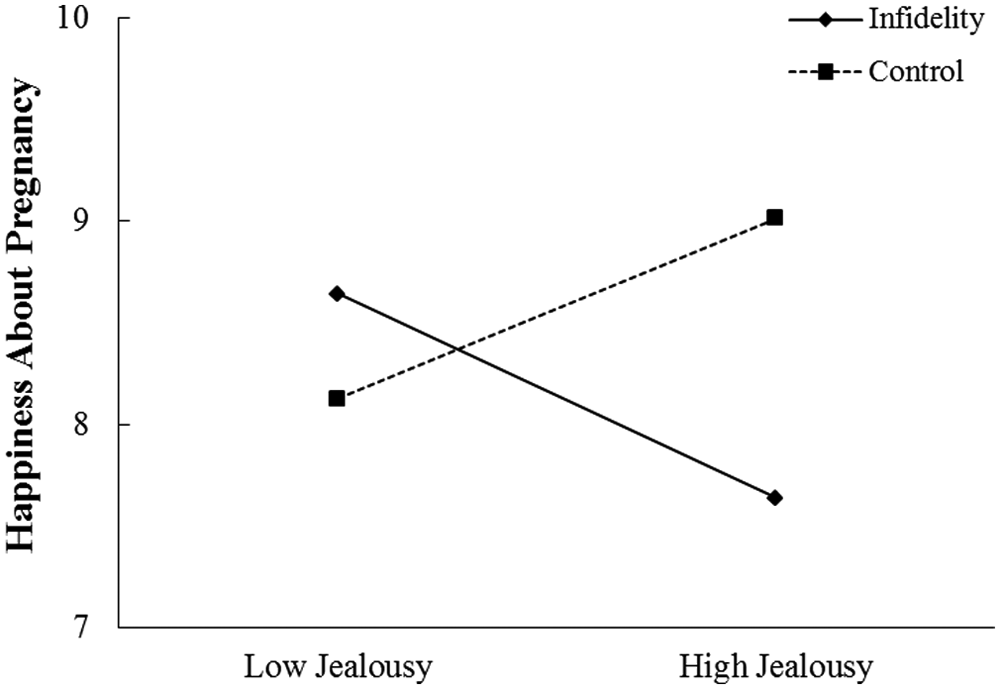
Priming infidelity threat led participants high in chronic jealousy to report less happiness about expecting their first child relative to participants in the control condition (Study 2)
Discussion
The results of Study 2 replicated the specific pattern of results obtained in Study 1. Among individuals high in chronic jealousy, infidelity threat led to decreased happiness in response to learning that one was expecting his or her first child. As with Study 1, the effect of jealousy on participants’ reactions to pregnancy news was only observed among those most concerned with relationship threats (i.e., individuals high in chronic jealousy). Study 2 also revealed that although chronic jealousy was positively related to happiness about pregnancy in the control condition, it was negatively related to happiness about pregnancy in response to an infidelity threat. Although the observed positive relationship between chronic jealousy and happiness for participants in the control condition was not predicted in advance, it was consistent with the results of Study 1. These findings suggest that reproductive readiness may itself prompt chronic jealousy, a possibility that we address in greater detail in the “General Discussion” section. Despite this unanticipated result, the present study provides further support for the hypothesis that concerns about infidelity lead those most chronically worried about such a threat to experience psychological changes that diminish their present desire for children.
Study 3: Does Jealousy Influence Men’s and Women’s Desire to Invest in Children?
Study 3 was designed to explore the effects of jealousy on men’s and women’s desire to invest in their own children. Although the experience of jealousy was hypothesized to diminish both men’s and women’s interest in having a baby (demonstrated by decreased interest in infants and less happiness about pregnancy), the reasons underlying these effects are likely sex differentiated. For women, the primary cost associated with reproduction in the face of infidelity threat is being abandoned by their mate and left to raise the child on their own. For men, however, the primary cost associated with reproduction in such a context is heightened paternity uncertainty (Buss et al., 1992; Daly et al., 1982; Symons, 1979; Trivers, 1972). Because infidelity threat makes the benefits of parental investment less certain for men (but not for women), we therefore predicted that jealousy would decrease men’s (but not women’s) desire to invest in a child. We tested this prediction using the same priming procedure as Studies 1 and 2. We then asked participants to indicate how much time they would ideally spend performing 22 duties related to child care (e.g., holding the child, reading to the child) relative to their partner. We predicted that exposure to the infidelity prime would cause chronically jealous men—but not women—to prefer investing relatively less effort in child care compared with similar men in the control condition.
Method
Participants
A total of 116 heterosexual university students (61 female; M age = 19.42 years, SD = 1.23) served as participants in this study (55 in the jealousy condition) in exchange for course credit. In all, 70 participants reported being single at the time of the study (33 female) and 46 reported being involved in a romantic relationship (28 female).
Design and Procedure
The design and procedure were the same as the previous two studies except that following the priming procedure, participants were asked to imagine that they were married and expecting their first child. They were then asked to indicate how much time they would like to spend performing 22 activities related to child care. The experiment closed with participants filling out a brief questionnaire that included demographic information as well as the measure of chronic jealousy. A suspicion probe at the end of the study revealed that no participants guessed the true nature of the hypothesis under investigation.
Dependent measures
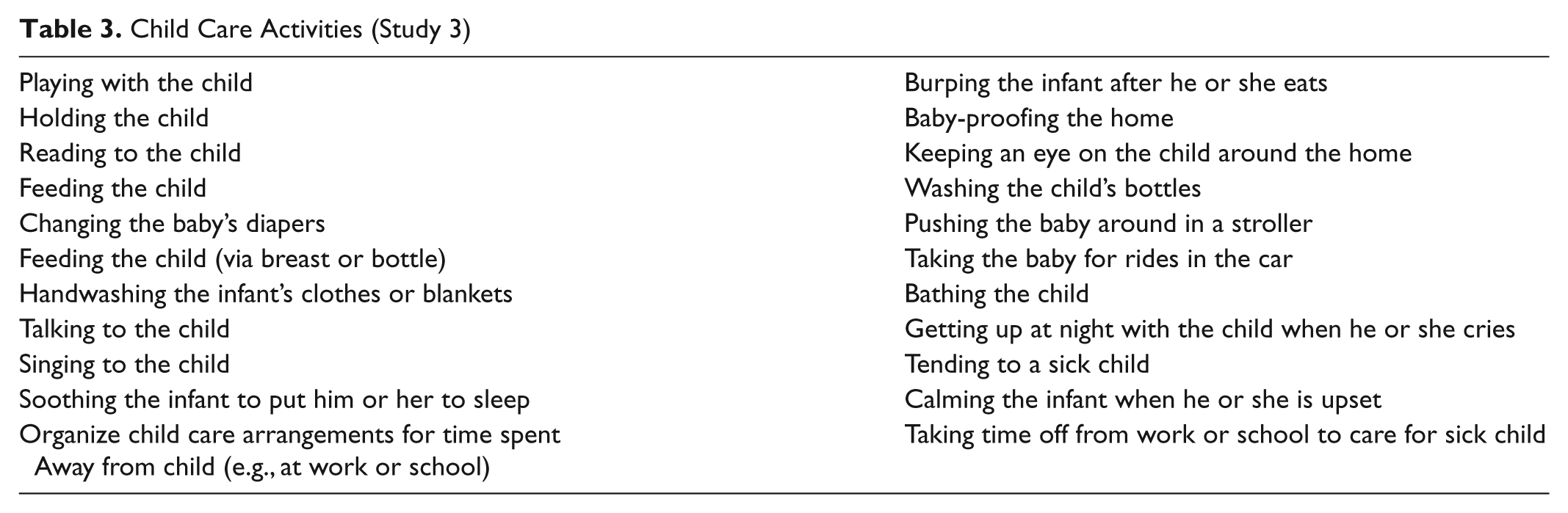
Participants were instructed to imagine that they and their romantic partner recently found out that they were expecting their first child. They were then asked to indicate how much time they would like to spend (relative to their partner) performing 22 tasks related to child care (e.g., holding the child, singing to the child, baby-proofing the home; see Table 3 for complete list of activities). Participants indicated their preferences on 6-point rating scales (anchors: 1 = My partner should do this most of the time, 6 = I should do this most of the time). A composite measure was created by averaging participants’ responses to each of the 22 items (α = .94), and higher values correspond to greater willingness to invest in one’s child (relative to one’s partner).
Child Care Activities (Study 3)
Results
First, to ensure that the priming procedure did not influence participants’ chronic jealousy scores, we conducted a t test with chronic jealousy as the dependent variable and condition (jealousy vs. academic failure) as the grouping variable (see Table 4 for descriptive statistics). The results revealed no effect of priming condition on reported chronic jealousy (p = .67). Next, to test whether participants’ relationship status influenced how they responded to the priming procedure, we ran a 2 (Condition) × 2 (Relationship Status) ANOVA with desired parental investment as our dependent measure. The results of this analysis revealed neither a main effect of relationship status (p = .82) nor an interaction between relationship status and priming condition on participants’ desired parental investment (p = .65).
Descriptive Statistics (Study 3)
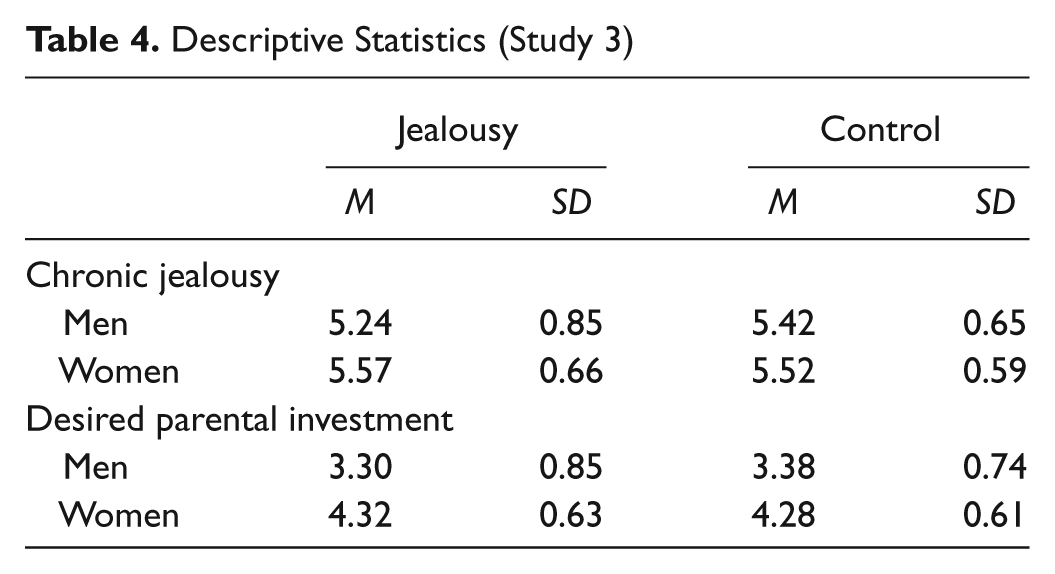
Next, we used multiple regression to test our predictions, regressing desired parental investment on priming condition, chronic jealousy, participant sex, and all centered interactions. Results revealed the predicted three-way interaction between priming condition, chronic jealousy, and participant sex on desired parental investment, β = .27 (SE = .38), t(7, 108) = 1.89, p = .06, and semipartial r2 = .02 (see Table 4 for descriptive statistics). Although marginally significant, we probed this interaction by splitting the file by sex and running the analysis again within each sex (after dropping sex as a predictor). For women in the experimental condition, results revealed a main effect of chronic jealousy on desired parental investment, indicating a positive relationship between these variables, β = .39 (SE = .17), t(3, 57) = 2.27, p = .03, and semipartial r2 = .08. This pattern was also observed in the control condition, but the relationship was not significant (t = 1.67, p = .10). Moreover, as predicted, the analysis failed to reveal a main effect of priming condition on desired parental investment (β = –.01, p = .93) or an interaction between priming condition and chronic jealousy for women (β = –.06, p = .72; see Figure 3).
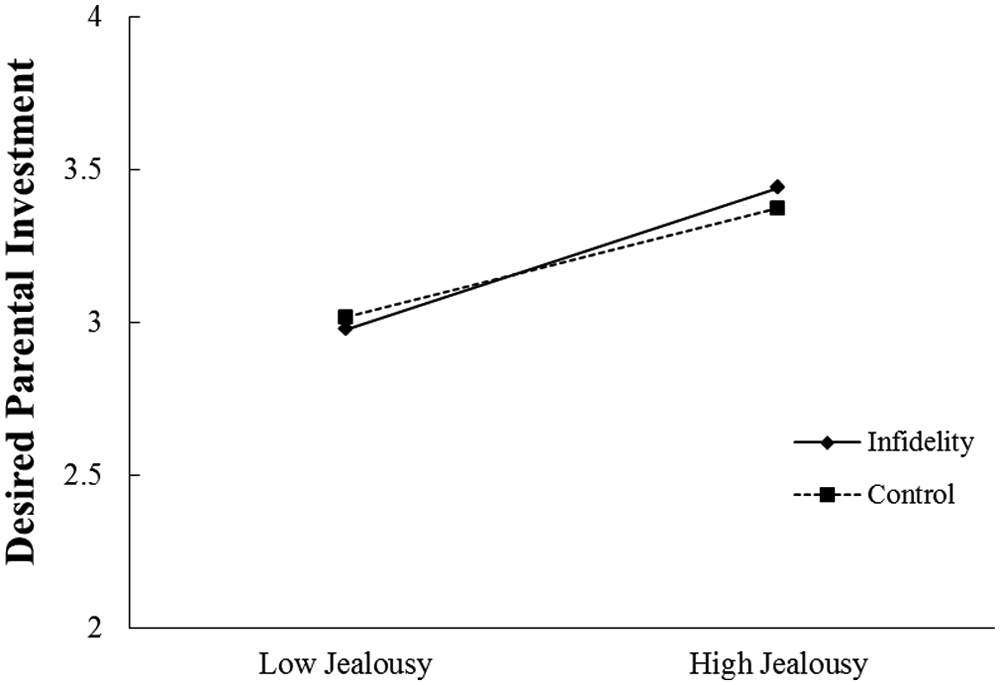
Effect of infidelity threat and chronic jealousy on women’s desired level of parental investment (Study 3)
For men, however, the analysis revealed the predicted two-way interaction between priming condition and chronic jealousy on desired level of parental investment, β = .37 (SE = .28), t(3, 51) = 2.22, p = .03, and semipartial r2 = .08. Probing this interaction revealed no main effect of condition (t = –.85, p = .40) or chronic jealousy on the desire to invest in a future child for men in the control condition (t = .71, p = .48). However, for men in the experimental condition, results revealed a main effect of chronic jealousy on their desire to invest in a child, β = –.45 (SE = .18), t(3, 51) = −2.65, p = .01, and semipartial r2 = .12, indicating that greater jealousy was negatively related to desired parental investment. Moreover, as predicted, among men high in chronic jealousy (1 SD above the mean), the jealousy prime decreased their desire to invest in a soon-to-arrive child relative to men in the control condition, β = .38 (SE = .30), t(3, 51) = 1.99, p = .05, and semipartial r2 = .07 (see Figure 4). We did not observe a priming effect for men low in chronic jealousy, however (β = –.19, p = .29).
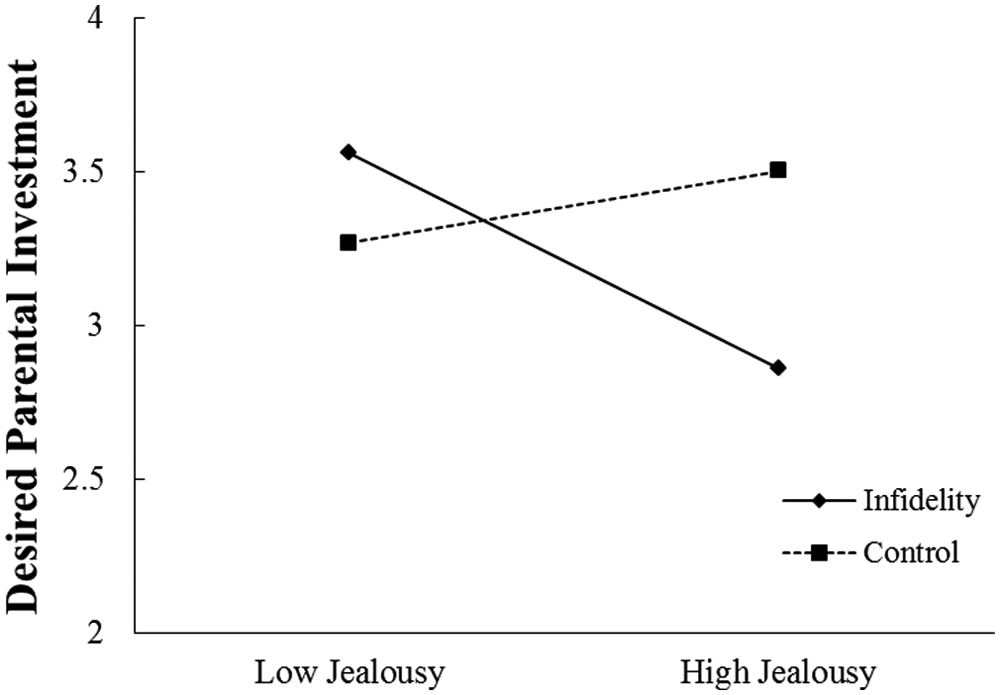
Effect of infidelity threat and chronic jealousy on men’s desired level of parental investment (Study 3)
Discussion
Study 3 provided further support for our evolutionary-based hypothesis regarding the relationship between jealousy and the desire to have and invest in children, revealing an important sex difference in the effect of jealousy on men’s and women’s desired level of parental investment. For women, priming jealousy had no effect on their desire to invest in children, nor did the jealousy prime interact with chronic jealousy to influence investment desires. This result is consistent with the evolutionary logic of our model. For women, maternity is always certain. Therefore, although infidelity threat renders women more vulnerable to loss of their mates’ paternal investment, it should not influence their own willingness to invest resources in genetic offspring.
For men, on the other hand, the present study revealed a pattern of results very similar to those obtained in Studies 1 and 2. Among chronically jealous men, primed infidelity threat resulted in a diminished desire to invest effort in the care of an unborn child. This finding is consistent with the evolutionary logic of parental investment theory (Trivers, 1972) and the hypothesis that jealousy may function to mitigate the reproductive costs associated with partner infidelity (Buss, 2000). For men, jealousy signals a potential threat to paternity. Accordingly, if jealous feelings are salient when a man learns that his mate is expecting a child, parental investment theory predicts that men should downregulate parental effort to diminish the fitness costs associated with misdirected investment due to paternity uncertainty. This result is consistent with previous research indicating that men calibrate their parental investment decisions based on resemblance cues in infant faces (Platek et al., 2003; Platek et al., 2004).
An unanticipated result of Study 3 was that, for women in both conditions, chronic jealousy was found to be predictive of increases in desired parental investment (although this relationship did not reach significance in the control condition). This result is similar to what was observed in the control conditions for Studies 1 and 2, where chronic jealousy was found to predict increased interest in infants and happiness about pregnancy news. Although we did not predict this relationship in advance, it is possible that this pattern of results reflects a naturally occurring relationship between reproductive readiness and chronic jealousy. That is, although chronic jealousy did not interact with the infidelity prime to influence women’s desire to invest in offspring, for women, the desire to have and invest in children may itself predict hypervigilance to potential relationship threats. This possibility is discussed in greater detail below.
General Discussion
From an evolutionary perspective, infidelity is as adaptively costly as it is psychologically painful. This cost is particularly pronounced in the contexts of pregnancy and child rearing. For men, infidelity on the part of their partner opens up the possibility that they are not the biological father of children borne from their mate (i.e., cuckoldry). For women, an unfaithful partner increases the likelihood of losing critical male resource investment, an outcome that could mean the difference between life and death for her and her children (Buss, 1988; Schützwohl, 2008; Thornhill & Alcock, 1983). Given that the most substantial costs of infidelity are borne in the domains of pregnancy and parental investment, we sought to explore the relationship between infidelity threat, chronic jealousy, and men’s and women’s desire to have and invest in children.
Across three experiments, we found evidence that jealousy—the unpleasant psychological arousal that occurs in response to infidelity threat—plays an important role in men’s and women’s parenting interest and investment decisions. Studies 1 and 2 revealed that experimentally activating jealousy led chronically jealous men and women to experience a diminished desire for children. This effect manifested itself both as diminished interest in infants (Study 1) and decreased happiness in response to pregnancy news (Study 2). These findings are consistent with the view that perceived infidelity threat in a relationship may facilitate psychological shifts that favor delaying reproduction until such a time that one can be more certain of their paternity (men) or of the reliability of paternal investment (women). Study 3 revealed that infidelity concerns also have implications for men’s, but not women’s, desired level of parental investment. Specifically, chronically jealous men, but not women, responded to the threat of infidelity by reporting diminished desire to invest in a future child. This sex-differentiated effect was predicted based on the evolutionary logic of parental investment theory (Trivers, 1972) and lends further support for jealousy being sex differentiated in ways that are specific to the adaptive problems that have reliably confronted men and women threatened by infidelity (Buss et al., 1992; Buss & Shackelford, 1997).
The present research also revealed that the effects of experimentally induced jealousy on participants’ desire to have and invest in children were influenced not only by the fitness-relevant costs associated with infidelity, as predicted from an evolutionary perspective. In addition, our results were moderated in important ways by individual differences in the accessibility of schemas associated with partner infidelity. Specifically, primed infidelity threat only diminished parenting interest among individuals for whom the threat of infidelity was particularly salient. No effects were observed, however, among those relatively less threatened by infidelity cues. These results are consistent with previous findings (e.g., Maner et al., 2009) and contribute to the growing body of research demonstrating that individual responses to proximal adaptive challenges are influenced in theoretically meaningful ways by the chronic accessibility of relevant social schemas (see for example, Griskevicius, Tybur, Delton, & Robertson, 2011; Schaller, Park, & Mueller, 2003).
Taken together, the results of the present research demonstrate that jealousy—both chronically accessible and experimentally activated—may play an important role in modulating individuals’ reproductive readiness and parental investment. When men and women perceive a threat to the integrity of an existing romantic relationship, this experience may activate psychological processes aimed at mitigating the costs associated with a partner’s infidelity, including diminishing one’s desire to reproduce and, for men, diminishing one’s desired level of parental effort. These results lend support for the evolutionary hypothesis that jealousy functions to mitigate the reproductive costs associated with partner infidelity (e.g., Buss et al., 1992; Daly et al., 1982; Symons, 1979) and add to a growing body of research on evolution and the emotions (Ackerman et al., 2006; Buss, 2000; Griskevicius et al., 2009; Hill, DelPriore, & Vaughan, 2011; Maner et al., 2005; Maner et al., 2007; Maner et al., 2009; Ohman & Mineka, 2001), parental investment (Platek et al., 2003; Platek et al., 2004), and behavior (e.g., Griskevicius, Cialdini, & Kenrick, 2006; Kenrick, Griskevicius, Neuberg, & Schaller, 2010; Miller & Maner, 2010; Ronay & von Hippel, 2010; Van Vugt & Spisak, 2008).
Limitations and Future Directions
One unanticipated result that emerged across all three experiments was that each study revealed a positive association between chronic jealousy and reproductive interest (Studies 1 and 2) and desired parental investment (Study 3) in cases where chronic jealousy did not interact with the priming condition. Although this association was not predicted in advance, it is possible that this result reflects chronic jealousy varying both within and between individuals as a function of reproductive readiness. That is, it is possible that the desire to start a family and to begin having children may itself increase chronic jealousy due to the high level of commitment required by one’s partner in the context of reproduction. For individuals who are ready to start a family, the costs associated with partner infidelity are much greater than for those who are less ready to do so. This explanation is consistent with the idea that jealousy functions as a commitment device (Buss, 2000; Frank, 1988) and suggests that chronic infidelity concern may vary more generally across the life span based on the costliness of such infidelity. Future research is needed to test this possibility.
An important limitation of the present research is that we relied exclusively on self-report questionnaires rather than capturing behavioral measures associated with the desire to have children and invest in their care. This limitation was, in part, due to the difficulty of capturing such behaviors in an experimental setting. Future research on overt behavior is an important next step for this line of research. In addition, it is important to address that although we included questions assessing participants’ relationship status (single vs. in a relationship), none of the studies included questions to assess whether participants were married or had existing children at the time of the study. Although the participants in each of the studies were traditionally aged college students—the majority of whom are unmarried and childless—it is possible that some of our participants were either married, had children, or both. It is thus possible that differences in marital and parental status may have influenced the results of the present studies in ways that we are unable to account for. Importantly, each of the three studies revealed that relationship status (single vs. in a relationship) did not influence participants’ responses to any of our measures, nor did it interact with priming condition to influence our results. This suggests that participants’ present relationships may not have influenced how they responded to the experimental scenarios. Furthermore, the present research revealed a consistent pattern of results across each of the three studies, suggesting that the reported effects were unlikely driven by outliers whose marital or parental status differed from the majority of the sample. Nonetheless, future research would benefit from testing our hypothesis in a more diverse sample of individuals, comprising samples that include a large number of married couples and parents, to test whether these personal variables influence men’s and women’s responses.
Similarly, because participants in the present studies were all undergraduate students with relatively low levels of chronic jealousy, our sample was fairly homogeneous. This limitation may have reduced our power to detect the predicted effects as our results were driven by individuals with relatively high levels of chronic jealousy. It is possible that a more diverse sample that includes more individuals with higher levels of chronic jealousy may respond to infidelity threat in an even stronger manner. Although future research is needed to examine similar effects in more diverse populations, one of the strengths and contributions of the present studies is the emergence of this robust effect even within samples of individuals with relatively low levels of chronic jealousy. Nonetheless, the present research provides novel insights into the relationship between infidelity threat, jealousy, and men’s and women’s parenting interest and investment expectations.
The present research found that the relationship between primed infidelity threat and changes in participants’ interest in reproduction and parental investment were specific to those high in chronic jealousy. The specificity of these results, on the surface, may appear to be inconsistent with the evolutionary psychological view of jealousy as a species-typical adaptation possessed by all humans (e.g., Buss, 2000; Buss et al., 1992). However, the view that jealousy is an adaptation does not preclude variability in this trait or its behavioral manifestation. For example, sexual desire is a species-typical trait that most would argue is an adaptation shaped by selection to promote sexual behavior. However, individuals differ in the frequency and intensity of their desire for sex based on factors present in their internal (e.g., hormones, gender) and external (e.g., the presence of attractive members of the opposite sex) environments. Accordingly, a person–situation approach to social–psychological research might reasonably predict that individuals who have higher levels of chronic sexual arousal will respond differently to sexual stimuli than individuals low on this dimension. Indeed, this is what such research finds. For example, Maner et al. (2007) demonstrated that for people for whom mating-related schemas are chronically accessible (i.e., people with an unrestricted sociosexual orientation), activating mating goals leads to increased attunement to members of the opposite sex, results that are not found among those with a restricted orientation. Such results do not suggest that sexual desire is not an adaptation but rather that the expression of adaptations vary as a function of features of the person and the situation (see Kenrick, 1999; Kenrick & Funder, 1988).
Conclusion
The birth of one’s first child is often a rewarding and exciting time for expectant parents. However, jealous concern about a partner’s suspected infidelity can quickly dampen a new parent’s enthusiasm. The present studies suggest that infidelity concerns decrease parenting interest and desired investment among chronically jealous men and women. These results provide evidence that jealousy—both locally and chronically activated—may function to minimize costs associated with paternity uncertainty and loss of resource investment among men and women, respectively. Furthermore, these findings suggest that jealousy may be contextually and individually tuned to help men and women successfully confront adaptive challenges associated with childbearing and rearing recurrently faced throughout our evolutionary past.
Footnotes
Acknowledgements
We thank Ruth Lee, Alice Schruba, Shannon Shiels, and John Thomas for their research assistance with this project.
Declaration of Conflicting Interests
The author(s) declared no potential conflicts of interest with respect to the research, authorship, and/or publication of this article.
Funding
The author(s) received no financial support for the research, authorship, and/or publication of this article.