



Abstract
The desire for justice can escalate or facilitate resolution of intergroup conflicts. Two studies investigated retributive and restorative notions of justice as the mediating factor of the effect of perceived outgroup sentience—an aspect of (mechanistic) dehumanization referring to the emotional depth attributed to others—on intergroup conflict resolution. Study 1 showed that for Palestinians, who see themselves as victims, perceived sentience of Israelis decreased retributive but increased restorative notions of justice, which, ultimately, increased support for conflict resolution by negotiation rather than political violence. Study 2 partially replicated Study 1’s findings with Jewish Israelis. The role of perceived sentience and its relationship to retributive and restorative notions of justice in protracted and nonprotracted conflicts and their resolution is discussed.
The process of conflict resolution is a long and tortuous one. Governments and nongovernmental organizations (NGOs) devote large amounts of financial and human resources to the task, but are rarely considered successful (e.g., Slater, 2001). For example, over 10 years after the end of violent conflict, the relationship between Kosovars and Serbs is as tense as ever; Bosnia-Herzegovina is still split into two, causing political and economic stagnation. Even more disturbing is the existence of long-term conflicts, such as the Israeli– Palestinian dispute, that remain violent despite considerable attempts by the protagonists and well meaning third parties to find a peaceful resolution.
It is increasingly clear that to account for such a state of affairs, we need to move beyond rational choice models and focus on symbolic aspects of intergroup relations, such as the centrality and meaning of collective identities, as well as the effects that conflict, especially violent conflict, has on the image of the other (cf. Ginges, Atran, Medin, & Shikaki, 2007; Nadler, Malloy, & Fisher, 2008; Skitka, 2003; Wenzel, 2009). In this article, we focus on the latter factor. Building on social-psychological literature, we investigate the mechanism underlying the often-demonstrated effects of perceptions of outgroups on approaches to intergroup conflict. We do so in one of the most conflict-ridden areas of the world, investigating the Israeli–Palestinian conflict. Linking the dehumanization and justice literatures, we propose that the extent to which people dehumanize outgroup members by not perceiving them as sentient beings influences the extent to which people display support for aggressive or diplomatic conflict resolution strategies through people’s desire for retributive and restorative justice. To our knowledge, the research presented here is the first to show that dehumanization of the outgroup explains the notion of justice people adopt and their demands to solve a real-life conflict.
Dehumanization and Intergroup Conflict Resolution
There is ample evidence in social-psychological research that the perception of the other impacts on how “we” relate to “them.” Overt negative stereotyping and prejudice result in discrimination, and implicit negative attitudes toward outgroups lead to spontaneous, unsavory behavior (for a review, see Fiske, 1998). Although these factors sometimes result in violence (e.g., hate crimes), a wealth of evidence points to the specific association between dehumanized perceptions of the other and large-scale violence (e.g., Castano & Kofta, 2008; Kelman, 1973; Staub, 1989). Dehumanized perceptions of outgroups influence how people think about resolving ongoing intergroup conflict. In the Israeli–Palestinian conflict, for instance, dehumanization has been reported to increase support for retaliatory aggressive policies in the conflict (Maoz & McCauley, 2008). The process of how dehumanized perceptions of outgroups increase support for aggressive rather than diplomatic conflict resolution strategies is, however, unclear.
We begin by noting that in many conflicts, both parties consider conflict resolution strategies through the perspective of victimization. Regardless of power differentials, often both parties see themselves as victims, perhaps because the role of the victim is psychologically rewarding (Noor, Brown, & Prentice, 2008). Victimhood is, by definition, the perception of the suffering at the hands of the other side (i.e., the perpetrators) as inappropriate and unjust (Mummendey & Otten, 1989; Otten, Mummendey, & Wenzel, 1995). Victims thus seek justice. The kind of justice they seek, we contend, depends on how they perceive the perpetrator and, in turn, affects their choice of conflict resolution strategies.
Justice and Intergroup Conflict Resolution
Justice has the potential to prevent, restrict, or resolve conflicts (Fisher, Ury, & Patton, 1991) but can also escalate conflicts (Pruitt & Carnevale, 1993). Empirical evidence and theoretical accounts of the relationship between notions of justice and conflict (resolution) are scarce, though. Even the notable exception of Mikula and Wenzel (2000) does not distinguish between different notions of justice when theorizing how justice influences conflict. The present contribution extends the justice and conflict literature by examining whether and how different notions of justice are adopted, and whether and how they affect conflict and its resolution.
Victims of interpersonal and intergroup transgressions typically seek either retributive or restorative justice (e.g., Wenzel, Okimoto, Feather, & Platow, 2008; Wenzel & Thielmann, 2006). We might expect a preference for these different forms of justice to be associated with different preferences for conflict resolution. We expect that a preference for retributive justice, which focuses on punishment of perpetrators (Darley & Pittman, 2003; Tyler, 2006), to be associated with support for aggressive conflict resolution strategies—such as support for political violence—which prolong and possibly fuel the conflict. In contrast, we expect that a preference for restorative justice, which focuses on material (e.g., financial reparations) and symbolic compensation (e.g., apologies), as well as the reaffirmation of shared values between victim and perpetrator (J. Braithwaite, 2002; J. Braithwaite & Strang, 2001; Okimoto, Wenzel, & Feather, 2009; Roche, 2003), to be associated with support for diplomatic conflict resolution strategies—such as a push for peace negotiations.
What determines the desire for retributive versus restorative justice? It is likely that multiple factors are involved, including the expectations regarding the likelihood of a restorative approach to be successful or effective (Gromet & Darley, 2006). 1 An important determinant of the perceived likelihood for restorative justice to be successfully achieved, we argue, is a specific form of dehumanization: the perceived (lack of) sentience of the other.
Dehumanization Through Denial of Sentience
Sentience is often used as a synonym for “consciousness” or to indicate the capacity to have subjective experiences. Because of its implications for ethics, morality, and the law (e.g., people tend to experience discomfort when acting violently against sentient beings), sentience is a central concept in discussions on animal welfare (V. Braithwaite, 2010; do fish feel pain?) and abortion (Steinbock, 1992). In the present context, following a philosophical distinction between sentience and reason, we consider sentience the capacity to feel and experience emotions. This capacity is central to our understanding of human nature, and its denial tantamount to mechanistic dehumanization (i.e., seeing others as objects or automata; Haslam, 2006). Sentience is also considered a building block of empathy, as the perception of others as sentient beings is a necessary condition for “us” to be able to empathize with “them” (Castano, 2012). In 2003, a Hungarian judge ruled that two men wrongly accused of murder should receive less compensation than they had demanded in their wrongful-arrest suit. The judge argued that the two Gypsy men had “more primitive personalities than the average; therefore, the psychological damage they suffered was not so serious that it would justify the compensation they requested” (cited in Marcu, Lyons, & Hegarty, 2007).
We consider sentience as an especially interesting and important form of dehumanization with respect to this research. While being similar to other forms of dehumanization or infrahumanization in that it should also be related to how “we” (can) treat “them,” unlike other forms of dehumanization, sentience should moreover be related to how “we” (can) expect to be treated by “them.” The latter should be important when it comes to negotiating issues of intergroup justice, peace, and conflict resolution. Accordingly, we argue that people’s perception of outgroup members as sentient is best suited to investigate how conflict parties negotiate justice and conflict resolution.
Encompassing both perceptions of how “we” can treat “them” and how “they” will likely treat “us,” perceived sentience should influence both parties’ expectations about the type of justice that should be pursued in the aftermath of intergroup violence and in the process of conflict resolution. The lower the perceived sentience of the perpetrator, the lower the quest for restorative justice, because a perpetrator lacking sentience is by definition not equipped with the emotional depth that motivates and provides reality to restorative efforts. Even if such perpetrators were to engage in processes of restorative justice (e.g., compensating the victim group), these are unlikely to be perceived as indicating an acknowledgment of their wrongdoings and sincere remorse for their transgressions (Giner-Sorolla, Castano, Espinosa, & Brown, 2008; Roche, 2003; Strang, 2002). The lower the perceived sentience of the perpetrator, however, the greater the quest for retributive justice. Because in this case restorative justice, in the self-identified victim’s mind, is likely to be unsuccessful and/or unsatisfactory. But also because any restraint in seeking punishment against an outgroup is likely reduced by this dehumanized perception (cf. Castano, 2012; Castano & Giner-Sorolla, 2006; Leidner, Castano, Zaiser, & Giner-Sorolla, 2010).
We thus expect that when people identify as victims in an intergroup conflict, the degree of sentience they attribute to the perpetrating outgroup will positively predict a restorative notion of justice (i.e., demanding and willing to accept compensation to be provided by the perpetrating outgroup to the victimized ingroup, as well as value reaffirmation), whereas it will negatively predict a retributive notion of justice (i.e., demanding punishment of the outgroup perpetrators). Restorative and retributive notions of justice, in turn, should increase support for diplomatic and aggressive conflict resolution strategies, respectively. To maximize external validity, these predictions were tested in the context of the Israeli–Palestinian conflict, using a representative sample of Palestinian adults and a convenience sample of Israeli adults.
Study 1
Study 1 used Palestinian adults as participants. Palestinians perceive themselves, and are broadly perceived by the international community, as the victims in the Israeli–Palestinian conflict. We investigated the effects of Palestinians’ attribution of sentience to Israelis on Palestinians’ support for diplomatic and aggressive conflict resolution strategies, and whether these effects were mediated by Palestinians’ inclinations to achieve justice by punishing the Jewish State of Israel (retributive justice), and by receiving symbolic compensation and apologies from Israel, as well as reaffirming common values shared with Jewish Israelis (restorative justice).
We expected that Palestinians’ perceptions of sentience of Jewish Israelis would positively predict support for diplomatic and negatively predict support for aggressive conflict resolution strategies. Most importantly, theses effects should be mediated by the expected differences in notions of justice. That is, Palestinians’ perceptions of sentience of Jewish Israelis should lead to greater demand for restorative justice and lower demand for retributive justice. A restorative notion of justice should, in turn, go hand in hand with more support for peaceful conflict resolution, or at least no support for retaliatory acts of the ingroup against the outgroup. Meanwhile, a retributive notion of justice should decrease support for peaceful conflict resolution and even increase support for actively hindering attempts of peaceful conflict resolution by means of political violence.
Method
Participants
The sample consisted of 1,268 Palestinians surveyed in December 2007, in the West Bank (64% of the sample) and Gaza (36% of the sample). The median age of respondents was 38 (range = 18-80), 52% of the sample were female and 48% male. Forty-six percent of respondents were refugees and 52% identified with one of the Islamic parties (e.g., Hamas or Palestinian Islamic Jihad). Almost all (98.6%) of the respondents were identified as Muslim. Most respondents reported to pray to Allah once a day (48.78%) or five times a day (48.38%); only a minority reported to pray only on Fridays (2.53%) or rarely (0.32%). Fifty-three percent said their family lived below the official poverty line (1,800 NIS [new Israeli shekel] monthly), 17.5% said their family was on the poverty line, and about 29% were above the poverty line.
Procedure
The sampling process went through three stages: (a) randomly selecting population locations (clusters or counting areas) using probability proportionate to size, (b) randomly selecting households from the population locations using updated maps, and (c) selecting a person who is 18 years or older from among persons in the house using Kiesh tables’ method. The sample was self-weighting, but there was also checking that the age groups obtained were similar to those in the society using data from official Palestinian and Israeli government statistics. Two fieldworkers, a male and a female, conducted every interview to overcome social difficulties that might prevent a male/female from entering a home.
Sentience was assessed by asking the Palestinian participants to what extent they thought that having compassion for someone else’s suffering is a typical trait of the average Jewish Israeli (M = 3.26, SD = 0.92). Answers were given on a Likert-type scale from 1 = very typical to 4 = very atypical. This score was reversed so as to indicate perceived outgroup sentience. 2
Retributive justice was measured by three items tapping punishment as a way to reestablish justice (“Do you strongly disagree [1], somewhat disagree [2], somewhat agree [3], or strongly agree [4] that the only way to restore justice is to punish the Israelis?”; “ . . . that justice is served at the moment that the Israelis are punished?”; “ . . . that for the sake of justice, Israelis have to suffer?”; Cronbach’s α = .73, M = 3.07, SD = 0.58).
Restorative justice was measured by three items tapping apologetic behavior and reaffirmation of shared values (“Do you strongly disagree [1], somewhat disagree [2], somewhat agree [3], or strongly agree [4] that without the Israelis’ sincere apology for having acted wrongly, the injustice is not completely restored?”; “ . . . that to restore justice, Israelis and Palestinians need to agree on rules of a peaceful world?”; “ . . . that for justice to be reinstated, Israelis and Palestinians need to agree on ethical values that should not be violated?”; Cronbach’s α = .71, M = 2.75, SD = 0.63).
Support for bombing attacks (SBA)
Two items assessed participants’ opinion of suicide bombings against Israelis (e.g., “What is your opinion about bombing attacks (which some call martyrdom attacks and others call suicide attacks) where the bomber kills himself with the aim of killing Israelis who are enemies of Palestine? Do you believe that these attacks should be [1] forbidden, [2] allowed, [3] encouraged, or [4] required?”; Cronbach’s α = .92, M = 1.95, SD = 0.96).
Support for peace deals (SPD)
Participants were presented with three peace deals between Israel and Palestinians and asked for the likelihood that they would vote for each deal (e.g., “As you know, Israelis believe that they have a historic and legitimate right—that they believe is sacred—to a Jewish state in Israel. Suppose the United Nations organized a peace deal between Israel and the Palestinians. Under this deal, (a) Palestinians would recognize the historic and legitimate right of the Jewish people to Israel and (b) There would be two states—a Jewish State of Israel and a Palestinian state in 99% of the West Bank and Gaza. How likely is it that you would vote in favor of this agreement?”; Cronbach’s α = .73, M = 1.64, SD = 0.84). Answers were given on a Likert-type scale from 1 = I would not consider voting for it to 4 = I would certainly vote for it.
Support for bombing campaigns (SBC) in opposition of peace deals
With respect to the same three peace deals, participants were also asked whether they “agree or disagree with a bombing campaign (involving what some call martyrdom attacks) to oppose this agreement?” (Cronbach’s α = .89, M = 2.36, SD = 0.76). Answers were given on a Likert-type scale from 1 = strongly disagree to 4 = strongly agree.
The survey contained a series of other variables: religion (coded 1 for Muslim and 2 for other), gender (coded 1 for males and 2 for females), refugee status (coded 1 for refugees and 2 for nonrefugees), age, identification with Islamic parties (e.g., Hamas or Palestinian Islamic Jihad; coded 1 for non-Islamic parties and 2 for Islamic parties), whether participants lived in the West Bank or the Gaza Strip (westbank, coded 0 for people living in the Gaza Strip and 1 for people living in the West Bank), frequency of praying, and sacred values. Frequency of praying was assessed with the question “How often do you pray to Allah?” with the response alternatives 1 = never, 2 = very little, 3 = rarely, 4 = on Fridays only, 5 = once a day, 6 = five times a day. Sacred values were measured by asking participants whether they agree (coded as 0) or disagree (coded as 1) that it can ever be permissible (a) to compromise on the right to return, (b) to give away any part of Jerusalem, or (c) to consider recognizing the historic and legitimate right of the Jewish people to Israel. All of these variables are likely to impact on the variables of interest here, and their effect was thus accounted for when testing the hypotheses of the study (see results section).
Results
To investigate the hypothesized effect of sentience on willingness to resolve the conflict, mediated by the two notions of justice, we conducted a path analysis. In this analysis, sentience predicted both notions of justice, which, in turn, predicted all three conflict resolution variables (SBA, SBC, SPD). Reflecting the fact that they are aspects of the same construct (justice and reconciliation, respectively), the error terms of the two justice variables were correlated, and so were the error terms of the three conflict resolution variables. We also conducted hierarchical/sequential regression analyses for the effects of (a) sentience on retributive justice, (b) sentience on restorative justice, and (c) retributive and restorative justice on conflict resolution. As these regression analyses yielded results corresponding to the results of the path analysis, we only report the path analysis, which tested all these effects simultaneously.
As previous research has shown variables such as identification with Islamic parties to be correlated with one or more of the dependent variables (DVs; Ginges & Atran, 2008; Ginges et al., 2007; Ginges, Hansen, & Norenzayan, 2009), our path model took into account the following variables as additional exogenous variables besides sentience: sacred values, frequency of praying, religion, gender, refugee status, age, identification with Islamic parties, and whether participants lived in the West Bank or Gaza Strip. Because the chi-square statistics are very sensitive to sample size (e.g., Marsh, Balla, & McDonald, 1988), the model fit was evaluated not only on the basis of the chi-square significance test but also on the basis of the ratio of chi-square and the degrees of freedom (df), and so-called close-fit indices: comparative fit index (CFI) and root mean square error approximation (RMSEA).
The model, depicted in Figure 1, fit the data well, χ2(33) = 74.49, p < .01, χ2 / df = 2.26, RMSEA = .03, CFI = .98. Possible paths not depicted in Figure 1 were fixed to zero, reflecting the hypothesis that these effects should not be significant. Sentience predicted a retributive notion of justice negatively (β = −.16, p < .01) and a restorative notion of justice positively (β = .09, p < .01). A retributive notion of justice predicted SBA (β = .14, p < .01) and SBC (β = .13, p < .01) positively, while it predicted SPD negatively (β = −.16, p < .01). A restorative notion of justice, however, predicted SBA (β = −.14, p < .01) and SBC (β = −.22, p < .01) negatively, while it predicted SPD positively (β = .25, p < .01). Direct effects of sentience on the three DVs were not significant, suggesting the mediation of the effect of sentience on conflict resolution by notions of justice. The indirect effect (on a composite score averaging all three DVs into one) was significant for both mediators, retributive justice, Sobel = −0.05, z = −5.93, p < .001, and restorative justice, Sobel = 0.02, z = 3.65, p < .001. The total effect (on the aforementioned composite score) was also significant, c = .066, t = 5.22, p < .001, indicating that there was an effect to be explained to begin with. Retributive and restorative justice were allowed to correlate, which they did to the same moderate extent as on bivariate level (rpathmodel = .33, rbivariate = .34, ps < .01).

Path Model for Study 1
As noted earlier, we used control variables. Although the effects of these variables were not of primary interest to our investigation, they were consistent with expectations. Identification with Islamic parties, for instance, predicted support for SBA and SBC positively and SPD negatively, and the holding of sacred values (i.e., not being willing to consider compromises on controversial issues in the Israeli–Palestinian conflict, such as the Palestinian right to return) predicted restorative justice and SPD negatively. All effects of the control variables are depicted in Figure 1.
Overall, this model explained 4% of the variance in retributive justice, 9% of the variance in restorative justice, 16% in the variance of both SBA and SBC in opposition to peace deals, and 19% in the variance of SPD.
Alternative meaningful models were tested (MacCallum, Wegener, Unchino, & Fabrigar, 1993). In one model, retributive and restorative justice were the independent variables (IVs), and sentience was the mediator, χ2(31) = 148.54, p < .01, χ2 / df = 4.79, RMSEA = .06, CFI = .93. This alternative model reflected the idea that justice, once pursued, might affect sentience, and ultimately conflict resolution strategies. In the second alternative model, retributive and restorative justice were the IVs and conflict resolution strategies the mediators, χ2(32) = 106.71, p < .01, χ2 / df = 3.33, RMSEA = .05, CFI = .96, reflecting the idea that notions of justice may function as post hoc justification of conflict resolution strategies. These alternative models fit the data more poorly than our hypothesized model (AICdiff = 78.05 for the comparison between the original and the first alternative model; AICdiff = 34.22 for the second), particularly considering that several crucial paths in these models were nonsignificant (e.g., the paths from mediators to DVs).
Discussion
Study 1 looked at the effect of (self-identifying) victims’ perceptions of sentience of perpetrators on demands for retributive and restorative justice as well as on strategies of conflict resolution, using a random sample of Palestinian adults in the natural setting of one of the world’s most conflict-ridden areas in the 20th and 21st century. Replicating previous research on dehumanization and aggressive conflict resolution strategies (e.g., Maoz & McCauley, 2008), sentience—as a specific form of dehumanization—predicted three strategies of conflict resolution (SBA, SPD, and SBC to oppose such deals). Supporting our mediational hypothesis, these effects were mediated by notions of justice. As expected, sentience predicted retributive justice negatively and restorative justice positively, which, in turn, differentially predicted conflict resolution strategies. Whereas retributive justice predicted SBA and SBC positively, restorative justice predicted them negatively. The reverse is true for SPD. These findings show that perceptions of the perpetrator’s sentience affect conflict resolution strategies by modulating victims’ notions of justice. From a different angle, perceived outgroup sentience does not only affect notions of justice in important and theoretically meaningful ways, but this effect ultimately translates into differential support of aggressive versus diplomatic conflict resolution strategies.
Importantly, all these effects held when controlling for other critical variables, such as people’s identification with Islamic parties and the extent to which they viewed certain demands of their ingroup as sacred. Controlling these variables limited the size of our effects of primary interest, explaining the small effect size. At the same time, it has to be emphasized that finding effects of the “softer,” psychological variables at the focus of our investigation is all the more remarkable when considering the various powerful, “harder” variables we controlled for and the fact that the data were collected in a natural setting with very high ecological validity.
Our operationalization of retributive justice, mainly focusing on demands for punishment, deserves comment. A valid concern might be that such a demand for retributive justice may be widely overlapping with support for conflict resolution strategies (especially political violence), as the latter could have been construed as a form of punishment in participants’ minds. We contended that demands for punishment primarily reflect a desire for justice rather than a less lofty desire for the infliction of violence and suffering, which led us to distinguish between retributive justice on one hand and support for conflict resolution strategies such as political violence on the other hand. This is supported by bivariate correlations and exploratory and confirmatory factor analyses. The bivariate correlations between retributive justice on one side and support for violence and SPD on the other are only weak (rs between .05 and −.09, ps between .01 and .45). An exploratory factor analysis over all the items of retributive justice, SBA, SBC, and SPD yields at the very least a three-factor (or even a four-factor) solution (with oblique/oblimin rotation). In the three-factor solution, the three retributive justice items load on one distinct factor, the SPD items on a second distinct factor, and the SBA and SBC items on a third distinct factor. In the four-factor solution, the first two factors are the same as in the previous solution, but the previous third factor now is split into two—one distinct factor for SBA and one distinct factor for SBC. In both solutions, the side loadings of all items are negligible. Correspondingly, comparing a one-factor model with a three- or four-factor model via confirmatory factor analysis and likelihood ratio tests revealed that the three- and four-factor models yield a significantly better fit than the one-factor solution. Thus, both theoretically and empirically we see our treatment of retributive justice and the conflict resolution variables as distinct but related concepts/variables as justified.
Our operationalization of restorative justice did not include aspects of financial reparations or material compensation. It could be argued that this specific aspect of restorative justice, demands for reparations, should not be moderated by perceived sentience of the perpetrating outgroup and therefore our findings should not be generalizable to material compensation but limited to symbolic compensation and value reaffirmation. Victims could demand reparations for their suffering regardless of whether or not they see their tormentors as sentient. Although the data presented here cannot speak to this, we think that the findings of Study 1 with respect to symbolic compensation and value reaffirmation will generalize also with respect to material compensation and reparations. Victims’ perceptions of their perpetrators’ sentience may well lead to greater demand for restorative and lower demand for retributive justice because perceived sentience is likely to influence the subjective likelihood of actually receiving material compensation (cf. Gromet & Darley, 2006), which in turn is likely to influence demands for said compensation. Also, perceived sentience is likely to affect the victims’ interpretation of material compensation. When perceived sentience is low, victims may interpret material compensation as “adding insult to injury,” doubting the sincerity and remorse behind the compensation and pondering the perpetrators’ potential ulterior motives for offering compensation. For these reasons, we find it rather likely that sentience will also affect demands, as well as acceptance, of restorative justice in form of material compensation.
Study 2
Study 1 had the benefit of investigating our hypothesis in the context of a real conflict with a representative sample. The fact that a pattern of findings consistent with our hypotheses emerged from this study is remarkable—particularly with regard to the differential relation of sentience to different notions of justice and different conflict resolution strategies. However, sentience was measured with only one item 2 in Study 1, and although face validity exists for this measure, a psychometrically stronger measure yielding empirical evidence for the relatedness and equivalence of the two measures would strengthen our conclusions. We thus conducted a second study, which included two measures of sentience (i.e., the one-item measure of Study 1 and a more elaborate measure added in Study 2), also focusing on the Israeli–Palestinian conflict, but in which participants were Jewish Israelis. Regardless of opinions regarding the Israeli–Palestinian conflict, ordinary citizens of both groups have been victimized (and feel victimized) by the violent actions of the other. Thus, our predictions are similar to those of Study 1.
Method
Participants
The sample of this online study consisted of 295 Jewish Israelis surveyed in October 2011, in Israel. Forty participants did not pay sufficient attention to a news report of a terrorist attack on Israel launched from the Palestinian territories (see “Procedure” section) indicated by misunderstandings regarding who were the perpetrators and the victims of the attack. These participants were thus excluded from subsequent analyses, leaving a sample of 255 participants for analysis. The median age of the remaining 255 respondents was 40 (range = 18-64), 52% of the sample were female and 48% male. All respondents were Israeli citizens currently living in Israel. The majority was born in Israel (80%) and spoke Hebrew as their primary language (85%). Thirty-six percent of respondents was identified as Haredi, 34% as religious, 21% as secular, and 9% as traditional (Masorti). Ten percent of respondents had less than high school as education, 20% had a high school degree/General Education Development (GED), 24% had some college education, 8% a 2-year college degree, 26% a 4-year college degree, 11% a master’s degree, and 1% a PhD. As expected, the majority of participants (70.98%) saw Israelis as the victims and Palestinians as the perpetrators of the Israeli–Palestinian conflict (29.02% saw both Israelis and Palestinians as both victims and perpetrators; none saw Israelis as perpetrators and Palestinians as victims).
Procedure
Jewish Israelis currently living in Israel were recruited via the Midgam Project (www.midgam.com). They received a small monetary reward to fill out an online survey (in Hebrew). In the survey, participants read a short news report by an Israeli online newspaper, reporting on recent terrorist attacks against Israel launched from the Palestinian territories. After reading the news report, participants filled out the following measures in the order they are described below.
To the extent possible, measures matched those used in Study 1, only this time adapted to the Israeli context. The measure SBC in opposition to peace deals was translated to the Israeli context by generalizing it to support for violence in opposition to peace deals, as the specific act/strategy of (suicide) bombings is not used by Israelis. The only measure that had to be dropped in Study 2 was support for (suicide) bombing attacks, as this could not be translated to the Israeli context. All other measures of Study 1 were used in almost identical fashion.
Sentience was assessed by the same one-item measure as in Study 1, asking participants to what extent they thought that having compassion for someone else’s suffering is a typical trait of the average Palestinian (M = 3.64; SD = 2.19). Answers for the one-item measure were given on a visual analog scale from 1 = very atypical to 9 = very typical (see Note 2). In addition, participants were asked to what extent Palestinians can feel a series of 28 emotions taken from Demoulin et al. (2004; for example, disgust, shame, anger, pain, suffering, hope, attraction, admiration, fascination, surprise). As all emotion items loaded on one factor and elimination of any item did not lead to any significant increase in reliability, all emotions were averaged into a composite score (Cronbach’s α = .86; M = 5.03; SD = 1.02). 3 The two measures were fairly strongly correlated, r = .41, p < .001, and were thus combined into a composite score (Cronbach’s α = .97, M = 4.33, SD = 1.39). 4
Retributive justice was measured by the same three items as in Study 1, adapted to the outgroup of Palestinians (i.e., “The only way to restore justice is to punish the Palestinians,” “Justice is served at the moment that the Palestinians are punished,” “For the sake of justice, Palestinians have to suffer”; Cronbach’s α = .87, M = 3.66, SD = 2.13).
Restorative justice was measured by the same three items as in Study 1, adapted to the outgroup of Palestinians (i.e., “Without the Palestinians’ sincere apology for having acted wrongly, the injustice is not completely restored,” “To restore justice, Palestinians and Israelis need to agree on rules of a peaceful world,” “For justice to be reinstated, Palestinians and Israelis need to agree on ethical values that should not be violated”). The first item had to be eliminated due to a negative item-total correlation (r = −.14). The resulting two-item scale had good reliability (Cronbach’s α = .79, M = 7.78, SD = 1.63). 5
SPD
Participants were presented with one peace deal between Israel and Palestinians and asked for the likelihood that they would vote for the deal (e.g., “As you know, Palestinians believe that they have a historic and legitimate right—that they believe is sacred—to have their own homeland. Suppose the United Nations organized a peace deal between the Palestinians and Israel. Under this deal (a) Israelis would recognize the historic and legitimate right of the Palestinians to have their own homeland. (b) There would be two states—a Jewish State of Israel and a Palestinian state in 99% of the West Bank and Gaza. How likely is it that you would vote in favor of this agreement?”; M = 3.54, SD = 2.53). Answers were given on a visual analog scale from 1 = very unlikely to 9 = very likely.
Support for violence in opposition of peace deals. With respect to the same peace deal, participants were also asked to what extent they agreed “with a violent campaign to oppose this agreement?” (M = 3.04, SD = 2.37). Answers were given on a visual analog scale from 1 = strongly disagree to 9 = strongly agree.
The survey also contained a series of other variables, among which were political ideology (measured from 1 = very liberal to 9 = very conservative; M = 6.53, SD = 1.95) and hawkishness (measured from 1 = dove to 9 = hawk; M = 4.72, SD = 2.32), as well as age and gender (coded as 1 for males and 2 for females). These variables were expected to impact on the hypothesized mediators and DVs, so their effects were accounted for when testing the specific hypotheses of interest.
Results
As in Study 1, we tested the hypothesized effect of sentience on willingness to resolve the conflict, mediated by the two notions of justice, via path analysis. The path model took into account the following variables as additional exogenous variables besides sentience: political ideology, hawkishness, age, and gender. Also as in Study 1, the results of hierarchical/sequential regression analyses for the effects tested in the path model corresponded to the results in the path model. Therefore, we again only report the path model (see Figure 2).
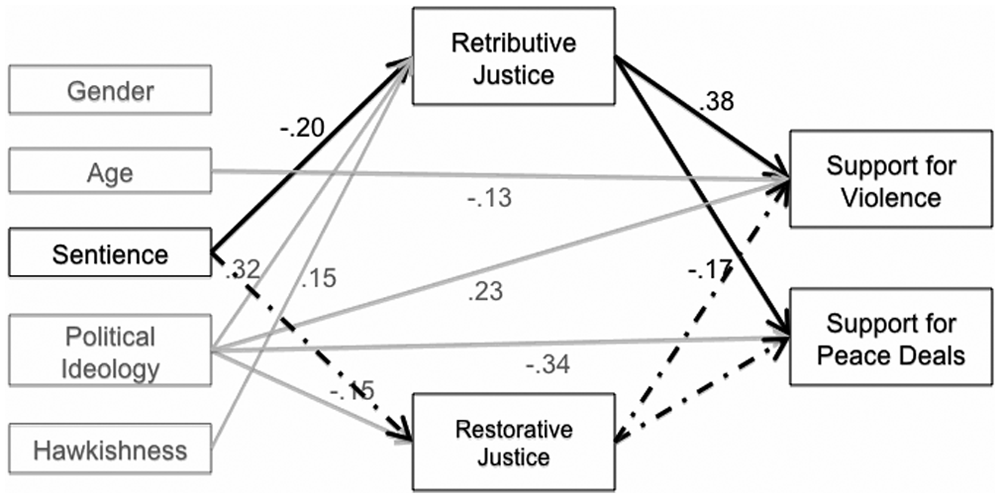
Path Model for Study 2
Possible paths not depicted in the model were fixed to zero, reflecting the hypothesis that these effects should not be significant. Dashed paths reflect effects that were hypothesized to be significant but were not significant and thus dropped from the final model. In this model, which showed acceptable fit, χ2(15) = 31.36, p < .01, χ2/df = 2.09, RMSEA = .07, CFI = .93, sentience predicted a retributive notion of justice negatively (β = −.21, p < .01). A retributive notion of justice predicted support for violence positively (β = .38, p < .001), while it predicted SPD negatively (β = −.17, p < .01). Sentience did not, however, predict a restorative notion of justice, nor did a restorative notion of justice predict support for violence or peace deals. Direct effects of sentience on the two DVs were not significant, suggesting the mediation of the effect of sentience on conflict resolution by retributive but not restorative justice. The indirect effect (on a composite score averaging both DVs into one) was significant for retributive justice, Sobel = −0.07, z = −2.60, p = .009, but not for restorative justice, Sobel = 0.00, z = 0.07, p = .945. The total effect (on the aforementioned composite score) was also significant, c = .195, t = 2.87, p < .01, indicating that there was an effect to be explained to begin with. Retributive and restorative justice were allowed to correlate freely. Although they displayed a significant bivariate correlation (r bivariate = −.22, p < .05), in the path model they did not correlate significantly (r pathmodel = −.10, p > .05).
All these effects went beyond the effects of the control variables that were taken into account simultaneously. While these latter effects were not of primary interest to our investigation, they came out as expected. Both political ideology and hawkishness, for instance, predicted retributive justice positively, and political ideology also predicted restorative justice and SPD negatively, and support for violence positively. All effects of the control variables are depicted in Figure 2.
Overall, this model explained 22% of the variance in retributive justice, 2% of the variance in restorative justice, 29% in the variance of support for violence, and 19% in the variance of SPD.
As in Study 1, we tested two plausible alternative models. In one model, retributive and restorative justice were IVs and sentience the mediator, χ2(13) = 58.34, p < .01, χ2/df = 4.49, RMSEA = .13, CFI = .80. In the second alternative model, retributive and restorative justice were the IVs and conflict resolution strategies the mediators, χ2(12) = 28.59, p < .01, χ2/df = 2.38, RMSEA = .08, CFI = .93. Both models fit the data more poorly than our hypothesized model (AICdiff = 30.98 and AICdiff = 3.22, respectively), particularly considering that the crucial paths in these models were not significant (e.g., the path between sentience as the mediator and conflict resolution strategies as the DVs in the first alternative model, and the paths between sentience as the IV and conflict resolution strategies as the mediators, and conflict resolution strategies as the mediators and notions of justice as the DVs, in the second alternative model).
Discussion
Study 2 aimed at replicating the findings of Study 1 using a more expansive measure of sentience and extend previous findings to the other party of the real conflict investigated in Study 1. As expected, sentience negatively predicted retributive justice, which, in turn, predicted violent opposition to conflict resolution positively and support for negotiated peace deals negatively. However, restorative justice did not predict conflict resolution strategies, and sentience did not predict restorative justice. In other words, our mediational hypothesis was supported for retributive but not for restorative justice. The reason for this could lie in the relatively small size of restorative justice effects, compared with retributive justice effects; had we had a larger sample, or a random or representative rather than convenience sample, as in Study 1, these effects may have reached significance. Another reason might be the strong average endorsement of restorative justice by Jewish Israelis and its high positive skewness (which could not be improved by variable transformations). This restricted variability in restorative justice and therefore its relationships with the other variables.
The main goal of Study 2, namely to address the possible limitations in the design of Study 1, was nonetheless reached to a substantial degree. Half of the hypothesized links between our variables of interest were replicated in Study 2 (i.e., the pathway from sentience to conflict resolution strategies through retributive justice) while using a more comprehensive measure of sentience that elaborated on the measure used in Study 1. It is also important to note that the more expansive measure of perceived outgroup sentience used in Study 2 included similar measures of dehumanization used in past research (e.g., Leidner et al., 2010; Leyens et al., 2000). The close relationship to the measure of sentience used in Study 1 provides convergent validity to that measure and our claim that perceived (lack of) sentience is a specific form of dehumanization. Therefore, we argue that the mediational findings of Study 1 can safely be generalized to dehumanization in general, at least with respect to retributive justice.
General Discussion
Conflict resolution, particularly in the case of protracted conflict, is an extremely difficult task ridden with obstacles. One such obstacle, we argue in this contribution, is the dehumanization of “the other” that is often if not always present in violent conflict. Building on extensive social psychological literature of social identity, intergroup relations, and justice, we reasoned that different notions of justice may be underlying and responsible for this dynamic. Specifically, we hypothesized that a particular kind of dehumanization of the other, namely, denial of sentience, plays a critical moderating role in demands for/expectations of different kinds of justice, and that these, in turn, affect behavioral intentions of relevance for conflict resolution. Two studies were carried out, the findings of which yielded support for our hypotheses.
We found that in a protracted conflict with victimization on all sides, the more people perceive the members of the other side as lacking sentience, the more they seek retributive justice in form of punishment (Studies 1 and 2) and the less they seek restorative justice in form of symbolic compensation, such as apologies, and value reaffirmation (Study 1). These findings emerge from two field studies conducted in the context of one of the longer lasting and consequential conflicts of the 20th and 21st century, namely the Israeli–Palestinian dispute. Furthermore, variables directly related to conflict resolution were assessed. The effect of perceived sentience on these variables, as hypothesized, was mediated by notions of justice. Specifically, we found that the greater the sentience perceived in the other, the more restorative and the less retributive justice, and in turn the more SPD and the less support for violence to compromise peace deals. In doing so, this research took a significant step in furthering our understanding of the origin of individual differences in desire for retributive (and, to a lesser extent, restorative) justice.
With respect to notions of justice in particular, there were two noteworthy differences between Study 1 and Study 2, both of which may have contributed to the link between sentience, restorative justice, and conflict resolution, not emerging in Study 2. First, the Jewish Israelis in Study 2 endorsed restorative justice more strongly (and retributive justice less strongly) than the Palestinians in Study 1 (Msrestorative = 7.78 on a 9-point scale and 2.75 on a 4-point scale [which would be 6.19 on a 9-point scale], respectively; Msretributive = 3.66 on a 9-point scale and 3.07 on a 4-point scale [which would be 6.91 on a 9-point scale], respectively). Although this may simply be an effect of the time of data collection (2007 for Study 1, 2011 for Study 2) or status differences between Palestinians and Israelis, it could also be related to the strength of identification with the victim identity. Although both Palestinians and Israelis commonly adopt the victim rather than the perpetrator identity, Palestinians may do so to a greater extent. This conjecture is in line with the fact that in the Israeli sample, almost one third of participants did not see Israel(is) as the exclusive victims but both Israelis and Palestinians as victims of the conflict. It is reasonable to assume that strength of identification as victim may be inversely related to a restorative notion of justice: The more people identify as victims, the less they may expect, or be inclined to accept, compensation or value reaffirmation. Israelis, by identifying less strongly with an exclusive victim identity, may thus be more receptive to a restorative notion of justice. Tangential support for this contention comes from the data of Study 2: Israelis who identified exclusively as victims demanded significantly more retributive justice, F(1, 252) = 19.60, p < .001, and marginally significantly less restorative justice, F(1, 252) = 2.77, p = .098, than Israelis who identified as both victims and perpetrators (Msretributive = 4.03 and 2.77, respectively; Msrestorative = 7.67 and 8.05, respectively).
Second, the correlation between restorative and retributive justice was positive in Study 1 but negative (on bivariate level) or nonexistent (in the path model) in Study 2. Again possibly affected by the different time of data collection or differences in group status, this difference in the relationship between restorative and retributive justice held by Palestinians and Israelis points to the possibility that Palestinians may want justice “by all means possible”—either they do or they do not want justice, and if they do, both kinds of justice are equally demanded and acceptable. Israelis, however, may have more specific expectations of how justice should be done (either retributively or restoratively), and assess them independently from one another or even in opposition to each other (i.e., either retributive or restorative justice).
The differences between the two studies need to be expected, considering the fact that data are “noisier” in field research than in lab research. In lab research, people typically seek to replicate a finding by taking a second convenience sample out of the same population (typically North American undergraduate students) and run the study in a controlled environment. In the field research presented here, we used two different populations (Palestinians and Israelis), different languages (Arabic and Hebrew), radically different procedures (face-to-face interviews and Internet), and further differences coming along with these. Without being able to conclusively explain the differences in the results, the empirical support for our hypotheses and the consistency of findings are nevertheless substantial and, in fact, extraordinary. In two highly ecologically valid but very different samples from two sides of the same real-life conflict, we found converging evidence for notions of justice (at least the retributive one) underlying the relationship between outgroup perceptions and conflict resolution approaches.
The findings from these two studies significantly extend the existing literature on intergroup perception, intergroup justice, and conflict resolution, and provide specific evidence on how dehumanization is directly linked to important outcome variables. The factor of sentience is all the more important, as it very likely affects other factors such as trust, empathy, and forgiveness, which are known to impact on conflict resolution (Cehajic, Brown, & Castano, 2008; Nadler & Liviatan, 2006; Noor, Brown, Gonzalez, Manzi, & Lewis, 2008; Noor, Brown, & Prentice, 2008). 6
Nonprotracted and Protracted Conflicts
What do our studies tell us about real-life conflicts? Here, we distinguish between two types of conflicts: nonprotracted conflicts, where there might be a clear perpetrator and victim divide (e.g., World War I [WWI], World War II [WWII]), and protracted conflicts, where the lines between perpetrator and victim side are often blurred (e.g., Israeli–Palestinian conflict).
Nonprotracted conflicts
After nonprotracted conflicts, the labeling of one side as perpetrator and the other as victim creates differential needs that have to be addressed to truly resolve the conflict. According to Shnabel and Nadler (2008, 2010), the main needs are acceptance and empowerment. Perpetrators are more in need of being accepted by others, to counteract the loss of reputation, being ostracized by members of the international community, and other negative consequences they suffer from being seen as the perpetrator. Victims, however, have a higher need of being empowered after having lost status and power due to their victimization. Relating these needs to notions of justice, retributive justice would work for the victims, as punishing the perpetrators reduces their power and status, thereby relatively empowering the victims and possibly leveling the status/power difference between perpetrators and victims. Retributive justice does not satisfy the perpetrators’ need for acceptance, however, instead possibly planting the seed for future “retaliation against the unjust punishment” the perpetrators may see themselves as suffering from. A historical example is WWI, in which Germany, the perpetrator, was punished by its victims who ultimately won the war. The treaty of Versailles was perceived by Germans to some extent as an “unjust punishment,” thus planting the seed of resentment that were to be exploited to increase the German public’s support for WWII a few decades later.
Restorative justice can satisfy the needs of both victims and perpetrators. The victims’ need for empowerment can be satisfied when the perpetrators provide material (e.g., money) and/or symbolic (e.g., apology) compensation, thereby increasing the victims’ power/status relative to the perpetrators. The perpetrators’ need for acceptance can be satisfied by the bi-/multilateral component of restorative justice, reaffirmation of common/shared values, and consequences of restorative justice such as forgiveness (see also Shnabel, Nadler, Ullrich, Dovidio, & Carmi, 2009). WWII provides a good example here: Germany was not only punished (e.g., the Nuremberg trials), but it was also dealt restorative means such as the Marshall Plan, which reaffirmed shared values and helped to reintegrate Germany into the international community. Thus, for nonprotracted conflicts, restorative justice seems to be a crucial addition to the pursuit of justice and conflict resolution, rather than using retributive justice alone.
Protracted conflicts
Parties in protracted conflicts cannot be easily labeled “perpetrator” or “victim,” as they usually alternate between these roles. This is further complicated by the tendency of all conflict parties to feel and display a deep sense of victimhood (Nadler & Saguy, 2004)—even in conflicts seen by third parties as nonprotracted conflicts with clear perpetrator and victim groups (e.g., Germany’s sense of victimhood after WWI)—and the related phenomenon of competitive victimhood (Noor, Brown, Gonzalez, et al., 2008; Noor, Brown, & Prentice, 2008). Because the victim status is experienced as psychologically rewarding (Nadler et al., 2008), each group usually sees itself as suffering more than the other—a problem exacerbated by minimization of the other’s sentience, seeing “them” as unable to suffer as “we” do. If all conflict parties view themselves as victims (e.g., in the Israeli–Palestinian conflict), it follows that all of them are more in need of empowerment rather than acceptance. Thus, retributive justice will be even more detrimental than in the case of nonprotracted conflicts, as punishment is even less acceptable if you perceive yourself as victim rather than perpetrator. Restorative justice, however, is harder to achieve in protracted conflicts, in which the unidirectional leveling of the playing field by compensation from one side to the other cannot work. It is possible, however, to achieve restorative justice by having all sides reciprocally provide material and, more importantly, symbolic compensation to each other (Atran & Ginges, 2009; Ginges et al., 2007). If this restorative justice process is understood as a symbolic act in itself, resolution of protracted conflicts might be possible without fighting a battle over ultimate victimhood. Restorative justice practices between perpetrator and victim, or simply between two parties in a conflict, may then be used to initiate a cycle of positive change and restoration of the broken connection between the two parties, increasing the likelihood of a diplomatic resolution of the conflict.
Footnotes
Declaration of Conflicting Interests
The author(s) declared no potential conflicts of interest with respect to the research, authorship, and/or publication of this article.
Funding
The author(s) disclosed receipt of the following financial support for the research, authorship, and/or publication of this article: Research reported here as well as the writing of this article was supported by National Science Foundation Research Grant BCS-0545801, to the second author, National Science Foundation Research Grant BCS-827313 and the Department of Defense Multidisciplinary University Research Initiative (AOR-MURI W911NF-08-1-0301), to the third author, and by a Fellowship for Young Scientists of the Gottlieb Daimler- und Karl Benz-Foundation (02-15/06), to the first author.