




Abstract
Four experiments were designed to test the hypothesis that performance is particularly undermined by time pressure when people are avoidance motivated. The results supported this hypothesis across three different types of tasks, including those well suited and those ill suited to the type of information processing evoked by avoidance motivation. We did not find evidence that stress-related emotions were responsible for the observed effect. Avoidance motivation is certainly necessary and valuable in the self-regulation of everyday behavior. However, our results suggest that given its nature and implications, it seems best that avoidance motivation is avoided in situations that involve (time) pressure.
Striving to avoid failure (avoidance motivation), as opposed to striving for success (approach motivation), has been associated with a variety of detrimental consequences. In the long run, avoidance motivation evokes anxiety and threat appraisals, lowers intrinsic motivation, reduces subjective well-being, and depletes self-regulatory resources (De Lange, Van Yperen, Van der Heijden, & Bal, 2010; Elliot & McGregor, 1999; Elliot & Sheldon, 1997; Oertig et al., 2013; Van Dijk, Seger, & Heller, 2012). With regard to short-term cognitive performance, however, the consequences of avoidance motivation are less straightforward. Compared with approach motivation, avoidance motivation prompts vigilance, and a more focused and systematic way of thinking. This enhances performance on tasks that require careful attention to detail (Förster, Friedman, & Liberman, 2004; Friedman & Elliot, 2008; Koch, Holland, & van Knippenberg, 2008) but may impair performance on tasks that require insight and creativity (Cretenet & Dru, 2009; Friedman & Förster, 2002, 2005; Sligte, De Dreu, & Nijstad, 2011).
The long- and short-term effects of avoidance motivation, considered together, suggest that avoidance motivation is associated with a focused, highly controlled type of information processing that requires cognitive resources and taxes energy. Approach motivation, in contrast, is associated with a more heuristic and flexible processing style that relies less on top-down executive control (Bohner, Moskowitz, & Chaiken, 1995; Evans, 2003; Koch et al., 2008; Roskes, De Dreu, & Nijstad, 2012; Ståhl, Van Laar, & Ellemers, 2012; Winkielman, Schwarz, Fazendeiro, & Reber, 2003). If this is true, we should see that endogenous and exogenous variables that tax cognitive resources undermine performance among avoidance-motivated individuals more than approach-motivated individuals. Put differently, if indeed performance under avoidance motivation relies more strongly on cognitive resources, performance under avoidance motivation should be relatively fragile and more easily undermined by cognitive overload than performance under approach motivation. In the current research, we tested this possibility by studying avoidance- and approach-motivated individuals performing different types of tasks under various levels of time pressure. Because time pressure taxes cognitive resources and undermines bottom-up, piecemeal information processing (De Dreu, 2003; De Dreu, Nijstad, & Van Knippenberg, 2008; Dijker & Koomen, 1996; Freund, Kruglanski, & Shpitzajzen, 1985; Heaton & Kruglanski, 1991; Kerstholt, 1994; Kruglanski & Freund, 1983), we predicted that performance would be particularly undermined by high time pressure when individuals were avoidance motivated.
Time Pressure and Cognitive Performance
High time pressure impairs performance on a variety of tasks, such as arithmetic tasks, the Stroop task, chess games, and speaking one’s second language (Ganushchak & Schiller, 2009; Keinan, Friedland, Kahneman, & Roth, 1999; van Harreveld, Wagenmakers, & van der Maas, 2006). Two primary reasons for the detrimental effects of time pressure on cognitive performance have been identified. First, the experience of time pressure elicits stress and arousal, which distracts individuals from the task at hand (Bargh, 1992; Keinan et al., 1999). Second, time pressure leads to a heightened need to monitor task progress and the amount of time remaining, which consumes mental resources needed for effective task performance (Karau & Kelly, 1992; Kelly, Jackson, & Hutson-Comeaux, 1997).
Time pressure does not always hurt performance. It can also lead people to work in a more focused manner (Chajut & Algom, 2003) and can be activating (Gardner, 1990; Gardner & Cummings, 1988), which may enhance enjoyment (Freedman & Edwards, 1988; Zivnuska, Kiewitz, Hochwater, Perrewe, & Zellars, 2002) and improve performance (Baas, De Dreu, & Nijstad, 2008; Gardner, 1990). Accordingly, it has been suggested that there may be an optimal level of time-related stress, and that there is an inverted U-shaped relation between time pressure and performance, with very low and very high levels of pressure being detrimental for performance (Baer & Oldham, 2006; Byron, Khazanchi, & Nazarian, 2010; Zivnuska et al., 2002). Some research supports this premise. For example, participants in a lab study performed best on anagram tasks under moderate levels of time pressure (Freedman & Edwards, 1988), and employees who reported experiencing a moderate level of time pressure were rated as more creative by their supervisors than employees who experienced a low level of time pressure (Baer & Oldham, 2006).
Because dealing with time pressure consumes mental resources, and because these resources are limited (Baumeister, Bratslavsky, Muraven, & Tice, 1998; Kehr, 2004; Koch et al., 2008; Muraven, Tice, & Baumeister, 1998; Vohs & Heatherton, 2000), the detrimental effects of time pressure should be especially pronounced for people who process information in a controlled, systematic way that relies heavily on top-down cognitive control. We propose that distracters that consume mental resources, such as time pressure, should hinder performance more when people are avoidance rather than approach motivated, given that performance relies more on effortful, top-down control when people are avoidance motivated. That is, the negative effects of time pressure are likely to be more pronounced for avoidance-motivated individuals. This interaction between motivational orientation (approach vs. avoidance) and time pressure should apply to a broad range of cognitive tasks.
The idea that time pressure undermines performance among avoidance-motivated individuals more than approach-motivated individuals is consistent with findings recently reported by Roskes et al. (2012). These investigators studied creative performance that was either functional or not functional to goal completion. Across a series of experiments, the findings revealed that creative performance among approach-motivated individuals was unaffected by functionality; avoidance-motivated individuals, however, performed better when creative performance was functional to goal completion rather than not. Furthermore, this increase in creative performance among avoidance-motivated individuals was associated with more persistent, bottom-up processing and, importantly, with greater feelings of exhaustion. Apparently, to perform well, avoidance-motivated people need to invest cognitive resources and effort to compensate for their systematic and persistent processing style, and this is difficult and depleting. Indeed, when cognitive resources were occupied by working under a cognitive load, avoidance-motivated people were no longer able to be creative, whether creative performance was functional or not. Along similar lines, Ståhl et al. (2012) recently showed that when working on noncreative tasks (such as a math test and the Stroop task), people rely heavily on cognitive resources when they are focused on avoiding failure, and that this can lead to depletion and reduced performance over time.
Here we extend this line of research by testing whether negative effects of time pressure are particularly pronounced when people are avoidance motivated, focusing on creative and noncreative task performance. Although avoidance motivation sometimes enhances performance on tasks that are a good fit to systematic processing styles, such as those that require attention to detail (e.g., the Stroop task, proofreading tasks; Koch et al., 2008; Mehta & Zhu, 2009), these tasks still require cognitive resources, and these resources are less available for such individuals under high time pressure. This argument applies equally well to tasks in which the systematic processing style of avoidance-motivated individuals is not a good fit to the task (e.g., creative tasks). Thus, the detrimental effects of time pressure on performance may be more pronounced among avoidance-motivated individuals, regardless of the type of task that is executed. To test this possibility, and the robustness of the effect, we investigated performance on tasks that fit and did not fit the vigilant, detail-oriented processing style that is activated by avoidance motivation. If people indeed suffer more from the negative consequences of working under time pressure when they are avoidance motivated, this has implications for efficient time management. Managers, for example, may need to assign more time to tasks that are avoidance-related (e.g., tasks in which avoiding mistakes are crucial such as checking financial books), and to refrain from setting tight deadlines in situations that evoke avoidance motivation (e.g., when people fear losing their jobs in times of financial crisis) and for people who are relatively avoidance motivated by nature.
In four experiments, we test the hypothesis that the performance of avoidance-motivated individuals is undermined more by time pressure than the performance of approach-motivated individuals. In Experiment 1, we examine the consequences of individual differences in the tendency to focus on avoiding negative outcomes and sensitivity to negative stimuli (i.e., avoidance temperament; Elliot & Thrash, 2010). In Experiments 2 and 3, we manipulate motivational orientation within subjects by having participants engage in tasks where they can win and lose points, and in Experiment 4, we manipulate motivational orientation between subjects by having participants complete a variation on the mouse-in-maze task (Friedman & Förster, 2001) in which participants lead a mouse toward a piece of cheese (approach) or away from an owl (avoidance). We examine the role of stress-related emotions in Experiments 1 and 4 as a possible mediator. We investigate performance on tasks that require creative insight (Experiment 1 and 2), analytical thinking (Experiment 3), and attention to detail (Experiment 4), to test the generalizability of the findings across task type.
Experiment 1
In Experiment 1, we tested whether performance is especially inhibited by working under high time pressure for people high in avoidance temperament. We tested this hypothesis on performance on the Remote Associates Test (RAT; Mednick, 1962). The RAT is a creative insight task that requires participants to identify associations among words that seem to be unrelated on first sight. Participants are provided with three words (e.g., car, swimming, cue), and are asked to generate a word that is associated with all of them (e.g., pool). This task has been used in a number of prior studies on creative insight (e.g., Ansburg & Hill, 2003; Friedman & Förster, 2000; Griskevicius, Cialdini, & Kenrick, 2006; Sligte et al., 2011). The first, most accessible associate to each of the words is often not related to the other words, and therefore, the solver must think of more distantly related information to connect the words. In this experiment, time pressure (low vs. high) was manipulated between subjects and individual differences in avoidance temperament were measured. We assessed whether stress-related emotions could account for any observed performance differences.
Method
Seventy-seven students at the University of Amsterdam (43 female, Mage = 20.65, SD = 4.17) were randomly assigned to the low time pressure or the high time pressure condition. They received €2 for their participation. Avoidance temperament was measured (Elliot & Thrash, 2010) by having participants rate, on a 1 (strongly disagree) to 7 (strongly agree) scale, how much they agreed with six statements (e.g., “When it looks like something bad could happen, I have a strong urge to escape”; Cronbach’s α = .76, M = 5.34, SD = 0.74). Higher scores reflect stronger avoidance temperament. Participants subsequently completed 30 RAT items (10 easy, 10 moderately difficult, and 10 difficult [presented in random order]; see Baas, 2010) under low time pressure (18 s per item) or high time pressure (8 s per item). Our main prediction involves the interaction of motivational orientation and time pressure, but we include difficulty level to facilitate comparisons with previous work that makes this distinction and finds that effects are often driven primarily by the moderately difficult items (e.g., Chen, Williams, Fitness, & Newton, 2008; De Dreu, Nijstad, Baas, Wolsink, & Roskes, 2012; Isen, Daubman, & Nowicki, 1987; Mikulincer & Sheffi, 2000; Sligte et al., 2011; Stafford, Ng, Moore, & Bard, 2010). The time frames for the low and high time pressure conditions were based on the average time that participants took to solve RAT items in a study without time constraints (13 s; Roskes et al., 2012, Experiment 4) and adding one standard deviation (low time pressure condition) or subtracting one standard deviation (high time pressure condition).
The numbers of correct responses to the RAT items at each level of difficulty were the dependent variables. After the RAT, participants completed a short mood questionnaire to assess stress-related emotions (Förster, Higgins, & Werth, 2004). This questionnaire assessed cheerfulness (“happy” and “content,” M = 4.46, SD = 1.12, α = .76), dejection (“discouraged” and “disappointed,” M = 3.03, SD = 1.57, α = .79), quiescence (“calm” and “relaxed,” M = 4.91, SD = 1.15, α = .68), and agitation (“tense” and “worried,” M = 4.05, SD = 1.11, α = .60) using a 1 (not at all) to 7 (extremely) scale. We expected stronger dejection and agitation, and weaker cheerfulness and quiescence, for participants higher in avoidance temperament working under high time pressure.
Results
RAT performance
The data were analyzed using a general linear model with time pressure (low vs. high; between-subjects), avoidance temperament (between-subjects), and difficulty level (easy, moderate, and difficult; within-subjects) as predictors of RAT performance. The analysis revealed a main effect of difficulty level, F(1, 74) = 695.99, p < .001, η2 = .91. On average, participants solved 7.18 (SD = 1.83) easy, 4.51 (SD = 1.78) moderately difficult, and 1.13 (SD = 1.07) difficult RAT items. Avoidance temperament did not interact with difficulty level; therefore, we analyzed performance using all 30 RAT items. 1 There was a main effect of motivational orientation; stronger avoidance temperament was related to weaker RAT performance, F(1, 73) = 7.69, p = .007, η2 = .10. There also was a main effect of time pressure, indicating that participants solved fewer RAT items in the high time pressure condition (M = 11.69, SD = 3.49) than in the low time pressure condition (M = 13.83, SD = 2.92), F(1, 73) = 7.97, p = .006, η2 = .10.
As expected, the interaction between motivational orientation and time pressure predicted RAT performance, F(1, 73) = 6.83, p = .011, η2 = .09. We conducted a simple slopes analysis using the approach of Aiken and West (1991) and software developed by Schubert and Jacoby (http://www.johannjacoby.de/stattools/SiSSy1.12.3.html). For people low in avoidance temperament (i.e., 1 standard deviation below the mean), there was no effect of time pressure on RAT performance, β = −.015, t(76) = −.10, p = .92. However, for people high in avoidance temperament (i.e., 1 standard deviation above the mean), there was a negative effect of time pressure on RAT performance, β = −.57, t(76) = −3.90, p < .001. In other words, the performance of people high in avoidance temperament was undermined more by working under high time pressure than the performance of people low in avoidance temperament (see Figure 1).

Correlations between avoidance temperament and the number of correctly solved RAT items in Experiment 1, at low (−1 SD), average, and high (+1 SD) levels of avoidance motivation.
Stress-related emotions
We tested for effects of avoidance temperament, time pressure, and their interaction on cheerfulness, dejection, quiescence, and agitation using multiple regression analysis. There was only a main effect of time pressure on quiescence; participants in the high time pressure condition reported less quiescence (M = 4.56, SD = 1.29) than participants in the low time pressure condition (M = 5.22, SD = 0.91), F(1, 73) = 6.89, p = .011, η2 = .09. There was no main effect of avoidance temperament and no interaction effect on any of the emotion measures. Due to the lack of interaction effects, we have no indication that the decline in performance of people high in avoidance temperament under high time pressure was due to heightened stress-related emotions (we return to this issue in Experiment 4 and in the general discussion).
Experiment 2
Experiment 1 supported our hypothesis that working under high time pressure is particularly problematic for avoidance-motivated individuals. Experiment 2 was designed to further test this hypothesis by manipulating rather than measuring avoidance motivation. In this experiment, we manipulated motivational orientation within subjects, making measures of mood difficult to implement; as such, we did not include mood measures in this experiment. We did, however, include a manipulation check for experienced time pressure.
Method
Seventy-seven students at the University of Amsterdam (60 female, Mage = 21.00, SD = 2.82) received €2 for participation, and were randomly assigned to the low time pressure or the high time pressure condition. Participants completed 30 RAT items (10 easy, 10 moderately difficult, and 10 difficult, as in Experiment 1) under low time pressure (18 s per item) or high time pressure (8 s per item). For some of the randomly presented items, participants were able to win a point by providing a correct answer, while an incorrect answer did not affect their score (approach condition); for the other items, participants could lose a point by providing an incorrect answer, while a correct answer did not affect their score (avoidance condition). The goal in this task was to gather as many points as possible. Note that this instruction makes task performance functionally relate to obtaining (or not losing) points. As a consequence, and in line with Roskes et al. (2012), we did not expect poorer performance on avoidance items than on approach items. Rather, we expected time pressure to have a stronger negative effect on avoidance items than on approach items.
Before each item appeared on the computer screen, participants were informed that the item would be a “win” or a “lose” item by presenting a plus (+) or a minus (−) sign, respectively. After each item, participants were informed whether they did (or did not) win or lose a point on the last item, and were provided with their current total score. Because win and lose items were presented randomly, not all participants had exactly the same number of each. 2 Therefore, the percentages of correct responses to the win items and the lose items were used as dependent variables in the analyses. Finally, to check whether the manipulation induced the experience of time pressure, participants indicated, on a 1 (strongly disagree) to 7 (strongly agree) scale, whether they had too little time to do the task, whether they had enough time to do the task (reversed), and whether they experienced time pressure (Cronbach’s α = .79, M = 4.68, SD = 1.42).
Results
Manipulation check
A t test confirmed that the time pressure manipulation was successful, as participants in the high time pressure condition experienced more pressure (M = 5.04, SD = 0.57) than participants in the low time pressure condition (M = 4.53, SD = 0.60), t(75) = −3.79, p < .001.
RAT performance
The data were analyzed using a 2 (time pressure: low vs. high) × 2 (motivational orientation: approach vs. avoidance) × 3 (difficulty level: easy, moderate, and difficult) mixed model ANOVA with time pressure as a between-subjects factor and motivational orientation and difficulty level as within-subjects factors. The analysis revealed a main effect of difficulty level, F(1, 74) = 891.21, p < .001, η2 = .92. On average, participants solved 7.48 (SD = 1.70) easy, 4.70 (SD = 2.08) moderately difficult, and 1.31 (SD = 1.12) difficult RAT items. We did not find interactions with difficulty level; therefore, we analyzed performance using all 30 RAT items. 3 There was a main effect of time pressure, indicating that participants solved fewer RAT items in the high time pressure condition (M = 40.61, SD = 11.60) than in the low time pressure condition (M = 46.84, SD = 11.26), F(1, 74) = 7.24, p = .009, η2 = .09. There was no main effect of motivational orientation.
As expected, the interaction between motivational orientation and time pressure predicted RAT performance, F(1, 74) = 5.62, p = .020, η2 = .07. A simple effects analysis revealed that performance on the lose items was worse under high time pressure than under low time pressure, F(1, 74) = 11.15, p = .001, but performance on the win items was not, F(1, 74) = 0.41, p = .52 (see Figure 2).
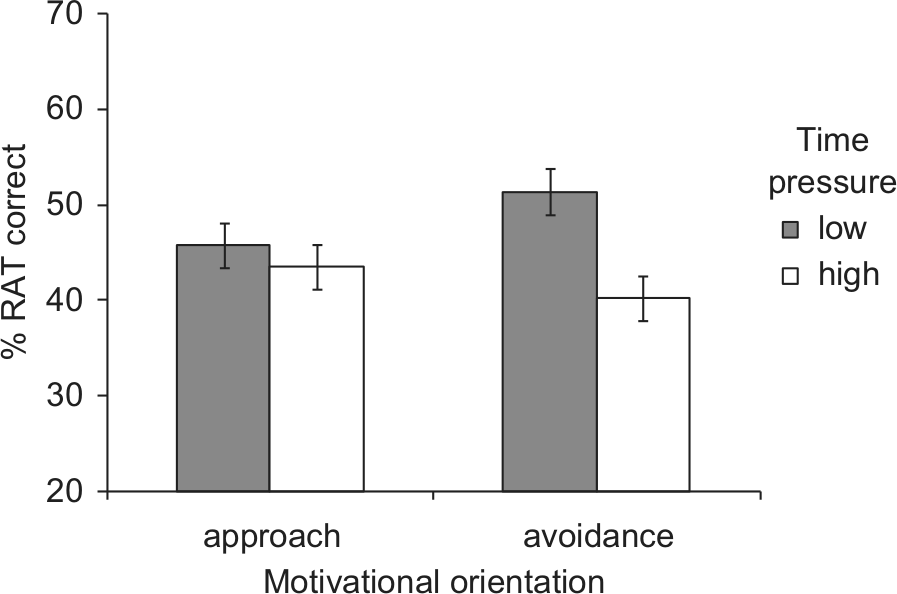
Percentage of correctly solved RAT items (+SE) in Experiment 2.
Experiment 3
Experiments 1 and 2 showed that performance on a creative insight task was particularly impaired by time pressure for individuals avoiding negative outcomes rather than approaching positive outcomes. However, the type of task utilized in these experiments was not a good fit for people avoiding negative outcomes, as avoidance motivation evokes focused and systematic information processing, but the task was best suited to heuristic and flexible processing. It is possible that time pressure only has an inimical influence on performance for avoidance-motivated individuals on tasks that do not fit their processing style. As such, in Experiments 3 and 4, we aimed to test whether this undermining effect extends to other tasks that are better suited to avoidance motivation. The existing literature is mixed as to whether avoidance motivation is a good fit to straightforward analytical tasks such as basic math problems (Elliot, Shell, Bouas Henry, & Maier, 2005; Friedman & Förster, 2005; Seibt & Förster, 2004), but is quite clear that it is a good fit to mundane tasks requiring careful attention to detail (Kuschel, Förster, & Denzler, 2010; Mehta & Zhu, 2009). In Experiment 3, we utilized a straightforward analytical task, and in Experiment 4 we utilized a task requiring careful attention to detail. In Experiment 3, we assessed performance on basic math problems. As in Experiment 2, we manipulated time pressure between subjects and motivational orientation within subjects.
Method
Seventy-eight students at the University of Amsterdam (60 female, Mage = 21.86, SD = 4.89) received €2 for participation, and were randomly assigned to the low time pressure or the high time pressure condition. Participants completed eight basic math problems (e.g., 114 / 2 − 58 = ?) under low time pressure (18 s per item) or high time pressure (8 s per item). As in Experiment 2, some of the randomly presented items were “win” items (approach condition) and some were “lose” items (avoidance condition). The percentages of correct responses to the win items and the lose items were used as dependent variables in the analyses. Finally, participants completed the same time pressure manipulation check as in Experiment 2 (Cronbach’s α = .79, M = 4.64, SD = 1.40).
Results
Manipulation check
A t test confirmed that the time pressure manipulation was successful, as participants in the high time pressure condition experienced more pressure (M = 5.02, SD = 0.57) than participants in the low time pressure condition (M = 4.46, SD = 0.58), t(76) = −4.26, p < .001.
Math performance
The data were analyzed using a 2 (time pressure: low vs. high) × 2 (motivational orientation: approach vs. avoidance) mixed model ANOVA with time pressure as a between-subjects factor and motivational orientation as a within-subjects factor. Overall, participants performed worse on the math task under high time pressure (M = 74.74, SD = 23.66) than under low time pressure (M = 82.01, SD = 22.68), F(1, 76) = 10.34, p = .002, η2 = .12; there was no main effect of motivational orientation, F(1, 76) = 0.02, p = .96. Furthermore, the interaction of motivational orientation and time pressure predicted math performance, F(1, 76) = 5.03, p = .028, η2 = .06. A simple effects analysis revealed that performance on the lose items was worse under high than under low time pressure, F(1, 76) = 14.58, p < .001, η2 = .16, but performance on the win items was not, F(1, 75) = 1.92, p = .17 (see Figure 3).
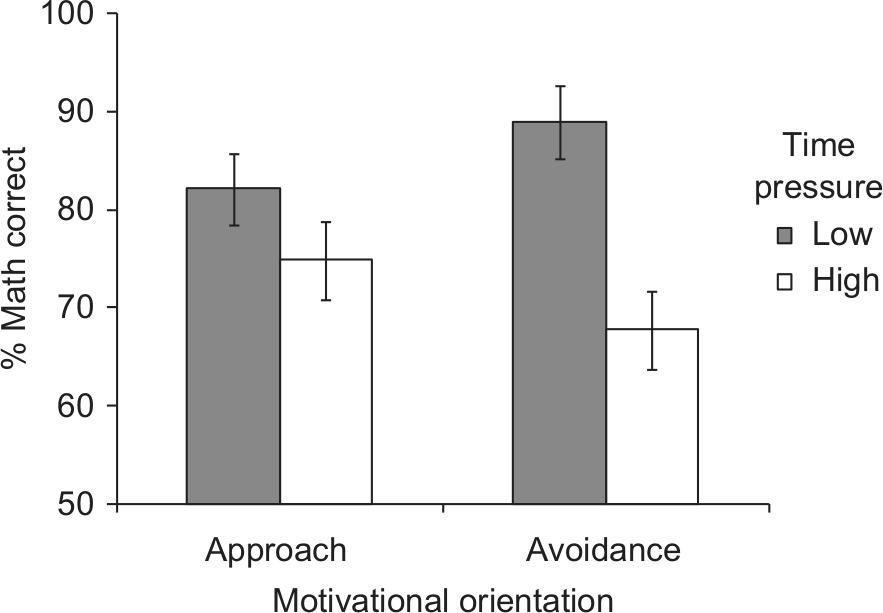
Percentage of correctly solved math items (+SE) in Experiment 3.
Experiment 4
Experiments 1, 2, and 3 provided converging evidence that performance under avoidance motivation is fragile and is impaired more by time pressure than performance under approach motivation. Experiments 1 and 2 revealed that high time pressure impaired performance under avoidance motivation on a creative insight task, and Experiment 3 revealed that high time pressure impaired performance on a basic analytical task. In Experiment 4, participants completed the d2 test, a task that requires careful attention to detail, which should be an ideal fit to avoidance motivation (Brickenkamp & Zillmer, 1998, see also Bates & Lemay, 2004). Both time pressure and motivational orientation were manipulated between subjects; this allowed us to include the measures of stress-related emotions used previously in Experiment 1.
Method
Seventy-nine students at the University of Rochester (60 female, Mage = 19.75, SD = 1.40) were randomly assigned to the conditions of a 2 (time pressure: low vs. high) × 2 (motivational orientation: approach vs. avoidance) between-subjects design. They received extra course credit for their participation. Participants were asked to look at a maze in which a cartoon mouse was depicted trying to find a piece of cheese at the end of the maze (approach condition) or trying to escape from an owl that was hovering over the maze (avoidance condition). They were asked to write a vivid story from the perspective of the mouse. In the approach condition, they were instructed to write about “the happiest day in the life of the mouse” by imagining the mouse getting closer to the cheese, finding it, and eventually eating it. In the avoidance condition, they were instructed to write about “the terrible death of the mouse” by imagining the mouse attempting to escape the owl and eventually being caught, killed, and eaten (Friedman & Förster, 2005).
After writing the story, participants proceeded to a computerized version of the d2 test. In the d2 test, the task is to cancel out all target characters (i.e., a “d” with a total of two dashes placed above and/or below it), which are interspersed with visually similar nontarget characters (i.e., a “d” with more, or less, than two dashes, or a “p” with any number of dashes). A series of 48 characters appeared in two horizontal rows on the screen, and participants canceled out targets by clicking on them. The test consisted of 14 successive series of characters, and participants had 20 s (low time pressure) or 13 s (high time pressure) to cancel out as many targets as possible. The total number of errors (both of omission and commission) made by participants was used as the dependent variable. After the d2 test, participants completed the same mood questionnaire as in Experiment 1, assessing cheerfulness (M = 3.20, SD = 1.24, α = .57), dejection (M = 2.87, SD = 1.49, α = .76), quiescence (M = 3.51, SD = 1.77, α = .93), and agitation (M = 3.06, SD = 1.54, α = .82). Finally, participants completed the same time pressure manipulation check as in Experiments 2 and 3 (Cronbach’s α = .67, M = 5.69, SD = 1.24).
Results
Manipulation check
Confirming that the time pressure manipulation was successful, a 2 (time pressure: low vs. high) × 2 (motivational orientation: approach vs. avoidance) between-subjects ANOVA predicting experienced time pressure revealed that participants in the high time pressure condition experienced more time pressure (M = 6.10, SD = 0.91) than participants in the low time pressure condition (M = 5.27, SD = 1.39), F(1, 75) = 9.87, p = .002, η2 = .12. The experience of time pressure was not influenced by the manipulation of motivational orientation, F(1, 75) = 0.01, p = .91, nor by the interaction between time pressure and motivational orientation, F(1, 75) = 0.41, p = .53.
d2 performance
The data were analyzed using a 2 (time pressure: low vs. high) × 2 (motivational orientation: approach vs. avoidance) between-subjects ANOVA. Overall, participants performed worse (i.e., made more errors) on the d2 test under high time pressure (M = 235.43, SD = 22.18) than under low time pressure (M = 123.74, SD = 37.14), F(1, 75) = 276.36, p < .001, η2 = .79; there was no main effect of motivational orientation, F(1, 75) = 0.22, p = .64. Furthermore, the interaction of motivational orientation and time pressure predicted the number of d2 errors, F(1, 75) = 4.89, p = .030, η2 = .06. A simple effects analysis revealed that the d2 performance of participants in the approach condition was better in the low than in the high time pressure condition, F(1, 76) = 106.31, p < .001, but this effect was even larger for participants in the avoidance condition, F(1, 76) = 177.23, p < .001 (see Figure 4).
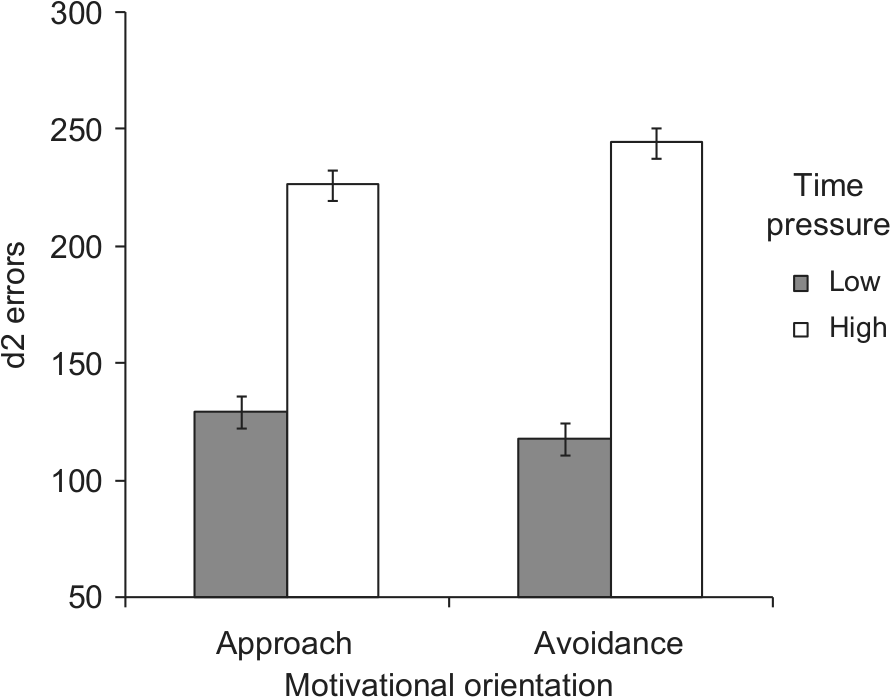
Number of errors on the d2 test (+SE) in Experiment 4.
Stress-related emotions
A 2 (time pressure: low vs. high) × 2 (motivational orientation: approach vs. avoidance) between-subjects ANOVA predicting cheerfulness, dejection, quiescence, and agitation revealed no main effects of time pressure. There were main effects of motivational orientation: Participants in the avoidance condition reported less cheerfulness 4 (M = 2.83, SD = 1.10 vs. M = 3.55, SD = 1.28), F(1, 75) = 6.95, p = .010, η2 = .09, and less quiescence (M = 2.95, SD = 1.49 vs. M = 4.05, SD = 1.87), F(1, 75) = 8.26, p = .005, η2 = .10, than participants in the approach condition. There were no main effects of motivational orientation on dejection and agitation, and no interaction effects on any of the mood measures. Thus, as in Experiment 1, we have no indication that the decline in performance of avoidance-motivated individuals under high time pressure was due to heightened stress-related emotions.
General Discussion
Four experiments revealed that performance is particularly undermined by time pressure when people are avoidance motivated. This was the case whether avoidance motivation had a dispositional basis or was situationally induced. This effect was found for performance on tasks that did not fit avoidance motivation well because they required flexibility and creative insight, and on tasks that did fit avoidance motivation well because they required basic analytical thinking and careful attention to detail. We did not find evidence in favor of an emotion-based account of these findings in the current set of studies.
People are often confronted with time pressure in everyday achievement situations, such as deadlines for handing in school assignments or for finishing reports at work. As such, the present research is not only of theoretical importance for understanding the nature of avoidance motivation but is also of clear practical importance. Other research in applied (specifically, work) domains has shown that working under time pressure can have deleterious implications for performance because it increases worker anxiety (Baer & Oldham, 2006; Byron et al., 2010). The present research focuses on the interactive influence of time pressure and aversive traits and states more generally (i.e., avoidance motivation), showing that the confluence of these factors is particularly problematic for performance outcomes. Future work is needed to test the generalizability of these findings beyond the controlled laboratory environment to real-world achievement settings like the workplace or the classroom. As discussed in our introduction, our findings suggest that managers may need to take into account whether tasks have an avoidance-related nature (e.g., proofreading to filter out mistakes and checking financial books) and schedule more time for those tasks. Furthermore, based on our findings, we recommend refraining from setting tight deadlines in situations that evoke avoidance motivation and for people who tend to be relatively avoidance motivated in general.
The present research sheds light on how individual differences influence the way that people respond to time pressure. Our results indicate that avoidance temperament influences how well people are able to cope with time pressure; specifically, individuals high in avoidance temperament are especially susceptible to the negative consequences of time pressure. Future research would do well to focus on ways to protect people with high avoidance temperament from these negative consequences. One straightforward way of addressing this issue is to teach individuals high in avoidance temperament techniques for effective time management that may reduce their susceptibility to time constraints. Alternatively, framing deadlines in terms of approach motivation may reduce the negative consequences of working under high time pressure. For example, instead of emphasizing the negative consequences of not handing in a report before a deadline, people could be encouraged to do the best they can within a given time limit. Individuals with high avoidance temperament could also be encouraged to pursue approach goals in the service of their dispositional avoidance tendency (i.e., striving to approach success to avoid failure), which has been found to lessen the negative implications of avoidance motivation (Elliot & Church, 1997). Motivation entails multiple levels of representation and operation, meaning dispositional tendencies, even if biologically based, are not destiny but may be effectively regulated through the use of lower-level goals, strategies, and tactics (Elliot, 2006; Scholer & Higgins, 2008).
Our research was primarily designed to investigate the joint influence of high time pressure and avoidance motivation on task performance. However, we also included some measures designed to begin examining the “second generation” question (Zanna & Fazio, 1982) of the processes underlying the focal effect. The present experiments did not provide evidence that stress-related emotions are responsible for the performance decrement for avoidance-motivated people under high time pressure. It is possible that avoidance-motivated individuals did not experience more stress under high time pressure than approach-motivated individuals. It is also possible that approach and avoidance-motivated individuals experience similar stress-related emotions when working under high time pressure, but for avoidance-motivated individuals, this stress interferes more with performance because their performance relies more on cognitive control and the availability of cognitive resources. It should be noted that our experiments did not find clear evidence that time pressure per se increased stress-related emotions. This raises the question of whether our null findings for stress-related emotions may be due to our use of a self-report assessment that is not sensitive enough to capture ongoing, but implicit, stress-related processes. Other indicators of stress or threat, such as cardiovascular reactivity or cortisol levels (Berry Mendes, McCoy, Major, & Blascovich, 2008; Taylor et al., 2008, 2010), may be more sensitive in detecting differences in stress levels between conditions, and may shed additional light on the issues under consideration. Alternatively, the undermining effect of time pressure for avoidance-motivated individuals may be entirely due to cognitive processes.
Previous work indicates that performance under avoidance motivation relies more on cognitive control and the recruitment of cognitive resources than performance under approach motivation (e.g., Oertig et al., 2013; Roskes et al., 2012; Ståhl et al., 2012). Avoidance motivation evokes a focused, systematic processing style that is resource demanding, making it vulnerable to other factors such as time pressure that also compete for the limited cognitive resources available for task engagement. Therefore, factors that occupy or expend cognitive resources should be particularly problematic for performance outcomes when people are avoidance motivated. If the undermining effect of time pressure for avoidance-motivated individuals is caused by limited access to cognitive resources, this implies that the undermining effect of time pressure for avoidance-motivated individuals should appear chiefly when sufficient cognitive resources are available. Moreover, not only time pressure but also other types of pressure—such as that evoked by high expectations, a strong evaluative emphasis, dispositional perfectionism, or low perceptions of one’s skills and abilities (Dweck, 1999; Greenberger, Lessard, Chen, & Farruggia, 2008; Harackiewicz & Sansone, 1991; Stoeber & Eismann, 2007)—may undermine the performance of avoidance-motivated individuals more than approach-motivated individuals. Future research is needed to further clarify the processes underlying the observed effect.
Research on avoidance motivation has shown that it can be useful, in that it mobilizes energy for the purpose of averting dangers and losses, and it evokes a form of cognitive processing that is beneficial for some types of tasks (Friedman & Förster, 2005; Koch et al., 2008; Roskes et al., 2012). However, the present research highlights the fact that avoidance motivation is also quite fragile and costly, and often leads to deleterious consequences. Indeed, our research joins a growing body of work showing that avoidance motivation represents a psychological vulnerability, in that it is problematic for task absorption, performance, and intrinsic interest for some tasks in the short run (Elliot & Harackiewicz, 1996; Friedman & Förster, 2002; Sligte et al., 2011), and it is inimical for many, if not most, performance and well-being outcomes in the long run (De Lange et al., 2010; Elliot & Sheldon, 1997; Oertig et al., 2013). Our work highlights the fragility of avoidance motivation in that it shows deleterious consequences of working under pressure for performance attainment even when the task requirements at hand are conducive to avoidance motivation. Avoidance motivation is certainly necessary and valuable in the self-regulation of everyday behavior, but given its nature and implications, it seems best that it is avoided in situations that involve (time) pressure.
Footnotes
Declaration of Conflicting Interests
The author(s) declared no potential conflicts of interest with respect to the research, authorship, and/or publication of this article.
Funding
The author(s) disclosed receipt of the following financial support for the research, authorship, and/or publication of this article: This research was supported by Grant NWO-400-06-098 from the Netherlands Organization for Scientific Research (NWO) awarded to Carsten de Dreu and Bernard Nijstad.