




Abstract
This research extends our understanding of gender bias in leader evaluations by merging role congruity and implicit theory perspectives. We tested and found support for the prediction that the link between people’s attitudes regarding women in authority and their subsequent gender-biased leader evaluations is significantly stronger for entity theorists (those who believe attributes are fixed) relative to incremental theorists (those who believe attributes are malleable). In Study 1, 147 participants evaluated male and female gubernatorial candidates. Results supported predictions, demonstrating that traditional attitudes toward women in authority significantly predicted a pro-male gender bias in leader evaluations (and progressive attitudes predicted a pro-female gender bias) with an especially strong effect for those with more entity-oriented, relative to incrementally oriented person theories. Study 2 (119 participants) replicated these findings and demonstrated the mediating role of these attitudes in linking gender stereotypes and leader role expectations to biased evaluations.
Over the last half century, we have witnessed an enormous shift toward accepting women in positions of power and influence in society. Nonetheless, women still have more difficulty than men in being perceived as having what it takes to be a top-level leader (Eagly & Carli, 2007; Hoyt, 2010). People’s attitudes toward women in positions of authority can be potent predictors of their evaluations of female leaders, with more traditional attitudes predicting bias against women in positions of power (Rudman & Kilianski, 2000; Simon & Hoyt, 2008). However, the extent to which individuals rely on their preexisting attitudes versus information about the specific individuals and situations when making evaluations of leaders varies. In this research, we seek to gain a more detailed understanding of the link between attitudes and biased evaluations of women in leadership and authority positions.
More specifically, we suggest that individual differences in meaning systems can reliably predict the extent to which people rely on prior gender attitudes when judging female leaders. Building upon the burgeoning implicit person theory literature (e.g., Chiu, Hong, & Dweck, 1997; Yang & Hong, 2010), we contend that the extent to which people believe that human traits are stable or malleable will predict how strongly individuals rely on their existing attitudes when evaluating female and male leaders. Furthermore, extending existing implicit person theory research which has primarily examined main effect predictions, we posit implicit theories as a moderator and offer an overall process model that details when and how preexisting attitudes predict biased evaluations of female leaders. Namely, we suggest that entity theorists, who view human attributes as fixed, will anchor their evaluations on prior attitudes to a much greater extent than incremental theorists who view human attributes as malleable. And, merging an implicit theory perspective with role congruity processes (Eagly & Karau, 2002; Heilman, 2001), we expect these attitudes to be the mediating mechanism in the link between perceived incongruity between gender and leader roles and ensuing gender-biased leadership evaluations.
Gender Bias and Leadership: A Role Congruity Perspective
Positions of power and influence in society have traditionally been occupied by men, whereas women have historically held lower status positions. This division of labor has given rise to consensually shared beliefs about what women and men usually do and what they should do, termed gender roles (Eagly, 1987). According to the role congruity theory, one outcome of these gendered social roles is less favorable attitudes toward women in positions of power and leadership (Eagly & Karau, 2002). Although there is ample evidence demonstrating that people generally have more negative attitudes toward women, compared with those toward men, in authority positions, these biases have decreased considerably over the years and not everyone holds these biased attitudes. For example, a recent Gallup Poll (2011) asking whether people would prefer to work for a man or woman showed that although preferences for men (32%) outnumbered those for women (22%), the most popular response was no preference (44%). These responses differ noticeably from responses given to the same question in 1995 (Gallup/CNN/USA Today Poll) when 46% preferred a male boss, 19% preferred a female boss, and 33% indicated no preference. Thus, although more people prefer a male boss, not only has this decreased over the years, but preference for a female boss and no preference have increased.
The present research situates leadership gender bias within a role congruity perspective which conceptualizes bias as emerging when stereotypic beliefs about members of a particular social group are viewed as being incongruent with a social role (Eagly, 2004; Eagly & Karau, 2002; Heilman, 2001). Thus, prejudice against women in leadership ensues from the incongruity between the female gender role and associated stereotypes and the perceived leadership role requirements (Eagly, 2004). The gender stereotypes that contribute to biased evaluations in leadership are the pervasive and resilient gender stereotypes maintaining that women take care and men take charge (Dodge, Gilroy, & Fenzel, 1995; Heilman, 2001; Hoyt, 2010). That is, women are associated with communal characteristics that highlight a concern for others, whereas men are viewed as possessing agentic characteristics that emphasize confidence, self-reliance, and dominance (Deaux & Kite, 1993; Eagly, Wood, & Diekman, 2000; Williams & Best, 1990). Men, as opposed to women, are seen as possessing traits that “fit” with the leadership role because the agentic qualities used to describe men are the same as those used to describe effective leaders. People have conceptions of what it means to be a leader, called leadership prototypes 1 (Forsyth & Nye, 2008), and ample research demonstrates that these prototypes are culturally masculine (Eagly & Carli, 2007; Koenig, Eagly, Mitchell, & Ristikari, 2011). The role congruity perspective contends that greater perceived mismatch between leader prototypes and female gender stereotypes (i.e., role incongruity) is a precursor to more negative attitudes toward women in authority and prejudice toward female leaders (Eagly & Karau, 2002).
Much of the existing research on role incongruity has focused on factors related to the leader or the role that may exacerbate perceptions of mismatch such as the gendered requirements of the role (Eagly, Makhijani, & Klonsky, 1992; Lyness & Heilman, 2006; Swim, Borgida, Maruyama, & Myers, 1989) and the gender stereotypicality of the individual (e.g., attractiveness or parenthood; Heilman & Okimoto, 2008; Heilman & Stopeck, 1985a, 1985b; Ridgeway & Correll, 2004). Research has also examined factors associated with perceivers that influence role incongruity-based biases. Not surprisingly, one potent predictor of people’s evaluations of women in non-traditional roles is their attitudes surrounding gender roles (Rudman & Kilianski, 2000; Simon & Hoyt, 2008). Hoyt (2012) extended these findings by demonstrating that individuals who support the gender role status quo, conservatives, discriminate against women in employment decisions, whereas individuals who actively reject the status quo, liberals, show favor toward female candidates.
Implicit Theory Perspective
Extending existing work, we merge the role congruity literature with an implicit theory perspective to test the prediction that the link between attitudes toward women in authority and gender bias is moderated by beliefs about the nature of individuals. Namely, we focus on implicit person theories about the malleability of human attributes (Chiu et al., 1997). Individuals who believe that attributes are fixed are referred to as entity theorists, whereas those who believe that attributes are malleable are referred to as incremental theorists. Implicit person theories predict a host of social judgments (Chiu et al., 1997) including trait inferences (Erdley & Dweck, 1993; Poon & Koehler, 2008), punishment (Dweck, Chiu, & Hong, 1995; Gervey, Chiu, Hong, & Dweck, 1993), and stereotyping (Levy, Stroessner, & Dweck, 1998; Plaks, Stroessner, Dweck, & Sherman, 2001).
Across studies of person perception, an entity belief is associated with a greater tendency to process information in terms of specific traits, whereas an incremental belief is associated with a greater tendency to process information related to the dynamics of behavior including the situational context (e.g., Bastian & Haslam, 2008). Entity theorists are much more likely to engage in lay dispositionism, the tendency to use traits as the critical unit of analysis in social perception, whereas incremental theorists are more likely to focus on the entire picture and consider that past behavior does not always predict current behavior. For example, in evaluating transgressions, children with entity theories labeled the person as “bad,” whereas incremental theorists considered mediating factors such as intentions (Heyman & Dweck, 1998). Entity theorists’ focus on trait judgments goes hand in hand with a belief that behaviors will be consistent across time and situations. For example, students were asked to watch a slide show of a young boy, who cheated and lied to make a good first impression while adjusting to a new school. When asked what they thought the boy would be like several years later, entity theorists were much more likely than incremental theorists to predict the boy would be a troublemaker (Erdley & Dweck, 1993). In summary, entity and incremental theories consistently predict how identical situations may be processed and interpreted differently to form judgments.
In the current research, we are testing the role of these theories in moderating the extent to which individuals make evaluations based on social category-based attitudes (e.g., attitudes toward women in authority) or individuating information (e.g., job qualifications). According to one prominent model of impression formation, Fiske and Neuberg’s (1990) continuum model, the perception of others occurs along a continuum ranging from more category-based to more individuated impressions. Whether we construct our impressions using fast and heuristic-based processing or more systematic and piecemeal processing depends on factors such as the extent to which the person fits our categories and how motivated we are to learn about the person or to be accurate. In this research, we argue that people’s implicit person theories influence the extent to which they rely on preexisting attitudes and social categories as opposed to individuating information during person perception. We suggest that for entity theorists, a limited amount of information (i.e., preexisting attitudes) is needed to make evaluations. In contrast, incremental theorists engage in more intricate and effortful scrutiny, relying less on preexisting attitudes, to gain an understanding of the person and to make evaluations.
In addition to enhancing our understanding of the factors involved in the processing of social information along the continuum from more heuristic-based to more systematic processing (Fiske & Neuberg, 1990), the current work seeks to extend the literatures on implicit theories and social judgments in three key ways. First, to our knowledge this is the first article to merge an implicit theory perspective with role congruity theory to examine biased evaluations of women in authority positions; this article thus presents a new context for exploring implicit person theories and an original outcome. Second, we suggest implicit person theories serve as an important individual difference variable for understanding the link between preexisting attitudes and subsequent evaluations. That is, rather than implicit person theories serving as a direct predictor of judgments, in the current work, they serve as a moderator of the link between attitudes and evaluations. Specifically, we seek to illustrate that entity theorists are not just negatively biased but rather they rely more on their preexisting attitudes in making both positive and negative evaluations of women in positions of authority. Third, and perhaps most importantly, in merging implicit theories with role congruity theory, we offer an overall process model that seeks to clarify the long-standing link between attitudes and biased evaluations of women in leadership and authority positions (see Figure 1).

Study 1 tests the model in gray in which implicit theory is a moderator of the link between attitudes toward women in authority and gender-biased leader evaluations. Study 2 tests the entire conceptual model in which implicit theory also moderates the direct link between role congruity processes and gender-biased evaluations as well as the indirect effect of leader-gender role congruity processes on gender-biased evaluations through attitudes toward women.
The Current Research
The primary goal of this research is to gain a more sophisticated understanding of factors that predict biased evaluations of female leaders by assessing the moderating role of implicit person theories in the link between people’s gender role attitudes and gender-biased leader evaluations. Specifically, we expect attitudes toward women in authority to predict leadership evaluations but for this link to be especially strong for those who hold more entity, as opposed to more incremental, theories about people. For entity theorists, more traditional attitudes will be associated with a bias in favor of men, whereas more progressive attitudes will be associated with a bias in favor of women. That is, for entity theorists, attitudes will predict greater bias, against and in favor of women, whereas for incremental theorists this link will be weaker. This prediction was tested in Study 1 and Study 2.
In Study 2, we extend our investigation to more precisely examine the processes purported to give rise to these attitudes and biases toward women in authority. According to the role congruity perspective (Eagly & Karau, 2002), the relative perceived incongruity between leader prototypes and female gender stereotypes gives rise to both attitudes toward women in authority and bias toward female leaders. Thus, in the second study, in addition to testing our prediction that implicit theories moderate the link between gender role attitudes and gender-biased leader evaluations, we also test the prediction that implicit theories moderate the link between role congruity processes and gender-biased leader evaluations. Finally, we test the prediction derived from role congruity theory (Eagly & Karau, 2002) that attitudes toward women in authority mediate the link between role congruity and biased evaluations. Thus, in the second study, we test our full conceptual model (see Figure 1) in which role congruity processes have both a direct effect on gender-biased leadership evaluations that is moderated by implicit theories and an indirect effect through attitudes toward women in authority which is also moderated by implicit theories.
Study 1
Method
Participants
We recruited 147 undergraduate students (55% female; median age = 20; range = 18-23) to voluntarily participate in a study examining evaluations of gubernatorial candidates. Participants were entered into a raffle for a chance to win a small monetary prize.
Procedure and manipulations
After providing informed consent, participants completed a survey that included measures of their implicit person theories and attitudes toward female authorities before they evaluated two gubernatorial candidates. We presented campaign statements purportedly written by two political candidates in an ostensible upcoming gubernatorial election. The sex of the candidates was manipulated through the use of sex-specific first names: Mark Taylor (male) and Elizabeth Moore (female). These names have been used previously in research (Hoyt, Simon, & Reid, 2009). The content of the two campaign statements was based on previous research and included both task-oriented and relationship-oriented statements (Cohen, Solomon, Maxfield, Pyszczynski, & Greenberg, 2004; Ehrhart & Klein, 2001; Hoyt et al., 2009). Similar to Hoyt et al. (2009), the assignment of political statements to candidate sex was counterbalanced, as was the order of presentation of candidates. After reading each campaign statement, participants assessed the candidates. Following completion of these evaluations, participants responded to demographic questions and were thanked for their time.
Measures
Participants responded to all measures using a scale ranging from 1 (strongly disagree) to 9 (strongly agree).
Implicit person theories
Participants responded to a well-validated 8-item implicit person theory measure (Levy et al., 1998; Plaks et al., 2001). This measure is designed to assess general implicit theories about individuals. Sample items include “People can substantially change the type of person they are” and “Everyone is a certain type of person, and there is not much that can be done to really change that.” Items were scored such that higher numbers represent agreement with an incremental theory and were highly interrelated (α = .90).
Gender authority measure (GAM) 2
We assessed participants’ attitudes toward women in authority with Rudman and Kilianski’s (2000) 15-item measure on which participants indicate preference for male versus female authorities. This scale has been shown to demonstrate a single factor structure with adequate internal consistency and convergent and discriminant validity. Example items include, “In general, I would rather work for a man than a woman”; “The people I look up to most are women”; and “For most college courses, I prefer a male professor to a female professor.” Items were coded such that higher numbers indicate more traditional, pro-male attitudes and were reliably interrelated (α = .81).
Leader evaluation gender bias
Participants evaluated the candidates using a measure composed of all five items from Cohen et al.’s (2004) candidate evaluation scale (e.g., “I admire this candidate,” and “This candidate would be an ideal governor”) and one additional item: “I would vote for this candidate.” Responses for female and the male candidates were averaged separately and both scales were reliable (α = .92, α = .91, respectively) and significantly correlated (r = .26, p < .001).
To assess candidate evaluation bias, we computed a bias variable by subtracting the female candidate evaluation from the male candidate evaluation. This relative difference measure is a common method of assessing intergroup bias (Craig, DeHart, Richeson, & Fiedorowicz, 2012; Hoyt et al., 2009; Levin, Federico, Sidanius, & Rabinowitz, 2002; Sears & Henry, 2003; Sears, Van Laar, Carrillo, & Kosterman, 1997). Candidate evaluation scores above zero indicate a pro-male candidate evaluation bias and scores below zero indicate a pro-female candidate evaluation bias, and numbers further from zero indicate greater bias in general. This data analytic strategy is also similar to McCauley and Stitt’s (1978) diagnostic ratio approach (also see Schimel et al., 1999). In addition to the bias variable, we also computed diagnostic ratios by dividing participants’ male leader evaluations by their female leader evaluations. Analyses with the ratio data yielded results similar to those reported using the bias variable. Both approaches take into account the evaluations of the male and female leaders relative to one another.
Results and Discussion
Table 1 presents the scale means, standard deviations, and intercorrelations for the study variables. The hypothesis that implicit theories will moderate the relationship between attitudes toward women in authority and candidate gender evaluation was tested and supported using Hayes’ (2012) PROCESS macro. This macro uses an ordinary least squares or logistic regression-based path analytical framework to analyze statistical models involving moderation, mediation, and their combination, termed conditional process modeling. Specifically, this analysis employed an ordinary least squares regression in which participants’ implicit theories and attitudes toward women in authority were entered into the equation along with the two-way interaction term while controlling for both counterbalanced factors (candidate statement and the order in which they read about the candidates). Attitudes toward women in authority significantly predicted candidate bias such that more traditional attitudes were associated with greater bias in favor of the male candidates (B = .57, p < .001). Although implicit theory did not directly predict bias (B = −.02, n.s.), there was a significant interaction between theory and gender authority attitudes (B = −.16, p = .049). This interaction is visually depicted in Figure 2 (Panel A) which plots the simple slope of attitudes toward women in authority at three values of implicit theories. Tests of simple slopes across levels of implicit theories revealed a significant and strong association between gender authority attitudes and candidate bias for relative entity theorists (−1 SD on the implicit theories scale; B = .82, p < .001), a significant yet weaker relationship for those at the mean of the implicit theories scale (B = .57, p < .001), and an even weaker, and only marginally significant, relationship for those with relative incremental theories (+1 SD on the implicit theories scale; B = .33, p = .096).
Study1: Scale Means, Standard Deviations, and Intercorrelations.
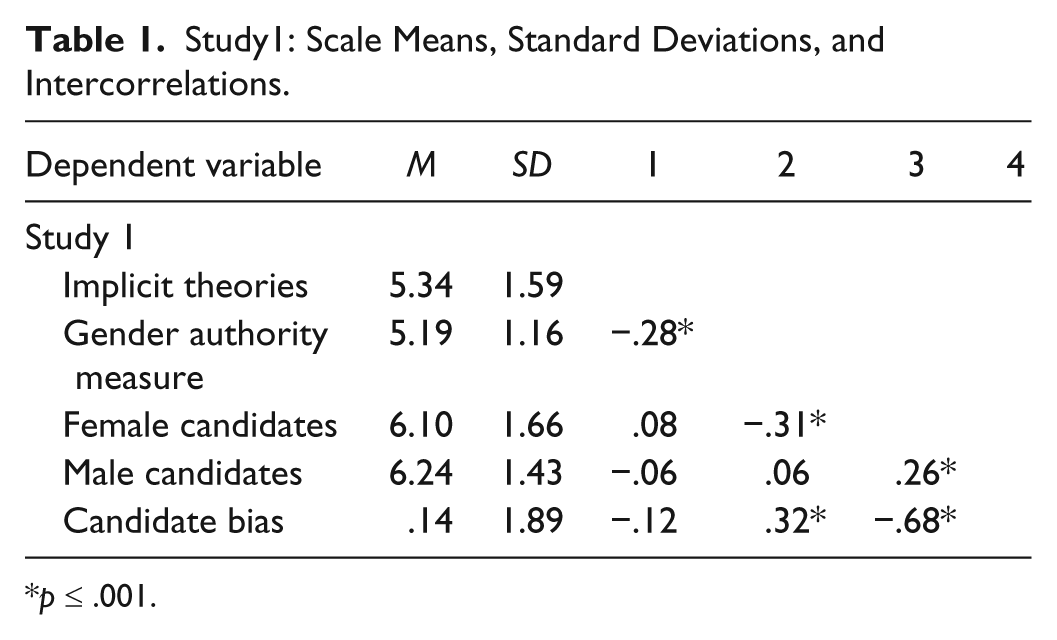
p ≤ .001.

Study 1: Gender-biased leader evaluations as a function of implicit theory and attitudes toward women in authority (Panel A) and Johnson–Neyman regions of significance for the conditional effect of attitudes toward women at values of implicit person theories (Panel B).
We further probed the interaction by using the Johnson–Neyman technique (Bauer & Curran, 2005; Hayes & Matthes, 2009), which demonstrates the values within the range of the moderator, implicit theories, in which the association between attitudes toward women and gender-biased evaluations are significant. That is, this technique shows “regions of significance” for the conditional effect of implicit theories. These regions can be seen in Figure 2 (Panel B) where we have plotted the conditional effect (solid line) of attitudes on bias across values of implicit theories along with the upper and lower bounds of the 95% confidence interval (dashed lines) for this conditional effect. The region of significance can be found at values where the confidence interval does not encompass zero; thus, attitudes toward women in authority only predict gender-biased leader evaluations when implicit person theories are less than 6.71 (on the 9-point scale).
Results confirm the prediction that implicit person theories moderate the link between gender role attitudes and gender-biased leader evaluations. Specifically, more traditional attitudes toward women in authority predicted pro-male leadership evaluations and more progressive attitudes predicted pro-female leader evaluations, and this relationship was stronger for those who hold more entity, as opposed to more incremental, theories about people. Thus, although like previous research this study demonstrated that attitudes toward women in authority predict gendered leader evaluations, this study also demonstrated that the extent to which people rely on these attitudes systematically varies with the extent to which people believe that human attributes are stable versus malleable.
Study 2
Study 1 provided an initial demonstration that implicit theories moderate the relation between gender role attitudes and gender-biased leadership evaluations. Study 2 was designed to replicate and extend these findings. This research aimed to examine more precisely the role congruity processes purported to give rise to attitudes toward women in authority and resultant gender-biased leadership evaluations. According to the role congruity perspective (Eagly & Karau, 2002), bias against women in leadership stems from the mismatch between the female gender stereotypes and the prototypical characteristics deemed crucial for leadership success. Thus, we tested a model in which greater perceived mismatch between leader prototypes and female gender stereotypes is a precursor to more negative attitudes toward women in authority and bias toward female leaders (Eagly & Karau, 2002). Specifically, in this second study we tested our full conceptual model in which role congruity processes have a direct effect on gender-biased leadership evaluations that is moderated by implicit theories and an indirect effect through attitudes toward women in authority which is also moderated by implicit theories (see Figure 1).
Method
Participants
A total of 126 undergraduate students (50% female; median age = 19; range: 18-23) volunteered to participate in the study and were entered into a raffle for a chance to win a small monetary prize. Of them, 4 failed to complete the entire study and 2 participants’ data were unusable for the final sample size of 120.
Procedure and manipulations
Participants provided their informed consent and were given a series of questionnaires to answer including measures of their implicit person theories, attitudes toward female authorities, gender stereotype assessment, and a measure of their gendered leader prototypes. These measures were presented in a randomized fashion. Next, participants were asked to evaluate the male and female gubernatorial candidates as in Study 1. Again, the assignment of political statements to candidate sex was counterbalanced, as was the order of presentation of candidates. After completing these evaluations, participants responded to demographic questions and were thanked for their time.
Measures
Again, participants responded to all measures using a scale ranging from 1 (strongly disagree) to 9 (strongly agree). Implicit theories (α = .86), attitudes toward women in authority (α = .83), and candidate evaluations (female α = .84; male α = .93) were assessed in the same manner as in Study 1. Candidate evaluation bias was computed in the same manner as in Study 1, subtracting the female candidate evaluation from the male candidate evaluation, with scores above zero indicating a pro-male bias and scores below zero indicate a pro-female bias. In addition, we assessed leader prototypes and gender stereotypes.
Agentic leader prototype 3
Similar to scales used in previous research (Hoyt, Simon, & Innella, 2011; Rudman & Glick, 2001), participants responded to a scale assessing the agentic traits associated with their leader prototype. Participants were asked to indicate how important they think it is for a leader to possess eight traits including self-confidence, assertiveness, and dominance (α = .72). Higher scores reflect a greater association of those traits with leaders. That is, higher numbers represent more support of agentic leader prototypes.
Agentic gender stereotypes
To assess participants’ gender stereotypes, they indicated the extent to which they think “a typical male” or “a typical female” possesses the same eight items used to assess agentic leadership prototypes. The scale for the typical female (α = .76) and typical male (α = .79) was reliable. Using an established method to compute stereotype indices (Rudman, Ashmore, & Gary, 2001), gender stereotypes for agency were computed by subtracting female scores from male scores. Higher scores reflect a greater association of males, relative to females, with agency.
Results
Table 2 presents the scale means, standard deviations, and intercorrelations for the study variables. We employed the Hayes’ (2012) PROCESS macro to test our proposed overall process model as depicted in Figure 1. Specifically, controlling for both counterbalanced factors (candidate statement and the order in which they read about the candidates), we used regression-based path analyses along with computational tools for estimating and probing interactions and conditional indirect effects (Hayes & Matthes, 2009; Preacher, Rucker, & Hayes, 2007).
Study 2: Scale Means, Standard Deviations, and Intercorrelations.
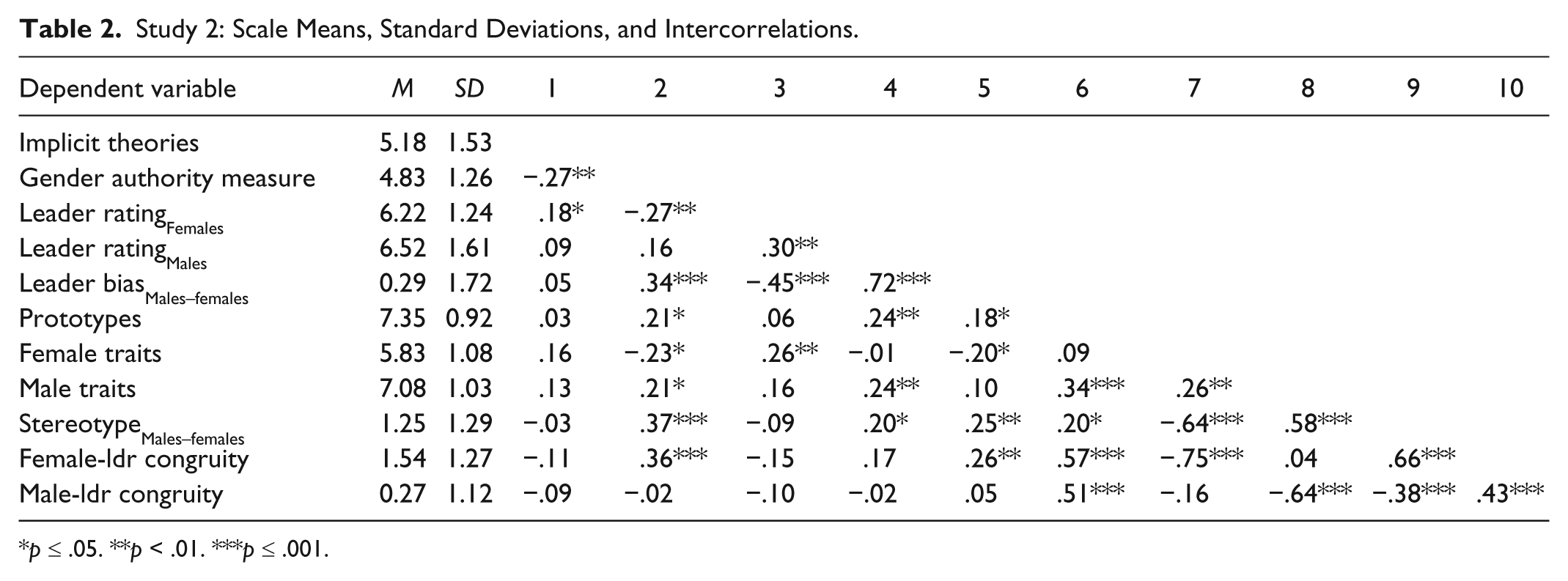
p ≤ .05. **p < .01. ***p ≤ .001.
First, we conducted an analysis examining the moderating role of implicit theories on the relationship between attitudes toward women in authority and candidate evaluation bias. In addition to replicating Study 1, this is one of the three sets of OLS regressions estimated to test our overall model. Similar to Study 1, attitudes toward women in authority significantly predicted candidate bias such that more traditional attitudes were associated with a pro-male bias, and more progressive attitudes were associated with a pro-female bias (B = .45, p < .001). Although implicit theory did not predict bias (B = .09, n.s.), there was an interaction between theory and gender authority attitudes (B = −.14, p = .056; see Figure 3). Replicating Study 1, tests of simple slopes across levels of implicit theories revealed a significant and strong association between gender authority attitudes and candidate bias for relative entity theorists (B = .67, p < .001), a significant yet weaker relationship for those at the mean of the implicit theories scale (B = .45, p < .001), and a nonsignificant relationship for those with relative incremental theories (B = .23, p = .198). Probes of the interaction using the Johnson–Neyman technique demonstrate the region of significance where attitudes toward women in authority predict gender-biased leader evaluations. Specifically, this occurs when implicit theories are less than 6.20 (again, all scales are 9-point). Results confirm that more traditional attitudes toward women in authority predicted pro-male leadership evaluations and more progressive attitudes predicted pro-female leader evaluations, and this relationship was stronger for those who hold more entity, as opposed to more incremental, theories about people.
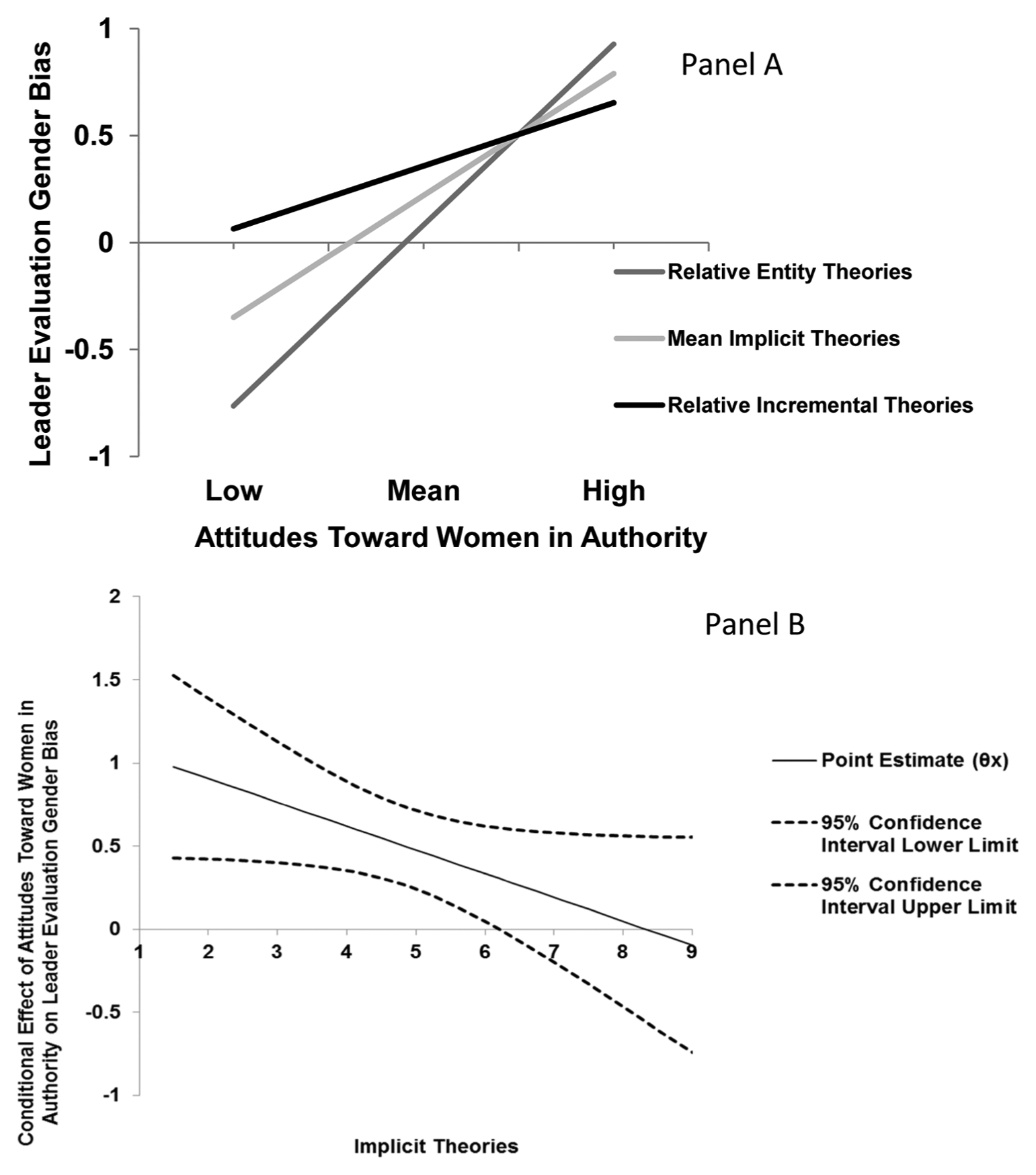
Study 2: Gender-biased leader evaluations as a function of implicit theory and attitudes toward women in authority (Panel A) and Johnson–Neyman regions of significance for the conditional effect of attitudes toward women at values of implicit person theories (Panel B).
The next analysis examined the moderating role of implicit theories on the relationship between role congruity processes and leader evaluation bias. According to role congruity theory, gender-biased leader evaluations are driven by agentic leader prototypes and a greater association of males with agency compared with females (gender stereotypes). Thus, there are various approaches that can be taken to examine the role congruity predictions. In our first approach, we created a role incongruity index by subtracting scores on the female stereotype agency scale from scores on the leader prototype agency scale. There was one low outlier on the index which we replaced with the next highest nonoutlier value. Scores above zero indicate greater perceived agency in an “effective leader” relative to a “typical female.” The role incongruity index significantly predicted candidate bias such that the more people perceive agency in leaders relative to women the greater pro-male leader evaluation bias they show (B = .36, p = .003). Implicit theory did not predict bias (B = .04, n.s.), but the cross-product term between the role incongruity index and implicit theory on leader bias was significant (B = −.19, p = .019; see Figure 4). There was a significant and strong association between the role incongruity index and candidate bias for relative entity theorists (B = .64, p < .001), a significant yet weaker relationship for those at the mean of the implicit theories scale (B = .36, p = .003), and a nonsignificant relationship for those with relative incremental theories (B = .07, p = .66). A Johnson–Neyman probe of the interaction revealed that the congruity between people’s female stereotypes and leader prototypes predict gender-biased leader evaluations for those with implicit theories less than 5.79.

Study2: Gender-biased leader evaluations as a function of implicit theories and role incongruity (Panel A) and Johnson–Neyman regions of significance for the conditional effect of role incongruity at values of implicit person theories (Panel B).
We also examined these role congruity predictions by separately examining agentic leader prototypes and agentic gender stereotypes as predictors. In the first analysis examining whether implicit theories will moderate the relationship between agentic leader prototypes and candidate gender evaluation bias, prototypes marginally predicted candidate bias such that more agentic prototypes were associated with a pro-male bias (B = .28, p = .093). Although implicit theory did not predict bias (B = .01, n.s.), there was an interaction between theory and leadership prototypes (B = −.27, p = .037). The Johnson–Neyman inquiry revealed that agentic leader prototypes predict gender-biased leader evaluations when implicit theories are less than 5.00. Finally, we examined whether implicit theories moderate the relationship between agentic gender stereotyping (a greater association of males than females with agency) and candidate evaluation bias. Gender stereotypes significantly predicted candidate bias such that a greater association of males with agency was associated with a pro-male bias (B = .32, p = .006). Although implicit theory did not predict bias (B = −.01, n.s.), there was an interaction between theory and gender stereotypes (B = −.20, p = .025). A Johnson–Neyman probe of the interaction revealed that agentic gender stereotypes predict gender-biased leader evaluations for those with implicit theories less than 5.58. Taken together, these results confirm the prediction that implicit person theories moderate the link between role congruity processes and gender-biased leader evaluations. Specifically, greater perceived role incongruity between women and leadership predicted pro-male leadership evaluations and lower perceived role incongruity predicted pro-female leader evaluations, and this relationship was stronger for those who hold more entity, as opposed to more incremental, theories about people.
Finally, our overall model predicts that the effect of role congruity processes on gender-biased leader evaluations is carried out, in part, indirectly through attitudes toward women in authority. We examined this proposed conditional indirect effect by employing Hayes’ (2013) PROCESS macro to test our moderated mediation model. We conducted these analyses using the three different approaches to examining role congruity processes discussed above (the role incongruity index, agentic leader prototypes, and agentic gender stereotypes) and all three approaches reveal similar findings. For simplicity, we only present analyses using the role incongruity index; again, scores above zero indicate greater perceived agency in an “effective leader” relative to a “typical female.” We examined the conditional indirect effect of role incongruity on gender-biased leader evaluations through attitudes toward female authority at three values of implicit theories: the mean and ± 1 SD, with higher scores representing agreement with an incremental theory. Bootstrap-based confidence intervals (95%) for the indirect effect were generated by taking 5,000 samples from the original data set. These indicated that the conditional indirect effect was significant with a 95% confidence interval for those −1 SD [.075, .372] and for those at the mean [.052, .253] but not for those +1 SD [−.020, .205]. Thus, the cutoff value in the lower tail of the bootstrap distribution of conditional indirect effects was above zero for those at or below the mean for implicit theories indicating that the conditional indirect effect of role incongruity on bias through gender attitudes is significantly different from zero (at p < .05). Thus, implicit theories moderate the indirect effect of role congruity processes on gender-biased leader evaluations through attitudes toward women in authority.
General Discussion
Although there has been an enormous shift toward accepting women as leaders over the last half century, women still have more difficulty than men in being evaluated positively for top-level leadership positions from the boardroom to the senate floor (Eagly & Carli, 2007; Hoyt, 2010). There is ample evidence demonstrating that people’s attitudes toward women in positions of authority can be an important predictor of gender-biased leader evaluations (Rudman & Kilianski, 2000; Simon & Hoyt, 2008) and these biases contribute to the remaining disparity (Eagly & Carli, 2007; Heilman & Eagly, 2008). However, the extent to which people rely on preexisting attitudes and social categories as opposed to individuating and using situational information during person perception varies considerably (Fiske & Neuberg, 1990). This research was designed to merge an implicit theories perspective with a role congruity framework to both examine individual differences in the propensity to rely on these existing attitudes when evaluating leaders and to examine the role congruity processes involved in these gender-biased leader evaluations.
Across two studies, this research shows that the extent to which people’s attitudes toward women in authority predict gender-biased leader evaluations depends in large part on their a priori implicit person theories, or the extent to which they believe human attributes are fixed versus malleable. Specifically, entity theorists’ attitudes reliably and significantly predicted their biased evaluations with more traditional attitudes toward women in authority positions predicting pro-male leadership evaluations and more progressive attitudes predicting pro-female leader evaluations. Incremental theorists’ leader evaluations, however, were not reliably predicted by their preexisting attitudes toward women in authority. Study 2 more fully delineated the role congruity processes that are involved in these gender-biased leadership evaluations. Namely, entity, relative to incremental, theorists rely more heavily on their gender stereotypes and leader prototypes when making their leader evaluations. Furthermore, the link between these stereotypes/prototypes and biased evaluations is mediated by attitudes toward women in authority. 4
Our research provides a more nuanced understanding of gender biases in the leadership domain and has a number of implications for psychological theory. The majority of the research taking a role congruity perspective to women and leadership focuses on the prejudice women experience at the intersection of incompatible social role expectations (Eagly & Karau, 2002). The present work extends this perspective by also showing the bias in favor of women that can surface when people hold progressive attitudes toward women in authority. Although the average leader bias was above zero in both studies, indicating an average pro-male bias, the results show leader evaluation biases in favor of the male and the female candidates. Thus, this research contributes to a nascent literature demonstrating that gender bias in workplace and leadership domains is not always against women. Much of the previous research showing an increased preference for female over male leaders has generally focused on changing the requirements of the leadership role. For example, research on the glass cliff shows that women are preferred over men to lead organizations during times of organizational crisis (Ryan & Haslam, 2007). Related, Brown, Diekman, and Schneider (2011) have shown that under conditions of threat people prefer a change in leadership and they favor female leaders who are associated with change more so than male leaders.
Rather than focusing on how the changing requirements of the leader role can result in variation in bias against female leaders, the present research focuses on better understanding the conditions under which gender-related attitudes influence the evaluation of female leaders. Attitudes toward gender roles have been shown to be important in predicting evaluations of women in traditionally role-incongruent contexts with those who denunciate traditional roles being more likely to support women in these positions (Hoyt, 2012). In addition to substantiating the importance of attitudes toward female gender roles in predicting the relative support of female leaders, in the present work we show the critical role of perceivers’ implicit theories in moderating the extent to which these attitudes are invoked when making these evaluations. These findings make clear the need for a more sophisticated understanding of the contexts and individual differences that predict biased evaluations of female leaders.
The present research also directly tested the purported role congruity processes (Eagly & Karau, 2002) associated with attitudes toward women in authority and subsequent gender-biased leader evaluations. Study 2 demonstrated that biased leader evaluations in favor of men were predicted from greater perceptions of the leadership role as requiring agency, a greater male-agency stereotype, and a greater discrepancy between leader prototypes and female gender stereotypes. Furthermore, these links were mediated by more traditional attitudes toward women in authority. These findings corroborate the argument that negative attitudes and bias emerge in particular social contexts, when stereotypic beliefs about members of a particular social group (women) are viewed as being relatively more or less congruent with a social role (leadership; Eagly, 2004). As noted above, not only do our findings reveal the prejudice against women that ensues from the incongruity between the female gender stereotypes and the perceived leadership role requirements, but they also show the bias in favor of women that emerges when these roles are seen as more congruent. In addition to supporting the role congruity perspective on understanding gender and leadership, our findings support arguments that communality and agency are orthogonal constructs and corroborates the contention that the lack-of-fit leadership processes revolve primarily around agentic traits (Eagly & Karau, 2002; Heilman, 2001; Heilman & Eagly, 2008).
Importantly, the present work also illustrates that the extent to which people rely on category-based information when making impressions of these leaders depends on their implicit person theories. That is, entity, but not incremental, theorists rely on their gender stereotypes, leadership prototypes, and attitudes in making their evaluations. Thus, these studies make an important contribution to our understanding of impression formation as well as the growing literature on implicit person theories particularly as they pertain to information processing in person perception. Our findings add another facet to our understanding of impression formation (Fiske & Neuberg, 1990); the extent to which we construct our impressions using fast and heuristic-based processing or more systematic and piecemeal processing seems to be dependent upon our implicit person theories. Entity theorists, relative to incremental theorists, pay greater attention to stereotype-consistent information compared with stereotype-inconsistent information and rely more on social group membership and trait-related information when perceiving others (Bastian & Haslam, 2008; Chiu et al., 1997; Eberhardt, Dasgupta, & Banaszynski, 2003; Friedman, Cooper, Chladek, & Rudy, 2007; Plaks, Grant, Dweck, 2005; Poon & Koehler, 2008). Extending this work, we find that when evaluating the gubernatorial candidates, entity theorists appear to focus on information consistent with their preexisting attitudes, namely leader gender, when making their evaluations. Incremental theorists, on the other hand, do not rely to the same degree on their preexisting attitudes suggesting that they found the leader’s gender less useful when evaluating the candidates.
Although this study is not the first to demonstrate that implicit theories predict different social inferences, we extend previous work by focusing on gender-biased evaluations and delineating one mechanism (i.e., preexisting attitudes) by which theories predict bias. Although past research has stipulated possible mechanisms linking theories to social inferences (e.g., Molden, Plaks, & Dweck, 2006), limited work has empirically tested such mechanisms. The present work suggests that entity theorists make more biased gender evaluations because they rely more heavily on their attitudes, especially their agentic prototypes of leaders and expectations about female leaders.
In addition to theoretical advancements, this research has important practical significance for helping to understand gender bias in leadership processes. Leadership is an inherently social process driven in large part by social perceptions. Indeed, leadership is principally in the eye of the beholder, with leaders’ influence dependent upon other individuals granting them their authority. The present research contributes to our understanding of the various and subtle factors that influence gender biases in leader evaluations. As the nature of leadership-related evaluations and decisions are generally unstructured and allow for biased decisions without accountability (Powell & Graves, 2003; Uhlmann & Cohen, 2005), the subtlety of these biases are particularly worrisome.
Our findings underscore the importance of individuals’ fundamental assumptions regarding human traits in leader evaluations. At the very least, understanding the important moderating role of implicit theories helps identify those who are more or less likely to benefit from interventions designed to increase reliance on individuating and relevant situational information during leader evaluations. At best, these findings point to the possible utility in developing interventions designed to encourage incremental person theories. Although we have focused on implicit person theories as an individual difference variable, these theories, like other schemas and beliefs, can be primed and manipulated (e.g., Franiuk, Pomerantz, & Cohen, 2004). Indeed, past interventions have demonstrated the potential malleability of these beliefs and have proven effective in promoting goal achievement (e.g., Blackwell, Trzesniewski, & Dweck, 2007; Burnette & Finkel, 2012).
Limitations
Despite the theoretical advances and practical implications, before this research is put into practice, some limitations need addressing in future work. First, although work has shown causal links between implicit theories and social perception processes (e.g., Molden et al., 2006), the present work relied on naturally occurring implicit person theories. Future work should examine causal processes throughout the model. Furthermore, experimental approaches to altering leadership prototypes and/or gender stereotypes will help us better understand the causal role of these beliefs in predicting attitudes toward women in authority and gender-biased leader evaluations. Such understandings can inform future interventions.
Our results may also be limited in their generalizability, particularly in regard to our reliance on undergraduate students as well as the use of the hypothetical gubernatorial vignettes. The observed processes may differ for those who have greater or dissimilar experience with leaders in comparison with the undergraduate sample used in the present work. Likewise, there may be age and/or generational differences as stereotypes and leadership prototypes are constantly changing, albeit slowly (Koenig et al., 2011). In addition, the incongruity between the female gender role and the leader role can change substantially across leadership settings. For example, leader roles in educational settings and roles that are not high status are seen as less masculine than other leader positions such as state governors (Koenig et al., 2011). These findings are also limited to situations in which the primary demonstrable difference between candidates is gender. Future research should examine the generalizability of these effects to include members of other nondominant social groups, such as ethnic and racial minorities, who face biases of their own in the leadership domain (Livingston & Pearce, 2009; Livingston, Rosette, & Washington, 2012; Rosette & Livingston, 2012). In addition, findings are limited to specific attitudes (toward women in authority). Future work could examine whether results replicate using other classic explicit gender-biased measures (e.g., Hostile and Benevolent sexism; Glick & Fiske, 1996) and more implicit gender-biased measures (e.g., IAT; Greenwald, Nosek, & Banaji, 2003).
Summary
Attitudes toward women in positions of authority have been shown to be powerful predictors of people’s evaluations of female leaders (Rudman & Kilianski, 2000; Simon & Hoyt, 2008). However, we predicted that the extent to which individuals rely on these gender role–based attitudes when evaluating leaders is reliably determined by their implicit theory. Across two studies we tested whether individual differences in core assumptions about the nature of human traits underlie differences in the use of preexisting gender attitudes when evaluating leaders. We found that entity, relative to incremental, theorists were more likely to use their attitudes about the roles that women and men should have to make judgments about leaders. Specifically, traditional attitudes toward women in authority positions predicted pro-male leadership evaluations and more progressive attitudes predicted pro-female leader evaluations. Supporting the role congruity perspective, we found that entity theorists’ biased evaluations were also predicted by the extent to which they perceive the leadership role as requiring agency and the extent to which they hold gender stereotypes. Furthermore, attitudes toward women in authority mediated the link between these stereotypes/prototypes and biased evaluations. In addition to holding practical significance, this work theoretically contributes to role congruity theory and implicit person theories literature by merging these perspectives to better understand gender-biased leader evaluations.
Footnotes
Acknowledgements
We acknowledge and thank Conor Flanagan, Athena Hensel, Abbey Hone, Lindsay Hudson, Jennifer Johnson, and Colin Sweeney for their contributions to this research.
Declaration of Conflicting Interests
The author(s) declared no potential conflicts of interest with respect to the research, authorship, and/or publication of this article.
Funding
The author(s) received no financial support for the research, authorship, and/or publication of this article.