



Abstract
The mere thought effect is defined in part by the tendency of self-reflective thought to heighten the generation of and reflection on attitude-consistent thoughts. By focusing on individuals’ fears of invalidity, we explored the possibility that the mere opportunity for thought sometimes motivates reflection on attitude-inconsistent thoughts. Across three experiments, dispositional and situational fear of invalidity was shown to heighten reflection on attitude-inconsistent thoughts. This heightened reflection, in turn, interacted with individuals’ thought confidence to determine whether attitude-inconsistent thoughts were assimilated or refuted and consequently whether individuals’ attitudes and behavioral intentions depolarized or polarized following a sufficient opportunity for thought, respectively. These findings emphasize the impact of motivational influences on thought reflection and generation, the importance of thought confidence in the assimilation and refutation of self-generated thought, and the dynamic means by which the mere thought bias can impact self-persuasion.
Although individuals often strive to be objective, a core tenet of many models of persuasion is that the nature of thoughts people generate in response to a persuasive appeal can be quite biased (Chaiken, Liberman, & Eagly, 1989; Petty & Cacioppo, 1986). Such biased thought could result from the nature of the thoughts people actively generate, selectively recall, or differentially weight. Yet regardless of the means by which this bias occurs, considerable research demonstrates the influence of biased thought on attitude change (see Petty & Wegener, 1999). Not surprisingly, then, researchers have been interested in identifying the factors that stimulate biased thought in persuasion situations. For instance, a message recipient’s mood (Petty, Schumann, Richman, & Strathman, 1993), a message source’s expertise (Chaiken & Maheswaran, 1994), and even stereotypes (Wegener, Clark, & Petty, 2006) have been shown to bias the nature of thoughts people generate and subsequently reflect on during the attitude change process.
Classic work on the mere thought effect (Tesser, 1978) demonstrates that individuals often engage in biased thought even in the absence of any external persuasion attempt. That is, merely providing individuals with sufficient opportunity to think about an issue, person, or other attitude object has been shown to foster biased thinking such that individuals generate and reflect on attitude-consistent thoughts (Chaiken & Yates, 1985; Clarkson, Tormala, & Leone, 2011; Liberman & Chaiken, 1991; Tesser & Leone, 1977). Overhearing two individuals talk about gun control, for instance, might lead one to spontaneously generate thoughts related to gun control that are consistent with one’s attitude.
Moreover, this biased generation of attitude-consistent thoughts can lead individuals to become more extreme in their evaluations of an attitude object as a mere function of thinking about it (Briñol, McCaslin, & Petty, 2012; Clarkson et al., 2011; Leone, 1996; Tesser & Leone, 1977). In other words, the mere opportunity for thought can foster attitude polarization by triggering the generation of attitude-consistent thought (for a review, see Tesser, Martin, & Mendolia, 1995). Evidence for the role of attitude-consistent thinking in the mere thought effect suggests a host of situational (Liberman & Chaiken, 1991; Millar & Tesser, 1986; Tesser, 1976; Tesser & Leone, 1977) and dispositional (Leone, 1989, 1994, 1996) factors that can amplify or attenuate the generation of attitude-consistent thoughts.
Thought Generation Versus Reflection
As with most persuasion processes, the mere thought effect is largely defined by the nature of thoughts that are generated while considering an attitude object. Again, when presented with the opportunity to reflect on an attitude object, people tend to generate thoughts that are consistent with their attitudes (Clarkson et al., 2011; Tesser & Leone, 1977). This generation of attitude-consistent thoughts has been the hallmark mechanism for mere thought effects (see Tesser et al., 1995). Implicit in this argument, of course, is that people not only generate more attitude-consistent than attitude-inconsistent thoughts but also reflect more on attitude-consistent than attitude-inconsistent thoughts. The present research explores the possibility that, even when more attitude-consistent thoughts are generated, people sometimes reflect more on their attitude-inconsistent thoughts, giving those thoughts more weight in subsequent attitude change (i.e., self-persuasion).
As a starting point, we assume that in general attitude-consistent and attitude-inconsistent thoughts are salient when people consider their attitudes. Indeed, if thoughts are represented in knowledge clusters (Bruner, 1957; Higgins, 1996), then reflecting on a given attitude object should activate attitude-relevant information, regardless of the consistency of that information with the focal attitude. In support of this assumption, empirical evidence shows that the thought profiles of individuals in the mere thought paradigm are not entirely attitude-consistent (e.g., Clarkson et al., 2011; Liberman & Chaiken, 1991; Tesser & Leone, 1977). That is, people do tend to generate attitude-inconsistent thoughts when they think for a period of time about their attitudes or a given attitude object (see also Tormala, Falces, Briñol, & Petty, 2007), even if their thought profiles still disproportionately favor attitude-consistency. Thus, there is evidence for the notion people do generate attitude-inconsistent thoughts in the mere thought paradigm. However, it remains unclear what factors—if any—heighten reflection on attitude-inconsistent rather than attitude-consistent thoughts.
Fear of Invalidity
We submit that one motivational factor that might heighten reflection on attitude-inconsistent thoughts is the desire to avoid being inaccurate, a construct embodied by an individual’s fear of invalidity. The fear of invalidity, whether conceptualized as an individual difference or a situational state, refers to a heightened level of apprehension about making incorrect or invalid decisions. Specifically, individuals high (rather than low) in a fear of invalidity are described as being highly apprehensive about making incorrect judgments (Thompson, Naccarato, Parker, & Moskowitz, 2001). This concern about being wrong or inaccurate in decisions and evaluations often results in self-imposed delays in, or outright avoidance of, decision making (Freund, Kruglanski, & Shiptajzen, 1985; Neuberg, Judice, & West, 1997; Webster & Kruglanski, 1994; see Kruglanski & Freund, 1983). Moreover, when people high in fear of invalidity do make decisions, they tend to hold them with lower confidence (Freund et al., 1985; but see Britt, Millard, Sundareswaran, & Moore, 2009) and greater ambivalence (Thompson & Zanna, 1995).
Extending this notion to the current concerns, we submit that fear of invalidity might heighten the salience of, or amplify one’s reflection on, attitude-inconsistent thoughts in the mere thought paradigm. That is, the desire to avoid being inaccurate might be sufficient to motivate people to engage in greater reflection on their attitude-inconsistent (rather than attitude-consistent) thoughts.
Assimilation Versus Refutation
If fear of invalidity increases reflection on attitude-inconsistent thoughts, then what effect does it have on people’s attitudes? Our interest is in the possibility that greater reflection on attitude-inconsistent thought might lead high fear of invalidity individuals to become less extreme (i.e., to depolarize) in their attitudes when given sufficient opportunity for thought. Consistent with this general notion, Briñol et al. (2012) had participants engaged in a role-playing exercise in which they explicitly instructed participants to consider thoughts that were either consistent or inconsistent with their initial attitude. They found that people instructed to consider attitude-inconsistent thoughts assimilated those thoughts into their attitudes and, consequently, demonstrated attitude depolarization.
Alternatively, heightened reflection on attitude-inconsistent thoughts could also lead people to become more extreme (i.e., to polarize) in their attitudes. For instance, Chaiken and Yates (1985) asked participants to write an essay toward one of two issues. They found that participants included attitude-consistent and -inconsistent thoughts in their essays, but a content analysis of the essays revealed that (a) participants were quick to refute their own attitude-inconsistent thoughts, and (b) this refutation was instrumental in heightening attitude extremity. In this instance, then, the presence of attitude-inconsistent thoughts led people to refute those thoughts which in turn increased attitude polarization rather than depolarization. A priori, then, even if the fear of invalidity increases reflection on attitude-inconsistent thoughts, the effect of these thoughts on attitudes is potentially bidirectional.
We contend that the direction of this effect (i.e., whether attitude-inconsistent thoughts will be assimilated and lead to depolarization or refuted and lead to polarization) depends on the amount of confidence people have in their thoughts. According to the self-validation hypothesis (Petty, Briñol, & Tormala, 2002: see Briñol & Petty, 2009), the impact of people’s thoughts on their attitudes is a function not only of the amount and valence of thoughts people have, but also of the confidence with which people hold those thoughts. More specifically, confidence is a means by which thoughts are validated, and validated thoughts (i.e., thoughts held with high confidence) have a greater impact on peoples’ attitudes than do invalidated thoughts (i.e., thoughts held with low confidence; Briñol, Petty, & Tormala, 2004; Tormala, Petty, & Briñol, 2002). Thus, in the mere thought paradigm, we would expect thoughts held with confidence to be assimilated and thoughts held with doubt to be refuted, irrespective of their consistency.
Overview
The goal of the present research was twofold. First, we sought to identify whether fear of invalidity is related to the thoughts people reflect on when considering their attitudes. Specifically, we postulated that being high (relative to low) in fear of invalidity might increase people’s focus on attitude-inconsistent thoughts. Second, we tested the possibility that fear of invalidity and thought confidence interact to determine the mere thought effect. Specifically, for individuals focused on attitude-consistent thoughts (i.e., individuals low in fear of invalidity), we expected high thought confidence to result in attitude polarization and low thought confidence to result in attitude depolarization. Conversely, for individuals focused on attitude-inconsistent thoughts (i.e., individuals high in fear of invalidity), we expected high thought confidence to result in depolarization (because they are confident of thoughts that contradict their attitudes) and low thought confidence to result in polarization (because they doubt their thoughts that contradict their attitudes). These hypotheses are tested across three experiments
Experiment 1
Experiment 1 has two goals. First, we sought to assess whether people’s fear of invalidity is related to differential reflection on self-generated attitude-consistent (versus inconsistent) thoughts (Experiment 1a). Second, we sought to test the role of thought confidence as a determinant of the assimilation versus refutation of these self-generated thoughts (Experiment 1b). Across both experiments, we measured fear of invalidity using Thompson et al.’s (2001) Personal Fear of Invalidity (PFI) scale.
Experiment 1a
Using the PFI scale, Experiment 1a provided an initial assessment of whether the fear of invalidity is associated with increased reflection on attitude-consistent versus attitude-inconsistent thought. We expected high (versus low) PFIs to report placing a greater focus on thoughts that were inconsistent (versus consistent) with their attitudes.
Method
Sixty-two participants were informed that the purpose of the study was to understand the different types of thoughts that come to mind when people think about various issues. Participants then responded to a series of questions intended to assess the thoughts they were most likely to reflect on when thinking about their attitudes. In particular, participants were asked to focus on a particular attitude—specifically, their attitude toward capital punishment—and to respond to the following questions with this attitude in mind: Which type of thoughts do you most reflect on as you think about your attitude? Which type of thoughts do you most consider as you think about your attitude? Which type of thought is more relevant to you as you think about your attitude? Which type of thought is more valuable to you as you think about your attitude? Responses were given on a binary scale that asked participants to indicate thoughts that were either consistent or inconsistent with their attitude. Responses to each item were recoded (0 = inconsistent thoughts, 1 = consistent thoughts) and then summed such that higher values indicated greater reflection on attitude-consistent (relative to attitude-inconsistent) thoughts.
Following a brief filler task, participants completed the PFI scale (Thompson et al., 2001). The PFI is a 14-item scale that assesses the extent to which people are apprehensive about being incorrect in their judgments. As noted, people high in PFI tend to be apprehensive about being incorrect (e.g., “I can be reluctant to commit myself to something because of the possibility that I might be wrong”), whereas people low in PFI are less apprehensive about being incorrect (e.g., “I rarely doubt that the course of action I have selected will be correct”). Responses to the items were obtained on scales ranging from 1 (extremely uncharacteristic of me) to 9 (extremely characteristic of me), and scores were summed to create a composite index of PFI for each participant (α = 84). On completing the PFI scale, participants were debriefed and thanked for their time.
Results and Discussion
We submitted the thought reflection data to a simple linear regression with PFI as the predictor. The analysis revealed a significant negative relation, β = −.27, t(60) = −2.15, p < .05. As expected, as PFI increased, so too did participants’ reflection on attitude-inconsistent (rather than consistent) thoughts. Thus, these data offer initial evidence of a relationship between fear of invalidity and the thoughts that people focus on as they consider their attitudes.
Experiment 1b
Given the observed relationship between fear of invalidity and thought reflection in Experiment 1a, the purpose of Experiment 1b was to provide initial insight into the assimilation versus refutation of those thoughts. Specifically, we sought to test the role of thought confidence as a determinant of the assimilation versus refutation of self-generated thoughts. Based on the self-validation hypothesis (Petty et al., 2002), we expected that heightening individuals’ thought confidence would validate (and thus facilitate the assimilation of) their salient thoughts, whereas undermining individuals’ thought confidence would invalidate (and thus facilitate the refutation of) their salient thoughts. Consequently, for individuals focused on their attitude-consistent thoughts (i.e., low PFIs), we anticipated that boosting thought confidence would foster polarization, whereas undermining thought confidence would foster depolarization. Conversely, for individuals focused on attitude-inconsistent thoughts (i.e., high PFIs), we anticipated that boosting thought confidence would foster depolarization, whereas undermining thought confidence would foster polarization.
Method
Sixty-four undergraduates were informed that the goal of the study was to develop an opinion profile of the student body at their university. Participants were then provided with a questionnaire that asked them to report their attitudes toward a host of different social issues on scales ranging from 1 (against) to 9 (in favor). Embedded within these issues was our target issue: capital punishment. As in prior research (e.g., Clarkson et al., 2011; Tesser & Leone, 1977), only those individuals who reported a moderate attitude toward the target issue (i.e., 2, 3, 4 or 6, 7, 8) proceeded with the experiment, as only moderate attitudes allow for polarization and depolarization as well as a clear definition of attitude-consistent versus attitude-inconsistent thought.
On completing the opinion profile questionnaire, participants were told that the experimenters were especially interested in students’ attitudes toward capital punishment and, accordingly, they would be asked to complete a more in-depth assessment of their views on this issue. They were then prompted to think about the issue of capital punishment and list any thoughts that came to mind until instructed to stop (see Leone, 1989). Participants were then presented with an opportunity to list their thoughts about capital punishment. The specific amount of time provided (180 s) was pretested to be perceived as moderate (as opposed to too long or too short) within this specific paradigm (for specifics on the pretesting procedure, see Clarkson et al., 2011).
After listing their thoughts toward capital punishment, participants received false feedback about the strength of their thoughts. This manipulation was adapted from similar manipulations of metacognitive constructs and was designed to alter participants’ thought confidence (e.g., Tormala, Clarkson, & Petty, 2006; Tormala & Petty, 2002). In particular, participants were told that, to gauge the strength of their thoughts, we would compare the thoughts they listed with a global database of thoughts from other students toward the issue of capital punishment. After a timed delay, participants received feedback indicating where their thoughts ranked on a strength index ranging from 1 to 30. In the weak feedback condition, participants were informed their strength index was 3 and, thus, that their thoughts were very weak and not compelling. Conversely, in the strong feedback condition, participants were informed their strength index was 28 and, thus, that their thoughts were very strong and very compelling.
Following this feedback, participants again reported their attitudes toward capital punishment on the same scale as used in the opinion profile questionnaire. Then, after a 5-min filler task, participants completed the PFI scale as in Experiment 1a (α = 80). On completing the PFI Scale, participants were debriefed and thanked for their time.
Results
Each dependent measure was submitted to a multiple regression analysis. In this analysis, we treated thought feedback (0 = weak, 1 = strong) and PFI (continuous, mean centered) as main effect predictors in the first step and their interaction in the second step (following the recommendations of Cohen, Cohen, West, & Aiken, 2003).
Thought consistency
As noted, participants were asked to list their thoughts about capital punishment. We presented these thoughts to two independent coders and instructed them to categorize each thought as consistent (+1), inconsistent (−1), or neutral (0) with respect to the participant’s initial attitude. Given the consistency among coders (r = .90, p < .001), their ratings were averaged and a thought consistency index was computed for each participant by subtracting the number of inconsistent thoughts from the number of consistent thoughts (e.g., Clarkson et al., 2011). Higher values thus reflected more consistent relative to inconsistent thoughts. Interestingly, analysis of this index revealed a significant association between PFI and thought consistency, β = −.27, t(61) = −2.15, p < .04; individuals low in PFI generated a more attitude-consistent profile of thoughts than did individuals high in PFI. No other effects were significant (ts < 1).
Attitude change
An attitude change index was computed by subtracting participants’ Time 2 attitudes from their Time 1 attitudes for those with initially unfavorable attitudes and subtracting participants’ Time 1 attitudes from their Time 2 attitudes for those with initially favorable attitudes. Of importance, though, because moderate attitudes have more room to depolarize than to polarize on this index (e.g., an initial rating of 6 has more room to move toward 1 than toward 9) that creates potential bias toward depolarization (see Tesser, 1978), we followed the approach of past research and coded any attitude change value greater than 0 as 1, any value less than 0 as −1, and no change as 0 (see also Clarkson et al., 2011; Chaiken & Yates, 1985; Leone, 1996; Liberman & Chaiken, 1991; Millar & Tesser, 1986). Positive values increasing to 1, therefore, indicated greater attitude polarization, whereas negative values decreasing to −1 indicated greater attitude depolarization. Finally, although we selected only individuals with moderate attitudes for analysis, we also controlled for participants’ Time 1 attitudes to ensure that any differences in attitude change were not driven by incidental variance in participants’ initial attitudes.
Analysis of the attitude change index (controlling for Time 1 attitudes) revealed the predicted thought feedback × PFI interaction, β = .34, t(59) = 3.07 p < .01. As illustrated in Figure 1, participants low in PFI evinced greater attitude polarization in the strong versus weak feedback condition, β = .36, t(59) = 2.17, p < .05, whereas participants high in PFI reported greater attitude polarization in the weak versus strong feedback condition, β = .33, t(59) = −2.16, p < .05. Neither main effect was significant (ps > .17).

Predicted attitude change as a function of personal fear of invalidity and thought feedback in Experiment 1b.
Discussion
The results across Experiments 1a and 1b offer initial support for the notion that personal fear of invalidity influences the thoughts that come to mind when people reflect on their attitudes. As hypothesized, high PFIs reported greater focus on their attitude-inconsistent thoughts relative to low PFIs. Moreover, these differences in thought reflection interacted with our manipulation of thought confidence to alter self-persuasion. Specifically, low PFIs showed greater attitude polarization when confident in their (more attitude-consistent) thoughts, whereas high PFIs showed greater attitude polarization when doubtful of their (more attitude-inconsistent) thoughts. This interaction pattern is consistent with prior research identifying thought confidence as an important determinant of when thoughts will be validated (invalidated) and thus assimilated (refuted) into one’s overall attitude (Petty et al., 2002).
It is important to note that the attitude change effect in Experiment 1b occurred despite evidence that the thought profile of high PFIs still consisted of predominantly attitude-consistent thoughts (as evidenced by the absence of a PFI main effect on thought consistency). That is, high PFIs reported greater attitude change when doubtful of their thoughts, and while their thoughts were relatively less attitude-consistent than the thoughts of low PFIs, overall they still tended to be attitude-consistent. Therefore, the thought data coupled with the attitude change data offer some evidence that people are generating attitude-consistent and -inconsistent thoughts but reflecting or focusing more on one or the other depending on their level of PFI. Indeed, if high PFIs were focusing on either their attitude-consistent thoughts or on their overall profile of thoughts, we would have expected them to display a pattern of attitude change that was similar to but somewhat weaker than that observed among low PFIs. The crossover interaction on attitude change is more consistent with the argument high (low) PFIs were differentially focused on their attitude-inconsistent (attitude-consistent) thoughts.
Experiment 2
Experiment 2 had two primary aims. First, we sought to assess the extent to which the attitude effects demonstrated in Experiment 1 extend to behavioral outcomes. In particular, might the polarization versus depolarization observed in Experiment 1b also produce more and less extreme behavioral intentions? To examine this issue, we asked participants to think about a target issue (recycling) and then indicate their behavioral intentions toward it, as behavioral intentions tend to be effective reasonable proxy for, or predictor of, actual behavior (Fishbein & Ajzen, 1975; see also Ajzen, 2012). Second, we sought to directly manipulate PFI to offer stronger convergent support for its causal role in shifting people’s focus on attitude-consistent versus attitude-inconsistent thoughts.
Method
The procedure for Experiment 2 was similar to that of Experiment 1b, with a few key exceptions. First, we changed the target issue from capital punishment to recycling. Second, we directly manipulated PFI. Third, we altered our manipulation of thought confidence. Fourth, we included an assessment of participants’ behavioral intentions toward the target issue.
In this experiment, 116 participants were informed of our interest in recycling and were asked to indicate their attitude toward it on a scale ranging from 1 (against) to 9 (in favor). They were further informed of our desire for them to complete an in-depth assessment of their views on recycling. Prior to doing so, however, participants were randomly assigned to receive one of two instructional sets designed to alter their fear of invalidity.
1
Specifically, participants in the high fear of invalidity condition were told Researchers have long known that accuracy is important to people. Even though we are interested in peoples’ personal opinions rather than facts, it is still possible for our personal opinions to be wrong (e.g., people hold personal views that go against expert opinion). In light of the abundance of research showing the importance people place on expressing accurate personal opinions, we would now like to gather more in-depth information about your perceptions of recycling.
Participants in the low fear of invalidity condition were told Researchers have long known that accuracy is important to people. Because we are interested in people’s personal opinions rather than facts, it isn’t possible for our personal opinions to be wrong (e.g., on matters of opinion, it doesn’t matter what experts think). In light of the abundance of research showing the importance people place on expressing their own personal opinions, we would now like to gather more in-depth information about your perceptions of recycling.
Following this instructional set, participants were provided with an opportunity to think about and list their thoughts about recycling for a duration pretested to be perceived as moderate (180 s). Afterward, they completed a recall task designed to alter their thought confidence. Specifically, participants were informed that the experimenters were also interested in the role of memory in the formation of opinions and then were randomly assigned to recall four instances in which they experienced a great deal of either confidence or doubt. Specifically, in the confidence (doubt) condition, participants were told as follows: We would like you to list four experiences you have had in which you felt a great deal of confidence or certainty (doubt or uncertainty). These experiences could reflect confidence (doubts) in thoughts you have had, confidence (doubt) in decisions or predictions you’ve made, or even confidence (doubt) in your general ability to do something. In each of the four boxes on the next several screens, please describe a different experience in which you felt highly confident (doubtful) about something.
This manipulation has been used in prior research to vary thought confidence (Petty et al., 2002).
Afterward, participants again indicated their attitude toward recycling before reporting their willingness to volunteer time at a local recycling center as well as their willingness to find out about recycling groups in their community and receive more information on the recycling process. Participants responded to these latter items on 9-point scales anchored at not at all willing to very willing. After responding to these items, participants were debriefed and thanked for their time.
Results
Each measure was submitted to a 2 × 2 Analysis of Variance (ANOVA), with fear of invalidity and prime as the independent variables.
Thought consistency
Participants’ thoughts were collected and coded using the method described in Experiment 1b. Coders again demonstrated consistency in their ratings (r = .84, p < .001), and a thought consistency index was computed such that higher values reflected more consistent relative to inconsistent thoughts. Analysis of participants’ thoughts revealed only a significant main effect of fear of invalidity, F(1, 112) = 6.99, p < .01; participants in the low fear of invalidity condition (M = 5.17, SD = 4.13) generated a more attitude-consistent profile of thoughts than did individuals in the high fear of invalidity condition (M = 3.15, SD = 4.17). No other effect was significant (Fs < 1).
Attitude change
The attitude change data were transformed using the procedure outlined in Experiment 1b. Analysis of this trichotomous index (controlling for Time 1 attitudes) revealed the predicted fear of invalidity × prime interaction, F(1, 111) = 13.65, p < .001. As illustrated in the top panel of Figure 2, participants in the low fear of invalidity condition showed greater attitude polarization in the confidence (M = .17, SD = .71) rather than doubt (M = −.17, SD = .59) condition, F(1, 111) = 7.08, p < .01, whereas participants in the high fear of invalidity condition showed greater attitude polarization in the doubt (M = .20, SD = .48) rather than confidence (M = −.11, SD = .42) condition, F(1, 111) = 6.78, p < .05. Neither main effect was significant (Fs < 1).

Attitude change (top panel) and behavioral intentions (bottom panel) as a function of fear of invalidity and confidence condition in Experiment 2.
Behavioral intentions
An index of behavioral intentions was computed by averaging across the items (α = .89), with higher values indicating more favorable intentions toward recycling. Importantly, our analysis of behavioral intentions focused solely on participants with favorable attitudes toward recycling, as the number of participants with unfavorable attitudes (N = 14) was too small to submit to analysis. Heightened polarization, therefore, was predicted to coincide with more positive intentions toward the issue. Analysis of behavioral intentions revealed the predicted fear of invalidity × prime interaction, F(1, 98) = 17.12, p < .001. As illustrated in the bottom panel of Figure 2, participants in the low fear of invalidity condition reported more favorable behavioral intentions in the confidence (M = 6.63, SD = 2.27) rather than doubt (M = 5.33, SD = 1.82) condition, F(1, 98) = 5.23, p < .05. Conversely, participants in the high fear of invalidity reported more favorable behavioral intentions in the doubt (M = 6.68, SD = 1.95) rather than confidence (M = 4.65, SD = 2.02) condition, F(1, 98) = 12.60, p < .01). Neither main effect was significant (Fs < 1).
Discussion
The findings of Experiment 2 provide further support for the notion that fear of invalidity can affect not only the thoughts that come to mind when people think about their attitudes, but also the consequences of the thoughts they reflect on for self-persuasion and behavioral intentions. Moreover, this finding occurred despite a host of methodological changes from Experiment 1—including, most importantly, a manipulation of PFI. Thus, Experiment 2 bolsters our confidence that PFI is causally responsible for the differences observed in attitude-consistent versus -inconsistent thinking (and attitude polarization versus depolarization) in the mere thought paradigm.
Experiment 3
Experiments 1 and 2 provide indirect support for the notion that fear of invalidity affects the thoughts that people reflect on in the mere thought paradigm, and that these thoughts interact with thought confidence to alter individuals’ attitudes and behavioral intentions. Experiment 3 was designed to establish the mechanism for this effect. Specifically, we posit that individuals should attribute any confidence or doubt that they feel about their thoughts to those thoughts that are most salient during reflection. Consequently, any feedback regarding the validity of self-generated thoughts should be applied to (and thus alter the confidence of) attitude-consistent thoughts for those low in fear of invalidity but attitude-inconsistent thoughts for those high in fear of invalidity. In addition, these differences in thought confidence should predict subsequent attitude change, such that the attitude change of high (low) PFIs is driven by confidence in their attitude-inconsistent (consistent) thoughts.
Method
The procedure for Experiment 3 was very similar to the prior experiments, with three exceptions. First, we changed the target issue to gun control. Second, to ensure that our findings were not constrained to instances in which participants engaged in a thought-listing task, we presented participants with sufficient opportunity to think about the issue but removed the thought-listing instructions. Third, to directly assess our hypothesized causal model, we included measures of participants’ confidence in their attitude-consistent and -inconsistent thoughts about gun control.
One hundred fourteen participants took part in an online study on the issue of gun control. At the outset, participants indicated their attitude toward the issue on a scale ranging from 1 (against) to 9 (in favor). They were next informed of our desire to obtain an in-depth assessment of their views on gun control and then presented with the same fear of invalidity manipulation used in Experiment 2. Afterward, they were asked to consider their thoughts toward gun control. Importantly, participants were not explicitly instructed to list their thoughts about the issue; they were simply asked to consider those thoughts. As in prior experiments, the specific amount of time provided (here, 90 s) was pretested to be perceived as moderate (as opposed to too long or too short) within this specific paradigm.
Following this opportunity for thought, participants were exposed to an amended version of the thought feedback manipulation in Experiment 1b. In this case, participants were told about a supposed international research center that gathers people’s reactions toward various social and political issues. They were further told that this center has noted several factors that affect the quality of people’s thoughts toward an issue. Our sample of online participants were then informed that online participation was one such factor, and that, for various reasons, online participation tends to produce either rather weak and unconvincing thoughts (weak feedback) or rather strong and convincing thoughts (strong feedback). Again, this manipulation served as our manipulation of thought confidence.
Afterward, participants again indicated their attitude toward gun control on the same scale as Time 1 before reporting their level of confidence and certainty in their attitude-consistent (r = .93, p < .001) and -inconsistent (r = .96, p < .001) thoughts. Participants indicated their thought confidence toward their consistent and inconsistent thoughts separately, with the presentation order randomized. Responses to the thought confidence items were obtained on 9-point scales anchored at not confident at all/not certain at all to very confident/very certain. After responding to these items, participants were debriefed and thanked for their time.
Results
We submitted each measure to a 2 × 2 ANOVA, with fear of invalidity and thought feedback as the independent variables. Means for each measure are depicted in Table 1.
Attitude Change, Attitude-Consistent Thought Confidence, and Attitude-Inconsistent Thought Confidence as a Function of Fear of Invalidity and Thought Feedback in Experiment 3.

Note. Standard deviations are listed in parentheses.
Attitude change
The attitude change data were transformed as in the other experiments. Analysis of this trichotomous index (controlling for Time 1 attitudes) revealed the predicted fear of invalidity × thought feedback interaction, F(1, 109) = 9.90, p < .01. Participants in the low fear of invalidity condition reported greater attitude polarization in the strong (versus weak) thought feedback condition, F(1, 109) = 5.03, p < .05, whereas participants in the high fear of invalidity condition reported greater attitude polarization in the weak (versus strong) thought feedback condition, F(1, 109) = 5.00, p < .05. Neither main effect was significant (Fs < 1). 2
Thought confidence
We first analyzed participants’ confidence in their attitude-consistent thoughts. The analysis revealed a significant fear of invalidity × thought feedback interaction, F(1, 110) = 4.12, p < .05. Participants in the low fear of invalidity condition reported greater confidence in their attitude-consistent thoughts following the strong (versus weak) thought feedback, F(1, 110) = 5.76, p < .05, whereas participants in the high fear of invalidity condition showed no effect of the thought feedback manipulation (F < 1).
We next analyzed participants’ confidence in their attitude-inconsistent thoughts. This analysis also revealed a significant fear of invalidity × thought feedback interaction, F(1, 110) = 5.34, p < .05. Here, however, participants in the high fear of invalidity condition reported greater confidence in their attitude-inconsistent thoughts following the strong (versus weak) thought feedback, F(1, 110) = 7.39, p < .01, whereas participants in the low fear of invalidity condition showed no effect (F < 1).
Mediation
To assess the mediating influence of thought confidence on attitude change, we conducted a formal test of multiple mediation. Specifically, we analyzed the mediating impact of confidence in attitude-consistent and attitude-inconsistent thoughts on the attitude change effects of individuals in the high and low PFI conditions. Following the recommendations of MacKinnon (2008) and Preacher and Hayes (2008), we used bootstrapping procedures to compute a confidence interval (CI) around the indirect effect of each mediator in a single model, with significant mediation indicated by a CI that does not include zero (see Figure 3 for standardized betas of individual analyses). For participants in the low PFI condition, the analysis revealed a significant mediating pathway through confidence in attitude-consistent (95% CI = [.03, .54]) but not inconsistent (95% CI = [−.04, .21]) thoughts. Conversely, for participants in the high PFI condition, the analysis revealed a significant mediating pathway through confidence in attitude-inconsistent (95% CI = [−.73, −.02]) but not consistent (95% CI = [−.27, .06]) thoughts.
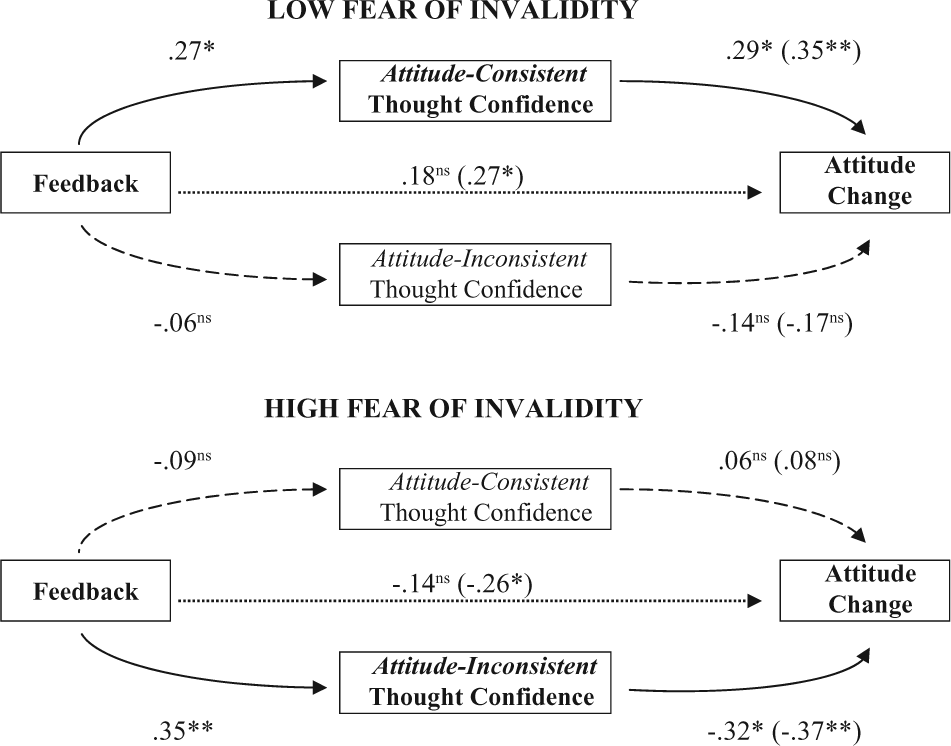
Mediation analyses for participants in the low (top panel) and high (bottom panel) fear of invalidity conditions, Experiment 3.
Discussion
Experiment 3 offered direct evidence for the notion that thought confidence and doubt inductions were applied differentially to attitude-consistent and -inconsistent thoughts, depending on which were salient to participants. Specifically, low PFIs applied the thought confidence manipulation to their attitude-consistent thoughts, whereas high PFIs applied the thought confidence manipulation to their attitude-inconsistent thoughts. Furthermore, the attitude change of low PFIs was driven by their confidence in attitude-consistent thoughts, whereas the attitude change of high PFIs was driven by their confidence in attitude-inconsistent thoughts. Thus, not only do high and low PFIs appear to reflect on different thoughts (see Experiment 1a), but they also base their attitudes on their confidence in those different thoughts.
General Discussion
The mere thought effect refers to the tendency of people to become more extreme in their attitudes after thinking about an attitude object. This classic effect has been attributed to the fact that people generate attitude-consistent thoughts toward the attitude object when given an opportunity to do so (Tesser, 1978). The present research explored the hypothesis that people vary in the type of thought (i.e., attitude-consistent or attitude-inconsistent) they reflect on while considering their attitudes. In addition, we explored when these different thoughts would be assimilated versus refuted as people considered their attitudes. Across three experiments, using measured and manipulated approaches, we approached this issue by considering the role of fear of invalidity. In short, we observed that when people were focused on their attitude-consistent thoughts (i.e., low fear of invalidity), they showed greater attitude polarization and depolarization when they were made to feel confident and doubtful of their thoughts, respectively. Conversely, when people were focused on their attitude-inconsistent thoughts (i.e., high fear of invalidity), they showed greater attitude polarization and depolarization when they were made to feel doubtful and confident of their thoughts, respectively. Thus, fear of invalidity interacted with thought confidence to determine the attitudinal consequences of mere thought.
Recent research has focused on the importance of high thought confidence (Briñol et al., 2012; Clarkson et al., 2011) as a contributor to the mere thought effect. The present work investigated the possibility that undermining people’s confidence in their thoughts might sometimes produce the same classic mere thought effect. We found that reducing thought confidence can indeed foster attitude polarization as long as the thoughts in question are attitude-inconsistent. Thus, by studying fear of invalidity, we have broadened the scope of factors and processes by which attitudes can polarize in the mere thought paradigm. Notably, low and high PFI individuals (and/or situations) can show the mere thought effect, but the effect occurs as a function of confidence (doubt) in attitude-consistent (attitude-inconsistent) thoughts.
We do find it worth noting that these findings beg the question of whether people are in fact concerned with the validity of their attitudes. Across experiments, the classic mere thought bias was replicated only under conditions in which people were low in fear of invalidity. That is, low PFIs showed a greater focus on their attitude-consistent thoughts that resulted in greater self-persuasion when confident of their thoughts. This pattern, however, reversed when people were high in fear of invalidity. In response, we wonder if individuals typically show greater confidence in their consistent thoughts and doubt in their inconsistent thoughts. If so, then this possibility would offer an explanation for why high and low PFIs tend to still polarize over time despite reflecting on different thoughts. More specifically, even though high (low) PFIs primarily focus on their attitude-inconsistent (consistent) thoughts, they may naturally hold these thoughts with low (high) confidence and therefore exhibit the typical mere thought effect, albeit through different processes (see Experiment 3). In support of this possibility, further analysis of the thought confidence data in Experiment 3 reveals that individuals in general were more confident of their consistent (M = 6.92, SD = 1.74) rather than their inconsistent (M = 5.08, SD = 2.10) thoughts, t(113) = 7.90, p < .001.
Next Steps
As discussed, the mere thought effect is a ubiquitous influence in which the opportunity for thought boosts the generation of attitude-consistent thoughts, resulting in more extreme attitudes (see Tesser, 1978). However, the current studies—coupled with revived interest in the processes underlying the mere thought effect (Briñol et al., 2012; Clarkson et al., 2011) and self-persuasion more broadly (Maio & Thomas, 2007)—point to several intriguing avenues for future research.
Multiple Means of Biased Thought
First, as noted, biased thought could be due to a number of processes, such as the nature of the thoughts people actively generate, selectively recall, differentially weight, or refute. Indeed, the studies in this article focus on a distinction between the thoughts people generate versus reflect on when considering an attitude. We believe that differentiating these processes could provide greater insight into the means by which polarization occurs as well as identify novel moderators of the mere thought effect. For instance, consider the potential impact of thinking about a specific attitude (e.g., an attitude toward a very concrete attitude object; see Weigel, Vernon, & Tognacci, 1974) or a highly inaccessible attitude (i.e., an attitude that does not come quickly to mind: see Fazio, Powell, & Herr, 1983). It could be argued that highly specific attitudes as well as highly inaccessible attitudes would impede the generation of attitude-consistent thoughts in a mere thought paradigm, though the reasons might differ. For instance, an attitude that is overly specific may restrict the ability to selectively generate new thoughts (i.e., reality constraints; Tesser, 1976), whereas an inaccessible attitude may restrict the ability to selectively recall prior thoughts. Examining the different means by which biased thought occurs, then, may offer further insight into the factors and processes guiding the impact of thought on self-persuasion.
Awareness of a Mere Thought Influence
Despite a revived interest in the processes underlying the mere thought effect, it remains unclear to what extent people are aware of the effect of self-reflection on their attitudes. In fact, we do not know of any research that has directly examined the extent to which people are aware of the fact that mere thought affects their attitudes (cf., Tesser, Leone, & Clary, 1978), let alone that different motives (e.g., as captured by fear of invalidity) may induce reflection on different thoughts that influence the direction of self-persuasion. What factors then promote versus impede this awareness? If aware, do people try to correct for the influence or perhaps accept the bias because the source of change (the self) is deemed to be legitimate? Understanding the level of awareness people have about the mere thought effect, as well as potential factors that alter this level of awareness, may offer additional insight into the conditions that amplify versus attenuate self-persuasion.
Alternative Determinants of Motivated Rumination
Finally, in the current studies, fear of invalidity biased the thoughts people focused on and consequently interacted with thought confidence to determine the direction of attitude change. Going forward, it would be worthwhile to consider other factors that alter people’s reflection on attitude-consistent and -inconsistent thoughts. For instance, having insufficient knowledge about an attitude object could produce a focus on attitude-inconsistent thoughts. Indeed, prior research has shown that insufficient knowledge mitigates the mere thought effect (Tesser & Leone, 1977). Perhaps an absence of knowledge prevents individuals from generating a sufficient number of attitude-consistent thoughts and/or increases sensitivity to new attitude-inconsistent information? Conversely, research on compensatory conviction (e.g., McGregor, Zanna, Holmes, & Spencer, 2001) suggests that feelings of personal uncertainty can increase the extremity of people’s extensions of themselves (e.g., personal goals, social identities). Interestingly, any effect of personal uncertainty on thought reflection might be moderated by the overlap of the attitude object with one’s self-concept (see Clarkson, Tormala, DeSensi, & Wheeler, 2009). For instance, feelings of uncertainty might heighten reflection on attitude-consistent thoughts as a means of compensatory conviction, though only for attitudes that strongly overlap with one’s personal identity. We look to future research to delineate these alternative possibilities.
Conclusion
Popular models of persuasion have documented the pervasive impact of thoughts on attitude change. The mere thought effect is in many ways the quintessential illustration of this impact, as the simple opportunity for thought is sufficient to stimulate self-generated attitude change. Yet despite decades of research documenting the mere thought effect, evidence from the current studies suggests that the thoughts people focus on while thinking about an attitude object can vary. Specifically, three studies demonstrate that fear of invalidity determines whether people are more likely to reflect on attitude-consistent or attitude-inconsistent thoughts in the mere thought paradigm. Moreover, the thoughts that are focused on interacting with people’s confidence in these thoughts to dictate when those thoughts will be assimilated versus refuted and, consequently, when mere thought will lead to either attitude polarization or depolarization. We look to future research to further understand the persuasive implications of thought generation, reflection, and the various metacognitive influences that shape their impact.
Footnotes
Acknowledgements
The authors would like to thank Frank Kardes and Sam Karpen for their feedback.
Declaration of Conflicting Interests
The author(s) declared no potential conflicts of interest with respect to the research, authorship, and/or publication of this article.
Funding
The author(s) received no financial support for the research, authorship, and/or publication of this article.