



Abstract
The present research examined the notion that the prosocial attitude of compassion is positively related to the antisocial attitude of hostility given that compassion and hostility entail elements reflecting vigilant, prevention-focused self-regulation. In fact, it was found in four samples (N = 4,903) that individuals with a strong vigilant prevention focus reported higher levels on measures of hostility as well as higher levels on compassion than individuals characterized by a weak prevention focus. In addition, compassion and hostility are indeed positively correlated reflecting the Compassion–Hostility Paradox. The positive association between compassion and hostility is substantially reduced when the chronic level of prevention-focused self-regulation is controlled for. A complementary experimental study in which compassion was manipulated revealed an effect of compassion on hostility in chronically prevention-focused individuals.
Introduction
In the 1970s, the Red Army Fraction (RAF) inflicted politically motivated killings on Germany. Several leading politicians and industrialists were killed. One of the most prominent members of the RAF was Ulrike Meinhof who possessed two seemingly antagonistic traits (Prinz, 2005). She was strongly compassionate when she observed the suffering of other people. However, she was also a hostile person, best indicated by her readiness to hurt and even kill people. So Ulrike Meinhof possessed the interpersonal attitude of compassion, which research in social psychology has convincingly linked to prosociality (Batson, 1987, 1998; Goetz, Keltner, & Simon-Thomas, 2010). However, she also possessed the interpersonal attitude of hostility, which promotes aggressiveness and antisocial behavior (Bushman, Cooper, & Lemke, 1991; Crick & Dodge, 1994; Dodge, 1980). In the current work, we deal with the question that emerges inescapably: How is it possible to reconcile the prosocial attitude of compassion and the antisocial attitude of hostility? As illustrated in the case of Ulrike Meinhof, the present work addresses the notion that the two interpersonal attitudes representing compassion and hostility can be positively related to each other. In the present work, we further specify this relation and argue that compassion can lead to hostile tendencies, particularly in prevention-focused individuals.
Intuitively, one would expect to find a negative association between the two constructs given that compassion and hostility seem to reflect counterparts representing end-poles of the dimension of prosocial versus antisocial attitudes. In fact, whereas compassion indicates a strong concern for others, hostility seems to reflect low concern for others. In line with this perspective, the interpersonal circumplex model proposed by Wiggins, Trapnell, and Phillips (1988) contains a horizontal axis representing hostility (antisocial coldness) and friendliness (prosocial warmth) as diametrically opposed poles and thus a negative relation. In contrast, however, we expect a positive relation between the prosocial construct of compassion and the antisocial construct of hostility. Given the counterintuitive nature of such a positive association (at first sight), we refer to this relation as the Compassion–Hostility Paradox.
Taking a more elaborate look at the concepts, we propose to explain the paradox arguing that compassion and hostility share a common basis. Specifically, both constructs entail a vigilant, prevention-focused orientation reflecting a focus on negative information. We define compassion in line with Lazarus (1991) who states that “the core relational theme for compassion [ . . . ] is being moved by another’s suffering and wanting to help” (p. 289). Accordingly, compassion reflects feelings and a concern for those who suffer based on a special sensitivity to negative things that happen to other individuals (Haidt, 2003; Nussbaum, 1996). Of note, the motivation to help is considered a consequence rather than a defining element of the state of compassion (Batson et al., 1997; Haidt, 2003). Hostility, on the other hand, reflects a sensitivity to negative behavioral tendencies that can be observed in other individuals (e.g., negative evaluation and dislike of others; Buss, 1961). In this sense, both constructs reflect a special kind of sensitivity to negative social information. Thus, an analysis of the association between a vigilant, prevention-focused self-regulation and compassion as well as hostility is expected to reveal a positive association. Finally, given that negative sensitivity builds a common conceptual ground in that hostility as well as compassion reflect a focus on negative social information, the analysis of the association between hostility and compassion is expected to reveal a positive relation as well.
The first aim of the present work is to test the assumed positive association between compassion and hostility. As outlined in detail below, we propose that prevention-focused self-regulation plays a crucial role regarding this association. The second aim is to investigate a possible causal relation between compassion and hostility. We postulate that the stronger someone is feeling compassion with suffering other individuals, the more likely it is that the person develops a hostile attitude toward other people. We further assume that the causal relation between compassion and hostility is most likely to be observed in prevention-focused individuals. The studies reported below put these assumptions to an empirical test. We want to emphasize that the present research is focused on correlates and consequences of compassion (rather than on the causal influence of the prevention focus) with a specific interest in the relation between the prosocial attitude of compassion and the antisocial attitude of hostility. Studies 1 and 2 can be considered as complementary in that both address the compassion–hostility association and the role of prevention-focused self-regulation regarding this association. They are complementary in that (a) Study 1 explores in correlational designs whether the association between compassion and hostility can be explained with reference to the common self-regulatory element of prevention-focused self-regulation and (b) Study 2 is designed to explore whether individuals with a special attention regarding the negative (and thus hostility arousing) content of compassion-arousing situations (i.e., prevention-focused individuals) are most likely to react with enhanced hostility when they are induced to feel compassion with a person experiencing negative treatment by third persons.
The theoretical rationale underlying this research is outlined in the next sections starting with a discussion of self-regulatory orientations as proposed in regulatory focus theory (RFT; Higgins, 1998)—a particularly prominent model differentiating two specific modes of self-regulation.
Self-Regulatory Orientation as a Fundamental Factor in Social Behavior
Recent social-psychological research has documented that many fundamental social cognitive as well as social interactive mechanisms are heavily influenced by self-regulatory orientation, which affects individuals’ thought processes and behavioral tendencies (for an overview on self-regulation research, see Baumeister & Vohs, 2004). One specific theoretical perspective figures prominently in the field of research on self-regulatory orientations: RFT introduced by Higgins (1997, 1998). RFT holds that two basic modes of self-regulation can be differentiated. In the prevention mode of self-regulation, individuals strive to achieve safety and security, fulfill their duties and obligations, and avoid losses. In the promotion mode of self-regulation, individuals are guided by the need for nurturance and growth, the desire to reach their ideal goals and aspirations, and the motivation to achieve gains.
RFT has been applied to an impressively wide spectrum of topics and psychological phenomena across a diverse array of domains (for an overview, see Higgins & Spiegel, 2004). The existing evidence shows that a vast number of social cognitive as well as social interactive phenomena can be related to the basic self-regulatory orientations outlined in RFT. The present contribution aims to explore the role of RFT with respect to important interpersonal attitudes, compassion, and hostility, by testing the hypothesis that a prevention-focused self-regulatory orientation explains the compassion–hostility association. Somewhat surprisingly, there is little research on the role of self-regulatory orientations regarding interpersonal attitudes. The current research aims to address this theoretical and empirical gap.
Core Assumptions of RFT
Extending the basic hedonic principle that people approach pleasure and avoid pain, RFT holds that it is necessary to differentiate among distinct types of pleasures and distinct types of pain, and to assess the specific strategic orientations and types of goal pursuit that reflect self-regulation guided by two distinct motivational systems—promotion focus and prevention focus.
Research on RFT (for reviews, see Higgins & Spiegel, 2004 and Molden, Lee, & Higgins, 2008) shows that both types of regulatory orientations are related to specific consequences. The psychological consequences of promotion-focused self-regulation are (a) a special sensitivity to the presence or absence of positive outcomes, (b) application of eager strategic means, (c) ambitious and keen striving to reach ones aspirations as reflected in tenacious goal pursuit that is focused on maximal goals, (d) cheerfulness–dejection emotions in response to positive and negative events, and (e) an independent self-construal emphasizing the unique aspects of the self. In contrast, the psychological consequences of prevention-focused self-regulation are (a) a special sensitivity to the presence or absence of negative outcomes, (b) application of vigilant strategic means, (c) a risk-averse and defensive orientation in the pursuit of minimal goals, (d) quiescence-agitation emotions (i.e., relaxation vs. worry and anxiety) in response to positive and negative events, and (e) an interdependent self-construal emphasizing the social connectedness of the self.
According to RFT, the two self-regulatory systems can be situationally induced (e.g., Freitas, Liberman, & Higgins, 2002; Friedman & Förster, 2001; Shah, Higgins, & Friedman, 1998). However, and most important in the present context, RFT posits that individuals differ in their predominant chronic self-regulatory orientations, basically as a function of parenting styles (Keller, 2008). Several measures to assess individual differences in self-regulatory orientation have been developed (e.g., regulatory focus questionnaires, cf. Higgins et al., 2001; Keller & Bless, 2008; Lockwood, Jordan, & Kunda, 2002; regulatory strength measures, cf. Shah et al., 1998). It is important to note that the two modes of self-regulation have been conceptualized as distinct constructs. Thus, prevention-focused self-regulation does not represent the opposite pole of promotion-focused self-regulation. This implies that it is possible that one of the two modes is associated with a certain psychological phenomenon, while the other mode is not.
Vigilant Self-Regulatory Orientation and Sensitivity to Negative Social Information
One specific assumption entailed in RFT is particularly important in the present context: the differential sensitivity hypothesis. This proposition holds that individuals in a vigilant mode of self-regulation (prevention focus) show a special sensitivity to negative events, outcomes, and related cues (Higgins, 1998, 2012). Neural correlates support this assumption indicating a greater activity in the amygdala, anterior cingulate, and extrastriate cortex for prevention-focused individuals when negative (vs. positive) information is presented (Cunningham, Raye, & Johnson, 2005). Building on this general notion, it is proposed that one should find a special sensitivity to negative social information in individuals characterized by a strong prevention focus. Moreover, given that prevention-focused individuals strive to fulfill their duties, responsibilities, and oughts, reflecting normative standards (Higgins, 1998, 2012; Pfattheicher & Keller, in press), we argue that prevention-focused individuals should be sensitive to negative social information such as norm violations (e.g., selfishness, dishonesty, criminal acts, or violence).
Hostility as a Correlate of Vigilant Self-Regulation
One specific type of negative social information individuals can be confronted with are instances of negative social behavior reflecting selfishness, dishonesty, criminal acts, or violence. In general, these types of (negative) behaviors represent norm violations. It is argued that prevention-focused individuals are particularly sensitive with regard to such negative information involving norm violations and therefore are likely to monitor other persons’ behavior in normative contexts. Accordingly, prevention-focused individuals are most likely to observe instances of norm violations and to react upon cases of norm violations—due to their special vigilance (cf. Keller, Hurst, & Uskul, 2008; Study 3; Pfattheicher & Keller, in press). This reasoning is well in line with the fact that prevention-focused individuals are especially concerned with security (particularly in the context of social order) and conformity (obedience; cf. Keller, 2013; Leikas, Lönnqvist, Verkasalo, & Lindeman, 2009). As a consequence, we expect to find that prevention-focused individuals develop a critical and fairly negative perspective on the social world as reflected in hostile tendencies toward other individuals. Such a hostile perspective is most likely to develop in individuals who are particularly sensitive with regard to negative information involving norm violations. It may also be true that prevention-focused individuals are especially likely to interpret ambiguous behaviors in a hostile manner reflecting a hostile attribution bias (cf. Crick & Dodge, 1994; Dodge, 1980). Moreover, previous evidence supports the notion that a vigilant style of self-regulation is positively correlated with hostility. Specifically, Tremblay and Ewart (2005) observed a positive link between neuroticism (emotional instability) and hostility. Given that neuroticism is substantially correlated with prevention-focused self-regulation (cf. Keller et al., 2008; Winterheld & Simpson, 2011), this finding is well in line with the proposed positive association between prevention-focused self-regulation and hostility.
Compassion as a Correlate of Vigilant Self-Regulation
Based on the notion that prevention-focused individuals are particularly sensitive to negative social information, one can derive another interesting hypothesis. Specifically, we expect that vigilance regarding norm violations constitutes a basis for compassion in that individuals who are especially sensitive concerning negative social behaviors are particularly likely to monitor other persons’ behavior in social contexts and likely to observe instances of norm violations including the ill-treatment of individuals. Given that the sensitivity to the suffering of another individual constitutes the basis for compassion (Goetz et al., 2010; Lazarus, 1991), prevention-focused self-regulation should be positively associated with compassion. Moreover, the fact that prevention-focused self-regulation is known to be related to interdependence and a concern with social connectedness (cf. Aaker & Lee, 2001; Lalwani, Shrum, & Chiu, 2009; Lee, Aaker, & Gardner, 2000; Uskul, Sherman, & Fitzgibbon, 2009) supports the argument that prevention-focused self-regulation constitutes a basis for the interpersonal attitude of compassion. Finally, we know from previous research that vigilant prevention-focused self-regulation is related to a susceptibility to affective states that are typically experienced by individuals experiencing ill-treatment by others (such as fear, agitation, and anger). Specifically, Higgins, Shah, and Friedman (1997) observed that failure feedback resulted in a particularly strong experience of agitation in prevention-focused participants. Moreover, Cooper, Gomez, and Buck (2007), Harmon-Jones (2003), as well as Smits and Kuppens (2005) found that vigilant self-regulatory orientation (assessed with the Behavioral Inhibition Scale [BIS]; Carver & White, 1994) is positively correlated with trait anger (specifically, with the tendency to express anger inwardly). 1 Accordingly, vigilant, prevention-focused individuals are particularly prone to empathize with victims of ill-treatment who typically experience exactly those emotional states related to prevention-focused self-regulation. Our reasoning leads to the conclusion that prevention-focused self-regulation should be positively related to the interpersonal attitude of compassion.
Paradoxical Relation Between Compassion and Hostility
Based on the notion that vigilant prevention-focused self-regulation can be expected to correlate positively with (a) hostile tendencies as well as (b) compassion, we expect that the two apparently incompatible constructs overlap to some degree resulting in a positive relation between compassion and hostility reflecting the Compassion–Hostility Paradox. This counterintuitive assumption is based on the idea that compassion and hostility share a crucial element of vigilant, prevention-focused self-regulation: sensitivity to negative information, specifically to negative social (norm-related) information. Accordingly, we expect that the proposed association between compassion and hostility is substantially reduced when the common self-regulatory element is controlled for. These assumptions are tested in Study 1.
Addressing a potential causal relation between compassion and hostility, it is plausible to assume that individuals who are sensitive to the negative suffering experiences other people are involved in (i.e., prevention-focused individuals) and have strong compassionate feelings for suffering others develop a hostile attitude, given that the suffering experiences of others often involve hostile and selfish behaviors of third persons. Accordingly, it seems not too surprising that those who feel with others who are being exploited and mistreated by third persons develop a hostile perspective. Given that prevention-focused individuals are characterized by a special attention toward the negative (and thus hostility arousing) content of compassion-arousing situations, we expect that compassion leads to hostility particularly in prevention-focused individuals. These assumptions are tested in Study 2.
To sum up, the reported research consists of two complementary studies. Study 1 is based on four samples addressing the Compassion–Hostility Paradox by way of analyzing (a) the association between chronic compassion and hostility as well as (b) the explanatory role of prevention focus regarding this association. In Sample 4 of Study 1, we also analyze a measure of neuroticism because we expect neuroticism to be positively related to prevention focus, compassion, and hostility due to an overlap regarding (affective) negativity. Accordingly, it is meaningful to document (beyond neuroticism) that it is the specific sensitivity to negative social information and normative standards (i.e., norm violations) implemented in prevention-focused self-regulation (but not implemented in conceptualizations of neuroticism—which mainly focus on general affective negativity) that explains the paradoxical relation between compassion and hostility. In Study 2, we report on an experimental study addressing the causal nature of the association of compassion and hostility and manipulate compassion. We further examined whether the causal impact of compassion on hostility depends on the chronic level of prevention-focused self-regulation. In sum, the two studies address the positive compassion–hostility association and both studies address the role of prevention-focused self-regulation.
Study 1
Method
Participants
Study 1 involved one sample of students at the University of Mannheim (Sample 1: N = 83; Mage = 24.6; 50.6% females) and two samples of students at the University of Ulm (Sample 2: N = 60; Mage = 23.4; 48.3% females; Sample 3: N = 122; Mage = 22.7; 88.4% females). Sample 4 consists of a representative study (the LISS Panel) in the Netherlands (N = 4.638; Mage = 51.5; 53.6% females). Unless indicated otherwise, all scale endpoints of self-report items were labeled (1) not at all true and (7) completely true. Alpha coefficients of all scales in the present work were > .70 (with one exception as noted below).
Regulatory focus
The regulatory focus scale consists of a prevention focus subscale (nine items, sample item: “In general, I am focused on preventing negative events in my life”) and a promotion focus subscale (nine items, sample item: “I frequently imagine how I will achieve my hopes and aspirations”). In Samples 1 to 3, chronic self-regulatory orientations were assessed using a German version (Keller & Bless, 2006) of the regulatory focus scale developed by Lockwood et al. (2002). 2 In Sample 4, a Dutch version was used. In Sample 2, a five-item per subscale version (α promotion focus = .63) was used (validated in Florack, Keller, Ineichen, Leder, & Lockwood, 2013).
Hostility
The hostility subscale of the Buss and Perry (1992) aggression questionnaire was used in Samples 1 to 3 to assess hostility. A sample item of the scale reads “I am sometimes eaten up with jealousy.” In Sample 4, we take advantage of the panel-character of the LISS, which allows to merge several waves of the panel. In Mai 2011, a wave assessing basic personality traits was conducted, which included the Marlowe and Crowne (1961) scale to assess social desirability. One item of the scale reads, “There have been times when I was quite jealous of the good fortune of others.” This item is basically a measure of hostility and very close to “I am sometimes eaten up with jealousy” from the hostility subscale of Buss and Perry (1992). In a validating study (N = 88), we assessed the hostility subscale and included the single hostility item of the Marlowe and Crowne (1961) scale. The single item was strongly and significantly correlated with the hostility subscale (r = .63, p < .001). Entering the hostility subscale and the single item into a factor analysis, all items loaded on a common factor (explaining 46.55% of the variance; all item loadings >.48).
The single hostility item in the LISS Panel (Sample 4) was dichotomous (yes/no). Based on the dummy character and the temporal distance between the waves (3 months), somewhat lower correlations between prevention focus and compassion with the single hostility item compared with the other samples were likely to emerge.
Compassion
An adapted version of the emotional empathy scale developed by Mehrabian and Epstein (1972) was used to assess compassion (see appendix). Nine items were selected based on their content validity to measure compassion (i.e., items that include a negative event of other individuals and referring to feelings for the suffering individual/s). A sample item reads “It makes me sad to see a lonely stranger in a group.” In a pretest (N = 41; Mage = 21.7; 41.5% females), the nine-item version was substantially correlated with other available scales measuring compassion and empathic suffering/concern (compassion scale of Shiota, Keltner, & John, 2006: r = .64, p < .001; empathic sufferin subscale of Caruso & Mayer, 1998: r = .81, p < .001; empathic concern subscale of Davis, 1980: r = .70, p < .001).
Neuroticism
A (Dutch) measure of neuroticism (Goldberg et al., 2006; Gow, Whiteman, Pattie, & Deary, 2005) was used in Sample 4 (representative LISS study), which consists of 10 items (a sample item reads, “I worry about things”). Neuroticism was assessed in the same wave as hostility.
Cognitive perspective taking
So far, the present work focused on compassion from an affective perspective and left aside cognitive aspects (perspective taking) that could be related to compassion. We focused on compassion (rather than cognitive perspective taking) for several reasons. First, we argue that it is the special sensitivity to negative information (that is characteristic of compassion and prevention-focused self-regulation) and not a general sensitivity regarding other person’s situation (i.e., cognitive perspective taking as the ability to adopt the psychological point of view of others) that explains the Compassion–Hostility Paradox. Second, previous research revealed that cognitive (but not affective) perspective taking showed a negative association with hostility and aggressiveness (Jolliffe & Farrington, 2004; of note, the association between cognitive perspective taking and aggressiveness disappeared when intelligence was controlled for). Accordingly, it seems not particularly likely to observe a positive association between cognitive perspective taking and hostility. Third, compassion can arise under conditions where an observer does not adopt the actual psychological point of view of others. It is sufficient that a person experiences feelings for someone else, irrespective of the fact whether these feelings match those of the other person or not (Lazarus, 1991). Finally, Jolliffe and Farrington (2006) observed that affective but not cognitive perspective taking was positively correlated with neuroticism (a trait that is positively linked with prevention-focused self-regulation; cf. Keller et al., 2008), whereas cognitive (but not affective) perspective taking was positively related to openness (a trait that is negatively linked with prevention-focused self-regulation; Leikas et al., 2009). This previous evidence indicates that cognitive perspective taking is obviously conceptually distinct from and in part inconsistent with compassion and prevention-focused self-regulation. To address this reasoning we included a measure of cognitive perspective taking, namely, the “Reading the Mind in the Eyes” test (RMET; Baron-Cohen, Wheelwright, Hill, Raste, & Plumb, 2001) to measure cognitive perspective taking in Sample 2. The RMET consists of 36 photographs of the eye-region that express mental states of different people. Participants had to select one out of four words of the same valence, which describes the depicted mental state most accurately (correct answers: M = 23.90, SD = 4.37).
Results and Discussion
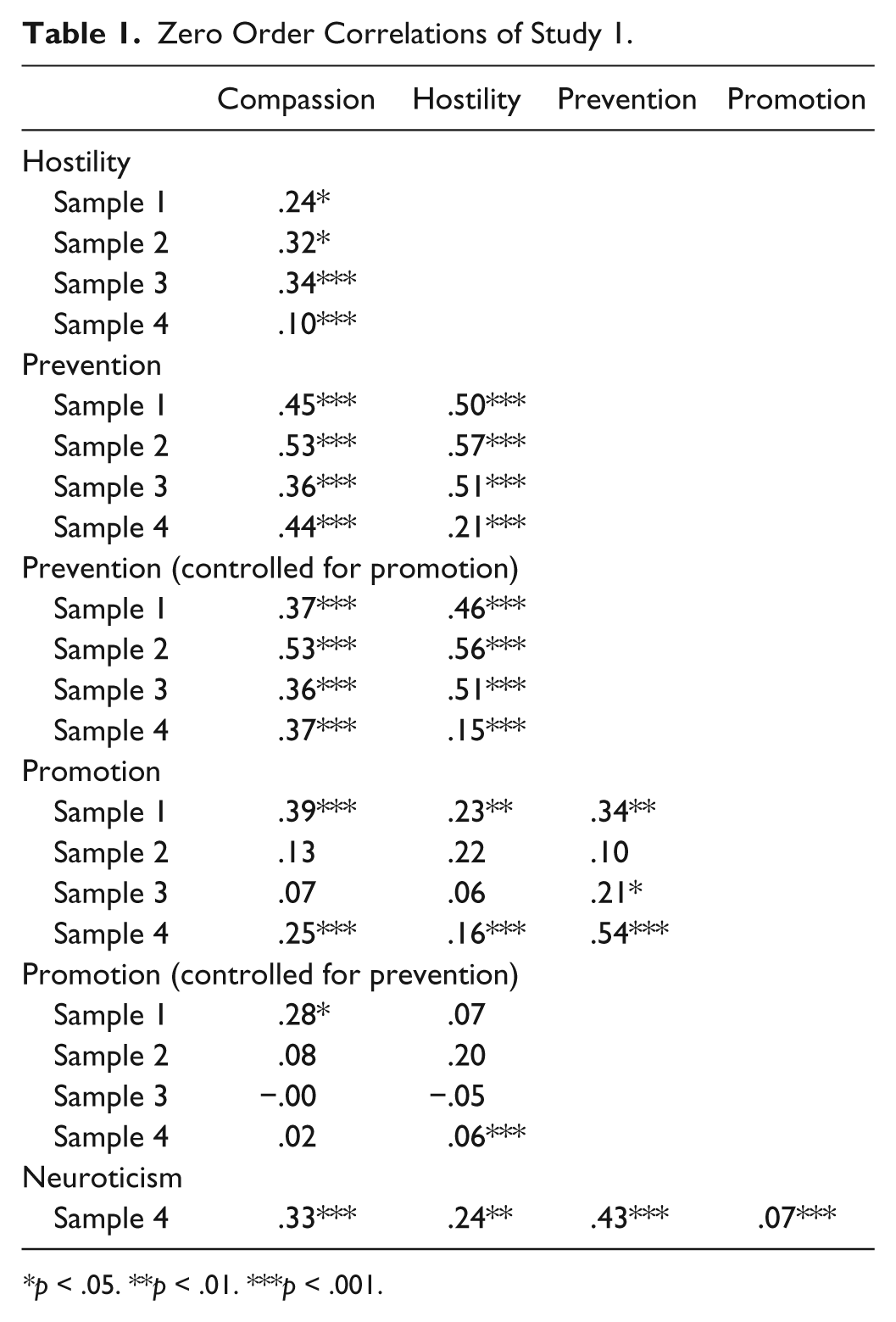
Zero-order correlations are depicted in Table 1. The correlations revealed the expected positive association between prevention-focused self-regulation and compassion as well as hostility. Importantly, in all four samples, we found that compassion and hostility were positively correlated. This provides evidence in line with the proposed Compassion–Hostility Paradox. 3
Zero Order Correlations of Study 1.
*p < .05. **p < .01. ***p < .001.
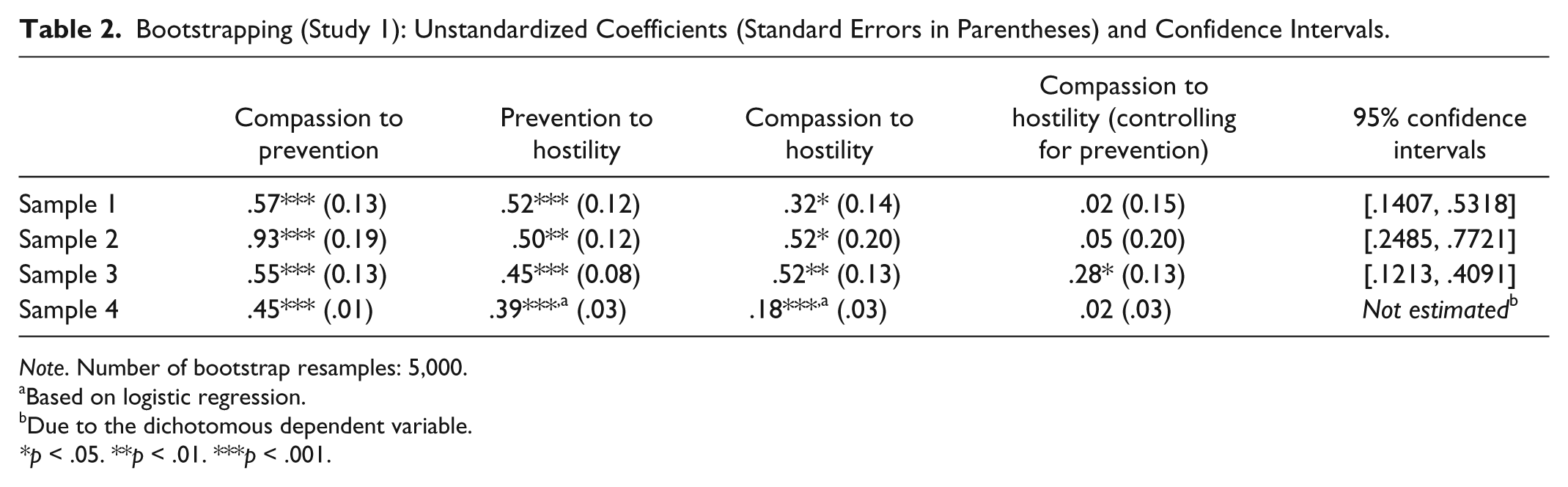
In further analyses, the potential explanatory role of the prevention focus regarding the association between compassion and hostility was assessed (see Table 2). The regression analyses revealed that the positive association between compassion and hostility is substantially reduced when the chronic level of prevention-focused self-regulation is controlled for. Bootstrapping analyses according to Preacher and Hayes (2004) revealed that prevention focus significantly explained the positive association between compassion and hostility (see Table 2; 95% confidence intervals [CIs] do not include zero).
Bootstrapping (Study 1): Unstandardized Coefficients (Standard Errors in Parentheses) and Confidence Intervals.
Note. Number of bootstrap resamples: 5,000.
Based on logistic regression.
Due to the dichotomous dependent variable.
*p < .05. **p < .01. ***p < .001.
Assessing the impact of neuroticism, analyses reveal that neuroticism was significantly positively related to prevention focus, hostility, and compassion (see Table 1). Including neuroticism into our main model (compassion and prevention as predictors), neuroticism (B = .60, SE B = .05, p < .001) does not fully account for the hostility and compassion association, prevention focus (B = .25, SE B = .03, p < .001) was still important in explaining the positive hostility–compassion association. Results further indicate that both constructs are equally important (no significant difference, 95% CI [−.046, .041]) regarding the relation between compassion and hostility, indirect effect neuroticism = .12 (95% CI [.097, .145]) and prevention focus = .12 (95% CI [.087, .147]).
We further investigated the relations between cognitive perspective taking, compassion, prevention focus, and hostility in Sample 2. It emerged that neither compassion (r = −.01, p < .94), prevention focus (r = −.12, p = .35) nor hostility (r = −.13, p = .32) showed a notable relation with cognitive perspective taking. These results underpin our reasoning that it is the special sensitivity to negative social information (that is characteristic of compassion and prevention-focused self-regulation) and not a general sensitivity regarding other person’s situation (perspective taking) that explains the compassion–hostility association. In combination, the obtained findings strongly support the proposed Compassion–Hostility Paradox.
In critically reflecting Study 1, we want to note that in Sample 4, we used a single item from the Marlowe and Crowne (1961) scale that was originally designed to assess social desirability rather hostility (“There have been times when I was quite jealous of the good fortune of others”). In fact, there probably is a social desirable component in the item (which is true regarding almost all scales assessing aggression and hostility based on self-report). The basic idea of the Marlowe–Crowne scale is that it measures social desirability across several items referring to different topics (e.g., “On occasion I have had doubts about my ability to succeed in life”). Only if a person endorses several items of the Marlowe–Crowne scale, this would reflect a general social desirable response tendency, whereas selectively agreeing with the statement “There have been times when I was quite jealous of the good fortune of others” mainly reflects hostility. Indeed, the single item was strongly and significantly correlated with the Hostility subscale (see “Method” section).
Study 2
Study 2 was conducted to investigate the possible causal relation between compassion and hostility. It was hypothesized that the stronger a person feels compassion for other individuals who are suffering the more likely this individual develops hostile attitudes toward other people. As outlined above, compassionate feelings toward individuals who are mistreated by third persons are likely to foster a view that people are bad in general, that is, a hostile worldview. Study 2 builds on the findings of Study 1: Given that prevention-focused individuals are characterized by a special attention toward the negative (and thus hostility arousing) content of compassion-arousing situations, we expect that compassion leads to hostility particularly in prevention-focused individuals. Accordingly, the positive association between compassion and hostility should depend on prevention-focused self-regulation (which represents an interaction effect between a compassion manipulation and prevention-focused self-regulation).
Method
Procedure
Study 2 consisted of 118 University of Ulm students (Mage = 21.7; 57.6% females). Participants received a chocolate bar as compensation for participating in the study. We first measured chronic self-regulatory orientations (Lockwood et al., 2002) and manipulated compassion afterward (see below). Finally, hostility was assessed using the Buss and Perry (1992) instrument as in Study 1.
Manipulation of compassion
We adapted an established procedure to induce compassion with a target person (cf. Batson et al., 1997, Study 3; Batson, Chang, Orr, & Rowland, 2002). Three conditions were implemented: A neutral control condition, a low compassion condition, and a high compassion condition. In all conditions, participants were told that researchers are interested in how individuals process information when reading a personal interview. The content of the interview and the instructions were manipulated. In the neutral control condition, participants read an interview with a botanist called Peter Hallmaier who talked about his job. In the low compassion condition, participants were asked before reading an interview to take an objective perspective toward what is described. They were told to not get caught up in how the man who is interviewed feels. They should remain objective and detached. Next, they read an interview in which a murderer called Peter Hallmaier speaks about his neighbor who repeatedly persecuted him, set fire to his loved car, and mocked him. In the interview, Peter Hallmaier mentions that he killed his neighbor afterward and that he was immediately arrested. At the end of the interview, Peter Hallmaier was asked about his time in prison. He complains that he is having a hard time and that he was mistreated and bashed up by other prisoners several times, even in the prisoners’ courtyard where he loves to be, but now he is anxious to go there. In the high compassion condition, participants were asked before reading the same interview to imagine how the man who is interviewed feels about what has happened. They were told to feel for the interviewed man and that they could let themselves be guided by their feelings.
We hypothesized that there should be no significant difference in hostility between the neutral control and the low compassion condition. However, when adding the element of compassion (in the high compassion condition), hostility should increase, specifically in strongly prevention-focused individuals. Therefore, we predicted a significant difference between the high compassion condition versus the neutral control and the low compassion condition in strongly prevention-focused individuals given that prevention-focused individuals are characterized by a special attention toward the negative (and thus hostility arousing) content of compassion-arousing situations. Accordingly, the proposed association between compassion and hostility should emerge for strongly prevention-focused individuals, that is, an interaction effect between the prevention focus and the compassion manipulation (high vs. control and low) should be observed.
Results and Discussion
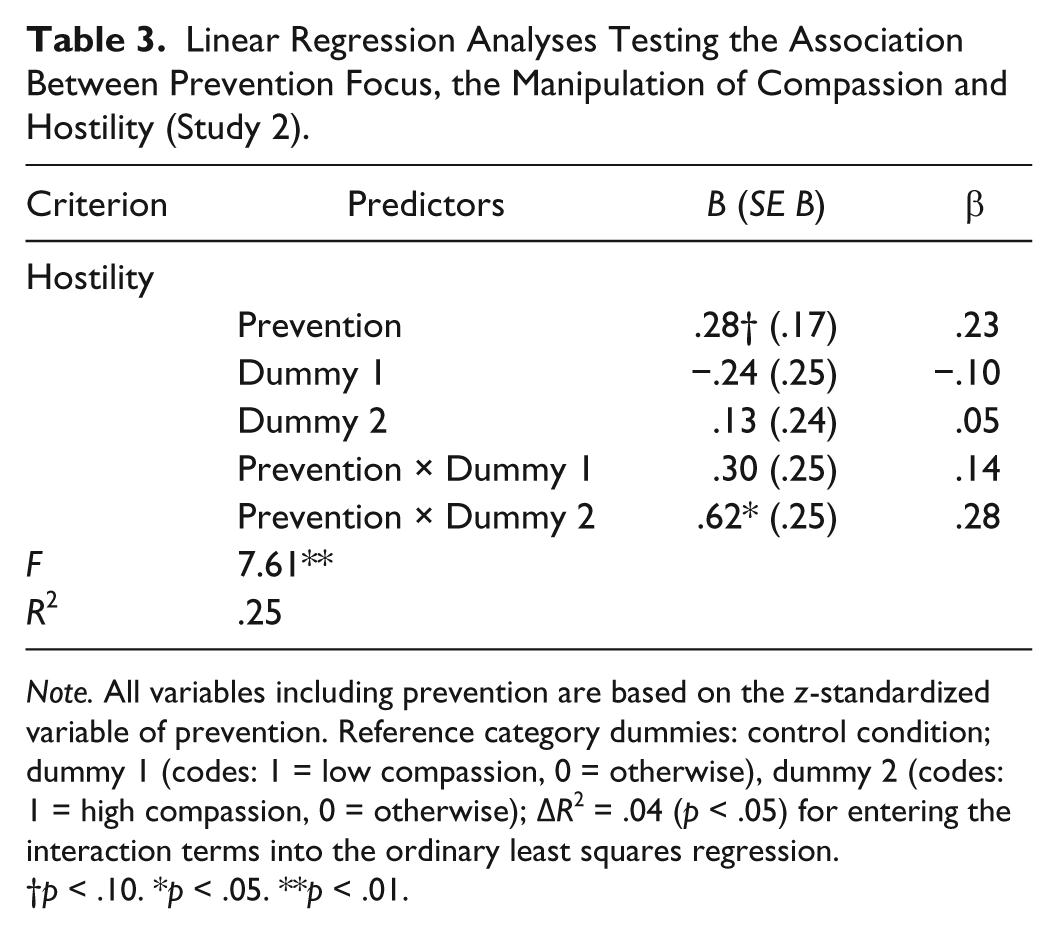
Hostility was regressed on the following variables: z-standardized prevention focus, dummy 1 (codes: 1 = low compassion, 0 = otherwise), dummy 2 (codes: 1 = high compassion, 0 = otherwise), the interaction involving standardized prevention focus and dummy 1, and the interaction involving standardized prevention focus and dummy 2. The crucial interaction term (Prevention Focus × Dummy 2) turned out significant (see Table 3). The slopes are plotted in Figure 1.
Linear Regression Analyses Testing the Association Between Prevention Focus, the Manipulation of Compassion and Hostility (Study 2).
Note. All variables including prevention are based on the z-standardized variable of prevention. Reference category dummies: control condition; dummy 1 (codes: 1 = low compassion, 0 = otherwise), dummy 2 (codes: 1 = high compassion, 0 = otherwise); ΔR2 = .04 (p < .05) for entering the interaction terms into the ordinary least squares regression.
p < .10. *p < .05. **p < .01.
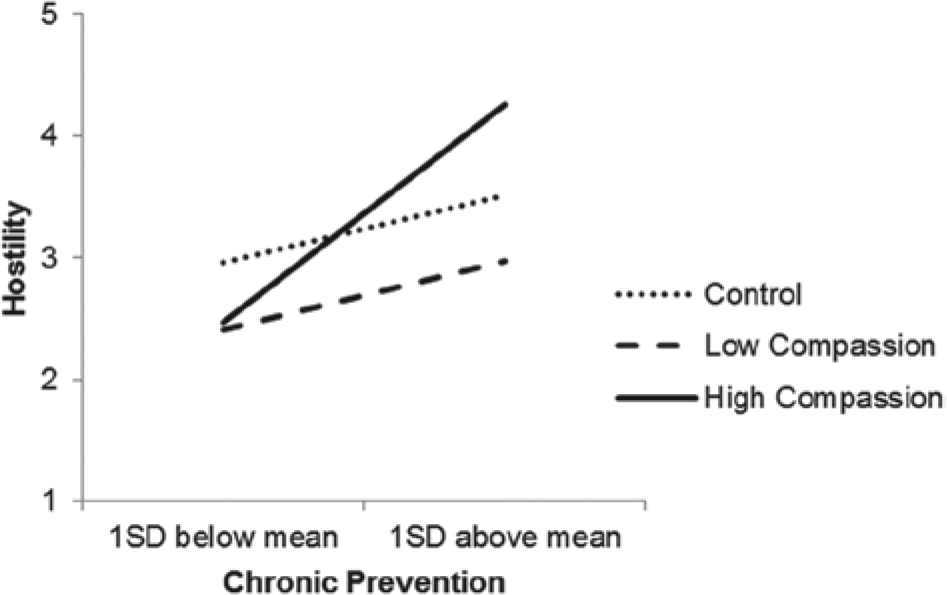
Plotted slopes of Study 2: Hostility as a function of prevention focus and the condition.
To test our prediction that there should be a significant difference between the high compassion condition versus the neutral control and the low compassion condition in strongly prevention-focused individuals, simple slopes analyses were applied (Aiken & West, 1991). The effect of the high compassion versus low compassion condition assessed at 1 SD above the mean prevention focus score was positive and significant, β = .34, t(73) = 2.05, p = .04. In contrast, at 1 SD below the mean prevention focus score the effect of the high compassion versus low compassion condition was not significant, β = .03, t(73) = .16, p = .87 (see Figure 1). The effect of the high compassion versus control condition assessed at 1 SD above the mean prevention focus score was positive and marginally significant, β = .37, t(75) = 1.95, p = .054. In contrast, at 1 SD below the mean prevention focus score the effect of the high compassion versus control condition was not significant, β = −.24, t(75) = −.24, p = .13. Control versus low compassion did not differ significantly for either 1 SD below or above the mean prevention focus score (both ps > .10). Promotion focus scores (and the interaction terms involving promotion focus scores) did not play a meaningful role in Study 2 (all ps > .10).
In sum, the findings obtained in this experiment indicate that enhanced compassion can result in an increased level of hostility in prevention-focused individuals.
General Discussion
In relating interpersonal attitudes to RFT (Higgins, 1998), it was proposed that a prevention-focused mode of self-regulation is positively related to hostile attitudes and compassion. Specifically, the argument put forth in the present contribution holds that distinct pro- and antisocial interpersonal attitudes are positively associated—reflecting the Compassion–Hostility Paradox—and that a vigilant focus on negative social information (prevention focus) explains the positive association of compassion and hostility. The obtained findings support the assumed positive relation between compassion and hostility and reveal that the observed relation is explained by vigilant, prevention-focused self-regulation. Furthermore, we could extend the correlational findings of Study 1, specifically, a causal relation between compassion and hostility could be observed in prevention-focused individuals.
The reported research findings are innovative in several respects. First, our work contributes to a more balanced view of compassion. The finding that enhanced compassion can result in hostile tendencies in prevention-focused individuals has one important implication for research in the field of compassion. That is, the prosocial construct of compassion can not only foster altruistic helping behavior (Batson, 1987, 1998) but also antisocial tendencies, as reported in the studies above. We propose that this positive association is most likely to emerge on the basis of a special sensitivity to negative social information, and we propose that the special sensitivity to negative social information implemented in prevention-focused self-regulation accounts for the positive association of compassion and hostility. Second, our findings have implications for the interpersonal circumplex model proposed by Wiggins and colleagues (1988). Specifically, one might ask whether the diametrically opposed poles of the interpersonal circumplex model representing antisocial coldness and prosocial warmth are unconditionally negatively related. Our findings indicate that prosocial warmth (in our model: compassion) can actually lead to antisocial coldness (in our model: hostility), so on the basis of our findings, we conclude that antisocial coldness and prosocial warmth are not unconditionally negatively related but can also be positively related. Third, in relating RFT to compassion and hostility, the crucial impact of self-regulatory orientations with regard to important interpersonal attitudes has been documented. So far, the role of self-regulatory mechanisms has been only rarely addressed in the analysis of interpersonal attitudes and the present study addresses this gap. Fourth, because these interpersonal aspects of prevention-focused self-regulation have not been documented before, the current findings extend our knowledge on the specific mechanisms characteristic of this distinct self-regulatory mode. Fifth, the observation that prevention-focused self-regulation is positively associated with hostile tendencies is well in line with and extends previous work documenting a positive relation between prevention-focused self-regulation and generalized distrust (Keller, Mayo, & Greifeneder, 2012) and aggressiveness (Keller et al., 2008). Sixth, we document that the prevention focus explains the compassion–hostility association beyond neuroticism. This is particularly remarkable with regard to the substantial correlation of prevention focus and neuroticism and speaks to the uniqueness of the prevention focus in distinction to neuroticism. Taken together, the present work represents a new and promising approach to the study of interpersonal attitudes and their underlying forces that takes into account that interpersonal processes are heavily influenced by the self-regulatory orientations that are guiding individuals’ thoughts and behavior.
It seems noteworthy that we obtained the positive correlations between hostility and compassion on self-report instruments where respondents frequently try to edit their responses to appear consistent (Tourangeau, Rips, & Rasinski, 2000). Moreover, the conversational “maxim of manner” (avoid ambiguity) outlined by Grice (1975; cf. Sudman, Bradburn, & Schwarz, 1996) also contributes to a tendency to edit consistent responses. Also, social desirable response tendencies attenuate the relation due to the fact that a high level of compassion is typically considered as a positive (benevolent) characteristic whereas hostility is typically negatively evaluated. In combination, several mechanisms may have been at work that run counter to a positive relation between compassion and hostility and yet the observed data consistently reveal the proposed positive correlation.
It is important to note that the position taken in this contribution is not that only prevention-focused self-regulation is related to interpersonal attitudes and that promotion-focused self-regulation is irrelevant in the discussion of such constructs. The position taken is that both modes of self-regulation can contribute to or inhibit the development and expression of interpersonal attitudes and behavioral tendencies, though they do so through very different routes and mechanisms. For example, certain factors that affect individuals’ pro- and antisocial interpersonal attitudes are conceptually linked to promotion-focused self-regulation (e.g., the experience of status competition or perceived power and competence). Thus, there is reason to assume that the analysis of promotion-focused self-regulation also contributes to our understanding of interpersonal attitudes. However, promotion-focused self-regulation does not relate to the critical theoretical aspects addressed in the current work as a focus on negative social information is not characteristic of promotion-focused self-regulation. Therefore, promotion-focused self-regulation is largely excluded from our discussion.
In the present work, we focused on feelings and a concern for those who suffer (i.e., compassion) and documented an increase of hostility after rendering compassionate tendencies salient in prevention-focused individuals. What we did not address is the tendency to feel for those who experience positive events. It is possible that such feelings may actually reduce hostility rather than increase it. Given that feelings for other individuals experiencing positive events does not reflect compassion (but vicarious joy), as compassion is defined as feelings and a concern for those who suffer (Lazarus, 1991), the idea that empathizing with individuals experiencing positive events may reduce hostility is not incompatible with the compassion–hostility association documented in the current set of studies. It is important to note that compassion and (affective) empathy are not redundant constructs and that the present work is specifically addressing compassion and not affective empathy in general (which would include feelings for others who experience positive events).
Conceptualization of Vigilant Self-Regulation
The present analysis can contribute to a balanced evaluation of regulatory foci acknowledging the fact that both styles of self-regulation are related to positive as well as negative aspects, a position that is typically highlighted in RFT (cf. Higgins, 1997; Molden et al., 2008). On one hand, the present line of research documents a reliable association between vigilant, prevention-focused self-regulation and compassion, a trait that can be considered as adaptive in interpersonal contexts, specifically regarding the development of close relationships and a network of social support (two elements that build a particularly important basis for well-being, cf. Cohen & Wills, 1986; House, 1986; Sheldon & Hoon, 2007).
On the other hand, vigilant, prevention-focused self-regulation can be related to predominantly maladaptive and negative traits such as hostility. It is noteworthy that hostility is a well-established psychological risk factor of coronary heart disease (cf. Miller, Smith, Turner, Guijarro, & Hallet, 1996). Accordingly, the present work documenting underlying factors of hostility constitutes a potential basis for further research addressing this problematic trait as well as potential measures that could be applied as interventions to diminish or prevent the development of hostility. For example, an attributional training designed to work against hostile attribution tendencies may be a promising strategy in this respect.
Philosophical Perspective Underlying the Compassion–Hostility Paradox
The findings obtained in the present set of studies documenting a positive association between compassion and hostility are well in line with an ancient philosophical perspective known as “orphism” (Craig, 1998) according to which mankind was born from the ashes containing the bodies of the Titans (representing evil, demonic elements) and Dionysos (representing positive, divine elements). That is, orphism represents a view of human nature that acknowledges the coexistence of pro- and antisocial elements in human nature. A similar perspective was proposed by Heraclitus who discussed the “Unity of Opposites” (Robinson, 1987). This perspective is also reflected in recent psychological reasoning proposed by McCullough (2008) who emphasized the fact that the desire for revenge as well as the capacity for forgiveness are built-in features of human nature. This “unity-perspective” stands in contrast to approaches that construe mankind either as purely selfish, competitive, and hostile in nature (e.g., Hobbes, 1998) or as entirely good and prosocial (Rousseau, 1987). In this context, the current work can be understood as empirical support for the ancient idea (initially proposed in orphism) that human nature consists of good and evil elements that are obviously well compatible. In sum, the theoretical perspective and the empirical findings reported in the present paper contribute to the understanding of the role self-regulatory orientations play regarding the interpersonal attitudes of compassion and hostility.
Footnotes
Appendix
Items included in the Compassion Scale:
It upsets me to see helpless old people.
I cannot continue to feel OK if people around me are depressed.
I get very angry when I see someone being ill-treated.
I tend to get emotionally involved with a friend’s problems.
I am very upset when I see an animal in pain.
It makes me sad to see a lonely stranger in a group.
I become nervous if others around me seem to be nervous.
Seeing people cry upsets me.
I feel compassion when I observe a child being mistreated by its parents [not used in Study 1, Sample 4].
Acknowledgements
We are grateful to Julia Haselberger, Susanne Hirth, Lucia Philipp, and Silvia Rajec for their help with data collection. We are particularly grateful to Liborio Ciccarello for fruitful discussions and his input from a philosophical perspective.
Declaration of Conflicting Interests
The author(s) declared no potential conflicts of interest with respect to the research, authorship, and/or publication of this article.
Funding
The author(s) disclosed receipt of the following financial support for the research, authorship, and/or publication of this article: This research was supported by a grant from the German Science Foundation to Johannes Keller.