



Abstract
Recent studies have found that activating religious cognition by priming techniques can enhance prosocial behavior, arguably because religious concepts carry prosocial associations. But many of these studies have primed multiple concepts simultaneously related to the sacred. We argue here that religion and God are distinct concepts that activate distinct associations. In particular, we examine the effect of God and religion on prosociality toward the ingroup and outgroup. In three studies, we found that religion primes enhanced prosociality toward ingroup members, consistent with ingroup affiliation, whereas, God primes enhanced prosociality toward outgroup member, consistent with concerns of moral impression management. Implications for theory and methodology in religious cognition are discussed.
Does religion and belief make people good? All major world religions teach a form of the “golden rule”—to treat others as you would have them treat you (Smith, 1991). All major world religions also share a belief in God or gods as beings who care about the morality of humans and dole out punishment for transgressions (Roes & Raymond, 2003). However, the relationship between religion and prosocial behavior may not be entirely straightforward. Scholars have noted that “religion” is composed of different aspects of belief and orientations toward the sacred that can have different influences on morality (Batson & Gray, 1981). For example, distinctions have been made between institutional religion and personal religion (James, 1902/1961), religion and spirituality (Hill et al., 2000; Zinnbauer & Pargament, 2005), horizontal and vertical faith (Ji, Pendergraft, & Perry, 2006), and between personal orientations toward extrinsic, intrinsic (Allport, 1966), and quest religiosity (Batson, 1976). Moreover, different aspects of religious belief may activate different goals that can sometimes be conflicting (e.g., conservatism vs. prosociality) and can direct prosociality in different ways (Malka, Soto, Cohen, & Miller, 2011).
Recently, a wave of new research has examined the question of religious prosociality, using priming methodologies to manipulate religious cognition. In the most well-known of these studies (Shariff & Norenzayan, 2007), participants were primed in a scrambled sentence task that contained various religious words (e.g., spirit, divine, sacred, prophet, God) or neutral scrambled sentences, before engaging in an anonymous dictator game. Those primed with the religious sentences were more generous to a stranger than those primed with neutral sentences. Researchers argue that these religious primes activate prosocial goals that are associated with religious concepts. Priming religious words (supraliminally or subliminally) has also been found to increase prosocial intentions (Pichon, Boccato, & Saroglou, 2007) and honesty when given a chance to cheat (Randolph-Seng & Nielsen, 2007). But in some contexts, religious primes increase aggressive retaliation (Bushman, Ridge, Das, Key, & Busath, 2007; Saroglou, Corneille, & Van Cappellen, 2009) and hostility toward outgroups (M. K. Johnson, Rowatt, & LaBouff, 2010, 2012). One reason as to why there are inconsistent effects of religious priming on prosociality may be that religion is itself comprised of different components or concepts that can shape moral concerns in different ways. Yet, religious priming studies often prime multiple religious concepts in a single condition, with the assumption that there is a unified concept of religious prosociality activated by all these words.
The current research examines whether different religious concepts may activate different prosocial goals. In particular, we examine religion and God as two distinct components of the sacred that may differentially affect prosocial behavior. Religion and God have some parallels with other distinctions that have been made in the literature. For example, religion may be more closely related to the affiliative aspects of religious practice, whereas God may be associated with personal belief. Moreover, both religion and belief in God are theorized to influence prosocial behavior, although through different routes. Religion is associated with social responsibility and within-group cooperation (Batson, 1983; Sosis & Alcorta, 2003). However, Gods are represented as divine moral authorities that observe human action and dole out punishment (D. D. P. Johnson & Kruger, 2004; Shariff, Norenzayan, & Henrich, 2010). As we elaborate below, concepts of God and religion may shape prosocial behavior in different ways, particularly where the specific prosocial behavior concerns the religious ingroup or outgroup.
Religion and Concern for the Ingroup
Most of the world’s population identify as religious, and as a member of a specific religious group. Indeed, religion is an important part of culture (A. B. Cohen, 2009), with rich traditions and history that connect followers to other members across different locations and through history. The role of religion as cultural group identity may be central to its influence on prosociality. Many theorists have suggested that the bonds of religious affiliation paved the way for large-scale cooperation between unrelated people, allowing for towns, cities, and nations to grow and thrive (Batson, 1983; Norenzayan & Shariff, 2008; Rossano, 2006). Religious practice may have emerged as an early cultural adaption that extended the social unit beyond immediate blood relatives to a larger “family” and thereby extended the norms of cooperation to unrelated individuals within that group. However, this may be a limited prosociality, restricted to other members of the religious ingroup (Saroglou, 2006). Religious groups may promote concerns for a good moral reputation within the group to maintain good standing (Norenzayan & Shariff, 2008). Moreover, helping ingroup members improves the overall well-being of the group, with indirect and direct benefits to oneself and one’s kin. But there is no indirect benefit to the self by helping an outgroup member, nor any likely opportunity for reciprocity. Indeed, helping outgroup members can indirectly harm the ingroup (and by extension, oneself), by giving an outside group a competitive advantage in survival.
Some recent priming research has also supported the idea that religious prosociality may be selectively directed toward the religious ingroup. Surveys conducted outside a religious setting (i.e., a church) vs. a secular setting (e.g., civic center) promote willingness to help a homeless person but not an illegal immigrant (Pichon & Saroglou, 2009) and also, increases negative attitudes toward numerous outgroups (LaBouff, Rowatt, Johnson, & Finkle, 2012). When primed with Christian-specific words (e.g., bible, Jesus), Christians, subsequently, report more negative attitudes toward atheists and Muslims in relation to Christians (M. K. Johnson et al., 2012). Ginges, Hansen, and Norenzayan (2009) similarly found that asking Israeli participants about their frequency of synagogue attendance (but not frequency of prayer) increased their support of suicide attacks against the Palestinians.
Religious priming, therefore, appears to increase prosociality toward the religious ingroup, while increasing aggression toward religious outgroups. However, these previous studies used primes that directly related to religion as an ingroup affiliation (church, synagogue, Christian-specific terms), which may enhance the salience of religious group membership over other aspects of religious belief. Religious prosociality may be associated with concerns for the welfare of the group over the concerns of self and the concerns for outside groups (Wilson, 2002). Likewise, we argue here that the concept of religion is associated with the religious identity shared with fellow members of the religious group. Reminders of religious bonds should activate concerns for the welfare of the ingroup, promoting prosocial goals toward the religious ingroup but not toward religious outgroups. In the current research, we predict that exposure to “religion” primes should increase ingroup prosociality but not outgroup prosociality.
God and Moral Impression Management
Religious groups may differ in traditions and customs, but a key feature common to all religious faiths, is the belief in an anthropomorphized God or gods (Atran & Norenzayan, 2004; Barrett, 2000), who are at the center of religious belief, stories, rituals, and worship. Like other agents, gods are perceived to have minds that allow them to perceive, think, and to will their own actions. The central presence of agent concepts in religious thought has been suggested by many to be a result of cognitive processes used to detect agents in the environment (Bering, 2002; Boyer, 2001). This idea is supported by evidence that belief in God is reduced among people who score higher on the autism-spectrum (which is associated with an impaired theory of mind; Norenzayan, Gervais, & Trzesniewski, 2012) and that highly religious people are more susceptible to false-positives in detecting agency (Petrican & Burris, 2012).
But gods are unlike humans or other natural agents as they possess some supernatural abilities (Norenzayan, Atran, Faulkner, & Schaller, 2006; Wierenga, 1989) that have important consequences on human morality. For example, the God of Abrahamic religions (4 billion adherents worldwide) is depicted as both omniscient (all-knowing, all-seeing) and omnipotent (all-powerful). The darkest deeds concealed from loved ones are all in full view of an omniscient God, and an omnipotent God has absolute power to punish and reward those actions accordingly (D. D. P. Johnson & Kruger, 2004). Moreover, gods are commonly depicted as concerned with human morality (Roes & Raymond, 2003). This perception of God as omniscient, omnipotent, and concerned with human morality creates a “perfect storm” of impression-management concerns for those humans who might be tempted to cheat, steal, lie, or hurt others. Indeed, exposure to God concepts has been shown to enhance feelings of public self-consciousness (appearance to others) but not private self-consciousness (personal introspection; Gervais & Norenzayan, 2012), and exposure to anthropomorphic images of God enhances moral judgment over more abstract concepts of God (Morewedge & Clear, 2008). Religiosity has been argued to promote prosocial behavior because it is positively correlated with self-control (McCullough & Willoughby, 2009), but it is important to note that this relationship is mediated by a feeling of “watched by God” (Carter, McCullough, & Carver, 2012). Belief in gods as supernatural watchers may have been essential to the success of large societies, by promoting self-monitoring and self-control of moral behavior, without the need for costly second-order policing (Bering & Johnson, 2005; Shariff et al., 2010).
The perception of God as an all-seeing moral judge may motivate people to appear virtuous as a way to avoid punishment, and also, to adhere to the moral standards of a perfect God. But what exactly might these moral standards be? The mind of God may be difficult to judge, and when in doubt, people may project their own moral standards onto Him (Epley, Converse, Delbosc, Monteleone, & Cacioppo, 2009). Still, specific concepts of God do imply certain values. The ideal of a one true God in monotheistic traditions suggests that God rules over all people not just one region or group. If religious groups helped to extend social cooperation beyond immediate kin to a larger religious “family”, connection through a single God extends those bonds even further because all people can be considered “God’s children” and members of the larger human “family”. Ideas of God may therefore activate goals of universality and benevolence that includes outgroup members and not just ingroup members.
The Current Research
We argue here that God and religion primes will have different effects on prosocial behavior with religious ingroup versus outgroup members. First, we argue that religion is associated with religious practice and community. Thus, religion primes should be associated moral concerns for the protection of the religious ingroup, and therefore, increase prosocial behavior with ingroup members. In contrast, we argue that God primes will activate concerns for moral appearance before God, and therefore, increase prosocial behavior with outgroup members. These hypotheses are stated as follows:
Hypothesis 1: Religion primes will activate prosocial concerns for members of the religious ingroup
Hypothesis 2: God primes will activate prosocial concerns for members of the religious outgroup.
These predictions were examined in three studies. In Study 1, we first establish a perceived divergence between the religious group and God as different moral audiences. Specifically, Study 1 tested whether people believed that God and their religious leader would want them to devote their prosocial efforts toward different targets (either the religious outgroup, or ingroup). Study 2 and 3 directly examined the differential effect of religion or God concepts on prosocial behavior, by priming religion and God in separate conditions. Study 2 examined prosocial behavior in a disease context, where participants distributed money to aid victims of swine flu (H1N1 virus). Study 3 examined the effect of subliminal God or religion primes in a competitive context, playing a one-shot Prisoner’s Dilemma game against another player who was either a religious ingroup, or outgroup member.
Study 1A and 1B: Moral Audiences
Study 1A and 1B sought to establish that one’s religious group and God serve as different moral audiences for prosocial behavior with different prosocial goals. Participants read a hypothetical scenario that pitted helping members of the religious ingroup against helping members of a religious outgroup. In Study 1A, participants read the scenario twice: the first time they were asked who God would want them to help, and the second time who they thought their religious leader would want them to help. Study 1B used a between-subjects design, and also asked people to explain why God or their leader would want to help that choice. We predicted that people expected that their religious leader want them to help the religious ingroup (H1), but that God would want them to help the religious outgroup (H2).
Method
Participants
Ninety-seven undergraduates were recruited to fill out a short survey from on and around the University of Illinois campus. Nine people failed to answer questions on both sides of the survey, leaving 88 participants in the analysis (36 men, 52 women, mean age = 19.8 years, 66% Christian, 1 % Jewish, 4.5% Hindi, 2.3% other, 26% no affiliation).
Stimuli and procedure
Participants were presented with a hypothetical scenario in which they could choose to help an ingroup or an outgroup family. The scenario read:
As a member of an online community blog, you often receive e-mails from people who will soon be moving into your neighborhood. Sometimes these families ask simple questions, such as information about the area, but other times they ask for more costly help (such as assistance for moving into their new house when they have no one else to turn to). Today you receive last minute requests to help two different families move in. One family (the Ziffs) happens to be joining your local religious organization, whereas, the other (the Zoggs) is not. It is too late to mobilize enough people to help both families move in, so you can only choose one.
In a repeated-measures design, participants were asked whom God would want them to help (Ziffs or Zoggs) as a dichotomous choice, and the strength of that preference on a 5-point scale (1 = Not at all; 5 = Extremely) on one side of a survey. On the other side of the survey, participants were asked whom their own religious leader would want them to help, and the strength of that preference (1 = Not at all; 5 = Extremely). Order presentation (God/religious leader) was counterbalanced and randomly assigned. At the bottom of the second survey, participants completed demographic information on age, gender, ethnicity, and religious affiliation. In addition, participants were asked to indicate how strongly they believe in God and how religious they are on two separate 5-point scales (endpoints: 1 = Not at all; 5 = Very Strongly), and also their political ideology on a 5-point scale (1 = Strongly Liberal; 5 = Strongly Conservative).
Results
The dichotomous choice to help the ingroup/outgroup (Ziffs/Zoggs) by moral audience (God or their religious leader) was analyzed using McNemar’s test. Results suggested a significant difference between God and the religious leader as a moral audience, χ2(1, n = 88) = 20.63, p < .001 (see frequencies, Table 1). Although people responded that their religious leader would prefer them to help the ingroup family (70%), they believed that God would prefer them to help the outgroup family (70%). Following the dichotomous choice, we asked participants to indicate the strength of the preference on a 5-point scale. These were re-coded to a 10-point continuous scale such that greater values indicated stronger preference to help the ingroup family. These values were analyzed by a 2 (Audience: God/Leader) × 2 (Order) ANOVA with repeated measures on the first variable. There was no main effect of Order, nor an Audience × Order interaction (Fs < 1). But most important, the predicted main effect of Audience (God/Leader) was significant, F(1, 85) = 30.71, p < .001, partial η2 = .27. People expected the religious leader would want them to help the religious ingroup family (M = 6.68, SD = 3.03), whereas, they expected God would want them to help the outgroup family (M = 4.46, SD = 2.83). To establish independent support for H1 and H2, one-sample t tests were conducted on means within the God and Leader conditions, respectively. Means were tested against the midpoint of the 10-point scale (5.5). When asked about the religious leader, mean preference to help the ingroup was significantly greater from the midpoint, t(87) = 3.56, p = .001, supporting H1. When asked about God, mean preference was significantly lower than the midpoint, t(87) = −3.42, p = .001), supporting H2.
Preference to Help Ingroup Family by God/Religious Leader, Studies 1A and 1B.

Religiosity and belief
Self-reported belief in God and religiosity were measured at the end of the survey on separate 5-point scales. These variables were mean-centered and entered as covariates into the 2 (Audience) × 2 (Order) ANOVA. There were no interactions between moral audience and belief in God or religiosity (ps > .11), and the main effect of moral audience remained statistically significant, F(1, 83) = 30.87, p < .001. Collapsing across the two moral audience scenarios, stronger than average belief in God was associated with more outgroup help, overall, F(1, 83) = 13.85, p < .001, but there was no overall effect of religiosity (F < 1).
Study 1B
Study 1B replicated the design of Study 1A, and also investigated the rationales for different prosocial goals by asking participants to explain why God/religious leader would want them to help a particular group.
Method
Participants
One hundred twenty-seven pedestrians around campus of the University of Illinois were solicited to participate in a brief survey. Twelve people did not complete the key dependent measures and were omitted from analyses, leaving 115 in the analysis (65 women, 44 men, 6 not reporting; mean age = 21.6 years).
Stimuli and procedure
We used a similar “new neighbor” paradigm as in Study 1A, with the following differences: The names of the ingroup and outgroup families were changed to the “Smiths” and “Johnsons”, respectively. In this version, we used a between-subjects design, with participants randomly assigned to either a God or a religious leader condition. In the God condition, participants were first asked if they believed in God (Yes/No). Next, participants were asked whom they thought God would want them to help in the new neighbor scenario, and to rate the strength of the preference on a 5-point scale. They were then asked to report why God would have this preference in an open response. In the religion condition, participants first reported their religious affiliation and then asked whom their religious leader would want them to help in the new neighbor scenario, the strength of that preference (1-5), and to report the reason for that choice (open response). Finally, participants completed demographic information and reported the strength of their belief in God, religiousness, and political preference on respective 5-point scales.
Results
God/Leader preferences
The dichotomous choice to help the ingroup or outgroup family (Smiths/Johnsons) by moral audience (God or their religious leader) was analyzed using chi-square. Results suggested a significant difference between God and the religious leader as a moral audience, χ2(1, n = 115) = 19.14, p < .001 (see Table 1 for frequencies). Whereas people most often responded that their religious leader would prefer them to help the ingroup family (73%), they believed that God would prefer them to help the outgroup family (68%). Following the dichotomous choice, we asked participants to indicate the strength of the preference on a 5-point scale. These were re-coded to a 10-point continuous scale, such that greater values indicated stronger preference to help the ingroup family. These values were analyzed by one-way ANOVA on Condition (God/Leader), F(1, 113) = 23.22, p < .001, partial η2= .17. People expected the religious leader would want them to help the religious ingroup family (M = 6.71, SD = 2.67), whereas they expected God would want them to help the outgroup family (M = 4.39, SD = 2.48). To establish independent support for H1 and H2, one-sample t tests were conducted on means within both the God and Religion conditions. Means were tested against the midpoint of the 10-point scale (5.5). Results closely replicated those of Study 1A. When asked about the religious leader, mean preference to help the ingroup was significantly greater from the midpoint, M = 6.71, SD = 2.67; t(58) = 3.49, p = .001, supporting H1 When asked about God, mean preference was significantly lower than the midpoint, M = − 4.39, SD = 2.48; t(48) = −3.34, p = .002, supporting H2.
Prosocial motivations
After data collection, the open-response reasons for the choice of God/religious leader were read by authors to create motivational coding categories. Six themes emerged: (a) Universality, for example, “all people are equal”; (b) Conversion, for example, “show them salvation through God”; (c) Need, for example, “who is most needy”; (d) Similarity, for example, “have common ground”; (e) Community, for example, “members have a more tightly knit relationship” and (f) Other, for example, “first come, first served.” Responses were each coded 0/1 for each category, and responses could be coded for more than one category. Authors were blinded to condition during coding and discussed discrepancies until consensus was reached. Categorical responses were each analyzed using contingency tables (see all frequencies Table 2). Conversion was more frequently cited for as a motivation for God than the religious leader, χ2(1, n = 115) = 7.96, p < .01, as was Universality, χ2(1, n = 115) = 7.66, p < .01. Similarity, χ2(1, n = 115) = 5.06, p = .03, and Community, χ2(1, n = 115) = 18.02, p < .001, were cited more often as the motivation of the religious leader than God. There were no differences in mentions of Need (χ2 < 1, p = .92), or Other (χ2 < 1.21, p = .27).
Frequency Count of Prosocial Motivations Reported for God/Religious Leader, Study 1B.

p < .05. **p < .01. ***p < .001.
Religiosity and belief
Self-reported belief in God and religiosity were measured at the end of the survey on separate 5-point scales. Eight participants did not complete these measures. These variables were mean-centered and entered as covariates into the one-way ANOVA for the continuous measure of preference. Neither belief nor religiosity was a significant covariate, (ps > .30), and the main effect of moral audience remained statistically significant, F(1, 103) = 27.20, p < .001. Neither belief (r = .08, p = .40), nor religiosity (r = .10, p = .33) was correlated with preferences to help in the ingroup/outgroup.
Discussion: Studies 1A and 1B
In Studies 1A and 1B, we found evidence that God and one’s religious leader serve as different moral audiences for prosocial behavior. In the new neighbor scenario, people expected that their religious leader would want them to help an ingroup family over an outgroup family (supporting H1), but that God had the opposite preferences, which was to help the outgroup family over the ingroup family (supporting H2). In Study 1B, we also found that God and the religious leader were associated with different motivations that seemed to guide their prosocial preferences. God was associated with goals of conversion, (i.e., spreading belief and “word of God” to those outside the religious group), and a value of universality (benevolence and acceptance to all). However, people associated the religious leader with motivations for community and similarity. These results establish that God and religion are associated with different prosocial concerns regarding the ingroup and outgroup. But so far, these studies do not demonstrate whether people would be motivated to act on these divergent prosocial motivations in real situations. Studies 2 and 3 investigated this question by priming God and religion in separate conditions and observing subsequent prosocial behavior toward the religious ingroup/outgroup.
Study 2: Swine Flu Outbreak
Study 2 investigated the effects of God and religion primes on charity donation in the context of a contagious disease—the outbreak of swine flu (H1N1 virus). Care for the sick represents an especially important domain of prosocial behavior as it requires sacrifice of resources and carries serious health risks to the self. In addition, concerns over disease and contagion are connected to religion (Preston & Ritter, 2012; Ritter & Preston, 2011) and issues of ingroup protection (Navarrete & Fessler, 2006). Pedestrians around the University of Illinois campus were asked to complete a short health survey, and at the bottom were given the opportunity to distribute up to 99¢ between the Mexican Red Cross and American Red Cross, which would be used to help swine flu victims. Surveys were collected from April 27 to May 1, 2009, shortly after the first cases of swine flu outbreak were reported in the news. During this time, reported cases of flu were limited to Mexico and the United States, but confirmed cases and deaths were rising daily (WHO, 2009). This period was also the height of media attention and public fear of the virus (Gallup, 2009), and scientists were still unclear on the contagiousness and ultimate fatality of the virus (J. Cohen & Enserink, 2009).
We predicted that people would show an ingroup bias in their donations when primed with religion, but an outgroup bias when primed with God. It was important that these predicted effects should interact with the religious affiliation of the participants. Mexico is a predominantly Catholic nation (Central Intelligence Agency, 2001). In a pretest, 1 we found that Catholics identify with Mexico as the religious ingroup when religious concepts are activated. Here, we also expect that prosocial motivations along group divisions should differ by religion and God primes. In the current study, we predict opposite patterns of donations for Catholics and non-Catholics in the religion/God conditions. When primed with religion, non-Catholics should give more to the American Red Cross (H1A), whereas Catholics should give more to the Mexican Red Cross (H1B). But when primed with God, participants should be more generous to the religious outgroup, that is, non-Catholics will give more to the Mexican Red Cross (H2A), but Catholics will give more to the American Red Cross (H2B).
Method
Participants
Eighty-eight pedestrians around campus of the University of Illinois (34 women, 53 men, 1 not reporting, mean age = 21 years; religious affiliation: 25% Catholic, 21.6 % other Christian, 2% Jewish, 2% Muslim, 1% Hindu, 1% Buddhist, 42% no affiliation) volunteered to participate in a brief survey between April 27 and May 1, 2009.
Procedure
Participants were randomly assigned to a God prime, religion prime, or control condition. Because we wanted to activate the salience of one’s own religious identity, participants were primed with God or religion at the beginning of the survey by questions about their belief in God (Yes/No) or religious affiliation (open response). In the control condition there was no such belief or religion question. The survey included nine questions regarding health habits (e.g., How often do you exercise per week?) designed to activate a general health goal. The end of the survey list contained a portion where participants were given the opportunity to donate to ingroup and outgroup charities. It read: “for every survey collected today, we will donate 99¢ to local charities supported by World Health Organization (WHO) to aid in the ongoing efforts to fight the swine flu.” The participants distributed the 99¢ between the American Red Cross and Mexican Red Cross. On the reverse side of the survey, participants completed demographic information including gender, age, ethnicity, and religious affiliation. All participants (including those primed at beginning of the survey) were also asked to rate their belief in God and religiousness at the end of the survey on two respective 5-point scales (endpoints: 1 = Not at all, 5 = Very Strongly).
Results
Donations coding
Participants were asked to distribute a maximum of 99¢ between the American Red Cross and the Mexican Red Cross. Eleven participants failed to complete the donation portion of the survey and were excluded from the analyses. If the total donation exceeded 99¢, donations to each charity were re-coded to the nearest whole numbers that maintained the difference between donations to the charities, but did not exceed maximum total. For example, if participants allotted 50¢ to United States and Mexico (total $1.00), this was re-coded as a donation of 49¢ to each (98¢ total).
Ingroup biases
Our central prediction was that we would observe a difference in charity toward religious ingroup versus outgroup according to prime condition. Our hypotheses concerned those with a clear religious affiliation with either the United States Protestant Christianity or Mexico (Catholicism), and so we excluded data from 10 participants with other religious affiliations. 2 A 3 (Prime) × 2 (Catholic: No/Yes) univariate ANOVA was conducted on difference scores. Neither the main effect of Prime, nor denomination was significant (Fs < 1). But of critical importance was the fact that the Prime × Catholic interaction was significant in the predicted direction, F(2, 64) = 3.13, p = 05, partial η2 = .09. In the control condition, both Catholics (M = +$.13, SD = .69) and non-Catholics (M = +$.26, SD = .70) showed a national ingroup favoritism by giving more money to the American Red Cross compared with the Mexican Red Cross. But in both experimental conditions, Catholics and non-Catholics showed the opposite patterns of donation, consistent with the religious identity of the two charities. In the religion prime condition, non-Catholics gave more to the American as opposed to the Mexican Red Cross, (M = +$.16, SD = .83), supporting H1A. But Catholics gave more to the Mexican as opposed to the American Red Cross (M = −$.16 SD = .75), when primed with religion, supporting H1B. In the God prime condition, these patterns flipped, consistent with predictions. Non-Catholics gave more to the Mexican Red Cross in the God prime condition (M = −$.39, SD = .65), supporting H2A. However, Catholics gave more to the American Red Cross (M = $.39, SD = .69) when primed with God, supporting H2B.
On the basis of this analysis, we re-coded donations to each charity according to the religious ingroup of the participants and computing new difference scores between the religious ingroup–outgroup, collapsed across denomination. These means were analyzed by a one-way ANOVA on prime condition. Planned contrasts (weights: religion prime = 1, control = 0, God prime = −1) supported the specific prediction that religious ingroup bias would be strongest when primed with religion, and lowest when primed with God, t(67) = 2.68, p < .01. Post hoc contrasts (Least Squares Difference) revealed that ingroup bias was significantly lower in the God prime condition, compared with both the control (p = .012) and religion prime conditions (p < .01) but that the control and religion primes did not differ significantly from each other (p = .90).
Belief in God and religiosity
Self-reported belief in God and religiosity were measured at the end of the survey on two separate 5-point scales. We examined the effect of these variables by computing difference scores between the religious ingroup–outgroup and analyzing means by a univariate ANOVA on condition with belief in God and religiosity as covariates. The overall effect of prime on donations remained significant, F(2, 62) = 5.14, p < .01. There was no effect of religiosity, F(1, 62) = 1.99, p = .16) or belief in God, F(2, 62) = 2.67, p = .11).
Discussion
Study 2 found evidence that God and religion primes have divergent effects on prosociality toward the religious ingroup versus the outgroup, in the context of a contagious disease. When primed with religion, people donated more money to the charity associated with the religious ingroup versus outgroup. But when primed with God, participants donated more to the religious outgroup versus the ingroup. In the religion and God prime conditions, Catholics showed the opposite donation patterns toward the American/Mexican Red Cross. Mexico is a strongly Catholic country, and therefore, Catholics donated more to the Mexican Red Cross when primed with religion, and more to the American Red Cross when primed with God.
These findings lend further support for a divergence between religion and God primes. However, this study did have some limitations. Because the participants were explicitly primed with religion/God by questions asking about their own affiliation/belief at the beginning of the study, there is some possibility that they could become aware of our hypotheses. Second, subjects were not donating their own money to the charities, so there was no personal cost for prosocial behavior. Notably, no significant differences were observed between control and religion prime conditions, with greater donations allocated to the religious ingroup than the outgroup, in both conditions. In other words, people in the control condition already exhibited an ingroup bias, and this bias was not enhanced by religion primes. One possible reason for this is that donations were not at personal cost to the participants, rather, donations were provided by the experimenter and participants decided how to distribute the money. Finally, although Mexico and the United States differ in the prevalence of Catholicism, both countries are predominantly Christian. To test our hypotheses, we limited our analyses to subjects for whom these were relevant group categories. But it is important to also examine these effects with non-Christian targets and to be able to include non-Christian participants in the analyses. We tried to address all these limitations in Study 3.
Study 3: Prisoner’s Dilemma
In Study 3, we examined whether religion and God primes would have divergent effects on prosociality toward a particular target of help, depending on the religious group membership of the target. Participants were subliminally primed with either Religion, God, or a control word before playing a Prisoner’s Dilemma game with either an ingroup or outgroup member. The Prisoner’s Dilemma game represents a particularly useful paradigm because it allows for either a prosocial behavior (cooperate) or antisocial behavior (defect). There is some evidence that priming ingroup concepts may improve ingroup cooperation in Prisoner’s Dilemma tasks, for example, Chinese participants cooperate more with friends when primed with Chinese symbols (Wong & Hong, 2005). In a recent study, priming Christian concepts has been shown to increase cooperation with the other player (Ahmed & Salas, 2011). In that case the religious identity of the other player was unknown, and subjects may have assumed the other player was of a similar religious background (Galen, 2012). In the current study, participants played against a person with an implied religious identity. We predicted in this study that religion primes would foster cooperation with an ingroup member, but God primes would increase cooperation with an outgroup member.
Method
Stimuli pretests
Prior to the experiment, we pretested pictures of five young South Asian (Indian) and five young Caucasian men, who were chosen from a large database (Minear & Park, 2004) with 75 undergraduates. Two final pictures were selected as stimuli, matched on ratings of perceived intelligence (MIndian = 4.54; MCausacsian = 4.69) and kindness (MIndian = 4.53; MCaucasian = 4.49) on respective 7-point scales. In a second pretest, we asked 116 participants to identify the most likely religious affiliation of the selected Caucasian and South Asian targets. The Caucasian target was identified as most likely to be Christian (92%), and the South Asian target was identified as most likely to be Hindu (35%) or Muslim (49%).
Participants
Eighty-five undergraduates (31 men, 54 women; mean age = 20.6 years; religious affiliation: 71% Christian, 7% Jewish, 7% Hindu, 2% Muslim, 2% Buddhist, 11% no affiliation) participated for partial course credit and $5 payment.
Procedure
Instructions
Participants were seated in a private lab room and all directions were given on a computer. They were told they would play a one-trial Prisoner’s Dilemma game with another player, who was playing the game in another part of the building. The game and rules were explained, and the participants were shown the payoff matrix (see Figure 1). In this version of the Prisoner’s Dilemma, the payoff matrix was arranged so that players always benefitted financially from defecting against the other player. This created a more pure measure of prosociality because there was no self-serving incentive to cooperate. Participants were told that the purpose of the study was to examine how brief visual exposure to others (“thin slices”) could enhance accuracy of interpersonal judgments. Next, participants were told they had been randomly assigned to a “knowledge” condition, where they would briefly see a picture of the other player before making their decision, whereas, the other player had been assigned to a “no knowledge” condition. Thus, participants believed that they would get a brief look at the other player, but they would not be seen by the other player. In reality, no other player was present and participants were randomly assigned to view a picture of either the Caucasian, or South Asian target as the other player.
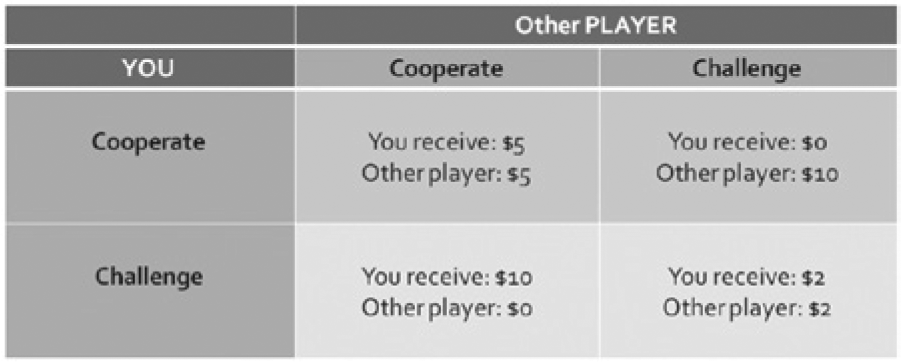
Payoff matrix for the Prisoner’s Dilemma task in Study 3.
Manipulation
Participants were randomly assigned to one of six conditions in a 3 (Prime: Religion/God/Control) × 2 (Target) between-subjects design. Following instructions, participants were subliminally primed in a computer reaction time task, presented to subjects as a measure of visual processing speed. The task was to press the spacebar whenever a string of asterisks (***) appeared on screen. Thirty-two trials consisted of a 250-ms premask (xxxxx), 15-ms presentation of the target prime, 50-ms postmask (xxxxx), followed by the asterisk string. In the religion and God conditions, the target primes for each of the 32 trials were the words “Religion” or “God”, respectively. In the control condition, two target primes were used on 16 alternating trials: “Broccoli” (matched on word length for “Religion”) and “Hat” (matched on length for “God”).
Prisoner’s dilemma game
The experiment then proceeded to the Prisoner’s Dilemma game. Participants viewed the “other player” for 4 seconds (either the Caucasian or South Asian target). After viewing the other player, the payoff matrix was displayed once more, and participants made their choice to cooperate or defect. After their choice, participants rated their general trust of the other player on a 7-point scale (endpoints: 1= Strongly do not trust; 7 = Strongly trust), and whether they expected the other player would choose to cooperate or defect in the Prisoner’s Dilemma game. Participants completed demographic information, including ratings of belief in God and religiousness. All participants were probed for suspicion and debriefed and received $5 payment.
Results
Religious group membership
Group membership was coded according to the self-reported religious affiliation of the participant and target. Six participants who viewed the White partner self-reported their own affiliation as Hindu (n = 5), or Muslim (n = 1), and so were coded as the outgroup condition. Two participants who viewed the Indian partner self-reported their own religion as Hindu (n = 1) or Muslim (n = 1), and were coded as ingroup condition. We did not change coding for nonreligious participants, although the results do not change when these participants are excluded. 3 Cooperation by Prime (Religion/God/control) and Group membership (ingroup/outgroup) was analyzed by logistic regression. There were no main effects of Prime or Group, but the predicted Prime × Group interaction was significant, Wald χ2(2, n = 85) = 8.20, p = .02, see means Figure 2. We tested our specific hypotheses for prosocial behavior toward the ingroup and outgroup, using contingency tables and Pearson’s chi-square test of independence. According to H1, the religion prime condition should increase cooperation with ingroup members relative to the God or control prime conditions. To test this, we collapsed God prime and control prime conditions together, to compare with the religion prime condition. The prediction was supported, χ2(1, n = 42) = 5.04, p = .02. Participants were more likely to cooperate with the ingroup target when primed with religion compared with the God prime (pairwise comparsion: p = .02), but difference with control prime was not significant (p = .42). According to H2, God primes should increase cooperation with outgroup members, relative to the religion or control primes. We collapsed religion and control conditions together to test this prediction, χ2(1, n = 43) = 4.24, p = .04. Outgroup cooperation was marginally higher in the God prime condition compared with the religion (p = .09) and control prime conditions (p = .07).

Percentage of participants cooperating with ingroup/outgroup target, by prime condition, Study 3.
Religiosity, belief, and trust
Cooperation did not correlate with either belief in God (r = .04), or religiousness (r = .07), and there was no evidence of any moderation or mediation effect with these variables. Cooperation was correlated with self-reported trust of the other player (r = .41, p < .001), and whether they expected the other player to choose to cooperate in the Prisoner’s Dilemma game (r = .26, p < .05).
Discussion
In a competitive Prisoner’s Dilemma game, we found that God and religion primes had different effects on cooperation with ingroup versus outgroup members. Both main predictions were supported. First, subliminal “religion” primes increased cooperation when the other player was an ingroup member, consistent with H1. In contrast, “God” primes enhanced cooperation with the outgroup member, consistent with H2.
General Discussion
Three studies found evidence that religion and God primes had different effects on prosociality toward members of the religious ingroup or outgroup. Studies 1A and 1B first established that religion and God serve as different moral audiences, associated with different prosocial goals. Studies 2 and 3 extended these effects to prosocial behavior toward the ingroup and outgroup. As predicted by H1, participants primed with religion distributed funds preferentially to an ingroup charity over an outgroup charity (Study 2) and showed greater cooperation with an ingroup member in a Prisoner’s Dilemma game (Study 3). However, when primed with “God”, greater donations were given to an outgroup charity (Study 2), and more cooperation was shown with a religious outgroup member in a Prisoner’s Dilemma game (Study 3).
These effects emerged even among participants who reported no belief in God or religious affiliation. This may seem to present a puzzle—why should thoughts of religion and God affect the actions of people with no religious bonds or God to fear? While some previous studies show a different effects of priming for believers and atheists (e.g., Dijksterhuis, Preston, Wegner, & Aarts, 2008), other studies observe similar effects of religious priming on non-believers and believers alike (e.g., Laurin, Kay, & Fitzsimons, 2012), and others show mixed effects across different studies (e.g., Gervais & Norenzayan, 2012; Shariff & Norenzayan, 2007). While no clear picture has emerged in the literature yet, we suggest two possible reasons that religious primes may sometimes affect non-believers. One possibility is that there are very few “true” atheists. Even those who report no belief can hold some residual belief (Jong, Halberstadt, & Bluemke, 2012), and so, may hold the same associations with prosocial goals when these concepts are primed. Second, even if atheists truly hold no belief of their own, they still share society with a larger religious population, and so may absorb the shared cultural associations with religion and belief, regardless of individual acceptance of those beliefs (Rounding, Lee, Jacobson, & Ji, 2012).
Cultures, Concepts, and Contexts
All the current studies were conducted on the campus of the University of Illinois at Urbana-Champaign, with a majority of White and Christian participants. This raises the question: should we expect the effects to generalize to other cultures and religious beliefs? This question can be definitively addressed only by future research, but we can speculate on cross-cultural effects based on current evidence. First, we expect that religion primes would have similar ingroup-protection effect across cultures (to cooperate with the religious ingroup). All religions emerge as forms of group affiliation and identity, with particular practices and rules that demarcate true followers from outsiders. And although Christian texts have numerous passages that explicitly advocate an inclusive prosociality, in these studies religion primes did not foster cooperation outside the religious ingroup, with a predominantly Christian population. Other studies also suggest evidence for ingroup prosociality in non-Christian religious groups (Ahmed, 2009; Sosis & Ruffle, 2004), and also evidence for priming effects on ingroup prosociality in non-Christian populations (Ginges et al., 2009). Accordingly, we expect that religion primes (in any language, in any culture) should likewise activate moral concerns and cooperation within one’ religious ingroup.
What about the effect of God primes in different cultures or contexts? The true power of God concepts arises from their depiction as agents, and so the actions of gods are governed by their own beliefs, desires, and will. In a sample of mostly Christian American undergraduates, we found that people believed God would want them to help an outgroup family over an ingroup family (Studies 1A and 1B). Likewise, Studies 2 and 3 (with similar samples) found that God primes elicited an outgroup bias in prosociality, consistent with a goal to help the outgroup. But the effect of God primes may vary in other contexts and cultures, depending on what one believes God wants. Other research has found greater antisocial behavior (i.e., aggression, retaliation) toward perceived enemies when people are led to believe that God advocates revenge (Bushman et al., 2007; Saroglou et al., 2009). This suggests that prosocial behavior may be altered by manipulating the apparent goals and desires of God. Other evidence suggests that the effect of God primes may interact with the image of God as intervening and punishing, rather than passive and forgiving (Shariff & Norenzayan, 2011). As discussed, people should be most concerned with maintaining a good moral image before God if they are worried about being punished for immoral behavior. But this also assumes that one has a concept of God that is punishing and values outgroup cooperation. This particular image of God may be more prevalent among Catholics and mainline Protestants, the most common Christian denominations where these studies were conducted. Other Christian denominations may view God as punishing with a more inclusive group morality (e.g., Evangelicals). The bottom line here is that the effect of God concepts on behavior is directed by what one imagines to be the mind of God. This suggests many exciting directions for future research that could explore how differences in specific aspects of God’s agency (His beliefs, desires, and actions) could subsequently affect different kinds of behavior to comply with His will. For example, a large national sample could examine the roles of specific denomination, God concept, and other dimensions of religious belief, such as fundamentalism or intrinsic/quest orientations. For our own part, the current studies demonstrate that thoughts of God promote prosocial behavior toward those whom God wants us to help (in this case, the religious outgroup), which can sometimes be in opposition to the prosocial goals of the religious ingroup.
Implications for the Study of Religious Cognition
The divergent effects of religion and God primes we find here are consistent with major theories of religious prosociality that emphasize the binding effects of religious groups (e.g., Batson, 1983; Rossano, 2006) and self-monitoring effects of belief in gods (Bering & Johnson, 2005; Gervais & Norenzayan, 2012). But often these two theoretical processes are treated as part of a single force on prosociality—two sides of the same religious coin that compels the faithful to moral action. An important contribution of the current research is the distinction between religion and God as two separate forces on prosocial goals and greater specificity on how these influences manifest in actual prosocial behavior. Future studies may build on these insights by examining the separate influences of religion and God in greater detail and how the processes may affect other aspects of morality, (e.g., moral feelings such as regret, guilt, shame, and forgiveness).
More broadly, there are strong implications here for future studies that rely on priming techniques to activate religious cognition: to use specific primes, and consider the specific meaning of the concepts being primed. The psychology of religion has enjoyed renewed attention from social psychologists in recent years, accompanied by a boom of religious priming studies. Some priming studies examine prosociality, but priming has also been used to examine a wide range of psychological phenomena, including self-control (Rounding et al., 2012), goal pursuit (Laurin et al., 2012), cleanliness concerns (Preston & Ritter, 2012), and neurophysiological stress (Inzlicht & Tullet, 2010), to name just a few examples. A few studies have manipulated specific religious concepts (e.g., Dijksterhuis et al., 2008; Ginges et al., 2009), but most previous research has used a multiple-priming method, with several religious concepts used together to activate religious cognition. Such studies have improved our understanding of religious cognition and its many implications on behavior, but at the same time, may have also inadvertently conflated different religious concepts, making it difficult to determine the true mechanisms responsible for their effects. Our goal here is not to diminish the valuable contributions of these past studies, but rather, to offer a more precise methodology for researchers to investigate these questions, and new hypotheses, in future studies. Our current findings demonstrate that religion and God are distinct concepts that may differentially affect behavior, but these may not be the only distinctions to be made among various religious constructs (Ritter & Preston, in press). As interest in religious cognition continues to grow in social psychology, priming methods will become an increasingly important tool for researchers. For a comprehensible science of religious cognition to emerge from a flurry of effects, we need to have a clear understanding of the kind of religious cognition that we are priming.
Conclusion
In three studies, concepts of religion or God activated different prosociality concerns for the ingroup versus outgroup. Whereas religion primes enhanced prosocial behavior toward the religious ingroup, God primes recast prosocial impulses toward religious outsiders. These results integrate two mechanisms for religious prosociality that have been proposed by other scholars, but also, demonstrate that these are distinct aspects of religious cognition. Discussions of religious cognition sometimes conflate religion and belief in God, and these findings remind us of key differences in their meaning and their behavioral associations.
Footnotes
Acknowledgements
We thank Sean Berbert, Elizabeth Frazier, Daniel Relihan, Ben Sands, and Pin-Ya Tseng for assistance in data collection, and Dov Cohen for helpful advice on Study 1.
Declaration of Conflicting Interests
The author(s) declared no potential conflicts of interest with respect to the research, authorship, and/or publication of this article.
Funding
The author(s) disclosed receipt of the following financial support for the research, authorship, and/or publication of this article: This publication was made possible in part from grant support from the John Templeton Foundation (Grant 29104), awarded to Jesse Preston.