




Abstract
Four experiments found that positive and negative affect dictated whether primed social categories and trait concepts led to assimilation or contrast. This influence was further found to be flexibly responsive to the momentary activation of a global or local focus. When a global focus was dominant, positive affect resulted in assimilation to primed traits and social categories, and negative affect resulted in contrast. But, when a local focus was dominant, the opposite pattern of assimilation and contrast as a consequence of positive and negative affect was observed. These results are consistent with the more general view that positive and negative affect signal the value of currently accessible response tendencies and are, therefore, flexibly responsive in their influence cognition to changing situations and mental contexts.
Early research examining emotion and priming effects asked if particular affective feelings conjured mental content of corresponding valence. Happy moods were assumed to prime happy thoughts and memories, and sad moods to prime sad thoughts and memories (Bower, 1981; Isen, Shalker, Clark, & Karp, 1978). The present research was motivated by a different question: Do affective feelings adjust the influence of already activated mental content on judgment and behavior? Or, more specifically, do they dictate whether primed social categories and trait concepts produce assimilation or contrast? To my knowledge, no research to date has provided an answer to this question. Indeed, as suggested by Bless and Schwarz (2010), “This area is ripe for investigation” (p. 358). The purpose of the present project was to bridge this empirical gap.
Priming Effects
The mental concepts activated in our minds have been repeatedly shown to shape perception, judgment, and behavior. Early research emphasized the role played by chronically accessible concepts and motivational orientations in perception (Bruner, 1957), whereas recent research has emphasized the role played by temporarily accessible concepts in directing judgment and behavior (for reviews, see Bargh, 1997; Dijksterhuis, Chartrand, & Aarts, 2007; Förster & Liberman, 2007; Higgins, 1996). In this recent research, mental concepts are covertly activated and their effects on judgment and behavior are observed.
Primed trait concepts have been shown to influence processes of impression formation (Higgins, Rholes, & Jones, 1977). In this research, participants completed two ostensibly unrelated tasks. In the first, allegedly a verbal learning task, participants memorized a series of words, some of which were related to trait concepts (e.g., adventurous, reckless). Then, in the second task, participants read a brief passage describing the actions of a person named Donald whose actions could be interpreted as adventurous or reckless. Participants’ impressions of Donald assimilated to the trait concepts primed in the first task, with those primed with reckless forming more negative impressions of Donald than those primed with adventurous (see also Srull & Wyer, 1979).
Similarly, primed social categories, such as the elderly, have been shown to influence behavior (Bargh, Chen, & Burrows, 1996). In this research, via a sentence unscrambling task, participants were primed with the social category Elderly or no social category under the control condition. Following this, the time it took participants to walk down the hallway to a nearby elevator was measured. Consistent with behavioral assimilation, participants primed with the category Elderly walked more slowly to the elevator than participants under the control condition. Activating the category Elderly has also been found to result in slower reaction times on a word recognition task (Dijksterhuis, Spears, & Lépinasse, 2001; Kawakami, Young, & Dovidio, 2002; Schubert & Häfner, 2003).
The influence of priming on judgment and behavior, however, is not always the same. Primed concepts may at times produce assimilation, as in the research discussed earlier, and at other times they may produce contrast. Assimilation occurs when judgments and behavior come to reflect the informational or behavioral implications of activated concepts. Contrast occurs when participants’ judgments and behavior come to reflect the opposite judgmental or behavioral implication of primed concepts (for reviews, see Bless & Schwarz, 2010; DeCoster & Claypool, 2004; Förster & Liberman, 2007).
The inclusion/exclusion model (IEM) provides a useful framework to organize the many factors known to determine whether priming leads to assimilation or contrast (Bless & Schwarz, 2010; Schwarz & Bless, 1992). According to the model, assimilation occurs when a prime is included in the representation of the target. Contrast occurs when a prime is excluded from the representation of the target, and instead forms a standard against which the target is compared. Following Förster, Liberman, and Kuschel (2008), a useful way to understand the intuition behind the IEM is to imagine the prime and target as two blots of ink. Features of the primed concept and any cognitive operation that blurs the boundary between prime and target (i.e., the two blots of ink) should trigger assimilation. Features of the primed concept and any cognitive operation that sharpens the boundary between the blots of ink, leading the prime to serve as a comparison standard, should trigger contrast.
In studies examining the effect of primed traits on impression formation, the person being evaluated is the target (e.g., Donald; Higgins et al., 1977), and in studies examining the effect of primed social categories on behavior, the self is the target (Wheeler, DeMarree, & Petty, 2007). According to the IEM, then, factors that promote inclusion of the prime in the representation of the target person or the self should lead to assimilation of impressions and behavior. Factors that promote exclusion of the prime from the representation of the target should lead to contrast.
Features of the prime itself may impact whether it is included or excluded from the representation of the target. Abstract and indistinct primes such as general trait concepts (e.g., intelligent, dumb, helpful) and generic social categories (e.g., professor, supermodel, superhero) have fuzzy boundaries, which encourages inclusion and assimilation. By contrast, concrete and distinct primes such as exemplars (e.g., Einstein, Claudia Schiffer, Superman) have sharp boundaries, which encourages exclusion and contrast (Bless & Schwarz, 2010; Herr, 1986; Herr, Sherman, & Fazio, 1983).
Of more relevance to the present work is research showing that the particular cognitive operation applied to the prime and target influences inclusion and exclusion. One such cognitive operation is a global or a local focus (Förster et al., 2008; Nussinson, Seibt, Häfner, & Strack, 2010). A global focus results in attention to the Gestalt or global features of a presented stimulus (i.e., a focus on the forest), activation of more abstract superordinate concepts and a search for similarities. A local focus results in attention to the details or local features (i.e., a focus on the tress), activation of more concrete or lower level concepts and a search for dissimilarities (Förster, 2009; Förster & Dannenberg, 2010; Förster et al., 2008). Because a global focus results in activation of more abstract, indistinct representations (i.e., a broadening of conceptual attention), it should facilitate inclusion of the prime in the representation of the target and therefore assimilation. Because a local focus results in activation of more concrete, distinct representations (i.e., a narrowing of conceptual attention), it should facilitate exclusion of the prime in the representation of the target and therefore contrast.
This influence of global and local focus on assimilation and contrast is illustrated in research examining the influence of trait priming on impression formation (Förster et al., 2008; Experiment 1). In this research, participants first were primed with a global or local focus and then completed a task that activated words related to aggression or words unrelated to aggression. Following this, participants read a brief description of a person named John, and were asked to form an impression of this person. Participants with a global focus primed with aggression words judged John to be more aggressive than those primed with neutral words, whereas those with a local focus primed with aggression words judged John to be less aggressive than those primed with neutral words (Förster et al., 2008).
A similar influence of global or local focus on assimilation and contrast can be seen in research in which social categories associated with intelligence (professor) or stupidity (soccer player) were primed (Nussinson et al., 2010). In this research, participants were primed with a global or local focus by having them perform approach or avoidance motor actions, respectively. While engaging in the motor actions, participants also imagined the typical lifestyle and characteristics of either professors or soccer players. Participants with a global focus displayed assimilation—that is, those primed with the category Professor correctly answered more general knowledge questions than those primed with the category Soccer player. Participants with a local focus displayed contrast—that is, those primed with the category Professor correctly answered fewer general knowledge questions than those primed with the category Soccer players.
Affect and Global/Local Focus
Positive affect is typically associated with a broadened or global perceptual focus and negative affect is typically associated with a narrowed or local perceptual focus (Fredrickson & Branigan, 2005; Gasper & Clore, 2002; Rowe, Hirsh, & Anderson, 2007). When judging the similarity between a series of geometric figures, for example, people in happy moods tend to base their similarity judgments on the global features of the stimuli more than people in sad moods (Gasper & Clore, 2002). These shifts in perceptual scope are echoed in shifts in conceptual or representational scope, with positive affect producing a global conceptual focus and negative affect a local conceptual focus. Happy people characterize behavior in more abstract terms, whereas sad people represent behavior in more concrete terms (Beukeboom & Semin, 2005, 2006). People in positive moods also form more inclusive categories, for example, including more atypical exemplars (e.g., elevator) in a superordinate category (e.g., vehicle; Isen & Daubman, 1984).
A common explanation for these and other results is that positive and negative affect directly generate tendencies to focus globally or locally (Fredrickson, 2004; Friedman & Förster, 2010; Schwarz & Clore, 2007). Explanations of this sort generally begin with the idea that positive and negative affect signal the state of the environment, with positive affect signifying a benign environment and negative affect signifying a problematic environment. The safety signal provided by positive affect is assumed to directly trigger a broadened scope of perceptual and conceptual attention, and a more open and flexible mindset. And the danger signal provided by negative affect is assumed to trigger a narrowed scope of attention, a more restricted and rigid mindset.
Other accounts suggest instead that positive and negative affect may have more flexible effects on tendencies to focus broadly or narrowly. These accounts, which build on prior formulations of the affect as information approach, begin with the idea that positive and negative affective cues from moods and emotions simply provide experiential information about the value of whatever perceptual and conceptual inclinations happen to be in mind (Clore et al., 2001; Clore & Huntsinger, 2009; Huntsinger & Clore, 2012; Isbell, Lair, & Rovenpor, 2013; for a similar perspective see work on self-validation theory, for example, Briñol, Petty, & Barden, 2007). Thus, rather than only providing information about the state of the environment, such explanations suggest instead that the information conveyed by affective feelings is more general and less constrained than previously thought. Positive affect acts as a “go signal” that facilitates and negative affect acting as a “stop signal” that inhibits the use of accessible thoughts and inclinations. From this perspective, positive and negative affect do not have particular perceptual and conceptual signatures, but rather their influence is responsive to changes in mental context (e.g., tendencies to focus globally or locally).
From this view, then, the finding that positive affect produces a broad or global focus and negative affect produces a narrow or local focus can be explained by the fact that people generally focus broadly (Bruner, 1957; Eriksen & St. James, 1986; Fiske & Taylor, 2008; Kimchi, 1992; Kohler, 1929; Navon, 1977, 2003; Neisser, 1967; Pomerantz, Sager, & Stover, 1977; Reicher, 1969). Rather than directly triggering a broad focus or a narrow focus, in past research, positive and negative affect may have simply conferred positive or negative value on this typical way of viewing the world. If this is the case, then making a narrow focus temporarily accessible should reverse the connection between affective valence and perceptual scope. Now, happy people should focus narrowly and sad people broadly.
Recent research supports this reasoning (for a review, see Huntsinger, 2013). In this research, when a global focus was most accessible, the typical influence of affective valence on perceptual focus was observed, with happy participants exhibiting a broadened focus and sad participants exhibiting a narrowed focus. But when a local focus was most accessible, happy participants displayed a narrowed focus and sad participants displayed a broadened focus (Huntsinger, Clore, & Bar-Anan, 2010). These effects were recently shown to occur at encoding, suggesting that such flexibility reflects a fundamental change in visual attention, rather than merely a change in response selection or some other post-perceptual process (Huntsinger, 2012).
Overview of the Present Research
The influence of positive and negative affect on assimilation and contrast was predicted to depend on the particular cognitive context, in particular, the accessibility of a global or local focus. The customary cognitive context for most people, most of the time appears to be one in which a global focus is highly accessible. Positive affect should act as a “go signal” that promotes and negative affect should act as a “stop signal” that inhibits the use of this general tendency. In such circumstances, positive affect should lead to a global focus, and negative affect should lead to a local focus. Consequently, positive affect should promote activation of more abstract, indistinct representations, which should facilitate inclusion of the prime in the representation of the target and therefore assimilation. Negative affect should promote activation of more concrete, distinct representations, which should facilitate exclusion of the prime in the representation of the target and therefore contrast.
To illustrate, consider an impression formation study in which participants are primed with either positive (e.g., persistent) or negative (e.g., stubborn) trait concepts and then asked to form an impression of a person whose behavior can be construed as either persistent or stubborn. Happy participants should exhibit assimilation, with those primed with positive traits forming more positive impressions than those primed with negative traits. Sad participant should exhibit contrast, with those primed with positive traits forming more negative impressions than those primed with negative traits.
Varying the cognitive context by making a local focus momentarily accessible should produce the opposite influence of affect on assimilation and contrast. Consider the same study as described with the only change being that the accessibility of a global versus local focus is manipulated. The same pattern of impressions as a consequence of mood and primed traits as described earlier should emerge when a global focus is most accessible. This pattern should reverse when a local focus is most accessible. Now, happy participants should exhibit contrast, with those primed with positive traits forming more negative impressions of Donald than those primed with negative traits; sad participants should exhibit assimilation, with those primed with positive traits forming more positive impressions of Donald than those primed with negative traits. These predictions were evaluated in four experiments.
Experiment 1
Experiment 1 examined if positive and negative affect would determine whether priming the social category Elderly led to behavioral assimilation or contrast. Participants’ mood was manipulated to be happy or sad, and they then experienced the priming manipulation, a lexical decision task, in which the social category Elderly or no category was primed. The speed with which participants recognized words in the lexical decision task served as the index of behavioral assimilation or contrast (see, for example, Dijksterhuis et al., 2001; Kawakami et al., 2002; Schubert & Häfner, 2003).
Positive affect was predicted to promote the customary tendency to focus globally, which should facilitate inclusion of the primed social category in the representation of the target (i.e., self) and therefore behavioral assimilation. Negative affect was predicted to inhibit the customary tendency to focus globally, leading to a local focus, which should facilitate exclusion of the primed social category in the representation of the target (i.e., the self) and therefore behavioral contrast. Specifically, happy participants primed with the category Elderly were predicted to exhibit slower response latencies than happy participants in the control condition (assimilation). Sad participants primed with the category Elderly should exhibit faster response latencies than sad participants in the control condition (contrast).
Participants
One hundred and thirteen participants (92 women, 20 men, 1 unknown) took part in this experiment for partial fulfillment of a course requirement.
Procedure and Materials
Participants were run one at a time. After signing consent forms, participants were told that they would complete a series of computer-based tasks, and then answer a series of questions, also on the computer. Participants were then told that we were testing out a series of musical selections for use in another experiment. This pretesting was in reality the mood induction. All participants agreed to take part in this pretesting, and were randomly assigned to listen to either a happy or sad musical selection. At this point, the experimenter started the computer program that would guide participants through the rest of the experiment, and left the room. Instructions on the computer told participants to put on a pair of headphones, and then to press a combination of keys to start the music. After listening to the music for approximately 10 min, the computer automatically advanced to the next part of the experiment. Participants were next informed that they would complete a word recognition task in which they would determine whether presented stimuli were words or nonwords. During the lexical decision task, participants were primed either with photos of elderly persons or no photos in the control condition. Following this, participants completed a series of manipulation check questions and demographic items, and then were probed for suspicion via a funneled debriefing procedure (Dulany, 1962).
Mood induction
Via headphones participants listened to one of two musical selections shown in previous research to induce positive moods (Mozart’s Eine kleine Nachtmusik) and negative moods (Mahler’s Adagietto; Niedenthal & Setterlund, 1994).
Social category priming procedure
A lexical decision task was used to prime participants with either the category Elderly or, in the control condition, no category. During this task, participants were instructed to respond with the “5” key if the stimulus was a word or the “a” key if the stimulus was a nonword. Prior to each word or nonword appearing on the screen, participants were exposed to either a photo of an elderly person for 40 ms or no photo. A total of six photos (three male and three female; Nosek, Banaji, & Greenwald, 2002) represented the category Elderly. The target words were unrelated to the category Elderly. A forward mask preceded and a backward mask followed each presentation of a photo. The forward and backward masks remained on the screen for approximately 150 and 15 ms, respectively. Results of a funneled debriefing revealed that no participants reported seeing the photos. Thus, the forward and backward masks served their purpose. The task was broken into 10 practice and 60 test trials and all stimuli appeared in the center of the computer screen. Participants were primed (or not) with the category Elderly during both practice and test trials. Words or nonwords remained on the screen until participants provided the correct answer. Incorrect answers elicited a red error message in the middle of the screen.
Behavior
Performance on the lexical decision task served as the main outcome. Following past research, only word latencies from both practice and test trials were analyzed (see, for example, Dijksterhuis et al., 2001; Kawakami et al., 2002; Schubert & Häfner, 2003). Incorrect responses (7.1%) and latencies exceeding 3 standard deviations from each participant’s individual mean were excluded (2.4%). Error rates did not vary across experimental conditions. Analysis of log-transformed latencies and raw latencies yielded near identical results. Therefore, all reported analyses used the raw response latencies as the outcome. 1
Manipulation check
Participants were asked how happy (sad) they felt while listening to the musical selections to assess the efficacy of the mood manipulation (1 = not at all, 7 = very). These two items were correlated (r = −.71, p < .01); therefore, a composite measure of mood was created with higher values indicating a more positive mood.
Results and Discussion
Manipulation check
Submitting participants’ responses to the mood manipulation check to a 2 (mood: happy, sad) × 2 (prime: elderly, control) between-participants ANOVA revealed a significant main effect of mood, F(1, 109) = 7.61, p = .007,
Main analysis
Submitting participants’ response latencies from the lexical decision task to the same ANOVA as earlier yielded the predicted mood by prime interaction, F(1, 109) = 8.26, p = .005,
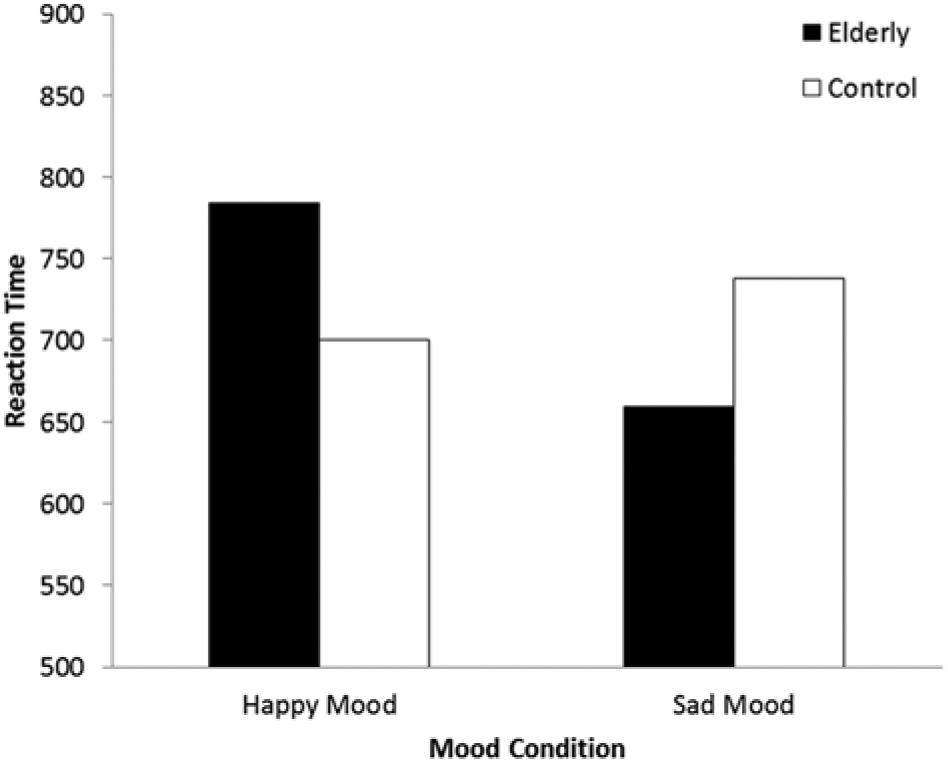
Reaction time (ms) as a function of mood condition (happy vs. sad) and prime (elderly vs. control).
Experiment 2
Experiment 2 examined if positive and negative affect would determine whether primed trait concepts led to assimilation or contrast in impression formation. The basic procedure for this experiment was as follows. Participants’ mood was first manipulated to be happy or sad, and then to prime positive trait concepts (e.g., persistent) or negative trait concepts (e.g., stubborn), participants completed a sentence memorization task (Moskowitz & Roman, 1992). After these manipulations, participants read about a person named Donald (Higgins et al., 1977), and then indicated their impression of him along several trait dimensions (confident–conceited, persistent–stubborn). As in Experiment 1, positive affect was predicted to promote the customary tendency to focus globally, which should facilitate inclusion of the primed trait concepts in the representation of the target (i.e., Donald) and therefore assimilation. Negative affect was predicted to inhibit the customary tendency to focus globally, leading to a local focus, which should facilitate exclusion of the primed trait concepts in the representation of the target (i.e., Donald) and therefore contrast. Specifically, happy participants primed with positive traits should form more positive impressions of Donald than those primed with negative traits (assimilation). Sad participants primed with positive traits should form more negative impressions of Donald than those primed with negative traits (contrast).
Participants
One hundred and seventy participants (127 women, 43 men) completed the experiment in exchange for course credit.
Procedure and Materials
One to six participants took part in any given experimental session, but did not interact at all during the experiment as they were in individual cubicles. After signing consent forms, they were told that the experiment involved several different stages in which they would complete different tasks. At this point, the experimenter started the computer program that would guide participants through the rest of the experiment, and left the room. In the first stage, participants listened to the same musical mood induction from Experiment 1. In the second, participants experienced the trait priming manipulation in which they were asked to read and memorize a series of five trait-implying sentences. In one condition, two of the sentences implied positive traits (e.g., confident, persistent) and in the other condition, two of the sentences implied negative traits (e.g., conceited, stubborn). Following this, participants were asked to read a brief paragraph about an individual named Donald and to form an impression of this person. Finally, they indicated their impressions of Donald along several dimensions and completed several manipulation check questions. Participants then were thoroughly debriefed and thanked for their participation.
Trait primes
Following past research (Moskowitz & Roman, 1992), participants were asked to read and memorize five trait-implying sentences of which two sentences varied across randomly assigned condition. In the positive prime condition, these two sentences implied the traits confident and persistent (“He peddled even harder as he fell further behind in the race,” “He knew he could handle most problems that would come up”), and in the negative prime condition, the sentences implied the traits conceited and stubborn (“He refused to listen to them even though all the evidence was in their favor,” “He knew he was the best and didn’t hesitate to tell people about it”). The trait-implying sentences were always located second and fourth and the remaining three filler sentences were the same across conditions “She climbed the tree with her pet frog in her pocket,” “She did not like to walk the streets by herself at night,” and “She inspired them to reexamine their places in the universe”).
Donald paragraph
Participants read a paragraph from past research (Higgins et al., 1977) that described the actions of a man named Donald. The description of Donald was ambiguous and his actions could be construed as either confident and persistent or conceited and stubborn.
Donald ratings
Participants indicated their impression of Donald using two 1- to 7-point bipolar scales (confident–conceited, persistent–stubborn). As these two items performed identically in the analyses described next, they were combined into a single measure of participants’ impressions of Donald, with higher numbers indicating a more negative impression.
Manipulation check
Participants were asked how happy (sad) they felt while listening to the musical selection to assess the efficacy of the mood manipulation (1 = not at all, 7 = very). These two items were correlated (r = −.53, p < .005) and therefore combined to form a composite measure of positive mood.
Results and Discussion
Manipulation check
Participants’ responses to the mood manipulation check were submitted to a 2 (mood: happy, sad) × 2(trait prime: positive, negative) ANOVA. This analysis yielded a main effect of mood, F(1, 166) = 33.00, p < .0005,
This analysis also revealed an unexpected mood by trait prime interaction, F(1, 166) = 4.59, p = .03,
Main analysis
The primary prediction was that participants’ affective state would dictate whether primed traits led to assimilation or contrast. This prediction was tested by separately submitting participants’ ratings of Donald to the same ANOVA as above. This analysis yielded the predicted mood by prime interaction, F(1, 166) = 10.09, p = .002,
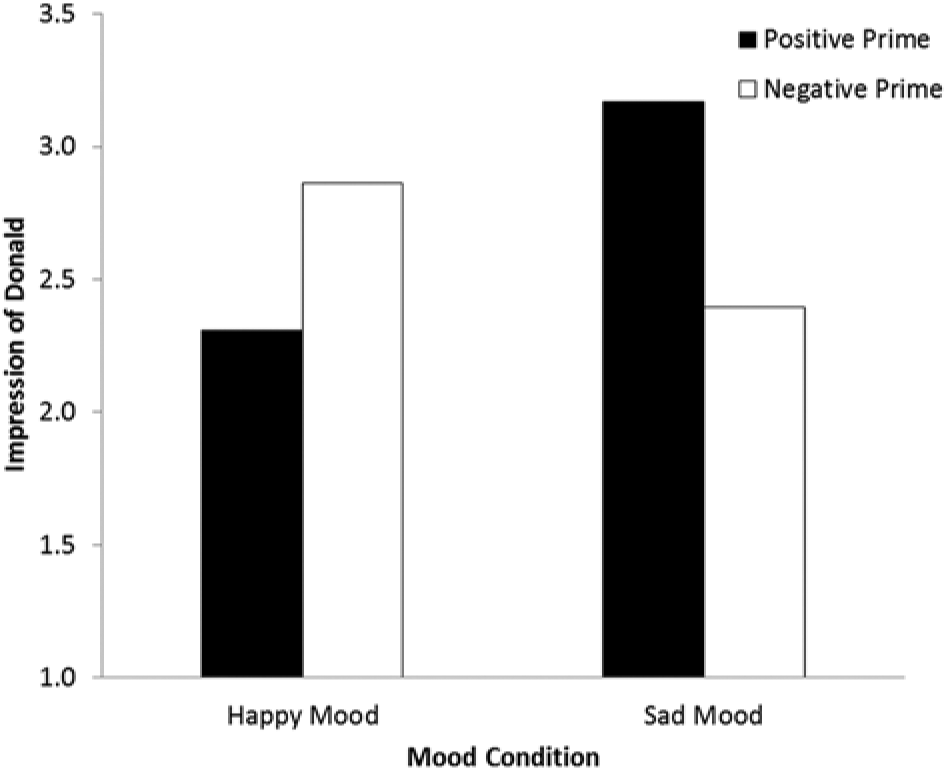
Impression of Donald (higher values indicate a more negative impression) as a function of mood condition (happy vs. sad) and trait prime (positive vs. negative).
Experiment 3
The purpose of Experiment 3 was to examine flexibility in the influence of affective feelings on social category priming. The basic procedure was identical to that of Experiment 1 with the only change being that prior to the manipulation of mood, the relative dominance of a global focus or a local focus was manipulated. When a global focus was most accessible, results were expected to conceptually replicate those of Experiment 1, with participants in happy moods predicted to exhibit behavioral assimilation to the primed social category, whereas those in negative moods predicted to exhibit behavioral contrast from the social category. When a local focus was most accessible, however, this pattern of assimilation and contrast was predicted to reverse. Now, happy participants primed with the category Elderly should exhibit faster reaction times than those in the control condition, and sad participants primed with the category Elderly should display slower reaction times than those in the control condition.
Participants
One hundred and eighty-six participants (134 women, 52 men) took part in this experiment for partial fulfillment of a course requirement.
Procedure and Materials
One to six participants took part in any given experimental session, but did not interact at all during the experiment as they were in individual cubicles. The procedure for this experiment was similar to that of Experiment 1, with several changes. Participants first completed the manipulation of a global or local focus. Next participants experienced the mood induction, which consisted of reading one of two short stories shown in past research to induce either a strong happy or sad mood (Huntsinger, 2012). Participants then completed the same social category priming manipulation from Experiment 1. Last, participants completed a series of manipulation check questions, and several demographic items.
Global/local priming task
Perceptual and conceptual scopes are closely connected (Förster & Dannenberg, 2010). Therefore, following past research (Förster et al., 2008), a variant of the Navon-letter task was use to prime global versus local conceptual focus. On each trial, a compound stimulus—a large letter (3 × 3 cm) made up of smaller letters (0.5 × 0.5 cm)—appeared on a computer screen. Each stimulus remained until a participant responded. Four of the composite letters included global targets (e.g., an H made of Fs) and four included local targets (e.g., an F made of Ls). Participants were instructed to press the “L” key if the letter “L” appeared in the compound stimulus, and press the “H” key if the letter “H” appeared. Following correct responses, the next stimulus appeared after 250 ms. Incorrect responses were met with an error message, and the next stimulus was presented after 1,250 ms. In the global focus condition, all 80 trials had global-letter targets whereas in the local focus condition, all 80 trials had local-letter targets.
Mood induction
Ostensibly as part of a “media-classification task,” participants were asked to read one of two stories describing events that happened to a young female artist. The story used to produce a positive mood described a number of favorable events culminating in her receiving a scholarship to study art. The story used to produce a negative mood described how the same person was overcome by a rare, disabling illness (rheumatoid arthritis) at the end of her freshman year in college. This manipulation was identical to that used in past research to induce strong happy and sad moods (Huntsinger, 2012).
Social category priming task
This manipulation was identical to that used in Experiment 1.
Behavior
This measure was identical to that used in Experiment 1. As before, only word latencies from both practice and test blocks were analyzed, errors were deleted (5.5%), latencies 3 standard deviations above each participant’s mean were removed (2.8%), and all reported analyses were conducted on raw response latencies. 3
Manipulation check
Participants in this experiment were asked six questions to assess the effectiveness of the mood induction (“How happy [sad, positive, negative, good, bad] did you feel after reading the story about the artist?” [1 = not at all, 7 = very]). These items were averaged to form a composite measure of positive mood (α = .95).
Results and Discussion
Manipulation check
One participant failed to answer the manipulation check items. The mood manipulation check was submitted to a 2 (perceptual prime: global, local) × 2 (mood: happy, sad) × 2 (prime: elderly, control) ANOVA. This analysis yielded a significant main effect of mood, indicating that the mood induction was successful, F(1, 177) = 140.95, p < .0005,
Main analysis
The main prediction was that the relative accessibility of a global focus or a local focus would determine whether a happy mood or sad mood led to behavioral assimilation or contrast. This prediction was tested by submitting participants’ response latencies from the lexical decision task to the same ANOVA as above. This analysis yielded the predicted perceptual prime by mood by prime interaction, F(1, 178) = 9.78, p = .002,

Reaction time (ms) as a function of perceptual prime (global vs. local), mood condition (happy vs. sad) and prime (elderly vs. control).
As predicted when a global focus was accessible, happy participants primed with the category Elderly (M = 742, SD = 116) displayed slower response latencies than happy participants primed with no social category (M = 687, SD = 65), t(178) = 1.88, p = .062, d = .28. Sad participants primed with the category elderly displayed faster response latencies (M = 648, SD = 75) than sad participants primed with no social category (M = 718, SD = 91), t(178) = 2.33, p = .02, d = .35. Furthermore, conceptually replicating results of Experiment 1, the simple mood by prime interaction in the global priming condition was significant, F(1, 87) = 11.32, p = .001,
When a local focus was accessible, this pattern reversed, as predicted, however not significantly so. Happy participants primed with the category Elderly displayed faster response latencies (M = 676, SD = 85) than those primed with no social category (M = 701, SD = 109), t(178) = 0.86, p = .39, d = .13. And sad participants primed with the category Elderly displayed slower response latencies (M = 756, SD = 123) than those primed with no social category (M = 722, SD = 117), t(178) = 1.16, p = .25, d = .17. The simple mood by prime interaction in the local priming condition was not significant, F(1, 91) = 1.68, p = .20,
This analysis also yielded a theoretically meaningless mood by perceptual prime interaction, F(1, 178) = 7.89, p = .006,
Experiment 4
Experiment 4 was a conceptual replication of Experiment 2 with the only change being the introduction of the global versus local focus manipulation prior to the mood induction. When a global focus was most accessible, the pattern of results was expected to mirror that of Experiment 2. Happy participants primed with positive traits should form more positive impressions than happy participants primed with negative traits, whereas sad participants primed with positive traits should form more negative impressions than sad participants primed with negative traits. When a local focus was most accessible, this pattern of assimilation and contrast should reverse. Now, happy participants primed with positive traits should form more negative impressions than those primed with negative traits, and sad participants primed with positive traits should form more positive impressions than sad participants primed with negative traits.
Participants
One hundred and thirty-two participants (107 women, 22 men, 3 unknown) took part in this experiment for partial fulfillment of a course requirement.
Procedure and Materials
One to six participants took part in any given experimental session, but did not interact at all during the experiment as they were in individual cubicles. The procedure for this experiment was identical to that of Experiment 2, with the only change being that participants first completed the manipulation of a global or local focus from Experiment 3. The mood induction, trait priming manipulation, and the Donald paragraph and ratings were identical to those used in Experiment 2.
Manipulation check
Similar to Experiment 3, participants in this experiment were asked six questions to assess the efficacy of the mood induction (“How happy [sad, positive, negative, good, bad] did you feel while listening to the musical selection?”). These items were averaged to form a composite measure of positive mood (α = .86).
Results and Discussion
Manipulation check
Submitting the mood manipulation check to a 2 (perceptual prime: global, local) × 2 (mood: happy, sad) × 2 (trait prime: positive, negative) ANOVA revealed only a significant main effect of mood, F(1, 124) = 7.48, p < .01,
Main analysis
The main prediction was that the relative accessibility of a global focus or a local focus would determine whether a happy mood or sad mood led to judgmental assimilation or contrast. This prediction was tested by submitting participants’ ratings of Donald to the same ANOVA as above. This analysis yielded the predicted perceptual prime by mood by prime interaction for descriptively related traits, F(1, 124) = 24.79, p < .0005,
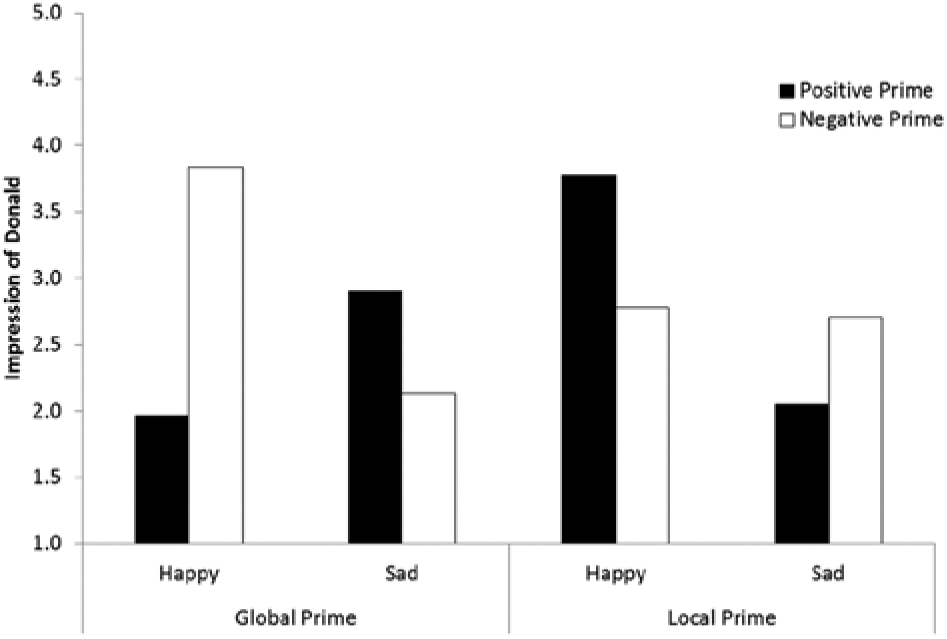
Impression of Donald (higher values indicate a more negative impression) as a function of perceptual prime (global vs. local), mood condition (happy vs. sad), and trait prime (positive vs. negative).
When primed with a global focus, as predicted, participants in happy moods displayed assimilation and those in sad moods displayed contrast. Specifically, happy participants primed with positive traits formed more positive impressions of Donald (M = 1.97, SD = .99) than those primed with negative traits (M = 3.83, SD = 1.53), t(124) = 4.21, p < .0005, d = .76, whereas sad participants primed with positive traits formed somewhat more negative impressions of Donald (M = 2.91, SD = 1.00) than those primed with negative traits (M = 2.13, SD = .93), t(124) = 1.74, p = .084, d = .31. Conceptually replicating results of Experiment 2, the simple mood by prime interaction in the global focus condition was significant, F(1, 58) = 20.85, p < .0005,
By contrast, when primed with a local focus, participants in happy moods now displayed contrast, with participants primed with positive traits forming more negative impressions (M = 3.78, SD = 1.27) than those primed with negative traits (M = 2.78, SD = 1.26), t(124) = 2.35, p = .02, d = .42. Participants in sad moods displayed assimilation, with participants primed with positive traits forming somewhat more positive impressions (M = 2.05, SD = 1.10) than those primed with negative traits (M = 2.71, SD = 1.58), t(124) = 1.59, p = .115, d = .28. The simple mood by prime interaction in the local focus condition was significant, F(1, 66) = 6.59, p = .01,
This analysis also yielded a main effect of mood, indicating that happy participants formed more positive impressions of Donald than sad participants, F(1, 124) = 8.86, p = .004,
General Discussion
The current project concerned the influence of affective feelings on priming effects, in particular, whether primed trait concepts and social categories result in assimilation or contrast. The first two experiments found that the behavior (Experiment 1) and judgments (Experiment 2) of participants in happy moods displayed assimilation to primed social categories and trait concepts, and that the behavior and judgments of those in sad moods displayed contrast. In Experiments 3 and 4, this influence was further found to be flexibly responsive to momentary changes in cognitive context, that is, the activation of a global or local focus. Specifically, when a tendency to focus globally or broadly was most accessible, happy moods produced assimilation and sad moods produced contrast. However, when a tendency to focus locally or narrowly was most accessible, now happy moods produced contrast and sad mood produced assimilation.
Although the pattern of results was consistent with predictions across experiments, some results achieved significance and others fell short. Table 1 provides a meta-analytic summary of the predicted pattern of assimilation and contrast as a function of mood and chronically or temporarily accessible tendencies to focus globally or locally. As can clearly be seen, the key results were quite robust when meta-analytically averaged across studies.
Meta-Analysis of Assimilation and Contrast as a Function of Mood and Chronically or Temporarily Accessible Focus Across Experiments.
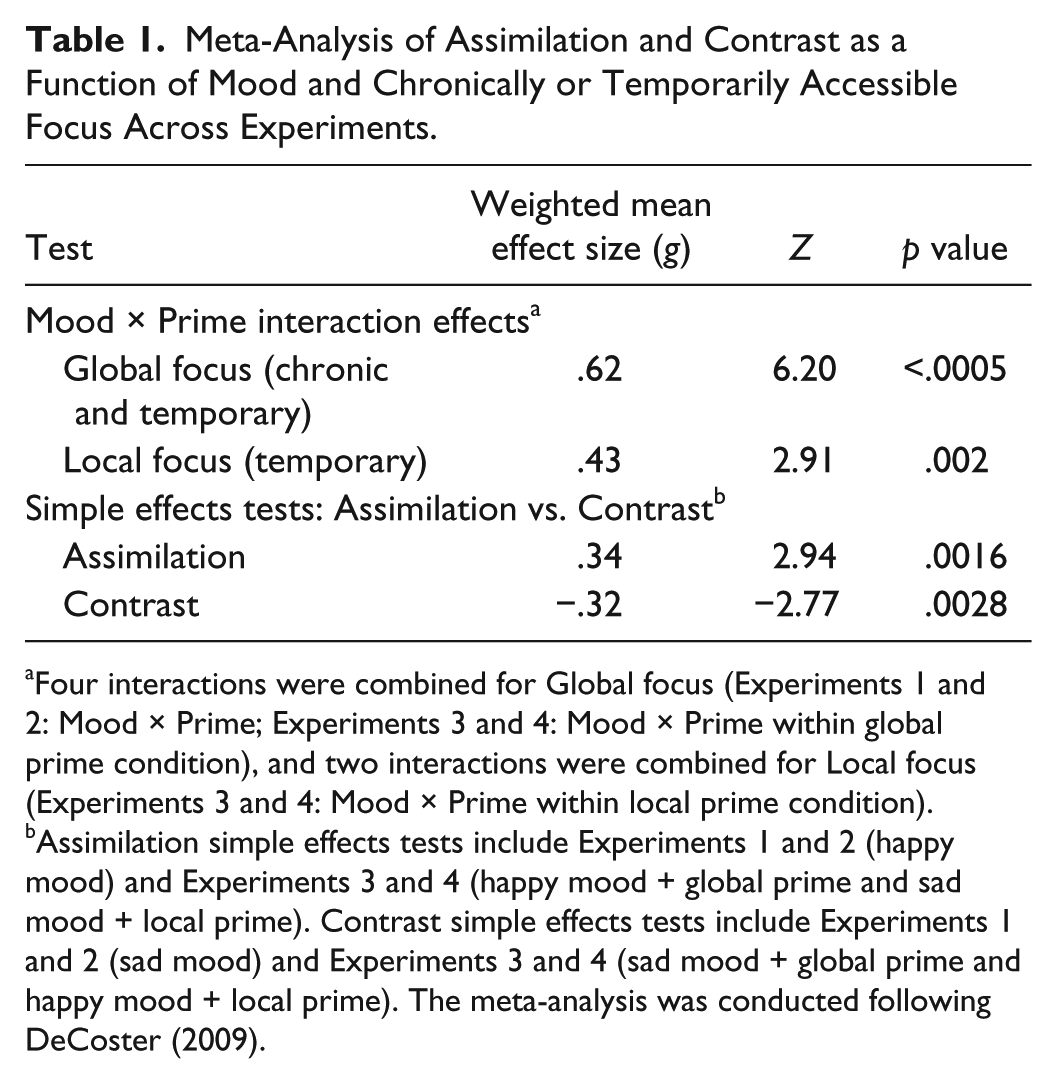
Four interactions were combined for Global focus (Experiments 1 and 2: Mood × Prime; Experiments 3 and 4: Mood × Prime within global prime condition), and two interactions were combined for Local focus (Experiments 3 and 4: Mood × Prime within local prime condition).
Assimilation simple effects tests include Experiments 1 and 2 (happy mood) and Experiments 3 and 4 (happy mood + global prime and sad mood + local prime). Contrast simple effects tests include Experiments 1 and 2 (sad mood) and Experiments 3 and 4 (sad mood + global prime and happy mood + local prime). The meta-analysis was conducted following DeCoster (2009).
In Experiments 3 and 4, negative affect led to reversals in which priming a global focus led to a local focus (i.e., contrast) and priming a local focus led to a global focus (i.e., assimilation). Such reversals are to be expected and, indeed, identical reversals have been observed in past research (Huntsinger, 2012; Huntsinger et al., 2010). As explained elsewhere (e.g., Huntsinger, 2012), the negative value placed on an accessible global or local orientation by negative affect leads to its exclusion from later processing. To the extent that negative affect confers negative value on the most accessible orientation, it should be supplanted by responding on the basis of the other option. Thus, assimilation should result either from having an accessible global orientation validated by positive affect or a local orientation invalidated by negative affect. Equally, contrast should result either from having a primed local focus empowered by positive affect or a primed global focus inhibited by negative affect.
In summary, these results are consistent with the idea that a global focus produces assimilation and a local focus produces contrast (Förster & Dannenberg, 2010; Förster et al., 2008). They are inconsistent, however, with the idea that positive and negative affect have dedicated effects on tendencies to focus broadly or narrowly, as is often assumed. They instead support the view that positive and negative affect simply act on currently accessible perceptual and conceptual tendencies and are, therefore, flexibly responsive in their influence on priming effects, and cognition more generally, to changing situations and mental contexts (Clore et al., 2001; Clore & Huntsinger, 2007, 2009; Huntsinger & Clore, 2012; Isbell et al., 2013).
Implications and Alternate Explanations
The reality of social priming effects in general and behavioral priming effects in particular has been much discussed lately (e.g., Abbott, 2013; Bartlett, 2013; Yong, 2012). This conversation was kicked off by a number of events, including several failures to replicate high-profile priming effects (e.g., Doyen, Klein, Pichon, & Cleeremans, 2012; Pashler, Rohrer, & Harris, 2013; Shanks et al., 2013). Although I am hesitant to enter into this at times acrimonious debate, studies demonstrating moderators of priming effects, such those reported here, are important as a reminder of the many (often subtle) factors that can influence the likelihood of obtaining or even reversing such effects. If, for example, the current studies had ignored the impact of mood or of focus, it might have looked like there were no significant effects of primes on speed of responding or on trait ratings. Some may see discussion of these (hidden) moderators as mere hand-waving (Bartlett, 2013). But even well-established effects (e.g., mere exposure; Zajonc, 1968) may vanish or even reverse under conditions not anticipated or identified by early investigators (Stang, 1974). A failure to replicate, then, presents an opportunity to seek out these moderating variables, rather than a simple statement regarding the reality of the effect under investigation.
Throughout affect was assumed to regulate assimilation and contrast by providing experiential feedback about chronically or temporarily accessible tendencies to focus globally or locally. Affect provides an answer to the most salient question afforded by the environment (Clore et al., 2001; Clore & Huntsinger, 2009; see also work on self-validation theory, for example, Briñol et al., 2007). Because participants were focused on their task performance, the most salient (likely implicit) question for participants was some variation of the following, “How should I approach this task?” Thus affect provided feedback about the adequacy of one’s approach to the experimental tasks, in particular whether one should adopt a usually default or recently primed way of processing information.
If perceptions of the experimenter or the lab room were made salient, by, for example, explicitly asking participants whether they liked or disliked the rather drab lab decor, then affect would have provided information about liking or disliking. Similarly, and more relevant, if participants experienced their affective feelings as feedback about the adequacy of thoughts generated during the priming task, then they would have directly influenced the use of such thoughts. Indeed, there is good evidence that, under certain conditions, affect may influence the use of activated thoughts, rather than processing style (e.g., Briñol et al., 2007). A key to understanding when affect will influence processing style versus use of activated thoughts is the placement of the mood induction (see Briñol et al., 2007). In the present experiments, the mood inductions were placed prior to the category and trait priming tasks. Thus, the most salient question concerned the adequacy of one’s approach to the task, as discussed above. If, however, the mood inductions were placed after the priming task, affect would have been experienced as information about the adequacy of the thoughts generated by the priming tasks.
Can these results be explained by a cognitive flexibility account (e.g., Baumann & Kuhl, 2005; Derryberry, 1993; Isen, 2008)? According to this view, rather than supporting a specific focus of attention, positive affect is claimed to increase cognitive flexibility, and therefore improve the ability to shift focus depending on task demands. Negative affect is claimed to increase cognitive rigidity, and therefore impair the ability to shift focus (Baumann & Kuhl, 2005; Isen, 2008). A flexibility alternative is interesting. It is unclear, however, how such an account bears on the current work. The claim here is that positive affect says “yes” and negative affect says “no” to currently accessible response tendencies. Saying “yes” is precisely as flexible or inflexible as saying “no,” as the effects of both are totally dependent on currently accessible tendencies to focus globally or locally. The issue, then, is not whether “yes” leads to more flexibility than “no,” but rather that affective influences are flexible in the sense that they are not tied to one or another effect on priming (i.e., assimilation or contrast). Furthermore, such a view, presumably, would predict null effects of priming in the negative mood conditions (see, for example, Baumann & Kuhl, 2005). Contrary to this expectation, clear negative mood reversals were observed in these experiments.
A final issue concerns whether the negative mood inductions created truly negative moods or instead “neutral” moods. There is no question that, with the exception of Experiment 3, means in the negative mood conditions are above the scale midpoint. This is not a problem. People generally report quite positive resting moods (Diener & Diener, 1996). Research shows that people respond to relative changes in affective values, rather than to absolute affective values (Mellers, Schwartz, & Ritov, 1999). Thus, the mood experienced in response to the negative mood induction was functionally quite negative as it changed people’s normatively positive baseline moods to a less positive state. In other words, this change in mood was not experienced as a “neutral” mood, but rather a negative mood. Consistent with this reasoning is the finding that the strong sad mood induced in Experiment 3 led to identical effects as the more mild sad moods induced in the other experiments.
Conclusion
The present research demonstrates that particular affective states may not only call to mind thoughts of particular valence, but may also influence what people do with thoughts that are already in mind. Four experiments found that positive and negative affect influenced whether primed social categories and trait concepts resulted in assimilation or contrast. However, just as positive and negative affect do not invariably call to mind thoughts of similar valence, they do not invariably produce either assimilation or contrast. Rather, their influence on priming effects depends on the particular cognitive context in which they are experienced.
Footnotes
Declaration of Conflicting Interests
The author(s) declared no potential conflicts of interest with respect to the research, authorship, and/or publication of this article.
Funding
The author(s) received no financial support for the research, authorship, and/or publication of this article.