



Abstract
Narcissism has been conceptualized as a set of coherent, mutually reinforcing attributes that orients individuals toward self-enhancement and positive self-feelings. In this view, reducing one element of narcissism—such as a greater concern for agency than communion—may situationally reduce narcissism in a state-like manner. Across five studies, we found that increasing communal focus toward others decreases state narcissism. In Study 1, participants induced to feel empathy reported less state narcissism. In Studies 2 to 4, participants primed with interdependent self-construal reported less state narcissism than control participants and those primed with independent self-construal. Furthermore, in Study 4, changes in state narcissism mediated changes in desire for fame and perceptions that others deserve help. Thus, changes in one element of narcissism may situationally reduce narcissistic tendencies. These findings suggest that narcissism is more state-like and context-dependent than previously assumed.
Narcissism is marked by an over-inflated sense of self-worth. It is associated with unrealistic, grandiose self-views, a strong self-focus, and sense of entitlement (Campbell & Foster, 2007; Morf & Rhodewalt, 2001). 1 Although narcissism may be adaptive in some ways (e.g., Sedikides, Rudich, Gregg, Kumashiro, & Rusbult, 2004), it is associated with numerous maladaptive qualities; narcissists are more dishonest, greedy, insincere, and antisocial than non-narcissists (Miller & Maples, 2010). Given that narcissism may be on the rise among younger generations (e.g., Twenge, Konrath, Foster, Campbell, & Bushman, 2008), it is important to better understand the intra- and interpersonal dynamics of narcissism. In the present studies, we test whether a more communal focus on other people situationally reduces narcissistic tendencies. In doing so, we test whether narcissism is more state-like and context-dependent than previously assumed.
Narcissism and a Lack of Communal Focus
Bakan (1966) argued that human motives and behavior can be divided into two broad domains: The communal domain represents a desire to relate to and co-operate with others and includes qualities such as warmth, nurturance, and caring whereas the agentic domain represents a desire to assert one’s self and includes qualities such as ambition, confidence, and independence. We consider communal focus to be an umbrella term that encompasses a variety of motives and processes, such as compassion, gratitude, collectivism, agreeableness, empathy, perspective taking, and interdependent self-construal. Agency and communion are typically viewed as orthogonal, such that an individual can be motivated by both agency and communion (Frimer, Walker, Dunlop, Lee, & Riches, 2011; Trapnell & Paulhus, 2012; Wiggins, 1991). Narcissists, however, focus substantially more on agentic than communal concerns.
Although narcissists are known for their grandiosity, an equally central aspect of narcissism is a disregard of others (Campbell & Foster, 2007; Morf & Rhodewalt, 2001). Early psychodynamic theories of narcissism argued that it reflects too much attachment of libidinal energy on the self and not enough on others (Ronningstam, 2010). Recent research supports the idea that narcissists care more about themselves than others. Narcissists are more concerned with possessing agentic (e.g., skill and competence) than communal qualities (e.g., warmth and nurturance; Campbell, Rudich, & Sedikides, 2002). They are more interested in attention and admiration than intimacy and closeness (Campbell, 1999; Campbell & Foster, 2002), lower in agreeableness (Miller & Campbell, 2008; Paulhus, 2001), less empathetic and compassionate toward others (Wai & Tiliopoulos, 2012; Watson & Morris, 1991), and more aggressive (e.g., Bushman & Baumeister, 1998) than those lower in narcissism. Narcissists also demonstrate more independent and less interdependent self-construals than those lower in narcissism (Konrath, Bushman, & Grove, 2009). Given the tendency for narcissists to be more concerned with agency than communion, in the current studies, we examine whether increasing communal focus can cause state changes in narcissism. Some models of narcissism suggest this possibility.
State Narcissism
Many theorists approach narcissism as a personality process rather than an immutable individual difference. Early theorists of narcissism, such as Freud and Rank, conceptualized narcissism as a dimensional personality trait but also “a process or state” (Levy, Ellison, & Reynoso, 2011, pp. 4-5). Consistent with these conceptualizations, a number of recent models of narcissism view it as a coherent set of characteristics, abilities, strategies, behaviors and emotions that mutually reinforce one another and orient individuals toward self-enhancement and positive self-feelings (e.g., Campbell & Foster, 2007; Morf & Rhodewalt, 2001).
In their extended agency model, Campbell and Foster (2007) propose that narcissism contains four core elements: (1) entitled and inflated self-views, (2) desire for self-esteem, (3) approach orientation, and pertinently (4) greater concern with agency than communion (also see Foster & Brennan, 2010). These elements are mutually reinforcing and connected by positive feedback loops. Thus, they tend to fuel one another. However, an additional implication of this model is that a reduction in any of the elements—such as an increase in communal, rather than agentic, concern—could situationally reduce narcissism. Thus, a specific prediction, consistent with early psychodynamic models, is that narcissism can be state-like and fluctuate across situations. In the present studies, we test whether increases in communal focus cause reductions in state narcissism. In doing so, we examine the as yet untested prediction that narcissism is context-bound and fluctuates across situations.
Can Communal Focus Reduce State Narcissism?
Recent research suggests that changes in communal focus can reduce some consequences of narcissism. Konrath, Bushman, and Campbell (2006) found that increasing participants’ sense of personal connection to an interaction partner (by being told they shared the same birthday or fingerprint type) reduced narcissistic aggression toward that partner. Finkel, Campbell, Buffardi, Kumashiro, and Rusbult (2009) found that “communal activation”—priming communal thoughts or motives—caused narcissistic individuals to become more committed to romantic partners. Thus, encouraging greater concern with communal qualities can reduce some specific interpersonal consequences of narcissism.
We extend this work by testing whether a more communal focus causes reductions in state narcissism. We do so by examining the effects of communal focus on the endorsement of narcissistic tendencies on a widely-used measure of narcissism, the Narcissistic Personality Inventory (NPI; Raskin & Terry, 1988). This measure includes items reflecting core aspects of narcissism, such as grandiosity, entitlement, exploitativeness, and superiority. We thus extend earlier research by focusing on a wider array of core narcissistic tendencies, which we conceptualize as state narcissism. The present studies are, to our knowledge, the first to examine state changes in narcissism. In doing so, we hope to align narcissism research more with context-sensitive models of personality (e.g., Cervone & Shoda, 1999; McConnell, 2011; Mischel & Shoda, 1995). Past research demonstrates that narcissists flexibly adopt different self-enhancement strategies as a function of situational affordances (e.g., Rhodewalt & Morf, 2005). We extend this work by testing whether there are situational factors that reduce the functioning of narcissistic tendencies overall. By doing so, we demonstrate the state-like, or context-dependent, character of narcissism.
The Current Research
In the present studies, we operationalize communal focus in terms of empathic concern and interdependent self-construal. In Study 1, we manipulate empathy toward a person in distress. In Studies 2 to 4, we prime independent or interdependent self-construal. We expect that enhanced empathy or interdependent self-construal will decrease state narcissism. Such findings would suggest that increasing communal focus can reduce state narcissism. They would also, notably, demonstrate context-dependent variability in narcissism.
Study 1
We begin by examining whether empathy situationally reduces narcissism. A lack of empathy, in some conceptualizations, is a defining aspect of narcissism (e.g., American Psychiatric Association, 2000). Narcissists are generally low in empathic concern (e.g., Wai & Tiliopoulos, 2012). We conceptualize empathy as reflecting a communal focus; empathy is predominantly other-focused, involves feeling vicarious emotion that is shared with another person, and tends to be more altruistic than egoistic (Batson, Fultz, & Schoenrade, 1987). We thus examine whether encouraging empathy toward a person in distress causes decreases in state narcissism.
We manipulated empathy by having participants read about a drunk-driving accident. Participants were instructed to read the story objectively (low empathy) or by taking the perspective of the suffering protagonist (high empathy; see Batson, Sager, Garst, Kang, & Rubchinsky, 1997). We then measured state narcissism by adapting the NPI to include state instructions. We expected that experiencing greater empathy would reduce endorsement of the narcissistic tendencies reflected in NPI items. We also assessed state self-esteem to examine whether our predicted effects were specific to narcissism or extend to self-esteem.
Method
Participants
Undergraduates (N = 209) participated in exchange for partial course credit. Four participants were excluded from analyses because they identified the purpose of the study in debriefing, leaving 205 participants (152 females, Mage = 18.85, SD = 1.84). Preliminary analyses in all studies revealed no gender effects and so gender is not discussed further.
Participants were recruited from a pool of individuals who completed mass testing at the beginning of the term. In all studies, we limited participation to individuals with non-Asian ethnicity; this restriction was made because Asian individuals are generally higher in interdependence and lower in narcissism than non-Asian individuals (Foster, Campbell, & Twenge, 2003; Fukunishi et al., 1996). Thus, including Asian participants may have restricted our ability to influence these attributes and observe changes in them. We also did not have access to enough Asian participants to meaningfully test whether culture moderates our results.
Materials and procedure
Participants completed the study online. They completed the tasks in the following order.
Empathy manipulation
Participants were randomly assigned to a high or low empathy condition. All participants read an article that describes a woman named “Karen Simmons,” who was driving to work with her sister when their car was hit by a drunk driver. Karen suffered extensive injuries, confining her to a wheelchair; her sister was killed. The article describes Karen’s struggles with physical and emotional trauma and rehabilitation. Participants received instructions (adapted from Batson et al., 1997) to either read the article as “objectively as possible” and to “remain detached” (low empathy) or “imagine how the person in the news story feels” and consider how the accident affected her (high empathy).
Narcissism
Participants completed the NPI twice: once during pre-testing at the beginning of the academic term (alpha = .80) and again following the empathy manipulation (α = .84). The NPI consists of 40 forced-choice items, with one option being more narcissistic (e.g., “If I ruled the world it would be a better place”) than the other (e.g., “The thought of ruling the world frightens the hell out of me”). Participants select the option they identify with the most. We adapted the instructions on the post-manipulation NPI to reflect state changes. Specifically, participants indicated the option they identified with most “right now,” at the current moment. We summed the number of narcissistic choices to create a state narcissism score.
Self-esteem
Participants completed the Rosenberg (1965) Self-Esteem Scale (RSES) twice: once during pre-testing (α = .93) and again following the empathy manipulation (α = .88). This scale consists of 10 items (e.g., “I take a positive attitude toward myself”), and participants indicate how much they agree with each item from 1 (strongly disagree) to 7 (strongly agree). After the manipulation, we adapted the RSES with state instructions that asked participants to respond according to how they feel “right now.” Items were averaged, with higher scores indicating higher state self-esteem.
Results
We expected empathy to cause people to demonstrate less state narcissism. To test this prediction, we conducted an ANCOVA with post-manipulation narcissism scores as our dependent measure, controlling for pre-manipulation narcissism. As predicted, participants in the high empathy condition scored lower on the NPI (M = 14.50, SD = 6.49) than those in the low empathy condition (M = 15.56, SD = 7.28), F(1, 202) = 3.94, p = .049,
Means (Standard Deviations) of State Narcissism as a Function of Communal Focus Condition for Studies 1 to 4.

Note. The means presented for Studies 1, 2a, and 3 are adjusted because we control for pre-test NPI scores. In Study 1, high and low communal focus correspond to high and low empathy conditions; in Studies 2 to 4, high and low communal focus correspond to interdependent and independent self-construal primes with an additional no-prime control in Study 3.
There were also no significant differences in state self-esteem across conditions, F(1, 201) = 1.89, p = .170,
Discussion
Study 1 suggests that state narcissism can be reduced by increasing communal focus. Those made to feel more empathy for a suffering protagonist endorsed fewer narcissistic tendencies than those made to feel less empathy. Although the effect size was small, these results are theoretically significant because they demonstrate that empathy can cause changes in state narcissism. There was not, however, a concurrent change in state self-esteem. Furthermore, our results suggest that the effect of empathy on state narcissism does not depend on initial trait levels of narcissism. Study 2 seeks to extend these findings by examining a different instantiation of communal focus.
Studies 2a and 2b
In Studies 2a and 2b, we investigate whether changes in self-construal affect state narcissism. Self-construal is empirically related to narcissism and closely reflects our conceptualization of communal focus. Self-construal is the extent to which one’s self-concept incorporates information about the social environment and can be modeled with two dimensions: independent self-construal and interdependent self-construal (Markus & Kitayama, 1991). Those with an independent self-construal view their stable individual traits as important to identity and place less emphasis on group memberships and social roles. Those with an interdependent self-construal value harmonious group relations and view group memberships and social roles as central to identity. All individuals can have both independent and interdependent self-construals, although one may predominate. By highlighting different elements of a person’s self-concept, it is possible to situationally alter self-construal (Cross, Hardin, & Gercek-Swing, 2011). In Studies 2a and 2b, we prime independent or interdependent self-construal and examine their impact on state narcissism. In Study 2b, we measure grandiosity and psychological entitlement in addition to the NPI; these two dimensions reflect core facets of narcissism (Tamborski, Brown, & Chowning, 2012). In addition, in Study 2b we test whether the effect of communal focus on narcissism is robust enough to observe on the standard, trait version of the NPI rather than the state version. We expect that priming an interdependent self-construal, relative to an independent self-construal, will reduce state narcissism, grandiosity, and entitlement.
Method
Participants
Undergraduates (Study 2a: N = 83, 69 female, Mage = 18.18, SD = 3.06; Study 2b: N = 98, 70 female, Mage = 18.86, SD = 3.03) participated in exchange for partial course credit. Study 2a participants completed mass pre-testing at the beginning of the term; Study 2b participants did not, because most data were collected in a term without mass pre-testing.
Materials and procedure
Participants completed the experimental tasks online and in the following order.
Self-construal manipulation
Participants were randomly assigned an interdependent or independent self-construal condition. We used the similarities and differences with friends and family (SDFF) manipulation (Tarfimow, Triandis, & Goto, 1991). A recent meta-analysis identified this technique as the most effective manipulation of self-construal (Oyserman & Lee, 2008). Participants answered two open-ended questions about their friends and family; either, “What makes you similar to your friends and family?” and “What do they expect you to do in the future?” (interdependent), or “What makes you different from your friends and family?” and “What do you expect yourself to do in the future?” (independent).
Narcissism
As in Study 1, participants in Study 2a completed the NPI during pre-testing (α = .87) and again after the self-construal manipulation (α = .85). The post-test measure used state instructions. In Study 2b, participants completed the NPI only after the manipulation (α = .83), with its standard (i.e., non-state) instructions.
Psychological entitlement
In Study 2b, participants completed the Psychological Entitlement Scale (PES; Campbell, Bonacci, Shelton, Exline, & Bushman, 2004). Participants indicated their agreement with nine items such as “I honestly feel I’m just more deserving than others” and “I demand the best because I’m worth it” (α = .84) on a scale from 1 (strong disagreement) to 7 (strong agreement). We averaged items such that higher scores indicate greater entitlement.
Grandiosity
In Study 2b, participants also completed the State-Trait Grandiosity Scale (STGS; S. A. Rosenthal, Hooley, & Steshenko, 2003). Participants indicated the extent to which they possess 16 personal qualities (e.g., superior, omnipotent, envied) from 1 (not at all) to 7 (extremely; α = .95). Items were averaged such that higher scores indicate more grandiosity.
Results
We expected individuals primed with interdependent self-construal to report lower state narcissism, grandiosity, and psychological entitlement than those primed with independent self-construal. To test these predictions, in Study 2a and 2b, we examined post-manipulation NPI scores as a function of condition. In Study 2a, we controlled pre-test NPI scores. As predicted, this analysis revealed a significant effect of self-construal condition. Participants in the interdependent condition (Study 2a: M = 14.45, SD = 8.05; Study 2b: M = 14.36, SD = 6. 40) endorsed significantly fewer narcissistic items than those in the independent condition (Study 2a: M = 16.26, SD = 6.26; Study 2b: M = 17.02, SD = 6.64), F(2, 80) = 4.31, p = .041,
In Study 2a, we tested whether the effect of self-construal on narcissism depended on initial narcissism. (Parallel analyses could not be conducted for Study 2b because we did not have pre-test measures of narcissism for that sample.) We regressed post-manipulation NPI scores on pre-test NPI scores (mean centered), condition (effect coded: 1 = independent, −1 = interdependent) and their interaction. This analysis revealed a significant effect of condition, t(79) = 2.06, p = .043, and pre-test NPI scores, t(79) = 31.51, p < .001. However, the interaction was not significant, t(79) = .12, p = .905. This pattern of results suggests that the effect of self-construal on narcissism did not depend on initial levels of narcissism.
Discussion
As predicted, when people were primed with interdependent self-construal, they endorsed fewer narcissistic tendencies (Study 2a and 2b), less grandiosity, and marginally less psychological entitlement (Study 2b) than those primed with independent self-construal. Thus, increasing communal focus, by priming interdependent self-construal, situationally reduced narcissistic tendencies. As in Study 1, initial narcissism did not moderate this effect in Study 2a. In addition, Study 2b suggests that communal focus reduces some of the more negative, overt aspects of narcissism reflected in grandiosity and feelings of entitlement. Furthermore, the effect of communal focus on narcissism is robust enough to observe on the standard, trait version of the NPI.
Study 3
In Study 3, we attempt to replicate and extend our findings in two ways. First, we add a no-prime control condition to determine whether changes in interdependent or independent self-construal primarily affect state narcissism. We expected participants primed with interdependent self-construal to endorse fewer narcissistic self-descriptions relative to those in the control condition. We did not expect independent self-construal to have as large an effect, because our North American participants are likely to already be high in independent self-construal (Markus & Kitayama, 1991); thus, increased interdependent self-construal may be a more significant change for them and more influential in affecting narcissism.
Second, our self-construal manipulation in Studies 2a and 2b may have been somewhat transparent to participants. Contemplating similarities or differences to others might have caused participants to change their responses on the NPI due to demand characteristics. Thus, in Study 3, we use a more subtle manipulation of self-construal.
Method
Participants
Undergraduates (N = 84; 61 females, Mage = 19.37, SD = 3.59) participated in exchange for partial course credit. All participants completed pre-testing at the beginning of the term.
Materials and procedure
Participants completed the experimental tasks online and in the following order.
Self-construal manipulation
Participants were randomly assigned to an independent self-construal, interdependent self-construal or a no-prime control condition. We manipulated self-construal with the I/We prime task, which affects interdependent and independent self-construal by activating the concept of “I” (independent) or “we” (interdependent; Brewer & Gardner, 1996). Participants counted the pronouns in a paragraph about a trip to the city, as part of a reading comprehension task. The pronouns were either singular (i.e., I, me, my) in the independent condition, plural (i.e., we, us, our) in the interdependent condition, or impersonal (i.e., it, its) in the control condition.
Narcissism
Participants completed the NPI both in pre-testing (α = .85) and after the self-construal manipulation (α = .86). In this study, we used standard trait instructions for the NPI for both administrations.
Self-esteem
Participants completed the RSES in pre-testing (α = .86) and after the self-construal manipulation (α = .93). As with the NPI, we did not use state instructions; participants indicated their agreement with each item in general.
Results
We predicted that participants primed with interdependent self-construal would report fewer narcissistic tendencies than those primed with independent self-construal and those in the no-prime control condition. We thus conducted an ANCOVA testing the effects of condition on post-manipulation NPI scores while controlling pre-test NPI scores. As predicted, there was a main effect of condition, F(2, 80) = 5.94, p = .004,
We again tested whether these self-construal effects depended on initial levels of narcissism. We regressed post-manipulation NPI scores on pre-test NPI scores (mean centered), condition (effect coded: 1, 0 = independent, 0, 1 = interdependent, −1, −1 = control) and their interaction. There was a main effect of pre-test NPI scores, t(78) = 8.80, p < .001, and the interdependent condition, t(79) = −3.36, p = .001, on post-manipulation narcissism. There was, however, no significant interaction, R2-change = .001, p = .905.
There were no effects of condition on self-esteem, F(2, 79) = .68, p = .511,
Discussion
Study 3 conceptually replicated Studies 2a and 2b with a subtle manipulation of self-construal, suggesting that the effect of self-construal on narcissism is not due to demand characteristics. As hypothesized, participants primed with interdependent self-construal endorsed fewer narcissistic tendencies than those primed with independent self-construal and those in the control condition. This pattern of results suggests that interdependent self-construal reduces narcissism rather than independent self-construal increasing it. One reason independent self-construal did not significantly affect narcissism relative to the control condition may be that the impersonal pronouns used in the control condition (“it,” “its”) may have been interpreted by participants to be relatively agentic in orientation. Our sample was also likely high in independent self-construal to begin with (Markus & Kitayama, 1991), possibly limiting the impact of the independence manipulation. It is possible that in other contexts or within different cultural samples, independent self-construal would also increase narcissism. This study thus provides additional evidence that communal focus reduces state narcissism. In Study 4, we explore whether the situational changes in narcissism observed in Studies 1 to 3 have additional psychological consequences.
Study 4
Studies 1 to 3 suggest that a communal focus situationally reduces narcissism. In Study 4, we explore whether these changes predict changes in other constructs related to narcissism, namely, fame-striving and prosocial behavior. Narcissists display a heightened desire to achieve fame and a celebrity lifestyle (Kasser & Ryan, 1996; Maltby, 2010). The extended agency model posits that a desire for fame and a celebrity lifestyle is part of narcissistic self-regulation (Campbell & Foster, 2007). The desire for fame may thus increase or decrease as narcissism changes. We expect that reducing state narcissism through communal focus will attenuate the desire to be famous.
Similarly, narcissists may be relatively unhelpful. Narcissism is related to hostility (Morf & Rhodewalt, 2001), aggression (Bushman & Baumeister, 1998), disagreeableness (Paulhus, 2001), and a lack of empathy (Watson & Morris, 1991). All of these qualities may reduce prosocial tendencies. We thus explore the relations between narcissism and decisions to help as well as perceptions of whether other people deserve help. We expect that a more communal focus will reduce state narcissism, which may increase intentions to help others and perceptions that others deserve help.
Thus, in Study 4, we attempt to replicate our finding that priming interdependent self-construal reduces narcissistic tendencies. We further expect changes in narcissism to mediate changes in the desire to be famous and prosocial behavior.
Method
Participants
Undergraduates (N = 164; 134 females, Mage = 20.01, SD = 4.47) participated in exchange for partial course credit.
Materials and procedure
Participants completed this study online. They completed the experimental tasks in the following order.
Self-construal manipulation
Participants were randomly assigned to an independent or interdependent prime condition. Participants completed the I/We prime used in Study 3, although we did not include a no-prime condition.
Narcissism
Participants then responded to the 40-item NPI (α = .87) with state instructions. Participants did not complete a pre-test measure of narcissism because most data were collected in a term when pre-testing was unavailable.
Fame
Participants also completed three seven-item subscales from Maltby’s (2010) fame scale, assessing the degree to which people care about fame. We included subscales assessing fame intensity, celebrity lifestyle, and perceived suitability for fame, as these subscales correlate with narcissism (Maltby, 2010). The fame intensity subscale reflects an intensity toward, and desperation for, being famous (e.g., “Very little matters to me apart from being famous”; α = .90). The celebrity lifestyle subscale reflects a desire for celebrity lifestyle that involves easy access to money and publicity (e.g., “I want to be famous because I want everyone to know my name; α = .87). The perceived suitability subscale measures a belief in one’s suitability for fame (e.g., “I’ve got what it takes to be famous”; α = .90). Participants responded on a scale ranging from 1 (strongly disagree) to 5 (strongly agree). Items were averaged within each subscale such that higher scores indicate a more intense desire to be famous, increased desire for celebrity lifestyle, and increased perceptions of fame suitability.
Helping and deservingness
We also asked participants to rate how willing they would be to help others in need and their perceptions of whether those others deserve help (Conway & Peetz, 2012). Participants read four scenarios describing a person in need of help, for example,
Imagine you are one of Bill’s neighbors. One day you see him working in his garden using a small hand-tool where a bigger one would be much easier to use. You happen to have the exact tool he needs, but you were planning to use it yourself later that day. Bill asks if you have any tools that would help make his gardening chores easier.
The other scenarios involve “Cindy” needing spare change, delivering a parcel for “Susan,” and letting “Jim” move ahead in a lunch line. Participants were asked to indicate their willingness to help each person on a scale from 1 (extremely unlikely) to 9 (extremely likely). We averaged these items to create an index of willingness to help (α = .62). Participants also indicated how much each person deserved help on a scale from 1 (not at all) to 9 (very much). We averaged these items to create an index of deservingness perceptions (α = .85).
Results
We conducted independent samples t-tests to determine whether the self-construal primes affected state narcissism, willingness to help, perceptions of deservingness, and the fame interest subscales. As predicted, and consistent with our previous findings, there was a significant effect of condition on state narcissism whereby those in the interdependent condition (M = 13.27, SD = 6.49) endorsed fewer narcissistic tendencies than those in the independent condition (M = 15.62, SD = 7.78), t(161) = −2.09, p = .038,
We also found that self-construal affected fame intensity; those in the independent condition (M = 1.33, SD = 0.40) reported greater fame intensity than those in the interdependent condition (M = 1.17, SD = 0.28), t(142) = −2.86, p = .006. Likewise, participants in the independent condition (M = 1.84, SD = 0.78) wanted a celebrity lifestyle marginally more than those in the interdependent condition (M = 1.61, SD = 0.63), t(143) = −1.94, p = .055. However, there was no difference across conditions on the perceived suitability for fame subscale, t(143) = −1.06, p = .289.
For the helping measures, there was no effect of condition on willingness to help, t(161) = .19, p = .848. There was, however, a marginally significant effect of self-construal on perceptions of how deserving each person was of help; participants in the interdependent condition (M = 6.17, SD = 1.48) thought that others were more deserving of help than those in the independent condition (M = 5.68, SD = 1.87), t(159) = 1.86, p = .065.
We expected narcissism to mediate the effects of self-construal on the subscales of fame interest and perceptions of deservingness, and conducted mediation analyses to test these predictions. We effect coded self-construal conditions (interdependent = 1, independent = −1) as our independent variable and used NPI scores as our mediator. We tested mediation in each case with the bootstrapping procedure advocated by Preacher and Hayes (2004, 2008) with 5,000 re-sampling iterations.
For fame intensity (see Figure 1), consistent with the analyses reported above, the mediation analysis revealed significant effects of self-construal condition on state narcissism and fame intensity. When controlling condition, the effect of narcissism on fame intensity was significant, b = .01, t(144) = 3.28, p = .001. The indirect effect of self-construal on fame intensity, mediated by narcissism, was also significant, b = −.02 (SE = .01), with the 95% confidence interval excluding 0 (lower bound = −.05, higher bound = −.01). These results suggest that the effect of self-construal on fame intensity was mediated by state narcissism. A reverse mediation model, with desire for fame as the mediator and narcissism as the outcome did not fit the data well, as the confidence interval included zero.
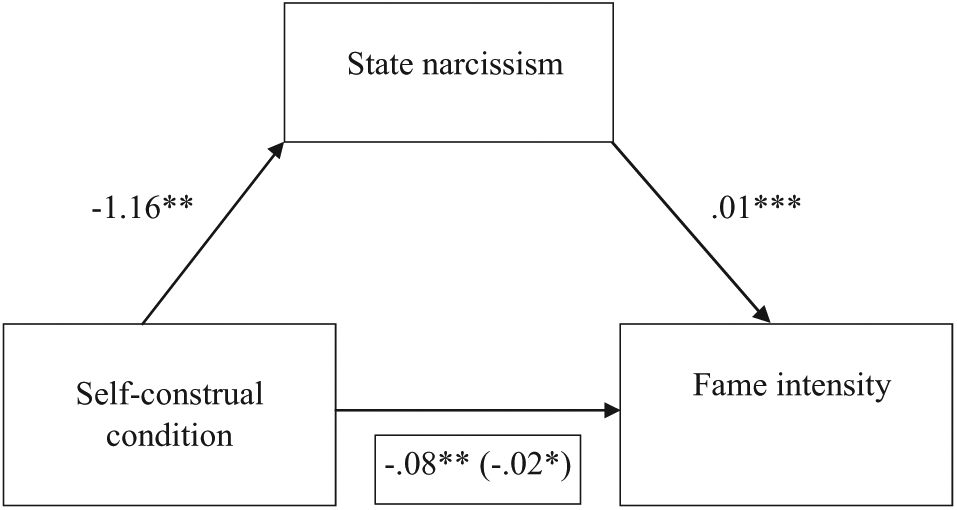
Effect of interdependent self-construal on fame intensity mediated by state narcissism.
A similar pattern was found for the celebrity lifestyle subscale (see Figure 2). When controlling condition, the effect of state narcissism on desire for celebrity lifestyle was significant, b = .04, t(145) = 5.85, p < .001. The indirect effect was also significant, b = −.07 (SE = .03), with the 95% confidence interval excluding 0 (lower bound = −.14, higher bound = −.02). This analysis suggests that the effect of self-construal on the desire for celebrity lifestyle is mediated by state narcissism. 2 Again, a reverse mediation model did not fit the data well, as the confidence interval included zero.

Effect of interdependent self-construal on celebrity lifestyle mediated by state narcissism.
Last, we tested whether changes in narcissism mediated perceptions of how deserving others were of help (see Figure 3). When controlling condition, the effect of state narcissism on perceptions of deservingness was significant, b = −.04, t(161) = −2.39, p = .018. The indirect effect was also significant, b = .06 (SE = .56) with the 95% confidence interval excluding 0 (lower bound = .01, higher bound = .14). These analyses support a model in which the effects of self-construal on perceptions of others’ deservingness of help are mediated by state narcissism. The reverse mediation model included zero in the confidence interval and did not fit the data.

Effect of interdependent self-construal on judgments of how deserving others are of help mediated by state narcissism.
Discussion
Study 4 provides further evidence that communal focus reduces state narcissism. Priming interdependent self-construal caused participants to endorse fewer narcissistic self-descriptions than priming independent self-construal. These changes in state narcissism, moreover, mediated changes in closely-allied constructs. Specifically, priming interdependent self-construal reduced fame intensity (i.e., the overriding desire to be famous) and desire for celebrity lifestyle. It also led participants to perceive others as being more deserving of help. We found evidence that all of these changes were mediated by changes in state narcissism. Study 4 thus provides evidence that the situational changes in narcissism observed in Studies 1 to 3 are psychologically meaningful. A more communal focus makes people less concerned with being famous and more apt to see others as deserving of help, and these changes may be caused by situational reductions in state narcissism.
Notably, changes in state narcissism were not associated with changes in willingness to help. This may be because of the relatively low reliability of the willingness to help measure or because participants were responding to hypothetical scenarios for which it was easy to report willingness to help without incurring personal costs. However, the fact that people experiencing higher levels of narcissism were just as likely to report a willingness to help but viewed others’ as less deserving of help may suggest that they were more motivated by egoistic concerns than those experiencing less narcissism. Being willing to help even those perceived to be undeserving of help may be a way to increase a sense of power and narcissistic esteem. This interpretation is speculative but warrants further investigation.
Supplementary Analyses
One concern with the current findings might be that our results could be driven by demand characteristics. Participants encouraged to adopt a more communal focus on others might intuit that it is inappropriate to endorse self-centered statements on the NPI. A demand characteristic explanation might suggest that the effects found on narcissism would be driven mainly by the interpersonally-oriented items on the NPI. To address this concern, we conducted a series of supplementary analyses for each study, examining underlying factors of the NPI. We examined seven- (Raskin & Terry, 1988), four- (Emmons, 1987), and three-factor solutions (Ackerman et al., 2011) for the NPI within each study. The effect of communal focus on narcissism was not driven by any specific underlying factor of the NPI, as there were no consistent effects across studies on any of the subscales. In particular, factors with more interpersonal content (e.g., Entitlement/Exploitativeness) were not more affected than other factors. These analyses reinforce the impression that narcissism as a whole changes coherently in response to changes in communal focus; it is not simply one facet of narcissism that changes. Indeed, in Study 2b, interdependent self-construal reduced grandiosity (as well as psychological entitlement). Grandiosity is a central component of narcissism but does not include overtly communal content.
We also had two independent raters code the NPI items into two categories: (1) those for which the non-narcissistic option is more communal than the narcissistic option (e.g., “I prefer to blend in with the crowd” vs. “I like to be the center of attention”) and (2) those for which the options are equally communal (e.g., “I always know what I am doing” vs. “Sometimes I am not sure of what I am doing”; Cohen’s kappa = .78). (The narcissistic option was never more communal). Disagreements were resolved through discussion. The coders also rated the communal content of each item, from 1 (no communal content) to 4 (high degree of communal content; interrater reliability = .83). Items for which the forced-choice options are equally communal had significantly less communal content (M = 2.32, SD = 1.21) than those for which the non-narcissistic option was more communal (M = 4.04, SD = 0.66), t(38) = 4.85, p < .001. If demand characteristics are driving our effects, they should be stronger on items for which the non-narcissistic option is more communal. This, however, was not the case. Meta-analyses across all studies (R. Rosenthal, 1979) found that communal focus affected items with similarly communal options (z = 2.74, p = .006) as well as those for which the non-narcissistic option is more communal (z = 2.15, p = .032). These analyses do not support a demand characteristic explanation.
General Discussion
Narcissism has been conceptualized as a coherent set of intra- and interpersonal processes that are mutually reinforcing (e.g., Campbell & Foster, 2007; Morf & Rhodewalt, 2001). Consistent with this view, we examined whether state narcissism is reduced when a core element of narcissism—greater concern with agency than communion—is reduced. Across five studies, we found that increased communal focus decreased narcissistic tendencies. In Study 1, participants induced to feel greater empathy for a person in distress expressed less state narcissism. In Studies 2 to 4, participants primed with interdependent self-construal demonstrated less state narcissism, including grandiosity and entitlement, than those primed with independent self-construal. The effect of self-construal, moreover, was driven by interdependent rather than independent self-construal. In Study 3, participants primed with interdependent self-construal reported fewer narcissistic tendencies than those in a no-prime control condition, whereas those primed with independent self-construal did not differ from control participants. Last, in Study 4, situational changes in narcissism mediated changes in the desire for fame and a celebrity lifestyle and perceptions that others deserve help.
These findings extend theorizing about the nature of narcissism and support models of narcissism that view it as a set of mutually reinforcing elements (e.g., Campbell & Foster, 2007; Morf & Rhodewalt, 2001). We tested the prediction that narcissism has a state-like and context-dependent component that fluctuates across situations. We found that narcissism changes when one element of narcissism, in this case communal focus, is altered. Past research found that when this aspect of narcissism is changed (e.g., increasing a sense of personal connection with another person, or communal activation) some of the negative interpersonal consequences of narcissism are curtailed (Finkel et al., 2009; Konrath et al., 2006). The present studies extend this research by demonstrating that state narcissism changes in accordance with changes in communal focus. That is, a broad range of core narcissistic tendencies are reduced by enhancing a communal focus on others. These changes in state narcissism, moreover, mediated changes in constructs related to narcissism, such as an overriding desire for fame and perceptions that others deserve help. Indeed, we expect that the effects observed by Finkel et al. (2009) and Konrath et al. (2006) reflect underlying changes in state narcissism. Enhancing a communal focus reduces state narcissism, which may in turn reduce many of narcissism’s deleterious consequences.
Our findings are also notable for demonstrating situational changes in narcissism, as measured by the NPI. From a theoretical standpoint, our results suggest that narcissism can function as a state that fluctuates across contexts (Campbell & Foster, 2007; Morf & Rhodewalt, 2001). Research in narcissism has moved beyond a strict categorical conceptualization of narcissism to a dimensional conceptualization (see Foster & Campbell, 2007). The current work challenges a strict trait view of narcissism and aligns research on narcissism more with context-dependent models of personality (Cervone & Shoda, 1999; Mischel & Shoda, 1995). Such models specify that aspects of personality emerge in particular contexts. Our findings suggest that narcissism may be less evident and influential in contexts that highlight communion rather than agency.
From a practical standpoint, it is important for researchers to recognize that situational factors influence scores on the NPI. This insight may have important implications for interpreting narcissism research. Research conducted on university students in exchange for course credit may create an “invisible context” that highlights agency concerns, because participants behave primarily in the context of their academic aspirations, even if their attention is not specifically drawn to them (McConnell, 2011). Such studies may thus give a biased picture of the prevalence of narcissistic tendencies and how they operate. In other contexts, such as among family or friends, communal considerations may be more salient and narcissistic tendencies may be less prominent.
Limitations
As previously mentioned, one concern with the current research may be that our results could be driven by demand characteristics. Indeed, the manipulations of empathy and self-construal in Studies 1, 2a, and 2b may have been fairly transparent to participants. However, a subtle manipulation of communal focus, the I/We prime, also produced changes in narcissistic tendencies. The effectiveness of these subtle manipulations argues against a demand characteristic explanation of our results. This explanation is also difficult to reconcile with the fact that we observed no effects of self-construal on helping intentions in Study 4. Finally, our supplementary analyses demonstrate that communal focus reduced endorsement of NPI items that had little communal content and for which the narcissistic alternatives were not less communal than the non-narcissistic alternatives. It is thus unlikely that our effects reflect the influence of demand characteristics.
Another limitation concerns the nature of our samples. We recruited only non-Asian participants, because Asian individuals are typically less narcissistic and have more interdependent self-construal than North American individuals (Foster et al., 2003; Fukunishi et al., 1996). We reasoned that the inclusion of Asian participants might make it more difficult to test our hypotheses by restricting our ability to effect changes in self-construal or narcissism. This restriction on our samples, however, may have contributed to the fact that we observed changes in state narcissism only in response to interdependent self-construal primes. Because our North American participants were likely already high in independent self-construal, priming independent self-construal may have affected them less than priming interdependent self-construal. With a more culturally-diverse sample, we might have observed changes in narcissistic tendencies in response to increased independent self-construal as well. We could also have tested whether cultural background influences the processes we observed.
Implications for Treating Narcissism
Notably, this research may inform ways to effectively treat narcissism. Although a number of treatments for Narcissistic Personality Disorder (NPD) exist, these treatments have understandably developed before firm empirical evidence could identify factors that cause and maintain narcissism (Thomaes & Bushman, 2011). Recent work has begun to fill this gap with narcissism research conducted in non-clinical samples. This work may provide important insights into factors that contribute to NPD (Miller & Campbell, 2010a, 2010b). Identifying such factors is critical for designing effective interventions to reduce narcissistic tendencies. Recent findings, as noted earlier, suggest that communal focus can reduce some of the deleterious consequences of narcissism (Finkel et al., 2009; Konrath et al., 2006). Our results extend this work by suggesting that state narcissism can be reduced by increasing communal focus. Our findings thus help to establish a causal connection between communal focus and narcissism that can inform interventions.
As with other basic research that identifies factors that contribute to narcissism, our work does not delineate clear-cut treatment strategies (Thomaes & Bushman, 2011). A number of steps must be taken before our work can meaningfully inform interventions. First, strategies must be developed to ensure that initial changes in narcissism can be maintained over longer durations. The findings observed here are likely short-lived, but they can inform efforts to effect long-term changes in narcissism. Techniques have been developed to induce prolonged changes in communal focus (Gilbert, 2005; Hofmann, Grossman, & Hinton, 2011). Our findings suggest that these approaches may reduce narcissism. It will be particularly important, however, to test directly whether such interventions are effective for individuals with NPD. Although we did not observe any moderating effects of initial narcissism, our samples likely did not contain many individuals who would meet the clinical criteria for NPD.
Reducing narcissism by enhancing communal focus is a promising approach because it does not require “tearing down” narcissists’ grandiosity but rather increasing narcissists’ communal concerns and sense of connection to others (see Campbell & Foster, 2007). This approach may thus defuse narcissists’ defensive tendencies. Increasing a communal focus, in combination with established treatments for narcissism, may be a “safe” way to reduce narcissism without engendering defensive resistance to treatment. Indeed, it may be a particularly desirable approach to reducing narcissism because we found that it did not concomitantly reduce self-esteem. The adaptive consequences of narcissism are entirely mediated by self-esteem (Sedikides et al., 2004), so increasing communal focus may reduce the maladaptive aspects of narcissism without undermining its more adaptive elements.
Conclusions
This research helps to further delineate the nature of narcissism. Campbell and Foster (2007) suggested that narcissism can function as a state, fluctuating within individuals across situations as elements of narcissism are enhanced or diminished. The present studies are, to our knowledge, the first to directly examine situational changes in narcissism. Past research has found that changing one element of narcissism (e.g., increasing a sense of connection to others) can curtail some of the detrimental consequences of narcissism (e.g., Finkel et al., 2009; Konrath et al., 2006). Across five studies, we extend this research by demonstrating that communal focus reduces a broad range of narcissistic tendencies, reflected in state narcissism. Thus, narcissism may have a state-like component that waxes and wanes across situations, particularly as one feels more or less connected to others. Although there are stable individual differences in narcissism that may have a heritable component (Holtzman & Strube, 2011), our findings suggest that there are also meaningful within-person variations in narcissism. Our findings may imply that everyone has the propensity to be narcissistic in some situations but also that we can be less narcissistic by focusing more communally on other people.
Footnotes
Acknowledgements
We thank Joseph Hayes, Ian McGregor, and Virgil Zeigler-Hill for valuable feedback on drafts of this article.
Declaration of Conflicting Interests
The author(s) declared no potential conflicts of interest with respect to the research, authorship, and/or publication of this article.
Funding
The author(s) disclosed receipt of the following financial support for the research, authorship, and/or publication of this article: This research was supported by a research grant from the Social Sciences and Humanities Research Council of Canada to the second author.