




Abstract
A major barrier to conflict resolution is group members’ tendency to hold on to the ingroup’s narrative of the conflict and reject the outgroup’s perspective. In the current research, we propose that voicing internal criticism to an outgroup crowd can undermine such orientations and foster intergroup openness. Across four experiments, Israeli Jews who were exposed to a Palestinian criticizing Palestinians were more open to the Palestinians’ perspective of the conflict, than those not exposed to the criticism. This effect was obtained when the criticism was related (Study 1) and unrelated (Study 2) to the conflict, and was consistently mediated by increased hope about the future relations between the groups. Study 3 showed that the effect is more pronounced among those who believe that groups can change. Study 4 established that perceptions about the outgroup as open-minded underlie the effect of ingroup criticism on hope, and further demonstrated downstream effects of openness.
People have generally little incentive to voice criticism against their own group. This is especially true when such criticism would be at odds with what the rest of the group thinks, and as such would render the internal criticizer a deviant. A great deal of research has documented the negative responses of groups to non-normative (or deviant) behavior of their members, ranging from negative evaluations to exclusion from group boundaries (e.g., Eidelman, Silvia, & Biernat, 2006; Levine, 1989; Packer, 2008; see Tata et al., 1996, for meta-analysis). Moreover, research on the black sheep effect has shown that ingroup members who express deviant opinions are evaluated even more negatively than outgroup members who hold the same views (Eidelman & Biernat, 2003; Eidelman et al., 2006; Marques & Paez, 1994). In the current research, we offer that voicing a deviant opinion in the form of internal criticism, although costly when considering reactions from within the ingroup, can instigate positive consequences when considering reactions from outgroup members. Our central proposition is that expressions of internal criticism, when communicated to the outgroup within the context of intergroup conflict, can open the minds of outgroup members exposed to that criticism.
Previous research on group-directed criticism has focused mostly on reactions of ingroup members to others voicing criticism against their own group (e.g., Chan, Louis, & Hornsey, 2009; Hornsey, Grice, Jetten, Paulsen, & Callan, 2007; Hornsey, Trembath, & Gunthorpe, 2004). For example, to the extent that ingroup members are considered committed to their group (and thus motivated to benefit the group with their criticism), the more positively their critique is received by fellow group members (Hornsey et al., 2004; see Hornsey, 2005, for a review). This issue was also studied in the context of intergroup communication with the focus being the reactions of people to criticism against their group, originating from an outgroup member. Although generally negative (Hornsey & Imani, 2004), unfavorable reactions to outgroup members who criticize the ingroup were found to be attenuated when the criticizer conveyed that both his group and the criticized group share the same flaws (Hornsey, Robson, Smith, Esposo, & Sutton, 2008). For example, Australians who were exposed to an American criticizing Australians for being racist responded less negatively to the criticizer when s/he mentioned that Americans are racist as well (Hornsey et al., 2008; Study 2). According to Hornsey and colleagues, once outgroup members voice criticism against their own group as well, they are perceived as more motivated to benefit one’s ingroup with the criticism, thereby eliciting less resistance.
In the current research, we also focus on group-directed criticism in the context of intergroup communication, but we take a different perspective than the one dominating previous work. Instead of considering reactions of people to criticism against their ingroup originating from an outgroup member, we consider reactions of people to criticism against the outgroup originating from an outgroup member. Stated differently, we examine how people react to an outgroup member who voices internal criticism against his or her own group. The research reviewed above (Hornsey et al., 2008) suggests that the communication of internal criticism to an outgroup crowd can buffer against the negative reactions people typically have toward an outgroup criticizer. We draw on this work and extend it in two important ways. First, we consider the communication of internal criticism to an outgroup crowd in the absence of any other critique directed against the listeners’ group. Thus, we are interested in testing the unique impact of voicing internal criticism to an outgroup crowd. Second, we study reactions to internal criticism in the context of intergroup conflict, in which relations between groups are characterized by rigid and destructive intergroup orientations.
Indeed, groups that are involved in long-term conflicts tend to hold on to the ingroup’s narrative of the conflict and reject the outgroup’s perspective (Bar-Tal & Halperin, 2009). Such tendencies are characterized by rigidity and closed-mindedness such that information that fits the reigning cognitive-emotional structure is accepted as valid while incongruent information is processed in a biased and distorted manner (Bar-Tal, 2007; see Kruglanski, 2004, for related work on cognitive freezing). Dating to the classic work of Kurt Lewin (1947/1976), those trying to promote conflict resolution have considered these rigid orientations as a major challenge, which stabilizes negative attitudes and emotions among groups in conflict. Indeed, according to Bar-Tal and Halperin (2009), successful conflict resolution processes should ultimately stimulate openness to outgroup’s views and narratives. The authors further offer that messages or ideas that create internal tension between one’s held beliefs and the new information can be successful in stimulating people to question their basic positions and search for alternative beliefs. Little work, however, has managed to identify these messages or ideas which can challenge entrenched attitudes and emotions among groups in conflict and drive openness to the outgroup’s views.
We propose that a message from the outgroup conveying internal criticism can stimulate openness to the outgroup views due to its potential to affect the way group members view the future of the conflict. In particular, we argue that exposure to an outgroup member voicing internal criticism can convey the sense that unlike always, there is someone in the other side who can listen to the ingroup’s perspective on contested issues. Groups in conflict tend to view one another as generally biased, ideologically driven, and rigid (Pronin, 2007; Pronin, Gilovich, & Ross, 2004). In the contexts of violent intractable conflicts, such perceptions are intensified and involve the de-legitimization of the outgroup as an unviable counterpart (Bar-Tal, 2007). Hearing an outgroup member voicing a view that has elements of inward criticism can produce the opposite view of the outgroup as an open-minded partner.
Such a message can be impactful also due to its relative balanced, or two-sided, nature (Hovland, Janis, & Kelley, 1953). Research on persuasion has shown that two-sided messages (i.e., those highlighting more than a single perspective on a matter) are generally more persuasive and considered more credible than messages that are one-sided (e.g., Crowley & Hoyer, 1994; Faison, 1961). The two-sided message is even more credible and effective when it includes content which appears to contradict the goals of the communicator (Kelman & Hovland, 1953). While people in the context of intergroup conflict are used to listen to one-sided messages coming from the outgroup, a message conveying internal critique may signal a different way of thinking on part of one’s opponent—one that is more balanced and considerably less rigid.
Such perceptions can be extremely important in generating a hopeful feeling that there might be a way of resolving the conflict and stepping out of the vicious violent cycle. For example, in the context of the Israeli–Palestinian conflict, one of the most repeated claims is that there is no hope for peace because there is no partner in the other side with whom to resolve the conflict (Halperin & Bar-Tal, 2007). Thus, the sense that there is an open-minded partner on the other side can drive a positive outlook on the future of the relations between the groups. Such outlook is what defines hope in the context of intergroup relations (Breznitz, 1986; Snyder, 1994). Previous studies have identified hope as a crucial emotion for promoting conflict resolution (Bar-Tal, 2001; Coleman, 2003). Hope facilitates goal setting, planning, use of imagery, creativity and cognitive flexibility (Breznitz, 1986; Snyder, 1994). As such, it can enable members of groups in violent conflict to consider new paths with respect to the conflict, and to imagine a future that is different and better than the present (Cohen-Chen, Halperin, Crisp, & Gross, 2014; Jarymowicz & Bar-Tal, 2006).
Our goal in the current research was to provide empirical support for the association between exposure to the outgroup conveying internal criticism, hope, and openness to the outgroup in the context of intergroup conflict. On one hand, hope generated by ingroup criticism may reflect the sense that the other side would simply agree more with one’s own perspective. On the other hand, however, such hope may reflect the view of the outgroup as open minded and can thus instigate a positive spiral of affairs, leading the ingroup to reciprocate, and open up to the outgroup’s perspective. We hypothesized that the second process may be more valid and thus, aimed to establish the effect of exposure to ingroup criticism on openness to the outgroup’s views, via the mediating role of hope.
We conducted four experiments, all in the context of the Israeli–Palestinian conflict, one of the most consequential and heated conflicts in the world today. Across studies, our participants were Israelis who were either exposed or not to a Palestinian voicing internal criticism against his group (i.e., against the Palestinians). The first two studies examined the proposed causal link among exposure to the criticism, hope regarding the future relations, and openness to the outgroup’s perspective. In Study 1, the criticism was directly related to the conflict, and in Study 2 it was unrelated to the conflict, providing a test of the external validity of the effect. In Study 3, we tested for potential boundary conditions. Study 4 tested the mechanism behind the effect of ingroup criticism on hope, and further tested for downstream effects of openness.
Study 1
In Study 1, Israeli Jews were presented with a fictitious report that either included or did not include a statement by a “Palestinian official” voicing internal criticism about the Palestinians. The internal critique was about the conflict and specifically about the behavior of Palestinians toward Israelis being extremely violent. We then measured participants’ hope about the future relations with Palestinians, and their openness to the Palestinian narrative. We expected participants who were exposed to the criticism to be more open to the outgroup perspective via feelings of hope.
Method
Participants were 91 students, all Israeli Jews (61% women; Mage = 23.28, SD = 2.03) who completed a survey online for partial course credit. The online survey opened with a brief report, allegedly written by a UN committee, summarizing information regarding the Israeli–Palestinian conflict. Across conditions, the report included an emphasis on the number of casualties in each side in recent years. In the ingroup criticism condition, this report was followed by a quote by a Palestinian official who commented,
The Palestinians’ violence against Israel was exaggerated and unnecessary. It reflects Palestinians’ lack of values. It is time that we, as a society, will find other solutions to the conflict, which would not cost in innocent people’s lives. No doubt that we acted too violently in recent years toward innocent Israeli civilians.
In the no-criticism condition, the report did not include this statement.
Participants then completed the outcome measures which, unless otherwise indicated, were rated on a scale from 1 (not at all) to 7 (very much). To measure hope regarding the intergroup relations, participants indicated the extent to which they feel “Hope,” “Optimism,” and “Despair” (r) regarding the future relations between Palestinians and Israelis (α = .85). To assess openness to the outgroup perspective, participants rated the extent to which they would be interested in “disseminating the Arab point of view of the conflict to the general Israeli public,” “watching movies or reading books which present the Palestinian point of view of the conflict” (r = .70, p < .01). Given the central role that political affiliation in Israel plays in determining attitudes toward Palestinians and toward conflict-related views, we further asked participants to indicate their political orientation on a 7-point scale ranging from 1 (extreme left) to 7 (extreme right).
Results
We first ran an ANOVA on hope and on openness with condition as an independent variable. Participants who were exposed to the Palestinian criticizing the Palestinians were more hopeful about the relations between Israelis and Palestinians (M = 3.90, SD = 1.60) than those in the control condition (M = 2.62, SD = 1.12), F(1, 89) = 19.15, p = .001,
We next tested a mediation model using Hayes’s (2012) PROCESS Macro. The independent variable was the criticism condition, the mediator was hope and the dependent variable was openness to the outgroup perspective. As indicated in the ANOVAs, the condition predicted more hope (b = 1.28, SE = .29, t = 4.38, p < .01) and more openness to the outgroup perspective (b = 0.73, SE = .34, t = 2.15, p < .05). In addition, hope was associated with openness (b = 0.39, SE = .12, t = 3.37, p < .01). Most importantly, the effect of the condition on openness was reduced after the mediator was entered into the model (b = 0.23, SE = .36, t = 0.64, p = .52) such that the indirect path through hope was significant (a × b = .50, 95% confidence interval [CI] = [0.22, 0.95]).
Discussion
Study 1 provided initial evidence to our hypothesis that exposure to an outgroup member communicating internal critique increases openness to the outgroup perspective via an increased sense of hope regarding the intergroup relations. Notwithstanding this support, Study 1 suffers from two drawbacks. First, the criticism voiced by the Palestinian was about the conflict and specifically about Palestinians’ behavior toward Israelis. As such, the effect could be ascribed to the sense that the Palestinian official agrees with what the participants think, which could have little to do with voicing criticism per se. In addition, the manipulation used in Study 1 primed issues related to violence between the groups—which may limit the ability to generalize the effect of ingroup criticism to other domains. Study 2 was designed to address these limitations.
Study 2
In Study 2 we aimed to establish the external validity of the effect found in Study 1 by testing whether it would hold when the conveyed criticism has little to do with the intergroup conflict. Such replication would suggest that the effect of criticism on openness is not due to a sense of similarity between the Palestinian and Israeli views of the conflict, but rather has more to do with voicing internal criticism per se. For that purpose, Israeli Jews were again presented with a fictitious report that either included or did not include a statement by a “Palestinian official” voicing internal criticism. To avoid mentioning of the conflict between the two sides, the report was a dry summary of world facts including data about the level of education in various countries (including the Palestinian authority). In the criticism condition, this report was followed by a Palestinian official criticizing the level of education in the Palestinian authority. We measured the same constructs as in Study 1, and again expected the criticism condition to increase openness to the outgroup perspective through the mediation of hope.
Method
Participants were 74 Israeli Jews (53% women; Mage = 29.34, SD = 13.75). All completed a survey which included (or did not include) the manipulation of ingroup criticism followed by the measures (as in Study 1). Due to constraints on the number of participants available through the students subject pool, about half of the sample included students who completed the survey for partial course credit (44%) and the rest were train passengers who completed the survey in exchange for chocolate while riding the train. There were no differences between the samples on any of the measures.
For all participants, the survey opened with a short report summarizing general information regarding health, education, demographics, and culture in several countries around the world, including the Palestinian authority. Among other data, the report mentioned that the Palestinian authority is relatively poor with respect to education-related achievements. In the ingroup criticism condition, this report included the following quote by a Palestinian official:
The data about the level of education in the Palestinian authority should bother all Palestinians. Palestinians are indifferent when it comes to the education of their children and this is clearly reflected in the low level of schooling. It is time that we, as a society, will put more emphasis on promoting education and would invest more in our children. This is a matter of governmental policy and the Palestinian authority should dedicate resources to this end.
In the control condition, the report did not include this ingroup criticism.
Participants then completed a measure of hope with the same items used in Study 1 (α = .67). To the measure of openness to outgroup perspective, we added the following item, which was found to increase the reliability of the scale in previous work (Halperin & Bar-Tal, 2011): “Meeting with Palestinians to hear their point of view of the conflict.” Indeed, the composite measure was highly reliable (α = .85). Finally, we again assessed demographic information and political affiliation.
Results
An ANOVA with condition as an independent variable revealed that participants who were exposed to the Palestinian criticizing the Palestinians were more hopeful about the relations between Israelis and Palestinians (M = 3.63, SD = 1.42) than those in the control condition (M = 2.61, SD = 1.30), F(1, 71) = 9.31, p = .003,
We next ran the same mediation model, as in Study 1. As indicated in the ANOVAs, the condition predicted more hope (b = 1.01, SE = .34, t = 2.99, p = .004) and more openness to the outgroup perspective (b = 0.85, SE = .42, t = 2.04, p < .05). In addition, as in Study 1, hope was associated with openness (b = 0.42, SE = .14, t = 3.01, p < .05). Supportive of our mediation hypothesis, the effect of the condition on openness was reduced after hope was entered into the model (b = 0.43, SE = .42, t = 1.01, p = .32). Further consistent with Study 1, the indirect path through hope was significant (a × b = .43, 95% CI = [0.10, 0.98]).
Discussion
This study demonstrated that the effect of ingroup criticism on outgroup openness via an increased sense of hope, obtained in Study 1, holds also when the criticism is unrelated to the conflict. This replication indicates that the criticism communicated by the outgroup does not have to map directly to the ingroup’s views regarding the conflict—but can involve rather new information that has elements of inward critique.
Despite the support that the first two studies lend to our ideas, the experimental condition in them included both the criticism and the outgroup representative voicing it—making it difficult to determine what drives the effects—the source or the content of the criticism. It could be the case that when people are exposed to criticism about their enemy, they become more hopeful and open to the outgroup’s perspective simply because they feel validated or affirmed as group members (see Čehajić, Effron, Halperin, Liberman, & Ross, 2011). To rule out this possibility, in Study 3, we exposed all participants to criticism about the outgroup and varied the source of that criticism to be either an outgroup representative or a third party. If the criticism has to be voiced by an outgroup member to be effective, the same message voiced by a third party will not have similar effects. In addition, in Study 3, we aimed to further our understanding of the effects obtained in Study 1 by examining potential boundary conditions.
Study 3
The primary goal of Study 3 was to examine whether it has to be an outgroup source, and not just any source, voicing internal criticism in order to obtain the effects of the criticism on hope and openness. Israeli-Jewish participants were exposed to criticism about the Palestinians either originating from a Palestinian official, a European Union official, or a Chinese official. We included two types of third parties because we suspected that Israeli participants might consider a European official to be pro-Palestinian. Criticism against Palestinians coming from a pro-Palestinian party might be more impactful (i.e., resembling the condition in which a Palestinian voices the critique) compared with when the same criticism is coming from a neutral third party. To account for this possibility, we added a condition of a Chinese official to the design. Given China’s little involvement in the Israeli–Palestinian conflict, a Chinese official might be considered a rather neutral third party. Thus, the design of Study 3 enabled us to explore potential differences in reactions to messages from third parties that vary in their perceived alignment with the outgroup.
Our second goal in Study 3 was to investigate potential boundary conditions of the effects. The influence of internal criticism on hope and openness is likely to be dependent on people’s belief that the criticism signals potential change among outgroup members. As such, for the criticism to be effective, people have to believe that changes in groups are generally possible. Therefore, the effects we observed may be moderated by the extent to which individuals believe that groups in general can change (Rydell, Hugenberg, Ray, & Mackie, 2007). Believing that groups cannot change may lead people to have little faith in the potential improvement of relations with the outgroup. Recent research demonstrate that the belief in the malleability of groups increases support for political compromises (Halperin, Russell, Trzesniewski, Gross, & Dweck, 2011) and for interacting with outgroup members (Halperin, Crisp, Husnu, Dweck, & Gross, 2012). Drawing on these ideas, we predicted that participants who generally do not believe that groups can change would be less affected by the internal criticism manipulation that those who believe groups can change.
Method
Participants were 83 Jewish Israelis (45 men, 29 women, 9 unspecified, Mage = 31.60, SD = 13.70) who were passengers on a train. All were exposed to the same alleged UN report used for Study 1, summarizing information regarding the Israeli–Palestinian conflict in recent years. Across conditions, the report ended with the same comment as in Study 1 by an official criticizing the Palestinians for being too violent against Israel. In one condition, the official was a Palestinian; in another condition, he was “a European Union official”; and in the third condition, he was “a Chinese official.” Participants then completed measures of hope (α = .66), openness to outgroup perspective (α = .83), political affiliation, and demographic information with the same items used in Study 2.
To test potential moderating effects, prior to the presentation of the manipulation, we asked participants to answer four items assessing their belief in the malleability of groups (Halperin et al., 2012; Halperin et al., 2011): “Any group can substantially change its basic characteristics,” “Every group has values and beliefs that cannot be substantially changed” (r), “It is impossible to change the basic characteristics of different nations and groups” (r), “Groups that have radical and violent characteristics will never change, as these characteristics are deeply ingrained within them” (r; α = .70).
Results
To test our predictions, we ran a planned contrast comparing the Palestinian condition (weighted as 2) with the other two conditions involving either a European or a Chinese criticizing the Palestinians (weighted as −1 each). Another orthogonal contrast compared the European condition (weighted as 1) with the Chinese condition (weighted as −1). The analyses revealed that, as expected, participants who were exposed to the Palestinian criticizing the Palestinians were more hopeful about the relations between Israelis and Palestinians (M = 3.93, SD = 1.78) than those exposed to a European (M = 3.13, SD = 1.36) or to a Chinese (M = 2.83, SD = 1.18) criticizing the Palestinians t(77) = 2.72, p = .008. Furthermore, exposure to the Palestinian official criticizing his group increased openness to the Palestinians’ perspective (M = 4.93, SD = 1.40) relative to the other two conditions (M = 3.65, SD = 1.88 in the European condition and M = 3.68, SD = 1.87 in the Chinese condition) t(76) = 3.1, p = .004. Across measures, there were no significant differences between participants exposed to the European and Chinese conditions, p > .35. As in Studies 1 and 2, for both measures, there were no significant interactions of the condition with political affiliation.
We next ran a mediation model similar to the one used in Studies 1 and 2, specifying the criticism source as the independent variable (the European and Chinese conditions, which did not differ on any of the measures, were combined and coded as 0 and the Palestinian condition was coded as 1), hope as the mediator, and openness to the outgroup perspective as a dependent measure. The condition predicted more hope (b = 0.94, SE = .35, t = 2.66, p = .009) and more openness to the outgroup perspective (b = 1.27, SE = .42, t = 3.03, p = .003). In addition, hope was associated with openness (b = 0.42, SE = .13, t = 3.28, p = .002). Supportive of our mediation hypothesis, the effect of the condition on openness was reduced after hope was entered into the model (b = 0.87, SE = .41, t = 2.13, p = .04). Further consistent with Studies 1 and 2, the indirect path through hope was significant (a × b = .39, 95% CI = [0.08, 0.91]).
Finally, we turned to test potential moderating effects. Using Hayes’s PROCESS macro (specifying model 7, which conducts a test of moderated mediation), we considered beliefs in the malleability of groups as a potential moderator of the mediation model predicting openness to the outgroup perspective via hope. This analysis tests whether the indirect effect of condition on openness through hope remains significant at different levels of the moderator (1 SD below the mean, at the mean level, and 1 SD above the mean). Findings revealed that consistent with our predictions, the effect of condition on hope was moderated by perceptions of group malleability (b = 0.53, SE = .26, t = 2.04, p = .04) such that the effect of condition on openness through hope was significant only among participants who had a relatively strong belief in groups as malleable (those who scored 1 SD above the mean of the malleability measure; a × b = .38, 95% CI = [0.04, 0.97]). There was no mediated effect through hope for those who scored at the mean of the malleability measure (a × b = .18, 95% CI = [−0.01, 0.56]) or 1 SD below the mean (which meant weaker beliefs that groups can change; a × b = −.02, 95% CI = [−0.41, 0.38]).
Discussion
The results of Study 3 further supported our theorizing about the influence of internal criticism on openness to the outgroup perspective. Israelis who heard a Palestinian criticizing Palestinians, relative to those who heard the exact same information communicated by a third party, were more hopeful about the future relations with Palestinians and were more open to the outgroup perspective. These findings further corroborate our ideas and suggest that the source of the inward critique has to be the outgroup itself, to exert the predicted effects.
Moreover, Study 3 suggests that even when the third party communicating the critique is considered to be (to some extent) aligned with the outgroup’s perspective (i.e., a European official), there is still a significant difference between exposure to such a source and exposure to an outgroup source (i.e., a Palestinian). Study 3 further demonstrated that participants, who had initial beliefs that groups are of fixed nature and cannot change, were not affected by the manipulation. Indeed, the effect of internal criticism on hope, and thereby on openness, was only relevant for those who held the view that groups are of malleable nature. These findings are highly consistent with previous work showing the constructive effects of malleability beliefs, particularly in the context of intergroup conflict (Halperin et al., 2012; Halperin et al., 2011).
Notwithstanding the support that Studies 1 to 3 lend to our predictions, the mechanism that connects ingroup criticism to increased feelings of hope remains unclear. Another related issue that Stu dies 1 to 3 have not addressed is whether the effect of voicing ingroup criticism can go beyond openness to influence actual political views related to the conflict. Study 4 was designed to address these open questions.
Study 4
As we noted earlier, the communication of ingroup criticism can lead individuals to view the outgroup in a fresh light, as more open-minded than usual. Given that hope is often offset by perceptions of the outgroup as rigid, views of the outgroup as more open-minded may be a critical instigator of hope. To examine this proposition and to explore the role of alternative mechanisms, in Study 4, we considered a range of variables that could play a mediating role between the communication of criticism and hope, and tested whether perceptions of the outgroup as open-minded play a unique role in explaining that effect.
Specifically, in addition to measuring perceptions of the outgroup as an open-minded partner, we included a more general measure of outgroup attitudes. This measure enabled us to examine whether viewing the outgroup as open-minded has a unique effect in driving hope, over and above general outgroup liking. In addition, we measured perceptions of cross-group commonality (Saguy, Tausch, Dovidio, & Pratto, 2009) to further establish that the effect of criticism on hope and openness is not simply a result of perceiving more similarity across group lines. Finally, we included a measure of outgroup variability (Brauer & Er-rafiy, 2011). Listening to an outgroup member voicing internal criticism may convey the sense that not all outgroup members are the same, which may in turn drive hope as well. The inclusion of this range of measures enabled us to examine which is significantly influenced by our manipulation, and which may explain the expected effect of the manipulation on hope.
To further understand the nature of hope in our studies, we attempted to better understand its consequences. To that end, we first revised our measure of outgroup openness. After listening to the outgroup voicing internal critique, hope may, arguably, reflect the sense that the outgroup views have shifted to be more similar to those of the ingroup. If this is the case, then our measure of openness, which was used in Studies 1 to 3, may reflect openness to the outgroup views which are now considered to be more similar to the ingroup’s perspective. To get a better sense of the nature of outgroup openness, it is therefore important to clarify which outgroup perspective the ingroup is more open to. We therefore revised our measure of outgroup openness to directly indicate openness to the classic outgroup views, which are clearly at odds with those of the ingroup. This revised measure, in addition to the range of potential mediators of the effect of criticism on hope, would further enable us to provide richer and more conclusive empirical case for our proposed effect.
Finally, to further understand the impact of exposure to the outgroup communicating internal criticism, we added a measure that captures willingness for political compromise in Study 4. Previous work has shown that openness to the outgroup’s views can increase support for political compromises (Halperin & Bar-Tal, 2011). According to that approach, at least some of the opposition for compromises can be attributed to lack of in-depth understanding of the other side’s views. Demonstrating that openness to the outgroup perspective drives willingness for political compromise would indicate that the effects obtained in Studies1 to 3 reflect a meaningful change in how Israelis view Palestinians.
Method
Participants
Ninety-six Israeli Jews (49% women; Mage = 36.96, SD = 11.55) were recruited online through a panel system. Each received about 20 NIS (equivlanet of $5) for participation.
Procedure and measures
The manipulation of ingroup criticism was identical to the one used in Study 1. All participants read an alleged UN report about the Israeli–Palestinian conflict. In the criticism condition, the report was followed by a quote by a Palestinian official communicating internal critique, and in the no-criticism condition, the report did not include the critical statement. Participants then completed the outcome measures which, unless otherwise indicated, were rated on a scale from 1 (not at all) to 7 (very much).
To measure perceptions of the outgroup as open-minded, participants indicated their agreement with the following items: “The text made me feel there is a chance that the Palestinians will open up and listen to the Israeli side of the conflict,” “The text made me feel that perhaps finally there will be an open ear in the Palestinian side to our side of the story,” and “The text made me feel there is a chance for a real partner for negotiations in the Palestinian side” (α = .94). To assess general outgroup attitudes, participants indicated their feelings toward Palestinians on a thermometer ranging from 0 (very cold) to 100 (very warm). To assess perceptions of cross-group commonalities, participants were asked to rate their agreement with the following statement: “I think Israelis and Palestinians have much in common.” Outgroup variability was assessed using the items: “I regard Palestinians as different from one another,” “Among the Palestinian there are all kinds of people,” and “Most Palestinians think similarly” (r; α = .61).
We measured hope with the same items as in Studies 2 and 3 (α = .78). For our revised measure of outgroup openness, participants rated the extent to which they would be interested in “disseminating the Arab point of view of the conflict to the general Israeli public, reflecting the Palestinian classic narrative,” “watching movies or reading books which present the Palestinian point of view of the conflict as reflected in the Palestinian classic narrative, ” and “meeting personally with Palestinians to hear their point of view of the conflict, even if that point of view is opposite to yours” (α = .86, p < .01). Finally, to assess willingness for political compromise, we asked participants to indicate the extent to which they support a compromise on one of the most contentious issues separating Israelis and Palestinians today: the refugee problem. The item was worded as follows: “Given a peace agreement, to what extent do you support Israel taking partial responsibility for the refugee problem by allowing a limited number of refugees to enter Israel?” Responses on this measure ranged from 1 (not at all) to 7 (very much). Following the completion of these measures, participants completed demographic information, including political affiliation on a scale ranging from 1 (extreme right wing) to 7 (extreme left wing).
Results
We first examined the zero-order correlations among all measures. As indicated in Table 1, hope was associated with greater perceptions of outgroup open-mindedness, more positive outgroup attitudes, stronger perceptions of cross-group commonality and of outgroup variability, and with more willingness for political compromise. We next run an ANOVA on each of these outcome measures to examine whether these were shaped by the manipulation of ingroup criticism. As specified in Table 2, these analyses indicated that in the criticism condition (relative to control), participants had stronger perceptions of the Palestinians as open-minded, were more hopeful about the future of the intergroup relations, and, as in our previous studies, were more open to the Palestinians’ point of view of the conflict. Importantly, given our revised measure of openness, the latter effect indicated that the perspective the Israelis were more open to was the one reflected in the classic narrative of the Palestinians, suggesting that Israelis were willing to hear a perspective much different from their own. The analyses further revealed two marginally significant effects. One indicating that exposure to the criticism somewhat increased perceptions of cross-group commonalities, and the other indicated that although participants were generally reluctant to politically compromise, they were somewhat more willing to do so in the criticism condition. None of these effects was moderated by political affiliation. As further indicated in Table 2, the manipulation did not exert a significant effect on outgroup attitudes and outgroup variability. These findings suggest that exposure to the outgroup communicating criticism did not generate general positivity toward the outgroup, but rather a specific view of the outgroup as open-minded.
Means, Standard Deviations, and Zero-Order Correlations Among Variables in Study 4.
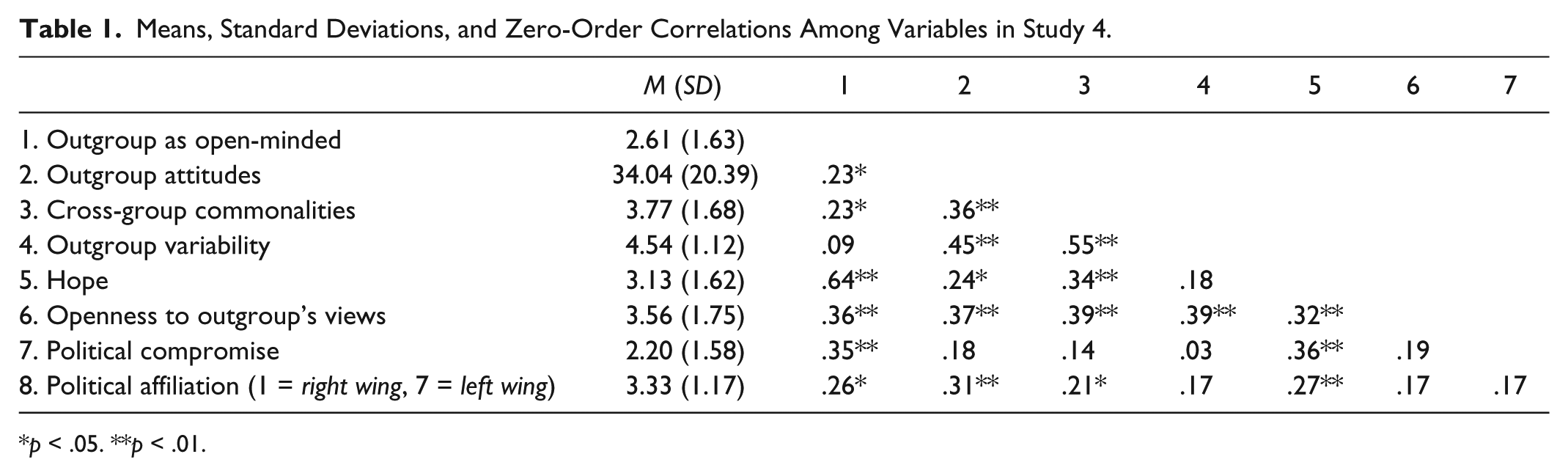
p < .05. **p < .01.
The Effect of the Manipulation on All Dependent Measures in Study 4 (Means and Standard Deviations of Each Condition, F Values, p Values, and Effect Size).
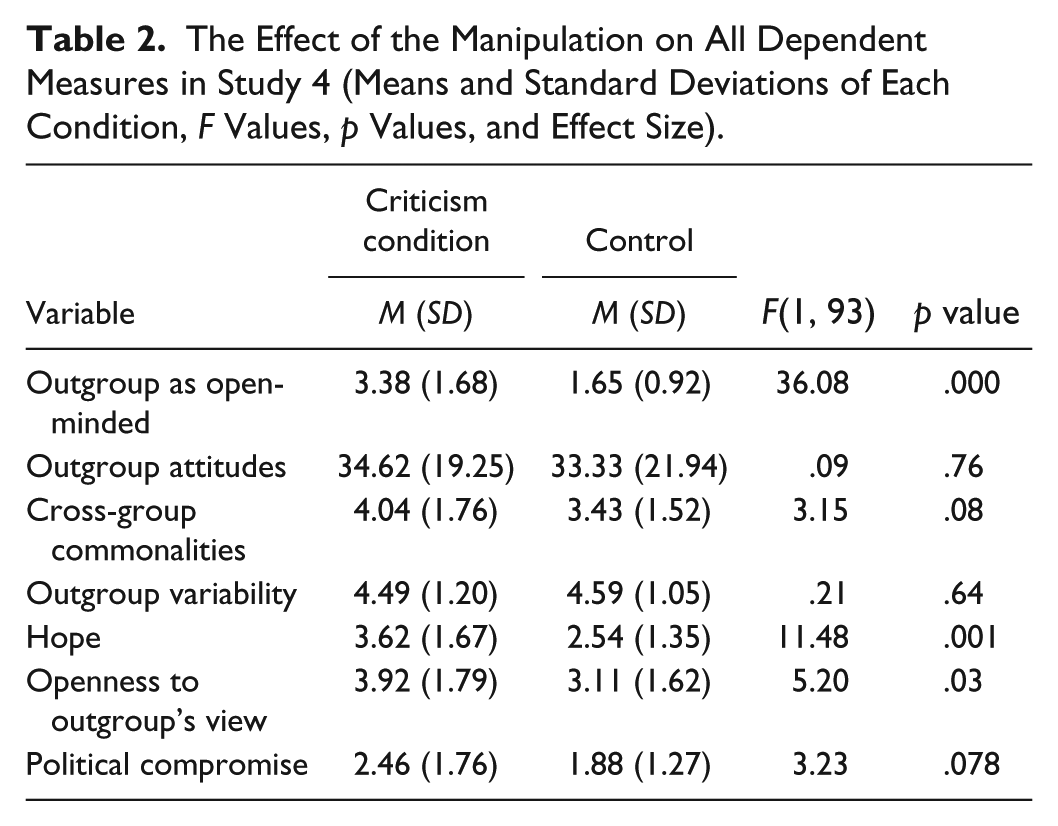
We next turned to examine whether perceptions of the outgroup as open-minded play a mediating role in explaining the effect of ingroup criticism on hope. To that end, we ran a mediation model specifying ingroup criticism as the independent variable and hope as the outcome. Beyond considering outgroup open-mindedness as a mediator, we also added perceptions of cross-group commonalities as a potential mediator given that the manipulation had a marginally significant effect on it. As indicated in the ANOVAs, the condition predicted stronger perceptions of outgroup open-mindedness (b = 1.73, SE = .29, t = 6.01, p < .001), more hope (b = 0.76, SE = .25, t = 3.05, p < .01) and also, somewhat, perceptions of cross-group commonalities (b = 0.61, SE = .34, t = 1.78, p = .079). In addition, outgroup open-mindedness was associated with hope (b = 0.39, SE = .08, t = 5.06, p < .01), as was cross-group commonalities (b = 0.13, SE = .07, t = 1.99, p < .05). Supportive of our mediation hypothesis, the effect of the condition on hope was reduced after the mediators were entered into the model (b = 0.01, SE = .25, t = .04, p = .97). Tests of the indirect effects indicated that the indirect path through outgroup open-mindedness was significant (a × b = .69, 95% CI = [0.41, 1.05]), whereas the indirect effect via cross-group commonalities was not (a × b = .08, 95% CI = [−0.003, 0.24]). Thus, as we hypothesized, viewing the outgroup as more open-minded drove the effect of criticism on hope, over and above other outgroup perceptions, even those somewhat impacted by the criticism manipulation such as perceptions of cross-group commonalities.
We next turned to examine the full hypothesized model, linking ingroup criticism, via the mediating roles of outgroup open-mindedness and in turn hope, to openness. This model also included willingness for political compromise as the ultimate outcome resulting from openness (see Figure 1). We assessed this model with structural equation modeling (SEM) using the AMOS 19 software. To assess overall model fit, we used the chi-square test, the comparative fit index (CFI), and the root mean square of approximation (RMSEA). A satisfactory fit is generally indicated by a non-significant χ2, a χ2/df ratio ≤ 3, a CFI ≥ .95, and a RMSEA ≤ .08 (p close > .05-.10; Hu & Bentler, 1999). The model provided excellent fit to the data: χ2(3) = 4.80, p = .19; CFI = .99, RMSEA = .06 (p close = .33). Unstandardized parameter estimates were in line with our predictions and are shown in Figure 1. As indicated in the figure, exposure to the outgroup voicing internal criticism led to the perception of the outgroup as open-minded, which in turn increased hope. Outgroup open-mindedness and then hope served to mediate the effect of criticism on outgroup openness. Importantly, pointing to the important downstream effect of openness to the outgroup perspective (Halperin & Bar-Tal, 2011), openness predicted greater willingness for political compromise.

Model linking exposure to the outgroup voicing internal criticism to political compromise via outgroup open-mindedness, hope, and openness (Study 4).
We next tested few alternative models in which the order of variables was changed to reflect processes other than the one we proposed. The specified order of variables in these models and their fit indices are indicated in Table 3. We report the Akaike information criterion (AIC; Akaike, 1974) for comparison of non-nested models, where the model with the lowest AIC is considered most parsimonious and robust (see Saguy et al., 2009; Study 2). As indicated in Table 3, a model specifying hope as the final outcome, driven by openness and in turn political compromise, fit the data poorly (see alternative Model 1). A model specifying political compromise as the final outcome, driven by openness and then hope (see alternative Model 2), also had poor fit to the data. Another alternative model that specified hope as driving outgroup open-mindedness, and in turn, openness, and then political compromise, fit the data better than the other alternative models, but worse than our proposed model (see alternative Model 3).
Fit Indices for Alternative Models of the Results in Study 4.
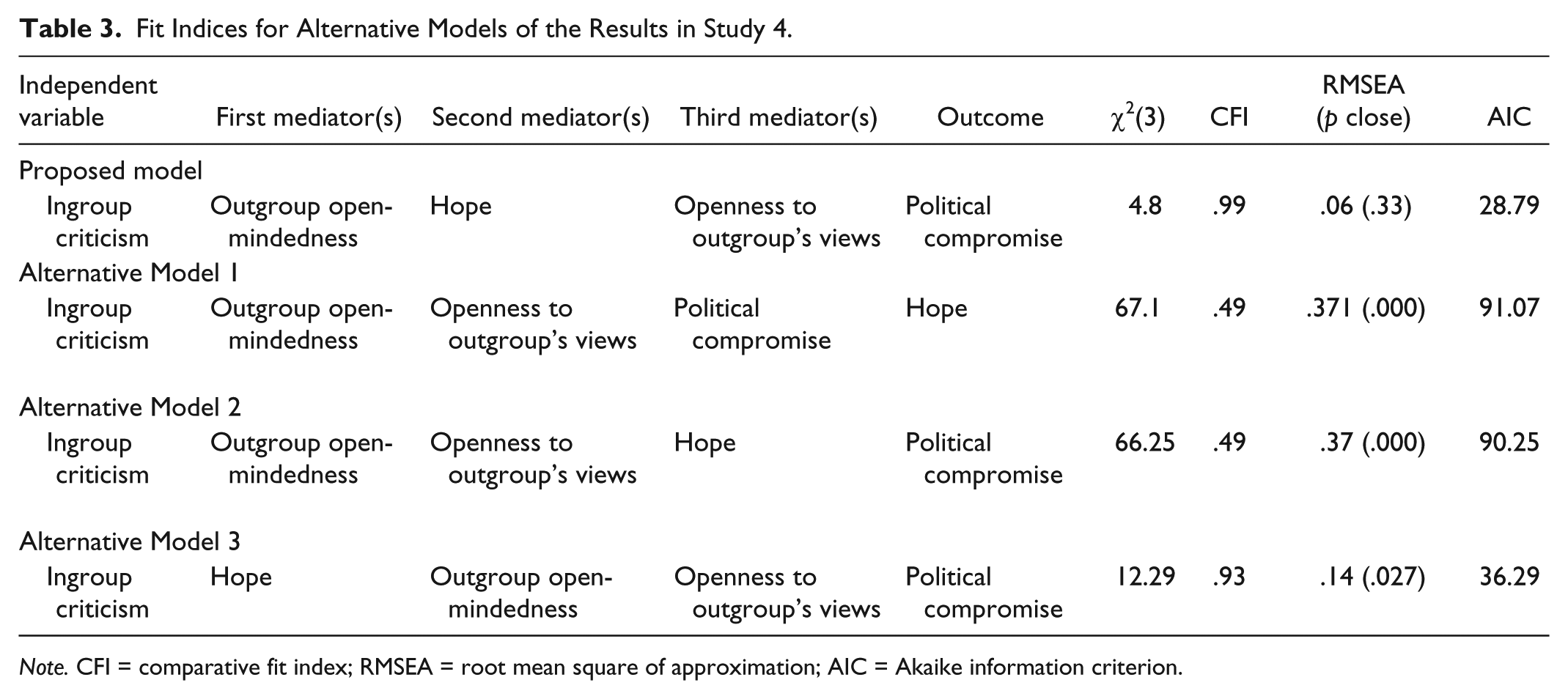
Note. CFI = comparative fit index; RMSEA = root mean square of approximation; AIC = Akaike information criterion.
Discussion
Study 4 provided more evidence for the effect of ingroup criticism on outgroup openness via hope, while further indicating the process underlining the effect on hope and the nature of outgroup openness. Indeed, this study indicated that Israeli Jews are willing to engage with an outgroup perspective that was not necessarily pro-Israeli, but rather, with the classic Palestinian narrative which is in sharp contrast to the Israeli perspective. In addition, this openness does not seem to be a result of general positivity toward the outgroup, but rather a result of a more specific view of the outgroup as open-minded. This view instigates a positive spiral of affairs, generating hope about the future relations, and, in turn, more willingness to open up to the other side’s views. Finally, and maybe most importantly, Study 4 revealed important downstream effects of openness, which was shown to be positively associated with increased support even for the most difficult political compromises that are required to promote peace.
General Discussion
One of the major barriers to conflict resolution is group members’ tendency to hold on to extremely negative attitudes and emotions toward outgroup members (Bar-Tal & Halperin, 2009). Such fortification in one’s own rigid narratives and views about the conflict is associated with a host of destructive outcomes ranging from failed communication across group lines to extreme forms of violence (Halperin & Bar-Tal, 2011). The main goal of the current study was to introduce and examine a novel way to stimulate intergroup openness by voicing internal criticism to an outgroup audience.
We conducted four experiments among Jewish Israelis in the context of one of the most violent, prolonged, and intractable conflicts worldwide. Our findings show that even within that context, in which attitudes and emotions toward the outgroup tend to be extremely negative, small ingroup criticism intervention led to a significant increase in Jewish Israelis’ motivation to listen to Palestinians’ views and narratives about the conflict. The study also demonstrates that the effects of such intervention hold when the message is unrelated to the conflict and that these effects are mediated by increased levels of hope, which is triggered by the view of the outgroup as more open-minded. Furthermore, the findings demonstrate that for the message to be effective, it has to be expressed by an outgroup member (vs. a third party) and that such message is more effective among those holding a belief that groups, in general, can change.
Finally, the last study showed that exposure to the outgroup communicating internal criticism promotes openness even to the classic narrative of the outgroup, and that it can go beyond the effect on openness to increase support for compromises required for peace. The last study further helps to clarify the nature of the influence exerted by ingroup criticism. The results indicated that while exposure to internal criticism leads people to have a more optimistic view of the outgroup as open-minded, it had little influence on current outgroup attitudes. This suggests, consistent with our theorizing, that exposure to the outgroup communicating internal critique has a primary impact on beliefs and emotions regarding the outgroup potential—as further reflected by the consistent effects of the manipulation on hope and also by the moderation with beliefs about the malleability of groups. These future orientations may operate independently of current liking of the outgroup. Indeed, the communicated critiques across studies involved negative information about the outgroup, and as such might not influence the general negativity in which the outgroup is viewed—but would still instill a hopeful view about the future of the conflict. For example, Israelis might generally dislike Palestinians, but yet, after being exposed to Palestinians criticizing themselves, will develop a sense of them as less rigid and potentially, more viable partners for negotiations. These perceptions, although arguably limited in generating harmonious relations, can be critical for bringing Israelis to the table and putting a negotiation into motion (see Kteily, Saguy, Sidanius, & Taylor, 2013).
This issue raises a potential limitation of the current work. Across studies, the voiced critique communicated negative information about Palestinians—information which Israelis are likely to agree with. That is, although our results demonstrated that the effect of ingroup criticism holds both when the critique is related and unrelated to the conflict, in both cases the criticism was consistent with what Israelis already think (i.e., Palestinians are too violent and are weak on internal affairs). This introduces the possibility that the effect of internal criticism is limited to cases which involve perceived attitudinal similarity between the criticizer and the participants. We are currently studying this possibility by examining whether the effect of internal criticism would hold when the communicated critique is completely inconsistent with the listener’s views. For example, would Israelis become more hopeful and open to the Palestinian views if they heard a Palestinian voicing a critique about the Palestinians becoming too westernized? This line of work can provide important insight into the boundary conditions of the effects of internal criticism.
Together, the findings from the current work have theoretical as well as applied relevance. On the theoretical level, the results suggest that criticism that up until now has been studied mostly in the context of reactions of ingroup members to others voicing criticism against their own group (e.g., Chan et al., 2009; Hornsey et al., 2007; Hornsey et al., 2004), and was considered in most cases as spoiler of intragroup, as well as intergroup relations, can operate as a constructive psychological tool, if only used properly. Furthermore, the current studies contribute to our understanding of processes leading to some of the most important cognitive (i.e., perceiving the outgroup as more open-minded) and affective (i.e., hope) mechanisms that can help in reducing intergroup tensions.
From an applied perspective, the current results have implications for possible interventions to increase openness and support for peace in long-term conflicts. It may be possible to construct conflict resolution interventions by highlighting existing cases in which outgroup members expressed criticism over their own group, without even mentioning the conflict itself or the issues under debate. Such an indirect approach may be particularly valuable for promoting conflict resolution in contexts in which individuals may resist direct attempts to change their positions (Bar-Tal & Rosen, 2009). Yet, such interventions should be handled with extra caution making sure it does not induce all well-established dark sides of criticism (e.g., deviant rejection) that can potentially backfire (e.g., Eidelman et al., 2006; Levine, 1989; Packer, 2008; see Tata et al., 1996, for meta-analysis).
Indeed, an avenue for future research concerns the conditions under which group members would be willing to express criticism against their own group. As described earlier, group members who air their dirty laundry to the outgroup face a range of negative consequences including devaluation and exclusion (Levine, 1989; see Eidelman et al., 2006), even more so than outgroup members who hold similar views (Marques, Yzerbyt, & Leyens, 1988). For example, Iwao (1963) found that divinity school students evaluated a fellow divinity student more negatively than a law school student for expressing the same critical views. This finding converges with those of Marques and his colleagues, who have shown that unfavorable ingroup members are often derogated more harshly than unfavorable outgroup members (Marques & Paez, 1994). Given these consequences, it is critical to identify the conditions that would allow people to engage in ingroup critique in front of an outgroup crowd. As alluded to earlier, processes that can facilitate such willingness might have to do with the apparent group commitment of the criticizer (i.e., level of perceived ingroup identification) and with the perceived status of the criticizer within his or her own group. Internal critique that comes from a previously proven, highly committed ingroup member can be received more positively because group members are likely to perceive the individual as having positive intentions, such as bettering the group (see Hornsey et al., 2004). Thus, if one can publicly affirm his or her commitment to the ingroup prior to the communication of ingroup criticism, the negative consequences might be attenuated. These possibilities and others are valuable to pursue in future work. Future work can further investigate whether the effects of internal criticism would remain as strong when the person communicating the criticism is not an outgroup official, but rather simply an outgroup member. We have some preliminary data to suggest that in both cases the critique results in the expected positive effects—but this needs further validation.
Although the current results are intriguing because they demonstrate a way to open the minds of people in a context characterized by rigidity and closed-mindedness, we believe that they should be regarded as preliminary. First, our studies focused only on one side (the powerful party) of one conflict (the Israeli–Palestinian conflict). It remains an open question whether similar effects would be evident among members of groups belonging to the other, weaker, party in an asymmetrical conflict. Second, in all studies we have utilized self-reports rather than behavioral measures as outcome variables, which leaves open the possibility of demand effects. Nevertheless, the fact that the manipulation consistently affected hope and openness, and not attitudes toward the outgroup, renders the demand problem less likely. Moreover, the findings from Study 4, revealing effects on actual compromises for peace, which are considered in Israel as rigid and very difficult to change, further undermine the role of demand characteristics as driving the effects.
In summary, the reported work reveals that in the context of intergroup conflict, voicing internal criticism to an outgroup crowd can be a highly effective tool for improving intergroup relations. As such, the findings reveal that group-based criticism can be, under some conditions, a highly constructive element in intergroup communication. This work is further unique and intriguing because it offers a new tool (i.e., ingroup criticism) that can open the minds of people in the face of adversarial outgroup members. This is done while avoiding the risk involved in more direct attempts to alter attitudes toward an adversary, which can backfire due to the deep rooted animosity between the groups. Indeed, the groups do not even have to interact face to face, or to address the conflict, for ingroup criticism to exert its positive effects.
Footnotes
Acknowledgements
We thank Maayan Dvir, Adi Perry, and Nili Hyman for their assistance in various stages of the research.
Declaration of Conflicting Interests
The author(s) declared no potential conflicts of interest with respect to the research, authorship, and/or publication of this article.
Funding
The author(s) disclosed receipt of the following financial support for the research, authorship, and/or publication of this article: The research was partially supported by Marie Curie FP7 Reintegration Grant awarded by the European Union to the first author, and by the United States–Israel Binational Science Foundation grant.