



Abstract
Cancer health information is dominated by enemy and war metaphors intended to motivate the public to “fight” cancer. However, enemy metaphoric framing may influence understanding of, and responses to, cancer. Cancer prevention benefits from avoiding risk increasing behaviors, yet self-limitation is not closely associated with fighting enemies. If so, the metaphor may hurt prevention intentions involving self-limitation. Participants read messages with minute wording variations that established different metaphoric frames. Results show that metaphorically framing cancer as an enemy lessens the conceptual accessibility of (Study 1) and intention for self-limiting prevention behaviors while not increasing intention for monitoring and treatment behaviors (Studies 2 and 3). Framing self-limiting prevention behaviors in terms of fighting an enemy increases their appeal, illustrating the benefits of metaphor matching (Study 3). Overall, these results suggest that enemy metaphors in cancer information reduce some prevention intentions without increasing others, making their use potentially harmful for public health.
“Now is the time to commit ourselves to waging a war against cancer as aggressive as the war cancer wages against us.”
Public discourse about cancer is dominated by enemy metaphors, from society’s “war on cancer” to an individual’s “heroic battles” with a “harsh enemy” (Bowker, 1996; Gibbs & Franks, 2002; Sontag, 1978). Although discussion of cancer has included this bellicose discourse for some time, it was elevated when the War on Cancer was popularized by fear-appeal-based advertisement campaigns in the 1970s as a way to drum up funding for cancer research. The Cold War was a salient fear at the time, and advertisements simply asked for governmental funding to deal with the cancer “threat” (Mukherjee, 2010). Framing cancer as an enemy served as an effective fear appeal because it met the necessary conditions for effective fear appeals (for reviews, see Hovland, Janis, & Kelley, 1953; McGuire, 1972): it evoked fear by riding the coattails of a salient theme (war with enemies), and it made a clear recommendation that was easy for the public and government to implement (support cancer research). However, while times have changed, this portrayal of cancer as an enemy has persisted. It pervades public discourse, figures prominently in slogans of cancer research organizations (e.g., “Celebrate. Remember. Fight back.”—American Cancer Society’s Relay for Life; “Love life. Fight cancer.”—Dutch Cancer Society), and even enters into discussion of preventive behaviors (Foods That Fight Cancer: Preventing Cancer Through Diet, Beliveau & Gingras, 2006). It is also the most common conceptual metaphor employed in science journalism about cancer (Camus, 2009). Some fear appeals have proven effective in cancer prevention (Stephenson & Witte, 1998), and video game interventions where players virtually battle and destroy enemy cancer cells can increase treatment adherence in young cancer patients (Kato, Cole, Bradlyn, & Pollock, 2008) as well as increase perceptions of cancer risk in young non-patient populations (Khalil, 2012). Indeed, the prevailing wisdom suggests that fear evoked by portraying cancer as an enemy would encourage people to “fight” cancer in their own personal lives and promote beneficial behavioral change.
Because metaphors shape and structure thought (Lakoff & Johnson, 1980), however, it is possible that metaphorically framing cancer as an enemy affects people’s understanding of the disease in unintended ways. For instance, thinking of cancer as an enemy may give patients a preference for overly aggressive treatment options (because one acts aggressively toward enemies; Aktipis, Maley, & Neuberg, 2010) and may hurt the intention to engage in preventive behaviors that are less associated with fighting enemies. While such conjectures are compatible with conceptual metaphor theory (Lakoff & Johnson, 1980), they go against the prevailing wisdom that emphasizes the potential of the enemy metaphor to motivate beneficial behaviors (Kato et al., 2008; Khalil, 2012; Mukherjee, 2010; Stephenson & Witte, 1998). The current research investigates the potential effects of bellicose conceptual metaphors on people’s understanding of cancer and intention to engage in a range of prevention behaviors.
Metaphors Shape Thought
Conceptual metaphor theory (Lakoff & Johnson, 1980) posits that metaphors structure thinking by providing conceptual mappings between concrete and abstract concepts. Concrete concepts highlight relevant aspects of metaphorically related abstract concepts, deemphasize irrelevant aspects, and ultimately guide knowledge of and reasoning about the abstract concept. Since the initial work in cognitive linguistics, extensive experimental research has illuminated how abstract concepts are understood in terms of metaphorically related concrete domains (for a review, see Landau, Meier, & Keefer, 2010). For instance, interpersonal warmth is often understood in terms of physical warmth (Williams & Bargh, 2008), importance is understood in terms of physical weight (Ackerman, Nocera, & Bargh, 2010; Chandler, Reinhard, & Schwarz, 2012; Jostmann, Lakens, & Schubert, 2009), valence and power are related to verticality (Meier & Robinson, 2004; Schubert, 2005), and so are God and Devil related concepts (Meier, Hauser, Robinson, Friesen, & Schjeldahl, 2007). As many conceptual metaphors are learned via linguistic experience, linguistic framing of an abstract concept via the use of metaphoric expressions can also activate a metaphoric representation of the abstract concept and influence reasoning (Lakoff & Johnson, 1980; Landau, Sullivan, & Greenberg, 2009; for reviews, see Gibbs, 2014; Ottati, Renstrom, & Price, 2014). For instance, metaphorically framing crime as either a virus plaguing a city or as a beast ravaging a city causes people to propose different solutions to a hypothetical crime wave (Thibodeau & Boroditsky, 2011). Similarly, metaphoric framing of America as a body harshens Americans’ attitudes toward immigration when they are threatened by physical contamination (Landau et al., 2009). In short, varying the accessibility of concrete metaphors for abstract concepts via metaphoric framing can guide reasoning in the abstract domain in metaphor-consistent ways.
Further illustrating the power of metaphors, a meta-analysis of persuasive messages found that the use of metaphors reliably increases persuasion when they metaphorically frame a familiar target early in the message in terms of a single novel source domain (Sopory & Dillard, 2002). The persuasive influence of metaphors can unfold through multiple pathways (for reviews, see Ottati & Renstrom, 2010; Ottati et al., 2014). For instance, metaphoric conceptualizations of abstract concepts can be activated in multiple ways (Ottati et al., 2014), such as by directly stating the root metaphor (“Cancer is an enemy”) or through more subtle means like evoking the root metaphor through surface metaphoric utterances (“We must win the war on cancer”). In addition, once a root metaphor is activated, metaphors can affect judgments through multiple processes. Metaphors can affect the amount of message elaboration when they link the target to a domain that is of interest to the recipient; for example, sports metaphors increase elaboration of persuasive messages for sports fans and decrease elaboration for non-sports fans (Ottati, Rhoads, & Graesser, 1999). Metaphors also increase persuasion when they match the recipient’s lay metaphoric representation of the topic (Sopory, 2005) and hence increase fluent access to related knowledge. Metaphors can also contribute to attitude change by directly mapping attributes from the source to the target domain, as is the case for the NATION IS A BODY metaphor, which maps attributes of physical contamination onto the abstract concept of national immigration policy (Landau et al., 2009).
Present Research
Drawing on these insights from metaphoric framing research, the present studies investigate whether conceptual metaphors that relate cancer to an enemy influence people’s reasoning about cancer and their willingness to engage in a variety of preventive behaviors. The studies also bear on whether key theoretical findings of metaphoric framing research extend across different manipulations and into socially relevant content domains. As noted in recent discussions (Stroebe & Strack, 2014), consistent effects of multiple operationalizations of a conceptual variable across diverse content domains are a crucial criterion for the robustness of a theoretical approach.
The prevailing wisdom in health communication is that fear raised by enemy framing will motivate people to engage in beneficial preventive behaviors (Kato et al., 2008; Khalil, 2012; Mukherjee, 2010; Stephenson & Witte, 1998). However, we hypothesized that, in line with the theory of metaphoric framing (Lakoff & Johnson, 1980), framing cancer as an enemy should cause people to bring attributes of enemies to bear on their representation of cancer. While this may enhance motivation to engage in prevention behaviors related to an enemy metaphor, it may hurt the motivation to engage in prevention behaviors that are difficult to reconcile with this metaphor. Unfortunately, the latter applies to the bulk of behaviors that support cancer prevention.
The enemy metaphor emphasizes power, strength, masculinity, and taking aggressive actions toward an enemy (Harrington, 2012; Reisfield & Wilson, 2004). As such, behaviors that entail active engagement are particularly suited to the enemy metaphor because they help bolster these attributes and promote attacking an enemy. However, behaviors which entail limitation and restraint are less applicable to the enemy metaphor because they often undermine attributes of power, strength, and masculinity, and they do not promote attacking an enemy. Cancer prevention recommendations promote either engagement or limitation and, accordingly, differ in their applicability to fighting enemies. Table 1 displays the 11 cancer prevention recommendations that an expert review identified as efficient in reducing the risk of developing cancer (World Cancer Research Fund & the American Institute for Cancer Research, 2007); the table also notes whether the recommendation promotes engagement or limitation. Other organizations have arrived at similar prevention recommendations (see Kushi et al., 2012).
How Common Cancer Prevention Recommendations Fit With Engagement and Limitation.
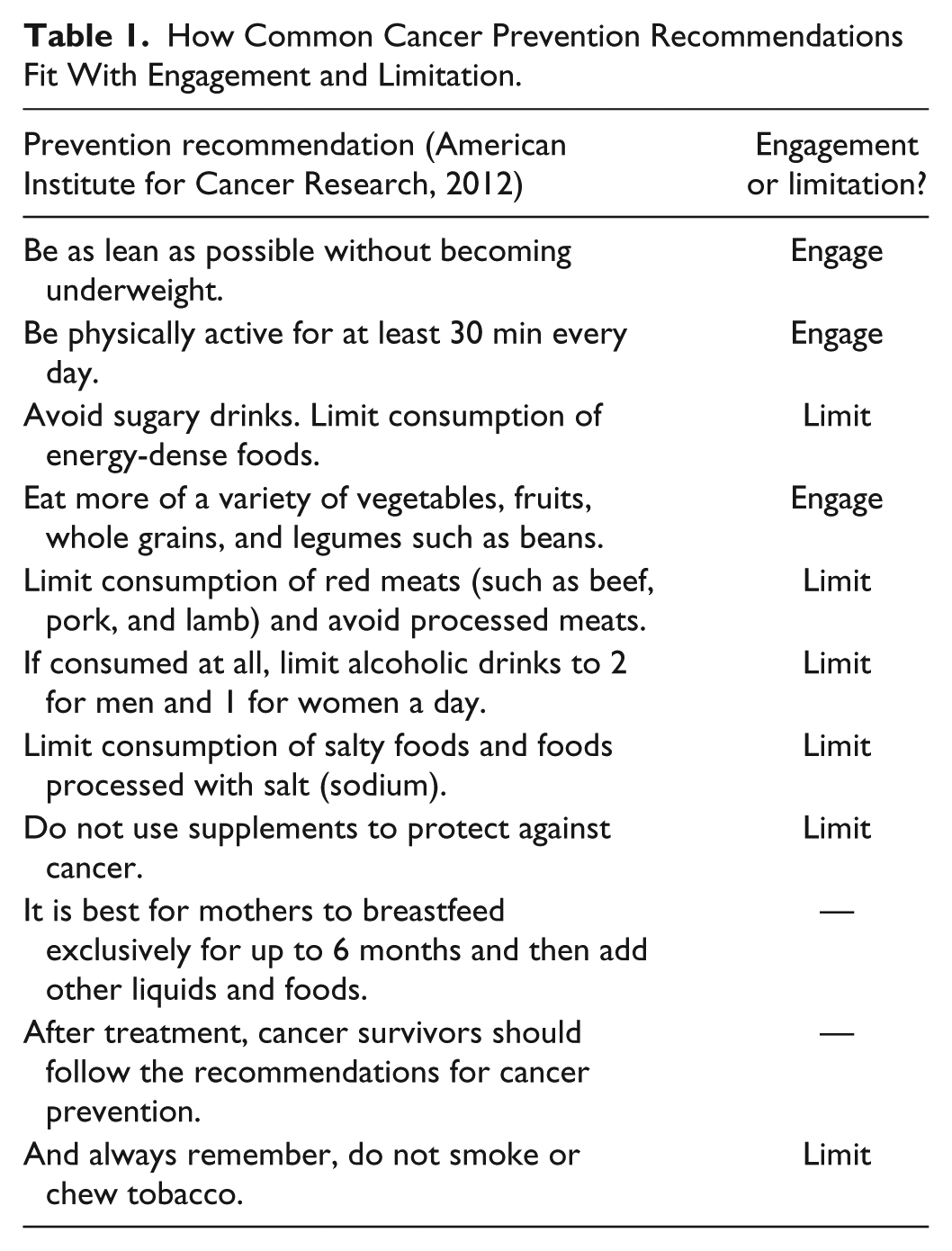
As the prevention recommendations in Table 1 illustrate, cancer prevention is only occasionally characterized by active engagement in behaviors that also come to mind while thinking of fighting a battle against an aggressor. Instead, many of the more efficient prevention behaviors amount to self-limitation (avoid smoking, avoid alcohol, avoid fatty foods, avoid red meats, and so on). Unfortunately, self-limitation is a class of behaviors that is unlikely to figure prominently in people’s associations with fighting enemies.
A pilot study using the Corpus of Contemporary American English (COCA; Davies, 2008) confirmed this intuition. Linguistically, limitation is less associated with attacking than it is with prevention. In natural language, there is less co-occurrence of limitation-related words with the word ATTACK than with the word PREVENT; for instance, the odds of seeing the word INHIBIT within nine words before or after the target word ATTACK in natural language are one-twentieth that of seeing it within nine words before or after the target word PREVENT. Given that word co-occurrence corresponds with semantic association (Landauer & Dumais, 1997), these data highlight that limitation is less associated with an enemy concept than with a prevention concept. This suggests that people do not think of limiting the self when they think of fighting enemies. If so, framing cancer in terms of an enemy metaphor may lessen people’s intention to engage in some of the more effective prevention behaviors available to them.
In the following series of studies, we test this possibility. In Study 1, we examine if the enemy representation affects the accessibility of limitation-related prevention behaviors. In Studies 2 and 3, we explore if the enemy representation affects intention for various prevention, monitoring, and treatment behaviors. In addition, Study 3 explores whether the predicted adverse effects of enemy framing are attenuated when prevention behaviors are presented in a metaphorical language that matches the metaphor used in the message.
Study 1
Assuming that limiting the self is not closely associated with the concept of fighting an enemy, framing cancer as an enemy should impair the accessibility of prevention behaviors that involve self-limitation. Study 1 tests this hypothesis.
Method
Participants
Sixty-four American participants (22 female) from Amazon Mechanical Turk completed the task in exchange for 30 cents.
Materials and procedure
Participants first read background information on cancer. The information concerned the development of cancer, who was at risk of developing cancer, the percentage of people who survive cancer diagnoses (adapted from Cancer Facts & Figures, American Cancer Society, 2012), and how eating habits relate to cancer. Participants were then asked to list what they would do to lessen their chances of developing cancer in their lifetime; they were provided nine open-ended text boxes to type in their responses.
Participants were randomly assigned to either an enemy metaphoric frame or a neutral frame. In the enemy-frame condition, the background information included two additional words in the first sentence of the passage (shown here in italics): “Cancer is a broad group of diseases characterized by the hostile growth and invasive spread of abnormal cells.” The two italicized words were missing in the neutral frame condition. In addition, the listing task prompt read “what things would you do to fight against developing cancer” in the enemy-frame condition, but “what things would you do to reduce your risk of developing cancer” in the neutral frame condition. Our method of framing falls in line with the “surface metaphoric utterances” method of subtly activating a root metaphor as discussed in Ottati et al. (2014).
Two coders, blind to hypotheses and participant condition, rated whether each behavior listed by the participants was a self-limiting behavior or a self-bolstering behavior. Rating instructions said a self-bolstering behavior was “one that people engage in to lower their risk of cancer,” whereas a self-limiting behavior was “one where people limit or avoid a behavior which is associated with increasing one’s risk of cancer.” Coders classified the behaviors as self-bolstering, self-limiting, or neither by rating them along a 1 (clearly self-bolstering) to 5 (clearly self-limiting) scale. The two coders’ ratings were highly consistent, r(330) = .94; coders disagreed on 37 items (11.2% of items), which were resolved through discussion. Our analysis draws on the number of reported self-bolstering versus self-limiting behaviors; analyses based on the raw rating scores lead to the same conclusions.
Results and Discussion
We counted the number of self-bolstering and self-limiting behaviors listed and conducted a 2 (metaphor: enemy, neutral) × 2 (behavior type: self-bolstering, self-limiting) mixed analysis of variance. Overall, participants listed more self-bolstering than self-limiting behaviors, F(1, 62) = 12.18, p = .001,

Message metaphor by behavior type on the mean number of behaviors listed.
These results parallel those observed in the linguistic analysis. When thinking of cancer as an enemy, limitation-related prevention behaviors do not come to mind. However, there was no beneficial effect of enemy framing on self-bolstering behavior accessibility as one would intuitively expect. One reason for this may be differences in chronic accessibility of the behavior types; participants listed more self-bolstering than self-limiting behaviors, suggesting that self-bolstering behaviors may be more chronically accessible than self-limiting ones. We explore these differences in chronic accessibility and ambiguity in the next study.
While these effects on accessibility provide preliminary support for our hypotheses, additional framing manipulations are necessary to rule out alternate explanations stemming from the use of one specific method of framing. Therefore, Study 2 employs a different framing manipulation in a conceptual replication and extension of Study 1.
Study 2
Building on the observation that metaphorical framing influences what comes to mind when people are asked to list potential prevention measures (Study 1), Study 2 tests whether the observed effects extend to behavioral intentions. The prevailing wisdom would suggest that enemy framing would increase intentions for all behaviors that would help someone “fight” cancer (i.e., prevention, monitoring, and treatment). However, in line with conceptual metaphor theory, we hypothesized that metaphorically framing cancer as an enemy in a message would lessen intention for self-limiting prevention behaviors.
Furthermore, many have offered the conjecture that an enemy representation might boost motivation for active, agentic behaviors against cancer. For instance, because one must be active to fight enemies, one must also take active steps to fight cancer (Harrington, 2012; Reisfield & Wilson, 2004). In addition, because one fights enemies aggressively, one must also fight cancer by opting for aggressive treatments (Aktipis et al., 2010). To our knowledge, Study 2 provides the first experimental test of these conjectures by examining the effect of enemy cancer framing on a range of preventive intentions (i.e., self-limiting and self-bolstering prevention, monitoring, and treatment). If the enemy representation boosts motivation for active agentic behaviors, enemy framing should boost intention for self-bolstering, monitoring, and treatment behaviors, while undermining intentions to engage in self-limiting behaviors.
Finally, Study 2 added another metaphoric framing condition to the design—that of cancer as imbalance. Recent research has shown that the use of any applicable metaphor in health information about vaccination can increase a reader’s intention to get vaccinated (Scherer, Scherer, & Fagerlin, 2014). Therefore, the imbalance metaphor condition serves as a control that tests whether the predicted effect of enemy framing is unique to this metaphor (as we expect) or also observed for other metaphors that have different substantive implications. Furthermore, the imbalance conceptualization was once the dominant conceptual metaphor for disease (Goatly, 2007; Mukherjee, 2010) and is still the dominant conceptual metaphor for most diseases in Chinese cultures (Stibbe, 1996). In fact, some medical scholars suggest that illness and treatment may better fit an imbalance metaphor than an enemy metaphor. For example, ecological balance metaphors emphasize population-level prevention and sustainable treatment practices (Annas, 1995; Nesse & Williams, 1996), unlike bellicose metaphors that emphasize defeating diseases at all costs. For these reasons, the remaining studies include an imbalance metaphor framing group for comparison purposes.
Method
Participants
Three hundred and thirteen American participants (113 female; age range 18 to 67) completed the survey on Amazon Mechanical Turk in exchange for 25 cents each.
Materials and procedure
In an ostensible pre-test of health information messages, participants were randomly assigned to read one of three messages that framed cancer either in neutral terms or in terms of an enemy or imbalance metaphor. The message is presented below, with the words unique to the enemy message in brackets and words unique to the imbalance message in parentheses. The neutral message consisted of all words outside of parentheses and brackets: Colorectal cancer is cancer of the colon. This disease involves (an imbalance of) [an enemy uprising of] abnormal cellular growth in the large intestine. At any given point in time, a healthy person has small amounts of cancerous cells which his/her body deals with. However, (an unbalanced) [a hostile] growth of cancerous cells in the large intestine can form a tumor, which can metastasize in nearby or distant parts of the body. The average American faces a 5% lifetime risk of developing colorectal cancer as a result of (unbalanced) [hostile] abnormal cellular growth. In 2008, 608,000 deaths worldwide were due to colorectal cancer.
Following filler questions about the message, participants reported their intention to engage in various health behaviors related to cancer (1 = do not intend; 7 = strongly intend). Self-limiting prevention questions asked “how much do you intend to limit” behaviors associated with a high risk of cancer (drinking alcohol excessively; eating red meats more than once per day; eating high fat, high calorie foods). Self-bolstering prevention questions asked “how much do you intend to engage in” behaviors that are associated with a low risk of cancer (eating fruits and vegetables, eating foods high in fiber, eating foods made of whole grains). Monitoring questions asked “how much do you intend to undergo” medical procedures associated with detecting cancer (stool test, barium enema and abdominal X-rays, colonoscopy).
Participants were also presented with a hypothetical diagnosis of Stage 3 colorectal cancer (with a 64% 5-year survival rate) and were asked “how much do you intend to undergo” various treatment plans associated with removing cancerous cells (surgery; surgery and chemotherapy; radiation, surgery, and chemotherapy).
Results and Discussion
We created indices for intention to self-limit (α = .77), self-bolster (α = .91), monitor (α = .87), and treat (α = .90) by averaging the ratings of the respective items. A 3 (message metaphor: enemy, imbalance, neutral) × 4 (intention: self-limiting, self-bolstering, monitoring, treatment) × 2 (gender: male, female) mixed analysis of variance revealed the predicted significant omnibus two-way interaction between message metaphor and intention, F(6, 921) = 2.48, p = .022,
Self-limiting behavior
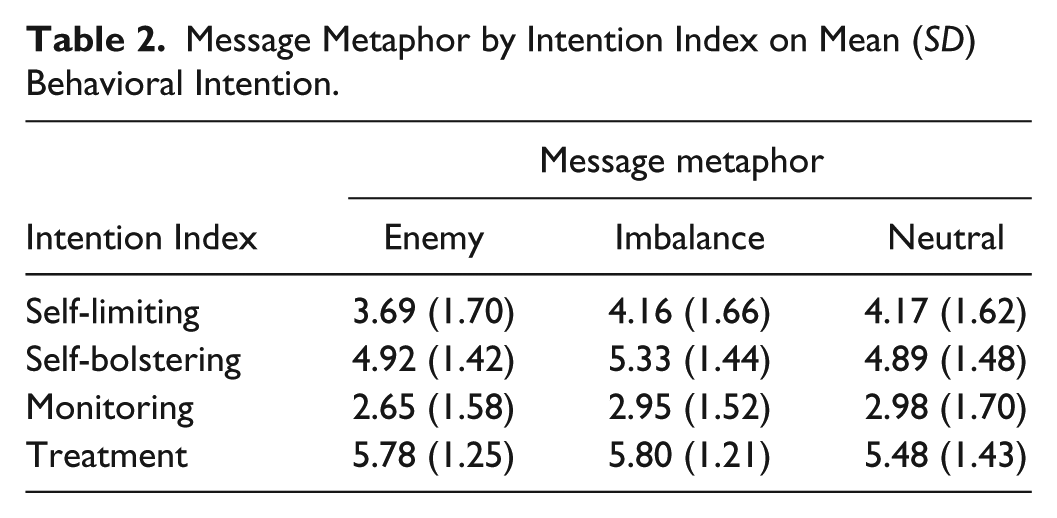
As predicted, enemy framing lowered intentions for self-limiting behaviors compared with the neutral representation, t(307) = −2.21, p = .028, d = .29, 95% CI = [–0.96, –0.03], and compared with the imbalance representation, t(307) = −2.54, p = .012, d = .28, 95% CI = [–0.80, –0.14] (Table 2). These differences are reflected in an omnibus simple main effect of message frame, F(2, 307) = 3.91, p = .021,
Message Metaphor by Intention Index on Mean (SD) Behavioral Intention.
Self-bolstering behaviors
An omnibus simple main effect of message metaphor for the self-bolstering index, F(2, 307) = 4.13, p = .017,
Monitoring and treatment
Finally, the framing manipulations did not affect the monitoring or treatment intentions. For the monitoring index, the simple main effects of message metaphor, F(2, 307) = 1.61, p = .201; gender, F < 1; and the message Metaphor × Gender simple interaction, F < 1, were not significant. Similarly, for the treatment index, the simple main effects of message metaphor, F(2, 307) = 1.12, p = .327; gender, F < 1; and the message Metaphor × Gender simple interaction, F(2, 307) = 1.04, p = .356, were not significant.
Gender effects
In the overall model, there was an additional significant two-way interaction between gender and intention, F(3, 921) = 8.26, p < .001,
Discussion
In sum, the current findings suggest that enemy framing undermines self-limiting prevention intentions but has no effect on self-bolstering prevention intentions, monitoring intentions, or treatment intentions. This absence of a beneficial effect on self-bolstering, monitoring, and treatment intentions is both surprising and concerning because it is one of the primary reasons cited for the continued use of the enemy metaphor (Harrington, 2012; Reisfield & Wilson, 2004) and it goes against the prevailing wisdom that enemy framing motivates people to “fight” cancer (Kato et al., 2008; Khalil, 2012; Mukherjee, 2010).
However, research may provide clues as to why the enemy representation only affects intention for a subset of preventive behaviors. Metaphoric framing manipulations appear to be constrained to the same variables as conceptual priming manipulations (see Higgins, 1996); a source concept must be applicable to the target (Jones & Estes, 2006) and its impact increase with the abstractness and ambiguity of the target (Jia & Smith, 2013; Keefer, Landau, Sullivan, & Rothschild, 2011). Thus, participants may only draw upon metaphoric entailments when they are unsure of their intentions, but may not when their intentions are clear. As such, intention for self-limiting behaviors may be more ambiguous than intentions for self-bolstering, monitoring, and treatment behaviors, creating the observed pattern of results for the enemy metaphor.
Our data indirectly bear on this hypothesis. Participants making ambiguous judgments tend to stick to the midpoint of the scale, shying away from the descriptive anchors on scale endpoints. In our study, participants rated their intention for behaviors on a 1 (do not intend) to 7 (strongly intend) point scale, making a rating of 4 the scale midpoint. Thus, we would expect ambiguous intention indices to hover around a scale value of 4, whereas unambiguous intention indices would deviate from the neutral point.
A one-way within subject analysis of variance on the deviation of each index from the scale midpoint (4) found a significant omnibus effect of index, F(3, 936) = 67.15, p < .001,
We additionally observed that imbalance framing increased intentions for self-bolstering behaviors. Because we had not predicted this effect, the next study examines if this effect replicates in a different sample.
Study 3
The preceding two studies consistently showed that framing cancer messages in terms of an enemy metaphor has adverse consequences for prevention behaviors that involve self-limitation, from avoiding overexposure to the sun to avoiding fatty foods. The theoretical rationale of metaphor framing implies that these adverse effects can be attenuated when the target behavior is framed in a way that matches the metaphor (Lakoff & Johnson, 1980; Landau et al., 2010; Lee & Schwarz, 2014b). Because aptness facilitates metaphoric processing (Jones & Estes, 2006), metaphorically describing the behaviors in a way that makes them a better fit with a metaphoric conceptualization should facilitate fluent processing (Thibodeau & Durgin, 2008, 2011), which may attenuate the adverse effects of the enemy metaphor. Study 3 tests this implication.
Method
Participants
One hundred and seventy-six undergraduates (95 females; age range 18 to 29) at the University of Michigan participated in the study in exchange for subject pool credit.
Materials and procedure
The procedure and materials were identical to those of Study 2 except for the addition of a manipulation that linked preventive, monitoring, and treatment behaviors to the metaphoric framing of cancer. Just as in Study 2, each participant first read one of the messages with metaphorical cancer framing (metaphoric frame: enemy, imbalance, neutral) and answered filler questions.
Next, each participant was randomly assigned to a behavioral frame that introduced each set of behaviors as apt for the different metaphoric conceptualizations (behavior frame: enemy, imbalance, neutral). All participants read introductions to the behaviors that mirrored those of Study 2 (“The following behaviors are associated with a higher risk of developing cancer” for self-limiting behaviors). In the neutral behavior frame condition, the introduction was limited to these sentences; for the other behavior frame conditions, an additional sentence was added. In the enemy behavior frame condition, participants read an additional sentence on how each set of behaviors (self-limiting, self-bolstering, monitoring, and treatment) was apt for fighting enemies, while those assigned to the imbalance behavior frame read how each set of behaviors was apt for restoring balance.
The enemy behavioral frame for the self-limiting behaviors expressed that the following behaviors “weakened the body’s ability to fight colorectal cancer,” whereas the imbalance frame expressed that the behaviors “impaired the body’s ability to restore balance.” The enemy behavioral frame for self-bolstering behaviors expressed that the following behaviors “strengthened the body’s ability to fight colorectal cancer,” and the imbalance frame expressed that the behaviors “improved the body’s ability to restore balance.” The enemy behavioral frame for monitoring behaviors expressed that the following behaviors “detected colorectal cancer in its early stages when it is weak and easier for your body to fight,” and the imbalance frame expressed that the behaviors “detected colorectal cancer in its early stages when it is smaller and easier for your body to restore balance.” Finally, the enemy behavioral frame for hypothetical treatment behaviors expressed that the following treatment options “help your body fight colorectal cancer,” and the imbalance frame expressed that the behaviors “help your body restore health and balance.”
Aside from the additional introductory paragraph framing the behaviors, participants followed the same procedure as in Study 3 when rating their intention for each set of behaviors pertaining to self-limiting, self-bolstering, monitoring, and treatment.
Results
We computed intention indices for each type of behavior (self-limit α = .73; self-bolster α = .93; monitor α = .89; treatment α = .90) by averaging the respective behavior ratings. We first address whether Study 3 replicates the effects of message framing observed in Study 2; subsequently, we turn to the new predictions and address the influence of metaphor matching.
Do the effects of Study 2 replicate?
The materials of the neutral behavior framing condition of the present study were identical to the materials of Study 2. This allows us to assess the robustness of our results with a new sample. To do so, we assessed the influence of message framing on participants’ prevention intentions under neutral behavior framing.
Message framing again affected participants’ intention to engage in self-limiting prevention behaviors, F(2, 57) = 2.68, p = .077,
There were no effects of message framing on the remaining behavioral intention indices; omnibus main effect of message framing on the self-bolstering index, F(2, 57) = 1.59, p = .212; on the monitoring index, F < 1; and on the treatment index, F(2, 57) = 1.07, p = .351.
In a meta-analytic analysis of Study 2 and the replication conditions of Study 3, enemy-framed messages undermine recipients’ intention to engage in self-limiting prevention behaviors, relative to neutrally framed messages; Z = 4.11, p = .004, following the procedures of the Stouffer method as described by Rosenthal (1978). Further, enemy-framed messages do not affect intention to engage in self-bolstering (Z = .25, p = .80), monitoring (Z = −.74, p = .46), and treatment behaviors (Z = 1.51, p = .13) in the individual studies or the meta-analytic analyses. Thus, across studies, enemy-framed messages lessen intentions for self-limiting behaviors while remaining ineffective on altering intentions for self-bolstering prevention, monitoring, and treatment intentions.
In addition, the effects of imbalance-framed messages in Study 2 did not replicate in our new sample. In contrast to Study 2, imbalance-framed messages did not increase intention for self-bolstering behaviors. Further, imbalance-framed messages lessened intentions for self-limiting behaviors. Thus, it appears as if the effects of this once dominant metaphor for disease have as-of-yet unknown moderating conditions which preclude us from drawing firm conclusions. In addition, populations differed between Study 2 (MTurk) and Study 3 (subject pool) and differences between populations in chronic accessibility, aptness, or conventionality of the imbalance metaphor may also account for the inconsistent effects.
Does metaphor matching improve intentions?
A 3 (message metaphor: enemy, imbalance, neutral) × 3 (behavior frame: enemy, imbalance, neutral) × 4 (intention: self-limit, self-bolster, monitor, treat) × 2 (gender: male, female) mixed analysis of variance revealed the predicted omnibus three-way interaction between message metaphor, behavior frame, and intention, F(12, 474) = 1.90, p = .033,
To diagnose this three-way interaction, we examined the simple two-way interactions of message metaphor and behavior frame for each set of behaviors. There was no simple two-way interaction of message metaphor and behavior framing for treatment intentions, F(4, 158) = 1.19, p = .315; monitoring intentions, F < 1; or self-bolstering intentions, F(4, 158) = 1.63, p = .170, indicating that metaphor matching did not influence intentions for these behaviors. This was expected and replicates Study 2, which found no effect of initial metaphoric framing in the message on intentions for these behaviors.
In contrast, the intention to engage in self-limiting prevention behaviors was affected by the experimental variables, F(4, 158) = 3.07, p = .018,
Intention to engage in self-limiting behaviors
Enemy frame
Previous research has shown that a neutral, non-metaphoric sentence about a target concept can be considered to “mismatch” a metaphoric representation of the target concept; after reading a metaphoric sentence, reading times for a neutral non-metaphoric sentence about the same topic are delayed to the same extent as reading times for a sentence utilizing a different source metaphor for the topic (e.g., Thibodeau & Durgin, 2008, Study 3). Our planned contrasts take this observation into account. A planned contrast pertaining to the enemy message metaphor, which compared enemy behavioral framing (match) to neutral and imbalance behavioral framing (mismatch), revealed a marginally significant metaphor matching effect (Figure 2), t(167) = 1.88, p = .062, d = .52. Follow-up comparisons showed that participants who had received an enemy-framed message reported higher intentions to engage in self-limiting behaviors when these behaviors were framed as apt for fighting enemies than when they were framed neutrally, t(167) = 1.82, p = .070, d = .66, 95% CI = [−0.01, 1.79], or as apt for restoring imbalance, t(167) = 1.41, p = .159, d = .43, 95% CI = [−0.36, 1.72]. Thus, metaphor matching can eliminate the otherwise observed adverse effects of the enemy metaphor—for participants with an enemy conceptualization of cancer, describing self-limiting behaviors in enemy-consistent terms increased intention relative to describing those behaviors in enemy-inconsistent terms (either described literally or in terms of imbalance).
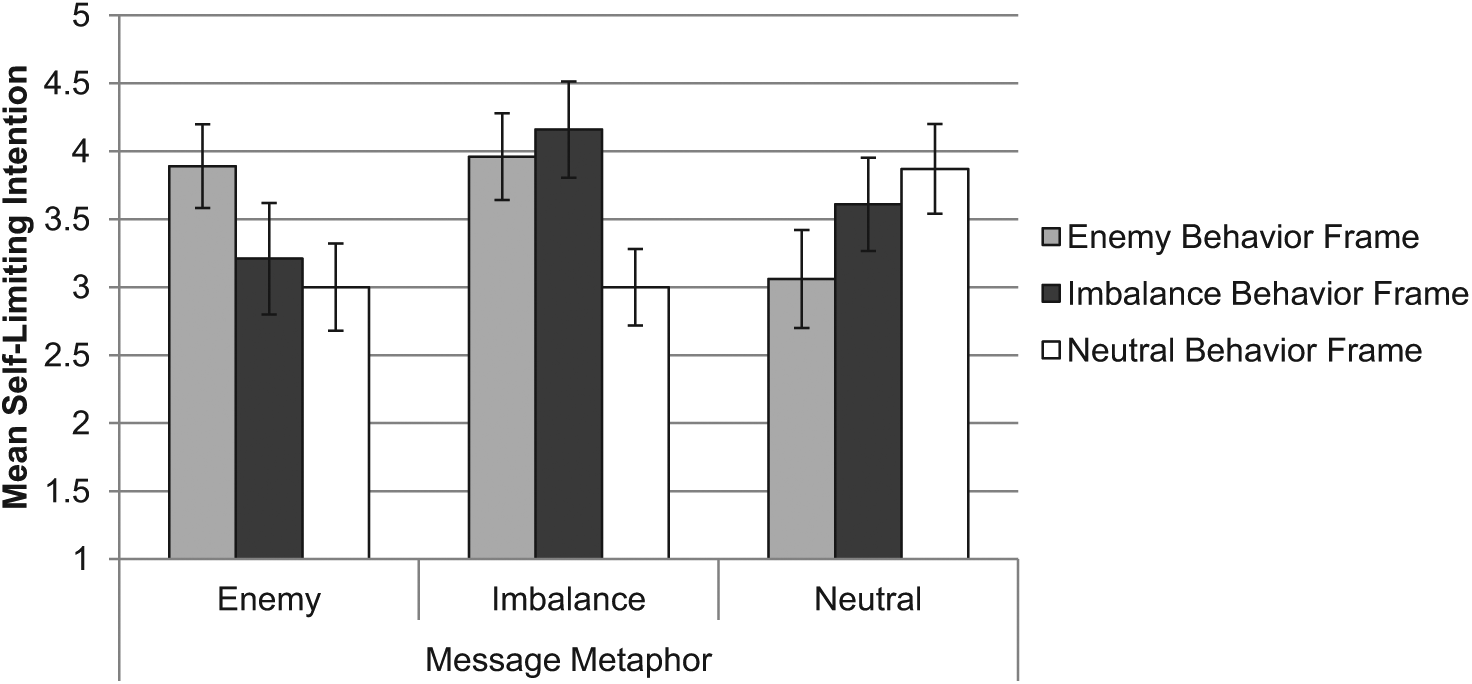
Message metaphor by behavior frame on self-limiting intention.
Of theoretical and applied interest is a comparison of the above conditions with the neutral control conditions. As metaphor matching effects typically only compare metaphor matches against metaphor mismatches (see Thibodeau & Durgin, 2008), it is currently unknown if metaphor matching effects actually facilitate comprehension and intention over basic literal statements. Further, this comparison has applied interest, as it might potentially demonstrate that enemy framing has a persuasive advantage over non-framing when behaviors are described as apt for the enemy conceptualization.
The comparison with the neutral control condition shows that metaphor matching did not endow the enemy metaphor with any persuasive advantage. When the enemy frame of the message matched the enemy frame of the target behavior, participants’ intentions merely equaled, but did not exceed, the intentions under neutral control conditions, where neither the message nor the behavior was described in metaphorical terms, t(167) = 0.05, p = .963.
Imbalance frame
The planned contrast looking at imbalance message framing and comparing imbalance behavior framing (match) to neutral and enemy behavior framing (mismatch) also revealed a marginally significant metaphor matching effect (Figure 2), t(167) = −1.69, p = .092, d = .46. Follow-up comparisons showed that participants who had received an imbalance-framed message reported higher intentions to engage in self-limiting behaviors when they were framed as apt for restoring balance than when they were framed neutrally, t(167) = 2.52, p = .013, d = .80, 95% CI = [0.24, 2.07], but not when they were framed as apt for fighting enemies, t(167) = 0.41, p = .679. This indicates a conditional metaphor matching effect—relative to literal behavioral framing, imbalance behavioral framing enhanced intention for self-limiting behaviors when participants had an imbalance conceptualization of the disease.
Neutral frame
Finally, the planned contrast looking at neutral message framing and comparing neutral behavior framing to enemy and imbalance behavior framing showed no effect of matching on intentions in the neutral control conditions, t(167) = 1.31, p = .192.
Gender effects
As in Study 2, there were significant effects of gender in the overall model that, while not bearing on the proposed hypotheses, still deserve discussion. Also, as in Study 2, gender did not moderate the effects described earlier as the four-way interaction of gender, message metaphor, behavior frame, and intention was not significant, F(12, 474) = 1.38, p = .17.
There was a significant main effect of gender, F(1, 158) = 20.04, p < .001,
Last, there was an interaction of gender and intention type that was similar to the one observed in Study 2, F(3, 474) = 3.46, p = .016,
General Discussion
Counter to the prevailing wisdom’s expected benefits of framing cancer as a feared enemy, our findings suggest that framing cancer in terms of bellicose enemy metaphors has unintended side-effects that may impair efficient prevention strategies. Many behaviors that reduce the risk of cancer require one to limit enjoyable activities, from sunbathing to drinking alcohol and eating red meats. Yet, limiting and constraining oneself is not a concept closely associated with fighting enemies. Hence, a bellicose message frame that emphasizes fighting an enemy may render these protective behaviors less compelling than they might otherwise be. Three studies provided consistent support for this prediction. First, enemy framing reduced the likelihood that self-limiting behaviors were listed when participants described prevention options in a free response format (Study 1). Second, enemy framing reduced participants’ intention to engage in self-limiting prevention behaviors when a list of prevention options was presented to them (Studies 2 and 3). Third, counter to the prevailing wisdom, this negative impact of enemy framing on prevention intentions was not offset by the increased intentions to engage in other preventive behaviors (Studies 2 and 3), most notably self-bolstering behaviors, such as eating more fruits or more high fiber foods. Fourth, also in contrast to the prevailing wisdom, enemy framing did not increase participants’ intention to engage in effective monitoring procedures (Studies 2 and 3), nor did it affect their preference for different treatment options (Studies 2 and 3). Most notably, it did not increase their intention to seek aggressive treatments, in contrast to conjectures offered in the literature (Aktipis et al., 2010; Reisfield & Wilson, 2004). Finally, framing self-limiting behaviors as particularly apt in “fighting” cancer eliminated the negative impact of enemy framing, but did not provide any advantage over a neutral frame (Study 3). In combination, these findings cast doubt on the benefits of a metaphorical frame that has come to dominate public discourse about cancer: cancer as an enemy against whom we ought to wage a war “as aggressive as the war cancer wages against us” (Obama, cited in Lennon, 2009).
The findings are consistent with conceptual metaphor theory (Lakoff & Johnson, 1980) and extend earlier work that showed metaphorical framing effects on sociopolitical attitudes (Landau et al., 2009), relationship perception (Lee & Schwarz, 2014a), and reasoning about fictional cities (Thibodeau & Boroditsky, 2011). However, not all predictions of conceptual metaphor theory were fully supported. Most notably, the expected beneficial effect of metaphor matching (Landau et al., 2010; Lee & Schwarz, 2014b) was only partially observed. On one hand, describing preventive behaviors as apt to fight cancer eliminated the otherwise observed disadvantage of enemy framing; on the other hand, an imbalance-framed message not only increased prevention intentions when the behavior was described as apt at restoring balance (as predicted), but also when it was described as apt at fighting enemies (Study 3). One might conjecture that fighting enemies is one way of restoring balance on a battle field, but this possibility merely highlights an ambiguity that frequently plagues metaphor research: as the meaning of any other utterance, the meaning of metaphors is highly context sensitive and open to unanticipated interpretations.
Although the current research makes no predictions about the time-course of the effect of metaphorically framing cancer as an enemy, prior research suggests the effect would be relatively short lived. Metaphoric framing effects are often thought to operate similarly to conceptual priming effects (Lee & Schwarz, 2014b), so the metaphoric framing effect might be quickly replaced by the next activated concept. However, our messages with very minor wording differences were able to affect behavioral intentions, which are reliable predictors of behavior (at r = .47 in meta-analyses; Armitage & Conner, 2001). Hence, even though the influence of a single metaphoric framing manipulation may be short lived, it may have long-term consequences if people can be induced to form behavioral intentions, preferably in ways that facilitate the later implantation of the intention (see Gollwitzer, 1999). More important for the present issue, enemy metaphoric framing of cancer is pervasive in public discourse, and the influence of this continuous exposure is likely to far exceed the observed impact of a single additional exposure in an experiment. To illustrate the ubiquity of enemy framing in discussions about cancer, we conducted a collocation analysis of sources of contemporary American English using the COCA database (Davies, 2008). This analysis revealed that two verbs related to the enemy metaphor, FIGHT and BATTLE, are among the top 10 verbs found up to two words prior to the word CANCER. This high frequency of use may ultimately make the enemy metaphor for cancer a powerful influence on public health.
Our findings carry implications for public health messages, which now follow the view that enemy framing of cancer, through evoking fear, would increase public adherence to beneficial health behaviors. The enemy metaphor has pervaded media portrayals of cancer (Camus, 2009) and information created by cancer funding organizations. Yet, our studies suggest that enemy metaphoric language for cancer undermines intention for limitation-related prevention behaviors. Further, it does not increase motivation for active, agentic behaviors to fight the disease among a lay audience. As such, the evidence suggests that the use of enemy metaphors for cancer in public health information does not boost intention for active agentic behaviors as intended. Rather, it seems more likely that it hurts intention for self-limiting prevention behaviors. Hence, the continued use of the enemy metaphor in public information campaigns on cancer may not be warranted and may ultimately be hurting more than helping public health.
Footnotes
Acknowledgements
We thank Allison Earl and Robert Axelrod for helpful comments and Aashna Sunderrajan and Marina Antonucci for assisting with Study 1.
Declaration of Conflicting Interests
The author(s) declared no potential conflicts of interest with respect to the research, authorship, and/or publication of this article.
Funding
The author(s) received no financial support for the research, authorship, and/or publication of this article.

Notes
References
Supplementary Material
Please find the following supplemental material available below.
For Open Access articles published under a Creative Commons License, all supplemental material carries the same license as the article it is associated with.
For non-Open Access articles published, all supplemental material carries a non-exclusive license, and permission requests for re-use of supplemental material or any part of supplemental material shall be sent directly to the copyright owner as specified in the copyright notice associated with the article.
