



Abstract
This research introduces low goal ambivalence as a relevant correlate of goal self-concordance. In three studies, we tested the hypothesis that university freshmen’s ambivalence toward the goal of completing their degree mediates the effect of goal self-concordance on subjective well-being. In Studies 1 and 2, differences in goal ambivalence accounted for effects of goal self-concordance on concurrent life satisfaction and affect at the end of the freshman year. Study 3 evidenced a longitudinal mediation effect of goal ambivalence on 1-year post-entry increases in life and study satisfaction, which were explained through perceptions of goal progress at the end of the freshman year. Decomposing self-concordance into autonomous and controlled motivation revealed non-redundant parallel effects for both subcomponents. These results point to ambivalence as a significant experience in goal pursuit and suggest that it represents an additional explanatory variable in the self-concordance model of goal striving and longitudinal well-being.
Consider a high school graduate with exceptional creative talent and a strong affinity for the performing arts. Even if encouraged by her parents to freely choose her field of further education, she may feel obliged to not depend on their support and, thus, to pursue a vocation that promises financial security. Instead of following her genuine interests and trying for drama school, she might instead enroll in a business major with better career prospects.
Research on goal self-concordance has shown that “not all personal goals are personal” (Sheldon & Elliot, 1998), indicating that personal endeavors are sometimes chosen for perceived external demands (e.g., financial independence) rather than inner desires (e.g., enjoyment of performing on stage). These “non-concordant” goals result in impaired striving and well-being compared with goals that are more concordant with the self (Sheldon & Elliot, 1999). We propose that this is the case because individuals who strive for non-concordant goals experience conflicting reactions, that is, ambivalence toward these goals. In the case of our freshman business student, she may be strongly committed to successfully pursuing her degree but at the same time experience mixed emotions or evaluative reactions and feel torn between conflicting desires at the thought of this goal. This in turn may make her unhappy and impede her effort to consistently work toward goal attainment.
Goal Self-Concordance
The self-concordance model of goal striving (Sheldon & Elliot, 1999), developed as an extension of self-determination theory (Deci & Ryan, 2000), aims at explaining longitudinal increases in well-being and adjustment through the successful pursuit of self-concordant personal goals. It draws from self-determination theory the assumption that goal-directed behavior is instigated through qualitatively different forms of motivation, ranging on a continuum of increasingly internalized perceived loci of causality. Specifically, reasons for goal selection can lie on the more controlled end of the continuum (extrinsic or introjected motivation), if goals are pursued due to external pressure or feelings of obligation or, on the more autonomous end (identified or intrinsic motivation), if goals are chosen because they truly represent personal values and interests or because their pursuit provides fun and enjoyment. Goal self-concordance describes the relative autonomy of personal goals, that is, the extent to which their underlying motivations are autonomous rather than controlled. Self-concordant personal goals have been associated with concurrent well-being across different life domains and cultures (Sheldon et al., 2004). More importantly, in the tradition of telic theories of well-being (Diener, 1984), several prospective studies have shown that the pursuit of self-concordant personal goals leads to longitudinal changes in well-being through goal progress and attainment (e.g., Sheldon & Elliot, 1999).
Because self-concordant goals reflect people’s authentic values and interests, their pursuit is assumed to be energized by consistent motivation. There is ample evidence that goal self-concordance is related to goal progress and attainment through effective self-regulation, such as planning and effort expenditure (for a meta-analytic overview, see Gaudreau, Carraro, & Miranda, 2012). However, empirical research has been silent about the phenomenological experience that accompanies the pursuit of personal goals differing in their degree of self-concordance; it therefore remains somewhat unclear why self-concordant goals lead to effective self-regulation and progress. In addition, as Gaudreau et al. (2012) pointed out, previously examined mediators in the self-concordance model have generally been approach-oriented, but avoidance-oriented mechanisms have been neglected. We contend that successful and satisfying goal pursuit requires not only the presence of sufficient approach tendencies but also the absence of inhibiting avoidance tendencies. The present research thus focuses on the degree of contradictory (i.e., approaching and avoiding) action tendencies or goal evaluations as a more proximal explanation for the known effects of self-concordance. In the words of Koestner, Lekes, Powers, and Chicoine (2002, p. 234), we predict that “self-concordance prevents [the occurrence of] ambivalence and conflict from affecting one’s effort and persistence toward goal completion” and that the absence of experienced ambivalence about the respective goal explains the positive influence of self-concordance on well-being.
As a measure of relative autonomy, self-concordance is operationalized by subtracting ratings of controlled motivation from ratings of autonomous motivation (Sheldon, 2002). This approach has been criticized on the grounds of non-significant empirical correlations between autonomous and controlled goal motivations (Koestner, Otis, Powers, Pelletier, & Gagnon, 2008), which stand in contradiction to the theoretically assumed continuum of internalization. Moreover, it has been repeatedly found that only autonomous, but not controlled, motivation predicts outcomes such as self-regulation and goal progress (for meta-analytic overviews, see Gaudreau et al., 2012; Koestner et al., 2008), goal attainment (e.g., Sheldon & Elliot, 1998), and satisfaction (e.g., Bono & Judge, 2003). These findings imply that effects of overall self-concordance on goal progress and attainment may be driven solely by autonomous motivation. In the present research, in addition to the global self-concordance index, we thus separately examine its subcomponents, autonomous and controlled motivation, with respect to their relations to our proposed mediator, goal ambivalence.
Goal Ambivalence
Ambivalence can broadly be defined as the presence of simultaneous conflicting reactions toward the same object, person, or course of action, manifesting at the cognitive, affective, and/or behavioral level (Jonas, Broemer, & Diehl, 2000; Sincoff, 1990). Within the framework of personal strivings, goal ambivalence has been conceptualized as an approach–avoidance conflict (Emmons, 1986), in which a person simultaneously hopes for and fears the attainment of a personal striving. This type of conflict is likely to interfere with the actions necessary to progress toward the goal: Avoidance tendencies inhibit approach tendencies while demanding additional resources for dealing with the state of inconsistency. Such struggling to navigate toward an end state that appears both desirable and undesirable should hardly lead to feelings of happiness and blissful coherence, both along the way and at goal attainment. It thus comes as no surprise that personal striving ambivalence has been related to rumination and behavioral inhibition as well as to indicators of ill-being, such as depression and distress (Emmons & King, 1988). In other words, people who are ambivalent about their strivings dwell instead of acting upon them, while feeling anxious and unhappy. Though studies on goal ambivalence are rather scarce, research on ambivalence in other fields, for example, the realm of attitudes (Jonas et al., 2000; van Harreveld, van der Pligt, & de Liver, 2009), concurs with these findings, overall suggesting that the experience of ambivalence may provide a link between goal motivations and their self-regulatory and well-being outcomes.
In the present research, we intend to reanimate goal ambivalence research and extend and refine the operationalization of the construct. Previous measurement (Emmons, 1986) has asked respondents to estimate how unhappy they would feel at goal attainment. This one-item measure certainly adequately reflects the avoidance component of an approach–avoidance conflict, but it does not tap into the actual conflict of contradictory reactions, which in our view is quintessential to the definition of ambivalence. Though this measure has generated findings conforming to theoretical expectations, it has failed to reliably relate to well-being (Kelly, Wood, Shearman, Phillips, & Mansell, 2012; Romero, Villar, Luengo, & Gomez-Fraguela, 2009). For instance, in one study, only distress about goal ambivalence, but not ambivalence itself, was associated with a measure of depression and anxiety (Kelly et al., 2012). This may be owed to the fact that ambivalence-induced discomfort is only experienced when positive and negative reactions about an object are simultaneously accessible (Newby-Clark, McGregor, & Zanna, 2002), which may not have been captured by the rather narrow measure of goal ambivalence. We thus take a new and broadened measurement approach, drawing on attitudinal ambivalence research (Jonas et al., 2000) to create a measure of experienced goal ambivalence that explicitly reflects the extent of felt conflict between contradictory reactions. Applications of ambivalence concerning behavioral regulation in the stages of change model (Armitage & Arden, 2007), as well as self-ambivalence (Riketta & Ziegler, 2007), have also been derived from attitude measures, demonstrating that these measures represent a valid and useful method of assessing conflicting evaluations of one’s own actions or self-concept. Though apparently pertinent, this method has not been used in the analysis of personal goals so far.
Goal Ambivalence as a Mediator of Goal Self-Concordance Effects
Even though direct evidence for a negative relationship between goal self-concordance and goal ambivalence is lacking, several extant findings portend such an association. First, examples of particularly self-concordant pursuits—among the highest in self-concordance reported by Sheldon and Kasser (1998)—are spiritual goals. Spiritual strivings have been shown to be less ambivalent than non-spiritual strivings (Emmons, Cheung, & Tehrani, 1998). Second, pertaining to the experience of intrapsychic conflict in general, in the original article on the construct (Sheldon & Kasser, 1995), goal self-concordance predicted fewer conflicts between self-roles and less distress related to these conflicts. Finally, self-concordance has also been found to minimize the risk of an action crisis in personal goals, a situation that describes the conflict between continuing and disengaging from further goal pursuit (Herrmann & Brandstätter, 2013).
Decomposing self-concordance into its subcomponents and turning to work on self-determination theory in general reveals even stronger theoretical connections between goal motivations and conflicting reactions. Controlled motivation has been commonly referred to as a state of conflict. Extrinsically motivated action evidently holds the potential for conflicts between external demands or rewards and internal motivations. This may hold true to an even greater extent for introjected motivation: Here, external motivations have been somewhat internalized, in the sense that the person feels compelled by internal demand to carry out a certain behavior, but they have not been completely integrated in the self, presumably leading to inner pressures and conflicts (Deci & Ryan, 2000; Markland, Ryan, Tobin, & Rollnick, 2005; Ryan & Connell, 1989).
However, controlled motivation represents only one end of the motivational spectrum. We expect that the effect of self-concordance on goal ambivalence should certainly not only be determined by the conflict-inducing potential of controlled goal pursuit. Increasingly autonomous motivation should also generate lower levels of ambivalence: Identification with a goal and its integration into the self are thought to create a sense of ownership and strong volition (Deci & Ryan, 2000), so that little conflict should be experienced about the desirability of the goal or engagement in goal-directed behavior. These unambiguously positive feelings toward the goal would then maintain stable motivation and consistent effort.
Empirical evidence indicating associations between controlled versus autonomous forms of motivation and the actual experience of ambivalence comes from a study on personal strivings, in which goal ambivalence loaded on an “externality” factor together with extrinsic and (negatively) intrinsic striving motivation (Romero et al., 2009). In another study on political motivation, voters with introjected reasons for participating in an election anticipated both positive and negative emotions should the election lead to their preferred outcome, whereas identified motivation was associated only with pleasant emotions (Koestner, Losier, Vallerand, & Carducci, 1996, Study 1). Mixed emotions about an aspired end state clearly mirror the conception of goal ambivalence. Furthermore, introjection was positively and identification negatively related to the reliance on others when making political decisions. Such malleability through external information is a well-established characteristic of ambivalent attitudes (Bell & Esses, 2002).
In sum, the research outlined above leads us to hypothesize that the relative autonomy, that is, self-concordance of a personal goal will be negatively related to goal ambivalence. Building on the known detrimental effects of goal ambivalence on self-regulation and well-being, we further predict that goal ambivalence will act as a mediator in the self-concordance model, reflecting the phenomenological experience that explains the respective effects of self-concordance.
The Present Research
We tested our hypotheses in the academic domain, examining university freshmen’s motivation and adjustment. Pursuing postsecondary education is an important life goal for many high school graduates as well as a major developmental transition. Previous research has found the motivations underlying study goals to affect this transition across different populations. For example, self-concordance of achievement goals predicted Finnish adolescents’ educational trajectories after secondary school through school engagement (Vasalampi, Salmela-Aro, & Nurmi, 2009). In a sample of Belgian high school students, relative autonomous motivation for planning to go to university was positively associated with life satisfaction (Niemiec et al., 2006). And U.S. freshmen’s autonomy of goals for attending college predicted increases in social and emotional adjustment over the first semester (Conti, 2000). Clearly, the reasons for pursuing a degree seem to matter for first-year students’ development and well-being. In comparison, there is little research on ambivalence in educational goal motivation. One study suggests that ambivalence may have negative effects on transitional adjustment (Kasperzack, Ernst, & Pinquart, 2014): German high school graduates’ experienced ambivalence regarding their career decision (in most cases, university decision) related to life satisfaction and satisfaction with the chosen career path in a 6-month longitudinal study. We aim to integrate these findings by examining goal ambivalence as a mechanism of the effects of study goal self-concordance on university freshmen’s well-being.
We tested our mediation hypothesis in three studies. In Studies 1 and 2, we sought to demonstrate that ambivalence toward the goal of pursuing one’s chosen degree mediates the relationship of goal self-concordance with concurrent well-being at the end of the first year of university. Study 3 used a prospective design to show that goal ambivalence acts as a mediator between self-concordance of study choice and increases in well-being and adjustment to university over the first year through perceptions of goal progress.
Study 1
The objective of Study 1 was to provide evidence for the hypothesized associations between our new measure of goal ambivalence and well-established measures of goal self-concordance and well-being. We further aimed to test the hypothesis that goal ambivalence accounts for the cross-sectional relationship between self-concordance of the study goal and well-being at the end of the freshman year.
Method
Participants and procedure
Participants were recruited toward the end of the spring semester in an undergraduate psychology lecture of a Swiss university. One hundred questionnaires were distributed during the lecture; the attendees were given the option to take part in a study on the assessment of one’s studies in exchange for extra course credit. Seventy-seven students (64 women, Mage = 23.65 years, SDage = 6.84) returned the questionnaire, 72 of whom were in their first year of studying. 1
Measures
Goal self-concordance
As in previous research (Sheldon & Elliot, 1999; Sheldon & Kasser, 1995), participants were presented with four reasons for pursuing their goal of “attaining a bachelors’ degree in Psychology.” Two of these reasons were autonomous (“I am pursuing this goal, because it matches my affinities and interests,” “ . . . because I believe it is an important and meaningful concern”) and two were controlled (“ . . . because I would feel bad [guilty, ashamed, or anxious] if I didn’t,” “ . . . because it is expected of me or I am receiving something in return for pursuing it”). The four statements were rated on a 7-point Likert-type scale anchored at 1 = not at all and 7 = completely. We computed the global self-concordance index (Cronbach’s α = .47) by subtracting the ratings of the controlled reasons from those of the autonomous reasons (Sheldon, 2002). Measures of the self-concordance subcomponents were formed by averaging the ratings of the two respective autonomous (r = .25, 95% confidence interval [CI] [.03, .45]) and controlled (r = .60 [.43, .73]) motivation items (Sheldon & Elliot, 1998).
Goal ambivalence
We assessed goal ambivalence with a measure of experienced ambivalence adapted from research on attitudinal and self-ambivalence (Priester & Petty, 1996; Riketta & Ziegler, 2007). Two different operationalizations of ambivalence prevail in the attitude literature: Potential ambivalence (also termed objective or structural ambivalence) describes the separate assessment of positive and negative reactions toward an attitude object, which are then computationally integrated into an index of ambivalence. In contrast, experienced ambivalence (also referred to as subjective or felt ambivalence) encompasses the extent of perceived conflict between inconsistent reactions (Jonas et al., 2000; Priester & Petty, 1996). As we were primarily interested in the actual experience of conflict associated with more or less self-concordant goals, we adopted the latter approach, conceiving of goal ambivalence as the coexistence of inconsistent affective, cognitive, and/or conative reactions (see Priester & Petty, 1996) toward a goal that leads to the experience of conflict. Eight items were included that intended to capture conflicting affective (e.g., “When I think about my goal of pursuing a bachelors’ degree in Psychology, I have mixed feelings”), cognitive (“ . . . my thoughts are both positive and negative”), and conative (“ . . . I am torn”) reactions toward the goal as well as affective–cognitive inconsistency (“ . . . my feelings contrast with my convictions”). The eight statements were rated on a 7-point Likert-type scale anchored at 1 = not at all and 7 = completely (α = .93).
To establish construct validity for this scale and demonstrate that the experience of conflict is actually related to simultaneous positive and negative evaluations of the goal, we also included a measure of structural ambivalence that assesses these evaluations more directly. On two separate unipolar 7-point Likert-type scales, respondents were asked to separately indicate their positive and negative feelings toward the goal. The ratings were then combined into an index of structural ambivalence using a formula proposed by Thompson, Zanna, and Griffin (1995). 2 The index measure was positively related to our experienced ambivalence scale, with the size of the correlation (r = .47, 95% CI [.28, .63]) lying within the range reported for ambivalent attitudes by Priester and Petty (1996).
Well-being
As in previous research (e.g., Sheldon et al., 2004; Sheldon & Kasser, 1995), we included life satisfaction and affect as indicators of subjective well-being. Life satisfaction was measured with the five-item Satisfaction With Life Scale (Diener, Emmons, Larsen, & Griffin, 1985; α = .85), answered on a 7-point Likert-type scale anchored at 1 = not at all and 7 = completely.
Affect was measured with the subscales Positive Emotions and Negative Activation from the short version of the Multidimensional Mood Questionnaire (Steyer, Schwenkmezger, Notz, & Eid, 1997). Each subscale consists of four adjectives (e.g., content, anxious) that participants rated with respect to their current state of feelings on 7-point Likert-type scales anchored at 1 = not at all and 7 = very. The two subscales were highly correlated (r = −.69, 95% CI [−.79, −.55]), and separating them in the analyses did not yield any differing results; we thus aggregated them into an overall measure of positive affect (α = .92).
Results and Discussion
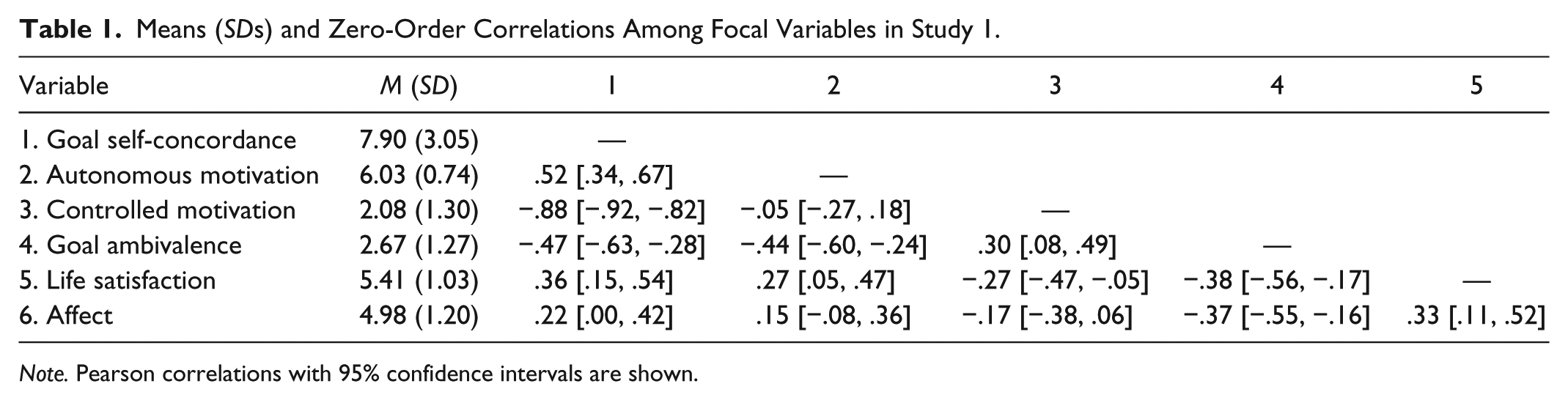
Means, standard deviations, and zero-order correlations among the study variables are presented in Table 1.
Means (SDs) and Zero-Order Correlations Among Focal Variables in Study 1.
Note. Pearson correlations with 95% confidence intervals are shown.
Correlational results
As predicted, goal ambivalence exhibited substantial correlations with self-concordance, autonomous, and controlled motivation, as well as the well-being measures. Autonomous and controlled motivation were not correlated. Regressing ambivalence on both forms of motivation simultaneously revealed that the variance explained by autonomous, β = −.43, B (SE) = −0.73 (0.17), 95% CI [−1.07, −0.39], and controlled, β = .28, B (SE) = 0.27 (0.10), [0.08, 0.47], motivation was not redundant. Self-concordance was positively related to both well-being measures, although the correlations between its subcomponents autonomous and controlled motivation and affect were rather small.
Mediation analyses
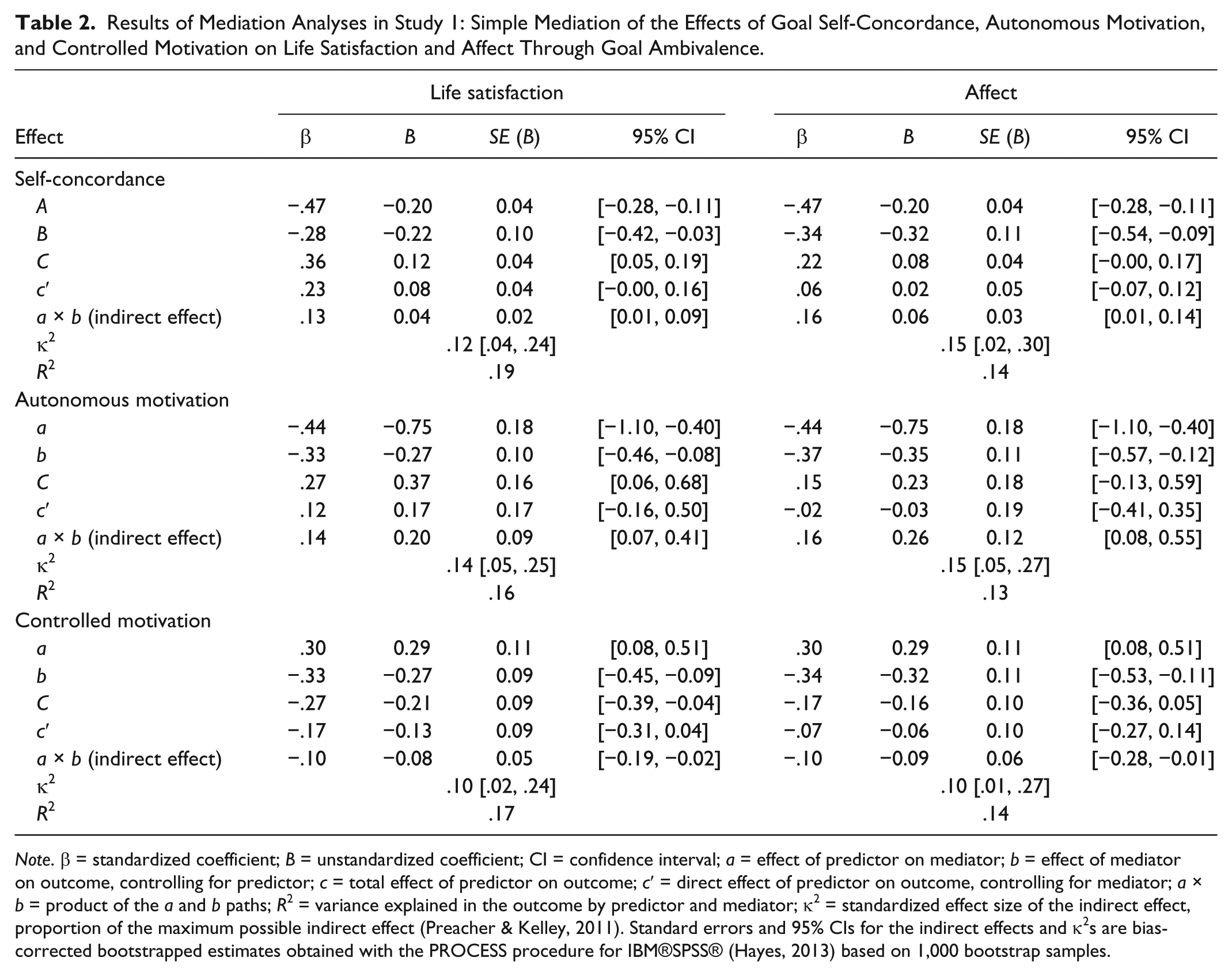
Six mediation models with the predictors (a) goal self-concordance, (b) autonomous, and (c) controlled motivation, and the outcomes (a) life satisfaction and (b) affect were tested following procedures suggested by Hayes (2013). Coefficients of mediation paths a (path from predictor to mediator), b (path from mediator to outcome, controlling for predictor), c (total effect of predictor on outcome), and c′ (direct effect of predictor on outcome, controlling for mediator) were estimated with a series of ordinary least squares (OLS) regression models. Regression weights and coefficients of the indirect effects (paths a × b) are shown in Table 2.
Results of Mediation Analyses in Study 1: Simple Mediation of the Effects of Goal Self-Concordance, Autonomous Motivation, and Controlled Motivation on Life Satisfaction and Affect Through Goal Ambivalence.
Note. β = standardized coefficient; B = unstandardized coefficient; CI = confidence interval; a = effect of predictor on mediator; b = effect of mediator on outcome, controlling for predictor; c = total effect of predictor on outcome; c′ = direct effect of predictor on outcome, controlling for mediator; a × b = product of the a and b paths; R2 = variance explained in the outcome by predictor and mediator; κ2 = standardized effect size of the indirect effect, proportion of the maximum possible indirect effect (Preacher & Kelley, 2011). Standard errors and 95% CIs for the indirect effects and κ2s are bias-corrected bootstrapped estimates obtained with the PROCESS procedure for IBM®SPSS® (Hayes, 2013) based on 1,000 bootstrap samples.
As is evident from Table 2, none of the 95% CIs of the indirect effects included zero, implying that goal self-concordance and autonomous motivation exhibited positive, and controlled motivation negative, indirect effects on life satisfaction and affect through goal ambivalence. The indirect effects were medium in size as indicated by their κ2s (proportion of the maximum possible indirect effect; Preacher & Kelley, 2011), although the estimates were somewhat imprecise, with respective 95% CIs spanning the small-to-large range.
Overall, the correlational results of Study 1 provide evidence for the validity of our measure of experienced goal ambivalence, whereas the mediational findings support our hypothesis of ambivalence as a mechanism of self-concordance effects on well-being.
Study 2
In Study 2, we sought to replicate the results of Study 1 with a larger sample. In addition, this study was designed to rule out an alternative explanation for the effects, namely, that our findings were owed to inter-individual differences in general self-regulatory strategies. Regulatory mode theory (Kruglanski et al., 2000), which proposes locomotion and assessment as two distinct self-regulatory dimensions, lends itself as a self-regulatory framework theoretically corresponding to our focal constructs. People high in locomotion are action-oriented “doers”; those high in assessment are concerned with evaluating goals, means, and alternatives. Locomotion has been positively related to autonomous motivation and goal self-concordance, whereas assessment has been positively related to controlled motivation and negatively to self-concordance (Kruglanski et al., 2000; Pierro, Kruglanski, & Higgins, 2006). In addition, locomotion has been positively, and assessment negatively, associated with well-being (Kruglanski, Pierro, Mannetti, & Higgins, 2013). Because assessors are focused on comparing positive and negative aspects of a goal and its alternatives (Kruglanski et al., 2000), one could expect that they are also more likely to feel ambivalence, whereas locomotors’ focus on implementing goal-related actions may prevent them from experiencing conflicting reactions. It might be then that people high in locomotion choose more self-concordant goals, and at the same time experience less ambivalence and better well-being, whereas the opposite pattern applies to those high in assessment—potentially accounting for our hypothesized relations. We therefore included measures of dispositional differences in locomotion and assessment to test for this possibility.
Method
Participants and procedure
Data for this study were collected the year following Study 1 in the same lecture. Procedures were identical except for the sample size (n = 200) and details of the questionnaires. One hundred eighty-nine students (154 women, Mage = 23.01 years, SDage = 7.19) took part in the study, 182 of whom were in their freshman year.
Measures
Measures of goal self-concordance (α = .44), its subcomponents autonomous (r = .25, 95% CI [.11, .38]) and controlled (r = .45, [.33, .56]) motivation, goal ambivalence (α = .92), life satisfaction (α = .86), and affect (α = .89) were the same as in Study 1. The experienced goal ambivalence scale showed an equally strong correlation (r = .46, [.34, .57]) with the same index measure of potential goal ambivalence as in the first sample.
Locomotion and assessment were measured with a German version of the Locomotion and Assessment Questionnaire (Sellin, Schütz, Kruglanski, & Higgins, 2003). Twelve statements representing locomotion (e.g., “When I decide to do something, I can’t wait to get started”; α = .73) and 10 statements representing assessment (e.g., “I often critique work done by myself or others”; α = .72) were rated on 6-point Likert-type scales ranging from 1 = strongly disagree to 6 = strongly agree.
Results and Discussion
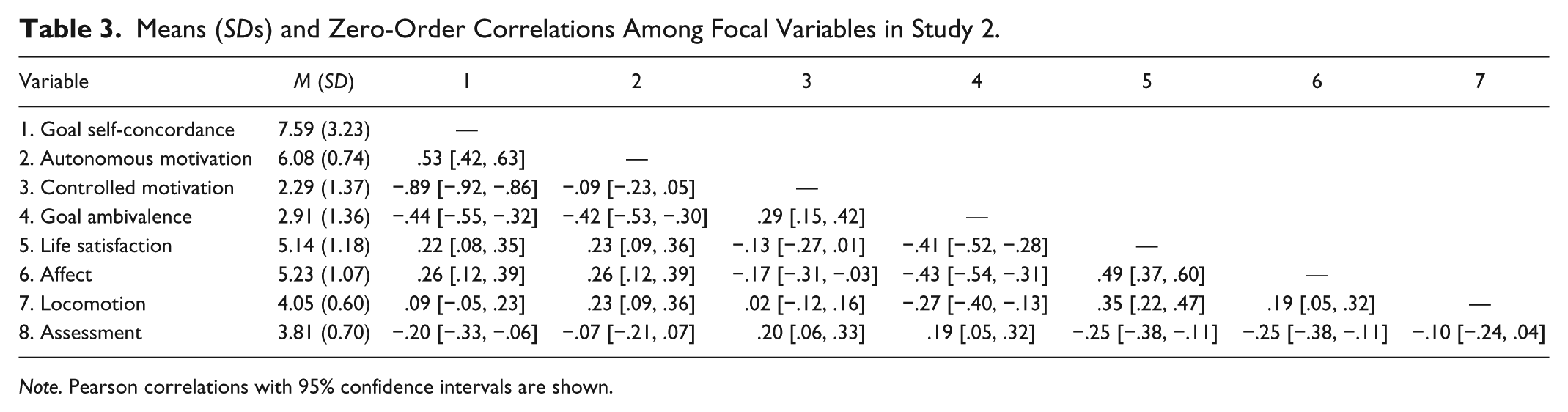
Means, standard deviations, and zero-order correlations among the study variables are shown in Table 3.
Means (SDs) and Zero-Order Correlations Among Focal Variables in Study 2.
Note. Pearson correlations with 95% confidence intervals are shown.
Correlational results
Intercorrelations among the focal constructs were by and large comparable with those of Study 1; due to the increase in sample size, the strength of the associations was also more precisely estimated (as indicated by narrower 95% CIs; Cumming, 2012).
Again, autonomous and controlled motivation were not related, but independently contributed to ambivalence, β = −.40, B (SE) = −0.73 (0.12), 95% CI [−.96, −.50], and β = .26, B (SE) = 0.25 (0.06), [.13, .38], respectively. Except for the lack of a larger correlation between self-concordance and locomotion, locomotion and assessment related to the other constructs as expected, justifying their inclusion as control variables in the following analyses.
Mediation analyses
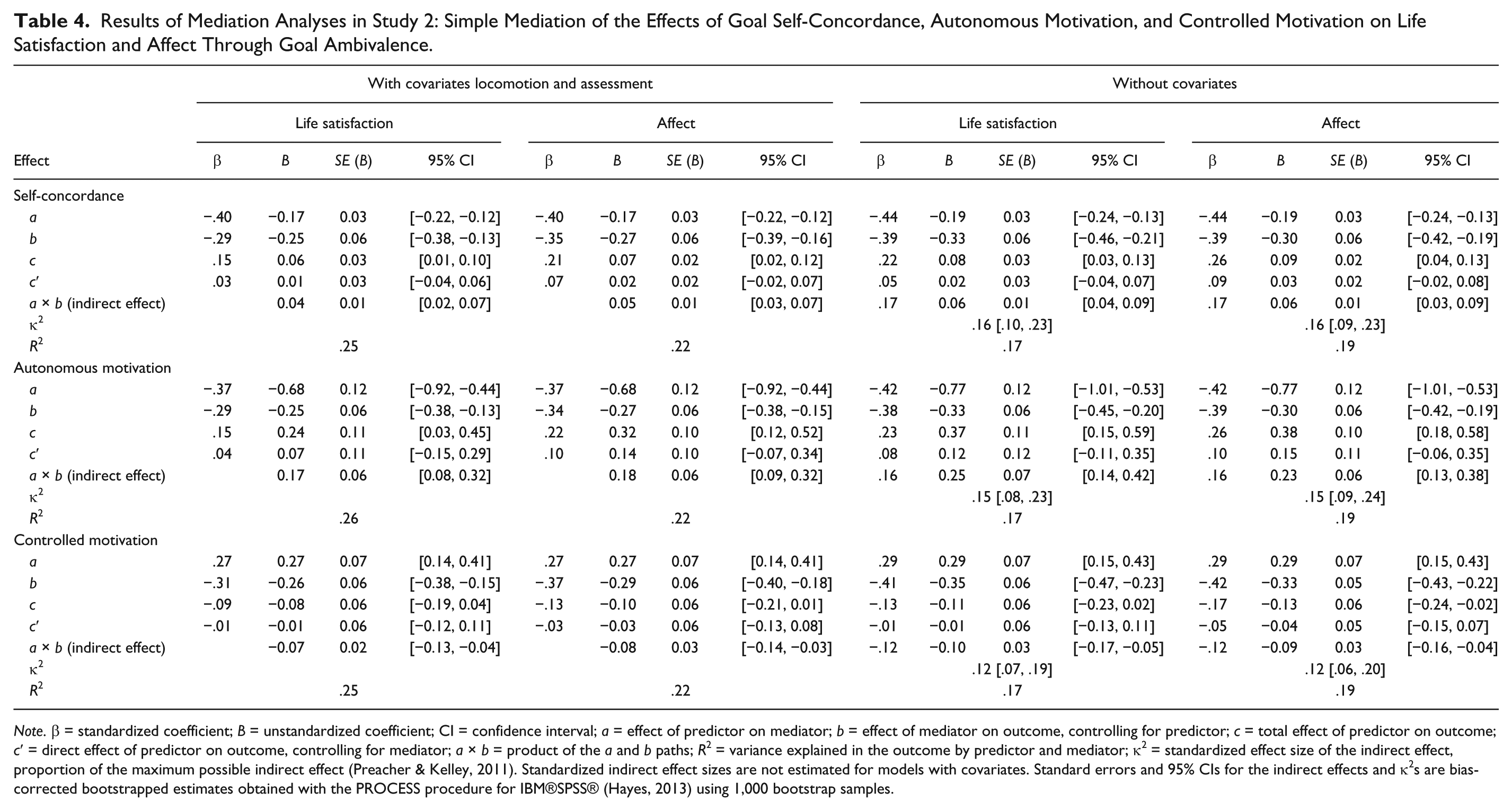
The analytic procedures for testing the mediation hypothesis were the same as in Study 1, with the exception that locomotion and assessment were included as covariates. Table 4 presents the results of the analyses both with and without the covariates.
Results of Mediation Analyses in Study 2: Simple Mediation of the Effects of Goal Self-Concordance, Autonomous Motivation, and Controlled Motivation on Life Satisfaction and Affect Through Goal Ambivalence.
Note. β = standardized coefficient; B = unstandardized coefficient; CI = confidence interval; a = effect of predictor on mediator; b = effect of mediator on outcome, controlling for predictor; c = total effect of predictor on outcome; c′ = direct effect of predictor on outcome, controlling for mediator; a × b = product of the a and b paths; R2 = variance explained in the outcome by predictor and mediator; κ2 = standardized effect size of the indirect effect, proportion of the maximum possible indirect effect (Preacher & Kelley, 2011). Standardized indirect effect sizes are not estimated for models with covariates. Standard errors and 95% CIs for the indirect effects and κ2s are bias-corrected bootstrapped estimates obtained with the PROCESS procedure for IBM®SPSS® (Hayes, 2013) using 1,000 bootstrap samples.
Consistent with the results of Study 1, we found non-zero indirect effects of self-concordance, autonomous, and controlled motivation on life satisfaction and affect through goal ambivalence. The indirect effects in the models without covariates, which can be directly compared with those of Study 1, were not only similar (or larger) in size in the present sample but also estimated with higher precision throughout. When comparing the results of the analyses with and without covariates, coefficients appear somewhat smaller in the models controlling for locomotion and assessment, attesting to some shared variance with the study variables; however, including the covariates did not affect the overall pattern of results.
From the results of Study 2, we conclude that our findings are robust across two independent samples and that the hypothesized model explains variance in the focal variables over and above the effects of inter-individual differences in self-regulatory strategies.
Study 3
In Study 3, we aimed to extend the results of Studies 1 and 2 by testing two key assumptions of the self-concordance model. First, an integral characteristic of the model is that self-concordance not only predicts cross-sectional differences but also longitudinal increases in well-being. Second, these effects have been shown to occur through goal progress or attainment (Sheldon, 2002). We therefore tested a longitudinal process model, in which self-concordance of the study goal, measured at the beginning of the freshman year, would be associated with lower levels of ambivalence during the academic year, leading to higher ratings of goal progress at the end of the academic year, which would then predict 1-year increases in well-being at the beginning of the second year (see Figure 1). In addition to life satisfaction and affect, we added satisfaction with studies as a further outcome variable to demonstrate that our hypotheses apply to global as well as more goal-specific indicators of adjustment.

Serial multiple mediator models of goal self-concordance (predictor), goal ambivalence (Mediator 1), goal progress (Mediator 2), and latent change in the criterion variables (A) life satisfaction, χ2(1) = 0.250, χ2/df = .250, NNFI = 1.040, CFI = 1.000, RMSEA = .000, 95% CI [.000, .174], AIC = 38.250; AICmodel4 = 35.333; (B) satisfaction with studies, χ2(1) = 0.845, χ2/df = .845, NNFI = 1.010, CFI = 1.000, RMSEA = .000 [.000, .212], AIC = 38.845; AICmodel4 = 35.245); and (C) affect, χ2(1) = 0.909, χ2/df = .909, NNFI = 1.007, CFI = 1.000, RMSEA = .000 [.000, .215], AIC = 38.909; AICmodel4 = 35.276).
Method
Participants and procedure
Study 3 was part of a larger research project consisting of a longitudinal study with 207 freshmen (145 women, Mage = 21.0 years, SDage = 3.61, 72 psychology students) at a Swiss university over 1½ years, four semesters, and 12 measurement points (T1-T12). As we were interested in the adjustment to university in the first year, the present analyses are based on data from the first year of the survey and therefore focused on measurement points T1 to T8. 3
The study was advertised via an email approved of, and delivered by, the legal department of the university. Students were further recruited via announcements during lectures, flyers, and advertising on billboards and were emailed a coupon (worth 30 euros for the first and 10 euros for each subsequent measurement point) of a popular mail-order company in compensation for their participation.
Measures
In this study, the focal goal was defined as “the successful continuation or pursuit of your field of study.”
Goal self-concordance was measured at T1 with the same four items as in Studies 1 and 2, rated on a 9-point Likert-type scale anchored at 1 = does not apply at all and 9 = applies very much, which were combined into the overall index (α = .55) and its subcomponents autonomous (r = .44, 95% CI [.32, .54]) and controlled (r = .64, [.55, .71]) motivation.
Goal ambivalence was also assessed with the same scale as in Studies 1 and 2. Concurring with previous research (e.g., Sheldon & Elliot, 1999), we aggregated the mediator across several measurements during the academic year. However, because measurement points were not equidistant, instead of averaging the ratings, we computed the area under the curve (ground) (AUCg) across six measurements of goal ambivalence taken during the first and second semester using a formula provided by Pruessner, Kirschbaum, Meinlschmid, and Hellhammer (2003). This index can be interpreted as the weighted total extent of goal ambivalence experienced from the beginning of the first to the end of the second semester. Internal consistencies of the eight-item scale at each measurement point (T1-T6) ranged from α = .93 to α = .96; the reliability of the scale mean across the six measurement points was α = .93.
Goal progress was assessed at the end of the academic year (T6) with one item (“I am satisfied with the progress in pursuing my field of study.”) rated on a 7-point Likert-type scale ranging from 1 = does not apply at all to 7 = applies fully.
Life satisfaction was assessed at the beginning of the first semester (T1) and 1 year later at the beginning of the third semester (T8) with the same measure as in Studies 1 and 2, rated on a 7-point Likert-type scale ranging from 1 = not at all agree to 7 = precisely agree (αT1 = .85, αT8 = .89).
Affect was measured at T1 and T8 with 12 adjectives (e.g., happy, anxious), 4 of which were taken from the Positive and Negative Affect Schedule (Watson, Clark, & Tellegen, 1988) and 8 from Brunstein (1993). Participants were instructed to rate how often they had experienced each of these feelings over the past 2 weeks on a 7-point Likert-type scale anchored at 1 = never and 7 = frequently (αT1 = .87, αT8 = .90).
Satisfaction with studies was measured at T1 and T8 with a scale developed by Hiemisch, Westermann, and Michael (2005). The scale comprises five statements (e.g., “I really take much pleasure in my studies.”) that were rated on an 11-point Likert-type scale anchored at 0 = does not apply at all and 10 = applies very much (αT1 = .63, αT8 = .75).
Results and Discussion
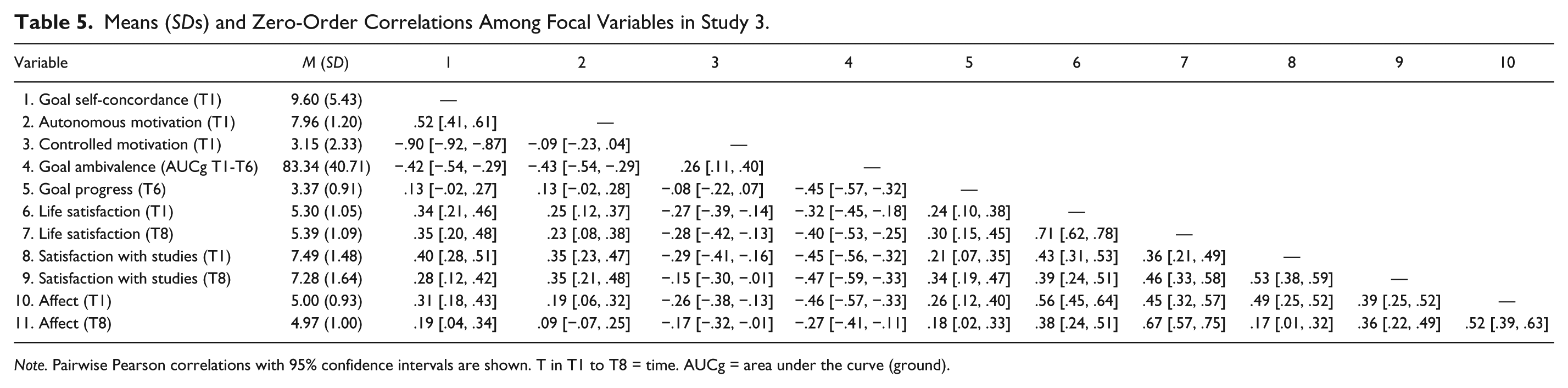
Means (standard deviations) and zero-order correlations among the main constructs of the study are reported in Table 5.
Means (SDs) and Zero-Order Correlations Among Focal Variables in Study 3.
Note. Pairwise Pearson correlations with 95% confidence intervals are shown. T in T1 to T8 = time. AUCg = area under the curve (ground).
Correlational results
As can be seen in Table 5, goal self-concordance (at T1) was, at T1 and T8, positively related to all criterion variables (i.e., life satisfaction, satisfaction with studies, and affect), negatively associated with goal ambivalence over the first two academic semesters (AUCg T1-T6), and positively correlated with goal progress after 1 year (T6), although the latter relationship was comparably small.
As in Studies 1 and 2, the correlation between autonomous and controlled motivation was not statistically different from zero, but both were related to goal ambivalence. Again, simultaneously regressing the ambivalence measure on both subcomponents revealed non-redundant contributions of autonomous, β = −.42, B (SE) = −0.15.39 (2.50), 95% CI [−20.32, −10.46], and controlled, β = .25, B (SE) = 4.57 (1.23), [2.14, 7.00], motivation.
Mediation analyses
We examined serial multiple mediator models (Hayes, 2013) to test the hypothesis that (a) goal ambivalence (AUCg T1-T6) and goal progress (T6) mediate the effect of goal self-concordance (T1) on change in life satisfaction over the first year following university entry (ΔT1-T8) and (b) goal ambivalence over the first two semesters (AUCg T1-T6) mediates the relationship between goal self-concordance (T1) and goal progress at the end of the second semester (T6; cf. Figure 1A). Analogous models were tested for the criterion variables satisfaction with studies and affect (cf. Figures 1B and 1C). For all three criterion variables, we separately analyzed the (indirect) effects of goal self-concordance as well as its subcomponents controlled and autonomous motivation. For parsimony’s sake, the respective results for the two subcomponents of goal self-concordance are summarized in Note 4. The effects in the mediation models were estimated with the bootstrap resampling method (Shrout & Bolger, 2002). A change-regression model (McArdle, 2009) was included in the models to estimate the respective base-free change in life satisfaction, satisfaction with studies, and affect from T1 to T8 (ΔT1-T8; cf. Figure 1). By adding fixed values (=1) to the two regression paths predicting the criterion variables at T8 (during model specification), the unobserved (i.e., latent) variable latent change was specified as the variance of the criterion variable at T8 that is not identical to the criterion variable at T1. Thus, the variable latent change represents the change in the criterion variable from T1 to T8 (McArdle, 2009; cf. Figure 1).
Testing for sample selectivity
As performing bootstrap analyses to estimate effects with the AMOS software package requires complete data, we evaluated (for all three criterion variables separately) whether the subsample with complete data on all study variables (n = 147, 100 women, Mage = 20.93 years, SDage = 3.35, 44 psychology students) showed evidence of selectivity in comparison with the total sample (n = 207). For this purpose, the serial multiple mediator models depicted in Figure 1 were estimated with the dataset of (a) the total sample (Model 1, n = 207, df = 1) using full information maximum likelihood (FIML) 5 and (b) the subsample with complete data (Model 2, n = 147, df = 1). To compare whether the parameter estimates (i.e., covariances and regression weights) in the two samples differed, the result of the total sample (Model 1) was applied to the subsample with complete data. More specifically, the two covariances and seven regression weights of the resulting Model 3 (n = 147, df = 10) were fixed to the estimates obtained in Model 1. Lower AICs 6 (Akaike information criterion; Akaike, 1987) for Model 3 in comparison with Model 2 (cf. Figure 1), for all three criterion variables (life satisfaction: AIC = 24.453; satisfaction with studies: AIC = 22.092; affect: AIC = 21.703), suggested that the parameter estimates fit the data well and thus did not differ between the total sample and the subsample with complete data. As there was no evidence of selectivity, analyses are subsequently reported merely for the subsample with complete data, the results of which arguably can be assumed to be representative of the total sample.
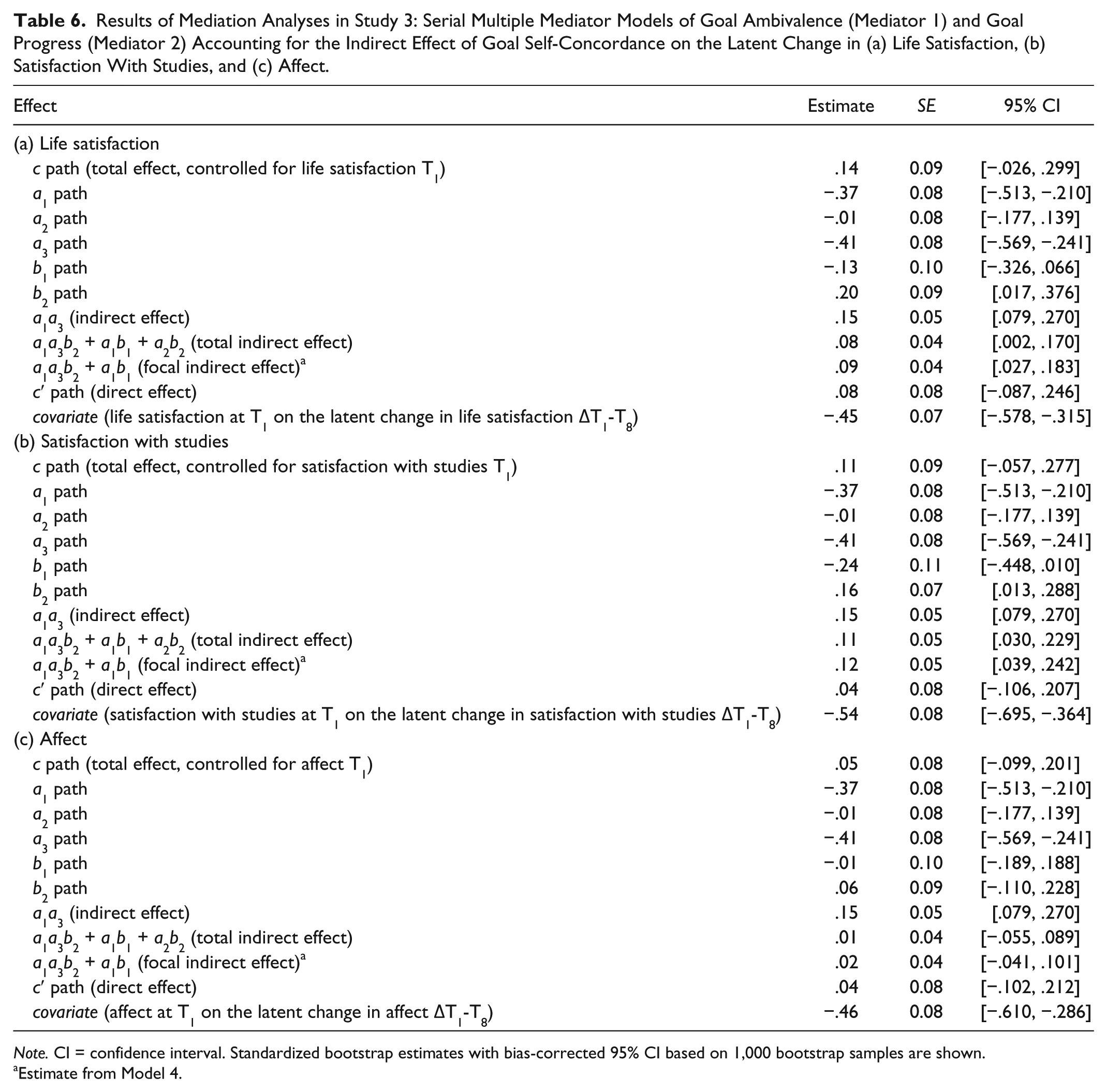
The serial multiple mediator models calculated for the subsample with complete data (Model 2) had excellent indices of fit for all three criterion variables. Results and fit indices are provided in Figure 1 and Table 6.
Results of Mediation Analyses in Study 3: Serial Multiple Mediator Models of Goal Ambivalence (Mediator 1) and Goal Progress (Mediator 2) Accounting for the Indirect Effect of Goal Self-Concordance on the Latent Change in (a) Life Satisfaction, (b) Satisfaction With Studies, and (c) Affect.
Note. CI = confidence interval. Standardized bootstrap estimates with bias-corrected 95% CI based on 1,000 bootstrap samples are shown.
Estimate from Model 4.
Estimating indirect effects
As illustrated in Figures 1A and 1B and summarized in Table 6, goal self-concordance at the beginning of the first semester (T1) indirectly predicted latent change in life satisfaction and satisfaction with studies over the first year (ΔT1-T8), mediated through goal ambivalence over the first two semesters (AUCg T1-T6) and goal progress at the end of the second semester (T6) (total indirect effect: a1a3b2 + a1b1 + a2b2). In addition, goal self-concordance had an indirect effect on goal progress through goal ambivalence (indirect effect: a1a3). The effects of the criterion variables at T1 on the latent change in the respective criterion variable over the first year (ΔT1-T8) mirror the law of initial values (e.g., Wilder, 1957). 7 As is evident from Figure 1C and Table 6, the path from goal progress to latent change in affect was very close to zero, and hence no indirect effect was found on this criterion.
Because the indirect effect of goal self-concordance (T1) on the criterion variable (ΔT1-T8) via goal progress (T6) (a2b2) contributes to the total indirect effect (a1a3b2 + a1b1 + a2b2), but does not include goal ambivalence as a mediating variable, we also compared Model 2 with a more parsimonious Model 4 (df = 3), in which the direct paths from goal self-concordance to goal progress (b2) as well as the latent change in the criterion (c′) were constrained to zero. This model, which is consistent with our assumption of goal ambivalence as the central mediator in the self-concordance model, fit the data even better (cf. AICs in Figure 1). The focal indirect effects through goal ambivalence (a1a3b2 + a1b1) are provided in Table 6.
In Study 3, goal progress at the end of the academic year did not contribute to a 1-year increase in affect, precluding the hypothesized indirect effect of self-concordance through goal ambivalence and goal progress. Possibly, evaluations of short-term affect are malleable to influences of other personal strivings, for example, social and relationship goals, that are more salient at the beginning of the academic year, thus lessening the effect of past study goal progress. In contrast, progress on this central personal goal did predict an increase in the more global well-being evaluation of life satisfaction, as well as satisfaction with studies. The fact that life and study satisfaction were strongly correlated (around r = .45) may also testify to the importance of successful pursuit of the study goal for overall well-being. Taken as a whole, the results of Study 3 provide compelling evidence for the mediating role of goal ambivalence in predicting well-being increases through self-concordant goal pursuit.
General Discussion
Across three studies, we found strong support for our hypothesis of goal ambivalence as a mediator of goal self-concordance effects on well-being. In all studies, self-concordance of university freshmen’s study goal was negatively related to goal ambivalence. In Study 1, the cross-sectional effects of self-concordance on life satisfaction and affect were mediated through goal ambivalence. Study 2 replicated this result, finding it to remain robust beyond the effects of differences in self-regulatory strategies. In Study 3, we demonstrated that the well-established indirect effects of self-concordance on longitudinal changes in well-being and adjustment through goal progress were also accounted for by experienced goal ambivalence. In our view, these findings provide a valuable addition to previous research on the self-concordance model. By integrating a phenomenological correlate of perceived locus of causality that resonates with the self-determination literature, but to our knowledge has not been empirically investigated, the present research contributes to an even more fine-grained analysis of the processes that lead from self-concordant goal selection to successful attainment and increased well-being.
Ambivalence: Capturing a Relevant Experience in Personal Goal Pursuit
In this article, we also present a new, reliable, and valid measure of goal ambivalence. This scale better represents the notion of simultaneous conflicting reactions toward a goal during its pursuit than previous assessments focusing on expected unhappiness at attainment, yet it likewise predicted lower well-being. Beyond issues of measurement, we also extend previous research on the consequences of goal ambivalence by establishing goal self-concordance as an important predictor.
Notably, although self-concordance effects were fully explained through the experience of ambivalence, the correlation between the two constructs was far from perfect. Sheldon (2008) has described the relative autonomy index of self-concordance as a suitable self-report measure of a person’s integration of her or his goals with other levels of personality. He did, however, acknowledge that it may not fully tap into incongruencies for all people, with some exhibiting “illusory self-concordance” (p. 473), falsely classifying their goals as more internalized than they really are. Even though these individuals may not be able to recognize its external locus of causality, they could still perceive a sense of incongruence and discomfort toward a given goal as captured by our ambivalence scale. Current in-the-moment feelings of ambivalence toward a goal may be easier to report on than relatively abstract evaluations of retrospective locus of causality, which could explain the incremental value of goal ambivalence in predicting well-being in the present studies.
In spite of these considerations, we contend that the two constructs are not conceptually equivalent and that goal ambivalence will also be determined by factors beyond the self-concordance framework. Other theories of motivational congruence may equally benefit from assessing conflicting reactions toward a goal. For instance, incongruence between implicit motivational dispositions and personal goals—which has in fact been directly linked to lower goal self-concordance (Sheldon & Schüler, 2011)—is assumed to be a “hidden stressor” (Baumann, Kaschel, & Kuhl, 2005, p. 781) that can be resolved through emotional disclosure (Schüler, Job, Fröhlich, & Brandstätter, 2009). Distress about goal ambivalence is similarly reduced by expressive writing about emotions (Kelly et al., 2012), suggesting that the experience of goal ambivalence may be a—not so hidden—mechanism of motive–goal incongruence effects on ill-being. Different forms of person–goal incongruence, such as regulatory misfit (Higgins, 2005), may also precipitate goal ambivalence. In a similar vein, discrepancies between one’s own and important others’ appraisals of a personal goal could lead to feelings of ambivalence toward the goal, as demonstrated by Priester and Petty (2001) for attitude objects. In light of the strong associations with well-being measures in the present research, it seems desirable to examine potential antecedents of goal ambivalence and their interrelations.
Autonomous and Controlled Motivation: Independent but Converging Effects
In addition to proposing goal ambivalence as a relevant mediator in the self-concordance model, the present research addressed the question of interrelations and differential effects of self-concordance’s subcomponents. As in previous research, we did not find substantial negative correlations between autonomous and controlled motivation. Both components incrementally contributed to the experience of goal ambivalence, supporting our assumption of an independent protective effect of autonomous motivation. Every goal, self-concordant or not, can entail negative aspects and undesired consequences, potentially contributing to the experience of ambivalence. However, the sense of ownership and integration with the self of autonomously pursued goals seems to prevent individuals from translating these negative aspects into the experience of conflict.
Both subcomponents also indirectly affected outcome measures through goal ambivalence. These findings are intriguing in that they further support the view that effects of autonomous and controlled motivation are non-redundant. However, separating them revealed no differential mediation effects and thus offered no incremental insight compared with the self-concordance index. In line with previous research, total effects of controlled motivation (e.g., on affect in Study 1 and on goal progress in Study 3) were not statistically different from zero and somewhat smaller than those of self-concordance and autonomous motivation. However, all three predictors had non-zero indirect effects through ambivalence, hence suggesting that inconsistent self-concordance findings could be reconciled by including additional mechanisms.
Limitations
Some shortcomings of the present research may limit its generalization to other applications of the self-concordance model. First, our domain-specific analyses of a single goal, namely, the study goal, differ from the common practice in the self-concordance literature of aggregating evaluations across several personal goals. However, other research has also diverged from this practice, reasoning that ratings of self-concordance do not always coincide across different domains or goals (Carraro & Gaudreau, 2011). Second, we did not model the entire process of self-concordant goal pursuit on longitudinal changes in well-being through effort, attainment, and basic need satisfaction, as proposed by Sheldon and Elliot (1999), although the design of Study 3 did map several of its core features. Future studies should extend our findings by including measures of self-regulation and basic need satisfaction and perhaps more elaborate assessments of goal attainment (e.g., scaling techniques or objective indicators) than our one-item measure of goal progress. Finally, the average level of study goal self-concordance was relatively high in our samples, perhaps concurring with research that has found German undergraduates to experience higher levels of autonomous motivation compared with their American counterparts (Levesque, Zuehlke, Stanek, & Ryan, 2004). Underpinning the validity of our findings, self-concordance has been found to predict well-being across different cultures, despite intercultural mean differences (Sheldon et al., 2004). Nonetheless, these findings should be replicated with other samples and within different domains before general conclusions can be drawn.
Practical Implications
For the university freshmen in the present studies whose reasons for pursuing their field of study were less self-concordant, goal ambivalence was clearly a relevant experience. If this proves to be true in other contexts, explicitly addressing ambivalent reactions toward non-concordant goals may open up possibilities for intervention. Pertaining to efficient self-regulation, identification of potential conflicts is necessary to execute self-control (Myrseth & Fishbach, 2009). In cases of impaired action regulation, psychotherapeutic techniques such as motivational interviewing already rely on first activating and then resolving ambivalence, which has been assumed to enable integration of extrinsically motivated goals if delivered in an autonomy-supportive manner (Markland et al., 2005; Vansteenkiste & Sheldon, 2006). Acknowledging that non-concordant goals are accompanied by feelings of ambivalence could thus help individuals bring their endeavors into congruence with their genuine motivations, values, and interests and to set more self-concordant goals in the first place.
Conclusion
Humans’ desire for congruence within their self-concepts, attitudes, and actions lies at the heart of numerous psychological theories (e.g., theories of cognitive (in)consistency in social psychology, Gawronski & Strack, 2012; therapeutic approaches in clinical psychology, Grawe, 2004). Research from diverse theoretical backgrounds has asserted that the collision of conflicting motivational tendencies leads to discomfort and ill-being because it impairs the efficient regulation of behavior (Emmons, King, & Sheldon, 1993; Harmon-Jones, Amodio, & Harmon-Jones, 2009; Michalak, Heidenreich, & Hoyer, 2004). Previous work on both goal self-concordance as motivational congruence (Sheldon, 2008) and goal ambivalence as motivational conflict (Emmons & King, 1988) lies within this tradition.
Arguably, increasing congruence among theoretical approaches is imperative for the advancement of psychological science and seems tantamount to the importance of individuals’ perceived consistency among their motivations and actions for successful striving and thriving. Avenues for future research depart from our findings regarding the role of goal ambivalence in the self-concordance model of goal striving, but also for its integration with other theories of personal goal pursuit, as well as for motivational accounts of conflict and consistency more generally. We believe that the present research sets the stage for further examination of goal ambivalence as a phenomenon that has been comparatively neglected by contemporary motivation science but holds the potential to meaningfully contribute to the understanding of human goal pursuit.
Footnotes
Declaration of Conflicting Interests
The author(s) declared no potential conflicts of interest with respect to the research, authorship, and/or publication of this article.
Funding
The author(s) disclosed receipt of the following financial support for the research, authorship, and/or publication of this article: Parts of this research were funded by a grant from the Swiss National Science Foundation (SNSF) to Veronika Brandstätter (100014_130131).

Notes
References
Supplementary Material
Please find the following supplemental material available below.
For Open Access articles published under a Creative Commons License, all supplemental material carries the same license as the article it is associated with.
For non-Open Access articles published, all supplemental material carries a non-exclusive license, and permission requests for re-use of supplemental material or any part of supplemental material shall be sent directly to the copyright owner as specified in the copyright notice associated with the article.
