



Abstract
This research investigated how regulatory focus might influence trend-reversal predictions. We hypothesized that compared with promotion focus, prevention focus hinders sense of control, which in turn predicts more trend-reversal developments. Studies 1 and 3 revealed that participants expected trend-reversal developments to be more likely to occur when they focused on prevention than when they focused on promotion. Study 2 extended the findings by including a control condition, and revealed that participants expected trend-reversal developments to be more likely to occur in the prevention condition than in the promotion and control conditions. Studies 4 and 5 revealed that participants’ chronic prevention focus predicted a low sense of control (Study 4), and that promotion focus predicted a high sense of control (Studies 4 and 5). Furthermore, participants with a high sense of control expected trend-reversal developments to be less likely to occur. Thus, the results provided converging evidence for the hypothesis.
A major retailer was contemplating whether to open more stores across the country. The key determining factor under consideration was whether sales would continue to grow as they had in the past few years, or would start to decrease. Before making the decision, imagine that she had either been focusing her thoughts on her wishes and aspirations, such as how to achieve fast growth in her business, or on her duties and obligations, such as how to prevent losing market shares to her biggest competitors. Would thinking about her wishes and aspirations versus duties and obligations have any impact on her decision regarding opening new stores?
The answer is yes. Our predictions about the future are often influenced by our motivations, such as in wishful thinking (Babad, Hills, & O’Driscoll, 1992). Thus it is important to study the influence of motivational focus on our predictions about the future. In particular, this article examines how focusing on promotion versus prevention may affect trend-reversal predictions one makes for the future.
Regulatory Focus
Regulatory focus theory (Higgins, 1997, 1998) proposes two types of self-regulation motivations: promotion focus and prevention focus. In promotion focus, people are mostly concerned with the presence and absence of positive outcomes. That is, they tend to focus more on ideals, accomplishments, aspirations, and so on. People with a promotion focus are eager to obtain positive outcomes. In contrast, people with a prevention focus are mostly concerned with the presence and absence of negative outcomes. As a result, they tend to focus more on their duties, obligations, potential failures, threats, and so on. People with a prevention focus are vigilant and cautious to avoid failing personal duties and obligations (Langens, 2007).
Research has supported regulatory focus theory. For example, Förster, Grant, Idson, and Higgins (2001) found that people with a promotion focus were more sensitive to positive feedback signaling possible successes. In contrast, people with a prevention focus were more sensitive to negative feedback signaling possible failures. Similarly, other researchers have found that individuals high on promotion focus were more likely to be motivated by positive role models, for example, a student who is getting A+s, whereas individuals high on prevention focus were more motivated by negative role models, for example, a student who has been placed on academic probation (Lockwood, Jordan, & Kunda, 2002; Lockwood, Marshall, & Sadler, 2005).
Regulatory focus has broad influences on people’s thinking and behavior. Compared with prevention focus, promotion focus is found to foster a sense of control (Langens, 2007). Individuals with a promotion focus are eager to obtain desired outcomes, and such outcomes receive more attention and are more memorable. Thus, a high sense of control develops. In contrast, individuals with a prevention focus are vigilant toward undesired outcomes, and such outcomes receive more attention and are more memorable. Thus, a low sense of control develops. That is, the biasing effect of regulatory focus on information processing impacts sense of control. In one study, Langens (2007) induced participants to focus on either promotion or prevention by activating nurturance (promotion) or security (prevention) concerns, respectively. Specifically, participants played a computer game in which they had to move a circle through a matrix. A yellow square representing either a golden bar (promotion condition) or a quicksand (prevention condition) randomly appear in the matrix. Participants needed to move the circle either toward the yellow square for gain or non-gain of the golden bar (promotion condition), or to move it away from the yellow square for non-loss or loss in the quicksand (prevention condition). Participants then reported their perceived control over an uncontrollable outcome. It was found that participants who were induced with a promotion focus reported having more control over the outcome than did those induced with a prevention focus.
Trend-Reversal Predictions
People hold different lay or implicit theories, or beliefs regarding the stability and change of personal attributes (Ross, 1989), and more generally of people, things, and events (Ji, Nisbett, & Su, 2001) over time. Indeed, the implicit theories regarding stability and change are powerful enough to bias people’s recall of their personal history, resulting in exaggeration of the similarities or differences between the past and the present self (Ross, 1989). Although people’s expectations about the future are generally based on their knowledge and causal explanations regarding each specific topic, their expectations about future development can also be affected by their implicit theories of stability and change. More specifically, a person with linear implicit theories of change tends to see stability, rather than change, as the norm (Ji, 2005). If things or events do change, the change is expected to take place in a linear manner, progressing further in the same direction (continuity). In contrast, a person who holds non-linear implicit theories of change tends to believe that things and events change all the time—and that they change in a non-linear or cyclical fashion, often in the form of a reversal in trends. In other words, people who hold non-linear implicit theories of change tend to believe that trend-reversal developments are more likely to happen and trend-continuity developments are less likely to happen than those who hold linear theories of change.
People’s beliefs about how things change over time influence their decision making. Ji, Zhang, and Guo (2008) found that due to different beliefs about how stock prices would change in the future, Chinese students and investors, who tend to expect trend-reversal developments, were more willing to sell and less willing to buy stocks with a recent trend of increasing prices, compared with Canadian students and investors, who tend to expect trend-continuity developments. For stocks with a trend of falling prices, Chinese students and investors were more likely to buy and less likely to sell than were their Canadian counterparts. The different preferences were related to cultural differences in people’s lay theories of change.
The Present Study
The present research investigated how regulatory focus might influence trend-reversal predictions. Compared with prevention focus, promotion focus fosters a sense of control (Langens, 2007). People with a high sense of control may be less likely to see things develop in a non-linear way. Non-linear patterns of development are more difficult to accurately predict and control than linear patterns, and thus would be inconsistent with a high sense of control. Although people in general may anticipate that a given trend would continue and would not be reversed when no reasons for change were provided, those with a high sense of control may be more confident in such a belief than those with a low sense of control. Consequently, people with a high sense of control may see trend-reversal developments as less likely to happen. Consistent with this, research has shown that prolonged control deprivation, which can lead to low sense of control, made people expect more trend-reversal developments (Zhou, He, Yang, Lao, & Baumeister, 2012).
Therefore, we predicted that compared with promotion focus, prevention focus would lead to more trend-reversal predictions for the future. Furthermore, the influences of regulatory focus on trend-reversal predictions would be mediated by sense of control. We conducted five studies to test this hypothesis. In Studies 1, 2 and 3, participants’ regulatory foci were manipulated before they made predictions for given scenarios. In Studies 4 and 5, participants’ chronic regulatory foci and sense of control were measured and they indicated how likely trend-reversal developments were in different scenarios.
Study 1
The purpose of Study 1 is to investigate if regulatory focus has an influence on trend-reversal predictions. In this study, participants were induced to focus on either prevention or promotion. They then made predictions about future developments of a series of hypothetical scenarios.
Methods
Participants
Seventy-five undergraduate students (38 males, 36 females, and 1 didn’t report gender) from an introductory psychology course at University of Macau, China, participated in the study. Participants’ mean age was 19.46 years (SD = 2.56). Participants received course credit for their participation.
Procedure
Participants first completed a regulatory focus manipulation task. After that, they completed a seemingly unrelated prediction task.
Regulatory focus manipulation
Regulatory focus was induced by activating strong ideas (for promotion) or security needs (for prevention). Specifically, participants were randomly assigned to one of two conditions: promotion or prevention focus. In the promotion focus condition, participants were asked to think about something they ideally would like to do or they would like to obtain, such as their hopes, aspirations, or the goals they wanted to accomplish. They then listed two or three such things. Participants in the prevention focus condition were asked to think about something they would like to avoid or to prevent from happening, such as potential failures, losses, or dangers they were trying to prevent from happening. They then listed two or three such things. This procedure was adapted from Halamish, Liberman, Higgins, and Idson (2008).
Trend-reversal predictions
To measure trend-reversal predictions, four hypothetical scenarios were presented to participants. For each scenario, participants predicted how likely a contrary outcome would happen in the future. The first three scenarios were drawn from Ji, Nisbett, and Su (2001). Specifically, participants read, “Lucia and Jeff are both seniors at the same university. They have been dating each other for 2 years. How likely is it that they will break up after graduation?” “Two kids are fighting at kindergarten. How likely is it that they will become lovers some day?” and “Vincent has been the chess champion for 3 years in high school. How likely is it that he will lose in the next game against his strongest opponent?” We created the fourth scenario, where participants read, “Daniel invested in the stock market and made a great amount of money in the past 5 years. He will continue to invest in the stock market next year. How likely is it that he will lose money next year in the stock market?” Participants rated each of the four scenarios on a scale ranging from 1 (extremely unlikely) to 7 (extremely likely). Higher scores indicate greater trend-reversal predictions.
The questionnaire was first created in English. It was then translated into traditional Chinese by two independent bilinguals. The two translations were compared and all the discrepancies in the translations were discussed until agreement was reached. Participants completed the study in Chinese. The same translation procedures were applied to Studies 2, 3, and 4 in the article.
Results and Discussion
The four trend-reversal scenarios yielded similar patterns of results. Participants in the prevention focus condition (Ms = 4.41, 4.44, 3.86, and 4.49, respectively) predicted more trend reversals than those in the promotion focus condition (Ms = 4.08, 3.55, 3.71, and 4.08, respectively). Thus, the mean rating on the four scenarios was calculated. The mean rating was normally distributed. Mean ratings that were more than 3 SDs away from the mean were defined as extreme outliers and were subsequently excluded from the following analysis. As a result, two participants were excluded from the analysis. Then a one-way ANOVA with regulatory focus as the independent variable and mean rating of trend-reversal developments as the dependent variable was conducted. As predicted, the main effect of regulatory focus was significant, F(1, 71) = 9.22, p = .003, Cohen’s d = 0.70, and 95% CI was 0.16 ≤ MPrevention – MPromotion ≤ 0.75. Participants in the prevention focus condition (M = 4.27, SD = 0.76) made more trend-reversal predictions than those in the promotion focus condition (M = 3.82, SD = 0.50). Thus, the results supported the hypothesis that compared with promotion focus, prevention focus fostered more trend-reversal predictions. Similar results were obtained when the two extreme outliers were included in the analysis.
Study 2
In Study 1, we found that participants made more trend-reversal predictions when they focused on prevention than when they focused on promotion. In Study 2, we adopted a different way to manipulate participants’ regulatory focus and examined its effect on trend-reversal predictions. In addition, we included a control group to further explore how prevention focus and promotion focus might uniquely influence trend-reversal predictions. Furthermore, to generalize the findings to other scenarios, two other hypothetical scenarios were used to measure people’s trend-reversal predictions.
Methods
Participants
One hundred and thirty-nine undergraduate students (46 males and 93 females) from an introductory psychology course at University of Macau, China, participated in the study. Participants’ mean age was 19.19 years (SD = 1.48). Participants received course credit for their participation.
Procedure
Participants completed an online questionnaire for the study. Specifically, they first completed the regulatory focus manipulation, and then completed the trend-reversal prediction task. Participants completed the questionnaire in Chinese.
Regulatory focus manipulation
Participants were randomly assigned to one of three conditions: promotion focus, prevention focus, or control. Strong ideals and strong “oughts” were used to induce promotion focus and prevention focus, respectively. Specifically, in the promotion focus condition, participants read, “Please think about something you ideally would like to do. In other words, please think about the hopes or aspirations you currently have. Please spend at least 2 to 3 min to think about these hopes or aspirations as this is very important for the study.” They then listed two or three hopes or aspirations. Participants in the prevention focus condition read, “Please think about something you believe you ought to do. In other words, please think about the duties or obligations you currently have. Please spend at least 2 to 3 min to think about these duties or obligations as this is very important for the study.” They then listed two or three duties or obligations. Participants in the control condition read, “Please think about the things you did today. Please spend at least 2 to 3 minutes to think about the things you did today as this is very important for the study.” They then listed two or three things they did. The procedure for promotion and prevention manipulations was adapted from Vaughn, Malik, Schwartz, Petkova, and Trudeau (2006).
Trend-reversal predictions
Participants read two scenarios, which were adapted from Ji et al. (2001). The two scenarios depicted an increasing and a decreasing trend (respectively) related to three time points. Specifically, in one scenario participants read, “The yields of sunflower seeds in the world were 1,210 kg/hectare in 2009, 1,220 kg/hectare in 2011, and 1,240 kg/hectare in 2013 as indicated on the graph below.” And in the other scenario participants read, “About 960,000 books were published in 2009, about 940,000 books were published in 2011, and about 900,000 books were published in 2013, as indicated on the graph below.” A graph followed each scenario to depict the trend information. Using scales ranging from 1 (extremely low) to 7 (extremely high), participants rated the likelihood that compared to 2013, the yields of sunflower seeds and that the number of books published in 2015 would “go up,” “go down,” or “remain the same,” respectively. For the scenario with an increasing trend, “go down” or “remain the same” was considered as trend-reversal developments and “go up” was considered as trend-continuity development; for the scenario with a decreasing trend, “go up” and “remain the same” was considered as trend reversals and “go down” was considered as trend-continuity development. The two trend-continuity items were reverse coded when calculating the mean trend-reversal scores and higher scores indicate higher trend-reversal predictions.
Results and Discussion
The trend-reversal prediction scenarios had acceptable reliabilities, α = .62. Thus, the mean score was calculated. The mean score was normally distributed and no extreme outliers were identified. A one-way ANOVA with regulatory focus as the independent variable and the mean score of trend-reversal developments as the dependent variable was conducted. As predicted, the main effect of regulatory focus was significant, F(2, 136) = 3.14, p = .05, partial η2 = .04. A post hoc least significant difference (LSD) analysis revealed that participants in the prevention focus condition (M = 3.24, SD = 0.72) predicted that trend-reversal developments were more likely to happen than did those in promotion focus condition (M = 2.90, SD = 0.69), p = .02, Cohen’s d = 0.49, and the 95% CI was 0.07 ≤ MPrevention – MPromotion ≤ 0.63. Participants in the prevention condition also predicted that trend-reversal developments were more likely to happen than those in the control condition (M = 2.97, SD = 0.75) at a marginally significant level, p = .08, Cohen’s d = 0.38, and the 95% CI was −0.04 ≤ MPrevention – MControl ≤ 0.60. Participants in the promotion focus and those in the control condition did not differ in their trend-reversal predictions, p = .65.
The finding that promotion focus manipulation had no influence on trend-reversal predictions is unexpected. A post hoc explanation is that Chinese may be less likely to rely on promotion strategies to regulate themselves. That is, participants in the promotion focus condition may continue to adopt their chronic prevention strategies and thus their predictions for the futures were similar to those in the control conditions. Cross-cultural research has shown that East Asians, including Chinese, Koreans, and Japanese, tend to adopt prevention strategies to regulate themselves (Lee, Aaker, & Gardner, 2000; Lockwood et al., 2005). For example, Lockwood et al. (2005) found that because of the cross-cultural differences in regulatory focus, East Asians are more likely to be motivated by negative role models, whereas North Americans are more motivated by positive role models. This may explain why prevention focus, not promotion focus, uniquely related to trend-reversal predictions for the Chinese participants in the current study.
Study 3
In Studies 1 and 2, we found that participants made more trend-reversal predictions when they focused on prevention than when they focused on promotion. In Study 3, we further validated the findings by directly replicating Study 1 with a sample size determined a priori based on power analysis. In addition, we included a sense of control measure to examine the mediating mechanisms.
Methods
Participants
We determined the number of participants a priori based on a power analysis using the software G*Power. In the analysis, effect size was estimated by the results of Study 1, p was set at .05, and power was set at 0.95. That is, we calculated the number of participants needed if we wanted to have 95% of chance to replicate the findings of Study 1 at p = .05. The results showed that we need 90 participants.
Thus, 90 undergraduate students (23 males and 67 females) from University of Macau participated in the study. Participants’ mean age was 19.22 years (SD = 1.28). They received course credit for their participation.
Procedure
As in Study 1, participants completed the regulatory focus manipulation task, then the prediction task. At the end, participants completed a Sense of Control Scale. Participants completed the questionnaire in Chinese.
Regulatory focus manipulation
Participants were randomly assigned into either a promotion focus condition or a prevention focus condition. The regulatory focus manipulation was identical to Study 1.
Trend-reversal predictions
The trend-reversal prediction measure was identical to Study 1.
Sense of control
Participants completed the Sense of Control Scale developed by Lachman and Weaver (1998). The scale contains 12 items. Participants rated their perceived control over the environment and their lives on a scale ranging from 1 (strongly disagree) to 7 (strongly agree). Sample items include “Whether or not I am able to get what I want is in my own hands” and “There is little I can do to change many of the important things in my life.” Higher scores indicate higher sense of control.
Results and Discussion
Trend-reversal predictions
Similar to Study 1, the four trend-reversal scenarios yielded similar patterns of results. Participants in the prevention focus condition (Ms = 3.96, 3.60, 3.96, and 4.24, respectively) predicted more trend-reversal predictions than those in the promotion focus condition (Ms = 3.76, 3.29, 3.73, and 3.96, respectively). Thus, the mean rating on the four scenarios was calculated. There were no extreme outliers. The mean rating in the prevention condition was normally distributed. However, the mean rating in the promotion condition was not normally distributed. Because the numbers of participants in the two conditions were equal and larger than 30, Independent-samples t test is robust to the violation of normality assumption (Pagano, 2013, p. 376). We therefore reported the t test results for readers to easily compare the results with those of Study 1, although similar results were obtained with the non-parametric Mann-Whitney U test. As predicted, participants in the prevention focus condition (M = 3.94, SD = 0.47) made more trend-reversal predictions than those in the promotion focus condition (M = 3.68, SD = 0.57), t = 2.32, p = .02, Cohen’s d = 0.50, and the 95% CI was 0.04 ≤ MPrevention – MPromotion ≤ 0.47. Thus, the results replicated the findings in Study 1 that compared with promotion focus, prevention focus fostered more trend-reversal predictions.
Sense of control
The Sense of Control Scale had a high internal reliability, α = .81. Thus, the mean score was calculated. The mean score of sense of control had no extreme outliers and was normally distributed. An independent-sample t test revealed that participants in the prevention focus condition (M = 4.21, SD = 0.76) had a lower sense of control than those in the promotion focus condition (M = 4.54, SD = 0.68), t = 2.17, p = .03, Cohen’s d = 0.46, and the 95% CI was −0.64 ≤ MPrevention – MPromotion ≤ −0.03. Thus, the results conceptually replicated Langens’s (2007) finding that compared with prevention focus, promotion focus led to a high sense of control.
Mediation analysis
We proposed that the influence of regulatory focus on trend-reversal predictions was mediated by sense of control. The regulatory focus condition was dummy coded such that promotion focus condition was coded as 0 and prevention focus condition was coded as 1. A mediation analysis with regulatory focus as the predictor, trend-reversal predictions as the dependent variable, and sense of control as the mediator was conducted. As predicted, regulatory focus positively predicted trend-reversal anticipations, β = .24, t = 2.32, p = .02, R2 = .06. As predicted, regulatory focus also negatively predicted sense of control, β = −.23, t = −2.17, p = .03, R2 = .05. More importantly, when both regulatory focus and sense of control were entered to predict trend-reversal predictions, regulatory focus became marginally significant, β = .18, t = 1.77, p = .08, whereas sense of control negatively predicted trend-reversal predictions, β = −.26, t = −2.50, p = .01. Following the procedure outlined by Preacher and Hayes (2004), a bootstrapping analysis (Boot = 5,000) revealed that the indirect effect through sense of control was marginally significant, Z = 1.73, p = .08, and the 95% CI was −0.001 ≤ indirect effect ≤ 0.137. Thus, sense of control partially mediated the influence of prevention focus on trend-reversal predictions at a marginal level.
Although we proposed that sense of control mediated the impacts of regulatory focus on trend-reversal predictions, we did not manipulate sense of control. Thus, the reversed causal relationship (i.e., regulatory focus impacts trend-reversal predictions, which in turn impacts sense of control) cannot be ruled out by the design. Therefore, a mediation analysis was conducted to test the reversed model. The results showed that regulatory focus negatively predicted sense of control, β = −.23, t = −2.17, p = .03, R2 = .05. Regulatory focus also positively predicted trend-reversal predictions, β = .24, t = 2.32, p = .02, R2 = .06. And when both regulatory focus and trend-reversal predictions were entered to predict sense of control, regulatory focus became non-significant, β = −.16, t = −1.57, p = .12, whereas trend-reversal predictions negatively predicted sense of control, β = −.26, t = −2.50, p = .01. A bootstrapping analysis (Boot = 5,000) revealed that the indirect effect through trend-reversal predictions was marginally significant, Z = −1.63, p = .10, and the 95% CI was −0.202 ≤ indirect effect ≤ 0.019. Thus, both models were consistent with the data. Statistically, we were not able to determine the causal direction between sense of control and trend-reversal predictions with the current data.
Study 4
In Studies 1, 2, and 3, we found that when being induced to focus on prevention, people made more trend-reversal predictions than when being induced to focus on promotion. In Study 4, we examined if people’s chronic regulatory focus would have any influence on their trend-reversal predictions. In addition, we further examined the underlying mechanism for such influences, namely sense of control.
Methods
Participants
Seventy-five Chinese undergraduate students (29 males, 45 females, and 1 didn’t report gender) from an introductory psychology course at University of Macau, China, participated in the study. Participants’ mean age was 19.22 years (SD = 1.00). They received course credit for their participation.
Procedure
Participants made predictions about trend developments in two hypothetical scenarios and then completed the Regulatory Focus Scale (Lockwood et al., 2002) and the Sense of Control Scale (Lachman & Weaver, 1998). Participants completed the questionnaire in Chinese.
Trend-reversal predictions
The trend-reversal prediction scenarios from Study 2 were adopted. Same as in Study 2, the two trend-continuity items were reverse coded and higher scores indicate higher trend-reversal predictions.
Regulatory Focus Scale
Participants then completed the regulatory focus measure developed by Lockwood et al. (2002). The Regulatory Focus Scale contains 18 items on two dimensions: one dimension measures promotion focus and the other measures prevention focus. Sample items in the promotion focus dimension include “I frequently imagine how I will achieve my hopes and aspirations,” and “In general, I am focused on achieving positive outcomes in my life.” Sample items in the prevention focus dimension include “I am anxious that I will fall short of my responsibilities and obligations,” and “In general, I am focused on preventing negative events in my life.” Participants rated the items on a scale ranging from 1 (not true at all of me) to 7 (very true of me). Higher scores indicate higher promotion focus on the promotion dimension and higher prevention focus on the prevention dimension.
Sense of control
Participants completed the same Sense of Control Scale as in Study 3.
Results and Discussion
The trend-reversal predictions, the Prevention Focus subscale, the Promotion Focus subscale, and the Sense of Control Scale had acceptable reliabilities, α = .74, α = .76, α = .84, and α = .76, respectively. Thus, the mean score was calculated for each scale. See Table 1 for the correlations among these variables.
Correlations Among Trend-Reversal Predictions, Prevention Focus, Promotion Focus, and Sense of Control for Chinese Participants.
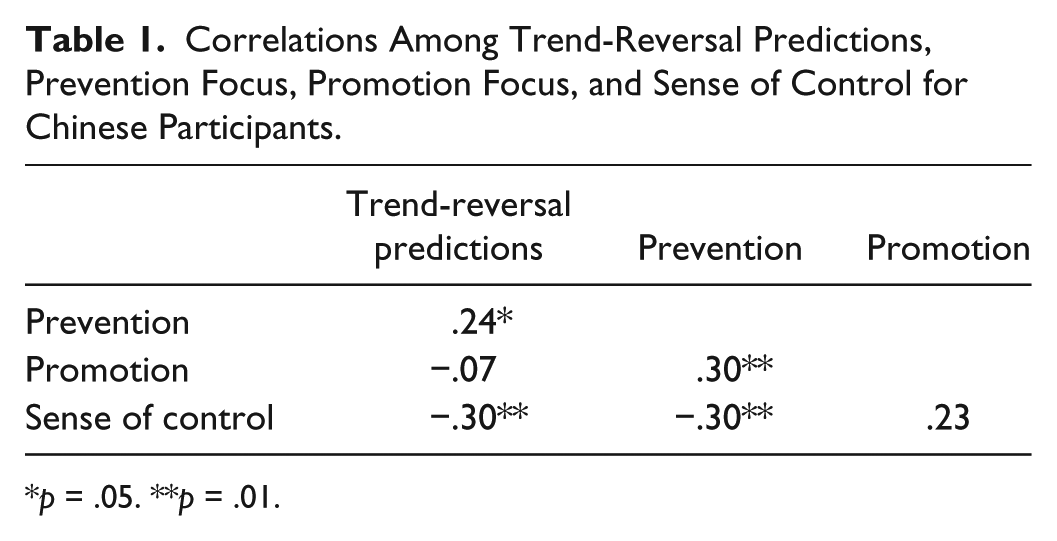
p = .05. **p = .01.
We proposed that individuals with higher prevention scores and lower promotion scores would have a lower sense of control, which in turn would predict more trend-reversal anticipations. Because the proposed model contains two predictors, promotion focus and prevention focus, the mediation analysis based on regressions was not appropriate (Iacobucci, Saldanha, & Deng, 2007). Therefore, structural equation modeling was conducted to test the model. Specifically, in the specified model, both promotion and prevention have a direct effect on sense of control, which in turn was allowed to have effect on trend-reversal anticipations. Promotion was allowed to relate to prevention and the error terms for the endogenous variables were set to free. Moreover, each latent variable was indicated by one single measured variable. The model fit the data well, normed fit index (NFI) = .93, incremental fit index (IFI) = 0.99, and root mean square error approximation (RMSEA) = .04. Figure 1 shows the results of the mediation model. The results showed that promotion focus positively related to prevention focus, β = .30, p = .01. More importantly, as expected, promotion focus positively predict sense of control, β = .35, p = .001. The more an individual chronically focused on promotion, the higher the sense of control the individual had. Prevention focus negatively predicted sense of control, β = −.41, p < .001. The more an individual chronically focused on prevention, the lower the sense of control the individual had. As expected, sense of control negatively predicted beliefs in trend-reversal developments, β = −.30, p = .01. The Monte Carlo bootstrapping analysis (Boot = 5,000) showed that the indirect effect of promotion focus on trend-reversal predictions through sense of control was significant, β = −.10, p = .01, 95% CI: −0.20 ≤ indirect effect ≤ −0.04. The indirect effect of prevention focus on trend-reversal predictions through sense of control was also significant, β = .12, p = .01, 95% CI: 0.04 ≤ indirect effect ≤ 0.23.

Sense of control mediated the impact of regulatory focus on trend-reversal predictions for Chinese participants.
Same as in Study 3, we tested the reversed model. Specifically, in the reversed model, both promotion and prevention were allowed to have effect on trend-reversal predictions, which in turn was allowed to have an effect on sense of control. Promotion was allowed to relate to prevention and the error terms for endogenous variables were set to free. The results showed that the reversed model fit the data poorly, NFI = .60, IFI = 0.64, and RMSEA = .27. Taken together, the results showed that regulatory focus predicted sense of control, which predicted trend-reversal anticipations.
Study 5
In Studies 1, 2, and 3, we found that when being induced to focus on prevention, people made more trend-reversal predictions than when being induced to focus on promotion. In Study 4, we found that chronic prevention focus led to less trend-reversal predictions, and the influence was mediated by sense of control. All the four studies were based on Chinese participants. To examine if regulatory focus relates to trend-reversal predictions for Westerners, in Study 5, we recruited a group of participants from the United States and measured their trend-reversal predictions, chronic regulatory focus, and sense of control. In addition, to increase our confidence in the findings, we adopted a different measure for regulatory focus. We explored how chronic regulatory focus might impacts trend-reversal predictions through sense of control for American participants.
Methods
Participants
An online questionnaire was created with Qualtrics and posted on www.mturk.com for this Study. To qualify for the study, participants had to be located in the United States. One hundred and fifty-one participants (61 males, 87 females, and 3 participants didn’t report any demographic information including gender) completed the questionnaire. The sample included 121 Caucasian Americans, 17 African Americans, 5 Asian Americans, 3 Latin Americans, and 2 of mixed ethnicity. Participants’ age ranged from 19 to 74 years, with a mean age of 40.01 years (SD = 14.28). Participants received a small monetary incentive for their participation.
Procedure
In the online questionnaire, after agreeing to participate in the study, participants were firstly instructed to complete the study by themselves with minimal distractions. They were instructed not to engage in any irrelevant activities and tasks. Then, to ensure participants completed the study seriously, they were asked to indicate (1) if they were a serious person who would complete the study in one sitting, and (2) if they were a responsible person who would follow the guide and complete the study carefully. Next, participants completed a trend-reversal prediction task, followed by a Sense of Control Scale (Lachman & Weaver, 1998) and a Regulatory Focus Scale (Higgins et al., 2001).
Trend-reversal predictions
The same trend-reversal prediction scenarios from Study 2 were adopted. Same as in Study 2, the two trend-continuity items were reverse coded and higher scores indicate higher trend-reversal predictions.
Sense of control
Participants completed the same Sense of Control Scale developed by Lachman and Weaver (1998) as in Study 3. Higher scores indicate higher sense of control.
Regulatory Focus Scale
Participants completed the regulatory focus measure developed by Higgins et al. (2001). The Regulatory Focus Scale contains 11 items and 2 dimensions: one dimension measures promotion focus (including six items) and the other measures prevention focus (including five items). Sample items in the promotion focus dimension include “Compared to most people, are you typically unable to get what you want out of life? (reverse coded),” and “How often have you accomplished things that got you ‘psyched’ to work even harder?” And sample items in the prevention focus dimension include “Not being careful enough has gotten me into trouble at times (reverse coded),” and “How often did you obey rules and regulations that were established by your parents?” Participants rated the items on a scale ranging from 1 (never or seldom) to 5 (very often).
Results and Discussion
All participants answered “yes” to the question of whether or not they were a responsible person who would follow the guide and complete the study carefully. All but one participant answered “yes” to the question of whether or not they were a serious person who would complete the study in one sitting. Data from all participants were included in the analysis and similar results were obtained when the participant who answered “no” to the one-sitting question was excluded from the analysis.
The trend-reversal predictions, the Prevention Focus subscale, the Promotion Focus subscale, and the Sense of Control Scale had acceptable reliabilities, α = .68, α = .65, α = .77, and α = .90, respectively. Thus, the mean score was calculated for each scale. See Table 2 for the correlations among these variables.
Correlations Among Trend-Reversal Predictions, Prevention Focus, Promotion Focus, and Sense of Control for American Participants.
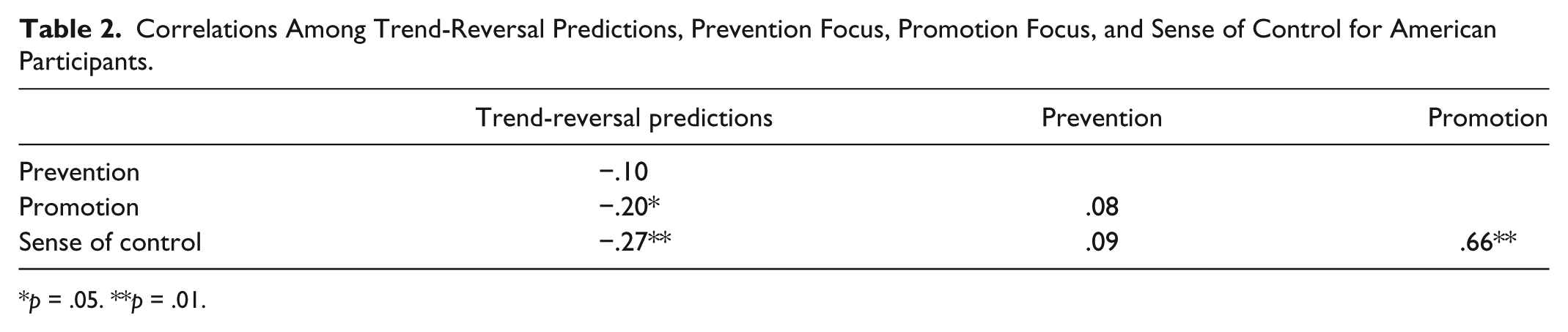
p = .05. **p = .01.
As in Study 4, structural equation modeling was conducted to test the proposed model. Specifically, both promotion and prevention were allowed to have direct effect on sense of control, which was allowed to have an effect on trend-reversal predictions. Promotion was allowed to relate to prevention and the error terms for endogenous variables were set to free. Moreover, each latent variable was indicated by one single measured variable. The model fit the data well, NFI = .99, IFI = 1.01, and RMSEA < .001. Figure 2 shows the results of the mediation model. The results showed that promotion focus did not relate to prevention focus, β = .08, p = .33. More importantly, as expected, promotion focus positively predicted sense of control, β = .66, p < .001. The more an individual chronically focused on promotion, the higher the sense of control the individual had. Prevention focus did not predict sense of control, β = .04, p = .53. Sense of control negatively predicted expectations for trend-reversal developments, β = −.27, p < .001. The Monte Carlo bootstrapping analysis (Boot = 5,000) showed that the indirect effect of promotion focus on trend-reversal predictions through sense of control was significant, β = −.18, p = .001, 95% CI: −0.26 ≤ indirect effect ≤ −0.09. The indirect effect of prevention focus on trend-reversal predictions through sense of control was not significant, β = −.01, p = .45.

Sense of control mediated the impact of promotion focus on trend-reversal predictions for American participants.
Same as in Study 4, we used structural equation modeling to test the reversed model. Specifically, in the reversed model, both promotion and prevention were allowed to have direct effect on trend-reversal predictions, which was allowed to have an effect on sense of control. Promotion was allowed to relate to prevention and the error terms for endogenous variables were set to free. The results showed that the reversed model fit the data poorly, NFI = .19, IFI = 0.20, and RMSEA = .51.
Taken together, the results showed that for American participants, chronic promotion focus had a negative influence on trend-reversal predictions through sense of control. Contradictory to the findings in Studies 2 and 4, prevention focus had no impacts on trend-reversal predictions. The influence of regulatory focus on trend-reversal predictions was mainly driven by promotion focus for American participants.
General Discussion
We proposed that compared with promotion focus, prevention focus would lead to more trend-reversal predictions, and that the influence would be mediated by sense of control. Five empirical studies provided converging evidence supporting the prediction. Specifically, Studies 1, 2, and 3 revealed that Chinese participants made more trend-reversal predictions on different hypothetical scenarios when they were induced to focus on prevention than when they were induced to focus on promotion. Studies 4 and 5 revealed that participants’ chronic regulatory focus predicted sense of control, which in turn predicted trend-reversal anticipations. Specifically, it was found that prevention focus predicted a low sense of control (Study 4), and promotion focus predicted a high sense of control (Studies 4 and 5). Furthermore, participants with a high sense of control expected trend-reversal developments were less likely to happen.
Comparing Studies 2, 4, and 5, we found that the influences of regulatory focus on trend-reversal predictions were different for Chinese participants compared with American participants. Promotion focus, not prevention focus, was uniquely related to trend-reversal predictions for American participants. Although the measures and manipulations of regulatory focus differed for the Chinese and American participants, this pattern of results suggested that compared to Chinese participants, Americans may tend to adopt promotion strategies in regulating themselves and may be affected more by promotion focus. Our findings are in the same vein as the findings by Lockwood et al. (2005). Further research is needed to assess the reasons for the cross-cultural differences.
Sense of control was found to mediate the impact of regulatory focus on trend-reversal predictions. In Studies 3, 4, and 5, we found that lower sense of control was associated with more trend-reversal predictions. It is important to note that we did not directly manipulate sense of control in the studies. The relationship between sense of control and trend-reversal predictions was therefore correlational in nature. To rule out alternative models, we tested the reversed model in the studies. Although we were not able to statistically determine which model was more plausible in Study 3, the reversed model fit the data poorly in Studies 4 and 5, suggesting the proposed model was more plausible than the reversed model. Furthermore, our proposed model is consistent with other findings that prolonged control deprivation leads to more trend-reversal predictions (Zhou et al., 2012). In one study, Zhou et al. found that prolonged control deprivation, which leads to low sense of control, can make people expect more trend-reversal changes. Similarly, Miyamoto and Ji (2011) showed that sense of agency hinders holistic thinking (Miyamoto & Ji, 2011), which includes trend-reversal predictions (Choi, Koo, & Choi, 2007). Thus we believe the proposed model is more plausible than the reversed one, and that it is very possible that sense of control influences trend-reversal predictions.
The research presented here has significant theoretical implications. Previous research has attributed cultural differences in predicting continuity versus reversals to historical differences in philosophy and thinking styles between the East and the West (e.g., Ji et al., 2001; Nisbett, 2003). Linear prediction is associated with analytical thinking and trend-reversal prediction is associated with holistic thinking (Choi et al., 2007). The current research has implied that regulatory focus might be a proximal factor accounting for the cultural differences in predicting trend continuity versus trend-reversal. Our findings could be a manifestation of analytical versus holistic thinking on the motivational dimension. Thus, the results of the present research provide us with a proximal cause and potential mechanism of cultural differences in predicting continuity and reversals, namely regulatory focus. Future studies can explore if such a mechanism accounts for the cross-cultural differences in predicting continuity and reversals or not.
The current research also has significant practical implications. It presents an approach to change one’s reasoning styles by influencing one’s regulatory focus and sense of control. Thus, it not only provides us with a more complete understanding about why cultural differences in future predictions may have occurred in the first place, but also offers us a potential way to influence people’s views about the future in a desirable way. For example, our research suggests that in the recent housing bubble where the price of housing increased rapidly, making people focus on prevention could make them more likely to predict that the bubble could burst and prices will go down in the future. As such, those without secure jobs may be less likely to foolishly apply for large mortgages that allow them to live beyond their means, and that could cause them to become bankrupt when rates change in the future. Similarly, campaigns to decrease incidences of binge drinking among young people who idealistically perceive that their current health will continue into the future could be more effective if such people were primed with a prevention focus before exposing them to messages about the effects of binge drinking on their future health. In the meantime, such knowledge can also raise awareness that people may be taken advantage of by someone who immorally uses such tactics to change others’ views about the future for their own personal gain. Furthermore, our views about the future should generally come from the knowledge we have regarding the topic, rather than regulatory focus. Altering one’s views of the future by manipulating one’s regulatory focus thus may backfire in the wrong situations. It is a double-edged sword.
Footnotes
Acknowledgements
The authors would like to thank Siyu Xu and Sut Wan Lam for their help with data collection.
Declaration of Conflicting Interests
The author(s) declared no potential conflicts of interest with respect to the research, authorship, and/or publication of this article.
Funding
The author(s) disclosed receipt of the following financial support for the research, authorship, and/or publication of this article: The research project received an internal multiple year research grant from University of Macau, China. The grant number is MYRG030(Y1-L1)-FSH13-GTY.

References
Supplementary Material
Please find the following supplemental material available below.
For Open Access articles published under a Creative Commons License, all supplemental material carries the same license as the article it is associated with.
For non-Open Access articles published, all supplemental material carries a non-exclusive license, and permission requests for re-use of supplemental material or any part of supplemental material shall be sent directly to the copyright owner as specified in the copyright notice associated with the article.
