




Abstract
Across three studies, we investigate men’s reactions to women in superior roles. Drawing from precarious manhood theory, we hypothesize that when a woman occupies a superior organizational role, men in subordinate positions experience threat, which leads them to behave more assertively toward her and advocate for themselves. In Studies 1 and 2, we demonstrate that men feel more threatened (relative to women) by women in superior roles (relative to men in superior roles) and, as a result, engage in more assertive behaviors toward these women. In Study 3, we investigate a boundary condition to this effect and demonstrate that a woman in a superior role who displays qualities associated with administrative agency (e.g., directness, proactivity) rather than ambitious agency (e.g., self-promotion, power-seeking) elicits less assertive behavior from men. We conclude by discussing implications as well as directions for future research.
There exists a general consensus that women are greatly underrepresented in positions of power in organizations in the United States. This consensus, however, is somewhat misleading; although the number of women who occupy executive positions in the upper rungs of the corporate ladder has tapered off around 14.6% in 2013 (Catalyst, 2013), women are represented almost at par with men in the lower and middle management positions (Bureau of Labor Statistics, 2013). This statistic suggests that it is therefore not uncommon for employees to have a female supervisor, and begs the question of how both male and female employees react to this situation. Most research into this question has focused on general attitudes and behaviors as they affect females in supervisory roles. What remains still to be more thoroughly investigated, however, is how having a female supervisor affects her subordinates, in terms of their experiences and behaviors.
In the current work, we focus mainly on male subordinates, as they have been shown to react especially negatively to female supervisors (for a review, see Eagly & Karau, 2002). We investigate whether men accept female supervision as readily as male supervision, or whether they experience working under a female superior as a threat. We draw from precarious manhood theory, which postulates that manhood is more easily threatened than womanhood and, as such, men “often feel compelled to demonstrate their manhood through action, particularly when being challenged” (Vandello, Bosson, Cohen, Burnaford, & Weaver, 2008, p. 1327). In the context of the current work, we propose that, to affirm their manhood, men act more assertively when interacting with women who occupy roles superior to their own.
Despite the progress made toward understanding the role that gender plays in interpersonal dynamics in everyday life and in organizations, the literature examining the fragility of manhood in the workplace and other settings is limited in a number of ways. First, although the literature generally accepts that threats to manhood lead to assertive behaviors, existing research tends to rely on a narrow range of threat manipulations. For example, providing men with feedback that they scored low on measures of masculinity (Vandello et al., 2008) or asking them to perform a stereotypically feminine task (Bosson, Vandello, Burnaford, Weaver, & Wasti, 2009; Weaver, Vandello, & Bosson, 2013) both have been shown to threaten men. However, it has yet to be established which behaviors enacted by women threaten men. Next, much of the research on precarious manhood has been conducted by merely manipulating gender threat with gender threatening feedback (e.g., Caswell, Bosson, Vandello, & Sellers, 2014; Vandello et al., 2008; Weaver et al., 2013). However, research has shown that some work-related challenges, such as the threat of job loss (e.g., Kimmel, 2006; Levant & Kopecky, 1995) or seeking out work flexibility (Vandello, Hettinger, Bosson, & Siddiqi, 2013), can also threaten manhood—given the centrality of work to normative masculinity. It is therefore important to identify a broad range of work-related situations that can threaten a man’s gender status. Third, previous research on precarious manhood has demonstrated that gender status threat leads to physical aggression (Vandello et al., 2008) and greater financial risk-taking (Weaver et al., 2013). However, a wider range of negative or positive interpersonal behaviors warrants investigation. Given that displays of physical aggression are rare in most workplaces, it is important to investigate how threats to manhood manifest when physical aggression is not an appropriate response. Finally, despite substantial strides made in elucidating ways in which female supervisors can minimize men’s negative reactions toward them—for example, by displaying communality (Heilman & Okimoto, 2007)—there remains more work to be done in this area if we are to provide practical solutions.
Providing these gaps, the current work makes a number of important contributions. First, we draw from precarious manhood theory (Vandello et al., 2008) to posit and empirically demonstrate that when a man is in a subordinate position to a woman, he experiences threat, behaves more assertively toward her, and advocates more strongly for himself. Whereas previous research has manipulated threats to masculinity by providing men with feedback that they are low on masculinity (a gender threat), we examine how threat could be elicited in an organizational context. Moreover, the current research distinguishes between status and gender plus status threats. We manipulate status threat by having a man play the role of a subordinate to a man, and a gender plus status threat by having a man play a role of a subordinate to a woman. As we demonstrate, a status threat by itself is not sufficient to elicit threat and subsequent negative reactions in men; instead, a woman in a higher position (a gender plus status threat) is necessary for manifestation of threat and negative reactions.
Next, rather than focusing on physical aggression as an outcome of having one’s manhood threatened, we investigate the more typical response of behaving assertively in negotiation and resource allocation contexts. Finally, we demonstrate that men’s negative reactions to women in supervisory positions are not inevitable. That is, to the extent that these women display administrative rather than ambitious agency, men experience less threat and engage in less assertive behavior. As such, we further contribute to both the precarious manhood and female leadership literatures by demonstrating how women occupying supervisory roles might temper the threat experienced by their male subordinates.
Precarious Manhood Theory as an Explanation for Men’s Assertive Behaviors Toward Female Superiors
Precarious manhood theory postulates that manhood is “elusive” and “tenuous” (Vandello & Bosson, 2013; Vandello et al., 2008, p. 1326. In other words, manhood is not something that is guaranteed to be achieved with age, nor is it guaranteed to remain. Instead, men must continuously prove their manhood. Support for this claim comes from both evolutionary theory, which suggests that displaying manhood through physical displays was adaptive by increasing reproductive success (e.g., Symons, 1995), and social role theory, which suggests that men who participated in physically demanding and dangerous labor achieved greater status (e.g., Eagly, 1987; Wood & Eagly, 2002). Vandello and Bosson (2013) further posited that “real men” hold an “anti-femininity mandate” (p. 102), which is developed when boys separate from and no longer rely on female caregivers (e.g., Freud, 1937; Horney, 1932), and requires avoidance of femininity to achieve manhood.
In the context of the current research, working under female supervision may be construed as a close association with femininity under the conditions of low autonomy and agency (Bem, 1974; Williams & Best, 1990), and could therefore undermine manhood and induce threat. In addition, research shows that societal norms proscribe men from working in a subordinate position unless their supervisor is someone truly deserving of the position (Connell, 1985, 1987). Because women are perceived as less suitable for leadership positions than men (Eagly & Karau, 2002), men might feel particularly inferior working in roles subordinate to women. Indeed, past research has demonstrated that observers conferred the lowest status and masculinity to a man when he worked under the supervision of a woman, compared with men and women working under the supervision of a man (Brescoll, Uhlmann, Moss-Racusin, & Sarnell, 2012). This provides initial support for the idea that men working under the supervision of women might also feel more threatened and less masculine than men working under the supervision of men.
Furthermore, previous studies have shown that a threat to male identity—occurring, for example, as a result of interacting with a highly educated feminist woman—has led men to derogate the female target via sexual harassment (Berdahl, 2007a, 2007b; Maass, Cadinu, Guarnieri, & Grasselli, 2003) and physical aggression (Bosson et al., 2009; Vandello et al., 2008). In the current work, we investigate behavioral responses among men that are likely more pervasive than overt aggression. We predict that a woman who occupies a superior role will elicit more assertive behavior from male subordinates and offer the following hypotheses:
As an important feature of the current research, we sought to investigate factors that might mitigate the tendency of men to experience threat and behave assertively toward women occupying supervisory roles. Previous research suggests that negative reactions are elicited in response to female leaders due to the widespread belief that leaders must necessarily possess attributes such as competitiveness, self-confidence, objectiveness, aggressiveness, and ambitiousness (Schein, 1975, 2001). These leader attributes, though welcomed in a male, are inconsistent with prescriptive female stereotypes of warmth and communality (Rudman, Moss-Racusin, Phelan, & Nauts, 2012). The ideal woman is not perceived as having what it takes for a leadership role. As such, women who have been successful in achieving leadership roles are perceived as more masculine, and this violation of the female gender role elicits backlash (Eagly & Karau, 2002). Indeed, research suggests that the mere indication that a female leader is successful in her position leads to increased ratings of her selfishness, deceitfulness, and coldness (Heilman, Block, & Martell, 1995; Heilman, Block, Martell, & Simon, 1989; Heilman, Wallen, Fuchs, & Tamkins, 2004). Furthermore, the fact that women are penalized only when they have success in a male arena and not in a female arena (Heilman et al., 2004) suggests that it is not their success per se that leads to these negative evaluations (e.g., the status threat), but rather the threat that such success poses to men’s superior position in the gender hierarchy.
Previous research has shown that one way to circumvent the backlash directed at an agentic woman is to provide additional information about her communality. For example, Heilman and Okimoto (2007) have shown that the provision of information about the caring, sensitive, and supportive nature of an agentic woman precludes negative reactions. In addition, Parks-Stamm, Heilman, and Hearns (2008) found that when participants are provided with information to suggest that a female vice-president is very communal, backlash is prevented. In the current article, we contribute to this literature by investigating another way to counter men’s negative reactions to agentic women. We draw from the work of Livingston and colleagues, who distinguished between administrative agency (e.g., proactivity, directness) and ambitious agency (e.g., self-promotion, power-seeking) to propose that the preconceptions about the traits embodied by agentic women could be eliminated with the provision of information that depicts agentic women as less threatening to the manhood of their male subordinates (Hall et al., 2012; Livingston & Washington, 2013).
Precarious manhood theory (Vandello & Bosson, 2013) suggests that to maintain the precarious status of a real man, men must meet two conditions: (a) they must possess agency and have the freedom to act according to their will (e.g., Bem, 1974; Williams & Best, 1990) and (b) they must eschew all traces of femininity from their behaviors (Brannon & David, 1976; Doyle, 1989). To the extent that a female manager is observed—or known—to display traits associated with ambitious agency (e.g., Wood & Eagly, 2010), she effectively positions herself as equal to men in the status hierarchy, thereby competing with him for status. To the extent that she succeeds, a man is left without agency and freedom to act and is downgraded to a traditionally female, passive follower role. By preventing a man from meeting either of the above conditions, an ambitiously agentic female manager is emasculating, and will thus elicit threat and assertive behavior from men. By contrast, when a female manager is observed, or has been known, to display traits associated with administrative agency—which are not at odds with male agency and action—we would not expect feelings of threat and assertive behavior to follow. Accordingly, we make the following prediction:
Study 1
In Study 1, we test whether a man’s assertive behavior toward a female superior is a function of feelings of threat. We investigate this behavior in the context of a negotiation, wherein assertive behavior is a result of adopting value-claiming negotiation strategies that focus on oneself rather than the opponent, and help one acquire more rewards in distributive negotiations (Raiffa, 1982). We also investigate the role of implicit threat as a mediator. We chose to focus on implicit rather than explicit threat because Vandello and colleagues (2008) argued that admitting anxiety and threat in itself “might constitute a challenge to a man’s manhood status” (p. 1332).
Method
Participants and design
Seventy-six students (52 men, 24 women) participated in the study for course credit. Their mean age was 23.1 years (SD = 3.7). We employed a 2 (gender of participant) × 2 (gender of the negotiation partner) between-subjects factorial design.
Procedure
Upon arrival, participants were seated in front of computers located in separate cubicles. In a computerized negotiation adapted from Amanatullah and Morris (2010), participants were led to believe that they were negotiating with another randomly selected participant when, in reality, they were negotiating with a computer-simulated partner.
All participants were assigned the role of a job recruit in the negotiation and the partner played the role of the hiring manager. They were told, however, that their role was assigned to them on the basis of their performance on a test assessing their managerial ability, which was comprised of several Graduate Record Examination (GRE) questions (although the role of a job recruit was assigned to them regardless of their performance). Participants were then randomly assigned to one of two conditions. In one, participants were told that they would be negotiating their salary with a female hiring manager (Sarah), whereas in the other, they were told that they would negotiate with a male hiring manager (David). These names were selected because they appeared in the list of top 25 most popular names during the past 100 years (Social Security, 2014).
Given that previous research has shown that the names used in scenario studies can be sources of confounds (e.g., Kasof, 1993), we pretested our selected names to ensure that they differed only on gender and not on perceived ability or age. Our dependent variable measures were comprised of eight ability items (e.g., logical, organized, α = .70) taken from Goodwin, Piazza, and Rozin (2014), as well as three stereotypically male attributes (assertive, career-oriented, aggressive, α = .66) and three stereotypically female attributes (warm, emotional, interested in children, α = .68) taken from Rudman and colleagues (2012). We also asked participants to indicate the extent to which, without meeting this manager, a typical person would believe the manager is an older adult. Sixty adults (33 men and 27 women) from the United States completed the study on Amazon’s Mechanical Turk website in exchange for US$0.25. The results of this pretest revealed that participants did not believe that a typical subordinate would associate a manager named David with higher levels of ability (M = 4.38, SD = 0.73) than a manager named Sarah (M = 4.45, SD = 0.60), t(58) = .47, p = .64. Moreover, participants associated Sarah with more stereotypically female attributes (M = 4.33, SD = 1.05) than David (M = 3.71, SD = 0.86), t(58) = 2.49, p = .016, and David with more stereotypically male attributes (M = 4.91, SD = 0.82) than Sarah (M = 4.26, SD = 0.98), t(58) = −2.78, p = .007. The perceived age of the manager was not significantly different between David (M = 3. 86, SD = 1.19) and Sarah (M = 3.45, SD = 1.43), t(58) = 1.20, p = .23. The results of this pretest confirmed that the two names we selected manipulated gender but not perceived competence or age.
Participants in the primary study began the negotiation after being provided with their role information. The negotiation started with an opening salary offer ($28,500) from the hiring manger, David or Sarah. Participants were then given the option to either accept or decline this offer. If a participant chose to accept, the negotiation was terminated. If a participant chose to decline, he or she was then asked to provide a numerical counteroffer. Participants were told that their counteroffers were being shared with the hiring manager, who would be given an opportunity to respond. If participants chose to provide yet another counteroffer, the negotiation could have been potentially continued for up to five rounds. Following the analytic procedure of Amanatullah and Morris (2010), we used the counteroffer in Round 1 (the reaction to the hiring manager’s opening offer) as the primary dependent variable. 1
After the negotiation, participants were asked to complete an implicit threat measure (DeMarree, Wheeler, & Petty, 2005; Kouchaki & Desai, 2015), where participants were asked to guess which word appeared on the screen for only a fraction of a second but then was covered by a string of random characters. Participants were presented with six trials, half of which were target trials, in which one of the four response options was a threat-related word (e.g., threat, risk). The order and position of threat-related words were randomized. Scores on implicit threat measure were computed by summing the number of threat-related words selected (a number between 0 and 3), with higher scores indicating stronger implicit threat.
Finally, participants were directed to a survey that contained demographic questions, as well as a manipulation check. For the manipulation check, we asked participants to type in the name and indicate the gender of their negotiation partner.
Results
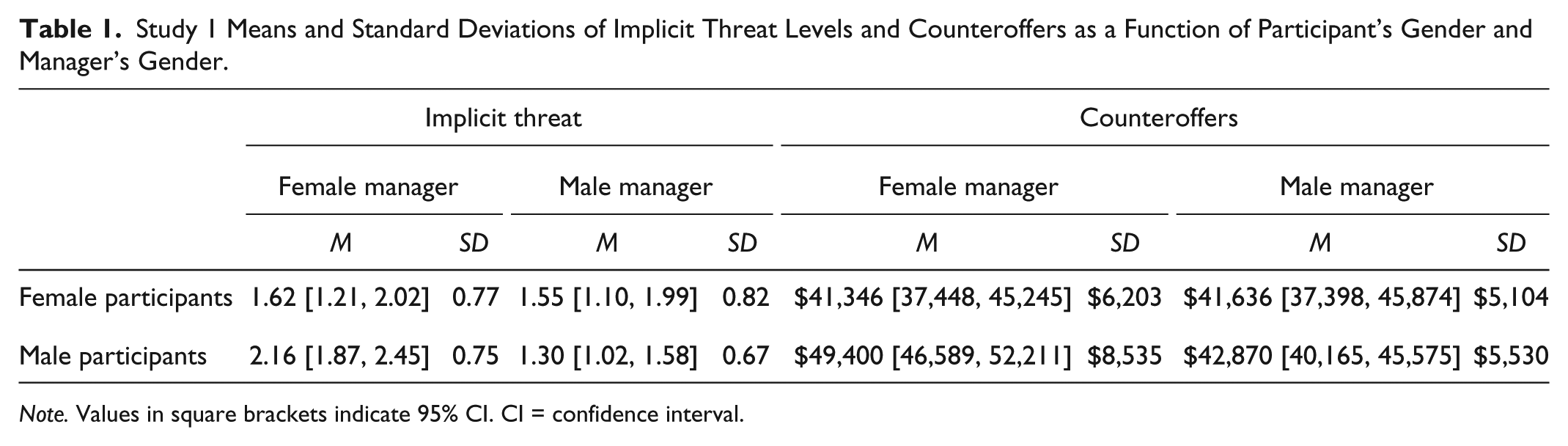
All of the participants correctly recalled the name and gender of their negotiation partner, so we included all participants in the subsequent analysis. A 2 (manager’s gender) × 2 (participant’s gender) between-subjects ANOVA revealed a significant main effect of manager’s gender, F(1, 72) = 6.61, p = .012,
Study 1 Means and Standard Deviations of Implicit Threat Levels and Counteroffers as a Function of Participant’s Gender and Manager’s Gender.
Note. Values in square brackets indicate 95% CI. CI = confidence interval.
Next, we conducted a 2 × 2 between-subjects ANOVA on the Round 1 counteroffer. None of the participants accepted the offer in the first round. The analysis revealed a significant main effect of participant’s gender, F(1, 72) = 7.09, p = .01,
We next investigated whether implicit threat mediated the relationship between manager’s gender and salary counteroffer. We used the bootstrapping approach outlined by Preacher, Rucker, and Hayes (2007) and the statistical software of Hayes (2013) to test for the conditional indirect effect (with 5,000 resamples). We tested a model in which manager’s gender was designated as the independent variable, threat was the mediator, counteroffer was the dependent variable, and participant’s gender was a moderator of the path from manager’s gender to implicit threat. In support of Hypothesis 2, the results suggested that for male participants, threat fully mediated the relationship between manager’s gender and counteroffer (indirect effect = 2,529.40, SE = 1,337.58, 95% confidence interval [CI] = [533.44, 6,022.63]). For female participants, however, bootstrapping yielded no evidence of mediation (indirect effect = 204.80, SE = 1,021.11, 95% CI = [−1,757.03, 2,486.85]).
Discussion
The results of Study 1 indicated that when men negotiated with a female hiring manager, they responded with more assertive counteroffers. Moreover, this effect was mediated by implicit threat. Notably, the fact that the negotiation in this study was not zero-sum (higher counteroffers were not harmful to the female manager personally) suggests that men’s reactions were related to self-assertion rather than backlash. The gender of the hiring manager neither affected the counteroffers that female participants made, nor their threat scores.
Although these findings provide support for the notion that men experience threat and behave more assertively when interacting with female managers, alternative explanations are possible. For example, it is not implausible that men experience threat when engaging in any type of negotiation task with women, regardless of whether these women hold formal power. Negotiating with a woman might elicit threat in men regardless of her position because a woman who engages in the very act of negotiation is violating stereotypes that prescribe warm and cooperative behavior (Eagly, 1987) by participating in a masculine and competitive activity (Bowles, Babcock, & Lai, 2007). It could also be that rather than experiencing threat to their manhood, male participants reacted with assertive behavior because they expect women to be submissive in negotiation contexts—an expectation that would make it easier for them to push and exploit (e.g., Broverman, Vogel, Broverman, Clarkson, & Rosenkrantz, 1972; Spence & Sawin, 1985).
To rule out these alternative explanations, Study 2 was designed to investigate men’s reactions to partners who occupied either the same or a more powerful position than themselves. In addition, this time we used a zero-sum negotiation scenario. By creating a situation wherein participants who negotiate more assertively can leave their negotiation partners at a disadvantage, we could assess the degree to which female superiors elicit self-assertion from male subordinates, even in situations when female managers will be harmed.
Study 2
In Study 2, we investigated the notion that threat and self-assertion are elicited primarily when men negotiate with a female superior (e.g., team leader) rather than when they negotiate with a woman occupying a position at the same level as themselves (e.g., team member).
Method
Participants and design
Sixty-eight male students participated in the study for course credit. Their mean age was 24.8 years (SD = 5.6). We employed a 2 (gender of the colleague) × 2 (position of the colleague: coworker vs. team leader) between-subjects factorial design.
Procedure
Participants were provided with a scenario in which they were asked to imagine that they worked in a marketing department in an organization. Recently, they had completed an important project for their department with another employee and, as such, upper management in the department had allocated a $10,000 bonus to be split between themselves and their colleague. After imagining themselves in this scenario, participants were randomly assigned to one of four conditions. The hypothetical colleague was either (a) a female team member working at the same organizational level as the participant, (b) a male team member working at the same organizational level as the participant, (c) a female team leader, or (d) a male team leader. As in Study 1, the female colleague’s name was Sarah and the male colleague’s name was David.
After participants read the scenario, they were instructed to complete the same implicit threat measure used in Study 1. Next, participants were asked to indicate how much of the $10,000 bonus they would propose to their colleague that they wanted to keep for themselves. This question was followed by manipulation checks that asked them to indicate the name, gender, and organizational level occupied by their hypothetical colleague. Finally, participants provided their demographic information.
Results
All participants correctly recalled the name, position, and gender of the person with whom they communicated in the scenario. A 2 (colleague’s gender) × 2 (colleague’s position) between-subjects ANOVA revealed a marginally significant main effect of manager’s position, F(1, 64) = 2.84, p = .097,
Study 2 Means and Standard Deviations of Men’s Implicit Threat Levels and Bonus Amount Kept for Themselves as a Function of Target Gender and Target Type.

Note. Values in square brackets indicate 95% CI. CI = confidence interval.
To further test our predictions, we conducted a 2 × 2 ANOVA on the amount of the bonus male participants proposed that they keep for themselves. The analysis revealed a significant main effect of colleague’s position, F(1, 64) = 9.18; p = .004,
Supporting Hypothesis 1, we found a significant interaction between colleague’s gender and colleague’s position, F(1, 64) = 4.23, p = .04,
We used bootstrapping approach to test the role of threat in the moderated mediation (Hypothesis 2). We tested a model in which colleague’s gender was designated as the independent variable, implicit threat as the mediator, one’s own portion of the bonus as the dependent variable, and colleague’s position as a moderator of the path from colleague’s gender to implicit threat.
Supporting Hypothesis 2, the analysis with 5,000 iterations suggested that for participants negotiating with a team leader, implicit threat fully mediated the relationship between colleague’s gender and their proposal (indirect effect = −62.98, SE = 46.58, 95% CI = [−206.03, −6.91]). The nature of mediation was such that male participants experienced greater threat in response to a female team leader, and this led them to provide themselves with a larger portion of the bonus. For those participants paired with a team member, the analysis yielded no evidence of mediation of implicit threat (indirect effect = 25.03, SE = 37.79, 95% CI = [−17.51, 150.36]).
Discussion
Study 2 provided a constructive replication of Study 1. We found that when participating in a zero-sum resource allocation task with a female superior, participants kept larger sums of bonus money for themselves than participants who participated in the same task with male superiors, and relative to participants who participated in this task with women who were at equal standing to themselves. As in Study 1, we found that this effect was mediated by threat, and therefore found more support for Hypotheses 1 and 2.
Importantly, we ruled out two alternative explanations for our findings—one that would argue that men negotiated more assertively toward their female negotiation partner as a way of penalizing them for violating prescriptive stereotypes, and the other that would argue that men’s self-assertion was a result of them believing that women would be submissive in negotiation. When male participants were splitting the money with a team member (someone at the same organizational level), regardless of the team member’s gender, the amounts they proposed to keep for themselves were similar to the amounts they offered, presumably because there is no rational reason why one team member deserves more money than another team member. In essence, our participants behaved on a principle of fairness when negotiating with team members. Meanwhile, our male participants clearly felt that the male team leader was deserving of a larger portion of the bonus than a team member because of his higher position, and this was reflected in their offers. However, when presented with a female team leader, male participants displayed higher levels of implicit threat, which led them to offer her essentially the same amount as what was offered to team members. In short, men negotiating with a female team leader engaged in assertive behaviors that stemmed from feelings of threat, rather than from the motivation to penalize a woman for violating prescriptive expectations or from the belief that she could be exploited. Importantly, we found that men self-asserted more when paired with a female manager even in a situation when the self-assertion directly harmed her outcomes.
Study 3
Having now shown that a female manager elicits threat and assertive behavior from her male subordinates (Studies 1 and 2), Study 3 examined what might temper feelings of threat. Drawing upon the work of Livingston and Washington (2013), we compared the threat elicited in men by a female team leader displaying administrative agency versus ambitious agency.
In this study, we used the same zero-sum resource allocation task as we did in Study 2 but to test our prediction that an ambitious female leader is more threat-inducing than an administrative female leader, we provided additional information about the leader that was adapted from Livingston and Washington (2013). In the ambitious agency condition, participants read that Sarah is committed to climbing the corporate ladder, striving to reach the top and is tireless in her determination. She often takes on projects that have allowed her to stand out and distinguish herself from others. In general, she is more comfortable with a high level of power and authority than other individuals in the group.
In the administrative agency condition, participants read that Sarah is committed to getting the task done. In general, she manages projects effectively and carries out projects that are important to the functioning and efficiency of the organization. As the head of the team, she delegates responsibility to the other individuals in the group, and oversees projects from start to finish.
We conducted a pretest to justify our assumption that a female team leader’s ambitious behaviors are viewed as emasculating both by men and by women, and therefore capable of threatening manhood. Eighty-seven (47 men and 40 women) adults from the United States completed the study on Amazon’s Mechanical Turk website in exchange for US$0.25. Participants were presented with both versions of a female team leader profile (administrative and ambitious) in random order, and after each profile they were asked to indicate “how a typical man would feel if he was working under the team leader (Sarah) described in the scenario.” We included five items: emasculated, threatened, his ego is hurt, not a real man, his manhood is taken away (α = .92). Consistent with our prediction, a repeated-measure analysis with the emasculation rating for the ambitious and administrative female team leader included as the within-participant factor, and the gender of the participant included as the between-participant factor revealed a main effect of type of team leader, F(1, 85) = 23.20, p < .001, with no gender effect (p = .51). That is, both men and women viewed ambitious agency (M = 3.78, SD = 1.40) as more emasculating than administrative agency (M = 3.26, SD = 1.50).
To further ensure that these two types of agencies were different only on perceived agency and not actual or perceived power, we conducted another pretest study with 82 (42 men and 40 women) adults from the United States recruited through Amazon’s Mechanical Turk website in exchange for US$0.25. These participants read one of the two previously used descriptions of a team leader named Sarah: ambitiously or administratively agentic. Afterward, we asked participants to indicate how Sarah would be viewed by a typical subordinate. We measured perceived power with eight items (e.g., Sarah can make her subordinates listen to what she says, α = .90; Anderson, John, & Keltner, 2012). Actual power was measured with four items (e.g., Sarah can provide her subordinates with material resources such as money and economic opportunity, α = .64; Keltner, Gruenfeld, & Anderson, 2003). Legitimacy was measured with three items (e.g., Sarah has the right to evaluate her subordinates’ decisions, α = .71; van der Toorn, Tyler, & Jost, 2011). We also measured perceived agency with four items that are female proscriptions (dominating, arrogant, aggressive, intimidating; α = .71) and four items that are male prescriptions (ambitious, aggressive, competitive, assertive; α = .74) taken from Rudman and colleagues (2012).
We found that participants believed that a typical subordinate working under the ambitiously (vs. administratively) agentic leader would view her as having similar levels of actual power (M = 4.78, SD = 0.98 vs. M = 4.74, SD = 0.92), t(80) = .23, p = .82, and perceived power (M = 5.90, SD = 0.70 vs. M = 5.75, SD = .78), t(80) = .96, p = .34. However, the perceived legitimacy of the leaders differed, such that the ambitious female leader was perceived as less legitimate (M = 5.09, SD = 0.78) than the administrative female leader (M = 5.42, SD = 0.69), t(80) = 2.01, p = .048. Moreover, the ambitious female leader was rated higher than the administrative female leader on both female proscriptions (M = 4.73, SD = 0.82 vs. M = 4.29, SD = 0.83), t(80) = 2.41, p = .018, and male prescriptions (M = 6.02, SD = 0.61 vs. M = 5.37, SD = 0.82), t(80) = 4.08, p < .001. These results suggest that a typical subordinate views both types of female leaders as equally powerful supervisors, though the ambitiously agentic female leader is perceived as more agentic (on both female proscriptions and male prescriptions) and less legitimate.
Method
Participants and design
Three hundred seventy (226 men and 144 women) adults from the United States completed the study on Amazon’s Mechanical Turk website in exchange for US$0.50. Respondents were, on average, 30.6 years old (SD = 10.5). We employed a 2 (gender of participant) × 2 (gender of team leader) × 2 (type of agency: administrative vs. ambitious) between-subjects factorial design in this study.
Procedure
The procedure and stimulus materials were identical to those of Study 2, except this time included the manipulation of agency described in the pilot study. Participants were asked to imagine that they worked in an organization and that they had to split a $10,000 bonus between themselves and their team leader. Participants were randomly assigned to one of four conditions, where they were presented with the hypothetical team leader who was either (a) a female high on administrative agency, (b) a male high on administrative agency, (c) a female high on ambitious agency, or (d) a male high on ambitious agency.
The type of additional information provided about the team leader was manipulated as described in the pretest. After responding to the question of how much of the $10,000 bonus they would propose to their colleague that they want for themselves (serving as the dependent variable), participants answered a few manipulation check questions. Specifically, to ensure that our manipulation did not influence the perceived competence of the team leaders, we asked participants to rate the leader on the following competence-related items: capable, efficiency, organized, and skillful (α = .93; Cuddy, Fiske, & Glick, 2004). In addition, we asked participants to indicate the gender of their hypothetical team leader. At the end, participants completed a short demographic questionnaire.
Results
Four participants did not correctly recall the gender of the person with whom they interacted in the scenario and were excluded from the analyses. ANOVA indicated no significant effects in competence perceptions as a function of agency information (Mambitious = 6.07, SD = 0.86 vs. Madministrative = 6.14, SD = 0.80), F(1, 364) = .67, p = .41. Female participants generally provided higher ratings of the targets on competence (Mfemale = 6.39, SD = 0.68 vs. Mmale = 5.93, SD = 0.87), F(1, 364) = 28.29, p < .001. There were no other significant main or interaction effects.
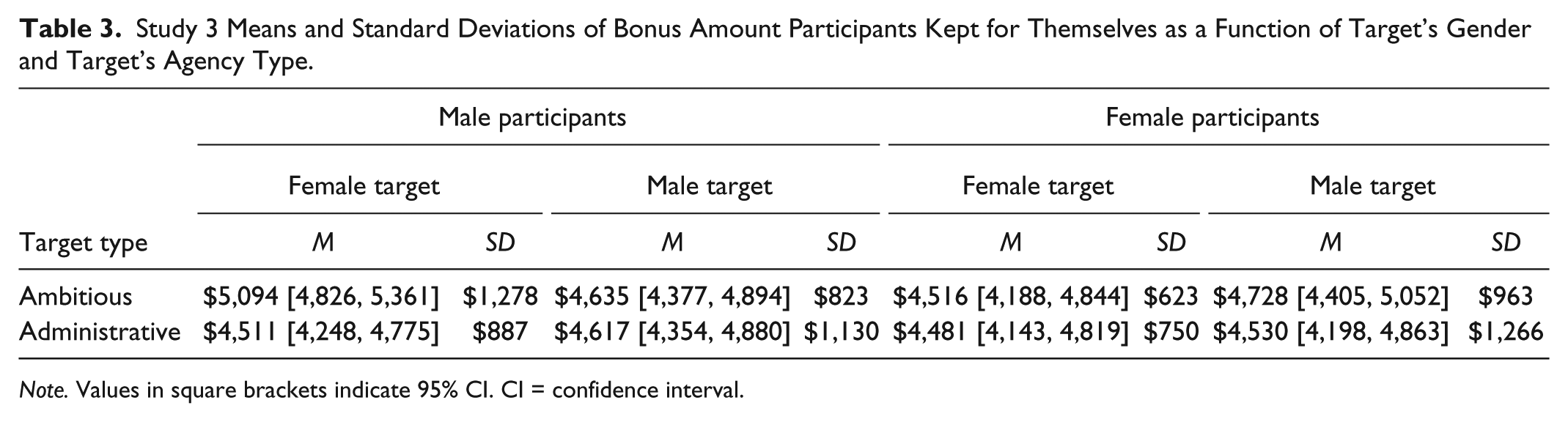
Data were analyzed using a 2 (gender of team leader) × 2 (type of agency) × 2 (participant’s gender) ANOVA—with the dependent variable being the amount of the bonus that participants proposed that they keep for themselves. There was a main effect of type of agency, F(1, 358) = 3.76, p = .05,

Mean amount of bonus participants proposed to keep for self by team leader’s gender, applicant’s gender, and type of team leader agency in Study 3 (three-way interaction).
To further test our predictions, we examined the two-way interaction of gender of leader and type of agency separately for male and female participants. For male participants, the 2 (gender of team leader) × 2 (type of agency) ANOVA revealed a significant two-way interaction, F(1, 220) = 4.10, p = .044,
Study 3 Means and Standard Deviations of Bonus Amount Participants Kept for Themselves as a Function of Target’s Gender and Target’s Agency Type.
Note. Values in square brackets indicate 95% CI. CI = confidence interval.
Discussion
In Study 3, we demonstrated that not all agentic women elicit self-assertive behaviors in men. Indeed, to the extent that female leaders display qualities associated with administrative rather than ambitious agency, men act less assertively toward them. Study 3 also ruled out an alternative explanation for the findings of Study 1—that men behave more assertively because they assume their female negotiation partner will acquiesce. We demonstrated that men act more assertively toward an ambitious female leader, whose profile suggested that she would likely fight harder for her share of money than the administrative female leader.
General Discussion
Contributing to and extending prior research that suggests manhood is more easily threatened than womanhood (e.g., Vandello et al., 2008), the current research demonstrates that working with a woman who holds more status and/or power might serve as a threat to manhood. In a set of three studies, we demonstrated that men responded to a woman occupying a supervisory position with greater feelings of threat and more assertive behaviors, both of which are ways of protecting and boosting one’s masculinity. Importantly, we were able to separate status threats from gender plus status threats to conclude that a status threat by itself is not sufficient to trigger feelings of threat and subsequent self-assertive behavior. Instead, as we demonstrated in Study 2, a gender plus status threat is required to elicit these responses.
It is important to note how the current findings compared with those of the backlash literature (Eagly & Karau, 2002; Parks-Stamm et al., 2008; Rudman, 1998; Rudman et al., 2012), which has demonstrated that negative reactions to female leaders are elicited in both men and women. Unlike most of this research, we found significant effects only for men. This discrepancy, however, is likely explained by the differential ways in which negative reactions were operationalized. It is likely that both men and women hold negative perceptions about female leaders; however for men, these negative perceptions are likely accompanied by feelings of threat, as we have shown in our studies. For women, meanwhile, these negative perceptions likely arise simply from viewing masculine women as violating feminine prescriptions, and therefore need not elicit assertive behaviors. Moreover, the existing research on backlash primarily shows that negative evaluations of an agentic woman are a form of penalization for violating prescriptive stereotypes, whereas our results demonstrate that such reactions could also stem from men feeling that having a female superior threatens their manhood.
In Study 3, the results that emerged from the ambitious agency condition were similar in direction and significance to effects we found in Studies 1 and 2, wherein no information about the agency of the female superior was provided. This suggests that without additional information, male participants automatically assumed that the female hiring manager (Study 1) and team leader (Study 2) necessarily possessed the attributes associated with ambitious agency. However, as Study 3 demonstrates, self-assertive behavior can be attenuated to the extent that female superiors showcase qualities associated with administrative rather than ambitious agency. This finding contributes to a nascent literature that investigates tools women might utilize to reduce negative reactions toward them. For example, Heilman and Okimoto (2007) showed that by emphasizing their motherhood status, women were able to mitigate negative responses associated with their work-related status. Our findings suggest that the display of communal characteristics (via warmth or motherhood) is not necessary to circumvent these reactions from men. This is especially encouraging, as demonstrating communality is associated with its own set of negative perceptions in the workplace, such as perceived incompetence (Correll, Benard, & Paik, 2007). As such, our results suggest that women might be best advised to emphasize their administrative agency rather than their communality.
Although the current research makes important contributions to our overall understanding of the backlash effect and women’s underrepresentation in leadership roles, it is not without limitations. Provided that our implicit measure of threat was not specific to masculinity, it could be that threat resulted from psychological processes other than perceptions of emasculation, such as a desire to protect the gender status quo or hostile sexism. In the case of the former, however, we would have expected to find increased levels of threat in female subordinates toward female superiors, which we did not. In the case of the latter, random assignment diminished the possibility that male participants in the female superior condition were higher on hostile sexism relative to the other conditions. As such, we are confident that the threat levels evidenced in our studies were most likely the result of threats to masculinity. However, future studies are necessary to further distinguish this type of threat from others.
Although we have ruled out a number of alternative explanations across our studies, there are additional ones that we were unable to disconfirm. For example, it is possible that men perceive the power of a female superior as more illegitimate or unjustified, relative to a male superior (Jost & Kay, 2005). This belief might, in turn, have provided male participants with what they viewed as an opportunity to increase their power by asserting themselves. It is also possible that both men and women perceived the power of a female superior as undeserved, but as men should be somewhat more concerned with achieving power than women (Konrad, Ritchie, Lieb, & Corrigall, 2000), perhaps they perceived the situation as more of an opportunity to achieve power relative to their female counterparts. Consistent with this notion, research has shown that perceptions of illegitimate power in superiors elicit more approach-oriented behavior in subordinates and motivate them to pursue their goals (Willis, Guinote, & Rodríguez-Bailón, 2010). As such, this explanation would suggest that assertiveness is a reflection of the motivation to gain power when working under a woman who is seen as holding power undeservingly. To eliminate this alternative explanation, future research should measure the perceived deservingness of the female superior and test a three-step causal chain.
In addition to addressing these limitations, our hope is that future research will build on the current findings. As one possible direction, we would like to see more research into factors that temper or exacerbate threats to masculinity. For example, perhaps providing information about female superiors’ high levels of generosity, competence, and productivity could mitigate the backlash effect, while also preventing a communality penalty. Meanwhile, men’s individual differences and life experiences, such as having a stay-at-home wife (Desai, Chugh, & Brief, 2014), might serve as threat-exacerbating variables. As an extension to Studies 2 and 3, it would also be interesting to investigate whether putting a male participant in the role of an adviser to a friend—male or female—who needs to negotiate with a woman also elicits responses of threat. To the extent that the recommendations given to a female friend entail less assertive behaviors than those given to a male friend, this would lend further credence to the precarious manhood theory.
Finally, future research should investigate the potential moderating role of gender stratification in men’s reactions to female superiors. It would be interesting to explore what happens when men engage in simulated negotiations with female leaders in hypothetical organizations that have a higher-than-average proportion of female leaders. On one hand, having more women in positions of power may create more threat because this challenges the status quo to a greater degree (Maass et al., 2003). On the other hand, having more women in positions of power might normalize it, thereby minimizing the salience of any given female manager.
It is our hope that the current research contributes to the literature and inspires future research into the nature of female leadership, the backlash effect, and precarious manhood. With a more comprehensive understanding of how female leaders are perceived and reacted to by subordinates, management researchers will be in a better position to help women understand and mitigate their male subordinates’ reactions and behaviors.
Footnotes
Authors’ Note
The first two authors contributed equally to the manuscript.
Declaration of Conflicting Interests
The author(s) declared no potential conflicts of interest with respect to the research, authorship, and/or publication of this article.
Funding
The author(s) received no financial support for the research, authorship, and/or publication of this article.

Notes
References
Supplementary Material
Please find the following supplemental material available below.
For Open Access articles published under a Creative Commons License, all supplemental material carries the same license as the article it is associated with.
For non-Open Access articles published, all supplemental material carries a non-exclusive license, and permission requests for re-use of supplemental material or any part of supplemental material shall be sent directly to the copyright owner as specified in the copyright notice associated with the article.
